Oral Tirzepatide FDA Status & Alternatives (2026)
No FDA-approved oral tirzepatide exists. Learn why, what happened to compounded drops, and your actual options for needle-free GLP-1 weight loss treatment including the new Wegovy pill and upcoming orforglipron.
For informational purposes only—not medical advice.
Disclosure: This page contains affiliate links to telehealth providers. If you make a purchase through these links, we may earn a commission at no additional cost to you. See our advertising disclosure for details.
We wrote this guide because the search results for "oral tirzepatide" are a mess. Some pages are selling products that are no longer permitted to be sold through routine compounding. Others say "it doesn't exist" but don't help you figure out what to do instead. And almost none of them mention that the Wegovy pill just got approved last month.
- Is oral tirzepatide real or FDA-approved?
- What happened to the compounded drops and tablets?
- What are your actual options if you want a pill?
- How do you spot unsafe products?
- What does everything cost?
- What should you do next?
The Quick Answer
No FDA-approved oral tirzepatide exists.
The only FDA-approved tirzepatide products are Mounjaro (for type 2 diabetes) and Zepbound (for weight loss)—both are weekly injections, not pills.
If you've seen "oral tirzepatide drops" or "tirzepatide tablets" advertised online, those were compounded products. When the FDA determined the tirzepatide shortage was resolved, it ended the temporary compounding flexibility and set enforcement wind-down dates. As a result, routine compounding of tirzepatide copies is no longer permitted outside narrow, patient-specific exceptions.
But here's the good news:
If you want a needle-free GLP-1 for weight loss, the FDA approved the Wegovy pill (oral semaglutide 25mg) on December 22, 2025. It launched in January 2026 with NovoCare cash-pay pricing at $149/month for 1.5mg and 4mg doses (4mg price valid through August 31, 2026, then $199/month), and $299/month for 9mg and 25mg maintenance doses. There are also other options we'll cover below.
Reality Check: What Actually Exists vs. What's Claimed
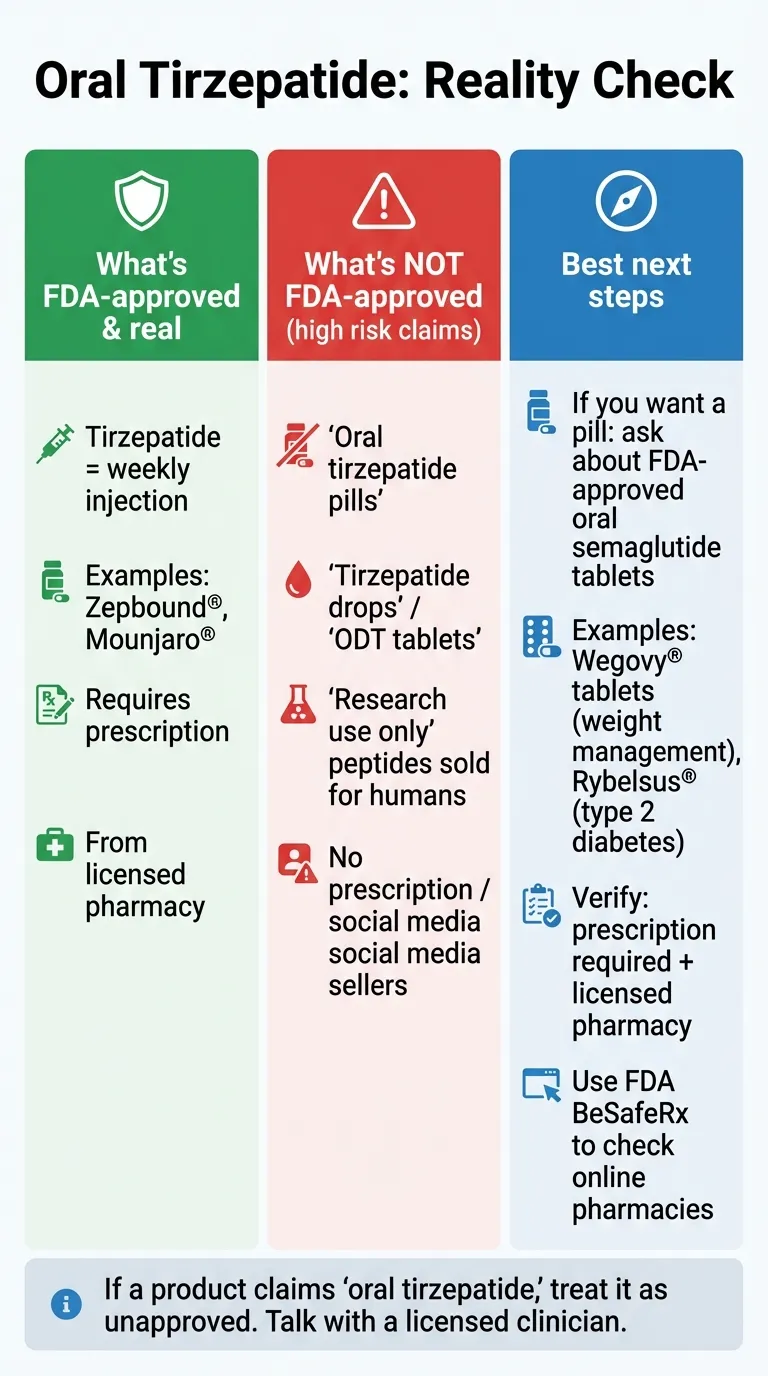
| What You See Online | FDA-Approved? | What It Actually Is | Risk Level | What To Do |
|---|---|---|---|---|
| "Oral tirzepatide pills" | No | Was compounded; routine compounding no longer permitted | High | Avoid; consider FDA-approved alternatives |
| "Tirzepatide drops" | No | Was compounded sublingual; routine compounding no longer permitted | High | Avoid; report to FDA if still being sold |
| "Tirzepatide ODT tablets" | No | Was compounded; no longer available | High | Avoid |
| Mounjaro | Yes | Injectable tirzepatide for diabetes | Low | Safe with prescription |
| Zepbound | Yes | Injectable tirzepatide for weight loss | Low | Safe with prescription |
| Wegovy pill | Yes | Oral semaglutide 25mg for weight loss | Low | FDA-approved; available now |
| Rybelsus | Yes | Oral semaglutide for diabetes | Low | FDA-approved; available now |
| Compounded oral semaglutide | No* | Pharmacy-compounded version | Medium | Not FDA-approved; verify provider credentials |
*Compounded at FDA-registered facilities but not FDA-approved as a finished product. FDA determined the semaglutide shortage was resolved and set enforcement discretion wind-down dates in 2025.
Is Oral Tirzepatide FDA Approved?
No. As of January 2026, there is no FDA-approved oral form of tirzepatide.
The FDA has approved tirzepatide in two forms:
- Mounjaro — Approved May 2022 for type 2 diabetes (injection)
- Zepbound — Approved November 2023 for chronic weight management (injection)
Both are administered as once-weekly subcutaneous injections. Neither comes in pill, tablet, capsule, or liquid form.
This isn't a regulatory delay or a supply issue. Eli Lilly, the company that makes tirzepatide, has explicitly stated that tirzepatide is not available as an oral formulation. Their medical information page says: "Tirzepatide is not available in pill form for oral administration. Tirzepatide is an injectable medicine for subcutaneous use."
Why this matters:
If any website is currently selling something called "oral tirzepatide" or "tirzepatide pills," it's either:
- Left over from when compounded versions were permitted (they're not anymore for routine use)
- Operating outside FDA's current enforcement framework
- Selling something that isn't actually tirzepatide
Common Questions About FDA Status
Is there an oral Zepbound?
No. Zepbound is only available as a weekly injection.
Is there an oral Mounjaro?
No. Mounjaro is only available as a weekly injection.
What is the oral tirzepatide brand name?
There isn't one. No oral tirzepatide product has been approved by the FDA, so there's no brand name.
Is Eli Lilly working on an oral tirzepatide?
There's no public evidence that Eli Lilly is developing an oral tirzepatide formulation. Their oral GLP-1 efforts are focused on a different drug called orforglipron (more on that later).
What People Mean by "Oral Tirzepatide" (Pills, Drops, Tablets, ODT)
If you've been searching for oral tirzepatide, you've probably come across several different product formats. Here's what they actually are:
Sublingual Drops
These were liquid tirzepatide solutions designed to be placed under your tongue, where the medication would absorb through the mucous membranes and bypass the digestive system. They were typically taken daily rather than weekly.
ODT (Orally Disintegrating Tablets)
These tablets dissolved on your tongue without water. The idea was similar to sublingual drops—get the medication into your bloodstream through your mouth rather than your stomach.
Regular Tablets or Capsules
Some compounding pharmacies made tablets or capsules designed to be swallowed. These faced significant absorption challenges because tirzepatide, like most peptides, breaks down quickly in your digestive system.
"Research Use Only" Products
This is the biggest red flag. Some websites sell peptides labeled "for research purposes only" or "not for human consumption"—but then provide human dosing information anyway. The FDA has specifically warned against these products, noting that they're marketed in ways that suggest they're intended for human use despite the disclaimers.
What All These Have in Common
None of them were FDA-approved. They were all compounded products, meaning they were made by pharmacies that combined ingredients to create a customized medication. During the tirzepatide shortage (2022-2024), the FDA permitted this compounding. Once the shortage ended, that permission was revoked.
As of March 19, 2025, compounding pharmacies can no longer legally sell tirzepatide in any form unless they can document a specific clinical reason why a commercially available medication isn't appropriate for a particular patient—a high bar that most situations don't meet.
Why Isn't Tirzepatide Available as a Pill?
This isn't about regulations or business decisions. It's basic biology.
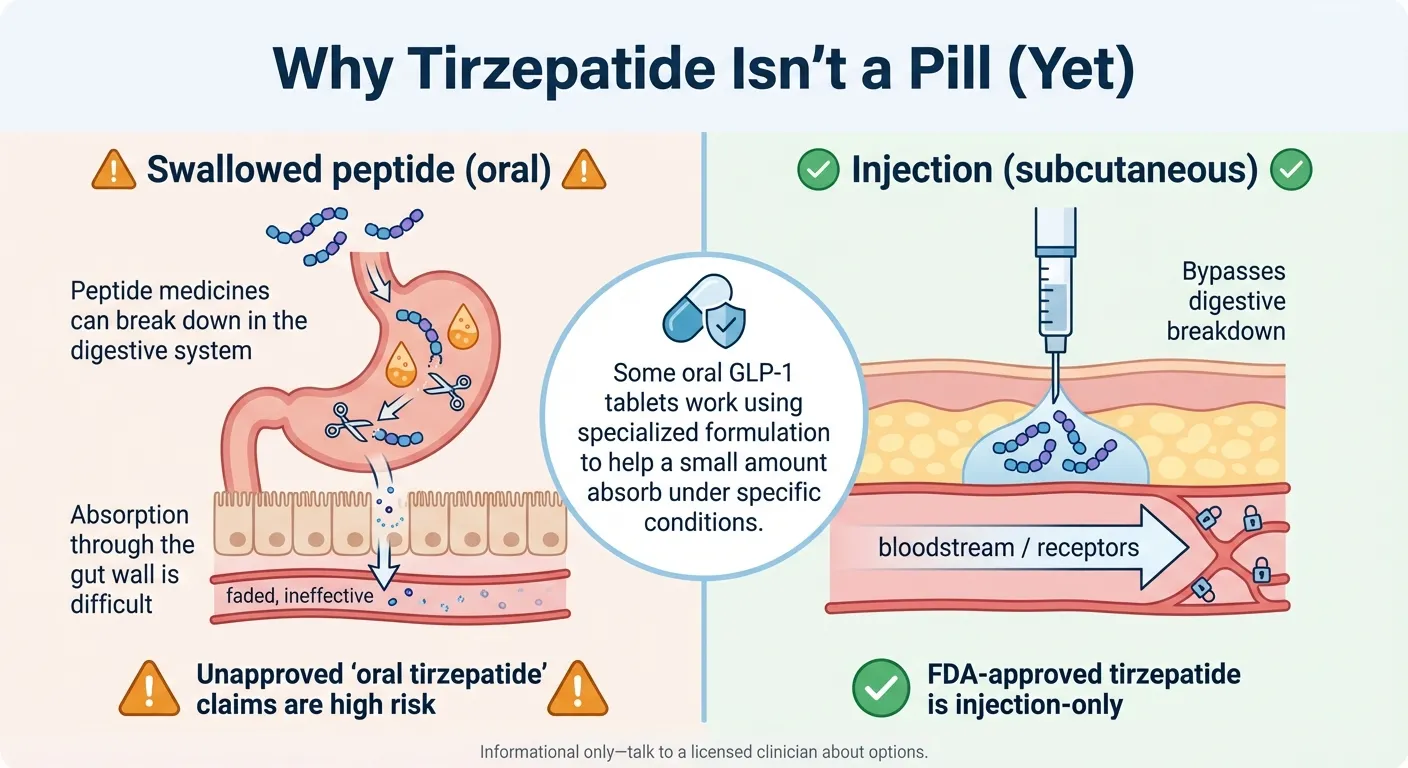
Tirzepatide is a peptide—a chain of amino acids folded into a specific three-dimensional shape. That shape is what makes it work. When tirzepatide binds to GIP and GLP-1 receptors in your body, it triggers the signals that reduce appetite, slow stomach emptying, and improve blood sugar control.
The problem is that your digestive system is designed to destroy peptides. That's literally its job. When you eat protein (which is made of peptides), your stomach acid and digestive enzymes break it down into individual amino acids that your body can absorb and use.
If you swallow tirzepatide, the same thing happens. The acid and enzymes shred it into pieces that no longer have the right shape to activate those receptors. By the time anything reaches your bloodstream, it's no longer functional tirzepatide.
The Numbers Tell the Story
Tirzepatide has a molecular weight of 4,813 daltons. In pharmaceutical development, there's a general rule that molecules larger than about 500 daltons have a very hard time being absorbed intact through the gut wall. Tirzepatide is nearly ten times that size.
How Oral Semaglutide Solved This Problem
You might wonder: if peptides can't survive the digestive system, how does oral semaglutide (Rybelsus, Wegovy pill) work?
The answer is a specialized absorption enhancer called SNAC (sodium N-[8-(2-hydroxybenzoyl)amino] caprylate). Here's the simplified version:
- You take the pill on an empty stomach with very little water
- SNAC temporarily raises the pH in your stomach, reducing acid activity
- SNAC also helps semaglutide cross the stomach lining directly into your bloodstream
- This all happens in a short window, which is why you can't eat or drink for 30 minutes
Even with this technology, only about 1% of the semaglutide you swallow actually makes it into your system. That's why oral semaglutide requires much higher doses than the injection—the 25mg Wegovy pill delivers roughly the same effective dose as the 2.4mg weekly injection.
Why This Hasn't Been Done for Tirzepatide
Tirzepatide is larger and more complex than semaglutide. The same SNAC approach might not work as well, or might require different formulation technology. Eli Lilly hasn't publicly announced any efforts to develop an oral tirzepatide.
Instead, they're working on orforglipron—a completely different oral GLP-1 drug that's a small molecule, not a peptide. Small molecules don't have the same absorption problems because they're... small. Orforglipron was FDA-approved on April 1, 2026 and now sells under the brand name Foundayo.
For a selected reference to other pills being studied, see weight-loss pills in Phase 3 trials.
What Happened to Compounded Oral Tirzepatide?
If you were using compounded tirzepatide drops or tablets before 2025, you're probably wondering what happened. Here's the timeline:
2022-2024: The Shortage Era
When Mounjaro launched in 2022, demand quickly outstripped supply. The FDA added tirzepatide to its drug shortage list, which triggered a regulatory provision allowing compounding pharmacies to make their own versions. During this period, dozens of telehealth companies and compounding pharmacies offered tirzepatide in various forms—including sublingual drops, ODT tablets, and traditional tablets. Many people used these products and reported positive results, though no clinical trials were ever conducted to establish their safety or efficacy.
October 2024: FDA Declares Shortage Over
The FDA announced that Eli Lilly had resolved its supply issues and could now meet demand for tirzepatide. This was the beginning of the end for compounded products.
December 2024: Confirmation and Transition Period
The FDA upheld its decision and set enforcement discretion wind-down timelines for compounders—different deadlines for different types of pharmacies (503A vs 503B facilities).
March 2025: Enforcement Discretion Period Ends for Most Compounders
After these deadlines, routine compounding of tirzepatide copies was no longer permitted outside narrow, patient-specific exceptions. A 503A pharmacy can only compound tirzepatide if it can document a specific clinical need for an individual patient that FDA-approved products cannot meet—a high bar that most situations don't meet.
Court Rulings Uphold FDA Decision
Compounding pharmacies challenged the FDA's decision in court. The court denied their preliminary injunction motion, ruling that the FDA had followed proper procedures and had the authority to end the compounding allowance once the shortage was resolved.
What About Sites Still Selling It?
The FDA has warned about unapproved GLP-1 products sold online and has received adverse event reports associated with some compounded and unapproved products, with underreporting likely.
If you see a website still selling "oral tirzepatide" today, it's operating outside FDA's enforcement framework. Eli Lilly has filed lawsuits against several such companies. We'd strongly recommend avoiding these products—not just because of the regulatory issues, but because there's no way to verify what you're actually getting.
Your Actual Options: FDA-Approved Needle-Free GLP-1 Medications
Here's what you can actually get if you want a GLP-1 medication without needles. For a comprehensive comparison of the best oral tirzepatide alternatives and options, we've created a detailed guide.
FDA-ApprovedWegovy Pill (Oral Semaglutide 25mg) — For Weight Loss
This is the big news that most "oral tirzepatide" articles miss: the FDA approved the Wegovy pill on December 22, 2025. It launched in January 2026.
What it is:
The first oral GLP-1 medication specifically approved for weight loss. Same active ingredient as injectable Wegovy (semaglutide), but in pill form. You take it once daily instead of injecting once weekly.
The clinical results:
In the pivotal trial (OASIS 4), the FDA label reports people taking Wegovy tablets lost about 13.6% of body weight on average (vs ~2.4% placebo), and about 30% reached 20% or greater loss (treatment policy estimand). The on-treatment estimate shows approximately 34% achieving ≥20% weight loss for patients who continued treatment throughout the trial.
How you take it:
- • One pill daily, first thing in the morning on an empty stomach
- • With no more than 4 ounces of water
- • Wait at least 30 minutes before eating, drinking, or taking other medications
The doses:
- • Weeks 1-4: 1.5mg
- • Weeks 5-8: 4mg
- • Weeks 9-12: 9mg
- • Week 13+: 25mg (maintenance dose)
Cost:
- • Cash pay (NovoCare pricing): $149/month (1.5mg and 4mg through April 2026), $299/month (9mg and 25mg)
- • With insurance: Potentially as low as $25/month with coverage and savings card
FDA-ApprovedRybelsus (Oral Semaglutide 7mg/14mg) — For Diabetes
Rybelsus has been available since 2019, but it's approved for type 2 diabetes, not weight loss.
- What it is: Oral semaglutide at lower doses than the Wegovy pill.
- How it's used: Primarily for blood sugar control in people with type 2 diabetes. Some doctors prescribe it off-label for weight loss, but it's not as effective for that purpose because the doses are lower.
- The doses: 7mg or 14mg daily (compared to 25mg for Wegovy pill).
- Cost: Around $900-1,000/month retail; varies significantly with insurance.
- Who it's for: Adults with type 2 diabetes who want to improve blood sugar control without injections.
CompoundedCompounded Semaglutide — Understanding the Current Landscape
Here's something important to understand: the FDA also determined that the semaglutide injection shortage was resolved, and moved toward ending routine compounding of copies with enforcement discretion timelines and related litigation in early 2025.
What this means: During shortages, some compounding occurred under FDA's shortage framework. Once the FDA determined the semaglutide injection shortage was resolved, it moved toward ending routine compounding of copies. If a provider offers a compounded GLP-1 today, ask exactly what is being prescribed and why it differs medically from an FDA-approved product.
Important FDA warning:
The FDA has also raised concerns about compounded products made with semaglutide salt forms (e.g., semaglutide sodium/acetate), which are not the same as the semaglutide used in FDA-approved medicines.
The important caveats:
- • These are NOT FDA-approved as finished products
- • They're made by compounding pharmacies that are FDA-registered but the final products don't go through FDA review
- • Quality can vary between pharmacies
- • No clinical trials have been conducted specifically on compounded formulations
- • Regulatory status depends on specific circumstances
Cost:
Typically $179-$369/month through telehealth providers.
A Note on Compounded Medications
We want to be clear about what "compounded" means, since there's a lot of confusion.
Compounding pharmacies are legitimate, licensed facilities. They've existed for decades and serve an important role—making customized medications for people who can't use standard formulations (for example, someone who's allergic to an inactive ingredient in the branded version).
The FDA regulates these pharmacies, but differently than it regulates pharmaceutical manufacturers. The pharmacy is inspected and licensed; the individual medications are not reviewed and approved the same way a new drug would be.
If you're considering compounded oral semaglutide, we'd recommend: using a telehealth provider that works with accredited compounding pharmacies, asking which pharmacy fills the prescription and verifying their licensure, starting with a lower dose and monitoring how you respond, and working with a provider who offers ongoing medical supervision.
Comparing Your Options: Pill vs. Injection
Let's put everything side by side so you can see how these options compare.
| Feature | Zepbound (Injectable) | Wegovy Pill | Rybelsus | Compounded Oral Semaglutide |
|---|---|---|---|---|
| Active ingredient | Tirzepatide | Semaglutide | Semaglutide | Semaglutide |
| Mechanism | Dual GIP/GLP-1 | GLP-1 only | GLP-1 only | GLP-1 only |
| FDA-approved | Yes | Yes | Yes (diabetes) | No* |
| How you take it | Weekly injection | Daily pill | Daily pill | Daily (varies) |
| Avg weight loss | 20-22% | 13.6-16.6%** | ~4%**** | Not established*** |
| Fasting required | No | Yes (30 min) | Yes (30 min) | Varies |
| Monthly cost (self-pay) | $550-1,100 | $149-299 | $900-1,000 | $179-369 |
| Monthly cost (insured) | $0-150 | $25+ | Varies | Not covered |
| Best for | Maximum weight loss | Needle-free, FDA-approved | Diabetes with oral preference | Ask provider about circumstances |
*Compounded at FDA-registered facilities; regulatory status depends on circumstances
**13.6% treatment policy estimand; ~16.6% on-treatment estimand from OASIS 4 trial
***No clinical trials on compounded oral formulations; estimates extrapolated from injectable data
****Rybelsus is FDA-approved for type 2 diabetes, not weight loss; ~4% weight loss observed in diabetes trials per FDA label
What the Numbers Mean
Tirzepatide (Zepbound) produces more weight loss than semaglutide. The SURMOUNT trials showed average weight loss of 20-22% with tirzepatide, compared to about 15-17% with injectable semaglutide. This is because tirzepatide activates both GIP and GLP-1 receptors, while semaglutide only activates GLP-1.
Oral medications require daily dosing with food restrictions. This is a trade-off for avoiding needles. You need to take them first thing in the morning, on an empty stomach, and wait 30 minutes before eating. Some people find this inconvenient; others prefer it to weekly injections.
The Wegovy pill achieves similar results to injectable Wegovy. Despite requiring a much higher dose (25mg vs 2.4mg), the pill version produces comparable weight loss. This suggests the absorption technology works well enough to deliver effective doses.
How to Spot Unsafe "Oral Tirzepatide" Products
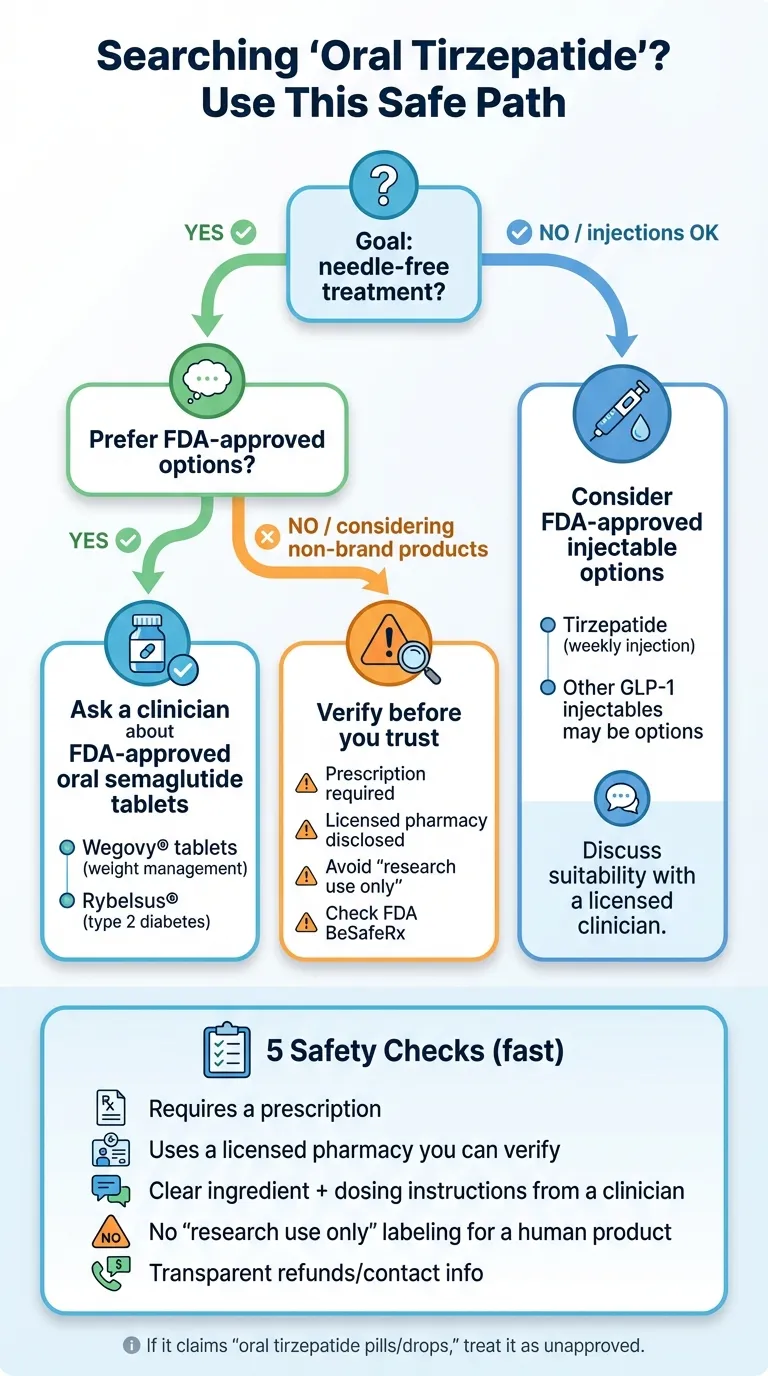
Since compounded tirzepatide is no longer legal, any website claiming to sell oral tirzepatide should raise immediate red flags. Here's how to protect yourself:
The 12 Red Flags Checklist
- 1.Claims to sell "oral tirzepatide" or "tirzepatide pills" — These products are not legally available
- 2.Labeled "for research use only" but provides human dosing — This is a common trick to skirt FDA regulations
- 3.No prescription required — All legitimate GLP-1 medications require a prescription
- 4.Ships from outside the United States — US regulations don't apply; you don't know what you're getting
- 5.No way to verify the pharmacy — Legitimate providers disclose which pharmacy fills prescriptions
- 6.Prices that seem too good to be true — If it's dramatically cheaper than every other option, ask why
- 7.No medical consultation offered — Even telehealth should include a provider review
- 8.No information about the compounding pharmacy — You should be able to verify licensure
- 9.Vague about what's actually in the product — Ingredients and concentrations should be clear
- 10.Aggressive marketing with "limited time" pressure — Legitimate medical providers don't operate this way
- 11.No refund policy or contact information — Signs of a fly-by-night operation
- 12.Reviews that seem fake or templated — Look for specific details and varied experiences
What the FDA Says
"FDA is aware of unapproved versions of GLP-1 products (such as semaglutide and tirzepatide) being sold through various channels, including websites and social media... Some products have been marketed with claims that they are FDA-approved or that they are the same as FDA-approved products, when this is not the case."
The FDA recommends using their BeSafeRx program to verify online pharmacies. You can check if a pharmacy is properly licensed at FDA.gov/BeSafeRx.
If You Already Bought Something Suspicious
If you've purchased a product you're now concerned about:
- Stop using it until you can verify what it is
- Contact your healthcare provider if you've experienced any adverse effects
- Report the seller to the FDA's MedWatch program
- Don't assume "natural" or "compounded" means safe — verification matters
Cost Breakdown: What You'll Actually Pay
Let's talk real numbers, because cost is often the deciding factor.
Zepbound (injectable tirzepatide):
- • List price: $1,086.37 per fill (per Eli Lilly)
- • With Eli Lilly savings program (no insurance): $550/month
- • With insurance + manufacturer copay card: Often $25-150/month
- • Limitation: Must not be using Medicare Part D
Wegovy Pill (oral semaglutide):
- • 1.5mg and 4mg doses: $149/month (cash pay via NovoCare)
- • 9mg and 25mg maintenance doses: $299/month
- • With insurance: Potentially $25/month or less with savings card
Rybelsus (oral semaglutide for diabetes):
- • List price: ~$900-1,000/month
- • With insurance: Highly variable; check your formulary
- • Note: Not FDA-approved for weight loss
Compounded semaglutide (via telehealth):
- • First month: Typically $179-$299 (includes consultation)
- • Ongoing: Typically $249-$369/month
- • Note: Regulatory status depends on circumstances
What's included in telehealth pricing:
- • Medical provider consultation
- • Prescription (if appropriate)
- • Medication shipped to your door
- • Ongoing support and dose adjustments
Most insurance plans don't cover weight loss medications. Check for prior authorization requirements and appeal denials when applicable.
Insurance Reality Check
Most insurance plans—including many employer plans—don't cover weight loss medications at all. They're often classified as "lifestyle" drugs rather than medical necessities.
Even when coverage exists, you may face:
- Prior authorization requirements
- Step therapy (must try other treatments first)
- High copays or coinsurance
- Quantity limits
Pro tip: If your insurance denies coverage, ask your provider to file an appeal. Include documentation about weight-related health conditions and how GLP-1 treatment could reduce future medical costs.
Cost-Saving Strategies
- Check manufacturer savings programs first — Eli Lilly and Novo Nordisk both offer programs
- Compare telehealth providers — Prices vary significantly
- Ask about generic alternatives — Not available for these specific drugs yet, but the landscape is changing
- Use FSA/HSA funds — These medications typically qualify
- Consider compounded options if cost is prohibitive — Understand the trade-offs
Side Effects: What to Expect
All GLP-1 medications share similar side effects. Here's what the clinical data shows:
Common Side Effects (Most People Experience These)
- • Nausea (most common, especially when starting or increasing dose)
- • Diarrhea
- • Vomiting
- • Constipation
- • Abdominal pain
These effects typically peak during the first few weeks and dose escalation periods, then improve as your body adjusts.
- • Decreased appetite (this is partly how the medication works)
- • Fatigue (usually temporary)
- • Headache
- • Dizziness
Serious Warnings (Less Common But Important)
Boxed warning — Thyroid C-cell tumors:
In animal studies, tirzepatide and semaglutide caused thyroid tumors. It's unknown whether this occurs in humans. These medications are contraindicated if you or a family member has a history of medullary thyroid carcinoma (MTC) or Multiple Endocrine Neoplasia syndrome type 2 (MEN 2).
Pancreatitis:
Acute pancreatitis has been reported. Symptoms include severe abdominal pain that may radiate to your back. If you experience this, stop the medication and contact your healthcare provider immediately.
Gallbladder problems:
GLP-1 medications may increase the risk of gallbladder disease, including gallstones.
Kidney injury:
Dehydration from vomiting or diarrhea can lead to kidney problems. Stay well-hydrated, especially if you're experiencing GI side effects.
Low blood sugar (hypoglycemia):
Risk increases if you're also taking insulin or sulfonylureas. Monitor blood sugar and adjust other medications as directed.
When to Seek Medical Attention
Contact your healthcare provider immediately if you experience:
- Severe abdominal pain that doesn't go away
- Signs of allergic reaction (rash, swelling, difficulty breathing)
- Signs of pancreatitis or gallbladder problems
- Persistent vomiting or inability to keep fluids down
- Signs of kidney problems (decreased urination, swelling)
Oral vs. Injectable: Any Difference in Side Effects? The side effect profiles are similar between oral and injectable forms. Some patients report that oral medications cause more initial nausea because of the empty-stomach requirement and direct GI contact. Others find the gradual daily dosing easier to tolerate than weekly peaks.
Dosing Guide: How These Medications Work
Understanding dosing helps you know what to expect and have informed conversations with your healthcare provider.
Standard titration schedule:
- • Weeks 1-4: 2.5mg once weekly
- • Weeks 5-8: 5mg once weekly
- • Weeks 9-12: 7.5mg once weekly
- • Weeks 13-16: 10mg once weekly
- • Weeks 17-20: 12.5mg once weekly
- • Week 21+: 15mg once weekly (maximum dose)
Inject once weekly on the same day. Can be taken with or without food. Rotate injection sites.
Titration schedule:
- • Weeks 1-4: 1.5mg daily
- • Weeks 5-8: 4mg daily
- • Weeks 9-12: 9mg daily
- • Week 13+: 25mg daily (maintenance dose)
Take first thing in the morning on an empty stomach with no more than 4oz of water. Wait 30 minutes before eating.
Compounded Oral Semaglutide
Dosing varies by provider and formulation. Common approaches include:
- Daily sublingual administration
- Starting doses typically equivalent to 0.25-0.5mg injectable
- Gradual titration based on tolerance
Important: Because compounded formulations aren't standardized, absorption may vary. Work closely with your provider to monitor response and adjust dosing as needed.
What About Oral Tirzepatide Dosing?
There is no established dosing for oral tirzepatide because it doesn't exist as an approved product. Any "dosage chart" you see online for oral tirzepatide is not based on clinical evidence or FDA-approved labeling.
When Will Oral Tirzepatide Be Available?
The honest answer: We don't know if it ever will be.
The Current Landscape
Eli Lilly has not announced any plans to develop an oral tirzepatide formulation. Their public statements and investor communications focus on:
- Expanding manufacturing for injectable Mounjaro and Zepbound
- Developing orforglipron — an oral GLP-1 (but not tirzepatide)
- Researching retatrutide — an injectable triple-agonist (GIP/GLP-1/glucagon)
Why It's Probably Not Coming Soon
To bring oral tirzepatide to market, Eli Lilly would need to:
- Solve the formulation challenge — Develop technology to deliver a 4,813-dalton peptide through the GI tract
- Conduct Phase 1 trials — Establish safety and dosing in humans
- Conduct Phase 2 trials — Demonstrate efficacy
- Conduct Phase 3 trials — Large-scale studies (typically 1,000+ patients)
- Submit to FDA and await approval — Usually 10-12 months for review
- Scale up manufacturing — Oral formulations have different production requirements
This process typically takes 7-10 years from initial development to market. Even if Eli Lilly started tomorrow, you'd be looking at the early 2030s.
What IS Coming: Orforglipron
Eli Lilly's oral GLP-1 drug orforglipron is much closer to reality:
What it is: A once-daily oral GLP-1 receptor agonist. Unlike tirzepatide, it's a small molecule, not a peptide—which makes oral delivery much simpler.
Key differences from tirzepatide:
- • GLP-1 only (tirzepatide is dual GIP/GLP-1)
- • Smaller molecule = easier to absorb
- • No food or water restrictions required
- • Slightly less weight loss in trials (~12.4% vs ~20% for tirzepatide)
FDA status:
Eli Lilly submitted for FDA approval in late 2025. The FDA granted it a Commissioner's National Priority Voucher, which expedites review. According to Eli Lilly's CEO, the current target FDA action date is March 2026.
Trial results:
In the ATTAIN-1 trial, patients lost an average of 12.4% body weight (about 27 lbs) over 72 weeks.
The Realistic Outlook
- 0-2 years: Not happening. No development announced.
- 3-5 years: Possible but unlikely. Would require rapid development.
- 5+ years: Maybe, if the market demands it and formulation technology advances.
- Available now: Wegovy pill, Rybelsus, compounded semaglutide
- Coming soon: Orforglipron (expected March 2026)
How to Get Treatment Safely
Whether you choose an FDA-approved option or a telehealth provider, here's how to do it safely.
Option 1: Traditional Healthcare Route
Best for: People who want in-person care, have good insurance, or prefer established relationships.
Advantages:
- • Face-to-face relationship with provider
- • Insurance more likely to cover
- • Access to full range of FDA-approved options
- • Integrated with your other healthcare
Disadvantages:
- • May require multiple appointments
- • Limited availability in some areas
- • Some PCPs aren't comfortable prescribing weight loss medications
- • Insurance bureaucracy (prior authorizations, denials)
Option 2: Telehealth Providers
Best for: People who want convenience, don't have insurance coverage, or want more affordable options.
What to look for in a telehealth provider:
- • Licensed healthcare providers (MDs, DOs, NPs, PAs)
- • Clear pricing with no hidden fees
- • Transparent about which medications they prescribe
- • Accredited partner pharmacies with verifiable licenses
- • Ongoing support and monitoring
- • Clear policies on refunds and cancellations
Questions to ask:
- What exactly will I receive? (Brand name vs. compounded)
- Is this FDA-approved for weight loss?
- Which pharmacy fills the prescription?
- What state is the pharmacy licensed in?
- What happens if I have side effects?
- What's your refund policy?
Important context: Many telehealth providers primarily offer compounded medications, which are not FDA-approved as finished products. This is a trade-off: potentially lower cost, but without the same level of regulatory oversight as branded products. Ask your provider about the specific circumstances of what they're prescribing.
Option 3: Retail Pharmacy (For FDA-Approved Products)
For Wegovy pill (launched January 2026):
- • You'll need a prescription from any licensed prescriber
- • Most pharmacies will stock it
- • Manufacturer pricing starts at $149/month for self-pay
- • Check for savings programs at Wegovy.com
For Zepbound or Mounjaro:
- • Requires prescription
- • Check manufacturer savings programs (can reduce cost to $550/month without insurance)
- • Specialty pharmacies may have better stock
What To Avoid
Never buy from:
- • Websites that don't require prescriptions
- • Overseas pharmacies
- • Social media sellers
- • "Research chemical" suppliers
- • Any site still claiming to sell "oral tirzepatide"
Red flag statements:
- • "No prescription needed"
- • "Same as Zepbound, just cheaper"
- • "FDA-approved oral tirzepatide" (doesn't exist)
- • "Research purposes only" with human dosing instructions
Decision Framework: Which Option Is Right for You?
Here's a practical way to think through your options:
Start Here: What's Your Top Priority?
If your priority is maximum weight loss:
→ Injectable tirzepatide (Zepbound) produces the best results in clinical trials
→ Typical outcome: 20-22% body weight reduction
If your priority is avoiding needles:
→ Wegovy pill (FDA-approved, 13.6-16.6% weight loss)
→ Ask your provider about other options
→ Try Foundayo (orforglipron) — FDA-approved April 1, 2026
If your priority is lowest cost:
→ Ask your healthcare provider about available options and trade-offs
→ Check manufacturer savings programs for branded options
→ Appeal insurance denials if applicable
If your priority is FDA approval and maximum safety:
→ Wegovy pill for weight loss (FDA-approved December 2025)
→ Zepbound for maximum weight loss (FDA-approved injection)
→ Rybelsus if you have type 2 diabetes
Summary by Situation
| Your Situation | Recommended Option | Why |
|---|---|---|
| Maximum weight loss matters most | Zepbound injection | 20%+ weight loss in trials |
| Must avoid needles, have insurance | Wegovy pill | FDA-approved oral, similar results to injection |
| Must avoid needles, limited budget | Compounded oral semaglutide | $179-369/month, accessible |
| Have type 2 diabetes | Mounjaro or Rybelsus | FDA-approved for diabetes indication |
| Want to wait for newest option | Orforglipron | Expected March 2026, no food restrictions |
| Want maximum safety/oversight | Any FDA-approved option | Clinical trial data, FDA monitoring |
What to Expect When Starting GLP-1 Treatment
Whether you choose an oral or injectable option, here's what the first few months typically look like.
You'll start at the lowest dose. For injectable tirzepatide, that's 2.5mg weekly. For the Wegovy pill, it's 1.5mg daily. Some people notice reduced appetite almost immediately. Others don't feel much at this starting dose—that's normal.
Common experiences:
- • Mild nausea, especially after meals
- • Slightly reduced appetite
- • Possible constipation or changes in bowel habits
- • Some people feel more full on smaller portions
Your dose increases according to the schedule. Side effects may temporarily intensify with each increase. This is when most people start noticing significant appetite changes. The "food noise"—constant thoughts about eating—often quiets down.
Common experiences:
- • More noticeable appetite suppression
- • Nausea peaks (usually manageable; improves within days)
- • Possible fatigue as your body adjusts to eating less
- • Early weight loss (typically 3-7 lbs in the first month)
You continue titrating until you reach your maintenance dose or the dose where you're seeing good results with manageable side effects. The side effects that peaked during escalation usually settle into a manageable pattern.
Common experiences:
- • Steady weight loss (typically 1-2 lbs per week)
- • Improved relationship with food
- • Better blood sugar control (if applicable)
- • Increased energy as you lose weight
- • Possible hair thinning (related to rapid weight loss, not the medication itself)
Tip: Focus on protein intake (aim for 60-100g daily). Maintain or start light exercise. Have regular check-ins with your provider.
You've reached your maintenance dose. Weight loss continues but may slow as you approach a new stable weight. The medication becomes part of your routine. Side effects are minimal for most people.
What the data shows:
- • Most weight loss occurs in the first 12-18 months
- • Weight typically stabilizes at a new setpoint
- • Continuing medication helps maintain results
- • Stopping medication often leads to weight regain (this is true for all obesity treatments)
Setting Realistic Expectations
Based on clinical trial data, here's what "average" results look like:
| Treatment | Average Weight Loss (1 year) | % Achieving 10%+ Loss | % Achieving 20%+ Loss |
|---|---|---|---|
| Zepbound 15mg | 20-22% | ~90% | ~55% |
| Wegovy injection | 15-17% | ~85% | ~30% |
| Wegovy pill | 13-17% | ~75% | ~34% |
| Orforglipron (trials) | 12-14% | ~70% | ~25% |
Important context: These are averages. Individual results vary significantly based on starting weight and metabolic health, adherence to treatment, dietary changes, physical activity, and genetics. Some people lose more than the average; some lose less. What matters is whether the treatment improves your health and quality of life.
Frequently Asked Questions
Sources and Methodology
FDA Approval Documents
- FDA approves Mounjaro (tirzepatide) for type 2 diabetes. FDA. May 2022.
- FDA approves Zepbound (tirzepatide) for chronic weight management. FDA. November 2023.
- FDA approves Wegovy (semaglutide) oral tablets for chronic weight management. FDA. December 2025.
- Zepbound (tirzepatide) Prescribing Information. Eli Lilly.
FDA Safety Communications
Clinical Trial Data
- Jastreboff AM, et al. Tirzepatide Once Weekly for the Treatment of Obesity. N Engl J Med. 2022;387:205-216. (SURMOUNT-1)
- Wharton S, et al. Oral semaglutide at a dose of 25 mg in adults with overweight or obesity. N Engl J Med. 2025;393:1077-1087. (OASIS 4)
Manufacturer Information
- Is Zepbound (tirzepatide) available as an oral formulation? Eli Lilly Medical Information. [lilly.com]
- FDA approves Novo Nordisk's Wegovy pill. Novo Nordisk Press Release. December 22, 2025.
- Wegovy Tablets FDA Label (semaglutide). [accessdata.fda.gov]
- Rybelsus FDA Label (semaglutide). [accessdata.fda.gov]
- NovoCare Pricing for Wegovy. [novocare.com]
- Zepbound Pricing Information. Eli Lilly. [zepbound.lilly.com]
How We Research
This guide was created by reviewing:
- FDA-approved prescribing information and approval documents
- Manufacturer press releases and medical information
- Published clinical trial results in peer-reviewed journals
- FDA safety communications and guidance documents
- Current market pricing from manufacturers and telehealth providers
We do not present unverified claims as facts. When we discuss products that lack clinical trial data (such as compounded medications), we clearly note this limitation.
Affiliate Disclosure
This page contains affiliate links to telehealth providers. If you make a purchase through these links, we may earn a commission at no additional cost to you. We only recommend services we believe provide legitimate value to readers.
Medical Disclaimer
This content is for informational purposes only and does not constitute medical advice, diagnosis, or treatment. Always consult a qualified healthcare provider before starting any medication. Individual results vary. Never use medications from unverified sources.
Update Log
January 31, 2026: Initial publication. Reflects Wegovy pill FDA approval (December 2025). Updated orforglipron FDA timeline (target: March 2026 per Eli Lilly CEO). Confirmed compounded tirzepatide remains unavailable.
This guide answers the question "Is oral tirzepatide real?" and provides a complete roadmap for people seeking needle-free GLP-1 treatment. If you found it helpful, consider bookmarking it—we update it as new information becomes available.
Related Guides
Related Articles
SURMOUNT-1 Through SURMOUNT-5 Summaries
All five SURMOUNT tirzepatide trial summaries with population, percentage clock, estimand, stopping data, FDA label crosswalk, and evidence limits.
Best Online Tirzepatide Provider 2026: Verified Prices
We verified pricing, cancellation terms, and FDA records for 8 tirzepatide providers. See real costs — not intro pricing.
Best Tirzepatide Without Membership Fee
7 tirzepatide providers with $0 membership fees compared by real pricing, refill traps, and cancellation rules.
Microdosing Tirzepatide
Complete guide to tirzepatide microdosing including dosage charts, safety, and medical guidance.
What Is GLP-1?
A complete beginner's guide to GLP-1 medications, how they work, and what to expect.
Best GLP-1 Telehealth Providers
Ranked and reviewed telehealth providers offering GLP-1 prescriptions for weight loss online.