Wegovy Prior Authorization: How to Get Approved in 2026 (Criteria, Forms & What to Do If Denied)
Disclosure: Some links on this site are affiliate links. If you purchase through these links, we may earn a commission at no extra cost to you. Thank you for supporting our site.·For informational purposes only—not medical advice.
Wegovy prior authorization is the insurance approval process your doctor's office must complete before your pharmacy can fill your Wegovy prescription. It typically takes 1–7 business days, and most insurers require a BMI of 30 or higher (or 27+ with a qualifying health condition), documented lifestyle changes, and sometimes trials of other medications first. Your doctor handles the paperwork — not you.
Here's what you actually need to know right now: prior authorization is not a denial. It's a checkpoint. And if you come prepared, most people get through it.
But if your PA is denied — or your plan excludes weight-loss medications entirely — you still have options. In Medicare Advantage, more than 80% of prior authorization denials that were appealed were overturned — but only about 1 in 10 patients ever bother to appeal. And since December 2025, the FDA-approved oral Wegovy pill is available at $149–$299/month self-pay — no insurance required.
This guide covers every step: how the PA process works, what each major insurer requires, exactly what documentation your doctor needs, how long it takes, what to do if you're denied, how to appeal, and your best options if insurance won't budge. We've verified criteria against publicly available insurer policy documents and linked to original sources wherever possible.
What Is Prior Authorization, and Why Does Wegovy Need It?
Prior authorization (PA) is your insurance company's way of saying: “Before we pay for this, prove that it's medically necessary.”
That's it. It's a form. Your doctor fills it out, submits it to your insurer, and the insurer decides whether your plan will cover the medication. It's standard practice for expensive drugs — and brand-name Wegovy injections cost roughly $1,349 per month at list price, so insurers want to verify you qualify before they agree to pay.
Three things worth knowing right away:
“Did my doctor prescribe the wrong thing?”
No. Wegovy (semaglutide) is FDA-approved for chronic weight management and cardiovascular risk reduction. PA is about insurance, not about whether the prescription is correct.
“Is this a denial?”
Not yet. A PA request is a question, not an answer. Your pharmacy flagging “PA required” just means the process hasn't been completed. It's the starting line, not a stop sign.
“Is this common?”
Extremely. Prior authorization is standard practice for high-cost medications like GLP-1s. If your pharmacy says “PA required,” it means your plan wants documentation that you meet their coverage criteria — not that your doctor prescribed the wrong thing. You're not the only person dealing with this — far from it.
The honest truth: coverage is still limited. In KFF's employer survey, 19% of large firms (200+ workers) reported covering GLP-1 drugs for weight loss in 2025 — up from 18% the year prior. Many insurers still classify obesity treatment as “lifestyle” rather than medical — even though the American Medical Association recognized obesity as a disease back in 2013, and the landmark SELECT trial proved Wegovy reduces heart attacks and strokes by 20% in adults with cardiovascular disease and obesity.
But coverage is expanding. The FDA-approved Wegovy pill launched in January 2026 at $149/month self-pay. CMS has finalized rules pushing for faster PA response times. And if your specific plan does cover Wegovy, this guide will help you get approved on the first try.
The 3-Gate Framework: Why PAs Get Denied (and How to Avoid It)
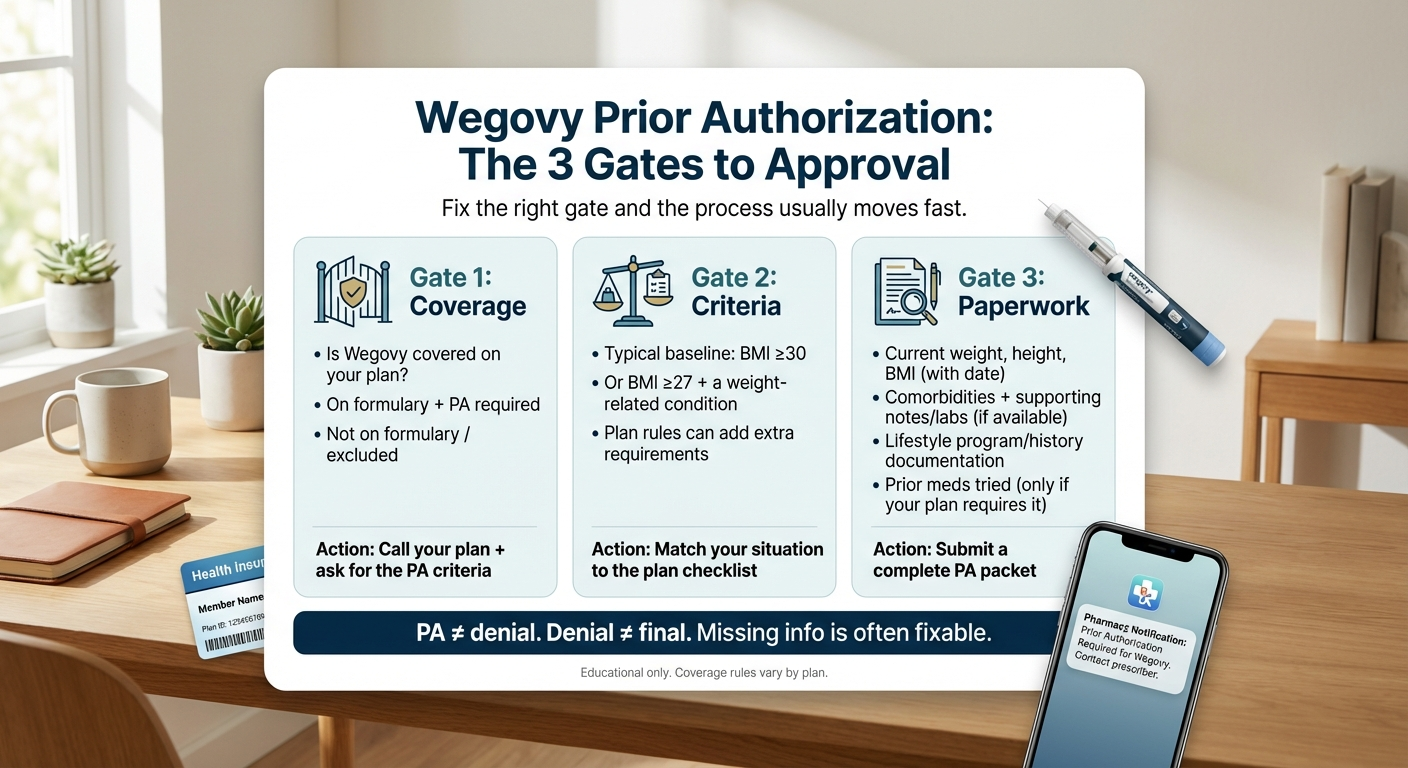
Before we get into the step-by-step, here's the simplest way to understand the entire Wegovy PA process. Think of it as three gates. If any gate fails, your PA fails.
Coverage
Is Wegovy covered on your plan at all? Some plans cover Wegovy with PA. Some exclude weight-loss medications entirely. If it's not on your formulary, no amount of documentation will get it approved — you'll need a formulary exception or a different path.
Criteria
Do you meet your plan's medical criteria? Most plans require BMI ≥30, or BMI ≥27 with a qualifying health condition. Some also require documented lifestyle modification or trials of other weight-loss medications first.
Paperwork
Did the PA packet prove it cleanly? You might qualify on paper, but if the submission is missing a lab result or doesn't document your prior weight-loss attempts, the PA gets denied for “insufficient documentation.” The fix is usually simple — resubmit with the missing information.
The key insight: Most PA denials aren't because you don't qualify. They're because the paperwork didn't clearly prove you qualify. That's fixable.
Do I Meet the Criteria for Wegovy Prior Authorization?
You likely qualify if you meet the FDA-approved indications AND your specific insurer's criteria.
FDA-Approved Indications for Wegovy
Wegovy is currently FDA-approved for three uses:
1. Chronic Weight Management (most common)
- • Adults with a BMI of 30 or higher (obesity)
- • Adults with a BMI of 27 or higher (overweight) AND at least one weight-related medical condition
- • Children ages 12+ with a BMI at or above the 95th percentile for their age and sex
2. Cardiovascular Risk Reduction
- • Adults with established cardiovascular disease (prior heart attack, stroke, or peripheral artery disease) AND either obesity or overweight
- • Based on the SELECT trial, which showed a 20% reduction in major cardiac events
3. MASH (Metabolic Dysfunction-Associated Steatohepatitis)
- • Adults with noncirrhotic MASH and moderate-to-advanced liver fibrosis (stages F2–F3)
- • This is a newer indication approved in 2025
Health Conditions That Qualify You at BMI 27–29.9
If your BMI is between 27 and 29.9, you'll need at least one of these weight-related conditions for most insurers to approve coverage:
Important: Your insurer's criteria may be stricter than the FDA label. For example, some UnitedHealthcare plans require BMI ≥40 for Wegovy specifically (while accepting BMI ≥30 for Zepbound). Always verify with your plan.
ICD-10 Codes Your Doctor Should Use
Correct coding prevents denials due to simple administrative errors. Share these with your doctor's office if they're not already familiar:
| Code | Description |
|---|---|
| E66.01 | Morbid (severe) obesity due to excess calories |
| E66.09 | Other obesity due to excess calories |
| E66.8 | Other obesity (used when BMI 30–39.9) |
| Z68.30–Z68.45 | BMI-specific codes (required by many insurers as supporting documentation) |
| E11.9 | Type 2 diabetes, without complications (if applicable) |
| I10 | Essential hypertension (if applicable) |
| G47.33 | Obstructive sleep apnea (if applicable) |
| I25.10 | Atherosclerotic heart disease (for cardiovascular indication) |
| K75.81 | MASH / nonalcoholic steatohepatitis (if applicable) |
Wegovy Prior Authorization Criteria by Insurer
Requirements vary significantly between insurers. This table summarizes the most common patterns we've verified from publicly available policy documents. Always confirm your specific plan's criteria — even within the same insurer, employer plans can differ.
| Insurer / PBM | BMI Criteria | Step Therapy? | Lifestyle Docs? | Initial Approval | Renewal Req. | Key Notes |
|---|---|---|---|---|---|---|
| CVS Caremark | ≥30 or ≥27 + comorbidity | Typically NO | Yes | Varies by plan | ≥5% weight loss | Wegovy became the preferred GLP-1 for obesity on CVS Caremark's largest commercial template formularies effective July 2025. |
| UHC / OptumRx | ≥30 or ≥27 + comorbidity (some plans ≥40) | Sometimes | Yes | 5 months | ≥5% weight loss | May be stricter for Wegovy than for Zepbound. Confirm your specific plan. |
| Blue Cross Blue Shield | ≥30 or ≥27 + comorbidity | Varies by plan | Varies | 6–12 months | ≥5% weight loss | BCBS is 34 independent companies — criteria vary significantly by state. |
| Aetna | ≥30 or ≥27 + comorbidity | Not specified | Yes — structured program required | 6 months | ≥5% + lifestyle | Requires proof of structured lifestyle program participation. Employer designs may add step therapy. |
| Cigna | ≥30 or ≥27 + comorbidity | Yes | Yes | 6 months | ≥5% weight loss | Detailed 27-page clinical criteria policy. Step therapy common. |
| Express Scripts | Varies by plan | Varies | Varies | Varies | Varies | Manages Rx benefits for many employers. Check your specific plan. |
| TRICARE | ≥30 or ≥27 + risk factors | Yes — must try/fail 3 meds | Yes | Varies | ≥4–5% weight loss | Strict step therapy: phentermine, Qsymia, AND Contrave. Active duty: follow MTF policies. |
| VA | Per VA Criteria | Reviewed by VA provider | Yes | Per VA guidelines | Per VA guidelines | Uses VA-specific “Criteria for Use” document. |
| Medicare Part D | NOT covered for weight loss | N/A | N/A | N/A | N/A | May cover for CV risk reduction (SELECT trial basis). CMS launched voluntary BALANCE model in 2025. |
| Medicaid | Varies by state | Varies | Varies | Varies | Varies | Many states exclude weight-loss meds. Check your state's Medicaid formulary. |
Criteria verified from publicly available insurer policy documents. Last verified: February 2026. Requirements change — always confirm with your specific plan.
How Does the Wegovy Prior Authorization Process Work?
Here's exactly what happens, step by step. This whole process usually takes about a week when done right.
Confirm Your Coverage First (Before Anything Else)
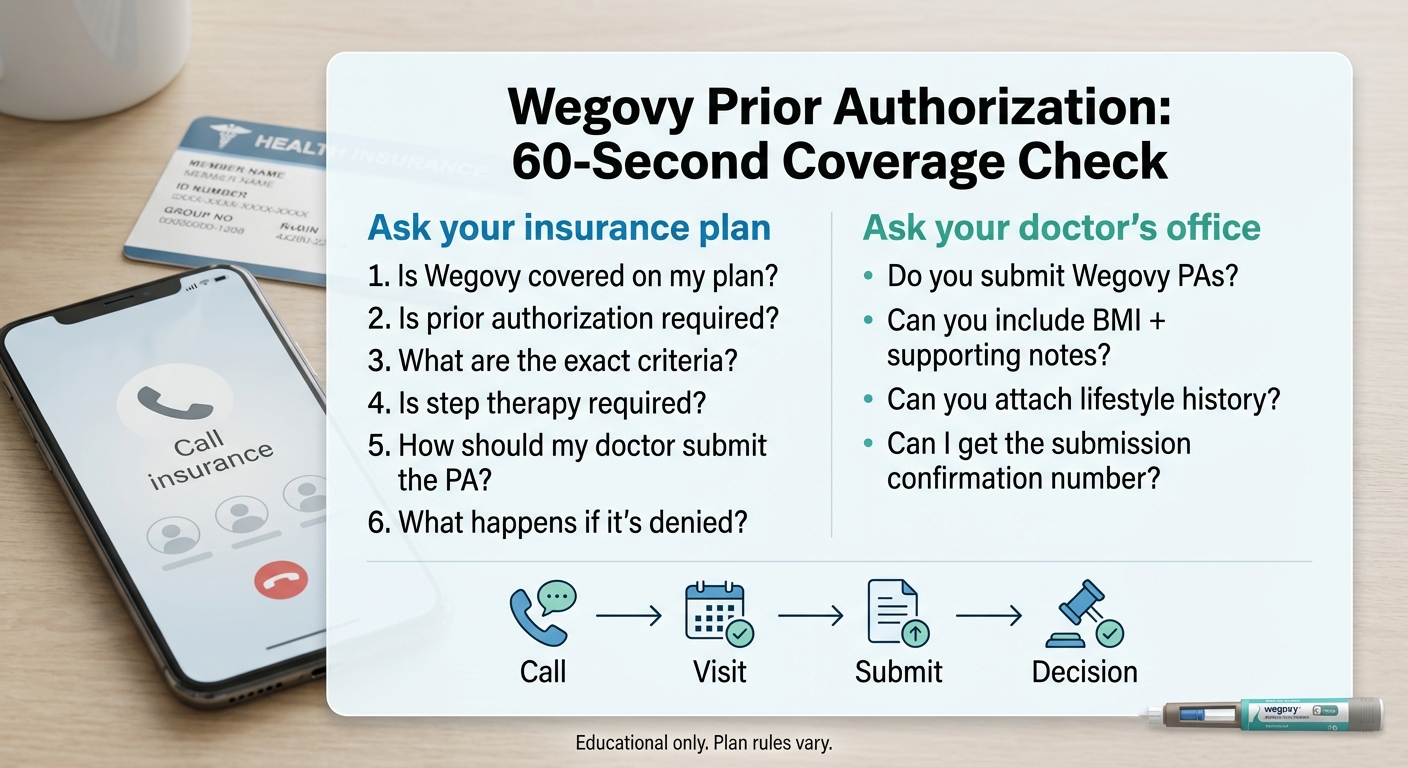
Before your doctor spends time on paperwork, you need to know whether your plan covers Wegovy at all. This takes one phone call.
Call the number on the back of your insurance card. Ask:
- “Is Wegovy (semaglutide) on my plan's formulary for weight management?”
- “Does my plan require prior authorization for Wegovy?”
- “What are the specific prior authorization criteria — BMI, comorbidities, step therapy?”
- “Can I get this coverage determination in writing?”
Pro tip: While you're on the phone, also ask about Zepbound (tirzepatide) criteria. Your insurer may prefer — or only cover — a different GLP-1 medication.
If your plan excludes weight-loss medications entirely, skip ahead to “Options Without Insurance Coverage”.
Schedule an Appointment With Your Doctor
See your doctor specifically to discuss Wegovy. Don't try to sneak this into a 10-minute checkup for something else. Come prepared with:
- Your current weight (get weighed at the visit)
- A timeline of your weight history over the past several years
- A list of every weight-loss method you've tried (diets, exercise programs, other medications — with approximate dates)
- Documentation of any lifestyle modifications (nutritionist visits, gym membership, food tracking app, weight management program enrollment)
- Records of any weight-related health conditions (blood pressure readings, A1C results, sleep study, cholesterol labs)
Your Doctor Submits the Prior Authorization
This is the part you don't do yourself. Your doctor's office completes a PA form — typically 1–2 pages — and submits it to your insurer. The form asks for:
- Your diagnosis codes (ICD-10)
- Current BMI with date of measurement
- Weight-related comorbidities
- Prior weight-loss attempts and outcomes
- Documentation of lifestyle modifications
- Prescribed dosage of Wegovy
- Previous weight-loss medications tried (if step therapy required)
The #1 PA mistake — and we hear this constantly — is when the doctor writes a perfectly appropriate prescription, but the PA form doesn't explicitly map to the insurer's criteria checkboxes. The doctor knows you qualify. But the paperwork doesn't prove it in the insurer's language. That's why the documentation checklist below matters.
Wait for the Decision (1–7 Business Days, Usually)
Once submitted, your insurer reviews the request against their criteria. You'll get one of three results:
Fill Your Prescription (If Approved)
Let your pharmacy know the PA was approved. They can resubmit the claim and fill your prescription. Check your copay amount — it varies based on your plan's deductible and coinsurance structure.
Don't forget: Note when your approval expires. Most initial approvals last 3–6 months. You'll need to reauthorize before that period ends.
How Long Does Wegovy Prior Authorization Take?
Most PA decisions come back within 1–7 business days when documentation is complete.
24–72 hrs
Electronic Submissions
CoverMyMeds, payer portals
5–10 days
Faxed Submissions
Slower, harder to track
Up to 14 days
Some Insurers (Aetna, BCBS)
Varies by state and plan
The 2026 CMS Prior Authorization Rule
CMS finalized a prior authorization rule (CMS-0057-F) that sets response-time expectations — 72 hours for expedited requests, 7 calendar days for standard — for certain impacted payers, including Medicare Advantage plans, Medicaid/CHIP managed care, and qualified health plans.
This does not guarantee your Wegovy pharmacy PA will be decided within 7 days. Prescription drug PA timelines are still driven mainly by your specific plan, PBM, and state rules. But if your plan is taking longer than their own stated policy allows, ask for a supervisor and request the timeline and criteria in writing. That creates a paper trail — and paper trails get things moving.
The #1 Cause of Delays
Incomplete documentation. It's not dramatic — it's a missing lab result, an unsigned form, or a diagnosis code that doesn't match the criteria the insurer is checking. That's why coming to your appointment prepared matters so much.
How to speed things up without being difficult:
- Ask your doctor's office for the PA submission confirmation number
- Ask if the insurer has requested any additional information
- Offer to provide your weight history documentation directly
- Follow up with your insurer at day 3–5 if you haven't heard back
- If denied, request a peer-to-peer review immediately
What Should I Do If Wegovy Prior Authorization Is Denied?
Take a breath. A denial is frustrating — but it's not the end.
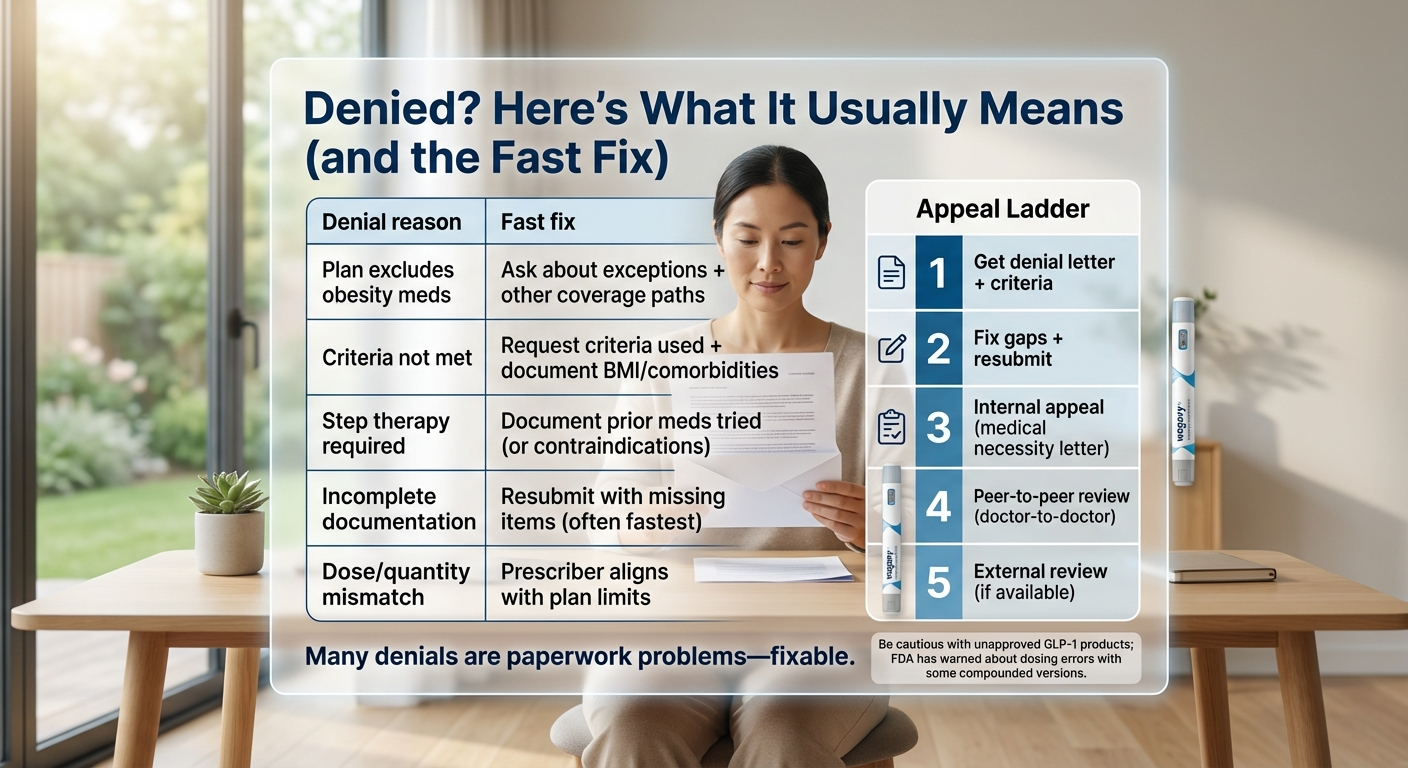
Here's the number that should give you hope: more than 80% of PA denials that were appealed were overturned in Medicare Advantage. Yet fewer than 1 in 10 patients ever bother to appeal. The people who appeal usually win. The people who give up never find out they would have.
Denial Decoder: What Your Denial Actually Means
| Denial Reason | What It Actually Means | Your Next Move | Who Does It |
|---|---|---|---|
| “Not medically necessary” | Insurer says you don't meet their clinical criteria | Appeal with detailed BMI documentation, comorbidity evidence, and medical necessity letter | Your doctor + you |
| “Step therapy required” | You haven't tried cheaper meds first (phentermine, Contrave, Qsymia) | Document prior medication trials — dates, doses, duration, and why you stopped. Or request a step therapy override. | Your doctor |
| “Plan exclusion / benefit not covered” | Your plan doesn't cover weight-loss medications at all | Request a formulary exception. Cite obesity as a disease (AMA) and Wegovy's CV benefits (SELECT trial). Consider Plan B. | Your doctor + you |
| “Incomplete documentation” | Form was missing required info | Easiest fix — resubmit with complete records. Usually not a true denial. | Your doctor's office |
| “Formulary restriction” | Insurer prefers a different GLP-1 | Ask about the preferred medication, or request a formulary exception explaining why Wegovy specifically is needed | Your doctor |
| “Quantity limit / dose mismatch” | Dose prescribed doesn't match what the plan approves | Doctor adjusts to approved dosing schedule, or documents medical justification for the specific dose | Your doctor |
First thing to do after a denial: Call your insurer and ask for the denial in writing, including the specific reason code and the policy criteria they used to evaluate your request. You need this to build your appeal.
The Appeal Playbook (Step by Step)
Think of this like a calm, organized conversation — not a fight. Your goal is to give the insurer the evidence they need to say yes.
Need more detail? See our complete step-by-step guide: How to Appeal a Wegovy or Zepbound Denial (7 Real Steps, 2026)
The Reason to Try: Real Appeal Success Data
A Government Accountability Office study found that 39–59% of internal insurance appeals succeed even without additional evidence. With complete documentation, your odds are significantly better. And if internal appeals fail, you have the right to an external review by an independent third party under the Affordable Care Act.
Identify the Denial Type
Go back to the 3-gate framework:
- Gate 1 denial (plan exclusion): You need a formulary exception or a different strategy entirely
- Gate 2 denial (criteria not met): You need better documentation proving you qualify
- Gate 3 denial (paperwork issues): You need to resubmit with complete information
Build Your Appeal Packet
Your doctor's office will typically handle the appeal submission, but you can prepare the materials. The medical necessity letter should include:
- Your weight history and BMI documentation
- All weight-related comorbidities with diagnosis codes
- Prior weight-loss attempts (diet, exercise, other medications — with dates and outcomes)
- Clinical evidence supporting Wegovy (cite the STEP trials for weight loss or the SELECT trial for cardiovascular benefit)
- Why alternative treatments are insufficient for your case
- A specific statement from your doctor explaining why Wegovy is medically necessary for you
Novo Nordisk provides a sample appeal letter template you can download at NovoCare.com. It's a helpful starting point.
Request a Peer-to-Peer Review
This is one of the most effective appeal tools — and most patients don't know about it. A peer-to-peer review is a phone call between your prescribing doctor and the insurance company's medical director.
Tips for your doctor's peer-to-peer call:
- Focus on medical necessity, not patient preference
- Cite specific clinical data (SELECT trial, STEP trials)
- Document failed alternatives and why they're inadequate
- Be concise and professional
External Review (If Internal Appeal Fails)
If your internal appeal is denied, you have the right to request an external review by an independent third-party organization. This is guaranteed under the Affordable Care Act for plans created after March 2010. Your denial letter should include instructions on how to request this.
Your appeal timeline: You typically have 180 days from the denial to file an internal appeal (check your specific denial letter for the exact deadline). Don't wait — the sooner you appeal, the sooner you can get back on track.
Don't Lose Momentum While You Appeal
Appeals take time. If you don't want to pause your weight-loss progress while fighting the insurance battle, telehealth weight-loss programs offer semaglutide starting at $179/month with no prior authorization required — so you can begin treatment now and transition to brand-name Wegovy if your appeal succeeds.
Telehealth providers listed include affiliate partners. See our ranking methodology.
How Can I Get Semaglutide Without Insurance Coverage?
If your plan excludes weight-loss medications, your PA was denied after appeal, or you're uninsured — you're not out of options. Here are the most accessible paths to semaglutide in 2026, ranked from most to least affordable.
Option 1: Oral Wegovy Pill (FDA-Approved, Self-Pay)
The FDA approved oral Wegovy (semaglutide 25mg tablet) on December 22, 2025. It's now available at over 70,000 US pharmacies.
$149/mo
Starting dose (1.5mg)
Up to $299/mo
Maintenance doses (up to 25mg)
$25/mo
With insurance + savings card
- Same semaglutide molecule as injectable Wegovy
- Taken once daily (instead of weekly injection)
- No refrigeration required
- Must be taken 30 minutes before food, drink, or other medications
- Clinical trials showed ~17% weight loss in adherent patients over 64 weeks (OASIS 4 trial) — comparable to the injection
Option 2: Novo Nordisk Savings Programs
- NovoCare Savings Card: Eligible commercially insured patients may pay as little as $25/month, subject to a maximum savings of $100 per 1-month prescription. Not available to government insurance beneficiaries (Medicare, Medicaid, TRICARE, VA).
- NovoCare Patient Assistance Program (PAP): Free Wegovy for qualifying uninsured, low-income patients. Eligibility requirements apply.
- New self-pay pricing: Novo Nordisk reduced starter-dose pricing to ~$149/month through NovoCare Pharmacy as part of a 2025 agreement. Call 1-888-809-3942 for current details.
Option 3: Compounded Semaglutide Through Telehealth
If brand-name Wegovy is out of reach financially and you don't qualify for assistance programs, compounded semaglutide through licensed telehealth programs is another path.
Compounded products marketed as “semaglutide” are prepared by licensed US compounding pharmacies (503A/503B facilities). They are NOT FDA-approved as finished products. The FDA has warned that some compounded products use semaglutide salt forms (such as semaglutide sodium or acetate), which are different active ingredients than those used in approved semaglutide drugs. If you consider compounded semaglutide, ask: (1) which form is used, (2) the pharmacy name and license type, and (3) whether it is a state-licensed 503A pharmacy or an FDA-registered 503B outsourcing facility.
How it works: You complete an online medical evaluation, a licensed physician reviews your information, and medication is shipped to your door. No prior authorization. No insurance required. No waiting. Learn more about compounded semaglutide safety.
Option 4: Pharmacy Discount Cards
GoodRx, SingleCare, and Optum Perks can reduce brand-name Wegovy injection costs, though even with coupons you're typically looking at $800–$1,200/month. These are most useful if you have partial coverage and need help with copays.
Decision Guide: Which Path Is Right for You?
Insurance covers Wegovy + PA approved: Fill your prescription. Use NovoCare savings card for copay help.
Insurance covers Wegovy + PA denied: Appeal first (80%+ of appealed MA denials are overturned). Consider oral Wegovy self-pay ($149/mo) as a bridge while you appeal.
Insurance excludes weight-loss meds entirely: Self-pay oral Wegovy ($149–$299/mo) or compounded semaglutide through telehealth ($179–$299/mo).
Uninsured: Check NovoCare PAP eligibility first. Then self-pay oral Wegovy or compounded semaglutide.
Medicare: Not covered for weight loss. May be covered for cardiovascular risk reduction. Self-pay oral Wegovy or compounded semaglutide if ineligible.
Does the New Oral Wegovy Pill Require Prior Authorization?
If going through insurance: Yes. The oral Wegovy pill requires the same PA process as the injection — same drug, same FDA-approved indications, same insurer criteria.
If paying out of pocket (self-pay): No. No PA needed. You get a prescription, you fill it, you pay the listed price. That's it.
This is why the oral Wegovy pill is a genuine game-changer for access. At $149/month for the starting dose, the math changes for a lot of people. For comparison:
| Injectable Wegovy | Oral Wegovy Pill | Compounded Semaglutide | |
|---|---|---|---|
| FDA-approved? | Yes | Yes | No (facility is FDA-regulated) |
| Monthly cost (self-pay) | ~$1,349 | $149–$299 | $179–$299 |
| How taken | Weekly injection | Daily pill | Weekly injection or daily tablet |
| Refrigeration needed? | Yes | No | Varies |
| PA required? | If using insurance | If using insurance | No (cash-pay) |
| Weight loss (trials) | ~15% average | ~14–17% average | Not independently studied |
The bottom line: if you're frustrated with the PA process and your primary concern is access and cost, oral Wegovy at $149–$299/month removes a lot of barriers. Learn more in our Wegovy pill cost and availability guide.
How Do I Renew Wegovy Prior Authorization?
Most insurers approve Wegovy for an initial period of 3–6 months. After that, you'll need reauthorization — your insurer wants to see that the medication is working before they keep paying for it.
What Most Insurers Require for Renewal
What If You Haven't Lost 5%?
Don't assume it's over. You have options:
Document everything else that's improved. Blood pressure down? A1C improved? Sleep apnea less severe? Mobility increased? Cholesterol better? These are all legitimate evidence that the medication is providing clinical benefit, even if the scale isn't moving as fast as the insurer's threshold.
Appeal the renewal denial. The same appeal process applies. Your doctor can write a letter explaining why continued treatment is medically justified despite not hitting the specific weight-loss number.
Start documenting from day one. Track your weight weekly, keep records of dietary changes and exercise, log any health improvements. This makes renewal paperwork seamless — and gives you strong appeal material if you need it.
Dose changes can trigger new PAs. If your doctor adjusts your Wegovy dose during treatment (which is standard — Wegovy uses a titration schedule from 0.25mg up to 2.4mg), some insurers may require a new PA for the higher dose. Ask your doctor's office to preemptively address dose escalation in the initial PA submission when possible.
The Wegovy PA Documentation Checklist
Print this. Bring it to your appointment. It's the single most useful thing we can give you.
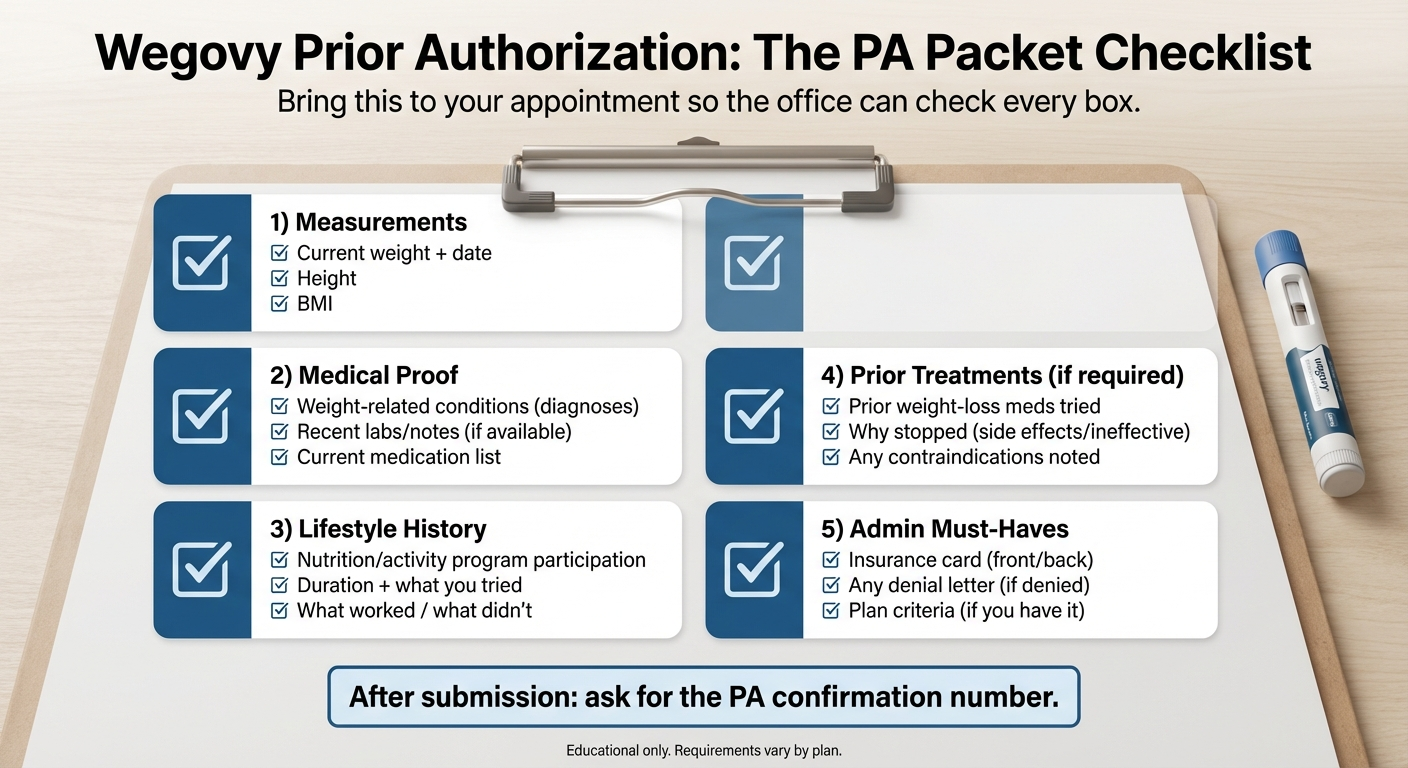
- Your current weight (will be measured at the visit)
- Weight history for the past 2–5 years (approximate weights and dates)
- List of all prior weight-loss attempts: diets, exercise programs, commercial programs (dates and outcomes)
- Prior weight-loss medication history: drug names, dates, doses, duration, and why you stopped (if step therapy is required)
- Records of weight-related health conditions: blood pressure readings, A1C or glucose results, lipid panel, sleep study results, PCOS documentation
- Proof of lifestyle modifications: nutritionist/dietitian visit records, gym membership, weight management program enrollment, wearable device activity summaries
- Your insurance card (front and back — your PBM name is usually listed)
- The specific PA criteria from your insurer (from the phone call in Step 1)
- PA form completion and submission
- Diagnosis codes (ICD-10)
- Clinical documentation / chart notes
- Statement of medical necessity
- Submission via CoverMyMeds, Surescripts, payer portal, or fax
- Get the PA submission confirmation number
- Note the expected timeline for a decision
- Set a reminder to follow up at day 3–5 if no response
- If denied: request the written denial with reason code and policy criteria used
What Wegovy Costs After PA Approval (So You're Not Surprised)
Getting PA approval doesn't mean Wegovy is free. Here's what to expect financially.
If Your Insurance Approves Wegovy
Copay plans: You'll pay a fixed amount per fill — commonly $30–$150/month for preferred medications, potentially more for non-preferred tiers.
Coinsurance plans: You'll pay a percentage of the drug's cost (often 20–40%) after meeting your deductible. For a $1,349/month medication, that can add up fast early in the year.
High-deductible plans: You may pay full cost until your deductible is met, then a copay or coinsurance kicks in.
Use the NovoCare Savings Card to reduce costs. Eligible commercially insured patients may pay as little as $25/month, subject to a maximum savings of $100 per 1-month prescription. It does NOT work with Medicare, Medicaid, or other government-funded plans.
If Your Insurance Denies or Excludes Wegovy
| Access Path | Monthly Cost | Notes |
|---|---|---|
| Brand-name Wegovy injection (cash) | ~$1,349 | Retail pharmacy, no discounts |
| Wegovy injection + GoodRx coupon | ~$800–$1,200 | Varies by pharmacy and location |
| Oral Wegovy pill (self-pay) | $149–$299 | Starting dose $149; maintenance up to $299 |
| NovoCare Patient Assistance Program | $0 | For qualifying uninsured, low-income patients |
| Compounded semaglutide (telehealth) | $179–$399 | Varies by program and dose. Not FDA-approved. |
The oral Wegovy pill has fundamentally changed the cost conversation. Before December 2025, patients without insurance were looking at $1,000+/month for brand-name semaglutide. Now there's a $149/month FDA-approved option. That's a shift worth understanding. See our full GLP-1 cost breakdown.
Special Situations: TRICARE, VA, Medicare & Medicaid
TRICARE uses Express Scripts as its pharmacy benefit manager and has the most demanding step therapy requirements. You must have tried and failed (or have a documented contraindication to) all three of the following before Wegovy will be approved:
- Generic phentermine
- Qsymia (phentermine/topiramate)
- Contrave (naltrexone/bupropion)
For each prior medication, you'll need to document: the dates you took it, how long you took it, and why you stopped (ineffective, side effects, contraindication). For continuation/renewal, TRICARE requires proof that you've lost ≥5% of body weight (adults) or ≥4% (adolescents ages 12–17).
Active duty members: Even if the TRICARE PA form indicates coverage won't be approved, it still must be submitted to the TPharm Contractor for initial review. Follow your Military Treatment Facility's specific weight management program requirements.
The VA maintains its own “Criteria for Use” (CFU) document for Wegovy/semaglutide for weight management, reviewed and updated independently from commercial insurance criteria. The VA system doesn't use traditional “prior authorization” — instead, your VA provider must document that you meet the VA's specific criteria before prescribing.
- The VA's criteria are clinically focused, not driven by cost containment in the same way commercial plans operate
- Coverage decisions are made by VA pharmacists and the provider team, not an external PBM
- The VA has its own formulary, and Wegovy's placement on it affects access at your specific facility
Consult with your VA provider directly and reference the VA Criteria for Use document (revised August 2025) for the most current requirements.
For weight loss: Medicare Part D does not currently cover Wegovy (or any medication) specifically for weight loss. Weight-loss drugs have been explicitly excluded from Medicare Part D coverage since the program's inception.
For cardiovascular risk reduction: Wegovy's March 2024 FDA approval for reducing heart attack and stroke risk opened a significant door. Because this indication is cardiovascular — not weight loss — it falls under a different coverage category. Some Medicare plans have begun covering Wegovy for the CV indication in patients who meet these criteria: age 45+, established cardiovascular disease, BMI ≥27, and using Wegovy alongside standard cardiac treatments.
As of July 1, 2026, CMS's Medicare GLP-1 Bridge provides eligible Part D beneficiaries access to Wegovy injection, Wegovy tablets, Foundayo, and Zepbound KwikPen for weight management at a flat $50/month copay. The Bridge runs through December 31, 2027. Eligibility requires a qualifying BMI and clinical criteria — visit CMS.gov for details. The longer-term BALANCE model expands Medicaid access starting May 2026.
Bottom line for Medicare beneficiaries: If you have cardiovascular disease and obesity/overweight, the CV indication may open traditional Part D coverage. If not, the Medicare GLP-1 Bridge offers $50/month access through December 2027 — the most direct path for Medicare patients right now.
Medicaid coverage for Wegovy varies dramatically by state. Many state Medicaid programs exclude weight-loss medications entirely, while others cover them with prior authorization. If you're on Medicaid and your state doesn't cover Wegovy, your options are similar to those without insurance: self-pay oral Wegovy, NovoCare patient assistance (if eligible), or compounded semaglutide through telehealth.
What Real Patients Say About the PA Process
Navigating the PA process is an emotional experience, and it helps to know you're not alone.
“I first tried my doctor and she tried to get me approved for name brand Wegovy. My insurance said ‘Nope,’ not paying. In fact, my insurance plan doesn't even cover a nutritionist to help someone who was at 260 pounds and 5'2″ lose weight to improve their comorbidities. I searched the internet for options... I got on board with [a compounded semaglutide] program approximately 31 pounds ago. I have steadily lost 5 to 6 pounds a month.”
— ConsumerAffairs reviewer (2025)
“When I received my denial letter from my insurance I was devastated and started searching how to write an appeal letter.”
— Patient testimonial, Trustpilot (2025)
The pattern we see: people who persist — whether through successful appeals, alternative access paths, or a combination — tend to find a way. The PA process can feel like a wall, but it's really a door with a lock. And you now have the keys.
Wegovy Safety: Why Plans Have These Requirements
Wegovy carries an FDA boxed warning about the risk of thyroid C-cell tumors (based on animal studies). It's contraindicated in patients with a personal or family history of medullary thyroid carcinoma (MTC) or Multiple Endocrine Neoplasia syndrome type 2 (MEN 2). The most common side effects are gastrointestinal: nausea, diarrhea, vomiting, constipation, and abdominal pain. These are usually worst during the dose-escalation phase and improve over time. See our full overview of GLP-1 risks and downsides.
Insurers aren't being difficult for no reason — they're required to verify that medications with these profiles are being prescribed appropriately. The PA process, frustrating as it is, exists partly to ensure patient safety.
That said: many physicians and the AMA argue that the PA system has become overly burdensome, delaying access to medications that improve — and save — lives. A 2023 AMA survey found that 78% of physicians reported that prior authorization can lead to treatment abandonment by patients. The system needs reform. But in the meantime, this guide helps you work within it.
How We Verified This Guide
We built this guide by reviewing publicly available PA policy documents from each major insurer and PBM listed in our comparison table, including criteria PDFs from CVS Caremark, UnitedHealthcare, Aetna, Cigna, and TRICARE/Express Scripts. All clinical information is sourced from FDA prescribing information, the SELECT trial results, and the OASIS 4 trial data for oral Wegovy.
We updated this guide to reflect:
- The oral Wegovy pill (FDA-approved December 22, 2025)
- CVS Caremark's preferred GLP-1 status for Wegovy (effective July 1, 2025)
- The CMS Prior Authorization Final Rule (CMS-0057-F)
- The CMS BALANCE model for Medicare/Medicaid GLP-1 access (announced December 2025)
- Current Novo Nordisk self-pay pricing (verified February 2026)
Our standards: Insurer criteria sourced from official policy documents and linked directly. Clinical claims sourced from FDA labels and published trial data. “Provider-stated” information clearly distinguished from “verified by us.” Testimonials cited from public review platforms with source attribution.
This guide is not medical advice. Always consult with your healthcare provider about whether Wegovy is appropriate for your situation. We provide information to help you navigate the insurance process — your doctor makes the medical decisions.
The Final 5-Step Checklist
If you remember nothing else from this guide, remember these five steps:
Confirm Gate 1
Call your insurer. Is Wegovy on your formulary? Which PBM runs your pharmacy benefit? What are their specific PA criteria?
Confirm Gate 2
Check your plan's BMI and comorbidity requirements — don't rely on generic rules. Get the criteria in writing if possible.
Build the PA packet
Bring your weight history, comorbidity records, lifestyle modification evidence, and prior medication history to your doctor's appointment. Use the documentation checklist above.
Submit and track
Get the confirmation number. Follow up at day 3–5 if you haven't heard back. Note your approval expiration date.
If denied
Decode the denial reason. Fix what's missing. Appeal with your doctor's support. Use peer-to-peer review. And have a backup access plan — oral Wegovy self-pay ($149/mo) or compounded semaglutide through telehealth — so you don't lose momentum while you fight.
The insurance system makes this harder than it should be. But you're not powerless. You have the information, you have the checklist, and you have options. That's what this page was built to give you.
Skip the PA Process — Explore Semaglutide Options
If insurance coverage isn't working out, telehealth providers prescribe semaglutide (the same active ingredient in Wegovy) starting from around $179/month. No PA, no step therapy, no waiting.
Affiliate disclosure: We may earn a commission through partner links. This never affects our recommendations. Full disclosure.
Frequently Asked Questions About Wegovy Prior Authorization
Medical Disclaimer: This guide is for informational purposes only and does not constitute medical, legal, or insurance advice. Insurance coverage requirements change frequently. Always verify your specific plan's criteria by contacting your insurance provider directly. Wegovy (semaglutide) is a prescription medication with risks and potential side effects — see full prescribing information from Novo Nordisk. This content is not affiliated with or endorsed by Novo Nordisk.
• This guide is independently published. We're an affiliate site — not an insurer, not a pharmaceutical company, not a healthcare provider.