Disclosure: Some links on this site are affiliate links. If you purchase through these links, we may earn a commission at no extra cost to you. Thank you for supporting our site.
Best Oral Semaglutide for Weight Loss: The Complete 2026 Guide
Review scope: dosing, contraindications, safety warnings, drug interactions, and claim accuracy (not provider endorsement).

The Short Answer
Verdict: The best FDA-approved oral semaglutide for weight loss is Wegovy tablets (titrated up to 25 mg daily). In the pivotal 64-week trial, average weight loss was 13.6%. Rybelsus is oral semaglutide for diabetes (lower dose). Compounded oral products aren't FDA-approved—verify carefully.
If you want FDA-approved oral semaglutide for weight loss, you have one option: Wegovy tablets. You titrate through 1.5 mg → 4 mg → 9 mg → 25 mg, with 25 mg once daily as the maintenance dose. FDA approved December 22, 2025.
On pricing: Wegovy tablets have a list price around $1,349 per monthly package, but eligible self-pay programs (NovoCare Pharmacy, GoodRx for Weight Loss) offer $149/month for 1.5 mg and 4 mg doses (4 mg offer available through August 31, 2026, then $199), and $299/month for 9 mg and 25 mg doses. Always confirm current pricing before ordering.
Rybelsus is also oral semaglutide, but it's only FDA-approved for type 2 diabetes—not weight loss. The doses are lower (max 14mg vs. Wegovy's 25mg), and while some doctors prescribe it off-label for weight management, the results aren't as strong.
Quick Comparison: Oral Semaglutide Options
| Option | FDA-Approved For | Max Dose | Avg Weight Loss | Monthly Cost |
|---|---|---|---|---|
| Wegovy Pill | Weight loss, CV risk | 25mg daily | 13.6% | $149-$299 (self-pay programs) |
| Rybelsus | Type 2 diabetes | 14mg daily | ~5-6% | $900-$1,400+ |
| Compounded Tablets | Not FDA-approved | Varies | Varies | $200-$369 |
The honest trade-off: Oral semaglutide requires a strict morning routine—empty stomach, tiny sip of water, wait 30+ minutes before eating or drinking anything else. If your mornings are chaotic or you take thyroid medication, the weekly injection might actually be simpler for you. For a detailed breakdown of the differences, see our oral semaglutide vs injectable comparison.
Below, we'll cover everything: how it works, what it costs, how to take it correctly, side effects, where to get it safely, and how to avoid scams. By the end, you'll know exactly which option fits your situation.
What Is Oral Semaglutide?
Oral semaglutide is the same medication found in Ozempic and Wegovy—just in pill form instead of an injection. It belongs to a class of drugs called GLP-1 receptor agonists, which work by mimicking a hormone your body naturally produces after eating.
Here's what it does in plain terms:
- Reduces appetite by sending "I'm full" signals to your brain
- Slows stomach emptying so you feel satisfied longer after meals
- Helps regulate blood sugar by improving how your body uses insulin
- May reduce food cravings, particularly for high-fat and sweet foods
The reason oral semaglutide exists at all is actually pretty interesting. Peptide drugs like semaglutide normally get destroyed by stomach acid—that's why most GLP-1 medications are injections. But Novo Nordisk (the manufacturer) developed a technology called SNAC (sodium N-[8-(2-hydroxybenzoyl) amino] caprylate) that protects the medication long enough for it to be absorbed through your stomach lining.
This is why the dosing instructions are so specific. The SNAC technology only works under certain conditions: empty stomach, minimal water, and enough time for absorption before food interferes.
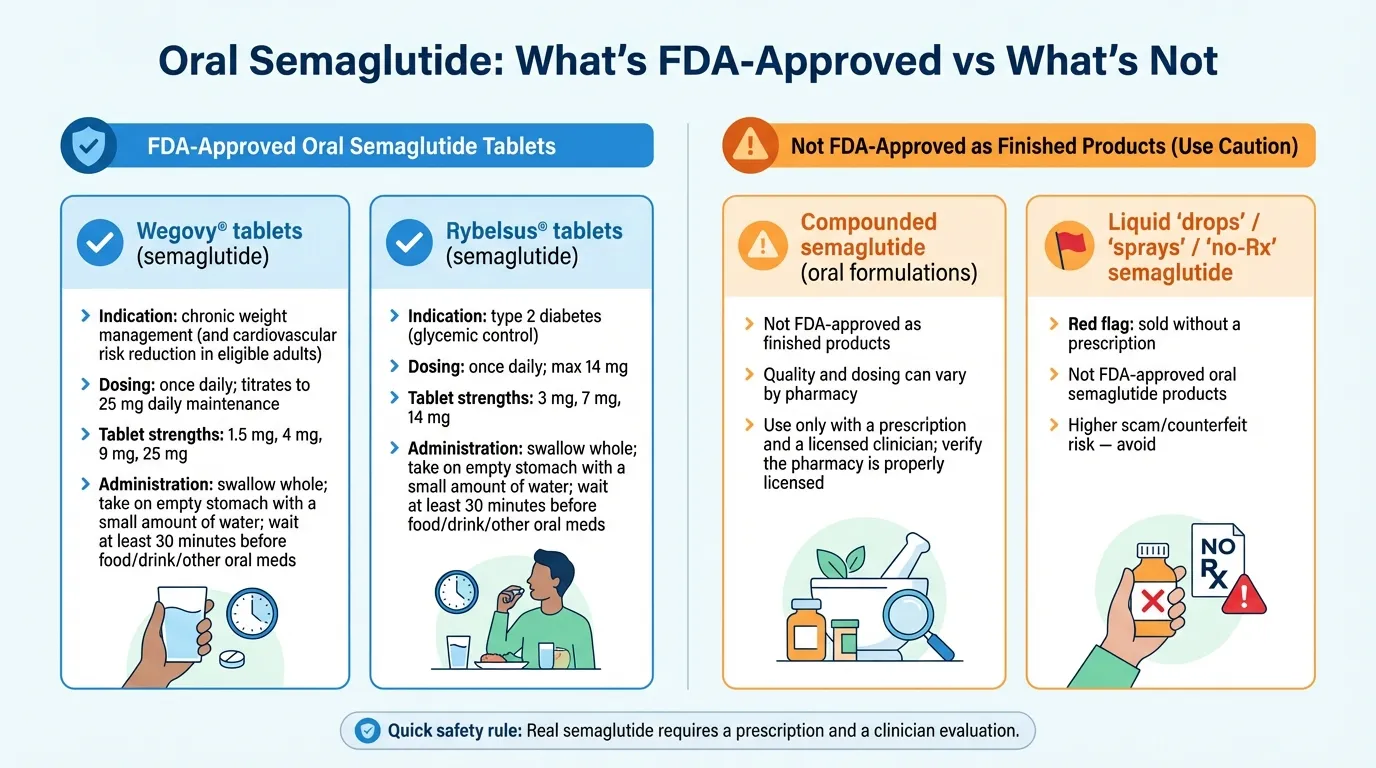
The Two FDA-Approved Oral Semaglutide Products
1. Wegovy Tablets (semaglutide 25mg)
- FDA-approved for chronic weight management in adults with obesity (BMI ≥30) or overweight (BMI ≥27) with at least one weight-related condition
- Also approved to reduce cardiovascular risk in adults with established heart disease and obesity/overweight
- Maintenance dose: 25mg once daily
- FDA approved December 22, 2025
2. Rybelsus (semaglutide 3mg, 7mg, 14mg)
- FDA-approved for type 2 diabetes management
- NOT FDA-approved for weight loss (though sometimes prescribed off-label)
- Maximum dose: 14mg once daily
- Available since 2019
The key difference is the dose. Wegovy tablets go up to 25mg daily, while Rybelsus maxes out at 14mg. Higher doses mean stronger appetite suppression and more weight loss—which is why Wegovy produces significantly better weight loss results than Rybelsus.
What Doesn't Count as "Real" Oral Semaglutide
You'll find a lot of products online claiming to be oral semaglutide. Many of them aren't what they claim to be:
- "Oral semaglutide drops" or "sublingual semaglutide" – These are compounded products, not FDA-approved medications
- "Semaglutide research chemicals" – Not approved for human use
- "Semaglutide sprays" – Not a legitimate delivery method
- Products that don't require a prescription – Semaglutide is a prescription-only medication
The FDA has issued multiple warnings about unapproved GLP-1 products being sold for weight loss. Some have been found to contain incorrect doses, contamination, or different ingredients than advertised. We'll cover how to spot these scams later in this guide.
Is Oral Semaglutide FDA-Approved for Weight Loss?
Yes—but only one oral semaglutide product is FDA-approved specifically for weight loss: Wegovy tablets.
The FDA approved Wegovy tablets on December 22, 2025, making it the first oral GLP-1 medication approved for chronic weight management. This was a significant milestone because previously, all FDA-approved GLP-1 weight loss medications required injections.
What Wegovy Tablets Are Approved For
According to the FDA prescribing information, Wegovy tablets are indicated for:
- Chronic weight management in adults with:
- Obesity (BMI ≥30), OR
- Overweight (BMI ≥27) with at least one weight-related condition (high blood pressure, type 2 diabetes, high cholesterol, obstructive sleep apnea, or cardiovascular disease)
- Reducing cardiovascular risk (heart attack, stroke, or cardiovascular death) in adults with:
- Established cardiovascular disease, AND
- Either obesity or overweight
The approval was based on the OASIS 4 clinical trial, which we'll discuss in detail in the next section.
What About Rybelsus for Weight Loss?
Rybelsus is only FDA-approved for type 2 diabetes—not weight loss. However, some healthcare providers prescribe it "off-label" for weight management, particularly for patients who also have diabetes or prediabetes.
Off-label prescribing is legal and common in medicine, but there are important differences:
- Lower doses (max 14mg vs. 25mg) mean less weight loss
- Insurance may not cover it for weight loss since that's not the approved use
- Clinical trial data for weight loss is more limited compared to Wegovy
If your primary goal is weight loss and you don't have type 2 diabetes, Wegovy tablets are the better choice—assuming cost and access aren't barriers.
How Much Weight Can You Actually Lose?
Let's look at what the clinical trials actually showed, because this is where a lot of websites exaggerate or cherry-pick data.
The OASIS 4 Trial (Wegovy Tablets)
The FDA approval for Wegovy tablets was based primarily on the OASIS 4 trial, published in the New England Journal of Medicine. Here's what happened:
- 307 adults with obesity or overweight (plus at least one weight-related condition) were enrolled
- Participants were randomized to receive either oral semaglutide 25mg or placebo
- Everyone also received lifestyle counseling (reduced-calorie diet + increased physical activity)
- The trial lasted 64 weeks
OASIS 4 Trial Results:
| Outcome | Wegovy (semaglutide 25mg) | Placebo |
|---|---|---|
| Average weight loss | 13.6% | 2.2% |
| Lost ≥5% of body weight | 76% | 31% |
| Lost ≥10% of body weight | 59% | 13% |
| Lost ≥15% of body weight | 42% | 6% |
| Lost ≥20% of body weight | 25% | 2% |
Source: Wharton S, et al. N Engl J Med. 2025
To put this in real numbers: if you weigh 220 pounds, a 13.6% loss means losing about 30 pounds over 64 weeks (roughly 15 months).
The "If Everyone Stayed on Treatment" Number
You may see ~16.6% cited in analyses that estimate results under full adherence ("trial product estimand")—essentially, the estimated results if everyone had stayed on treatment and taken their medication as directed. In reality, some people stop taking the medication (due to side effects, cost, or other reasons), which is why the "real-world" number of 13.6% is more useful for setting expectations. Individual results vary widely—some people lose substantially more than average, others less.
How Does This Compare to Wegovy Injections?
The STEP trials studied injectable Wegovy (2.4mg weekly). Here's a comparison:
| Metric | Wegovy Pill (25mg daily) | Wegovy Injection (2.4mg weekly) |
|---|---|---|
| Trial duration | 64 weeks | 68 weeks |
| Average weight loss | 13.6% | 14.9% |
| Achieved ≥5% loss | 76% | 86% |
| Achieved ≥10% loss | 59% | 69% |
| Achieved ≥15% loss | 42% | 51% |
Sources: OASIS 4 (2025), STEP 1 (2021)
Important note: These are different trials in different populations, so treat this as a cross-study comparison, not a head-to-head trial.
The injection produces slightly better results—about 1-2 percentage points more weight loss on average. For most people, this difference is small enough that the choice comes down to other factors: needle comfort, daily vs. weekly dosing, morning routine flexibility, and cost. For a deeper dive on this decision, see our full oral semaglutide vs injectable comparison.
What to Realistically Expect
Weight loss with oral semaglutide isn't instant. Here's a general timeline based on clinical trial data and patient reports:
- Weeks 1-4: Reduced appetite becomes noticeable. Scale may not move much yet.
- Weeks 4-8: Most people start seeing measurable weight loss (3-5% of starting weight).
- Weeks 8-16: Dose increases continue. Weight loss accelerates for many people.
- Weeks 16-40: Approaching maintenance dose. Steady weight loss continues.
- Weeks 40-64+: Maximum effects typically reached. Weight stabilizes at new baseline.
Some important caveats:
- Individual results vary significantly. Some people lose 25%+ of their body weight; others lose 5%.
- Weight loss isn't linear. Plateaus are normal and don't mean the medication stopped working.
- Diet and exercise still matter. The trials included lifestyle intervention—the pill isn't a replacement for healthy habits.
- Stopping the medication often leads to weight regain. This is true for all obesity medications, not just semaglutide.
Oral vs. Injectable Semaglutide: Which Is Better?
This is one of the most common questions people ask, and the honest answer is: it depends on your lifestyle and preferences.
The Case for Oral Semaglutide (Wegovy Pill)
Choose oral if:
- You have needle anxiety or phobia
- You prefer a daily routine over remembering a weekly injection
- You travel frequently and don't want to deal with keeping injections cold
- The idea of self-injection is a significant barrier to starting treatment
- You can reliably follow the empty-stomach morning routine
Advantages:
- No needles
- Room temperature storage (no refrigeration needed)
- More discreet—looks like any other pill bottle
- Daily dosing may feel more "routine" for some people
Disadvantages:
- Strict timing requirements (empty stomach, 30-minute wait)
- Can't take with other morning medications at the same time
- Slightly lower weight loss on average (13.6% vs. 14.9%)
- Must take every single day (vs. once weekly)
The Case for Injectable Semaglutide (Wegovy Injection)
Choose injectable if:
- You're comfortable with (or can tolerate) needles
- Your mornings are unpredictable or chaotic
- You take other medications first thing in the morning (especially thyroid meds)
- You want maximum possible weight loss
- Once-weekly dosing fits your lifestyle better than daily
- You work shift schedules or frequently cross time zones
Advantages:
- Flexible timing (can take any time of day, with or without food)
- Only once per week
- Slightly better weight loss results on average
- No interaction with morning routines or other medications' timing
Disadvantages:
- Requires self-injection (thin needle, but still)
- Needs refrigeration (until first use; then room temp for up to 28 days)
- Self-pay programs typically $199-$349/month (list price ~$1,349)
- Some people experience injection site reactions
Head-to-Head Comparison
| Factor | Oral (Wegovy Pill) | Injectable (Wegovy) |
|---|---|---|
| Administration | Daily pill | Weekly injection |
| Needles | None | Yes (very thin) |
| Timing rules | Strict (empty stomach, 30-min wait) | Flexible (any time, any day) |
| Average weight loss | 13.6% at 64 weeks | 14.9% at 68 weeks |
| Storage | Room temperature | Refrigerated (pen unused) |
| Travel-friendly | Yes | Needs cold pack |
| Cost (typical self-pay) | $149-$299/mo | $199-$349/mo |
| Best for | Needle-averse, routine-oriented | Max results, flexible schedule |
Who Should Strongly Consider Injections Instead
Even if you prefer pills, injections might be the better practical choice if:
- You take levothyroxine (thyroid medication) – Both require empty-stomach timing, and taking them together affects absorption. Spacing them 4+ hours apart is difficult.
- You work irregular shifts – The strict morning timing for oral semaglutide doesn't work well with rotating schedules.
- You frequently forget daily medications – Missing the oral dose means skipping that day entirely. Missing an injection day gives you more flexibility to take it late.
- You have conditions affecting stomach absorption – Gastric bypass, severe gastroparesis, or other GI conditions may affect how well oral semaglutide works.
Learn more about all GLP-1s for weight loss including tirzepatide options.
How to Take Oral Semaglutide Correctly
This section matters more than you might think. The strict administration rules aren't arbitrary—they directly affect whether the medication works.
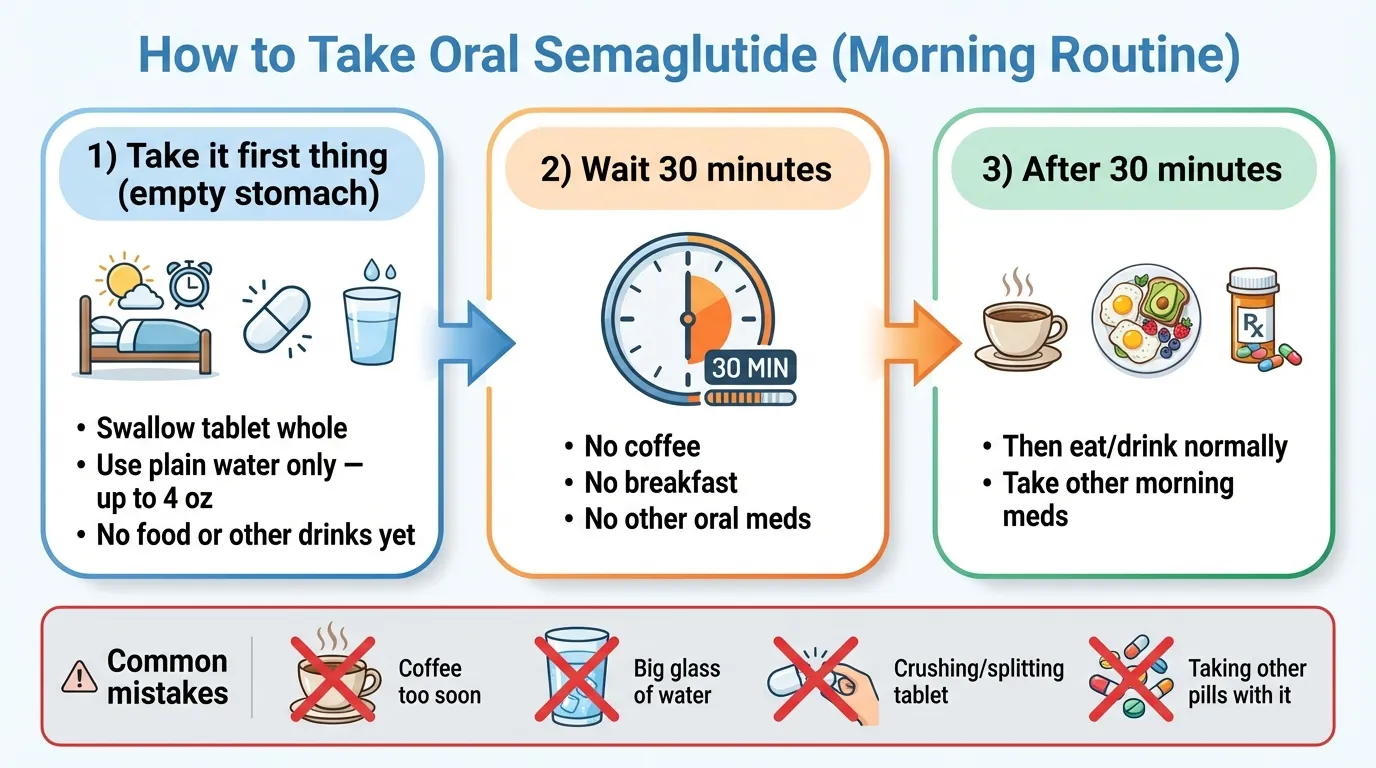
The Non-Negotiable Rules (Wegovy Tablets)
Based on the FDA prescribing information:
- Take on an empty stomach – First thing in the morning, before eating or drinking anything except water
- Use only plain water – No coffee, juice, tea, or other beverages. Just water.
- Use minimal water – 4 ounces (about half a glass) or less. More water actually dilutes the stomach conditions needed for absorption.
- Swallow whole – Do NOT split, crush, chew, or dissolve the tablet. The formulation is designed to release in a specific way.
- Wait at least 30 minutes – Before eating, drinking anything other than water, or taking other oral medications.
Why These Rules Exist
The SNAC absorption technology in Wegovy tablets is sensitive to stomach conditions:
- Food in your stomach creates a barrier that prevents absorption
- Too much water dilutes the local pH changes that protect the medication
- Other liquids (especially acidic ones like coffee or juice) interfere with the absorption process
- Other medications can compete for absorption or change stomach chemistry
According to the FDA label, if you take it with food, beverages (other than water), or other oral meds—or you don't wait the full 30 minutes—the medication may be less effective.
The Practical Morning Routine
Here's how to make this work in real life:
Before bed:
- Put your Wegovy pill bottle and a small glass of water on your nightstand
- Set an alarm for 30+ minutes before you need to eat breakfast
When you wake up:
- Take one tablet immediately with a small sip of water (≤4 oz)
- Set a 30-minute timer on your phone
- Go about your morning: shower, get dressed, check email—just don't eat or drink
- When the timer goes off, you're free to have breakfast, coffee, and other medications
Common mistakes to avoid:
- ❌ Taking a big gulp of water to wash down the pill
- ❌ Having "just a sip" of coffee while waiting
- ❌ Taking your thyroid medication at the same time
- ❌ Eating after only 20 minutes because you're running late
- ❌ Crushing the pill because it's easier to swallow
- ❌ Storing pills in a different container (keep in original bottle)
What If You Miss a Dose?
Per the FDA prescribing information:
- If you miss a dose: Skip it and take your next dose the following day at your regular time
- Don't double up: Never take two tablets to make up for a missed dose
- If you've missed several days in a row: Ask your prescriber for guidance before resuming
Missing occasional doses happens to everyone. But if you're regularly missing doses, talk to your healthcare provider—the weekly injection might be a better fit for your lifestyle.
Travel and Time Zone Tips
Oral semaglutide can be tricky when traveling:
- Short trips (1-3 time zones): Keep taking it at your usual home time if possible
- Long trips (4+ time zones): Gradually shift your dosing time by 1-2 hours per day
- International travel: Pack pills in carry-on (not checked luggage) with the original prescription label
- Storage advantage: Unlike injections, Wegovy tablets don't need refrigeration—store at room temperature (68-77°F)
The Complete Dosing Schedule
Oral semaglutide uses a gradual "titration" schedule—you start at a low dose and increase over several months. This approach significantly reduces side effects, especially nausea.
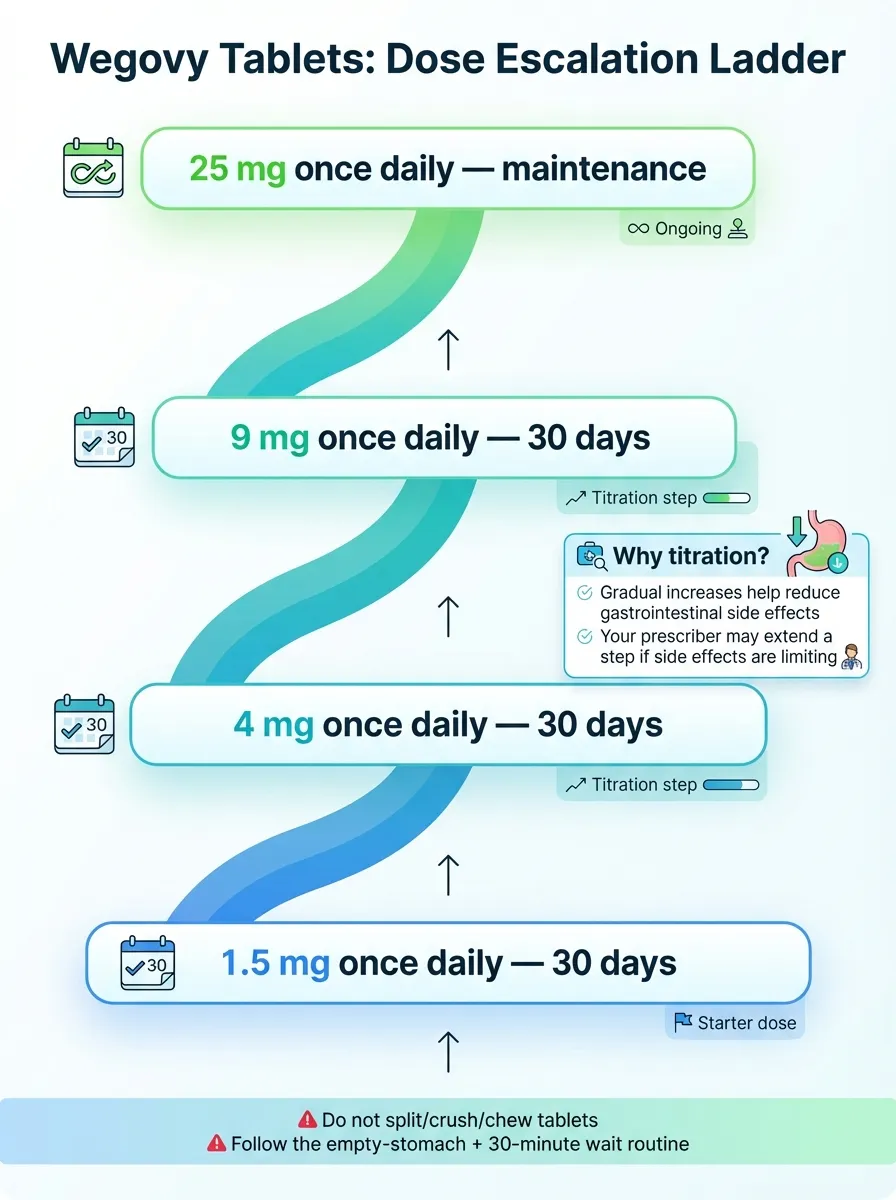
Wegovy Tablets Titration Schedule
| Phase | Dose | Duration | Purpose |
|---|---|---|---|
| Week 1-4 | 1.5 mg daily | 30 days | Let your body adjust |
| Week 5-8 | 4 mg daily | 30 days | Gradual increase |
| Week 9-12 | 9 mg daily | 30 days | Building tolerance |
| Week 13+ | 25 mg daily | Ongoing | Maintenance dose |
Your healthcare provider may adjust this schedule based on how you tolerate the medication. If side effects are severe at a particular dose, you might stay at that level for an extra 4 weeks before increasing.
Rybelsus Dosing (If Prescribed Off-Label)
| Phase | Dose | Duration |
|---|---|---|
| Month 1 | 3 mg daily | 30 days |
| Month 2 | 7 mg daily | 30 days |
| Month 3+ | 14 mg daily | Ongoing |
Note: The maximum Rybelsus dose (14 mg) is significantly lower than Wegovy tablets (25 mg), which is why weight loss results are typically more modest.
What to Expect at Each Dose Level
1.5 mg (Weeks 1-4):
- Most people notice mild appetite changes
- Some experience mild nausea
- Weight loss is usually minimal at this dose
- This phase is primarily about letting your body adapt
4 mg (Weeks 5-8):
- Appetite suppression becomes more noticeable
- Nausea may increase temporarily then improve
- Some people start seeing scale movement
- Food preferences may start shifting (less interest in high-fat/sweet foods)
9 mg (Weeks 9-12):
- Full appetite effects typically emerge
- Weight loss usually accelerates
- Side effects often stabilize
- Most people feel noticeably different around food
25 mg (Week 13+):
- Maximum therapeutic dose
- Full weight loss effect achieved over following months
- Side effects generally stable (what you experience here is what to expect long-term)
Can You Stay on a Lower Dose?
Yes, if it's working for you. Some people achieve good results at 9 mg and prefer to stay there rather than move to 25 mg. The FDA label notes that "if the 9 mg dose is not tolerated, consider maintaining patients on 9 mg." However, clinical trial data shows that higher doses generally produce more weight loss. The 25 mg dose is what was studied in the OASIS 4 trial that showed 13.6% weight loss.
Switching Between Pill and Injection
It's possible to switch between Wegovy tablets and Wegovy injections under medical supervision:
From injection to pill:
- Stop Wegovy injection (2.4 mg weekly)
- Wait one week
- Start Wegovy tablets at 25 mg daily
From pill to injection:
- Stop Wegovy tablets (25 mg daily)
- Start Wegovy injection (2.4 mg weekly) the next day
If you don't tolerate Wegovy 25 mg tablets: The FDA label notes that switching to Wegovy injection 1.7 mg weekly may be considered. Your prescriber will provide specific guidance based on your situation. These aren't decisions to make on your own.
Side Effects and Safety Information
Like all medications, oral semaglutide causes side effects. Most are manageable, but some are serious. Here's what to know.
Common Side Effects
The most common side effects are gastrointestinal. From Wegovy clinical trials:
| Side Effect | Wegovy (semaglutide) | Placebo |
|---|---|---|
| Nausea | ~44% | ~17% |
| Diarrhea | ~30% | ~14% |
| Vomiting | ~24% | ~7% |
| Constipation | ~24% | ~11% |
| Abdominal pain | ~16% | ~7% |
| Headache | ~14% | ~10% |
| Fatigue | ~11% | ~5% |
| Dyspepsia (indigestion) | ~10% | ~4% |
Data from adult weight-loss trials. See FDA prescribing information for complete details.
Important context:
- Most GI side effects occur early (first few weeks) and during dose increases
- They typically improve as your body adjusts
- Eating smaller, bland meals can help
- Staying hydrated is important, especially if you have vomiting or diarrhea
- In adult weight-loss trials, 6.8% of Wegovy-treated patients discontinued due to adverse reactions vs. 3.2% with placebo
For detailed side effect management tips, see our GLP-1 SOS side effect relief guide.
Serious Warnings
The FDA prescribing information includes several important warnings:
Boxed Warning (Thyroid Tumors):
In animal studies, semaglutide caused thyroid C-cell tumors. It's unknown whether this happens in humans, but as a precaution:
- Wegovy is contraindicated if you have a personal or family history of medullary thyroid carcinoma (MTC)
- It's contraindicated if you have Multiple Endocrine Neoplasia syndrome type 2 (MEN 2)
Other Serious Risks:
- Pancreatitis: Inflammation of the pancreas has been reported. Seek immediate medical attention for severe, persistent abdominal pain.
- Gallbladder problems: Gallstones and gallbladder inflammation occur more frequently in people taking semaglutide.
- Kidney injury: Usually from dehydration due to vomiting or diarrhea. Stay hydrated.
- Diabetic retinopathy complications: In people with type 2 diabetes and history of diabetic eye disease.
- Hypoglycemia: When used with insulin or sulfonylureas in diabetic patients.
- Allergic reactions: Rare but can be serious. Stop taking and seek medical help if you experience swelling of face/throat or difficulty breathing.
- Suicidal thoughts: The FDA is monitoring reports of suicidal ideation with GLP-1 medications. Tell your provider if you experience mood changes.
- Planned surgery/anesthesia: Tell your clinician you're on a GLP-1—aspiration risk has been reported with GLP-1 receptor agonists during general anesthesia or deep sedation.
Call your doctor soon if:
- Nausea or vomiting that doesn't improve after several days
- Constipation lasting more than a week
- Persistent fatigue that affects daily life
- Mood changes or unusual thoughts
- Any new or worsening symptoms
Seek emergency care if:
- Severe abdominal pain that doesn't go away (possible pancreatitis)
- Signs of allergic reaction: swelling, difficulty breathing, severe rash
- Severe vomiting/diarrhea with signs of dehydration
- Severe upper right abdominal pain with fever (possible gallbladder)
- Thoughts of self-harm
Pregnancy and Breastfeeding
Pregnancy:
- Stop Wegovy tablets at least 2 months before you plan to become pregnant
- Semaglutide has a long half-life (~7 days), so it takes time to clear your system
- Animal studies showed fetal harm; avoid during pregnancy
Breastfeeding:
- Breastfeeding is not recommended during treatment with Wegovy tablets
- Wegovy tablets contain an absorption enhancer (SNAC / salcaprozate sodium)
- If you need GLP-1 treatment while breastfeeding, discuss alternatives with your doctor
Drug Interactions You Need to Know
This section doesn't get enough attention on most websites, but it matters—especially for people taking multiple medications.
How Oral Semaglutide Affects Other Drugs
Semaglutide slows gastric emptying (how fast food moves through your stomach). This can affect how other oral medications are absorbed.
According to the FDA prescribing information: "Wegovy causes a delay of gastric emptying and has the potential to impact the absorption of concomitantly administered oral medications."
For most common medications, this isn't clinically significant. But some drugs need closer monitoring.
The Levothyroxine Issue
This is the most practical drug interaction for many people:
When oral semaglutide (Rybelsus, in the study) was taken with levothyroxine (thyroid medication), the total exposure to levothyroxine increased by about 33%.
What this means:
- If you take levothyroxine, your dose might need adjustment
- Your doctor should monitor thyroid levels more closely
- Timing both medications (both require empty stomach) is complicated
Practical options if you take levothyroxine:
- Take levothyroxine, wait 4+ hours, then take oral semaglutide (awkward timing)
- Consider injectable semaglutide instead (no timing conflict)
- Work with your doctor to adjust levothyroxine dose based on lab monitoring
Other Medications to Discuss with Your Doctor
Medications that require clinical monitoring when taken with oral semaglutide:
- Narrow therapeutic index drugs: Medications where small changes in blood levels matter (certain seizure medications, warfarin, digoxin)
- Diabetes medications: Insulin and sulfonylureas increase hypoglycemia risk
- Blood pressure medications: Effects may need monitoring as you lose weight
- Oral contraceptives: In interaction studies with oral semaglutide, ethinylestradiol and levonorgestrel exposures were not meaningfully changed. However, if you've had breakthrough bleeding or take medications with strict timing, ask your prescriber for individualized guidance.
Medications that are generally fine:
Clinical studies showed no significant interactions with:
- Metformin
- Most common blood pressure medications
- Statins (cholesterol medications)
- Common pain relievers
The Bottom Line on Interactions
Before starting oral semaglutide, make a complete list of everything you take—including supplements—and review it with your prescriber. This isn't just a formality; it directly affects whether oral semaglutide is right for you versus the injectable form.
How Much Does Oral Semaglutide Cost?
Let's talk real numbers. Cost is often the deciding factor for which option people choose.
How we verify prices: We check provider websites monthly and note verification dates. Prices shown are provider-stated; always confirm at checkout.
FDA-Approved Wegovy Pill Pricing
List price: ~$1,349 per monthly package (same as the injection)
Self-pay programs (NovoCare Pharmacy, GoodRx for Weight Loss):
| Dose | Monthly Cost |
|---|---|
| 1.5 mg (starter) | $149 |
| 4 mg | $149 (through August 31, 2026), then $199 |
| 9 mg | $299 |
| 25 mg (maintenance) | $299 |
Note: Government beneficiaries (Medicare, Medicaid) are not eligible for these self-pay programs. Confirm current pricing at novocare.com or goodrx.com.
With commercial insurance + savings card:
- As low as $25/month if your insurance covers it (max savings $100/fill)
- Novo Nordisk offers a savings program for eligible commercially insured patients
Where to fill:
- Available at most retail pharmacies (CVS, Walgreens, Costco)
- Through telehealth providers (Ro, LifeMD, GoodRx for Weight Loss, Weight Watchers)
- NovoCare Pharmacy (Novo Nordisk's direct channel)
Rybelsus Pricing (If Prescribed Off-Label)
Rybelsus is significantly more expensive at retail:
| Dose | Retail Price | With GoodRx |
|---|---|---|
| 3 mg | ~$1,000/mo | ~$900/mo |
| 7 mg | ~$1,100/mo | ~$950/mo |
| 14 mg | ~$1,400/mo | ~$1,100/mo |
Insurance may cover Rybelsus for type 2 diabetes but often denies coverage for weight loss (since that's off-label use).
Compounded Oral Semaglutide
Several telehealth providers offer compounded oral semaglutide tablets or sublingual formulations at lower prices:
| Provider | First Month | Ongoing | Format |
|---|---|---|---|
| MEDVi | Starting at $249/mo | Tablets | |
| Willow | $299/mo (most dosages) | Tablets | |
| SynergyRx | Starting at $299/mo | Oral dissolving tablets | |
Pricing per provider websites. Confirm current pricing at checkout. Last verified: January 2026.
Important: Compounded medications are NOT FDA-approved as finished products. They're prepared by compounding pharmacies based on a prescription but don't undergo the same regulatory review as brand-name medications. More on this in the safety section.
Insurance Reality Check
Here's the frustrating truth about insurance coverage for weight loss medications:
- Most commercial plans have historically excluded weight loss medications
- Medicare Part D generally doesn't cover GLP-1s when prescribed only for weight loss, but it may cover Wegovy when prescribed for cardiovascular risk reduction in adults with established heart disease and obesity/overweight. Coverage depends on your specific Part D plan's formulary.
- Some employer plans are starting to cover GLP-1s (ask your HR department)
- Prior authorization is almost always required—your doctor must document medical necessity
- Step therapy may be required (trying cheaper options first)
The landscape is changing. More insurers are adding coverage as evidence for these medications grows. But for now, many people pay out of pocket. See our guide to getting GLP-1s without insurance.
Cost Comparison: Oral vs. Injectable
| Option | Monthly Cost (Self-Pay Programs) | List Price |
|---|---|---|
| Wegovy Pill | $149-$299 | ~$1,349 |
| Wegovy Injection | $199 (first 2 fills), then $349 | ~$1,349 |
| Compounded oral semaglutide | $200-$369 | N/A |
| Compounded injectable semaglutide | $179-$299 | N/A |
Self-pay program pricing through NovoCare Pharmacy. Government beneficiaries excluded.
For many people, the Wegovy pill's lower self-pay price (compared to the injection) makes the oral option more accessible.
Where to Get Oral Semaglutide Safely
There are legitimate ways to get oral semaglutide and dangerous ones. Here's how to navigate safely.
Option 1: Your Primary Care Doctor or Obesity Specialist
Pros:
- Insurance more likely to cover with in-person evaluation
- Full medical workup and monitoring
- Established relationship and medical history access
- Can manage other conditions simultaneously
Cons:
- Appointment wait times can be weeks to months
- Many PCPs aren't comfortable prescribing weight loss medications
- May require multiple visits for prior authorization paperwork
Best for: People with good insurance coverage, existing doctor relationship, and/or complex medical histories.
Option 2: Telehealth Providers
Pros:
- Fast access (often within days)
- No travel or waiting room time
- Many specialize in weight management
- Convenient for refills and follow-ups
Cons:
- Usually cash-pay only
- Quality varies significantly between providers
- May not coordinate well with your other healthcare
- Some aren't available in all states
Best for: People paying cash, seeking convenience, or whose local doctors don't prescribe weight loss medications.
Option 3: Endocrinologist or Cardiologist
Pros:
- Appropriate for complex cases (diabetes, heart disease)
- Can prescribe for cardiovascular risk reduction indication
- Often more experience with GLP-1 medications
Cons:
- Longer wait times for specialists
- May require referral from PCP
- Higher visit costs
Best for: People with type 2 diabetes, heart disease, or other conditions requiring specialist management.
What to Look for in Any Provider
Whether in-person or telehealth, verify that:
- ✓ Licensed prescribers – Physicians (MD/DO), nurse practitioners, or physician assistants licensed in your state
- ✓ Requires medical evaluation – No legitimate provider will prescribe without reviewing your health history
- ✓ Clear pharmacy information – You should know which pharmacy fills your prescription
- ✓ Follow-up care – Legitimate programs include ongoing monitoring, not just one-time prescriptions
- ✓ Refund/cancellation policies – Clearly stated terms before you pay
Online Provider Comparison
For people choosing the telehealth route, here's a comparison of providers offering oral semaglutide options.
How We Evaluated Providers
We looked at:
- Legitimacy: Licensed prescribers, pharmacy transparency, prescription requirements
- Product offerings: FDA-approved, compounded, or both
- Pricing: Total monthly cost including consultations and shipping
- Support: Follow-up care access, response times
- Transparency: Clear policies on refunds, cancellation, what's included
FDA-Approved Wegovy Pill Providers
These providers offer the actual FDA-approved Wegovy tablets:
| Provider | Monthly Cost | Insurance? | Notes |
|---|---|---|---|
| GoodRx for Weight Loss | $149-$299 | No | Cash price at 70,000+ pharmacies |
| Ro | $149-$299 + subscription | No | Includes coaching option |
| LifeMD | $149-$299 + consult fee | May help with PA | Established telehealth platform |
| Weight Watchers | $149-$299 + membership | No | Combines with WW program |
Compounded Oral Semaglutide Providers
For those seeking lower-cost alternatives to FDA-approved products:
Important distinction: Compounded "oral dissolving" or "sublingual" tablets are not the same as FDA-approved Wegovy tablets. FDA-approved oral semaglutide uses SNAC technology and must be swallowed whole on an empty stomach. Compounded versions use different delivery mechanisms and have different administration guidelines. If you want the cleanest evidence base, start with FDA-approved Wegovy tablets if you qualify and can access them.
MEDVi
Recommended for Compounded Oral Options- Cost: $249 first month, $369 ongoing (provider-stated pricing)
- What's included: Physician consultation, medication, shipping, 24/7 messaging support
- Format options: Injectable and oral dissolving tablets
- Why we recommend: Popular option for people seeking oral GLP-1 alternatives without the higher cost of brand-name medications
MEDVi specializes in making GLP-1 medications accessible. Their oral tablet formulation is convenient for those who want to avoid needles. Month-to-month billing, no long-term contracts.
Check Your Eligibility at MEDViWillow
- Cost: $249 first month, $349 ongoing (provider-stated)
- What's included: Provider consultation, medication, shipping
- Format: Sublingual tablets
- Notable: Clean interface, straightforward pricing
SynergyRx
- Cost: Starting at $200/month (provider-stated; confirm current pricing at checkout)
- What's included: Consultation, medication, shipping
- Format: Injectable and oral dissolving tablet options
- Notable: Competitive price point
Important Caveats About Compounded Products
Compounded medications differ from FDA-approved products in important ways:
- Not FDA-approved – The FDA doesn't review compounded products for safety, effectiveness, or quality before they're marketed
- Quality varies – Compounding pharmacy standards vary; look for pharmacies registered with FDA and state boards
- Different formulations – May use different delivery mechanisms than brand products
- Limited clinical data – The clinical trials supporting efficacy used FDA-approved products, not compounded versions
- FDA warnings exist – The FDA has expressed concerns about some unapproved GLP-1 products
Avoid semaglutide salt forms: The FDA has stated there's no evidence that semaglutide sodium or semaglutide acetate are equivalent to the base form. Reputable compounding pharmacies use semaglutide base, not salt forms.
The FDA states that compounding should generally occur when an FDA-approved medication is unavailable or when a patient has a specific medical need that commercial products can't meet.
That said, many people use compounded GLP-1 medications safely and effectively under physician supervision. If you choose this route, make sure you're working with a reputable provider using licensed U.S. compounding pharmacies. Compare all options at our best GLP-1 online programs comparison.
How We Verify Provider Claims
Transparency builds trust. Here's exactly how we evaluate the providers mentioned in this guide.
What We Check
Pricing verification:
- We go through each provider's checkout process to confirm actual prices
- We note any additional fees (consultation, shipping, membership)
- We screenshot pricing pages and note dates verified
- Last verification: January 2026
Licensing and legitimacy:
- We verify prescribers are licensed in states where they operate
- We confirm compounding pharmacies are registered with state boards
- We check for FDA facility registration where applicable
- We look for third-party certifications (LegitScript, etc.)
Our Editorial Standards
- Affiliate relationships don't determine rankings. Providers can't pay for placement. Our recommendations are based on the criteria above.
- We disclose clearly. If we earn a commission from a link, we tell you at the top of the page.
- We include non-affiliate options. We mention providers regardless of whether we have business relationships with them.
- Negative information gets published. If a provider has concerning policies or limitations, we note them—even for providers we recommend.
Learn more about how we rank providers and our editorial standards.
Managing Side Effects (Practical Tips)
Most side effects from oral semaglutide are manageable with the right strategies. Here's what actually works, based on clinical guidance and patient experience.
Nausea Management
Nausea is the most common side effect, affecting about 44% of people in clinical trials. Here's how to minimize it:
Dietary changes:
- Eat 5-6 smaller meals instead of 2-3 large ones
- Choose bland, low-fat foods (think: grilled chicken, rice, bananas, toast)
- Avoid greasy, spicy, or very rich foods—especially during dose increases
- Eat slowly and stop when you feel satisfied (not full)
- Don't lie down immediately after eating
What can help:
- Ginger (tea, ginger chews, or supplements)
- Staying well hydrated (between meals, not during)
- Over-the-counter options like Dramamine or Emetrol (check with your doctor)
- Prescription anti-nausea medication for severe cases
Constipation Management
About 24% of people experience constipation. Here's what helps:
- Increase fiber gradually—too fast can cause bloating
- Stay very well hydrated—aim for 64+ oz of water daily
- Stay physically active—even walking helps gut motility
- Prunes or prune juice work for many people
- Consider fiber supplements like psyllium husk
- MiraLAX is generally safe for occasional use (check with your doctor)
Diarrhea Management
Also common at about 30%. Try:
- Stay hydrated—this is critical to prevent dehydration
- Avoid high-fat and high-sugar foods
- Cut back on artificial sweeteners (especially sugar alcohols like sorbitol)
- Try the BRAT approach: bananas, rice, applesauce, toast
- Consider probiotics
General Strategies That Help Across the Board
- Don't eat until uncomfortably full. This is the single biggest trigger for multiple side effects.
- Keep a food diary to identify your personal trigger foods.
- Expect side effects during dose increases—they usually stabilize after a few weeks.
- Most people feel significantly better after 4-6 weeks at a stable dose.
How to Spot Scams and Fake Products
This section could save you from wasting money—or worse, harming your health.
FDA Warnings About Unapproved GLP-1 Products
The FDA has issued multiple warnings about GLP-1 products being sold without proper approval:
"FDA is aware of and concerned about drugs and other substances that appear to be unapproved versions of GLP-1 medications, such as semaglutide and tirzepatide, being marketed and sold for weight loss through various channels."
There have also been alerts about counterfeit Ozempic found in the U.S. drug supply chain.
Red Flags That a Product Is Fake or Unsafe
Immediate disqualifiers:
- 🚩 No prescription required – All legitimate semaglutide products require a prescription
- 🚩 "Research chemical" or "for research use only" – Not approved for human use
- 🚩 Significantly cheaper than market rate – If it's $50/month, it's not real semaglutide
- 🚩 Unusual formulations – "Semaglutide cream," "semaglutide nasal spray," or other non-standard delivery methods
- 🚩 No verifiable pharmacy – Can't identify which pharmacy fills prescriptions
- 🚩 Ships from outside the U.S. – Often counterfeit or unapproved products
- 🚩 Website has no contact information – Legitimate providers have phone numbers and addresses
- 🚩 Promises that sound too good – "Lose 50 pounds in 2 weeks" is not how any medication works
About "Oral Semaglutide Drops"
You'll see many products marketed as "oral semaglutide drops" or "sublingual semaglutide." These are:
- Compounded products – Prepared by compounding pharmacies, not the FDA-approved tablets
- Not the same as Wegovy tablets – Different formulation and delivery mechanism
- Variable quality – Depends on the compounding pharmacy's standards
Some compounded sublingual products are legitimate when prescribed by licensed providers and prepared by licensed pharmacies. Others are unregulated products of questionable quality.
If you're considering sublingual drops, verify:
- The prescriber is licensed in your state
- The compounding pharmacy is licensed and registered
- There's an actual medical evaluation before prescribing
Safe Buying Checklist
Before purchasing oral semaglutide from any source:
- ✓ Did you complete a medical questionnaire or consultation?
- ✓ Is a licensed prescriber reviewing your information?
- ✓ Can you verify the pharmacy's license?
- ✓ Is the pricing realistic (not suspiciously cheap)?
- ✓ Is there a phone number/email to contact the company?
- ✓ Are refund/cancellation policies clearly stated?
- ✓ Does the product name match an FDA-approved product OR is it explicitly disclosed as compounded?
Who Should (and Shouldn't) Take Oral Semaglutide
You May Be a Good Candidate If:
Medical criteria (for Wegovy tablets):
- BMI ≥30 (obesity), OR
- BMI 27-29.9 (overweight) with at least one of:
- High blood pressure
- Type 2 diabetes
- High cholesterol
- Obstructive sleep apnea
- Cardiovascular disease
Lifestyle factors:
- You can follow a consistent morning routine (empty stomach, 30-min wait)
- You're motivated to make dietary and activity changes alongside medication
- You don't have needle phobia (but prefer pills) OR you have needle phobia
- You're committed to long-term treatment (these aren't short-term medications)
You Should NOT Take Oral Semaglutide If:
Medical contraindications:
- Personal or family history of medullary thyroid carcinoma (MTC)
- Multiple Endocrine Neoplasia syndrome type 2 (MEN 2)
- Known serious hypersensitivity to semaglutide or any ingredient
- Currently taking another GLP-1 medication (can't combine)
- Currently taking another semaglutide product (can't double up)
Relative cautions (discuss with your doctor):
- History of pancreatitis
- History of gallbladder disease
- Diabetic retinopathy
- Kidney disease
- History of depression or suicidal thoughts
- Pregnancy or planning pregnancy soon
- Breastfeeding
The Injection Might Be Better For You If:
- Your mornings are unpredictable (shift work, parenting young kids, etc.)
- You take levothyroxine or other medications requiring empty-stomach timing
- You frequently travel across time zones
- You have difficulty remembering daily medications
- You want maximum possible weight loss and are comfortable with needles
- You have conditions affecting stomach absorption
Check if you qualify with our GLP-1 BMI eligibility calculator.
Frequently Asked Questions
The Bottom Line
Oral semaglutide is a genuine breakthrough for people who want the benefits of GLP-1 weight loss medication without needles. The FDA-approved Wegovy pill produces nearly identical results to the injection—about 14% body weight loss over a year—while eliminating the need for self-injections.
The key points to remember:
- The best oral semaglutide for weight loss is Wegovy tablets (25mg)—it's the only FDA-approved oral option specifically for weight management. You titrate through 1.5 mg → 4 mg → 9 mg → 25 mg over several months.
- Results are nearly equivalent to injections (13.6% vs. 14.9% weight loss in different trials), so choose based on lifestyle fit, not just efficacy.
- The 30-minute empty-stomach rule matters—if you can't reliably follow it, consider the weekly injection instead.
- Self-pay programs offer $149-$299/month for FDA-approved Wegovy tablets (list price is ~$1,349). Compounded alternatives from providers like MEDVi run $200-$369/month but aren't FDA-approved.
- Beware of scams—stick to licensed prescribers and verified pharmacies. If something seems too cheap or too easy, it probably isn't legitimate.
For most people seeking needle-free GLP-1 treatment, the FDA-approved Wegovy pill through NovoCare Pharmacy or GoodRx (if you can afford the $149-$299/month self-pay price) is the gold standard. If that's out of reach, physician-supervised compounded alternatives from providers like MEDVi offer a pathway—just understand the trade-offs.
Ready to Start Your GLP-1 Journey?
Compare our verified providers offering oral semaglutide options:
The choice between oral and injectable ultimately comes down to what fits your life. Neither is objectively "better"—they're just different tools for the same goal.
Sources
- FDA Prescribing Information: WEGOVY (semaglutide) tablets. FDA.gov. December 2025. Link
- FDA Prescribing Information: RYBELSUS (semaglutide) tablets. FDA.gov. 2024. Link
- Wharton S, et al. Oral semaglutide 25 mg once daily for weight management. N Engl J Med. 2025. (OASIS 4 trial)
- Wilding JPH, et al. Once-weekly semaglutide in adults with overweight or obesity. N Engl J Med. 2021;384(11):989-1002. (STEP 1 trial)
- FDA. FDA's concerns with unapproved GLP-1 drugs used for weight loss. FDA.gov. 2024. Link
- FDA. FDA warns consumers not to use counterfeit Ozempic found in U.S. drug supply chain. FDA.gov. 2024. Link
- NovoCare. Wegovy savings and support. novocare.com. Accessed January 2026.
- GoodRx. Wegovy pricing information. goodrx.com. Accessed January 2026.
Disclaimer: This guide provides general health information and is not a substitute for professional medical advice. Individual medical decisions should be made in consultation with a qualified healthcare provider who can evaluate your specific circumstances. The authors and publishers are not responsible for any adverse effects or consequences resulting from the use of information presented here.