Affiliate disclosure: This guide contains affiliate links. We may earn a commission at no extra cost to you. Rankings are based on our methodology, not affiliate relationships.
How to Get GLP-1 in California: Fastest Legit Options, Real Costs, and What to Check First
Sources cited: FDA, California DHCS, Medical Board of California, Novo Nordisk, Eli Lilly, NEJM
Yes, you can get GLP-1 medication in California — online, legally, and often within a few days. But here's the part most sites won't tell you upfront: California just made it harder. Medi-Cal ended GLP-1 coverage for weight-loss indications for adults 21 and older as of January 1, 2026. Kaiser tightened its formulary rules. And the FDA has cracked down on compounded GLP-1 marketing.
So how to get GLP-1 in California now actually depends on your insurance situation, your budget, and whether you want brand-name or an alternative. We spent weeks verifying pricing, checking California licensing, and reading the fine print so you don't have to.
Below, we break down every legitimate path — what it costs month one and month six, who it's best for, what to watch out for, and what we could actually verify. If you've been researching this for a while, this is the page that's going to give you a clear next step.
Reality check before we start:
The cheapest first-month GLP-1 offer is usually not the true monthly cost. And some online programs use compounded medications that are not FDA-approved. That's exactly why this guide shows month-one pricing, refill pricing, medication type, and what we could verify publicly. We think you deserve that transparency before you spend a dollar.
What Changed for GLP-1 in California in 2026 (and Why You're Probably Here)
If you searched “how to get GLP-1 in California” this year, you're probably already feeling the squeeze. Here's what shifted — and why it matters for your next move.
Medi-Cal ended GLP-1 coverage for weight-loss indications
Effective January 1, 2026, Medi-Cal no longer covers Wegovy, Zepbound, or Saxenda when prescribed for weight loss or weight-loss-related indications for adults 21 and older. All previously approved prior authorizations expired December 31, 2025. Non-weight-loss indications may still be reviewed for coverage based on medical necessity — Wegovy may still be considered for MASH or cardiovascular disease, and Zepbound for obstructive sleep apnea, on a case-by-case basis. Members under 21 may still qualify under EPSDT (Source: DHCS Medi-Cal Rx member notice).
Kaiser tightened its coverage requirements
Kaiser coverage for GLP-1 weight-loss medications varies by plan, formulary, region, and Evidence of Coverage (EOC). Many California Kaiser members report being required to complete weight management programs and trial other interventions before GLP-1 is considered. Check your specific Kaiser formulary, your EOC, and any prior-authorization requirements for weight-management agents before assuming coverage (Source: Kaiser Permanente drug formulary).
Brand-name self-pay prices dropped significantly
This is the part many older articles miss. Novo Nordisk launched the Wegovy pill in January 2026 with self-pay pricing at $149 per month for the 1.5 mg and 4 mg doses (4 mg offer available through August 31, 2026, then $199/month for 4 mg). Injectable Wegovy's introductory self-pay offer is $199 per month for the 0.25 mg and 0.5 mg doses for up to two monthly fills through December 31, 2026, then $349 per month. Eli Lilly's Zepbound self-pay through LillyDirect starts at $299 for the 2.5 mg starting dose, $399 for 5 mg, and $449 for 7.5 mg and above through the Self Pay Journey Program (Source: Wegovy.com; Source: Zepbound.lilly.com).
The FDA tightened compounding rules
The semaglutide drug shortage was officially resolved in early 2025. That means the legal exception that allowed broad compounding of semaglutide copies has narrowed significantly. The FDA says compounded drugs might be appropriate if a patient's medical need cannot be met by an FDA-approved drug, or if the FDA-approved drug is not commercially available — but compounded drugs are not FDA-approved, and the FDA does not review them for safety, effectiveness, or quality before marketing. The FDA has also issued warning letters to specific telehealth companies, including one to SkinnyRx in February 2026 (Source: FDA.gov).
The net effect: Getting GLP-1 in California through insurance is harder than it was a year ago. But getting it through telehealth or brand self-pay? More options exist now than ever. You just need to know which path fits you.
California GLP-1 Access at a Glance: What We Verified
We built this table because no other page had it — a side-by-side comparison of the actual routes available to California residents, with month-one pricing, refill pricing, and what we could confirm from public sources.
| Route | Medication Type | Month 1 Cost | Ongoing Monthly | Format | Insurance? | Best For |
|---|---|---|---|---|---|---|
| MEDVi | Compounded (not FDA-approved) | $179 (injection) / $249 (tablet) | $299 (injection) / $349 (tablet) | Injection or daily tablet | Cash-pay; HSA/FSA may apply | Cash-pay simplicity, month-to-month |
| Eden Health | Compounded (not FDA-approved) | From $129 (3-mo plan) / $149 (monthly) | ~$249/mo when prescribed | Injection | Cash-pay; HSA/FSA may apply | Broad menu, same-day online start |
| Yucca Health | Compounded (not FDA-approved) | From $146 (6-mo plan) | $206/mo (6-mo) to $296/mo (monthly) | Injection | Cash-pay; HSA/FSA may apply | Lowest price (with commitment) |
| Wegovy Pill (self-pay) | FDA-approved semaglutide tablet | $149 (1.5 mg & 4 mg)† | See dose schedule† | Daily pill | With or without insurance | Brand-name, no needles, FDA-approved |
| Wegovy Injectable (self-pay) | FDA-approved semaglutide injection | $199 (0.25–0.5 mg, limited time)‡ | $349/mo‡ | Weekly injection | With or without insurance | Brand-name, proven track record |
| Zepbound (self-pay via LillyDirect) | FDA-approved tirzepatide injection | $299 (2.5 mg starting dose) | $399 (5 mg) / $449 (7.5 mg+)§ | Weekly injection | With or without insurance | FDA-approved dual-action GLP-1/GIP |
| Your Doctor + Insurance | FDA-approved | $0–$200 copay | $0–$200 copay | Injection or pill | Yes (if covered) | Commercial plans that cover GLP-1 |
| Walgreens Weight Mgmt | FDA-approved (brand) | $149 (Wegovy pill, intro) | Varies by medication/dose | Pill or injection | Cash-pay (no insurance billing) | Self-pay + pharmacy convenience |
†Wegovy pill: Patients pay $149/mo for 1.5 mg and 4 mg through August 31, 2026. After that, 4 mg is $199/mo. Higher maintenance doses priced separately. For eligible patients; Novo Nordisk may modify or cancel. See Wegovy.com.
‡Wegovy injection: $199/mo for 0.25 mg and 0.5 mg for up to two monthly fills through December 31, 2026, for eligible new self-pay patients filling through NovoCare Pharmacy. Then $349/mo. See Wegovy.com.
§Zepbound: Self Pay Journey Program pricing through LillyDirect. Must refill within 45 days to maintain $449/mo pricing at 7.5 mg+. Regular non-program prices are significantly higher. 2.5 mg is a starting dose, not a maintenance dose. See Zepbound.lilly.com/savings.
What we verified vs. what is provider-stated: Brand-name pricing was verified against official manufacturer pages (Wegovy.com and Zepbound.lilly.com) as of March 2026. Telehealth provider pricing was verified against each provider's public website. Speed-to-start claims are provider-stated and could not be independently verified. All pricing is subject to change.
What this table doesn't show: Customer service quality, cancellation friction, or long-term side-effect management. We dig into those below.
How to read this: If you see “compounded (not FDA-approved)” in the medication type column, that means the medication was prepared by a compounding pharmacy — not manufactured by the original drugmaker — and it has not been reviewed by the FDA for safety, effectiveness, or quality as a finished product. That distinction matters, and we'll explain it fully in a later section.
“Lost 16 lbs in 10 weeks — no side effects. Down two sizes. I wish I’d started sooner.”
— Verified MEDVi patient on ConsumerAffairs ★★★★★
Which California GLP-1 Option Is Best for Your Situation?
This is the part most guides skip. They rank providers like it's a top-10 list. But the right answer depends entirely on where you're starting from.
If you want the simplest cash-pay program and fast access
Consider MEDVi.
Here's why this lane works for a lot of Californians: no insurance hoops, no contracts, no six-month Kaiser step-therapy process. You complete an online health assessment, a licensed physician through the OpenLoop Health network reviews your case, and — if appropriate — writes a prescription for compounded GLP-1 medication. Medication ships to your door, typically within a few days.
What we could verify from public sources: MEDVi lists semaglutide injections starting at $179 for month one, with refills at $299 per month. Tablets start at $249 with $349 refills. The company is LegitScript-certified, partners with Belmar Pharma Solutions (a named, licensed US compounding pharmacy), and explicitly discloses that compounded medications are not FDA-approved. They offer 24/7 messaging support, and prescribing decisions are made by licensed clinicians — not automated.
What to know going in: MEDVi prescribes compounded GLP-1 medications, which are not FDA-approved as finished products. The month-one price is lower than the ongoing cost. Some user reviews mention billing questions around cancellation timing. The company recommends canceling at least 72 hours before your next billing date.
Who it's best for: Californians who want affordable, no-insurance-needed access with month-to-month flexibility and don't want to wait weeks to start.
“My clinician was kind, informative, gave a clear understanding of expectations, what was needed and future follow-ups. Very easy to understand and helpful.” — Testimonial shown on MEDVi provider website (self-reported)
If you want the lowest first-month semaglutide price (and don't mind a commitment)
Look at Yucca Health.
Yucca's pricing structure rewards longer commitments. Their 6-month semaglutide plan lists a first month around $146, with ongoing months at $206. The monthly plan is higher — around $296 per month. They also advertise a “$0 due today unless approved” structure.
What to know: The pricing varies meaningfully depending on which billing plan you choose. Read the commitment terms before signing up. Compounded medications — same FDA disclosure as above.
If you want a broad option menu and same-day consults
Consider Eden Health.
Eden's weight-loss page promotes same-day online consultations, doctor-led plans, and both compounded and brand-name GLP-1 options. Their first-month semaglutide pricing starts from $129 on a 3-month plan, with ongoing pricing around $249 when prescribed monthly.
What to know: Homepage promo pricing and detailed medication pricing may differ. Confirm your ongoing cost during the consultation. Eden maintains strong review scores on Trustpilot, and their leadership personally responds to critical reviews — something we don't see often in this space.
If you want FDA-approved brand-name medication and nothing else
Go the brand self-pay or insurance route.
This is important because many people researching GLP-1 aren't aware that brand-name self-pay pricing has dropped dramatically in 2026:
- Wegovy pill: $149/month for 1.5 mg and 4 mg doses through NovoCare savings (terms apply; see Wegovy.com)
- Wegovy injection: $199/month intro for first two months (0.25–0.5 mg, through December 31, 2026), then $349/month (see Wegovy.com)
- Zepbound injection: $299/month for 2.5 mg starting dose, $399 for 5 mg, $449 for 7.5 mg+ through LillyDirect Self Pay Journey Program (see Zepbound.lilly.com/savings)
You can access these through your primary care doctor, an obesity specialist, Walgreens Weight Management (available in California, $49 per visit, no subscription), or Cedars-Sinai Connect.
Who it's best for: Anyone who wants the full FDA stamp of approval — clinically tested, standardized dosing, and the strongest safety evidence available. This lane costs more than compounded telehealth, but the gap has narrowed considerably.
If you want a daily pill instead of a weekly injection
The Wegovy pill changes everything here.
Approved by the FDA in December 2025 and launched in January 2026, the Wegovy pill is the first — and currently only — FDA-approved oral GLP-1 for weight loss. On the official Wegovy pill results page, adults taking the Wegovy pill achieved an average of 14% weight loss, and about 1 in 4 (28%) lost 20% or more of their body weight in a 64-week clinical study (Source: Wegovy.com pill results; NEJM, OASIS 4 trial, September 2025).
Self-pay: $149/month for the 1.5 mg and 4 mg doses through NovoCare savings (4 mg offer through August 31, 2026). No refrigeration required. You take it once daily on an empty stomach, wait 30 minutes, then eat.
This is a big deal for people who've been putting off GLP-1 treatment because they don't want to inject. And it's FDA-approved — not compounded. For a deeper dive, see our guide to the best oral semaglutide for weight loss.
A note about Rybelsus: Rybelsus is also an oral semaglutide tablet, but it's FDA-approved for type 2 diabetes management, not weight loss. Some providers prescribe it off-label for weight loss, but it's a different product with different dosing than the Wegovy pill. Don't confuse the two.
Can You Get GLP-1 Online in California? (What the Law Actually Says)
Short answer: Yes. But not without a licensed clinician and a real medical evaluation.
California law allows telehealth for prescribing GLP-1 medications. There is no separate standard of care for telehealth — a California-licensed clinician must perform an appropriate evaluation, obtain informed consent, and prescribe only if medically indicated. The Medical Board of California's guidance on internet prescribing is clear: dangerous drugs cannot be prescribed via the internet without an appropriate prior examination and medical indication (Source: Medical Board of California, Telehealth Resources).
In practical terms, “getting GLP-1 online” means:
- You complete a detailed health intake (medical history, current medications, height, weight, goals, relevant conditions)
- A California-licensed physician or nurse practitioner reviews your information
- They conduct a consultation — video, phone, or secure messaging depending on the provider and state rules
- If appropriate, they write a prescription
- Medication is fulfilled through a licensed pharmacy and shipped to your California address
That's it. It's fast, it's legal, and it's private. Many Californians can complete evaluation and prescribing entirely via telehealth, but the clinician may require additional evaluation, labs, or in-person care when medically necessary to meet the standard of care.
Red flag:
Any website offering GLP-1 medication without requiring a medical evaluation, or selling products labeled “for research purposes only,” is operating outside the law. The FDA has explicitly warned consumers about these (Source: FDA.gov).
Step by Step: How to Get a GLP-1 Prescription in California
Whether you go the telehealth route or see a local doctor, the process follows the same basic structure. Here's what to expect.
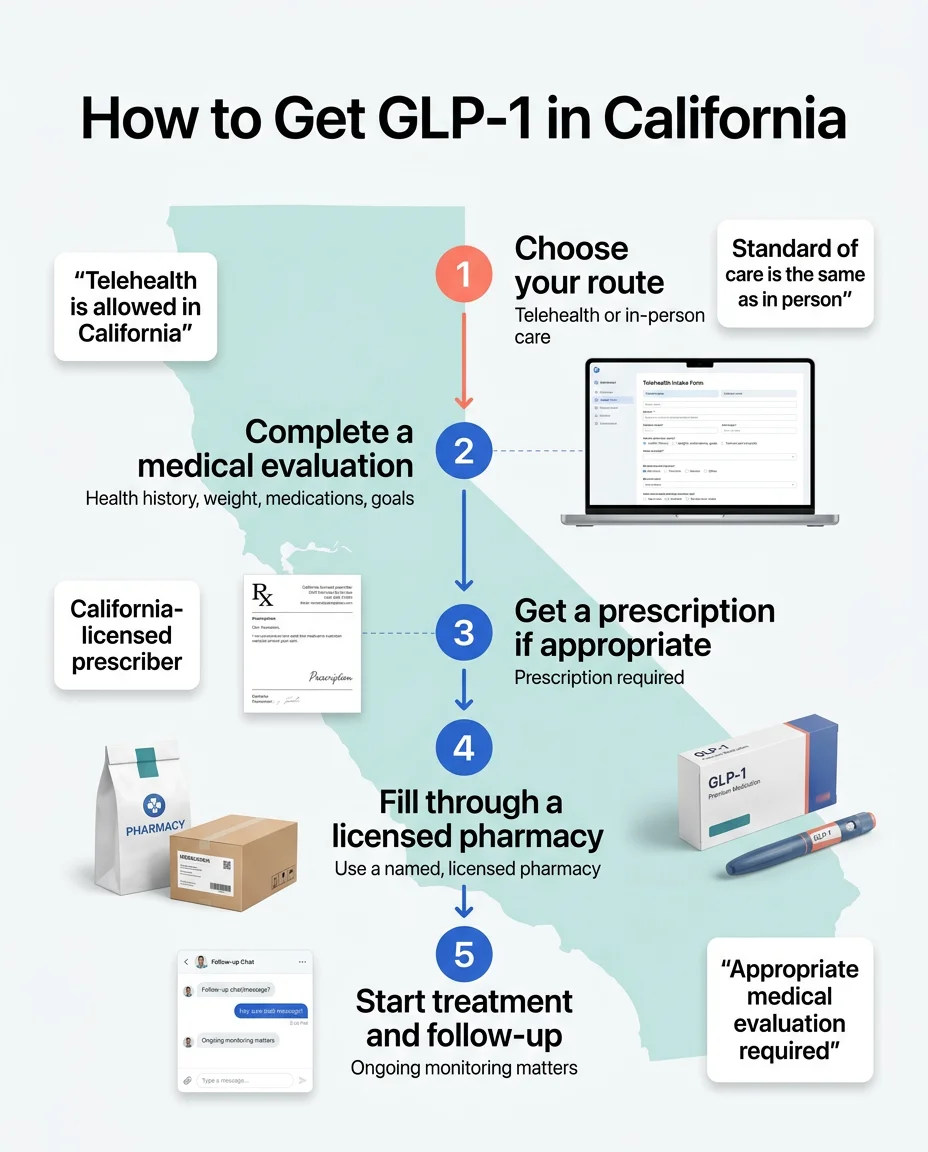
Choose your route
Insurance + your doctor, brand self-pay, or cash-pay telehealth. Your choice here depends on your insurance situation and how fast you want to start.
Complete a medical intake
You'll share your health history, current medications, weight, BMI, goals, and any relevant conditions (type 2 diabetes, high blood pressure, sleep apnea, etc.). This takes most people 5 to 15 minutes online.
A licensed clinician reviews your case
They're checking whether you meet eligibility criteria, whether any contraindications exist, and which medication makes sense for your health profile. This is not a rubber stamp — and it shouldn't be. If a provider approves everyone without asking real questions, that's a red flag.
Prescription or prior authorization
If you're going the insurance route, your doctor submits a prior authorization request to your insurer — this can take days to weeks. If you're going cash-pay telehealth, many providers state that approvals happen within a few days, though timelines vary by provider and individual case.
Pharmacy fulfillment
Brand-name medications go through retail pharmacies or direct shipping programs. Cash-pay telehealth programs ship from their partner compounding pharmacies. Either way, the pharmacy should be licensed and identifiable. The FDA's safe online pharmacy guidance says to look for: a valid prescription requirement, a US address and phone number, access to a licensed pharmacist, and state board licensure (Source: FDA BeSafeRx).
Start treatment and follow up
Your provider sets your initial dose — usually the lowest available — and increases gradually over weeks to minimize side effects. Good programs include follow-up check-ins. Great ones give you messaging access to your provider so you can ask questions between appointments.
The timeline from signup to receiving medication varies by provider, pharmacy, and whether prior authorization is needed — but many telehealth patients report receiving medication within about a week. No waiting room. No insurance phone tree. No awkward conversation with your regular doctor if you'd rather keep this private.
MEDVi
From $179/month
Which Medication Are People Actually Asking About?
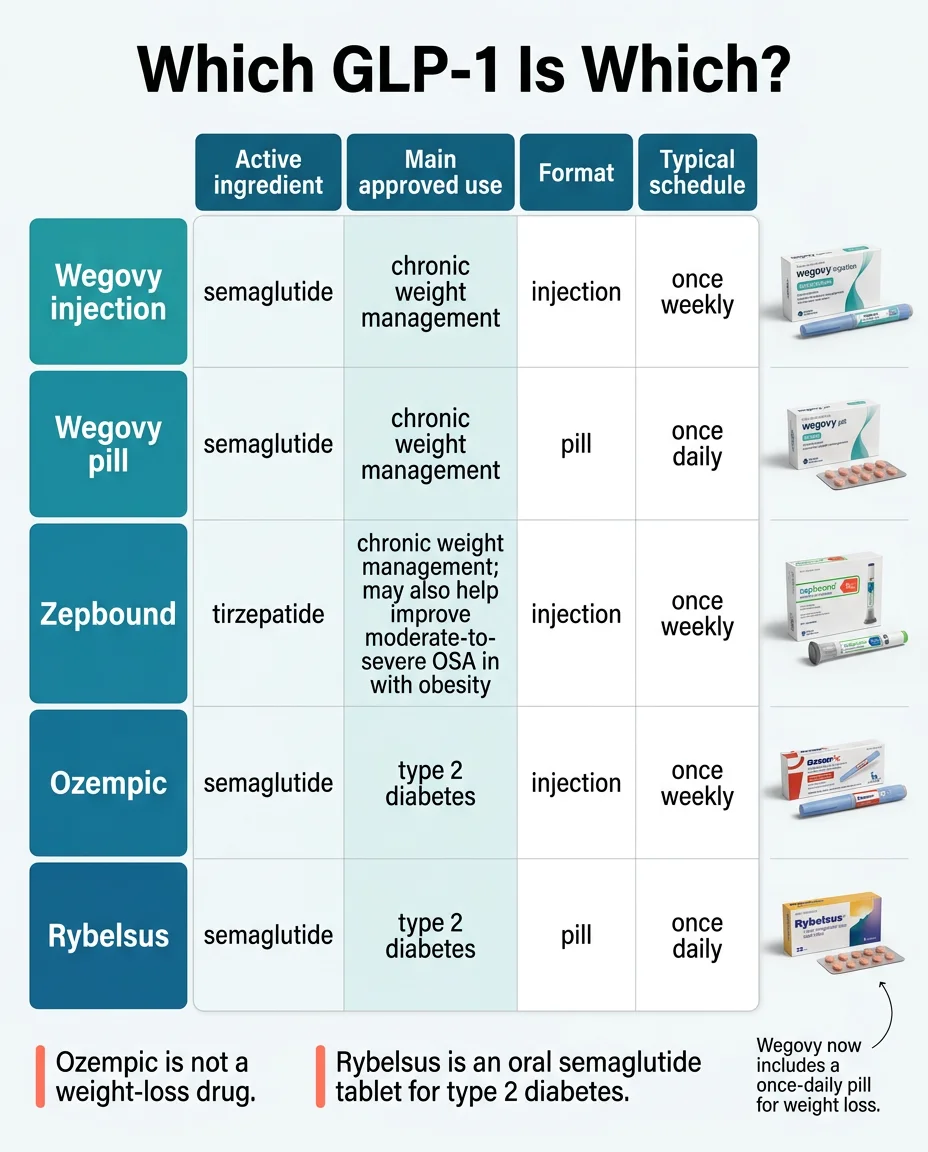
GLP-1 is a category, not a single drug. And the brand names trip people up. Here's the cheat sheet.
Semaglutide (the most-searched GLP-1)
Semaglutide comes in several branded versions, and they're not interchangeable:
- Wegovy (injection): FDA-approved for weight loss and cardiovascular risk reduction. Weekly injection. This is the one you've probably seen in the news.
- Wegovy (pill): FDA-approved for weight loss as of December 2025. Daily tablet. First oral GLP-1 for weight management. Self-pay starts at $149/month.
- Ozempic: FDA-approved for type 2 diabetes and cardiovascular risk reduction. Weekly injection. Same molecule as Wegovy but different dosing and indication. Frequently prescribed off-label for weight loss, but that's the prescriber's clinical judgment.
- Rybelsus: FDA-approved oral tablet for type 2 diabetes. Not approved for weight loss. Different dosing than the Wegovy pill. Not the same product.
Why this matters: If someone says “I want the semaglutide pill for weight loss,” the FDA-approved option is the Wegovy pill, not Rybelsus. Older articles often get this wrong. For more, see our oral semaglutide guide.
Tirzepatide (the dual-action option)
Tirzepatide works on both GLP-1 and GIP receptors, which is why some clinical trials show even higher average weight loss:
- Zepbound: FDA-approved for weight loss and obstructive sleep apnea. Weekly injection. Self-pay from $299/month.
- Mounjaro: FDA-approved for type 2 diabetes. Same molecule as Zepbound, different indication and dosing.
In the SURMOUNT trials, tirzepatide showed average weight loss of up to 22% of body weight over 72 weeks in some participants — higher than semaglutide in head-to-head trial data (Source: Jastreboff et al., NEJM). See our semaglutide vs tirzepatide comparison.
GLP-1 Pills vs. Weekly Injections
This used to be simple: GLP-1 meant injections. Not anymore.
The Wegovy pill is now a real option. On the official results page, adults taking the pill achieved an average of 14% weight loss in a 64-week study. It doesn't need refrigeration. You take it once daily on an empty stomach with a small amount of water, wait 30 minutes, then eat.
The trade-off? The pill requires daily consistency (injection is weekly). And the maintenance dose takes longer to reach because you start low and titrate up over about 12 weeks.
If needles are the reason you've been putting this off, the Wegovy pill may be worth asking about specifically. Check our oral vs injectable semaglutide comparison.
Quick Medication Comparison
| Feature | Wegovy Injection | Wegovy Pill | Zepbound Injection | Compounded (Telehealth) |
|---|---|---|---|---|
| FDA-approved for weight loss | Yes | Yes | Yes | No (not FDA-approved as finished product) |
| Frequency | Once weekly | Once daily | Once weekly | Varies by provider |
| Average weight loss (trials) | ~15% (ITT) | ~14% (ITT) | ~20-22% | No equivalent trial data |
| Refrigeration needed | Yes | No | Yes | Varies |
| Self-pay starting price | $199/mo intro‡ | $149/mo† | $299/mo§ | $179/mo (MEDVi) |
| Available as pill | No | Yes (it IS the pill) | No | Some providers offer tablets |
This table isn't meant to suggest these are equivalent products — they're not. FDA-approved medications have undergone rigorous clinical trials. Compounded alternatives have not. But we know price and convenience matter, so you should see the full landscape.
What Does GLP-1 Actually Cost in California? (Real Numbers)
Let's cut through the marketing. Here's what you'll actually pay, month one vs. ongoing.
Brand-Name FDA-Approved Options (Current Self-Pay Pricing)
| Medication | Self-Pay Pricing | Conditions | Source |
|---|---|---|---|
| Wegovy pill | $149/mo for 1.5 mg and 4 mg | 4 mg offer through August 31, 2026; then $199/mo for 4 mg | Wegovy.com |
| Wegovy injection | $199/mo for 0.25–0.5 mg (intro) | Up to two monthly fills through December 31, 2026. Then $349/mo | Wegovy.com |
| Zepbound (2.5 mg) | $299/mo | Starting dose only (not maintenance) | Zepbound.lilly.com |
| Zepbound (5 mg) | $399/mo | Via LillyDirect Self Pay Journey Program | Zepbound.lilly.com |
| Zepbound (7.5–15 mg) | $449/mo | Must refill within 45 days to keep this rate | Zepbound.lilly.com |
These prices are from official manufacturer savings programs as of March 2026. They can change, and eligibility terms apply. Always verify directly. For a complete breakdown, see our Zepbound cost without insurance guide.
Cash-Pay Telehealth (Compounded, Not FDA-Approved)
| Provider | Month 1 | Ongoing Monthly | Medication Type |
|---|---|---|---|
| MEDVi (injection) | $179 | $299 | Compounded semaglutide |
| MEDVi (tablet) | $249 | $349 | Compounded semaglutide |
| MEDVi (tirzepatide) | $279 | $399 | Compounded tirzepatide |
| Eden (3-mo plan) | From $129 | ~$249 | Compounded semaglutide |
| Yucca (6-mo plan) | ~$146 | ~$206 | Compounded semaglutide |
| Yucca (monthly) | ~$296 | ~$296 | Compounded semaglutide |
With Insurance (If Your Plan Covers GLP-1)
Copays typically range from $25 to $200 per month depending on your plan, formulary tier, and whether you've met your deductible. KFF reports that about 1 in 5 (19%) of firms with 200 or more workers covered GLP-1 agonists for weight loss in 2025. Those that do nearly all require prior authorization (Source: KFF 2025 Employer Health Benefits Survey). For detailed insurance guidance, see our GLP-1 cost with and without insurance guide.
The Hidden Cost You Need to Watch
Month-one pricing is not your real cost. Almost every provider — brand and telehealth alike — starts lower. Your real cost is the month 3+ price. Before you commit, know your refill rate.
Also consider: some programs require lab work (potentially $50–$200 if not covered by insurance), some charge for follow-up consults separately, and cancellation policies vary. MEDVi includes consultations in the monthly price. Some competitors don't. Ask before you sign up.
Can you use HSA or FSA? Potentially. HSA/FSA reimbursement depends on whether the expense is for treatment of a specific disease diagnosed by a physician — such as obesity, diabetes, hypertension, or heart disease — and on your specific plan rules. Most telehealth providers, including MEDVi and Eden, state that they accept HSA/FSA cards. Confirm eligibility with your plan administrator (Source: IRS FAQ on medical expenses). See our guide to GLP-1 providers that accept HSA.
How to Get GLP-1 in California Without Insurance
This deserves its own section because it's one of the most-searched follow-up questions — and the landscape looks very different than it did even six months ago.
You have three real routes:
Route 1: Cash-pay telehealth (compounded)
The most popular path for uninsured Californians. Providers like MEDVi bundle everything — physician review, prescription, medication, shipping, and ongoing support — into a single monthly price. No insurance paperwork. No prior authorization. You can often start within days. The trade-off: compounded medications are not FDA-approved as finished products.
Route 2: Brand-name self-pay through a prescriber
This is the route most people don't realize is now competitive. The Wegovy pill starts at $149 per month through NovoCare savings. Zepbound starts at $299 per month through LillyDirect. You'd get a prescription from your doctor, a telehealth platform like Walgreens Weight Management ($49 per visit, no subscription), or another licensed provider, then fill it at a retail pharmacy using the manufacturer's savings offer. The trade-off: prices go up as you titrate to higher doses.
Route 3: In-person doctor or weight-loss clinic paying cash
You pay for the office visit and the medication separately. Works well if you want a long-term relationship with a local physician and prefer face-to-face care.
For most Californians without insurance who want the simplest start, cash-pay telehealth remains the fastest path. But don't automatically assume compounded is the only affordable option anymore. Check the brand self-pay prices. They may surprise you. See our complete guide to getting GLP-1 without insurance.
A Practical Cost Comparison: What a 6-Month Journey Actually Costs
Let's do the math most sites avoid. What does GLP-1 treatment actually cost over six months? (Note: these are estimates based on current published pricing. Actual costs depend on dosing, eligibility, and program terms.)
MEDVi (compounded semaglutide injection):
$179 (month 1) + $299 x 5 = ~$1,674 total for 6 months. Everything included — consults, medication, shipping, support (provider-stated).
Wegovy pill (brand, self-pay):
Approximately $149 x 3 (starting/lower doses) + higher dose pricing thereafter = varies, but potentially $1,200–$1,800 for 6 months depending on dose escalation schedule and eligibility. Verify at Wegovy.com.
Zepbound (brand, self-pay via LillyDirect):
$299 (month 1 at 2.5 mg) + $399 (month 2 at 5 mg) + $449 x 4 (7.5 mg+) = ~$2,494 for 6 months if you stay in the Self Pay Journey Program. Missing a 45-day refill window resets to regular pricing, which is significantly higher.
Insurance with copay:
If covered, potentially $150–$1,200 for 6 months depending on your copay — but this assumes approval, which is not guaranteed.
“Lost 16 lbs in 10 weeks — no side effects. Down two sizes. I wish I’d started sooner.”
— Verified MEDVi patient on ConsumerAffairs ★★★★★
How to Get GLP-1 Covered by Insurance in California
If you have commercial insurance, it's worth trying. But go in with realistic expectations and a backup plan.
Commercial Insurance (Blue Shield, Anthem, Aetna, UnitedHealthcare, etc.)
About 1 in 5 (19%) of large employer plans now cover GLP-1 for weight loss, according to KFF. Nearly all require prior authorization, and the process can take weeks.
Prior Authorization Success Checklist
(This is what insurers want to see)
- Two BMI measurements, taken at least 30 days apart, both meeting the threshold (≥30, or ≥27 with comorbidity), within the past 90 days
- Documented weight-related comorbidity with ICD-10 diagnosis code (type 2 diabetes, hypertension, dyslipidemia, sleep apnea, PCOS, prediabetes, cardiovascular disease)
- Supporting labs: A1C, comprehensive metabolic panel, lipid panel, TSH
- Documentation of 3 to 6 months of failed diet and exercise attempts
- Physician letter of medical necessity explaining why GLP-1 is appropriate, expected benefits, why alternatives are insufficient, and a monitoring plan
- Pregnancy test for women of childbearing age
First-attempt approval rates run around 60 to 70 percent when documentation is complete. If denied, appeal success rates are around 30 to 40 percent — but only if you address the specific denial reason with additional evidence. Our advice: submit complete documentation on the first try. It saves weeks. For a detailed walkthrough, see our Wegovy prior authorization guide.
Kaiser Permanente Members
This is one of the most frustrating situations in California GLP-1 access. Kaiser coverage for weight-loss medications varies by plan, formulary, and Evidence of Coverage (EOC). Many Kaiser members report being required to complete weight management classes and trial other interventions before GLP-1 prescribing is considered — a process that can take months. Check your specific plan's formulary and prior-authorization requirements before assuming coverage (Source: Kaiser Permanente drug formulary).
Your alternative: Use Kaiser for your primary care. Get GLP-1 independently through telehealth. This is completely legal and increasingly common. Your telehealth provider prescribes and manages the GLP-1 treatment. Kaiser handles everything else. Many California Kaiser members are doing exactly this.
Medi-Cal Members
We'll be direct: as of January 1, 2026, Medi-Cal does not cover GLP-1 medications for weight loss or weight-loss-related indications for adults 21 and older.
Wegovy, Zepbound, and Saxenda were all removed from the Medi-Cal Rx Contract Drug List for weight-loss indications. All previously approved prior authorizations expired December 31, 2025. Claims submitted for weight loss will be denied (Source: DHCS Medi-Cal Rx member notice; California Medical Association).
What IS still reviewed for coverage:
Non-weight-loss indications may still be covered based on medical necessity. Wegovy may still be considered for MASH or cardiovascular disease, and Zepbound for obstructive sleep apnea, on a case-by-case basis with approved prior authorization. GLP-1 drugs remain on the CDL for type 2 diabetes with proper ICD-10 codes.
Under 21:
The federal EPSDT benefit may still cover GLP-1 for weight loss on a case-by-case basis with prior authorization and documentation of medical necessity.
Your options if you're on Medi-Cal and need GLP-1 for weight loss: Cash-pay telehealth starting at $179 per month through programs like MEDVi. Talk to your doctor about whether a non-weight-loss indication might apply to your situation. Know your rights — Medi-Cal members who receive a Notice of Action denying coverage generally have 90 days from the date of the NOA to request a State Hearing (Source: DHCS Medi-Cal Rx FAQ).
Medicare
Medicare coverage for GLP-1 weight-loss medications is evolving in 2026. CMS has announced the BALANCE model, which launches in Medicaid as early as May 2026, with a separate short-term Medicare demonstration beginning in July 2026 and broader Medicare Part D coverage and has been delayed — check cms.gov for the current launch date. Coverage will depend on participation and qualifications, and CMS explicitly states the model does not guarantee coverage for any individual. Details are still being finalized — check CMS.gov for the latest. Traditional Medicare Part D coverage for diabetes indications remains unchanged.
If you're on Medicare and want to start now, the same self-pay options available to other Californians apply to you.
California Legislation to Watch
SB 535 is a bill that would address GLP-1 coverage requirements in California health plans. As of March 2026, it has been introduced but is not enacted law — it was placed on suspense in committee. Do not plan around it yet, but it's worth following (Source: California Legislative Information).
Brand-Name vs. Compounded vs. Pills: What You Actually Need to Know
This is where trust gets built or broken. We're going to be straight with you.
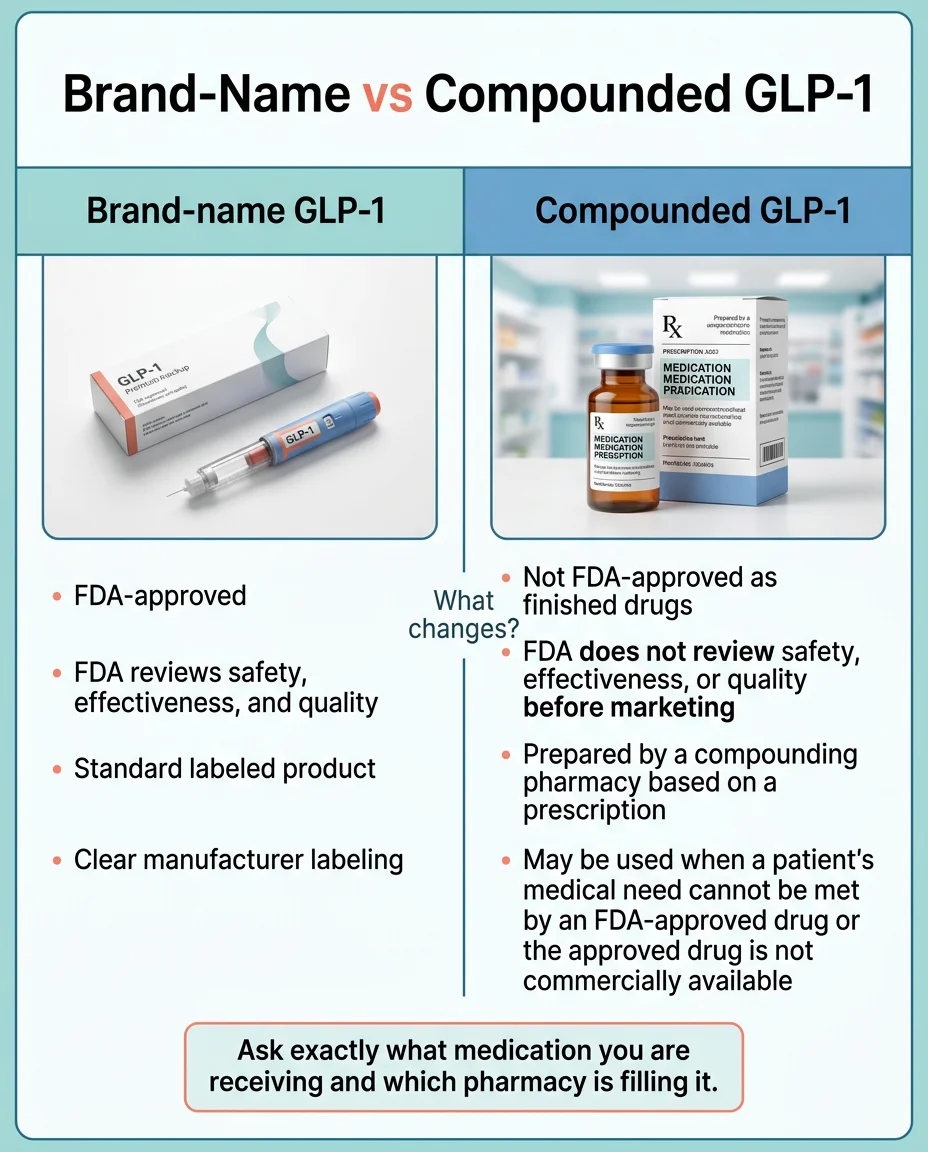
FDA-Approved Brand-Name Medications
Wegovy, Zepbound, Ozempic, Mounjaro, Saxenda — these are manufactured by major pharmaceutical companies (Novo Nordisk, Eli Lilly), have undergone extensive clinical trials with tens of thousands of participants, and carry full FDA approval for specific indications. Standardized dosing. Rigorous quality control. The strongest safety evidence available.
The downside has traditionally been price. But as of 2026, self-pay pricing has dropped significantly. The Wegovy pill starts at $149 per month. That changes the math for a lot of people. For a deeper comparison, see our compounded semaglutide safety guide.
Compounded GLP-1 Medications
Compounded GLP-1 medications are prepared by compounding pharmacies based on individual prescriptions from licensed providers. They are not FDA-approved as finished products. The FDA has not reviewed them for safety, effectiveness, or quality as finished formulations. They are not generic equivalents of FDA-approved brand medications.
The FDA's position: compounded drugs might be appropriate if a patient's medical need cannot be met by an FDA-approved drug, or if the FDA-approved drug is not commercially available. Compounded drugs are not FDA-approved, and the FDA does not review them for safety, effectiveness, or quality before marketing (Source: FDA.gov).
With the semaglutide shortage resolved in early 2025, the legal basis for broad compounding has narrowed. Legitimate compounding continues for patient-specific medical needs under Section 503A of the Federal Food, Drug, and Cosmetic Act. But the days of mass-market compounded semaglutide are coming to an end, and FDA enforcement is increasing.
Why people still choose compounded: Cost. A compounded semaglutide injection through MEDVi costs $299 per month ongoing. Brand-name Wegovy injection costs $349. Brand Zepbound starts at $299 but goes to $549 at higher doses. For many uninsured Californians, the price difference still matters — especially over months of treatment.
Our take: If you can access FDA-approved brand-name medication at a price you can sustain, that's the strongest medical choice. If your budget doesn't allow it and you choose a compounded option, make sure your provider is transparent about what they're prescribing, uses a named and licensed US compounding pharmacy, and maintains ongoing physician oversight. Don't choose based on price alone. Choose based on transparency.
A word about the changing landscape in 2026: The compounded GLP-1 market is in flux. With the FDA shortage resolved and enforcement increasing, some providers may adjust their offerings or pricing. Any provider you choose should be transparent about how regulatory changes might affect your treatment continuity. Ask directly: “What happens to my treatment if compounding rules change?”
MEDVi, for its part, partners with Belmar Pharma Solutions — a named, established US compounding pharmacy — and maintains LegitScript certification. That level of transparency isn't universal in this space, and it matters.
The Decision Framework
Choose brand-name FDA-approved if:
You want the strongest clinical evidence, standard dosing, and full FDA oversight. You can sustain the monthly cost. You have insurance coverage or can use manufacturer savings programs.
Choose cash-pay compounded telehealth if:
Brand pricing is out of reach. You understand and accept that compounded medications are not FDA-approved. Your provider is transparent about their compounding pharmacy and maintains proper medical oversight.
Choose a daily pill if:
You don't want to inject. The Wegovy pill is the FDA-approved option here. Some telehealth providers also offer compounded oral tablets — same FDA disclaimer applies.
Choose in-person care if:
You want an ongoing face-to-face medical relationship. You have complex health conditions that benefit from hands-on monitoring. You prefer a local doctor coordinating all your care.
How to Avoid Scams and Bad Providers (This Section Could Save You Real Money)
The GLP-1 boom has attracted bad actors. Here's how to protect yourself.
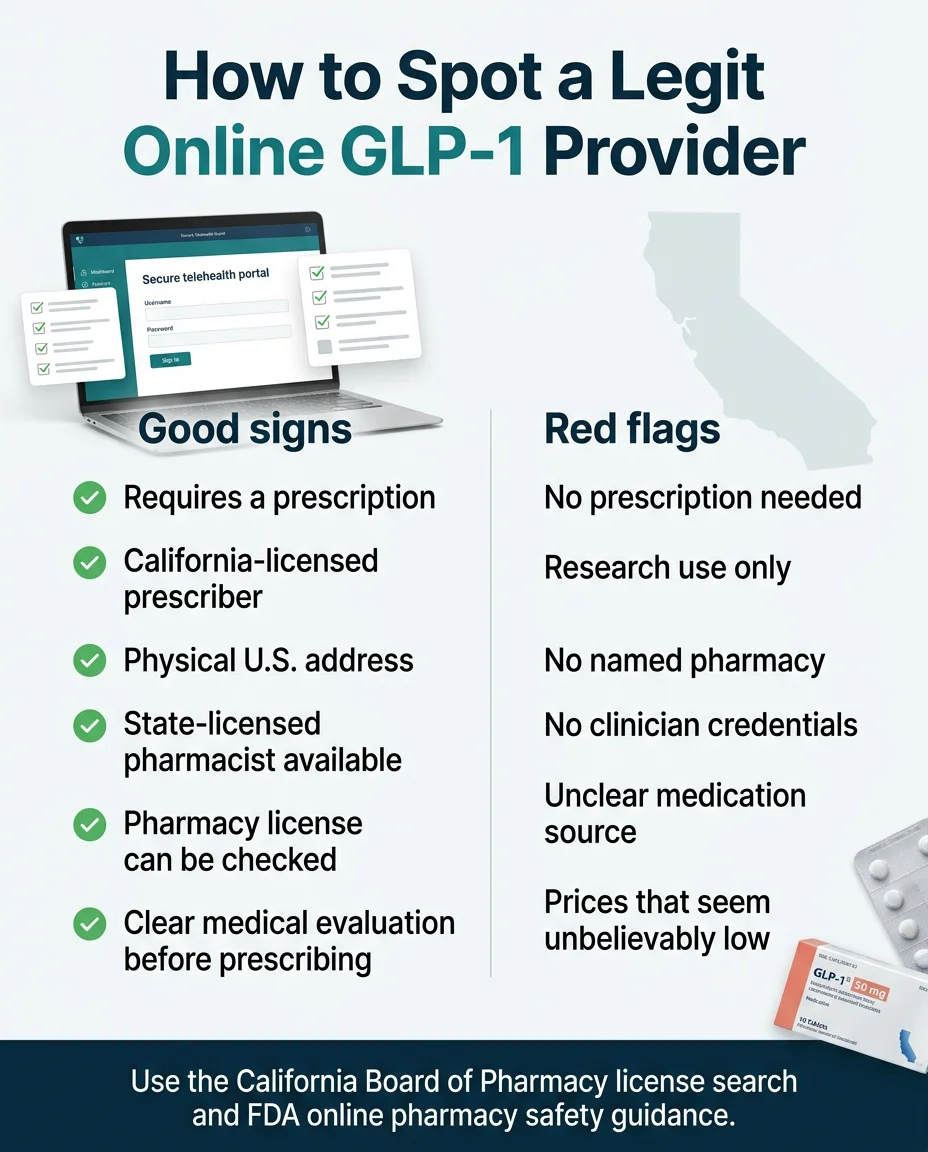
What a Legitimate Provider Looks Like
- Requires a medical evaluation before prescribing (not just a checkout button)
- Uses clinicians licensed in California
- Names their partner pharmacy or pharmacies
- Provides clear pricing with month-one AND ongoing costs
- Offers ongoing medical support, not just a one-time prescription
- Has real, named physicians on their medical team
- Includes safety information and contraindications prominently
Red Flags to Walk Away From
- “No prescription needed” or “no doctor required” — that's illegal for GLP-1 medications
- Products labeled “for research purposes only” or “not for human consumption” — the FDA has specifically warned about these
- Claims that compounded medications are “the same as” or “equivalent to” FDA-approved drugs — they're not
- No named pharmacy or unclear medication sourcing
- No real medical team listed on the website
- Prices that seem impossibly low with no explanation
- No cancellation policy or refund information
How to Verify a Provider
- Check LegitScript certification — this means the company is regularly monitored and complies with state and federal laws
- Look up the compounding pharmacy — a legitimate provider will name their pharmacy partner. You can check state board licensure through the California Board of Pharmacy license lookup.
- Use NABP's Safe Site Search Tool — the National Association of Boards of Pharmacy maintains a database at safe.pharmacy
- Check prescriber licensure — verify through the Medical Board of California license verification
- Read the FDA's BeSafeRx page — their checklist for safe online pharmacy purchases is straightforward and helpful (FDA.gov/BeSafeRx)
A Note on SkinnyRx
We want to be transparent: SkinnyRx received an FDA warning letter in February 2026. Given that regulatory action, we do not recommend them as a primary option at this time. If you're currently using SkinnyRx, consider discussing your situation with an independent licensed physician (Source: FDA Warning Letter to Lean Rx Inc. dba SkinnyRx, February 2026).
Do You Qualify for GLP-1 in California?
Most adults who feel they need medical help with weight loss will qualify. But not everyone, and the criteria matter.
Standard Eligibility (FDA-Approved Indications)
- BMI of 30 or above (obesity), OR
- BMI of 27 or above with at least one weight-related condition such as: type 2 diabetes, high blood pressure, high cholesterol, obstructive sleep apnea, PCOS, prediabetes, or cardiovascular disease
What those BMI numbers look like in real life:
- 5'4” and 175 lbs = BMI of approximately 30
- 5'8” and 200 lbs = BMI of approximately 30
- 5'10” and 210 lbs = BMI of approximately 30
Use our GLP-1 BMI eligibility calculator to check your BMI instantly.
Who Should Not Take GLP-1 Medications
Do not use (label-backed contraindications):
- Personal or family history of medullary thyroid carcinoma (MTC) or Multiple Endocrine Neoplasia syndrome type 2 (MEN 2) — this is a boxed warning on the FDA label
- Known serious hypersensitivity to semaglutide, tirzepatide, or any of the product's ingredients
Needs clinician review / may not be appropriate:
- Currently pregnant, breastfeeding, or actively trying to become pregnant
- History of pancreatitis
- Significant kidney disease or liver disease
- Active eating disorder or history of eating disorder
- Current suicidal thoughts or prior suicidal attempt
These conditions require clinical judgment — your prescribing clinician will evaluate whether GLP-1 treatment is appropriate for your specific situation. That's one reason the medical evaluation matters (Source: FDA prescribing information for Wegovy; FDA prescribing information for Zepbound). Learn more in our full GLP-1 eligibility guide.
What If You Don't Qualify?
Don't bounce. You still have options. Talk to your doctor about other FDA-approved weight-loss medications (like naltrexone-bupropion or phentermine-topiramate), structured weight management programs, metabolic health optimization, or whether addressing an underlying condition like thyroid dysfunction might help first.
Also worth knowing: many people who think they won't qualify actually do. A BMI of 27 with high blood pressure is enough. Prediabetes counts. Sleep apnea counts. PCOS counts. The online evaluation through providers like MEDVi takes about 10 minutes and costs nothing — you'll find out quickly whether GLP-1 treatment is an option for you.
MEDVi
$179/month to start
What to Expect When You Start: A Week-by-Week Reality Check
You're going to read a lot of success stories online. Here's what the clinical data and real user experiences actually show.
Weeks 1–2
You start on the lowest dose. Some people feel a decrease in appetite almost immediately. Some don't notice much yet. The most common side effect is nausea — it's real, and most people experience at least some of it. It's usually mild to moderate and tends to peak in the first two weeks. This is normal. Your provider is starting you low specifically to manage this. If it's too intense, reach out. Good providers — including MEDVi, which offers unlimited messaging — can adjust your dose or offer guidance.
Weeks 3–4
For most people, nausea fades significantly. Appetite suppression becomes more noticeable. You start making different food choices not because you're forcing yourself, but because you're genuinely less interested in overeating.
Months 2–3
This is when weight loss becomes visible. Clinical trial data with semaglutide shows an average of 5 to 7 percent body weight loss by month three. Energy levels often improve. Clothes start fitting differently. People around you start to notice.
Months 3–6
Continued steady progress. Your provider may increase your dose for continued results. Average body weight loss of 10 to 15 percent by six months in clinical trials.
Months 6–12
Approaching the results seen in major clinical trials — average ~15 percent weight loss with semaglutide injection (Wegovy), ~14 percent with the Wegovy pill, and up to ~22 percent with tirzepatide (Zepbound) in their respective trials. These are averages. Individual results vary. But the trajectory for people who stick with treatment is consistently meaningful (Sources: Wilding et al., STEP trial, NEJM; Wharton et al., OASIS 4, NEJM; Jastreboff et al., SURMOUNT trial, NEJM).
Important context:
Research does show that most people regain some weight after stopping GLP-1 treatment. This isn't a failure of the medication — it reflects the reality that obesity is a chronic condition, much like hypertension or diabetes. Some people use GLP-1 long-term. Others use it as a runway to establish healthier habits. Discuss the long-term plan with your provider early. See our guide: what happens when you stop taking GLP-1.
What Real People Say
We read hundreds of reviews across Trustpilot, ConsumerAffairs, and Google to understand what actual patients experience. The patterns are consistent:
“I was so nervous to start. The first week I felt queasy, but by week 3 the nausea was gone and my appetite was completely different. I've lost 35 pounds in 4 months and I feel like a different person.” — Telehealth patient (theme from public review platforms)
“After Kaiser denied me for the third time, I found an online provider and got started within a week. I wish I hadn't wasted 8 months trying to go through insurance.” — California patient (paraphrased from public review theme)
“I was skeptical about doing this online, but the whole process was professional. My doctor called me, reviewed my history, and we had a real conversation about my health.” — Testimonial shown on MEDVi provider site (self-reported)
The negative reviews matter too. The most common complaints across all providers are: unexpected charges after cancellation (always confirm the cancellation window), slow customer service response times during peak demand, and occasional shipping delays. These are real and worth planning for — but they're operational hiccups, not safety issues.
Honest Side Effects and What Most Pages Leave Out
We're not going to sugarcoat this. You deserve the full picture. For the complete breakdown, see our comprehensive guide to GLP-1 side effects.
Common Side Effects (Most People, Usually Temporary)
- Nausea — the most reported side effect, typically worst in weeks 1–2, then fading
- Diarrhea or constipation
- Vomiting — less common, usually dose-related
- Headache and fatigue
- Injection site reactions (for injectable forms)
The dose titration schedule exists specifically to minimize these. Starting low and increasing gradually is standard practice and it works for most people. If you're experiencing side effects, check our GLP-1 nausea relief guide.
Serious Side Effects (Rare but Real)
- Pancreatitis — seek immediate medical attention for severe, persistent abdominal pain
- Gallbladder problems — including gallstones
- Kidney injury — particularly in patients who become dehydrated from GI side effects
- Thyroid tumors — a boxed warning on the label based on rodent studies. GLP-1 medications are contraindicated in people with personal or family history of medullary thyroid carcinoma or MEN 2
- Changes in mood — monitoring is recommended
What Most Sites Skip
“Ozempic face.”
Rapid weight loss — from any cause — can lead to facial volume loss. It's a cosmetic concern, not a medical emergency, but it catches people off guard.
Muscle loss.
GLP-1 medications can cause some loss of lean muscle mass alongside fat. Mitigation: eat adequate protein (aim for 0.7 to 1 gram per pound of body weight daily) and incorporate resistance training. Your provider should discuss this. See our muscle preservation guide and protein calculator.
The cost commitment.
GLP-1 treatment is ongoing. Budget for months, not weeks. Ask about long-term pricing before you start.
Supply and fulfillment delays.
While the major shortages are resolved, some patients still report occasional delays, especially around dose increases. Have a conversation with your provider about their supply reliability.
These are real trade-offs. But when you weigh them against the health risks of untreated obesity — heart disease, type 2 diabetes, sleep apnea, joint problems, reduced quality of life — most physicians consider GLP-1 treatment well worth it for eligible patients. For a deeper dive, read our long-term effects of GLP-1 guide.
California-Specific Situations You Might Be Dealing With
“I was on GLP-1 through Medi-Cal and just lost my coverage.”
You're not alone. Thousands of Californians lost GLP-1 coverage on January 1, 2026. Here's your game plan:
- Check whether a non-weight-loss indication applies. If you have type 2 diabetes, cardiovascular disease, or chronic kidney disease, Medi-Cal may still cover your GLP-1 medication with proper ICD-10 codes and prior authorization. Talk to your doctor.
- Know your rights. Medi-Cal members who receive a Notice of Action denying coverage generally have 90 days from the date of the NOA to request a State Hearing (Source: DHCS Medi-Cal Rx FAQ).
- Cash-pay telehealth is your fastest alternative. MEDVi's $179 first-month pricing, while more expensive than a Medi-Cal copay, is designed to be accessible for people in exactly this situation. Month-to-month commitment means you can adjust or pause if your financial situation changes.
“I'm a California state employee. Am I covered?”
CalPERS plan coverage varies by your specific plan and employer group. Some plans cover GLP-1 medications with prior authorization; others don't include them on their formulary. Contact your benefits administrator directly — they can tell you whether your specific plan covers Wegovy, Zepbound, or other GLP-1 medications, and what prior authorization steps are required. If your plan doesn't cover it, the same cash-pay and brand self-pay options available to other Californians apply to you.
“My doctor won't prescribe GLP-1. What do I do?”
Some primary care doctors are uncomfortable prescribing GLP-1 medications, don't have experience with them, or simply don't agree with the approach. That's their right. But it's also your right to seek care elsewhere.
Options: ask for a referral to an endocrinologist or obesity medicine specialist, try a telehealth provider that specializes in GLP-1 prescribing, or switch to a PCP who's more experienced with metabolic health. You do not need your current doctor's permission to seek a GLP-1 prescription from another licensed provider. See our guide: how to start GLP-1.
Frequently Asked Questions
Frequently Asked Questions
How We Verified This Page
We don't just aggregate what other affiliate sites say. Here's our process. See our full editorial standards and how we rank providers.
What we checked for each provider:
- California licensing (can they legally prescribe to CA residents?)
- Medical evaluation requirement (do they actually screen patients?)
- Named pharmacy partners (can you verify the source of medication?)
- Transparent pricing (month-one AND ongoing, not just the promotional number)
- Third-party certifications (LegitScript, BBB, etc.)
- Real patient reviews (Trustpilot, ConsumerAffairs — not just testimonials on their own site)
Sources we cited:
- FDA prescribing information for Wegovy and Zepbound
- FDA.gov unapproved GLP-1 concerns page
- FDA BeSafeRx safe online pharmacy guidance
- FDA warning letters (SkinnyRx, February 2026)
- California DHCS Medi-Cal Rx policy updates (October 2025, December 2025)
- Medical Board of California telehealth and internet prescribing guidance
- Kaiser Permanente California GLP-1 coverage change notices
- KFF 2025 Employer Health Benefits Survey
- Novo Nordisk press releases and NovoCare savings programs
- Eli Lilly Zepbound savings page
- NEJM: Wilding et al. (STEP trial), Jastreboff et al. (SURMOUNT trial), Wharton et al. (OASIS 4)
- California Legislative Information (SB 535)
- Provider websites: MEDVi, Eden Health, Yucca Health, Walgreens Weight Management
What we could not independently verify:
- Internal approval rates or average delivery times at each provider
- Long-term customer satisfaction beyond what's visible on public review platforms
- Whether specific compounding pharmacies are currently in good standing with the FDA (this changes and should be verified by your provider)
Change Log: March 2026 — Initial publication. Verified all pricing, California Medi-Cal status, Wegovy pill availability, FDA enforcement actions, and provider details against primary sources.
Your Next Step
You've read more about GLP-1 access in California than 99% of people who search for it. Here's what to do with that knowledge.
If you don't have insurance and want to start this week:
Complete a free eligibility check through MEDVi. You'll know within minutes whether you're likely to qualify, and you can have medication at your door in days. No contract, no commitment beyond one month at a time.
Check Your Eligibility NowIf you have commercial insurance:
Print our prior authorization checklist above. Bring it to your next doctor's appointment. Submit complete documentation the first time and save yourself weeks of back-and-forth.
If you want FDA-approved brand medication without insurance:
Ask your prescriber about the Wegovy pill ($149/month for starting doses; see Wegovy.com for current terms) or check Zepbound self-pay pricing through LillyDirect. Brand-name GLP-1 is more affordable than it's been at any point in the last five years.
If you're on Medi-Cal or Kaiser and frustrated:
You have options. Telehealth programs operate independently of your insurance. You can get GLP-1 access while keeping your existing doctors for everything else.
Whatever path you choose, make sure your provider is licensed, transparent, and actually monitoring your health — not just shipping medication.
The Bigger Picture
If you've been thinking about this for a while — researching, comparing, wondering if it's worth it, if you'll qualify, if it'll work for you — the clinical data is encouraging. For most eligible adults, GLP-1 medications produce meaningful, sustained weight loss that goes beyond what diet and exercise alone can achieve for many people. Not because you lacked discipline before. Because obesity has biological drivers, and these medications help address them.
The people who get the best results are the ones who start with a qualified provider, stay consistent, and communicate openly about side effects and progress along the way.
This guide is free, updated monthly, and built to help you make a confident, informed decision. If we saved you hours of research or helped you avoid a bad provider, we did our job.
“Lost 16 lbs in 10 weeks — no side effects. Down two sizes. I wish I’d started sooner.”
— Verified MEDVi patient on ConsumerAffairs ★★★★★
Medical Disclaimer: This content is for informational purposes only and does not constitute medical advice. GLP-1 medications are prescription medications that should only be used under the guidance of a licensed healthcare provider. Always consult your physician before starting any medication. Compounded medications are not FDA-approved as finished products and have not been reviewed by the FDA for safety, effectiveness, or quality as finished formulations.
Last updated: March 2026 | About the author | Medical reviewer credentials | Editorial standards | Affiliate disclosure