How Much Does Zepbound Cost Without Insurance? What You’ll Actually Pay in 2026
For informational purposes only—not medical advice.
The short answer: Without insurance, Zepbound does not have one price. That’s why you keep finding different numbers on every site you visit.
Right now in the U.S., brand-name Zepbound can cost as little as $299/month through Eli Lilly’s self-pay program — or over $1,300 at a retail pharmacy if you just walk in without a discount. The price you’ll actually pay depends on three things: your insurance situation, which device you use, and where you buy it.
We spent the last several weeks verifying every current pricing path directly from Eli Lilly’s official sources, GoodRx snapshots, and pharmacy data. Below is the pricing matrix we wish existed when we started researching this — because the confusion around Zepbound pricing is real, and most pages online only show you part of the picture.
Here’s what you need to know before you pay a single dollar.
We may earn a commission if you use our provider links. This does not influence our pricing research. See our editorial standards.
The Short Answer: How Much Does Zepbound Cost Without Insurance?
Most pages quote one Zepbound number. Real-world Zepbound pricing is messier than that. Here’s every current price path at a glance:
| Your Situation | What You’ll Pay (Monthly) | Device | Where |
|---|---|---|---|
| Self-pay via LillyDirect (no insurance needed) | $299 (2.5 mg) · $399 (5 mg) · $449 (7.5–15 mg)* | Single-dose vial or KwikPen | LillyDirect home delivery; Walmart pickup available for vials |
| Commercial insurance, no Zepbound coverage | As low as $499 | Single-dose pen | Any retail pharmacy with Savings Card |
| Retail pharmacy + GoodRx coupon (pens) | ~$995 | Pre-filled pen | CVS, Walgreens, Walmart, Costco, Target† |
| Retail pharmacy, no discount | ~$1,272 avg. retail (list price $1,086) | Pre-filled pen | Varies by pharmacy |
| Commercial insurance with Zepbound coverage | As low as $25 | Single-dose pen | Any retail pharmacy with Savings Card |
*Important catch: The $449 price for doses 7.5 mg and above requires refilling within 45 days of your last delivery. Miss that window and the price jumps — sometimes significantly. We explain exactly how this works below.
Sources: Eli Lilly official pricing (LillyDirect, Zepbound Savings Card Terms & Conditions); †GoodRx coupon snapshot accessed March 7, 2026 — local prices vary by pharmacy and location; Zepbound.lilly.com/savings; pricinginfo.lilly.com/zepbound.
If you’re staring at these numbers thinking “finally, someone laid it all out” — that’s the point. Keep reading and we’ll walk you through which path fits your situation, what the catches are, and the cheapest legitimate way to start treatment.
Which Zepbound Price Applies to You?
Not every path above is available to every person. Here’s how to find yours fast.
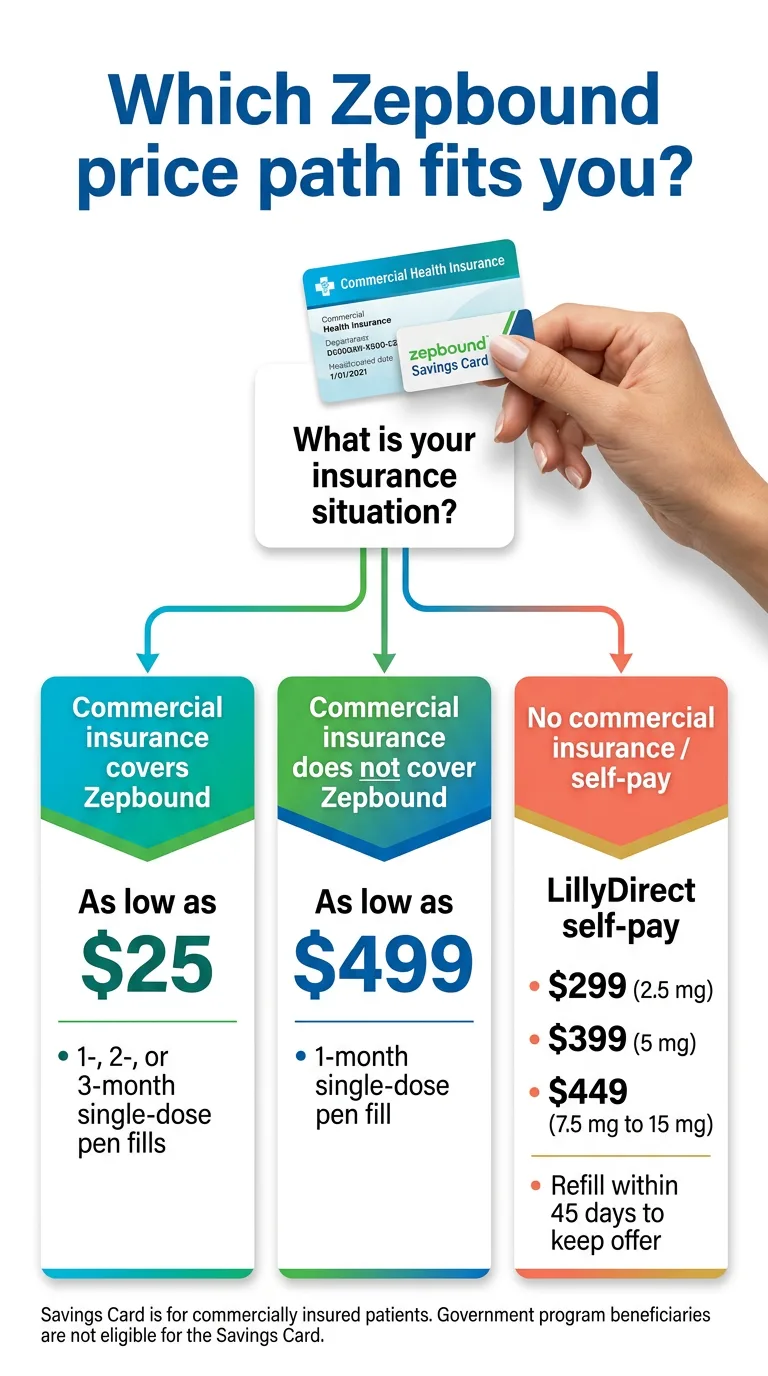
“I have no insurance at all.”
Your best option is almost certainly LillyDirect’s self-pay program. You’ll pay $299–$449/month for authentic, FDA-approved Zepbound vials shipped to your door or picked up at Walmart. No insurance required.
“I have insurance, but it doesn’t cover Zepbound.”
You have two options: use the Zepbound Savings Card to bring pen pricing down to $499/month, or skip insurance entirely and use LillyDirect self-pay vials at $299–$449/month (often cheaper).
“I have insurance that covers Zepbound.”
Apply for the Zepbound Savings Card at zepbound.lilly.com/savings. You may pay as little as $25/month. That’s the cheapest path — period.
“I’m on Medicare or Medicaid.”
Medicare currently covers Zepbound only for obstructive sleep apnea (OSA) — not weight loss. Medicaid varies by state. The Zepbound Savings Card is not available to government insurance beneficiaries. Your best cash-pay option is LillyDirect at $299–$449/month.
“Brand-name Zepbound is still too expensive for me.”
There are lower-cost telehealth GLP-1 programs that offer treatment paths starting under $200/month. We cover these honestly — including what to watch out for — in the budget section near the bottom of this page.
Why You’re Seeing So Many Different Zepbound Prices Online
If you’ve searched for Zepbound pricing, you’ve probably seen numbers ranging from $25 to $1,500. That’s not because anyone is lying — it’s because Zepbound pricing depends on variables that most articles don’t explain clearly. Let’s fix that.
List price is not what you pay
Eli Lilly’s list price (also called wholesale acquisition cost or WAC) for Zepbound is $1,086.37 for a 28-day supply. This is the price Lilly charges wholesalers. Most pharmacies then add markup — the average retail price for the most common version is approximately $1,272, according to GoodRx, with some chains pricing above $1,300.
But this is a starting point, not a final price. Almost nobody should pay full retail. There’s nearly always a cheaper path available.
The device you use changes the price dramatically
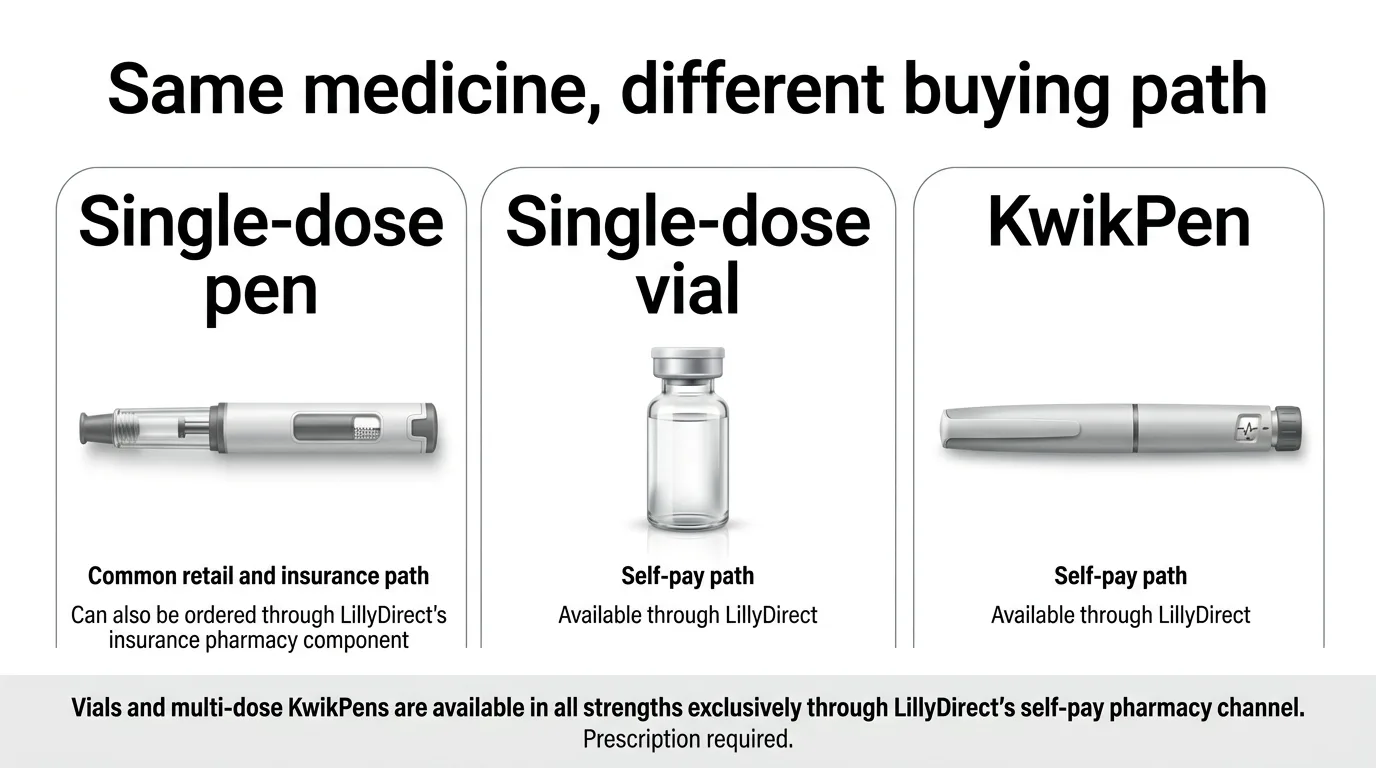
Zepbound comes in three forms:
The vial and KwikPen are available exclusively through LillyDirect for self-pay patients, not at your local CVS or Walgreens. This is why the price gap is so large — retail pharmacies primarily stock the more expensive single-dose pens.
Where you buy matters more than you’d think
Walking into a retail pharmacy with no discount, you’ll pay approximately $1,272 on average for pens (with some pharmacies pricing above $1,300). Using a GoodRx coupon at the same pharmacy, that drops to roughly $995. Using LillyDirect for vials, you’re at $299–$449. Same medication. Massive price difference.
The 45-day refill rule on higher doses
This is the detail that most sites bury in fine print — and it can cost you hundreds of extra dollars if you don’t know about it.
Eli Lilly’s Self Pay Journey Program offers the $449/month price for Zepbound doses 7.5 mg through 15 mg. But that price only applies if you refill within 45 days of your previous delivery. If you miss that 45-day window for any reason — vacation, forgot, supply issue — the price jumps.
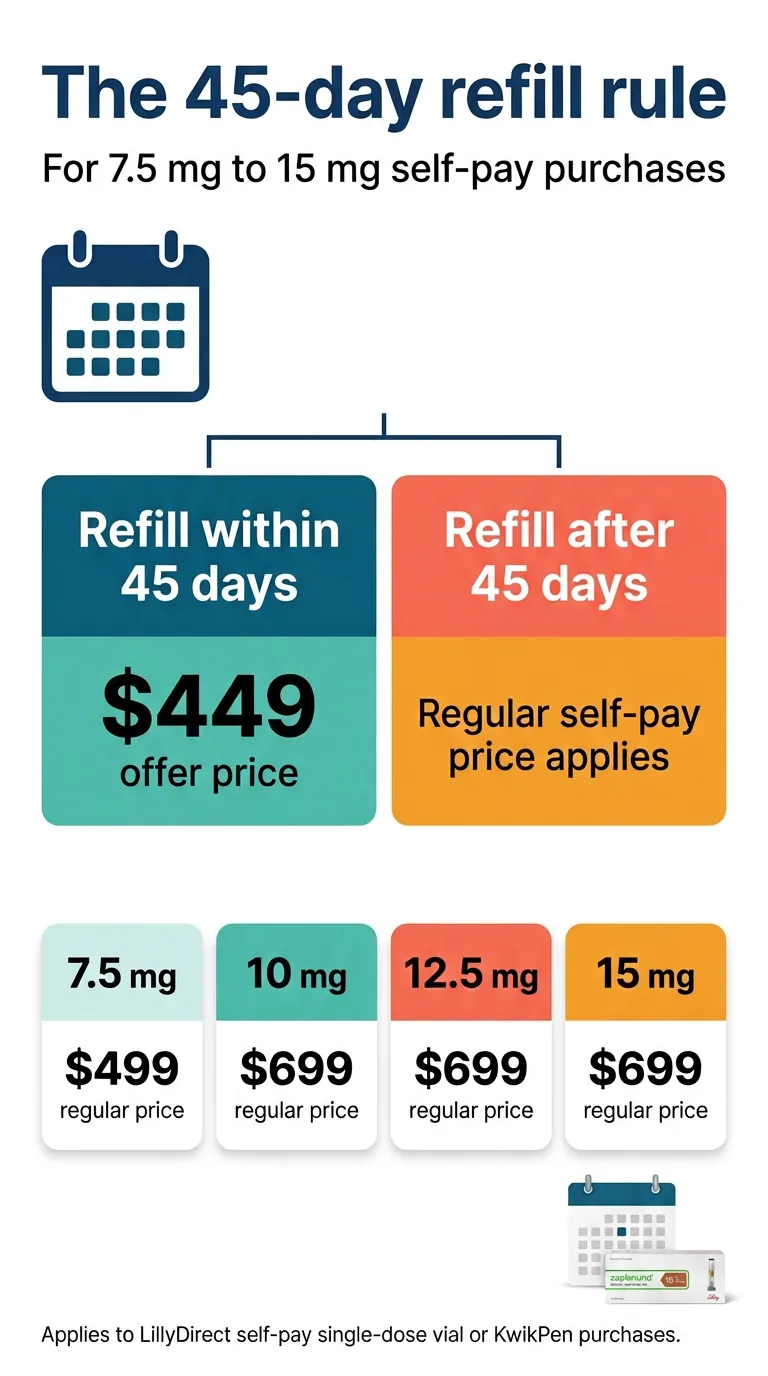
| Dose | Price Within 45 Days | Price If You Miss the Window |
|---|---|---|
| 2.5 mg | $299 | $299 (no window restriction) |
| 5 mg | $399 | $399 (no window restriction) |
| 7.5 mg | $449 | $499 |
| 10 mg | $449 | $699 |
| 12.5 mg | $449 | $849 |
| 15 mg | $449 | $1,049 |
At the 15 mg maintenance dose, missing the refill window means paying $1,049 instead of $449 — a $600 difference. Set a calendar reminder. We mean it.
The 2.5 mg and 5 mg doses don’t have this restriction, which is helpful while you’re starting out.
Source: Zepbound Self Pay Journey Program Terms & Conditions, Eli Lilly (accessed March 2026).
Zepbound Price by Dose, Device, and Buying Path
This is the table we couldn’t find anywhere else — every dose, every device, every buying path, side by side. We built it so you don’t have to stitch pricing together from five different sites.
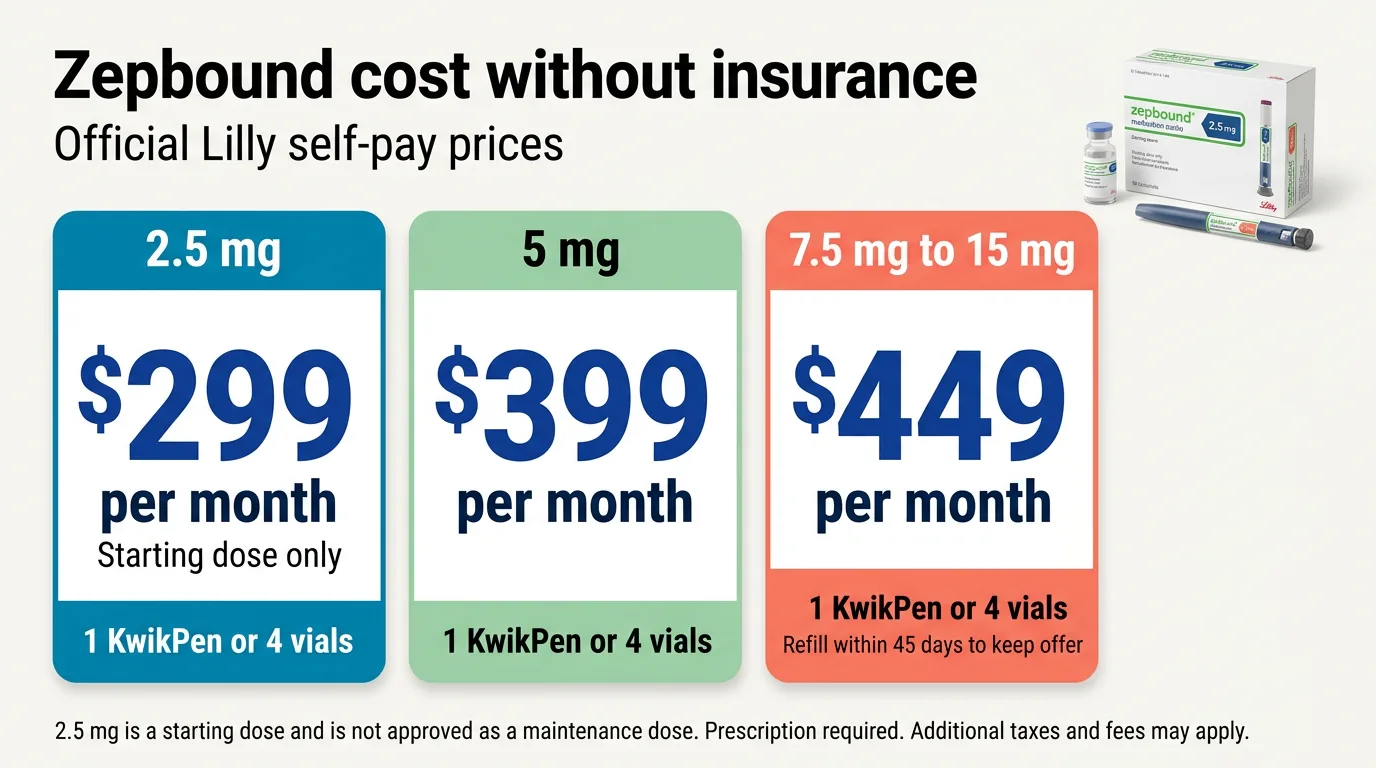
| Dose | Type | LillyDirect Vial/KwikPen | Retail Pen (GoodRx)† | Retail (No Discount) | Savings Card (Covered) | Savings Card (Not Covered) |
|---|---|---|---|---|---|---|
| 2.5 mg | Starter only | $299 | ~$995 | ~$1,272 | $25 | $499 |
| 5 mg | Starter/Maintenance | $399 | ~$995 | ~$1,272 | $25 | $499 |
| 7.5 mg | Dose escalation | $449* | ~$995 | ~$1,272 | $25 | $499 |
| 10 mg | Maintenance | $449* | ~$995 | ~$1,272 | $25 | $499 |
| 12.5 mg | Dose escalation | $449* | ~$995 | ~$1,272 | $25 | $499 |
| 15 mg | Maintenance | $449* | ~$995 | ~$1,272 | $25 | $499 |
Zepbound’s recommended weight-management maintenance doses are 5 mg, 10 mg, or 15 mg once weekly. The 7.5 mg and 12.5 mg strengths are dose-escalation steps, not listed maintenance doses. For obstructive sleep apnea, recommended maintenance doses are 10 mg or 15 mg. (Zepbound prescribing information)
* = Requires refill within 45 days. See the section above for what happens if you miss the window.
Key detail: The 2.5 mg dose is a starting dose only — it’s not approved as a maintenance dose. Your doctor will increase your dose over time. That means you’ll only be at the $299 price point for about a month before moving up.
One thing that works in your favor: Eli Lilly’s list price for pens is the same regardless of dose. And through LillyDirect, the Self Pay Journey offer prices all higher strengths (7.5 mg through 15 mg) at $449. So under the offer, your cost doesn’t jump as your dose goes up — as long as you stay within the 45-day refill window. If you miss that window, regular prices vary by dose (see the penalty table above).
Sources: LillyDirect.lilly.com pricing page; †GoodRx.com/zepbound snapshot accessed March 7, 2026 — local prices vary; Zepbound Savings Card Terms & Conditions.
How Much Will Zepbound Cost Over a Full Year?
Monthly pricing only tells part of the story. Here’s what you might spend over 12 months in an example scenario, based on the label’s recommended titration starting at 2.5 mg and increasing in 2.5 mg increments every 4 weeks. Your actual titration schedule depends on your provider’s assessment of your response and tolerability.
Zepbound is dosed on a 28-day cycle — that’s 13 fills per year, not 12. Most cost estimates miss this.
LillyDirect Self-Pay (refilling within 45 days)
- Month 1 (2.5 mg): $299
- Month 2 (5 mg): $399
- Months 3–13 (7.5–15 mg): $449 × 11 = $4,939
Year 1 total: approximately $5,637
Retail pharmacy with GoodRx coupon (pens)
- Months 1–13: ~$995 × 13 = $12,935
Year 1 total: approximately $12,935
Savings Card, insurance covers Zepbound
- Months 1–13: $25 × 13 = $325
Year 1 total: approximately $325
Savings Card, insurance doesn’t cover Zepbound
- Months 1–13: $499 × 13 = $6,487
Year 1 total: approximately $6,487
The LillyDirect self-pay path saves roughly $7,300 per year compared to filling pens at a retail pharmacy with a GoodRx coupon. That’s a car payment — every single month — that you keep in your pocket.
How Does LillyDirect Work? The Self-Pay Path Most People Don’t Know About
LillyDirect is Eli Lilly’s direct-to-consumer healthcare platform. It’s not a telehealth startup or a third-party pharmacy — it’s run by Zepbound’s manufacturer. For most uninsured patients, this is the cheapest way to get authentic, FDA-approved Zepbound.
Current LillyDirect self-pay pricing (verified March 2026):
How to get started:
About the vials: Yes, vials require drawing up your dose with a syringe and injecting it yourself. That sounds intimidating if you’ve never done it. But it’s a simple subcutaneous injection — same as the pen, just a few more steps. Your prescriber can walk you through it. Many patients find it’s easier than they expected, and the savings of $500+ per month make the learning curve worth it.
LillyDirect has seen rapid adoption among self-pay patients. This isn’t a niche workaround — it’s becoming one of the primary paths for cash-pay Zepbound access.
Sources: Eli Lilly press releases (Dec 1, 2025; Oct 29, 2025); LillyDirect.lilly.com; Walmart corporate announcement (Oct 29, 2025).
How the Zepbound Savings Card Works
The Zepbound Savings Card is a manufacturer discount program from Eli Lilly. It’s free to enroll and can dramatically reduce your out-of-pocket costs — but it’s only available to certain patients.
If your commercial insurance covers Zepbound:
- Pay as little as $25 for a 1-, 2-, or 3-month supply of single-dose pens
- Maximum savings: up to $100/month ($1,300/year)
- Up to 13 prescription fills per year
- Card valid through 12/31/2026
If your commercial insurance does NOT cover Zepbound:
- Pay as little as $499 for a 1-month supply of single-dose pens
- Maximum savings: up to $620/month ($8,060/year)
- Same fill limits apply
Who is NOT eligible:
- • Medicare, Medicaid, Medicare Part D, Medigap, Medicare Advantage
- • VA, TRICARE, DoD
- • Any state patient or pharmaceutical assistance program
This is a critical distinction: “without insurance” and “insured but not covered” are not the same thing. If you have commercial insurance through your employer but your plan doesn’t cover Zepbound, you can still use the Savings Card to bring the pen price down to $499/month. If you have no insurance at all, the Savings Card won’t help you — but LillyDirect self-pay pricing at $299–$449/month is often cheaper anyway.
How to apply: Visit zepbound.lilly.com/savings or call 1-800-LillyRx (1-800-545-5979).
Source: Zepbound Savings Card Program Terms & Conditions, Eli Lilly (accessed March 2026).
Is There a Zepbound Patient Assistance Program?
Don’t confuse a savings card with a patient assistance program (PAP). They’re different.
Eli Lilly runs the Lilly Cares Foundation Patient Assistance Program, which provides certain Lilly medications at no cost to eligible low-income, uninsured patients. However, as of our last check, Lilly Cares’ available-medications list did not include Zepbound. You can verify the current list at lillycares.com/available-medications.
For people who need affordable access, other resources include:
We want to be straight with you here: Zepbound is an expensive medication, and the patient assistance landscape for it is not as generous as it is for some older drugs. The most reliable affordable path for uninsured patients right now is LillyDirect.
Source: lillycares.com; Eli Lilly.
LillyDirect vs. CVS, Costco, Walmart, Walgreens, and GoodRx
This is one of the most common follow-up questions we see: “Should I go through LillyDirect or just fill at my local pharmacy?” Here’s the honest comparison:
When LillyDirect usually wins on price
For most self-pay patients, LillyDirect offers the best price — by a wide margin. At $299–$449/month for vials, you’re paying roughly half (or less) of what you’d pay at a retail pharmacy, even with a GoodRx coupon.
| Pharmacy | GoodRx Coupon Price (Pens) |
|---|---|
| CVS | ~$995 |
| Walmart | ~$995 |
| Walgreens | ~$995 |
| Costco | ~$995 |
| Target (CVS) | ~$995 |
That’s for pre-filled pens. LillyDirect’s $449/month vial pricing is $546/month cheaper. Over a year, that’s over $7,000 in savings.
When a retail pharmacy makes more sense
Walmart is the best of both worlds
Through the LillyDirect-Walmart partnership, you can order Zepbound self-pay vials through LillyDirect and pick them up at your local Walmart pharmacy. Same $299–$449 pricing as home delivery, but with the convenience of local pickup. Walmart has nearly 4,600 pharmacy locations nationwide.
Sources: GoodRx.com/zepbound snapshot accessed March 7, 2026 — local prices vary; Walmart corporate announcement (Oct 29, 2025); LillyDirect.lilly.com.
Will Insurance Cover Zepbound for Weight Loss?
The short answer: It depends entirely on your specific plan. Coverage for GLP-1 weight loss medications is inconsistent across the insurance industry. Some plans cover Zepbound. Many don’t. And the rules are changing constantly.
Commercial insurance (employer-sponsored or individual plans): Coverage for Zepbound is growing but still far from universal. If your plan does cover Zepbound, it typically requires prior authorization — meaning your doctor has to submit paperwork demonstrating medical necessity before the plan will approve filling the prescription. The single most important step is to call the number on the back of your insurance card and ask: “Is tirzepatide or Zepbound on my formulary for weight management? What are my cost-sharing requirements?”
If you’re denied coverage: You have the right to appeal. Your doctor can file a letter of medical necessity explaining why Zepbound is appropriate for your situation. Appeals succeed more often than people think, especially when the documentation is thorough.
Zepbound’s OSA indication may help. Zepbound was approved in December 2024 for moderate-to-severe obstructive sleep apnea in adults with obesity. If your doctor has diagnosed you with both obesity and OSA, the sleep apnea indication may make insurance approval easier.
Practical takeaway: If insurance covers Zepbound + Savings Card, you pay $25/month — unbeatable. If insurance doesn’t cover it, the Savings Card brings pens to $499/month, but LillyDirect vials at $449/month are cheaper. If you have no insurance at all, LillyDirect at $299–$449/month is your best path.
What about Medicare, Medicaid, and VA coverage?
Sources: FDA-approved indications; CMS.gov; Zepbound Savings Card Terms & Conditions.
“Lost 16 lbs in 10 weeks — no side effects. Down two sizes. I wish I’d started sooner.”
— Verified MEDVi patient on ConsumerAffairs ★★★★★
How Do You Get a Zepbound Prescription?
You’ll need a prescription from a licensed healthcare provider. Zepbound is not available over the counter. Here are your options:
What you’ll need to qualify:
- • BMI of 30 or higher (obesity), OR
- • BMI of 27 or higher with at least one weight-related medical condition (high blood pressure, type 2 diabetes, high cholesterol, obstructive sleep apnea, etc.)
- • No personal or family history of medullary thyroid carcinoma or MEN2 syndrome
What it will cost beyond the medication: If you’re paying out of pocket for the doctor visit itself, expect $100–$300 for an in-person consultation or $50–$150 for a telehealth visit, depending on the provider. Some telehealth programs bundle the consultation with ongoing care.
Is Zepbound Worth the Cost? What the Research Shows
We understand the hesitation. Paying $300–$500/month for a medication is a real financial commitment, especially without insurance. So let’s look at what you’re actually paying for.
Zepbound (tirzepatide) is a dual GIP and GLP-1 receptor agonist — the first in its class — FDA-approved for chronic weight management. Its clinical trial results are the strongest ever published for any weight loss medication.
SURMOUNT-1 Trial (NEJM, 2022)
2,539 adults with obesity studied over 72 weeks:
SURMOUNT-5 Trial (NEJM, 2025) — Head-to-head vs. Wegovy
To put that in plain language: at the highest dose, the average person lost roughly 1 in 5 pounds of their body weight. For someone starting at 250 lbs, that’s about 50 lbs over 18 months. And in the only head-to-head trial against Wegovy — the previous gold standard — Zepbound won convincingly.
We’ll be honest about something else: most people who stop taking GLP-1 medications regain a significant portion of the weight. That’s why Zepbound is approved for long-term use, and why thinking about the annual cost (not just monthly) matters. This is a long-term investment in your health, not a quick fix.
That said, the investment tends to compound. People who lose significant weight often see reduced spending on other medications (blood pressure, cholesterol, blood sugar), lower healthcare visits, and improvements in daily functioning that have real economic value.
Common side effects to know: Nausea, diarrhea, constipation, and vomiting, especially during dose increases. These are real and they affect most people to some degree during the titration phase. The good news: for the majority of patients, they improve significantly as the body adjusts. Starting low and going slow is the standard approach, and it works for most people.
Sources: Jastreboff et al., NEJM 2022;387(3):205-216; Aronne et al., NEJM 2025; Eli Lilly SURMOUNT-5 press release (May 2025); FDA-approved Zepbound Prescribing Information.
How Does Zepbound Compare to Wegovy and Other GLP-1s on Cost?
If you’re weighing Zepbound against other weight loss medications, price is only part of the equation. Here’s how the major options stack up on both cost and results.
| Medication | What It Is | FDA Approved For | Cash Price (Self-Pay) | Avg. Weight Loss |
|---|---|---|---|---|
| Zepbound (tirzepatide) | Dual GIP + GLP-1 receptor agonist | Weight loss, OSA | $299–$449/mo (LillyDirect) | ~20.9% at 15 mg |
| Wegovy (semaglutide 2.4 mg) | GLP-1 receptor agonist | Weight loss, CV risk reduction | $199/mo intro → $349/mo standard | ~14.9% (STEP 1) |
| Ozempic (semaglutide) | GLP-1 receptor agonist | Type 2 diabetes (off-label for weight loss) | $199/mo intro → $349/mo; $499/mo (2 mg) | ~12–14% (off-label) |
| Mounjaro (tirzepatide) | Dual GIP + GLP-1 receptor agonist | Type 2 diabetes | Similar to Zepbound | Same drug as Zepbound |
Zepbound and LillyDirect pricing has made tirzepatide surprisingly competitive on cost. At $449/month for higher strengths, Zepbound through LillyDirect is now comparable to Wegovy’s standard self-pay price of $349/month — while delivering roughly 47% more weight loss based on the SURMOUNT-5 head-to-head trial.
Wegovy recently lowered its pricing significantly. Novo Nordisk dropped Wegovy’s standard self-pay price from $499 to $349/month in November 2025, with a $199/month introductory offer for the first two months on starter doses. That makes Wegovy more accessible than ever, but Zepbound still delivers substantially greater weight loss in head-to-head trials.
Mounjaro is the same drug as Zepbound — both contain tirzepatide — but it’s approved for type 2 diabetes, not weight loss. Some doctors prescribe Mounjaro off-label for weight management, and insurance coverage may be better for the diabetes indication. If you have type 2 diabetes and want tirzepatide, Mounjaro may be the easier path through insurance.
Sources: SURMOUNT-1 (NEJM 2022), SURMOUNT-5 (NEJM 2025), STEP 1 trial (NEJM 2021), Novo Nordisk press release (Nov 17, 2025), manufacturer pricing pages (accessed March 2026).
How to Think About Whether Zepbound Fits Your Budget
We don’t want to sugarcoat this: Zepbound is a meaningful monthly expense, even at the lowest price points. Before committing, here’s a framework we think is useful.
At $449/month through LillyDirect, Zepbound costs about $15/day. That’s roughly what many people spend on coffee, takeout, or subscriptions they don’t use. We’re not saying it’s trivial — we’re saying the daily number feels different than the monthly one.
Research consistently shows that individuals with obesity face approximately $3,000 more in annual healthcare expenses compared to those at healthy weights. Higher medication costs for blood pressure, cholesterol, and blood sugar. Higher insurance premiums. Missed work. Reduced mobility.
Using pre-tax dollars can effectively reduce your cost by 20–37% depending on your tax bracket. Don’t leave that on the table.
This isn’t a 3-month commitment. Most people stay on GLP-1 medications for 12–24 months, and many continue indefinitely at a maintenance dose. Run the annual number, not just the monthly one. Through LillyDirect, that’s roughly $5,600 per year — meaningful, but potentially life-changing.
What If Brand-Name Zepbound Is Still Out of Budget?
We’ve covered every official Zepbound pricing path above. For many people, LillyDirect at $299–$449/month makes treatment genuinely accessible. But we know that’s still a significant expense — especially for people managing tight budgets over many months.
If you’ve evaluated all the brand-name options and Zepbound still doesn’t fit your budget, there are lower-cost GLP-1 treatment paths worth knowing about. We want to be clear and honest about what these are and what they aren’t.
What these programs are
Several telehealth platforms offer physician-supervised weight loss programs using compounded GLP-1 medications at lower price points — often in the range of $155–$399 per month. These programs typically include a licensed provider evaluation, ongoing support, and medication shipped to your door.
What these programs are NOT
Compounded GLP-1 medications are not FDA-approved as finished products. They have not been individually reviewed by the FDA for safety, effectiveness, or quality. They are not generic versions of Zepbound or Wegovy. They are not interchangeable with brand-name medications. The FDA has issued cautions about compounded GLP-1 products and has taken enforcement action against companies making misleading claims.
If you explore this path, here’s what to verify
We’ve reviewed the major programs
Our team has done deep-dive evaluations of the most popular telehealth GLP-1 programs. Rather than making a sales pitch inside this pricing guide, we’d rather point you to those reviews where we’ve done the homework:
If you decide to explore these options, do your due diligence. Choose a program with transparent pricing, verifiable pharmacy partnerships, and real clinical oversight. And be skeptical of any program that promises results that sound too good to be true or prices that seem impossibly low.
What a solid lower-cost GLP-1 program looks like
The programs that earn our trust share certain characteristics. They’re upfront about what you’re getting — compounded medication prepared by a licensed pharmacy, not brand-name Zepbound. They include a real physician evaluation, not just a checkbox questionnaire. They ship medication properly, with cold packs for temperature-sensitive injectables. They don’t lock you into long-term contracts. And their pricing doesn’t mysteriously jump after the first month without disclosure.
Programs with all-inclusive flat-rate pricing tend to be easier to budget for than those that layer on separate consultation fees, membership charges, and medication costs. When comparing options, always calculate the true total monthly cost — not just the headline price.
Our eligibility tool walks you through a short set of questions and matches you with options that fit your budget, insurance situation, and preferences — whether that’s brand-name Zepbound through LillyDirect or a more affordable path.
Can You Use HSA or FSA to Pay for Zepbound?
Yes — and this is one of the most underutilized savings strategies we see.
Zepbound is a prescription medication, which means it qualifies for reimbursement from Health Savings Accounts (HSA) and Flexible Spending Accounts (FSA). Using pre-tax dollars effectively gives you a discount equal to your marginal tax rate.
What that might look like in practice (example only — consult a tax professional):
- • In the 22% federal tax bracket, a $449/month LillyDirect payment could effectively cost around ~$350/month after tax savings
- • In the 32% bracket, that same $449 could effectively be around ~$305/month
- • State income taxes may push the effective savings even higher
This applies to both the medication cost and, in many cases, telehealth consultation fees. Check with your plan administrator to confirm your specific HSA/FSA eligibility. If you’re already contributing to an HSA or FSA and not using it for Zepbound, you’re leaving money on the table.
For a deeper look at HSA-eligible GLP-1 options, see our guide: GLP-1 Providers That Accept HSA/FSA.
Who Should NOT Take Zepbound (Safety Before You Pay)
Before spending any money, make sure Zepbound is safe for you. This medication has important safety considerations that your prescriber should discuss with you.
Boxed Warning: Zepbound carries an FDA boxed warning regarding thyroid C-cell tumors observed in animal studies. It is unknown whether tirzepatide causes thyroid C-cell tumors in humans. Zepbound is contraindicated in patients with a personal or family history of medullary thyroid carcinoma (MTC) or Multiple Endocrine Neoplasia syndrome type 2 (MEN 2).
Do not use Zepbound if you:
- Have a personal or family history of MTC or MEN2
- Have had a serious allergic reaction to tirzepatide or any Zepbound ingredients
- Are currently using another tirzepatide-containing product (like Mounjaro) or any GLP-1 receptor agonist
Common side effects (reported in clinical trials):
Serious side effects to watch for:
- • Pancreatitis (severe stomach pain that doesn’t go away)
- • Gallbladder problems
- • Kidney problems, including kidney failure from dehydration due to GI side effects
- • Severe allergic reactions (anaphylaxis, angioedema)
- • Low blood sugar (especially if taking insulin or sulfonylureas)
- • Risk of pulmonary aspiration if undergoing anesthesia or deep sedation
Pregnancy: Zepbound may cause fetal harm. When pregnancy is recognized, discontinue Zepbound. Oral contraceptives: Females using oral hormonal contraceptives should switch to a non-oral method or add a barrier method for 4 weeks after starting Zepbound and for 4 weeks after each dose increase.
This is not a complete safety summary. Read the full prescribing information and discuss your medical history with your provider before starting treatment. Source: Zepbound FDA-approved Prescribing Information.
How We Verified Every Price on This Page
We take pricing accuracy seriously because we know you’re making financial decisions based on this information. Here’s our process:
If you spot a number on this page that seems outdated, let us know. Pricing accuracy is the foundation of trust — and trust is the only reason this page is worth reading.
7 Zepbound Cost Strategies Most People Miss
Before we wrap up, here are a few practical moves that can save you real money:
If you have any commercial insurance, apply for the Savings Card before filling your first prescription. Even if you think your plan doesn't cover Zepbound, you won't know until you check — and the Card works even without coverage ($499 vs. $995+ at retail).
If you have obstructive sleep apnea and obesity, Zepbound's OSA indication may unlock insurance coverage that wouldn't apply for weight loss alone. This is especially relevant for Medicare patients.
Pricing changes. What's cheapest today might not be cheapest in six months. Run the numbers at renewal.
Set calendar reminders at 30 days and 40 days after each delivery. A single missed window at the 15 mg dose costs you $600 extra. That's the most expensive calendar mistake you can make.
We covered this above, but it bears repeating — pre-tax dollars can effectively reduce your cost by 20–37%.
The Savings Card for commercially insured patients with coverage supports 1-month, 2-month, and 3-month fills for pens — which can simplify your schedule and reduce pharmacy trips.
Nobody should pay $1,086+ at a pharmacy counter without first checking LillyDirect, the Savings Card, GoodRx coupons, and any applicable assistance programs. There is almost always a cheaper path.
Your Next Step
You’ve made it this far, which means you’re serious about this. Here’s what to do now.
“Lost 16 lbs in 10 weeks — no side effects. Down two sizes. I wish I’d started sooner.”
— Verified MEDVi patient on ConsumerAffairs ★★★★★
The price of Zepbound without insurance isn’t $1,086. Not for most people. For true cash-pay patients, official Zepbound pricing currently ranges from $299 to $449 through LillyDirect self-pay, around $995 at retail pharmacies with a GoodRx coupon, and approximately $1,272 average retail without any discount. If you have commercial insurance, the Savings Card can bring costs down even further — to as little as $25/month with coverage or $499/month without.
We know the pricing landscape is confusing. That’s exactly why we built this page — to cut through the noise and give you one place with every verified number, every path, and every catch. No guessing. No conflicting numbers from five different tabs.
Whatever path you take, take it with confidence. The data supports what Zepbound can do. The pricing paths exist to make it accessible. And now you have the information to make the best decision for your situation.
Frequently Asked Questions About Zepbound Cost
How much does Zepbound cost per month without insurance?
What is the cheapest way to get Zepbound without insurance?
How much does Zepbound cost at CVS without insurance?
How much does Zepbound cost at Costco without insurance?
How much does Zepbound cost at Walmart without insurance?
How much does Zepbound cost at Walgreens without insurance?
How much does Zepbound 15 mg cost without insurance?
Is there a generic version of Zepbound?
Can I use GoodRx for Zepbound?
Does the cost of Zepbound go up as my dose increases?
Can I use the Zepbound Savings Card without insurance?
What happens if I miss the 45-day LillyDirect refill window?
Will Medicare cover Zepbound for weight loss?
Are compounded GLP-1 programs the same as Zepbound?
How much does Zepbound cost per year without insurance?
Can telehealth prescribe real brand-name Zepbound?
Is LillyDirect cheaper than GoodRx for Zepbound?
Is this pricing U.S.-only?
What's the difference between Zepbound pens and vials?
Can I switch between doses without changing my price?
What if I need to pause treatment temporarily?
How quickly does Zepbound ship from LillyDirect?
Sources
- Eli Lilly — Zepbound Prescribing Information (FDA-approved label), pi.lilly.com/us/zepbound-uspi.pdf
- Eli Lilly — "Lilly lowers the price of Zepbound single-dose vials," press release, December 1, 2025
- Eli Lilly — Zepbound Self Pay Journey Program Terms & Conditions, lilly.com/lillydirect/medicines/zepbound/self-pay-terms-conditions
- Eli Lilly — Zepbound Savings Card Program Terms & Conditions, zepbound.lilly.com/savings
- Eli Lilly — LillyDirect pricing page, LillyDirect.lilly.com
- Eli Lilly — Zepbound pricing information, pricinginfo.lilly.com/zepbound
- Walmart — "LillyDirect and Walmart Pharmacy Launch First Retail Pick-Up Option," corporate.walmart.com, October 29, 2025
- GoodRx — Zepbound coupon pricing snapshot, goodrx.com/zepbound, accessed March 7, 2026 (local prices vary)
- Jastreboff AM et al. "Tirzepatide once weekly for the treatment of obesity." New England Journal of Medicine. 2022;387(3):205-216
- Aronne LJ et al. "Tirzepatide as compared with semaglutide for the treatment of obesity." New England Journal of Medicine. 2025
- Eli Lilly — SURMOUNT-5 results press release, investor.lilly.com, May 2025
- FDA — Zepbound approval announcement, November 2023
- Lilly Medical — "How do I get Zepbound vials or multidose KwikPens," medical.lilly.com
- FDA — "FDA Requests Removal of Suicidal Behavior and Ideation Warning from GLP-1 RA Medications," January 13, 2026
- Novo Nordisk — "Novo Nordisk launches introductory self-pay offer for Wegovy and Ozempic for $199 per month," November 17, 2025
- Lilly Cares Foundation — Available Medications list, lillycares.com/available-medications
- CMS — BALANCE Model, cms.gov/priorities/innovation/innovation-models/balance
- IRS — Topic 502: Medical and Dental Expenses, irs.gov/taxtopics/tc502
This page is for informational purposes only and does not constitute medical or financial advice. Zepbound requires a prescription. Always discuss treatment options with a qualified healthcare provider. Prices are subject to change; verify current pricing through official sources before making purchase decisions.