Is Compounded Semaglutide Safe?
Compounded semaglutide is not FDA-approved, meaning the FDA has not reviewed it as a finished product for safety, effectiveness, or quality before it reaches patients. As of May 31, 2026, the FDA had received 990 adverse event reports associated with compounded semaglutide. These reports do not establish that the drug caused each event and do not provide an incidence rate; FDA also warns that reporting is incomplete. (FDA guidance) Separately, the FDA has warned about serious dosing errors (some requiring hospitalization), unapproved salt forms, and fraudulent products. But it's not automatically dangerous. This guide helps you determine if your source is safe—or if you need to make a change.
Disclosure: Some links on this site are affiliate links. If you purchase through these links, we may earn a commission at no extra cost to you. Thank you for supporting our site.·For informational purposes only—not medical advice.

Informational illustration
The Short Answer
Is compounded semaglutide safe? It depends entirely on where you get it and how it's made.
Compounded semaglutide is not FDA-approved, which means no federal agency has verified its safety, effectiveness, or quality before it reaches you. As of May 31, 2026, FDA had received 990 adverse event reports associated with compounded semaglutide. These reports do not establish that the drug caused each event and do not provide an incidence rate; FDA also warns that reporting is incomplete. Separately, the FDA has warned about serious dosing errors (including hospitalizations), the use of unapproved salt forms (e.g., semaglutide sodium/acetate), and fraudulent or counterfeit GLP-1 products.
But here's what matters: compounded semaglutide isn't automatically dangerous. When prepared by a properly licensed pharmacy using pharmaceutical-grade semaglutide base, with clear dosing instructions, it can work. The problem is that many people can't tell the difference between a legitimate compounding pharmacy and a scam operation selling who-knows-what in a vial.
This guide will help you figure out if your situation is safe—or if you need to make a change.
Your Safest Next Step
| Your Situation | What To Do |
|---|---|
| You can access FDA-approved semaglutide (Wegovy, Ozempic) through insurance, manufacturer programs, or telehealth | Choose the FDA-approved option. It's the safest path with verified quality and proper dosing. |
| You can't afford brand-name and are considering compounded | Verify first. Use the 7-point checklist below before your first injection. |
| You already bought from a med spa, online seller, or unknown source | Stop and verify before your next dose. Check the label, verify the pharmacy, and ask questions. |
| You're currently using compounded with no problems | Still verify. Good experiences so far don't guarantee future safety. Confirm your source meets all requirements. |
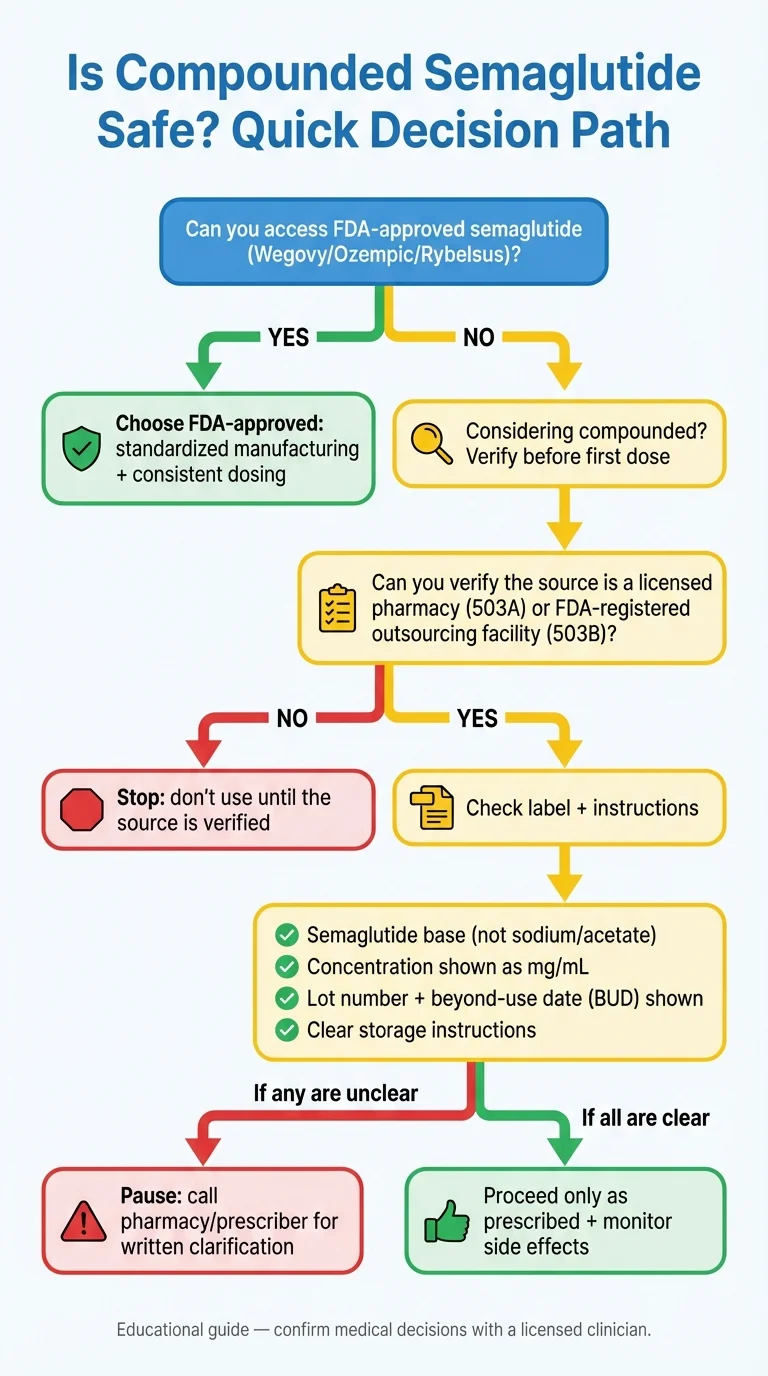
Decision flowchart: Find your situation and follow the recommended path
What You'll Learn in This Guide
- What "compounded semaglutide" actually means
- What the FDA has specifically warned about
- The legal status after FDA removed semaglutide from the shortage list (2025–2026)
- The 5 biggest safety risks
- How to verify if your source is legitimate
- What to do if you're already using it
- Safer alternatives worth considering
- Common questions answered
What Is Compounded Semaglutide?
First, let's clear up what we're actually talking about.
Semaglutide is the active ingredient in Wegovy (approved for weight loss), Ozempic (approved for Type 2 diabetes), and Rybelsus (oral tablets for diabetes). These are all made by Novo Nordisk and have gone through rigorous FDA testing.
Compounded semaglutide is a custom-prepared version made by a compounding pharmacy. A pharmacist mixes the ingredients from scratch to create the final injectable product.
Compounded ≠ Generic
This is a critical distinction. Many people think compounded semaglutide is like a generic version of Wegovy—same thing, lower price. It's not.
Generic drugs go through FDA review. The FDA confirms they contain the same active ingredient, in the same amount, and work the same way as the brand-name version. There are no FDA-approved generic versions of semaglutide. The patents don't expire for years.
Compounded drugs skip all of that. No FDA review. No standardized testing. No quality verification before the product reaches you. The pharmacy prepares it, and that's what you get.
This doesn't mean compounded medications are inherently bad. Compounding has legitimate uses—like when a patient is allergic to an inactive ingredient in the brand-name product, or needs a dose that isn't commercially available. Compounding pharmacies have served an important role in healthcare for decades. But for a medication you're injecting into your body weekly, that lack of oversight matters. For more context, see our compounded GLP-1 vs. name-brand comparison.
The 4 Things People Call "Compounded Semaglutide"
When someone says they're using "compounded semaglutide," they could be referring to very different products with very different risk profiles:
Each of these carries different risks. The rest of this guide focuses primarily on categories 1 and 2, since those are the legitimate (or at least quasi-legitimate) compounding channels.
Is Compounded Semaglutide Safe and Effective for Weight Loss?
This is the core question, and it deserves a direct answer.
What we know: Semaglutide as a molecule works. The FDA-approved clinical trials for Wegovy demonstrated an average weight loss of about 15% of body weight. The SELECT cardiovascular outcomes trial showed a 20% reduction in major cardiovascular events. These are significant, well-documented results. Learn more in our GLP-1s for weight loss guide.
What we don't know about compounded versions: Your specific compounded product has not been studied or approved. We don't know if the potency matches the label. We don't know if the formulation is equivalent to what was tested in clinical trials. We don't know if salt forms (sodium, acetate) work the same as semaglutide base.
If you've taken compounded semaglutide (especially if you may have taken more than prescribed), seek urgent care or call emergency services if you experience:
- Severe, persistent vomiting that you cannot control
- Signs of severe dehydration: dizziness, fainting, dark urine, rapid heartbeat
- Severe abdominal pain (could indicate pancreatitis)
- Confusion or altered mental state
- Difficulty breathing
If you think you took much more than your prescribed dose, contact Poison Control at 1-800-222-1222 or seek emergency care immediately. Don't wait to see if symptoms develop.
What the FDA Has Specifically Warned About
The FDA doesn't regulate compounded drugs the same way it regulates approved medications. But it does monitor safety signals and issue warnings when problems emerge. Here's what they've flagged for compounded GLP-1 drugs like semaglutide:
990 Adverse Event Reports (As of May 31, 2026)
As of May 31, 2026, FDA had received 990 adverse event reports associated with compounded semaglutide. These reports do not establish that the drug caused each event and do not provide an incidence rate; FDA also warns that reporting is incomplete. (FDA guidance) Some reports involved patients seeking medical attention for symptoms including nausea, vomiting, diarrhea, abdominal pain, and constipation.
To put this in context: FDA-approved semaglutide products also have known risks and side effects. Many side effects are expected with GLP-1 medications regardless of the source. The key difference with compounded products isn't necessarily more adverse events—it's more uncertainty. With FDA-approved products, the formulation and manufacturing are standardized and monitored. When something goes wrong with FDA-approved Wegovy, you know exactly what you took. With compounded versions, you might be dealing with incorrect potency, contamination, or ingredients that were never tested for safety.
Dosing Errors Leading to Hospitalization
This is the biggest acute safety concern the FDA has highlighted.
Unlike Wegovy and Ozempic, which come in pre-filled pens that deliver exactly the right dose, compounded semaglutide typically comes in multi-dose vials. You draw up the medication yourself using a syringe.
This creates multiple opportunities for error:
Concentration confusion: Compounding pharmacies use different concentrations. One pharmacy might use 5 mg/mL, another uses 2.5 mg/mL. If you're used to one and switch to another, you could easily inject double or half your intended dose.
Unit measurement confusion: Instructions sometimes tell patients to inject "units" instead of milligrams or milliliters. But "units" can mean different volumes depending on the concentration. The FDA documented cases where patients took 5 to 20 times their intended dose because of this confusion.
Syringe size problems: Some patients received syringes much larger than needed for their dose, making it easy to overdraw medication.
Healthcare provider errors: Even clinicians have miscalculated doses when converting between milligrams, milliliters, and units. In one case, a provider prescribed 20 units instead of 2 units, affecting three patients who received 10 times the intended dose.
Lack of clear instructions: One patient reported that when they contacted their telehealth provider for dosing clarification, they couldn't get a clear answer. The patient searched online for guidance and ended up taking five times the intended dose.
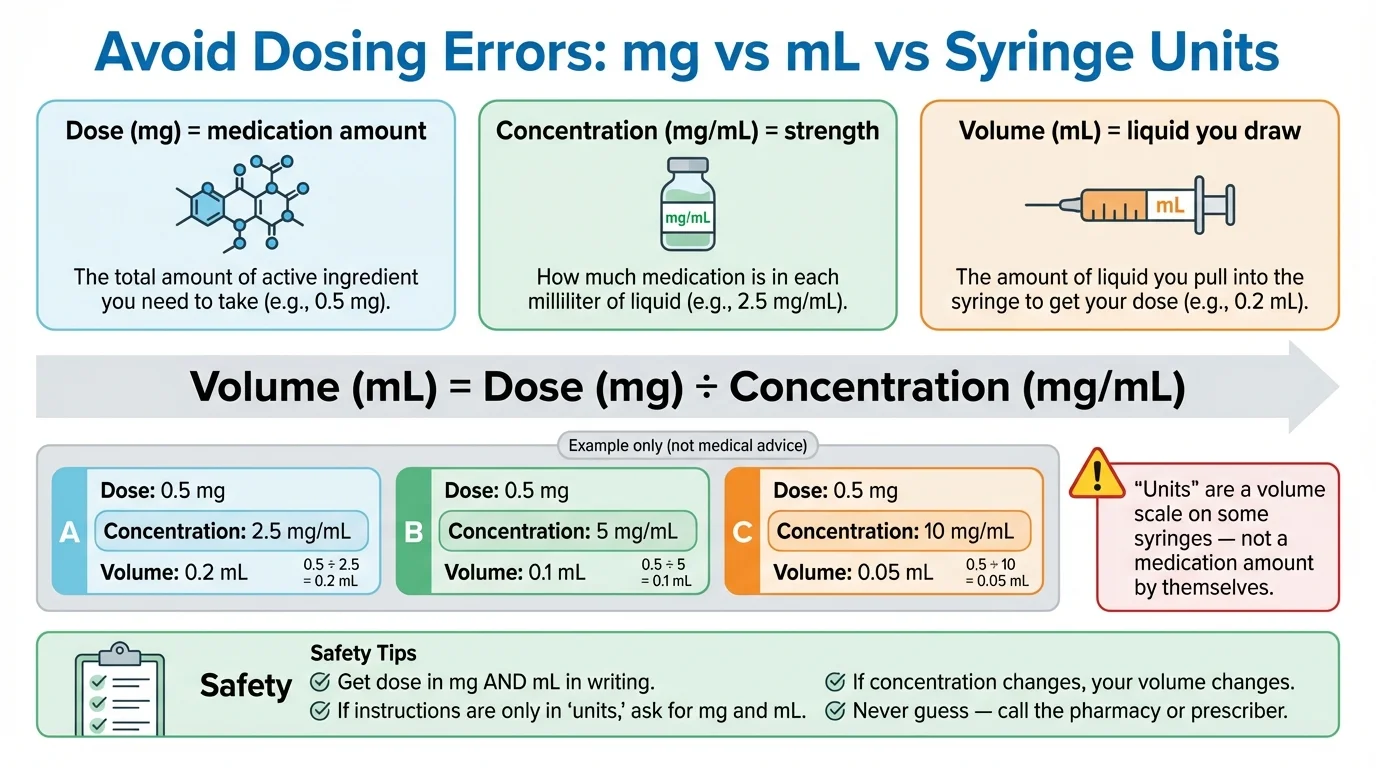
Understanding dosing: mg vs mL vs units at different concentrations
The FDA has stated clearly: "Dosing errors have resulted from patients measuring and self-administering incorrect doses of the drug, and in some cases, healthcare providers miscalculating doses of the drug."
Semaglutide Salt Forms (Not the Same Ingredient)
This is technical but important.
FDA-approved semaglutide products use something called semaglutide base—that's the actual molecule that was tested in clinical trials and approved as safe and effective.
Some compounding pharmacies have been using semaglutide salts instead—like semaglutide sodium or semaglutide acetate. These are chemically different from semaglutide base.
The FDA's position: "The agency does not have information on whether these salts have the same chemical and pharmacologic properties as the active ingredient in the approved drug, and we are not aware of any lawful basis for their use in compounding."
In plain English: salt forms haven't been tested. We don't know if they work the same, absorb the same, or have the same safety profile. And there's no legal basis for using them in compounded medications.
If your compounded semaglutide label says "semaglutide sodium" or "semaglutide acetate" instead of just "semaglutide"—that's a red flag.
Fraudulent Products
The FDA has identified counterfeit compounded semaglutide and tirzepatide products with fake pharmacy names on the labels. Some labels reference pharmacies that don't actually exist. Others use the name of a real licensed pharmacy—but that pharmacy didn't actually make the product.
There's also a market for products labeled "for research purposes only" or "not for human consumption" being sold directly to consumers for injection. These products often include dosing instructions, making it clear they're intended for human use despite the labeling. They're illegal, and their quality is completely unknown.
Improper Storage and Shipping
Injectable semaglutide needs refrigeration. The FDA has received complaints about compounded products arriving warm or with inadequate ice packs. Once a medication exceeds its temperature range, its quality may be compromised—it might not work as well, or it might degrade into something harmful.
If your medication arrives warm, don't use it.
Is Compounded Semaglutide Legal in 2026?
The legal landscape changed significantly when the FDA declared the semaglutide shortage resolved.
The Timeline
- 2022: FDA declared a semaglutide shortage. Demand for Wegovy and Ozempic exceeded supply.
- During shortage: Federal law allowed compounding pharmacies to make "essentially copies" of FDA-approved drugs during shortages. This opened the door for widespread semaglutide compounding.
- February 21, 2025: FDA declared the semaglutide shortage resolved. Supply now meets demand.
- April 22, 2025: April 22, 2025 was the original 503A target date. FDA extended discretion pending the court decision; after the April 24 denial of the preliminary injunction, FDA confirmed in its April 28 update that the 503A period had ended. (FDA clarification)
- May 22, 2025: Enforcement discretion period ended for 503B outsourcing facilities.
Understanding 503A vs. 503B
These designations matter for understanding the regulatory landscape:
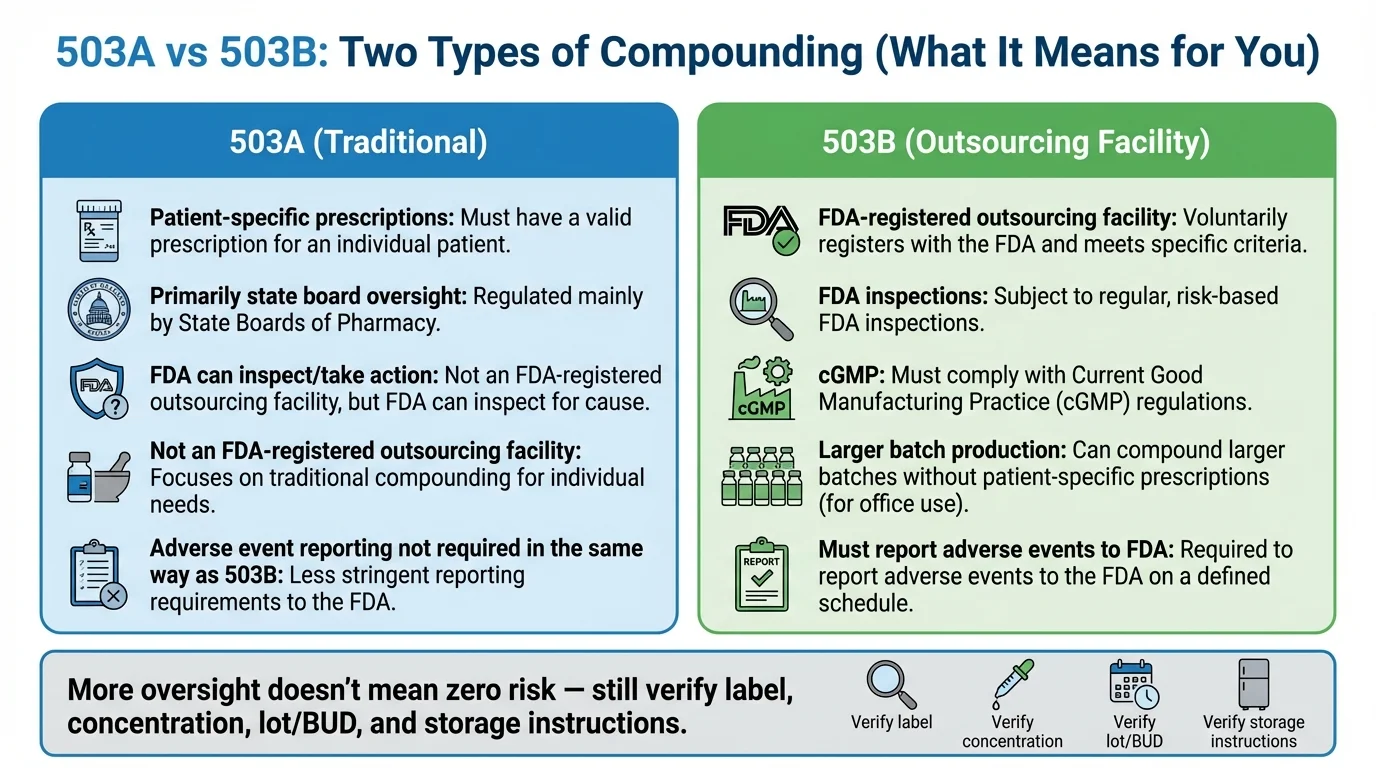
503A vs 503B compounding pharmacy comparison
- • Licensed by state boards of pharmacy
- • Compound medications based on individual prescriptions
- • Primarily regulated at the state level
- • Not required to register with FDA
- • FDA can inspect and take action when problems found
- • Not required to report adverse events to FDA
- • Must register with FDA
- • Subject to FDA inspections
- • Must follow Current Good Manufacturing Practice (cGMP) standards
- • Can compound larger batches without patient-specific prescriptions
- • Required to report adverse events to FDA
- • Generally higher level of oversight than 503A
What This Means Now
With the shortage resolved, pharmacies can no longer legally compound products that are "essentially copies" of FDA-approved semaglutide medications just because it's cheaper or more convenient.
Compounding is still permitted in limited circumstances:
- True patient-specific need: A patient has a documented allergy to an inactive ingredient in Wegovy or Ozempic, and a compounded version without that ingredient is medically necessary.
- Non-standard dosing: A patient needs a dose that isn't commercially available (though this is harder to justify with the multiple dose options now on the market).
- Clinical difference: The compounded product is meaningfully different from the FDA-approved version in a way that serves a specific patient need.
What's NOT permitted:
- Compounding semaglutide simply because it's cheaper
- Compounding copies of FDA-approved products when those products are available
- Making small changes that don't serve a legitimate medical purpose just to claim the product isn't a "copy"
The Litigation Factor
The Outsourcing Facilities Association filed lawsuits challenging the FDA's removal of semaglutide from the shortage list. They argued the decision was "reckless and arbitrary." Courts have denied requests for preliminary injunctions, meaning the FDA's enforcement timelines remain in effect.
However, ongoing litigation creates some uncertainty. Some compounding operations may be continuing to operate while challenging the regulations. This doesn't make their products safer or more legal—it just means enforcement is complicated.
The Practical Reality
Despite these restrictions, compounded semaglutide is still being sold. Some of this is legitimate—there are real patients with real medical needs that FDA-approved products can't meet. Some of it exists in a legal gray area. And some of it is clearly illegal.
As a consumer, you should understand that the legal protection for compounded semaglutide has narrowed significantly. The "it was legal during the shortage" justification no longer applies.
How the FDA Categorizes These Concerns
The FDA has organized its concerns about compounded GLP-1 drugs into several key areas. Understanding these categories helps you evaluate your own risk:
Category 1: Quality and Sterility Issues
The FDA cannot verify that compounded semaglutide is: free from contamination, properly sterilized, correctly formulated, or adequately tested before distribution.
Unlike FDA-approved manufacturing facilities, compounding pharmacies face less rigorous inspection requirements. A 503A pharmacy might go years without a comprehensive inspection. Even 503B outsourcing facilities, while subject to FDA oversight, have had documented quality failures.
Category 2: Ingredient Authenticity
The FDA has found that some compounded products contain:
- Semaglutide salt forms instead of the approved base form
- Ingredients from unregistered foreign suppliers
- Active pharmaceutical ingredients labeled "for research use only"
- Unknown or undisclosed additives
Category 3: Dosing and Administration Risks
The pre-filled pen design of Wegovy and Ozempic exists for a reason. FDA-approved pens reduce dosing-measurement errors because the dose delivery is standardized compared with drawing medication from a vial. No measuring, no calculations, no opportunities for mistakes.
Compounded vials remove that safety feature. Every injection requires: correctly reading the concentration, calculating the volume needed, drawing up the exact amount, using the right syringe, and verifying you have the right dose. Each step is an opportunity for error.
Category 4: Supply Chain and Distribution Concerns
The path from raw ingredient to your injection involves multiple steps:
- Raw semaglutide is manufactured (often overseas)
- Imported into the US (may or may not be from FDA-registered facility)
- Supplied to compounding pharmacy
- Mixed into final formulation
- Packaged and labeled
- Stored properly
- Shipped with appropriate cold chain
- Delivered to you
At each step, something can go wrong. The FDA has established an import alert specifically to stop GLP-1 APIs with potential quality concerns from entering the US supply chain—but not all problematic ingredients get caught.
The 5 Biggest Safety Risks
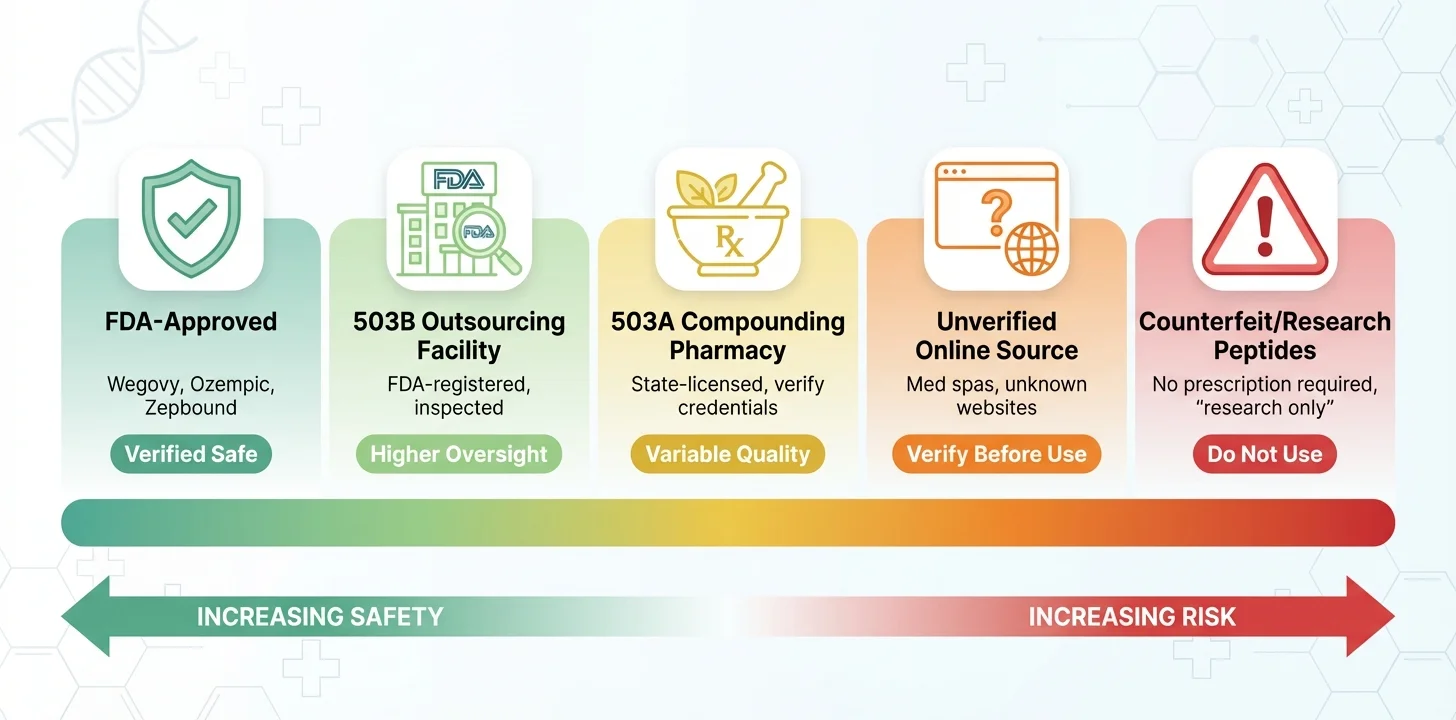
Safety spectrum: Understanding risk levels by source type
With FDA-approved medications, every batch is tested. The active ingredient is verified. Purity is confirmed. Potency is consistent.
With compounded medications, quality control varies widely. Some compounding pharmacies do extensive testing. Others do minimal testing. Some may be sourcing ingredients from suppliers who cut corners.
The FDA notes that poor compounding practices can result in contamination or medication that contains too much, too little, or none of the active ingredient.
Beyond potency, there are concerns about: Sterility (is the injectable product actually sterile?), Endotoxins (are there bacterial byproducts that could cause reactions?), Particulates (is the solution free of particles that shouldn't be there?), and Ingredient sourcing (where did the raw semaglutide come from?).
If your label shows semaglutide sodium, semaglutide acetate, or any other salt form, you're not getting the same ingredient that was tested in clinical trials.
How to check: Look at your vial label. It should say "semaglutide" without any qualifier. If it says "semaglutide sodium" or another variation, contact the pharmacy and ask questions.
This is the number one acute safety issue identified by the FDA. The problems: variable concentrations between pharmacies, confusing instructions (units vs. mg vs. mL), syringes that are wrong for the dose, and no built-in safety features like the pre-filled pens have.
The FDA documented patients who accidentally injected 5 to 20 times their intended dose. Some required hospitalization.
Understanding the Concentration Problem:
Different compounding pharmacies use different concentrations. Common ones include: 2.5 mg/mL, 5 mg/mL, and 10 mg/mL.
If you're prescribed 0.5 mg of semaglutide:
- With a 2.5 mg/mL concentration, you need 0.2 mL
- With a 5 mg/mL concentration, you need 0.1 mL
- With a 10 mg/mL concentration, you need 0.05 mL
If you switch pharmacies or get a new vial with a different concentration and don't adjust your volume, you could easily double or halve your dose without realizing it.
The market for GLP-1 medications is enormous, which makes it attractive to fraudsters. The FDA has documented:
- Products with completely fake pharmacy names on labels
- Real pharmacy names used without authorization
- "Research use only" products being sold for injection
- Products sold without any prescription requirement
Red flags:
- No prescription required
- Prices that seem too good to be true (under $100/month is suspicious)
- Payment only in cryptocurrency or gift cards
- Vague or missing pharmacy information
- Claims that it's "generic semaglutide" (generics don't exist yet)
- Website doesn't require medical evaluation
When you take an FDA-approved medication and experience a serious adverse event, there's a system in place. The manufacturer is required to track adverse events. The FDA monitors safety signals. If a pattern emerges, warnings are issued or products are recalled.
With compounded medications, that safety net is weaker. State-licensed 503A pharmacies aren't required to report adverse events to the FDA. So even when problems occur, they may never be documented. You're flying with less visibility into what could go wrong.
The 7-Point Verification Checklist
Before you use any compounded semaglutide, verify these seven things. If you can't verify all of them, reconsider your source.
1You Have a Legitimate Prescription
Semaglutide requires a prescription from a licensed healthcare provider. Period. If someone is selling you semaglutide without requiring a prescription, they're operating illegally.
A legitimate prescription means: you had a medical evaluation (can be via telehealth), a licensed prescriber determined semaglutide is appropriate for you, and the prescription was sent to a licensed pharmacy.
2The Pharmacy Is State-Licensed
Every compounding pharmacy must be licensed by the state board of pharmacy where they operate.
How to verify: Ask the pharmacy for their license number. Go to that state's board of pharmacy website. Search for the pharmacy name or license number. Confirm the license is active and in good standing. Check for any disciplinary actions.
3If It's a 503B Outsourcing Facility, It's FDA-Registered
503B outsourcing facilities must register with the FDA and appear on a public list.
How to verify: Ask the pharmacy if they're a 503B facility. If yes, search the FDA's registered outsourcing facility list. Confirm they're listed and in good standing. 503B facilities undergo FDA inspections and must follow cGMP standards.
4The Label States "Semaglutide" (Not a Salt Form)
Look at your vial. The active ingredient should be listed as "semaglutide" or "semaglutide base." If it says "semaglutide sodium," "semaglutide acetate," or any other variation—that's not the same ingredient approved by the FDA. Ask questions before using it.
5Concentration and Dosing Instructions Are Clear
Your label and accompanying instructions should clearly state: the concentration (e.g., 2.5 mg/mL or 5 mg/mL), your prescribed dose in milligrams (mg), the corresponding volume in milliliters (mL), and how to measure the dose with your syringe.
If instructions are confusing, tell you to measure in "units" without specifying what that means, or you can't figure out how much to inject—don't guess. Call your pharmacy and prescriber for clarification.
6Lot Number and Beyond-Use Date Are Present
Legitimate compounded products have: Lot number (identifies the specific batch—important if there's ever a recall or quality issue) and Beyond-use date (BUD) (the date after which you shouldn't use the product—this is NOT the same as a manufacturer expiration date; BUDs for compounded sterile preparations are typically much shorter).
7Storage Instructions Are Clear and Were Followed
Injectable semaglutide needs refrigeration. Your pharmacy should provide clear storage instructions, and the medication should arrive with appropriate cold packing. If your medication arrived warm or without adequate refrigeration, don't use it. Contact the pharmacy and request a replacement.
How to Verify an Online Pharmacy
Many people access compounded semaglutide through telehealth services or online pharmacies. Here's how to evaluate them:
Use NABP Resources
The National Association of Boards of Pharmacy (NABP) maintains databases to help consumers identify legitimate pharmacies:
- Safe.Pharmacy: Enter a website URL to check if it's recommended, not recommended, or unknown
- Digital Pharmacy Accreditation: Look for NABP-accredited pharmacies and .pharmacy verified domains
Check the Telehealth Provider Separately
If you're using a telehealth service that connects you with prescribers and then fills prescriptions: verify the prescriber is licensed in your state, verify the pharmacy is licensed in the state where it operates. These can be two different entities—check both.
Red Flags for Online Pharmacies
- No prescription required
- Ships from outside the United States
- Prices dramatically lower than typical pharmacy pricing
- No phone number or physical address
- Payment only through unusual methods
- Spelling errors or unprofessional website
- Claims of "FDA-approved compounded semaglutide" (compounded drugs aren't FDA-approved)
8 Questions to Ask Before Ordering
Don't be shy about asking questions. A legitimate pharmacy should be able to answer:
1. "What is your pharmacy license number and which state issued it?" — They should provide this readily. Verify it yourself.
2. "Are you a 503A pharmacy or a 503B outsourcing facility?" — Know which category they fall into.
3. "Where do you source your semaglutide active ingredient?" — The answer should reference an FDA-registered manufacturer.
4. "Do you use semaglutide base or a salt form?" — The answer must be "base." If they say sodium, acetate, or don't know—red flag.
5. "Can you provide a Certificate of Analysis for the batch you're dispensing?" — Legitimate pharmacies should be able to provide documentation.
6. "What concentration do you compound, and how will my dose be measured?" — The answer should be clear and specific, in both mg and mL.
7. "What are your storage and shipping procedures?" — They should describe appropriate cold chain handling.
8. "What is the beyond-use date for your compounded semaglutide?" — They should provide a specific timeframe.
If a pharmacy is evasive about any of these questions, or their answers don't add up—find another source.
Evaluating Telehealth Providers
- Licensed providers in your state
- Clear prescription process with medical evaluation
- Transparent about which pharmacy fulfills orders
- Responsive customer service
- Realistic claims about results
- Guaranteed results or unrealistic promises
- No medical evaluation before prescribing
- Won't disclose pharmacy partner information
- Aggressive marketing with countdown timers
- Prices that seem too good to be true
What If You're Already Using Compounded Semaglutide?
If you're currently using compounded semaglutide and haven't had problems, that doesn't necessarily mean you need to stop immediately. But you should do a verification check.
If you've experienced adverse effects that might be related to compounded semaglutide, report them to:
- FDA MedWatch: The FDA's adverse event reporting program accepts reports from consumers
- Your state board of pharmacy: They can investigate compounding pharmacy issues
- Your healthcare provider: Document it in your medical record
Safer Alternatives to Consider
If you're concerned about the safety of compounded semaglutide, there are FDA-approved options worth exploring. See our semaglutide vs. tirzepatide comparison for more details.
FDA-Approved GLP-1 Medications
- • FDA-approved for chronic weight management
- • Pre-filled pen reduces dosing-measurement errors
- • Maintenance dose: 2.4 mg weekly
- • Approved for adults and adolescents 12+
- • Also approved for cardiovascular risk reduction
- • Cost: ~$1,349/month without insurance
- • FDA-approved for Type 2 diabetes
- • Often prescribed off-label for weight loss
- • Pre-filled pen
- • Maximum dose: 2 mg weekly
- • Also approved for cardiovascular/kidney risk reduction
- • Cost: ~$935/month without insurance
- • FDA approved in late 2025, available early 2026
- • First FDA-approved GLP-1 pill for weight loss
- • No needles required
- • Take with plain water only; wait 30 min before food, drink, or other oral medicines
Learn more: Wegovy pill cost and where to buy | Best oral semaglutide options
- • FDA-approved for Type 2 diabetes (not weight loss)
- • Oral tablet taken daily
- • FDA-approved oral semaglutide tablet
- • Must be taken on empty stomach
- • Some weight loss occurs
- • FDA-approved for weight loss
- • Dual GLP-1 + GIP agonist mechanism
- • Studies show ~21% average weight loss at highest dose in trials
- • Pre-filled pen, weekly injection
- • Cost: ~$1,086/month (list price)
- • Same active ingredient as Zepbound
- • FDA-approved for Type 2 diabetes
- • Often prescribed off-label for weight loss
- • Pre-filled pen
The Cost Reality
Let's be honest about costs, because this is often why people turn to compounded options. For more details, see our GLP-1 cost guide.
| Medication | Typical Cash Price | With Insurance | With Savings Card |
|---|---|---|---|
| Wegovy | $1,349/month | $0-$500/month | $0-$500/month |
| Ozempic | $935/month | $0-$200/month | $0-$200/month |
| Zepbound | $1,086/month | $0-$500/month | $0-$500/month |
| Compounded semaglutide | $199-$599/month | Rarely covered | N/A |
Looking for help accessing FDA-approved options? Services like MEDVi connect you with licensed providers who can prescribe FDA-approved medications, help navigate insurance coverage and prior authorizations, and ensure you're getting genuine products—not compounded alternatives with unknown quality.
Explore FDA-Approved Options with MEDViWhat to Look for in a Telehealth Provider
- Licensed providers in your state
- Prescribes FDA-approved medications (not just compounded)
- Helps with insurance prior authorization
- Provides ongoing medical support
- Transparent pricing
- Responsive customer service
For more options without insurance, see our guides on how to get GLP-1 without insurance and best GLP-1 online programs.
Special Situations: What the Evidence Shows
Pregnancy and Trying to Conceive
Don't use semaglutide if you're pregnant or planning to become pregnant.
The FDA-approved labeling for semaglutide recommends discontinuing the medication at least 2 months before a planned pregnancy. Animal studies have shown reproductive risks. There isn't enough human data to know the full risks. If you're using compounded semaglutide and become pregnant, stop taking it and contact your healthcare provider immediately.
Breastfeeding
Guidance differs by formulation. For Wegovy tablets, labeling says breastfeeding is not recommended during treatment. For semaglutide injections, it's not well established whether semaglutide passes into human milk; discuss risks and benefits with your clinician. For compounded semaglutide specifically, the uncertainty is even greater because of variable formulations.
Type 2 Diabetes
Semaglutide (as Ozempic) is FDA-approved for Type 2 diabetes. If you have diabetes, FDA-approved options are definitely preferable to compounded versions—you want reliable, consistent medication for managing a chronic condition. If you're in this situation, the verification checklist becomes even more important. Blood sugar management requires consistent, reliable medication.
History of Pancreatitis
Pancreatitis has been reported with GLP-1 receptor agonists, including semaglutide. If you have a history of pancreatitis, discuss risks with your clinician before using any semaglutide product. Compounded versions add uncertainty: if the potency is variable, your risk exposure is harder to predict.
Thyroid Cancer History
FDA-approved semaglutide products carry a boxed warning about thyroid C-cell tumors, based on rodent studies. If you have a personal or family history of medullary thyroid carcinoma (MTC) or Multiple Endocrine Neoplasia syndrome type 2 (MEN 2), semaglutide is contraindicated.
Gallbladder Disease
GLP-1 medications, including semaglutide, have been associated with gallbladder-related problems including gallstones. This risk exists for both FDA-approved and compounded versions, but with compounded products, variable potency could affect risk exposure. Rapid weight loss itself increases gallbladder risks.
Understanding What You're Injecting: A Deeper Look
The Importance of Pharmaceutical-Grade Ingredients
When Novo Nordisk manufactures Wegovy, they use semaglutide that meets rigorous pharmaceutical-grade standards. The raw material goes through multiple quality checks. The manufacturing process is validated. Every batch is tested before release.
Compounding pharmacies source their semaglutide from various suppliers—some FDA-registered, some not. The phrase "pharmaceutical-grade" gets thrown around, but it doesn't have a standardized legal definition for compounding ingredients.
What "B12 Added" Means
Some compounding pharmacies add Vitamin B12 (cyanocobalamin) to their semaglutide formulations. Marketing claims suggest this helps with energy, metabolism, or side effect reduction.
Here's the reality:
- There's no clinical evidence that adding B12 to semaglutide improves results
- B12 injections can help if you're deficient, but that's a separate medical issue
- The combination hasn't been studied for safety or effectiveness
- It may be used to create a "different" formulation for regulatory reasons
Reading Your Vial Label
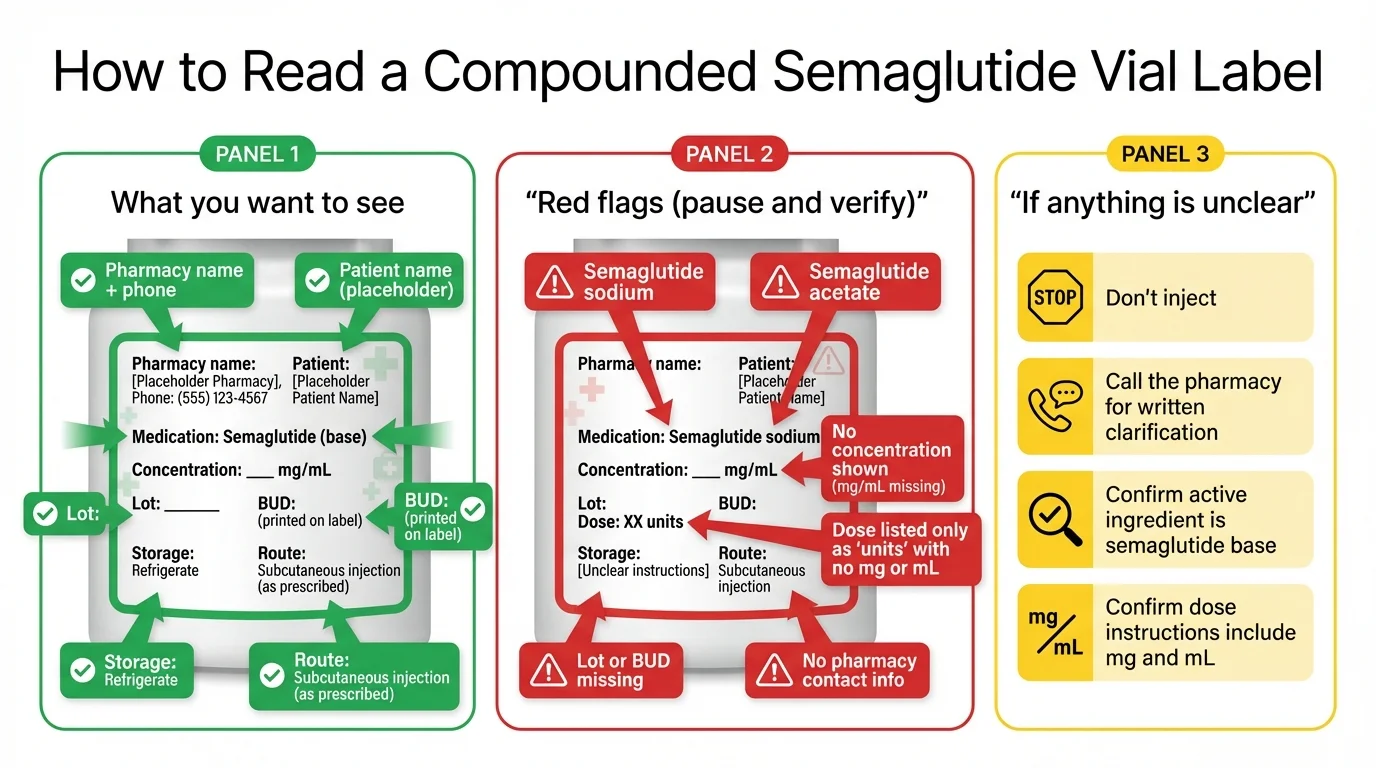
Know what to look for on your vial label
Your vial label should tell you:
- Active ingredient: Semaglutide (not semaglutide sodium or acetate)
- Concentration: mg/mL (e.g., 2.5 mg/mL, 5 mg/mL)
- Total volume: How much is in the vial
- Beyond-use date: When to stop using it
- Lot number: Identifies the batch
- Storage instructions: Usually "refrigerate"
- Pharmacy information: Name, address, contact
If any of this is missing, unclear, or seems inconsistent—contact the pharmacy before using the product.
Storage, Refrigeration, and the "28 Days" Question
FDA-Approved Storage Guidelines
For reference, here's what the FDA-approved products require:
- • Single-dose pens
- • Store in refrigerator (36°F to 46°F)
- • Can be kept at room temperature up to 28 days before use
- • Don't freeze; don't use if frozen
- • Similar storage requirements
- • Can be kept at room temperature (59°F to 86°F) for up to 56 days
Compounded Storage Is Different
Compounded medications have their own "beyond-use dates" (BUDs) based on USP guidelines and the pharmacy's testing. These are often shorter than manufacturer expiration dates.
Don't assume compounded semaglutide has the same storage window as Wegovy or Ozempic. Follow the specific instructions from your compounding pharmacy.
For compounded GLP-1 multi-dose vials, FDA recommends discarding the vial within 28 days after first use, even if medicine remains or the compounder’s instructions allow longer. An earlier beyond-use date or shorter discard instruction still takes priority. This recommendation does not replace the product-specific instructions for FDA-approved devices or set the shelf life of an unopened compounded vial. (FDA guidance)
What If It Got Warm or Wasn't Refrigerated?
- Don't use it. Temperature excursions can affect potency and potentially safety.
- Contact the pharmacy. Ask for guidance and potentially a replacement.
- When in doubt, throw it out. This isn't worth the risk.
After the Beyond-Use Date
Don't use compounded medication after its beyond-use date. Period. The BUD exists because the pharmacy can only guarantee the product's sterility, potency, and safety up to that point. After the BUD, you're gambling.
What Medical Organizations Say
The Common Theme: Professional medical organizations consistently recommend FDA-approved products when they're available. The core concern: without FDA oversight, there's no independent verification that compounded products are safe, effective, or properly made. This doesn't mean every compounded product is dangerous. But it does mean the medical establishment recognizes the additional risks—and advises accordingly.
Frequently Asked Questions
The Bottom Line
Is compounded semaglutide safe? There's no universal yes or no answer.
- Compounded semaglutide is not FDA-approved
- The FDA has documented 990+ adverse event reports, including hospitalizations
- Dosing errors are a significant risk with vial-and-syringe formats
- Some products contain unapproved salt forms
- Counterfeit and fraudulent products exist in the market
- The legal basis for compounding has narrowed since the shortage ended
- FDA-approved alternatives are safer when accessible
What this means for you: If you can access FDA-approved semaglutide (Wegovy, Ozempic) through insurance, manufacturer programs, or telehealth services that dispense genuine medications—that's the safest path. You get the benefit of extensive clinical testing, consistent manufacturing, and built-in safety features like pre-filled pens.
Ready to explore FDA-approved options? Telehealth services like MEDVi can help you navigate insurance coverage, connect with licensed providers, and access genuine FDA-approved GLP-1 medications without the uncertainties of compounded alternatives.
Get Started with MEDViThe Decision Framework
- You have insurance that covers it
- You qualify for manufacturer savings programs
- You're willing to pay more for FDA-approved products with standardized manufacturing
- You don't want to worry about dosing calculations
- You have ongoing health conditions that require consistent medication
- You prefer the peace of mind that comes with FDA oversight
- You have a documented medical need (like an allergy)
- You've verified your source meets all safety criteria
- You understand and accept the additional risks
- You're confident in your ability to measure doses correctly
- You have a healthcare provider monitoring your progress
- You've exhausted other options for accessing FDA-approved medications
- You can't verify the pharmacy's license
- The product contains salt forms instead of semaglutide base
- Dosing instructions are unclear or confusing
- The price seems too good to be true
- No prescription was required
- You have any doubts about the source's legitimacy
A Final Note on Weight Loss Journeys
The interest in compounded semaglutide ultimately reflects something important: people want effective tools for managing their weight, and the barriers to accessing FDA-approved medications—cost, insurance coverage, availability—have pushed many toward alternatives.
That's understandable. But the goal isn't just weight loss at any cost. It's sustainable, healthy weight management that doesn't put you at unnecessary risk.
Whatever path you choose, do it with open eyes. Understand the tradeoffs. Verify your sources. Work with healthcare providers who prioritize your safety, not just your credit card. Your health isn't worth gambling on an unknown product. Verify before you inject.
Sources and Citations
This guide draws on information from the following authoritative sources:
FDA Resources:
- FDA's Concerns with Unapproved GLP-1 Drugs Used for Weight Loss (fda.gov)
- FDA alerts health care providers, compounders and patients of dosing errors associated with compounded injectable semaglutide products (fda.gov)
- Compounding and the FDA: Questions and Answers (fda.gov)
- FDA clarifies policies for compounders as national GLP-1 supply begins to stabilize (fda.gov)
- FDA warns consumers not to use counterfeit Ozempic (semaglutide) found in U.S. drug supply chain (fda.gov)
- BeSafeRx: Your Source for Online Pharmacy Information (fda.gov)
Prescribing Information:
- Wegovy (semaglutide) injection prescribing information (novo-pi.com)
- Ozempic (semaglutide) injection prescribing information (novo-pi.com)
Professional Organizations:
- American Diabetes Association statement on compounded incretin therapies (diabetes.org)
- USP General Chapter 797 - Pharmaceutical Compounding: Sterile Preparations (usp.org)
Regulatory:
- Internet Crime Complaint Center (IC3) Public Service Announcement on fraudulent compounding practices (ic3.gov)
- National Association of Boards of Pharmacy (nabp.pharmacy)
About This Guide
Last Updated: September 14, 2026
Affiliate Disclosure: This article contains affiliate links to telehealth providers, including MEDVi. We may earn a commission if you sign up through our links at no additional cost to you. We only recommend providers that offer FDA-approved medications through legitimate medical channels.
Medical Disclaimer: This content is for informational purposes only and does not constitute medical advice. Always consult a licensed healthcare provider before starting, stopping, or changing any medication.
If this guide helped you make a more informed decision, consider sharing it with others who might be facing the same questions.
Related Guides
Semaglutide Deep Dives
Explore all 4 guides in this topic.
Semaglutide Drops
Guide to sublingual semaglutide drops including how they work, pricing, and provider options.
Do I Qualify for Wegovy?
Eligibility requirements for Wegovy including BMI criteria, medical conditions, and insurance rules.
GLP-1 Missed Period: What To Do First
GLP-1 missed period guide covering FDA labels, the tirzepatide and orforglipron birth-control warnings, pregnancy testing, and when to call your prescriber.
STEP Trials Summary: 18 Studies (2026)
What all 18 reported STEP semaglutide trials actually found, with an interactive closest-trial matcher and the STEP Evidence Atlas.
Related Articles
Semaglutide Drops
Guide to sublingual semaglutide drops including how they work, pricing, and provider options.
Do I Qualify for Wegovy?
Eligibility requirements for Wegovy including BMI criteria, medical conditions, and insurance rules.
GLP-1 Missed Period: What To Do First
GLP-1 missed period guide covering FDA labels, the tirzepatide and orforglipron birth-control warnings, pregnancy testing, and when to call your prescriber.
STEP Trials Summary: 18 Studies (2026)
What all 18 reported STEP semaglutide trials actually found, with an interactive closest-trial matcher and the STEP Evidence Atlas.
What Is GLP-1?
A complete beginner's guide to GLP-1 medications, how they work, and what to expect.
Best GLP-1 Telehealth Providers
Ranked and reviewed telehealth providers offering GLP-1 prescriptions for weight loss online.