Disclosure: Some links on this site are affiliate links. If you purchase through these links, we may earn a commission at no extra cost to you. Thank you for supporting our site.·For informational purposes only—not medical advice.
GLP-1 Providers That Accept HSA: Best Options for Semaglutide & Tirzepatide (2026)
Yes — GLP-1 providers that accept HSA exist, and prescribed GLP-1 treatment is generally HSA-eligible under IRS rules. But “HSA eligible” and “accepts your HSA card at checkout” are two very different things — and that gap is where most people get stuck.
We reviewed official provider pages, FAQs, and public payment information to separate providers that clearly accept HSA/FSA cards, providers that focus on reimbursement, and providers that leave key documentation questions unanswered.
Quick Verdict
Most affordable guided start: MEDVi offers $179 first month, advertised HSA/FSA acceptance, fast approval (24–48 hours), and bundled clinical support.
FDA-approved brand-name: NovoCare's self-pay semaglutide programs accept FSA/HSA cards directly, starting from $199/month for new patients.
Needle-free GLP-1 option: Embody advertises HSA/FSA acceptance on its cash-pay compounded plans, with a low $99 first month and a needle-free GLP-1 gum option for patients who want to skip injections.
Important: Many of the most affordable HSA-friendly online GLP-1 options are compounded medications, not FDA-approved finished drugs. The FDA has issued warnings about certain compounded GLP-1 marketing claims, and the shortages that initially allowed broad compounded access have been resolved for both semaglutide (February 2025) and tirzepatide (late 2024). If FDA-approved brand-name medication matters most to you, use the FDA-first path below.
Affiliate Disclosure: This page contains affiliate links. If you use our links to sign up with a provider, we may earn a commission at no extra cost to you. This doesn't affect our ratings, our editorial process, or what we recommend. Full editorial policy.
Last Updated: July 10, 2026 · Sources: IRS Publication 502, FDA.gov, NovoCare.com · Medical Disclaimer at bottom of page
GLP-1 Provider HSA/FSA Comparison Table
We reviewed each provider's official website, FAQ, and public payment information. Where we could not confirm a claim from public sources, we marked it accordingly.
| Provider | HSA/FSA Payment | Itemized Receipt? | LMN Support? | Med Type | Starting Price | Best For |
|---|---|---|---|---|---|---|
| MEDVi | Provider advertises HSA/FSA approved | Not publicly documented | Not publicly documented | Compounded semaglutide & tirzepatide | $179/mo | Cash-pay users who want guided support |
| NovoCare | Accepts FSA/HSA cards | Yes | N/A (brand-name Rx) | FDA-approved Wegovy & Ozempic | $199/mo intro | FDA-approved semaglutide |
| Embody | HSA/FSA advertised as accepted (cash-pay) | Not publicly documented | Not publicly documented | Compounded semaglutide & tirzepatide (injection or GLP-1 gum) | $99 first mo, then $299/mo | Low first-month start + needle-free gum |
| SkinnyRX | Accepts FSA/HSA cards | Not publicly documented | Not publicly documented | Injectable, oral, branded | From $199/mo | Multiple format choices |
| Yucca Health | Many patients use HSA/FSA | No | No | Compounded semaglutide & tirzepatide | From $146/mo | Budget-first buyers |
| Hers | Reimbursement recommended | Yes (downloadable) | Not publicly documented | Compounded + branded | From $69/mo (oral) | Pay-then-reimburse workflow |
| Hims | Reimbursement recommended | Yes (downloadable) | Not publicly documented | Compounded + branded | Varies by plan | Hims platform users |
| TrimRX | Verify directly before enrolling | Not publicly documented | Not publicly documented | Compounded semaglutide & tirzepatide | Verify current pricing | No-frills medication access |
How to read this table: “Accepts FSA/HSA cards” means we found an explicit public statement confirming card acceptance. “Provider advertises/says” means the provider claims HSA/FSA eligibility but we did not independently test the checkout flow. “Not publicly documented” means we could not find a clear public answer — contact the provider to confirm.
“Lost 16 lbs in 10 weeks — no side effects. Down two sizes. I wish I’d started sooner.”
— Verified MEDVi patient on ConsumerAffairs ★★★★★
Pick Your Path in 30 Seconds
Not everyone needs the same thing. Here's the fastest way to find your fit:
Most affordable guided start
MEDVi advertises $179 first month including medication, physician review, and shipping. HSA/FSA advertised. Month-to-month, cancel anytime.
Not ideal if you require FDA-approved brand-name medication.
FDA-approved semaglutide
NovoCare offers self-pay programs for Wegovy and Ozempic starting at $199/month for new patients (intro pricing through December 31, 2026). Accepts FSA/HSA cards.
Costs more than compounded alternatives; separate provider needed for prescription.
Low first-month start & needle-free option
Embody offers cash-pay compounded semaglutide and tirzepatide as weekly injections or a needle-free GLP-1 gum, with 24/7 support. HSA/FSA advertised as accepted. From $99 first month, then $299/mo ongoing.
Compounded, not FDA-approved; ongoing refills cost more than the intro month.
Lowest price, self-managed
Yucca Health's semaglutide plans start from $146/month (six-month plan). But their FAQ states they do not provide itemized receipts or LMN.
Best for HSA users comfortable managing reimbursement independently.
Can You Use HSA for GLP-1 Medications?
Short answer: in most cases, yes. Prescribed GLP-1 medications — semaglutide, tirzepatide, and others — are generally considered qualified medical expenses under IRS rules when they treat a diagnosed medical condition.
The IRS spells this out in Publication 502: you can include in medical expenses amounts you pay to lose weight if it is a treatment for a specific disease diagnosed by a physician, such as obesity, hypertension, or heart disease.
That's the key phrase: a specific disease diagnosed by a physician. Not weight loss for appearance. Not general wellness. A diagnosed condition.
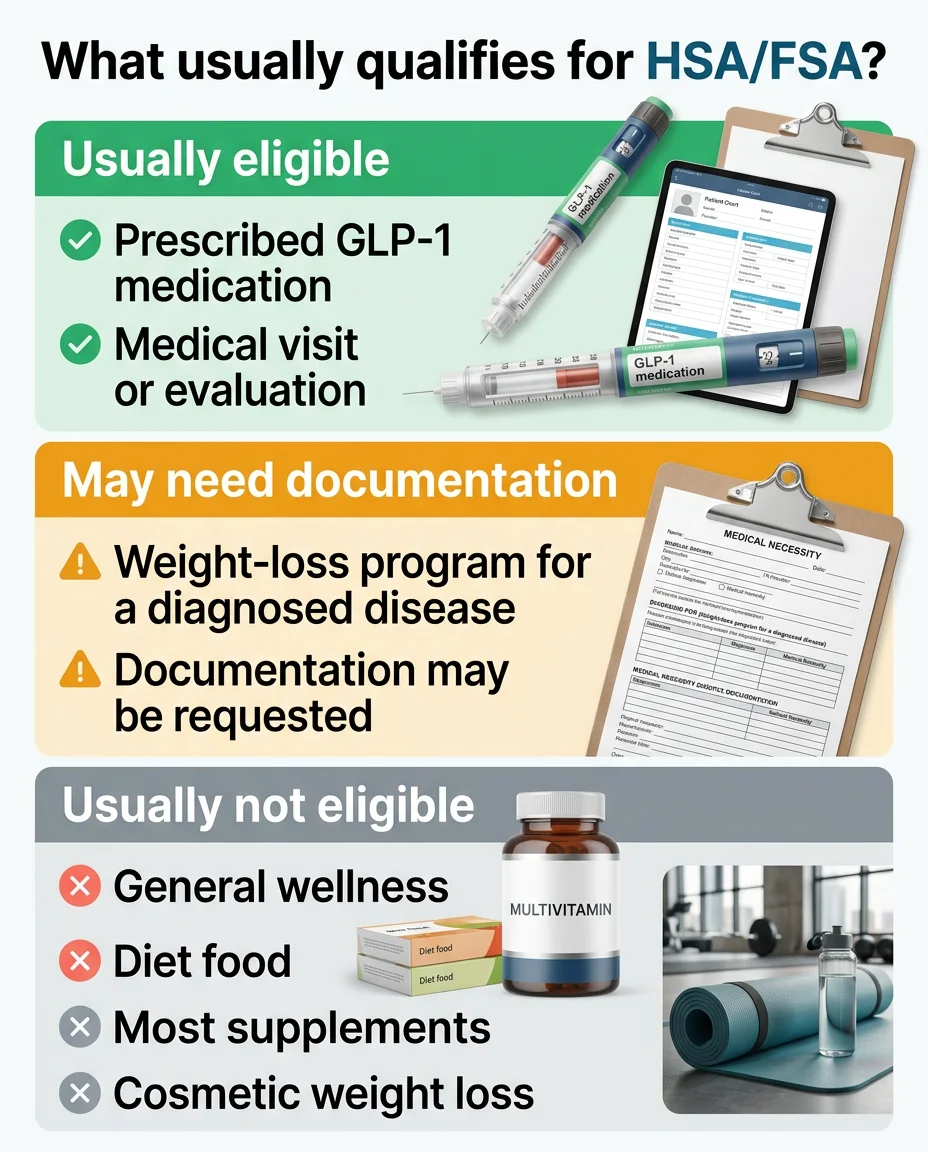
| Expense Type | HSA/FSA Eligible? | Documentation Typically Needed |
|---|---|---|
| GLP-1 prescribed for obesity, T2 diabetes, or related condition | Usually yes | Prescription from licensed provider |
| Weight-loss program fees / coaching | May require documentation | May need Letter of Medical Necessity (LMN) |
| Gym memberships, diet food, supplements | Generally no | IRS specifically excludes these |
| Cosmetic weight loss (no diagnosis) | No | Not a qualified medical expense |
Important: Your HSA/FSA plan administrator has the final say on what they'll approve. The IRS sets the framework, but individual administrators interpret and enforce the rules. Confirm documentation requirements with your administrator before relying on reimbursement.
The One Thing Most Pages Miss: “HSA Eligible” Is Not the Same as “HSA Checkout”
Almost every GLP-1 provider's website says some version of “HSA/FSA eligible!” But that phrase can mean three very different things:
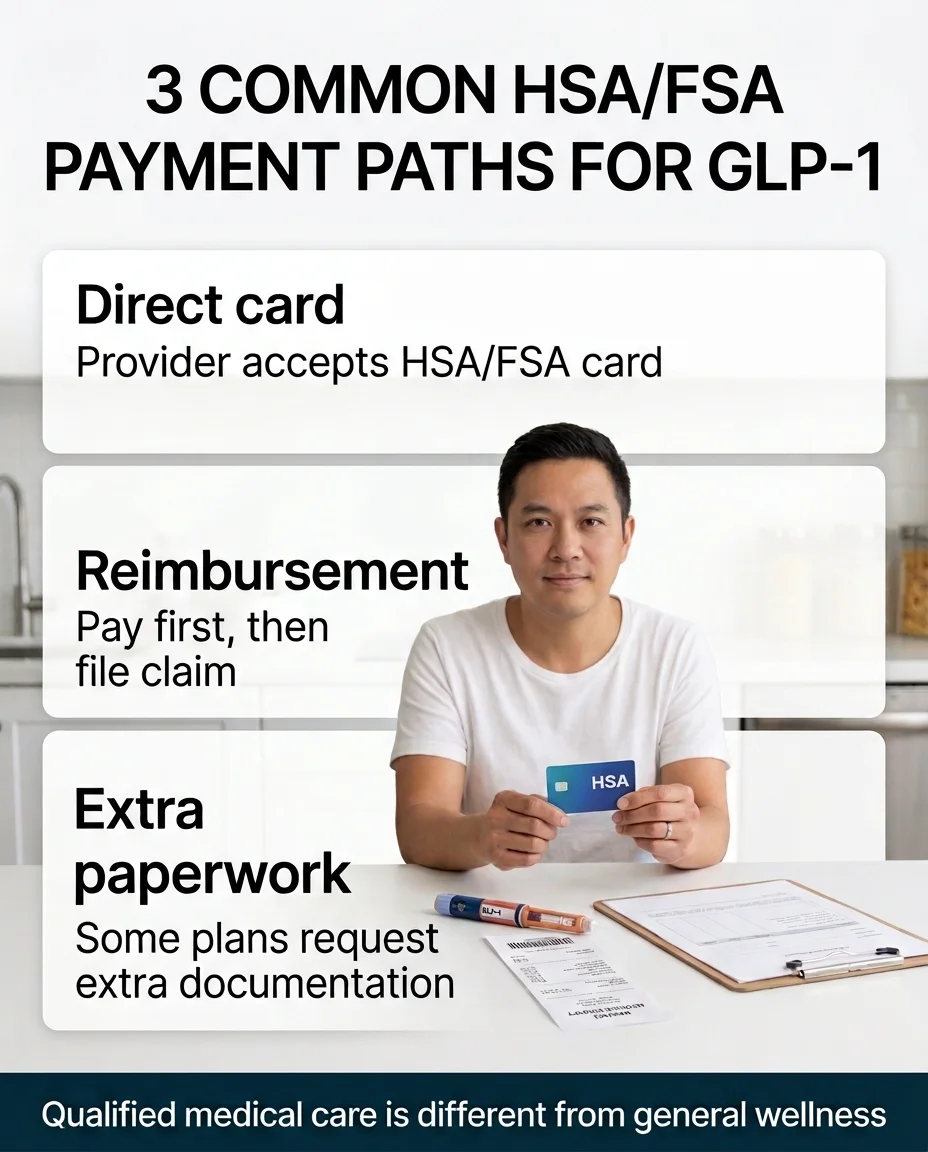
Direct HSA/FSA Card Checkout
You swipe your HSA debit card at checkout, the charge processes, and you're done. No paperwork, no waiting. This is the gold standard.
Who explicitly confirms this: NovoCare (FSA/HSA card acceptance documented). SkinnyRX states they accept FSA/HSA cards.
Pay First, Reimburse Later
You pay with a personal card, download your receipt, then submit a claim to your HSA/FSA portal. This works but takes more steps.
Who uses this model: Both Hims and Hers explicitly recommend paying with a regular card and submitting for reimbursement.
“Eligible” but Documentation Is on You
Some providers say HSA/FSA is accepted but don't provide the documentation your plan administrator might need.
Standout example: Yucca Health's FAQ explicitly states they do not provide itemized receipts or letters of medical necessity.
Bottom line: Before you sign up with any provider, know which of these three paths you're on. It saves you a declined card, a denied claim, and a headache.
How to Use Your HSA or FSA for GLP-1 Medication: Step by Step
This is simpler than most people think. Four steps.
Confirm You Have a Qualifying Diagnosis
GLP-1 medications are HSA/FSA-eligible when prescribed for a diagnosed medical condition. Common qualifying conditions:
- Obesity (BMI 30 or higher)
- Overweight with comorbidities (BMI 27+ with high blood pressure, T2 diabetes, high cholesterol, sleep apnea, or cardiovascular disease)
- Type 2 diabetes
- Insulin resistance or metabolic syndrome
When you complete a telehealth assessment, a licensed clinician determines if GLP-1 therapy is appropriate. That prescription serves as your documentation of medical necessity.
Choose Your Payment Path
- Direct HSA/FSA card: Fastest. Works if the provider processes HSA cards — see our comparison table above.
- Pay and reimburse: Use a personal card, save your receipt, submit a claim. Processing timelines vary.
- Not sure? Start with your HSA card. If it declines, pay with a personal card and reimburse.
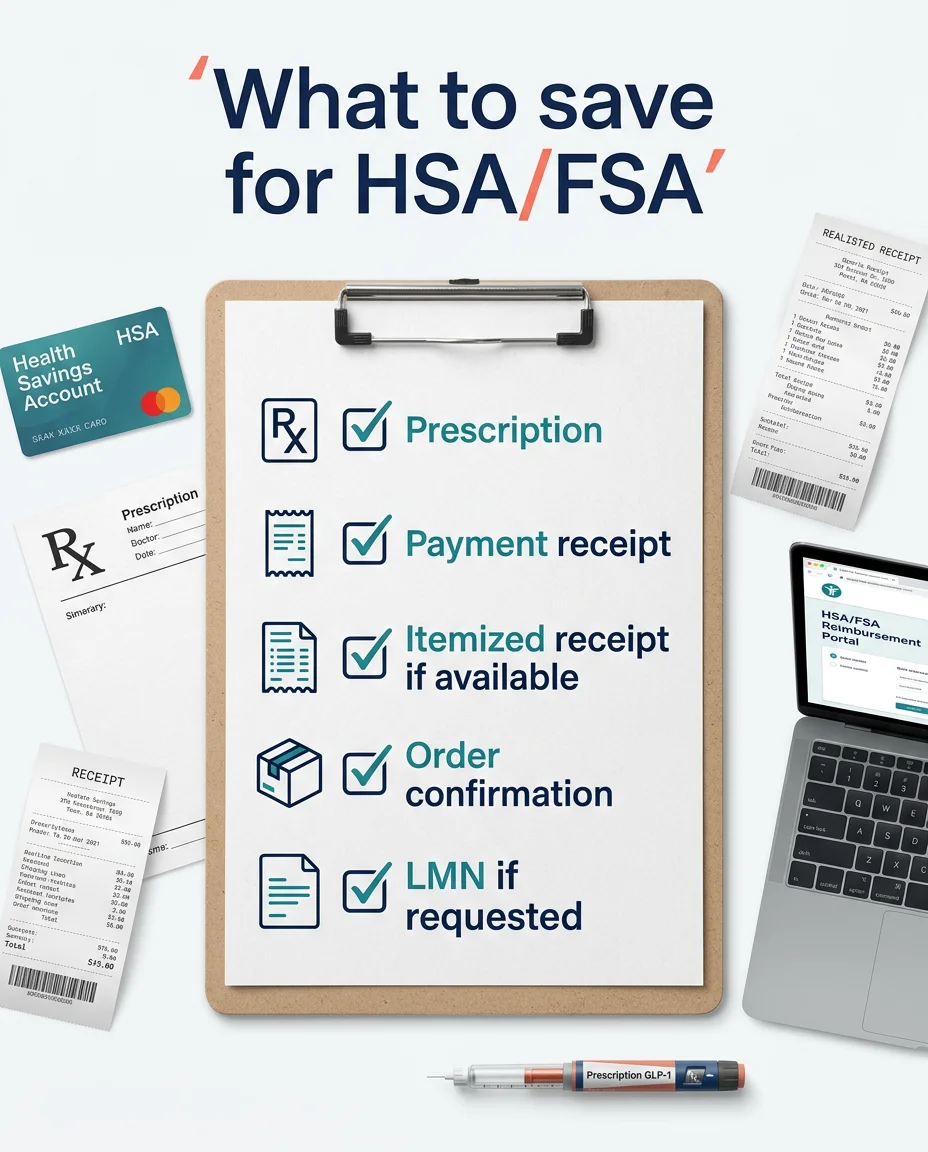
Save Your Documentation
- Itemized receipt showing date, provider name, amount, and description of services
- Prescription documentation from your telehealth provider
- Letter of Medical Necessity if your plan requires one (more common with FSAs)
- Order confirmation and shipping records
Know Your Backup Plan
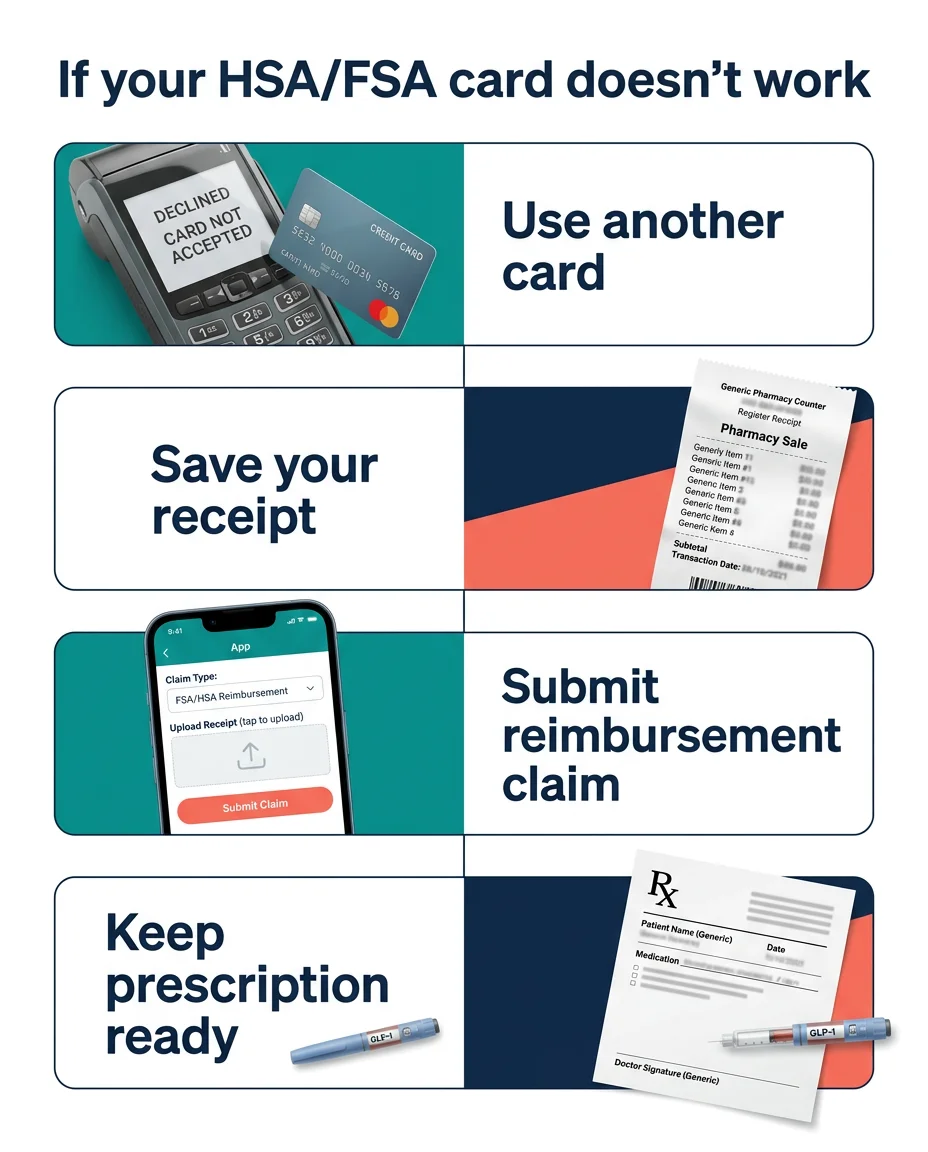
If your HSA card is declined at checkout:
- Don't panic — it's almost always a processing issue, not an eligibility issue
- Pay with a personal card
- Download your receipt from the provider's account portal
- Submit a reimbursement claim through your HSA/FSA portal
- If denied, contact your administrator and ask what documentation they need
HSA vs. FSA for GLP-1 Payments: Key Differences
Health Savings Account (HSA)
- Requires enrollment in a High Deductible Health Plan (HDHP)
- 2026 limits: $4,400 individual / $8,750 family (+$1,000 catch-up if 55+)
- Funds roll over indefinitely — no deadline pressure
- Triple tax advantage: deductible contributions, tax-free growth, tax-free withdrawals
- New for 2026: All Bronze and Catastrophic Marketplace plans are now HSA-eligible
For GLP-1 users: HSA is typically the easier path. Your prescription is your primary proof of medical necessity.
Flexible Spending Account (FSA)
- Employer-sponsored
- 2026 limit: $3,400 (up to $680 carryover if employer allows)
- Use-it-or-lose-it: Funds generally expire at plan year end
- Stricter verification — administrators review claims more carefully
- Weight-loss prescriptions may trigger LMN requests
For GLP-1 users: FSA works but expect more friction. Have prescription documentation ready.
| Feature | HSA | FSA | HRA |
|---|---|---|---|
| Funds Roll Over? | Yes, indefinitely | Usually no (up to $680) | Varies by employer |
| Deadline Pressure? | No | Yes — plan year end | Varies |
| LMN Likely Needed? | Rarely | More often (weight loss Rx) | Varies |
| Tax Advantage | Triple (deduction + growth + withdrawal) | Single (pre-tax contribution) | Employer-funded |
The HSA triple tax advantage in practice: When you contribute to your HSA, the money goes in pre-tax (saving you income tax). If you invest it, it grows tax-free. When you withdraw it for a qualified medical expense like GLP-1 medication, it comes out tax-free. Even if you have the cash to pay out of pocket, routing the payment through your HSA is almost always the smarter financial move.
Are Semaglutide and Tirzepatide HSA Eligible?
Is Semaglutide HSA Eligible?
Yes. Semaglutide — whether prescribed as brand-name Ozempic, Wegovy, or through a compounding pharmacy — qualifies when prescribed to treat a diagnosed medical condition like obesity or type 2 diabetes. The prescription itself is your primary proof.
Is Tirzepatide HSA Eligible?
Yes. Tirzepatide follows the same IRS framework. When prescribed for a diagnosed condition, it's a qualified medical expense — in both brand-name (Mounjaro, Zepbound) and compounded forms.
Are Ozempic, Wegovy, Mounjaro, and Zepbound HSA/FSA Eligible?
Yes, all four. Each one qualifies as an HSA/FSA expense when prescribed by a licensed provider for a medical condition.
- Ozempic — FDA-approved for type 2 diabetes and chronic kidney disease
- Wegovy — FDA-approved for chronic weight management and cardiovascular risk reduction
- Mounjaro — FDA-approved for type 2 diabetes
- Zepbound — FDA-approved for chronic weight management
Does Insurance Coverage Change HSA Eligibility?
No. Insurance determines who pays and at what price. HSA/FSA eligibility determines whether you can use pre-tax dollars. Even if your insurance denies GLP-1 coverage, you can still use HSA/FSA funds to pay out of pocket.
“Lost 16 lbs in 10 weeks — no side effects. Down two sizes. I wish I’d started sooner.”
— Verified MEDVi patient on ConsumerAffairs ★★★★★
FDA-Approved vs. Compounded GLP-1: What HSA Users Need to Know
What “Compounded” Actually Means
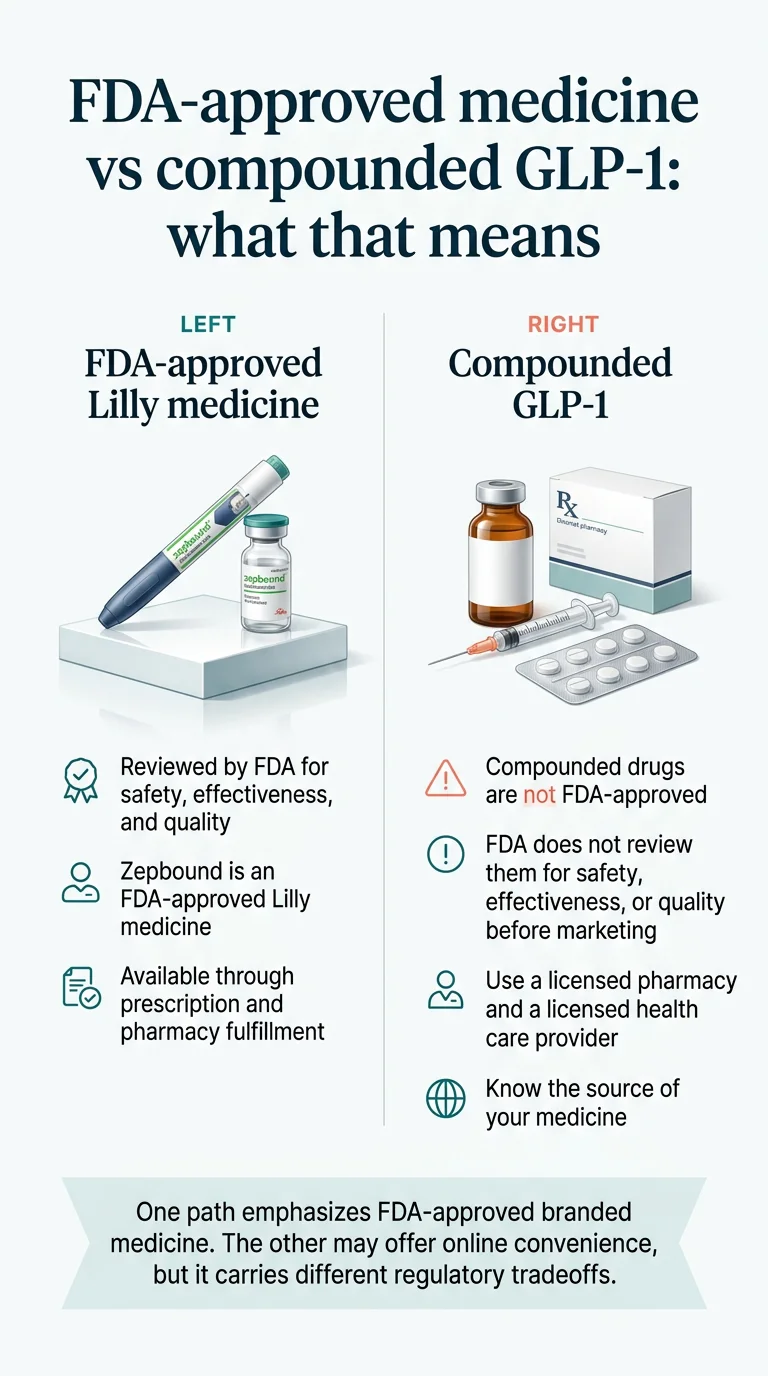
A compounding pharmacy takes active pharmaceutical ingredients and prepares custom formulations. This is legal, regulated, and has been part of healthcare for decades. However — compounded medications are not FDA-approved finished products. The FDA has not evaluated them for safety, efficacy, or quality as finished drug products.
The Current Regulatory Context
The FDA resolved the semaglutide shortage in February 2025 and the tirzepatide shortage in late 2024. Now that shortages are resolved, regulatory scrutiny of compounded GLP-1 products is increasing. In February 2026, the FDA issued a warning letter to MEDVi about false or misleading marketing claims.
| Factor | Compounded (MEDVi, Embody, Yucca, etc.) | Brand-Name (NovoCare, Hers) |
|---|---|---|
| Monthly Cost | $146–$299 | $199 intro, then $349+ |
| FDA-Approved? | No | Yes |
| HSA Eligible? | Yes, with prescription | Yes, with prescription |
| Clinical Support Included? | Usually bundled in monthly cost | Usually separate from medication cost |
| Regulatory Scrutiny | Increasing — shortages resolved | Standard FDA oversight |
Neither path is universally “better.” It depends on your budget, your risk tolerance, and how much the regulatory distinction matters to you. Both paths are HSA-eligible when prescribed for a diagnosed medical condition.
Best GLP-1 Providers That Accept HSA: Reviewed
We used the same evaluation criteria for every provider: published HSA/FSA payment information, pricing transparency, medication types, clinical support claims, and public patient reviews.
MEDVi — Low-Cost Entry Point for Cash-Pay HSA Users
Bottom line: MEDVi offers one of the lowest starting prices in the compounded GLP-1 telehealth space and advertises HSA/FSA acceptance. It's a reasonable option for cash-pay first-timers — with caveats you should understand.
What HSA users need to know: MEDVi advertises HSA/FSA approval on its website. Confirm any documentation your administrator requires before relying on reimbursement.
Current pricing (provider-stated, March 2026):
- Compounded GLP-1 injections: $179/month (first month), $299/month ongoing
- Oral GLP-1 tablets: $249/month
- No long-term contract — month-to-month, cancel anytime
The honest watch-out: In February 2026, the FDA issued a warning letter to MEDVi about false or misleading marketing claims. This is a marketing compliance issue — the FDA objected to specific claims on MEDVi's website, not to the underlying medical program. The introductory price of $179 increases to $299 after month one.
What patients report: On ConsumerAffairs (December 2025), one male patient over 50 described losing 20 pounds in two months on tirzepatide through MEDVi, noting reduced appetite and mild nausea that resolved after two weeks. Individual results vary and depend on adherence, diet, exercise, and biology.
Best for: Cash-pay users with HSA/FSA funds who want a low-cost guided entry into GLP-1 treatment and understand the compounded medication distinction.
“Lost 16 lbs in 10 weeks — no side effects. Down two sizes. I wish I’d started sooner.”
— Verified MEDVi patient on ConsumerAffairs ★★★★★
NovoCare — Best Path for FDA-Approved Semaglutide
Bottom line: If FDA-approved medication is non-negotiable, NovoCare is the clearest path to brand-name Wegovy or Ozempic with confirmed FSA/HSA card acceptance.
What HSA users need to know: NovoCare explicitly accepts FSA and HSA cards and offers self-pay savings programs for Wegovy and Ozempic. This is a pharmaceutical manufacturer program (Novo Nordisk), not a telehealth subscription.
Current pricing (NovoCare.com, March 2026):
- New patients intro (through December 31, 2026): $199/month for first two fills of 0.25 mg and 0.5 mg doses
- Ongoing self-pay: $349/month for Wegovy (all doses) and Ozempic (up to 1 mg); $499/month for Ozempic 2 mg
- Wegovy pill (1.5 mg and 4 mg): $149/month
- Free home delivery via NovoCare Pharmacy, or pickup at CVS retail locations
Why we include NovoCare: We don't have an affiliate relationship with NovoCare. We include them because some readers genuinely need or prefer FDA-approved medication, and pretending compounded options are the only path would make this guide less useful.
Best for: Users who want FDA-approved semaglutide and confirmed FSA/HSA card acceptance from the manufacturer.
Embody — Low First-Month Start with a Needle-Free GLP-1 Gum
Bottom line: Embody is a cash-pay telehealth program offering compounded semaglutide and tirzepatide as weekly injections or a needle-free GLP-1 gum, with fast online intake and 24/7 support. It advertises HSA/FSA acceptance and is a strong pick if you want a low first-month price or want to skip needles.
Current pricing (provider-stated):
- Compounded semaglutide injection: $99 first month, then $299/month ongoing
- Compounded tirzepatide injection: $149 first month, then $399/month ongoing
- Needle-free GLP-1 gum available for patients who want to skip injections
The honest watch-out: The low intro price is for the first month only — ongoing refills run $299–$449/month depending on medication and form. Embody's shipped options are compounded GLP-1 medications, not FDA-approved finished drugs, and it does not take insurance (HSA/FSA cards advertised as accepted).
Best for: Cash-pay patients who want the lowest first-month price and a needle-free GLP-1 gum option.
SkinnyRX — Multiple Medication Format Choices
Bottom line: SkinnyRX says they accept FSA/HSA cards and offers a wide menu — injectable, oral, and branded GLP-1 options.
Current pricing (provider-stated): Compounded injectable semaglutide from $199/month; oral tablets from $249/month. Verify current pricing directly.
Best for: Users who want format flexibility (oral vs. injectable) and educational support alongside their GLP-1 program.
Yucca Health — Lowest Starting Price, but Documentation Is on You
Bottom line: Yucca's pricing starts lower than most competitors. But there's a tradeoff: their FAQ states they do not provide itemized receipts or letters of medical necessity.
Current pricing: Semaglutide from $146/month on the six-month plan.
The honest watch-out: No itemized receipts. No LMN support. Compounded medications are not FDA-approved finished products. Refunds only available for billing errors, duplicate charges, or if a provider doesn't approve treatment.
Best for: HSA users (not FSA) who are confident managing their own documentation and prioritize the lowest monthly cost.
Hims and Hers — Reimbursement-First with Clean Receipt Workflow
Bottom line: Both Hims and Hers offer GLP-1 programs with well-documented reimbursement processes. Their official pages explain how to download receipts and submit HSA/FSA claims.
What HSA users need to know: Both platforms recommend paying with a personal card and then submitting for reimbursement. Their order portals generate downloadable receipts with the details most administrators need. Do not assume seamless HSA card checkout.
Hers pricing (provider-stated): Compounded GLP-1 injections from $199/month on longer plans; oral kits from $69/month.
Best for: Users already comfortable with reimbursement workflows who want a well-known telehealth brand.
TrimRX — No-Frills Compounded Access, Verify HSA Before Enrolling
Bottom line: TrimRX offers compounded semaglutide and tirzepatide with no membership fees. They publish reimbursement guidance, but we could not confirm direct HSA card checkout from public sources.
Best for: Budget-conscious users who want no-frills GLP-1 access and don't need bundled coaching.
How Much Do You Save by Paying for GLP-1s With Your HSA?
Using HSA or FSA dollars means you're paying with pre-tax money. That's effectively a discount equal to your marginal tax rate.
Tax Savings Estimate: $299/Month GLP-1 Program
| Federal Tax Bracket | Annual GLP-1 Cost | Est. Annual Tax Savings | Effective Annual Cost |
|---|---|---|---|
| 12% | $3,588 | ~$430 | ~$3,158 |
| 22% | $3,588 | ~$789 | ~$2,799 |
| 24% | $3,588 | ~$861 | ~$2,727 |
| 32% | $3,588 | ~$1,148 | ~$2,440 |
| 35% | $3,588 | ~$1,256 | ~$2,332 |
Estimates based on federal tax rates only. State tax savings may increase the benefit further. This is not tax advice — consult a tax professional for your specific situation.
The takeaway: Using your HSA is like getting a 12–35% discount on your GLP-1 medication. At a 24% bracket, that's over $860 per year in tax savings.
2026 Account Limits at a Glance
| Account | 2026 Annual Limit | Catch-Up / Carryover |
|---|---|---|
| HSA (individual) | $4,400 | +$1,000 if 55+ |
| HSA (family) | $8,750 | +$1,000 if 55+ |
| FSA | $3,400 | Up to $680 carryover (if employer allows) |
Do You Need a Letter of Medical Necessity?
When You Probably Don't Need an LMN
HSA users paying for prescription medication: Your prescription from a licensed provider is your primary documentation. Most HSA plans treat a prescription for a diagnosed condition as sufficient proof.
When You Might Need an LMN
FSA users with weight-loss prescriptions: FSA administrators are more likely to flag GLP-1 charges for weight management and request additional documentation.
How to Get an LMN
Ask your telehealth provider during your consultation. Provider support varies:
- MEDVi, Embody, SkinnyRX: Ask your assigned provider — most telehealth providers can supply an LMN upon request.
- Yucca Health: Explicitly states they do not provide LMN. You'd need to obtain one from your primary care physician.
- Hers/Hims: Not specifically documented. Their receipt workflow may satisfy most administrators.
Pro tip: Request your LMN before you pay, not after. Preventing a denied claim is easier than appealing one.
What If Your HSA Card Is Declined?
This happens more often than you'd think — and it almost never means your GLP-1 isn't eligible.
Why HSA Cards Get Declined at GLP-1 Providers
Merchant Category Code (MCC) mismatch: The most common reason. Your HSA card issuer expects a healthcare merchant code. Some telehealth platforms are coded as general e-commerce.
Insufficient HSA balance: Check your balance before checkout.
Plan administrator restrictions: Some plans require pre-approval for charges above a certain amount.
Card expired or needs activation: Some HSA debit cards have expiration dates or require activation.
The key insight: A declined card is a payment processing event, not an eligibility ruling. Don't let a card decline at checkout talk you out of using your HSA for an expense that is almost certainly qualified. The reimbursement path exists specifically for situations like this.
Which Saves More: Insurance, HSA, Manufacturer Cash Pay, or GoodRx?
For GLP-1s, the same drug can cost anywhere from $25/month to $1,500/month depending on how you access it.
| Payment Path | Typical Monthly Cost | HSA/FSA Eligible? | Notes |
|---|---|---|---|
| Insurance (brand-name, covered) | $25–$100 copay | Yes (copay) | Cheapest if your plan covers it |
| Compounded telehealth + HSA | $146–$299 pre-tax | Yes | Most popular for uninsured/denied users |
| NovoCare self-pay (brand-name) | $199 intro / $349 ongoing | Yes | FDA-approved; time-limited intro pricing |
| Retail pharmacy + GoodRx | $800–$1,200+ | Yes | Brand-name at reduced retail price |
| Retail pharmacy (no discount) | $1,000–$1,500+ | Yes | Full retail; rarely the right choice |
The bottom line on cost: For most uninsured or under-insured users, the math usually works out to: compounded telehealth program + HSA/FSA = lowest effective monthly cost. Brand-name through NovoCare is the middle ground if FDA approval matters. Insurance is cheapest if your plan covers it.
Can you use HSA with GoodRx? Yes — GoodRx is a discount tool, not a payment method. You use GoodRx to lower the price at the pharmacy, then pay with your HSA card. However, most telehealth GLP-1 programs already include medication in their monthly price, making GoodRx unnecessary.
How We Reviewed These Providers
What we checked: HSA/FSA payment information on official provider pages, published FAQs, public pricing, medication types, pharmacy partnership disclosures, and third-party review platforms (Trustpilot, ConsumerAffairs).
What “reviewed” means vs. “tested”: We reviewed publicly available information from provider websites and official sources. We did not personally test every provider's checkout flow with an HSA card.
Sources consulted: Official provider websites, IRS.gov (Publications 502 and 969, FAQ on medical expenses), FDA.gov (warning letters and compounded GLP-1 safety communications), HealthCare.gov (2026 HSA plan changes), Trustpilot, ConsumerAffairs.
Update frequency: We review pricing and payment policies monthly. Provider pricing and policies can change without notice.
Your Next Step: Pick the Right Path
You've read the rules, seen the comparison, and understand the tradeoffs. Here are the three clearest paths forward:
Path 1: Start with MEDVi
If you want the most affordable guided cash-pay GLP-1 option with advertised HSA/FSA acceptance.
Take the 2-minute assessment at MEDViPath 2: Start with NovoCare
If you want FDA-approved semaglutide (Wegovy or Ozempic) with confirmed FSA/HSA card acceptance.
Check NovoCare savings programsPath 3: Start with Embody or SkinnyRX
If you want a low first-month start, cash-pay compounded GLP-1, or a needle-free GLP-1 gum option.
In many cases, prescribed GLP-1 medication is a qualified medical expense — but confirm the documentation requirements with your plan administrator before you pay.
Frequently Asked Questions
Can I use HSA for semaglutide for weight loss?
In most cases, yes — when prescribed by a licensed provider to treat a diagnosed condition like obesity (BMI 30+) or overweight with comorbidities (BMI 27+ with related health conditions). IRS Publication 502 includes weight-loss treatment for physician-diagnosed diseases as a qualified medical expense. Weight loss for cosmetic or general wellness purposes does not qualify.
Is tirzepatide HSA eligible?
Yes. Tirzepatide follows the same IRS framework as semaglutide. When prescribed for a diagnosed medical condition, it is a qualified medical expense for HSA/FSA purposes.
Are GLP-1s FSA eligible?
Yes, with the same prescription requirement. FSA plans may require additional documentation such as a Letter of Medical Necessity, particularly for weight-loss prescriptions.
Does Hims or Hers accept HSA?
Both Hims and Hers currently frame HSA/FSA as a reimbursement workflow. Their official pages say eligible GLP-1 plans may be reimbursable, recommend paying with a regular credit/debit card, and explain how to download a receipt from the orders tab. Do not assume seamless HSA card checkout.
Is Ozempic covered by FSA?
Yes. Ozempic is an FDA-approved prescription medication and qualifies as an FSA expense when prescribed for a diagnosed medical condition.
Can you use HSA with GoodRx?
Yes. GoodRx reduces the cash price at the pharmacy. You can then pay that reduced price with your HSA card. Most telehealth GLP-1 programs include medication in their monthly cost, making GoodRx unnecessary for those purchases.
What if my HSA card is declined at a GLP-1 provider?
A declined card is almost always a payment processing issue, not an eligibility problem. Pay with a personal card, save your receipt, and submit a reimbursement claim through your HSA portal.
Are compounded GLP-1s HSA eligible?
IRS guidance treats prescribed medicines and drugs as qualified medical expenses. We did not find a separate IRS rule carving compounded GLP-1 prescriptions out of HSA/FSA eligibility, but plan administrators may still request documentation. Separately, compounded GLP-1 products are not FDA-approved, and FDA does not review them for safety, effectiveness, or quality as finished products before marketing.
Do I need a letter of medical necessity for GLP-1 HSA claims?
Usually not for HSA — your prescription is typically sufficient. For FSA, some administrators require an LMN for weight-loss prescriptions. Ask your FSA administrator before paying, and request an LMN from your prescribing provider if needed.
What GLP-1 is covered by Medicare?
The Medicare GLP-1 Bridge launched July 1, 2026 and covers brand-name Wegovy, Zepbound KwikPen, and Foundayo for eligible Part D beneficiaries at a flat $50/month co-pay (running July 1–December 31, 2027 initially). For diabetes, GLP-1s like Ozempic and Mounjaro are covered with prior authorization. Wegovy may also be covered for cardiovascular risk reduction. If you are enrolled in Medicare, you can still spend existing HSA funds on qualified medical expenses, but you can no longer contribute to an HSA.
Which provider gives the best receipt and documentation for HSA/FSA?
NovoCare provides clean pharmacy-grade receipts with confirmed FSA/HSA card acceptance. Hims and Hers both offer downloadable receipts designed for reimbursement claims. Yucca Health explicitly does not provide itemized receipts or LMN — the weakest option for documentation among the providers we reviewed.
Which provider is best if I want FDA-approved medication only?
NovoCare for semaglutide (Wegovy/Ozempic), starting at $199/month for new patients with confirmed FSA/HSA card acceptance. For tirzepatide (Zepbound), check LillyDirect for current self-pay availability.
My FSA expires soon — can I prepay for multiple months of GLP-1?
Ask your FSA administrator before prepaying. FSA treatment of prepaid multi-month telehealth charges is plan-specific and depends on when the expense is considered "incurred." Do not assume a multi-month prepaid charge will be treated as a single plan-year expense without confirming with your administrator first. A better strategy: enroll and pay for the current month now, then plan your next year's FSA contribution to include ongoing GLP-1 costs.
Can I use my spouse's HSA to pay for my GLP-1 medication?
Yes, in most cases. HSA funds can be used for qualified medical expenses incurred by the account holder, their spouse, and their tax dependents. If you are married and your spouse has an HSA, their funds can generally cover your GLP-1 prescription — even if you are not covered under their HDHP. Keep documentation showing the expense was for a qualified dependent or spouse.
Are GLP-1 side effect treatments covered by HSA?
Yes. Anti-nausea medications, follow-up medical consultations related to GLP-1 treatment, and medical supplies needed for injection administration are all qualified medical expenses under standard IRS rules. If your provider adjusts your dose or prescribes supportive medication for side effects, those costs are typically eligible too.
Can I deduct GLP-1 costs on my taxes if I don't have an HSA?
Yes — GLP-1 medications prescribed for a medical condition can be included as itemized medical deductions on Schedule A (Form 1040). However, you can only deduct the amount that exceeds 7.5% of your Adjusted Gross Income (AGI). For most people, HSA/FSA pre-tax payment is a better deal. Important: expenses paid with HSA/FSA funds cannot also be deducted on your tax return.
How long does HSA reimbursement for GLP-1 take?
Timelines vary by plan administrator. Submit clean, complete documentation — itemized receipt, prescription information, and LMN if applicable — to minimize delays. Contact your administrator for their specific processing timeline.
Do I need a prescription for GLP-1?
Yes — always. GLP-1 medications are prescription drugs. Telehealth providers like MEDVi include the physician consultation and prescription in their program. You cannot legally obtain GLP-1 medications without a prescription from a licensed provider.
Sources and Footnotes
- IRS Publication 502 — Medical and Dental Expenses. irs.gov/publications/p502
- FDA Warning Letter to MEDVi, LLC — February 20, 2026. fda.gov/warning-letters/medvi-llc
- NovoCare Pharmacy — FSA/HSA card acceptance and self-pay pricing. novocare.com/pharmacy.html
- Yucca Health FAQ — Receipt and LMN policy. tryyucca.com/frequently-asked-questions
- Hers — FSA/HSA reimbursement workflow. Hers FSA/HSA program
- Hims — FSA/HSA reimbursement workflow. Hims FSA/HSA program
- IRS FAQ — Medical Expenses Related to Nutrition, Wellness and General Health. irs.gov/individuals/frequently-asked-questions
- IRS Revenue Procedure 2025-19 — 2026 HSA contribution limits. irs.gov/pub/irs-drop/rp-25-19.pdf
- HealthCare.gov — 2026 HSA-eligible plans. healthcare.gov/hsa-options
- IRS Revenue Procedure 2025-32 — 2026 FSA limits. Referenced via newfront.com/blog/2026-health-fsa-limit-increases-to-3400
- MEDVi reviews — Trustpilot. trustpilot.com/review/medvi.org
- MEDVi reviews — ConsumerAffairs. consumeraffairs.com/health/medvi.html
- CMS — Medicare GLP-1 Bridge program (launched July 1, 2026); Contract Year 2026 Policy and Technical Changes.
- FDA — Concerns With Unapproved GLP-1 Drugs Used for Weight Loss. fda.gov
Affiliate Disclosure
Weight Loss Provider Guide may earn a commission when you sign up for a service through links on this page. This compensation does not influence which providers we include, how we rank them, what we recommend, or the editorial content of this guide. We include providers with whom we have no financial relationship (such as NovoCare) and disclose honest watch-outs for every provider — including our affiliate partners. Our recommendations are based on publicly available information, stated pricing, and documented HSA/FSA policies. You are never obligated to use our links, and you will not pay more by using them. For complete details, read our full editorial policy.
Medical Disclaimer
This content is for informational purposes only and does not constitute medical advice, diagnosis, or treatment. GLP-1 medications are prescription drugs that must be prescribed by a licensed healthcare provider based on an individual medical evaluation. Do not start, stop, or change any medication without consulting a qualified provider. Compounded medications are not FDA-approved finished products and have not been evaluated by the FDA for safety, effectiveness, or quality as finished drug products. The FDA has issued public warnings about certain compounded GLP-1 products. Individual results vary based on adherence, health history, diet, exercise, and biology. Always consult your healthcare provider for advice specific to your medical condition.
Financial and Tax Disclaimer
The tax savings estimates, HSA/FSA contribution limits, and IRS rule summaries on this page are for general informational purposes only and do not constitute tax, financial, or legal advice. We are not tax professionals, CPAs, or financial advisors. Tax savings depend on your individual tax bracket, filing status, state of residence, and specific plan rules. HSA and FSA eligibility, reimbursement timelines, documentation requirements, and card acceptance policies vary by plan administrator and can change without notice. Always verify eligibility and documentation requirements with your HSA/FSA plan administrator before making a purchase, and consult a qualified tax professional for advice specific to your financial situation.
Last Updated: March 2026 · Provider Pages Last Reviewed: March 2026
Related Guides
GLP-1 Cost With & Without Insurance
Full cost breakdown across every payment path.
Cheapest GLP-1 Without Insurance
Side-by-side price comparison of every provider.
Best GLP-1 Online Programs
Full reviews of every telehealth GLP-1 provider.
How to Get GLP-1 Without Insurance
Step-by-step guide to accessing GLP-1 medication.
GLP-1 and Hypoglycemia: Insulin & Sulfonylurea Risk
FDA label rates, 15-15 treatment rule, and prescriber checklist.