Disclosure: Some links on this site are affiliate links. If you purchase through these links, we may earn a commission at no extra cost to you. Thank you for supporting our site.·For informational purposes only—not medical advice.
Fact-checked against primary sources: Zepbound FDA-approved prescribing information, published clinical trial data (NEJM), LillyDirect pricing terms, ConsumerAffairs MEDVi reporting, Trustpilot, and FDA guidance on compounded GLP-1 products.
MEDVi vs Zepbound: Which Tirzepatide Option Is Actually Worth Your Money in 2026?
Here's the short answer. If you're comparing MEDVi vs Zepbound, you're looking at two paths to the same molecule — tirzepatide — the weight-loss drug that helped people lose an average of 20.9% of their body weight in the SURMOUNT-1 clinical trial (that's roughly 48 pounds in 72 weeks at the highest dose, per Zepbound's FDA-approved prescribing information).
Short on time? Skip to MEDVi eligibility check or check Zepbound insurance coverage.
The difference isn't the medication. It's how you get it, what you pay, and what comes with it. For broader context, see our GLP-1s for weight loss guide and GLP-1 cost breakdown.
| Zepbound | MEDVi | |
|---|---|---|
| What it is | FDA-approved medication | Telehealth program (includes medication) |
| Monthly cost (cash) | $299–$449 via LillyDirect | Tablets from ~$279; injections from ~$349 (all-inclusive) |
| Monthly cost (insured) | As low as $25 | N/A — cash-pay only |
| Includes doctor/support? | No — separate | Yes — bundled |
| FDA-approved finished product? | Yes | No (compounded) |
(Sources: Zepbound pricing from LillyDirect.lilly.com terms page, Dec 2025. MEDVi first-month pricing from MEDVi.org; ongoing pricing as reported by ConsumerAffairs, Feb 2026. Full comparison table below.)
Quick Decision Guide
- Choose Zepbound if your insurance covers it (you could pay as low as $25/month), or if FDA-approved, brand-name medication is non-negotiable for you.
- Choose MEDVi if you're paying cash, want everything bundled into one monthly payment (doctor, meds, support, shipping), and you're comfortable with compounded medication from a licensed U.S. pharmacy.
- Skip both and talk to your doctor first if you have a complex medical history, take insulin, or have a personal or family history of medullary thyroid carcinoma or MEN 2. See our GLP-1 eligibility guide.
The detail most sites won't tell you: Zepbound's LillyDirect pricing has a 45-day refill window. Miss it at higher doses and your $449/month payment rises to the regular self-pay rate ($499 for 7.5 mg, $699 for 10 mg and above). MEDVi has no refill-window penalty — your price doesn't spike if you reorder a few days late. That one detail changes the math for a lot of people.
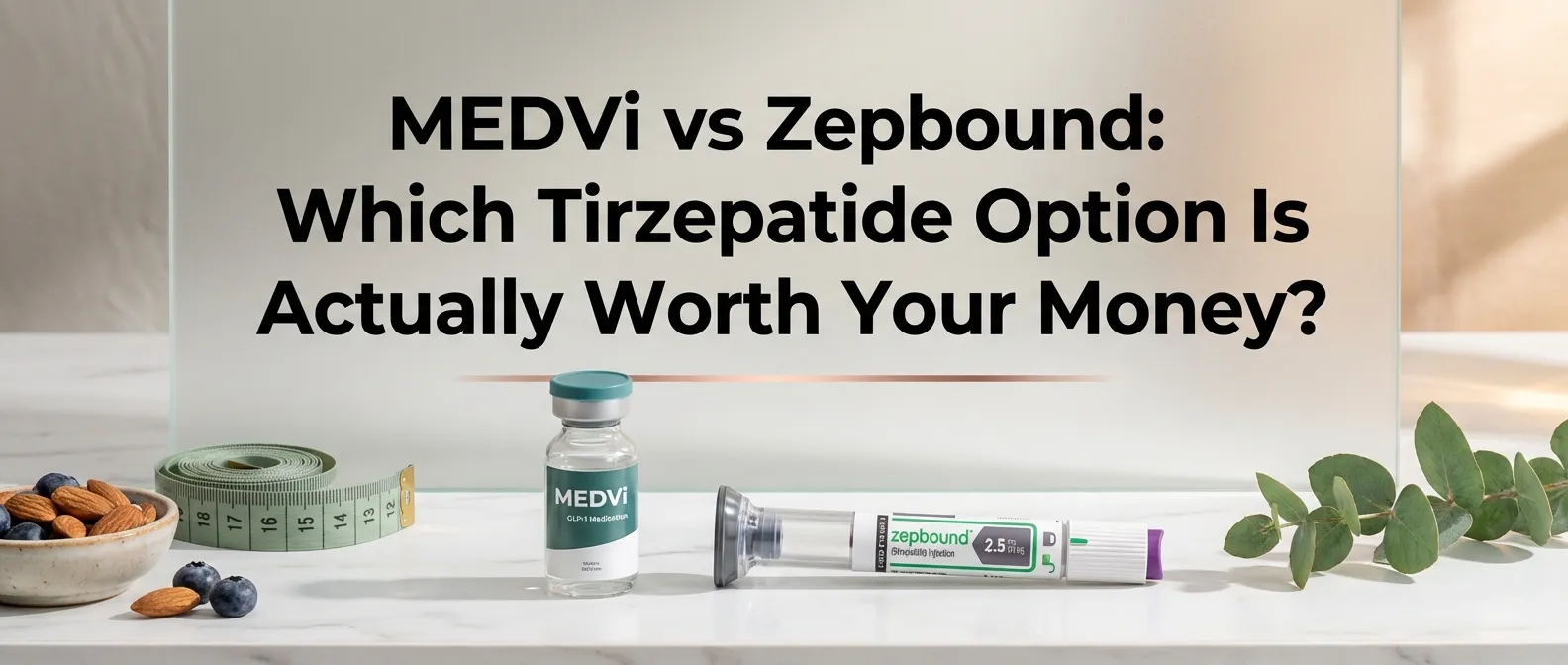
MEDVi vs Zepbound: verified pricing and safety comparison for 2026.
*Illustration only. Comparison context for educational purposes. Actual medication packaging and appearance may vary.*
MEDVi vs Zepbound — What's the Actual Difference?
This is where most people get confused, so let's clear it up in two sentences.
Zepbound is an FDA-approved brand-name medication. It's tirzepatide made by Eli Lilly, available as pre-filled pens (through insurance/pharmacy) or single-dose vials (through LillyDirect's self-pay program). You need a prescription from your own doctor, and you handle the pharmacy side yourself.
MEDVi is a telehealth membership program. It provides compounded tirzepatide — a pharmacy-prepared formulation made by licensed U.S. compounding pharmacies, not by Eli Lilly, and not FDA-approved — bundled with a doctor evaluation, ongoing clinical support, and home delivery. No insurance needed, no prior authorization, no separate pharmacy visits.
In plain English: Zepbound is the medication. MEDVi is a program that includes the medication. That distinction matters because you're not comparing two identical products. You're comparing two different ways to access the same molecule. The rest of this guide breaks down exactly when each option makes sense. For a deeper look at the molecule itself, see our semaglutide vs tirzepatide comparison.
Quick Decision: Who Should Pick MEDVi, and Who Should Pick Zepbound?
Pick Zepbound if:
- Your insurance covers it. With a Zepbound Savings Card and commercial insurance, you may pay as low as $25/month. That's unbeatable. Check with your insurer first.
- You want FDA-approved medication. Zepbound has been through the full FDA approval process as a finished product. If that distinction matters to you — and for some people it absolutely should — Zepbound is the clear choice.
- You already have a prescribing doctor. If your physician manages your weight-loss treatment and you have an established relationship, adding Zepbound through your existing care team is the most seamless path.
- You prefer auto-injector pens. Zepbound pens are available through insurance and retail pharmacies (at list price). LillyDirect's discounted pricing is for vials only, which require manual syringe injection.
Pick MEDVi if:
- You're paying out of pocket. No insurance coverage for weight-loss drugs? MEDVi's all-inclusive pricing (tirzepatide tablets from $279 first month; injections from $349 first month; around $399/month ongoing per ConsumerAffairs) eliminates the doctor-visit costs, pharmacy markup, and prior authorization headaches that come with pursuing brand-name drugs without coverage. See also: how to get GLP-1 without insurance.
- You want one monthly payment that covers everything. MEDVi bundles the physician evaluation, medication, shipping, metabolic report, and 24/7 messaging support into a single price. No surprise bills.
- You want to start fast. Most MEDVi patients get approved within 24 hours and receive medication within 7–9 days. No scheduling doctor appointments, no waiting for prior authorization responses, no pharmacy stock issues.
- You're comfortable with compounded medication. MEDVi partners with named, licensed pharmacies (Belmar Pharma Solutions and Beluga Health) and is LegitScript certified. More on compounded medication safety below.
- You hate needles. MEDVi offers compounded tirzepatide in dissolvable tablet form — an option Zepbound doesn't have. See our MEDVi pills reviews.
Skip both and talk to your doctor first if:
You take insulin, have a history of pancreatitis, have (or have family history of) medullary thyroid carcinoma or Multiple Endocrine Neoplasia syndrome type 2, are pregnant or planning to become pregnant, or have severe gastrointestinal disease. Tirzepatide — in any form — may not be appropriate for you, and a thorough medical evaluation is essential before starting. Learn more in our GLP-1 eligibility guide.
MEDVi vs Zepbound Comparison Table
(Verified February 16, 2026. Zepbound pricing: LillyDirect.lilly.com + official terms. MEDVi pricing/policies: ConsumerAffairs.com/health/medvi.html + MEDVi.org refund policy page. Prices and policies subject to change — always confirm directly before purchasing.)
| Category | Zepbound (Brand Tirzepatide) | MEDVi (Compounded Tirzepatide Program) |
|---|---|---|
| What it is | FDA-approved medication | Telehealth membership program (includes medication) |
| Active ingredient | Tirzepatide (made by Eli Lilly) | Compounded tirzepatide (pharmacy-prepared, not FDA-approved, made by licensed U.S. pharmacies) |
| FDA-approved finished product? | Yes | No — compounded medications are not FDA-approved as finished products |
| Monthly cost (cash/self-pay) | $299–$449/mo via LillyDirect vials; ~$1,086/mo list price at retail | Tablets from $279 first month; injections from $349 first month; ~$399/mo ongoing (as reported by ConsumerAffairs) |
| Monthly cost (insured) | As low as $25/mo with Savings Card + commercial coverage | N/A — cash-pay only, no insurance accepted |
| What's included in price | Medication only. Doctor visits, lab work, and support are separate | Physician evaluation, medication, shipping, metabolic report, 24/7 messaging support, unlimited doctor visits |
| Dose forms available | Pre-filled pens (via pharmacy/insurance); single-dose vials (LillyDirect) | Compounded injection vials; dissolvable tablets |
| How you get it | Prescription from your doctor → pharmacy or LillyDirect | Online health evaluation → MEDVi physician review → ships to your door |
| Time to start | Varies — depends on doctor availability, prior auth, pharmacy stock | Most approved within 24 hours; medication arrives in 7–9 days |
| Refill rules | LillyDirect: must refill within 45 days or higher-dose pricing jumps significantly | Monthly subscription; cancel anytime with 72-hour notice |
| Insurance accepted | Yes (commercial; some Part D plans may cover the OSA indication) | No — cash pay only. FSA/HSA may be used |
| Guarantee/refund | No money-back guarantee | Money-back guarantee if no weight loss after 5 months on program (75% refund minus 25% consultation fee) |
| Availability | Nationwide (through prescribing physicians + pharmacies) | 49 states (not available in North Dakota) |
| Best for | Patients with insurance coverage; those who require FDA-approved medication; patients with existing doctor relationships | Cash-pay patients without coverage; people who want all-in-one convenience; those who prefer tablet options |
How Much Does MEDVi Cost vs Zepbound? (Real Numbers, Not “It Depends”)
Cost is the #1 reason you're on this page. So let's get specific. For a broader view of GLP-1 pricing, see our GLP-1 cost breakdown and cheapest GLP-1 without insurance guides.
MEDVi Pricing: What You Actually Pay
MEDVi operates on a month-to-month subscription. No long-term contracts. Here's the breakdown based on ConsumerAffairs reporting and MEDVi's own policy pages:
Compounded tirzepatide injections:
- First month: from $349 (per MEDVi's refund policy page)
- Ongoing monthly: approximately $399 (per ConsumerAffairs)
Compounded tirzepatide tablets (dissolvable):
- First month: $279 (per MEDVi's refund policy page)
- Ongoing monthly: confirm directly with MEDVi before enrolling, as pricing varies by formulation and dose
Note: Some third-party reviews report higher-dose maintenance pricing up to $499/month. Verify your specific cost at checkout before committing.
What's included in every payment:
- Licensed physician evaluation (through OpenLoop Health network)
- Personalized treatment plan and metabolic report
- Full month of medication
- Standard shipping with cold packs
- Unlimited messaging with clinical team
- 24/7 support access
What's NOT included:
- Lab work (only required if your medical history warrants it — MEDVi states lab work may be included depending on clinical need; details can vary)
Annual cost estimate: Roughly $4,500–$5,500 for a full year, depending on your formulation and dose trajectory. Most patients start at the lower end and increase over time.
Zepbound Pricing: Three Very Different Paths
The price you pay for Zepbound depends entirely on your insurance situation. There are three lanes:
Lane 1: Insurance + Savings Card (best case)
If you have commercial insurance that covers Zepbound, you can apply for the Zepbound Savings Card and potentially pay as low as $25/month. Savings are capped at up to $100 per 1-month fill (Lilly defines “month” as 28 days), $200 per 2-month fill, or $300 per 3-month fill, with a $1,300 annual maximum. The card is valid through December 31, 2026. Government insurance (Medicare, Medicaid, TRICARE, VA) is excluded from the Savings Card.
Lane 2: LillyDirect Self-Pay Vials (no insurance needed)
As of December 1, 2025, Eli Lilly reduced cash prices on LillyDirect:
| Dose | Monthly Price (LillyDirect) | Refill Outside 45-Day Window |
|---|---|---|
| 2.5 mg (starter) | $299 | $299 (no penalty) |
| 5 mg | $399 | $399 (no penalty) |
| 7.5 mg | $449 | $499 (regular self-pay) |
| 10 mg | $449 | $699 (regular self-pay) |
| 12.5 mg | $449 | $699 (regular self-pay) |
| 15 mg | $449 | $699 (regular self-pay) |
LillyDirect self-pay access may involve Zepbound single-dose vial or KwikPen options depending on dose, availability, and program terms. You need a valid prescription, and the exact formulation matters for pricing and coverage, so verify whether you are receiving vial or KwikPen before committing.
The gotcha most people miss: At 7.5 mg and above, if you don't refill within 45 days of your last delivery, you lose the program pricing and pay the regular self-pay rate. Lilly currently lists the regular self-pay price as $499 for 7.5 mg and $699 for 10 mg, 12.5 mg, and 15 mg. Set a calendar reminder around day 30–35.
Lane 3: Retail/List Price (worst case)
Without LillyDirect, insurance, or any savings program, Zepbound's list price is approximately $1,086/month regardless of dose. This is what you'd pay at most retail pharmacies without coverage.
The 12-Month Math
Here's what a full year actually looks like at common scenarios:
| Scenario | Estimated Annual Cost |
|---|---|
| Zepbound with insurance + Savings Card | ~$300–$1,200/year |
| MEDVi compounded tirzepatide | ~$4,500–$5,500/year |
| Zepbound LillyDirect (maintenance dose) | ~$5,100–$5,700/year (medication only — doctor visits extra) |
| Zepbound retail (no coverage, no programs) | ~$13,000+/year |
The takeaway: If your insurance covers Zepbound, take Zepbound. Nothing else comes close to that price. If you're paying cash, MEDVi and LillyDirect land in a similar range — but MEDVi includes the doctor, support, and shipping. LillyDirect is medication only, and you need to bring your own prescription. For more cost comparisons, see our cheapest semaglutide guide.
Is MEDVi Legit? (How to Verify It Yourself)
Let's address the elephant in the room. If you've been Googling “is MEDVi legit” or “MEDVi scam,” you're not paranoid — you're smart. The online weight-loss space has real problems, and the FDA has flagged specific concerns about unapproved GLP-1 products being sold online. For more detail, see our MEDVi tirzepatide reviews.
Here's what we verified about MEDVi:
LegitScript Certified. LegitScript is a third-party verification service that monitors healthcare companies for compliance with federal and state laws. MEDVi holds active LegitScript certification, which means it's regularly audited for transparency, legal compliance, and legitimate practices.
Named pharmacy partners. Unlike some telehealth platforms that hide their pharmacy sources, MEDVi publicly identifies its compounding pharmacy partners: Belmar Pharma Solutions and Beluga Health. You can look these up yourself — Belmar is a well-established, licensed compounding pharmacy. This transparency is a green flag.
Licensed provider network. MEDVi uses OpenLoop Health to connect patients with licensed, board-certified physicians and nurse practitioners in their state. Prescriptions come from real, verifiable medical professionals — not an algorithm.
100,000+ patients (per MEDVi's homepage). MEDVi advertises over 100,000 patients across 49 states.
Money-back guarantee. If you follow MEDVi's program for at least five months and can demonstrate you haven't lost weight, you're eligible for a 75% refund (minus a 25% consultation fee). That's a level of accountability most competitors won't put in writing.
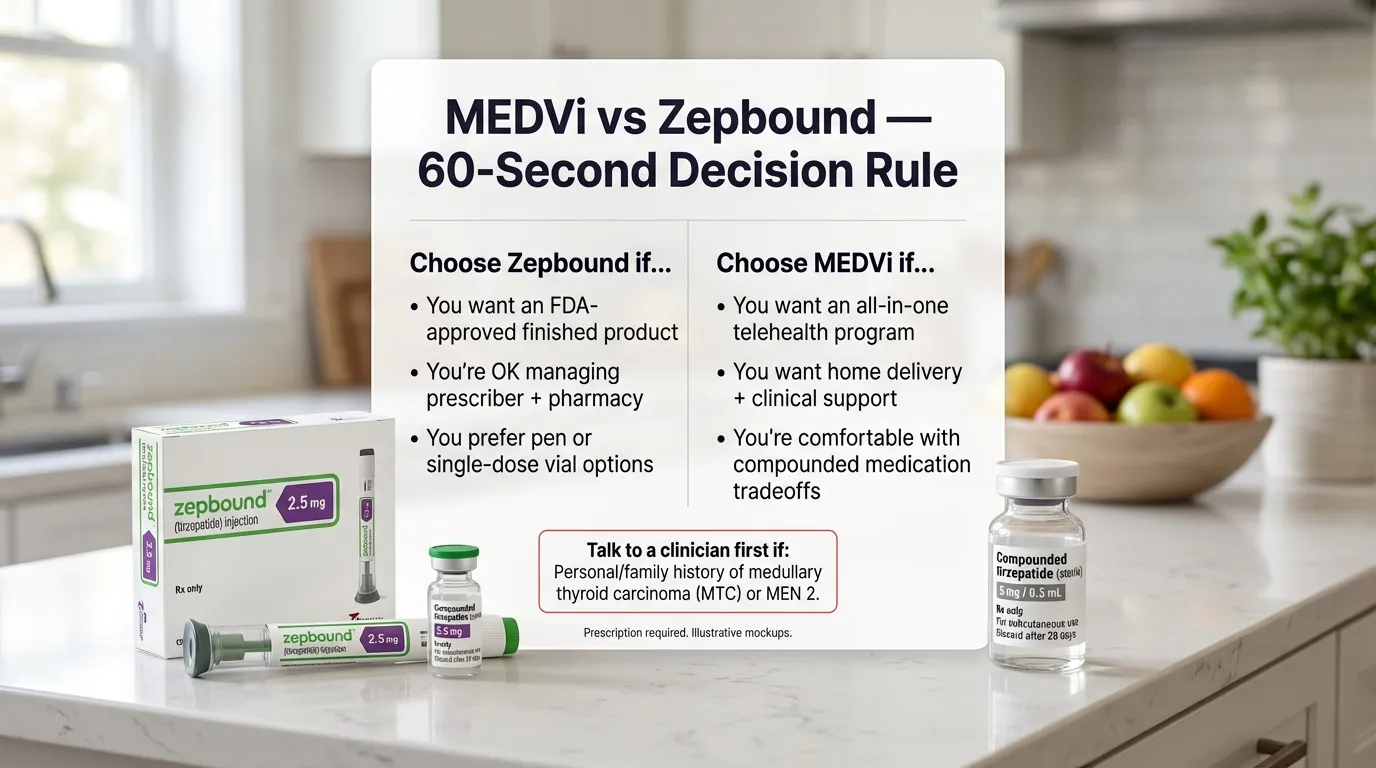
Your verification checklist for any online GLP-1 program.
*Illustration only. Safety verification steps for educational purposes. Actual medication packaging and appearance may vary.*
Your Verification Checklist (Before You Start Any Online GLP-1 Program)
This isn't just for MEDVi — use this for any telehealth weight-loss program you consider. It's built from the FDA's published guidance on unapproved GLP-1 drugs:
Prescription from a licensed clinician. A real person (MD, DO, NP, or PA) must review your health history and prescribe the medication. If a site ships medication without any medical evaluation, walk away.
Filled by a state-licensed U.S. pharmacy. Ask which pharmacy will fill your prescription. Look it up. Verify it's licensed in your state.
Proper cold-chain shipping. GLP-1 medications need temperature control. Your package should arrive with cold packs. If it arrives warm, don't use it — contact your provider immediately.
Label sanity check. When your medication arrives, the label should clearly show: the pharmacy name, your name, the medication and dose, the prescribing provider, and an expiration date. Typos, missing information, or “research use only” labels are red flags.
Not labeled “research use only.” Any product marketed this way is not intended for human use. Do not inject it.
No “too good to be true” pricing. If someone is selling tirzepatide for $50/month with no doctor visit, something is wrong.
Based on our verification, MEDVi meets every item on this checklist as of February 2026. That doesn't mean it's for everyone — but it does mean it appears to be operating within legitimate medical and pharmaceutical frameworks. Conditions can change; always re-verify before enrolling. For more context, see our best GLP-1 online programs guide and MEDVi vs Ozempic comparison.
Compounded Tirzepatide vs Zepbound: What's the Safety Difference?
This is the most important section on this page. Don't skip it.
What “FDA-Approved” Actually Means
Zepbound is an FDA-approved finished product. That means Eli Lilly submitted extensive clinical trial data proving it's safe and effective, and the FDA reviewed and approved its manufacturing process, labeling, and quality controls.
MEDVi's compounded tirzepatide uses the same active pharmaceutical ingredient — tirzepatide — but it's prepared by compounding pharmacies, not Eli Lilly's manufacturing facilities. Compounded medications are legal and regulated, but they haven't gone through the same pre-market approval process as brand-name drugs. The FDA does not verify compounded products for safety, effectiveness, or quality the same way it does for approved medications. For more, see our is compounded GLP-1 safe? guide.
This is a real distinction, not marketing language. It's the single most important trade-off in this entire comparison.
The FDA's Specific Concerns (And What They Mean for You)
The FDA has a dedicated page outlining its concerns about unapproved GLP-1 drugs used for weight loss. Here's what they flag and how it applies:
Temperature and shipping issues. Tirzepatide is sensitive to heat. The FDA has received reports of compounded products arriving without proper cold-chain packaging. MEDVi ships with cold packs — but inspect your package when it arrives. If anything seems warm or the cold packs are completely melted, contact MEDVi before using.
Fraudulent labels and fake pharmacies. Some online sellers aren't using real compounding pharmacies at all. This is why MEDVi naming Belmar Pharma Solutions and Beluga Health specifically is important — you can verify these pharmacies independently.
Dosing errors. Some compounding pharmacies have been found to provide incorrect concentrations. Working with named, licensed pharmacies that follow USP (United States Pharmacopeia) standards reduces this risk.
Salt form differences. The FDA has specifically flagged semaglutide salt form issues (sodium vs. acetate). This concern is primarily about semaglutide, not tirzepatide, but it illustrates why pharmacy quality matters.
The Calm, Non-Alarmist Conclusion
Compounded medication isn't automatically “bad.” Compounding pharmacies have been a legitimate part of American healthcare for decades — they exist because patients sometimes need medications in forms or doses that manufacturers don't offer. Read more in our best compounded semaglutide guide.
But compounded medication does demand more vigilance from you. If you choose MEDVi, use the checklist above. Verify the pharmacy. Inspect your shipment. Report anything unusual to your provider.
If FDA approval is an absolute requirement for your peace of mind, choose Zepbound. That's a perfectly valid decision and you shouldn't let anyone talk you out of it. If you're comfortable with a licensed, LegitScript-certified program that uses named U.S. compounding pharmacies and real physicians, MEDVi is a credible option that over 100,000 patients have used (per MEDVi.org).
Does Tirzepatide Work the Same in MEDVi as in Zepbound?
What the Clinical Evidence Shows
The active ingredient in both Zepbound and MEDVi's compounded version is tirzepatide — a dual GIP/GLP-1 receptor agonist. Here's what large-scale clinical trials found:
SURMOUNT-1 (published in the New England Journal of Medicine, 2022; 2,539 participants over 72 weeks):
Numbers below are from Zepbound's FDA-approved prescribing information (treatment-regimen estimand):
| Dose | Average Weight Loss | % Achieving ≥5% Loss | % Achieving ≥20% Loss |
|---|---|---|---|
| 5 mg | 15.0% (~34 lbs) | 85% | 30% |
| 10 mg | 19.5% (~44 lbs) | 89% | 50% |
| 15 mg | 20.9% (~48 lbs) | 91% | 57% |
| Placebo | 3.1% (~7 lbs) | 35% | 3% |
To put that in perspective: at the highest dose, more than half of participants lost over 20% of their body weight. About nine out of ten lost at least 5%.
SURMOUNT-5 (published in NEJM, 2025; tirzepatide vs semaglutide head-to-head): Tirzepatide achieved 20.2% average weight loss compared to 13.7% for semaglutide (the active ingredient in Ozempic and Wegovy). Tirzepatide was superior at every weight-loss threshold measured. For more on this comparison, see our semaglutide vs tirzepatide deep dive.
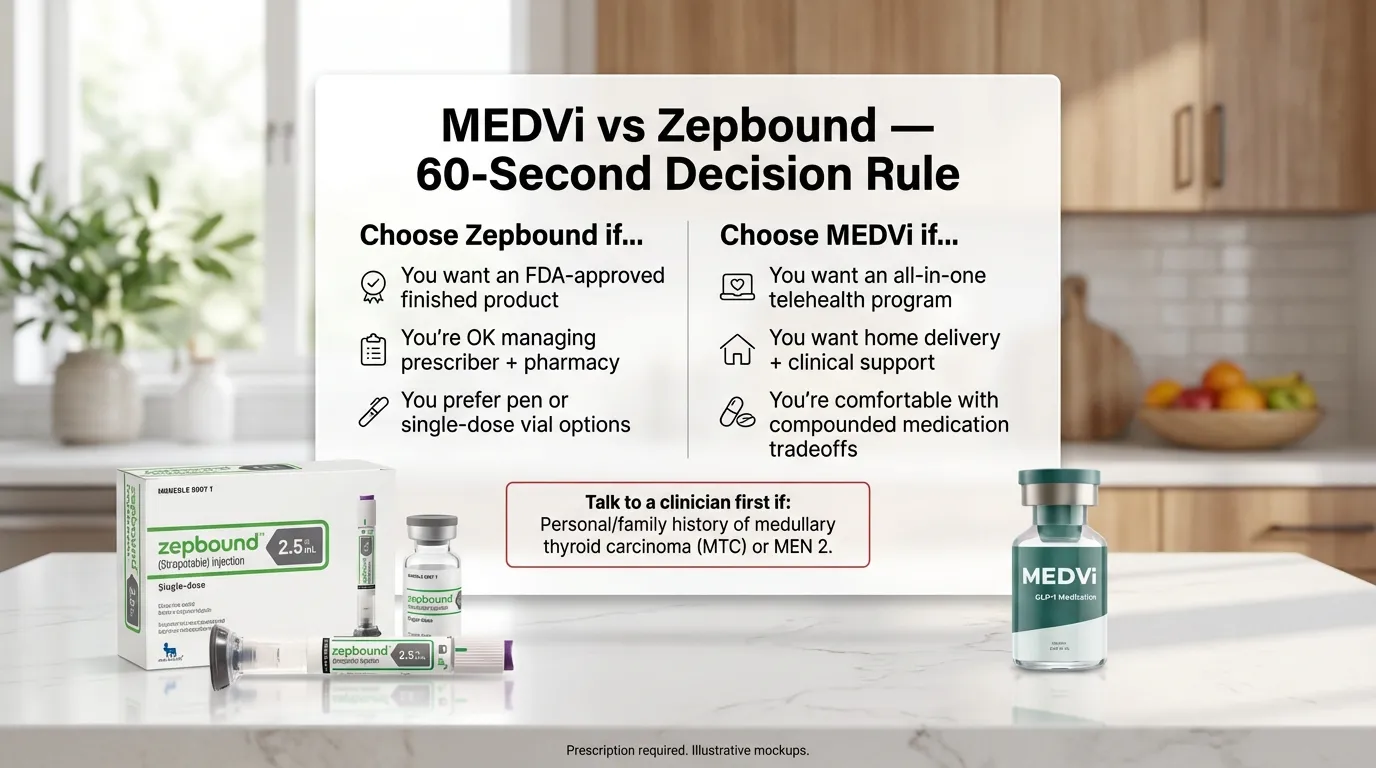
Clinical trial results for tirzepatide weight loss outcomes.
*Illustration only. Clinical data visualization for educational purposes. Actual medication packaging and appearance may vary.*
What We Can Say — And What We Can't
These trials used Eli Lilly's manufactured tirzepatide, not compounded versions. We can say with confidence that tirzepatide as an active ingredient produces significant weight loss in clinical settings.
We cannot say that compounded tirzepatide from any specific pharmacy will produce identical results. Compounded products haven't been through the same clinical trials. That said, when a licensed pharmacy uses the correct active ingredient at the correct dose and concentration, the mechanism of action is the same.
Practical Expectations (Not Hype)
If you start tirzepatide through either MEDVi or Zepbound, here's what a realistic timeline looks like:
Weeks 1–4 (2.5 mg starter dose): Reduced appetite is usually the first thing people notice. You may feel full faster. Some nausea is common as your body adjusts. Weight loss is typically modest — a few pounds.
Months 2–4 (dose escalation to 5–10 mg): This is where the significant changes happen for most people. Appetite suppression deepens. Food noise quiets down. Many patients report losing 1–2 pounds per week consistently.
Months 5–12+ (maintenance dose): Weight loss continues but the rate slows. You'll eventually reach a plateau — that's normal and expected. Clinical trials showed weight loss continued to accumulate through 72 weeks, with most of the benefit at higher doses.
What “food noise” actually means. This is the term patients use to describe the constant background chatter about food — what to eat next, cravings, fixation on snacks, difficulty stopping once you start. Tirzepatide significantly reduces this. In patient reports, the reduction in food noise is often the most impactful change people notice — even more than the number on the scale.
The non-negotiables: Tirzepatide isn't magic. The clinical trials included a reduced-calorie diet (500 calorie daily deficit) and at least 150 minutes of physical activity per week as part of the protocol. Protein intake matters — especially on a GLP-1, where muscle preservation requires adequate protein (most providers recommend roughly 0.7–1 gram per pound of target body weight daily). Movement, sleep, and hydration all play a role. For dietary guidance, see our what to eat on GLP-1 guide and GLP-1 SOS guide.
The plateau is normal. Every person who takes tirzepatide long enough will eventually reach a weight-loss plateau. Research from the SURMOUNT trials confirmed this is a physiological phase, not a failure. Your body adjusts its energy expenditure as you lose weight. Most patients plateau somewhere between months 9 and 18 depending on their dose and starting weight. When it happens, it doesn't mean the drug stopped working — it means your body found a new equilibrium. Read more in our what happens when you stop GLP-1 article.
Side Effects: What's Different (and What's the Same)
Since both Zepbound and MEDVi's compounded version deliver tirzepatide, the side effect profile is largely the same. Here's what to expect based on Zepbound's FDA-approved prescribing information:
Common Side Effects (Most Are Temporary)
These happen most often during the first few weeks and during dose increases. They usually improve as your body adjusts:
- Nausea (the most common — reported by roughly 1 in 4 users at higher doses)
- Diarrhea
- Constipation
- Stomach pain
- Vomiting
- Indigestion/heartburn
- Fatigue
- Injection site reactions (for injectable forms)
- Hair loss (typically temporary)
- Belching
Most of these are GI-related and happen because tirzepatide slows gastric emptying — your stomach processes food more slowly. Starting at a low dose and increasing gradually (titration) helps minimize these effects, which is exactly what both Zepbound and MEDVi protocols do.
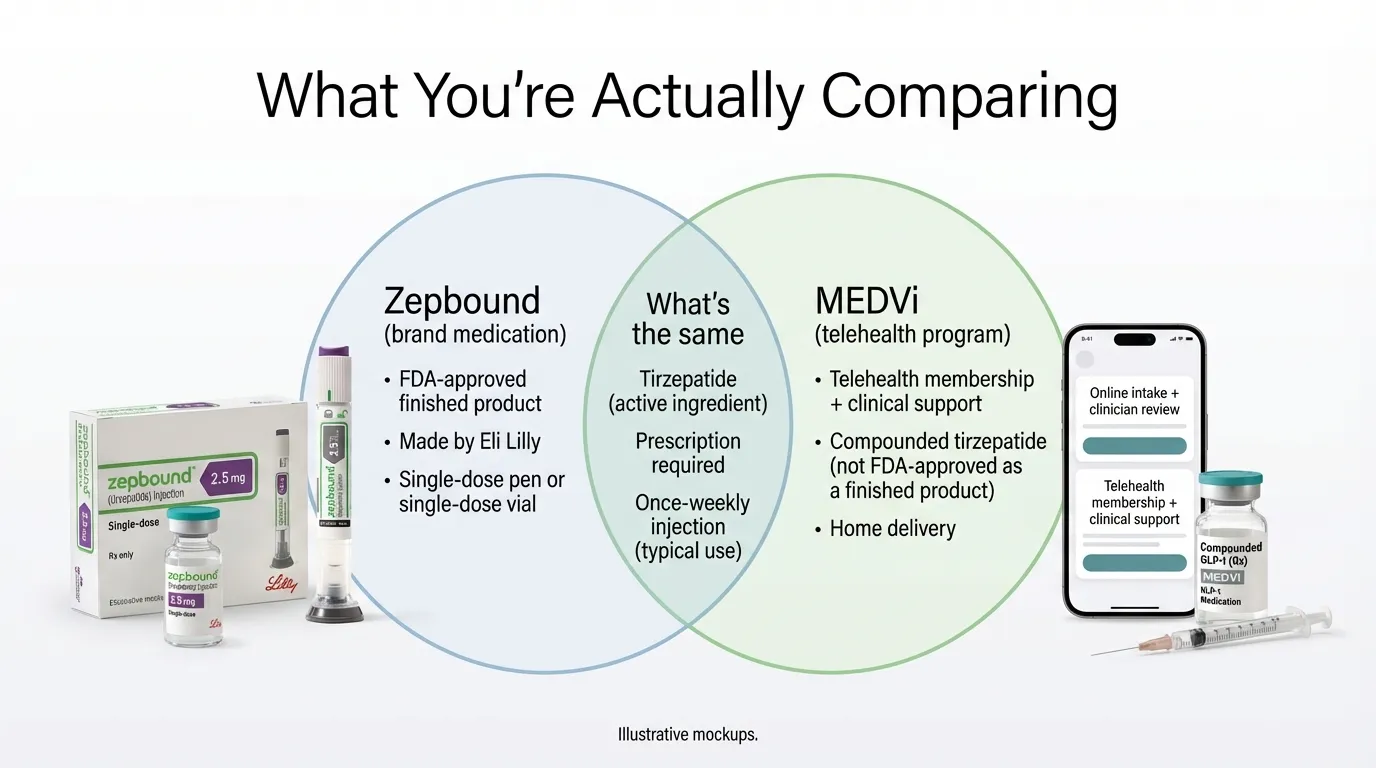
Side effects overview and management strategies for tirzepatide.
*Illustration only. Side effect guidance for educational purposes. Actual medication packaging and appearance may vary.*
Serious Warnings
These are rare but important. Discuss them with your prescribing provider:
- Thyroid C-cell tumors: Tirzepatide caused thyroid tumors in animal studies. It's unknown if this occurs in humans. Do NOT use tirzepatide if you or a family member have had medullary thyroid carcinoma or Multiple Endocrine Neoplasia syndrome type 2 (MEN 2).
- Pancreatitis: Stop use and contact your provider immediately if you experience severe abdominal pain that doesn't go away.
- Gallbladder problems: Including gallstones.
- Hypoglycemia: Especially if combined with insulin or sulfonylureas.
- Kidney injury: Severe GI side effects (vomiting, diarrhea) can cause dehydration, which can stress the kidneys.
- Serious allergic reactions: Difficulty breathing, swelling, rapid heartbeat.
- Vision changes in patients with type 2 diabetes.
- Depression or suicidal thoughts: Rare, but report any mood changes to your provider.
What to Do if Side Effects Hit
Don't panic. Do communicate. Contact your prescribing provider about any side effects — that's what they're there for. MEDVi offers 24/7 messaging with your clinical team, which makes reporting side effects faster than waiting for a doctor's office to open.
General comfort measures: Stay hydrated. Eat smaller meals. Increase fiber gradually. Avoid fatty or greasy foods during dose escalation. These aren't medical prescriptions — they're practical tips that most patients find helpful. For detailed dietary guidance, see our GLP-1 nausea relief guide.
When to seek urgent care: Severe abdominal pain that doesn't go away, signs of allergic reaction (swelling of face/throat, difficulty breathing), or persistent vomiting/diarrhea causing dehydration.
The One Honest Downside to MEDVi That Most Review Sites Won't Tell You
Every comparison page makes MEDVi sound effortless. Let's be real about one thing.
MEDVi's billing cycle starts when you sign up — not when your medication arrives. Because physician review, pharmacy processing, and shipping can take 7–9 days, your first billing cycle is already running before you have medication in hand. If you're not expecting this, it feels like you're paying for days you didn't use.
It's not a scam. It's how most subscription telehealth programs work. But nobody explains it upfront, and it catches people off guard.
The fix is simple: Understand the timeline before you enroll. Your first month includes the physician evaluation, treatment plan, metabolic report, and the medication itself. Think of it as an onboarding period. After month one, refills align more closely with a 30-day cycle.
Here's what matters more than the billing timing: MEDVi has no long-term contracts. You can cancel anytime with 72 hours' notice before your next billing date. There's no cancelation fee. And if the program doesn't work — they put their money where their mouth is with a money-back guarantee: follow the program for five months, demonstrate you haven't lost weight, and you'll receive a 75% refund.
That's more accountability than Zepbound, LillyDirect, or any retail pharmacy offers. Zepbound is a medication, not a program — there's no guarantee, no refund, and no support beyond what your own doctor provides. Over 100,000 patients have used MEDVi (per their homepage as of Feb 2026). The program holds approximately a 4.5-star rating on Trustpilot. Are there some billing complaints? Yes — and MEDVi responds to nearly all negative reviews publicly. Transparency under criticism is, honestly, a better trust signal than a perfect score.
What Real Patients Are Saying: MEDVi Reviews and Zepbound Experiences
We pulled these from third-party review platforms — not MEDVi's marketing materials.
Ruth Ann, ConsumerAffairs (verified reviewer): Ruth Ann described losing weight on MEDVi's tirzepatide program, noting she only needed to lose about 25 pounds gained after menopause that were affecting her blood pressure. She reported no issues with delivery, communication, or the medication itself, calling MEDVi “the perfect way to do it” for people without insurance, and adding she'd “highly recommend MEDVi.”
Trustpilot reviewer (verified purchase): One reviewer highlighted strong customer service and prompt replies to questions as standout positives of their MEDVi experience.
Reddit user (r/tirzepatidecompound): A community member shared that everything went as expected with MEDVi, noting they even called the compounding pharmacy directly to verify it and confirmed it was a legitimate pharmacy.
How to Read Online Reviews Intelligently
Look for specifics. Reviews that mention delivery timelines, support interactions, actual weight numbers, or specific processes are more trustworthy than generic praise.
Ignore “miracle” claims. Nobody loses 50 pounds in a month on any GLP-1. If a review sounds like an infomercial, it's probably planted.
Separate medication experience from program experience. A negative review about customer service or billing is valid feedback about MEDVi's operations — it tells you nothing about whether tirzepatide works. Similarly, rave reviews about weight loss are about the medication's effect, not the platform specifically.
Check the response. MEDVi responds to negative reviews on Trustpilot. How a company handles complaints tells you more than the complaints themselves.
For a deeper look at MEDVi patient experiences, see our MEDVi tirzepatide reviews page.
How Does MEDVi Work from Signup to First Shipment?
Here's the step-by-step, based on ConsumerAffairs reporting and our own research:
Step 1: Online Health Evaluation (10–15 minutes)
You'll fill out a detailed questionnaire covering your medical history, current medications, previous weight-loss attempts, and health goals. This isn't a casual quiz — it goes deep, and it should. Your provider needs this information to prescribe safely.
Step 2: Choose Your Medication and Pay
Select between compounded semaglutide or tirzepatide, injectable or tablet form. Enter payment information. Your first month is billed at this point.
Step 3: Physician Review (typically within 24 hours)
A board-certified physician or nurse practitioner from the OpenLoop Health network reviews your evaluation. If questions arise, they may follow up before approving. You can also request a live telehealth consultation at no extra cost.
Step 4: Pharmacy Processing and Shipping (2–5 business days)
Once approved, your prescription goes to one of MEDVi's partner pharmacies (Belmar Pharma Solutions or Beluga Health). Medication ships with cold packs and arrives within 2 business days of pharmacy dispatch. Total time from signup to delivery: approximately 7–9 days.
Step 5: Monthly Refills
At the end of each monthly cycle, fill out a brief refill form and pay your next month's membership. Your provider monitors your progress and adjusts your dose as needed.
State Availability
MEDVi is available in 49 states — every state except North Dakota. Some states may have specific requirements (such as an initial provider visit or restrictions on tablet vs. injection prescriptions). Confirm your state's requirements during the evaluation process.
How Do You Actually Get Zepbound? (Step-by-Step)
Insurance Route
- Visit your doctor and discuss tirzepatide for weight loss.
- Your doctor submits a prior authorization to your insurance company (if required).
- Wait for approval. This can take days to weeks. Many patients get denied on the first attempt.
- If denied, appeal. Your doctor can submit additional documentation. Some patients go through multiple rounds.
- If approved, fill at your pharmacy. Apply the Zepbound Savings Card if eligible.
LillyDirect Self-Pay Route
- Get a prescription from your doctor (any licensed prescriber authorized to prescribe in your state can write it).
- Visit LillyDirect (zepbound.lilly.com) and create an account.
- Select single-dose vials at the discounted pricing ($299–$449/month depending on dose).
- Enroll in the Self Pay Journey Program to lock in program pricing.
- Medication ships to your door or is available for Walmart pharmacy pickup in select locations.
- Refill within 45 days to maintain program pricing at doses of 7.5 mg and above.
What Slows People Down
- No primary care doctor: You need a prescriber to use LillyDirect. If you don't have one, you'll need to find a doctor who can write a tirzepatide prescription — which takes time.
- Prior authorization delays: Insurance companies routinely deny first requests for weight-loss medications.
- Pharmacy stock issues: Zepbound has experienced intermittent supply constraints.
- The vial learning curve: LillyDirect vials require drawing medication with a syringe. If you've never self-injected, there's a brief learning period.
LillyDirect Vials: What You Need to Know About Supplies
LillyDirect's discounted vial pricing ($299–$449/month) covers the medication only. The vials are single-dose — you'll need to draw the medication into a syringe yourself. Supplies you'll need:
- Insulin syringes (typically 1 mL with 29–31 gauge needle)
- Alcohol swabs for injection site preparation
- Sharps container for safe needle disposal
These supplies are inexpensive (roughly $10–$20/month from any pharmacy or Amazon) but they're not included in LillyDirect's price, and Lilly doesn't mention this prominently. MEDVi ships everything you need with your medication — no separate supply purchases required.
Can You Switch Between MEDVi and Zepbound?
Yes. Because both use tirzepatide, switching is pharmacologically straightforward. But there are a few things to know:
- Talk to your provider first. Whether you're going from MEDVi to Zepbound or vice versa, a clinician should help manage the transition to ensure your dose stays consistent.
- Document your dose history. If you've been on 10 mg through MEDVi and switch to Zepbound, your new prescriber needs to know exactly where you are in your titration.
- Don't overlap. Never take doses from two sources simultaneously.
- Allow for timing. If you cancel MEDVi and are transitioning to Zepbound through insurance, there may be a gap while prior authorization processes. Plan ahead.
The molecule is the same. The transition is usually seamless as long as your providers communicate.
Insurance, HSA/FSA, and How People Actually Pay
MEDVi: Cash-pay only. No commercial insurance, Medicare, or Medicaid. However, FSA and HSA payments are typically accepted — check with your account administrator to confirm GLP-1 medication qualifies under your plan.
Zepbound with commercial insurance: Coverage varies dramatically by plan. Many commercial insurers have added GLP-1 coverage for weight loss, but prior authorization is almost always required, and denials are common. If your insurer covers it, the Zepbound Savings Card can reduce your copay to as low as $25/month (commercial insurance only; $100/month savings cap, $1,300/year cap).
Zepbound without insurance: LillyDirect's self-pay vial pricing ($299–$449/month) is available to anyone with a valid prescription. You do not need insurance. You cannot use insurance through LillyDirect — it's cash-only.
Medicare: Medicare/Medicaid beneficiaries are not eligible for the Zepbound Savings Card. Medicare does not broadly cover weight-loss medications as of February 2026. However, Zepbound's FDA approval for obstructive sleep apnea (OSA) creates a Part D coverage pathway for Medicare patients with documented sleep apnea. Coverage varies by plan and indication — check your Part D plan or pharmacist for current coverage rules.
The practical reality: If you have commercial insurance → check Zepbound coverage first. If you don't have coverage → MEDVi and LillyDirect are your two main cash-pay paths, and the right choice depends on whether you want a full program or just the medication. For more options, see our how to get GLP-1 without insurance guide.
The One Honest Downside to Zepbound That Most People Miss
We covered MEDVi's billing quirk above. Here's the Zepbound one:
LillyDirect's 45-day refill window is unforgiving at higher doses. At 7.5 mg and above, if you don't reorder within 45 days of your last delivery, your price jumps to the standard self-pay rate:
- 7.5 mg: $449 with purchase offer → $499 regular self-pay if 45-day window missed
- 10 mg: $449 with purchase offer → $699 regular self-pay if 45-day window missed
- 12.5 mg: $449 with purchase offer → $699 regular self-pay if 45-day window missed
- 15 mg: $449 with purchase offer → $699 regular self-pay if 45-day window missed
You can re-enroll in the Self Pay Journey Program with your next order to get back to $449 — but that one missed refill will cost you. Life happens. Vacations happen. A busy week happens. That refill window is tighter than it looks. MEDVi doesn't have this refill-window penalty — your subscription price doesn't spike if you reorder a few days late.
If You're Still Undecided: The 60-Second Decision Rule
Ask yourself three questions:
1.Does my insurance cover Zepbound? → Yes: Get Zepbound through insurance. You'll pay a fraction of what any other path costs. → No or unsure: Continue to question 2.
2.Is FDA approval of the finished product a requirement for me? → Yes: Get Zepbound through LillyDirect self-pay ($299–$449/month + your own doctor). → No, I'm comfortable with a licensed compounding pharmacy: Continue to question 3.
3.Do I want a full program (doctor, meds, support, shipping all-in-one) or just the medication? → Full program: MEDVi is built for this. → Just the medication: LillyDirect is your best cash-pay option for brand-name.
That's it. Three questions, clear answer.
Frequently Asked Questions
Does MEDVi prescribe brand-name Zepbound?
No. MEDVi prescribes compounded tirzepatide, not brand-name Zepbound or Mounjaro. If you want the FDA-approved brand-name product, you’ll need a prescription from your own doctor filled at a retail pharmacy or through LillyDirect.
Is Zepbound FDA-approved for weight loss?
Yes. Zepbound (tirzepatide) is FDA-approved for chronic weight management in adults with obesity (BMI ≥30) or overweight (BMI ≥27) with at least one weight-related condition, as well as for moderate-to-severe obstructive sleep apnea in adults with obesity.
What’s the difference between compounded tirzepatide and Zepbound?
Zepbound is an FDA-approved medication manufactured by Eli Lilly under full FDA oversight. Compounded tirzepatide is a pharmacy-prepared formulation that is not FDA-approved and has not been reviewed by the FDA for safety, effectiveness, or quality. They are different products with different regulatory pathways.
Is MEDVi safe?
MEDVi is LegitScript certified, partners with named and licensed U.S. compounding pharmacies (Belmar Pharma Solutions, Beluga Health), and uses licensed physicians through the OpenLoop Health network. Over 100,000 patients have used the platform (per MEDVi.org). That said, compounded medications carry inherent trade-offs compared to FDA-approved products.
How much does MEDVi cost after the first month?
For compounded tirzepatide, expect around $399/month after the introductory period (per ConsumerAffairs reporting). Pricing varies by formulation (tablets vs. injections) and dose — confirm your specific cost directly with MEDVi before enrolling. This is all-inclusive — medication, physician oversight, and shipping included.
How much does Zepbound cost without insurance?
Through LillyDirect: $299/month for the 2.5 mg starter dose, $399 for 5 mg, and $449 for all higher maintenance doses (if refilled within 45 days). Without LillyDirect, the retail list price is approximately $1,086/month.
Can I cancel MEDVi anytime?
Yes. MEDVi has no long-term contracts. Cancel at least 72 hours before your next billing date. Note that refunds are not available for medication that has already been ordered for your current cycle. Prescription items are non-refundable once fulfilled.
Does MEDVi’s money-back guarantee really work?
MEDVi offers a guarantee: if you follow the program for at least five months and can demonstrate you haven’t lost weight, you’re eligible for a 75% refund (the remaining 25% covers consultation costs). You’ll need to document your participation and progress.
Can I use my HSA or FSA?
MEDVi accepts HSA/FSA payments in most cases. Confirm with your account administrator that GLP-1 medication qualifies under your specific plan. LillyDirect accepts standard payment methods; HSA/FSA eligibility for Zepbound depends on your plan.
Which has more side effects — MEDVi or Zepbound?
Since both deliver tirzepatide, the side effect profile is essentially the same. Common effects include nausea, diarrhea, constipation, and stomach pain — mostly during dose escalation.
What states is MEDVi available in?
49 states — all except North Dakota. Some states may have additional requirements for telehealth prescribing.
Is Zepbound a scam?
No. Zepbound is a legitimate, FDA-approved medication manufactured by Eli Lilly, one of the world’s largest pharmaceutical companies. However, be cautious about third-party websites claiming to sell Zepbound at steep discounts — counterfeit GLP-1 products exist. Only purchase through your pharmacy, LillyDirect, or verified healthcare partners.
MEDVi vs Zepbound for higher doses — which is cheaper?
At maintenance doses (7.5–15 mg), MEDVi charges approximately $399/month all-inclusive (per ConsumerAffairs; some sources report up to $499 at higher doses). LillyDirect charges $449/month for the medication only (if you refill within 45 days). If you add the cost of doctor visits to the LillyDirect price, MEDVi is often comparable or cheaper at higher doses. If you miss the LillyDirect refill window, MEDVi is significantly cheaper.
Can I switch from semaglutide (Ozempic/Wegovy) to tirzepatide?
Yes, but this should be done under medical supervision. Clinical evidence suggests tirzepatide produces approximately 6–7% more weight loss than semaglutide on average. Many patients who plateau on semaglutide switch to tirzepatide for additional results. MEDVi offers both compounded semaglutide (from $179 first month) and tirzepatide (from $279 first month), making it easy to switch within the same program.
What about oral tirzepatide (tablets)?
MEDVi offers compounded tirzepatide in dissolvable tablet form for patients who prefer not to inject. Zepbound is currently injection-only. There is no FDA-approved oral tirzepatide on the market. Eli Lilly’s oral non-peptide GLP-1 receptor agonist orforglipron was FDA-approved on April 1, 2026 and is sold under the brand name Foundayo, but orforglipron is a completely different molecule — not tirzepatide in pill form.
What happens if I stop taking tirzepatide?
Clinical data (SURMOUNT-4) showed that participants who discontinued tirzepatide regained a significant portion of lost weight over the following year. This is consistent with how the body responds to the removal of appetite-suppressing medication. Most obesity medicine specialists recommend viewing GLP-1 treatment as a long-term management strategy, not a short-term fix.
Will Medicare cover Zepbound in 2026?
Medicare/Medicaid beneficiaries are not eligible for the Zepbound Savings Card. As of February 2026, Medicare does not broadly cover GLP-1 medications for weight loss. Zepbound’s OSA indication may create a Part D coverage pathway for patients with documented sleep apnea. Coverage rules are evolving — check with your Part D plan or pharmacist for the most current information.
How long does shipping take with MEDVi?
After physician approval (usually within 24 hours), pharmacy processing takes 2–5 business days, and shipping takes approximately 2 business days. Total time from signup to medication in hand: roughly 7–9 days. Medications ship with cold packs to maintain proper temperature.
Can I pick up Zepbound at Walmart?
Yes. LillyDirect launched a Walmart pharmacy pickup option in late 2025, available at select locations. You order through LillyDirect at the same self-pay pricing and pick up at a participating Walmart pharmacy. This option is expected to expand nationwide in 2026.
Does MEDVi offer semaglutide too?
Yes. MEDVi offers compounded semaglutide (the same active ingredient in Ozempic and Wegovy) starting at $179 for the first month and $299/month ongoing. If you’re unsure whether semaglutide or tirzepatide is right for you, MEDVi’s physicians can help determine the best starting point based on your health profile and goals.
Can I take tirzepatide if I have type 2 diabetes?
Tirzepatide is the active ingredient in both Zepbound (approved for weight loss) and Mounjaro (approved for type 2 diabetes). If you have type 2 diabetes, talk to your doctor about whether Mounjaro or Zepbound is more appropriate based on your specific situation. Do not use both simultaneously. MEDVi can prescribe compounded tirzepatide, but you must disclose all medical conditions during your evaluation.
What’s the difference between Zepbound pens and vials?
Zepbound pre-filled pens are auto-injectors — click a button, and the needle deploys and injects automatically. They’re available through insurance and retail pharmacies at the list price (~$1,086/month). Zepbound single-dose vials (available through LillyDirect at $299–$449/month) require you to draw the medication into a syringe and inject manually. The medication inside is identical. The vials are cheaper but require slightly more skill.
Is tirzepatide better than semaglutide?
Head-to-head data from the SURMOUNT-5 trial (published in NEJM, 2025) showed tirzepatide produced 20.2% average weight loss vs. 13.7% for semaglutide over 72 weeks. Tirzepatide was statistically superior at every weight-loss threshold measured. However, semaglutide is cheaper (MEDVi: $179 first month vs. $279 for tirzepatide) and many patients achieve excellent results on semaglutide. Your provider can help determine which is best for your situation.
What if I can’t afford either option?
Several strategies can help. Ask your doctor about Zepbound’s Savings Card (up to $100/month off with commercial insurance). If you don’t have insurance, LillyDirect’s self-pay vials start at $299/month. MEDVi’s semaglutide program starts at $179/month — it’s less expensive than tirzepatide and still clinically effective. Also check whether your employer’s FSA or HSA covers GLP-1 medications.
Are there any foods or medications I should avoid while taking tirzepatide?
No specific food interactions, but most patients find they tolerate smaller, protein-rich meals better than large or greasy meals — especially during dose escalation. Tirzepatide slows gastric emptying, so heavy meals can worsen nausea. In terms of medications, tirzepatide can affect the absorption of some oral medications. Tell your prescriber about everything you take, including supplements. If you use oral contraceptives, discuss timing with your provider as absorption may be affected.
Is Zepbound the same as Mounjaro?
Same active ingredient (tirzepatide), different FDA approvals. Mounjaro is approved for type 2 diabetes; Zepbound is approved for chronic weight management and moderate-to-severe obstructive sleep apnea in adults with obesity. The medication inside is identical — the brand name and indication are what differ. Your doctor determines which is appropriate based on your diagnosis.
What if I miss a tirzepatide dose?
Per Zepbound’s prescribing information: if your next scheduled dose is more than 4 days (96 hours) away, take the missed dose as soon as possible. If it’s 4 days or fewer until your next dose, skip the missed dose and resume your regular schedule. Do not take two doses within 4 days of each other. Contact your prescribing provider if you’re unsure.
Edge Cases and Scenarios Most Guides Don't Cover
I was denied by insurance. Now what?
Start by appealing — your doctor can submit additional clinical documentation, and many patients get approved on appeal. While you wait, LillyDirect's self-pay vials or MEDVi's compounded tirzepatide are options that don't require insurance approval. Some patients use a hybrid approach: start on MEDVi or LillyDirect while their insurance appeal processes, then switch to insurance coverage if approved.
I'm on a different GLP-1 (Ozempic/Wegovy). Can I switch to tirzepatide?
Yes, with your provider's guidance. Many patients who plateau on semaglutide switch to tirzepatide for the additional GIP receptor activation. Head-to-head data (SURMOUNT-5) supports tirzepatide's superiority in terms of weight loss. Your provider will help manage the transition, typically starting tirzepatide at a lower dose to minimize GI side effects even if you were on a higher dose of semaglutide. For more on this, see our semaglutide vs tirzepatide comparison.
What about the TrumpRx program I keep hearing about?
TrumpRx.gov launched on February 5, 2026 as a federal discount/coupon platform that directs patients to drugmakers' direct-to-consumer websites. Zepbound is listed, with monthly pricing as low as $299 depending on dose — similar to LillyDirect pricing. TrumpRx is for cash-paying patients only (discounts don't apply through insurance). It doesn't sell medications directly — it aggregates manufacturer coupons and links. Availability and pricing can change; check TrumpRx.gov for current details.
I'm over 65. Is tirzepatide safe for me?
Age alone doesn't disqualify you. The SURMOUNT trials included participants across a range of ages. However, older adults may face additional considerations: risk of muscle loss is higher (protein intake becomes even more important), and drug interactions are more likely with multiple medications. Get a thorough medical evaluation — MEDVi's physicians screen for these factors, and your own doctor should be involved if you have complex medical needs.
I had bariatric surgery. Can I still use tirzepatide?
This is a conversation for your surgeon and endocrinologist. Some patients who've had gastric bypass or sleeve gastrectomy use GLP-1 medications for weight regain. But the altered GI anatomy can affect absorption and side effects. This is not a decision to make through a telehealth platform alone.
I'm breastfeeding. Can I take tirzepatide?
There is insufficient data on tirzepatide use during breastfeeding. The FDA labeling recommends discussing benefits and risks with your healthcare provider. Most obesity medicine specialists advise waiting until after breastfeeding to start GLP-1 treatment.
What happens to my loose skin after significant weight loss?
This isn't a tirzepatide-specific concern, but it's real. With 20%+ weight loss, many patients experience excess skin, particularly around the abdomen, arms, and thighs. The degree depends on your age, genetics, how much weight you lose, and how quickly. Some patients pursue skin removal surgery after reaching their goal weight (typically waiting 12–18 months at a stable weight). Insurance coverage for excess skin removal varies.
How We Evaluated MEDVi vs Zepbound (Our Methodology)
Pricing verification. MEDVi pricing confirmed through ConsumerAffairs, MEDVi.org, and multiple third-party reviews (January–February 2026). Zepbound pricing confirmed through LillyDirect.lilly.com, Eli Lilly investor announcements, and Reuters reporting (December 2025). LillyDirect 45-day refill window pricing confirmed through Lilly's official terms.
Clinical data. Zepbound prescribing information (FDA-approved label, Study 1/SURMOUNT-1 treatment-regimen estimand: 15.0%/19.5%/20.9%). SURMOUNT-5 (Aronne et al., NEJM 2025;393:No.1). Eli Lilly investor releases. We cite FDA label data for the active ingredient — not for any specific compounded product.
Safety information. Zepbound full prescribing information (pi.lilly.com). FDA guidance on unapproved/compounded GLP-1 drugs (fda.gov/drugs). LegitScript certification verified through LegitScript.com.
Reviews. Trustpilot (MEDVi: ~4.5 stars as of Feb 2026), ConsumerAffairs (detailed reporting on MEDVi pricing, process, states, and patient experiences), Reddit (r/tirzepatidecompound community discussions).
What's “provider-stated” vs. “independently verified”: MEDVi's claims about 100,000+ patients and the money-back guarantee come from MEDVi's own website and press releases. We note these as provider-stated. Pricing, pharmacy partnerships, and LegitScript certification are independently verifiable.
Affiliate relationship. We earn a commission if you start a MEDVi plan through our links. We do not have an affiliate relationship with Eli Lilly, LillyDirect, or Zepbound. Our recommendation would be exactly the same without the affiliate relationship — because the decision rule is simple and insurance-dependent, and we tell half our readers to choose Zepbound.
Update schedule. We re-verify pricing and policies monthly. Last full verification: February 16, 2026. Read our full methodology and advertising disclosure.
What to Expect in Your First Month (Whichever You Choose)
Starting tirzepatide is a real commitment — financially, physically, and mentally. Here's an honest preview so there are no surprises.
Week 1
You'll likely start at 2.5 mg (the standard starter dose for both Zepbound and MEDVi). Most people feel a noticeable reduction in appetite within the first few days. Some feel nothing at all for a week or two — that's also normal. Mild nausea is common. Weight loss this week is typically modest, if any.
Week 2
Your body is adjusting. Many patients describe feeling “full faster” — they sit down to eat what they normally would and can't finish it. Some describe the quiet in their head around food for the first time. If nausea is present, it usually peaks this week and starts to improve.
Weeks 3–4
By now, most people have settled into a routine. Eating smaller portions feels natural rather than forced. If you're tracking, you may see 2–5 pounds lost. Some people see more, some less.
End of month 1
This is when you and your provider discuss the next dose. The standard titration increases by 2.5 mg every four weeks. If side effects were minimal, you'll likely move to 5 mg. If nausea was significant, your provider may hold the dose for another cycle. This is why having an accessible provider (MEDVi's 24/7 messaging or your own doctor) matters — dose decisions should be individualized, not automatic.
One thing nobody talks about: The first month is as much about mindset as medication. You've spent years (maybe decades) fighting your body. Tirzepatide changes the rules of that fight. The urge to restrict aggressively on top of the medication is strong — resist it. Eat adequate protein, eat regular meals, and let the medication do its job without extreme dieting on top of it. The people who get the best long-term results are the ones who build sustainable habits during treatment, not the ones who crash diet alongside it.
Bottom Line: Your Next Step
You've read the data. Here's what to do with it.
- If your insurance covers Zepbound → Check Zepbound coverage and the Savings Card. You could pay as low as $25/month. Start there.
- If you're paying cash and want the full program → Check MEDVi eligibility and current pricing. Everything bundled, no insurance required, money-back guarantee. Start the evaluation and you'll know within 24 hours if you're approved.
- If you're paying cash and want FDA-approved brand-name → Explore LillyDirect self-pay vials. You'll need your own prescription. Set that 45-day refill reminder.
Tirzepatide works. The clinical data is as strong as it gets in obesity medicine. The only question is which path gets it into your hands safely, affordably, and sustainably.
Whatever you choose — talk to a qualified healthcare provider and make sure this medication is appropriate for your specific health situation. This guide is informational, not medical advice.
This article is for informational purposes only and does not constitute medical advice. Always consult a qualified healthcare provider before starting any medication. Weight Loss Provider Guide is an independent review site. We may earn a commission from purchases through our links, which helps fund our research. Read our editorial standards and medical reviewer information.
Full medical disclaimer · Advertising disclosure · Learn more about GLP-1s
Sources
- Jastreboff AM, Aronne LJ, et al. “Tirzepatide Once Weekly for the Treatment of Obesity.” New England Journal of Medicine. 2022;387:205-216.
- Aronne LJ, Bade Horn D, et al. “Tirzepatide as Compared with Semaglutide for the Treatment of Obesity.” New England Journal of Medicine. 2025;393(1).
- Eli Lilly and Company. “Zepbound Single-Dose Vials at Lower Prices on LillyDirect.” Investor.lilly.com. December 1, 2025.
- U.S. Food and Drug Administration. “FDA's Concerns with Unapproved GLP-1 Drugs Used for Weight Loss.” FDA.gov. Updated 2025.
- Zepbound (tirzepatide) Full Prescribing Information. Eli Lilly and Company. pi.lilly.com.
- ConsumerAffairs. “MEDVi Review.” ConsumerAffairs.com. Updated February 2026.
- Reuters. “Eli Lilly Cuts Zepbound Price to Widen Access to Obesity Drug.” Reuters.com. December 1, 2025.
Last updated: May 2026. This page is reviewed and verified monthly. Pricing, policies, and availability are subject to change. Check medvi.org and zepbound.lilly.com for the most current information.