How Much Does Tirzepatide Cost? Every Price, Every Scenario (2026)
By the WPG Research Team·Pricing Verified: February 2026
This page contains affiliate links. We may earn a commission at no extra cost to you if you purchase through these links. See our editorial policy and advertising disclosure.
Tirzepatide costs between $25 and $1,086 per month — and the gap between those two numbers is why you're here. The price you'll actually pay depends on three things: whether you have insurance, which brand you use (Zepbound or Mounjaro), and how you buy it.
Here's the short version. If you have commercial insurance that covers it and use a manufacturer savings card, you could pay as little as $25/month. If you're paying out of pocket, Eli Lilly's direct-to-consumer program (LillyDirect) now sells Zepbound vials starting at $299/month for the lowest dose, with higher maintenance doses starting at $449/month when you refill within 45 days (prices increase if you miss that window). Compounded tirzepatide through telehealth providers runs $199–$500/month, but it's not FDA-approved — and we'll explain exactly what that means for you later.
Most people don't pay anywhere near the $1,086 list price. But finding your number requires knowing which path fits your situation. That's what the rest of this page does — every pricing scenario, every savings program, every dose, verified against manufacturer sources as of this month.
Medical Disclaimer: This page is for informational and educational purposes only and is not a substitute for professional medical advice, diagnosis, or treatment. Tirzepatide is a prescription medication — always consult a qualified healthcare provider before starting, stopping, or changing any medication. See our full medical disclaimer.
Quick Cost Snapshot — Find Your Situation
| How You're Getting Tirzepatide | Monthly Cost | Who It's For | Verified |
|---|---|---|---|
| Brand-name pens (list price, no discounts) | ~$1,086 | Nobody should pay this if they read this page | Feb 2026 |
| Zepbound vials via LillyDirect (self-pay) | $299–$449 | Uninsured or insurance doesn’t cover it | Feb 2026 |
| Zepbound KwikPen via LillyDirect (self-pay) | $299–$449 | Same as above, easier to use (new Feb 2026) | Feb 2026 |
| Commercial insurance + savings card (covered) | As low as $25 | Commercially insured, plan covers Zepbound/Mounjaro | Feb 2026 |
| Commercial insurance + savings card (NOT covered) | ~$499 | Commercially insured, plan doesn’t cover it | Feb 2026 |
| Compounded tirzepatide (telehealth) | $199–$500 | Budget-focused; not FDA-approved | Feb 2026 |
| Medicare Part D (diabetes) | Varies by plan | Type 2 diabetes patients on Medicare | Feb 2026 |
| Medicare (weight loss) | Not covered yet | CMS GLP-1 demo expected July 2026 ($50/mo); BALANCE Part D date TBD (delayed) | Feb 2026 |
| Patient assistance (Lilly Cares) | $0 | Income-qualified, uninsured; Zepbound not currently listed | Feb 2026 |
Prices verified against Eli Lilly official program pages (zepbound.lilly.com/savings), LillyDirect, and GoodRx. Provider-stated prices noted where applicable. See how we verified these prices.
Answer 4–6 quick questions to get your personalized cost estimate
What Will Tirzepatide Cost You?
Answer a few questions — get your personalized cost estimate in under 60 seconds.
What's your insurance situation?
What Determines Your Tirzepatide Cost?
The reason tirzepatide pricing feels so chaotic online is that it's not one price — it's a pricing maze with at least six different paths through it. Two people taking the exact same medication at the exact same dose can pay wildly different amounts depending on how they navigate the system.
Three factors drive almost all of the variation:
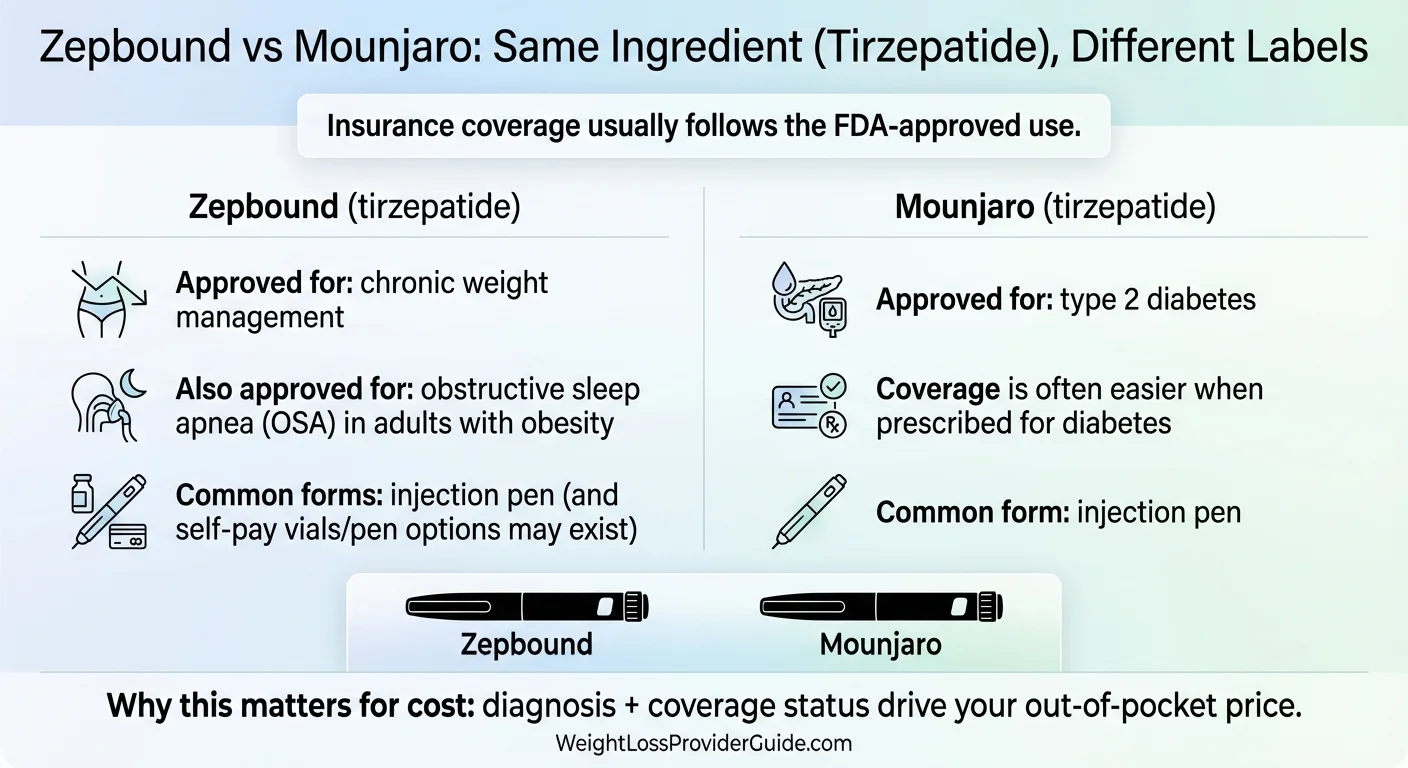
1. Which brand you use. Tirzepatide is the active ingredient. It's sold under two brand names: Zepbound (FDA-approved for weight management and obstructive sleep apnea in adults with obesity) and Mounjaro (FDA-approved for type 2 diabetes in adults and children age 10+). Same molecule, different labels, different insurance treatment. This distinction matters enormously for what you'll pay, because insurers are far more likely to cover Mounjaro for diabetes than Zepbound for weight loss.
2. How you pay. Your options include: insurance with a copay, insurance plus a manufacturer savings card, LillyDirect's self-pay program (no insurance needed), retail pharmacy with a discount card like GoodRx, or a telehealth provider offering compounded tirzepatide. Each path has a different price floor.
3. Your dose. Tirzepatide starts at 2.5 mg (a starter dose, not a maintenance dose) and increases in steps through 5 mg, 7.5 mg, 10 mg, 12.5 mg, and 15 mg. For weight management, recommended maintenance doses are 5 mg, 10 mg, or 15 mg weekly. For obstructive sleep apnea, recommended maintenance doses are 10 mg or 15 mg weekly. Some programs charge the same regardless of dose. Others charge more as the dose increases. This affects your long-term budget.
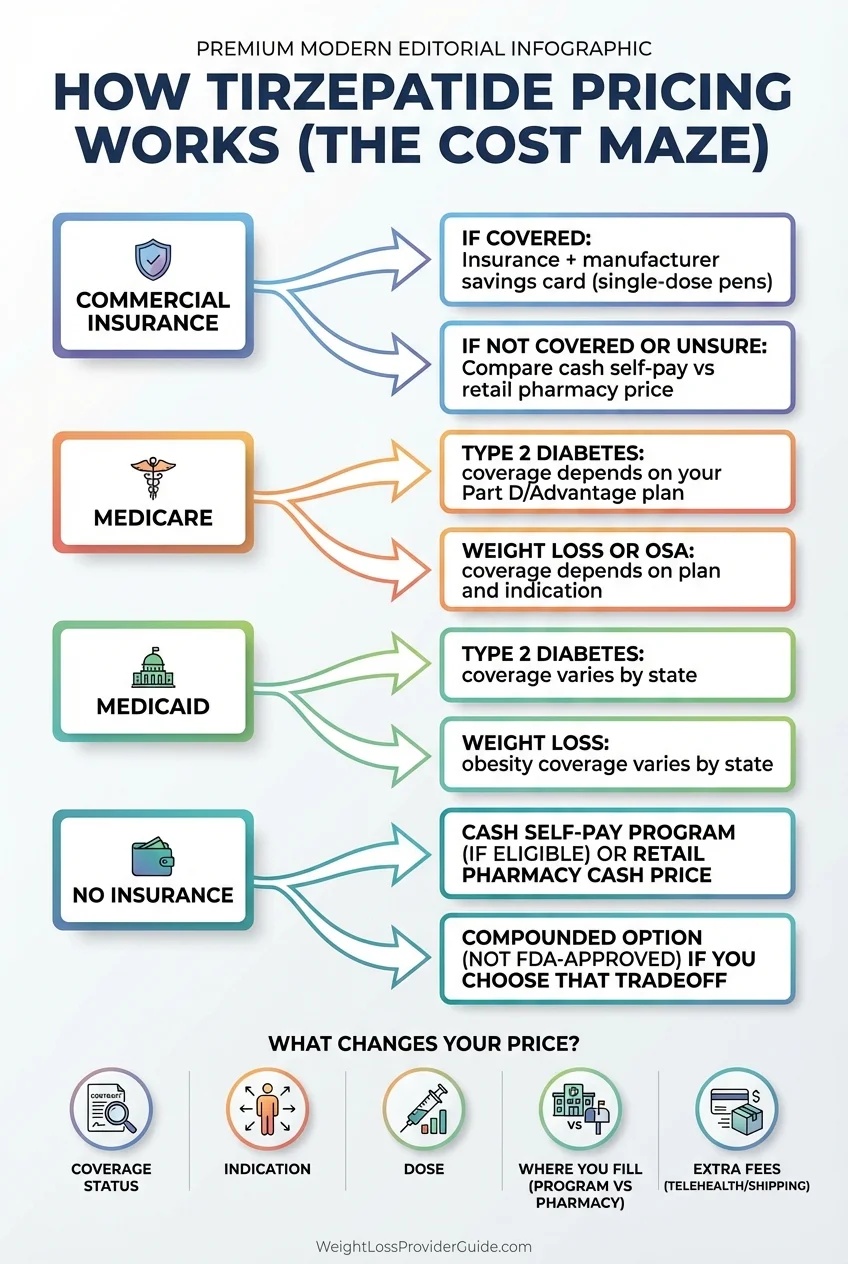
A few other things shift the number: your pharmacy, whether you choose a pen or a vial, hidden fees from telehealth providers (membership costs, shipping charges, consultation charges), and even your state. We'll walk through all of it below.
How Much Does Tirzepatide Cost Without Insurance?
This is where most people start — either because they don't have insurance, their insurance doesn't cover it, or they want to skip the prior authorization headache entirely. Let's look at every option.
Brand-Name at a Retail Pharmacy (Full Price)
If you walk into CVS or Walgreens with a prescription and no insurance or discounts, here's what you're looking at:
- Mounjaro: ~$1,080 for a 28-day supply (four pens), regardless of dose
- Zepbound: ~$1,086 for a 28-day supply (four pens), regardless of dose
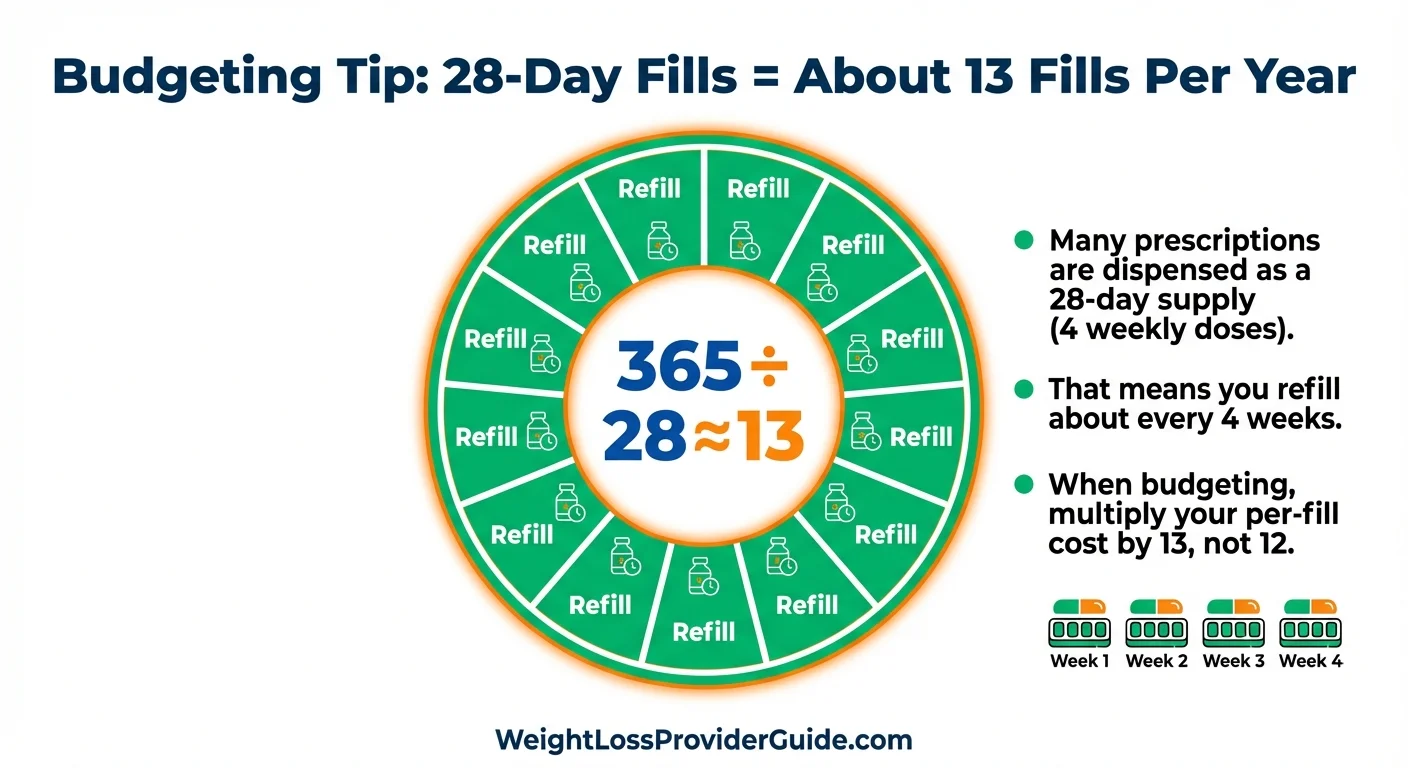
That's roughly $14,000+ per year (you need 13 fills because it's a 28-day supply, not a calendar month).
Almost nobody should pay this. If this is what your pharmacy quoted you, keep reading — there are legitimate ways to pay 50–75% less.
Zepbound via LillyDirect Self-Pay (Best Option for Most Uninsured People)
This is the biggest development in tirzepatide pricing over the past year, and it's the option we'd point most uninsured people toward first.
Eli Lilly sells Zepbound directly to patients through LillyDirect, their own digital pharmacy platform. No insurance needed — just a valid prescription for an on-label use. Prices were reduced again on December 1, 2025, and a new multi-dose pen option (the Zepbound KwikPen) launched with $449 pricing for maintenance doses starting February 23, 2026.
| Dose | LillyDirect Vial (Monthly) | KwikPen (Monthly, from Feb 23 2026) | Late Refill Price (>45 days, 7.5mg+) |
|---|---|---|---|
| 2.5 mg (starter) | $299 | $299 | $299 (no penalty) |
| 5 mg | $399 | $399 | $399 (no penalty) |
| 7.5 mg | $449* | $449* | $499 |
| 10 mg | $449* | $449* | $699 |
| 12.5 mg | $449* | $449* | $699 |
| 15 mg | $449* | $449* | $699 |
*The $449 price on doses 7.5 mg and above requires refilling within 45 days of your previous delivery. This is important. If you miss that window, the price jumps — significantly. On the 10 mg dose, for example, you'd pay $699 instead of $449. Set a reminder.
The 2.5 mg and 5 mg doses don't have this requirement. Their price is the same regardless of when you refill.
Source: Zepbound.lilly.com/savings and Lilly investor press release, Dec 1, 2025. KwikPen pricing confirmed on Lilly's KwikPen announcement page.
Vial vs. KwikPen — what's the difference?
The vial requires you to draw the medication into a syringe yourself. It's not hard, but it's an extra step. The KwikPen is a multi-dose monthly pen — one pen contains all four weekly doses for the month. No drawing, no syringe. Same medication, same price, easier to use. Your provider can help you decide which is right for you.
Walmart pickup is available.
As of November 2025, LillyDirect partnered with Walmart pharmacies nationwide so you can pick up your Zepbound vials in person instead of waiting for delivery. Same self-pay pricing.
How to enroll in LillyDirect self-pay:
- Get a prescription from your doctor or a telehealth provider (must be for an on-label use: weight management or obstructive sleep apnea)
- Your provider sends the prescription to LillyDirect Pharmacy
- You'll receive a text or email to confirm your order
- Choose delivery or Walmart pickup
- Injection supplies (needles, syringes, alcohol swabs) are available at checkout for a small additional fee if using vials
Pharmacy Discount Cards (GoodRx, RxSaver, SingleCare)
If you'd rather fill your prescription at a local pharmacy, discount cards can help — but they won't beat LillyDirect pricing for most people.
With a GoodRx coupon, Zepbound pens currently run around $995+ depending on your pharmacy and location. That's a savings off the $1,086 list price, but it's still more than double what you'd pay through LillyDirect.
- You use them instead of insurance, not in addition to it
- Prices vary by pharmacy and zip code — always check before you fill
- They work at most major retail pharmacies (CVS, Walgreens, Walmart, Costco)
- They're free to use
Bottom line: If LillyDirect self-pay is an option for you, it's almost always cheaper than a discount card at a retail pharmacy. The main reason to use a discount card is if you can't or don't want to use LillyDirect (e.g., your doctor won't prescribe Zepbound for an approved use, or you prefer a specific local pharmacy).
Compounded Tirzepatide Through Telehealth Providers
Compounded tirzepatide is the lowest-cost option available — but it comes with real tradeoffs that you should understand before choosing it.
Typical price range: $199–$500 per month.
Compounded tirzepatide is prepared by state-licensed compounding pharmacies using tirzepatide API — it is not FDA-approved as a finished drug, and the FDA does not verify its safety, quality, or potency. The FDA has explicitly stated that compounded GLP-1 products should not be marketed as equivalent to, the same as, or generic versions of Zepbound or Mounjaro. The FDA's temporary allowance for compounding tirzepatide during the drug shortage has ended, and compounding is now only permitted under specific legal frameworks (Section 503A or 503B of the FD&C Act) — typically when a practitioner determines a patient needs a customized formulation.
Watch for hidden fees.
Many telehealth providers advertise a medication price that doesn't include everything you'll actually pay. Some charge separate membership fees ($40–$100/month on top of the medication), consultation fees, shipping fees, or lab costs. Always ask for the total monthly cost, not just the medication price.
For example: a provider advertising "$199/month tirzepatide" with a $69/month membership fee actually costs you $268/month. That's not dishonest if disclosed upfront — but many providers bury it.
For the side-by-side billing terms, compare no-membership-fee tirzepatide options.
What to verify before choosing a compounded tirzepatide provider:
- Is the pharmacy licensed and registered as a 503A or 503B facility?
- What is the total monthly cost, including all fees?
- Do they require a real medical consultation with a licensed clinician?
- How do they handle potency and sterility testing?
- What happens if the FDA further restricts compounding?
- Can you switch to brand-name easily if needed?
Our honest assessment: Compounded tirzepatide can save $100–$200/month compared to LillyDirect. But with LillyDirect now at $299–$449/month for actual FDA-approved Zepbound, the price gap has narrowed considerably. For some people, the savings justify the tradeoffs. For others — especially those who want the certainty of an FDA-approved product — brand-name via LillyDirect is worth the extra cost. There's no universally right answer here, only the right answer for your situation. See our compounded tirzepatide provider comparison for vetted options.
How Much Does Tirzepatide Cost With Insurance?
Insurance can make tirzepatide dramatically cheaper — or barely budge the price at all. It depends entirely on your specific plan, your diagnosis, and whether you combine it with a manufacturer savings card.
If Your Insurance Covers Tirzepatide
This is the best-case scenario. If your commercial insurance plan has Zepbound or Mounjaro on its formulary and your claim gets approved:
- With the Zepbound savings card: as low as $25/month for a 1-month or 3-month supply
- With the Mounjaro savings card: as low as $25/month for a 1-month or 3-month supply
- Without a savings card: your copay depends on your plan's tier and cost-sharing structure — could be $50, $150, or more
The savings cards are free and available directly from Eli Lilly. They work on top of your insurance to reduce your out-of-pocket cost. The Zepbound savings card covers up to $100/month in savings (or $300 for a 3-month fill), capped at $1,300 per calendar year. The Mounjaro savings card covers up to $150/month in savings (or $450 for a 3-month fill), capped at $1,950 per calendar year.
Who can't use the savings cards: Anyone with Medicare, Medicaid, TRICARE, VA, or other government-funded insurance. This is a federal restriction, not Lilly's choice.
Source: Zepbound.lilly.com/savings and StartLilly.com/mounjaro
If You Have Commercial Insurance But It Does NOT Cover Tirzepatide
This is the most frustrating scenario — you're paying for insurance, but it won't cover the medication you need. Unfortunately, it's common. Many commercial plans still don't cover Zepbound for weight loss, and some don't cover Mounjaro for diabetes without prior authorization.
Even here, the savings cards can help:
- Zepbound savings card (non-covered): may reduce cost to approximately $499 for a 1-month supply of pens (up to $620/month in savings)
- Mounjaro savings card (non-covered): may reduce cost to approximately $499 for a 1-month supply (up to $647/month in savings)
But $499/month for pens is still more than LillyDirect's $299–$449/month for vials or the KwikPen. So if your insurance doesn't cover tirzepatide, LillyDirect self-pay may actually be cheaper than using your insurance with the savings card — especially at higher doses.
This is one of the most important things people miss: having insurance doesn't always mean using insurance is the cheapest path.
How to Check If Your Insurance Covers Tirzepatide
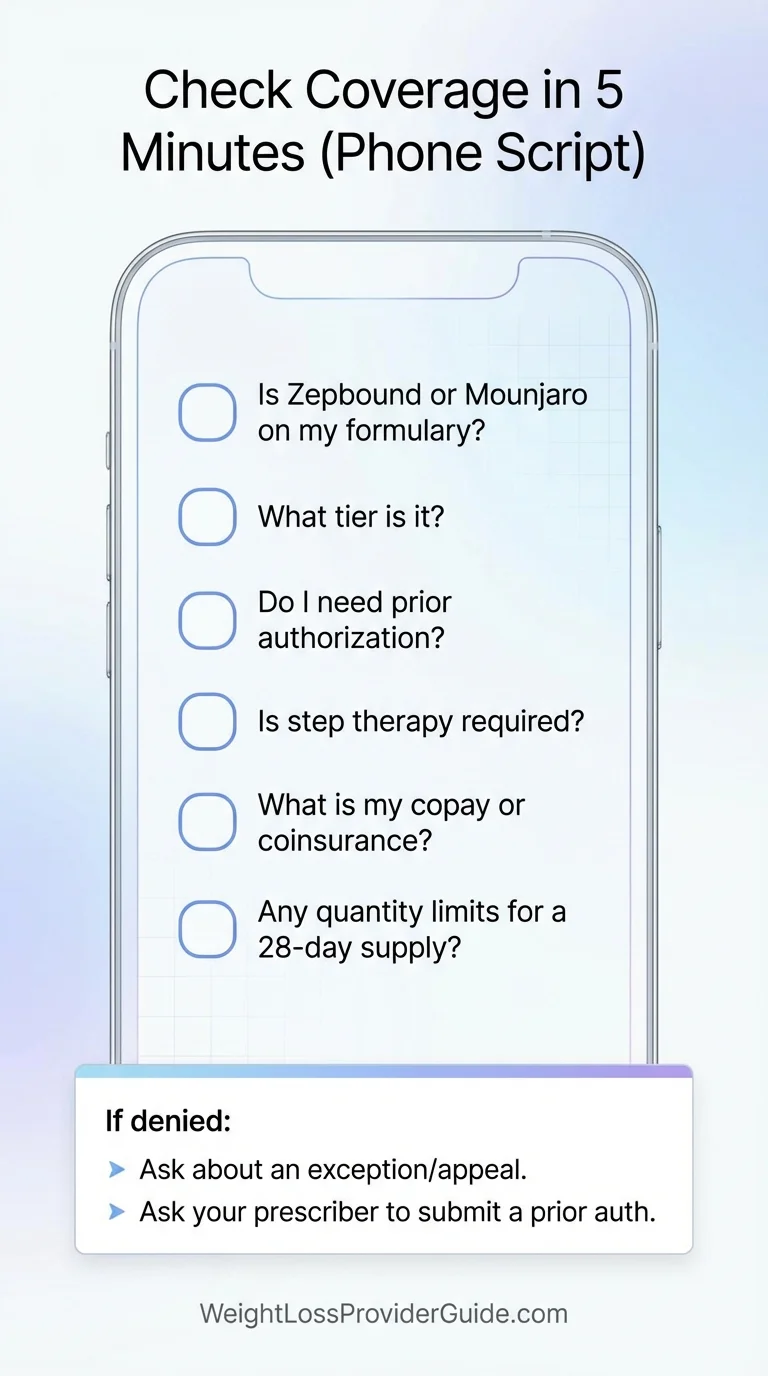
Don't guess. Call. Here's exactly what to do:
- Call the number on the back of your insurance card. Ask for the pharmacy benefits department.
- Ask: "Is Zepbound [or Mounjaro] on my formulary?" If yes, ask which tier it's on.
- Ask: "Is prior authorization required?" If yes, ask what documentation your doctor needs to submit.
- Ask: "Are there step therapy requirements?" (This means you may need to try cheaper medications first.)
- Ask: "What is my copay or coinsurance for this tier?"
- If denied: You can file an exception or appeal. Your doctor's office can help with this — they do it routinely.
Key insight: Mounjaro is far more likely to be covered when prescribed for type 2 diabetes. Zepbound for weight loss has significantly lower coverage rates across commercial plans. If you have both obesity and type 2 diabetes, talk to your provider about which brand and indication makes the most sense from a coverage perspective.
Tirzepatide Cost With Medicare, Medicaid, and Government Insurance
This section matters more than most pages acknowledge. Over 40 million Americans have Medicare, and millions more are on Medicaid. If that's you, here's where things stand — and where they're headed.
Medicare Coverage (As of February 2026)
The current reality: Medicare Part D does not cover tirzepatide for weight loss. This is a federal law restriction — the Medicare Modernization Act of 2003 specifically excludes drugs used solely for weight management.
What Medicare may cover:
- Mounjaro for type 2 diabetes — Many Part D plans include Mounjaro on formulary for blood sugar control. Check yours.
- Zepbound for obstructive sleep apnea — Some Medicare plans are starting to cover Zepbound for moderate-to-severe OSA in adults with obesity, though coverage is limited and plan-specific.
What's changing:
- In November 2025, Eli Lilly and the U.S. government announced an agreement to expand access to obesity medications for Medicare and Medicaid beneficiaries. Under this agreement, Medicare beneficiaries would pay no more than $50/month for Zepbound.
- CMS announced a separate GLP-1 Payment Demonstration expected to give eligible Medicare beneficiaries access by July 2026 at $50/month out-of-pocket. This demo will serve as a short-term bridge to the BALANCE model.
- The BALANCE Model (Better Approaches to Lifestyle and Nutrition for Comprehensive Health) will launch for Medicaid as early as May 2026 and for Medicare Part D (date TBD — delayed) — check cms.gov for the current launch date.
What you can do right now if you're on Medicare:
- If you have type 2 diabetes, ask your provider about Mounjaro coverage through your Part D plan
- If you have OSA and obesity, check whether your plan covers Zepbound for that indication
- For weight loss: use LillyDirect self-pay ($299–$449/month) while waiting for the GLP-1 demo (July 2026)
- Check if you qualify for Lilly Cares patient assistance (covers Mounjaro for diabetes; Zepbound not currently listed)
- Look into PAN Foundation or Patient Advocate Foundation grants
Sources: Eli Lilly press release, Nov 6, 2025; CMS BALANCE Model; KFF Medicaid GLP-1 analysis, Jan 2026
Medicaid Coverage
Medicaid coverage for tirzepatide varies wildly by state.
- For diabetes: Most state Medicaid programs cover Mounjaro for type 2 diabetes, though many require prior authorization
- For weight loss: Only 13 state Medicaid programs covered GLP-1s for obesity treatment as of January 2026, according to KFF data
- Notable change: California's Medi-Cal recently removed GLP-1 coverage for weight loss (December 2025)
- Coming: The BALANCE model is expected to expand Medicaid access to obesity drugs starting May 2026, though states must opt in
Contact your state Medicaid office directly to confirm coverage for your specific situation.
VA and TRICARE
VA coverage policies for Zepbound were updated in 2025, and coverage may require meeting specific criteria. TRICARE coverage varies by plan. Neither VA nor TRICARE beneficiaries are eligible for Eli Lilly's manufacturer savings cards.
If You Can't Afford Any Option: Patient Assistance
Lilly Cares Foundation provides certain Eli Lilly medications at no cost to patients who meet income and insurance requirements. As of February 2026, Lilly Cares covers Mounjaro for type 2 diabetes but does not currently list Zepbound for weight loss on its available medications list. This may change — check lillycares.com or call 1-800-545-6962 for the most current information.
Other resources: the PAN Foundation and Patient Advocate Foundation offer grants for prescription medications based on diagnosis and financial need.
Tirzepatide Cost by Dose: What You'll Pay Over Time
Most people start tirzepatide at the lowest dose and increase gradually. This means your monthly cost may change over the first few months — and it's worth budgeting for the full trajectory, not just Month 1.
How Dosing Works
The standard titration schedule for tirzepatide:
- Weeks 1–4: 2.5 mg/week (starter dose — not an approved maintenance dose)
- Weeks 5–8: 5 mg/week
- Weeks 9–12: 7.5 mg/week (if needed)
- Weeks 13+: 10 mg/week (can go up to 12.5 mg or 15 mg based on response)
Your provider determines the pace and final maintenance dose based on how you respond and tolerate the medication. For weight management, approved maintenance doses are 5 mg, 10 mg, or 15 mg weekly. For OSA, recommended maintenance doses are 10 mg or 15 mg weekly.
6-Month Cost Projection (LillyDirect Self-Pay)
| Month | Dose | LillyDirect Monthly Cost | Running Total |
|---|---|---|---|
| 1 | 2.5 mg | $299 | $299 |
| 2 | 5 mg | $399 | $698 |
| 3 | 7.5 mg | $449 | $1,147 |
| 4 | 10 mg | $449 | $1,596 |
| 5 | 10 mg | $449 | $2,045 |
| 6 | 10 mg | $449 | $2,494 |
6 months via LillyDirect: ~$2,494. Compare that to the ~$6,516 you'd pay at list price over the same period — a savings of more than $4,000.
At a stable maintenance dose of $449/month, your annual cost through LillyDirect is approximately $5,837/year (13 fills at 28-day intervals). Still significant, but less than half the $14,000+ list price.
With insurance ($25/month savings card): 6 months = $150. Annual = $325. The savings are enormous if you can get coverage.
Hidden Costs People Forget
The sticker on the medication isn't always your total spend. Budget for:
- Provider visits — Initial consultation + periodic follow-ups. Some telehealth platforms include these; others charge separately ($50–$200/visit).
- Lab work — Your provider may order bloodwork before starting and periodically during treatment. Cost varies by insurance and lab.
- Injection supplies — If using vials, you'll need syringes, needles, and alcohol swabs. LillyDirect offers these at checkout for a small fee. The KwikPen doesn't require separate supplies.
- Anti-nausea medication — GI side effects (nausea, especially) are common during the first weeks and after dose increases. Your provider may prescribe something to help.
Zepbound vs. Mounjaro: Cost Comparison
Same active ingredient. Different FDA approvals. Different pricing paths. Here's how they compare financially.
| Factor | Zepbound | Mounjaro |
|---|---|---|
| Active ingredient | Tirzepatide | Tirzepatide |
| FDA-approved for | Weight management + OSA | Type 2 diabetes |
| List price (28-day, pens) | $1,086 | $1,080 |
| Savings card (insured, covered) | As low as $25/mo | As low as $25/mo |
| Savings card (insured, not covered) | ~$499/mo for pens | ~$499/mo for pens |
| LillyDirect self-pay (vials/KwikPen) | $299–$449/mo | Not available |
| Insurance coverage likelihood | Lower (weight loss) | Higher (diabetes) |
| Medicare coverage | OSA only (limited) | Diabetes only |
The practical takeaway:
- If you have type 2 diabetes, Mounjaro through insurance is often cheapest
- If you need tirzepatide for weight loss without diabetes, Zepbound via LillyDirect self-pay is usually the most affordable brand-name option
- If you have both obesity and diabetes, talk to your provider about which brand and indication gives you the best insurance path
One thing worth noting: Mounjaro is sometimes prescribed off-label for weight loss. Insurance generally won't cover off-label prescriptions, but your provider can advise on whether this route makes sense in your case.
Tirzepatide Cost at Specific Pharmacies
If you're searching for tirzepatide pricing at a particular pharmacy — Costco, Walmart, CVS — here's a realistic picture.
| Pharmacy | Brand-Name Pens (No Insurance) | With GoodRx Coupon | LillyDirect Vials (Self-Pay) | Notes |
|---|---|---|---|---|
| CVS | ~$1,086 | ~$995+ | N/A | GoodRx accepted |
| Walgreens | ~$1,086 | ~$995+ | N/A | GoodRx accepted |
| Costco | ~$1,050 | Varies | N/A | Membership not required for pharmacy in most states |
| Walmart | ~$1,086 (pens) | ~$995+ | $299–$449 (LillyDirect pickup) | First retail LillyDirect partner |
| LillyDirect (online/delivery) | N/A | N/A | $299–$449 | Delivery or Walmart pickup |
Costco clarification: People assume Costco is always cheapest. For tirzepatide, it can be slightly less expensive than CVS or Walgreens for the retail cash price — but it still can't compete with LillyDirect pricing. Also, in most states, you don't need a Costco membership to use their pharmacy.
The real value at Walmart: Walmart is the only retail pharmacy currently offering LillyDirect self-pay pricing for Zepbound vials for in-store pickup. If you want brand-name tirzepatide at the lowest price and prefer picking it up locally over mail delivery, Walmart + LillyDirect is the play.
How to Get the Cheapest Tirzepatide for Your Situation
We've laid out every pricing path above. Now let us help you pick yours. Here's a decision framework based on your insurance status:
If You Have Commercial Insurance
Step 1: Call your insurer. Ask if Zepbound or Mounjaro is on your formulary.
Step 2 (if covered): Get the savings card from zepbound.lilly.com/savings or startlilly.com/mounjaro. You may pay as low as $25/month.
Step 3 (if not covered): Compare two options:
- Use the savings card at a pharmacy (~$499/month for pens)
- Use LillyDirect self-pay vials or KwikPen ($299–$449/month)
In most cases, LillyDirect wins — especially at maintenance doses.
Step 4 (if denied): Ask your provider to submit a prior authorization or appeal. This works more often than people think.
If You Don't Have Insurance
Best option for brand-name: LillyDirect self-pay. $299/month (starter) to $449/month (maintenance). Set a calendar reminder to refill within 45 days on doses 7.5 mg+.
Budget option (not FDA-approved): Compounded tirzepatide through a vetted telehealth provider. $199–$500/month. Verify the pharmacy is licensed. Ask for total cost including all fees. See our compounded tirzepatide guide.
Free option (if you qualify): Lilly Cares patient assistance program covers Mounjaro for type 2 diabetes at $0 for income-qualified, uninsured patients. Zepbound for weight loss is not currently listed — check lillycares.com for updates.
If You're on Medicare
For diabetes: Check if Mounjaro is on your Part D formulary. If covered, your copay depends on your plan's tier.
For weight loss: Not covered as of February 2026. Options:
- LillyDirect self-pay ($299–$449/month)
- Wait for the CMS GLP-1 demo (expected July 2026, $50/month)
- Check Lilly Cares eligibility (Mounjaro for diabetes currently listed; Zepbound not yet)
- Explore PAN Foundation grants
For OSA: Check if your plan covers Zepbound for this indication (coverage is limited but expanding).
If You're on Medicaid
For diabetes: Likely covered in most states, though prior authorization may be required.
For weight loss: Only covered in about 13 states as of January 2026. Contact your state Medicaid office.
Coming: The BALANCE model may expand Medicaid coverage for obesity drugs starting May 2026, but your state must participate.
Telehealth Providers: How Much Does Tirzepatide Cost With Hims, Hers, and Others?
If you've searched for tirzepatide online, you've been hit with ads from telehealth companies offering it at seemingly low prices. Some of these are legitimate. Some are misleading. Here's how to evaluate them.
Brand-Name vs. Compounded: The First Question to Ask
When a telehealth provider advertises "tirzepatide starting at $199/month," the first thing to determine is: are they offering brand-name Zepbound/Mounjaro, or compounded tirzepatide?
Most telehealth providers offering prices below $500/month are selling compounded tirzepatide, which is:
- Made by compounding pharmacies, not Eli Lilly
- Not FDA-approved
- Not verified for safety, quality, or potency by the FDA
- Subject to evolving regulatory status (the FDA has ended the tirzepatide shortage designation, and compounding rules are tightening)
This isn't automatically disqualifying — compounding pharmacies fill an important role. But you should know what you're getting.
The "All-In" Monthly Cost Checklist
Before signing up with any telehealth provider, ask about:
- Medication cost per month
- Membership or subscription fee
- Initial consultation fee
- Follow-up visit fees
- Lab work costs
- Shipping and handling
- Injection supplies (if applicable)
- Minimum commitment or contract length
- Cancellation policy and fees
Add all of those together. That's your real monthly cost.
Red Flags to Watch For
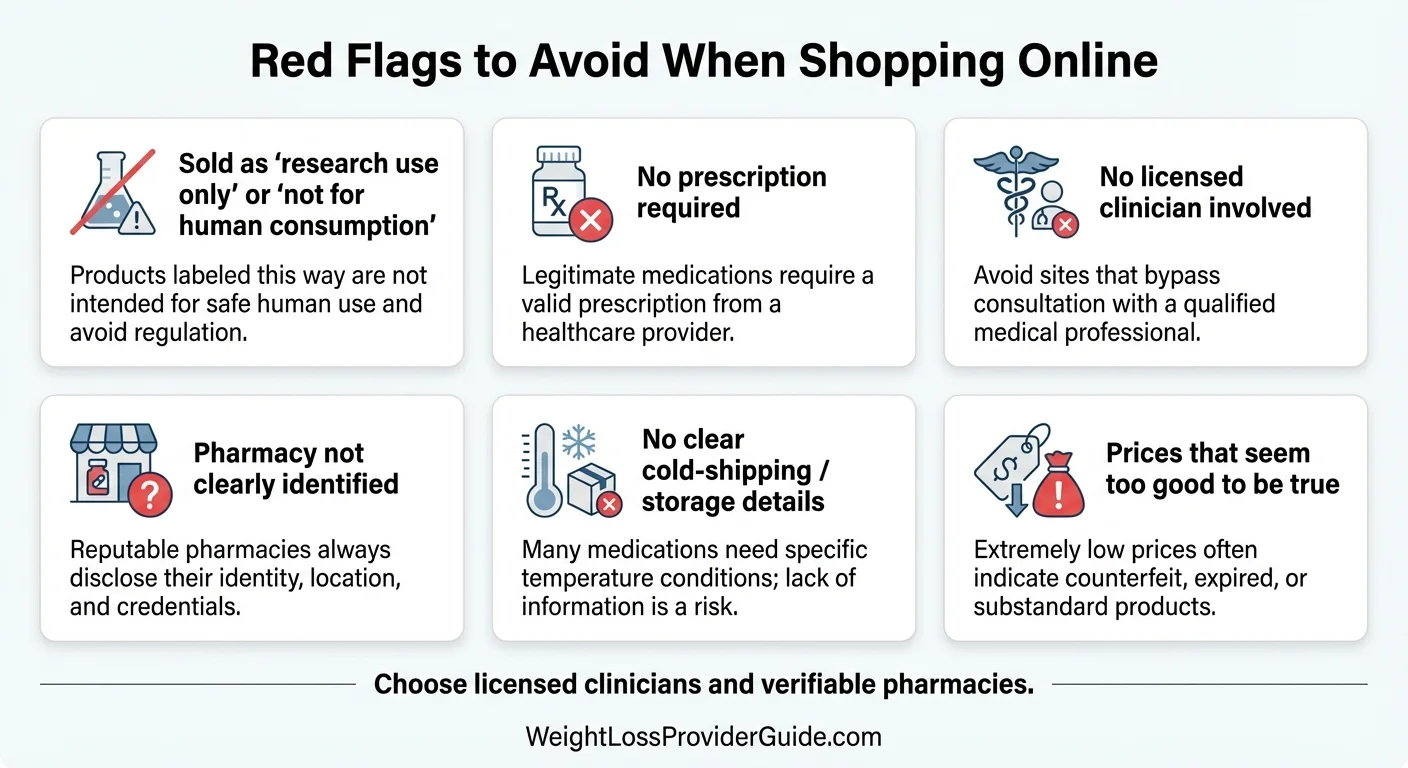
We want to be direct about this because the online tirzepatide market has real risks:
- "Research use only" products — This is not legitimate for human treatment. The FDA has specifically warned about unapproved GLP-1 products sold online as "research chemicals" or "not for human consumption." Do not buy these.
- No prescription required — Tirzepatide is a prescription medication. Any seller offering it without a clinician evaluation is operating outside the law.
- No identifiable pharmacy — You should be able to verify the compounding pharmacy's state license and registration.
- Prices that seem impossibly low — If it's $50/month for tirzepatide, something is wrong. Either the dose is negligible, the product isn't what it claims to be, or the pharmacy isn't following proper compounding standards.
- No clinician oversight — A licensed provider should evaluate your eligibility, monitor your progress, and adjust your dose.
Source: FDA — Concerns with Unapproved GLP-1 Drugs Used for Weight Loss
If you want to compare vetted, clinician-led weight loss providers (both brand-name and compounded options), we maintain a provider comparison page with verified pricing and honest reviews.
Is Compounded Tirzepatide Safe and Legal?
We get why people ask this question. Compounded tirzepatide costs a fraction of brand-name, and that price difference is life-changing for a lot of people. But the safety and legality picture is genuinely complicated right now, and you deserve a straight answer.
What Compounded Tirzepatide Actually Is
Compounded tirzepatide is made by specialty pharmacies using pharmaceutical-grade tirzepatide as the active ingredient. It's prepared based on an individual patient's prescription. It may include additional ingredients (like vitamin B12 or niacinamide) that aren't in the brand-name versions.
What it is not: An FDA-approved medication. The FDA has not reviewed compounded tirzepatide for safety, efficacy, or manufacturing quality. This doesn't mean it's inherently dangerous — it means there's no federal quality guarantee.
The Legal Landscape (As of February 2026)
The FDA declared the tirzepatide shortage resolved, which removes the shortage-based exemption that allowed broader compounding. Currently, compounding tirzepatide is only legal under:
- Section 503A — State-licensed pharmacies compounding patient-specific prescriptions based on individual medical need
- Section 503B — Outsourcing facilities registered with the FDA that compound without individual prescriptions but must follow current good manufacturing practices (CGMP)
The exact boundaries of "when compounding is permitted" are still being litigated and clarified. Several compounding pharmacies and industry groups have challenged the FDA's position in court, and the regulatory landscape continues to shift.
What This Means for You Practically
- Compounded tirzepatide is not illegal if it's prescribed by a licensed clinician and prepared by a licensed pharmacy following applicable rules
- Quality and potency vary between pharmacies — there is no universal standard
- If the FDA further restricts compounding, access could change quickly
- The World Health Organization and Eli Lilly have both warned about counterfeit and fake versions of GLP-1 drugs being sold internationally — this is a real risk in the compounding and online marketplace
Our Recommendation
If you choose compounded tirzepatide, minimize your risk:
- Use a provider that works with a PCAB-accredited or 503B-registered compounding pharmacy
- Verify the pharmacy's state license independently
- Make sure you have a real clinical relationship with a licensed provider who monitors your treatment
- Understand that you may need to switch to brand-name if compounding availability changes
- Never buy "research peptides" or products sold without a prescription
Tirzepatide Cost in Canada, Mexico, and Internationally
These searches come up often enough that they deserve a direct answer.
Why People Look Abroad
The math is simple: tirzepatide is cheaper in many other countries because of national price negotiations and different healthcare systems. In Canada, some patients report paying significantly less for Mounjaro than U.S. list prices. In Mexico, the cost can be even lower at some pharmacies.
The Reality Check
Before you book a trip or order online from an international pharmacy, here's what you should know:
Importing prescription medications into the U.S. for personal use is technically illegal under federal law, though enforcement varies. The FDA generally allows individuals to bring in a 90-day supply under certain conditions, but this is a discretionary policy, not a legal right.
Counterfeit risk is real. The World Health Organization and Eli Lilly have both issued warnings about fake versions of popular GLP-1 medications circulating internationally. Counterfeit tirzepatide may contain the wrong dose, the wrong ingredient, or nothing at all. This isn't a theoretical risk — seizures of counterfeit GLP-1 products have been documented.
Cold chain matters. Tirzepatide must be refrigerated. International shipping — especially from unverified online pharmacies — may not maintain proper temperature control throughout transit, which can degrade the medication and compromise its effectiveness or safety profile.
No clinician oversight. If you buy tirzepatide abroad without involving a U.S. healthcare provider, you lose the monitoring and dose adjustment that make the medication safer and more effective.
Our Take
With LillyDirect now offering Zepbound at $299–$449/month — prices that are competitive with many international options once you factor in shipping, travel, and risk — the financial incentive to buy abroad has shrunk. For most people, the combination of cost savings and safety makes LillyDirect a better choice than importing.
If you're still considering it, talk to your doctor first. Don't buy from websites that don't require a prescription or that you can't verify as licensed pharmacies.
What Happens to Your Cost If You Stop and Restart?
This is a question that keeps coming up on Reddit and in forums, and most tirzepatide cost pages ignore it entirely. For more on the medical side of stopping, see our guide to stopping GLP-1 medications.
The Financial Side
If you pause tirzepatide and restart later:
- LillyDirect: You'd need a new prescription sent to the pharmacy. If you were in the Self Pay Journey Program, you'd re-enroll. The 45-day refill window resets, so your first fill at 7.5 mg+ would be at the standard price ($499–$699) until you're back on a consistent schedule.
- Insurance: Your prior authorization may have expired. You might need to go through the approval process again, which can take days to weeks.
- Telehealth/compounded: You'd likely need a new consultation visit (and fee) with your provider.
The Medical Side (Briefly)
Medically, restarting tirzepatide typically means going back to a lower dose and titrating up again. This means your first months back are cheaper (lower-dose pricing) but the titration period can come with more side effects as your body readjusts. Your provider will determine the safest restart protocol.
The budget implication: Plan for at least 2–3 months of titration costs before reaching your maintenance dose again.
The Long-Term Budgeting Question Nobody Asks
Here's the honest reality: this is likely a long-term medication. Research suggests that most people regain weight after stopping GLP-1 medications. That doesn't mean you'll take it forever, but when budgeting, think in years, not months. For more on this, see our long-term effects of GLP-1 guide.
- Annual cost at $449/month (LillyDirect, maintenance): approximately $5,837 (13 fills per 28-day cycle).
- Annual cost at $25/month (insured with savings card): approximately $325.
- Annual cost at $300/month (compounded, flat rate): approximately $3,900.
These are significant numbers. But for context: the annual cost of unmanaged obesity in healthcare expenses and reduced quality of life is estimated at $4,000–$8,000 per year by several health economics analyses. That doesn't make tirzepatide cheap. It makes it a calculation worth doing honestly.
Tirzepatide vs. Semaglutide: Quick Cost Comparison
If you're weighing tirzepatide against semaglutide (Wegovy/Ozempic), cost is one piece of the puzzle. For a deeper comparison, see our semaglutide vs tirzepatide comparison.
| Factor | Tirzepatide (Zepbound) | Semaglutide (Wegovy) |
|---|---|---|
| How it works | Dual GIP + GLP-1 receptor agonist | GLP-1 receptor agonist only |
| Average weight loss (clinical trials) | ~20–25% body weight | ~15–17% body weight |
| List price/month | ~$1,086 | ~$1,349 |
| Self-pay programs | $299–$449 (LillyDirect) | $199 intro / $349 standard (NovoCare Pharmacy) |
| Insurance coverage | Varies widely | Varies (broader for cardiovascular indication) |
| Medicare (weight loss) | Not covered | Not covered (covered for CV risk reduction) |
At list price, Wegovy is actually more expensive than Zepbound. At self-pay pricing, the costs are now comparable. The clinical evidence shows tirzepatide produces greater average weight loss, but individual results vary and the "right" medication depends on your specific health profile.
Talk to your provider about which medication is best for you medically — then use the cost information on this page to find the cheapest path to fill the prescription.
Why Tirzepatide Prices Look So Confusing Online
You've probably noticed that every website seems to quote a different price. There's a reason for that, and understanding it will save you from making expensive mistakes.
List Price vs. What People Actually Pay
The list price ($1,086 for Zepbound) is the wholesale acquisition cost — what Eli Lilly charges distributors. It's a starting point, not what most patients pay. Think of it like the MSRP on a car. Useful as a reference, misleading as a final number.
The 28-Day "Month" Trap
Tirzepatide is dispensed in 28-day supplies, not calendar months. That means you need 13 fills per year, not 12. When you're budgeting, multiply by 13.
Telehealth Pricing Confusion
Many telehealth ads quote the medication-only price or an introductory price. They don't include membership fees, consultation charges, or the fact that pricing increases after a promotional period. We've seen providers advertise "$199/month" when the all-in cost is closer to $270–$350/month. Always ask for total cost.
Dose-Based vs. Flat-Rate Pricing
Some programs (like LillyDirect's $449/month for all maintenance doses) charge a flat rate regardless of your dose. Others (particularly compounding providers with tiered pricing) charge more at higher doses. If you're budgeting long-term, flat-rate is easier to plan around.
Safety Basics: What to Know Before Starting Tirzepatide
This section isn't about cost — but it's here because any responsible page about tirzepatide should mention it, especially since this is a medication you'll take for months or years. For more, see our long-term effects of GLP-1 guide.
Most Important Warnings
Per FDA-approved labeling, tirzepatide carries a boxed warning about thyroid C-cell tumors. In animal studies, tirzepatide caused thyroid tumors, including thyroid cancer. It's not known whether tirzepatide causes these tumors in humans.
- Do not use if you or a family member has had medullary thyroid carcinoma (MTC)
- Do not use if you have Multiple Endocrine Neoplasia syndrome type 2 (MEN 2)
- Tell your healthcare provider about any lumps or swelling in your neck, hoarseness, trouble swallowing, or shortness of breath
Source: FDA-approved Zepbound prescribing information
Common Side Effects
The most common side effects are gastrointestinal: nausea, diarrhea, decreased appetite, vomiting, constipation, and indigestion. These are most common during the first few weeks and after dose increases, and they typically improve with time. Staying hydrated and eating smaller meals can help.
Serious but less common risks include pancreatitis, gallbladder problems, kidney problems from dehydration, and severe allergic reactions. Report any unusual symptoms to your healthcare provider immediately.
Who Should Not Take Tirzepatide
Beyond the thyroid-related contraindications above, tirzepatide may not be appropriate if you have a history of pancreatitis, severe gastrointestinal disease, or certain other conditions. This is a conversation for you and your provider — not a decision to make based on a website. Check your eligibility with our GLP-1 eligibility calculator.
We are not doctors, and this page is not medical advice. It's a pricing guide. Talk to a licensed healthcare provider before starting any medication.
How We Verified These Prices
We believe pricing information for a medication this expensive — and this important — should be transparent and verifiable. Here's how we built this page:
Sources
- Eli Lilly official program pages: Zepbound.lilly.com/savings, Zepbound.lilly.com/hcp/coverage-savings, LillyDirect.lilly.com, StartLilly.com
- FDA: Prescribing information for Zepbound and Mounjaro, drug safety communications, compounding policy documents
- Pharmacy pricing: GoodRx, verified against live coupon data
- Government sources: CMS BALANCE Model announcement, KFF Medicaid data, Congressional Budget Office analyses
- Eli Lilly investor press releases: Pricing changes (Dec 1, 2025), Medicare agreement (Nov 6, 2025), KwikPen launch, Walmart partnership (Oct 29, 2025)
How We Verify
- Brand-name pricing is verified against Eli Lilly's official program pages — not third-party summaries
- Telehealth provider pricing is labeled "provider-stated" with the date we checked it
- We note where prices require specific conditions (refill windows, insurance type, enrollment in programs)
- We update this page after every major pricing announcement and conduct a full review monthly
What "Verified" Means on This Page
When we say "Verified Feb 2026," we mean we confirmed the price against the manufacturer's or provider's own published source on that date. Prices can change. If you notice something outdated, let us know.
Medical Disclaimer
This page provides pricing information for educational purposes. It is not medical advice. Tirzepatide is a prescription medication with serious potential side effects and contraindications. Consult a licensed healthcare provider before starting, stopping, or changing any medication. Always verify pricing directly with your pharmacy, insurance provider, or the manufacturer before making purchasing decisions.
Frequently Asked Questions About Tirzepatide Cost
How much does tirzepatide cost per month?
Between $25 and $1,086, depending on your insurance and how you buy it. Most people pay $299–$449/month through LillyDirect self-pay, or as low as $25/month with commercial insurance and a savings card.
How much does tirzepatide cost without insurance?
The list price is ~$1,086/month, but LillyDirect self-pay vials start at $299/month (2.5 mg) to $449/month for all maintenance doses. Compounded tirzepatide through telehealth runs $199–$500/month but is not FDA-approved.
How much does tirzepatide cost with insurance?
If your plan covers it and you use a savings card, as low as $25/month. If your plan doesn’t cover it, the savings card may reduce pen pricing to ~$499/month — but LillyDirect self-pay ($299–$449/month) may be cheaper.
Is there a generic version of tirzepatide?
No. As of February 2026, there is no FDA-approved generic tirzepatide. Compounded versions exist but are not generics — they’re custom-made preparations that haven’t been reviewed by the FDA for safety or efficacy.
What’s cheaper: Zepbound or Mounjaro?
List prices are nearly identical (~$1,080–$1,086). But Zepbound has a significant advantage for cash-pay patients: LillyDirect sells Zepbound vials and KwikPens at $299–$449/month. There’s no equivalent self-pay program for Mounjaro. However, Mounjaro is more likely to be covered by insurance for diabetes.
How much does tirzepatide cost at Costco?
Approximately $1,050 for brand-name pens without insurance — slightly less than other retail pharmacies but still far more expensive than LillyDirect ($299–$449). In most states, you don’t need a Costco membership to use the pharmacy.
Does tirzepatide cost more at higher doses?
At list price and with most insurance plans, no — the price is the same regardless of dose. Through LillyDirect, the starter doses (2.5 mg, 5 mg) cost less ($299, $399), while all maintenance doses (7.5–15 mg) are $449/month. Some compounding providers use tiered pricing by dose; others charge flat rates.
Can I use GoodRx with insurance?
No. GoodRx discount cards are used instead of insurance, not combined with it. If your insurance copay is lower than the GoodRx price, use your insurance. If your copay is higher, try GoodRx — but check LillyDirect first, as it’s usually cheaper.
Will Medicare cover tirzepatide for weight loss in 2026?
Not yet as of February 2026. CMS announced a GLP-1 Payment Demonstration expected to give eligible Medicare beneficiaries access by July 2026, with a $50/month out-of-pocket cap. The longer-term BALANCE model for Medicare Part D is delayed — check cms.gov for the current launch date. Current law still excludes weight-loss drugs from standard Part D coverage.
How much does tirzepatide cost with Hers?
Hers’ GLP-1 injectable plans start at $199/month with a 6-month plan paid upfront — but this is for their compounded GLP-1 offering, not brand-name Zepbound or Mounjaro. Confirm which medication you’re being prescribed, as the $199 price typically applies to compounded semaglutide, not tirzepatide specifically. Brand-name Zepbound through Hims & Hers has been listed around $1,899/month, which is why many people compare it to LillyDirect self-pay pricing ($299–$449/month). Always confirm the total cost including any membership or subscription fees.
Is compounded tirzepatide FDA-approved?
No. Compounded tirzepatide is not FDA-approved and has not been reviewed by the FDA for safety, efficacy, or manufacturing quality. It is prepared by state-licensed compounding pharmacies under different standards than Eli Lilly's manufacturing of Zepbound and Mounjaro, and the FDA has stated that compounded GLP-1 products should not be marketed as equivalent to, the same as, or generic versions of FDA-approved drugs.
Is it safe to buy tirzepatide from Mexico or Canada?
International pricing may be lower, but importing prescription medications into the U.S. for personal use exists in a legal gray area and carries risks including counterfeit products, improper storage, and lack of clinician oversight. The WHO and Eli Lilly have warned about fake GLP-1 products circulating internationally. If you’re considering this route, talk to a licensed U.S. healthcare provider first.
What is the Zepbound savings card and how do I get it?
It’s a free manufacturer discount card from Eli Lilly that reduces your out-of-pocket cost for Zepbound. If your insurance covers Zepbound, the card can bring your copay as low as $25/month. If your insurance doesn’t cover it, the card still provides significant savings. Get it at zepbound.lilly.com/savings. Not available for Medicare, Medicaid, or other government insurance.
What if I can’t afford any option?
Contact the Lilly Cares Foundation at 1-800-545-6962 or lillycares.com. They provide certain Lilly medications at no cost to income-qualified, uninsured patients — Mounjaro for diabetes is currently listed, though Zepbound for weight loss is not (check for updates). You can also explore grants from the PAN Foundation or Patient Advocate Foundation, or ask your provider about alternative medications that may be more affordable for your situation.
What happens if I stop tirzepatide and want to restart later?
From a cost perspective: you’d need a new prescription and may need a new consultation with your provider. If you were on a self-pay program like LillyDirect, you’d re-enroll. If you miss the 45-day refill window, higher doses lose their discounted pricing until your next on-time refill. Medically, restarting typically means beginning at a lower dose and titrating back up — your provider will guide this.
Is tirzepatide the same as semaglutide?
No. Tirzepatide (Zepbound/Mounjaro) is a dual GIP + GLP-1 receptor agonist. Semaglutide (Wegovy/Ozempic) is a GLP-1 receptor agonist only. They work differently, have different clinical trial results, and different pricing structures. Clinical trials show tirzepatide produces greater average weight loss (~20–25% vs ~15–17% body weight).
How do I know if my telehealth provider is legitimate?
Look for: a licensed clinician (MD, DO, NP, PA) conducting your consultation, a verifiable U.S.-licensed pharmacy filling your prescription, clear pricing with no hidden fees, and a real medical evaluation (not just a questionnaire with automatic approval). Avoid any provider that ships medication without a prescription, sells "research-use only" products, or cannot identify their pharmacy partner.
Does the price change when I increase my dose?
Through LillyDirect, the starter doses (2.5 mg, 5 mg) cost less ($299, $399), while all maintenance doses (7.5–15 mg) are $449/month with on-time refills. At list price and with most insurance plans, the price is the same regardless of dose. Some compounding providers use tiered pricing by dose; others charge flat rates.
Can my doctor prescribe the cheaper version?
Yes — off-label prescribing of Mounjaro for weight loss is legal and common. However, your insurance is unlikely to cover Mounjaro for weight loss. If your doctor prescribes Mounjaro off-label, you’d typically need to pay cash or use a discount card. The Mounjaro savings card terms require a valid prescription consistent with the FDA-approved label. Talk to your provider about whether this makes sense for your situation.
What’s the cheapest way to get tirzepatide right now?
If insured and covered: use the manufacturer savings card ($25/month). If uninsured or not covered: LillyDirect self-pay ($299–$449/month for FDA-approved Zepbound). Budget option: compounded tirzepatide through a vetted telehealth provider ($199–$500/month, not FDA-approved). If income-qualified: Lilly Cares patient assistance (Mounjaro for diabetes, $0).
What to Do Next: Find the Cheapest Safe Path for Your Situation
You've made it through the pricing maze. Here's your action plan:
Fastest route: Use the interactive cost calculator at the top of this page — answer 4–6 questions, get your estimated cost and next step in under 60 seconds.
Or follow the manual steps below:
Step 1: Know your insurance status. The single biggest factor in what you'll pay. Call your insurer if you're not sure about coverage.
Step 2: Get a prescription. You need one regardless of which path you choose. Your primary care doctor, endocrinologist, or a telehealth provider can prescribe tirzepatide.
Step 3: Pick your path. Based on everything above:
- Insured + covered? Savings card + pharmacy. Goal: $25/month.
- Insured + not covered? LillyDirect self-pay. Goal: $299–$449/month.
- Uninsured? LillyDirect self-pay. Goal: $299–$449/month. Lilly Cares if income-qualified (covers Mounjaro for diabetes).
- Budget-focused? Compounded via telehealth ($199–$500). Understand the tradeoffs.
- Medicare? LillyDirect self-pay now. CMS GLP-1 demo expected July 2026 ($50/mo). BALANCE Part D date TBD (delayed).
Step 4: Set your refill reminders. If using LillyDirect at maintenance doses (7.5 mg+), refill within 45 days to keep the $449 price.
Step 5: Bookmark this page. Tirzepatide pricing changes frequently. We update this page monthly and after every major announcement. Come back before your next refill to make sure you're still on the cheapest path.
Ready to compare providers? See our full comparison of vetted weight loss providers — including which ones prescribe brand-name Zepbound through LillyDirect and which offer compounded options, with verified pricing and honest pros/cons.
This page provides pricing information for educational purposes. It is not medical advice. Tirzepatide is a prescription medication with serious potential side effects and contraindications. Consult a licensed healthcare provider before starting, stopping, or changing any medication. Always verify pricing directly with your pharmacy, insurance provider, or the manufacturer before making purchasing decisions. See our full medical disclaimer and advertising disclosure.
This page was last updated on February 23, 2026. Prices were last verified against manufacturer sources on February 23, 2026. For questions, corrections, or to report outdated pricing, use our contact page. See our editorial policy and affiliate disclosure for more information about how we create and maintain our content.