Strut Health Reviews: Our Verified Verdict on Strut's GLP-1 Program
Disclosure: Some links on this site are affiliate links. If you purchase through these links, we may earn a commission at no extra cost to you. Thank you for supporting our site.·For informational purposes only—not medical advice.
Medical Disclaimer: This content is for informational purposes only and does not constitute medical advice. Compounded medications are not FDA-approved. Always consult a licensed healthcare provider before starting any weight loss medication.
The short answer: Strut Health is a digital healthcare company based in Dallas, TX, founded by Simal Patel, MD, that sells compounded GLP-1 medications for weight loss. Their standout feature is an oral semaglutide lozenge — a needle-free option — that we found listed at prices ranging from $99 to $149/month on different pages of their own website. The company has over 750 reviews on Trustpilot with a 3.3 average, a D+ BBB rating, and operates in a regulatory environment that changed significantly after the FDA issued Strut a direct warning letter on February 20, 2026.
Strut fits a specific person well. If you hate needles, want a compounded oral GLP-1 option, and you're paying out of pocket with no insurance coverage for weight loss medication, Strut is one of very few platforms offering that path.
Strut is not for everyone. If you want FDA-approved medication, insurance coverage, a BBB A+ rated company, or zero subscription friction, better options exist — and we'll point you to them.
That's the bottom line. Now here's why you can trust ours.
You searched "Strut Health reviews" because you're close to pulling the trigger — but not quite there yet.
Maybe you saw their oral semaglutide lozenges and thought, wait, I can do this without needles? Maybe the price looked too good. Maybe you just need someone to tell you the truth before you hand over your credit card.
We dug into every angle — the FDA warning letter, the customer complaints, the pricing discrepancies on their own site, and the real customer experiences across 750+ reviews. The rest of this page proves every claim above and answers every follow-up question we know you have, so you never need to click back.
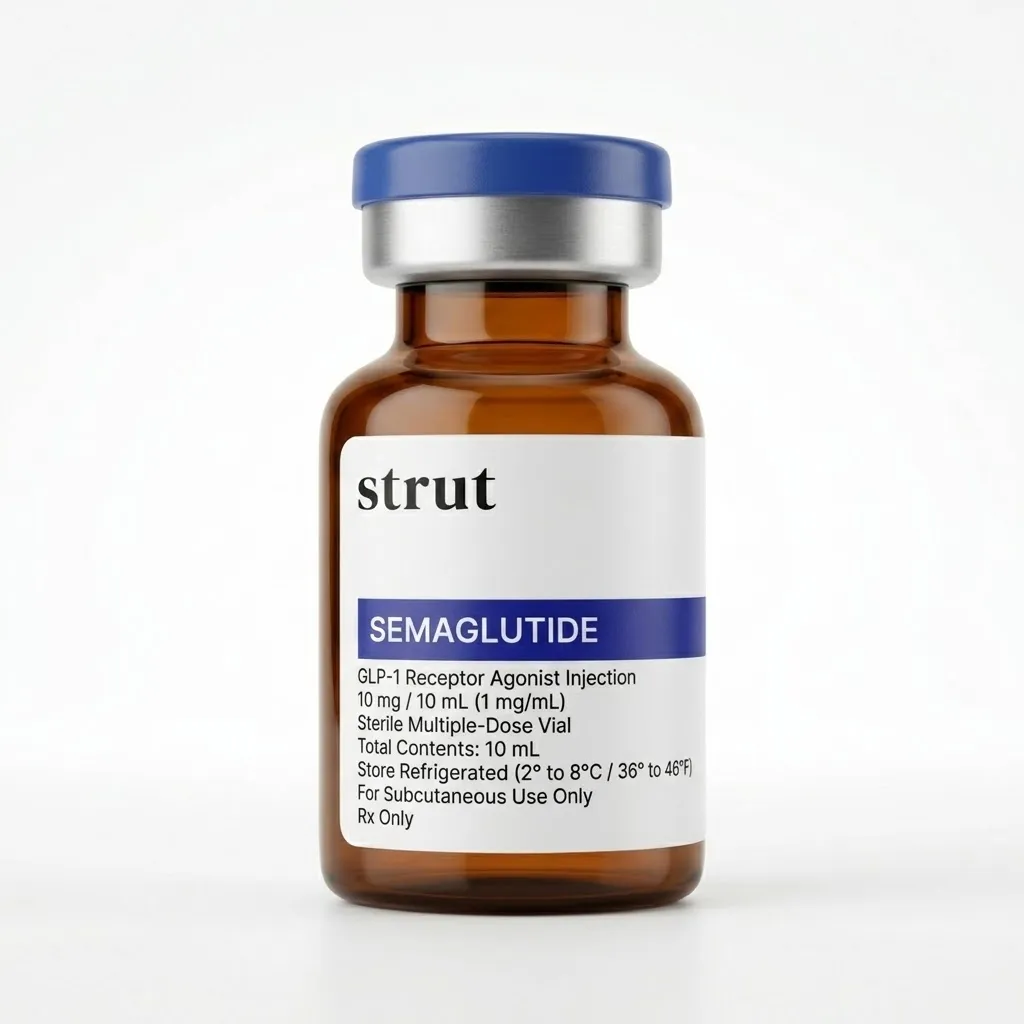
Strut Health
Oral GLP-1 Weight Loss Program
Strut Health at a Glance (March 2026)
Before you read another word, here is what we verified on Strut's own pages:
| Oral Semaglutide Lozenges | Injectable Semaglutide | Oral Tirzepatide | Injectable Tirzepatide | |
|---|---|---|---|---|
| Price Found on Site | $99–$149/mo (varies by page) | $149–$289/mo (varies by page) | ~$239/mo | ~$325/mo |
| Format | Daily sublingual lozenge | Weekly self-injection (vial + syringes) | Daily sublingual lozenge | Weekly self-injection |
| Consultation | Free (provider-stated) | Free (provider-stated) | Free (provider-stated) | Free (provider-stated) |
| Shipping | Free (provider-stated) | Free (provider-stated) | Free (provider-stated) | Free (provider-stated) |
| Contracts | None — month-to-month | None — month-to-month | None — month-to-month | None — month-to-month |
| Insurance | Not accepted | Not accepted | Not accepted | Not accepted |
| FDA Approved? | No — compounded | No — compounded | No — compounded | No — compounded |
Note on pricing: We found different prices for oral semaglutide on different Strut pages. One page shows $149/mo, another shows "as low as $99" with auto-refill. We break this down in the pricing section below. All pricing is provider-stated and should be confirmed directly with Strut before ordering.
All data verified on struthealth.com, March 2026. "Provider-stated" means we found this claim on Strut's website but could not independently verify it.
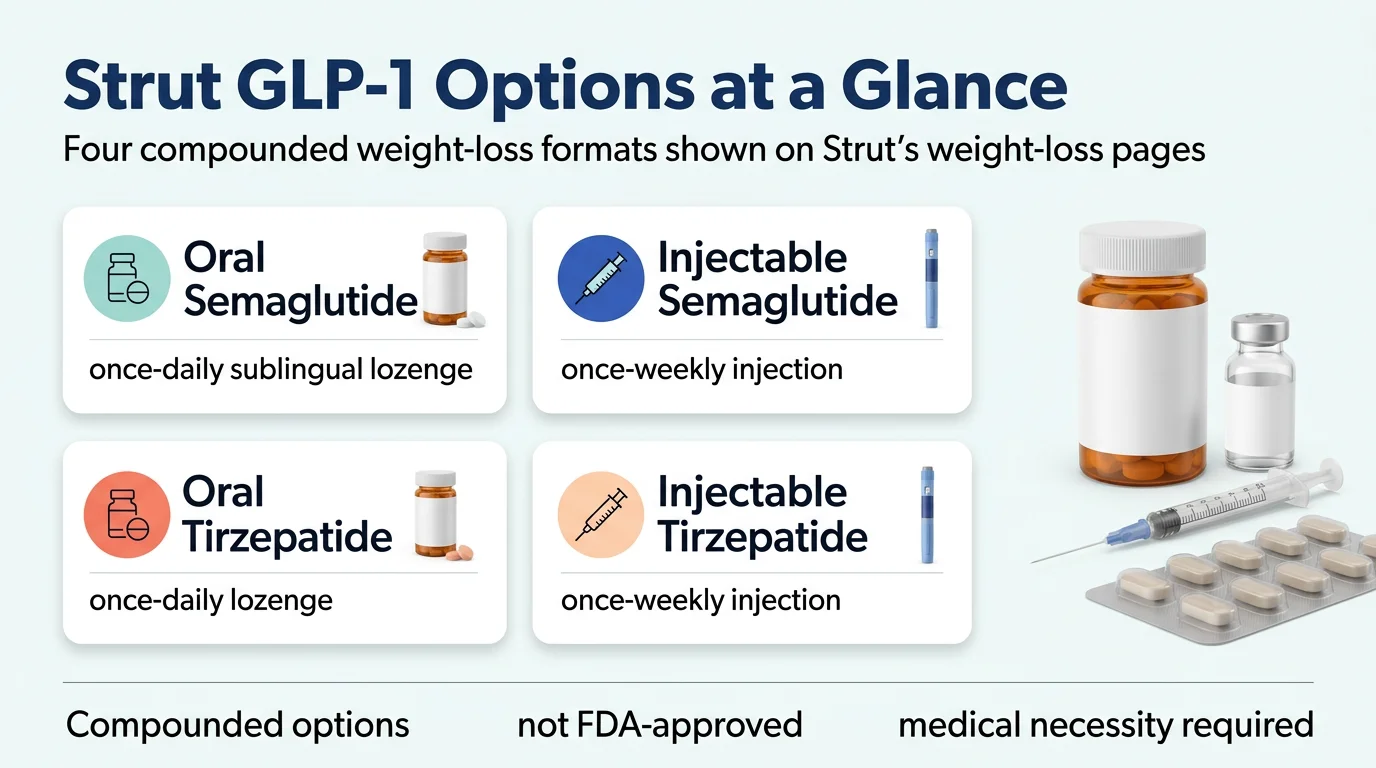
Strut's four compounded GLP-1 weight-loss formats. Compounded options are not FDA-approved. Medical necessity required.
Who Should Actually Choose Strut Health?
Not everyone. But the right person? Strut makes real sense for them. Here's how to tell if that's you.
Choose Strut if you want a needle-free GLP-1 path
This is Strut's clearest advantage. Most telehealth GLP-1 platforms focus on injectable semaglutide — you get a vial and syringes. If you're fine with that, great.
But a lot of people aren't fine with that. They've wanted to try GLP-1 medication for months but keep putting it off because the thought of self-injecting every week makes their stomach turn. If that's you, Strut's oral sublingual lozenge is one of the few options available. You place it under your tongue daily, let it dissolve, and that's it. No needles, no vials, no alcohol swabs.
Choose Strut if you're paying cash and want month-to-month flexibility
Strut doesn't accept insurance. Neither do most compounded GLP-1 platforms. But what Strut does offer is month-to-month pricing with no long-term contracts. You're not locked into a 3-month or 6-month commitment. If it works, you stay. If it doesn't, you cancel.
The oral semaglutide lozenge starting as low as $99/month with auto-refill is competitive with the least expensive compounded injectable options on other platforms — and you're getting it without needles.
Choose Strut if you're comfortable with compounded medication
This is the part most people don't fully understand, so let's be direct about it.
Strut sells compounded semaglutide and tirzepatide. "Compounded" means the medication is prepared by a licensed U.S. compounding pharmacy according to a physician's prescription. It is not FDA-approved as a finished product. It has not undergone the FDA's premarket review for safety, effectiveness, or quality that brand-name drugs like Wegovy and Ozempic go through.
This doesn't mean it's dangerous. It means there's a different level of regulatory oversight. The active pharmaceutical ingredients come from FDA-licensed facilities, and the compounding pharmacies follow strict USP guidelines. But the finished product itself does not carry an FDA approval stamp.
If that distinction matters to you — and for some people it absolutely should — then an FDA-approved path might be better. We cover that in the alternatives section.
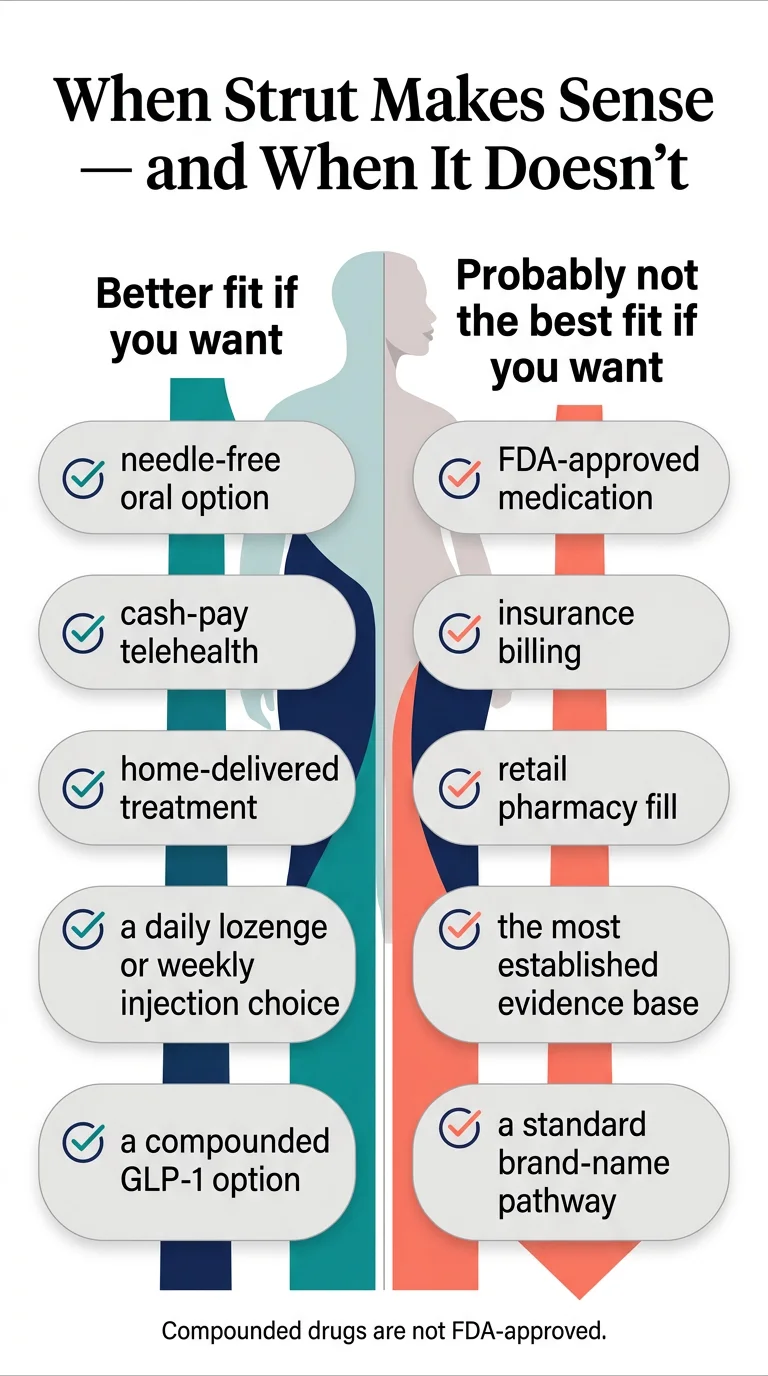
Compounded drugs are not FDA-approved.
Who Should Skip Strut Health?
This section will probably do more for your trust in us than anything else on this page. Here's who should not sign up.
Skip Strut if you want FDA-approved medication
If your insurance covers Wegovy (semaglutide) or Zepbound (tirzepatide), that is almost certainly a better path for you. These are FDA-approved, manufactured by Novo Nordisk and Eli Lilly respectively, and now come in multiple forms including injectable pens and (for Wegovy) a new oral tablet. The clinical evidence behind them is extensive and well-established. Talk to your doctor about getting a prescription filled at a retail pharmacy.
Skip Strut if you can't tolerate subscription friction
We need to be honest about this: Strut's most consistent complaint across every review platform is about cancellation and billing.
Their FAQ says you can cancel anytime with no fees. That part appears to be true. But the actual cancellation process requires emailing care@struthealth.com or messaging your provider through the platform. Multiple BBB complaints describe difficulty cancelling through the website login flow. Strut's support documentation also says 48-hour notice is needed before your next refill, and refunds are generally unavailable after the pharmacy has processed or shipped your order.
Is this a dealbreaker? For most people, no — if you know the process upfront, you can manage it. But if you want a simple "click cancel" experience, other platforms handle this more smoothly.
Skip Strut if you want the strongest clinical evidence base
There is a meaningful difference between "FDA-approved injectable semaglutide, which has been studied in large randomized controlled trials showing ~15% average body weight reduction over 68 weeks" and "a compounded sublingual lozenge made by a compounding pharmacy." The active pharmaceutical ingredient has been well-studied. The specific compounded lozenge format delivered sublingually has not been through those same large-scale clinical trials.
We are not saying Strut's lozenges don't work. Customer reviews suggest many people experience appetite suppression and weight loss. But the specific compounded lozenge format has not been through the large-scale clinical trials that established the efficacy of FDA-approved semaglutide products. If evidence strength is your top priority, the FDA-approved path has the most robust data behind it.
Skip Strut if the BBB rating concerns you
Strut Health currently holds a D+ rating with the Better Business Bureau and is not BBB-accredited. The rating reflects a small number of complaints — mostly about billing and cancellation friction — relative to their total customer base. Strut has responded to most of these complaints, and many were ultimately resolved with refunds. But if a strong BBB profile is something you weigh heavily, this is worth noting.
Looking for a higher-rated option?
“Lost 16 lbs in 10 weeks — no side effects. Down two sizes. I wish I’d started sooner.”
— Verified MEDVi patient on ConsumerAffairs ★★★★★
What Changed in 2026: The FDA Warning Letter to Strut Health
This is the single biggest reason older Strut reviews are now incomplete. If you're reading a Strut review that doesn't mention this, it's outdated.
Strut received a direct FDA warning letter on February 20, 2026
The FDA reviewed Strut's website in December 2025 and issued a warning letter directly to Simal Patel, MD, CEO of Strut Health, LLC. Here's what the FDA specifically said:
- Strut's website suggested Strut was the compounder of the medications when it was not. The product labels shown on the site identified "Strut" in a way the FDA said was false or misleading about who actually produced the drugs.
- Strut's website included claims like "Generic Zepbound, Mounjaro" and statements that semaglutide and tirzepatide are "the active ingredient in the brand medications" — language the FDA said was false or misleading for compounded products.
- The FDA said these claims make the products "misbranded" under federal law, because they imply FDA approval or equivalence with approved drugs when that is not the case.
- Strut was given 15 working days to respond with corrective actions, and the FDA warned that failure to address violations could result in "legal action without further notice, including seizure and injunction."
This warning letter is publicly available on FDA.gov (Strut Health, LLC dba Strut - 721448 - 02/20/2026).
The broader crackdown
Strut's warning letter was part of a much larger FDA enforcement action. On March 3, 2026, the FDA announced it had issued warning letters to 30 additional telehealth companies for making false or misleading claims about compounded GLP-1 products. FDA Commissioner Marty Makary said: "It's a new era. We are paying close attention to misleading claims being made by telehealth and pharma companies across all media platforms — and taking swift action."
Over the past six months, the FDA has sent thousands of letters to pharmaceutical and telehealth companies — more than the entire preceding decade combined. The two primary violations flagged across the industry: implying compounded products are equivalent to FDA-approved drugs, and obscuring who actually produces the compounded medication.
What this means — and what it doesn't
A warning letter is serious. It is an official enforcement notice from the FDA identifying specific legal violations and demanding corrective action. It is not, however, a final court ruling. It doesn't mean Strut has been shut down or that its products have been seized. It means the FDA found problems with Strut's marketing language and is requiring changes.
What matters to you as a potential customer: Strut may have already updated its website language in response (companies typically do after receiving these letters). But the underlying reality hasn't changed — compounded GLP-1 medications are not FDA-approved, are not the same as brand-name drugs, and should not be marketed as equivalent. Any platform that implies otherwise is drawing FDA scrutiny.
Why this matters to you
The regulatory landscape for compounded GLP-1 medications has narrowed significantly. The FDA resolved the semaglutide injection shortage in February 2025, removing the broadest legal basis for compounding copies of brand-name products. Compounding is still legal under limited exceptions — primarily when a prescriber determines a patient has a specific medical need that can't be met by commercially available products.
Strut's website currently states medications are "only available for patients that fail or cannot use commercially available GLP-1 medications" with "medical necessity required by a licensed physician." Whether you qualify under that framework is between you and the prescribing physician.
The honest reality: the long-term availability of compounded GLP-1 programs is not guaranteed. If you're considering Strut, this is worth factoring into your decision.
We will update this section as the regulatory situation develops.
What Do You Actually Get With Strut's Weight Loss Program?
Let's break down each option so you know exactly what you're buying.
Oral Semaglutide Lozenges (the needle-free option)
This is Strut's flagship weight loss product and what makes them different. You receive a monthly supply of sublingual semaglutide lozenges. Each morning (or whenever your doctor prescribes), you place one lozenge under your tongue and let it dissolve completely — roughly 15 minutes. Don't chew it, don't swallow it whole.
The dosing ramp-up is gradual — you start at a lower dose and increase over several months as your body adjusts. Your Strut physician will set your specific schedule based on your response and tolerance. Strut's support documentation indicates a multi-month titration where doses increase gradually, and price may increase as your dose increases — confirm this with your provider before you start.
You'll need to proactively contact your Strut physician to request dosage increases with each monthly refill. They won't automatically increase your dose — you need to initiate that conversation based on how you're responding.
Injectable Semaglutide
If you're comfortable with needles or the oral format doesn't suit you, Strut also offers compounded injectable semaglutide. This comes as a multi-dose vial with single-use syringes. You self-inject once weekly — typically in the abdomen, thigh, or upper arm.
The injectable follows a similar monthly dosage ramp-up, with your physician adjusting the dose based on tolerance and results. The advantage of injectable: once-weekly dosing (vs. daily for lozenges), and injectable GLP-1s generally have more published clinical data behind them. The disadvantage: needles, and a higher price point.
One thing to know: Strut's injectable semaglutide does not come in a pre-filled autoinjector pen like Wegovy or Ozempic. You're drawing medication from a vial into a syringe yourself. If you've never done this, it can be intimidating — though Strut provides instructions and your physician can walk you through it. The FDA has also flagged dosing errors as a risk with compounded injectable semaglutide specifically because of this vial-and-syringe format, so ask your provider to confirm your exact measurement before your first injection.
Oral and Injectable Tirzepatide
Strut also offers tirzepatide, the active pharmaceutical ingredient used in Mounjaro and Zepbound. Tirzepatide is a dual GIP/GLP-1 receptor agonist, targeting two hormonal pathways instead of one. In the SURMOUNT clinical trial program, participants on FDA-approved tirzepatide achieved up to 20%+ body weight reduction — somewhat more than semaglutide in comparative data.
Strut offers tirzepatide in both oral lozenge and injectable format. Tirzepatide pricing runs higher than semaglutide (we found ~$239/month for oral and ~$325/month for injectable on their site). If you want the most potent GLP-1 option and budget allows, tirzepatide is worth discussing with your Strut physician.
The same caveats apply: compounded tirzepatide is not FDA-approved, and the sublingual lozenge format has not been studied in the same large clinical trials as the FDA-approved injectable versions.
What's included with every option
Across all weight loss products, Strut states that your subscription includes:
- Free physician consultation — the initial medical review to determine if you're a candidate
- Free unlimited follow-ups — message your doctor anytime about side effects, dose changes, or questions
- Free shipping — medication delivered to your door monthly
- No contracts — month-to-month, cancel anytime (see our cancellation section for the details)
These are provider-stated benefits. The unlimited follow-up care is a meaningful differentiator — some competitors limit follow-up access or charge for additional consultations. Whether Strut's physician responsiveness lives up to that promise is something you'll experience firsthand, but customer reviews generally give the medical team positive marks even when the support team gets criticized.
Strut Health
Oral GLP-1 Weight Loss Program
How Much Does Strut Health Really Cost?
This is where we found something most review sites haven't caught: Strut's own pages show different prices depending on which page you're looking at.
The prices we found on Strut's official pages
| Product | Price Found | Page | Auto-Refill Price |
|---|---|---|---|
| Oral Semaglutide | $149/mo | Semaglutide product page | "As low as $99" |
| Injectable Semaglutide | $289/mo | Semaglutide product page | Lower with auto-refill |
| Oral Tirzepatide | ~$239/mo | Tirzepatide product page | Lower with auto-refill |
| Injectable Tirzepatide | ~$325/mo | Tirzepatide product page | Lower with auto-refill |
The "$99" figure you've probably seen in other reviews appears to be the auto-refill discounted price for oral semaglutide lozenges — roughly a 21% savings over the standard monthly price. That's a real discount, but it requires you to opt into automatic monthly charges.
What your first 90 days might actually cost
Here's a realistic scenario for the oral semaglutide lozenge path:
90-day total: Roughly $297–$447 (may vary as dose increases — confirm pricing at each level with Strut)
That's competitive with many compounded GLP-1 options. FDA-approved branded medications like Wegovy have historically cost significantly more without insurance, though pricing is changing rapidly — check current brand-name pricing and savings programs before assuming compounded is always cheaper.
What "all-inclusive" means (and doesn't)
Strut states that pricing includes the medication, physician consultation, and shipping. No hidden subscription fees. No enrollment fee.
What it does not include: Strut does not accept insurance, so you're paying 100% out of pocket. Compounded GLP-1 medications may be eligible for HSA/FSA reimbursement through some plans, but you'll need to confirm with your plan administrator.
Where Strut's pricing gets confusing
We want to be transparent about this because it matters: we found inconsistent pricing language across Strut's website. The oral semaglutide page in one location shows $149/mo as the base price with auto-refill dropping it to "$99." Another page presents $99 more prominently. Similarly, we found conflicting language about shipping times — one page says 7–10 days, while a support article says orders typically ship within 24 hours and arrive within 2 business days.
These discrepancies don't necessarily mean anything sinister — websites get updated unevenly, especially when prices change. But it's the kind of thing that erodes trust when you're about to spend real money. Our advice: confirm your exact price directly with Strut before your first order ships.
What Do Real Strut Health Reviews Say?
We analyzed reviews across multiple platforms. Here's what we found — patterns, not cherry-picks.
The numbers
| Platform | Rating | Key Pattern |
|---|---|---|
| Trustpilot | 3.3/5 (752+ reviews) | Mixed — positive product experience, negative billing/cancel friction |
| BBB | D+ (not accredited, limited complaints) | Billing/cancellation issues, pharmacy delays |
Trustpilot's 752+ reviews break down as roughly 57% five-star and 20% one-star — a polarized distribution that's typical of subscription telehealth companies. Strut replies to approximately 90% of negative reviews, usually within two weeks. That's better than most companies in this space.
Trustpilot notes that reviews are individual user opinions and do not represent the platform's own assessment. BBB similarly notes that complaint text may not represent all interactions.
- Easy signup process. The online questionnaire takes 10–15 minutes, the doctor review happens quickly, and medication ships to your door.
- Fast shipping. Many reviewers report receiving medication within days of approval.
- Doctor accessibility. Strut offers unlimited follow-up messaging with your assigned physician at no extra cost.
- The oral lozenge format. For needle-averse customers, this is frequently cited as the reason they chose Strut over competitors.
- Subscription management. The #1 complaint. Some describe difficulty navigating the cancellation process with login loops preventing online cancellation.
- Communication gaps. A notable number mention slow email response times from the support team (not the medical team).
- Product-specific mixed results. Some of Strut's other product categories (particularly hair loss) have more mixed feedback. Weight-loss-specific satisfaction may be higher than the 3.3 average.
Customer reviews are useful for identifying patterns in service quality, shipping, and support responsiveness. They are not clinical evidence. Someone saying "I lost 20 pounds in 3 months" is an individual experience, not proof that you'll have the same result.
Do Strut's Oral Semaglutide Lozenges Actually Work?
This is the question that matters most, and it deserves an honest answer broken into layers.
What the evidence says about semaglutide for weight loss
Semaglutide is one of the most studied weight loss medications in history. The STEP clinical trial program, published in the New England Journal of Medicine, showed that FDA-approved injectable semaglutide (Wegovy) led to an average body weight reduction of approximately 15% over 68 weeks compared to placebo, when combined with lifestyle modifications. That's a significant result — for a 250-pound person, that's roughly 37 pounds.
An FDA-approved oral tablet form of semaglutide (Rybelsus) is currently approved for type 2 diabetes and has also shown meaningful weight reduction in clinical trials, though it is dosed differently and absorbed through the GI tract rather than sublingually.
Why that doesn't automatically validate Strut's lozenge
Here's where we have to be careful and honest.
Strut's oral semaglutide is a compounded sublingual lozenge. It dissolves under the tongue and is absorbed through the oral mucous membranes. This is a different route of administration than both FDA-approved injectable semaglutide (subcutaneous injection) and FDA-approved oral semaglutide tablets (swallowed, absorbed through the stomach).
There is no published large-scale randomized controlled trial specifically studying compounded sublingual semaglutide lozenges for weight loss. That doesn't mean they don't work — it means the specific format has less rigorous evidence than the injectable or approved tablet forms.
What real-world experience suggests
Strut customers and compounded oral semaglutide users more broadly do report appetite suppression, reduced food cravings, and weight loss. These reports are consistent with what you'd expect from semaglutide reaching the bloodstream in meaningful amounts. The general pattern in customer reviews is mild effects in month 1, more noticeable appetite suppression by month 2, and visible weight loss by month 3 when reaching maintenance dosing.
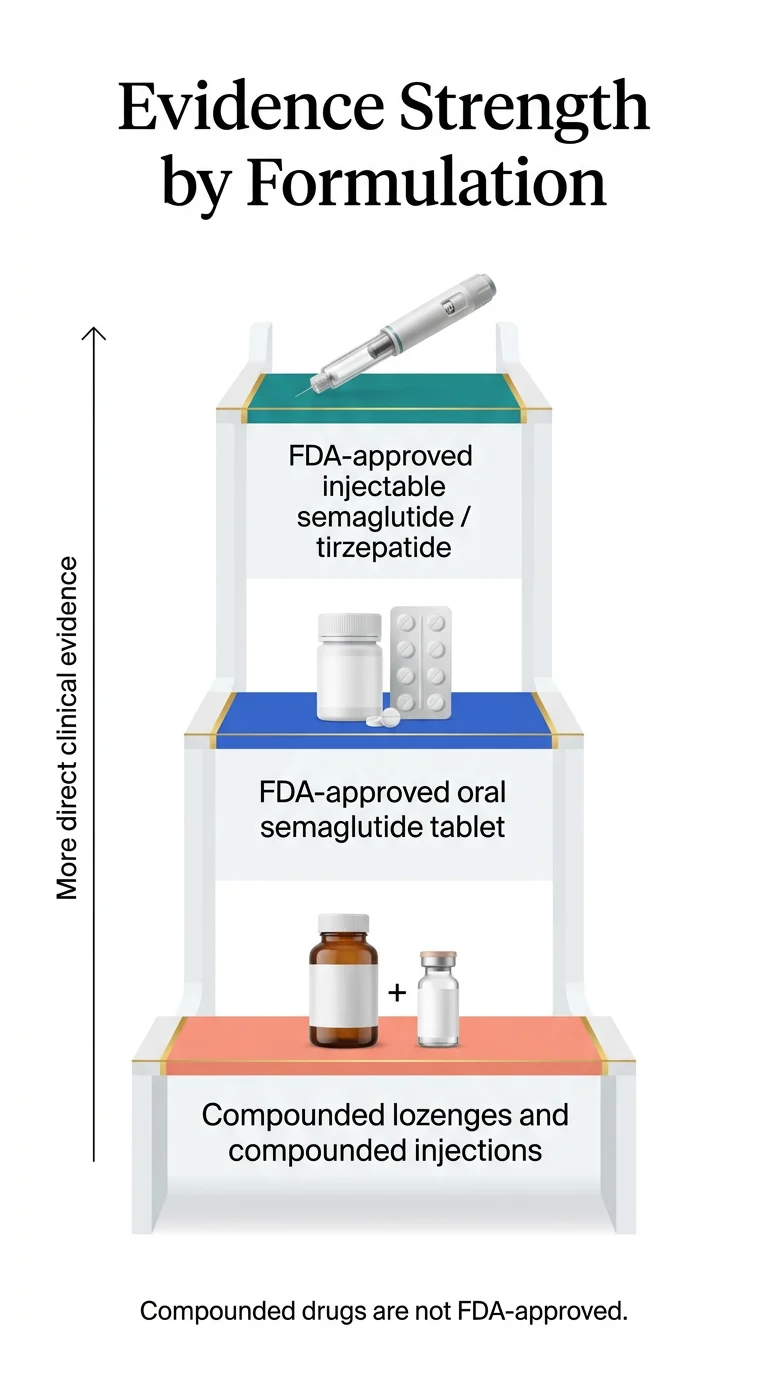
Compounded drugs are not FDA-approved.
An honest evidence hierarchy
Most evidence: FDA-approved injectable semaglutide (Wegovy/Ozempic) — large clinical trials, extensive real-world data, FDA-reviewed manufacturing
Moderate evidence: FDA-approved oral semaglutide tablet (Rybelsus) — clinical trials for diabetes, emerging weight loss data, different absorption mechanism
Least established: Compounded sublingual lozenges — real-world user reports exist, but no dedicated large-scale trials on this specific compounded format
That's the honest picture. If you want the most evidence-backed path, ask your doctor about Wegovy. If you want a needle-free compounded option and you accept the tradeoff in evidence certainty, Strut's lozenge format is one of the few places to get it.
Can You Cancel Strut Health Easily? Refunds, Auto-Refill, and the Fine Print
We're spending real time on this because it's the biggest trust gap between what Strut's FAQ says and what their support documentation reveals.
What the FAQ says
Strut's FAQ states you can "cancel or pause your subscription at any time through your online account settings. No long-term contracts are required." That sounds clean.
What the support docs say
Strut's support documentation adds more friction: cancellation should go to care@struthealth.com (or 1-833-Strut24), 48 hours' notice is required before the next refill, and refunds are generally unavailable after the pharmacy has processed or shipped your order.
What BBB complaints show
Several BBB complaints describe a specific pattern: the customer tries to cancel through the website, encounters a login or password loop that prevents completion, and then gets charged for the next shipment. Strut has responded to most of these complaints and typically issues refunds when the customer provides documentation of their cancellation attempt.
Our practical advice
If you sign up for Strut, do these three things to protect yourself:
- 1. Set a calendar reminder for 5 days before your next billing date
- 2. Email care@struthealth.com directly to cancel — don't rely solely on the website account settings
- 3. Save a copy of your cancellation email with the date and time, in case you need to reference it later
This isn't unique to Strut. Subscription telehealth is an industry-wide issue. But Strut has more complaints about it than some competitors, and knowing the process upfront removes the risk.
Shipping, State Availability, and Insurance
Quick answers to the operational questions.
How fast does Strut ship?
We found three different shipping timelines on Strut's own pages:
- Product comparison card: ships in 7–10 days
- FAQ: medications arrive in about 2 business days after physician authorization
- Support article: injectable medications ship within 7 days of approval; other compounded meds typically ship within 24 hours and arrive within 2 business days
Customer reviews generally describe receiving medication within about a week of completing their consultation.
What states does Strut serve?
Strut's physicians are licensed in all 50 states. However, certain compounded medications have state-specific restrictions. As of September 2024, Strut's documentation noted they could not ship to Arkansas for certain products due to state compounding laws. Always verify your state's eligibility during the consultation process.
Does Strut take insurance?
No. Strut operates on a cash-pay model. They do not bill insurance.
However, compounded GLP-1 medications may be eligible for HSA or FSA reimbursement depending on your specific plan. Check with your benefits administrator. See our guide: GLP-1 Providers That Accept HSA.
Can you use your own pharmacy?
Strut's FAQ indicates that in some cases, you may be able to transfer your prescription to another pharmacy, though a $40 physician consultation fee may apply. This is worth confirming directly with their support team if it matters to you.
Is Strut Health Safe? What to Verify Before You Order
This is a YMYL (Your Money or Your Life) question, so we're going to treat it with the seriousness it deserves.
What Strut says about safety
Strut states on their website that they work with U.S.-licensed physicians, U.S.-licensed compounding pharmacies, and that all active pharmaceutical ingredients are sourced from FDA-licensed facilities. They also state their compounding pharmacies perform sterility, potency, and purity testing on sterile compounds.
These are provider-stated claims. We have not independently audited Strut's pharmacy partners.
What the FDA says about compounded GLP-1 risks
The FDA has been clear and consistent on this point: compounded drugs pose a higher risk than FDA-approved drugs because they do not undergo FDA premarket review for safety, quality, or effectiveness. The FDA recommends that compounded drugs should only be used for patients whose medical needs cannot be met by an available FDA-approved drug.
The FDA has also specifically flagged risks with compounded GLP-1 products, including:
- Dosing errors from patients unfamiliar with measuring and self-administering medication from vials (applies more to injectables than oral lozenges)
- Fraudulent products with false pharmacy labels or misattributed compounding sources
- Salt form concerns — some compounders have used semaglutide sodium or semaglutide acetate, which are different active ingredients than the base form used in FDA-approved products
- Improper storage during shipping that could affect medication potency
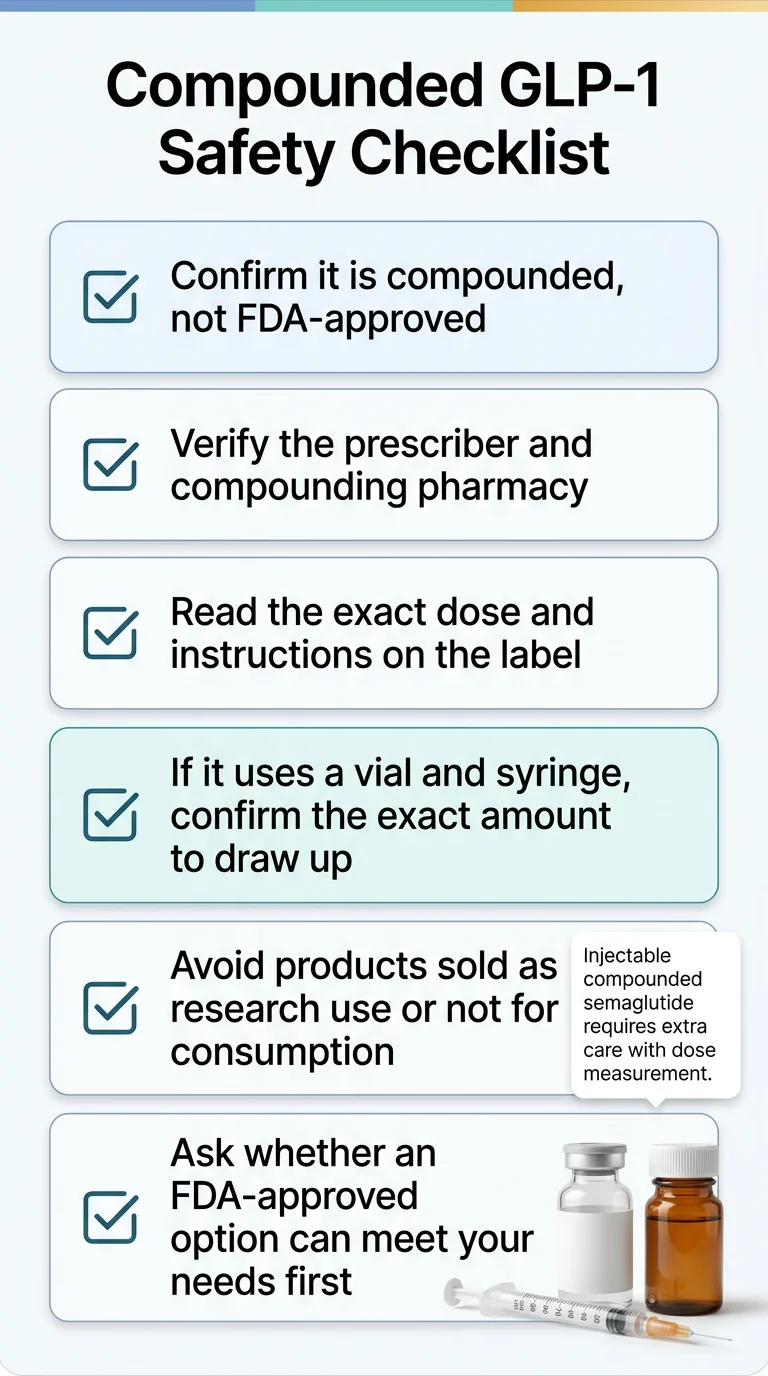
Injectable compounded semaglutide requires extra care with dose measurement.
A safety checklist before you order from any compounded GLP-1 platform
Whether you choose Strut or any other provider, run through these:
- Is the prescribing physician U.S.-licensed? (Strut states yes)
- Is the compounding pharmacy identified and U.S.-licensed? (Strut states they work with licensed pharmacies)
- Does the label clearly identify the medication as compounded and not FDA-approved? (Required by law)
- Are dosing instructions explicit and specific to your prescription?
- Is this compounded, not counterfeit? (Are you ordering from the actual platform, not a third-party reseller?)
- Have you confirmed with your doctor that an FDA-approved option isn't available or appropriate for you?
If you can check all of those boxes, you've done reasonable due diligence. If any of them raise a flag, pause and investigate.
Strut vs. Your Other Real Options
You don't have to choose Strut. Here are the paths that actually exist right now, who each one fits best, and the tradeoffs involved with each.
If you want needle-free: Strut is one of your few options
Most compounded GLP-1 platforms offer injectable semaglutide only. Strut is one of the few that specializes in oral sublingual lozenges. If avoiding needles is your primary requirement, Strut's oral semaglutide starting from $99/month with auto-refill is hard to beat on price.
If you want the cleanest trust profile: MEDVi or Hims
Both MEDVi and Hims have stronger brand recognition and generally higher trust-platform ratings than Strut. MEDVi offers compounded injectable semaglutide with a strong medical support model, and Hims offers a weight loss program with broad medication options. The tradeoff: no oral lozenge option, and pricing structures differ.
If trust signals and a smooth experience matter more to you than the oral lozenge format, these larger platforms may be worth exploring — just know you'll likely be doing injections.
If you want FDA-approved medication: Talk to your doctor
If your insurance covers Wegovy or Zepbound, or if you qualify for manufacturer savings programs, the FDA-approved path gives you the most established evidence, the safest supply chain, and pre-filled autoinjector pens that are easier to use than compounded vials. Your primary care doctor or an endocrinologist can write the prescription.
The downside of this path: FDA-approved branded GLP-1 medications have historically been expensive without insurance, though pricing, dosage forms, and savings programs are changing quickly. Check current official Wegovy or Zepbound pricing and coverage options before assuming compounded medication is cheaper — the gap may be narrower than you think, especially with manufacturer savings programs or good insurance.
This is the path we'd recommend for anyone whose insurance covers it. Full stop.
If you want the lowest out-of-pocket cost: Compare carefully
Prices shift constantly in this market. As of March 2026, Strut's oral semaglutide at ~$99/month with auto-refill is among the most affordable compounded GLP-1 options available. Some injectable-only platforms offer similar pricing ($99–$149/month), but you're comparing needles to no needles — and for a lot of people, that's the whole point.
One more thing to consider: the total cost over time. GLP-1 medication works best when taken consistently over months. A $50/month difference adds up to $600/year. If Strut's oral lozenge pricing holds, the annual savings over higher-priced injectable platforms can be meaningful — especially when you're paying entirely out of pocket.
See our full comparison: Cheapest GLP-1 Without Insurance
What Side Effects Should You Expect?
GLP-1 medications work partly by slowing how fast food leaves your stomach and reducing your appetite signals. That means your digestive system will notice.
The common stuff (most people experience some of this)
Nausea, bloating, gas, constipation, and diarrhea are the most frequently reported side effects across all GLP-1 medications — compounded and FDA-approved alike. They tend to be worst during the first few weeks and during dosage increases, then often improve as your body adjusts.
Interestingly, a study published in the Journal of Medical Internet Research analyzed 60 publicly available semaglutide user reviews and found that while gastrointestinal complaints were reported by the majority of users, they did not significantly reduce overall satisfaction ratings. Weight loss results drove satisfaction more than side effects reduced it.
Tips that actually help
- Eat smaller, more frequent meals instead of large ones
- Avoid greasy, high-fat, or very rich foods, especially early on
- Don't eat late at night
- Stay well hydrated
- Start at the lowest dose and ramp up gradually — Strut's protocol involves a multi-month titration schedule your physician will manage
For more detailed guidance, see: GLP-1 Nausea: What to Eat
When to contact your doctor immediately
Stop and seek medical attention if you experience:
- Severe, persistent abdominal pain (potential pancreatitis)
- Persistent vomiting that won't stop
- Signs of an allergic reaction
- A lump or swelling in your neck (thyroid concern — semaglutide carries a boxed warning about thyroid tumors based on animal studies)
These are rare but serious. Strut provides unlimited physician follow-ups as part of your subscription, which means you can message your Strut doctor about side effects at any time and adjust your dose if needed.
What to Expect Month by Month (Strut Oral Semaglutide)
Setting realistic expectations prevents disappointment.
1 Month 1: The ramp-up
Don't expect dramatic weight loss. This is your body getting acquainted with the medication at a low starting dose. You might notice slightly reduced appetite, occasional GI symptoms, or nothing at all. That's normal. The first month is about tolerability, not results.
2 Month 2: Building the dose
As your physician increases the dose, some people start to notice more consistent appetite changes. You might find yourself less interested in snacking or feeling satisfied with smaller portions. Experiences vary — some people feel it earlier, some later.
3 Month 3+: Working toward maintenance
By the time you reach a maintenance dose (which varies by individual and may take several months of titration), many people report meaningful appetite changes. How quickly visible weight loss follows depends on your starting point, diet, activity level, and how your body responds.
Contact your Strut physician proactively when approaching each dosage increase. Don't wait for them to reach out — request adjustments with your monthly refill.
Important reality check
Weight loss medication is not magic. The people who see the best results combine their medication with a reduced-calorie diet and increased physical activity. Semaglutide makes those lifestyle changes dramatically easier — that's the real superpower. It quiets the noise in your brain that used to shout eat more, eat more, eat more. But you still have to point yourself in the right direction.
How We Reviewed Strut Health (Our Methodology)
We think you deserve to know exactly how we built this page.
What we verified directly
- All pricing was checked on struthealth.com between March 1–6, 2026
- We reviewed Strut's consultation flow and product pages for weight loss
- We checked the FDA's drug shortage database, warning letter database, and compounding guidance
- We reviewed Trustpilot (752+ reviews) and BBB (complaint records) for pattern analysis
What we treated as provider-stated
Any claim that comes from Strut's own website — physician licensing, pharmacy accreditation, shipping timelines, follow-up care — is labeled "provider-stated" throughout this review. We could not independently verify these claims and have not audited Strut's operations.
How we used review platforms
We used customer reviews for pattern detection: identifying recurring themes in both positive and negative feedback. We did not treat individual reviews as medical evidence, and we noted where platform disclaimers apply (Trustpilot states reviews are individual user opinions; BBB notes complaint text may not represent all interactions).
How often we'll update this page
We commit to updating this page when: Strut's pricing changes, the FDA takes new regulatory action affecting compounded GLP-1 platforms, or our verification data becomes stale.
The Bigger Picture: What Weight Loss on GLP-1 Medication Actually Looks Like
We're including this section because we think it matters more than any individual platform review.
If you start Strut — or any GLP-1 program — here's what realistic success looks like based on the published data and real-world user patterns:
Weeks 1–4: You'll probably notice your appetite quieting down. Foods that used to call your name from the pantry lose their pull. You might feel full faster at meals. Some people describe it as the "food noise" just... stopping. The scale might move a little, but don't expect dramatic changes yet.
Months 2–3: This is when most people start seeing measurable results. You're on a higher dose now, and your body has adjusted to the medication. Weight loss becomes more consistent. Your clothes start fitting differently. People might start noticing.
Months 4–6: If you've been consistent with both the medication and lifestyle changes, you're likely looking at meaningful weight loss. Clinical trial data for semaglutide shows the most significant weight reduction occurring between months 3 and 12, with results continuing to compound as long as the medication is continued alongside a reduced-calorie diet and increased physical activity.
The hard truth about stopping
Research consistently shows that weight regain after discontinuing GLP-1 medication is common. Many people regain a significant portion of lost weight within a year of stopping. This isn't a failure of the medication — it's biology. GLP-1 receptors go back to their default state, and the appetite signals return.
Plan ahead with your physician for a long-term strategy, whether that's sustained low-dose maintenance, transitioning to another approach, or committing to the lifestyle changes that make the weight loss stick.
Learn more: What Happens When You Stop Taking GLP-1
How to Get Started With Strut Health (If You Decide It's Right)
If you've read everything above and Strut fits your situation, here's exactly what the process looks like:
Choose your medication
Go to Strut's weight loss page. Select oral semaglutide lozenges (if you want needle-free), injectable semaglutide, or tirzepatide (oral or injectable). If you're not sure, you can note that in your questionnaire and let the doctor recommend.
Complete the free consultation questionnaire
This takes about 10–15 minutes. You'll answer questions about your medical history, current medications, health conditions, weight loss goals, and which format you prefer. Be thorough and honest.
A U.S.-licensed physician reviews your information
If you're a good candidate, they'll create a treatment plan and write a prescription. If you're not approved, you won't be charged.
Choose your plan
Select monthly or auto-refill. Auto-refill saves roughly 21% on oral lozenges. You can toggle it off anytime. Our recommendation: start with auto-refill for the savings, set a calendar reminder a week before each billing date, and adjust or cancel if needed.
Medication ships to your door
Free shipping, discreet packaging. Most customers report receiving their first order within about a week of completing their consultation.
Start your medication and stay in touch
Begin with the lowest dose. Follow up with your physician about side effects and dosage increases. Don't be passive — the people who get the best results are the ones who actively communicate with their provider.
A few things we'd tell a friend
Track your weight weekly, not daily. Daily fluctuations will mess with your head. Take progress photos monthly — the mirror and the scale don't always agree, and photos tell the real story over time. And remember: the medication doesn't do the work alone. It makes the work dramatically easier by quieting your appetite. But you still need to eat better and move more. The combination is where the real transformation happens.
Final Verdict: Should You Try Strut Health?
Strut Health is not perfect. The pricing language on their site needs cleaning up. The cancellation process needs to be smoother. The BBB rating tells a story about customer service friction that's hard to ignore.
But Strut does something that almost no other platform does: it gives needle-averse people an accessible, affordable, oral path to compounded GLP-1 medication for weight loss. Starting from roughly $99/month, with no contracts, and with physician follow-up care included.
If you've been putting off GLP-1 treatment because of needles, Strut removes that barrier. If you've been priced out of brand-name medication, Strut creates a path. And if you go in with clear expectations — knowing the regulatory context, the cancellation process, and the evidence tradeoffs — you can make this work.
The people who do best with Strut are the ones who proactively communicate with their physician, stick with the dosage ramp-up schedule, and combine the medication with meaningful lifestyle changes. That's not Strut-specific advice. That's how GLP-1 medication works, period.
If Strut fits your situation:
Start Your Free Strut ConsultationFrequently Asked Questions About Strut Health
Related Guides
More From Weight Loss Provider Guide
Strut Health vs Hims
Head-to-head comparison of Strut Health and Hims for GLP-1 weight loss covering pricing, medications, FDA issues, and who each fits best.
SkinnyRx vs MEDVi
SkinnyRx vs MEDVi head-to-head comparison covering GLP-1 pricing, formats, FDA warning letters, cancellation policies, and which fits your situation.
DudeMeds GLP-1 Reviews
DudeMeds GLP-1 review covering pricing, compounding details, pharmacy transparency, public reviews, and honest verdict.
Henry Meds Review
Henry Meds GLP-1 telehealth review covering pricing, prescribing process, and patient outcomes.
Semaglutide Providers in Texas
Best semaglutide providers and telehealth options available specifically for Texas residents.
Best GLP-1 for Seniors
Safest GLP-1 options, real costs, Medicare coverage rules, and top programs compared for adults 60+.
This page was researched and written by the WPG Research Team. We analyze telehealth platforms, verify pricing, and synthesize customer reviews to help you make informed decisions about GLP-1 weight loss programs. We disclose all affiliate relationships and recommend competitors where they win.
Have you used Strut Health? We'd love to hear about your experience — good or bad. Your feedback helps us keep this page accurate.
Last Updated: March 2026 | Last Verified: March 6, 2026