GLP-1 Without Blood Work: 6 Real Provider Lab Policies Compared (2026)
By Weight Loss Provider Guide Editorial Team — an independent comparison resource for GLP-1 telehealth providers · Last verified: April 10, 2026
Weight Loss Provider Guide may earn a commission when you visit a provider through our links, at no extra cost to you. See our methodology.
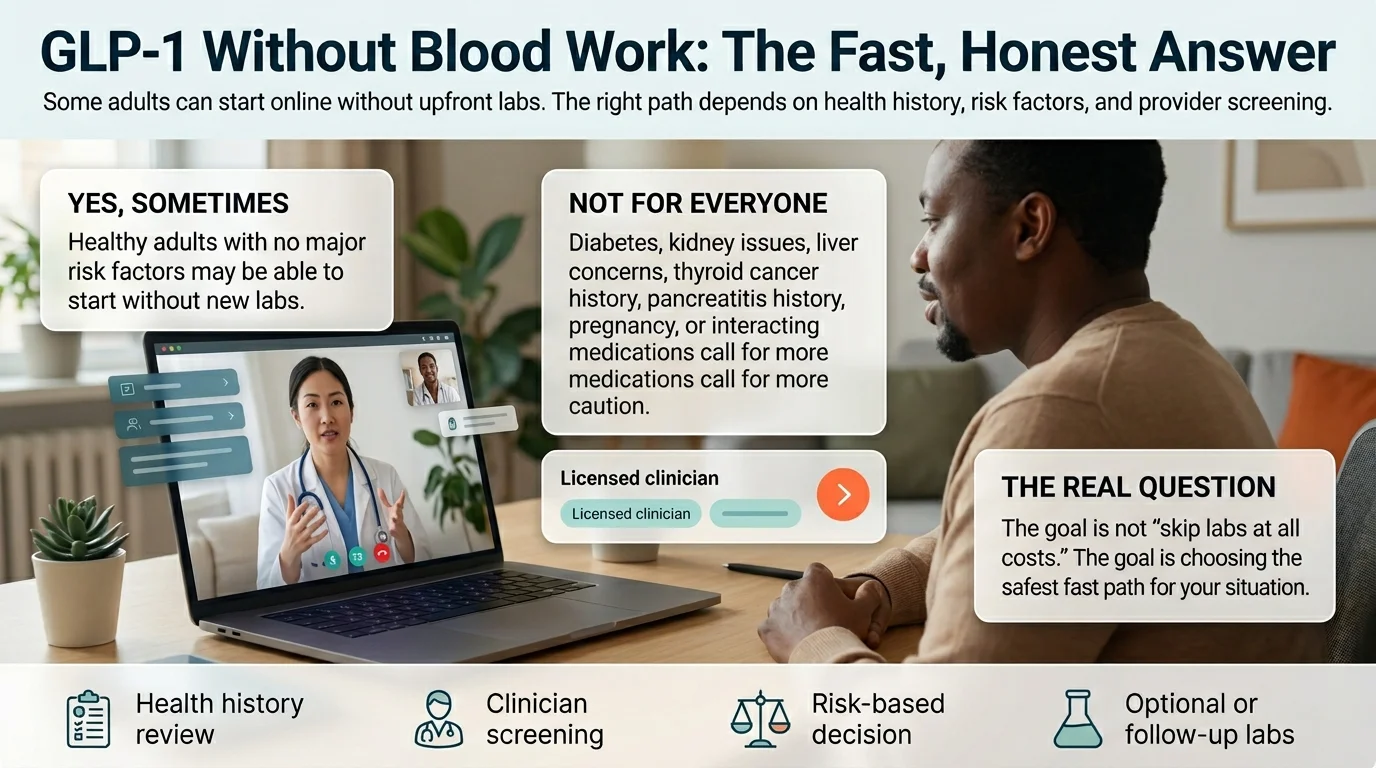
The short answer:
Can you get a GLP-1 without blood work? Yes — and it's not a red flag. We verified the lab policies of 6 major telehealth GLP-1 providers this month. The majority do not require baseline blood work before writing your first prescription. Walgreens publishes the clearest no-lab-first policy for brand-name medications. For compounded GLP-1s, Mochi explicitly states labs are never required. And if you want a provider that evaluates your history first and only orders labs when your risk profile calls for it, Ro strikes the best balance of speed and medical oversight.
But here's what other pages won't tell you: the question isn't really can you skip labs. The real question is whether skipping labs is right for you specifically. If you have diabetes, prediabetes, kidney disease, or a thyroid history, skipping labs is the wrong shortcut.
Jump to section
- 2026 GLP-1 Lab Requirement Matrix — 6 Providers
- Which Path Fits You? Three Lanes for Getting Started
- Is Starting a GLP-1 Without Blood Work Actually Safe?
- Who Should NOT Skip Labs Before Starting a GLP-1
- Which Blood Tests Actually Matter — and How Often
- What Does Getting Started Without Labs Really Cost?
- The Shady Version of "No Labs Required" — Avoid These
- Provider-by-Provider Breakdowns (Ro, Embody, Walgreens, Mochi, More)
- How We Verified This Page
- 10 FAQs Answered
The 2026 GLP-1 Lab Requirement Matrix
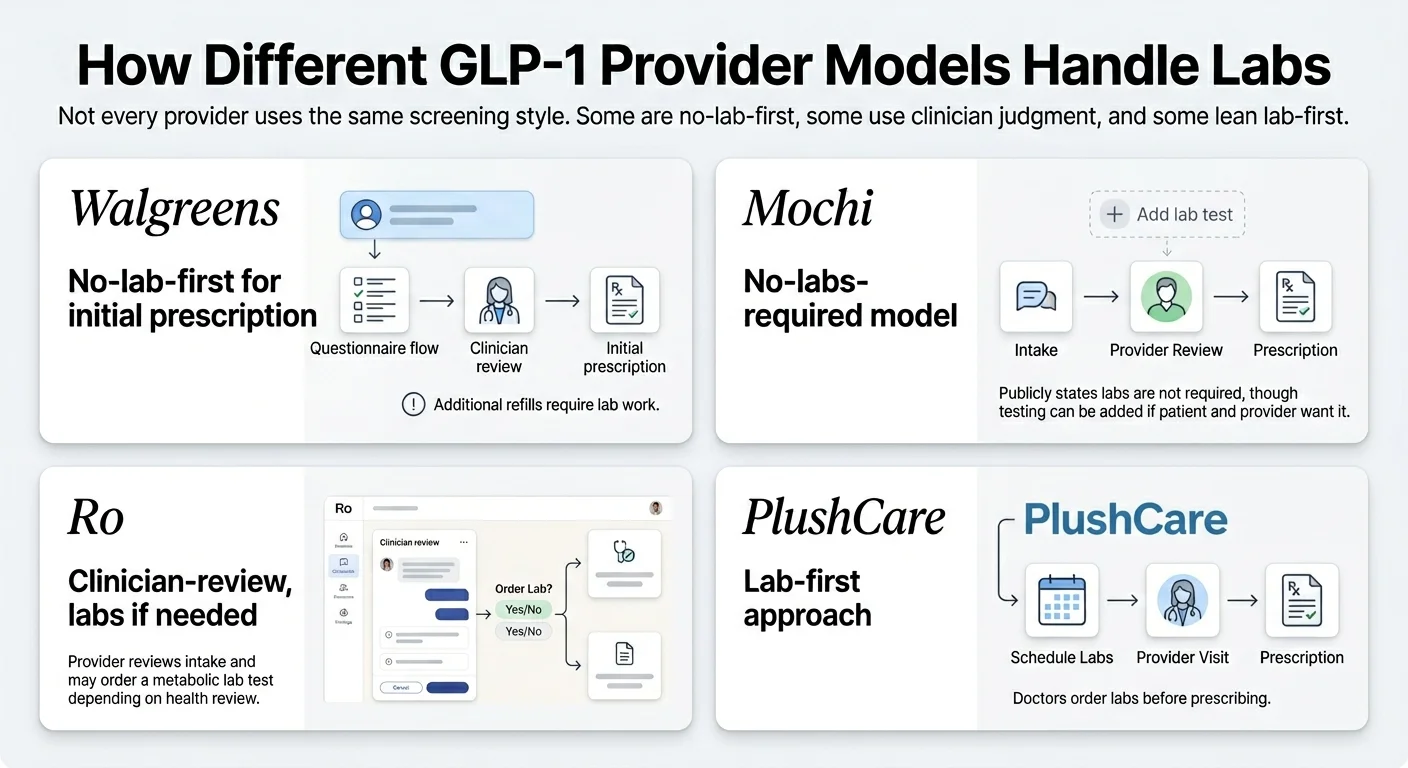
We reviewed the published lab policies, pricing pages, FAQ sections, and terms of service for 6 telehealth GLP-1 providers. Every data point below links back to the specific provider page it came from. The No-Lab Start Score and Clinical Oversight Score are our editorial framework — not provider-supplied ratings.
Scoring method: No-Lab Start Score: 5 = clear published policy of no labs needed; 1 = labs standard before prescribing. Clinical Oversight Score: reflects published depth of screening, follow-up, and monitoring. Both are editorial assessments, not provider ratings.
| Provider | Start Before Labs? | Labs Required Later? | Starting Price | Med Type | No-Lab Start | Oversight |
|---|---|---|---|---|---|---|
| Walgreens Weight Mgmt | Yes — no labs for initial Rx | Yes — HbA1c + BMP/CMP for refills | $49/visit; Wegovy pill from $149/mo, pen from $199/mo | FDA-approved brand-name | 5/5 | 4/5 |
| Mochi Health | Yes — labs never required | Optional — if patient and clinician decide | $79/mo membership + $99/mo compounded semaglutide | Compounded semaglutide | 5/5 | 2/5 |
| Embody | Clinician decides — may recommend labs after review | Provider-directed | From $99 first month; injection & gum options | Compounded medications | 3/5 | 4/5 |
| Ro Body ProgramEditor Pick | Provider may order metabolic lab test after intake | Periodic monitoring included | $39 first month, then $149/mo ($74/mo annual); medication separate | FDA-approved brand-name | 3/5 | 4/5 |
| WeightWatchers Clinic | Some members — labs may be required before first consult | Varies by clinician | $25 first month (12-mo plan); GLP-1 medication separate | FDA-approved brand-name | 2/5 | 4/5 |
| PlushCare | No — doctors order labs before prescribing | Yes — part of standard care | $19.99/mo membership (first month free) + $129 initial visit | FDA-approved brand-name | 1/5 | 5/5 |
All sources accessed April 10, 2026. Prices reflect published information at time of verification and may change. Walgreens manufacturer promotional pricing has specific eligibility requirements and expiration dates — always confirm on the provider's site before signing up.
Which Path Fits You? Three Lanes for Getting Started
Most people searching this topic don't actually want to avoid labs forever. They want the fastest legitimate path that won't come back to bite them later. That's a different question — and it has three honest answers.
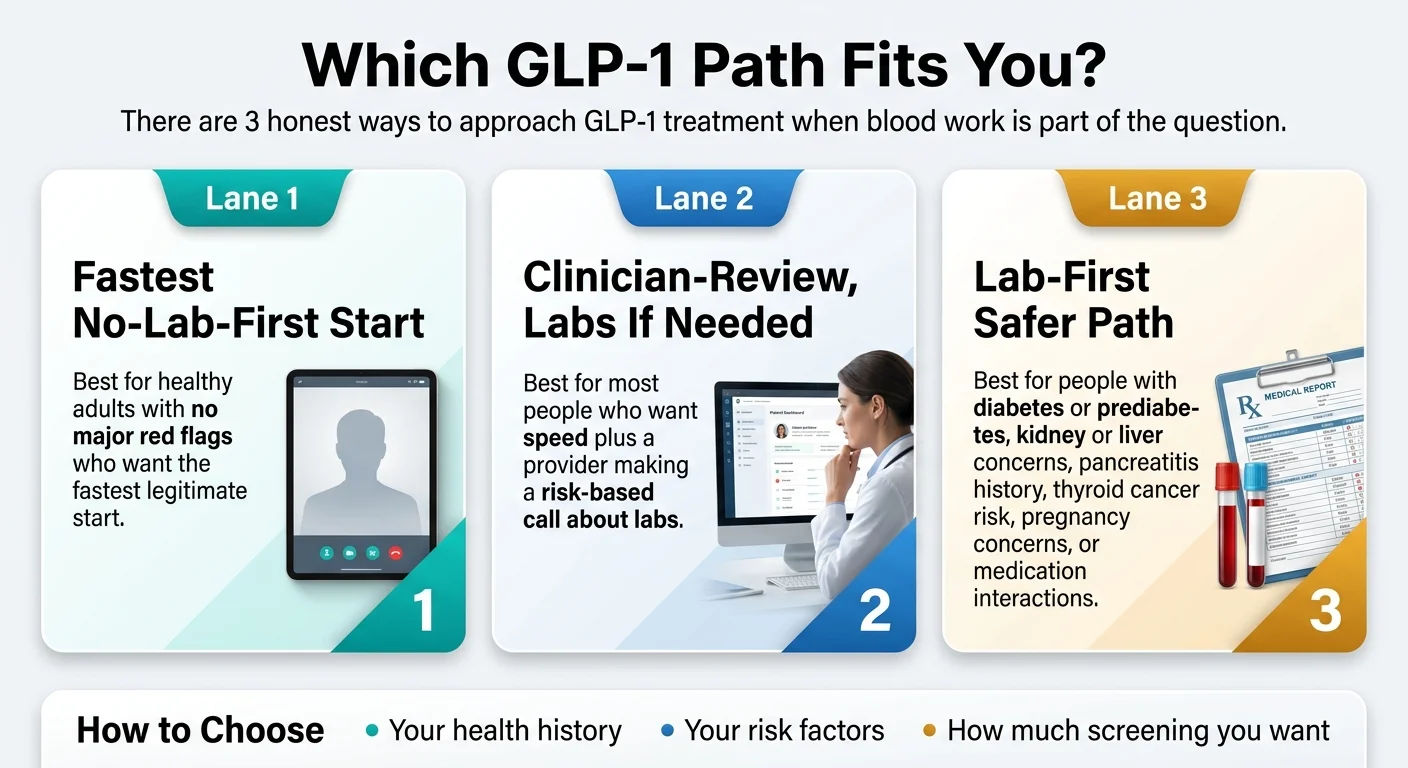
Fastest No-Lab-First Start
Walgreens (brand-name) · Mochi (compounded)
Best for: Healthy adults with no chronic conditions, no diabetes history, no medications that interact with GLP-1s, and a strong preference for speed.
You fill out an online health questionnaire, a licensed provider reviews it, and — if nothing in your history raises a flag — you get a prescription. No lab visit. No waiting for results. Medication ships to your door.
Clinician-Review — Labs If Needed
Ro · Embody
Best for: Most readers. You want to start quickly, but you also want a provider whose clinician makes a judgment call about whether your specific history warrants testing before prescribing.
You complete an intake, a licensed provider reviews your health history, and they decide whether to order labs based on what they see. Many patients start without labs. Some get a metabolic panel ordered through Quest Diagnostics. Either way, the clinician is making a risk-based decision — not rubber-stamping a questionnaire.
Ro: eligibility determined within 2 days; cash-pay patients can start in less than a week. Labs included in membership if ordered.
Lab-First Safer Path
PlushCare · WeightWatchers Clinic · Ro (if labs triggered)
Best for: Readers with diabetes or prediabetes, kidney or liver concerns, pancreatitis history, thyroid risk factors, or anyone taking insulin, sulfonylureas, or other interacting medications. Also for readers who simply prefer more clinical structure.
Your provider orders a lab panel before prescribing. You go to Quest, Labcorp, or your primary care doctor, get blood drawn, wait for results, and then your provider reviews everything before writing the prescription.
Is Starting a GLP-1 Without Blood Work Actually Safe?
Starting a GLP-1 without new blood work can be medically reasonable for some adults — but that is not the same as saying it's best practice for everyone. Here's what the clinical picture actually looks like.
The FDA-approved prescribing labels for semaglutide (Wegovy) and tirzepatide (Zepbound) — the two GLP-1s specifically approved for weight management — do not mandate baseline blood work as a prescribing requirement. What the labels do require is screening for specific contraindications: personal or family history of medullary thyroid carcinoma (MTC), multiple endocrine neoplasia syndrome type 2 (MEN2), and history of serious hypersensitivity to the active ingredient. That screening happens through your health questionnaire and provider review — not a blood draw.
Clinical guidelines from obesity medicine organizations recommend baseline labs as helpful context, not as a hard prerequisite. The American Association of Clinical Endocrinology (AACE) suggests checking glucose, lipids, liver function, and kidney function as part of a comprehensive obesity evaluation — but this is a recommendation for thorough workup, not a prescribing requirement.
In practical terms, most telehealth providers handle it this way: if your intake reveals no red flags, they prescribe without labs. If something raises a concern, they order targeted testing before prescribing. This is risk-stratified care, and it's how medicine works across many contexts.
What Responsible Telehealth Still Screens For (Even Without Blood Work)
When Recent Labs Count as "Good Enough"
If you had a physical or blood work done recently, you may be able to upload those results and skip a new draw entirely. Walgreens, for example, accepts lab results from the past 12 months. Other providers may have different cutoffs — ask during your intake what window they accept.
For anyone with diabetes, prediabetes, kidney disease, liver concerns, thyroid history, or medication interactions — don't prioritize speed over screening. A lab visit takes one morning and gives your provider critical information. That's not a barrier. It's the smarter way to start.
Who Should NOT Skip Labs Before Starting a GLP-1
This section exists to make the rest of this page more trustworthy. If we only told you "no labs needed, sign up here," you'd be right to question us. Some people genuinely need baseline blood work — and we'd rather lose you to a lab-first provider than see you start without the information your clinician needs.
Do not use a no-lab GLP-1 start if any of the following apply:
Diabetes or Prediabetes
If you have diagnosed type 2 diabetes — especially if you take insulin or sulfonylureas — blood sugar monitoring before and during GLP-1 treatment is important. GLP-1s lower blood sugar. Combined with insulin or sulfonylureas, that can cause hypoglycemia (dangerously low blood sugar). Your provider needs your current A1C and fasting glucose to dose safely.
Kidney Disease or Reduced Kidney Function
GLP-1s can cause nausea and vomiting, which can lead to dehydration, which stresses kidneys. All current GLP-1 prescribing labels carry warnings about acute kidney injury and volume depletion. If you have existing kidney impairment, your provider needs baseline creatinine and eGFR to monitor whether treatment is affecting kidney function.
Liver Disease or Elevated Liver Enzymes
If you have a history of fatty liver disease (MASLD/MASH), hepatitis, or unexplained elevated liver enzymes, baseline ALT and AST values give your provider a reference point. GLP-1s are being studied for potential liver-fat reduction benefits — but you need to know where you're starting from.
History of Pancreatitis or Gallbladder Disease
GLP-1s carry a known risk of pancreatitis and gallstones. If you've had either before, your provider should know your current levels and be monitoring more carefully during treatment.
Personal or Family History of Medullary Thyroid Carcinoma (MTC) or MEN2
This is a black-box warning on every GLP-1 label. If this applies to you, GLP-1s may not be appropriate at all — and thyroid evaluation is part of that discussion with your provider. This is not a "skip labs and start fast" scenario.
Pregnancy, Trying to Conceive, or Breastfeeding
GLP-1s are not recommended during pregnancy. If there's any chance you could be pregnant, confirm before starting.
What Blood Tests Actually Matter — and How Often
You don't need a medical textbook. You need the practical answer: which labs matter, what they tell you, and when to repeat them.
Core Tests Providers Check (When They Check Anything)
| Test | What It Tells You | Why It Matters for GLP-1 | When to Check |
|---|---|---|---|
| HbA1c / Fasting Glucose | Average blood sugar (A1c) or point-in-time blood sugar | Screens for diabetes/prediabetes; tracks metabolic improvement | Baseline if available, then every 3–6 months |
| Creatinine / eGFR / BUN | Kidney function | GLP-1-related nausea/dehydration can stress kidneys; all labels carry kidney warnings | Baseline if risk factors, then every 6 months |
| ALT / AST (Liver Enzymes) | Liver inflammation | Establishes baseline; helps track liver health during treatment | Baseline if risk factors, then every 6 months |
| Lipid Panel | Cholesterol (HDL, LDL, triglycerides) | GLP-1s often improve lipid levels — baseline lets you track progress | Baseline if available, then every 6–12 months |
| TSH (Thyroid) | Thyroid function | Rules out hypothyroidism mimicking weight-gain symptoms; relevant to MTC/MEN2 screening | Once at baseline if not recently checked |
Situation-Specific Tests
The Repeat Schedule in Plain English
If you're a healthy adult with no baseline concerns: consider getting a basic panel (A1C + metabolic panel + lipids) 2–3 months after starting, then every 6 months. This isn't about catching something scary — it's about tracking your progress. Many patients find that watching their A1C normalize or their cholesterol improve is more motivating than the scale.
If you have risk factors: your provider will set a monitoring schedule. Follow it.
Getting Labs Without a Doctor or Insurance
What Does Getting Started Without Labs Really Cost?
The true cost isn't just the first-month price on the landing page. It's whether labs are bundled or extra, whether medication is included or separate, whether the price goes up with your dose, and whether skipping labs now creates refill friction later.
Cost Comparison: Providers That Allow a No-Lab Start
| Provider | Visit/Membership Fee | Medication Included? | Lab Cost (If Ordered) | First-Month All-In Estimate | Ongoing Monthly | Price Change With Dose? |
|---|---|---|---|---|---|---|
| Walgreens | $49/visit | No — billed separately | Needed for refills; cost varies | ~$198+ (visit + lowest Wegovy pill dose) | $149–$349/mo medication + $49 per follow-up | Yes — higher doses cost more |
| Mochi | $79/mo ($39 promo first month) | No — $99/mo compounded semaglutide separate | Optional; patient-arranged | ~$138 (promo membership + medication) | ~$178/mo (membership + medication) | No — $99/mo at all doses |
| Embody | Included in plan | Yes — compounded included | Included when provider orders | From $99 (semaglutide injection) | $299–$449/mo based on medication | Yes — higher doses may cost more |
| Ro | $39 first month, then $149/mo (or $74/mo annual) | No — medication separate | Included if ordered (Quest); at-home kit $75 | $39 + medication cost | $74–$149 membership + medication | Medication cost varies by type/dose |
Prices reflect published information as of April 10, 2026. Walgreens medication pricing uses current manufacturer promotional offers with specific eligibility terms and expiration dates. Always confirm current pricing directly on the provider's site.
The Dose-Escalation Trap
Most GLP-1 programs advertise their lowest-dose price. But treatment involves titration — you start low and increase over several months. Many providers charge more at higher doses. What starts at $149/month can become $299+ by month four.
What Happens With Labs at Refill Time?
The Shady Version of "No Labs Required" — and How to Avoid It
We need to talk about this because "without blood work" sits right next to some genuinely dangerous search territory. There's a real difference between a legitimate telehealth provider that doesn't require upfront labs and a sketchy operation that skips clinical safeguards because they don't actually have clinicians.
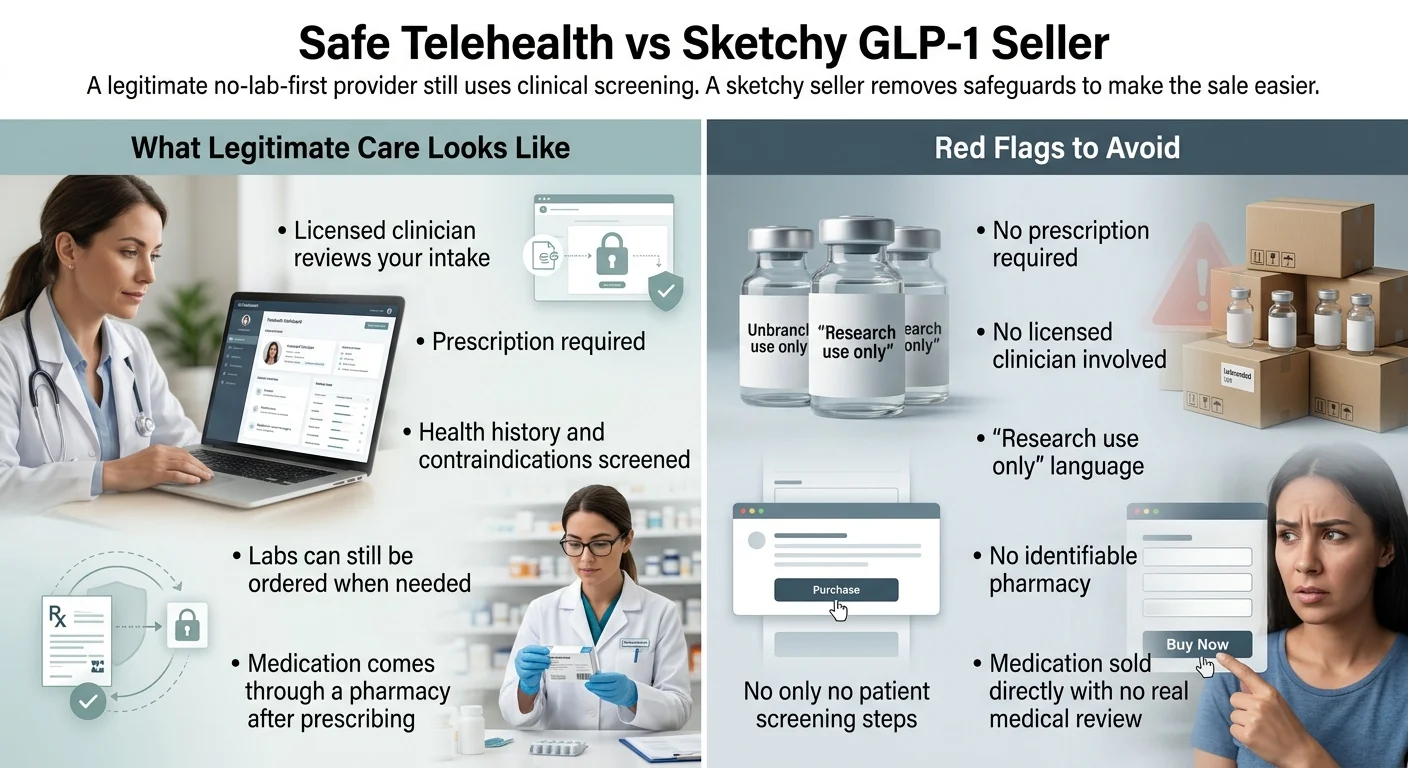
Red Flags That Should Stop You Immediately
Why the Compounded vs. FDA-Approved Distinction Matters Here
Compounded semaglutide and tirzepatide are prepared by licensed compounding pharmacies under a clinician's prescription. They are not FDA-approved as finished products — the FDA does not review compounded medications for safety, effectiveness, or quality before they reach you. They are not the same as Wegovy, Zepbound, or any other brand-name medication. The legal availability of compounded versions depends on specific conditions under federal 503A and 503B pharmacy regulations, and the FDA has been actively clarifying its enforcement approach as national GLP-1 supply stabilizes.
This matters for the "no blood work" question because some compounded providers operate with lighter clinical oversight than brand-name prescribers. That doesn't automatically make them unsafe — but it means you need to do more diligence. Ask:
Provider-by-Provider Breakdowns
Once you know which lane fits, here's the short version of each provider — who it's for, who it's not for, and the one thing that matters most about their lab policy.
Ro — Best Balance of Speed and Clinical Judgment
Editor PickWho it IS for
Want to start quickly but also want a real clinician making the call. Ro has a dedicated insurance concierge team for prior authorizations.
Who it is NOT for
If your only goal is guaranteeing zero chance of labs, Walgreens or Mochi publish more permissive policies. Ro focuses on FDA-approved brand-name GLP-1s.
Honest tradeoff
Ro does NOT guarantee a no-lab start. For someone who wants speed above all else, that might mean a few extra days. But you get a provider that treats this like healthcare — not e-commerce.
Embody — Best for Low Starting Price and Needle-Free Gum Option
Who it IS for
Want the lowest first-month price for compounded GLP-1, prefer a needle-free gum option, or want 24/7 care-team messaging with fast online intake.
Who it is NOT for
Anyone looking for flat pricing at every dose or "same price forever" refills. Embody's pricing increases after the first month to standard refill rates.
Low-cost starter
Embody's $99 first-month semaglutide injection is one of the most accessible entry points for GLP-1 therapy. If approved, medication ships to your door.
Walgreens Weight Management — Clearest No-Lab-First Policy for Brand-Name Meds
Non-AffiliateWho it IS for
Want a brand-name FDA-approved GLP-1 (Wegovy or Zepbound) from a name you trust, and want to start without a lab visit. Walgreens' policy is the most explicitly stated: no lab work for your first visit or initial Rx.
Who it is NOT for
Anyone who wants to avoid labs entirely — Walgreens requires HbA1c and a metabolic panel for refills. Also not for readers who want to handle insurance or prior authorizations — Walgreens does not currently offer that.
Why we include it
We don't have an affiliate relationship with Walgreens. We include them because they publish the clearest no-lab-first policy in the market. Leaving them out would make our comparison less useful.
Mochi Health — No Labs Required at Any Stage
Non-AffiliateWho it IS for
Want compounded semaglutide at a competitive price and genuinely do not want to deal with labs at any point. Mochi is the only provider in our matrix that explicitly states labs are never required to receive or continue treatment.
Who it is NOT for
Anyone who prefers stronger baseline screening. If you want a provider that orders labs proactively — even when you don't ask — Mochi's model is lighter on clinical oversight than Ro, Embody, or PlushCare.
WeightWatchers Clinic — Best for Insurance + Lifestyle Support
Who it IS for
Want FDA-approved GLP-1 medication, help navigating insurance, and a structured lifestyle program. WeightWatchers pairs treatment with their established Points system, coaching, and community support.
Who it is NOT for
Anyone looking for the fastest or cheapest start. WeightWatchers requires a 12-month plan commitment, medication costs are separate, and some members need labs before the initial consultation.
PlushCare — Most Thorough Lab-First Option
Who it IS for
Want a primary-care-style experience with labs ordered before prescribing. PlushCare explicitly states that doctors order an obesity lab panel before prescribing GLP-1 medications. If you prefer the traditional medical model, this is the one.
Who it is NOT for
Anyone who wants to start without labs. PlushCare is 1/5 on our No-Lab Start Score — this is lab-first by design. Same-day appointments available.
Related Guides & Comparisons
- GLP-1 Telehealth Local Pharmacy Pickup: 7 Verified Options (2026)
- Best GLP-1 Cash Pay Programs: 7 Real Picks (April 2026)
- GLP-1 Providers With Flat-Rate Pricing: 7 Options
- Semaglutide Providers That Accept HSA: 9 Verified Options
- Tirzepatide Providers That Accept HSA: 8 Verified Options
- GLP-1 Providers That Accept CareCredit: 7 Verified Options
- GLP-1 Providers That Accept Afterpay: 7 Verified Options
- Wegovy Providers That Take FSA: 5 Verified Paths (April 2026)
- How to Get Wegovy HD Online: 7 Routes, Real Prices (April 2026)
- Wegovy HD vs Wegovy Pill: 2026 Verdict (+ Real Prices)
- MEDVi vs Henry Meds: 7 Real Differences Compared
- Ozempic Cost Without Insurance: Real Prices Verified
- Best GLP-1 Pill Provider 2026: Oral Options Compared
- Month-to-Month GLP-1 Providers: 8 Options Compared
How We Verified This Page
Sources
Every provider row comes from current published pages on each provider's website — specifically pricing pages, FAQ sections, "how it works" flows, and terms of service. Medical and safety information references FDA-approved prescribing labels and official FDA consumer safety communications. Each row in the matrix includes a direct source link.
What "verified April 10, 2026" means
We accessed each provider's website on or shortly before this date and confirmed the lab policy, pricing, and program details shown. We maintain screenshot archives for reference.
How the scores work
Our No-Lab Start Score and Clinical Oversight Score are editorial assessments based on published provider information. A provider with a clear, public "no labs required" statement scores higher on No-Lab Start. A provider with documented follow-up testing, clinician-directed lab orders, and structured monitoring scores higher on Clinical Oversight.
Why some providers are excluded
If we cannot verify a clean public baseline-lab policy — or if recent information creates uncertainty we haven't resolved — we exclude the provider until we can confirm. We'd rather publish a smaller accurate table than a bigger one with guesses.
Refresh schedule
We re-verify pricing and lab-policy wording monthly. Broader medical references and state-availability notes are updated periodically. Significant events (FDA actions, provider policy changes) trigger immediate updates.
Weight Loss Provider Guide is an independent comparison resource for GLP-1 telehealth providers. We earn affiliate commissions from some providers featured on this site. This does not influence our editorial scoring, but it does affect which providers we link to in calls to action. We include non-affiliate providers (like Walgreens, Mochi, WeightWatchers, and PlushCare) when they are relevant to the comparison.
Last Verified: April 10, 2026 · Pricing Verified: April 10, 2026
Frequently Asked Questions: GLP-1 Without Blood Work
Still Not Sure Which GLP-1 Program Is Right for You?
You've read the lab policies, the pricing, and the safety details. If you're still weighing options, that's normal — this is a medical decision and you should feel certain before you start. Pick your situation below.
Want brand-name Wegovy or Zepbound with a clinician who evaluates your labs if needed:
Ro — best balance of speed and clinical judgment →Want a low first-month price and needle-free GLP-1 gum options:
Embody — start from $99, clinician-guided screening →Want brand-name medication from a pharmacy you already know, no labs for first Rx:
Walgreens Weight Management — no labs for initial RxWant the lab-first, most clinically thorough experience available online:
PlushCare — lab-first, same-day appointmentsAffiliate Disclosure & Medical Disclaimer
Weight Loss Provider Guide is an independent comparison resource for GLP-1 telehealth providers. All provider policies and pricing were verified from published sources in April 2026. We may earn a commission when you enroll through our affiliate links (Ro, Embody), at no additional cost to you. Non-affiliate providers (Walgreens, Mochi, WeightWatchers, PlushCare) are included because they are relevant to the comparison — not because of any commercial relationship.
Medical disclaimer: This content is for informational purposes only and does not constitute medical advice. Always consult a licensed healthcare provider before starting any treatment. Individual health situations vary and the appropriate lab testing protocol for you should be determined by your provider.
Last Verified: April 10, 2026 · Pricing Verified: April 10, 2026 · Written by Weight Loss Provider Guide Editorial Team
Full editorial policy · How we make money · Contact us if a lab policy has changed