GLP-1s for Weight Loss: The Complete, Label-Verified Guide (2026)
Medical Disclaimer: This content is for informational purposes only—not medical advice. Always consult a licensed clinician.
The Short Answer
GLP-1s for weight loss are prescription drugs that reduce appetite and slow digestion, helping people with obesity lose significant weight. In the U.S., three active ingredients are FDA-approved specifically for chronic weight management: semaglutide (Wegovy injection and Wegovy tablets), tirzepatide (Zepbound), and liraglutide (Saxenda).
In clinical trials, people lost 15-22% of their body weight—that's 30-45 pounds for someone starting at 200 lbs. Monthly costs range from $149-$499 without insurance, depending on the medication and dose.
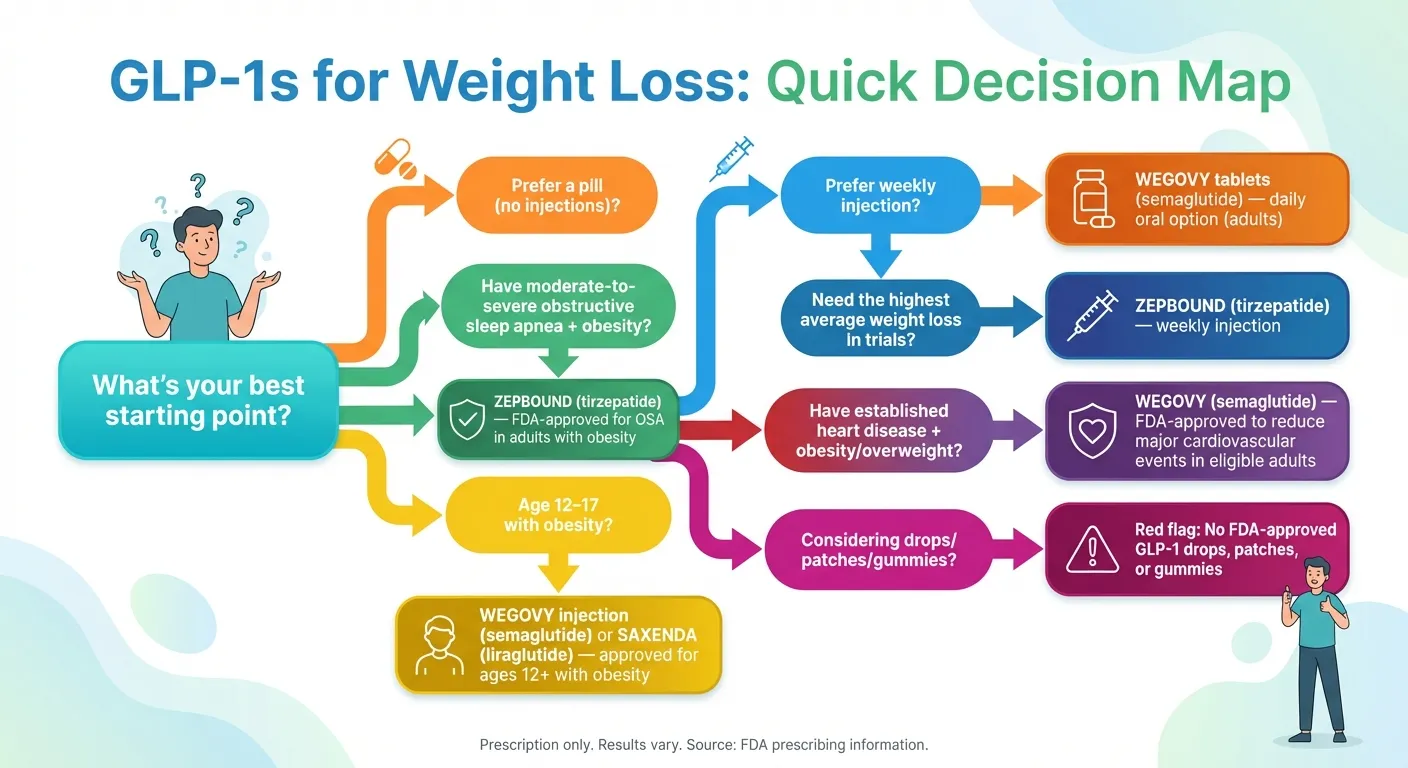
If you're considering a GLP-1, here's what you need to know:
| Your Situation | Best Starting Point |
|---|---|
| Want maximum weight loss | Zepbound (tirzepatide) — up to 22% in trials |
| Prefer no injections | Wegovy tablets — daily pill, ~13.6% weight loss |
| Have sleep apnea with obesity | Zepbound — FDA-approved for OSA |
| Have heart disease with obesity | Wegovy — approved to reduce cardiovascular events |
| On a tight budget | Oral Wegovy or generic liraglutide (generic Saxenda) |
| Seeing "GLP-1 drops" or "patches" | Red flag — no FDA-approved versions exist |
This guide covers everything: which medications actually work, realistic results, side effects, costs, and how to get GLP-1s safely without getting scammed.
Quick Comparison: FDA-Approved GLP-1s for Weight Loss (January 2026)
Before we dive deep, here's the comparison table you're probably looking for. This covers only the medications FDA-approved specifically for weight management—not diabetes drugs sometimes used off-label.
| Medication | Active Ingredient | How You Take It | Avg Weight Loss | Monthly Cost (Cash) | Who It's Best For |
|---|---|---|---|---|---|
| Zepbound | Tirzepatide | Weekly injection | 18-22% | $299-499 | Maximum weight loss; also approved for sleep apnea |
| Wegovy (injection) | Semaglutide | Weekly injection | 15-17% | $349-499 | Heart disease risk reduction; MASH; approved for ages 12+ |
| Wegovy (tablet) | Semaglutide | Daily pill | 13.6% | $149-299 | People who prefer pills over injections |
| Saxenda | Liraglutide | Daily injection | 5-8% | ~$300 (generic available) | Lower cost option; approved for ages 12+ |
Sources: FDA prescribing information for Wegovy, Zepbound, Saxenda
What Are GLP-1 Medications and How Do They Work?
GLP-1 stands for "glucagon-like peptide-1"—a hormone your gut naturally produces after eating. This hormone tells your brain you're full, slows down digestion, and helps regulate blood sugar.
GLP-1 medications are synthetic versions of this hormone, with a development history stretching back decades. When you take one, you're essentially amplifying a signal your body already uses to control appetite. Learn more about what GLP-1 is and how it works.
Three Ways GLP-1s Help You Lose Weight
1. They reduce appetite and "food noise"
Many people describe constant thoughts about food—what to eat next, cravings, thinking about snacks. GLP-1s quiet this mental chatter. Users often report that food simply becomes less interesting. You eat because you're hungry, not because you're thinking about food all day.
2. They slow gastric emptying
Food stays in your stomach longer, so you feel satisfied with smaller portions. That half-portion at dinner that used to leave you wanting more? On a GLP-1, it feels like enough.
3. They regulate blood sugar
By stimulating insulin release when you eat, GLP-1s prevent the blood sugar spikes and crashes that trigger cravings. This is why they were originally developed for diabetes—the weight loss was initially considered a side effect. Read more about how GLP-1 works for weight loss.
GLP-1 vs. GLP-1/GIP Dual Agonists
You'll hear about two types of medications in this space:
- GLP-1 agonists (Wegovy, Saxenda, Ozempic) target one hormone receptor.
- GLP-1/GIP dual agonists (Zepbound, Mounjaro) target two hormone receptors—GLP-1 and GIP (glucose-dependent insulinotropic polypeptide). GIP is another gut hormone involved in metabolism.
In clinical trials, the dual agonist tirzepatide (Zepbound) produced greater weight loss than semaglutide (Wegovy) alone. Whether this matters for you depends on your specific situation, tolerability, cost, and what your doctor recommends. Compare them directly: Semaglutide vs Tirzepatide.
Which GLP-1s Are FDA-Approved for Weight Loss?
This is where confusion runs rampant. Some GLP-1 medications are FDA-approved for weight loss. Others are approved only for diabetes but are sometimes prescribed "off-label" for weight loss. Same ingredients, different brands, different approvals.
FDA-Approved for Chronic Weight Management
These products have been reviewed by the FDA and approved specifically for weight loss:
Wegovy (semaglutide injection) — Weekly injection. Approved for adults and adolescents 12+ with obesity, or overweight with a weight-related condition. Also approved to reduce heart attack and stroke risk in adults with cardiovascular disease and obesity/overweight. Additional indication: treatment of noncirrhotic MASH (fatty liver disease) with moderate to advanced fibrosis in adults.
Wegovy (semaglutide tablets) — Daily pill. Approved December 2025. Indicated for weight reduction and cardiovascular risk reduction in eligible adults. Note: The MASH indication applies to WEGOVY injection only, not tablets. The tablet formulation is not established for patients under 18.
Zepbound (tirzepatide) — Weekly injection. Approved for adults with obesity, or overweight with a weight-related condition. Also approved for moderate to severe obstructive sleep apnea in adults with obesity.
Saxenda (liraglutide) — Daily injection. Approved for adults and adolescents 12+ with obesity, or overweight with a weight-related condition. The oldest of the weight-loss GLP-1s, and now the first with a generic version available.
Approved for Diabetes (Sometimes Used Off-Label for Weight Loss)
These medications contain the same active ingredients as the weight-loss versions but are FDA-approved only for type 2 diabetes:
| Brand Name | Active Ingredient | How Taken | FDA Indication |
|---|---|---|---|
| Ozempic | Semaglutide | Weekly injection | Type 2 diabetes |
| Mounjaro | Tirzepatide | Weekly injection | Type 2 diabetes |
| Rybelsus | Semaglutide | Daily tablet | Type 2 diabetes |
| Trulicity | Dulaglutide | Weekly injection | Type 2 diabetes |
| Victoza | Liraglutide | Daily injection | Type 2 diabetes |
"Off-label" prescribing is legal and common in medicine. Your doctor can prescribe Ozempic or Mounjaro for weight loss even though they're diabetes drugs. However, your insurance may not cover off-label use, and the doses may differ from the weight-loss formulations.
Understanding the Brand Name Confusion
Here's the relationship that trips everyone up:
| Active Ingredient | Diabetes Brand | Weight-Loss Brand |
|---|---|---|
| Semaglutide | Ozempic (injection), Rybelsus (tablet) | Wegovy (injection + tablet) |
| Tirzepatide | Mounjaro | Zepbound |
| Liraglutide | Victoza | Saxenda |
Same molecules, different packaging, different FDA approvals, sometimes different doses.
What About "Research Peptides," Drops, or Patches?
Let's be direct: There are no FDA-approved GLP-1 drops, patches, gummies, or supplements.
The FDA has issued warnings about products labeled "for research use only" that are being sold to consumers with dosing instructions. These are not legal prescription medications. They haven't been evaluated for safety, purity, or effectiveness.
If you see:
- "GLP-1 drops"
- "GLP-1 patches"
- "Research-grade semaglutide"
- "No prescription needed"
- Products sold with dosing instructions but labeled "not for human consumption"
These are red flags. Legitimate GLP-1 medications require a prescription and come from licensed pharmacies.
GLP-1 Pills vs. Injections: What's the Difference?
Most GLP-1s are injections, but oral options now exist. Here's how they compare.
Wegovy Tablets (Daily Oral)
The FDA approved Wegovy tablets in December 2025, making it the first oral GLP-1 specifically for weight loss. Here's what the label says:
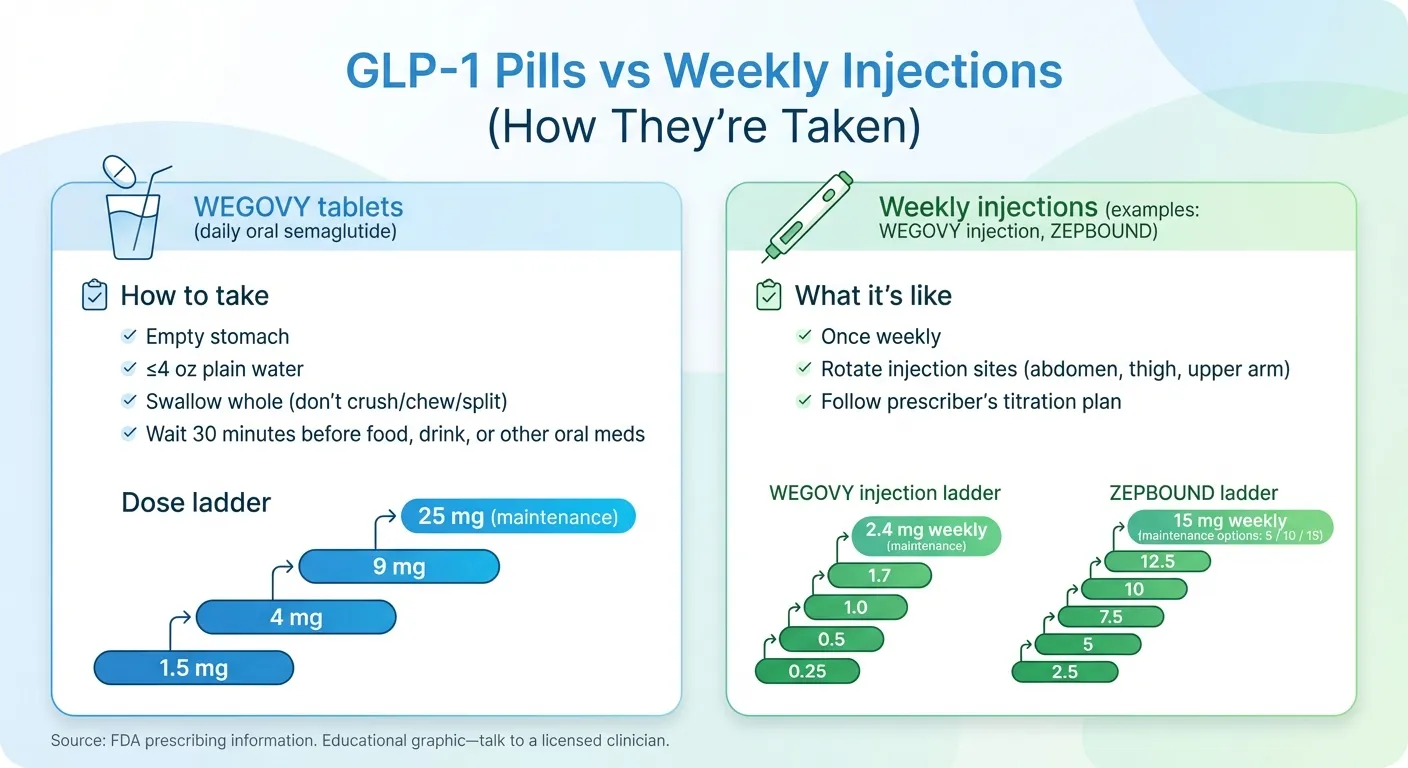
How to take it:
- Once daily, on an empty stomach in the morning
- Use no more than 4 ounces of plain water
- Do not take with other liquids besides water
- Do not crush, chew, or split the tablet
- Wait at least 30 minutes before eating, drinking anything else, or taking other oral medications
Dose escalation (FDA label):
| Days | Dose | Administration |
|---|---|---|
| 1-30 | 1.5 mg daily | Take on empty stomach with ≤4 oz water; wait 30 min before eating |
| 31-60 | 4 mg daily | Same administration |
| 61-90 | 9 mg daily | Same administration |
| 91+ | 25 mg daily | Maintenance dose |
Clinical results: In the OASIS 4 trial, adults taking 25 mg daily lost an average of 13.6% of their body weight over 64 weeks.
Limitations: The tablet formulation is not established for patients under 18 years old.
Wegovy Injection (Weekly)
The weekly injection has been available longer and has more extensive trial data.
Dose escalation (FDA label):
| Weeks | Dose | What to Expect |
|---|---|---|
| 1-4 | 0.25 mg weekly | Getting used to injections; minimal weight loss; mild GI symptoms possible |
| 5-8 | 0.5 mg weekly | Appetite changes begin; some weight loss; GI symptoms may increase |
| 9-12 | 1.0 mg weekly | Noticeable appetite reduction; steady weight loss |
| 13-16 | 1.7 mg weekly | Continued progress; most GI symptoms improving |
| 17+ | 2.4 mg weekly | Maintenance dose; weight loss continues then stabilizes |
Clinical results: In the STEP 1 trial, adults lost an average of 14.9% of their body weight over 68 weeks at the 2.4 mg maintenance dose.
Which Should You Choose?
| Factor | Weekly Injection | Daily Tablet |
|---|---|---|
| Weight loss in trials | 15-17% | 13.6% |
| Frequency | Once weekly | Once daily |
| Needle required | Yes (auto-injector, small needle) | No |
| Food restrictions | None | Must take on empty stomach with limited water, wait 30 minutes |
| Approved for adolescents | Yes (12+) | No |
| Monthly cost (cash) | $349-499 | $149-299 |
The tablet may be better if you:
- Have needle anxiety or phobia
- Prefer a daily routine
- Are cost-conscious (tablets are often cheaper)
- Are already stable on injections and want to switch
The injection may be better if you:
- Want maximum weight loss (slightly higher in trials)
- Prefer weekly dosing over daily
- Take other morning medications that would conflict with the 30-minute wait
- Are under 18 (tablets not approved for adolescents)
Switching Between Injection and Tablet
The FDA labeling provides specific guidance for switching between formulations:
From injection (2.4 mg weekly) → tablets (25 mg daily): Start tablets one week after discontinuing the 2.4 mg injection dose.
From tablets (25 mg daily) → injection (2.4 mg weekly): Start the injection the day after discontinuing 25 mg tablets. For patients who do not tolerate 25 mg tablets, consider switching to WEGOVY 1.7 mg injection.
Any switch involving different doses should be done under medical supervision with clinician guidance on the appropriate approach.
How Much Weight Will You Actually Lose?
This is the question everyone asks, and the honest answer is: it depends. Clinical trials show impressive results under controlled conditions. Real-world outcomes are typically more modest but still meaningful.
Clinical Trial Results (Best-Case Scenario)
| Medication | Trial | Duration | Avg Loss | ≥5% | ≥10% | ≥20% |
|---|---|---|---|---|---|---|
| Zepbound 15 mg | SURMOUNT-1 | 72 weeks | 22.5% | 91% | 83.5% | 56.7% |
| Zepbound 10 mg | SURMOUNT-1 | 72 weeks | 20.0% | 89% | 78% | 47% |
| Wegovy 2.4 mg injection | STEP 1 | 68 weeks | 14.9% | 86.4% | 69.1% | 32.0% |
| Wegovy 25 mg tablet | OASIS 4 | 64 weeks | 13.6% | — | — | — |
| Saxenda 3 mg | SCALE | 56 weeks | 8.0% | 63.2% | 33.1% | 14.4% |
Sources: FDA prescribing information and published trial data
What Those Numbers Mean in Pounds
| Starting Weight | 10% Loss | 15% Loss | 20% Loss |
|---|---|---|---|
| 180 lbs | 18 lbs | 27 lbs | 36 lbs |
| 200 lbs | 20 lbs | 30 lbs | 40 lbs |
| 220 lbs | 22 lbs | 33 lbs | 44 lbs |
| 250 lbs | 25 lbs | 37.5 lbs | 50 lbs |
| 300 lbs | 30 lbs | 45 lbs | 60 lbs |
Real-World Results Are Lower—Here's Why
Clinical trials involve carefully selected participants, regular check-ins, intensive support, and high adherence rates. Real life is messier.
A 2025 Cleveland Clinic study of nearly 8,000 patients found:
- Patients who stayed on treatment for 12 months: 11.9% average weight loss
- Patients who stopped within 3 months: 3.6% average weight loss
- Patients who stopped between 3-12 months: 6.8% average weight loss
- Patients on high maintenance doses of tirzepatide: 18.0% weight loss
- Patients on high maintenance doses of semaglutide: 13.7% weight loss
The main reasons for the gap between trial and real-world results:
- Cost and insurance barriers cause people to stop treatment early
- Side effects lead some people to quit or use lower doses
- Medication shortages interrupted treatment for many
- Less intensive support than clinical trial settings
What Can You Realistically Expect?
Based on real-world data, here's a realistic framework:
| Scenario | Expected Weight Loss | Total Annual Cost |
|---|---|---|
| Best case: High dose, no breaks, 12+ months | 15-20% | $3,600-6,000 |
| Typical case: Some missed doses, insurance gaps | 8-12% | $2,000-4,000 |
| Early discontinuation (<6 months) | 3-6% | Variable |
The takeaway: GLP-1s work, but results depend heavily on staying on treatment at adequate doses. The people who get the best outcomes are those who can afford to stay on medication long-term.
GLP-1 Side Effects and Risks
GLP-1 medications cause side effects in most people, especially during the first few weeks. The good news: most side effects are gastrointestinal, mild to moderate in severity, and improve as your body adjusts. Learn more in our complete GLP-1 side effects guide.
Common Side Effects (Wegovy Injection Clinical Trial Data)
These are the actual rates from the FDA label for Wegovy 2.4 mg injection vs. placebo:
| Side Effect | Wegovy | Placebo | Usually Improves? |
|---|---|---|---|
| Nausea | 44% | 16% | Yes (4-8 weeks) |
| Diarrhea | 30% | 16% | Yes |
| Vomiting | 25% | 6% | Yes |
| Constipation | 24% | 11% | Yes, with fiber/hydration |
| Abdominal pain | 20% | 10% | Yes |
| Headache | 14% | 10% | Yes |
| Fatigue | 11% | 5% | Yes |
| Dyspepsia | 9% | 3% | Yes |
| Dizziness | 8% | 4% | Yes |
| Hair loss | 3% | 1% | Variable |
Source: Wegovy FDA prescribing information, Table 3
Managing Common Side Effects
Most GI side effects can be minimized with some practical adjustments. Use our GLP-1 SOS tool for personalized relief suggestions.
For Nausea:
- Eat smaller, more frequent meals
- Avoid greasy, fatty, or fried foods
- Try ginger tea or ginger supplements
- Don't lie down immediately after eating
- Talk to your prescriber about slower dose escalation
For Constipation:
- Increase fiber intake (vegetables, fruits, whole grains)
- Stay well hydrated (GLP-1s can cause dehydration)
- Consider a fiber supplement like psyllium
- Stay physically active
For Fatigue:
- Ensure adequate protein intake (muscle preservation requires protein)
- Don't skip meals even if you're not hungry
- Stay hydrated
- This often improves as your body adjusts
Serious Risks and Warnings
All GLP-1 medications carry important warnings you need to know about.
Black Box Warning: Thyroid Tumors
All GLP-1 medications carry a boxed warning about thyroid C-cell tumors. In rodent studies, these medications caused thyroid tumors, including cancer. Whether this applies to humans is unknown.
Do NOT take GLP-1s if you have:
- Personal history of medullary thyroid carcinoma (MTC)
- Family history of MTC
- Multiple Endocrine Neoplasia syndrome type 2 (MEN 2)
Pancreatitis
GLP-1s have been associated with acute pancreatitis, including fatal cases. Stop taking the medication and contact your doctor immediately if you experience severe abdominal pain that may radiate to your back, with or without vomiting.
Gallbladder Problems
GLP-1s may increase the risk of gallbladder problems, including gallstones. Rapid weight loss from any cause can also trigger gallstones.
Hypoglycemia (Low Blood Sugar)
If you have diabetes and take insulin or certain diabetes medications (sulfonylureas), GLP-1s can increase your risk of low blood sugar. Your doctor may need to adjust your diabetes medications.
Kidney Problems
Dehydration from vomiting or diarrhea can worsen kidney function. Stay hydrated, and tell your doctor if you have kidney disease.
Pregnancy
GLP-1s should not be used during pregnancy. For semaglutide specifically, the FDA label recommends discontinuing at least 2 months before planned pregnancy due to its long half-life. If you become pregnant while taking a GLP-1, stop immediately and contact your healthcare provider.
When to Seek Medical Care
| Symptom | Action |
|---|---|
| Severe abdominal pain radiating to back | Seek urgent care (possible pancreatitis) |
| Signs of severe allergic reaction (rash, difficulty breathing, swelling) | Call 911 |
| Persistent vomiting with inability to keep fluids down | Seek same-day care (dehydration risk) |
| Symptoms of low blood sugar (shakiness, sweating, confusion) | Eat or drink fast-acting sugar; call doctor if severe |
| Lump in neck, hoarseness, difficulty swallowing | Schedule prompt appointment |
What About "Ozempic Face" and Hair Loss?
You may have heard about side effects not prominently featured in clinical trials:
"Ozempic face" refers to facial sagging that can occur with rapid weight loss from any cause. Fat loss in the face can make features look more gaunt or aged. This isn't unique to GLP-1s—it happens with any significant weight loss.
Hair loss was reported in 3% of Wegovy-treated patients vs. 1% on placebo in clinical trials. Rapid weight loss and reduced calorie intake can trigger temporary hair shedding (telogen effluvium). Adequate protein intake may help minimize this.
Both effects are related to the weight loss itself, not necessarily the medication.
Who Is a Good Candidate for GLP-1 Weight Loss Medications?
GLP-1s aren't for everyone. Here's who typically qualifies and who should consider other options.
Basic Eligibility
According to FDA labeling, GLP-1 weight loss medications are indicated for:
Adults with obesity: BMI of 30 or greater
Adults with overweight and at least one weight-related condition:
BMI of 27-29.9 plus: High blood pressure (hypertension), High cholesterol (dyslipidemia), Type 2 diabetes, Obstructive sleep apnea, or Cardiovascular disease
BMI Reference Chart
Not sure of your BMI? Here's a quick reference:
| Height | BMI 27 | BMI 30 | BMI 35 | BMI 40 |
|---|---|---|---|---|
| 5'0" | 140 lbs | 153 lbs | 179 lbs | 204 lbs |
| 5'2" | 148 lbs | 164 lbs | 191 lbs | 218 lbs |
| 5'4" | 157 lbs | 174 lbs | 204 lbs | 232 lbs |
| 5'6" | 167 lbs | 186 lbs | 216 lbs | 247 lbs |
| 5'8" | 177 lbs | 197 lbs | 230 lbs | 262 lbs |
| 5'10" | 188 lbs | 207 lbs | 243 lbs | 278 lbs |
| 6'0" | 199 lbs | 221 lbs | 258 lbs | 294 lbs |
| 6'2" | 211 lbs | 233 lbs | 272 lbs | 311 lbs |
Specific Situations
If you don't have diabetes: Yes, you can still qualify. Wegovy, Zepbound, and Saxenda are approved for weight management in people without diabetes who meet the BMI criteria.
If you have type 2 diabetes: GLP-1s can help with both blood sugar control and weight loss. However, if you also take insulin or medications that increase insulin (sulfonylureas), your doctor may need to adjust those to prevent low blood sugar.
If you have cardiovascular disease: Wegovy has a specific FDA indication for reducing the risk of major adverse cardiovascular events (heart attack, stroke, cardiovascular death) in adults with established cardiovascular disease and obesity or overweight. This is based on the SELECT trial, which showed a 20% reduction in these events.
If you have obstructive sleep apnea: Zepbound has an FDA indication for moderate to severe obstructive sleep apnea in adults with obesity. The SURMOUNT-OSA trials showed significant improvements in sleep apnea severity.
If you have fatty liver disease (MASH): Wegovy injection (not tablets) has an accelerated approval for treatment of noncirrhotic metabolic dysfunction-associated steatohepatitis (MASH) with moderate to advanced liver scarring (fibrosis).
If you're 12-17 years old: Wegovy injection and Saxenda are approved for adolescents 12 and older with obesity. Wegovy tablets and Zepbound are currently approved only for adults.
Who Should NOT Take GLP-1s
Absolute Contraindications:
- Personal or family history of medullary thyroid carcinoma
- Multiple Endocrine Neoplasia syndrome type 2 (MEN 2)
- Known hypersensitivity to the medication
- Pregnancy (current or planned within 2 months for semaglutide)
Use with Caution / Discuss with Doctor:
- History of pancreatitis
- Severe gastrointestinal disease (gastroparesis, IBD)
- History of gallbladder disease
- Severe kidney disease
- History of suicidal thoughts or behavior
- Breastfeeding (not recommended with Wegovy tablets)
- Using oral contraceptives with tirzepatide: The FDA label notes tirzepatide may reduce the effectiveness of oral hormonal contraceptives due to delayed gastric emptying. Switch to a non-oral method or add a barrier method for 4 weeks after starting and for 4 weeks after each dose escalation.
How Much Do GLP-1s Cost?
Cost is the biggest barrier for most people. Let's break down what you'll actually pay.
List Prices vs. What You'll Pay
GLP-1 medications have high list prices, but most people pay less through insurance, manufacturer programs, or negotiated cash prices.
How we verify prices: We check manufacturer direct-pay pages and major pharmacy pricing sources monthly. Prices vary by dose, location, and eligibility; always confirm your total monthly cost before starting.
| Medication | List Price | Cash Pay (Self-Pay) | With Insurance + Copay Card |
|---|---|---|---|
| Wegovy injection | $1,349/month | $349-499/month | As low as $25/month* |
| Wegovy tablet | $1,349/month | $149-299/month | As low as $25/month* |
| Zepbound | $1,086/month | $299-499/month | As low as $25/month* |
| Ozempic | $1,028/month | $349-499/month | As low as $25/month* |
| Saxenda | $1,349/month | ~$300/month (generic available) | Varies |
*With manufacturer copay card and commercial insurance that covers the medication
Note: These prices reflect medication programs only and may not include telehealth consult fees, labs, shipping, or membership costs. Prices verified: January 2026
How to Get the Lowest Price
Option 1: Check your insurance first
If your health insurance covers GLP-1s for weight loss, this is usually the cheapest option. However, only about 19% of large employers include weight loss medication coverage.
To check: Call member services, ask specifically about weight management coverage, prior authorization requirements, and step therapy.
Option 2: Use manufacturer savings programs
Both major GLP-1 manufacturers offer self-pay programs:
- Novo Nordisk (Wegovy, Ozempic): NovoCare Pharmacy offers self-pay pricing. Wegovy injection: $349/month standard.
- Eli Lilly (Zepbound): LillyDirect offers self-pay pricing starting at $299/month for lower doses.
Option 3: Manufacturer copay cards (with commercial insurance)
If your insurance covers the medication but you have a high copay, manufacturer savings cards can reduce your out-of-pocket cost to as low as $25/month. These don't work for Medicare, Medicaid, or other government insurance programs.
Option 4: Medicare (evolving coverage)
Medicare coverage for anti-obesity medications has historically been limited. The Medicare GLP-1 Bridge launched July 1, 2026 and has been extended through December 31, 2027, offering eligible Part D beneficiaries access at $50/month. The BALANCE Medicare Part D model has been delayed — check cms.gov for the current launch date. Verify coverage directly with your plan.
Compare all your options: Best GLP-1 Online Programs
How to Get GLP-1s Safely (and Avoid Scams)
GLP-1s require a prescription. Here are your legitimate options, ranked by safety.
Tier 1: Your Primary Care Doctor or Specialist
Pros:
- Knows your complete medical history
- Can coordinate with other conditions and medications
- Establishes ongoing relationship for long-term management
- Visit may be covered by insurance
Cons:
- May need to advocate for weight loss medication
- Some doctors less familiar with newer GLP-1s
- Longer wait times for appointments
Tier 2: Obesity Medicine Specialist or Endocrinologist
Best for: People who haven't succeeded with other approaches, those with significant obesity-related conditions.
Tier 3: Reputable Telehealth Providers
Telehealth has become a major access point for GLP-1s. Quality varies widely. For a detailed ranking and comparison of telehealth platforms, see our comprehensive guide to the best GLP-1 telehealth providers.
What to look for in a telehealth provider:
| Quality Marker | Good Sign | Red Flag |
|---|---|---|
| Medical intake | Comprehensive questionnaire, reviews medical history, asks about contraindications | Minimal questions, no health history review |
| Prescriber credentials | Licensed physician, NP, or PA in your state; credentials verifiable | Can't verify prescriber; no clear provider information |
| Pharmacy fulfillment | Ships from licensed US pharmacy; uses FDA-approved medications | Ships from overseas; "research" products; unclear sourcing |
| Ongoing care | Regular follow-ups; access to care team for questions | One-time transaction; no follow-up |
| Transparent pricing | Clear costs upfront; no hidden fees | Vague pricing; unexpected charges |
| Cancellation policy | Clear terms; reasonable cancellation process | Difficult to cancel; unclear terms |
Recommended Provider: MEDVi
MEDVi is a reputable telehealth provider that offers FDA-approved GLP-1 medications with comprehensive medical oversight, transparent pricing, and ongoing support.
Get Started with MEDViWhat to Avoid
No FDA-approved versions exist. These are not legitimate medications.
Products labeled "for research use only" or "not for human consumption" are not legal prescription medications.
GLP-1s are prescription-only medications. Any seller offering them without a prescription is operating illegally.
If someone offers brand-name GLP-1s for $100/month when the market rate is $300-500, something is wrong.
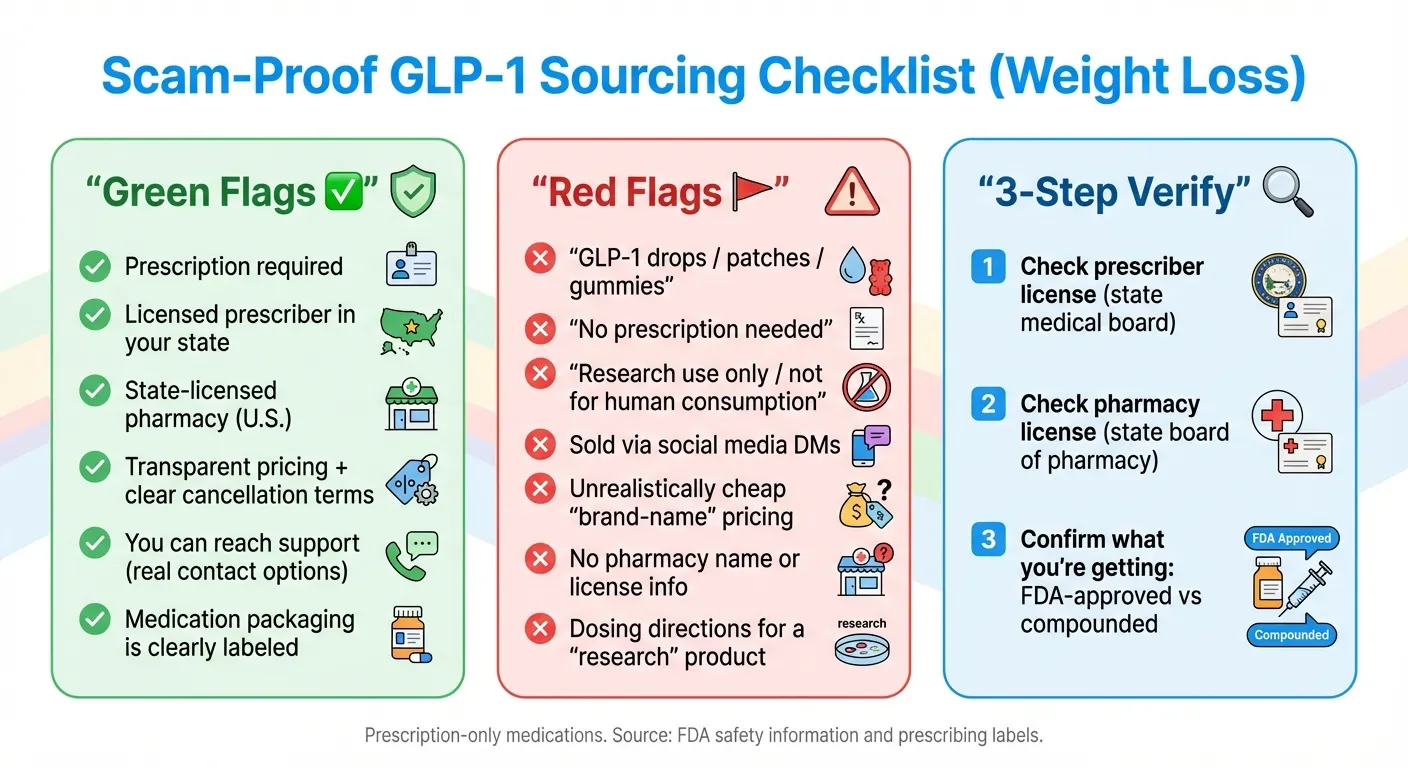
The Scam-Proof Sourcing Checklist
Before getting GLP-1s from any source, verify:
- Prescriber is licensed in your state (check your state medical board website)
- Pharmacy is licensed (check your state board of pharmacy)
- Medication is FDA-approved (not "compounded" unless FDA-approved is unavailable)
- Clear pricing with no hidden fees
- Medication ships with proper cold storage
- You can reach a real person if you have questions
- No claims that seem too good to be true
Frequently Asked Questions
How This Guide Is Maintained
We update this guide monthly and immediately when FDA labels change or significant new evidence emerges.
Our editorial process:
- Primary sources: FDA prescribing information, FDA safety communications, peer-reviewed clinical trials
- All claims are citation-verified before publication
- Pricing is verified through manufacturer programs and major pharmacy sources monthly
- Medical review by a licensed healthcare provider
- Update log maintained with all changes
Last comprehensive review: January 26, 2026
Update Log
| Date | Change |
|---|---|
| January 26, 2026 | Comprehensive update: Added Wegovy tablets (approved December 2025) with correct titration schedule per FDA label; updated all pricing to current levels; clarified Medicare coverage status; updated Zepbound OSA indication; corrected switching instructions per FDA label |
References and Sources
FDA Prescribing Information (Primary Sources)
- Wegovy (semaglutide injection and tablets) prescribing information. FDA. December 2025. Link
- Zepbound (tirzepatide) prescribing information. FDA. 2025. Link
- Saxenda (liraglutide) prescribing information. FDA. 2025. Link
FDA Safety Communications
- FDA's Concerns with Unapproved GLP-1 Drugs Used for Weight Loss. FDA. Link
- FDA Clarifies Policies for Compounders as National GLP-1 Supply Begins to Stabilize. FDA. Link
CMS Policy
- BALANCE Model. Centers for Medicare & Medicaid Services. Link
Clinical Trials
- Jastreboff AM, et al. Tirzepatide once weekly for the treatment of obesity. N Engl J Med. 2022;387(3):205-216. (SURMOUNT-1)
- Wilding JPH, et al. Once-weekly semaglutide in adults with overweight or obesity. N Engl J Med. 2021;384(11):989-1002. (STEP 1)
- Aronne LJ, et al. Continued treatment with tirzepatide for maintenance of weight reduction in adults with obesity. JAMA. 2024. (SURMOUNT-4)
- SELECT Trial Investigators. Semaglutide and cardiovascular outcomes in obesity. N Engl J Med. 2023.
Real-World Evidence
- Gasoyan H, et al. Changes in weight and glycemic control following obesity treatment with semaglutide or tirzepatide by discontinuation status. Obesity (Silver Spring). June 2025.
- Brown A, et al. Comparative effectiveness of semaglutide and tirzepatide vs bariatric surgery. Presented at ASMBS 2025 Annual Scientific Meeting.
Disclaimer: This guide provides general health information and is not a substitute for professional medical advice. Individual medical decisions should be made in consultation with a qualified healthcare provider who can evaluate your specific circumstances. The authors and publishers are not responsible for any adverse effects or consequences resulting from the use of information presented here.