Best GLP-1 for Seniors: Safest Options, Real Costs, Medicare, and Top Programs
We compared major GLP-1 access paths for adults 60+ — brand-name through your doctor, Medicare's live Bridge program, telehealth programs, and compounded options — focusing on pricing transparency, clinical oversight, senior-specific safety concerns, drug interaction screening, and cancellation terms. Here's what we found.
Disclosure: Some links on this site are affiliate links. If you purchase through these links, we may earn a commission at no extra cost to you. Thank you for supporting our site.·For informational purposes only—not medical advice.
What changed in this review — October 1, 2026 update: Selected public offers and policies checked October 1, 2026; checkout was not completed. Replaced the Medicare Bridge eligibility summary with the three CMS BMI routes, corrected Embody's medical-disqualification refund terms, separated Embody's tracked offer from its direct storefront, and removed an unsupported state-exclusion claim. September 21, 2026: Rechecked Embody's storefront and Terms, removed unverified claims that gum is currently offered, replaced stale Embody pricing, and rechecked CMS Bridge timing.
Here's the bottom line. For adults 60+, the right GLP-1 path usually starts with how you will pay and whether your health history calls for more hands-on medical oversight—not with one universal provider. If you have Medicare drug coverage, check Part D or the Medicare GLP-1 Bridge before paying cash. If you have employer or private insurance, check coverage first. If you expect to pay cash, compare the amount due today, billing commitment, medication type, and clinical support. Choose your situation below for the clearest next step.
Choose your next step
Which payment path fits you?
This quick guide does not ask for your diagnosis or detailed insurance information. Choose the situation that is closest to yours.
Medicaid, VA, TRICARE, dual coverage, or another government program? Start here rather than assuming Medicare Bridge rules apply.
There is no FDA age limit on GLP-1 medications. Clinical trials included adults well into their 70s, and the landmark SELECT cardiovascular trial — which showed semaglutide reduced major adverse cardiovascular events by 20% — enrolled patients with a mean age of 61.6 years (Source: NEJM, 2023). You are not too old for this. But you do need the right program, the right monitoring, and the right expectations.
This page covers two questions: Best medication (Wegovy vs Zepbound vs Ozempic — which drug fits your health profile) and Best program (where to get it safely and affordably as a senior). Jump to: Best medications · Medicare's new $50 program · Best programs
Quick Decision Guide
| Your Situation | Best Path | Why |
|---|---|---|
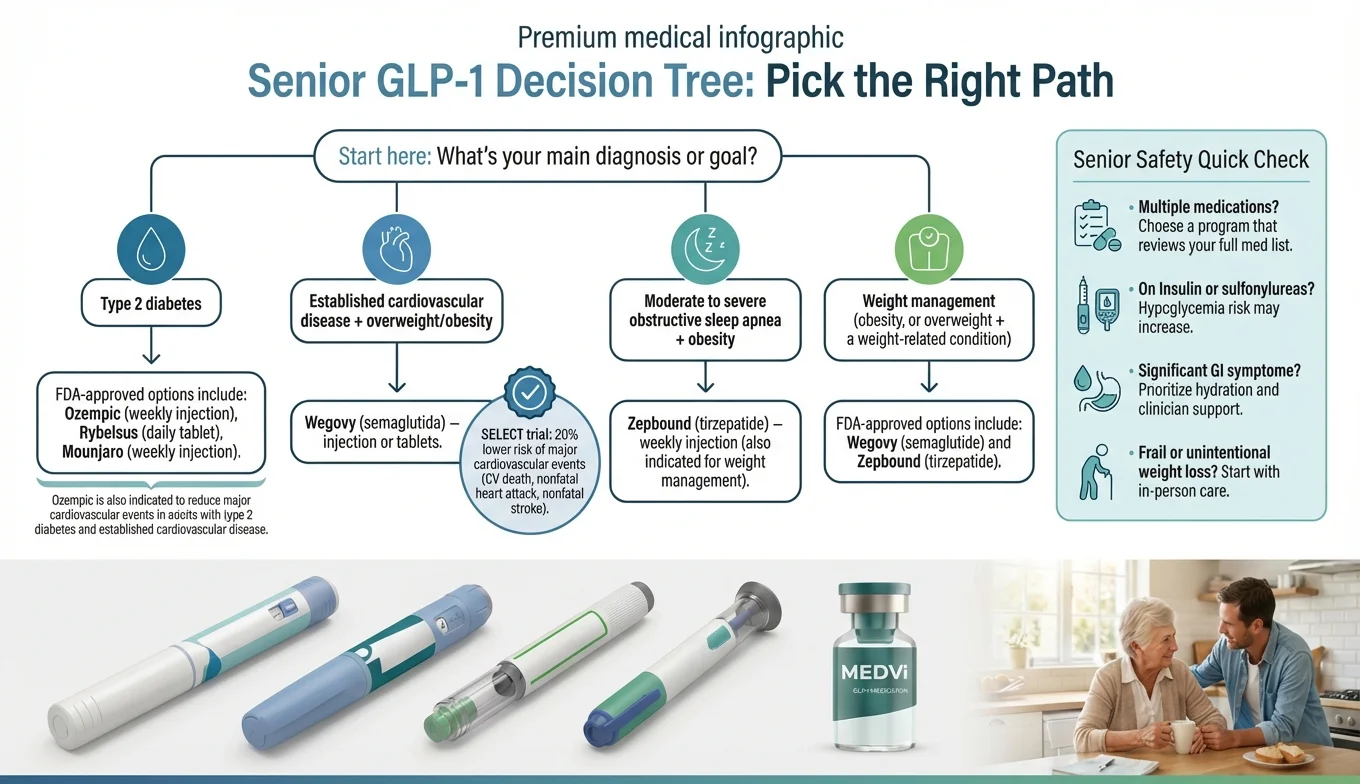
| You have Medicare Part D or MA-PD and want weight-management treatment | Check Part D and the live Medicare GLP-1 Bridge | Eligible beneficiaries may pay a $50/month copay under current CMS rules; not every Medicare Advantage plan qualifies |
| You have diabetes + Medicare | Ask your doctor about Ozempic or Mounjaro | Medicare Part D already covers GLP-1s for type 2 diabetes |
| You have heart disease + obesity | Ask your doctor about Wegovy (cardiovascular indication) | Part D can cover it under the CV indication today — no waiting for July |
| You expect to pay cash | Compare the amount due, billing commitment, medication type, and support | Use the payment-path guide above rather than assuming one provider fits every budget |
| You want an established cash-pay program | Review a provider's current program and support terms | Compare clinician access, medication, current pricing, and the provider's regulatory record |
| You want a pill, not a shot | Ask your doctor about an FDA-approved oral option and current coverage | Daily tablet; see oral semaglutide guide |
| You want a needle-free option | Compare FDA-approved tablets with compounded formats | Start with FDA-approved tablets (Wegovy tablets, Rybelsus, Foundayo); compounded oral products are a separate, non-FDA-approved category |
| You want the lowest possible ongoing cost | Compare current plan length and total amount due | A lower effective monthly figure may require paying several months upfront |
| You're frail, underweight, or 80+ with health concerns | See your doctor in person first | Telehealth alone isn't enough for complex cases |
Not sure which path is right for you?
Find My GLP-1 PathWhat's the Best GLP-1 Medication for Seniors Right Now?
There isn't one best GLP-1 for every senior — and anyone who tells you otherwise is selling something. What there is is a best fit for your situation based on four things: your health conditions, your coverage, your tolerance for injections, and your budget.
Here's how the major GLP-1 medications stack up for adults over 60:
| Medication | Type | FDA-Approved For | Best For Seniors Who... | Key Senior Concern |
|---|---|---|---|---|
| Semaglutide injection (Wegovy) | Weekly shot | Weight management + cardiovascular risk reduction | Have heart disease risk AND obesity | Hip/pelvis fracture risk noted in 75+ patients |
| Semaglutide injection (Ozempic) | Weekly shot | Type 2 diabetes | Have diabetes as the primary diagnosis | Both Ozempic and Wegovy contain semaglutide — different approved uses |
| Semaglutide tablets (Wegovy tablets) | Daily pill | Weight management + cardiovascular risk reduction | Want to avoid injections — covered by Medicare Bridge at $50/mo | New (approved late 2025) — long-term senior data still building |
| Semaglutide tablets (Rybelsus) | Daily pill | Type 2 diabetes | Have diabetes and prefer oral medication | Must be taken on empty stomach, 30 min before food |
| Orforglipron tablets (Foundayo) | Daily pill | Weight management | Want a daily pill and may qualify for the Medicare Bridge | Newest option — discuss senior-specific data with your doctor |
| Tirzepatide injection (Zepbound) | Weekly shot | Weight management + obstructive sleep apnea | Want maximum weight loss and can tolerate injections | Stronger weight loss in trials; less long-term cardiovascular data than semaglutide |
| Tirzepatide injection (Mounjaro) | Weekly shot | Type 2 diabetes | Have diabetes and want a dual-action medication | GLP-1 + GIP dual agonist |
| Compounded semaglutide (various providers) | Weekly shot or daily tablet, depending on provider | Not FDA-approved | Want affordable cash-pay access without insurance | Quality varies by pharmacy — choose carefully |
Sources: FDA prescribing information for Wegovy, Ozempic, Zepbound, Mounjaro, Rybelsus, Foundayo. Clinical data from STEP, SURMOUNT, and SELECT trials published in the New England Journal of Medicine.
The bottom line for most seniors: If you have diabetes, semaglutide (Ozempic) or tirzepatide (Mounjaro) may offer a dual benefit — blood sugar control and weight loss — and insurance coverage is more likely when the prescription matches an approved indication. If weight loss and heart health are your goals, the semaglutide data, including the SELECT trial's 20% MACE reduction, is important evidence for adults in their 60s and 70s. If you expect to pay cash, compare the medication type, clinical oversight, total cost, and billing commitment before enrolling in a compounded program.
Which GLP-1 Is Best for YOUR Situation?
We know you didn't come here for a lecture. You came here because something specific is going on — a doctor's recommendation, a friend's transformation, or a number on the scale that's affecting your knees, your blood sugar, or your confidence. So let's cut straight to it.
If You Have Type 2 Diabetes
You're in the strongest position of anyone reading this page. GLP-1 medications were originally designed for type 2 diabetes, and both semaglutide (Ozempic/Rybelsus) and tirzepatide (Mounjaro) are FDA-approved for it. That means:
- Your insurance or Medicare Part D is far more likely to cover it
- You get the dual benefit: better A1C and weight loss
- Your doctor already has a clinical reason to prescribe it
Your move: Talk to your doctor or endocrinologist about Ozempic or Mounjaro first. If cost is still a barrier even with insurance, ask about supervised cash-pay options only after reviewing the medication type, total price, refill terms, and clinical oversight. Explore your coverage options first.
If You Have Heart Disease or High Cardiovascular Risk
This is where the science gets genuinely exciting for older adults. The SELECT trial (published in the New England Journal of Medicine in 2023) studied over 17,600 adults with obesity and established cardiovascular disease. The mean age of participants was 61.6 years. The result: semaglutide 2.4 mg reduced major adverse cardiovascular events (MACE) — a composite of cardiovascular death, non-fatal heart attack, and non-fatal stroke — by 20% over a mean follow-up of 39.8 months.
That's not just a weight loss finding. That's a cardiovascular protection finding. And in March 2024, the FDA approved Wegovy specifically for cardiovascular risk reduction in adults with obesity or overweight and established heart disease.
Why this matters for Medicare: Because Wegovy has an FDA-approved cardiovascular indication, Medicare Part D can cover it today for eligible patients — not for weight management alone, but for cardiovascular risk reduction. If your prescription is for weight management, the Medicare GLP-1 Bridge, live since July 1, 2026, offers a $50/month copay for eligible beneficiaries under current rules.
Your move: If you have established cardiovascular disease plus obesity or overweight, ask your cardiologist or primary care doctor about Wegovy under the cardiovascular indication. This may be your most affordable path and is separate from the weight-management Bridge route.
If You're on Medicare or a Fixed Income
Let's be direct about the money, because we know it matters — and because the rules just changed in your favor.
What Medicare may cover through regular Part D:
- GLP-1 medications for type 2 diabetes — yes, Medicare Part D covers Ozempic, Mounjaro, and Rybelsus
- GLP-1 medications for cardiovascular risk reduction (Wegovy with the CV indication) — yes, for eligible patients
- Zepbound for obstructive sleep apnea — yes, Part D plans can cover it under the OSA indication
- GLP-1 medications for weight management alone — use the separate Bridge route if you meet its current criteria
The Medicare GLP-1 Bridge — what's confirmed for 2026:
The Bridge is a nationwide CMS demonstration running July 1, 2026 through December 31, 2027. Here is what CMS has made official:
- Cost to you: a flat $50/month copay. That's your total out-of-pocket for the medication. Note for low-income beneficiaries: the $50 is not reduced by the Low-Income Subsidy, and it does not count toward your Part D deductible or out-of-pocket maximum.
- Covered medications: Foundayo (all formulations), Wegovy (injection and tablets), and the Zepbound KwikPen. Zepbound single-dose vials and single-dose pens are not covered through the Bridge.
- Who qualifies: Medicare GLP-1 Bridge eligibility requires an eligible Part D plan type, age 18+, a weight-management prescription with ongoing lifestyle treatment, and prior authorization. CMS has three clinical routes:
BMI when GLP-1 treatment began Additional condition 35+ No listed comorbidity requirement for this route 30+ Heart failure with preserved ejection fraction; uncontrolled hypertension above 140 systolic or 90 diastolic despite two blood-pressure medicines; or chronic kidney disease stage 3a or higher 27+ Prediabetes under ADA criteria; previous heart attack; previous stroke; or symptomatic peripheral artery disease - BMI is measured when treatment began: CMS uses BMI at treatment initiation, including treatment begun before Medicare enrollment or the Bridge launch. Your prescriber must document the qualifying history. A lower BMI now does not automatically disqualify you.
- Some patients belong in Part D instead: CMS directs patients with type 2 diabetes, moderate-to-severe obstructive sleep apnea, or noncirrhotic MASH through Part D instead. A prescription intended to reduce major cardiovascular events also belongs with Part D. Not every Medicare Advantage plan qualifies. Source: CMS provider guidance.
- How it works: Your prescriber sends the prescription to the pharmacy first. The pharmacy claim starts the prior-authorization workflow, which is handled through the Bridge process rather than a normal Part D claim.
Sources: CMS Medicare GLP-1 Bridge pages and press release (May 2026); CMS FAQs (March 3, 2026); KFF and Medicare Rights Center analyses (May–June 2026); NPR (May 6, 2026).
If you do not qualify for the Bridge, need another indication, or expect to pay cash:
| Route | Monthly Cost | What's Included |
|---|---|---|
| Medicare GLP-1 Bridge (if eligible) | $50/mo flat copay | Brand-name Wegovy, Zepbound KwikPen, or Foundayo via your pharmacy |
| Brand-name (cash, no insurance) | $900–$1,500/mo (oral Wegovy from $149/mo at lower doses) | FDA-approved medication |
| Embody (compounded) | See current offer | Clinician review, available formats, current refund and cancellation terms |
| MEDVi (compounded) | See current offer | Physician review, support access, current medication and refill terms |
| TrimRx (compounded) | See current offer | Confirm medication, amount billed, billing cadence, renewal, and cancellation terms |
| Yucca Health (compounded) | See current offer | Compare plan length, total amount due, pharmacy, and shipping terms |
| Willow (compounded) | See current offer | Compare current medication, clinical support, availability, and refill terms |
We include the Bridge at the top of this table because we'd rather point you to Medicare than to any affiliate on this page. Provider prices and availability can change, so confirm the current amount due, billing cadence, cancellation policy, and state availability before purchasing.
If You Want a Pill Instead of a Shot
Good news: you have more needle-free options than ever. Start with the FDA-approved tablets; compounded oral products are a separate category with their own caveats.
Wegovy tablets are FDA-approved for weight management and cardiovascular risk reduction and are available through pharmacies. Their current cash price and coverage depend on the product, dose, plan, and indication; eligible beneficiaries may have a $50/month Bridge copay.
Rybelsus (oral semaglutide) has been available for type 2 diabetes since 2019. It's a once-daily tablet taken on an empty stomach with a small sip of water, then you wait at least 30 minutes before eating, drinking, or taking other medications — a timing rule that matters if you take several morning pills.
Foundayo (orforglipron) is an FDA-approved daily tablet and is among the products the Medicare GLP-1 Bridge lists; ask your prescriber whether it fits your history.
Compounded oral products are a separate category. MEDVi offers a compounded oral dissolvable tablet; current pricing varies by offer and treatment. Embody's public storefront checked September 21, 2026 listed compounded semaglutide and tirzepatide injections only — we could not verify that a gum format is currently offered, so do not choose Embody on that assumption. Compounded products are not FDA-approved and are not the same as the approved tablets above.
The honest tradeoff: In clinical trials, injectable semaglutide has generally shown greater weight loss than oral formulations. If maximum weight loss is your goal and you're comfortable with a weekly injection — the needle is tiny — the shot is likely more effective. But if needles are a dealbreaker, you now have FDA-approved pills (through your doctor or the Bridge), with compounded oral tablets as a separate, non-FDA-approved option. Don't let the injection question stop you from getting treatment.
If Your Adult Child Is Researching This for You
First — good for them, and good for you. Here's what to look for in a GLP-1 program for your parent:
- Does the provider screen for drug interactions? Your parent is likely on multiple medications. A provider that doesn't ask about current prescriptions is a red flag.
- Is there clinician-level oversight? Not just a chatbot or algorithm — a licensed clinician reviewing the case who can say no.
- Can they cancel easily — and what happens if they don't qualify? Seniors don't want to feel trapped in a subscription. Look for a clear cancellation process and a written refund policy. Embody's public Terms and Refund Policy require cancellation at least 72 hours before the next billing date to stop the next charge. Payments are generally final; cancellation stops future billing rather than refunding the paid term. Provider-initiated medical disqualification refunds the unused portion of the current term after deducting services already rendered. A full refund is not guaranteed. Confirm any stricter selected-plan deadline and keep written confirmation.
- Is pricing transparent? Look for the amount due today, the refill price, the billing cadence, and any plan commitment before paying.
Is GLP-1 Safe for Seniors? What the Clinical Data Actually Shows
This is the question that keeps most seniors on the fence. So let's answer it clearly.
Yes — GLP-1 medications are generally considered safe for adults over 60, and clinical trials have specifically included older adults. The FDA has not set an upper age limit for semaglutide or tirzepatide. In the Wegovy prescribing information, the FDA notes:
- Injection weight-management trials: 9% were 65–<75 years old; 1% were 75+
- Tablets weight-management trial: 8% were 65–<75; 2% were 75+
- CV outcomes trial (SELECT): 30% were 65–75; 8% were 75+
No overall differences in safety or efficacy were observed compared to younger adults — though the FDA adds that "increased sensitivity in some geriatric individuals cannot be ruled out." The SELECT trial provides particularly strong evidence because nearly 40% of participants were 65 or older.
Source: Wegovy FDA prescribing information (2024 revision); Lincoff AM et al., NEJM 2023; 389:2221-2232.
Side Effects Seniors Should Watch For
These are the same side effects that affect all GLP-1 users — but some hit harder when you're older:
Common (and usually manageable):
- Nausea, vomiting, diarrhea — Usually worst during the first few weeks and during dose increases. For seniors, the bigger risk is dehydration. Stay ahead of fluids.
- Constipation — Common across all ages. Adequate fiber, hydration, and gentle activity usually help.
- Decreased appetite — This is the mechanism working. But for seniors, eating too little is a real risk. You still need adequate protein and calories even when you're not hungry.
Less common but important:
- Hypoglycemia — Particularly if you're on insulin or sulfonylureas for diabetes. Your provider should adjust your diabetes medications when starting a GLP-1.
- Gallbladder issues — Slightly elevated risk of gallstones, especially with rapid weight loss. Report any severe upper abdominal pain.
- Pancreatitis — Rare but serious. Severe, persistent abdominal pain that radiates to the back needs immediate medical attention.
- Hip and pelvis fractures — In the SELECT cardiovascular outcomes trial, the Wegovy prescribing information notes that patients 75 and older reported more hip and pelvis fractures on Wegovy than placebo. This is important data and one reason why bone health monitoring matters.
When to call your doctor immediately: Severe abdominal pain that won't go away. A lump or swelling in your neck. Trouble swallowing or persistent hoarseness. Signs of severe dehydration (dizziness, dark urine, confusion). Symptoms of severe allergic reaction.
Sources: FDA prescribing information for Wegovy (2024), Ozempic, Zepbound, Mounjaro; Novo Nordisk novoMEDLINK geriatric safety data.
Drug Interactions Seniors Need to Discuss
If you're over 60, there's a decent chance you're taking more than one medication. GLP-1s slow gastric emptying — meaning they change how quickly your stomach processes what you put in it, including other pills. Here's what to flag with your provider:
- Insulin or sulfonylureas: Hypoglycemia risk increases. Your provider should reduce the dose of these medications when starting a GLP-1.
- Blood thinners (warfarin): GLP-1s may affect absorption timing. Your INR should be monitored more closely during the first few months.
- Blood pressure medications: As you lose weight, your blood pressure often drops. You may need less medication, not more. If you get dizzy standing up, tell your doctor.
- Thyroid medication (levothyroxine): Delayed gastric emptying can affect absorption. Maintain your regular dosing routine and get your thyroid levels checked.
- Oral medications taken on an empty stomach: The timing of all oral medications may need review.
This is exactly why we rank providers on drug interaction screening. If a GLP-1 provider doesn't ask what else you're taking during intake, that's not a provider built for seniors. Walk away. For more details, see our safe usage guide.
Is There an Age Limit for GLP-1 Medications?
No. There is no FDA-imposed upper age limit for semaglutide (Wegovy, Ozempic, Rybelsus) or tirzepatide (Zepbound, Mounjaro).
What does matter is your individual health status. Your doctor evaluates kidney function, nutritional status, frailty, current medications, and bone density — not a number on your driver's license. A healthy 72-year-old with obesity and high blood pressure is a completely appropriate candidate. An 85-year-old who's frail and losing weight unintentionally is probably not.
Source: FDA prescribing information, geriatric use sections for Wegovy, Ozempic, Zepbound, Mounjaro.
Will GLP-1 Cause Muscle Loss? A Senior's Guide to Staying Strong
We're going to be straight with you about something most GLP-1 websites won't touch.
GLP-1 medications can cause muscle loss alongside fat loss. In the STEP trials, roughly 39% of the total weight lost was lean mass (which includes muscle). For a 35-year-old with plenty of muscle to spare, that's a footnote. For a 65-year-old who's already losing muscle naturally — a process called sarcopenia — it matters.
This is the most important paragraph on this page: The muscle loss concern is real, it's manageable, and it shouldn't stop you. Because here's what the full picture shows: for obese seniors, the net health benefit of GLP-1 treatment — reduced joint stress, improved cardiovascular markers, better mobility, better blood sugar — often outweighs the manageable muscle loss for appropriate candidates when combined with adequate protein intake and resistance exercise, under clinician supervision.
A review published in Pharmacotherapy (2024) on pharmacological treatment of obesity in older adults emphasized that weight-loss interventions in this population should include exercise and adequate protein to preserve muscle and bone. The American Geriatrics Society and AACE/ACE guidelines echo this: evaluate for sarcopenia before and during treatment, and build a preservation plan.
Source: "Pharmacological Treatment of Obesity in Older Adults," PMC (2024); AACE/ACE Obesity Clinical Practice Guidelines. See also: How to prevent muscle loss on GLP-1.
The Senior Muscle Preservation Protocol
This isn't complicated. It just has to be deliberate.
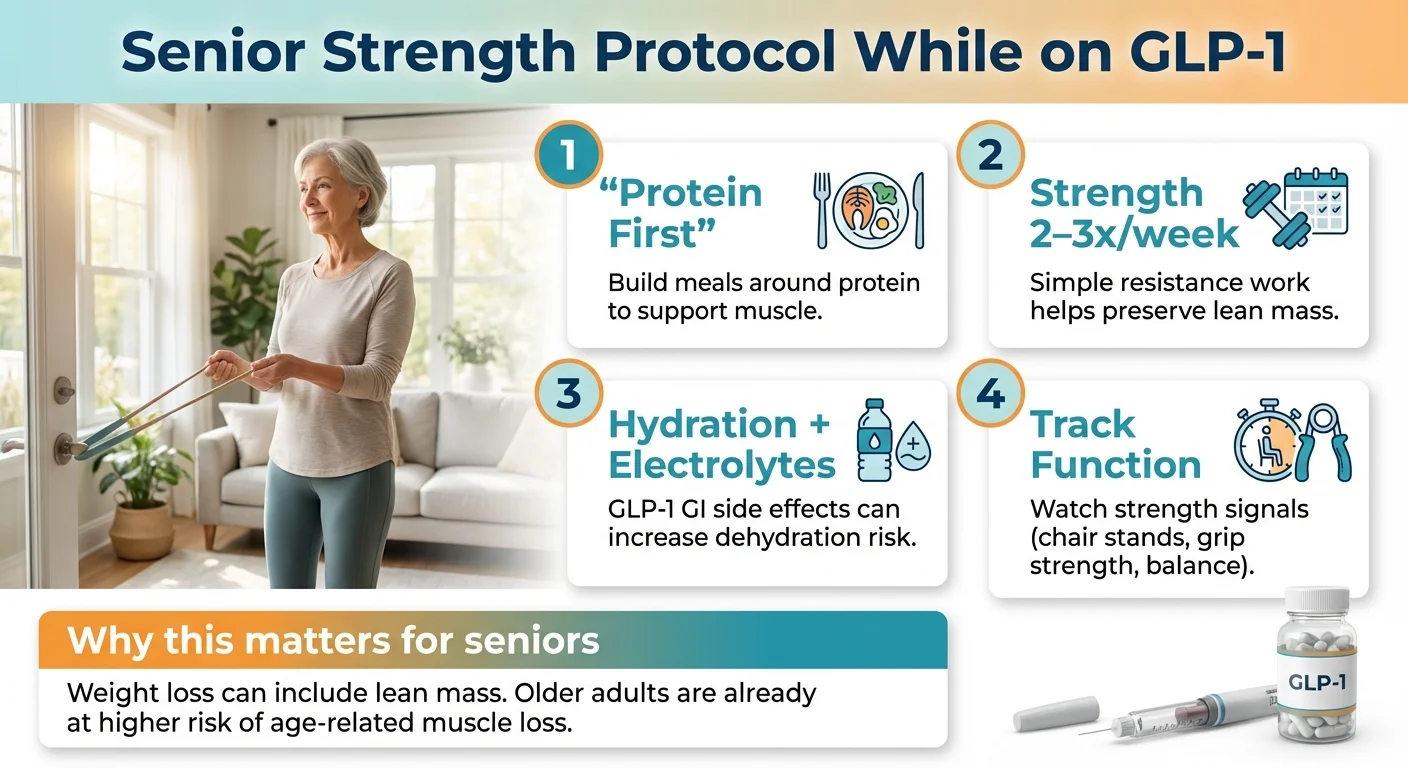
1. Protein: Aim for at least 1.0–1.2 grams per kilogram of body weight daily (about 0.45–0.55 g per pound). That's roughly 70–90 grams of protein per day for a 160-pound person — the baseline recommended by the PROT-AGE Study Group and ESPEN for adults 65+. If you have kidney disease, talk to your doctor before increasing protein — requirements may be lower. GLP-1s suppress appetite, so planning your protein first is even more important.
Senior-friendly protein sources: Greek yogurt, eggs (soft-scrambled if chewing is an issue), protein shakes and smoothies, chicken and fish, cottage cheese, canned tuna, protein bars, beans and lentils, and tofu.
2. Resistance exercise: Even 15–20 minutes, 2–3 times per week helps. You don't need a gym membership. Chair squats, wall pushups, resistance bands, light dumbbell curls, or simply standing up from a chair 10 times — all count. The goal is to give your muscles a reason to stick around.
3. Hydration: GI side effects plus reduced appetite equal dehydration risk. Follow your clinician's fluid guidance, especially if you have kidney or heart conditions. Seek medical advice for persistent vomiting, diarrhea, dizziness, confusion, or dark urine.
4. Ask your provider about monitoring: A DEXA scan at baseline gives you a starting point for bone density and body composition. Grip strength testing is a simple, cheap measure of muscle function. Request periodic check-ins on these markers.
If your GLP-1 provider doesn't discuss protein and exercise with you, they're not treating seniors properly. This is one of the reasons we prioritize clinical supervision in our rankings — a good provider builds a preservation plan alongside the prescription.
GLP-1 Provider Comparison for Seniors (2026)
Now let's talk about where to actually get GLP-1 medication if you're 60+ and paying cash. We evaluated providers on what matters most for seniors: medical supervision quality, drug interaction screening, pricing transparency, refund and cancellation terms, and regulatory standing.
Full Provider Comparison Table (Senior-Weighted)
| Provider | Starting Price | Refill Price | Drug Interaction Screening | Refund & Cancel Policy | FDA Warning Letter? | Senior Label |
|---|---|---|---|---|---|---|
| Embody | Tracked offer advertised semaglutide $69/mo and tirzepatide $119/mo; direct storefront from $79/$129 (checked Oct. 1, 2026; checkout not completed) | Public Terms list different Start and Flat schedules — confirm medication, amount due, recurring charge, and commitment at checkout | Yes — licensed clinician reviews intake and medications | Cancel 72+ hours before next billing; payments generally final. Medical disqualification refunds the unused term less services rendered (no guaranteed full refund) | Not in published letters as of June 2026 | Low Advertised Start — Verify Full Terms |
| MEDVi | $179/first mo | $299/mo | Yes — physician review via OpenLoop Health | Month-to-month; cancel 72+ hrs before billing | Yes — Feb 2026 (marketing claims) | Most Established + Unlimited Appointments |
| TrimRx | $199/mo (sema) | $199/mo (stable) | Yes — licensed provider consult | Cancel anytime | Not in published letters | Best Stable Pricing |
| Yucca Health | ~$146/mo (6-mo) | ~$146/mo (6-mo) | Yes — licensed U.S. providers | Cancel anytime, no membership fee | Not in published letters | Best Long-Term Price |
| Willow | $299/mo | $299+/mo | Yes — physician-designed plans | Cancel anytime, no contract | Yes — March 2026 wave | Premium All-Inclusive |
Provider pricing, availability, and review profiles can change. Confirm the current amount due, refill price, billing cadence, cancellation policy, and state availability on the provider's landing page before purchasing. Use our pricing index for broader comparisons.
Embody — Lower Initial Hurdle for Cash-Pay Seniors
Embody may fit seniors comparing a low advertised starting price who will verify the full terms before enrolling and are open to discussing a compounded option. It is not a universal best choice: compare the refill price, medication type, clinical oversight, and cancellation terms before enrolling.
What to confirm before enrolling:
- Current amount due today and the ongoing refill price
- Which medication and format you are actually being prescribed (the public storefront lists weekly compounded injections)
- Billing cadence, cancellation terms, and state availability
- HSA/FSA cards accepted; cash-pay only — Embody does not bill commercial insurance, Medicare, or Medicaid
What you get:
- Licensed-clinician review of your health history and current medications, typically within 24 hours of intake
- Weekly compounded semaglutide or tirzepatide injection — your clinician decides what fits
- Care-team messaging and ongoing dose adjustments (Embody advertises 24/7 messaging access; that is not a guaranteed 24/7 clinician response)
- Fast, temperature-controlled shipping if a provider approves treatment
- U.S.-based 503A compounding pharmacies
- Refunds are limited. Embody's public Terms and Refund Policy require cancellation at least 72 hours before the next billing date to stop the next charge. Payments are generally final; cancellation stops future billing rather than refunding the paid term. Provider-initiated medical disqualification refunds the unused portion of the current term after deducting services already rendered. A full refund is not guaranteed. Confirm any stricter selected-plan deadline and keep written confirmation.
The one thing you should know first: Embody does not have a long public track record. Its public review profile is smaller than MEDVi's, so people who prioritize a larger review history may prefer an established program. The product and offer details can change; confirm them on the current landing page.
Practical senior tips if you choose Embody: Order refills a week early so a shipping delay never leaves you skipping a dose; confirm your state and the current treatment route before paying, and do not assume nationwide service (the tracked offer checked October 1, 2026 excluded Louisiana); and get the recurring price and commitment in writing before your first payment.
The honest downside: Embody's shipped options are compounded GLP-1 medications — not FDA-approved finished drugs. No insurance or Medicare billing of any kind. Confirm the current refill price, pharmacy availability, and state eligibility during intake.
See Embody's current optionsIf you are considering Embody, review its plan costs and payment terms before committing; a low advertised monthly figure may involve a longer plan.
MEDVi — Most Established Cash-Pay Program (Largest Review Base)
MEDVi held the top spot on this page from February through May, and the reasons it ranked first still matter: documented physician oversight, transparent all-in pricing, and the largest independent review base in cash-pay GLP-1 care — 4.4/5 from 11,498 Trustpilot reviews as of June 2026.
What to confirm before enrolling:
- Current first payment, refill price, and any plan commitment
- Whether your selected medication is compounded and which format is available
- What physician review, appointments, support, medication, and shipping include
What you get:
- Licensed physician review of your health history and current medications (through OpenLoop Health's provider network)
- Compounded semaglutide (weekly injection or daily dissolvable tablet)
- Personalized care plan, unlimited appointments, 24/7 support access via messaging
- Medication shipped to your door (MEDVi states shipping is included in all plans)
Why it works for seniors: The physician-supervised model with unlimited appointments is what separates MEDVi from bare-bones discount providers — for seniors on multiple medications, that access matters. And the review volume means you can read thousands of real patient experiences before spending a dollar.
What changed — and you deserve to know: MEDVi received an FDA warning letter dated February 20, 2026 (made public March 3) regarding marketing claims about its compounded products, as part of an enforcement wave that reached 30 telehealth companies. The letter concerned marketing language — not a finding that the program is unsafe or illegal. But it's a real mark on the regulatory record that Embody does not currently carry, and it's one of the reasons our cash-pay ranking changed in June. If review volume and appointment access outweigh that for you, MEDVi remains an entirely reasonable choice.
The honest downside: MEDVi is cash-pay — no insurance or Medicare. Its current offer and refill terms can change, so verify the total cost and billing cadence before enrolling.
What real patients say: One Trustpilot reviewer noted: "The doctors are accessible! Online medication management can feel scary, but they are careful." Another shared a more mixed experience, noting a wait time of about 10 days for an initial appointment — a reminder that telehealth isn't always instant. On ConsumerAffairs, one user reported meaningful weight loss results, going from 158 to 138 pounds, crediting the appetite reduction effect.
Individual results vary. These reviews are shared from third-party platforms (Trustpilot, ConsumerAffairs) to illustrate real patient perspectives, not to guarantee outcomes.
See MEDVi's current programTrimRx — Potential Multi-Month Value
TrimRx may fit seniors who are comfortable comparing a multi-month payment and want to evaluate the effective monthly cost. Do not assume the lowest monthly figure is the lowest amount due today.
What to confirm before enrolling:
- Whether the current offer requires multiple months paid upfront
- Medication, dose schedule, amount billed, refill price, and renewal terms
- What consultation, supplies, shipping, and follow-up appointments include
Why it may work for seniors: A multi-month offer can make the effective monthly cost easier to compare, but it also creates a larger upfront commitment. Licensed providers conduct medical evaluations, and the program includes ongoing follow-up appointments. Read our full TrimRx review.
The honest downside: TrimRx is newer to the market compared to some competitors, and the level of ongoing support is lighter than Embody's advertised care-team messaging or MEDVi's unlimited appointments. We've also seen billing and cancellation complaints in reviews — read the cancellation terms before starting.
See TrimRx's current offerYucca Health — Best Long-Term Plan Pricing
Yucca Health offers cash-pay compounded options with pricing that varies by medication and plan length. Compare the total amount due, not just the effective monthly figure.
What to confirm before enrolling:
- Compounded semaglutide or tirzepatide availability and current pricing
- Plan length, total amount due, refill terms, and cancellation policy
- Pharmacy and shipping terms
Why it works for seniors: Yucca's provider review process is thorough — a licensed U.S. provider reviews your intake within 24 hours, and they follow a structured titration schedule designed to minimize side effects. Over 20,000 patients on their platform, with a Trustpilot average around 4.5/5 from 500+ reviews.
The honest downside: A lower effective monthly figure may require committing to a longer plan upfront — a bigger initial outlay than month-to-month programs. Consider the commitment only after discussing whether the medication is appropriate for you.
See Yucca Health's current offerWillow — Premium All-Inclusive Option
Willow is positioned as an all-inclusive option. Its current price, medication availability, shipping, and clinician-support terms should be confirmed on the landing page before enrolling.
What to confirm before enrolling:
- Current price for the selected compounded medication and dose
- Whether shipping, support, and follow-up are included
- State availability, renewal, and cancellation terms
Why it works for seniors: Willow's physician team designs personalized treatment plans and offers same-day prescription processing. Direct messaging to your physician via the patient portal. LegitScript-certified. Optional ondansetron ($30/mo) for nausea management.
The honest downside: Willow may cost more than other compounded options, and availability is limited by state. Willow was also named in the FDA's March 2026 warning-letter wave over compounded-GLP-1 marketing claims.
See Willow's current offerThe Brand-Name Route: When to Go Through Your Doctor
If any of the following apply to you, your doctor is the right first step — not a telehealth program:
- You have Medicare Part D and type 2 diabetes — Ozempic, Mounjaro, and Rybelsus are covered today. Start with your doctor.
- You have cardiovascular disease and obesity — Wegovy may be covered under the cardiovascular indication, today. Ask your cardiologist.
- You may qualify for the Medicare GLP-1 Bridge — eligibility depends on current CMS criteria and enrollment in a standalone Part D or MA-PD plan. Ask your prescriber or plan how to start the pharmacy-first prior-authorization process.
- You have a complex medical history or take 5+ medications — An in-person evaluation with an endocrinologist or obesity medicine specialist gives you a higher level of clinical oversight. You can always transfer to telehealth for ongoing refills.
- Your private insurance covers brand-name GLP-1s — Some employer plans and Medicare Advantage plans cover Wegovy or Zepbound. Check your formulary first.
We include this section because we'd rather lose an affiliate commission than send you down the wrong path. If brand-name coverage is available to you, use it.
Compounded GLP-1 for Seniors: What You Need to Know
If you're considering a telehealth program that prescribes compounded semaglutide, you should understand what "compounded" means — and what it doesn't.
- What compounded semaglutide is: A compounded medication containing semaglutide, prepared by a licensed compounding pharmacy pursuant to a prescription. It is not FDA-approved. These pharmacies are regulated by state boards of pharmacy and, in the case of 503B outsourcing facilities, by the FDA.
- What it's not: It is not FDA-approved as a finished product. Compounded formulations have not been reviewed by the FDA for safety, effectiveness, or quality before marketing, and they are not the same as generic drugs.
- What the FDA has said: The FDA has sent warning letters to companies making misleading claims about compounded semaglutide and tirzepatide, including MEDVi and Willow. This doesn't mean all compounded semaglutide is unsafe — it means you need to choose your source carefully.
5 Checks Before You Buy Compounded GLP-1 Online
- Is the pharmacy a licensed 503A or 503B facility? Ask the provider which pharmacy fills their prescriptions. (Embody states it uses U.S.-based 503A compounding pharmacies; MEDVi's prescriptions are filled through Belmar Pharma Solutions and Beluga Health.)
- Is there a licensed prescriber reviewing your case? Not a quiz that auto-generates a prescription — an actual clinician who can say no.
- Is pricing transparent? You should know the first-month cost AND the refill cost before you pay anything.
- Can you cancel without a fight — and what if you don't qualify? A clear cancellation process and written refund policy are essential. Embody's public Terms and Refund Policy require cancellation at least 72 hours before the next billing date to stop the next charge. Payments are generally final; cancellation stops future billing rather than refunding the paid term. Provider-initiated medical disqualification refunds the unused portion of the current term after deducting services already rendered. A full refund is not guaranteed. Confirm any stricter selected-plan deadline and keep written confirmation.
- Does the provider avoid "guaranteed results" language? Any program promising guaranteed weight loss isn't being medically honest. Results vary.
When Should a Senior NOT Take GLP-1 Medication?
No medication is right for everyone, and GLP-1s are no exception. For a detailed list, see our GLP-1 contraindications guide.
Absolute contraindications (do not take):
- Personal or family history of medullary thyroid carcinoma (MTC)
- Multiple Endocrine Neoplasia syndrome type 2 (MEN 2)
- Known hypersensitivity to semaglutide or tirzepatide
Situations where GLP-1 may not be appropriate for seniors:
- You're significantly underweight or losing weight unintentionally
- You have severe gastroparesis (GLP-1s slow gastric emptying further)
- You have a history of pancreatitis
- You're frail, malnourished, or have advanced sarcopenia
- You have end-stage kidney disease (dosing adjustments and close monitoring are necessary)
When telehealth alone isn't enough: If you're on 5+ medications, have an unstable cardiac condition, are in active cancer treatment, or have recently had major surgery, an in-person evaluation with a specialist is the smarter first step. You can always transition to a telehealth program for ongoing management after the initial assessment.
How GLP-1s Interact with Common Senior Health Conditions
GLP-1 and Type 2 Diabetes
The dual benefit here is undeniable. GLP-1s lower A1C and promote weight loss — both of which are foundational goals for managing type 2 diabetes in older adults. The American Diabetes Association's Standards of Care include GLP-1 receptor agonists as a preferred second-line therapy for T2D, particularly in patients with established cardiovascular disease or at high cardiovascular risk.
If you have diabetes, you likely already qualify for insurance or Medicare coverage. Start there.
Source: American Diabetes Association Standards of Care (2025).
GLP-1 and Heart Disease
The SELECT trial is worth repeating. In adults 45 and older with obesity, overweight, and established cardiovascular disease (but no diabetes), semaglutide reduced major adverse cardiovascular events (MACE) by 20%. Risk reductions were consistent across different ages, sexes, and ethnicities. The mean follow-up was nearly 40 months — this isn't short-term data.
For seniors with heart disease, GLP-1 medication may be protective, not just a weight-loss tool.
Source: Lincoff AM et al., NEJM 2023; ACC SELECT trial summary; Cleveland Clinic SELECT trial press release (2023).
GLP-1 and Joint Pain
This is the benefit seniors report most passionately. Every pound of body weight puts roughly 4 pounds of pressure on your knees. Losing 30 pounds takes 120 pounds of force off your joints. Many seniors on GLP-1 therapy report meaningful improvements in mobility — walking farther, climbing stairs with less pain, and in some cases, delaying or avoiding joint replacement surgery.
GLP-1 and Kidney Function
Early data from the FLOW trial (semaglutide) suggests kidney-protective effects in patients with type 2 diabetes and chronic kidney disease. For seniors with compromised kidney function, dosing adjustments may be necessary — your provider should check your eGFR (estimated glomerular filtration rate) before starting treatment and monitor it periodically.
Source: FLOW trial data; FDA prescribing information regarding renal impairment.
GLP-1 and Bone Health
This is an area of active research and one where the data isn't fully settled. The Wegovy prescribing information notes that in the cardiovascular outcomes trial, patients 75 and older reported more hip and pelvis fractures on Wegovy than placebo. Weight loss of any kind can affect bone density, and seniors are already at higher osteoporosis risk.
Our recommendation: Get a baseline DEXA scan before starting treatment, and repeat it after 12 months. Make sure your calcium and vitamin D intake are adequate. This is an area where you need your provider paying attention.
Source: Wegovy FDA prescribing information (2024 revision), geriatric use and fracture data.
How We Evaluated GLP-1 Programs for Seniors
We want you to know exactly how we made these rankings — because trust is the entire point.
What we evaluated (weighted for seniors):
| Criterion | Weight | Why It Matters for Seniors |
|---|---|---|
| Clinical supervision quality | 30% | Physician vs. NP vs. algorithm — seniors need real clinical judgment |
| Drug interaction screening | 20% | Polypharmacy is the rule, not the exception |
| Cost transparency + refund terms | 20% | Fixed income means no surprise charges — and the cost of finding out you don't qualify should be zero |
| Pharmacy legitimacy + regulatory standing | 15% | 503A/503B status, named pharmacy partners, FDA warning-letter record |
| Cancellation ease | 15% | No one should feel trapped in a subscription |
What we checked: Provider websites, pricing pages, terms of service, pharmacy partner credentials, patient reviews on Trustpilot and ConsumerAffairs, FDA warning-letter publications, and clinical team disclosures. Embody and MEDVi were fully re-verified in June 2026; rankings changed as a result, and we said so at the top of the page.
What we did NOT do: We did not receive free product or preferential treatment from any provider. Our rankings reflect independent evaluation. We earn a commission if you sign up through our links, but a provider's affiliate relationship does not influence where they appear in our rankings — their performance on the criteria above does.
Our verification process: We re-check pricing and policies regularly and update "Last Verified" dates accordingly. When a claim comes from the provider's own website, we label it "provider-stated." When we can independently confirm it, we say "verified." Read our full methodology.
Edge Cases: The Questions That Send Seniors Back to Search
These are the specific scenarios that cause people to leave a page and keep searching. We'd rather answer them here.
"I'm on Medicare Advantage — Is That Different from Part D?"
For the GLP-1 Bridge, the good news is: both work. The Bridge is open to beneficiaries enrolled in a standalone Prescription Drug Plan (PDP) or a Medicare Advantage plan with drug coverage (MA-PD) in 2026 — including certain Special Needs Plans and dually eligible beneficiaries. Outside the Bridge, many MA plans already cover GLP-1s for qualifying diagnoses (diabetes, cardiovascular risk, sleep apnea) with varying copays. Call the number on your Medicare Advantage card and ask: "Do you cover semaglutide or tirzepatide, and under what diagnoses?"
"I Travel or Snowbird — Can I Get Refills in Another State?"
Telehealth programs operate in most U.S. states, but licensing rules vary. Before you leave for the winter, confirm with your provider that they can prescribe and ship to your destination state (Embody, for example, says availability depends on your state and treatment route; the tracked offer checked October 1, 2026 excluded Louisiana, so confirm your destination state before paying). Brand-name prescriptions from your local doctor can typically be filled at any pharmacy nationwide — one more point for the Bridge route if you qualify.
For injectable medications, plan your travel around your supply. Most GLP-1 injections are weekly, so make sure you have enough for your trip plus a buffer. Carry medications in a cooler bag during travel, and never store them in a hot car.
"What If I Miss a Dose?"
Missed-dose rules differ by medication — don't assume one rule fits all:
Wegovy/Ozempic (semaglutide) injection: If you miss a dose and there are at least 2 days (48 hours) until your next scheduled dose, take it as soon as you remember. If fewer than 2 days remain, skip it and resume your normal schedule. Don't double up. (Source: Wegovy FDA prescribing information)
Zepbound/Mounjaro (tirzepatide) injection: Take your missed dose as soon as possible within 4 days (96 hours) of the missed dose. If more than 4 days have passed, skip it and take your next dose on the regularly scheduled day. (Source: Zepbound prescribing information, Eli Lilly)
Daily oral medications (Rybelsus, Wegovy tablets, Foundayo): Skip it and take the next one at your regular time the following day.
Missing an occasional dose isn't a crisis. Missing multiple weeks is more concerning — talk to your provider about whether you need to re-titrate from a lower dose. (This is also why we suggest ordering refills a week early with any shipped program.)
"Can I Switch from Semaglutide to Tirzepatide (or Vice Versa)?"
Yes, with your provider's guidance. Switching isn't uncommon — some patients respond better to one than the other. Your provider will determine the appropriate starting dose for the new medication. There's usually no washout period needed, but don't manage this switch on your own. Read more: Semaglutide vs tirzepatide.
"Do I Need to Stop GLP-1 Before Surgery?"
Updated guidance (October 2024): Most patients can continue GLP-1 medications before elective surgery, according to multi-society clinical practice guidance from the American Society of Anesthesiologists (ASA) and others.
The key takeaway for seniors: Always inform your surgeon and anesthesiologist that you're on a GLP-1 medication. Work with your care team to determine the right approach for your specific situation rather than automatically stopping the medication.
Source: Multi-Society Clinical Practice Guidance, ASA et al. (October 29, 2024); published in Clinical Gastroenterology and Hepatology.
"What Happens to My Cost After the Introductory Pricing?"
The affiliate links on this page were checked October 1, 2026 and led to an Embody offer advertising compounded semaglutide at $69/month and compounded tirzepatide at $119/month, described as flat monthly pricing. Embody's direct storefront separately advertises starting prices of $79 and $129. Its public Terms list different Start and Flat program schedules, so the recurring charge and commitment could not be confirmed from the public pages alone. Before enrolling, verify the exact medication, amount due today, refill price, cancellation deadline, and total commitment at checkout. MEDVi goes from $179 to $299, a $120 jump. For every provider, budget from the recurring price—not an introductory or "starting at" figure. On the brand-name side, manufacturer savings cards have expiration dates and eligibility rules, and the Bridge's $50 copay runs only through December 2027 as currently authorized. Always ask: "What will I pay in month 3, month 6, and month 12?" before you start any program.
Shots vs. Pills: A Quick Comparison for Seniors
| Factor | Injectable GLP-1 | Oral GLP-1 (Tablet) | Compounded Oral (Tablet) |
|---|---|---|---|
| Dosing frequency | Once weekly | Once daily | Once daily (per provider instructions) |
| Weight loss (trial data) | Generally stronger | Slightly less in clinical trials | No published head-to-head trial data for compounded products |
| Needle required? | Yes (small subcutaneous needle) | No | No |
| Stomach/timing rules | None — inject anytime | Rybelsus: empty stomach, wait 30 min; check label for Wegovy tablets | Follow the prescribing clinician's instructions |
| Dexterity concerns | Pre-filled pens are fairly simple | Easy | Easy — no pen handling |
| FDA-approved versions? | Yes (Wegovy, Ozempic, Zepbound, Mounjaro) | Yes (Wegovy tablets, Rybelsus, Foundayo) | No — compounded only |
| Covered by Medicare Bridge? | Wegovy injection, Zepbound KwikPen | Wegovy tablets, Foundayo | No |
| Available compounded? | Yes (Embody, MEDVi, others) | Yes (MEDVi dissolvable, Willow) | Yes — e.g., MEDVi dissolvable tablet; compounded and not FDA-approved |
If you can handle a weekly injection — and most people can, the needle is tiny — the injectable versions currently offer stronger weight-loss results and more flexible timing. If needles are a hard no, you now have FDA-approved tablets (through your doctor or the Bridge), with compounded oral tablets as a separate, non-FDA-approved option. Don't let the format question stop you from getting treatment you need.
Frequently Asked Questions: GLP-1 for Seniors
Is there an age limit for taking GLP-1 medications?
No. The FDA has not set an upper age limit for semaglutide or tirzepatide. Clinical trials included adults in their 60s and 70s, with some participants 75+. Your doctor evaluates your individual health, not your birthdate.
Can I take Ozempic if I'm over 70?
Yes, with proper medical supervision. Many adults over 70 use GLP-1 medications safely. Your provider should assess kidney function, current medications, nutritional status, and bone health before starting.
Are GLP-1 pills available for seniors?
Yes. Wegovy tablets (oral semaglutide, FDA-approved for weight management and cardiovascular risk reduction) are available in U.S. pharmacies, and the Medicare GLP-1 Bridge covers them at $50/month for eligible beneficiaries. Rybelsus (oral semaglutide for type 2 diabetes) has been available since 2019, and Foundayo (orforglipron) is an FDA-approved daily tablet. Separately, some telehealth programs (for example MEDVi) offer compounded oral tablets; compounded products are not FDA-approved and are not equivalent to the approved medicines above.
Does Medicare cover GLP-1 for weight loss?
Yes — through the Medicare GLP-1 Bridge, which is live from July 1, 2026 through December 31, 2027. Eligible beneficiaries enrolled in a standalone Part D plan or a Medicare Advantage plan with drug coverage (MA-PD) may qualify under the current CMS criteria for a flat $50/month copay. Outside the Bridge, standard Part D coverage depends on an approved indication such as type 2 diabetes, cardiovascular risk reduction, or obstructive sleep apnea — not weight loss alone.
Does Embody take Medicare?
No. Embody is a cash-pay program and does not bill Medicare, Medicaid, or commercial insurance in any form. If you qualify for the Medicare Bridge, that $50/month route through your doctor may be less expensive than a cash program. Embody is a cash-pay option for people who do not use that route or who want to consider its available formats.
Is Embody legit for seniors?
Embody is operated by Modern Metabolic Medicine, Inc., uses U.S.-licensed clinicians who review your health history and medication list, and offers compounded options through U.S.-based pharmacies. Embody's public Terms and Refund Policy require cancellation at least 72 hours before the next billing date to stop the next charge. Payments are generally final; cancellation stops future billing rather than refunding the paid term. Provider-initiated medical disqualification refunds the unused portion of the current term after deducting services already rendered. A full refund is not guaranteed. It is a newer program, and its shipped medications are compounded, not FDA-approved. Review the current offer and terms before enrolling.
Does Embody currently offer GLP-1 gum?
Embody's public storefront checked September 21, 2026 did not list gum. Its Terms mention gum in program tables, but we could not verify current availability, formulation, or checkout price. Do not choose Embody on the assumption that gum is available; ask the prescribing clinician or Embody support directly. Compounded products are not FDA-approved and are not the same as FDA-approved oral GLP-1 medications.
How long do seniors need to take GLP-1 medication?
Most research indicates that GLP-1 medications work best as ongoing treatment. Studies show that stopping the medication typically leads to weight regain. Discuss a long-term plan — including cost sustainability — with your provider.
Can GLP-1 medications interact with blood pressure medication?
Yes. As you lose weight, blood pressure often drops, and your blood pressure medications may need to be reduced. This is actually a positive outcome — but it requires monitoring so you don't develop dizziness or hypotension.
Is compounded semaglutide safe?
Compounded semaglutide is a prescription medication prepared by a compounding pharmacy — it is not FDA-approved, and the FDA does not review compounded drugs for safety, effectiveness, or quality before they're marketed. It is not the same as Wegovy, Ozempic, or a generic drug. Safety depends heavily on the pharmacy's quality standards and the prescriber's screening. Choose a provider with named, licensed U.S. pharmacy partners (503A or 503B), a real clinician review, and honest labeling.
What's the difference between semaglutide and tirzepatide for seniors?
Both are effective GLP-1-based therapies. Tirzepatide (Mounjaro/Zepbound) is a dual GLP-1/GIP agonist and has shown greater weight loss in clinical trials. Semaglutide (Wegovy/Ozempic) has more long-term safety data and the strongest cardiovascular outcome evidence (SELECT trial). For seniors with heart disease, semaglutide currently has the edge. Your provider can help choose based on your health profile.
What if GLP-1 medications don't work for me?
Some patients do not respond as expected or discontinue because of side effects. A good provider will adjust dosing, consider a different GLP-1, or discuss alternative approaches. Non-response is information that guides the next step. Ask about the total cost, refund policy, and cancellation terms before starting.
What happens if I stop taking GLP-1 medication?
Most studies show that weight regain occurs within 1–2 years of discontinuation. This is consistent across age groups. GLP-1 therapy is currently understood as a long-term treatment, similar to blood pressure or cholesterol medication — it manages a chronic condition rather than curing it.
How do I tell if a GLP-1 program is legitimate?
Look for: licensed clinicians on staff, named pharmacy partners (with verifiable credentials), transparent pricing (intro AND refill), clear cancellation and refund policies, and honest language (no "guaranteed" results). Red flags: no medical screening, prices that seem too good to be true, no identifiable clinical team, and aggressive "limited time offer" pressure.
What labs do seniors usually need before starting?
Common checks may include a basic metabolic panel, A1C or fasting glucose, lipid panel, and thyroid function. A clinician may also check liver function or request other testing based on your health history. Ask the prescriber which results are needed and whether recent labs can be used.
Can I take GLP-1 if I've had bariatric surgery?
Potentially, but this requires specialist guidance — particularly for regain after gastric bypass or sleeve. This is generally not a telehealth-first decision. See your bariatric surgeon or a weight management specialist.
Can I drink alcohol on GLP-1?
In moderation, most providers say occasional alcohol is fine. However, alcohol can lower blood sugar (a concern if you're diabetic), worsen GI side effects (nausea, vomiting), and contribute to dehydration. Go easy, drink water alongside it, and pay attention to how you feel.
What if the medication arrives warm?
GLP-1 injectable medications need refrigeration. Before ordering, ask your provider how medications are shipped and what cold-chain protections are included — Embody, for example, advertises temperature-controlled packaging with tracking. If your medication arrives warm or any included cold pack is fully melted, contact the provider before using it. Don't inject medication you suspect has been temperature-compromised.
Your Next Step
If you've read this far, you've done more research than most people do before starting any medication. That's exactly the right approach for a health decision like this.
What to Bring to Your Doctor's Appointment
Whether you're starting with your primary care doctor or a telehealth provider, walking in prepared saves time and gets you better care. Print this list or screenshot it:
Before your appointment, have ready:
- A complete list of every medication you currently take (including dosages, over-the-counter meds, and supplements)
- Your most recent lab work (A1C, kidney function, lipid panel, thyroid) — if it's from the past 6 months, most providers can work with it
- Your current weight and height (for BMI calculation)
- A list of your diagnosed health conditions (diabetes, heart disease, high blood pressure, sleep apnea, kidney disease, etc.)
- Any history of pancreatitis, thyroid cancer, or eating disorders
Questions to ask your provider:
- "Based on my medications, are there any drug interactions I should know about with GLP-1 therapy?"
- "Could I qualify for the Medicare GLP-1 Bridge, and what does the pharmacy-first prior-authorization process require?"
- "Do I need any lab work before starting?"
- "How will we monitor my muscle mass and bone health while I'm losing weight?"
- "What's my protein target, and can you refer me to a dietitian?"
- "If I'm on blood pressure medication, how often should we check whether I need a dose adjustment?"
- "What's the plan if I don't respond well to this medication?"
Here's the clearest path forward:
Step 1: If you have Medicare drug coverage, check Part D and the Bridge first. If you have diabetes or heart disease, ask about coverage that exists today; if your goal is weight management, ask your prescriber whether you meet the current Bridge criteria and how the pharmacy-first prior authorization works.
Step 2: If you don't have coverage, don't qualify, or want to consider cash pay — use the payment-path guide above, then review the current provider offer with a supervised telehealth program. Here are the tradeoffs based on what matters most to you:
Choose a route above to get a matched next step, or use the payment-path guide again.
Your selected route is a starting point, not a diagnosis or guarantee of eligibility. A licensed clinician or your health plan makes the final coverage and treatment decision.
Step 3: Whichever path you choose, make sure your provider screens for drug interactions, discusses protein and exercise, and monitors your progress — not just your weight, but your strength, your energy, and your labs.
This isn't about chasing a number on a scale. It's about your knees, heart, energy, and independence. The clinical evidence says GLP-1 therapy can meaningfully improve outcomes for some older adults, but the safest next step depends on your coverage, health history, and clinician's monitoring plan.
Sources cited in this article
- Lincoff AM et al., "Semaglutide and Cardiovascular Outcomes in Obesity without Diabetes" (SELECT), NEJM 2023; 389:2221-2232
- Wilding JPH et al., "Once-Weekly Semaglutide in Adults with Overweight or Obesity" (STEP-1), NEJM 2021
- Jastreboff AM et al., "Tirzepatide Once Weekly for the Treatment of Obesity" (SURMOUNT-1), NEJM 2022
- FDA prescribing information: Wegovy (2024, 2025 revisions), Ozempic, Zepbound, Mounjaro, Rybelsus, Foundayo
- CMS — Medicare GLP-1 Bridge program pages, press release (May 2026), and FAQs (March 3, 2026). cms.gov
- CMS — Medicare GLP-1 Bridge: Information for Medicare Beneficiaries (June 2026). cms.gov
- KFF — "What to Know About the BALANCE Model for GLP-1s in Medicare and Medicaid and the Medicare GLP-1 Bridge" (May 2026)
- Medicare Rights Center — "GLP-1 Weight-Loss Drug Demonstration Begins July 2026" (June 4, 2026)
- NPR — "Medicare to launch weight loss drug option in July with $50 copay" (May 6, 2026)
- "Pharmacological Treatment of Obesity in Older Adults," PMC/Pharmacotherapy 2024
- AACE/ACE Obesity Clinical Practice Guidelines
- Novo Nordisk novoMEDLINK: Wegovy geriatric safety data
- SELECT trial 4-year data (ECO 2024 presentation)
- FDA — "FDA's Concerns with Unapproved GLP-1 Drugs Used for Weight Loss"
- FDA — "FDA Warns 30 Telehealth Companies Against Illegal Marketing of Compounded GLP-1s," press release, March 3, 2026
- FDA — Warning letter to MEDVi LLC, February 20, 2026
- American Diabetes Association Standards of Care (2025)
- Embody (joinem.co) — program pages, Terms & Conditions, Refund Policy, FAQ; offer details rechecked September 21, 2026
- MEDVi — program pages, pricing, Terms of Service; offer details rechecked September 21, 2026
- Multi-Society Clinical Practice Guidance, ASA et al. (October 29, 2024); Clinical Gastroenterology and Hepatology
Medical Disclaimer: This content is for informational purposes only and does not constitute medical advice, diagnosis, or treatment. Always consult a qualified healthcare provider before starting any medication. GLP-1 medications require evaluation by a licensed clinician. Compounded GLP-1 products are not FDA-approved as finished medications and are not the same as generic drugs. Individual results vary. See our full medical disclaimer.