How GLP-1 Works for Weight Loss: Mechanism, Results & Risks
Disclosure: Some links on this site are affiliate links. If you purchase through these links, we may earn a commission at no extra cost to you. Thank you for supporting our site. For informational purposes only—not medical advice.
On this page
Quick Answer: How GLP-1 Medications Work for Weight Loss
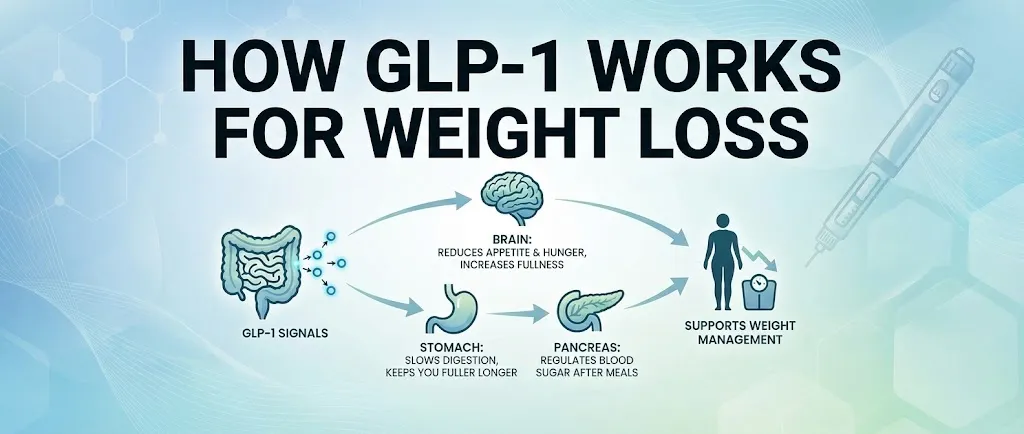
If you searched "how glp1 works for weight loss", here's the direct answer: GLP-1 medications help people lose weight primarily by reducing appetite and hunger, increasing fullness, and slowing stomach emptying—so you naturally eat less without constant willpower battles. They also improve blood sugar regulation, which can reduce cravings and energy crashes. [1]
These medications don't "burn fat" directly. They change hunger biology so a calorie deficit becomes achievable and sustainable—and that calorie deficit is what leads to fat loss over time.
What you'll get from this guide: a clear mechanism map, the real-world meaning of trial results, FDA-labeled risks and red flags, cost/access realities, and a decision framework you can take to your clinician—with citations to FDA prescribing information and peer-reviewed trials.
Need quick help with side effects right now? Try our GLP-1 SOS tool for immediate relief strategies. Want to learn the basics first? See our complete guide on what GLP-1 is.
Key Takeaways
-
Most weight loss comes from eating less—without feeling as hungry. GLP-1 medicines act on appetite and satiety pathways and slow gastric emptying, which reduces energy intake. [1][10]
-
"GLP-1" is used as shorthand, but there are different drugs and different FDA indications.
- Wegovy (semaglutide) and Saxenda (liraglutide) are FDA-approved for chronic weight management. [2][5]
- Zepbound (tirzepatide) is FDA-approved for chronic weight management and for moderate-to-severe obstructive sleep apnea (OSA) in adults with obesity. [4]
- Ozempic/Rybelsus (semaglutide) and Mounjaro (tirzepatide) are FDA-approved for type 2 diabetes (not for chronic weight management by label). [6][8][7]
-
Tirzepatide (Zepbound/Mounjaro) is not "just GLP-1." It activates both GIP and GLP-1 receptors (a dual incretin agonist), which is why it tends to produce greater average weight loss in trials. [4][16]
-
GI side effects are common. In Wegovy weight-reduction trials, gastrointestinal (GI) adverse reactions occurred in 73% of treated adults vs 47% with placebo; nausea (44%), diarrhea (30%), and vomiting (25%) were among the most frequent. [2] For a complete breakdown, see our guide on cons of GLP-1 medications.
-
Serious warnings exist and require awareness: thyroid C-cell tumor boxed warning, pancreatitis, gallbladder disease, kidney injury from dehydration, and pulmonary aspiration risk during anesthesia/deep sedation (postmarketing reports). These warnings are in FDA labeling. [2][4]
-
Stopping often means weight regain. In follow-up data after stopping semaglutide 2.4 mg, participants regained a substantial portion of lost weight over the following year—consistent with obesity being a chronic condition for many people. [15]
-
There is no FDA-approved OTC "GLP-1 supplement" or "GLP-1 patch." The FDA has published safety concerns about unapproved GLP-1 products marketed for weight loss. [9]
What Is GLP-1? (60-Second Biology)
GLP-1 (glucagon-like peptide-1) is a hormone your gut releases after eating. It contributes to the "meal is ending" signal through several effects:
- increases satiety (fullness)
- slows gastric emptying
- supports insulin secretion in a glucose-dependent way
- reduces glucagon (which raises blood sugar) [10][12]
Why your natural GLP-1 signal is brief: GLP-1 and related incretin hormones are rapidly inactivated by the enzyme DPP-4, which is why medication versions are engineered to last longer. [12]
What GLP-1 medications do: They activate GLP-1 receptors (and in tirzepatide's case, both GLP-1 and GIP receptors) long enough to change day-to-day hunger, fullness, and eating behavior in a clinically meaningful way. [10][12][4]
The Mechanism Map: How GLP-1 Causes Weight Loss
This is the full picture—what's happening biologically, what you'll notice, and why it leads to weight loss.
| Mechanism | What's Happening in Your Body | What You'll Notice | Why It Causes Weight Loss |
|---|---|---|---|
| 1. Appetite & Satiety Signaling | GLP-1 receptor activation influences appetite regulation in the brain and gut-brain signaling | Less hunger between meals, smaller portions feel satisfying, fewer snacking urges; "food noise" can feel quieter | You naturally eat fewer calories without constant willpower battles [1][10] |
| 2. Slower Gastric Emptying | Food leaves the stomach more slowly (a known GLP-1 effect), which also matters for peri-procedural aspiration considerations | "Full longer" after meals; may feel nausea or reflux if eating too fast or too much | Less grazing and fewer calories consumed; easier to sustain a deficit [10][11] |
| 3. Blood Sugar Regulation | Incretin effects support insulin release when glucose is elevated and reduce glucagon | Fewer energy crashes, less "hangry," reduced carb/sugar cravings (especially with insulin resistance) | Less reactive eating triggered by blood sugar swings [10][12] |
| 4. Reward Pathway Effects | GLP-1 receptors and signaling can influence appetite circuitry beyond simple stomach fullness | Food still enjoyable but less "urgent"; some people report less pull toward overeating | Easier to make intentional choices and stop at satisfaction [10] |
The bottom line: GLP-1 medications don't violate physics. They don't "melt fat." They alter biology so you can maintain a calorie deficit with far less friction—and that sustained deficit is what produces fat loss over time. [1][10]
Which GLP-1 Medications Are We Talking About?
People say "GLP-1" but often mean a whole family of incretin-based medications. Here's the simplest way to understand the landscape without confusion.
The Core Distinction
Semaglutide (GLP-1 receptor agonist):
- Wegovy = semaglutide for chronic weight management (plus additional labeled indications depending on formulation) [2][3]
- Ozempic = semaglutide for type 2 diabetes (not labeled for chronic weight management) [6]
- Rybelsus = oral semaglutide for type 2 diabetes (not labeled for chronic weight management) [8]
Tirzepatide (dual GIP + GLP-1 receptor agonist):
- Zepbound = tirzepatide for chronic weight management and moderate-to-severe OSA in adults with obesity [4]
- Mounjaro = tirzepatide for type 2 diabetes (not labeled for chronic weight management) [7]
Liraglutide (GLP-1 receptor agonist):
- Saxenda = liraglutide for chronic weight management [5]
Medication Comparison Table
| Brand | Active Drug | Class | FDA-Labeled Indication | Schedule | Administration | Key Notes |
|---|---|---|---|---|---|---|
| Wegovy | Semaglutide | GLP-1 RA | Chronic weight management | Injection: once weekly; Tablets: once daily | Injection or oral tablet | Not to be used with other semaglutide products [2][3] |
| Zepbound | Tirzepatide | Dual GIP/GLP-1 RA | Chronic weight management; moderate-to-severe OSA | Once weekly | Injection | Not to be used with GLP-1 receptor agonists [4] |
| Saxenda | Liraglutide | GLP-1 RA | Chronic weight management | Once daily | Injection | Daily dosing; older GLP-1 option [5] |
| Ozempic | Semaglutide | GLP-1 RA | Type 2 diabetes | Once weekly | Injection | Not labeled for weight management [6] |
| Mounjaro | Tirzepatide | Dual GIP/GLP-1 RA | Type 2 diabetes | Once weekly | Injection | Not labeled for weight management [7] |
| Rybelsus | Semaglutide | GLP-1 RA | Type 2 diabetes | Once daily | Oral tablet | Requires specific administration [8] |
Important labeling principle: Brand names can represent the same molecule (e.g., Ozempic and Wegovy are both semaglutide), but the FDA-labeled indication, formulation, and dosing schedule can differ. Always anchor your understanding to the prescribing information. [2][6]
The Wegovy Pill (Yes, It Exists)
Wegovy is available as injection (subcutaneous) and also as tablets for oral use (semaglutide tablets). [3]
The tablets have strict administration instructions in the FDA label—taken once daily, on an empty stomach, with no more than 4 ounces of plain water, and then you wait at least 30 minutes before eating, drinking, or taking other oral medicines. [3]
For current pricing and where to get the oral formulation, see our guide on Wegovy pill cost and where to buy.
Why Tirzepatide Often Produces More Weight Loss
Tirzepatide activates two receptors—GIP and GLP-1—rather than GLP-1 alone. This dual mechanism is described in FDA labeling and supported by trial outcomes. [4][16]
In separate large trials (not a universal head-to-head comparison across all populations), tirzepatide produced greater average weight loss than semaglutide 2.4 mg did in its pivotal weight-management trials. [16][13] For a detailed comparison, see our semaglutide vs tirzepatide guide. If you're already on semaglutide and considering a change, see our guide on how to switch from semaglutide to tirzepatide.
How Much Weight Loss Is Typical?
People want a number. The honest answer is: it varies, but we have high-quality trial data to set realistic expectations.
Zepbound (Tirzepatide): What the Trials Show
In a pivotal 72-week trial in adults with obesity or overweight with weight-related conditions (without diabetes), mean weight loss was dose-dependent. [4][16]
| Dose (once weekly) | Mean Weight Loss | Achieved ≥20% Loss | Achieved ≥25% Loss |
|---|---|---|---|
| 5 mg | 15.0% | 30.0% | 15.3% |
| 10 mg | 19.5% | 50.1% | 32.3% |
| 15 mg | 20.9% | 56.7% | 36.2% |
| Placebo | 3.1% | 3.1% | 1.5% |
Sources: FDA prescribing information for mean loss and ≥20% thresholds [4]; SURMOUNT-1 trial (NEJM 2022) reports the ≥25% thresholds [16].
Wegovy (Semaglutide 2.4 mg): What the Trials Show
In a large pivotal trial of adults with overweight/obesity (without diabetes), semaglutide 2.4 mg produced a mean weight reduction of 14.9% over 68 weeks versus 2.4% with placebo. [13]
This is why you often see "~15% average weight loss" associated with Wegovy.
Quick Facts
- Wegovy avg. weight loss
- ~15% in 68 weeks
- Zepbound (15mg) avg. loss
- ~21% in 72 weeks
- Placebo comparison
- 2-3% in same period
- Individual variation
- Results vary significantly
Two Truths Most People Don't Hear Up Front
1) Average ≠ you
Trials show averages and distributions—your experience depends on:
- whether you can reach and maintain an effective dose
- whether side effects affect eating quality (not just calories)
- baseline metabolic factors (insulin resistance, sleep apnea, medications that cause weight gain, etc.)
- your plan for protein, strength, sleep, and stress
2) Plateaus are normal
Plateaus are not proof the medication "stopped working." They often reflect a new energy balance: as body weight decreases, energy needs can drop. Plateaus are common in all effective weight loss methods, including medication.
The Weight Loss Timeline: What to Expect
Phase 1: Dose Escalation (First Weeks to Months)
Many GLP-1 and dual incretin regimens begin at a lower dose and increase gradually to improve tolerability—this step-up approach is reflected in prescribing information. [2][4]
What to expect:
- appetite changes may be immediate or subtle at first
- GI side effects (if they occur) often flare during dose increases
- early weight change can include water and glycogen shifts, not only fat
- your "portion size intuition" may change quickly
Phase 2: Therapeutic Dosing (Months 3–12)
Once you've reached and maintained an effective dose, appetite regulation often becomes more consistent.
What to expect:
- steadier reduction in hunger
- fewer cravings and less drive to snack
- weight loss can slow over time as you approach a new set point
Phase 3: Maintenance (12+ Months)
For many people, long-term success requires a maintenance plan (which may include continuing medication) rather than a "stop once you reach goal weight" approach.
What to expect:
- weight stabilizes
- the focus shifts from losing to maintaining
- habits that protect muscle and nutrition become more important (protein, strength, hydration, fiber)
What Happens If You Stop?
This is critical to understand before you start.
In a follow-up extension after stopping semaglutide 2.4 mg, participants regained a substantial portion of lost weight over the following year, and many cardiometabolic improvements moved back toward baseline. [15]
Key Insight
If medication is changing your hunger biology, stopping it often means that biology reverts. If you're considering GLP-1 therapy, think about a long-term plan—whether that's ongoing medication, a structured maintenance strategy, or a clinician-guided transition.
Side Effects and Red Flags: What's Common vs. Urgent
Common Side Effects (Especially During Dose Increases)
Gastrointestinal effects are the most common across this class. They're also the main reason dose escalation exists: to make the meds tolerable. [2][4]
Wegovy (Semaglutide): Common GI Rates From Weight-Reduction Trials
- GI adverse reactions: 73% with Wegovy vs 47% with placebo
- severe GI adverse reactions: 4.1% vs 0.9%
- nausea: 44%
- diarrhea: 30%
- vomiting: 25% [2]
Zepbound (Tirzepatide): Common Adverse Reactions
In weight-reduction studies, common adverse reactions included: [4]
- nausea: 25–29% (depending on dose)
- diarrhea: 19–23%
- constipation: 11–17%
- vomiting: 8–13%
- abdominal pain: 9–10%
- dyspepsia: 9–10%
- fatigue: 5–7%
Why this matters: Your odds of side effects are not a personal failing. They're part of the pharmacology, and they're common enough that you should plan for them.
Why These Side Effects Happen
Many GI effects connect to the same mechanism that helps with weight loss: slower gastric emptying and changes in GI motility and appetite signaling. [10][11]
A useful mental model:
- The medication changes "fullness timing."
- If your eating habits don't adjust fast enough (speed, portion size, fat content), you can feel nausea, reflux, or vomiting.
Practical Strategies to Reduce GI Symptoms
These are behavioral approaches many clinicians recommend. If symptoms are severe or persistent, contact your prescriber. For food-specific guidance, see our complete guide on what to eat on GLP-1 and use our GLP-1 SOS tool for quick relief strategies.
- Smaller portions — you can always eat more later
- Eat slower — give fullness signals time to register
- Avoid very high-fat meals while adjusting (fat can worsen fullness and nausea)
- Stop at "satisfied," not "stuffed"
- Hydration matters — especially with diarrhea or vomiting
- Protein first — often better tolerated than mixed heavy meals
- Fiber slowly — too much too fast can worsen bloating/constipation
When to Contact Your Prescriber
If you can't keep fluids down, or symptoms are escalating rather than improving, your clinician needs to know. Don't try to tough it out if you're becoming dehydrated.
Serious Warnings From FDA Labels (Know These)
This section focuses on the risks that are explicitly called out in FDA labeling—because these are the "don't miss" issues. [2][4]
1) Boxed Warning: Thyroid C-Cell Tumors (MTC/MEN 2)
Wegovy and Zepbound labeling include a boxed warning and contraindications related to medullary thyroid carcinoma (MTC) and Multiple Endocrine Neoplasia syndrome type 2 (MEN 2). People with a personal or family history of these conditions should not use these medications. [2][4]
2) Pancreatitis
Acute pancreatitis is listed in warnings/precautions. If pancreatitis is suspected, the medication should be discontinued and you should seek medical evaluation. [2][4]
Red flag symptoms: severe, persistent abdominal pain (may radiate to the back), often with vomiting.
3) Gallbladder Disease
Gallbladder events (including gallstones) are reported in trials and included in warnings. Rapid weight loss itself can increase gallstone risk, regardless of method. [2][4]
Red flag symptoms: right upper abdominal pain (especially after meals), fever, jaundice.
4) Kidney Injury From Dehydration
Labeling warns about acute kidney injury, particularly in the setting of severe nausea/vomiting/diarrhea and dehydration. [2][4]
Red flag symptoms: very dark urine, low urine output, dizziness/fainting, confusion.
5) Pulmonary Aspiration Risk During Anesthesia/Deep Sedation
Wegovy labeling describes rare postmarketing reports of pulmonary aspiration during general anesthesia or deep sedation, potentially related to delayed gastric emptying; labels emphasize notifying your healthcare team before procedures. [2][11]
If you have any procedure requiring anesthesia or sedation (including outpatient procedures like colonoscopy), tell the surgical/anesthesia team you use a GLP-1 medication and follow their instructions.
The Traffic Light Triage (Practical Urgency Guide)
This isn't a diagnostic tool—just a simple way to decide what to do next.
GREEN — Usually Expected (Monitor at Home)
- mild nausea that improves with eating changes
- mild constipation
- temporary fatigue or headache
- mild injection-site irritation
YELLOW — Contact Your Prescriber (Within 1–2 Days)
- nausea that doesn't improve over time or repeatedly interferes with eating
- repeated vomiting
- constipation unresponsive to basic home measures
- difficulty maintaining hydration or nutrition
- symptoms worsening with dose escalations rather than improving
RED — Seek Urgent Medical Care
- severe abdominal pain (possible pancreatitis)
- signs of significant dehydration (confusion, fainting, minimal urine)
- severe allergic reaction (swelling, difficulty breathing)
- right upper abdominal pain with fever or jaundice (possible gallbladder)
Who Is a Candidate? (FDA Indications Simplified)
Wegovy (Semaglutide) — Chronic Weight Management
Wegovy is indicated for chronic weight management (with reduced-calorie diet and increased physical activity) in: [2]
- adults with obesity (BMI ≥ 30), or
- adults with overweight (BMI ≥ 27) with at least one weight-related condition
Wegovy injection is also indicated in certain pediatric patients 12+ with obesity (see full prescribing information). [2]
Zepbound (Tirzepatide) — Chronic Weight Management + OSA
Zepbound is indicated for: [4]
- chronic weight management in adults who meet BMI criteria (with reduced-calorie diet and increased physical activity)
- treatment of moderate-to-severe obstructive sleep apnea in adults with obesity
Saxenda (Liraglutide) — Chronic Weight Management
Saxenda is indicated for chronic weight management with diet and activity in adults meeting BMI criteria and in certain adolescents (see full prescribing information). [5]
Key Contraindications (Do Not Skip)
These are label-level issues that matter more than "best brand" debates.
Common contraindications include:
- personal or family history of medullary thyroid carcinoma (MTC)
- Multiple Endocrine Neoplasia syndrome type 2 (MEN 2)
- known hypersensitivity to the medication or its components [2][4]
Pregnancy: GLP-1 weight-management medications are not intended for use for weight loss during pregnancy; see labeling and clinician guidance. [2][4]
"Can I Use GLP-1 Without Having Diabetes?"
Yes. Wegovy, Zepbound, and Saxenda are FDA-approved for weight management without requiring a diabetes diagnosis. Eligibility is based on BMI and weight-related conditions—not diabetes status. [2][4][5]
Not sure if you qualify? Use our BMI eligibility calculator or take the GLP-1 eligibility quiz to check.
Critical: Pregnancy, Fertility, and Birth Control
This is the section many pages bury. We don't.
Wegovy and Pregnancy (Semaglutide)
Wegovy labeling states to discontinue Wegovy at least 2 months before a planned pregnancy because of semaglutide's long half-life. [3]
If pregnancy occurs, follow label guidance and contact your clinician promptly.
Zepbound and Oral Contraceptives (Tirzepatide)
This is frequently missed and clinically important.
Zepbound labeling states it may reduce the efficacy of oral hormonal contraceptives due to delayed gastric emptying. The label advises: [4]
- switch to a non-oral contraceptive method, or
- add a barrier method
- for 4 weeks after initiation and 4 weeks after each dose escalation
If you're of reproductive potential, this should be a must-discuss topic with your prescriber before starting.
GLP-1 and Cardiovascular Health
For people with established cardiovascular disease (CVD), there's additional evidence beyond weight loss.
The SELECT trial studied semaglutide 2.4 mg in adults with overweight/obesity and established CVD (without diabetes) and found semaglutide reduced major adverse cardiovascular events compared with placebo. [18]
The FDA also approved Wegovy to reduce the risk of major cardiovascular events in certain adults with obesity or overweight and established cardiovascular disease (see full label for exact criteria). [17][2]
What this means: For some people, the treatment decision isn't only "how much weight will I lose?" It can also be "does this meaningfully reduce my risk of heart attack or stroke?" That's a clinician-level conversation, especially if you have CVD history.
GLP-1 and Muscle Loss: Protecting Body Composition
The Honest Reality
Any meaningful weight loss—medication, diet, or surgery—can include some loss of lean mass. The goal is to maximize fat loss while preserving muscle.
This matters because muscle affects:
- strength and physical function
- resting energy needs (metabolic rate)
- long-term maintenance
- how you look and feel after weight loss
The Three Levers That Matter Most
1) Protein priority GLP-1 medications can dramatically reduce appetite, which can unintentionally reduce protein intake. A practical approach is to build each meal around a protein source first, then add fiber-rich plants and carbs/fats as tolerated.
2) Resistance training Strength training is one of the clearest ways to signal your body to preserve muscle during weight loss. You don't need a gym—bands, bodyweight, or dumbbells work. Consistency matters more than perfection.
3) Avoid accidental under-nutrition With appetite suppression, some people drift into "too little food to function well" without realizing it. If you're persistently unable to meet basic hydration and nutrition needs, that is a reason to contact your prescriber and adjust the plan.
Medication Interactions and Special Situations
Oral Medication Absorption
Because GLP-1 therapies can delay gastric emptying, absorption timing of some oral medications can be affected—this is discussed in labeling and literature. [11][2]
If you take medications where timing or levels matter (thyroid hormone, seizure meds, certain antibiotics, etc.), discuss this with your prescriber.
Diabetes Medications and Hypoglycemia
GLP-1 therapies can lower blood glucose. The risk of hypoglycemia increases when combined with insulin or sulfonylureas, and clinicians may adjust those medications when starting incretin therapy. See your medication labeling and prescriber guidance. [2][4]
Planned Procedures and Anesthesia/Deep Sedation
Because of delayed gastric emptying and postmarketing aspiration reports, labels advise informing your clinical team before procedures requiring anesthesia or deep sedation. Your anesthesia team will provide specific instructions. [2][11]
Cost, Insurance, and Access
This is often the deciding factor—and it's also where misinformation and risky shortcuts show up. For verified pricing comparisons, see our cheapest GLP-1 without insurance guide and our review of the best GLP-1 online programs.
Reality Check: These Medications Can Be Expensive
Without insurance coverage or savings programs, GLP-1/GIP medications can cost hundreds to over a thousand dollars per month in the U.S., depending on the specific product, dose, and pharmacy pricing. (This changes over time; always verify current pricing.)
Best practice: treat any exact online price as "may be outdated," and verify with your pharmacy and your insurer.
What People Actually Pay (Varies Dramatically)
| Scenario | What It Often Looks Like |
|---|---|
| Commercial insurance that covers the med + savings | May be relatively low out-of-pocket (depends on plan + eligibility) |
| Commercial insurance that covers but requires prior auth | Coverage possible, but paperwork/criteria matter |
| Cash pay | Often the highest cost |
| Telehealth programs | Can bundle visit fees; may use FDA-approved meds or compounded products (verify) |
| Compounded products | Can be cheaper but carry important FDA safety concerns (see below) |
Insurance Coverage Reality
Commercial insurance:
- coverage varies dramatically by employer and plan
- weight management indications (Wegovy, Zepbound, Saxenda) may be covered differently than diabetes indications
- prior authorization is common (documentation of BMI and comorbidities, sometimes prior weight-loss attempts) [2][4][5]
Medicare/Medicaid:
- coverage rules differ and evolve; you must verify your plan and state specifics
A Practical Insurance Checklist
- Do I meet the labeled criteria? (BMI + comorbidity where applicable) [2][4][5]
- Which exact product is on my formulary? (Wegovy vs Ozempic; Zepbound vs Mounjaro)
- Is prior authorization required? What documentation?
- Are step therapy requirements present? (e.g., "must try X first")
- What is my monthly out-of-pocket at my preferred pharmacy?
- Can I use a savings card? (often commercial insurance only)
- If denied, what's the appeal process?
Compounded GLP-1 Products: Safety Concerns You Should Know
When brand-name medications are in shortage, some pharmacies may produce compounded versions. These can be less expensive but come with important caveats.
The FDA has issued safety information about unapproved GLP-1 products used for weight loss, including concerns about: [9]
- products not reviewed for safety, effectiveness, or manufacturing quality
- dosing errors
- use of salt forms not proven equivalent
- sterility and quality concerns
If Considering Compounded Products
- use only state-licensed pharmacies (avoid random online sellers)
- understand you are accepting unknown risks compared with FDA-approved products
- work with a clinician who can monitor you
- avoid "too good to be true" pricing and no-prescription claims
A Safer Access Pathway (In Order)
- Start with a licensed prescriber (primary care, endocrinology, obesity medicine)
- Confirm you're an appropriate candidate (BMI criteria + contraindications) [2][4]
- Check your formulary and prior authorization steps
- Use legitimate savings programs if eligible
- If cost is prohibitive, discuss alternatives or structured plans with your clinician—avoid unverified online sources
- If considering compounded, read the FDA's safety information first and proceed with caution [9]
For a complete safety guide, see how to get GLP-1 safely. Looking specifically for tirzepatide? Check our best tirzepatide online comparison.
The Decision Framework: Is GLP-1 Right for You?
Use this to organize your thinking before talking to a clinician.
Step 1: Medical Fit
- Do you meet labeled criteria for a weight management medication? [2][4][5]
- Any contraindications (MTC/MEN 2 history, hypersensitivity)? [2][4]
- Are you on medications that require special consideration (insulin/sulfonylureas; oral contraceptives with tirzepatide)? [4]
- Are you pregnant or planning pregnancy soon (requires planning/washout)? [3][4]
Step 2: Expectations
- Are you prepared to treat this as chronic/long-term care if needed? [15]
- Are your expectations realistic (trial averages help set expectations; individuals vary)? [13][16]
- Do you have a plan to protect muscle and nutrition (protein + strength training)?
Step 3: Tolerability
- Can you manage potential GI side effects (and adjust eating patterns)? [2][4]
- Is injection acceptable, or does a daily oral option matter? [3][8]
- Any upcoming procedures requiring anesthesia/deep sedation? (tell your team) [2][11]
Step 4: Access
- Do you have sustainable access to medication and monitoring?
- Can you afford ongoing cost (insurance, savings, or cash)?
- Do you understand the difference between FDA-approved vs unapproved products? [9]
Checklist: Good Candidate Indicators
- Meets BMI criteria and has weight-related health risk factors where applicable [2][4][5]
- No contraindications (MTC/MEN 2, hypersensitivity) [2][4]
- Prior efforts haven't produced lasting results
- Prepared for long-term management (not a quick fix) [15]
- Has a plan for protein, strength, and nutrition quality
- Has a sustainable access/cost plan
- Realistic expectations based on clinical evidence [13][16]
Checklist: May Not Be the Right Fit
- Personal/family history of MTC or MEN 2 [2][4]
- Pregnant or planning pregnancy soon without appropriate washout [3][4]
- Looking for short-term use only (often leads to regain) [15]
- Unable to tolerate GI side effects with no viable alternative
- Cost isn't sustainable
- History of eating disorder (requires careful specialist evaluation)
Questions to Ask Your Prescriber
- Based on my history, am I a candidate under FDA labeling? [2][4]
- Which medication fits best and why (semaglutide vs tirzepatide vs liraglutide)?
- What side effects should I expect, and what's our plan if they're severe? [2][4]
- How will this interact with my current medications (including birth control)? [4]
- What monitoring do you recommend for my case?
- How long do you expect treatment might be needed to maintain results? [15]
- What should I do if I have a procedure requiring anesthesia or deep sedation? [2][11]
- What lifestyle changes will maximize benefit and minimize muscle loss?
References and Sources
FDA Prescribing Information (Primary Sources)
- Wegovy (semaglutide) injection — FDA label (indications, contraindications, warnings, adverse reactions): [2]
- Wegovy (semaglutide) injection + tablets — FDA label (oral administration instructions, limitations of use): [3]
- Zepbound (tirzepatide) injection — FDA label (weight management + OSA indication; contraceptive guidance; adverse reactions): [4]
- Saxenda (liraglutide) — FDA label: [5]
- Ozempic (semaglutide) — FDA label: [6]
- Mounjaro (tirzepatide) — FDA label: [7]
- Rybelsus (semaglutide) tablets — FDA label: [8]
FDA Safety Information
- FDA safety information regarding unapproved GLP-1 drugs used for weight loss: [9]
Mechanism and Physiology
- Cleveland Clinic: GLP-1 agonists overview: [1]
- Peer-reviewed review on GLP-1 effects on appetite/weight: [10]
- Review on GLP-1, delayed gastric emptying, and aspiration considerations: [11]
- NCBI Bookshelf overview of GLP-1 receptor agonists/incretins: [12]
Clinical Outcomes (Key Trials)
- Semaglutide 2.4 mg (STEP 1): [13]
- Semaglutide 2.4 mg withdrawal/maintenance and related outcomes: [14][15]
- Tirzepatide obesity trial (SURMOUNT-1): [16]
- Semaglutide cardiovascular outcomes in obesity (SELECT trial): [18]
- FDA press announcement on Wegovy cardiovascular risk-reduction indication: [17]
Editorial Standards
- We prioritize FDA prescribing information for indications, contraindications, warnings, dosing schedule basics, and adverse reactions. [2][3][4]
- For mechanisms and physiology, we use peer-reviewed sources and major medical organizations. [1][10][11][12]
- We clearly distinguish between FDA-labeled use and broader discussion.
- We update this page at least every 90 days and after relevant FDA label changes.
If you identify an error, contact us. Verified errors will be corrected and logged in the changelog.
This content is based on FDA prescribing information and clinical trial data. Individual experiences may vary. Always consult your healthcare provider with questions about your specific situation.
Frequently Asked Questions
How we rank + verify
Last verified: March 3, 2026
What we verified: FDA prescribing information for Wegovy, Ozempic, Zepbound, Mounjaro, Saxenda, and Rybelsus. Clinical trial data from STEP 1, SURMOUNT-1, and SELECT trials.
Sources: FDA labels [2][3][4][5][6][7][8], FDA safety communications [9], peer-reviewed studies from NEJM [13][16][18], Cleveland Clinic, NCBI
Related Articles
A comprehensive guide to GLP-1 medication side effects, how to manage them, and when to contact your doctor. Based on FDA prescribing information.
Optimize your GLP-1 weight loss results with smart food choices. Learn what to eat, what to avoid, and how to manage reduced appetite.
This content is educational only and does not replace professional medical advice. Always consult a qualified healthcare provider before starting any medication.