Zepbound Sleep Apnea Prior Authorization: How to Get Approved in 2026
By Weight Loss Provider Guide Team · Published April 7, 2026 · Last verified: August 31, 2026
Zepbound (tirzepatide) is FDA-approved to treat moderate-to-severe obstructive sleep apnea in adults with obesity, together with a reduced-calorie diet and increased physical activity. That gives people with qualifying OSA a coverage route that is separate from a request made only for weight management.
Approval is not automatic. Your plan can still require prior authorization, apply its own coverage rules, or exclude the drug. The practical first step is to find out whether your specific plan covers the Zepbound pen for OSA, then make the submission match the plan's written criteria.
Bottom line
Public OSA criteria commonly begin with a sleep study documenting moderate-to-severe obstructive sleep apnea and current obesity documentation, but there is no universal PA checklist. Some plans also require PAP history, dietary-effort documentation, specialist involvement, counseling, laboratory information, or plan-specific forms. Check the written criteria for your exact plan before your doctor submits the request.
Partner disclosure: We may earn a commission if you use a partner link and later become a customer. This does not change your price or our coverage analysis. Coverage, clinical eligibility, prescriptions, and PA approval are never guaranteed.
Best first step if you plan to use insurance
Find out whether your plan covers the Zepbound pen before your doctor submits the PA.
Ro's free GLP-1 Insurance Coverage Checker contacts your insurer and sends a personalized report showing whether the Zepbound pen is covered and whether prior authorization is required.
Free coverage report. The check itself does not submit a prescription or treatment request. Ro may offer a $50 credit to eligible new accounts; verify current terms on the destination page.
Ro is a partner. We may earn a commission if you later start treatment through Ro. Coverage and prescriptions are not guaranteed.
Where are you in the process?
Already know PA is required? Jump to the 7-document checklist →
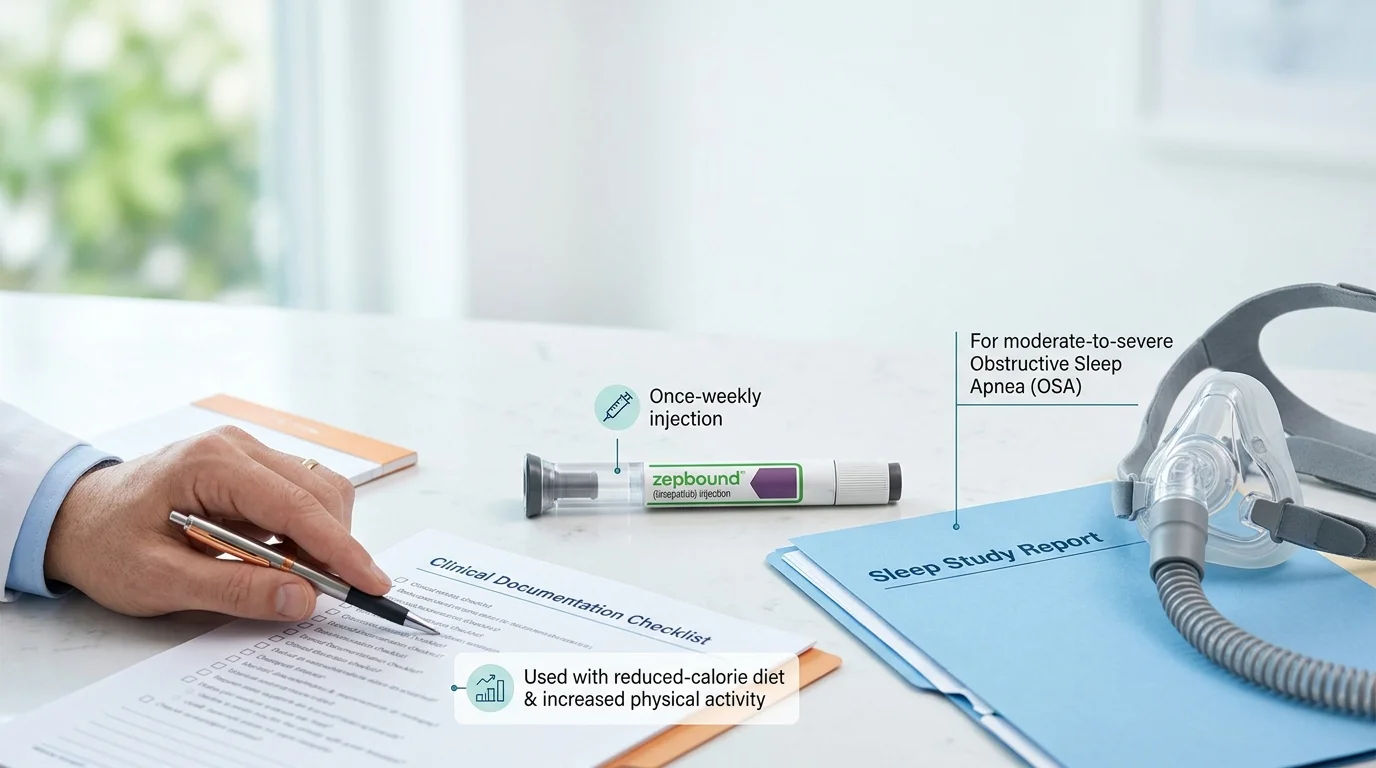
What Does Zepbound Sleep Apnea Prior Authorization Actually Require?
Most public policies ask for the same core proof: documented moderate-to-severe obstructive sleep apnea, documented obesity, and a complete submission that hits every checkbox your specific plan requires. In the public criteria we reviewed, the basics center on AHI/REI/RDI of at least 15 and BMI of at least 30 — but the extras range from simple to surprisingly strict.
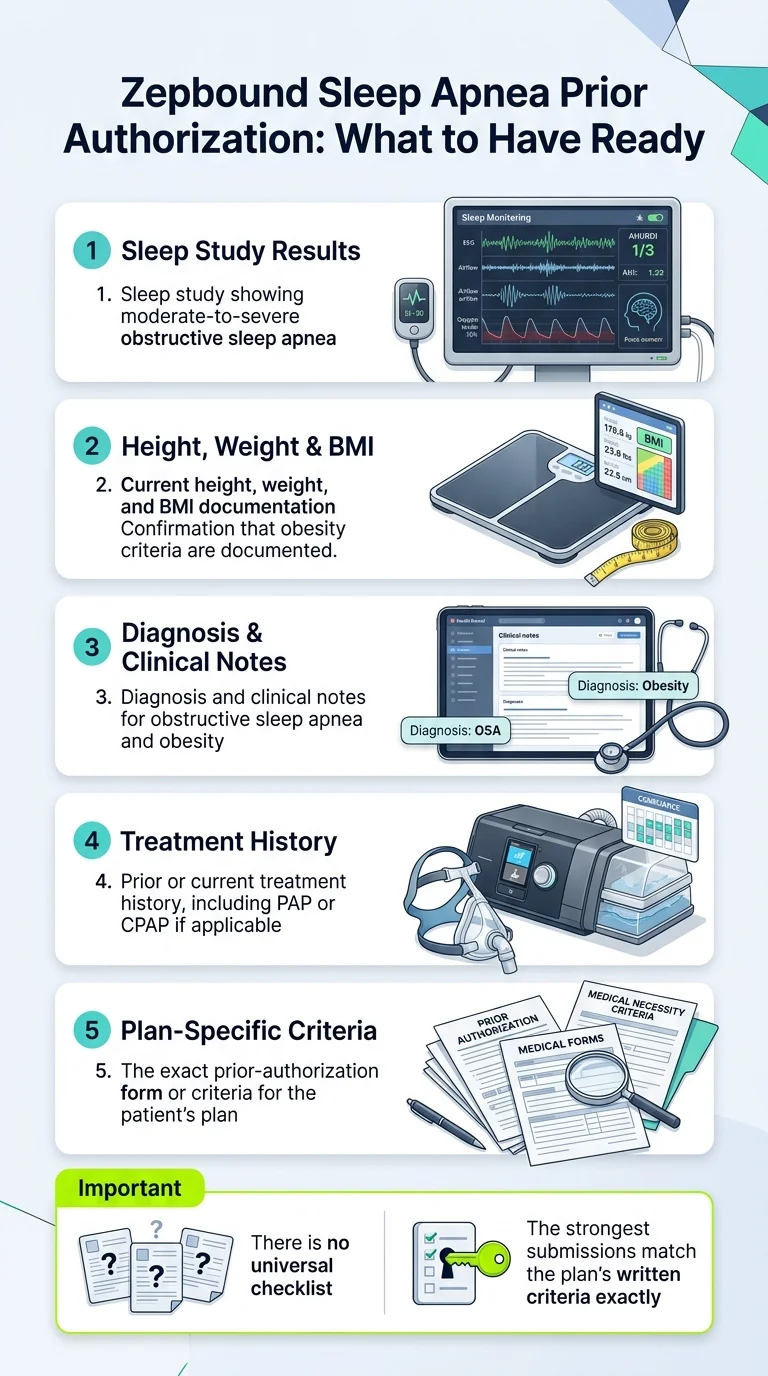
The 7 Documents to Gather Before Your Doctor Submits Anything
- 1
Sleep study results
Polysomnography (PSG) or home sleep apnea test (HSAT) documenting the OSA metric your plan accepts. Public criteria commonly use AHI, REI, or RDI of 15 or higher, and some plans require a recent study. Attach the full report — not just the diagnosis.
- 2
BMI documentation
Current clinical measurements and calculated BMI of 30 or higher when required by the applicable plan. Dating requirements vary; use the plan’s stated recency rule rather than a universal cutoff.
- 3
Diagnosis codes
The submission should clearly identify the OSA indication and use diagnosis coding that accurately reflects the documented condition. The clinician and plan determine the appropriate code order.
- 4
Treatment history
Any prior or current CPAP/PAP therapy, other OSA treatments, and response to each. Include compliance data if available. Some plans require documented failure or intolerance.
- 5
Comorbidity documentation
Include comorbidities when the plan’s criteria or the clinician’s medical-necessity explanation makes them relevant. Use the documented condition and applicable codes.
- 6
Prior weight-management efforts
Many plans require evidence of previous diet, exercise, or medication-based weight-loss attempts — with dates and outcomes.
- 7
Letter of Medical Necessity
Not always required, but it can organize the documented indication, sleep-study result, current measurements, treatment history, and the plan-specific reason the request meets criteria.
What "moderate-to-severe OSA" means in payer language
What counts as "obesity" in public criteria
The most common reason for PA denial: incomplete documentation
Sources: UHC commercial Zepbound OSA PA criteria; CVS Caremark Zepbound criteria; Eli Lilly PA Resource Guide
What Are the Actual Insurer Criteria Right Now?
There is no single national checklist. Public criteria range from AHI-plus-BMI rules to forms that ask for PAP records, specialist involvement, counseling, and plan-specific renewal documentation. We reviewed publicly available PA criteria from major insurers and government programs.
| Plan / PBM | Covers OSA? | Key Public Criteria | Notable Extra Requirements | Renewal Rule |
|---|---|---|---|---|
| UnitedHealthcare (Commercial) | OSA-specific policy | Age ≥18, BMI ≥30, a qualifying sleep study at the plan threshold, and a prior unsuccessful dietary effort | PAP symptoms despite documented adherence or a reason the patient is not a PAP candidate; diet/activity, counseling, diabetes/HbA1c, surgery, apnea-type, and prescriber requirements also apply | Initial authorization is 6 months. Reauthorization differs for PAP and non-PAP paths; the June 2026 revision removes the AHI/RDI/REI reduction requirement for patients using PAP, while other criteria remain |
| CVS Caremark / Aetna (Commercial) | OSA PA pathway published | AHI ≥15 on PSG or a technically adequate HSAT, plus current BMI ≥30 | Formulary status and any exception requirement remain plan-specific | Initial authorization is 6 months; continuation is 12 months and includes symptom response and maintenance-dose criteria |
| Highmark | Varies by region and plan | Use the exact current Highmark policy or PA form for the member | Confirm whether the applicable plan requests PAP records, specialist notes, oral-appliance information, or other documentation | Plan-specific |
| Medicare Part D | Plan-specific Part D pathway | Ask the beneficiary’s Part D plan for its OSA coverage and utilization-management criteria | The OSA route is separate from the Medicare GLP-1 Bridge, which is for eligible weight-management prescriptions | Plan-specific |
| WV Medicaid | Yes (specific form exists) | Documented OSA, BMI, measurements within last 90 days | State-specific form with detailed fields | State-specific |
Reviewed August 31, 2026. Requirements change frequently — always call the number on your insurance card and ask: "Is Zepbound covered for obstructive sleep apnea under my specific plan? What are the prior authorization criteria, and where is the PA form?"
UnitedHealthcare Commercial
UHC’s commercial OSA policy is effective September 1, 2026. Initial criteria include an OSA treatment request, age 18 or older, BMI of at least 30, a qualifying sleep study at the plan’s stated threshold, and a prior unsuccessful dietary effort. The policy also addresses documented PAP adherence or a reason the patient is not a PAP candidate, diet and activity, counseling, diabetes/HbA1c, planned surgery, central or mixed apnea, and prescriber specialty or experience. Initial authorization is six months. Reauthorization differs for PAP and non-PAP paths; the June 2026 revision says an AHI/RDI/REI reduction is not required for patients using PAP, while other continuation criteria still apply.
Use the exact policy effective for the date of submission and confirm the member’s plan follows it.
CVS Caremark / Aetna Commercial
CVS Caremark publishes an OSA prior-authorization pathway, but formulary status and any exception requirement remain plan-specific. The public criteria require AHI of at least 15 on PSG or a technically adequate HSAT and current BMI of at least 30. Initial authorization is six months; continuation is 12 months and includes positive response in OSA symptoms and use of a maintenance dosage.
Confirm the member-specific formulary and exception rules before submission.
Highmark
Highmark requirements can vary by region and plan. Use the exact current Highmark policy or PA form that applies to the member; do not rely on a generic historical form. Confirm whether the plan requests PAP records, specialist notes, oral-appliance information, or other documentation before submission.
Source: Highmark Zepbound PA form (PDF)
Already know prior authorization is required?
Need a clinician and insurance team—not another generic checklist?
Ro says its insurance concierge checks coverage and submits required prior-authorization paperwork for eligible members. Bring your complete sleep-study report and the written criteria for your plan so the request can be evaluated under the OSA indication.
See if Ro can handle my Zepbound PAOnline visit required. A licensed provider decides whether treatment is appropriate. Service availability, plan coverage, and approval vary.
The Complete PA Packet Checklist
The first submission should be built like a complete packet, not a casual prescription request. Eli Lilly's own PA resource guide emphasizes providing complete and correct information to avoid denied claims. Print this, bring it to your next appointment, and go through it with your doctor before anything is submitted.
Correct diagnosis framing
The PA should clearly state that the request is for obstructive sleep apnea and use diagnosis coding that accurately reflects the documented condition. The clinician and plan determine the appropriate code order.
Sleep study report (full report, not just a summary)
Attach the actual PSG or HSAT report showing the AHI, REI, or RDI score. Highlight the severity measurement. Some plans want to see the raw number, not just a physician's interpretation.
Current BMI documentation
Current clinical measurements and calculated BMI when required by the plan, following the plan’s recency rule. Use clinical documentation rather than self-reported values.
Treatment history
Current and prior OSA treatments: CPAP/PAP therapy (dates, compliance data if available), oral appliances, positional therapy. Include response to each treatment.
Comorbidity documentation
Include relevant comorbidities when the plan’s criteria or the clinician’s medical-necessity explanation calls for them, using the documented condition and applicable codes.
Prior weight-management efforts
Diet, exercise, or medication-based attempts with dates, programs, and outcomes.
Letter of Medical Necessity
Can organize the documented OSA indication, sleep-study result, current measurements, treatment history, and the plan-specific reasons the request meets criteria.
Correct PA form for your specific insurer
Do not assume a generic form is correct. Call your plan or check the provider portal for the current form that applies to the member and indication.
Message to Send Your Doctor Right Now
Copy, paste, and customize:
"Hi [Doctor's Name], I'd like to request prior authorization for Zepbound (tirzepatide) for my obstructive sleep apnea. Can we review my sleep study, current clinical measurements, treatment history, and the exact requirements for my plan before submitting the request? I'll call my insurer to confirm the current PA form and criteria."
Customize the placeholders with your doctor and plan details before sending. The message is a prompt for a conversation, not a guarantee that the request will be approved.
Copying and printing happen locally in your browser. No health information is sent from these controls.
Want to know whether this paperwork is worth preparing?
Check your plan first, then use the plan-specific criteria rather than guessing from a generic checklist.
Check whether my Zepbound is coveredThe Honest Truth About Getting Zepbound Covered
Zepbound does not have one universal prior-authorization checklist. Public criteria already range from simple AHI-plus-BMI policies to forms that require CPAP compliance logs, specialist consult notes, optimized-care documentation, and baseline-vs-current metrics. And private employer group plans may have criteria that differ from anything we can publicly verify.
What we can tell you is this: the submission should match the plan's written criteria as closely as possible. Do not assume a generic checklist or form is enough; compare the request with the current policy and ask the plan what it needs.
A practical next step is to call your insurer before submission, get the exact criteria, and hand your doctor a complete packet. That reduces avoidable back-and-forth, but it cannot predict the plan's decision.
What If Insurance Denied Zepbound as a Weight-Loss Drug?
A denial for weight management does not answer whether the plan evaluates Zepbound under its OSA indication. Some plans publish separate OSA criteria; others may exclude the drug or apply member-specific benefit rules. The written denial and plan policy determine the next step.
If you were denied Zepbound for weight loss and you have sleep symptoms — loud snoring, daytime sleepiness, your partner notices you stop breathing at night, morning headaches — talk to your doctor about a sleep study. If your AHI comes back at 15 or higher, you may qualify through the OSA pathway entirely.
A different indication may require a different request
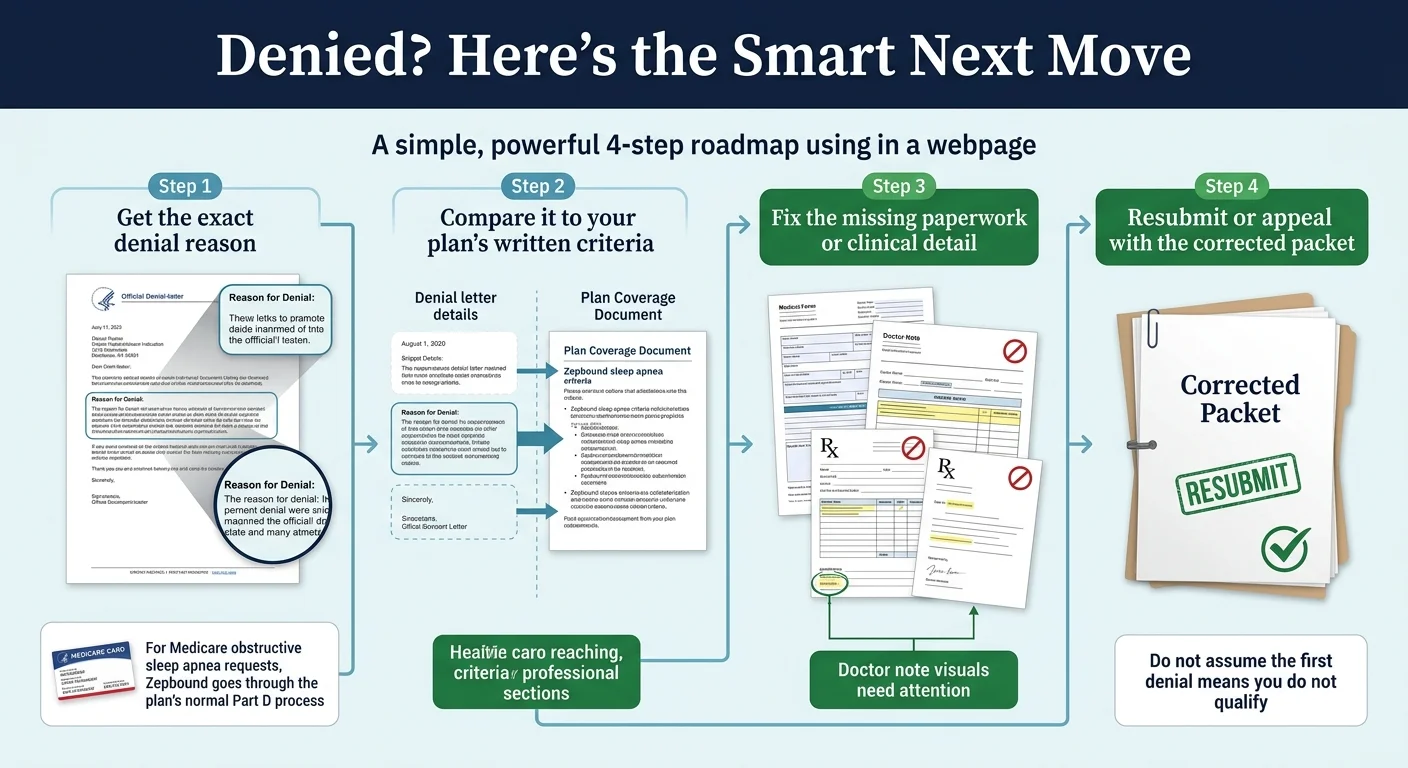
Get the exact denial reason
Pull the official denial letter — look for the specific wording, not just "denied".
Compare to written criteria
Request your plan's PA criteria document (you have the right to see it).
Address the stated gap
Ask the clinician and plan which missing document, coding issue, clinical criterion, or benefit rule matters.
Resubmit or appeal
Use the route and deadline in the denial notice; a corrected request and a formal appeal are not interchangeable.
Was the request filed under weight loss instead of obstructive sleep apnea?
Start with the denial letter and your plan's written criteria.
If the problem is the diagnosis pathway or missing documentation, ask the prescriber whether a corrected submission is appropriate. If the denial is based on medical necessity, nonformulary status, or an exclusion, follow the appeal instructions and deadline in the notice.
Ask whether your existing sleep study can be used and whether the provider can support a corrected PA for the OSA indication. Do not assume every case or plan is supported.
How to Appeal a Denied Zepbound Sleep Apnea Prior Authorization
An appeal is one possible next step, not a guaranteed solution. The OSA indication is relevant evidence when the request is being evaluated for OSA, but it does not override a plan's benefit terms or clinical criteria.
Get the denial letter and identify the exact reason
Look for language like "insufficient documentation," "not medically necessary," "not on formulary," or "weight loss — plan exclusion." The specific wording tells you exactly what the appeal needs to address.
Decide: new PA or formal appeal?
If the notice identifies missing documentation or an inaccurate indication, ask whether a corrected submission is appropriate. If the decision is based on medical necessity, nonformulary status, or an exclusion, follow the appeal instructions in the notice.
Build the appeal packet
- Copy of the denial letter
- Complete sleep study report with AHI/REI/RDI highlighted
- Current BMI documentation
- Updated provider notes
- A clinician explanation that addresses the documented OSA indication and the plan’s stated criteria
- Any additional documentation addressing the specific denial reason
Ask whether peer-to-peer review is available
Some plans offer a prescriber-to-reviewer conversation. Ask the plan or prescribing clinician whether it is available and what it can address; it does not guarantee a different decision.
File the internal appeal
Check your denial letter for the appeal deadline and required format. Submit as soon as the corrected packet is complete, using the instructions in the notice.
If internal appeal fails — external review
You have the right to an independent external review by a third party not employed by your insurer. This is separate from the internal appeal and carries significant weight.
Medicare Part D appeal path
When to request expedited review
Need a clinician for an online PA-support visit?
Ro says eligible members may receive insurance-supported care. Ask whether your existing sleep study and plan support the OSA documentation pathway; availability and approval vary.
Does Medicare Cover Zepbound for Sleep Apnea?
Medicare Part D may cover Zepbound when prescribed for moderate-to-severe obstructive sleep apnea in adults with obesity, subject to the beneficiary's plan, formulary, and utilization-management rules. This is a Part D coverage question, not a workaround for a weight-management exclusion.
To qualify under Medicare Part D, you need:
- Enrollment in a Part D plan and confirmation of its OSA coverage rules
- Documented moderate-to-severe OSA under the plan's accepted criteria
- Documentation of obesity when required by the applicable coverage criteria
- Any prior authorization or other utilization-management steps required by the plan
Question to ask your Part D plan, word for word:
"Is Zepbound covered under my Part D plan for the treatment of moderate-to-severe obstructive sleep apnea? What are the utilization-management criteria, and where can I find the PA form?"
Use Medicare's online plan comparison tool and call the plan to confirm whether it covers Zepbound for OSA and estimate your cost. The 2026 maximum Part D deductible is $615, and the total annual out-of-pocket cap is $2,100.
Medicare GLP-1 Bridge — why it does not apply to an OSA request
Commercial savings cards do not apply to government coverage
How Much Does Zepbound Cost for Sleep Apnea?
The cost depends on the presentation, dose, eligibility, and coverage situation. Here's what current official terms describe; prices and savings rules can change.
| Coverage Scenario | What You'd Pay | Source / Notes |
|---|---|---|
| Commercial insurance, PA approved, eligible for Lilly savings card | As low as $25/month (eligible covered single-dose pen) | Terms, savings limits, eligibility, and expiration can change. |
| Commercial insurance, not covered, eligible for savings card | As low as $499/month (eligible uncovered single-dose pen) | Check current Lilly terms for the uncovered commercial tier. |
| LillyDirect self-pay (KwikPen) | Dose-specific terms beginning at $299/month for eligible patients | Presentation, dose, eligibility, and price vary. Verify on Lilly’s official page. |
| Medicare Part D, PA approved for OSA | Plan-specific | $615 max 2026 deductible; $2,100 annual OOP cap applies |
| Government-insured (Medicare, Medicaid, Tricare) | Savings card NOT available | Use Part D/Medicaid coverage pathway instead |
Sources: Zepbound savings page; LillyDirect. Pricing and terms reviewed August 31, 2026. Subject to change.
Insurance will not cover brand-name Zepbound?
Check Lilly's official self-pay and savings options first. If you are open to a different cash-pay weight-management program, compare providers separately. Compounded tirzepatide is not Zepbound and is not FDA-approved to treat obstructive sleep apnea.
Note on compounded tirzepatide: Some telehealth platforms offer compounded tirzepatide at lower price points. Compounded tirzepatide is not FDA-approved Zepbound and is not specifically indicated for sleep apnea. If you're pursuing the PA route for OSA, you need the brand-name product.
Compare the right cash-pay route
Use Lilly for brand-name Zepbound information. If you are considering a separate cash-pay weight-management program, use the decision path below; it is not a substitute for an OSA PA request.
Can Zepbound Replace Your CPAP?
For some people, eventually — but not necessarily right away, and not for everyone. In the two 52-week SURMOUNT-OSA clinical trials, 42.2% and 50.2% of patients on Zepbound achieved disease remission or only mild, non-symptomatic OSA. Those are meaningful numbers.
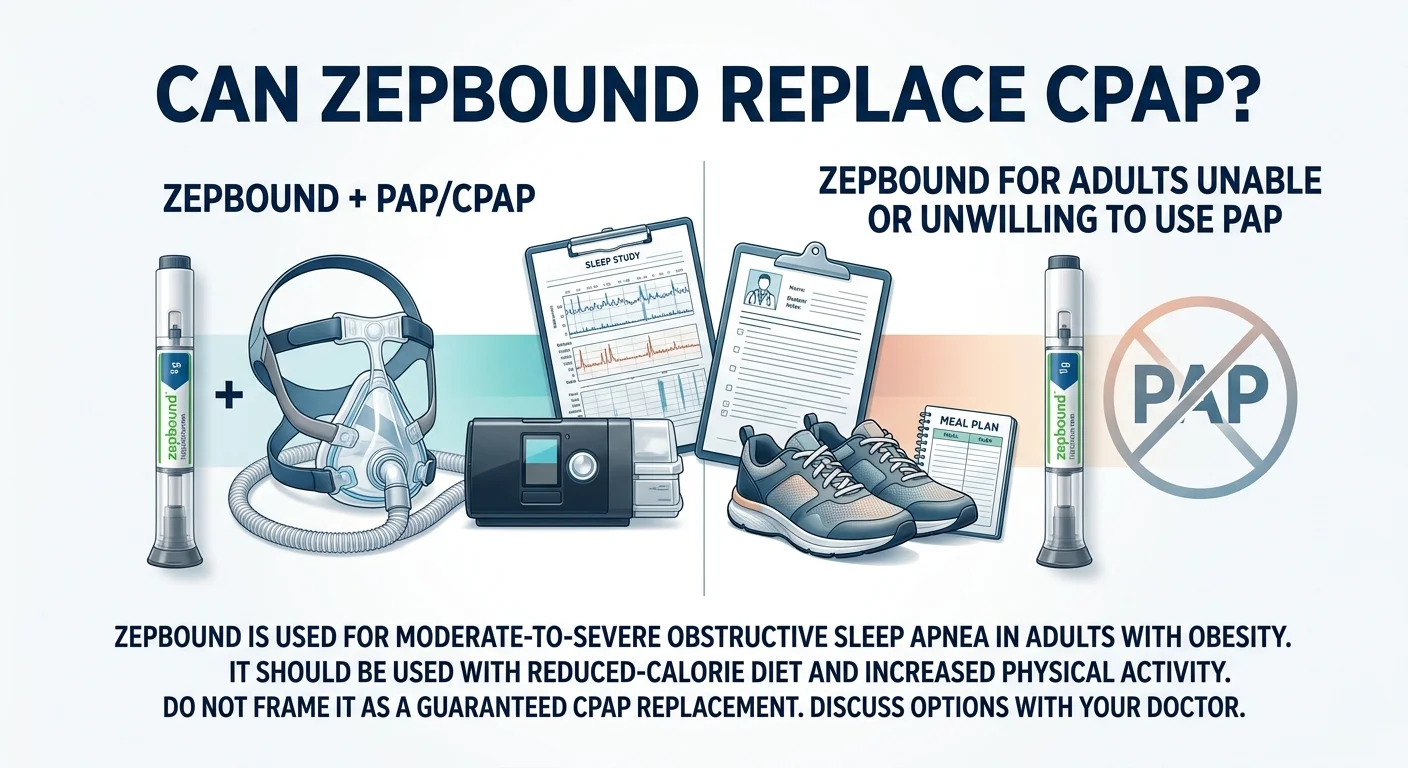
Zepbound + CPAP (combination)
- ✓ Both approaches studied in SURMOUNT-OSA trials
- ✓ Some plans view continued CPAP favorably in PA evaluation
- ✓ Continuing CPAP while on Zepbound is a reasonable path
- ✓ Follow-up sleep study assesses whether CPAP can be reduced
Zepbound without PAP
- ✓ FDA approval doesn't require concurrent CPAP use
- ✓ Some patients unable or unwilling to use PAP therapy
- ⚠ For severe OSA, Zepbound alone may not be sufficient
- ⚠ Do not stop CPAP on your own — get a follow-up sleep study first
Do not stop CPAP without a follow-up sleep study
What If Your Sleep Study Shows RDI but Not AHI?
This is a real edge case that catches more people than you'd expect. Some sleep studies report RDI (respiratory disturbance index) or REI (respiratory event index) prominently, while the AHI number is lower or calculated differently. If your RDI is 15+ but your AHI is under 15, you may run into trouble — because some payer criteria name AHI specifically.
The good news: some public criteria explicitly accept AHI, REI, or RDI at the ≥15 threshold. UnitedHealthcare's public policy, for example, references AHI/REI/RDI. Others are narrower.
What to do if you're in this situation:
- 1.Check your plan's written PA criteria to see which metrics they accept.
- 2.If they only list AHI and yours is borderline, ask your sleep specialist whether the study can be re-scored or whether a new study with different scoring criteria would produce a qualifying AHI.
- 3.If the metric issue caused a denial, your appeal should explicitly cite which measurement your plan accepts, provide the qualifying score, and reference any plan language that supports alternative metrics.
"Their insurer only looked at my AHI and denied the PA despite years of CPAP use and a strong RDI score. The appeal was also denied." — Anecdotal patient report (r/Zepbound). Not typical. This edge case is addressable with the right documentation and metric emphasis.
How Long Does Zepbound Prior Authorization Take?
Complete submissions can reduce avoidable back-and-forth, but the plan's rules control the timeline. Check the plan's PA instructions and any denial notice for the applicable deadline and review standard.
Medicare Part D (federally mandated)
- Standard coverage determination72 hours
- Expedited determination24 hours
- Redetermination (appeal)7 calendar days
- Expedited appeal72 hours
Source: Medicare appeals process (CMS)
Commercial plans
Commercial plans set their own timelines. Check your plan's PA instructions and denial letter for specific deadlines.
- • Plan-specific criteria and processing rules apply
- • Missing information can lead to a request for more documentation
- • Ask whether expedited review is available for an urgent medical need
How Quickly Can Zepbound Improve Sleep Apnea?
The SURMOUNT-OSA trials measured outcomes at 52 weeks. Participants who received Zepbound (10 or 15 mg weekly) experienced statistically significant and clinically meaningful reductions in breathing interruptions compared to placebo. Individual timelines vary.
This matters for PA renewals — plans have different continuation criteria:
- • CVS Caremark: Positive response evidenced by decreased OSA symptoms
- • Virginia Medicaid: Documentation of improvement in OSA symptoms
- • UHC: Reauthorization differs for patients using PAP and those not using PAP; review the current policy for the applicable continuation criteria
Ask your clinician what follow-up documentation your plan may request. Do not assume a single outcome measure applies to every plan.
How We Verified This Page
This guide was built from publicly available payer criteria documents, CMS guidance, Eli Lilly's official PA resource materials, FDA approval documents, clinical trial data, and patient reports. What "public criteria" means: the insurer requirements on this page come from publicly available policy documents and PA forms. Your exact employer-group plan terms may differ — always verify with your specific plan before submitting.
Sources reviewed:
- UHC commercial Zepbound OSA PA criteria (PDF)
- CVS Caremark Zepbound criteria (PDF)
- Highmark Zepbound PA form (PDF)
- WV Medicaid Zepbound OSA form
- CMS Medicare GLP-1 Bridge guidance
- FDA OSA approval announcement (Dec. 20, 2024)
- Eli Lilly PA Resource Guide
- Zepbound prescribing information (FDA)
- SURMOUNT-OSA trial (NEJM)
Not a guarantee: We don't guarantee any PA outcome. Individual plan criteria, coverage decisions, and eligibility determinations are unique to each patient and plan.
How we make money: This page includes clearly labeled partner links that may earn a commission if you later become a customer. This doesn't affect our editorial process or coverage analysis.
Not medical advice: This page is for informational purposes only. Consult your healthcare provider and insurer for decisions about your specific situation.
Last verified: August 31, 2026. We review payer criteria, prices, links, and FAQs before changing this date.
Frequently Asked Questions
Choose the next step that matches your situation
Keep the next action tied to the question you still need answered. No route guarantees coverage, a prescription, treatment, or PA approval.
Coverage unknown
Check whether the Zepbound pen is covered and whether PA is required.
PA required or denied
Ask whether an online visit can support the OSA documentation pathway.
Paying cash or comparing alternatives
Compare official brand-name self-pay information with separate weight-management programs.