Prior Authorization GLP-1: Requirements, Forms & Approval Checklist
Disclosure: Some links on this site are affiliate links. If you purchase through these links, we may earn a commission at no extra cost to you. Thank you for supporting our site. For informational purposes only—not medical advice.
Start here — before you build a PA packet
First, find out whether the drug is covered
Prior authorization only solves one type of coverage problem. Before gathering forms, check whether your plan covers the medication and whether PA is actually required. Ro's free GLP-1 Insurance Coverage Checker currently checks the Ozempic pen, Wegovy pen, and Zepbound pen and sends you a personalized coverage report.
Ro contacts your insurer to collect coverage information. The free checker does not submit a treatment request or write a prescription. Sponsored link. We may earn a commission if you later enroll in care.
On this page
On this page: Everything you need to get your GLP-1 medication approved—requirements, forms, checklists, denial fixes, and appeal templates. Use the checklists and templates below to build a complete PA packet and find your plan's specific criteria.
The Short Answer (Read This First)
If you're stuck waiting on prior authorization for a GLP-1 medication like Ozempic, Wegovy, Mounjaro, or Zepbound, here's what you need to know right now:
Answer: GLP-1 prior authorization is an insurer review that checks the requested indication, plan criteria, documentation, and any utilization-management rules that apply to the medication. Your plan may ask for diagnosis, BMI or comorbidity records, prior-treatment history, or other evidence; a complete request is easier to review, but it does not guarantee approval.
| What Insurers Check | Documentation to confirm | | --- | --- | --- | | BMI | Current value and date if the plan uses BMI criteria | | Qualifying Health Conditions | Diagnosis and supporting records if the plan requires them | | Prior Treatment | Any required lifestyle or medication history | | Correct Diagnosis Code | Code and clinical record matching the requested indication | | Step Therapy | The plan's required trial history, if applicable |
Approval depends on the specific plan, medication, indication, and documentation standard. A complete request commonly needs (1) a diagnosis and clinical record that match the requested use, (2) any BMI, comorbidity, or prior-treatment evidence required by the plan, and (3) the correct form and supporting documents. Missing information is one possible cause of delay, but it is not the only reason a request can be denied.
This guide exists to fix that. We'll show you exactly what your insurance company needs, help you gather the right paperwork before your appointment, and give you the tools to fight back if you're denied.
GLP-1 and related incretin medications include Ozempic, Wegovy, Mounjaro, Zepbound, Rybelsus, Saxenda, and Foundayo. Whether a medication needs prior authorization depends on the plan, benefit, indication, and product.
Do You Actually Need Prior Authorization?
Before we dive in, let's make sure prior authorization is actually what's blocking you.
Prior authorization (PA) is when your insurance company reviews your prescription before agreeing to cover it. A plan may use PA, step therapy, quantity limits, or other utilization-management rules for GLP-1 medications; the exact rule is plan-specific.
Here's the reality check:
You probably need PA if:
- Your pharmacy said "prior authorization required" when trying to fill your prescription
- Your insurance portal shows "PA" or "Prior Auth" next to GLP-1 medications on the formulary
- Your doctor's office said they need to submit paperwork to insurance
You might NOT need PA if:
- You're paying cash (no insurance involvement)
- Your plan's current criteria say PA is not required for that drug and indication
- Your employer plan has already pre-approved GLP-1 coverage
Important distinction: Prior authorization is different from a plan exclusion. If your plan specifically excludes weight-loss medications, a PA request won't override that—you'd need to request a formulary exception or explore other options (we cover those later in this guide).
Find the next step
What best describes your situation?
Choose the status you know. This tool does not collect or send your drug, diagnosis, BMI, insurer, or member information.
Pick Your Situation: The 3 Paths to GLP-1 Approval
GLP-1 medications are FDA-approved for different uses, and your path to approval depends heavily on why you're taking the medication. Insurance companies care about this a lot.
Path A: GLP-1 for Type 2 Diabetes
Medications typically used: Ozempic, Mounjaro, Trulicity, Victoza, and Rybelsus
If you have Type 2 diabetes, the relevant diabetes benefit and plan criteria determine the path. Some plans cover diabetes indications with a PA or other utilization-management requirement; others may have different rules.
What insurers typically require:
- Confirmed Type 2 diabetes diagnosis (ICD-10 code E11.x)
- Plans often require recent diagnostic labs (e.g., A1C or fasting glucose) and documentation of the diabetes diagnosis; the exact thresholds are plan-specific and appear on the PA form
- A plan-specific step-therapy requirement, which may include metformin or another diabetes treatment
- Documentation of any contraindication, intolerance, or prior-treatment history when the plan asks for it
Important: Your clinician should prescribe for the indication that applies to your care. Do not use a diabetes diagnosis or diabetes-only product as a shortcut for weight-management coverage.
Path B: GLP-1 for Weight Management (No Diabetes)
Medications with weight-management indications: Wegovy, Zepbound, Saxenda, and other products as reflected in current FDA labeling
This path can involve additional documentation. Weight-management coverage is especially plan-specific because some benefits exclude these medications and others apply PA, step therapy, or quantity limits.
What insurers typically require:
- A BMI threshold such as ≥30, or ≥27 with a weight-related health condition, if required by the plan
- Documentation of a supervised weight-management attempt when the plan requires it
- Proof of comorbidities if your BMI is between 27–30
- Any required lifestyle or other weight-management treatment history
The comorbidities that count:
- Hypertension (high blood pressure)
- Type 2 diabetes or pre-diabetes
- Dyslipidemia (high cholesterol/triglycerides)
- Obstructive sleep apnea
- Cardiovascular disease
- Osteoarthritis
- Fatty liver disease (NAFLD/NASH/MASH)
Reality check: If your employer plan or insurance specifically excludes "weight-loss drugs" or "anti-obesity medications," you may need to pursue a formulary exception—or explore alternatives. Check your Summary of Benefits and Coverage document, or call the number on your insurance card to confirm.
Path C: GLP-1 for Other FDA-Approved Uses
The FDA has approved some GLP-1 medications for uses beyond diabetes and weight loss. If one of these applies to you, your approval path may differ:
Cardiovascular Risk Reduction
- Check the current Wegovy application and labeling for the cardiovascular-risk-reduction indication and population (FDA Drugs@FDA)
- This indication can sometimes provide an alternative coverage pathway
Obstructive Sleep Apnea (OSA)
- Check the current Zepbound application and labeling for the obstructive-sleep-apnea indication and population (FDA Drugs@FDA)
- Requires documented OSA diagnosis (typically via sleep study)
MASH (Metabolic Dysfunction-Associated Steatohepatitis)
- Wegovy's current FDA labeling should be checked for the exact MASH indication, population, and formulation before a request is submitted (FDA Drugs@FDA)
- This is a newer indication and coverage policies are still evolving
Why your indication matters: Insurance criteria may mirror FDA indication language, so the documentation for CV risk reduction, OSA, MASH, diabetes, or weight management can differ. Ask the plan which indication and records apply before submitting.
What Is Prior Authorization—And Why Do GLP-1s Trigger It?
Let's make sure we're speaking the same language.
The Plain-English Definition
Prior authorization is your insurance company's way of saying: "Before we pay for this expensive medication, prove to us that you actually need it and meet our rules."
It's not a denial. It's a checkpoint. The insurance company reviews your medical records and decides whether to cover the drug based on their criteria.
For GLP-1 medications specifically, prior authorization exists because:
- These drugs are expensive. Many brand-name GLP-1s have four-figure monthly retail prices, which vary by dose, pharmacy, and discount programs. Insurers want to make sure they're not paying for medications that aren't medically necessary or won't be used correctly.
- Demand has exploded. GLP-1 prescriptions have increased dramatically since 2020, and insurers have tightened their approval processes in response.
- FDA-approved uses matter for coverage. A drug approved for diabetes may not be covered when prescribed "off-label" for weight loss, and vice versa.
- There are safety considerations. GLP-1s have contraindications and require appropriate patient selection.
Prior Auth vs. Step Therapy vs. Quantity Limits
These terms often get confused. Here's the difference:
| Term | What It Means | How It Blocks You | How to Resolve |
|---|---|---|---|
| Prior Authorization | Insurance reviews your case before approving | Prescription won't fill until approved | Submit required documentation |
| Step Therapy | Must try cheaper drugs first | Denied until you've tried (and failed) required drugs | Document prior med trials or get exception |
| Quantity Limit | Caps on how much you can fill | Pharmacy won't dispense more than allowed | May need PA for higher quantities |
| Formulary Exclusion | Drug isn't covered at all | Plan won't pay regardless of PA | Request formulary exception or pay cash |
Many GLP-1 prior authorizations involve multiple requirements—you might need to satisfy PA criteria AND complete step therapy AND stay within quantity limits. Understanding which barriers you're facing helps you address the right one.
GLP-1 Medications: Which Drug Is Which?
Before requesting prior authorization, make sure you're requesting the right medication for your situation. The most common PA denial that's entirely avoidable? Requesting a drug that doesn't match your insurance's coverage category.
The GLP-1 Medication Reference Table
| Brand Name / Formulation | Active Ingredient | FDA-Approved Uses to Check | Common Coverage Pathway / Plan-Specific Restrictions | | --- | --- | --- | --- | --- | | Ozempic pen | Semaglutide (injection) | Type 2 diabetes | Diabetes benefit; PA, step therapy, and quantity limits depend on the plan | | Wegovy pen | Semaglutide (injection) | Chronic weight management and other current label indications | Weight-management or other applicable benefit; confirm the plan's covered indication | | Wegovy tablets | Semaglutide (oral tablet) | Check current FDA labeling for the tablet indication | Do not assume tablet and pen coverage are identical | | Foundayo | Orforglipron | Check current FDA labeling for the indication and formulation | Formulary and utilization-management rules are plan-specific | | Rybelsus | Semaglutide (oral tablet) | Type 2 diabetes | Diabetes benefit; PA and step therapy vary by plan | | Mounjaro | Tirzepatide (injection) | Type 2 diabetes | Diabetes benefit; PA and step therapy vary by plan | | Zepbound pen / KwikPen | Tirzepatide (injection) | Chronic weight management and obstructive sleep apnea | Confirm the formulation, indication, and plan benefit before requesting PA | | Trulicity | Dulaglutide (injection) | Type 2 diabetes | Diabetes benefit; restrictions vary by plan | | Victoza | Liraglutide (injection) | Type 2 diabetes | Diabetes benefit; restrictions vary by plan | | Saxenda / generic liraglutide injection | Liraglutide (injection) | Check current FDA labeling for chronic weight management | Do not assume a generic or brand product is covered; verify the current formulary |
Note: Product approvals, formulations, and availability can change. Use the current FDA label and your plan's formulary rather than a promotional announcement to confirm what applies.
Key Things to Understand
Same ingredient, different drugs: Ozempic and Wegovy both contain semaglutide, but they're considered different products with different FDA approvals and different insurance coverage pathways. The same applies to Mounjaro and Zepbound (both tirzepatide).
"Off-label" prescribing is harder to get approved: If your doctor prescribes Ozempic for weight loss (not its FDA-approved use), your insurance may deny coverage because it's technically off-label. You'd need stronger clinical justification.
Check your plan's formulary first: Your insurance might cover Trulicity but not Ozempic, or Saxenda but not Wegovy. Knowing what's on your plan's preferred drug list can save you time.
The 6 Criteria Buckets: What Insurers Actually Check
This is where we get specific. Insurance companies evaluate GLP-1 prior authorization requests based on roughly six categories. Understanding these is how you make sure your request gets approved the first time.
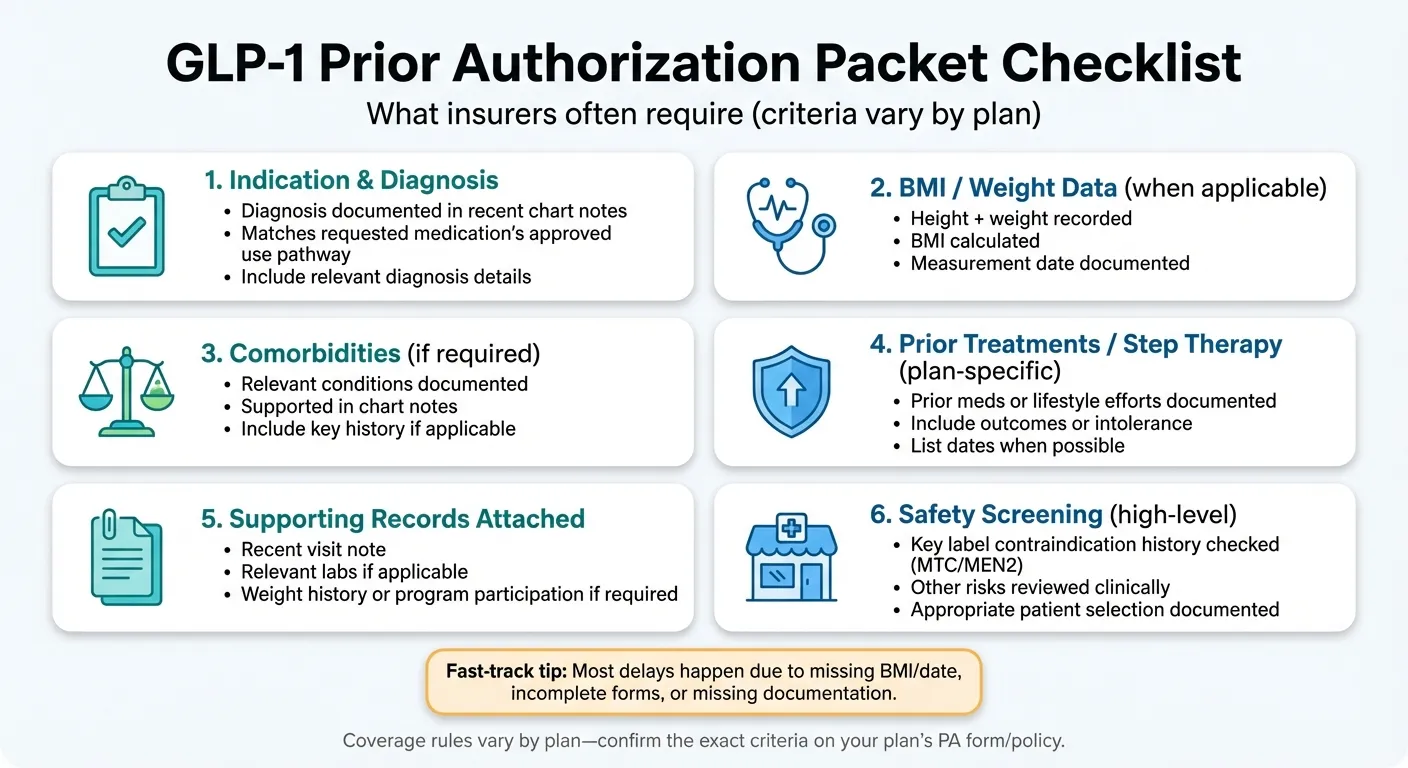
Bucket 1: Correct Indication + Diagnosis Proof
What it means: Your documented diagnosis must match the drug's FDA-approved use.
What insurers look for:
- ICD-10 diagnosis code in your medical records
- Clinical notes supporting the diagnosis
- Match between the diagnosis and the requested medication
Diagnosis & Coding: What Insurers Usually Need Documented
| What to Document | What It Looks Like in Chart Notes (Example) | Why It Matters |
|---|---|---|
| Indication diagnosis | Type 2 diabetes (E11.x) | Matches diabetes-only GLP-1 coverage pathways |
| Obesity severity | Obesity diagnosis (code varies by class/plan) + BMI value | Many obesity criteria are BMI-threshold based |
| BMI (value + date) | "BMI 33.4 on 01/28/2026" | Denials often happen when BMI or date is missing |
| Comorbidities | Hypertension, dyslipidemia, OSA, etc. | Needed when BMI is 27–29.9 and plan requires comorbidity |
| "Current use" add-on codes (provider-only) | e.g., Z79.85 can be used for injectable non-insulin antidiabetic drugs | Sometimes helps claims logic / continuity of care |
Important note: Coding is done by clinicians and coders, and requirements vary by payer. New obesity class codes (E66.811, E66.812, E66.813 for Class 1, 2, and 3 obesity) became effective October 2024 (Source: CDC ICD-10-CM update). Don't attempt to self-code—use this information only to understand what documentation your plan may be looking for.
Why requests get denied here:
- Wrong diagnosis code (e.g., requesting weight-loss drug with only diabetes code)
- No diagnosis code included at all
- Diagnosis not documented in recent chart notes
How to avoid this: Make sure your doctor's chart notes from your most recent visit include your diagnosis AND the corresponding ICD-10 code. If you're requesting a weight-loss medication, your BMI and any comorbidities need to be explicitly documented.
Bucket 2: BMI and Weight-Related Comorbidities
What it means: For weight-management medications, insurers require proof that your BMI meets their threshold, and documentation of any qualifying health conditions.
Standard BMI requirements (these vary by plan):
- BMI ≥30 (obesity) — usually qualifies on its own
- BMI ≥27 (overweight) + at least one weight-related comorbidity
- Some stricter plans require BMI ≥35 or even ≥40
What needs to be documented:
- Your weight (in pounds or kg)
- Your height
- The date the measurement was taken
- Calculated BMI
- Any qualifying comorbidities with their own diagnosis codes
Qualifying comorbidities typically include:
- Type 2 diabetes or pre-diabetes
- High blood pressure (hypertension)
- High cholesterol/triglycerides (dyslipidemia)
- Obstructive sleep apnea (requires sleep study)
- Cardiovascular disease
- Joint problems related to weight (osteoarthritis)
- Fatty liver disease (NAFLD/NASH/MASH)
- Polycystic ovary syndrome (PCOS)
Why requests get denied here:
- BMI documented but without a date
- Weight from a year ago (insurers want recent measurements)
- Comorbidities mentioned but not coded in chart notes
- BMI just under the threshold (e.g., 29.8 when plan requires 30)
How to avoid this: At your appointment, ask your doctor to document your current weight, height, BMI, and the date measured. If you have any of the comorbidities listed above, make sure they're noted with their ICD-10 codes.
Bucket 3: Step Therapy / Prior Medications Tried
What it means: Many insurance plans require you to try (and fail) other treatments before approving a GLP-1.
For Type 2 Diabetes path:
- A plan-specific trial requirement, which may include metformin or another diabetes treatment
- Additional prior medication history when the plan requires it
- An exception request supported by documented intolerance or contraindication when appropriate
For Weight Management path:
- A documented lifestyle-modification attempt when the plan requires it
- Sometimes: trial of other weight-loss medications (Contrave, Qsymia, phentermine)
- Exception: documented contraindication or prior failure
What counts as "tried and failed"?
- Inadequate response (didn't achieve target A1C or weight loss goal)
- Intolerable side effects (documented in chart notes)
- Contraindication (e.g., metformin + kidney disease)
Why requests get denied here:
- No documentation of prior treatments
- Patient says they tried medications, but no records
- Lifestyle modification not documented by a healthcare provider
How to avoid this: Bring records of any medications you've tried for diabetes or weight loss, including why they didn't work. If you've worked with a dietitian, weight-loss program, or exercise program, bring documentation.
Bucket 4: Lifestyle Program / Weight History Evidence
What it means: For weight-loss indications, insurers want proof that you've attempted non-medication approaches to weight management.
What typically counts as documentation:
- Records from a physician-supervised weight loss program
- Visits with a registered dietitian
- Enrollment in a structured weight-loss program (with dates)
- Weight history showing attempts at weight management
- Exercise program documentation
- Food logs or diet records (sometimes)
Time requirements vary: Some plans specify a period of documented lifestyle modification, while others use different evidence or do not require it. Check the current criteria for the exact plan and medication.
Why requests get denied here:
- "I tried dieting" without any documentation
- Weight-loss program enrollment but no visit records
- Lifestyle attempts not documented by a healthcare provider
How to avoid this: If you've participated in any structured weight-loss program, get documentation. Even visits with your primary care doctor where you discussed diet and exercise can count—ask for those chart notes. Some patients work with a dietitian for 2–3 visits specifically to create this documentation.
Bucket 5: Safety Screening / Contraindications
What it means: GLP-1 medications have specific contraindications, and insurers may check that appropriate safety screening was done.
Key safety considerations:
FDA labels list specific contraindications, including:
- Personal or family history of medullary thyroid carcinoma (MTC)
- Multiple Endocrine Neoplasia syndrome type 2 (MEN 2)
- Serious hypersensitivity to the drug or its components
FDA labels also include warnings and precautions that may require clinician screening, such as:
- History of pancreatitis
- Gallbladder disease
- Severe gastrointestinal issues
- Pregnancy or planned pregnancy considerations (handled clinically)
What insurers may check:
- Thyroid history documented
- No contraindications noted in chart
- Appropriate patient selection documented
Safety documentation can be part of the review, and a contraindication or missing clinical information can change the appropriate treatment path.
Bucket 6: Dose, Quantity, and Refill Rules
What it means: Even with PA approval, insurers may limit how much medication you can get and how often.
Common restrictions:
- Quantity limits per 30-day fill
- Dose escalation schedules (can't jump straight to highest dose)
- Refill timing restrictions (no early refills)
- Step-up requirements (start at low dose, increase gradually)
Why requests get denied here:
- Requested dose is higher than what plan allows initially
- Quantity requested exceeds plan's limit
- Refill attempted too early
How to avoid this: Make sure your prescribed dose matches your plan's allowed starting dose. If your doctor wants to start you at a higher dose, they may need additional justification.
What to Gather Before Your Appointment: Patient Checklist
The most important thing you can do to get your GLP-1 approved? Show up prepared. Your doctor can only document what they have access to, and you have more control over this than you think.
The 15-Minute Document Checklist
Gather these before your appointment:
Insurance Information
- Insurance card (front and back)
- RxBIN and RxPCN numbers (usually on the card)
- Member ID number
- Phone number for pharmacy benefits (for your doctor's office to call)
Weight History
- Weight measurements from the past 6–12 months (dates + weights)
- If you've tracked your weight at home, bring the records
- Any records from previous doctor visits showing weight over time
Medical Records
- List of your current health conditions (with diagnosis dates if you know them)
- List of all current medications (names + doses)
- Any recent lab results (A1C, cholesterol, blood pressure readings)
- Records of past weight-loss attempts or programs
Medication History
- List of medications you've tried for weight loss or diabetes
- Why they didn't work (side effects, didn't help, etc.)
- Photos of medication bottles if you don't remember exact names
Lifestyle Documentation
- Receipts/records from weight-loss programs, gym memberships, dietitian visits
- Food or exercise logs if you've kept them
- Documentation from any structured program (Weight Watchers, Noom, etc.)
Why this matters: Your doctor's prior authorization submission is only as strong as the documentation they have. If you walk in with your weight history, medication list, and proof of lifestyle attempts, you make it easy for them to check all the boxes insurers want.
Useful actions before you call
These actions run locally in your browser. WPG does not receive the information you type into a call script or write on a printed copy.
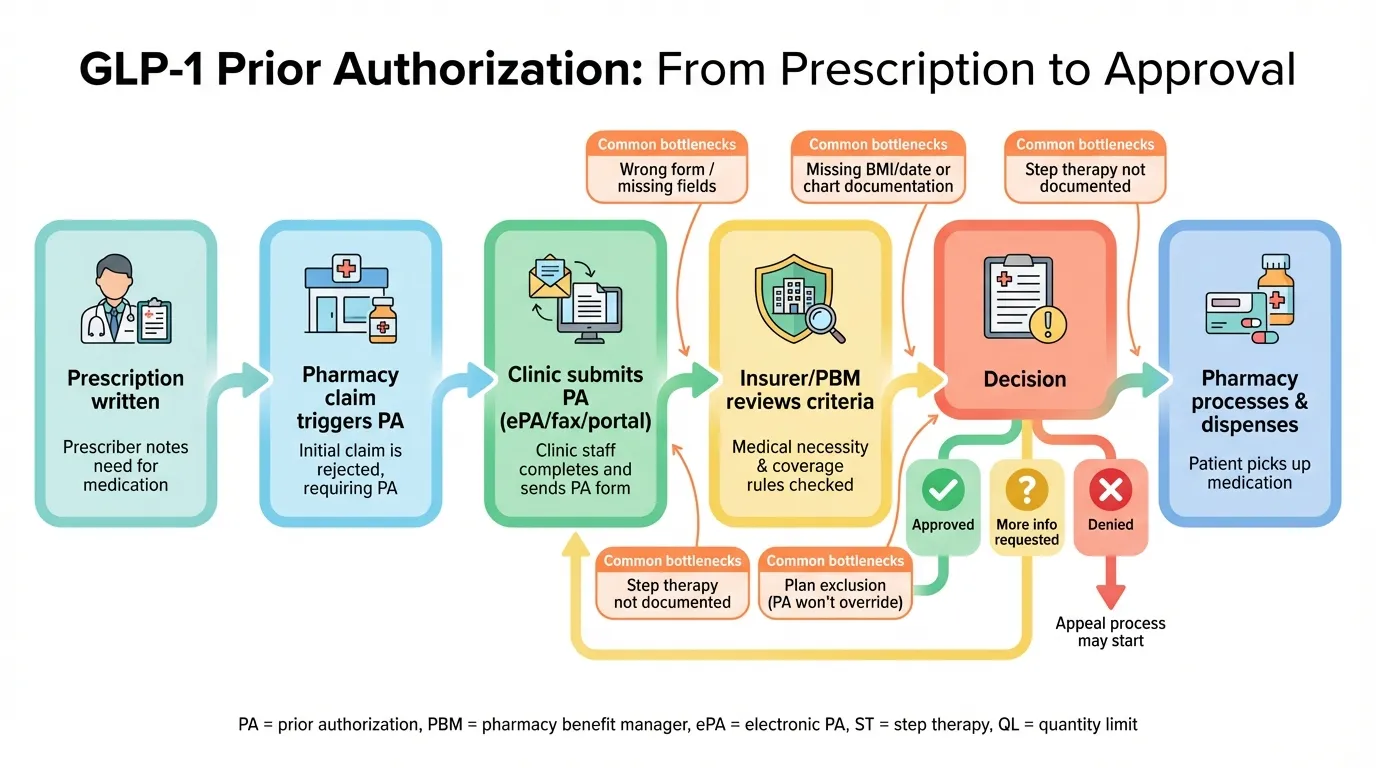
What Your Doctor's Office Needs: Provider Checklist
If you're a provider (or a patient who wants to help their doctor's office), here's what needs to be in the prior authorization submission.
The Complete PA Submission Package
Required Components:
-
Completed Prior Authorization Form
- Use the correct form for the patient's specific insurance/PBM
- Fill out all required fields (incomplete forms = automatic denial)
- Include prescriber NPI and contact information
-
Chart Notes from Recent Visit
- Date of visit
- Current weight, height, calculated BMI (with date)
- Documented diagnosis with ICD-10 codes
- Any relevant comorbidities with their codes
- Statement of medical necessity
-
Letter of Medical Necessity (if required or if criteria are borderline)
- Explain why this specific medication is needed
- Document prior treatments tried and why they failed
- Connect the patient's clinical picture to the drug's indication
-
Supporting Documentation
- Recent lab results (A1C for diabetes, lipid panel, etc.)
- Weight history (multiple data points)
- Records from lifestyle programs or dietitian visits
- Previous medication records
-
Correct Diagnosis Codes
- Primary diagnosis matching the drug's indication
- Secondary diagnoses for comorbidities
- BMI code if applicable
Sample Letter of Medical Necessity Template
Providers can customize this template for their patients:
[Practice Letterhead]
Date: [Insert Date]
Re: Prior Authorization Request for [Drug Name] Patient: [Patient Name] DOB: [Date of Birth] Member ID: [Insurance Member ID]
To Whom It May Concern:
I am writing to request prior authorization for [Drug Name] for my patient [Patient Name], who has been under my care since [Date].
Diagnosis: [ICD-10 Code] - [Diagnosis Description]
Clinical Summary:
- Current BMI: [Value] (measured [Date])
- Current weight: [Value] lbs/kg
- Relevant comorbidities: [List with ICD-10 codes]
- Duration of condition: [Timeframe]
Prior Treatment History: [Patient Name] has previously attempted the following treatments with inadequate response:
- [Medication/Treatment 1]: [Outcome/reason for discontinuation]
- [Medication/Treatment 2]: [Outcome/reason for discontinuation]
- Lifestyle modification: [Details of diet/exercise attempts]
Medical Necessity: [Drug Name] is medically necessary for this patient because [specific clinical rationale]. The patient meets FDA labeling criteria for this indication, and alternative treatments have been insufficient to achieve treatment goals.
Supporting Documentation Enclosed:
- Recent chart notes
- Laboratory results dated [Date]
- Weight history documentation
- [Other relevant records]
Please contact my office at [Phone Number] with any questions regarding this request.
Sincerely,
[Provider Signature] [Provider Name, Credentials] [NPI Number]
Electronic PA (ePA) vs. Traditional Submission
Many insurance plans accept electronic prior authorization through platforms like CoverMyMeds, Surescripts, or their own portals, but the available route depends on the plan and medication.
Advantages of ePA:
- Faster processing (sometimes same-day)
- Fewer errors from missing fields
- Real-time status tracking
- Automatic form selection
When traditional fax/portal may be needed:
- Complex cases requiring extensive documentation
- Plans that don't support ePA for certain drugs
- Appeals or resubmissions with additional information
Find Your Plan's GLP-1 Criteria and PA Form
This is where most people get stuck: finding the actual requirements and forms for their specific insurance plan.
Step 1: Identify Your PBM (Pharmacy Benefit Manager)
Your PBM processes your prescription benefits and sets the prior authorization rules. Look at your insurance card for one of these names:
- CVS Caremark (often shows "CVS" or "Caremark")
- Express Scripts (often shows "ESI" or "Express Scripts")
- OptumRx (often shows "Optum" or "UHC")
- Prime Therapeutics (often shows "Prime")
- Cigna (may process their own or use Express Scripts)
- Humana Pharmacy (may process their own)
Can't find it? Call the number on the back of your insurance card and ask: "Who is my pharmacy benefit manager for prescription coverage?"
Step 2: Access Formulary and PA Criteria
Once you know your PBM, you can look up whether GLP-1 medications require prior authorization and what the specific criteria are.
Where to Find PA Criteria by Major PBM:
| PBM/Insurer | Official starting point | What to ask for |
|---|---|---|
| CVS Caremark | Caremark pharmacy benefits | Your drug's formulary status, PA criteria, and correct form |
| Express Scripts | Express Scripts | Your drug's formulary status, PA criteria, and correct form |
| OptumRx | Optum Rx | Your drug's formulary status, PA criteria, and correct form |
| Cigna | Cigna pharmacy benefits | Your drug's formulary status, PA criteria, and correct form |
| Aetna | Aetna pharmacy benefits | Your drug's formulary status, PA criteria, and correct form |
| UnitedHealthcare | UnitedHealthcare pharmacy benefits | Your drug's formulary status, PA criteria, and correct form |
| Humana | Humana pharmacy | Your drug's formulary status, PA criteria, and correct form |
| Blue Cross Blue Shield | Your state's Blue Cross Blue Shield site | Your state plan's formulary, PA criteria, and correct form |
| Medicare Part D | Your plan's member portal and the official CMS Bridge information | Whether ordinary Part D or the Bridge rules apply |
| Medicaid | Medicaid.gov prescription drugs and your state program | Your state and managed-care formulary, PA criteria, and correct form |
| TRICARE | TRICARE pharmacy | The current pharmacy benefit and PA criteria |
Note: These are official starting points, not a substitute for your plan's member portal or the number on your insurance card. Policies and forms can change.
Step 3: Check Coverage Status Before Requesting
Before your doctor submits the PA request, it helps to know:
-
Is the drug on your formulary at all?
- Look up the specific drug (Ozempic, Wegovy, etc.)
- Check what tier it's on (Tier 4+ usually means higher cost)
-
What utilization management applies?
- PA = Prior Authorization required
- ST = Step Therapy required
- QL = Quantity Limits apply
-
Are weight-loss drugs excluded?
- Some plans exclude all anti-obesity medications
- Look for exclusions in your Summary of Benefits
Pro tip: If you call your insurance before the PA is submitted, ask: "What are the specific criteria for prior authorization approval for [Drug Name]?" They're required to tell you.
How Long Does GLP-1 Prior Authorization Take?
The honest answer: it depends on how complete your submission is.
Typical Timelines
| Scenario | What to expect |
|---|---|
| Complete ePA submission | Use the review standard stated by your plan |
| Fax or portal submission | May take longer than an electronic submission |
| Missing documentation | The plan may pause review while it requests more information |
| Denial and appeal | The denial letter gives the applicable deadline and process |
What Slows Things Down
- Incomplete forms — Missing fields mean the request sits in a queue for follow-up
- Missing documentation — Insurer sends request back for more info
- Wrong form used — Some plans have drug-specific PA forms
- High volume periods — January (new plan year) is especially busy
- Manual review required — Complex cases take longer than auto-approvals
How to Track Your PA Status
Ask your doctor's office:
- "Has the PA been submitted?"
- "What date was it submitted?"
- "Have you received any response or request for additional info?"
Ask your insurance:
- Call the pharmacy benefits number on your card
- Ask: "What is the status of the prior authorization for [Drug Name] for [Your Name]?"
- Get a reference number for the request
Ask your pharmacy:
- They can often see if a PA is pending or approved
- They may be able to run a test claim to check status
Expedited/Urgent Requests
In some situations, you can request expedited review under your plan's standard:
- Medical urgency (e.g., uncontrolled diabetes with complications)
- Risk of harm if medication is delayed
- Inpatient to outpatient transition
Your doctor needs to specifically request urgent/expedited review and provide justification. Not all cases qualify.
Optional insurance support
Want help handling the prior authorization?
If a Ro-affiliated provider determines treatment is appropriate and prescribes a supported medication, Ro's insurance concierge can coordinate with insurance and handle PA paperwork. This is separate from the free coverage checker above.
- Ro Body membership is paid separately and is not covered by insurance.
- Medication cost is separate from the membership fee.
- Coverage and approval are not guaranteed.
Sponsored link. We may earn a commission if you enroll in care.
How Long Does GLP-1 Prior Authorization Last (and What You Need to Renew)?
This is one of the most common questions people forget to ask—until their approval suddenly expires.
Approval duration
Your plan sets the approval period and renewal requirements. Do not assume a standard duration across insurers, medications, or indications:
| Plan Type | What to confirm |
|---|---|
| Commercial plans | The authorization expiration date and renewal criteria |
| Medicare Part D | The plan's rules and whether a separate CMS pathway applies |
| Medicaid | State and managed-care renewal rules |
Ask the plan or your doctor's office for the exact expiration date on your authorization.
What You Need for Reauthorization
When your PA is up for renewal, insurers typically want to see:
For Weight Management GLP-1s:
- Updated weight and BMI (showing treatment response)
- Continued documentation of lifestyle program participation
- Evidence of "positive clinical response" (weight loss maintained)
- Confirmation you're still taking the medication as prescribed
For Diabetes GLP-1s:
- Updated A1C or other diabetes labs
- Continued use documentation
- No contraindications developed
Renewal Checklist
To avoid gaps in coverage when your PA expires:
- Know when your current PA expires (ask your doctor's office or insurance)
- Schedule a follow-up visit 4–6 weeks before expiration
- Have updated weight/BMI documented at that visit
- Bring any lifestyle program documentation from the approval period
- Make sure your doctor's office submits the renewal PA before expiration
Pro tip: Ask when the renewal process should start so your doctor's office can submit any required documentation before the current approval expires.
Common Denial Reasons (And the Exact Fix for Each)
If you've been denied, don't panic. The next step depends on the exact reason in the denial notice: a correction, resubmission, reconsideration, or formal appeal may be appropriate.
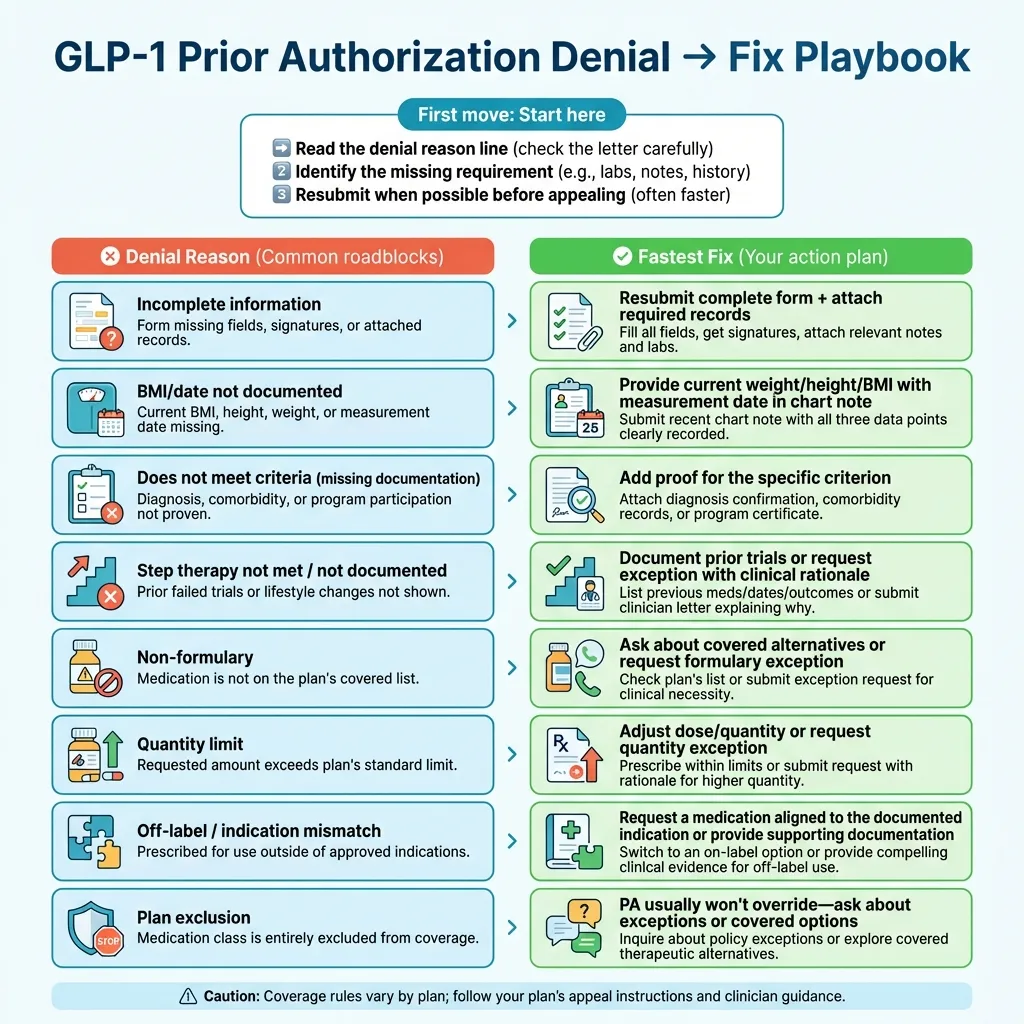
The Denial → Fix Table
| Denial Reason | What It Really Means | The Fix |
|---|---|---|
| "Does not meet criteria" | Missing BMI documentation, comorbidity proof, or diagnosis code | Resubmit with explicit documentation of BMI + date, qualifying health conditions with ICD-10 codes |
| "Step therapy not met" | Plan requires trial of other medications first | Document prior medication trials (what you tried, why it didn't work) OR get step therapy exception |
| "Prior authorization not obtained" | PA was required but not submitted before filling | Submit PA now; request retroactive review if medication was already dispensed |
| "Non-formulary" | Drug isn't on your plan's covered drug list | Request formulary exception OR switch to covered alternative |
| "Plan exclusion" | Your plan specifically excludes this drug category | Request formulary exception (may be difficult) OR explore alternatives |
| "Incomplete information" | PA form was missing required information | Resubmit complete form with all documentation |
| "Medical necessity not established" | Insurer doesn't see enough clinical justification | Provide detailed letter of medical necessity with supporting records |
| "Quantity limit exceeded" | Requested amount exceeds plan's allowed quantity | Request quantity limit exception OR adjust prescription to match limits |
| "Off-label use" | Drug requested for a use not matching FDA approval | Provide strong clinical rationale OR request drug approved for your indication |
| "Documentation not current" | Records provided are too old for the plan's rule | Provide documentation that meets the plan's recency requirement |
How to Read Your Denial Letter
Your denial letter should include:
- The specific reason for denial — Look for the exact criteria that wasn't met
- What would be needed for approval — Sometimes explicitly stated
- Appeal deadline — The deadline printed in your denial notice
- Appeal instructions — How to submit an appeal
- External review rights — Your right to an independent review
Save this letter. You'll need it for your appeal.
If You Were Denied: The Step-by-Step Appeals Process
Getting denied does not necessarily end the process. The appropriate next step depends on the denial reason and the appeal rights in your notice.
The Appeals Ladder
Level 1: Correct and Resubmit (Fastest)
If the denial was due to missing information or clerical issues:
- Don't appeal—just resubmit with the missing documentation
- This is faster than a formal appeal
Level 2: Internal Appeal / Reconsideration
If you believe you meet criteria but were incorrectly denied:
- Submit a written appeal within the deadline printed in the denial notice
- Include new or additional documentation addressing the denial reason
- Reference specific criteria from your plan that you meet
Level 3: Peer-to-Peer Review
Your doctor can request to speak directly with the insurance company's medical director:
- Often available before or during the appeal process
- Allows your doctor to explain the clinical rationale verbally
- Can be very effective for borderline cases
Level 4: External Review
If internal appeals are exhausted:
- You have the right to an independent external review
- An outside organization reviews your case
- Binding on the insurance company in many states
- Usually free to the patient
What to Include in Your Appeal
-
Appeal cover letter stating:
- Patient name, DOB, member ID
- Drug being requested
- Reference to the denial (date, reference number if available)
- Specific reasons why the denial was incorrect
- What documentation is enclosed
-
Point-by-point response to the denial reason:
- If they said "BMI not documented" → include current BMI with date
- If they said "step therapy not met" → document prior medication trials
- If they said "no comorbidity" → provide diagnosis codes and records
-
Updated documentation that addresses the gap:
- Recent chart notes
- Lab results
- Weight history
- Records from lifestyle programs
-
Letter of medical necessity from your doctor (if not previously included)
-
Supporting clinical literature (optional but helpful for complex cases):
- FDA labeling
- Clinical guidelines supporting the treatment
Sample Appeal Letter Template
[Your Name] [Your Address] [Date]
[Insurance Company Name] [Appeals Department Address]
Re: Appeal of Prior Authorization Denial Patient Name: [Your Name] Date of Birth: [Your DOB] Member ID: [Your Member ID] Drug: [Medication Name] Denial Date: [Date of Denial] Denial Reference #: [If available]
Dear Appeals Review Board:
I am writing to appeal the denial of prior authorization for [Drug Name], which was denied on [Date] due to [stated denial reason].
I respectfully disagree with this determination for the following reasons:
[Address each denial reason specifically]
- Regarding [denial reason 1]: [Explain why this is incorrect and what documentation proves it]
- Regarding [denial reason 2]: [Explain why this is incorrect and what documentation proves it]
Enclosed Documentation:
- [List all documents you're including]
- [Recent chart notes dated X]
- [Lab results dated X]
- [Letter of medical necessity from Dr. X]
- [Weight history documentation]
Based on the above, I meet the criteria for coverage of [Drug Name] as specified in your formulary/coverage policy. I request that this denial be reversed.
Please contact me at [phone number] or [email] if additional information is needed.
Sincerely,
[Your Signature] [Your Printed Name]
Timeline for Appeals
| Appeal Type | What to use |
|---|---|
| Standard internal appeal | Follow the deadline and decision standard in the denial notice |
| Expedited appeal (urgent cases) | Ask the plan whether the case qualifies and what standard applies |
| External review | Varies by plan, state, and applicable federal rules |
Optional insurance support
Want help handling the prior authorization?
If a Ro-affiliated provider determines treatment is appropriate and prescribes a supported medication, Ro's insurance concierge can coordinate with insurance and handle PA paperwork. This is separate from the free coverage checker above.
- Ro Body membership is paid separately and is not covered by insurance.
- Medication cost is separate from the membership fee.
- Coverage and approval are not guaranteed.
Sponsored link. We may earn a commission if you enroll in care.
Medicare, Medicaid, and Special Cases
Some insurance situations have unique rules for GLP-1 coverage. Here's what you need to know.
Medicare Part D: The Key Rule Everyone Misunderstands
The important distinction: Medicare coverage depends on the indication, program, formulation, and current CMS rules. A commercial insurance workflow should not be assumed to apply to Medicare.
What's covered:
- GLP-1s for Type 2 diabetes — coverage and PA rules depend on the specific Part D plan
- Some other FDA-approved indications may have their own coverage pathway; verify the indication and formulation with the plan
What's historically NOT covered:
- Traditional Part D rules have historically limited coverage for drugs used solely for weight loss, but the Medicare GLP-1 Bridge is a separate current pathway
What's changing:
- The Medicare GLP-1 Bridge began July 1, 2026 and currently runs through December 31, 2027. Under the Bridge rules, eligible beneficiaries pay a $50 monthly copay for covered formulations.
- The Bridge operates outside the normal Part D coverage and payment flow, and Part D sponsors do not need to opt in. CMS rules determine eligibility and the current covered formulations (official CMS Bridge information).
- Coverage rules and the list of covered formulations can change, so use the current CMS information rather than a stale product list.
If you have Medicare:
- Start with the official CMS Bridge information and eligibility rules
- Confirm your indication and formulation with your clinician
- Ask Medicare or your plan how the Bridge or ordinary benefit applies to your situation
- Keep the Bridge path separate from commercial insurance and cash-pay offers
Medicaid: State-by-State Reality
Medicaid coverage for GLP-1s varies dramatically by state.
General patterns:
- State Medicaid programs set their own coverage and PA rules. Managed-care and fee-for-service rules may differ.
- Check your state Medicaid program for current coverage, criteria, and forms rather than relying on a national count.
- Coverage criteria and PA requirements differ by state
How to find your state's Medicaid coverage:
- Search: "[Your State] Medicaid pharmacy formulary"
- Look up the specific GLP-1 medication
- Check the prior authorization criteria document
- Call your state's Medicaid pharmacy helpline
States with broader coverage tend to have:
- Lower BMI thresholds
- Fewer step therapy requirements
- Coverage for weight-loss indications
TRICARE
TRICARE (military health coverage) uses Express Scripts for pharmacy benefits.
GLP-1 coverage under TRICARE:
- Generally covers GLP-1s for Type 2 diabetes with PA
- Weight-loss GLP-1 coverage is more limited
- Uses Express Scripts' standard PA criteria
Where to find TRICARE PA requirements:
- Tricare.mil → Pharmacy → Drug Search
- Express Scripts TRICARE: 1-877-363-1303
Federal Employee Health Benefits (FEHB)
If you're a federal employee:
- Coverage varies by the specific FEHB plan you've chosen
- Check your plan's formulary and PA requirements
- Contact your plan directly for GLP-1 coverage questions
Employer Plans That Exclude Weight-Loss Drugs
Many employer-sponsored plans specifically exclude "anti-obesity medications" or "drugs used for weight loss."
How to check for exclusions:
- Review your Summary of Benefits and Coverage (SBC) document
- Look for "Prescription Drug Exclusions" section
- Call your benefits department or the number on your insurance card
If weight-loss drugs are excluded:
- A PA won't override an exclusion
- You can request a "formulary exception" (but approval is difficult for explicit exclusions)
- Ask your plan whether an exception or covered alternative is available
- If the exclusion is confirmed, compare cash-pay alternatives through the decision layer below
If Your GLP-1 Isn't Covered: Realistic Alternatives
Sometimes, despite your best efforts, insurance won't cover a GLP-1 for your situation. Here are your options, ranked by safety and practicality.
Option 1: Try a Different Covered GLP-1
If one GLP-1 isn't covered, another might be.
Ask your doctor:
- "Is there a GLP-1 on my formulary that would work for me?"
- "Can we try [covered alternative] instead?"
Common formulary patterns:
- Some plans prefer Trulicity over Ozempic
- Some cover Saxenda but not Wegovy
- Generic liraglutide may be available in some markets; confirm its current FDA status, supply, and formulary placement before relying on it
Option 2: Manufacturer Savings Programs
If you have commercial insurance (not Medicare/Medicaid), you may qualify for manufacturer savings cards that significantly reduce out-of-pocket costs.
Available programs:
- Ozempic/Wegovy/Rybelsus (Novo Nordisk): Check their patient assistance website
- Mounjaro/Zepbound (Eli Lilly): Check their savings program
- Trulicity (Eli Lilly): Check their patient support program
- Saxenda (Novo Nordisk): Check their savings program
Limitations:
- Most savings cards don't work with Medicare or Medicaid
- There may be income requirements for some assistance programs
- Savings amounts and eligibility change—always check current terms
Option 3: Cash-Pay Options
If insurance won't cover your GLP-1 at all, paying out of pocket is an option—though an expensive one.
How to minimize cash-pay costs:
- Check GoodRx, RxSaver, or similar discount sites for cash prices
- Compare prices between pharmacies (they vary widely)
- Consider mail-order pharmacies
- Ask about manufacturer cash-pay programs
Cost reality check:
- Many brand-name GLP-1s have four-figure monthly retail prices, which vary by dose, pharmacy, and discount programs (verify current pricing before deciding)
- Some telehealth programs offer bundled pricing
- Prices change frequently—always verify current costs
Option 4: Telehealth Weight-Loss Programs
Telehealth may be an alternative to a traditional insurance route, but it should not be the first response to an unresolved coverage question. Confirm whether the medication is covered, whether PA is required, and whether your benefit excludes weight-management medication before comparing paid programs.
How these work:
- Medical evaluation via telehealth
- Prescribing only when clinically appropriate
- Medication and membership costs may be separate
- Coverage, availability, and prices vary
If insurance won't cover it, choose the route that matches why
A covered drug with a PA problem is different from a non-formulary drug, an explicit benefit exclusion, or having no insurance. Only compare cash options after confirming which situation applies.
Important considerations for any telehealth program:
- Make sure the program uses licensed providers in your state
- Verify medications come from licensed U.S. pharmacies
- Be cautious of programs that seem "too easy"—legitimate prescribing requires real medical evaluation
- These programs don't bypass the need for appropriate patient selection
What About Compounded GLP-1s?
Strong caution here. While compounded semaglutide and tirzepatide have become more available, there are significant safety concerns.
FDA warnings about compounded GLP-1s:
- Compounded versions are NOT FDA-approved
- There have been dosing errors with compounded products (different concentrations than brand-name versions)
- The FDA has expressed concerns about quality, safety, and sterility of some compounded products
- Some products labeled as "semaglutide" may contain different ingredients or incorrect doses
If you're considering compounded GLP-1s:
- Only use 503A or 503B compounding pharmacies licensed in your state
- Verify the pharmacy through your state board of pharmacy
- Understand that you're accepting more risk than with FDA-approved products
- Discuss with your doctor who can monitor for safety
We recommend sticking with FDA-approved products from licensed pharmacies when possible. The cost savings of compounded products may not be worth the safety risks.
Safety Section: Avoiding Counterfeit and Unapproved GLP-1s
The demand for GLP-1 medications has unfortunately created a market for fake, counterfeit, and unapproved products. Here's how to protect yourself.
Red Flags to Watch For
Be cautious if:
- A price seems too good to be true
- A website doesn't require a prescription
- The product is shipped from overseas
- The packaging looks different than legitimate products
- You can't verify the pharmacy's license
FDA Warnings You Should Know About
Compounding dosing errors: The FDA has warned that compounded semaglutide products may use different concentrations than brand-name versions, leading to dosing confusion and potential overdose.
Counterfeit products: The FDA has warned consumers about counterfeit Ozempic found in the U.S. drug supply chain, and has identified products falsely labeled as "semaglutide" that contained different or harmful ingredients.
Unapproved GLP-1s: Some products marketed as GLP-1s or "peptides" are not FDA-approved and haven't been evaluated for safety or efficacy.
How to Verify a Pharmacy
Verify online pharmacies using FDA BeSafeRx (fda.gov/besaferx) and NABP Safe.Pharmacy (safe.pharmacy).
The Safe Sourcing Checklist
- Pharmacy is licensed in the United States
- Pharmacy requires a valid prescription
- Pharmacy is verifiable through FDA BeSafeRx or NABP Safe.Pharmacy
- Product is FDA-approved (for brand-name medications)
- Packaging includes NDC number and proper labeling
- Product is not being shipped from overseas
- Price is roughly in line with other legitimate pharmacies
Frequently Asked Questions
General PA Questions
What does "prior authorization" mean for GLP-1 medications? Prior authorization is when your insurance company reviews your prescription before agreeing to cover it. For GLP-1s, your doctor submits documentation proving you meet the plan's criteria, and the insurance company either approves or denies coverage based on that review.
Can I get Ozempic/Wegovy/Mounjaro without prior authorization? Some plans may not require PA for a particular drug and indication, while others use PA, step therapy, or quantity limits. Check the current formulary and criteria for your plan before assuming the process can be skipped.
How long does GLP-1 prior authorization take? There is no single GLP-1 prior-authorization timeline. Your plan sets the review standard, and complete electronic submissions may move faster than fax or portal submissions. Missing information, manual review, or an appeal can add time.
What happens if I start using the medication before PA is approved? If you pay cash to start the medication, your insurance won't reimburse you retroactively (in most cases) if PA is later denied. If PA is approved, some pharmacies may be able to reprocess the claim. It's generally best to wait for approval unless medically urgent.
How long does my PA approval last? Your plan sets the approval period and renewal requirements. Ask your insurance or doctor's office for the exact expiration date and what documentation is needed for reauthorization.
Criteria and Requirements
What BMI do I need for GLP-1 coverage for weight loss? Many plans use BMI ≥30, or BMI ≥27 with a weight-related health condition, but thresholds and documentation rules vary. Check your specific plan's current criteria.
What comorbidities count for GLP-1 coverage? Common qualifying comorbidities include: Type 2 diabetes or pre-diabetes, high blood pressure, high cholesterol, obstructive sleep apnea, cardiovascular disease, fatty liver disease, polycystic ovary syndrome, and obesity-related joint problems. The specific list varies by plan.
What counts as proof of lifestyle modification? Documentation from a physician-supervised weight-loss program, visits with a registered dietitian, enrollment records from structured programs (like Weight Watchers or Noom), or chart notes showing diet/exercise counseling at medical visits. The key is having provider documentation—not just saying you tried.
What is step therapy and how do I prove I tried prior medications? Step therapy means your plan requires you to try (and fail) other treatments before approving a GLP-1. To prove you've completed step therapy, your medical records need to show what medications you tried, at what doses, for how long, and why they didn't work (inadequate response, side effects, or contraindication).
Denials and Appeals
Why was I denied if I meet the BMI requirement? A denial can involve missing or outdated documentation, an unmet plan criterion, step therapy, a non-formulary drug, a quantity limit, or an exclusion. Read the denial letter for the exact reason and appeal instructions.
What is a peer-to-peer review? A peer-to-peer review is when your doctor speaks directly with the insurance company's medical director to discuss your case. It's often available during the PA or appeal process and can be effective for borderline cases where the clinical story isn't fully captured in paperwork.
Can I appeal if my plan excludes weight-loss drugs? You can request a "formulary exception," but success is difficult if the drug category is explicitly excluded. You're essentially asking the plan to make an exception to their policy, which requires strong medical justification and often still results in denial.
Medicare, Medicaid, and Special Plans
Does Medicare cover GLP-1 medications? Medicare Part D coverage depends on the indication and plan. The Medicare GLP-1 Bridge began July 1, 2026, operates outside the normal Part D payment flow, and provides eligible beneficiaries access to covered formulations at a $50 monthly copay through December 31, 2027. CMS rules determine eligibility; check the official Bridge information.
Does Medicaid cover GLP-1 medications? It varies by state and by managed-care or fee-for-service arrangement. Check your state's Medicaid formulary and current prior-authorization requirements.
What's the difference between Wegovy and Ozempic for insurance coverage? They contain the same active ingredient (semaglutide) but have different products, formulations, and FDA-approved uses. Ozempic is associated with a Type 2 diabetes pathway, while Wegovy coverage depends on the applicable current label indication and plan benefit. The coverage pathway depends on your diagnosis, formulation, and plan.
Safety and Alternatives
Is compounded semaglutide safe? The FDA has expressed concerns about compounded semaglutide products, including dosing errors and quality issues. Compounded products are NOT FDA-approved. If you choose compounded products, use only licensed compounding pharmacies and understand you're accepting additional risk. We recommend FDA-approved products when possible.
How do I avoid counterfeit GLP-1 medications? Verify online pharmacies using FDA BeSafeRx and NABP Safe.Pharmacy. Require a valid prescription. Be cautious of unusually low prices or overseas shipping. Verify all packaging and labeling. If something seems off, don't use it.
Glossary of Terms
Prior Authorization (PA): Insurance review process that must be completed before a medication is covered.
Preauthorization/Precertification: Same as prior authorization—different plans use different terms.
PBM (Pharmacy Benefit Manager): Company that manages prescription drug benefits for your insurance (examples: CVS Caremark, Express Scripts, OptumRx).
Formulary: Your insurance plan's list of covered medications, usually organized by tier (cost level).
Step Therapy: Requirement to try (and fail) other medications before a more expensive medication is approved.
Quantity Limit (QL): Maximum amount of medication you can fill in a given time period.
ePA (Electronic Prior Authorization): Submitting prior authorization requests electronically rather than by fax or phone.
ICD-10: The coding system used to describe medical diagnoses (e.g., E11.9 for Type 2 diabetes).
NPI: National Provider Identifier—the unique ID number for healthcare providers.
Medical Necessity: The standard insurers use to determine if a treatment is needed for your health condition.
Formulary Exception: Request to cover a drug that's not on your plan's formulary (or that's excluded).
External Review: Independent review of a denied claim by an organization outside your insurance company.
GLP-1 Receptor Agonist: The drug class that includes Ozempic, Wegovy, Mounjaro, Zepbound, and related medications.
Tirzepatide: The active ingredient in Mounjaro and Zepbound (a GLP-1/GIP dual agonist).
Semaglutide: The active ingredient in Ozempic, Wegovy, and Rybelsus.
MASH: Metabolic dysfunction-associated steatohepatitis, a form of fatty liver disease with inflammation and scarring.
Sources and Methodology
How This Guide Is Maintained
Coverage policies, drug approvals, and PA requirements change. Use the linked official sources and your plan's member materials to confirm current details.
Report an error or outdated information: If you notice something incorrect or out of date, please let us know.
Editorial Standards
- All coverage information is sourced from official insurer/PBM publications and verified where possible
- Clinical information references FDA-approved labeling and prescribing information
- We do not provide medical advice—consult your healthcare provider for personal medical decisions
- We may earn affiliate commissions if you use certain partner links; this doesn't affect our recommendations
Key References
FDA Drug Labels:
- Wegovy (semaglutide) prescribing information — accessdata.fda.gov
- Zepbound (tirzepatide) prescribing information — pi.lilly.com
- Ozempic (semaglutide) prescribing information — accessdata.fda.gov
- Mounjaro (tirzepatide) prescribing information — pi.lilly.com
FDA Safety Communications:
- FDA alerts on compounded semaglutide dosing errors — fda.gov
- FDA concerns about unapproved GLP-1 products — fda.gov
- FDA warns consumers about counterfeit Ozempic — fda.gov
Coverage and Policy Sources:
- CMS ICD-10-CM code files — cms.gov
- CDC obesity ICD-10 code update (October 2024) — cdc.gov
- Medicare Part D anti-obesity medication coverage analysis — aspe.hhs.gov
- Congressional Research Service Medicare drug coverage reports — congress.gov
Industry Data:
- AMA prior authorization physician survey — ama-assn.org
- AHA report on commercial health plan coverage challenges — aha.org
Final Checklist: Your GLP-1 Prior Authorization Action Plan
Before you close this page, here's your game plan:
If you haven't submitted PA yet:
- Identify your PBM and look up your plan's specific criteria
- Gather your documentation before your doctor's appointment
- Make sure your chart notes include BMI + date, diagnosis codes, and comorbidities
- Confirm any step therapy requirements and document prior medication trials
If PA has been submitted:
- Follow up using the submission date, case number, and review standard your plan provided
- Keep copies of all documentation submitted
- Know your appeal deadline in case of denial
If you were denied:
- Read the denial letter carefully—identify the specific reason
- Gather additional documentation that addresses the gap
- Submit your appeal before the deadline
- Consider requesting a peer-to-peer review
If insurance won't cover your medication:
- Explore alternative covered GLP-1s
- Check manufacturer savings programs
- Evaluate cash-pay options carefully
- Use the cash-pay decision layer above to compare FDA-approved and compounded routes
- Avoid unverified or overseas sources
Related Guides:
- Best GLP-1 Online Programs — Compare telehealth providers for GLP-1 prescriptions
- How Much Does GLP-1 Cost Without Insurance — Complete pricing guide
- Semaglutide vs Tirzepatide — Which medication is right for you
- GLP-1 Side Effects Guide — Managing common side effects
This guide is for informational purposes only and does not constitute medical advice. Always consult your healthcare provider for decisions about your health and treatment.
Affiliate Disclosure: Some links on this page are affiliate links. We may earn a commission if you use them to sign up for services, at no additional cost to you. This doesn't affect our editorial recommendations—we only recommend services we believe provide legitimate medical care. See our editorial standards for more information.
This content is educational only and does not replace professional medical advice. Always consult a qualified healthcare provider before starting any medication.