Ro vs Noom GLP-1: Which Program Is Better for Cost, Care, and Real-World Fit?
"Ro vs Noom" sounds like a simple head-to-head. It isn't — and that's exactly why most comparison pages get it wrong. Here's what nobody tells you: "Noom GLP-1" is not one product. It's actually five or six different programs with different pricing, different medications, and different billing structures. Comparing "Noom" to Ro is like comparing "a car" to a specific Honda Civic. You end up confused and second-guessing whatever you pick.
We spent weeks verifying every number on both platforms' official pricing pages, support docs, and fine print so you don't have to. Below, we'll break down what each program actually includes, what you'll really pay after the intro offer ends, and exactly who should pick which — including who should skip both entirely.
Our bottom line: For most people who are ready to start GLP-1 treatment, Ro is the stronger pick. Here's why — and where Noom legitimately wins instead.
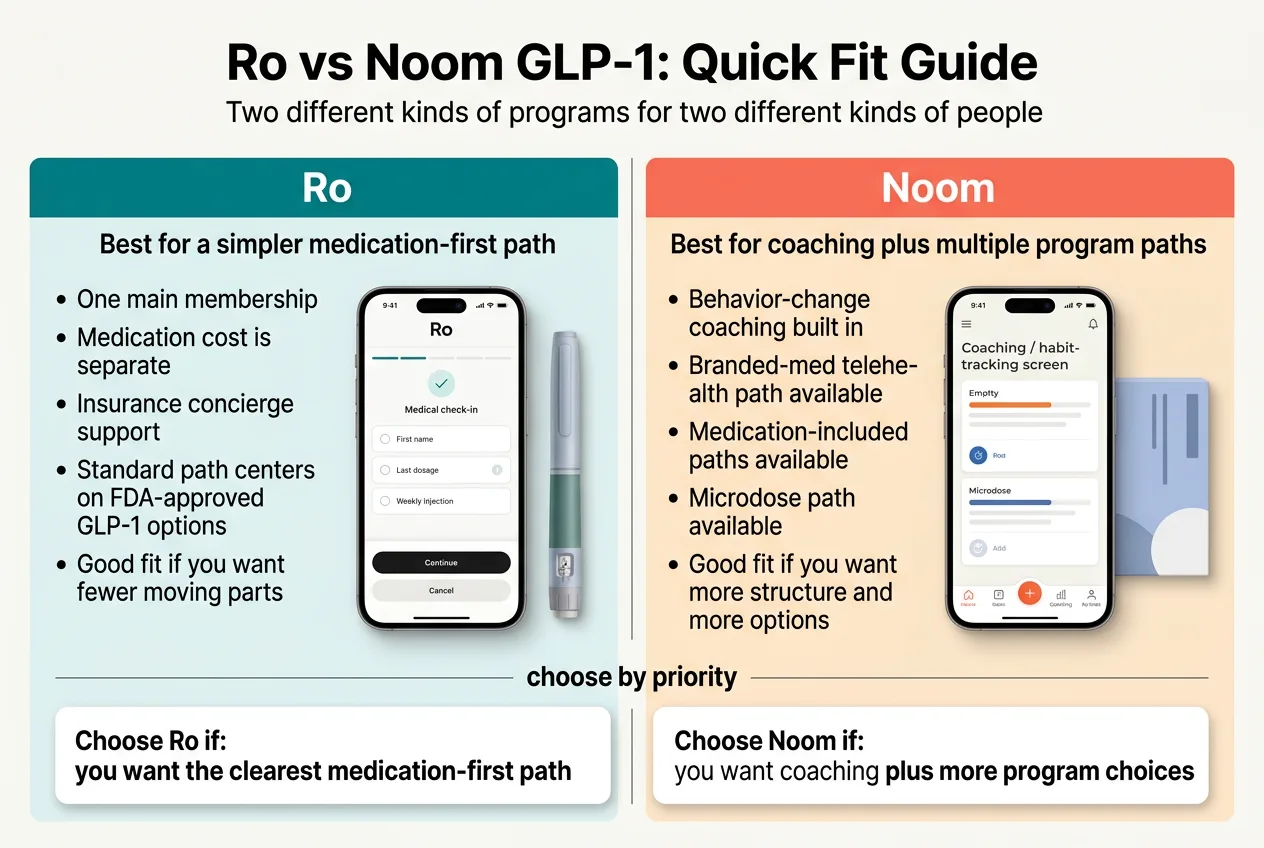
Ro vs Noom GLP-1: Which One Is Better?
Ro wins for most action-ready buyers
If you want a straightforward, medication-first program centered on FDA-approved GLP-1s, insurance support that actually fights for your coverage, and simple monthly billing you can cancel online at least 48 hours before renewal — Ro is the cleaner path. Their Body Program membership runs $149/month (after a $39 first month), and their medication prices match the lowest available through the manufacturers themselves.
Noom wins for a specific type of person
If daily behavioral coaching, food psychology lessons, group support, and the option to try a low-dose (microdose) GLP-1 path are what you're looking for, Noom offers a genuinely different experience. Some of their medication-included plans start at $99/month — but they use compounded GLP-1 medications, which have not been reviewed by the FDA for safety, effectiveness, or quality.
Skip both
If your primary care doctor already prescribes GLP-1s and your insurance covers the medication with a low copay. You may not need a telehealth membership at all.
Ro
$39 +First Month
FDA-approved GLP-1s at the lowest available price. Cancel online at least 48 hours before renewal.
Ro vs Noom at a Glance
Before we dig into the details, here's the comparison stripped down to what actually matters. Notice that Noom appears multiple times — because it really is multiple programs.
| Feature | Ro Body Program | Noom Telehealth (Branded Meds) | Noom GLP-1Rx (Full Dose) | Noom GLP-1Rx Plus | Noom Microdose GLP-1Rx |
|---|---|---|---|---|---|
| Best for | Medication-first, insurance-savvy buyers | Branded meds + Noom coaching app | Budget-conscious, okay with compounded semaglutide | Compounded tirzepatide path | Gentle start, minimal side effects |
| What you're buying | Physician-led GLP-1 care + insurance concierge | Clinician access + Noom app (meds separate) | Compounded semaglutide + coaching (meds included) | Compounded tirzepatide + coaching (meds included) | Low-dose compounded semaglutide + coaching (meds included) |
| Intro price | $39 first month | $69 first month | From $129–$199 (varies) | From $199 (varies) | From $99 |
| Ongoing price | $149/month | $99/month | $279–$349/month (varies) | Varies | $199/month (billed as $597 per 12 weeks) |
| Medication included? | No — billed separately | No — pharmacy price or insurance | Yes — compounded semaglutide | Yes — compounded tirzepatide | Yes — low-dose compounded semaglutide |
| FDA-approved meds? | Standard path centers on FDA-approved; terms allow compounded during shortages | Yes (filled at your pharmacy) | No — compounded, not FDA-reviewed | No — compounded, not FDA-reviewed | No — compounded, not FDA-reviewed |
| Insurance help | Full concierge — fights for coverage, handles paperwork | Coordination available | Not applicable (cash-pay) | Not applicable (cash-pay) | Not applicable (cash-pay) |
| Labs included? | Provider-ordered Quest testing included; $75 at-home kit option | Included at Quest/LabCorp in most states; extra cost in NY, NJ, RI | Varies by plan | Varies by plan | Varies by plan |
| Behavior coaching | Nurse coaching + lifestyle tools | Full Noom psychology-based app | Full Noom app | Full Noom app | Full Noom app |
| Provider access | Licensed clinician oversight, regular check-ins, ongoing secure messaging | Licensed clinician, messaging, telehealth visits | Licensed clinician, messaging | Licensed clinician, messaging | Licensed clinician, messaging |
| Billing cadence | Monthly | Quarterly after intro | Quarterly after intro on some plans | Varies | Quarterly after intro ($597/12 weeks) |
| Cancel ease | Online, at least 48 hrs before renewal | App or support; quarterly billing applies | App or support; quarterly billing applies | App or support | App or support |
| Availability | All 50 states + DC (varies by state) | Not available in AL or VA; other limitations may apply | Not available in all states | Not available in all states | Not available in AL, AR, IA, LA, MS; other restrictions may apply |
Every price in this table was verified from Ro.co and Noom.com as of March 16, 2026. Noom pricing varies by plan, promotion, and enrollment timing — confirm current rates at noom.com/med before signing up.
Wait — What Are We Actually Comparing When We Say "Noom GLP-1"?
This is the part most comparison sites skip, and it's the reason so many people feel confused after reading them. When you search "Ro vs Noom," you're picturing two companies side by side. But Ro offers one core product — the Body Program. Noom currently offers at least five different GLP-1-related paths, each with its own pricing, medication type, and billing structure. If you compare the wrong Noom path to Ro, you'll make the wrong decision. So let's clear this up.
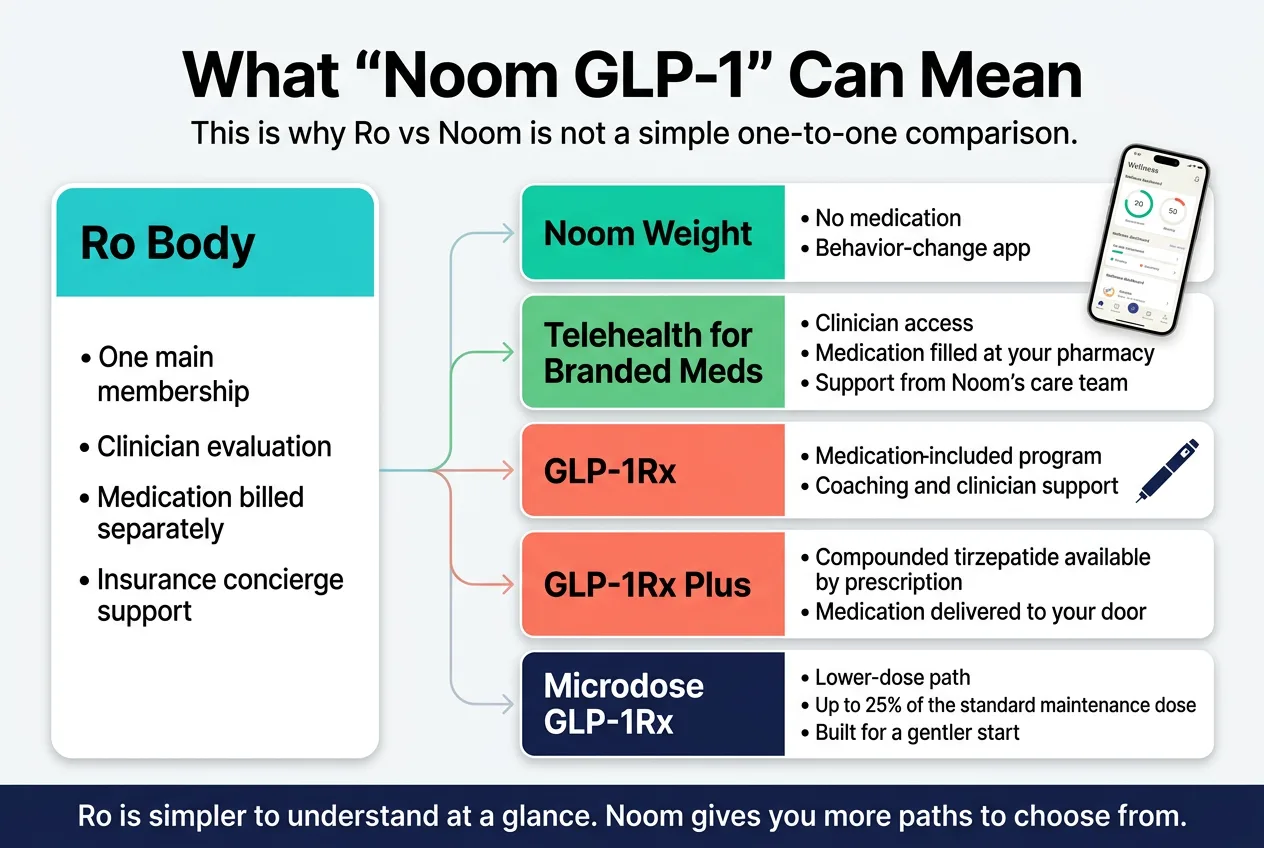
Noom Weight (The Original App — No Medication)
This is the Noom most people remember from the commercials. It's a behavior-change app with food logging, psychology-based lessons, and coaching. No prescriptions. No GLP-1s. Starts around $17/month on an annual plan. This is not what we're comparing to Ro — but it's worth knowing it exists, because some of Noom's marketing blurs the line between the app and the medical programs.
Noom Med: Telehealth for Branded Meds
This is Noom's entry-level medical path. For $69/month (first month), you get access to a Noom clinician who can prescribe FDA-approved medications like Wegovy, Zepbound, Ozempic, and others. But the medication itself is not included — you fill it at your pharmacy and pay through insurance or out-of-pocket. After the intro period, plans bill at $99/month, with some plans billed quarterly. This is the closest apples-to-apples comparison to Ro, because both are prescribing branded, FDA-approved medications separately from the membership cost. Not currently available in Alabama or Virginia.
Noom GLP-1Rx (Full-Dose, Medication Included — Compounded Semaglutide)
This is Noom's medication-included offering for compounded semaglutide. Pricing varies: Noom's official pages show intro pricing from $129–$199 depending on the plan and current promotion, with ongoing pricing from $279–$349/month, often billed quarterly after the intro period. The medication is produced by FDA-regulated compounding pharmacies — but the individual medications are not FDA-approved and have not been reviewed for safety, effectiveness, or quality. This plan also comes with Noom's taper-off guarantee (specific terms below).
Noom GLP-1Rx Plus (Medication Included — Compounded Tirzepatide)
A separate path from standard GLP-1Rx. GLP-1Rx Plus provides compounded tirzepatide (the active ingredient in Zepbound and Mounjaro), not semaglutide. Pricing starts from $199 and varies by plan. Same compounded medication caveats apply — these are not FDA-approved products. If you specifically want a tirzepatide-based GLP-1 through Noom, this is the path.
Noom Microdose GLP-1Rx
Noom's low-dose path, launched in August 2025. Starts from $99 for the initial period, then $199/month (billed as $597 per 12 weeks) thereafter. It uses lower doses of compounded semaglutide — designed for people who want a gentler start with fewer side effects. The dose is capped at 25% or less of the standard maintenance dose, adjusted using Noom's SmartDose protocol. Same compounded medication caveats apply. Not available in Alabama, Arkansas, Iowa, Louisiana, or Mississippi.
Why This Matters for Your Decision
For most readers, the real apples-to-apples comparison is Ro's Body Program vs. Noom's Telehealth for Branded Meds — two programs that both provide clinician access and prescribe FDA-approved medications, with medication priced separately. If you're considering Noom's medication-included plans (GLP-1Rx, GLP-1Rx Plus, or Microdose), you're making a fundamentally different choice: trading FDA-approved medications for a lower all-in price using compounded alternatives. That's a valid decision — but it's a different decision, and you should make it with your eyes open.
Which One Is Better for Your Situation?
Instead of a generic "pros and cons" list, here's a decision map based on who you actually are right now.
Pick Ro if you want the simplest medication-first path
Ro's program is built around one clear job: get you evaluated, prescribed, and on medication as efficiently as possible, with ongoing support to keep you on track. There's one membership, one billing structure, and a team that handles the insurance headaches so you don't have to. If you find Noom's multi-product lineup overwhelming, Ro is the antidote.
Pick Ro if FDA-approved medications matter to you
Ro's standard treatment paths center on FDA-approved GLP-1s: Wegovy (semaglutide injection and oral), Foundayo (orforglipron pill, FDA-approved April 2026), Zepbound (tirzepatide KwikPen and vials), and Ozempic (semaglutide, prescribed off-label for weight loss). Ro's terms of use note that compounded medication may be prescribed during national drug shortages — but the default program emphasis is clearly on branded, FDA-approved options. If medication quality assurance is a top priority, that emphasis is meaningful.
Pick Ro if insurance or cash-pay pricing is central to your decision
This is where Ro quietly separates from the pack. Ro has direct partnerships with NovoCare (Novo Nordisk's pharmacy) and LillyDirect (Eli Lilly's pharmacy), which means their members get the lowest available cash prices on Wegovy and Zepbound — the same prices the manufacturers offer directly. On top of that, Ro's insurance concierge doesn't just "coordinate" — they actively fight for your coverage, submit prior authorization paperwork, and explore alternatives if you're denied. That level of hands-on support is rare in this space.
Pick Noom if you specifically want behavioral coaching structure
We have to be fair here: Noom's coaching experience is genuinely different from what Ro offers. Noom's program is built on more than a decade of psychology-based behavior change, with daily lessons, food color-coding, habit tracking, group communities, and dedicated coaching. If your past experience tells you that medication alone won't solve the underlying habits — emotional eating, stress-driven choices, the patterns that got you here — Noom's wraparound support addresses that directly. Ro includes nurse coaching and lifestyle tools, but it's not the same depth of behavioral programming.
Pick Noom if you want a microdose or slower-feeling GLP-1 start
Noom's Microdose GLP-1Rx Program is a genuinely interesting option for people who are nervous about side effects. The lower dose approach means less nausea and GI discomfort during the early weeks, which is when most people quit. If side-effect fear is the thing standing between you and starting treatment, Noom's microdose path removes that barrier in a way Ro currently doesn't offer. That said, microdosing GLP-1s is considered off-label and hasn't been studied in clinical trials at these lower doses — some physicians have urged caution about the approach.
Skip both and talk to your doctor if…
You already have a primary care physician or endocrinologist willing to prescribe GLP-1s, your insurance covers Wegovy or Zepbound with a manageable copay, you have government insurance (Medicare, Medicaid, VA — neither Ro nor Noom coordinate GLP-1 coverage for government plans), or you need specialized care for conditions like type 2 diabetes alongside weight management.
Ro
$39 +First Month
Most members say they wish they started sooner. 5-minute online visit. Treatment plan within days.
Ro vs Noom Cost: What Will You Actually Pay After the Intro Offer?
Intro pricing is marketing. The real decision is what you pay at 90 days, 6 months, and 12 months — after the teaser rates expire, after your dose increases, and after reality sets in. We built out every common scenario so you can find yours and see the actual numbers.
1You Have Commercial Insurance and Your GLP-1 Is Covered
This is the best-case scenario, and Ro shines here.
With Ro:
$149/month membership + your insurance copay for medication. With manufacturer savings cards, some insured patients pay $0 for medication. Total could be as low as $149/month all-in.
With Noom (Telehealth for Branded Meds):
$69–$99/month membership + your insurance copay. Total could be as low as $69–$99/month all-in.
The math: If insurance covers your medication, Noom's lower membership price wins on raw numbers. But there's a catch — Noom's telehealth plan bills quarterly after the intro, meaning you may pay roughly $297 upfront for 3 months. Ro bills monthly, so you're only ever out $149 at a time. And Ro's concierge service is more aggressive about fighting denials and finding alternatives.
2Insurance Says No, But You Still Want FDA-Approved Medications
This is where Ro's manufacturer partnerships become your biggest advantage.
With Ro:
$149/month membership + medication at manufacturer pricing:
- Wegovy pill (low dose): $149/month → $299/month at higher doses
- Wegovy pen: $199/month intro → $349/month after
- Zepbound vials: $299/month (low dose) → $449/month (higher doses)
Total range: $294–$594/month
With Noom (Telehealth for Branded Meds):
$69–$99/month membership + retail pharmacy price for medication. Without insurance and without Ro's direct manufacturer pricing, you could be looking at $499–$1,349/month for medication.
Total range: $568–$1,448/month
The math: This scenario is Ro's strongest advantage. The same Wegovy or Zepbound that might cost you $1,000+ at a retail pharmacy is available through Ro at manufacturer pricing — because Ro has direct integrations with NovoCare and LillyDirect. Noom doesn't offer these same pricing partnerships for their branded telehealth path.
3You Want Medication Included in One Monthly Price
This is Noom's territory — and Ro doesn't play here.
With Ro:
Not applicable. Ro always bills medication separately from the membership.
With Noom GLP-1Rx:
Pricing varies by plan and promotion. Intro pricing from $129–$199, with ongoing rates from $279–$349/month, often billed quarterly after the intro period. Compounded semaglutide is included and shipped to your door. Flat pricing regardless of dose is a genuine advantage during titration.
With Noom Microdose:
From $99 for the initial period, then $199/month (billed as $597 per 12 weeks).
The catch: These medication-included plans use compounded GLP-1 medications, which have not been reviewed by the FDA for safety, effectiveness, or quality. The FDA has publicly expressed concerns about certain compounded GLP-1 products and has taken enforcement action against some compounders. That doesn't mean compounded medications are inherently dangerous — many thousands of people use them — but it is a different risk profile than FDA-approved medications, and you should understand that trade-off.
4What Happens to the Bill After Month One?
Ro after month one:
- Month 1: $39 (membership) + medication cost
- Month 2 onward: $149/month (membership) + medication cost
- Billing: Monthly. Cancel online at least 48 hrs before renewal.
- Medication cost may increase as your dose increases on cash-pay plans
Noom after the intro period:
- Noom Telehealth: $69 first month → $99/month, some billed quarterly
- Noom GLP-1Rx: $129–$199 intro → $279–$349/month (varies)
- Noom Microdose: From $99 intro → $199/month (billed as $597/12 weeks)
- Many plans auto-renew and bill upfront for three months after intro
The quarterly billing is the detail that catches people off guard. If you decide Noom isn't right after month two, you may have already paid for month three.
The 12-Month Estimate
| Scenario | Ro (12-Month Est.) | Noom GLP-1Rx (12-Month Est.) | Noom Telehealth + Branded Med via Insurance |
|---|---|---|---|
| Insured, med covered ($30 copay) | ~$2,000 | N/A for this plan | ~$1,518 |
| Uninsured, Wegovy pill low dose | ~$3,428 | N/A (branded not included) | N/A (retail pricing prohibitive) |
| Uninsured, compounded GLP-1 | N/A (not Ro's standard path) | ~$3,198–$4,048 (varies) | N/A for this path |
These are estimates based on published pricing as of March 2026. Noom pricing varies by plan and promotion. Your actual cost depends on your specific insurance, medication, and dose.
Medication Options: What Ro and Noom Can Actually Prescribe
Brand-Name, FDA-Approved Options
Both Ro and Noom can prescribe brand-name GLP-1 medications. Here's what's available:
Wegovy (semaglutide injection)
FDA-approved specifically for chronic weight management in adults with obesity (BMI ≥30) or overweight (BMI ≥27) with at least one weight-related condition. This is the gold standard for GLP-1 weight loss. Available through both Ro and Noom.
Wegovy oral (semaglutide pill)
A newer oral formulation of semaglutide, FDA-approved for chronic weight management. Available through Ro starting at $149/month cash-pay.
Zepbound (tirzepatide injection)
FDA-approved for chronic weight management. A dual GIP/GLP-1 receptor agonist — clinical trials showed average weight loss of about 20% of body weight over 72 weeks, paired with diet and exercise. Available through both Ro and Noom.
Ozempic (semaglutide injection)
Important clarification — Ozempic is FDA-approved only for type 2 diabetes, not for weight loss. Providers may prescribe it off-label for weight management at their discretion, and both Ro and Noom clinicians may do so when appropriate.
Other medications through Noom
Noom also offers metformin, Contrave, topiramate, Saxenda (liraglutide), and other non-GLP-1 weight loss medications. Ro's Body Program focuses on GLP-1 injectables and oral semaglutide.
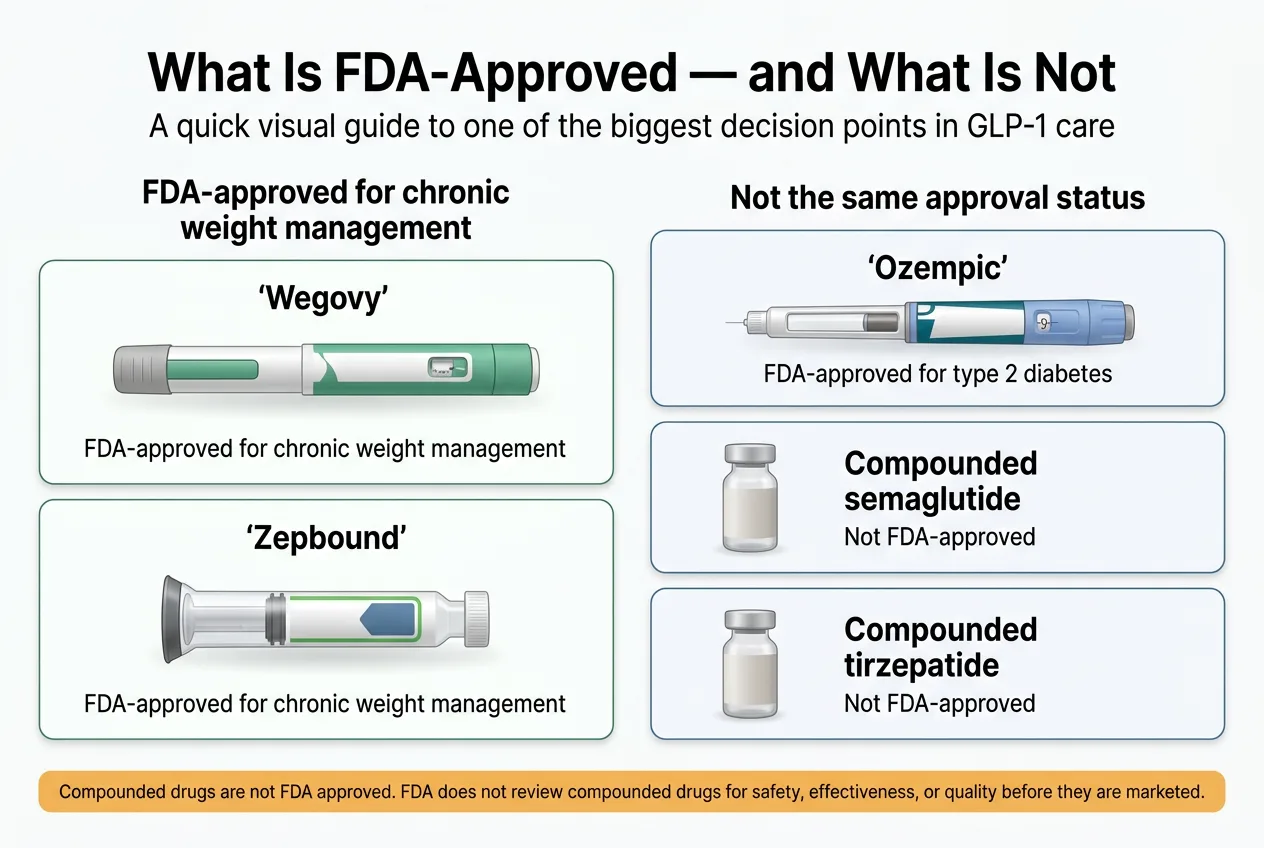
Which Paths Include Medication vs. Clinician Access Only
This is a critical distinction that trips people up:
Ro Body Program: Clinician access and prescription — medication is always billed and sourced separately (through insurance, pharmacy, or manufacturer cash-pay programs).
Noom Telehealth for Branded Meds: Same model as Ro — clinician access and prescription, medication sourced separately at your pharmacy.
Noom GLP-1Rx: Medication (compounded semaglutide) included in the monthly subscription price.
Noom GLP-1Rx Plus: Medication (compounded tirzepatide) included in the monthly subscription price.
Noom Microdose: Medication (low-dose compounded semaglutide) included.
The Compounded GLP-1 Question
We need to address this directly because it affects the entire Ro vs Noom comparison. Compounded medications are prepared by state-regulated pharmacies operating under FDA guidelines. Noom states it partners with 503B compounding pharmacies for their medication-included programs. These pharmacies are subject to FDA oversight and must follow current good manufacturing practices. Important regulatory context: For semaglutide and tirzepatide, the FDA has stated those substances are not currently on the 503B bulks list or the FDA shortage list — “503B” designation alone is not proof that a compounded GLP-1 is FDA-approved or currently authorized for bulk compounding.
However — and this is important — the FDA does not review individual compounded medications for safety, effectiveness, or quality. Noom's own website states this clearly in their disclaimers. The FDA has also issued public warnings about unapproved GLP-1 drugs used for weight loss, noting adverse event reports and taking enforcement action against certain compounders.
What this means for you: Compounded GLP-1 medications are a legitimate option that many people use, and the pharmacies producing them are regulated. But they carry a different regulatory profile than FDA-approved drugs. If medication quality assurance is your top priority, Ro's emphasis on FDA-approved GLP-1s is a meaningful advantage. If affordability is your primary concern and you're informed about the trade-off, Noom's compounded options offer a lower-cost path — just go in with clear eyes. Learn more about compounded semaglutide safety.
Insurance, Prior Authorization, and What Happens If Coverage Is Denied
Insurance is where the rubber meets the road for most people. Let's compare how each platform handles it.
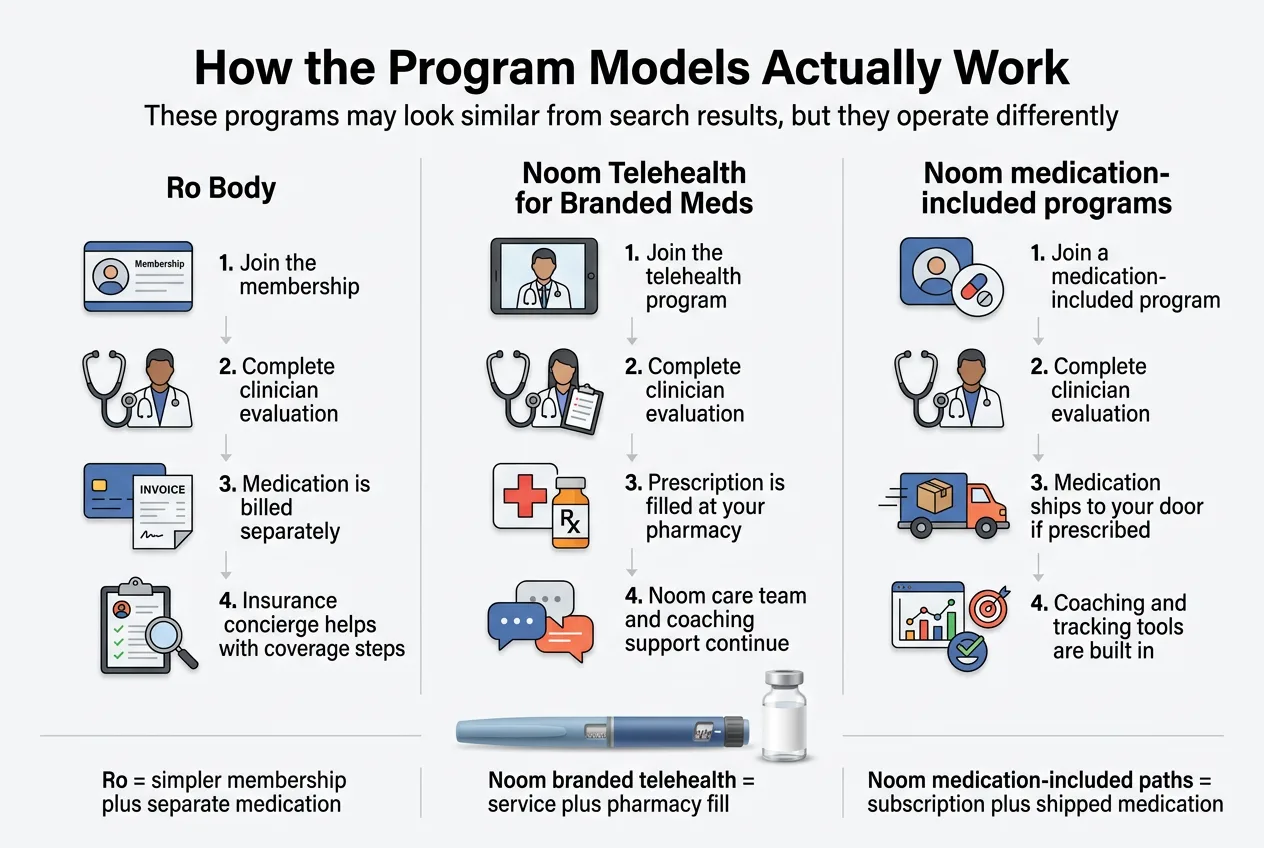
Ro's Insurance Concierge
- Checks your insurance to determine if GLP-1 coverage is available
- Submits prior authorization paperwork on your behalf if required
- Fights denials and explores alternatives if your first medication choice is rejected
- Works with your pharmacy to get the prescription filled
- All included in the $149/month membership — no additional cost
The process typically takes about 2–3 weeks when insurance is involved. If you're paying cash, you can get started in less than a week.
What Ro can't do: Ro currently can't coordinate GLP-1 coverage for government insurance plans — Medicare, Medicaid, VA, or Tricare. The exception is the Federal Employee Health Benefits Program (FEHB).
Noom's Insurance Support
Noom's Care Team helps coordinate insurance for branded medications through their Telehealth plan. Prior authorization decisions may take up to 14 days, with appeals potentially taking up to 90 days if denied.
Noom's support is useful, but based on our review, it's a less hands-on model than Ro's dedicated concierge approach. Where Ro positions insurance support as a core feature, Noom treats it more as a facilitation service alongside their behavioral program.
For Noom's medication-included plans (GLP-1Rx, GLP-1Rx Plus, Microdose), insurance is not a factor — those are cash-pay programs with compounded medication included.
What If You're Uninsured?
Ro:
Cash-pay options through manufacturer partnerships. Wegovy pill starts at $149/month, Wegovy pen at $199/month (limited-time promo for starter doses), and Zepbound vials start at $299/month. These match NovoCare and LillyDirect pricing. See our full GLP-1 cost guide.
Noom:
If you go the compounded route, your medication is included from $99–$349/month depending on the program. If you want branded medication through Noom's Telehealth plan without insurance, you'll pay retail pharmacy prices, which can run $499–$1,349/month.
Bottom line for uninsured readers: The choice comes down to medication type. For the lowest all-in price with compounded medication, Noom wins. For the lowest price on FDA-approved branded medication, Ro's manufacturer partnerships win.
Which One Gets You Started Faster?
Ro
Noom
Fastest path overall: If speed is your top priority and you're paying cash, both Ro (branded) and Noom (compounded) can get medication to you within about a week.
Support and Coaching: Medication Management vs. Behavior Change
This is where Ro and Noom take genuinely different philosophical approaches.
What You Get with Ro
- Licensed clinician oversight with regular check-ins
- Ongoing secure messaging (reviewed within 48 hours or sooner)
- Nurse coaching focused on nutrition, habits, and lifestyle
- Dose titration management
- Side-effect monitoring and support
- Weight tracking and logging tools in the Ro app
- Educational content and guidance
Comprehensive medical support designed to keep you progressing safely. Not a psychology curriculum or group community experience.
What You Get with Noom
- Licensed clinician access for prescription management
- Psychology-based daily lessons (rooted in CBT principles)
- Food color-coding system (green, yellow, orange foods)
- GLP-1 Companion tools including protein tracking and Muscle Defense workout library
- Group support community
- Side-effect management guides
- Ongoing coaching through the app
Which Is Better If You Hate App-Based Programs?
Ro. No question. You'll get clinical support and check-ins without daily lessons, food logging assignments, or in-app curriculum. Some people want to take their medication, get professional support when they need it, and not think about it the rest of the day. Ro is built for that person.
Which Is Better If Habits Are Your Biggest Problem?
Noom. If you've lost weight before and gained it all back — if you know the issue isn't information but behavior — Noom's psychology-first approach addresses the root cause rather than just the symptom. This is Noom's genuine strength.
Which Is Better If Side Effects Are Your Top Fear?
Both platforms offer provider support for managing GI side effects (nausea, constipation, diarrhea), which are common during the first few weeks and when doses increase. Noom has a slight edge here with their Microdose program, which starts at lower doses specifically designed to reduce side-effect intensity. Ro's clinicians also manage titration carefully — but there's no equivalent "microdose-first" program structure. Learn more about GLP-1 side effects.
Cancellation, Refunds, and Billing Friction
This section matters more than most comparison sites acknowledge. Signing up is easy everywhere. What happens when you want to leave?
How to Cancel Ro
- Cancel online through your account
- Must cancel at least 48 hours before your next renewal date
- No phone call required
- Email sent before every medication shipment asking if you still want it
- If medication is never prescribed, you get a full refund
- Monthly billing — never locked into multi-month upfront payments
- Membership fees are non-refundable once paid; prescription products are final sale
How to Cancel Noom
- Cancel through the app, patient portal, or by contacting support
- Some plans billed quarterly upfront after the intro period — you may have paid for 3 months before you cancel
- Many plans auto-renew after the intro period
- You may need to contact support about upcoming medication refills
- Taper-off guarantee requires completing the full 12-month program — canceling early voids it
Which One Is Easier to Leave Without Surprises?
Ro has lower cancellation friction. Monthly billing, online cancellation process, no phone call required. Noom's quarterly billing on some plans means you could be out up to 3 months of payments if you change your mind at the wrong time.
Ro: Where It Wins, Where It Loses, and Who It's Really For
Why Ro Is Our Default Pick
Ro does one thing and does it well: get you evaluated, prescribed FDA-approved medication, and supported on your weight loss journey with as little friction as possible. Their program doesn't try to be everything to everyone.
What sets Ro apart is the infrastructure. The partnerships with NovoCare and LillyDirect mean you're getting manufacturer-direct pricing that other telehealth platforms can't match. The insurance concierge means someone else is making phone calls and filing paperwork that would otherwise eat your evenings. In April 2025, Novo Nordisk announced a partnership with Ro (alongside Hims & Hers and LifeMD) to distribute Wegovy directly through their telehealth platforms — a pharmaceutical relationship that signals real legitimacy. Read our full Ro GLP-1 review.
And then there's what matters most: results. Clinical trials show 14–20% average body weight loss over one year with branded GLP-1 medications, paired with diet and exercise. People often start with the scale and end up discovering benefits they didn't expect — more energy, better sleep, improved confidence, the ability to do things they'd stopped doing.
Imagine where you could be 90 days from now. A treatment plan designed around your body. A team handling the insurance paperwork. Medication at the lowest price available. And the number on the scale finally, consistently, going in the right direction.
Honest Downsides of Ro (and Why They May Not Matter)
The membership costs more than some competitors.
At $149/month, Ro's membership is higher than Noom's $69 Telehealth tier. But that membership includes the insurance concierge, labs, provider access, and coaching. Think of it less as a subscription and more as a retainer for a team that handles the hard parts so you can focus on your health.
Medication is an additional cost.
Ro doesn't include medication in the membership price. But the trade-off is FDA-approved medications at the lowest available cash prices — often lower than retail pharmacy, even with a coupon. And if your insurance covers it, your medication cost could be $0 with manufacturer savings cards.
Default is FDA-approved meds, but compounded is possible during shortages.
Ro's terms allow compounded medication to be prescribed during national drug shortages. This is worth knowing, but Ro's clear emphasis and standard treatment path centers on branded, FDA-approved options.
No microdose program.
If you want to start with ultra-low doses, Ro doesn't offer a specific microdose path. However, Ro's clinicians still manage titration carefully at standard starting doses.
No intensive behavioral psychology program.
Ro's coaching is professional, but it's not a 12-week psychology curriculum. If that's what you need, look at Noom.
None of these are dealbreakers for most people. They're trade-offs that reflect Ro's philosophy: clinical quality, medication access, and operational simplicity. The people who love Ro love it because they don't have to think about it — the system works, the team handles the details, and the medication does its job.
Ro
$39 +First Month
Imagine where you could be 90 days from now. FDA-approved medication. Insurance support. A team in your corner.
Noom: Where It Wins, Where It Loses, and When It Really Is the Better Choice
Being fair to Noom matters — both for your trust and because some of you reading this genuinely should pick Noom.
Where Noom Legitimately Beats Ro
Behavioral coaching depth.
Noom's psychology-based program has more than 15 years of development behind it, with daily lessons, food psychology, and community support that create a behavior-change environment Ro doesn't attempt to replicate. For people whose weight challenges are rooted in emotional eating or stress habits, Noom's approach addresses causes rather than just symptoms.
Lower all-in cost for medication-included plans.
If you don't have insurance and want the lowest monthly total, Noom's compounded plans undercut Ro's membership-plus-medication total in most scenarios.
Microdose option.
One of the few platforms offering a structured low-dose GLP-1 path for people who want to ease in.
The taper-off guarantee.
Subscribe to a Noom Med plan with weight-loss medication for at least 12 consecutive months, average 10 or more NoomCoin per month, and claim within 18 months after completing the program. If you qualify, you get a free 12-month Noom Healthy Weight subscription or an equal-value credit toward Noom Med. That addresses one of the biggest fears around GLP-1s: what happens when you stop.
Wider medication menu.
Beyond GLP-1 injectables, Noom can prescribe metformin, Contrave, topiramate, and other oral weight loss options, plus compounded tirzepatide through GLP-1Rx Plus.
Where Noom Gets Confusing
Too many products, not enough clarity.
Five or six different program tiers with different pricing, billing, and medication types is a lot. We've seen online discussions where people can't figure out which Noom plan they signed up for or what their actual ongoing cost will be. This confusion is Noom's biggest weakness.
Quarterly billing after intro.
On some plans, you're billed for 3 months upfront after the intro period. If you're not expecting it, it stings.
Compounded medication caveats apply.
GLP-1Rx, GLP-1Rx Plus, and Microdose plans use compounded medications that have not been individually reviewed by the FDA.
Pricing varies significantly.
We found multiple price points for the same program depending on the landing page, promotion, and enrollment path. Always confirm your specific rate before committing.
Don't Choose Noom If…
- You want the simplest possible program with the fewest decisions
- You want only FDA-approved medications as your standard path
- You need robust insurance concierge support
- You prefer monthly billing with no quarterly commitments
- You live in a state where Noom's compounded plans aren't available
- You want manufacturer-direct pricing on branded GLP-1s
Choose Noom If…
- You specifically want daily behavioral coaching and psychology-based support
- You want the lowest all-in monthly cost and are informed about compounded medications
- You want to try a microdose approach
- You want the taper-off guarantee for long-term peace of mind
- You want access to oral weight loss medications or compounded tirzepatide beyond standard GLP-1 injectables
Safety, Side Effects, and Who Should Talk to a Doctor First
Common Side Effects (Both Platforms)
GLP-1 medications — whether semaglutide or tirzepatide, branded or compounded — share a common side-effect profile:
Most common
Nausea, vomiting, diarrhea, constipation, and reduced appetite. Worst during first few weeks and dose increases. Most diminish over time. Both Ro and Noom include provider support. See our GLP-1 nausea guide.
Less common but important
Fatigue, headache, dizziness, bloating, acid reflux.
Serious but rare (per FDA)
Risk of thyroid C-cell tumors (observed in animal studies). GLP-1 receptor agonists carry a boxed warning — do not use if you or your family have a history of MTC or MEN 2. Pancreatitis, gallbladder problems, kidney issues, and severe allergic reactions have been reported.
FDA Approval Status — What's Approved for What
Wegovy (semaglutide 2.4 mg injection and oral): FDA-approved for chronic weight management
Zepbound (tirzepatide): FDA-approved for chronic weight management
Ozempic (semaglutide 0.5 mg, 1 mg, 2 mg injection): FDA-approved for type 2 diabetes only — not FDA-approved for weight loss, though providers may prescribe it off-label
Mounjaro (tirzepatide): FDA-approved for type 2 diabetes only
Compounded semaglutide or tirzepatide: Not FDA-approved. Not reviewed by the FDA for safety, effectiveness, or quality.
Who Should Not Start Through an Online Program
Consider seeing your doctor in person first if you: have a history of medullary thyroid carcinoma or MEN 2, have a history of pancreatitis, have severe gastrointestinal disease, are pregnant or planning to become pregnant, have type 1 diabetes, are under 18, or have a complex medical history that needs in-person evaluation. Check your GLP-1 eligibility here.
What About HSA/FSA, Dose Increases, and Switching Programs?
A few edge cases that would otherwise send you back to searching.
Can I Pay with HSA or FSA?
Ro: Ro does not accept HSA/FSA cards as a direct payment method. However, after purchase you can submit a detailed receipt for reimbursement through your HSA/FSA plan.
Noom: Similarly, Noom does not accept direct HSA/FSA payments. Reimbursement may be possible with a receipt and a Letter of Medical Necessity, depending on your specific plan. Both platforms' services may qualify for HSA/FSA reimbursement — but check with your plan administrator, as rules vary. See our guide to GLP-1 providers that accept HSA.
What Happens When My Dose Goes Up?
With Ro (cash pay): Your medication cost increases with your dose. Wegovy pill at the starting dose is $149/month, but higher maintenance doses run $299/month. Zepbound vials go from $299/month at 2.5 mg to $449/month at higher doses. With insurance, your copay usually stays the same regardless of dose.
With Noom (compounded plans): GLP-1Rx and Microdose plans charge a flat rate regardless of dose. Your bill doesn't jump when your provider increases your medication. On the branded Telehealth path, standard pharmacy pricing applies and may increase with dose.
Can I Switch from One Platform to the Other?
Yes. Cancel either program and sign up for the other. Your prescription won't transfer — you'll need a new evaluation. But if you've been on a GLP-1, your new provider will likely continue at or near your current dose.
State Availability
Ro provides services in all 50 states and Washington, D.C., though specific treatment and program availability varies by state.
Noom operates in roughly 35 states for their medical programs. Noom's Microdose GLP-1Rx is not available in Alabama, Arkansas, Iowa, Louisiana, or Mississippi. Noom's Telehealth for Branded Meds is not available in Alabama or Virginia. Other programs may have additional restrictions — check noom.com/med for your state.
How We Compared Ro and Noom
We want you to trust this comparison, so here's exactly how we built it.
Pricing: Every dollar amount was verified directly from Ro.co/weight-loss/pricing and Noom.com/med during the week of March 16, 2026. Noom's pricing varies by plan and promotion — we note ranges where pricing is not fixed.
Medication availability: Confirmed from each platform's official medication pages, FAQs, and support documentation.
FDA regulatory status: Confirmed from FDA.gov drug labels for Wegovy, Ozempic, and Zepbound, and from the FDA's published guidance on compounded GLP-1 medications.
Insurance and cancellation policies: Verified from each platform's terms of use, help centers, and support documentation.
Clinical claims: We only cite clinical trial data from studies referenced in FDA prescribing information. When a platform makes claims from their own internal data, we note that it's platform-reported and not independently verified.
Methodology Note
This comparison is based on documented, publicly verifiable information from official sources. We did not test-enroll in both programs for this article. All "provider-stated" claims are labeled as such. All "verified" claims link to a primary source. Learn more about our editorial standards and how we rank providers.
Affiliate Disclosure
WeightLossProviderGuide.com is an independent comparison resource. Ro is an affiliate partner — we earn a commission if you sign up through our links. Noom is not currently an affiliate partner. This does not influence our analysis — we recommend based on verified data and real-world fit. Our editorial methodology is described above. If you believe any information in this article is inaccurate, contact us. See our full advertising disclosure.
Frequently Asked Questions
Our Final Verdict
We've laid out every number, every trade-off, every scenario. Here's where it all lands.
Choose Ro
If you want the clearest medication-first path to GLP-1 treatment. FDA-approved medications at the lowest available prices. An insurance concierge that fights for your coverage. Simple monthly billing. A team that handles the hard parts so you can focus on what matters — your health, your energy, your life.
Choose Noom
If you know from experience that medication alone won't change your habits, and you want structured behavior-change support alongside your GLP-1 treatment. Also choose Noom if you want the lowest all-in monthly cost using compounded medication, or if you want a microdose approach.
Skip both if your existing doctor and insurance already solve the problem.
Whatever you choose, you're taking a real step toward something better. GLP-1 medications have helped millions of people lose meaningful weight and improve their health in ways diet and exercise alone couldn't achieve. The hardest part isn't picking the right platform — it's deciding to start. And the best time to start was yesterday. The second best time is right now.
Ro
$39 +First Month
Imagine where you could be 90 days from now. FDA-approved medication. Insurance support. A team in your corner. Take the 5-minute online visit and find out if you qualify.
Sources
- Ro weight loss pricing — ro.co/weight-loss/pricing (verified March 16, 2026)
- Noom Med and Noom cost — noom.com/med and noom.com/blog/weight-management/noom-cost (verified March 16, 2026)
- Ro availability — ro.co/faq/telehealth ("Ro provides services to members in all 50 states and Washington, D.C.")
- Noom Telehealth for Branded Meds — noom.com/support
- Noom Microdose state availability — confirmed via NutriScan independent review citing official Noom disclosures (AL, AR, IA, LA, MS excluded)
- Noom GLP-1Rx Plus (compounded tirzepatide) — noom.com/support
- Noom Microdose GLP-1Rx — noom.com/med/glp1-microdose
- Ro terms of use — ro.co/terms-of-use
- GLP-1 microdosing caution — TODAY.com, "What Is GLP-1 Microdosing and Does It Lead to Weight Loss?" (November 2025)
- FDA concerns with unapproved GLP-1 drugs — fda.gov
- Wegovy prescribing information — FDA.gov
- Zepbound prescribing information — FDA.gov (72-week SURMOUNT trials, ~20% average body weight loss)
- Ozempic prescribing information — FDA.gov (approved for type 2 diabetes, not weight loss)
- Ro getting started timeline — ro.co/weight-loss
- Ro medication shipment confirmation process — ro.co/weight-loss/faq
- Noom taper-off guarantee terms — noom.com/support
- Novo Nordisk distribution partnership (April 2025) — press release via Ro, Hims & Hers, LifeMD
- Ro HSA/FSA policy — ro.co/weight-loss/faq
Related Articles
TrimRx Semaglutide Reviews 2026: Full Price and Complaint Audit
Independent TrimRx semaglutide review: 3.6/5 from 5,485 Trustpilot reviews, 32% one-star, conflicting prices, billing and refill complaints, FDA status, pharmacy records, cancellation, and full cost comparison.
TrimRx Cost 2026: 8 Plan Totals and Break-Even Math
Verified TrimRx cost audit with all 8 semaglutide and tirzepatide checkout totals, recurring-price uncertainty, break-even cases, Wegovy and Zepbound comparisons, cancellation terms, and 16 FAQs.
SkinnyRx Reviews
SkinnyRx GLP-1 review covering cost, safety, patient complaints, and whether it's worth trying.
Willow GLP-1 Reviews
Willow GLP-1 provider review with real patient ratings, pricing details, and safety assessment.
Willow GLP-1 Cost & Pricing (2026)
Every Willow GLP-1 price from $299 to $549, the $150 outside-pharmacy fee, referral offer, HSA/FSA rules, and cancellation deadlines.
Sesame Care GLP-1 Reviews
Sesame Care GLP-1 review with verified 2026 pricing ($59/mo care fee + $25–$1,145/mo medication), Costco partnership, cancellation rules, and honest verdict.