How to Get GLP-1 (GLP1) Without Insurance: Complete 2026 Guide
Disclosure: Some links on this site are affiliate links. If you purchase through these links, we may earn a commission at no extra cost to you. Thank you for supporting our site.·For informational purposes only—not medical advice.
The Short Answer
If you're wondering how to get GLP-1 without insurance, the good news is: yes, you can—but you still need a prescription from a licensed provider. For self-pay patients in 2026, the landscape has shifted significantly with new options:
Brand-name (FDA-approved) paths:
- Wegovy pill (newly FDA-approved December 2025): Starting at $149/month for the 1.5mg dose—the most affordable FDA-approved GLP-1 for weight loss to date
- Wegovy injection: $199/month for first two months (limited-time offer through March 31, 2026), then $349/month ongoing
Compounded paths:
- Telehealth + compounded semaglutide: $149–$299/month through licensed U.S. compounding pharmacies (not FDA-approved)
Prices and program terms change frequently, so we show the real annual cost math and a safety checklist to help you avoid counterfeits and problematic compounders.
Quick Verdict: Your 5 Legitimate Options at a Glance
Before diving into details, here's the reality of getting GLP-1 without insurance in 2026:
| Path | Best For | Monthly Cost | Speed to Start | Key Tradeoff |
|---|---|---|---|---|
| Manufacturer cash-pay (Wegovy pill/injection) | Want FDA-approved at lowest brand-name cost | $149–$349 | 5–10 days | Higher cost than compounded |
| Telehealth + compounded GLP-1 | Budget-conscious, want to start fast | $149–$299 | 3–7 days | Not FDA-approved |
| Local clinician + cash pharmacy fill | Prefer in-person care | $800–$1,500+ | 1–3 weeks | Highest cost, most oversight |
| Patient assistance programs (income-based) | Meet income requirements | Varies (possibly free) | 2–4 weeks | Strict eligibility |
| Clinical trials | Willing to meet strict criteria | Free | Weeks to months | Limited availability |
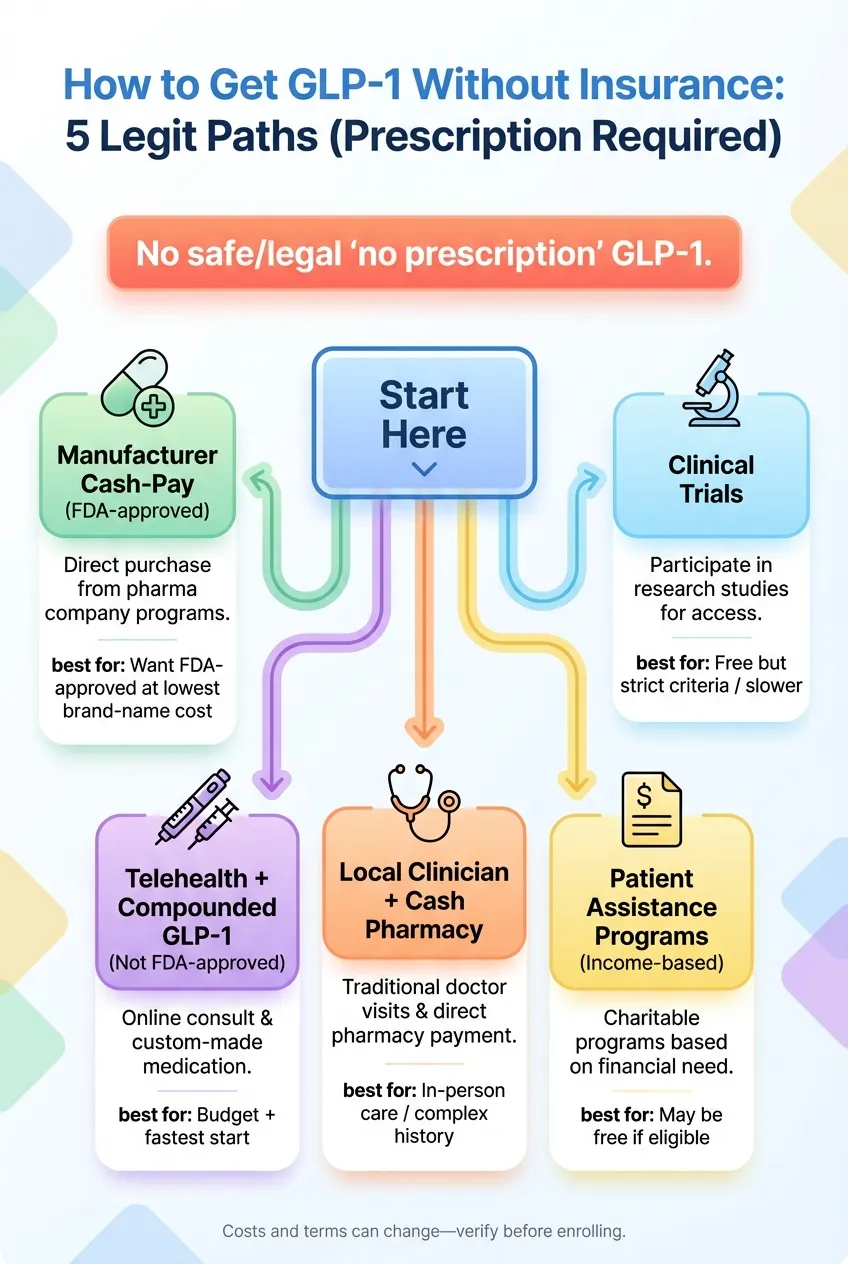
Infographic summary: Five legitimate pathways (prescription required). Costs vary; verify current pricing and eligibility.
There is no safe, legal way to get real GLP-1 medication without a prescription. Any website offering "no Rx needed" or "research peptides" is either selling counterfeits or operating illegally. The FDA has issued multiple warnings about counterfeit Ozempic found in the U.S. drug supply chain. Don't risk your health to save money.
What "Without Insurance" Actually Means (And What It Costs)
Let's get specific about costs, because vague pricing is how people get surprised.
The Real Cost Breakdown
When you pay for GLP-1 treatment, you're paying for multiple things:
- Telehealth: Usually included ($0)
- In-person: $150–$300 for initial visit
- Basic metabolic panel: $50–$150
- Many telehealth providers don't require
- Wegovy pill (self-pay): $149/month
- Wegovy injection: $199–$349/month
- Compounded: $149–$349/month
- Telehealth: Usually included
- Pharmacy: Syringes $10–$30 if needed
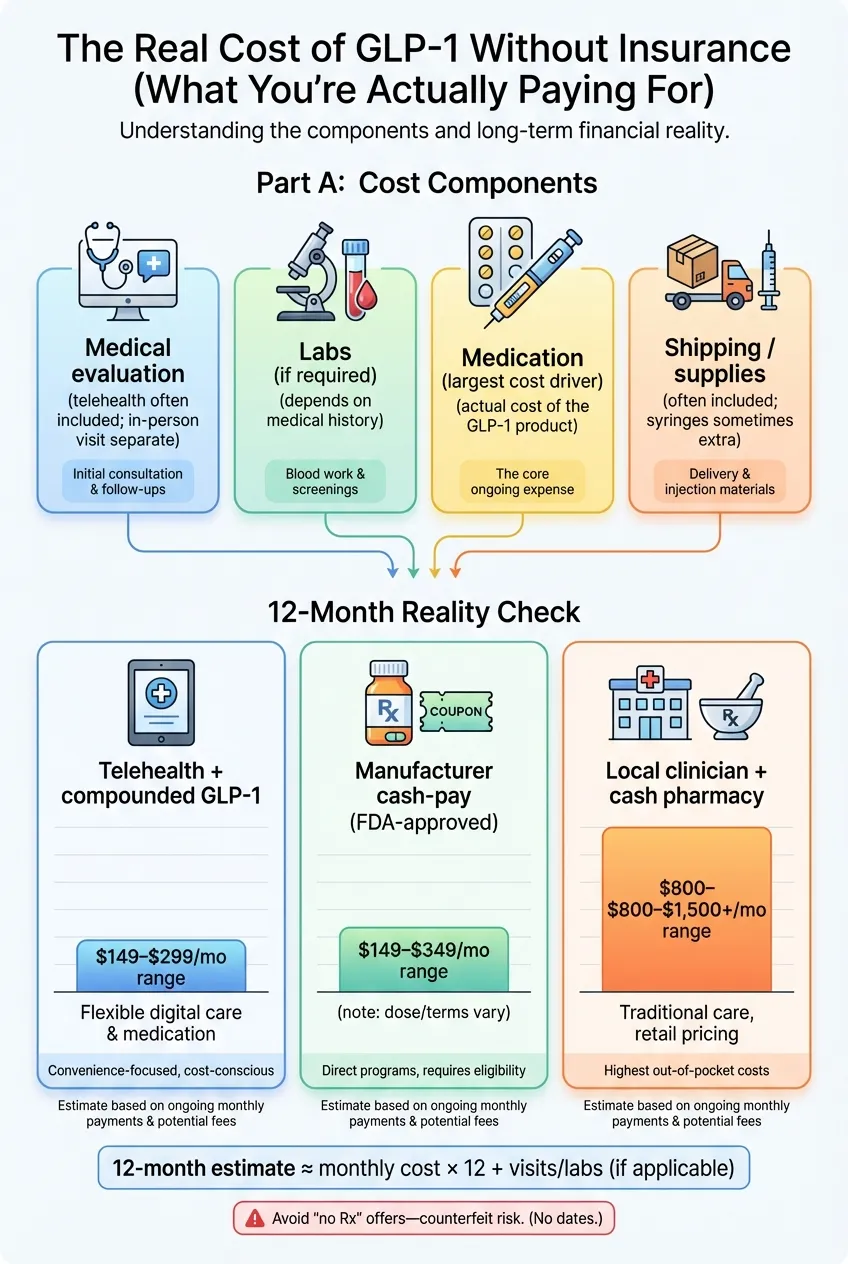
Infographic summary: Total cost = consult + labs (if needed) + medication + shipping/supplies. Ranges shown; verify current pricing.
What You'll Actually Pay: 12-Month Projections
This is where most comparison articles fail you. They show first-month promotional prices, but here's what a full year actually costs:
| Option | First Month | Ongoing Monthly | 12-Month Total |
|---|---|---|---|
| Compounded via telehealth (low end) | $149 | $249 | $2,888 |
| Compounded via telehealth (mid-range) | $179 | $299 | $3,468 |
| Wegovy tablets (FDA-approved, self-pay)* | $149 (1.5mg) | $299 (maintenance) | ~$3,288 |
| Wegovy injection (FDA-approved, self-pay)* | $199 (2 mos) | $349 (month 3+) | ~$3,888 |
*Wegovy tablets: Typical titration uses 1.5mg ($149) months 1-2, 4mg ($149) month 2, then 9mg/25mg ($299) months 3-12. Wegovy injection: $199/month for starter doses (0.25mg, 0.5mg) through March 31, 2026, then $349/month ongoing. Pricing verified January 2026.
Hidden Costs to Watch For
- Membership fees: Some providers charge monthly membership fees on TOP of medication costs ($100–$150/month separately)
- Dose escalation pricing: Watch out for providers whose prices jump significantly as you move to maintenance doses
- Cancellation fees: Some programs require prepayment for multiple months with limited refund options
- Lab requirements: If required, labs can add $50–$150 to your costs
Understanding Your Options: Compounded vs. Brand-Name
Before choosing a provider, you need to understand the fundamental difference between your two main medication categories.
FDA-Approved Brand-Name GLP-1s
These are medications manufactured by pharmaceutical companies (primarily Novo Nordisk and Eli Lilly) that have undergone rigorous FDA testing for safety, efficacy, and quality.
Available brand-name options:
- Wegovy (semaglutide) – FDA-approved for chronic weight management, now available as weekly injection and daily pill
- Ozempic (semaglutide) – FDA-approved for type 2 diabetes, often prescribed off-label for weight loss
- Zepbound (tirzepatide) – FDA-approved for weight loss
- Mounjaro (tirzepatide) – FDA-approved for type 2 diabetes
Compounded GLP-1 Medications
Compounded medications are custom-prepared by licensed compounding pharmacies using semaglutide or tirzepatide as the active ingredient. They're legal when prepared for individual patients with valid prescriptions, but they are NOT FDA-approved.
| Feature | Brand-Name (FDA-Approved) | Compounded |
|---|---|---|
| FDA-approved | Yes | No |
| Consistent quality/dosing | Yes, every time | Varies by pharmacy |
| Pre-filled pens available | Yes (injection) | Typically vials only |
| Clinical trial data | Extensive | Limited |
| Monthly cost (Wegovy self-pay) | $149–$349* | $149–$299 |
| Refrigeration required | Injection yes, pill no | Usually yes |
| Salt form concerns | No | Some use different forms |
*Note: The $149–$349 brand-name range refers specifically to Wegovy self-pay programs. Other FDA-approved GLP-1s (Ozempic, Zepbound, Mounjaro) typically cost $1,000–$1,500/month without insurance coverage.
Dosing errors: Some patients accidentally administered 5 to 20 times their intended dose because compounded products used confusing instructions.
Salt form issues: Some compounders use semaglutide sodium or acetate instead of semaglutide base. The FDA states there is "no evidence that these salt forms are chemically or pharmacologically equivalent."
Quality variability: Concentrations vary between compounders and sometimes between batches from the same compounder.
When Each Option Makes Sense
- FDA approval is important to you
- You can afford $149–$349/month
- You have complex medical history
- You prefer pills over injections
- Budget is your primary concern
- You understand and accept the risks
- You've verified the pharmacy thoroughly
- You want to start quickly
When Compounded Makes Sense
Financial necessity
If brand-name options don't fit your budget, compounded at $149–$299/month may be your only realistic option. There's no shame in this—it's the reality for most Americans seeking these medications.
Comfort with calculated risk
You understand the FDA concerns, you've verified your provider uses a legitimate compounding pharmacy, and you're comfortable with the risk-benefit calculation. Our GLP-1 cost finder can help you compare pricing across providers.
Already experienced with GLP-1
If you've previously used brand-name GLP-1 and know how your body responds, switching to compounded carries less uncertainty.
Provider you trust
You've thoroughly vetted your telehealth provider using our checklist and feel confident in their oversight.
When Brand-Name Makes Sense
Risk aversion
The FDA approval process exists for a reason. If uncertainty about compounded quality keeps you up at night, the peace of mind may be worth the extra cost.
Complex medical history
If you have multiple health conditions or take several medications, the standardized dosing and documented interactions of FDA-approved products may be safer.
Budget allows
With the new Wegovy pill at $149/month for the starting dose, FDA-approved options are now more accessible than ever.
Prefer pills
If you don't want to do injections at all, the FDA-approved Wegovy pill is now an option (compounded oral options exist but are less proven).
Insurance potential
If there's any chance your insurance might cover brand-name GLP-1, starting there avoids switching later.
Some patients start with compounded to prove the medication works for them, then switch to brand-name once they've achieved initial weight loss. This lets you test your response at lower cost before committing to higher ongoing expenses.
Others start with brand-name while navigating insurance appeals, then switch to compounded if appeals fail and continued brand-name isn't sustainable.
There's no single right answer. What matters is that you make an informed choice that you can sustain for the long term—because GLP-1 treatment is most effective when maintained over time.
Questions to Ask Yourself
Before deciding, consider:
- What's my realistic monthly budget for this medication long-term?
- How important is FDA approval to my peace of mind?
- Do I have health conditions that make quality consistency especially important?
- Am I comfortable with some uncertainty in exchange for lower cost?
- Can I commit to this treatment for at least 12–18 months?
Your answers will guide you to the right choice for your situation.
Step-by-Step: How to Get GLP-1 Without Insurance
Now let's get practical. Here's exactly how to get started, depending on which path you choose.
Option 1: Telehealth Provider (Fastest, Most Affordable)
This is how most uninsured patients access GLP-1 medications in 2026. The entire process typically takes 3–7 days from signup to medication delivery.
Choose a reputable provider
Look for licensed healthcare providers (MDs, DOs, NPs, PAs), named U.S. pharmacy partnerships, transparent pricing including ongoing costs, and real customer reviews on third-party sites.
Complete the online health assessment
Every legitimate provider requires a health questionnaire covering medical history, current medications, BMI, weight-related conditions, thyroid cancer family history, and pregnancy status.
Provider review
A licensed healthcare provider reviews your information and determines if GLP-1 medication is appropriate for you. Most providers complete this within 24–48 hours.
Prescription and payment
If approved, your provider writes a prescription. Most providers accept credit/debit cards and HSA/FSA cards.
Medication delivery
Your medication ships directly to your home, typically arriving within 3–5 days. Injectable medications require refrigeration upon arrival.
Start treatment with ongoing support
Legitimate providers include follow-up care: injection technique guidance, side effect monitoring, dose adjustments, and provider availability for questions.
MEDVi has positioned itself as a straightforward, budget-friendly option—the provider reports serving over 100,000 patients. They've focused on making the process as simple as possible while maintaining legitimate medical oversight.
What's included:
- Physician review and prescription by licensed U.S. providers
- Compounded semaglutide (injections or sublingual options)
- Personalized treatment plan based on your health profile
- 24/7 provider access for questions and concerns
- Shipping included in the monthly cost
- Dose adjustments as you progress through treatment
Pricing (verified January 2026):
- First month: $179 (injections)
- Ongoing: $299
- No membership fees or hidden costs
- No long-term contracts required
Pharmacy partner: Belmar Pharma Solutions (licensed U.S. compounding pharmacy with established track record)
Cancellation policy: Cancel anytime without penalties
Who it's best for: Patients who want affordable access with solid medical oversight and no commitment. The 24/7 provider access is genuinely useful for first-time GLP-1 users who have questions about side effects or dosing concerns.
Option 2: Brand-Name Through Manufacturer Self-Pay Programs
Wegovy (Novo Nordisk) Self-Pay Options:
Wegovy pill (daily tablet):
- Starter doses (1.5mg, 4mg): $149/month; Maintenance (9mg, 25mg): $299/month
- Available at 70,000+ U.S. pharmacies
- No refrigeration required
- Take on empty stomach with a small amount of water, then wait before eating or taking other meds (follow prescriber instructions)
Wegovy injection:
- Limited-time offer (through March 31, 2026): $199/month for first two months at starter doses
- Ongoing: $349/month
- Requires refrigeration
Option 3: Local Clinician + Cash Pharmacy Fill
The most expensive route but offers the most traditional medical oversight:
- Initial visit: $150–$300
- Follow-up visits: $75–$150 each
- Medication at retail pharmacy: $1,000–$1,500/month (without manufacturer programs)
- Labs if ordered: $50–$150
Option 4: Patient Assistance Programs
Pharmaceutical companies offer patient assistance for those who qualify based on income. These programs have strict eligibility criteria and application processes—worth exploring if you qualify, but not a quick solution.
Option 5: Clinical Trials
Clinical trials offer free access to GLP-1 medications plus regular medical monitoring at no cost. Search ClinicalTrials.gov for "semaglutide" or "tirzepatide" plus your location.
Avoiding Scams: How to Tell If a GLP-1 Source Is Legitimate
The explosion of demand for GLP-1 medications has attracted scammers. Here's how to protect yourself.
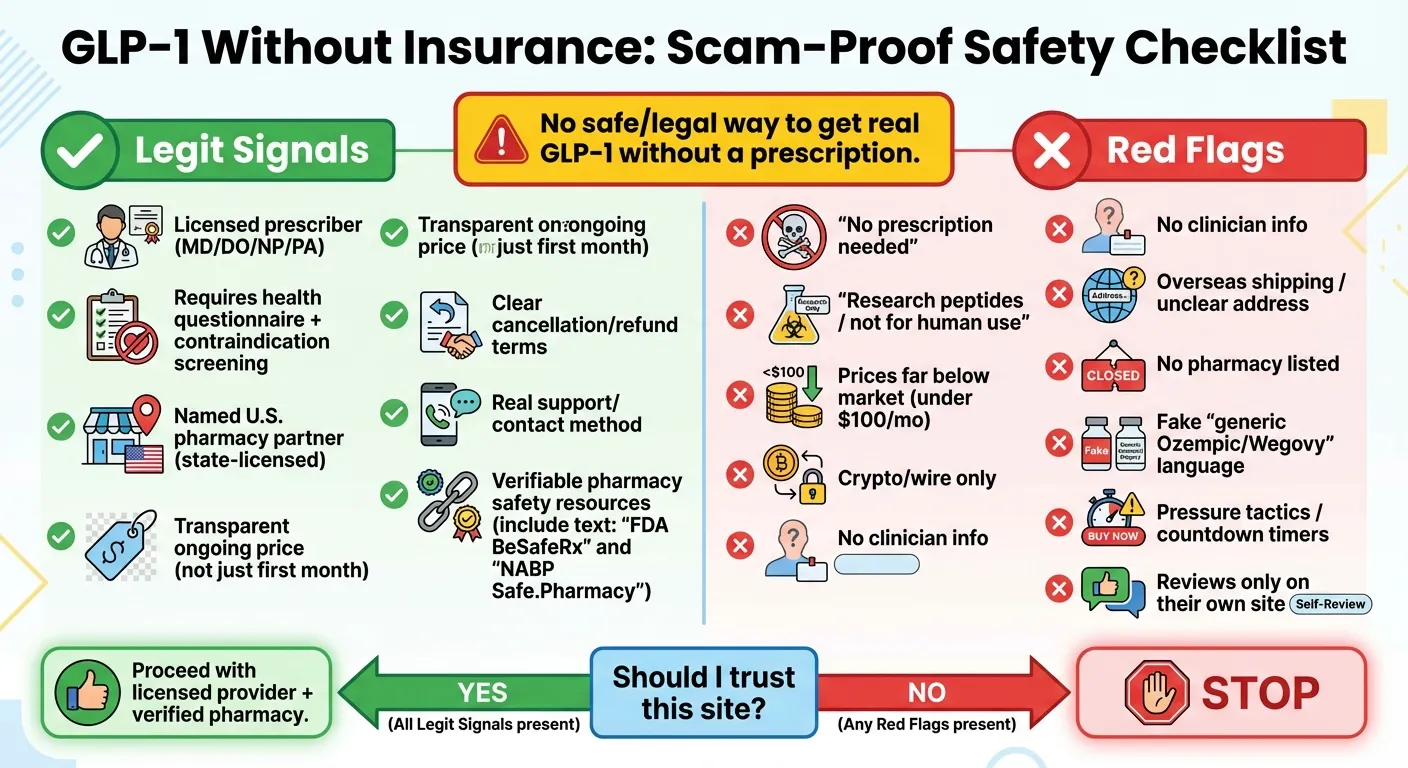
Infographic summary: If it's "no prescription" or "research peptides," treat it as a stop sign. Use FDA BeSafeRx and NABP Safe.Pharmacy to verify.
7-Point Safety Verification Checklist
1. Licensed Healthcare Providers
Clear statements that prescriptions are written by licensed MDs, DOs, NPs, or PAs.
2. Licensed U.S. Compounding Pharmacy
Named pharmacy partnerships. Legitimate providers name their compounding pharmacy partners.
3. Transparent Pricing
Clear breakdown showing first-month price AND ongoing costs. Pricing includes consultation, medication, and shipping.
4. No "Generic Ozempic" Claims
Clear disclosure that compounded medications are "not FDA-approved." No generic semaglutide exists for weight loss.
5. Required Medical Screening
Detailed health questionnaire, contraindication screening, provider review before any prescription.
6. Ongoing Care Included
Follow-up consultations, dose adjustment support, side effect management, provider availability for questions.
7. Real Customer Reviews
Reviews on Trustpilot, BBB, or Google with specific experiences (not just star ratings).
Red Flags to Avoid
What to Expect: Your First 90 Days on GLP-1
If you've never taken GLP-1 medication before, here's a realistic picture of what the first three months typically look like.
Note: Starter doses differ by formulation—semaglutide injection often starts at 0.25mg weekly, while semaglutide tablets use a different mg schedule (1.5mg daily for month 1). Follow your prescriber's plan.
You'll receive your medication and begin at the lowest dose (typically 0.25mg for semaglutide). At this dose, most people notice:
- Mild appetite reduction
- Possibly some nausea, especially after meals
- Learning the injection process (it's simpler than it looks)
What to do:
- • Take your injection on the same day each week
- • Eat smaller meals
- • Stay hydrated
- • Don't expect dramatic weight loss yet—this week is about your body adjusting
Your body is adapting to the medication. Side effects may peak during this period, especially nausea. You might notice:
- Stronger appetite suppression
- Feeling full faster than expected
- Possible GI discomfort
- Early signs of food preference changes (less interest in fatty or sugary foods)
What to do:
- • Don't increase your dose yet—stay at the starter dose for at least 4 weeks
- • If side effects are severe, contact your provider
- • Start paying attention to hunger cues—eat when hungry, stop when satisfied
Your provider will likely increase your dose gradually. Expect a temporary return of side effects as your body adjusts to each higher dose.
Weight changes vary widely in these early months. Many people notice appetite changes before significant scale changes, especially at starter doses.
What to do:
- • Focus on protein intake to preserve muscle mass
- • Continue or expand physical activity
- • Check in with your provider about progress and any concerns
At 90 days, you should have a clear picture of whether GLP-1 medication is working for you. Questions to consider:
- Am I losing weight at a reasonable pace?
- Are side effects manageable?
- Can I sustain this financially long-term?
- Am I making lifestyle changes that will stick?
If the answer to these questions is yes, you're on a good path. If not, talk to your provider about adjustments or alternatives.
GLP-1 Eligibility: Who Can Get These Medications?
Not everyone is a candidate for GLP-1 medications. Here's what providers evaluate.
| Requirement | Qualification Status |
|---|---|
| BMI ≥ 30 | Qualifies on its own (obesity) |
| BMI 27–29.9 + Type 2 diabetes | Qualifies with condition |
| BMI 27–29.9 + High blood pressure | Qualifies with condition |
| BMI 27–29.9 + High cholesterol | Qualifies with condition |
| BMI 27–29.9 + Sleep apnea | Qualifies with condition |
| BMI 27–29.9 + Heart disease | Qualifies with condition |
| BMI 27–29.9 + Fatty liver disease | Qualifies with condition |
BMI Formula: (Weight in lbs ÷ Height in inches²) × 703. Use our BMI eligibility calculator for quick results.
- Personal or family history of medullary thyroid carcinoma (MTC) or MEN2 syndrome
- Known hypersensitivity to semaglutide or tirzepatide
- Currently pregnant, planning pregnancy, or breastfeeding
- History of pancreatitis, diabetic retinopathy, or severe gastroparesis (requires evaluation)
GLP-1 Side Effects: What to Expect
Side effects are real and common, especially during the early weeks of treatment. Here's what to expect and how to manage it.
| Side Effect | Frequency | Management |
|---|---|---|
| Nausea | Common, often worst during dose increases | Usually improves after 2–4 weeks at each dose |
| Decreased appetite | Expected effect | This is how the medication works |
| Diarrhea | Common; varies by person | Stay hydrated, usually temporary |
| Constipation | Common; varies by person | Increase fiber and water intake |
| Vomiting | Less common; often during titration | Eat smaller meals, contact provider if persistent |
| Abdominal pain | Can occur | Report severe or persistent pain immediately |
| Fatigue | Common initially | May be related to reduced calorie intake |
| Injection site reactions | Common for injectables | Rotate injection sites |
Frequencies vary by medication, dose, and individual—see each drug's prescribing information for exact rates.
For detailed relief strategies, see our GLP-1 side effect relief guide.
If Insurance Won't Cover GLP-1: Quick Options
If you have insurance but coverage was denied, you have a few moves before going the self-pay route.
Insurance denials can sometimes be overturned with proper documentation. Many patients give up after the first denial, but appeals can be successful.
What you need:
- Letter from your doctor explaining medical necessity
- Documentation of weight-related health conditions
- Your BMI and weight history
- Evidence that lifestyle interventions alone haven't worked
- Any relevant lab results or health measurements
Ask your doctor to submit a peer-to-peer review with the insurance company's medical director. This is often more effective than a paper appeal alone.
Tips for successful appeals:
- • Be persistent—many appeals require multiple attempts
- • Document everything in writing
- • Request the specific criteria for approval
- • Ask what additional documentation would help
- • Consider involving a patient advocate if available
Your insurance may cover a different GLP-1 than the one prescribed. The medications aren't identical, but they work similarly.
Questions to ask:
- "Is there a GLP-1 on formulary I could try instead?"
- "What are the prior authorization requirements?"
- "What documentation do you need to approve coverage?"
- "Is tirzepatide covered if semaglutide isn't (or vice versa)?"
Some employers offer supplemental weight management benefits or wellness programs. Ask your HR department about:
- Wellness program benefits
- Health savings account contributions
- Supplemental coverage options
- Weight management program reimbursements
Even if insurance doesn't cover the medication, you can often use HSA/FSA funds for out-of-pocket costs. Using pre-tax dollars effectively reduces your cost by 20–30% depending on your tax bracket.
Even with insurance, manufacturer programs may help:
- Copay assistance cards (for those with commercial insurance)
- Patient assistance programs (income-based, for uninsured)
- Bridge programs (while waiting for insurance approval)
Frequently Asked Questions
If Nothing Else Works: Alternative Paths
If GLP-1 medications aren't accessible or appropriate for you, other options exist.
Many hospitals and clinics offer comprehensive weight loss programs that include:
- Dietary counseling with registered dietitians
- Behavioral therapy and psychology support
- Exercise programming and fitness guidance
- Medication options (non-GLP-1)
- Regular monitoring and accountability
For patients with BMI ≥ 40 (or ≥ 35 with obesity-related conditions), bariatric surgery may be an option. Surgery typically produces greater weight loss than medication and is often covered by insurance after meeting specific criteria.
Types include:
- Gastric bypass
- Sleeve gastrectomy
- Adjustable gastric banding
Several non-GLP-1 medications are FDA-approved for weight management:
- Contrave (bupropion/naltrexone): Works on brain reward centers
- Qsymia (phentermine/topiramate): Appetite suppressant combination
- Xenical/Alli (orlistat): Blocks fat absorption
- Plenity: Hydrogel capsules that create fullness
These typically produce less weight loss than GLP-1s but may be more accessible or affordable.
Structured programs like the National DPP (Diabetes Prevention Program) have shown significant results for some patients, especially those with prediabetes.
Generic liraglutide is now available for both Victoza (diabetes) and Saxenda (weight loss). While liraglutide has different dosing and typically produces less weight loss than semaglutide, it can be a lower-cost GLP-1 option for some people. Generic semaglutide is not yet available but will eventually come.
Getting Started: Your Next Step
You now have everything you need to make an informed decision about getting GLP-1 medication without insurance.
To make your first appointment (telehealth or in-person) as smooth as possible, gather:
- Your current weight and height (for BMI calculation)
- List of current medications and supplements
- Medical history summary (major conditions, surgeries)
- Family history of thyroid cancer or MEN2 (important contraindication)
- Recent lab results if available
- List of weight-related conditions you have (diabetes, high blood pressure, sleep apnea, etc.)
- Brief history of previous weight loss attempts
Quick Decision Framework
Choose telehealth + compounded if:
- Budget is your primary concern
- You're comfortable with non-FDA-approved medication under medical supervision
- You want to start quickly
- Annual cost of $2,888–$3,468 fits your budget
Choose brand-name (Wegovy pill or injection) if:
- FDA approval is important to you
- You can afford $149–$349/month
- You prefer the pill format (no injections, no refrigeration)
- Peace of mind about manufacturing quality matters to you
For patients seeking affordable, legitimate access to GLP-1 medication with solid medical oversight, MEDVi offers a straightforward option. Their program includes:
- Licensed U.S. provider evaluation
- Compounded semaglutide from licensed pharmacy
- 24/7 ongoing support access
- $179 first month, $299 ongoing
- No contracts—cancel anytime
You can complete the health assessment in about 5 minutes and typically receive provider review within 24–48 hours.
Start Your MEDVi AssessmentOnce you begin treatment, here's what to expect:
Receive medication, take first dose, monitor for side effects
Body adjusts, appetite changes begin, continue starter dose
First dose increase (if tolerated), weight loss typically begins
Continue titration, establish eating patterns, see significant progress
Reach maintenance dose, optimize results, plan for long-term
Remember: This is a marathon, not a sprint. Sustainable weight loss takes time, and the medication works best as part of an overall healthier lifestyle.
Ready to explore your options?
Sources and Editorial Information
Primary Sources Referenced
- FDA: "FDA's concerns with unapproved GLP-1 drugs used for weight loss" (fda.gov)
- FDA: Counterfeit Ozempic warning (fda.gov)
- FDA: BeSafeRx program for online pharmacy verification (fda.gov)
- Novo Nordisk: WegovyCare and NovoCare self-pay programs (wegovy.com)
- NABP: Safe.Pharmacy verification resource (safe.pharmacy)
- NEJM: STEP trial results for injectable semaglutide; OASIS 4 trial results for oral semaglutide
Medical Disclaimer
This content is for informational purposes only and does not constitute medical advice. GLP-1 medications are prescription medications with contraindications, side effects, and risks. Only a licensed healthcare provider can determine if these medications are appropriate for your specific situation. Always consult with a healthcare provider before starting any medication.
Related Articles
GLP-1 Cost With & Without Insurance
Complete guide to GLP-1 medication costs including cash prices, insurance coverage, and savings tips.
Cheapest GLP-1 Without Insurance Online
Verified cheapest GLP-1 options available online without insurance ranked by real prices.
Cheapest Tirzepatide Online Without Insurance
Real prices for the cheapest tirzepatide available online without insurance coverage.
Cheapest Semaglutide
Where to find the lowest semaglutide prices including compounded and brand-name options.
Wegovy Pill Cost & Where to Buy
Current Wegovy pill pricing, availability, and the best places to buy it in 2026.
Wegovy Prior Authorization
How to navigate Wegovy prior authorization including timelines, appeals, and approval tips.