GLP-1 With History of Eating Disorders: What's Actually True in 2026
By the Weight Loss Provider Guide editorial team · Weight Loss Provider Guide is an independent comparison resource for GLP-1 telehealth providers.
Last verified: August 5, 2026 · Clinically sourced. Not medical advice, and not a substitute for care from a clinician who knows your history. See our medical disclaimer.
No provider paid for a placement on this page. There are no affiliate links on this page. We'll explain why further down.
7 current FDA labels audited · 17 label-defined weight-management trials mapped · 2026 research included
The short answer
GLP-1 with history of eating disorders is not an automatic FDA-label no. Eating-disorder history does not appear in Section 4 — the "Contraindications" section — of the seven current U.S. label documents we reviewed. So if someone told you a past diagnosis automatically disqualifies you from every one of these medications, that is not what these seven labels say. [1–7]
That is not the same as "it's safe for you."
Here's what actually changes the answer: what you're doing right now. If you're restricting, purging, unable to keep food and fluids down, or feeling old thoughts creeping back, a routine online weight-loss checkout is the wrong door. You need someone who understands eating disorders to assess you first. If you're in stable recovery with no active symptoms, this becomes a real conversation with a real clinician — not an automatic yes, and not an automatic no.
And there's one thing almost nobody tells you, which we'll get to: the pivotal weight-management trials were not designed to answer the relapse-safety question for someone with a stable past eating disorder. Every one of the 17 label-defined adult trials used some form of psychiatric eligibility restriction, but the public records do not support saying every person with a remote, stable eating-disorder history was excluded. That distinction matters more than a dramatic blanket claim, and it explains why your doctor may seem unsure. [13–15]
Find yourself in this table first
| Where you are right now | What the current evidence supports |
|---|---|
| Past diagnosis, stable recovery, no active symptoms | Eating-disorder history is not listed in Section 4 of the seven current labels reviewed. You still need an individual assessment, not a checkbox. Ask for the safeguards in the prep tool below. |
| Actively restricting, purging, or unable to eat and drink enough | Do not go through a standard weight-loss telehealth signup. Get an eating-disorder-informed assessment first. This is the clearest thing on this page. |
| Binge-eating disorder (BED) | The subtype with the largest direct GLP-1 evidence base — but no GLP-1 is FDA-approved to treat BED, and the most encouraging BED-specific trials in the 2026 review were all rated high risk of bias. [10,12] Details here. |
| ARFID, or you just can't maintain nutrition | Very little direct research exists. Further appetite suppression may work against adequate intake here. Involve a specialist. |
| Already on a GLP-1 and old symptoms are returning | Call your prescriber and your eating-disorder clinician. Don't hide it and don't change your own dose. |
| You have type 2 diabetes or another strong medical reason | The benefit side of the math is different and legitimate. Your history still needs to be assessed — but a flat "no" without weighing the medical need is also incomplete. |
▸ Build your appointment question list
Answer a few private questions. Get a printable, one-page list of exactly what to ask your prescriber, which accommodations to request, who should be on your care team, and which warning signs to agree on in advance.
It takes about 90 seconds. It does not tell you whether you qualify, and it never asks for payment. No tool can decide this for you — but walking in with the right questions changes the appointment.
Is GLP-1 With History of Eating Disorders an FDA Contraindication?
No automatic contraindication appears in the seven current U.S. label documents reviewed. Across those labels, Section 4 lists two main categories: certain medullary thyroid carcinoma or MEN 2 histories, and serious hypersensitivity to the drug or its ingredients. Eating disorders do not appear in that section — which answers the labeling question, and only the labeling question. [1–7]
Three different things get mashed together in this conversation, and separating them is most of the work.
A contraindication is a hard stop written into the label. Section 4. It means: do not give this drug to this person. There are very few of them, and they're specific.
A warning or precaution is typically in Section 5. It identifies a serious risk or a situation requiring avoidance, monitoring, counseling, or management; the response depends on the warning.
Clinical caution is a prescriber looking at the complete situation and deciding the medication is inappropriate, needs extra safeguards, or requires specialist involvement for reasons not written as a Section 4 contraindication.
For the seven labels in this audit, eating-disorder history falls outside Section 4 and has to be handled through clinical assessment. That's why you'll find a clinic that says "not a contraindication" and a treatment center that says "we don't recommend this for anyone with a history," and both may be describing something true. They're answering different questions.
For the broader drug-by-drug exceptions that fall outside this seven-label audit, see our full GLP-1 contraindications guide. Some older GLP-1 products and insulin-combination products have different Section 4 language, which is another reason not to turn this seven-label finding into a class-wide absolute. [25]
What the seven current labels actually say
| Current U.S. label reviewed | Active ingredient | Eating disorder in Section 4? | What Section 4 actually lists | Verification status |
|---|---|---|---|---|
| Wegovy injection + tablets | Semaglutide | No | Personal or family history of MTC or MEN 2; prior serious hypersensitivity | ✅ Verified directly, current 2026 label |
| Zepbound | Tirzepatide | No | Personal or family history of MTC or MEN 2; known serious hypersensitivity | ✅ Verified directly, current 2026 label |
| Ozempic injection | Semaglutide | No | Personal or family history of MTC or MEN 2; serious hypersensitivity | ✅ Verified directly, current May 2026 label |
| Saxenda | Liraglutide | No | Personal or family history of MTC or MEN 2; serious hypersensitivity | ✅ Verified directly, February 2026 label |
| Mounjaro | Tirzepatide | No | Personal or family history of MTC or MEN 2; known serious hypersensitivity | ✅ Verified directly, current 2026 label |
| Rybelsus + Ozempic tablets | Semaglutide | No | Personal or family history of MTC or MEN 2; prior serious hypersensitivity | ✅ Verified directly, current 2026 combined label |
| Foundayo | Orforglipron | No | Personal or family history of MTC or MEN 2; known serious hypersensitivity | ✅ Verified directly, current 2026 label |
Method: we opened the current prescribing information and read Section 4 in all seven documents. "No" means eating-disorder history was not explicitly named in Section 4. It does not mean we inferred personal safety from its absence. Labels change; the product-specific Medication Guide and current prescribing information remain the source of truth. [1–7]
Saxenda availability note: Saxenda remains in this audit because its February 2026 prescribing information was current on August 5, 2026. Novo Nordisk says last shipments to U.S. wholesalers are planned for late January 2027 and says the discontinuation decision is not related to safety or quality. [8]
What this table does not mean. Absence from Section 4 is not a safety clearance. It means the FDA did not write a hard stop into these seven labels for this population. It does not mean the population was adequately studied. It emphatically does not mean it's a good idea for you specifically. Anyone quoting "not a contraindication" as though it settles the question is misreading the document.
Why a clinic can still turn you down — legitimately
- You're currently restricting, purging, experiencing uncontrolled bingeing, or having another active eating-disorder symptom that requires assessment
- You can't maintain enough food and fluid right now
- Your recovery is unstable or recently shaky
- You've been manipulating doses or using more than prescribed
- The clinic has no eating-disorder-informed follow-up and knows it
- The real reason you want it is to control eating-disorder behavior, not to treat a separate medical condition
- The clinic's own policy is stricter than the label
That last one is worth sitting with. A clinic being more careful than the FDA label requires can be a sign of a good clinic, not a bad one.
How long do you need to be in recovery before taking a GLP-1?
There is no evidence-based number of months or years in recovery that makes GLP-1 treatment automatically safe. None of the sources reviewed for this guide produced that threshold, and we found no current guideline that states one. A clinic may choose its own policy threshold, but it should call that a policy or clinical judgment — not a research-proven safe interval.
Let's be straight with you, because you'll figure it out eventually anyway and you should hear it from us first.
Not six months. Not two years. Not five. The evidence does not give you a magic date.
Here's why that cuts both ways — and this is the part that should give you some room to breathe.
The same missing evidence that stops anyone from telling you "you're cleared" also stops anyone from telling you "you're permanently disqualified." Both claims need data that doesn't exist. What is assessable is your current situation: what you're eating, whether you can maintain it, whether the thoughts are quiet or loud, what you're actually treating, and who's watching. Those are things you and a good clinician can look at together, this month, with real information.
The absence of a magic number isn't a dead end. It just means the decision is clinical instead of clerical.
Did pivotal GLP-1 weight-loss trials include people with eating disorders?
The 17 label-defined adult weight-management trials were not designed to answer the relapse-safety question for people with a stable past eating disorder. Every trial used a psychiatric eligibility restriction, and at least 15 explicitly documented suicide-specific screening. Some protocols named diagnosed eating disorders directly or let investigators exclude them, but the records do not support saying every person with a remote, stable eating-disorder history was excluded. [13–15]
We went and read the underlying eligibility records. Not the press releases — the sponsor protocols, FDA reviews, regulator assessments, official registries, and sponsor records that define who was allowed into the studies.
The trial universe here is not "every GLP-1 study ever run." It is the 17 adult chronic-weight-management efficacy trials identified from current U.S. labels: 3 SCALE trials for liraglutide, 8 STEP/OASIS/STEP UP trials for semaglutide, 4 SURMOUNT trials for tirzepatide, and 2 ATTAIN trials for orforglipron. Full sponsor protocols were publicly available for 13; the other four required FDA, regulator, registry, or sponsor records. [13]
| What the 17-trial review found | Verified result | What it means for this page |
|---|---|---|
| Label-defined adult weight-management efficacy trials | 17 | This is the pivotal efficacy universe, not every GLP-1 study |
| Full sponsor protocols publicly available | 13 | Four trials required other primary records |
| Psychiatric eligibility restriction | 17 of 17 | Enrollment was psychiatrically narrowed |
| Suicide-specific screening explicitly documented | At least 15 of 17 | Psychiatric histories were not represented without restriction |
| Stable, remote eating-disorder history excluded from every trial? | Not established | Do not claim "all people like you were excluded" |
What SURMOUNT-1 actually excluded
SURMOUNT-1, the trial behind Zepbound's initial chronic-weight-management approval, excluded significant active or unstable major depression or another severe psychiatric disorder within the previous two years. It also excluded any lifetime history of a suicide attempt. But the protocol allowed stable major depression or generalized anxiety in some circumstances, and it gave investigators discretion to exclude a diagnosed eating disorder if it could interfere with completing the protocol. [15]
That is much narrower — and much more useful — than saying "anyone with psychiatric history was excluded."
What STEP 1's second gate did
STEP 1, the trial behind Wegovy's initial weight-management evidence, went further in a way almost nobody notices. Beyond its published exclusion criteria, it applied a second gate between screening and randomization:
- Daily food-diary entries, with no more than two missed days
- PHQ-9 below 15 at randomization
- No suicidal behavior during the interval
- No C-SSRS type 4 or 5 suicidal ideation during the interval
A participant who passed the initial medical screen but failed one of those requirements was treated as a screen failure. The food diary therefore operated as an adherence gate even though it was not labeled as an exclusion criterion. [13,14]
What the approved BED-medication trials left out
Lisdexamfetamine is the only active ingredient with an FDA indication specifically for moderate-to-severe binge-eating disorder in adults. Its two pivotal phase 3 trials enrolled 724 adults — and excluded people with current anorexia nervosa or bulimia nervosa. They did not establish that every remote history was excluded. [16,17]
Put it together:
The GLP-1 weight-management evidence was built in psychiatrically selected populations, while the pivotal BED-medication trials excluded current anorexia and bulimia. Neither evidence base directly answers the exact question a person with a stable past eating disorder is asking now: "What is my relapse risk if I start this medication?"
Our companion 17-trial exclusion-criteria dataset assembles the full register. This page puts those trial gates next to the eating-disorder question they leave unanswered. [13]
Your doctor isn't necessarily being cagey or judgmental. Your doctor may be getting asked a question the research was not built to answer.
That doesn't mean the answer is no. It means the answer has to come from clinical judgment about you, and that's exactly the kind of appointment worth preparing for.
▸ Walk in with the questions the research can't answer for you
Since the trials did not resolve your exact situation, your appointment has to do the work instead. Our builder generates the specific questions that surface what a good clinician needs to know — and what you need to hear back.
Can a GLP-1 trigger an eating-disorder relapse?
Possibly, in some people — but no study can currently tell you your personal odds. A July 2026 meta-analysis of 25 randomized trials covering 8,069 participants found that GLP-1 medications reduced several binge-related and emotional-eating outcomes while also increasing cognitive or dietary restraint. That two-directional finding gives the caution a measurable basis, but it does not quantify relapse risk. [10]
This is the most important research finding on this page, and it was published in July 2026. Let's unpack it in plain terms.
The restraint paradox
Emptage and colleagues, writing in eClinicalMedicine, pooled 25 randomized controlled trials with 8,069 participants across 12 countries and four continents. The author team included eating-disorder researcher Cynthia Bulik. Trial duration ranged from 6 to 104 weeks. [10]
They found two things happening at once.
Good news: people receiving GLP-1 treatment reported reductions across outcomes involving binge eating, loss-of-control eating, disinhibited eating, and emotional eating.
The complication: the same evidence base showed higher cognitive or dietary restraint — more conscious monitoring or limiting of food intake.
For someone without a restrictive eating-disorder history, more restraint may be interpreted as better dietary control.
For someone with a restrictive eating-disorder history, rigid restraint can be part of the illness. It may be the exact thing recovery spent months or years dismantling. The review's authors flagged that restraint could become overly rigid or restrictive in people vulnerable to eating disorders and said the long-term implications remain uncertain. [10]
So here's the honest synthesis:
The same treatment pattern that appears to reduce binge-related symptoms may reinforce restriction. That is not a contradiction in the research — it is the reason your subtype and current behavior matter more than a diagnosis label by itself.
One more thing about that study worth knowing: the authors said generalizability to people with psychiatric illness was limited because many included trials screened certain psychiatric conditions. The exclusion problem again. [10,13]
"Less food noise" is not recovery
A lot of people describe GLP-1s quieting the constant mental chatter about food. That relief can be real.
But quiet is not the same as healed. Reduced food preoccupation does not by itself resolve body-image distress, fear of weight gain, shame, restriction, compensatory behavior, or whatever the eating disorder was doing for you. A drug that turns down the volume on food thoughts is not doing the work of therapy. If the noise stops and you take that as proof you're better, you may stop doing the things that were actually keeping you well.
Telling side effects apart from symptoms
This is where people get genuinely stuck, so we built you a decoder. Same experience, two very different meanings — and the difference is what you should bring to your clinician.
| What you're experiencing | The question that actually matters |
|---|---|
| Nausea or vomiting after a dose increase | Is this an expected side effect, a severe reaction, a dehydration risk — or is it interacting with purging? |
| Eating a lot less than usual | Is this appetite suppression, an inability to meet your nutrition needs, or a decision to restrict? |
| Weighing or body-checking more often | Has monitoring turned compulsive? |
| Wanting a higher dose sooner than scheduled | Is this symptom management, impatience, or the beginning of misuse? |
| Feeling relieved when you can't eat | Treat this as a warning sign, not proof the dose is working. Say it out loud to your clinician. |
| Dreading the idea of stopping | Is the worry about your health, access and cost, or weight coming back? |
That fifth row is the one to watch. Nausea that makes eating hard can be a side effect. Feeling rewarded that eating is hard belongs in the warning-sign column.
Starting and stopping both deserve a plan
Nobody plans for this part and it catches people out. Insurance changes. A shortage hits. Side effects get bad. You decide with your clinician to stop. Appetite and weight can change after discontinuation.
The 2026 meta-analysis included trials ranging from 6 to 104 weeks, but it found limited information about what happened to eating behavior after treatment ended. So the research does not give you a reliable post-discontinuation map either. [10]
If you start, have the "what happens when this ends" conversation before it ends. Write it down.
▸ Turn the warning signs into a written plan
The builder produces a relapse-warning list you and your clinician can agree on in advance — including what triggers a phone call, what triggers an appointment, and what pauses a dose increase.
Does the answer change depending on which eating disorder you had?
Yes, substantially. Active restrictive disorders and ARFID raise a different concern from binge-eating disorder: appetite suppression may work against adequate intake in one situation while early evidence suggests it may reduce some binge-related symptoms in another. Bulimia adds separate questions about vomiting, dehydration, electrolyte risk, and dose misuse. Body size does not tell you whether an eating disorder is active.
| Your situation | Direct GLP-1 evidence | The real question to assess | Where the evidence points |
|---|---|---|---|
| Past anorexia or atypical anorexia, stable now | Almost none specific to recovered populations | Current behavior, nutritional stability, why you want it, who is monitoring | Not listed in Section 4 of the seven labels reviewed. Individual assessment, not routine approval |
| Active anorexia or significant restriction | None supporting routine use | Appetite suppression vs. adequate nutrition; reinforcement of restriction | Do not use a standard weight-loss telehealth path. Assessment and stabilization come first |
| ARFID or inability to maintain intake | Very little | Further suppression of intake; nausea and fullness making food harder | Strong reason to pause and involve specialists |
| Bulimia or active purging | Sparse | Purging vs. drug-related vomiting; dehydration; electrolytes; secrecy; misuse | Needs direct clinical assessment, not an online form |
| Binge-eating disorder | The largest base, and still thin — see below | Whether there is a separate medical indication; whether binge symptoms are receiving evidence-based care | Possible signal. Not an approved GLP-1 indication |
| OSFED or no formal diagnosis | Minimal | Your behaviors matter more than whether a diagnosis appears in your chart | Screen behavior, not paperwork |
| On a GLP-1 now, symptoms returning | Emerging observational data only | Skipped meals, self-directed dose changes, compulsive weighing, secrecy | Contact both care teams. Don't self-adjust |
| Type 2 diabetes or another strong indication | Established evidence for approved indications outside the ED literature | The medical benefit may be larger; ED risk still needs assessment | Coordinated risk–benefit decision, not a blanket denial |
If you had anorexia or atypical anorexia
Two things are true and they pull in opposite directions.
Appetite suppression and rapid weight loss can recreate conditions in which restrictive illness previously thrived. That is a real concern and you're right to have it.
But a remote history with stable recovery is a different clinical situation from active restriction, and treating them as identical can deny someone an individualized assessment. People with eating-disorder histories also develop diabetes, sleep apnea, cardiovascular disease, and other conditions for which treatment can matter.
One thing to be clear about: if you're at a higher weight now, that does not mean your restrictive history stopped mattering. Atypical anorexia meets the core anorexia criteria without the person being at a low body weight, and it can be medically serious. BMI-only screening can miss relevant risk. Say your history out loud. [28]
If you're actively restricting right now
This is the clearest recommendation on this page, so we'll make it plain.
Do not sign up for a routine online weight-loss program right now. Not because you don't deserve care, and not as a judgment about you. Because a medication designed in part to reduce appetite, prescribed by someone who has never assessed your eating, can make the behavior you're already struggling with easier to continue and harder to see.
Get assessed first. If a clinician who understands eating disorders later says a GLP-1 makes sense for a separate medical reason, that is a completely different conversation with real safeguards around it. Find eating-disorder-informed care →
If you had ARFID
ARFID — avoidant/restrictive food intake disorder — involves limited intake that may be driven by sensory sensitivity, fear of adverse consequences such as choking, or low interest in eating rather than weight or shape concerns. It can be missed in adults.
The problem is practical. If your intake is already narrow and fragile, a drug that delays gastric emptying and reduces appetite may make an already hard job harder. Nausea and early fullness are not a minor inconvenience here — they point directly at the ability to maintain nutrition. Get someone who knows ARFID involved.
If you had bulimia or you're purging now
Extra questions here, and they're medical as much as psychological.
Vomiting caused by a medication and self-induced vomiting are different behaviors. But recurrent vomiting can still create dehydration, electrolyte problems, and dental or esophageal harm regardless of intent. The two can also get tangled: a drug-induced episode can slide into a familiar behavior.
There is also a misuse risk. A medication that reduces intake can become a restriction or compensatory tool. That needs naming with a clinician, not managing alone.
What does the research actually show for binge-eating disorder?
Binge-eating disorder has the largest direct GLP-1 evidence base — and the studies that look most encouraging are the ones with the weakest methods. A 2025 meta-analysis found an 8.14-point improvement in Binge Eating Scale scores across 5 studies and 182 participants. The larger 2026 meta-analysis found the biggest improvements in the three trials that specifically recruited people with BED, but all three were rated high risk of bias. No GLP-1 is FDA-approved to treat binge-eating disorder. [10,12]
Let's go through what exists, honestly, because this is the subtype where hope is most justified and also most easily oversold.
The 2025 meta-analysis
Radkhah and colleagues published a systematic review and meta-analysis in February 2025. What they found:
- 5 studies. 182 participants total. That is smaller than a single mid-sized trial.
- Binge Eating Scale scores improved by 8.14 points (95% CI, 3.15 to 13.13 points of improvement)
- Weight changed by −3.81 kg
- BMI changed by −1.48 kg/m²
- Waist circumference changed by −3.14 cm
- The authors reported heterogeneity across the included evidence
The review included observational studies and clinical trials, which is one reason the pooled result should not be read as if it came from one clean randomized program. [12]
An 8.14-point improvement on a questionnaire is a real signal. It is not "eight fewer binges," and it is not a remission rate. Anyone translating it that way is inventing numbers.
The 2026 meta-analysis
The bigger one — Emptage and colleagues, eClinicalMedicine, July 2026 — pooled 25 randomized trials and 8,069 participants. Details that matter:
- Participants had a median age of 47 and median BMI of 35.8
- About two-thirds were female, and participants were predominantly White
- Trial length ranged from 6 to 104 weeks
- The pooled evidence showed reductions across binge-eating severity, loss-of-control eating, and emotional eating outcomes
- The largest improvements came from the 3 trials that specifically enrolled people with BED — and all 3 were rated high risk of bias
- 12 of the 25 studies were rated high risk overall
- Most studies used liraglutide, so evidence on newer agents such as semaglutide and tirzepatide was thinner
- Most studies were industry funded
- Very few studies measured body image
The authors' conclusion was not "GLP-1s treat BED." It was that the evidence suggests potential benefit but remains insufficient to establish a BED-specific treatment effect with confidence. [10]
What is actually approved for BED
Lisdexamfetamine is the only active ingredient with an FDA indication specifically for moderate-to-severe binge-eating disorder in adults. Its current label also says it is not indicated or recommended for weight loss and carries a boxed warning for abuse, misuse, and addiction. It is a Schedule II controlled substance. [16]
The 2015 approval relied on two 12-week pivotal trials enrolling 724 adults. Four-week binge cessation at week 12 was:
- 40.0% vs. 14.1% in one trial
- 36.2% vs. 13.1% in the other
Those results were for dose-optimized lisdexamfetamine, generally 50 or 70 mg per day, versus placebo — not "50% on 70 mg versus 21%," as the earlier draft stated. The trials also excluded people with current anorexia nervosa or bulimia nervosa. [17]
The American Psychiatric Association recommends eating-disorder-focused cognitive behavioral therapy or interpersonal therapy for BED, in individual or group formats. Not everyone reaches remission with psychotherapy alone, which is exactly why the medication question is live. But "psychotherapy does not work for everyone" is not the same as "so take a GLP-1 instead." [18]
What the research does not establish
- Long-term remission of binge eating
- That GLP-1s beat therapy or work as well
- That symptom improvements last after treatment ends
- Safety in active anorexia, bulimia, ARFID, or OSFED
- Which GLP-1 drug or dose is best for binge eating
- A reliable way to predict who will shift from less binge eating into more rigid restriction
- That any benefit applies when there is no separate approved metabolic indication
From someone who lived it
The 2026 meta-analysis included a lived-experience panel — people with binge-eating disorder advising the research team. One panel member's summary of GLP-1s made it into the published paper:
"It's just a tool — it's not a fix."
— Lived-experience panel member, quoted in Emptage et al., eClinicalMedicine, July 2026 [10]
The panel's broader point was that medication may help in the short term while psychological support still matters.
That is a better summary than most clinical guidance manages, and it is the honest frame for this whole section.
▸ If you have BED and a separate medical reason
This is the situation where the conversation is most worth having properly — and where the wrong framing ("a GLP-1 will treat my BED") gets people hurt. The builder generates the specific questions that keep the two goals separate.
How common is GLP-1 use — and misuse — among people with eating disorders?
In one targeted U.S. sample of 436 adults with eating disorders, 32.1% reported lifetime GLP-1 use, 22.0% reported current use, 10.1% reported lifetime misuse, and 9.9% reported lifetime use of a compounded product. Those figures describe this nonprobability sample — not everyone with an eating disorder — and the study did not show that compounded use caused misuse. [11]
Peiper and colleagues published the cross-sectional research letter in JAMA Psychiatry on June 24, 2026. It provides a published estimate in a targeted eating-disorder sample, and it is worth reading carefully, including its limits.
| What they measured | Result |
|---|---|
| Adults with eating disorders analyzed | 436 |
| Lifetime GLP-1 use | 140 people (32.1%) |
| Current use | 96 people (22.0%) |
| Lifetime misuse | 44 people (10.1%) |
| Lifetime use of compounded products | 43 people (9.9%) |
| General-adult lifetime-use estimate cited for comparison | About 15% |
| Subtype pattern reported | Lifetime use was most common among participants with BED and atypical anorexia nervosa |
| Also had an anxiety disorder | 87.5% |
| Also had a mood disorder | 70.8% |
Data for this interim analysis was collected from December 2025 through January 2026 within an ongoing study that had been recruiting since March 2025. [11]
The honest caveats. This was a targeted, nonrandom sample, based on self-report and measured at one point in time. It is not a population prevalence estimate. Anyone citing "10% of people with eating disorders misuse GLP-1s" as a universal figure is overstating it.
The paper documents use and misuse in this sample. It does not tell us the national rate, prove that a GLP-1 caused or maintained anyone's eating disorder, or establish what would have happened without the medication.
Why that 9.9% figure changed how we built this page
Look at those two numbers next to each other: 10.1% reported lifetime misuse, and 9.9% reported lifetime use of a compounded product.
Those groups may overlap, but the paper did not report the overlap. It also did not identify where every participant obtained a compounded product, test the quality of screening they received, or show that compounded use caused misuse. The two percentages cannot be turned into one pathway. [11]
Compounded drugs are not FDA-approved, and FDA does not review them for safety, effectiveness, or quality before marketing. FDA says a compounded drug may be appropriate when an individual patient's medical need cannot be met by an FDA-approved drug or the approved drug is not commercially available. Some compounded prescriptions are handled through telehealth and some through in-person care; the JAMA study did not compare those routes. [19]
We found no published evidence that changing to a compounded formulation removes the appetite, nutrition, misuse, or relapse concerns on this page. Changing the formulation does not turn an eating-disorder risk assessment into an optional step.
So here's our disclosure, plainly. Weight Loss Provider Guide is an independent comparison resource for GLP-1 telehealth providers, and we do earn commissions when readers sign up through provider links on most of our pages. There are none on this page, and there won't be. We have not tested any provider's eating-disorder screening, care coordination, or escalation process. Ranking programs for this population without that testing would create a confidence we haven't earned, on a page read by people who cannot afford our overconfidence. If you want our provider comparisons for a situation that does not involve eating-disorder history, they're elsewhere on the site and they're honest work. This page is not the place for them.
What should happen before any prescriber says yes?
A real assessment covers six things: why the medication is being considered, what you're doing with food right now, whether you're nutritionally and medically stable, who else is on your care team, what accommodations you need, and what would trigger reassessment. If a program collects payment and issues a prescription without touching those, it hasn't assessed you — it has processed you.
1. Get clear on why
Before anything else: what are you treating?
- Is there an FDA-approved indication here — type 2 diabetes, obesity, overweight with a qualifying weight-related condition, cardiovascular risk reduction for an eligible product and patient, or another product-specific indication?
- Is the real goal metabolic health, or is it weight loss for its own sake?
- Are you hoping it will control binge urges or restriction? That is an eating-disorder treatment goal, and no GLP-1 is approved for it.
- What non-GLP-1 options exist for the medical problem?
Being honest with yourself here is the single highest-leverage thing you can do. The answer changes everything downstream.
2. Behavior, not just diagnosis
A good screen asks what you're doing, not just what is in your chart. Restriction. Bingeing. Purging. Compulsive exercise. Compulsive weighing. Body checking. Fear of weight gain. Dose manipulation. Whether you can eat regularly. Whether anything shifted recently.
"Have you ever had anorexia?" as a yes/no box is not enough. Behavior questions catch what paperwork misses.
3. Nutritional and medical stability
Your clinician may need to look at whether you're eating and drinking enough, your gastrointestinal symptoms, dizziness or fainting, drug interactions, hypoglycemia risk if you use other diabetes medication, and the other warnings in the specific product's label.
This matters more for you than for the average patient. Current labels include warnings involving severe gastrointestinal reactions and acute kidney injury due to volume depletion, among other product-specific risks. Those warnings can be especially relevant when nutrition or hydration is already compromised. [1–7]
4. Build the team before you start
Depending on your situation: the prescriber, your primary-care doctor or endocrinologist, an eating-disorder therapist, a dietitian with eating-disorder experience, a psychiatrist.
The critical part isn't the list. It's that someone knows who is watching which thing. Fragmented care is how symptoms hide in the gaps.
5. Ask for accommodations up front
You can ask to negotiate the shape of your treatment. Things worth discussing:
- Blind weights — you are weighed without seeing the number when clinically appropriate
- No patient-facing calorie target
- No daily scale requirement
- Non-weight measures of whether treatment is helping — blood sugar, blood pressure, energy, sleep, function, or another indication-specific outcome
- A structured eating plan from your dietitian rather than "eat less"
- More frequent contact during startup and dose changes
- Written permission for your clinicians to communicate
- A plan for supply or coverage disruption
Ask before you start. It is much harder to add safeguards after symptoms are moving.
6. Judge the program, not the marketing
Since we're not ranking providers here, here's the rubric to rank them yourself. This applies to any program — a big telehealth brand, a local clinic, or your own doctor's office.
| Signs of a program doing this properly | Signs to walk away |
|---|---|
| Asks directly about past and current eating-disorder symptoms | No eating-disorder questions at all |
| Distinguishes active symptoms from a remote history | One yes/no checkbox, no follow-up |
| Clarifies the medical indication before prescribing | Weight loss is the only outcome discussed |
| Talks about nutrition, hydration, and side effects | Encourages eating as little as possible |
| Gives you access to an identifiable clinician after prescribing | Support is limited to billing and automated messages |
| Agrees on monitoring and escalation in writing | No plan for what happens if symptoms return |
| Will coordinate with your existing eating-disorder team | Suggests not mentioning treatment to your other clinicians |
| Has criteria for declining and will explain them | "Guaranteed approval" before evaluation |
| Slows or pauses dose increases when clinically necessary | Automatic escalation regardless of symptoms |
Two entries there deserve emphasis. "Guaranteed approval" is a marketing claim, not a medical one. A program cannot responsibly promise approval before evaluating the person. And any program that suggests keeping treatment from your other clinicians has told you everything you need to know about it.
▸ This is the appointment that decides it
Everything above is what a good assessment covers. Our builder turns it into a page you hand across the desk — your history, your accommodations, your warning signs, your questions, in the order that gets them answered.
Free. No account. Nothing to buy. If it helps you have one better conversation, it did its job.
Build your GLP-1 + eating-disorder history appointment plan
This private, in-browser builder cannot tell you whether you qualify or whether a medication is safe for you. It turns your current recovery situation, triggers, medical indication, care team, and warning signs into a printable question list for the clinicians who can make that decision.
Local-only appointment tool
Build your GLP-1 + eating-disorder history appointment plan
Your answers are processed in this browser only. This tool does not send, store, or log them, and it does not ask for your name, contact details, or account. It cannot diagnose you, determine eligibility, choose a drug or dose, or predict relapse risk.
Your appointment question plan
This is a preparation sheet, not an eligibility answer. Bring it to the clinicians who know your history and can make the medical decision.
Questions for the prescriber
- What is the specific medical indication we are treating, and what outcomes besides weight would we monitor?
- How will you coordinate with my eating-disorder clinician or dietitian?
- What would make you slow, pause, or reassess treatment?
- How will we handle nausea, appetite changes, nutrition, hydration, and a missed or disrupted supply?
Questions for the eating-disorder clinician or dietitian
- Which changes in thoughts, behaviors, body image, nutrition, or hydration should I report first?
- What structure will help me maintain adequate nutrition without a patient-facing calorie target?
- Which accommodations should be written into the plan before treatment begins?
Care-team roles to clarify
- Who is responsible for medication questions?
- Who is responsible for eating-disorder symptoms and nutrition?
- Who should I contact between visits?
Accommodations to ask about
- Ask for non-weight measures of progress that match the medical indication.
- Ask for a written plan for nutrition, hydration, side effects, follow-up, and supply or coverage disruption.
Warning signs to put in writing
- What changes would trigger a call, an appointment, or a pause in dose changes?
What the builder asks
- Whether the eating disorder is active, in partial recovery, or in sustained recovery
- Which behaviors have occurred recently: restriction, purging, bingeing, compulsive exercise, compulsive weighing, or dose misuse
- Whether you can maintain nutrition and hydration
- Whether calorie tracking or visible weights are triggering
- Which clinicians are already involved
- Why the GLP-1 is being considered
- Which symptoms you want included in a written reassessment plan
- Whether there is an acute medical or self-harm concern
What you get
- A personalized list of questions for the prescriber
- A separate list for your eating-disorder clinician or dietitian
- Accommodations to ask about
- Care-team roles to clarify
- Warning signs to agree on before treatment
- A one-page printable appointment plan
What it will never tell you
The builder must never output "you qualify," "this is safe for you," a provider recommendation, a diagnosis, a medication or dose, a relapse-risk prediction, a calorie target, or a weight target.
Safety routing
- Active restriction, purging, or inability to maintain nutrition or hydration: stop the prescribing-oriented flow and produce an eating-disorder-assessment plan plus the support resources below.
- Fainting, inability to keep fluids down, or another severe medical symptom: show urgent-care guidance.
- Self-harm thoughts or immediate danger: show 988 and 911 before any other output.
- No acute disclosure: generate the appointment-preparation plan without making an eligibility judgment.
Privacy: No account, payment, name, email address, date of birth, or contact details are required. Do not enter identifying information.
What monitoring should be in place if you do start?
Monitoring should be agreed before the first dose and should cover eating-disorder symptoms, nutritional adequacy, gastrointestinal effects, hydration, mood, medication use, and the original medical goal — not weight alone. The moments that deserve the closest preplanned attention are startup, each dose change, any symptom recurrence, and any interruption in access.
The four moments to plan before they happen
| Moment | What can change | What should already be written down |
|---|---|---|
| Treatment startup | Appetite, nausea, fullness, routines, expectations | Who checks nutrition, symptoms, and medication tolerance |
| Dose increase | GI effects and appetite suppression may intensify | What must be stable before escalation and who can pause it |
| Old symptoms return | Restriction, purging, compulsive weighing, secrecy, fear of stopping | Which symptom triggers a call, appointment, or urgent evaluation |
| Access ends or treatment stops | Appetite, weight, anxiety, and ED thoughts may change | Who manages the transition and how support changes |
Divide the watching
- Prescriber: the drug — effects, dosing, adverse reactions, whether the indication is being met
- Eating-disorder clinician: thoughts, behaviors, relapse patterns, body image
- Dietitian: whether you're getting enough, in a structure that fits recovery
- You: the warning signs you all agreed on, and telling someone when you see them
There is no universal follow-up schedule and we won't invent one. Closer contact during startup and dose changes is the pattern that matters; the actual cadence belongs in your individual plan.
Track more than the scale
Whether you can maintain your agreed nutrition. Hydration. Binge urges, if relevant. Skipped meals. Purging. Compensatory exercise. Compulsive weighing or checking. Self-directed dose changes. Mood and daily functioning. Your actual medical target — blood sugar, blood pressure, or whatever you started this for. Side effects.
If weight is the only number anyone is tracking, the monitoring plan is not a monitoring plan.
Don't let side effects get relabeled as success
This trap is common enough to name explicitly:
- A dose is not "working better" because eating has become nearly impossible
- Nausea is a side effect, not a weight-loss feature — nobody should be congratulating you for it
- Being unable to maintain adequate intake is a clinical problem to solve, not evidence the treatment is succeeding
- A drug side effect and an eating-disorder behavior can happen at the same time. One does not rule out the other
Write down the triggers
Decide in advance, on paper: which symptoms mean a phone call, which mean an urgent appointment, who you call first, what has to be true before the next dose increase, what changes if eating-disorder symptoms return, and what happens if you lose access to the medication.
Decisions made calmly in a clinic are much better than decisions made alone at 11 p.m. in month four.
Which symptoms mean you should contact someone today?
Returning restriction, purging, inability to eat or drink enough, changing your own dose, compulsive weighing, fainting, severe or persistent gastrointestinal symptoms, or rapidly worsening mood all warrant contacting your care team rather than waiting. Suicidal thoughts or immediate danger warrant emergency or crisis support, not a scheduled appointment.
Eating-disorder warning signs
- Skipping more and more meals
- Feeling rewarded by not being able to eat
- Purging or exercising to compensate
- Hiding symptoms from clinicians or family
- Weighing or body-checking compulsively
- Taking more than prescribed or stretching doses
- Looking for a second source of medication
- Intense fear about lowering the dose or stopping
- Old rituals or intrusive food thoughts coming back
- Using the medication mainly to keep an eating-disorder behavior going
A practical escalation map
| What is happening | Appropriate next step |
|---|---|
| Old thoughts, skipped meals, compulsive checking, or pressure to change the dose | Contact the prescriber and eating-disorder clinician today |
| Persistent vomiting, inability to maintain fluids, fainting, severe abdominal symptoms, or signs of medical instability | Seek prompt or urgent medical evaluation |
| Suicidal thoughts, self-harm risk, or immediate danger | Call or text 988 in the U.S.; call 911 for immediate danger |
Medical warning signs
Current labels include warnings involving pancreatitis, severe gastrointestinal reactions, acute kidney injury due to volume depletion, and gallbladder disease, among product-specific risks. We're not going to turn that into a self-diagnosis checklist — read the Medication Guide for the exact product you were prescribed and contact your clinician about significant symptoms. [1–7]
About mood — and one piece of stale information you'll find everywhere
Correct this one, because half the internet hasn't:
On January 13, 2026, FDA requested that manufacturers remove the suicidal ideation and behavior warning from Saxenda, Wegovy, and Zepbound labeling. FDA's comprehensive review did not identify an increased risk. Its meta-analysis included 91 placebo-controlled trials and 107,910 patients, and the agency also reviewed a Sentinel cohort of more than 2.2 million new users. [9]
The original warning had been based on reports involving a variety of older weight-loss medicines, while diabetes-indication GLP-1 labels did not carry the same language. FDA said the action would make messaging consistent across approved GLP-1 medications. [9]
If you find a page saying "FDA warns GLP-1s cause suicidal thoughts," it has not incorporated the January 2026 action.
What did not change: new or worsening depression, unusual mood changes, or suicidal thoughts still need attention. FDA tells people to report those changes and tells clinicians to refer anyone disclosing suicidal ideation or behavior for mental-health evaluation. A population-level finding of "no increased risk" says nothing about what is happening to you specifically. [9]
Need help now
If you are in immediate danger or may harm yourself: call or text 988 in the United States, or call 911.
If you're medically unstable — fainting, unable to keep fluids down, or having severe symptoms — seek urgent medical care.
For eating-disorder support and treatment referrals: call the National Alliance for Eating Disorders at 866-662-1235, Monday through Friday, 9 a.m.–7 p.m. Eastern, or use its free treatment database at findEDhelp.com. The Alliance says its confidential helpline is staffed by licensed therapists who specialize in eating disorders. It is not a 24/7 crisis line. [20]
Can you use a GLP-1 without counting calories or seeing your weight?
These accommodations can be discussed and are used in eating-disorder care, but they are not guaranteed or appropriate in every medical plan. The plan still needs a way to confirm nutritional safety and whether the medication is doing its medical job. Removing the numbers you can see does not remove the need for someone to be watching.
| Accommodation to ask about | What it may reduce | What it does not replace |
|---|---|---|
| Blind weights | Exposure to a triggering number | Clinically necessary weight monitoring |
| No patient-facing calorie target | Compulsive tracking or numerical fixation | Assessment of nutritional adequacy |
| No daily home weighing | Reassurance-seeking or compulsive checking | Indication-specific monitoring |
| Non-weight outcome measures | Overreliance on the scale | The complete medical assessment |
| A structured eating plan | "Eat less" instructions with no recovery context | Individual work with a qualified clinician or dietitian |
Blind weights
Your clinician records your weight without showing you when that is clinically appropriate. Blind weights are used in some eating-disorder treatment settings; they are less routine in weight-loss programs, which is why you have to ask.
Worth knowing: for some medical indications your clinician may genuinely need to discuss weight trends with you. Ask what is clinically necessary rather than assuming it is all optional or all mandatory.
Nutrition plans without calorie numbers
Calorie tracking can be destabilizing for people with restrictive histories, and telling someone in recovery to log everything they eat can undo real progress.
Nutritional adequacy can sometimes be monitored through a structured plan — meals and snacks, food groups, or portions described without arithmetic — built by a qualified dietitian rather than handed to you as a daily calorie target. We're not going to print a meal plan here; that is your care team's job and it depends on you.
Other ways to know it is working
Depending on why you started: blood sugar or A1c, blood pressure, cholesterol, sleep quality, joint pain, energy, physical function, kidney measures, medication tolerance, and whether you can maintain consistent nutrition.
There are ways to measure medical progress that do not require the scale to be the only story.
A script, since asking is the hard part
"Calorie tracking and seeing my weight can bring back eating-disorder symptoms for me. Can we talk about blind weights, a nutrition plan that isn't calorie-based, and other ways to tell whether this is medically helping?"
Copy it. Read it off your phone. A clinician's response tells you a lot about whether the plan can make room for your recovery.
What if your doctor says no because of your history?
Ask what specifically the "no" is based on — active symptoms, nutritional instability, a label issue, the indication, or clinic policy — because each has a different path forward. What you should not do is hide the diagnosis or go looking for a program that skips screening. An eating-disorder-informed second opinion is a legitimate next step; a clinic that does not ask questions is not.
Ask for the reason in specifics
- Is this an actual contraindication in the medication's current label?
- Is your concern my current symptoms or my history by itself?
- What would need to change for you to reconsider?
- Would it help if my therapist or dietitian talked to you?
- Are there non-GLP-1 options for the condition we are treating?
- Would your answer be different if this were for my diabetes rather than weight management?
A vague denial can leave you unable to tell whether the reason is the label, your current symptoms, or the clinic's policy. Specific questions get specific answers.
| What the "no" is based on | What a useful next step looks like |
|---|---|
| Active symptoms or nutritional instability | Treat or stabilize the eating disorder and reassess the medical plan |
| A product-label issue | Review the exact current label and discuss alternatives |
| No appropriate medical indication | Discuss other treatments for the actual problem |
| Clinic lacks the needed expertise | Seek an eating-disorder-informed second opinion |
| Institutional policy | Ask for the policy basis and whether coordinated specialist input changes anything |
A second opinion is not the same as shopping
Getting assessed by someone with more relevant expertise — an obesity-medicine clinician, endocrinologist, psychiatrist, or eating-disorder specialist — is good medicine. Disclose your full history again. The point is a better assessment, not a guaranteed prescription.
What not to do
We'd rather say this plainly than have you find out the hard way:
- Don't conceal the diagnosis. It removes information the prescriber needs to build safeguards and respond safely.
- Don't answer screening questions falsely. Same reason.
- Don't run parallel prescriptions at multiple clinics.
- Don't use a compounded or illicit product to bypass a clinical denial. Compounded drugs are not FDA-approved and do not replace an assessment; illicit products may be counterfeit, contaminated, or incorrectly labeled. [19]
- Don't adjust doses on your own.
A "no" that came from someone who actually looked at you is worth more than a "yes" from someone who did not look at all.
▸ Prepare for a second opinion that actually gets somewhere
The builder generates a version of your question list aimed at a second-opinion appointment — including how to present your history so it gets assessed rather than reflexively declined.
Are online GLP-1 programs a safe route with an eating-disorder history?
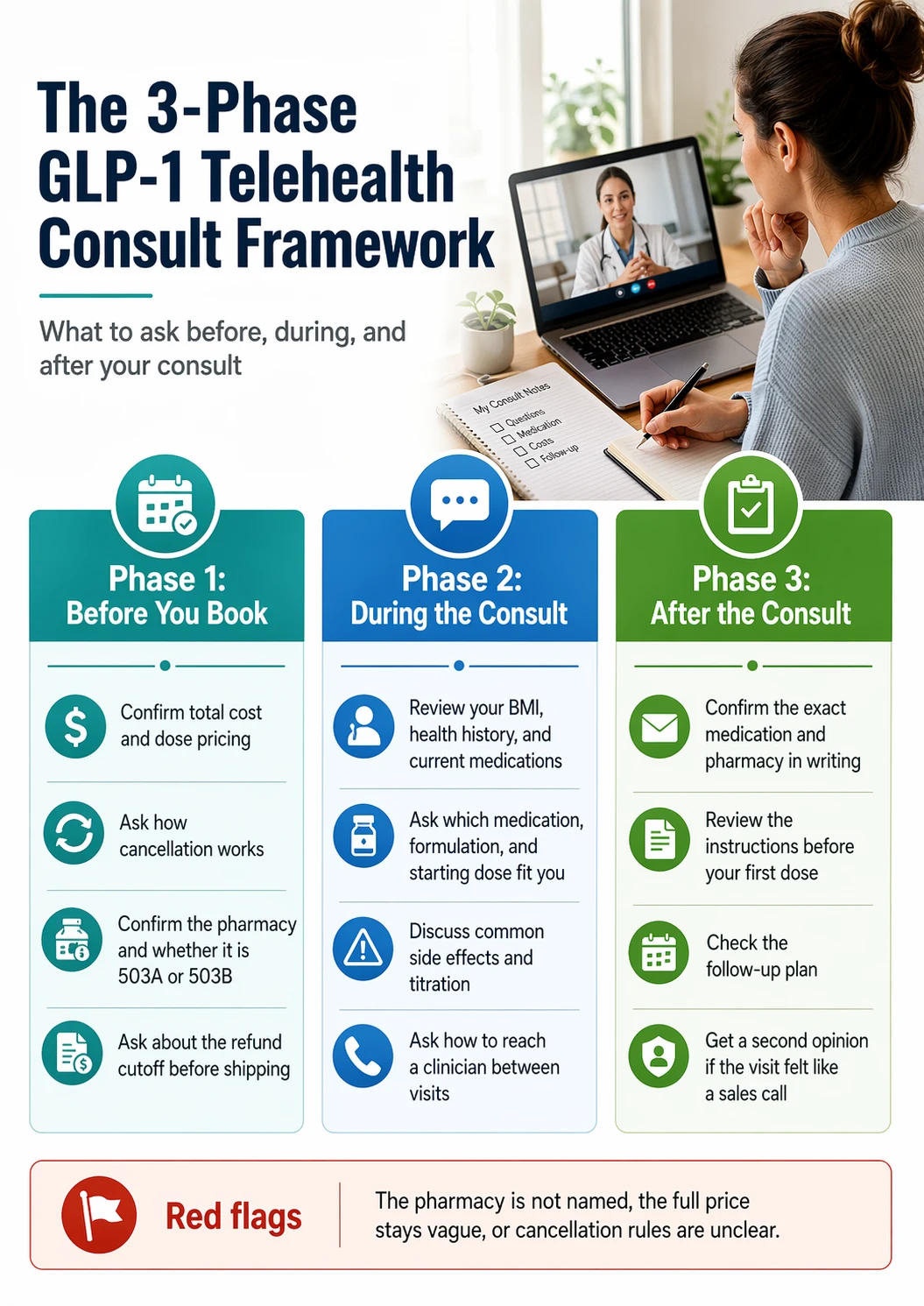
Telehealth is not automatically wrong — plenty of good medicine happens over video. But the model has to include a clinician who actually evaluates you, direct eating-disorder screening, reachable follow-up, oversight of dose changes, and a willingness to decline or refer. A program built to approve everyone quickly is structurally the wrong fit for this population, whatever its brand looks like.
The minimum bar: a real clinician evaluation, direct questions about current and past eating-disorder symptoms, a review of your nutrition and behavior, a clear medical indication, a label-specific contraindication check, follow-up access to an identifiable clinician, oversight of dose changes, a written escalation path, willingness to coordinate with your existing clinicians, and transparent criteria for saying no.
FDA's current consumer guidance identifies telehealth red flags that include providing medicine without screening and a prescription from a licensed doctor, or having no licensed doctor available to answer questions after the medication arrives. For a broader verification checklist, see How to Get GLP-1 Medications Safely Online. [19,26]
The walk-away signals are in the rubric above. The shortest version: if nobody asked, nobody is watching.
Why we're not naming winners here
We'll be direct about the limits of our own work, since that is the standard we are holding everyone else to.
We have not enrolled in these programs with an eating-disorder history to test what their screening actually catches. We have not timed their escalation responses, interviewed their clinicians about eating-disorder protocols, or verified how any of them handle a patient who discloses purging during treatment. Until we have, publishing a ranked list for this population would imply a confidence we do not have.
That is a real gap in this page, and we are telling you about it instead of papering over it. If we do that testing, this page gets updated and the update log below will say so.
What we can give you is the rubric to evaluate any program yourself — which is more durable anyway, because it still works when the market changes and a provider list goes stale.
What we actually verified
Last verified: August 5, 2026
Read directly for this guide
- Section 4 of seven current U.S. label documents: Wegovy injection/tablets, Zepbound, Ozempic injection, Saxenda, Mounjaro, the combined Rybelsus/Ozempic-tablet label, and Foundayo [1–7]
- Novo Nordisk's current Saxenda U.S. availability notice [8]
- FDA's January 13, 2026 suicidality communication, including its 91-trial meta-analysis [9]
- The Emptage et al. July 2026 eClinicalMedicine systematic review and meta-analysis [10]
- The Peiper et al. June 2026 JAMA Psychiatry research letter [11]
- The Radkhah et al. February 2025 systematic review and meta-analysis [12]
- The companion 17-trial exclusion-criteria register, including its source-completeness limits [13]
- The full STEP 1 and SURMOUNT-1 sponsor protocols and their eligibility architecture [14,15]
- Current Vyvanse prescribing information and the two pivotal phase 3 BED-trial report [16,17]
- The American Psychiatric Association eating-disorders guideline statement for BED psychotherapy [18]
- FDA's current compounded/unapproved GLP-1 consumer guidance [19]
- The National Alliance for Eating Disorders helpline hours, staffing, crisis limitation, and referral database [20]
- Current published guidance or positions from ANAD, Eating Recovery Center, Penn Medicine, and NEDC [21–24]
- The American Psychiatric Association patient resource on atypical anorexia and medical risk at normal or above-average weight [28]
How the seven-label audit was handled
We recorded whether eating-disorder history was explicitly named in Section 4. We did not infer personal safety from its absence. We reviewed label warnings separately and kept the conclusion narrow: eating-disorder history was not listed as a formal contraindication in these seven current documents.
How the 17-trial finding was handled
The 17 trials came from current U.S. chronic-weight-management labels. Full sponsor protocols were public for 13; FDA, regulator, registry, or sponsor records were needed for four. We therefore use "17 label-defined trials mapped," not "17 full protocols checked." We also separate three claims that are not interchangeable:
- Every trial used a psychiatric eligibility restriction.
- At least 15 explicitly documented suicide-specific screening.
- It is not established that every stable, remote eating-disorder history was excluded.
What we did not find, and looked for
- Any long-term randomized evidence establishing when someone with past anorexia, bulimia, ARFID, or OSFED can use a GLP-1 without added relapse risk
- Any validated tool that predicts individual relapse risk on these medications
- Any evidence-based recovery-duration threshold
- Any evidence that a compounded formulation reduces psychological, nutritional, or misuse concerns
- Any published head-to-head evidence showing that one GLP-1 molecule is safer than another for people with eating-disorder histories
- Any published testing of individual telehealth programs' eating-disorder screening and escalation process
- Evidence that every person with a stable, remote eating-disorder history was excluded from all 17 label-defined trials
What we did not do
We did not determine whether any medication is appropriate for you, test any provider, accept payment from a provider for placement on this page, or create a fake medical reviewer.
How we handled sources
In descending priority: current FDA prescribing information and safety communications; sponsor protocols, FDA reviews, and regulator records; peer-reviewed meta-analyses and original studies; recognized eating-disorder and academic medical organizations. Public forums may help editors understand reader language, but they were not used as evidence for a medical, safety, or regulatory claim. Commercial provider pages were excluded from every medical conclusion on this page.
Where expert organizations disagree, we say so rather than picking the position that reads better. Eating Recovery Center's published guidance is more restrictive than current FDA labeling, while ANAD emphasizes extreme caution and an eating-disorder-informed clinician. Thin evidence can support different institutional policies; pretending there is one settled consensus would be the dishonest move. [21,22]
Update log
| Date | What changed |
|---|---|
| August 5, 2026 | First publication. Seven current Section 4 labels verified; 17-trial evidence-boundary map added; Emptage 2026 restraint finding; Peiper 2026 use, misuse, and compounded-use data; corrected Vyvanse pivotal-trial outcomes; FDA January 2026 suicidality update; current National Alliance referral details incorporated. |
Frequently asked questions
Can I take Ozempic if I had an eating disorder?
Eating-disorder history is not listed in Ozempic injection's current Section 4 contraindications. Whether Ozempic is appropriate depends on your current symptoms, nutritional stability, medical indication, other label risks, and monitoring. The brand name does not change any of that. [3]
Can I take Wegovy if I previously had anorexia?
A remote history is not listed as a Section 4 contraindication in the current Wegovy label. Active or returning restriction is a serious clinical concern that should be assessed by someone who understands eating disorders. Neither BMI nor elapsed time since diagnosis is enough to decide on its own. [1]
Is Zepbound contraindicated for people with bulimia?
Bulimia is not named in Zepbound's current Section 4 contraindications. Active purging still raises significant concerns about vomiting, hydration, electrolytes, relapse, and misuse that need direct clinical assessment rather than an online form. [2]
How long do I need to be in recovery before taking a GLP-1?
There is no validated number. We found no study or current guideline that establishes a recovery duration making GLP-1 treatment automatically safe. A clinic can adopt a policy threshold, but current symptoms, nutritional stability, treatment purpose, support, and monitoring carry more clinical meaning than a made-up universal countdown.
Does a higher BMI mean my old restrictive eating disorder no longer matters?
No. Atypical anorexia can occur without low body weight and can still be medically serious. If a program assesses you on BMI alone, it can miss relevant behaviors and history. State it explicitly.
Is binge-eating disorder different from other eating disorders here?
Yes. BED has the largest direct GLP-1 evidence base: a 2025 meta-analysis of 5 studies and 182 participants found an 8.14-point improvement in Binge Eating Scale scores, and a 2026 meta-analysis of 25 trials found reductions across multiple binge-related outcomes. But no GLP-1 is FDA-approved to treat BED, and all three BED-specific trials in the 2026 review were rated high risk of bias. [10,12]
Can semaglutide treat binge-eating disorder?
Early evidence suggests GLP-1 medications may reduce binge-eating severity, but semaglutide is not FDA-approved for BED and the evidence is limited by short follow-up, heterogeneous methods, and high risk of bias in dedicated BED trials. Lisdexamfetamine is the only active ingredient with an FDA BED indication in adults, and APA recommends eating-disorder-focused CBT or interpersonal therapy. [10,16,18]
Did GLP-1 clinical trials include people with eating disorders?
The precise answer is that the 17 label-defined adult weight-management trials used psychiatric eligibility restrictions, and some protocols directly addressed eating disorders. But the public records do not establish that every person with a stable, remote eating-disorder history was excluded. The trials were not designed to quantify relapse risk in that population. [13–15]
Can a GLP-1 make my eating disorder come back?
Research cannot currently quantify your individual risk. The concern has a measurable basis: a 2026 meta-analysis of 25 trials and 8,069 participants found reductions in binge-related and emotional-eating outcomes alongside increased cognitive or dietary restraint. That pattern may matter differently in someone vulnerable to rigid restriction. [10]
How do I tell normal appetite reduction from restriction?
Reduced appetite is a medication effect. Restriction is a behavior pattern that requires context. Warning signals include using reduced appetite to skip needed nutrition, feeling rewarded by being unable to eat, hiding intake, or pushing for more appetite suppression. Report those signals even if the medication is also causing genuine nausea or fullness.
Is medication-related vomiting the same as purging?
No — intent and behavior differ. But recurrent vomiting can create medical risks regardless of cause, including dehydration and electrolyte problems, and a medication-triggered episode can interact with a familiar behavior. Report it either way.
Can I use a GLP-1 without counting calories?
Potentially. A care team may be able to monitor nutritional adequacy through a structured plan without giving you a patient-facing calorie target. That accommodation is not guaranteed and does not remove the need to confirm that you can eat and drink enough.
Can my doctor use blind weights?
Possibly. Blind weights are used in some eating-disorder settings, but they are not automatically appropriate in every medical plan. Ask what information the clinician needs, what you need to see, and whether another measure can satisfy both needs.
Should I stop my GLP-1 if old eating-disorder thoughts come back?
Contact your prescriber and eating-disorder clinician before changing the dose or stopping on your own, unless urgent medical instructions tell you otherwise. Symptom recurrence may lead the care team to pause, adjust, stop, or change monitoring. Hiding it removes the information they need to respond safely.
Did FDA find that GLP-1s cause suicidal thoughts?
No. On January 13, 2026, FDA requested removal of the suicidal ideation and behavior warning from Saxenda, Wegovy, and Zepbound after a comprehensive review did not identify increased risk. New or worsening depression, unusual mood changes, or suicidal thoughts still warrant prompt attention. [9]
Is compounded semaglutide safer for someone with an eating-disorder history?
There is no evidence that a compounded formulation removes the appetite, nutrition, misuse, or relapse concerns on this page. Compounded drugs are not FDA-approved, and FDA does not review them for safety, effectiveness, or quality before marketing. The 2026 JAMA study found that 9.9% of its targeted 436-person sample reported lifetime compounded-product use, but it did not show that compounding caused misuse or poor screening. [11,19]
Can an online quiz tell me if I'm safe to take a GLP-1?
No. A tool can prepare questions, identify issues to disclose, and help you make a written plan. It cannot diagnose you, determine medical eligibility, choose a drug or dose, or predict relapse risk.
Does the answer change if I need a GLP-1 for type 2 diabetes?
The benefit side of the calculation can be different and legitimate because GLP-1-based treatments have established approved uses for type 2 diabetes and other product-specific conditions. Your eating-disorder history still needs assessment, but a blanket denial that ignores the medical need can be as incomplete as an approval that ignores your history.
Is one GLP-1 safer than another for someone with an eating-disorder history?
We found no head-to-head evidence that establishes one GLP-1 molecule or brand as psychologically safer for this population. Product-specific contraindications, warnings, indications, side effects, route, and dosing still matter, but they do not create a validated eating-disorder safety ranking.
What about teenagers?
This page is written for adults. Adolescents with current or past eating disorders need assessment by clinicians experienced in pediatric medicine and eating disorders. Growth, development, family involvement, and weight suppression change the risk calculation enough to deserve separate treatment.
The bottom line
A past eating disorder is not an automatic FDA "no" in the seven current labels we reviewed. It is a reason for a much more careful "should we?" — and the difference between those two sentences is the whole point of this page.
What decides it is not your diagnosis code or how many years it has been. It is what you're doing right now, whether you can maintain nutrition, what you're actually treating, and whether anyone competent is watching. Active restriction, purging, inability to eat enough, dose manipulation, or symptoms creeping back all outrank a routine approval process — including a fast, cheap, friendly one.
The pivotal research did not resolve your exact situation. Every one of the 17 label-defined weight-management trials narrowed psychiatric eligibility, and the pivotal lisdexamfetamine BED trials excluded current anorexia and bulimia. But the evidence does not justify saying every person with a stable past eating disorder was deliberately excluded. What it justifies is a more honest conclusion: the relapse-safety question remains unanswered. [13–17]
That is not a reason to give up on treatment you may genuinely need. It is a reason to make sure the person prescribing it is looking at you instead of a form.
You're allowed to want metabolic health and protect your recovery at the same time. Those are not competing loyalties, and you should not have to pick one to be taken seriously.
▸ Take the next step with something in your hand
Build my GLP-1 appointment question list →
Free, no account, printable. Your questions, your accommodations, your warning signs, your care team — organized for the conversation that actually decides this.
If you're currently restricting, purging, or unable to eat and drink enough, please start here instead: find eating-disorder-informed care →. The medication conversation will still be there. This part comes first.
Sources
- FDA. WEGOVY (semaglutide) injection and tablets — Prescribing Information, 2026.
- FDA. ZEPBOUND (tirzepatide) — Prescribing Information, 2026.
- FDA. OZEMPIC (semaglutide) injection — Prescribing Information, May 2026.
- Novo Nordisk. SAXENDA (liraglutide) — Prescribing Information, February 2026.
- FDA. MOUNJARO (tirzepatide) — Prescribing Information, 2026.
- FDA. RYBELSUS and OZEMPIC tablets (semaglutide) — Combined Prescribing Information, 2026.
- FDA. FOUNDAYO (orforglipron) — Prescribing Information, 2026.
- Novo Nordisk. Saxenda U.S. availability and planned discontinuation notice.
- FDA. FDA Requests Removal of Suicidal Behavior and Ideation Warning from GLP-1 RA Medications, January 13, 2026.
- Emptage I, Kozmér S, Cobham-Wilson A, et al. The effectiveness of glucagon-like peptide-1 receptor agonists on binge eating in patients with obesity: a systematic review and meta-analysis. eClinicalMedicine. 2026;104007.
- Peiper NC, Zibbell JE, LaJoie AS, et al. Use and Misuse of GLP-1 Receptor Agonists Among People With Eating Disorders. JAMA Psychiatry. Published online June 24, 2026. doi:10.1001/jamapsychiatry.2026.1716.
- Radkhah H, Rahimipour Anaraki S, Parhizkar Roudsari P, et al. The impact of glucagon-like peptide-1 agonists in the treatment of eating disorders: a systematic review and meta-analysis. Eating and Weight Disorders. 2025;30:10.
- The RX Index Research. GLP-1 Clinical Trial Exclusion Criteria: 17 Weight-Management Trials. Version 1.1; last verified August 3, 2026.
- Novo Nordisk. STEP 1 trial protocol, NN9536-4373 / NCT03548935.
- Eli Lilly. SURMOUNT-1 trial protocol, I8F-MC-GPHK / NCT04184622.
- FDA. VYVANSE (lisdexamfetamine dimesylate) — Prescribing Information, 2026.
- McElroy SL, Hudson JI, Ferreira-Cornwell MC, et al. Lisdexamfetamine Dimesylate for Adults With Moderate to Severe Binge Eating Disorder: Results of Two Pivotal Phase 3 Randomized Controlled Trials. Neuropsychopharmacology. 2016;41:1251–1260.
- American Psychiatric Association. Practice Guideline for the Treatment of Patients With Eating Disorders. American Journal of Psychiatry. 2023.
- FDA. FDA's Concerns with Unapproved GLP-1 Drugs Used for Weight Loss.
- National Alliance for Eating Disorders. Helpline, referrals, and findEDhelp treatment database.
- ANAD. GLP-1 Medications & Eating Disorders.
- Eating Recovery Center. GLP-1s & Eating Disorders: What We Are Telling Providers.
- Penn Medicine. Implications of GLP-1 Medications for Eating Disorder Care.
- National Eating Disorders Collaboration. Eating Disorders and GLP-1RAs.
- Weight Loss Provider Guide. GLP-1 Contraindications: Who Should Not Take GLP-1 Medications.
- Weight Loss Provider Guide. How to Get GLP-1 Medications Safely Online.
- Weight Loss Provider Guide. Medical Disclaimer.
- American Psychiatric Association. What Are Eating Disorders?.
Related GLP-1 safety guides
Related Articles
GLP-1 for Beginners: How It Works
Thinking about GLP-1s? Clear beginner guide: how they work, who qualifies, first-month expectations, side effects, what to eat, and 2026 costs.
GLP-1 Medications Available in 2026: Pills, Shots & Costs
Every GLP-1 medication in 2026 — Foundayo, Wegovy HD, Wegovy pill. Verified costs, pill vs shot tradeoffs, who each one fits.
GLP-1 Pros and Cons: Benefits, Risks & Costs
GLP-1 pros and cons explained: expected weight loss, side effects, cost, safety risks, who qualifies, pills vs shots, and decision tools (2026).
GLP-1 Weight Loss Calculator: Wegovy, Zepbound & Foundayo
Estimate your weight loss on Wegovy, Zepbound, or Foundayo with our GLP-1 weight loss calculator. Anchored to FDA-label trial data. Verified May 2026.
GLP-1 Tips for Beginners: 30-Day Playbook
GLP-1 tips & tricks for beginners: injection-day routine, foods to eat/avoid, side-effect fixes, muscle protection + 30-day checklist. Updated 2026.
How GLP-1 Works for Weight Loss: Mechanism, Results & Risks
How GLP-1 medications like Ozempic and Wegovy work for weight loss. Mechanism map, clinical trial results, side effects, and decision framework.