GLP-1 Menstrual Cycle: What Changes, Why, and When to Worry
By the Weight Loss Provider Guide Research Team · Weight Loss Provider Guide is an independent comparison resource for GLP-1 telehealth providers.
Last verified: August 7, 2026 · Sources: current FDA prescribing information for Wegovy (revised June 2026), Zepbound (revised April 2026), and Foundayo (revised April 2026); four peer-reviewed analyses of the FDA's adverse event database; a PCOS meta-analysis and three newer semaglutide studies; CDC and ACOG clinical criteria; and a 1,754-person cycle survey.
Short answer: yes, a GLP-1 menstrual cycle change can happen. But it happens less often — and often in a different direction — than the internet will tell you.
In a 2026 Natural Cycles survey, 1,754 current or former GLP-1 users were asked whether their cycle had changed. 73% said they had noticed no change. Of the 27% who did notice something, the most common change was periods becoming more predictable. Not less. See the survey data.
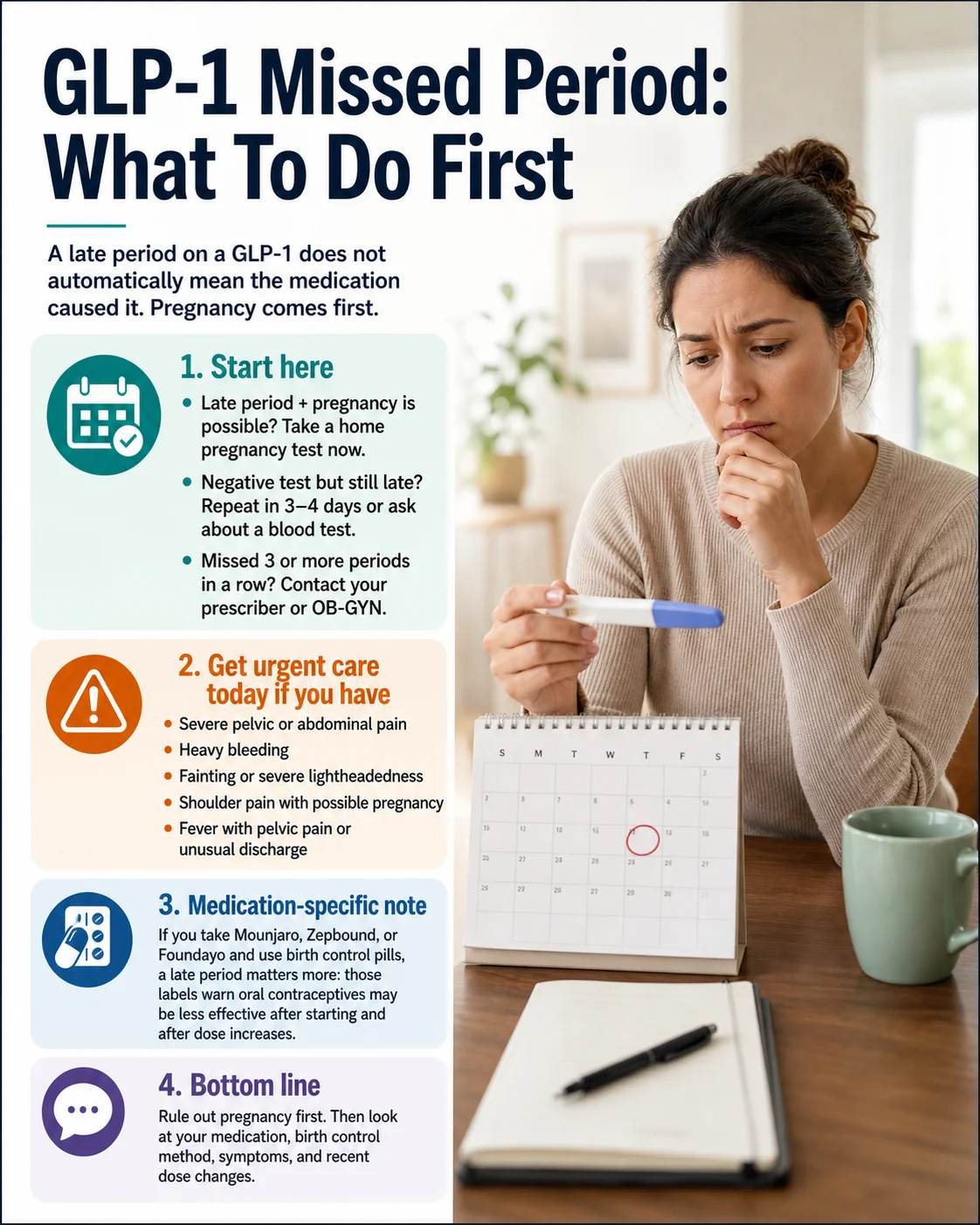
Three things change that answer. If your period is late and pregnancy is even remotely possible, take a test before you read another word. If you're bleeding between periods, or bleeding at all after menopause, that's a phone call, not a Google search. And if you take oral birth control with tirzepatide (Zepbound or Mounjaro) or with Foundayo, the current FDA labels give specific backup-birth-control rules that many people miss.
Everything else? If no warning sign below fits, track it against your dose dates for three cycles. Do not keep waiting if your cycles are repeatedly more than 45 days apart, you go three months without a period, or the bleeding keeps coming back.
Here's the label detail that changes how to read this. There is one sentence buried in the Wegovy prescribing information that points to a likely indirect pathway — and a related finding in the current Zepbound label. Both manufacturers connect their animal-cycle findings to lower food intake and body weight. Those animal findings do not prove what happened in your body. We'll show you exactly where.
Start here, based on what happened
| What happened? | Safest first step |
|---|---|
| Period is late or missed | Take a pregnancy test if pregnancy is possible at all |
| Heavy bleeding, big clots, or bleeding between periods | Check the warning signs below, then call your clinician |
| You have PCOS and your period suddenly got regular | Ovulation may have returned — use contraception if you're not trying to conceive |
| You take oral birth control with Zepbound or Mounjaro | Use a non-oral method or add a barrier method for 4 weeks after starting and for 4 weeks after every dose increase |
| You take oral birth control with Foundayo | Use a non-oral method or add a barrier method for 30 days after starting and for 30 days after every dose increase |
| Any bleeding after menopause | Call a clinician. Don't wait. Don't blame the medication. |
Jump to what you need: Is this normal? · What the FDA labels say · The 2026 safety study · Why it's happening · Late or missed period · Heavy bleeding and clots · PCOS · How long it lasts · Birth control · When to call a doctor · FAQ
🔍 What we actually verified
- ✅ Read the current Wegovy prescribing information (revised June 2026) line by line — including the animal-study section other articles skip
- ✅ Read the current Zepbound prescribing information (revised April 2026), including its exact birth-control wording and its related animal-cycle finding
- ✅ Read the current Foundayo prescribing information (revised April 2026), including its separate 30-day oral-birth-control rule
- ✅ Pulled the published 1,754-person Natural Cycles data insight, including the company's own stated limitations
- ✅ Read the 11-trial PCOS meta-analysis and checked which drugs it actually used (the answer surprised us)
- ✅ Added three newer semaglutide PCOS studies, including a 2026 randomized trial
- ✅ Compared four separate analyses of the same FDA report database side by side — including their report counts
- ✅ Pulled the CDC description of heavy menstrual bleeding and the ACOG criteria for when abnormal bleeding gets evaluated
- ⚠️ We are not clinicians. This page organizes published evidence. It cannot examine you, and it does not replace medical care.
- ⚠️ The animal-cycle findings are not human-period data. They support a possible indirect pathway; they cannot tell you what caused your cycle change.
We publish the gaps because a page that pretends to know everything is a page you shouldn't trust.
👉 Not sure which of these fits you? Our GLP-1 Period Change Checker asks seven quick questions about your medication, timing, and symptoms, then helps you see which explanations may fit — plus whether it's a track-it situation, a call-this-week situation, or a seek-care-now situation. No email. Nothing saved.
Run the Period Change Checker →
Is it normal for your GLP-1 menstrual cycle to change?
It happens, but it was not the majority experience in this survey. In the Natural Cycles data insight covering 1,754 current or former GLP-1 users, 73% reported no noticed change to their cycle. Among the 27% who did notice a change, the three most common were periods becoming more predictable (45%), more frequent (21%), and shorter (19%). Source.
That survey comes from Natural Cycles, a company that makes an FDA-cleared cycle-tracking app. Their users track their cycles closely, which makes them unusually good at noticing a change. But this was a self-reported company data insight, not a randomized trial and not a peer-reviewed estimate of how often all GLP-1 users are affected.
Here's the full breakdown:
| What changed? | All respondents | Respondents with PCOS |
|---|---|---|
| Noticed any change at all | 27% | 43% |
| More predictable periods | 45% of those who noticed a change | 64% |
| More frequent periods | 21% | 23% |
| Shorter periods | 19% | 20% |
Now read that again, because the framing matters. Almost three out of four women noticed nothing. And the single most common change reported was a period getting better behaved, not worse.
Natural Cycles is honest about what their data can't do, and so are we. Over half their respondents lost more than 10% of their body weight during treatment. Sixty-six percent started eating healthier foods. Forty-five percent exercised more. Twenty-four percent improved their sleep. Twenty percent improved their stress management. You cannot pull the drug out of that pile and say "this part was the medication."
But here's what struck us. Many articles on this topic open with some version of "GLP-1s can make your period irregular." This large dataset says the opposite is more common.
That doesn't mean irregular periods don't happen. They do, and we'll cover them in detail. It means the internet has been handing you more worry than the evidence asks for.
The one thing we can't tell you — and neither can anyone else
Let's get this out of the way early, because it's the honest thing to do and because the rest of this page is more useful once you accept it.
We cannot tell you whether your GLP-1 caused your period to change. Nobody can. Not us, not your doctor on a first visit, not the researchers who published the newest study. Anyone who tells you flatly "it's just the weight loss" or "it's definitely the drug" is guessing and dressing the guess up as an answer.
Here's why. The strongest evidence in the general population is a reporting signal — a pattern in a complaint database, which we'll explain in plain English shortly. That's a reason to look closer, not proof of cause. The strongest controlled evidence comes from studies of women with PCOS, and those results don't automatically apply to everyone. And in your own body, the medication started at the same time as rapid weight loss, a big drop in how much you eat, and probably some lifestyle changes too. All of those move a cycle on their own.
So that's the flaw in this page: we can't hand you certainty about cause.
But here's what we can hand you, and it's more than anywhere else we looked:
- What the actual drug labels say, including the part that explains the mechanism
- Which specific symptoms showed up in the 2026 safety data — and, just as importantly, which ones didn't
- The real numbers behind the scary headlines, so you can size the risk instead of feeling it
- The symptoms that genuinely warrant a call, and the evidence behind those thresholds
- A way to organize which of four explanations may fit your pattern
Certainty about cause isn't available. Everything else is.
| We know this | We don't know this |
|---|---|
| Menstrual changes are being reported during GLP-1 treatment | What percentage of GLP-1 users are actually affected |
| Some events show statistical reporting signals in FDA data | Whether the drug directly caused any individual event |
| Some women with PCOS become more regular | Whether the same benefit applies to women without PCOS |
| Tirzepatide and Foundayo have specific oral-birth-control instructions | A reliable universal timeline for how long changes last |
What do the FDA drug labels actually say about periods?
The current Wegovy prescribing information, revised June 2026, lists 19 adverse reactions that occurred in 2% or more of adults treated with the injection and more often than placebo. Not one is menstrual. Its post-market section has no reproductive category. But the label does contain a cycle finding — in the animal research section, where it reports longer estrous cycles in female rats at every dose tested. Current Wegovy label.
We read the whole thing. Here's what's in there.
The human side effect table has nothing
Section 6.1 of the Wegovy label (revised June 2026) contains Table 3: every side effect that showed up in at least 2% of the 2,116 adults on the drug and more often than in the 1,261 people on placebo.
Nausea. Diarrhea. Vomiting. Constipation. Stomach pain. Headache. Tiredness. Indigestion. Dizziness. Bloating. Burping. Low blood sugar. Gas. Stomach bug. Reflux. Gastritis. Viral stomach bug. Hair loss. Skin sensitivity.
Nineteen entries. Zero menstrual or gynecological terms.
Section 6.2 covers side effects reported after the drug went on the market. It has four categories: stomach, allergic reactions, lungs, kidneys. There is no reproductive category on the Wegovy label at all.
The current Zepbound label (revised April 2026) and Foundayo label (revised April 2026) tell the same human-trial story — menstrual changes are not among their listed common adverse reactions. Zepbound label. Foundayo label.
What that does and doesn't mean. It means menstrual changes were not established as a common event in the trials the label summarizes. It does not mean nobody has ever experienced one. Labels only carry what the evidence has forced onto them, and they change when evidence gets stronger.
The sentence almost nobody has read
Now the part we promised you. Section 13.1 of the Wegovy label covers animal studies. Buried in the rat fertility study is this:
"An increase in estrus-cycle length was observed at all dose levels."
— Wegovy prescribing information, Section 13.1, revised June 2026
The same paragraph says there were fewer corpora lutea at the two higher doses and says the effects were likely an adaptive response to semaglutide's effects on food consumption and body weight. Read the current label.
Let us translate that into normal words.
The rats' cycles got longer at every single dose tested. The estrous cycle is a reproductive cycle in rats. It is not the same thing as a human menstrual cycle, so this finding cannot be translated into "your period will be late."
At the two higher doses, the rats had fewer corpora lutea. Corpora lutea are structures that form after ovulation. That finding is consistent with fewer ovulations, but it is still an animal finding.
And here's the part that matters most. Novo Nordisk's own written explanation is that this was likely an adaptive response to the drug's effect on food consumption and body weight. The label points to an indirect pathway. It does not prove that a direct reproductive effect is impossible.
Rats are not women. We'll say that plainly. But this is one official place where a manufacturer explains why a reproductive-cycle finding may have happened, and its answer matches a plausible pathway in humans: eating less, losing weight, and changing energy availability.
It takes about thirty seconds to check. Open the Wegovy label PDF and search for the word "estrus."
Zepbound has a related animal finding too
The current Zepbound label reports prolonged diestrus, fewer corpora lutea, and fewer implantation sites and viable embryos in female rats at every tested dose. Lilly says those effects were considered secondary to lower food intake and body weight. Read Section 13.1.
That does not prove tirzepatide changes human periods. It does close a gap in the original draft: Wegovy is not the only current label with an animal reproductive-cycle finding. Foundayo's label does not report a comparable estrous-cycle finding; it also says orforglipron is not pharmacologically active in rats or mice, which limits direct animal comparison. Foundayo label.
Why the big trials did not settle this in humans
Here's the second thing hiding in the label, and it explains the whole evidence gap.
The current label summaries do not report menstrual-cycle change as a measured endpoint in the pivotal weight-loss trials.
Look at who was in them. The adult Wegovy trials had a mean participant age of 48, and 71% were women — roughly 1,500 women. The oral tablet trial: mean age 48, 79% women. Study 2, the largest: mean age 46, 74% women.
Think about what that means. The mean age sits in the range when perimenopause is common, creating overlap with cycle changes that can happen without the drug.
So there are two evidence limits stacked on top of each other. The label summaries were not built around menstrual endpoints. And the age mix included many women whose cycles may already have been changing because of perimenopause.
That's not a scandal. Obesity trials are designed to measure weight and heart outcomes, and they did that well. But when someone tells you "it's not a listed side effect, so it doesn't happen," remember what the label can and cannot show: these trial summaries were not built around menstrual outcomes, so absence from the table is not proof of absence.
I saw a headline about menstrual clots and heavy bleeding. Should I be worried?
In July 2026, researchers published an analysis in Obstetrics & Gynecology finding that several menstrual events were reported more often than expected for semaglutide and tirzepatide in the FDA's adverse event database. The signals are real and worth taking seriously. But they cannot tell you your odds, and three other analyses of the same database reached partly different conclusions.
This is the section that scared you into searching, so let's do it properly.
What the July 2026 study found
Connor Frey, MD, and Mahyar Etminan, PharmD, at the University of British Columbia analyzed the FDA Adverse Event Reporting System — usually called FAERS. It's the government's complaint box for medications. They looked at every report through March 2026, narrowed to female patients aged 12 to 55, and compared the reporting pattern for GLP-1 medications with reports for other drugs in the database.
The pool was 14,104,743 reports. After the age filter: 4,024 for liraglutide, 27,469 for tirzepatide, 6,060 for semaglutide.
Here's what they found. ROR means "reporting odds ratio" — how disproportional a drug-event pair was inside this report database. Higher number, stronger reporting signal. It does not mean that many times the real-world risk.
| Menstrual event | Semaglutide | Tirzepatide | Liraglutide |
|---|---|---|---|
| Menstrual clots | ROR 31.63 | ROR 5.41 | No positive signal |
| Cycles without ovulation | ROR 8.96 | No positive signal | No positive signal |
| Heavy menstrual bleeding | ROR 3.51 | No positive signal | No positive signal |
| Periods coming less often | ROR 3.09 | No positive signal | No positive signal |
| Bleeding between periods | ROR 2.91 | ROR 1.64 | No positive signal |
| General menstrual disorder | ROR 2.54 | No positive signal | No positive signal |
| No periods at all (amenorrhea) | No positive signal | No positive signal | No positive signal |
| Irregular menstruation | No positive signal | No positive signal | No positive signal |
| Painful periods | No positive signal | No positive signal | No positive signal |
Read the bottom of that table again
Many summaries of this study focus on the scary top rows and skip the bottom three. Those rows may matter more to you than everything above them.
Amenorrhea and irregular menstruation showed no positive disproportionality signal in this analysis. Not for semaglutide. Not for tirzepatide. Not for liraglutide.
Look at the pattern. The signals cluster around bleeding and ovulation: heavy flow, clots, spotting between periods, cycles where no egg is released, periods spacing further apart. They did not produce a positive signal for amenorrhea or general irregular menstruation in this one analysis.
Put that next to the Natural Cycles survey, where 73% of respondents noticed no change and the most common reported change was periods getting more regular. The two datasets answer different questions, but neither supports the blanket claim that GLP-1 treatment usually makes periods irregular.
If your worry is "my period is late" or "my cycle is all over the place," this study did not find a positive signal for amenorrhea or irregular menstruation. It still cannot tell you what caused your own change or whether you need care.
What "linked to" actually means in a news headline
This part is worth two minutes because it will change how you read every drug headline for the rest of your life.
The FDA keeps a giant complaint box. Anyone can file a report — a doctor, a patient, a family member, the drug company itself. Nobody checks whether the drug caused the problem. It's a box of "this happened to me while I was taking this."
Researchers count how often a drug and a symptom show up together in that box, then ask: is that more than we'd expect by chance? If yes, that's a signal. A signal is a flag that says look closer here.
A signal is not a percentage. It's not your odds.
Here's the part that makes it concrete. FAERS does not provide a reliable exposed-user denominator. The report box only holds people whose event was reported. Without a trustworthy total number of exposed users, you cannot do the division that would turn a reporting signal into a real-world risk.
So when a headline says "31 times higher," that does not mean menstrual clots are 31 times more likely to happen to you. It means the reporting odds ratio for that drug-event pair was 31.63 inside this analysis — not that the real-world risk was 31 times higher.
The study authors said this themselves. They listed their own limits: obesity affects cycles on its own, reports are voluntary and incomplete, heavily publicized drugs get over-reported, and some of their numbers came from event counts too small to be stable. And they still concluded the findings have clinical relevance.
Both of those things are true at once. That's science working normally. It just doesn't fit in a headline.
Four studies. One database. Four different answers.
Here is the comparison that puts that headline in proportion.
The July 2026 study is not the only analysis of GLP-1s and menstrual events in FAERS. There are at least four, covering overlapping time periods, querying the same database. They don't agree with each other.
| Study | What it compared | What it concluded |
|---|---|---|
| Frey & Etminan, Obstetrics & Gynecology, July 2026 | GLP-1 reports vs. reports for other drugs | Broad positive signals for semaglutide, narrower signals for tirzepatide, none for liraglutide |
| Comparative gynecological safety analysis, FAERS 2022–2025, 103,607 female reports | Tirzepatide vs. semaglutide, head to head | Gynecologic hemorrhage terms appeared in 0.60% of tirzepatide reports vs. 0.62% of semaglutide reports; ROR 0.97 |
| Lee et al., Diabetes/Metabolism Research and Reviews, 2026 | Six GLP-1 drugs with adjusted analyses | Semaglutide had positive associations; tirzepatide and dulaglutide had negative associations for several outcomes, including heavy bleeding, amenorrhea, and painful periods |
| Tirzepatide pharmacovigilance update, Drug, Healthcare and Patient Safety, January 2026 | Tirzepatide reports, including time-to-onset analysis | Flagged menstrual disorder as a new reporting signal |
Comparative study. Lee et al. Tirzepatide update.
Study one found the broadest positive profile for semaglutide. Study three found lower reporting odds for several outcomes with tirzepatide. Study four flagged a tirzepatide menstrual-disorder signal. Study two found almost no head-to-head difference in its broad gynecologic-hemorrhage category.
And the arithmetic doesn't line up either. The July 2026 study counted 6,060 female semaglutide reports over a period stretching back to the database's beginning. The head-to-head study counted 32,839 female semaglutide reports over a shorter window. Same database. Same drug. More than five times apart.
Tirzepatide is worse: 27,469 in one analysis, 70,768 in another.
The teams used different age filters, drug-name rules, date ranges, and methods. That is enough to produce very different report counts. It tells you exactly how little a single number from this kind of study can establish on its own.
One more detail from the head-to-head study that almost nobody discusses. 94.6% of tirzepatide reports came from consumers rather than healthcare providers. For semaglutide it was 53.4%. That reporting-source imbalance can contribute to reporting or notoriety bias. It does not prove that bias caused the difference, but it is one reason not to read report counts as incidence.
So what should you actually take from all this?
Three things:
- Bleeding-related changes are being reported often enough that researchers are paying attention. That's legitimate and it shouldn't be waved away.
- Nobody currently knows how often it happens. Not one of those four studies can tell you.
- A missing period and an irregular cycle showed no positive signal in the July 2026 analysis. That is useful context, not proof that the symptom cannot happen or does not need evaluation.
That's an unsatisfying answer. It's also the correct one, and you deserve the correct one more than you deserve a comfortable one.
👉 Want to know where your specific symptom lands? The Period Change Checker walks you through three bands: track it, call this week, or seek care now. It uses the CDC's bleeding criteria and ACOG's evaluation guidance — not our opinion.
Check where my symptom lands →
Why would a GLP-1 change your period?
There are four plausible explanations. Three are indirect: rapid weight loss, eating far less than usual, and improved insulin sensitivity. The fourth is an unproven direct-effect hypothesis. Timing can give you clues, but it cannot tell you which cause is yours.
Notice which symptoms each cause may fit. That's the part nobody maps out. These are mechanism-based clues, not validated predictions or a diagnosis.
1. Your body fat makes estrogen — so losing it changes your levels
Fat tissue isn't just storage. It's an active organ that can make estrogen. Lose a lot of it, fairly fast, and your estrogen exposure can change.
Similar changes in body composition and energy availability are among the reasons cycles can change after bariatric surgery, heavy endurance training, or major weight loss.
May fit: lighter periods, shorter periods, timing shifts.
2. Eating much less tells your brain to pause
Your brain constantly monitors whether there's enough fuel coming in. When intake drops sharply, it slows the signals that trigger ovulation. It's not a malfunction. It's a very old, very sensible system deciding this isn't a great moment.
GLP-1s cut how much people eat substantially, and this is exactly the mechanism the Wegovy rat study pointed at — the manufacturer's own explanation for why those cycles lengthened.
Doctors call the extreme version of this functional hypothalamic amenorrhea — periods stopping because of low energy availability. It's diagnosed only after ruling out other causes, so nobody should be self-labeling with it.
May fit: late periods, skipped periods, cycles without ovulation.
3. Better insulin sensitivity rebalances your hormones
This is the mechanism that makes cycles better, and it's most relevant if you have PCOS.
When insulin runs high, your body makes less of a protein called SHBG — sex hormone binding globulin — whose job is to bind up spare testosterone and keep it out of circulation. Less SHBG means more free testosterone, and high free testosterone jams ovulation.
Improve insulin sensitivity and that whole chain reverses. SHBG goes up. Free testosterone goes down. Ovulation can restart.
Plain version: high insulin was jamming the signal. Turning it down unjams it.
May fit: periods becoming more regular, periods returning after a long absence.
4. The drug itself might do something small, directly
GLP-1 receptors — the docking points these drugs act on — are found in parts of the brain involved in reproductive signaling and in reproductive tissues. Some animal research suggests direct effects on reproductive signaling. Review.
In humans, a direct menstrual effect is unproven. We're including it because it's a real hypothesis researchers are pursuing, not because there's evidence you should act on. If the July 2026 bleeding signals turn out to have a mechanism behind them, this is where it would live.
May fit: unknown. That's the honest answer.
Three of these four explanations are indirect
That's the takeaway. Three of the four explanations involve changes in body fat, energy intake, or insulin sensitivity rather than a proven direct drug effect. That does not guarantee the cycle will settle when weight settles.
⚠️ Things you'll read that we couldn't support
- "Fat releases stored estrogen and causes heavy bleeding." This gets repeated constantly. We could not find real support for it as a mechanism.
- "Your hormones are detoxing." Not a thing.
- "This always resolves once your weight stabilizes." "Always" is not supported, and general-population evidence does not establish how often it resolves on that timeline.
- "Changes typically resolve in three to six months." We saw this specific timeline on several commercial sites. Neither the FDA labels nor any general-population study we found establishes it.
Why is my period late or missing on a GLP-1?
A late or missed period can happen during GLP-1 treatment. Once pregnancy is ruled out, low energy intake is one plausible explanation — not the only one. Notably, the July 2026 FDA data analysis found no positive reporting signal for amenorrhea, the medical term for periods stopping, with semaglutide, tirzepatide, or liraglutide.
First, and always: rule out pregnancy
We're putting this before everything else because it's what you're most afraid of and burying it would be cowardly.
If pregnancy is possible at all, test before you do anything else. Not "probably fine." Test.
Three reasons this matters more than usual on a GLP-1:
- Early pregnancy symptoms — nausea, exhaustion, food aversions — look almost identical to GLP-1 side effects. You cannot tell them apart by feel.
- If you have PCOS and your cycles just got regular, you may be ovulating for the first time in years.
- If you take oral birth control with tirzepatide or Foundayo, each has a product-specific backup rule. See the birth control section.
How to test: home tests are most accurate from the day of your missed period onward. Follow the box instructions exactly. If it's negative and your period still hasn't come after a few more days, test again or call your clinician.
If it's positive: call your prescribing clinician promptly. For weight reduction, the current Wegovy, Zepbound, and Foundayo labels say to discontinue the medication when pregnancy is recognized. Don't build your own plan from a web page — that's a conversation with the person who prescribed it.
If pregnancy is ruled out, here's what's probably happening
One plausible cause is the low-energy signal we described above: your brain slowing the cycle because you are eating much less than you were. The timing can support that explanation, but it cannot prove it.
Those are two points worth checking in your own timeline: your fastest weight-loss stretch, and the weeks after a dose increase, when food intake may change most.
Other real possibilities worth considering with your clinician: thyroid problems, high prolactin, PCOS, perimenopause, major stress, a big change in exercise, or a different medication.
When does a missed period need actual evaluation?
Three months — or cycles that keep stretching beyond 45 days. The Endocrine Society recommends evaluation when cycle intervals persist beyond 45 days or when amenorrhea lasts three months or more. It should be evaluated rather than assumed to be the medication. Guideline.
That's not a scare number. It's a "stop waiting" number. Pregnancy gets excluded first, then your clinician looks at thyroid, prolactin, and other causes.
What this does not mean
A paused cycle from low energy availability is not menopause, and it's not proof you're infertile. It's generally reversible. We're saying that plainly because these are the two conclusions women jump to at 2 a.m., and neither is supported.
👉 Period late and the test was negative? The Checker helps you line up your dose-increase dates against your cycle dates. That overlap is one of the most useful things you can know before you call — and many people do not think to look at it.
Heavy bleeding, clots, and spotting between periods: what's worth a call?
Heavy bleeding, menstrual clots, and bleeding between periods all showed reporting signals in the July 2026 FDA analysis. But of those three, bleeding between periods is the one that most warrants evaluation — a premenopausal review found about 4.7 times the endometrial-cancer yield for bleeding between periods as for heavy bleeding.
That's backwards from what the headlines emphasize. Here's the whole picture.
First, what actually counts as "heavy"?
Most women have no reference point for this, so here are the CDC's criteria:
- Bleeding that lasts longer than seven days
- Needing a new pad or tampon in under two hours
- Passing clots about the size of a quarter or larger
- Bleeding heavy enough to cause weakness, fatigue, shortness of breath, or to limit your normal life
CDC description of heavy menstrual bleeding.
If you tick any of those, that's a reason to contact a healthcare professional. Not an emergency by itself — a phone call.
The number that puts this in proportion
Here's the part that turns fear into a decision. It comes from a systematic review of 65 studies looking at premenopausal women with abnormal bleeding, and asking how often endometrial cancer or atypical hyperplasia was found.
| Bleeding pattern | Chance of endometrial cancer being found |
|---|---|
| Any abnormal bleeding overall | 0.33% — about 1 in 300 |
| Cancer or atypical hyperplasia combined | 1.31% |
| Heavy menstrual bleeding | 0.11% — about 1 in 900 |
| Bleeding between periods | 0.52% — about 1 in 190 |
These numbers come from premenopausal women with abnormal uterine bleeding. They are not GLP-1-specific, and they do not apply after menopause. Systematic review.
Now look at that carefully, because it's genuinely surprising.
Heavy bleeding had the lowest endometrial-cancer yield of the patterns compared in this review. Across five studies that specifically looked for atypical hyperplasia in women with heavy periods, they found zero cases.
Bleeding between periods had about 4.7 times the endometrial-cancer yield in this review.
Which means the symptom the headlines shout loudest about — heavy bleeding and clots — had the lower endometrial-cancer yield in this review. And the quieter symptom, spotting between periods, is the one that deserves the appointment when it repeats.
That doesn't make heavy bleeding harmless. Prolonged heavy bleeding can drain your iron and leave you exhausted, dizzy, and short of breath, and that's worth treating on its own. It just means the fear and the risk aren't pointed in the same direction.
Why heavier periods can happen after a skipped ovulation
One benign explanation: if you go through a cycle where no egg is released, the uterine lining keeps building without the hormone signal that normally triggers a tidy shed. When it finally comes away, there's more of it. Heavier flow, sometimes clots.
That can explain a heavy bleed after a cycle without ovulation. It cannot tell you that a new or repeated heavy pattern will settle on its own.
Watch your iron
Nobody else mentions this and it's practical. Heavy bleeding drains iron. A GLP-1 can reduce how much you eat, which can reduce how much iron you take in. Those two together, over several months, can leave you noticeably run down.
If you're bleeding heavily and feeling wiped out, breathless on stairs, or unusually cold, mention iron specifically when you call. It's a simple blood test.
Bleeding between periods
One episode of light spotting can have many causes and may not repeat. Repeated bleeding between periods is different, and given the numbers above, it's the pattern most worth a conversation.
Track where it happened relative to your period, your medication start date, and any dose increase. That timeline is what your clinician will want.
What happens to your period if you have PCOS?
This is where the evidence is strongest and most positive. A meta-analysis of 11 randomized trials covering 840 women with PCOS found GLP-1 treatment significantly improved menstrual regularity and raised natural pregnancy rates. In the Natural Cycles survey, 64% of PCOS respondents who noticed a change said their periods became more predictable.
PCOS — polycystic ovary syndrome — is a hormone condition where insulin resistance and elevated androgens interfere with regular ovulation. Irregular or absent periods are one of its defining features. It's also strongly linked with excess weight, which means a lot of women reading this have both.
What the 11-trial meta-analysis found
Published in BMC Endocrine Disorders in 2023. Eleven randomized controlled trials. 840 women — 469 on a GLP-1, 371 in control groups.
- Menstrual regularity improved significantly (standardized mean difference 1.72, 95% CI 0.60 to 2.85, p < 0.001)
- Natural pregnancy rate rose meaningfully (relative risk 1.72, 95% CI 1.22 to 2.43)
- No statistically significant difference in IVF pregnancy rate was found (relative risk 1.06) — worth knowing if IVF is on your table
The catch nobody mentions
We read the paper's methods, and here's what we found.
Five of the eleven trials used exenatide. The other six used liraglutide. Not one used semaglutide. Not one used tirzepatide.
So the study everyone quotes to say "GLP-1s regulate your period" tested two older drugs. It did not test semaglutide or tirzepatide. That doesn't make the finding wrong — the underlying mechanism may carry across the class. But it's a bridge, not a proof, and every page that cites it as though it studied Ozempic is quietly misleading you.
The newer, smaller semaglutide evidence
Since that meta-analysis, semaglutide-specific PCOS research has started appearing. It's smaller and less definitive, but it points the same direction:
| Study | Design | Finding |
|---|---|---|
| 2025 randomized open-label trial | 100 women randomized to metformin or metformin + semaglutide; 80 completed | Higher rate of cycle recovery; natural pregnancy 35% vs. 15% during follow-up |
| Small semaglutide-only study | 27 patients with obesity and PCOS | 80% of weight-loss responders who stayed on treatment normalized their cycles by six months |
| 2026 randomized open-label trial | 64 women randomized to metformin or metformin + semaglutide; 61 completed | Regular cycles at 20 weeks: 86.9% vs. 60.0% |
2025 trial. 27-patient study. 2026 trial.
Read those honestly. The 2025 and 2026 randomized trials tested a combination with metformin, not semaglutide alone. The 27-patient study was small, uncontrolled, and reported cycle normalization among weight-loss responders who stayed on treatment. None proves what will happen for every woman. All three are encouraging.
So the fair summary is this: the strongest evidence uses older drugs, the newest evidence includes semaglutide — one of the drugs many readers are on — and both point the same way.
The warning that comes with the good news
If your period comes back after years of nothing, you can get pregnant.
Read that again if you need to. This catches women completely off guard.
A lot of women with PCOS have spent years being told conception would be difficult. Some stopped using contraception years ago on that basis. Then their cycle returns on a GLP-1 and the old assumption is suddenly wrong.
More regular periods likely mean more consistent ovulation. If you are not trying to conceive, use reliable contraception. If you are trying to conceive, that's a different conversation with your prescriber, because these medications carry pregnancy warnings.
On "Ozempic babies": That's a media phrase, not a medical finding. Surprise pregnancies on these drugs may involve some combination of restored ovulation, the tirzepatide birth-control interaction, and ordinary contraceptive failure. The phrase doesn't prove a class-wide fertility effect, and GLP-1s are not approved as fertility treatment.
👉 If you have PCOS and you're deciding whether to start, the cycle evidence above is the encouraging part of a bigger picture. Our PCOS guide compares programs on what actually matters for PCOS — dose flexibility, whether they'll run labs, and how they handle a cycle that restarts.
See the GLP-1 options for PCOS →
👉 If you're planning a pregnancy in the next year or two, timing matters a lot more than provider choice. Read the fertility planning guide →
How long until your cycle goes back to normal?
There's no reliable universal timeline, and any page giving you one as a promise is inventing it. The clearest duration evidence we found comes from PCOS trials, and it points at roughly six months rather than six weeks — 12-week treatment did not show a statistically significant menstrual-frequency change, while the longer-treatment subgroup did. Meta-analysis.
Here's the specific finding, and it's the most practical number we found anywhere.
In that 11-trial meta-analysis, the researchers ran a subgroup analysis by treatment length. Twelve weeks of treatment produced no statistically significant change in how often periods came. The trials running 24, 26, and 32 weeks did. The authors' own recommendation: at least 24 weeks of continuous treatment to restore a regular cycle.
Twenty-four weeks is about six months.
Caveat it properly: that comes from PCOS trials, using older drugs, with high variability between studies. It's the clearest pooled duration evidence we found. It is not a promise about your body.
A realistic pattern to expect
Not a prediction. A shape.
| Timeframe | What to check |
|---|---|
| Months 1–3 | Dose-escalation dates, speed of weight loss, and whether food intake dropped sharply |
| Months 4–6 | Whether the dose and weight trend have steadied, and whether the same cycle pattern keeps repeating |
| Month 6+ | If the change is still repeating, that is a conversation — not an open-ended wait-and-see |
The most useful thing you can watch is whether the cycle pattern changes as your dose, food intake, and rate of weight loss settle. That pattern can help your clinician. It is not a promise that the cycle will settle on its own.
What if you stop the medication?
The Wegovy label gives the numbers. Semaglutide's half-life is about one week, and the drug can remain in circulation for about five to seven weeks after the last 2.4 mg injection.
So skipping one dose to "test" whether it's the medication tells you nothing. The drug is still there.
That also matters if you're planning a pregnancy: the Wegovy label says to stop at least two months before a planned pregnancy, specifically because of that long half-life.
Do GLP-1s affect birth control?
It depends entirely on which drug. The current Zepbound and Mounjaro labels state that tirzepatide may reduce how well oral hormonal birth control works, and instruct users to switch to a non-oral method or add a barrier method for four weeks after starting and four weeks after each dose increase. Zepbound label. Mounjaro label. Foundayo has a separate 30-day rule. The Wegovy label specifically lists ethinyl estradiol and levonorgestrel among drugs with no clinically significant pharmacokinetic change. Zepbound label. Foundayo label. Wegovy label.
This is the most actionable thing on this entire page.
Three current labels give three instructions
We read all three. Here's the side-by-side:
| Product | Effect on oral hormonal birth control | Label instruction |
|---|---|---|
| Tirzepatide (Zepbound, Mounjaro) | May reduce effectiveness because of delayed stomach emptying | Use a non-oral method or add a barrier method for 4 weeks after starting and 4 weeks after every dose increase |
| Semaglutide (Wegovy) | No clinically significant change in ethinyl estradiol or levonorgestrel exposure in the label's studies | No special backup window on the label |
| Orforglipron (Foundayo) | The effect on oral contraceptive absorption was not evaluated in a clinical trial | Use a non-oral method or add a barrier method for 30 days after starting and 30 days after every dose increase |
Same drug class. Different product-specific instructions. The narrow rule is simple: follow the label for the exact product you take. Do not copy one drug's backup window onto another.
The four-week rule, mapped out
| When | What the Zepbound label says to do |
|---|---|
| Week 0 — you start tirzepatide | Switch to a non-oral method, or add a barrier method, for 4 weeks |
| Every dose increase (2.5 → 5 → 7.5 → 10 → 12.5 → 15 mg) | The 4-week backup window restarts |
| Steady dose, no increase | The label does not require an ongoing backup window |
Here's the practical consequence that surprises people. Zepbound doses may be increased after at least four weeks on the current dose. A person who increases every four weeks starts a new four-week backup window almost every time the old one closes.
Foundayo has a 30-day rule
Foundayo is a daily oral GLP-1 medication. Its current label says the effect on oral contraceptive absorption was not evaluated in a clinical trial. It tells people using oral hormonal contraceptives to switch to a non-oral method or add a barrier method for 30 days after starting and 30 days after each dose increase. Current label.
Foundayo dose increases are spaced at least 30 days apart. That means a person moving through several dose levels may restart the 30-day backup window more than once.
What about IUDs, implants, rings, patches, and shots?
The interactions described on the Zepbound and Foundayo labels concern oral contraception. The labels say hormonal contraceptives that are not taken by mouth should not be affected by the delayed-stomach-emptying mechanism.
That's the narrow, accurate statement. Whether a specific method is right for you is a conversation with your clinician.
One thing that applies to every GLP-1
If you vomit shortly after taking an oral contraceptive, that pill may not have absorbed — and your contraceptive's own missed-pill instructions apply. Vomiting is a common GLP-1 side effect, especially during dose increases. This has nothing to do with which molecule you're on.
This section is a summary. Our full guide covers washout timing, what to do if you're already pregnant, and how each contraceptive method interacts. Read the complete GLP-1, birth control, and pregnancy guide →
Is this the medication, or is this perimenopause?
They overlap heavily, and both can be true at the same time. Perimenopause often begins in the 40s and can produce cycles that change length and become unpredictable, often alongside hot flashes and sleep changes. A change that starts near a GLP-1 start or dose increase gives you a timing clue, but timing alone cannot separate the medication, weight loss, low intake, and perimenopause.
This confusion is baked into the evidence itself. Remember the trial ages — mean age 48 in the Wegovy adult trials. That age overlap would make any unmeasured cycle change harder to interpret.
Here's how the two tend to look different:
| Clue | Points toward perimenopause | Points toward medication, food-intake, or weight change |
|---|---|---|
| Your age | More common in the 40s, but timing varies | Any reproductive age |
| Timing | Gradual drift over months to years | Starts near treatment or a dose increase |
| Cycle pattern | May become shorter, longer, or less predictable | May be late, skipped, lighter, or otherwise changed |
| Other symptoms | Hot flashes, night sweats, disrupted sleep, vaginal dryness | Nausea, low appetite, vomiting, rapid weight change |
| What happens later | Keeps changing as the menopause transition continues | May track with dose, intake, or weight trend; no universal course is established |
Only a clinician can sort this out with any certainty, usually with a conversation and sometimes bloodwork. But knowing which column your symptoms sit in makes that appointment far more productive.
⚠️ One hard rule: if you have already gone through menopause, any vaginal bleeding needs medical evaluation. Not next cycle. Not after the next dose change. Do not assume a GLP-1 or weight loss explains it. Postmenopausal bleeding can signal a serious problem, and it is always worth checking. ACOG patient guidance.
More on GLP-1s during perimenopause →
When should you call a doctor?
Two patterns warrant a call regardless of what you think is causing them: repeated bleeding between periods, and any bleeding after menopause. Beyond those, ACOG says endometrial sampling should be considered under age 45 when abnormal bleeding is persistent, medical treatment has failed, and there is a history of unopposed estrogen exposure such as obesity or PCOS. ACOG guidance.
The real risk here isn't the medication
Here's the thing we'd want a friend to hear.
The natural move, when your period does something odd on a new drug, is to think "it's probably the medication," wait it out, and not bother anyone. It feels reasonable. It's polite. Nobody wants to be the patient who called about a heavy period.
But the group most likely to be reading this page — women carrying extra weight, women with PCOS — overlaps with the group ACOG says may need earlier evaluation when abnormal bleeding is persistent and other conditions stack up. ACOG's wording is narrower than a simple "obesity means biopsy" rule. It combines three things: persistent abnormal uterine bleeding, failed medical management, and a history of unopposed estrogen exposure such as obesity or PCOS.
That combination describes some of you.
A page that tells you "totally normal, don't worry" isn't being kind. It's being lazy.
And now hold the other number at the same time: across those 65 studies of premenopausal abnormal bleeding, endometrial cancer was found in 0.33%. About one in three hundred. Both facts are true. Get it checked, and don't spend the week before your appointment planning your funeral.
The three-band guide
🟢 TRACK IT — no urgent warning sign
(Note we're not saying "this is normal." We're saying nothing here meets a warning threshold. Those are different statements, and only one of them is honest.)
- Period a few days early or late, with pregnancy ruled out
- Lighter or shorter periods, and you otherwise feel fine
- Slightly heavier flow for one cycle that then settles
- Timing shifting right around a dose increase
- Your period returning after a long absence — with a pregnancy test
- No severe pain, no dizziness, no soaking through products
Do this: log three cycles alongside your dose dates. If the pattern repeats, move to the yellow list.
🟡 CALL THIS WEEK
- Any bleeding between periods, especially if it repeats
- Bleeding after sex
- Cycles that keep stretching beyond 45 days, or three months without a period, with pregnancy ruled out
- Bleeding lasting more than seven days
- Needing a new pad or tampon in under two hours, especially if it keeps happening
- Repeated large clots
- A heavy pattern that hasn't settled after three cycles
- Any bleeding at all if you've gone through menopause
- Feeling exhausted, breathless, or dizzy alongside heavy bleeding (possible low iron)
- Not able to eat enough because of ongoing vomiting or severe appetite loss
🔴 SEEK CARE NOW
- Very heavy bleeding with fainting, nearly fainting, or soaking through a pad or tampon every hour for more than two hours
- Chest pain or severe shortness of breath
- Severe weakness or confusion
- Severe pain, especially on one side of your lower abdomen
- Heavy bleeding when pregnancy is possible
- A positive pregnancy test with significant pain or bleeding
"But what if my doctor tells me to stop the medication?"
Let's name the real reason a lot of women don't make the call.
You've worked hard. It's working. And you're afraid that raising this gets your prescription taken away.
Say this out loud in the appointment:
"I want to stay on this medication if it's safe to. What do we need to check first?"
That's a completely reasonable thing to want, and a good clinician will work with it. Investigating abnormal bleeding and staying on a GLP-1 are not mutually exclusive. Starting an evaluation — a conversation, maybe bloodwork, maybe an ultrasound — does not automatically mean stopping the medication.
Don't let a fear that hasn't happened yet stop you from getting a question answered.
👉 Take something with you. The Checker gives you a one-page structure for your dates: what changed, when, which medication, your dose history, and the specific criteria your clinician will recognize. Print it or screenshot it.
Appointments go dramatically better when you're not reconstructing six months from memory.
GLP-1 Period Change Checker: seven questions before you call
This checker does not diagnose you. It helps you choose a safer next step and build a clean summary to take to a clinician. Do not use it instead of emergency care. No email. Nothing saved.
Browser-local tool
Quick private check
This is a short orientation tool, not a diagnosis. Your answers stay in this browser and are not sent or saved.
Choose the closest answers to see a next-step band. No result is stored.
1. Which medication are you taking?
- Semaglutide: Wegovy or Ozempic
- Tirzepatide: Zepbound or Mounjaro
- Orforglipron: Foundayo
- Liraglutide: Saxenda or Victoza
- Another product, or you are not sure
2. Write down three dates
- Medication start date
- Most recent dose-increase date
- First day the cycle change appeared
A change that starts close to a dose increase is useful timing evidence. It is not proof of cause.
3. What changed?
- Period came late, came early, or stopped
- Flow became heavier or lighter
- Large clots appeared
- Bleeding happened between periods or after sex
- A period returned after a long gap
- Cycle became more regular
4. Is pregnancy possible?
If yes or maybe, take a pregnancy test. If it is positive and you have pain or bleeding, use the red band below. For weight reduction, the current Wegovy, Zepbound, and Foundayo labels say to discontinue the medication when pregnancy is recognized; contact the prescribing clinician promptly rather than making the rest of the plan from this page.
5. Do you use oral hormonal birth control?
- Zepbound or Mounjaro: check whether you are inside the four-week window after starting or a dose increase.
- Foundayo: check whether you are inside the 30-day window after starting or a dose increase.
- Wegovy: its label gives no special backup window, but vomiting or severe diarrhea can still affect a pill dose.
6. Which background factors fit?
- PCOS
- Age 40 or older, hot flashes, night sweats, or sleep changes
- Rapid weight loss
- Eating much less than usual
- Major stress or a large exercise change
- Thyroid disease, high prolactin, fibroids, polyps, or another known cause of bleeding
7. Does any warning sign fit?
Use the first band that applies:
🔴 SEEK CARE NOW
- Fainting or nearly fainting with heavy bleeding
- Soaking through a pad or tampon every hour for more than two hours
- Chest pain, severe shortness of breath, confusion, or severe weakness
- Severe one-sided lower-abdominal pain
- A positive pregnancy test with significant pain or bleeding
🟡 CALL THIS WEEK
- Repeated bleeding between periods or bleeding after sex
- Any bleeding after menopause
- Bleeding longer than seven days or repeated large clots
- Cycles repeatedly longer than 45 days or no period for three months, with pregnancy ruled out
- Heavy bleeding with unusual exhaustion, dizziness, breathlessness, or feeling cold
- Not able to eat enough because of ongoing vomiting or severe appetite loss
🟢 NO URGENT WARNING SIGN IDENTIFIED
- A period a few days early or late, with pregnancy ruled out
- A lighter or shorter period while you otherwise feel well
- One slightly heavier cycle that settles and has no red or yellow feature
- A timing shift close to a dose increase
That green band does not mean "this is normal" or "the medication caused it." It means nothing you checked crossed a warning threshold on this page. Track three cycles and move to yellow if the pattern repeats.
Copy this clinician summary
Medication and current dose:
Start date:
Last dose increase:
Cycle change and first date:
Pregnancy test and date:
Birth-control method:
PCOS, perimenopause signs, rapid loss, low intake, stress, or exercise change:
Bleeding amount, clots, pain, dizziness, breathlessness, or other warning signs:
My goal: "I want to stay on this medication if it is safe. What do we need to check first?"
Three-cycle tracking log
| Cycle | First day | Days since last period | Medication and dose | Dose increase in prior 4 weeks? | Flow, clots, spotting, pain | Pregnancy test or clinician call |
|---|---|---|---|---|---|---|
| 1 | ||||||
| 2 | ||||||
| 3 |
Should you stop or change your GLP-1 because your period changed?
No — not on your own, and not based on one cycle. Skipping or adjusting doses without talking to your prescriber changes several variables at once and makes the pattern harder for anyone to interpret. Pregnancy, severe bleeding, or another urgent problem is a different situation and follows the medication-specific instructions.
Why self-adjusting backfires
Beyond the obvious: skipping one dose proves nothing. After the last 2.4 mg Wegovy injection, semaglutide can remain in circulation for about five to seven weeks. Whatever it's doing, it's still doing it next week.
So a "test" where you skip a dose and watch your next period gives you no usable information — while making it much harder for your clinician to read the timeline. You've added a variable, not removed one.
Questions to bring to the appointment
Copy these. Bring them.
- Could this change be related to my medication, my weight loss, or how little I'm eating?
- Does the timing of my dose increases matter here?
- Should I have a pregnancy test, a blood count, an iron level, or a thyroid check?
- Does my type of birth control change your advice?
- What bleeding or pain would mean I should go to urgent care?
- Do we need to change my dose, or can I stay where I am?
- Should my OB-GYN be involved too, or can you handle this?
Who to call for what
| Who | For what |
|---|---|
| Your prescriber | The medication, the dose, whether to change anything |
| OB-GYN | Bleeding, pelvic pain, pregnancy, evaluation |
| Primary care | Thyroid, iron, general workup |
| Urgent care or ER | Anything on the red list above |
Do GLP-1s work differently at different points in your cycle?
We found no GLP-1 study that tested treatment response by menstrual-cycle phase. Short-term fluid shifts around a period can move the scale and hide fat loss, so one week of scale data cannot tell you the medication stopped working.
We looked hard for evidence here because it's a common question, and we didn't find any. No GLP-1 trial we're aware of measured outcomes by menstrual cycle phase.
For context on how thin the reporting is: a 2026 peer-reviewed Nature Health analysis of 410,198 Reddit posts identified 67,008 people who said they were taking semaglutide or tirzepatide. Of those, 43.5% described at least one side effect. The top five were nausea (36.9%), fatigue (16.7%), vomiting (16.3%), constipation (15.3%), and diarrhea (12.6%). Reproductive symptoms, including menstrual irregularities, also emerged, but this was a social-media analysis — not a clinical incidence study and not proof of cause. Study.
Some women do report that nausea or appetite feels different around their period. That's plausible and it's worth tracking for yourself. We found no GLP-1 treatment study that measured this by cycle phase.
What we can tell you that's actually useful: weigh yourself at the same point in your cycle each month, not just the same day of the week. Cycle-related fluid shifts can mask short-term fat loss and make you think the medication stopped working.
And on injection timing: there is no evidence-based reason to move your dose around your cycle. Don't shift your schedule based on something you read in a forum without asking your prescriber.
What the evidence actually proves — the full map
Different kinds of evidence answer different questions. A drug label tells you what's officially established. A controlled trial tells you what happened under research conditions. A reporting database tells you what people complained about. A survey tells you what users notice. None of them should be stretched to answer a question they weren't built for.
Here's everything on this page in one table, with what each source can and can't do.
| Question | Best current evidence | What we can safely say | The limitation |
|---|---|---|---|
| Are period changes a listed common side effect of Wegovy? | Not in the current common-adverse-reaction table (rev. June 2026) | Not an established common labeled adverse reaction | Absence from the list does not prove it never happens |
| Same question for Zepbound and Foundayo? | Not listed among common adverse reactions (rev. April 2026 for both) | Same | Labels change as evidence develops |
| Does any label mention cycles at all? | Wegovy §13.1: longer estrous cycles in rats; Zepbound §13.1: prolonged diestrus and fewer corpora lutea | Both manufacturers connect the animal findings to lower food intake and body weight | Rats are not women; these are animal fertility studies |
| Is there a recent safety signal? | Obstetrics & Gynecology, July 2026 FAERS analysis | Reporting signals exist for several bleeding and ovulation events | Cannot prove cause or estimate how often they happen |
| Is it the same for every GLP-1? | Same study: broader signals for semaglutide, narrower for tirzepatide, none for liraglutide | Do not treat the molecules as interchangeable | Three other FAERS analyses reached partly different conclusions |
| Do missed or irregular periods show a signal? | Same study: no positive disproportionality signal for amenorrhea, irregular menstruation, or painful periods | Those outcomes did not cross the study's signal threshold | "No signal" is not "impossible" |
| Can GLP-1s improve cycles in PCOS? | 11 RCTs, 840 participants: menstrual regularity improved; natural pregnancy RR 1.72 | Some women with PCOS and excess weight become more regular | Very high variability; included trials used exenatide or liraglutide |
| Is there semaglutide-specific PCOS data? | Two randomized combination trials and a small semaglutide-only study | Newer evidence points the same direction | Small studies; two used metformin combination therapy; one was uncontrolled |
| How long until cycles settle? | PCOS subgroup analysis found no significant menstrual change at 12 weeks and improvement in the longer-treatment subgroup | The clearest PCOS evidence takes months, not weeks | It does not establish a general-population timeline |
| What do users report? | Natural Cycles data insight, n=1,754 | 73% noticed no change; most common reported change was more predictable periods | Self-selected and confounded by weight loss and lifestyle changes |
| Does tirzepatide affect the pill? | Zepbound label §8.3 | Follow the four-week backup rule | Do not apply it to every GLP-1 |
| Does Foundayo affect the pill? | Foundayo label §8.3 | Follow the 30-day backup rule | The absorption effect was not tested in a clinical trial |
| Does Wegovy affect the pill? | Wegovy label §12.3 | No clinically significant change in ethinyl estradiol or levonorgestrel exposure | Vomiting or severe diarrhea can still affect a pill dose |
| What counts as heavy bleeding? | CDC description | More than 7 days, a new product in under 2 hours, quarter-size clots, or symptoms of blood loss | Urgency also depends on how much you are bleeding and how you feel |
| What do the cancer-yield numbers mean? | 65-study premenopausal AUB review | Heavy bleeding: 0.11% endometrial-cancer yield; bleeding between periods: 0.52% | Not GLP-1-specific and not applicable after menopause |
| When does no period need evaluation? | Endocrine Society guideline | Persistent cycles over 45 days or no period for 3 months should be evaluated | Pregnancy is excluded first |
What nobody knows yet
We think it's worth listing plainly, because knowing where the map ends is part of reading it:
- The true rate of menstrual changes among GLP-1 users, for any drug
- Whether risk varies by age, dose, how fast you lose weight, or PCOS status
- Whether any of these events are caused directly by the drug rather than by weight loss
- A reliable timeline for when changes start and stop in the general population
- Whether the newest bleeding signals will hold up in properly controlled research
- How compounded versions compare — no separate menstrual data exists for them
That last one matters and we'll say it directly: compounded semaglutide and compounded tirzepatide are not FDA-approved medications. FDA does not review compounded drugs for safety, effectiveness, or quality before they are marketed. The approved-product labels on this page do not automatically describe a compounded product. FDA explanation.
Frequently asked questions
Can Ozempic make your period late? It can happen during treatment. Eating much less than usual is one plausible explanation, not a proven diagnosis. A late period is not listed as a common adverse reaction on the current Ozempic or Wegovy labels, and the July 2026 FDA data analysis found no positive reporting signal for amenorrhea. Always rule out pregnancy first. Ozempic label. Wegovy label.
Can Wegovy cause spotting between periods? Bleeding between periods showed a reporting signal for semaglutide in the July 2026 analysis (ROR 2.91). That means it's reported more often than statistics predict — not that Wegovy caused any individual episode. Repeated spotting between periods is worth a call, because the premenopausal review found a higher endometrial-cancer yield for bleeding between periods than for heavy bleeding.
Can Mounjaro or Zepbound cause a missed period? A missed period can happen during treatment, but the July 2026 analysis found no positive signal for amenorrhea with tirzepatide. Rule out pregnancy first — and check whether you are inside the label's four-week oral-birth-control backup window — then consider weight loss, low food intake, PCOS, perimenopause, and other causes with a clinician.
Why is my period suddenly heavier on semaglutide? Heavy menstrual bleeding showed the second-strongest semaglutide signal in the 2026 FDA analysis (ROR 3.51). One possible benign explanation is a cycle where no egg was released, letting the lining build up before it sheds. But fibroids, polyps, thyroid problems, and bleeding disorders can also cause it, so a persistent change deserves evaluation.
Can GLP-1s make periods more regular? Yes, especially in women with PCOS, where this is the best-supported cycle effect. A meta-analysis of 11 randomized trials in women with PCOS found significantly improved menstrual regularity, and 64% of PCOS respondents in a 1,754-person survey who noticed a change said their periods became more predictable. The evidence is strongest for women with PCOS and excess weight.
Can losing weight by itself stop your period? Low energy availability can slow the brain signals that trigger ovulation and can stop periods. The Wegovy label points to lower food intake and body weight when explaining its animal-cycle finding. Persistent absence of periods still needs evaluation rather than being assumed to be weight loss.
How long do GLP-1 period changes last? There's no established universal timeline, and the "three to six months" figure circulating on commercial sites is not supported as a general-population promise. The clearest duration data we found comes from PCOS trials: 12 weeks did not show a significant change, while the longer-treatment subgroup did.
Can tirzepatide make birth control pills less effective? Yes, according to its label. Zepbound and Mounjaro state that tirzepatide may reduce oral hormonal contraceptive effectiveness because it slows stomach emptying, and instruct users to switch to a non-oral method or add a barrier method for four weeks after starting and four weeks after each dose increase. Zepbound label. Mounjaro label. The label says hormonal contraceptives not taken by mouth should not be affected by this mechanism.
Does semaglutide affect birth control pills? The Wegovy label specifically lists ethinyl estradiol and levonorgestrel — the two main pill hormones — among drugs showing no clinically significant change with semaglutide. There is no four-week backup window on the label. Vomiting shortly after taking a pill can still mean it wasn't absorbed, in which case your contraceptive's own missed-pill rules apply.
Does Foundayo affect birth control pills? Its current label says the effect on oral contraceptive absorption was not evaluated in a clinical trial. It tells people using oral hormonal contraception to switch to a non-oral method or add a barrier method for 30 days after starting and for 30 days after every dose increase.
Should I stop my GLP-1 because my period changed? Not on your own. Skipping a dose to test the theory won't tell you anything useful, because after the last 2.4 mg Wegovy injection, semaglutide can remain in circulation for about five to seven weeks. Bring the pattern to your prescriber and ask what needs checking before any change is made.
Do GLP-1s cause early menopause? We found no evidence that GLP-1 treatment causes early menopause. A cycle pause linked to low energy availability is not the same diagnosis as menopause and is often reversible once the cause is corrected. If you're in your 40s, perimenopause and medication effects can overlap, which is a reason to get evaluated rather than to assume the worst.
Can I take my injection during my period? A period by itself is not a labeled reason to skip or move a scheduled dose. Follow your prescribed schedule unless your clinician tells you otherwise, and don't shift injection timing based on cycle-phase theories from forums — no evidence supports doing that.
Do GLP-1 side effects get worse right before a period? Some women report that nausea and appetite feel different around their period, but we found no GLP-1 study that measured treatment outcomes by cycle phase. Short-term fluid shifts can move the scale, so compare trends over time instead of treating one week as proof that the medication stopped working.
What if I get a positive pregnancy test while taking a GLP-1? Contact your prescribing clinician promptly. For weight reduction, the current Wegovy, Zepbound, and Foundayo labels say to discontinue the medication when pregnancy is recognized. Don't build your own plan from a web page.
Can I report a side effect to the FDA myself? Yes. Anyone can submit a report through FDA MedWatch. Reporting doesn't prove the medication caused what happened — it adds a data point to the same database the studies on this page analyze.
You're not the only one asking
We're including this because it helps to know you're not imagining it — and labeling it clearly because it is not evidence of anything.
These are real question titles people have posted publicly in weight-loss and PCOS communities:
"Does semaglutide cause period to be late or irregular?"
Notice the range. Late, regulated, inconsistent. That variety is consistent with several possible explanations — weight change, food intake, PCOS, perimenopause, another condition, or a drug effect — and the thread titles cannot separate them.
These are anecdotes, not data. They show what people are experiencing and asking. They don't tell you what's typical, and they can't tell you what caused anything.
How we researched this page, and how we'll keep it current
We are Weight Loss Provider Guide, an independent comparison resource for GLP-1 telehealth providers. We read the current FDA prescribing information for Wegovy, Zepbound, and Foundayo directly; pulled the numbers from a 1,754-person cycle survey, an 11-trial meta-analysis, three newer semaglutide PCOS studies, and four separate analyses of the FDA's adverse event database; and checked the CDC, ACOG, and Endocrine Society thresholds used on this page. Where we couldn't verify something, we say so.
Our source order
- FDA prescribing information and federal clinical guidance — for what's officially established
- Peer-reviewed controlled research and systematic reviews — for what happens under study conditions
- Peer-reviewed pharmacovigilance — for safety signals worth watching
- Transparent original surveys — for what users notice
- Community discussions — for language and questions only, never for medical claims
What we did not do
We did not conduct a clinical study. We did not interview patients. We are not clinicians, and this page has not been reviewed by one — we'd rather tell you that than paste a doctor's name on it who never read this version.
Original synthesis assembled for this page
We did assemble comparisons that the source papers do not present together: the current Wegovy, Zepbound, and Foundayo label language; four overlapping FAERS analyses with their different report counts and comparators; the 0.11% vs. 0.52% endometrial-cancer yield by bleeding pattern; the old-drug gap in the 11-trial PCOS meta-analysis; the newer semaglutide studies; and the product-specific 4-week vs. 30-day birth-control rules. Those are our calculations and source-to-source comparisons, not new patient research.
Sources
- Wegovy (semaglutide) prescribing information, revised June 2026.
- Ozempic (semaglutide) prescribing information.
- Zepbound (tirzepatide) prescribing information, revised April 2026.
- Mounjaro (tirzepatide) prescribing information.
- Foundayo (orforglipron) prescribing information, revised April 2026.
- Frey C, Etminan M. Association of GLP-1 receptor agonists with menstrual events in reproductive-aged patients. Obstetrics & Gynecology. July 2026.
- Comparative gynecological safety of tirzepatide vs. semaglutide: a real-world pharmacovigilance analysis, 2022–2025.
- Lee et al. Not all GLP-1 receptor agonists are alike: real-world evidence of differential endocrine and dermatologic safety. Diabetes/Metabolism Research and Reviews. 2026.
- Adverse events associated with tirzepatide: updated pharmacovigilance analysis using FAERS. Drug, Healthcare and Patient Safety. January 2026.
- Zhou L, Qu H, Yang L, Shou L. Effects of GLP1RAs on pregnancy rate and menstrual cyclicity in women with PCOS. BMC Endocrine Disorders. 2023;23:245.
- Chen et al. Combined metformin and semaglutide therapy in women with PCOS. 2025.
- Semaglutide treatment of excessive body weight in obese PCOS patients. 2023.
- Randomized metformin plus semaglutide PCOS trial. 2026.
- Natural Cycles. Do GLP-1 weight-loss drugs affect the menstrual cycle?
- Premenopausal abnormal uterine bleeding and risk of endometrial cancer: systematic review of 65 studies.
- American College of Obstetricians and Gynecologists. Management of Acute Abnormal Uterine Bleeding in Nonpregnant Reproductive-Aged Women; reaffirmed 2026.
- American College of Obstetricians and Gynecologists. Bleeding After Menopause Could Be a Problem. Here’s What to Know; reviewed February 2026.
- Centers for Disease Control and Prevention. About Heavy Menstrual Bleeding.
- Endocrine Society. Functional Hypothalamic Amenorrhea clinical practice guideline.
- Review of GLP-1 receptor agonists and reproductive health.
- Sehgal et al. Self-reported side effects of semaglutide and tirzepatide in online communities. Nature Health. 2026.
- FDA. Compounding and the FDA drug-approval process.
- Ro. Current Weight Loss Program Pricing and Program Terms.
Update log
| Date | What changed |
|---|---|
| August 7, 2026 | First published. Includes the July 2026 Obstetrics & Gynecology FAERS analysis; current June 2026 Wegovy and April 2026 Zepbound and Foundayo labels; three newer semaglutide PCOS studies; and the Period Change Checker. |
We update the "last verified" date only after actually re-checking the sources — never just to look fresh.
Still not sure which GLP-1 program is right for you? Take our free 60-second matching quiz.
It compares treatment paths and providers based on your situation. It does not diagnose bleeding, cycle changes, or pregnancy — if anything on the yellow or red list above applies to you, call a clinician first. That's not us being cautious. That's us telling you the quiz is the wrong tool for that job.
Take the 60-second matching quiz →
If you're ready to start and want an FDA-approved medication
Most of you came here already on a medication. But some of you are reading this before starting, deciding whether the cycle question is a dealbreaker. Here's an honest note for you.
The product-specific facts on this page come from FDA-approved medications — the current labels, trials, and interaction studies. If knowing exactly what you're taking and what's been studied matters to you, start there.
Ro is one route we track for FDA-approved branded medications. As of August 7, 2026, Ro lists Wegovy pill and pen, Foundayo, Zepbound KwikPen, and other branded options. It also offers insurance-support services for selected injectable products. Current Ro pricing and program terms.
| Claim | What Ro states | What we verified on August 7, 2026 |
|---|---|---|
| Membership price | $39 for the first month; $74/month on a 12-month plan prepaid annually; $149 month to month | Those prices were displayed on Ro's current pricing page; medication is a separate charge |
| FDA-approved menu | Access to branded GLP-1 options when prescribed | Ro's pricing page displayed Wegovy pill, Wegovy pen, Foundayo, and Zepbound KwikPen cash-pay options |
| Insurance help | Coverage checks, prior-authorization support, and an insurance concierge | Ro currently says the free insurance check covers Ozempic, Wegovy, and Zepbound autoinjector pens; it does not promise insurance processing for every form or drug |
| Cash prices | Ro says its listed cash prices match manufacturer-direct channels | This is a provider-stated comparison, not an independent checkout across every dose, state, and coupon term |
Ro is not the cheapest door. Its membership fee does not include medication, and the current weight-loss program page is built around branded medications rather than compounded semaglutide or tirzepatide. If the lowest possible cash price is your hard limit, compare the broader market before choosing — our GLP-1 telehealth-provider comparison is the better page for that decision. Ro's current program centers on branded, FDA-approved products and offers insurance support for selected products. Current Ro pricing and program terms.
If that fits what you're looking for, check your coverage and eligibility with Ro →
Weight Loss Provider Guide may earn a commission if you start treatment through our links. It does not change what you pay, and it does not change what we publish — the FDA labels, the study numbers, and the red flags on this page are the same whether or not you ever click anything.
This page is educational. It is not medical advice, and it cannot diagnose bleeding, pregnancy, PCOS, or a medication reaction. Talk to a licensed clinician about your situation. Compounded semaglutide and compounded tirzepatide are not FDA-approved medications.
Related GLP-1 women’s health guides
Related Articles
GLP-1 Night Sweats: A Side Effect, or a Low Blood Sugar Warning?
8-label FDA label check (no hyperhidrosis found), sweating as low-blood-sugar signal, 11-row other-causes table with evidence ratings, 4-level urgency table, interactive Pattern Checker, compounded worksheet. Verified July 2026.
GLP-1 Bad Breath: Causes, Fixes & Red Flags (2026)
4-drug FDA label check (bad breath not listed; belching/reflux documented), 6-pattern smell table, dry-mouth/sulfur-burp/reflux/fruity-breath/dental/other pattern guides, DKA red-flag emergency section, interactive Breath Source Finder (4 questions) + 7-Day Breath Tracker, who-to-call routing table, 13 FAQs. Verified July 2026.
GLP-1 Feeling Cold: Why It Happens and When to Worry
4-FDA-label check + 67,008-person Reddit study symptom data, quick triage table (911/same-day/monitor), COLD check method, low blood sugar look-alike section, cold decoder table (8 rows), interactive self-check + prescriber note builder, 13 FAQs. Verified July 2026.
Can You Take Ibuprofen With GLP-1? Risk Check (2026)
5-question risk checker (emergency/prompt/pharmacist/clear), label audit table (6 GLP-1 brands), Tylenol comparison, brand-specific timing (oral semaglutide 30-min rule), dehydration/kidney explainer, pharmacist script builder, 14 FAQs. Verified July 2026.
GLP-1 and Antibiotics: Can You Take Them Together? (2026)
FDA-label drug interaction guide: 30-second answer table, per-product rules (oral semaglutide 30-min, Foundayo CYP3A4, Soliqua 1-hour, injections general caution), antibiotic-by-antibiotic table (12 rows), symptom overlap table, triage table, pharmacist copy-paste message, 13 FAQs. No affiliate CTAs. Verified July 2026.
How to Read a Compounded GLP-1 COA: 24 Checks (2026)
API vs. finished-vial distinction, 24-field line-by-line decoder, FDA manufacturer registration lookup, Evidence Ladder (6 levels), 3-tier red flags, copy-paste pharmacy scripts, COA Scope & Lot Decoder tool. No affiliate CTAs. Verified July 2026.