Best GLP-1 Provider for Fertility Planning in 2026 (Verified Picks)
By the Weight Loss Provider Guide editorial team — an independent comparison resource for GLP-1 telehealth providers
Published: April 29, 2026 · Last updated: April 29, 2026 · Last verified: April 29, 2026 · Pricing verified: April 29, 2026
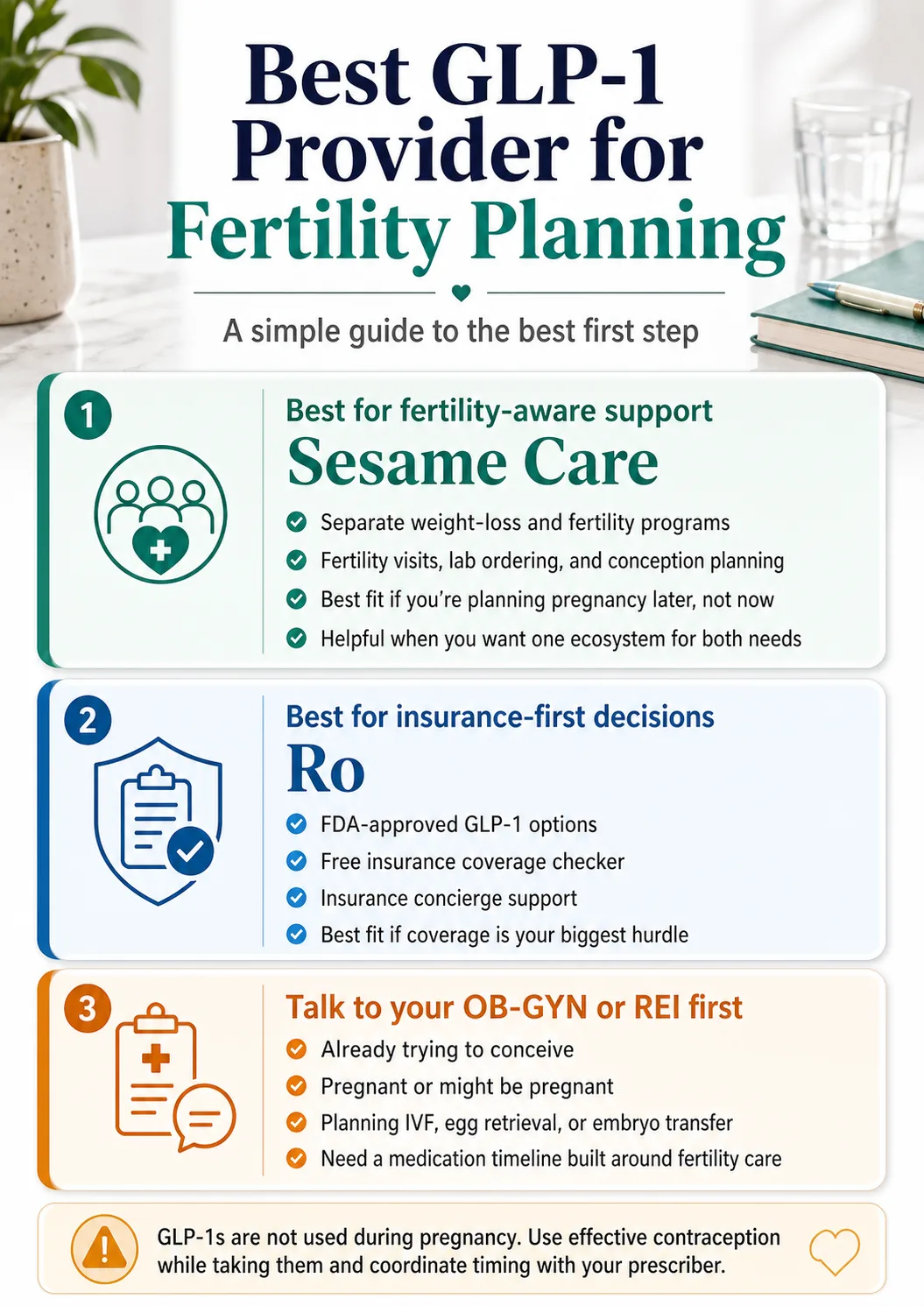
The honest answer to what's the best GLP-1 provider for fertility planning is one most articles won't give you straight: the right pick depends on how close you are to trying to conceive, what your insurance looks like, and whether PCOS is in the picture. Pick the wrong provider and you can compress your fertility timeline at exactly the wrong moment.
Here's the bottom line.
If you have at least 6 months of runway before TTC and you want weight-loss care plus fertility-aware planning in the same ecosystem, Sesame Care is the strongest fit. They run both an online weight-loss program and a separate fertility program with providers trained in diagnostic protocol for reproductive medicine, fertility lab and test ordering, conception planning, and IVI RMA coordination through their Costco partnership. Sesame's weight-loss program starts as low as $59/month with annual prepay; the fertility program is $99/month for Costco members or $119/month without.
If your real obstacle is insurance — whether your plan covers Zepbound or Foundayo and whether someone will actually fight a prior authorization for you — Ro is the smarter first move. Get started for $39 the first month, then as low as $74/month with annual plan paid upfront, with a free GLP-1 Insurance Coverage Checker and a dedicated insurance concierge built in. (Note that Ro's coverage assistance is for commercial insurance; Ro does not coordinate coverage for government plans.)
If you're already actively TTC, pregnant, or inside your fertility clinic's pre-transfer window, do not start with a provider link. Call your OB-GYN or reproductive endocrinologist (REI — a fertility specialist who manages things like IVF and IUI) first. We'll show you exactly what to ask.
Everything below — the verified pricing, the timeline math, the questions to bring to your fertility team — exists because no one else built it.
What we actually verified for the BLUF (above the fold)expand
- Sesame Care weight-loss program — pricing and program details verified at sesamecare.com on April 29, 2026
- Sesame Care fertility program — $119/month standard, $99/month Costco; verified at sesamecare.com fertility page on April 29, 2026
- Ro Body program — $39 / $149 / $74 annual pricing and free Insurance Coverage Checker verified at ro.co/weight-loss/pricing on April 29, 2026
- Semaglutide 2-month pre-pregnancy stop guidance — verified against MotherToBaby semaglutide fact sheet and Wegovy/Ozempic prescribing information
What is the best GLP-1 provider for fertility planning?
The short answer
Match yourself to the right next step
| Your situation | Best first step |
|---|---|
| TTC in 6–18 months, want fertility-aware weight-loss support | Sesame Care |
| TTC in 6–18 months, insurance might cover branded GLP-1 | Ro (use the free coverage checker first) |
| PCOS, planning pregnancy 12+ months out | Sesame Care for fertility-integrated care, or our Best GLP-1 for PCOS guide for the broader PCOS comparison |
| Already actively TTC | Stop here. Call your OB-GYN or REI before any GLP-1 decision |
| Planning IVF, IUI, egg freezing, or embryo transfer | Follow your clinic's protocol first. Then check Sesame Care if you have time before retrieval/transfer |
| Pregnant or possibly pregnant | Stop the GLP-1 immediately and contact your prescriber and OB-GYN |
| Don't know your timeline yet | Take our 60-second matching quiz for a personalized path |
Your timeline-risk score (use this before anything else)
| Time until TTC | What this means for you |
|---|---|
| 0–2 months | Too tight for a new GLP-1 start. Talk to your OB-GYN or REI first; weight loss won't accumulate inside the washout window. |
| 3–6 months | Timing-sensitive. Possible only with a structured discontinuation plan. Sesame is built for this; pure low-cost compounded shops aren't. |
| 6–18 months | Sweet spot. The provider comparison below applies cleanly to you. |
| 18+ months | Cost optimization matters more. A reputable compounded provider for the early phase, then a planned switch to Sesame or Ro 4–6 months before your washout, is a defensible path. |
Find your match based on your actual timeline
Take the GLP-1 fertility planning quiz →First, are you actually in a position to start a GLP-1?
The short answer
Most fertility-planning articles skip this step and rush you to a checkout page. That's how readers compress their fertility timelines and end up regretting it.
A GLP-1 medication takes weeks to clear from your body, and you'll need to stop it well before TTC. If you start a GLP-1 too close to your target conception date, you've eaten your runway before you've lost any meaningful weight. A 5% or greater weight loss can restore regular ovulation in some women with weight-driven cycle disruption per Cleveland Clinic guidance — and getting there usually takes 3–6 months of consistent treatment.
So before any provider decision, run this filter:
✅ You're a good candidate if ALL of these are true:
- • You're at least 6 months away from TTC, ideally 9–12+
- • You're using effective contraception during the GLP-1 phase (and you understand the tirzepatide–oral-contraceptive interaction we explain below)
- • You have a prescribing clinician who will support a structured discontinuation 4–9 weeks before TTC depending on your medication
- • You have an OB-GYN or REI who knows you're considering this and is on board with the timeline
- • You don't have any contraindications (history of medullary thyroid carcinoma, MEN 2 syndrome, current pregnancy, or severe gastroparesis, among others)
🚫 You should NOT start right now if ANY of these are true:
- • You're already trying to conceive
- • You're pregnant or could be pregnant
- • You're inside your fertility clinic's pre-retrieval or pre-transfer window
- • Your fertility team hasn't been told you're considering this
- • You're not using reliable contraception while on the medication
The math on that last point is real. Weight loss and metabolic improvement from GLP-1 therapy can restore ovulation in some people whose cycle disruption is weight-, PCOS-, or insulin-resistance-related — which is what the "Ozempic babies" headlines describe. If you've been told you can't get pregnant and you've been off contraception for years, your body may have updated the diagnosis without telling you.
If any disqualifier above applies to you, the right next step isn't a provider page. Use our quiz to generate a printable summary you can hand to your OB-GYN.
Build your OB-GYN / REI question list before you choose a provider
Build my OB-GYN / REI question list →Routes to the quiz with a printable output
Which GLP-1 providers actually fit fertility planning?
The short answer
This is the comparison no fertility clinic blog and no single-provider page will give you. We scored eight telehealth providers against the seven dimensions that actually matter when fertility timing is on the line — not generic "best GLP-1" criteria. Each provider was verified against its public-facing site as of April 29, 2026; pricing and formulary details were captured directly from each provider's pricing page.
The seven dimensions and why we picked them
- Fertility-specific support (25%). Does the provider handle conception planning, fertility labs, REI coordination, or pregnancy screening — or is it a pure weight-loss vendor?
- FDA-approved access and regulatory clarity (20%). For fertility planning, FDA-approved branded GLP-1s carry clearer pregnancy labels and more verifiable safety data than compounded versions.
- Clinician access and labs (15%). Live provider messaging, lab ordering, and dose-escalation support matter more when timing is sensitive.
- Pricing transparency (15%). The fertility-planning reader needs total cost clarity, not teaser pricing.
- Insurance and prior-auth handling (15%). PCOS, BMI, and diabetes coding can support coverage when clinically appropriate; most telehealth providers won't help.
- Timeline fit (5%). How well does the provider's program structure match an exit-planned arc?
- Trust signals (5%). FDA actions, pharmacy disclosure, and marketing-claim accuracy all count more on a YMYL fertility page.
The Fertility Planning Provider Fit Scorecard
| Provider | Fertility Support | FDA Access | Clinician + Labs | Price Transparency | Insurance Help | Timeline Fit | Trust | Score |
|---|---|---|---|---|---|---|---|---|
| Sesame Care | ✅ Separate fertility program (diagnostic protocol for reproductive medicine, fertility labs, conception planning, IVI RMA via Costco partnership) | ✅ FDA-approved Wegovy pill, Wegovy pen, Zepbound KwikPen | ✅ Video visits, messaging, lab ordering | ✅ Clear ($59–$119/mo program tiers; meds separate) | ⚠️ Provider-dependent | ✅ Strong | ✅ Clean | 9.1 / 10 |
| Ro | ⚠️ Not fertility-specific, but supports clean discontinuation | ✅ Wegovy pill, Foundayo, Zepbound KwikPen, plus insurance-eligible Zepbound pen, Wegovy pen, Ozempic | ✅ Body program with clinician check-ins | ✅ Transparent ($39 / $149 / $74 annual) | ✅ Free Coverage Checker + insurance concierge (commercial plans only) | ✅ Strong | ✅ Clean | 8.4 / 10 |
| Hers | ❌ None | ✅ FDA-approved Wegovy pill, Wegovy pen, Ozempic via Novo Nordisk partnership | ⚠️ Standard telehealth flow | ✅ Transparent | ❌ Limited | ⚠️ OK | ✅ Clean | 6.7 / 10 |
| Eden | ❌ None | ✅ FDA-approved Ozempic, Wegovy, Zepbound, Mounjaro listed; also offers compounded options | ⚠️ Async-leaning | ✅ No membership fees, FSA/HSA eligible; dose-level prices listed | ❌ Cash-pay focus | ⚠️ OK | ✅ Clean | 6.8 / 10 |
| Enhance.MD | ❌ None | ❌ Compounded-led | ✅ Includes labs (real value for PCOS) | ✅ Public dose pricing ($212–$322/mo on standard plans) | ❌ None | ⚠️ OK with switch | ⚠️ Compounded scrutiny applies | 6.4 / 10 |
| Yucca Health | ❌ None | ❌ Compounded-led | ⚠️ Async value model | ✅ Starting price disclosed ($146/mo on 6-month semaglutide plan); BNPL available | ❌ None | ⚠️ Better for longer runway | ✅ Clean | 6.2 / 10 |
| MEDVi | ❌ None | ⚠️ Cash-pay compounded GLP-1 prescribing publicly described | ⚠️ Standard | ⚠️ Variable | ❌ None | ⚠️ OK | ❌ FDA warning letter (Feb 20, 2026) for false/misleading compounded GLP-1 marketing claims | 5.9 / 10 |
| Trim Rx | ❌ None | ❌ Compounded-led | ⚠️ Standard | ⚠️ Variable | ❌ None | ❌ Cancellation/billing complaints documented at BBB | ⚠️ Mixed reviews | 5.4 / 10 |
The editorial conclusion: for a fertility-planning page specifically, the provider that wins a generic "best GLP-1" comparison doesn't necessarily win this one. Cheap compounded GLP-1 access is a feature for a long-runway weight-loss reader. It's a liability for a fertility-planning reader who needs FDA-approved labels, insurance pathways, and clinical coordination she can hand to her REI without flinching.
Two providers worth knowing about that didn't make our scorecard but operate in this niche: Allara Health runs a women's hormonal-health platform that covers PCOS, includes registered dietitian support, and may prescribe FDA-approved GLP-1s like Wegovy or Zepbound when appropriate. Fyrtle is a fertility-first telehealth service explicitly built around cycle-aware GLP-1 planning. Both are smaller, more specialized, and worth a look if Sesame and Ro aren't a fit.
Start with the highest-fit option
See Sesame's fertility and weight-loss availability →Why does Sesame Care win for most fertility-planning readers?
The short answer
What Sesame actually offers
The platform runs two distinct programs:
The online weight-loss program
The GLP-1 entry point. Includes provider care, video visits, messaging support, labs, and FDA-approved GLP-1 medication options including Wegovy pill, Wegovy pen, and Zepbound KwikPen. Pricing starts as low as $59/month with annual prepay; medication is billed separately.
The fertility program ← the differentiator
Matched with a fertility provider trained in diagnostic protocol for reproductive medicine. Includes fertility history review, lab and test ordering, medication management when appropriate, conception planning, follow-up messaging, and IVI RMA coordination through their Costco partnership. $99/month for Costco members or $119/month for non-members. Medication, fertility labs, imaging, IVF, IUI, and genetic testing are billed separately.
Verification gap: Direct integration between the weight-loss prescriber and fertility provider isn't documented on the public page — confirm with Sesame support whether you can use both concurrently and whether the two providers communicate with each other before you commit. This is a small but real gap, and we'd rather flag it than gloss over it.
Who Sesame is best for
- ✓You're 6+ months from TTC and want fertility-aware weight-loss support
- ✓You suspect PCOS, insulin resistance, or undiagnosed metabolic factors
- ✓You want lab work but don't yet have a fertility specialist
- ✓You want one ecosystem instead of three uncoordinated providers
- ✓You like Costco's price discipline (their members get the lower fertility program rate)
Who Sesame is NOT best for
If insurance coverage of brand-name Zepbound or Foundayo is your single biggest hurdle and you don't need fertility-specific support, Ro is a better first stop because Ro's insurance concierge will actively work the prior authorization for you. Sesame is excellent but not built around insurance navigation in the same structured way.
The damaging admission
Sesame Care is not the cheapest path to GLP-1 medication. A self-pay compounded provider can run noticeably less per month for the early phase of weight loss, and Sesame's fertility program adds a separate $99–$119/month layer on top of medication, labs, imaging, and any fertility procedures. If you're optimizing purely for the lowest sticker price and you're 12+ months from TTC, a compounded provider followed by a planned switch to Sesame or Ro 4–6 months before your washout window will save you money.
But if you're optimizing for fertility outcomes — and the data is clear that BMI, insulin sensitivity, and metabolic preparation meaningfully affect both natural and IVF pregnancy rates — you don't want to be re-shopping providers in the most timing-sensitive 6 months of your fertility plan. Sesame's premium isn't a fee for nothing. It's the price of having one care team across both arcs.
When is Ro the better GLP-1 provider for fertility planning?
The short answer
We want to be clear about this up front: Ro is not a fertility program. What Ro is, is the most well-built telehealth weight-loss program in the country for insurance-sensitive readers — and for a fertility-planning reader whose biggest blocker is "will my plan cover this?", that's exactly what you want.
What Ro actually offers
Ro's Body program is a structured GLP-1 program with clinician check-ins and a public formulary that currently includes Wegovy pill, Foundayo, Zepbound KwikPen, and insurance-eligible options for Zepbound pen, Wegovy pen, and Ozempic. The differentiator is Ro's free GLP-1 Insurance Coverage Checker plus an insurance concierge that handles prior-authorization paperwork on your behalf for commercial insurance plans. Ro does not coordinate coverage for government insurance (Medicare, Medicaid, Tricare); medication is billed separately from membership.
Ro's pricing as of April 29, 2026 — verified at ro.co/weight-loss/pricing
Get started for $39 the first month, then as low as $74/month with annual plan paid upfront
(or $149/month on the standard monthly plan). Medication is separate.
The reason this matters for fertility planning is that obesity (BMI ≥30, or BMI ≥27 with at least one weight-related condition) is the FDA-approved weight-management indication for Wegovy and Zepbound, and PCOS often supports the clinical context as a comorbidity. Coverage is plan-specific — Ro's concierge works the verification and prior auth for you, but actual copays vary widely. Some commercial plans run as low as $25/month for covered medication; others land much higher.
Who Ro is best for
- ✓Your commercial insurance might cover Zepbound, Foundayo, or another branded GLP-1
- ✓You don't yet have a clear fertility plan and don't need fertility-specific support inside the same telehealth program
- ✓You already have an OB-GYN or REI who'll handle your fertility timing
- ✓You want a structured FDA-approved-only path with no compounded ambiguity
- ✓You want to know coverage before you commit (the free checker takes 2 minutes)
Who Ro is NOT best for
If you want fertility-specific lab work, conception planning, or IVI RMA coordination inside the same provider, Sesame Care is built for that and Ro is not. Ro is the right call when insurance is the deciding factor; Sesame is the right call when fertility integration is.
How long before pregnancy should you stop a GLP-1?
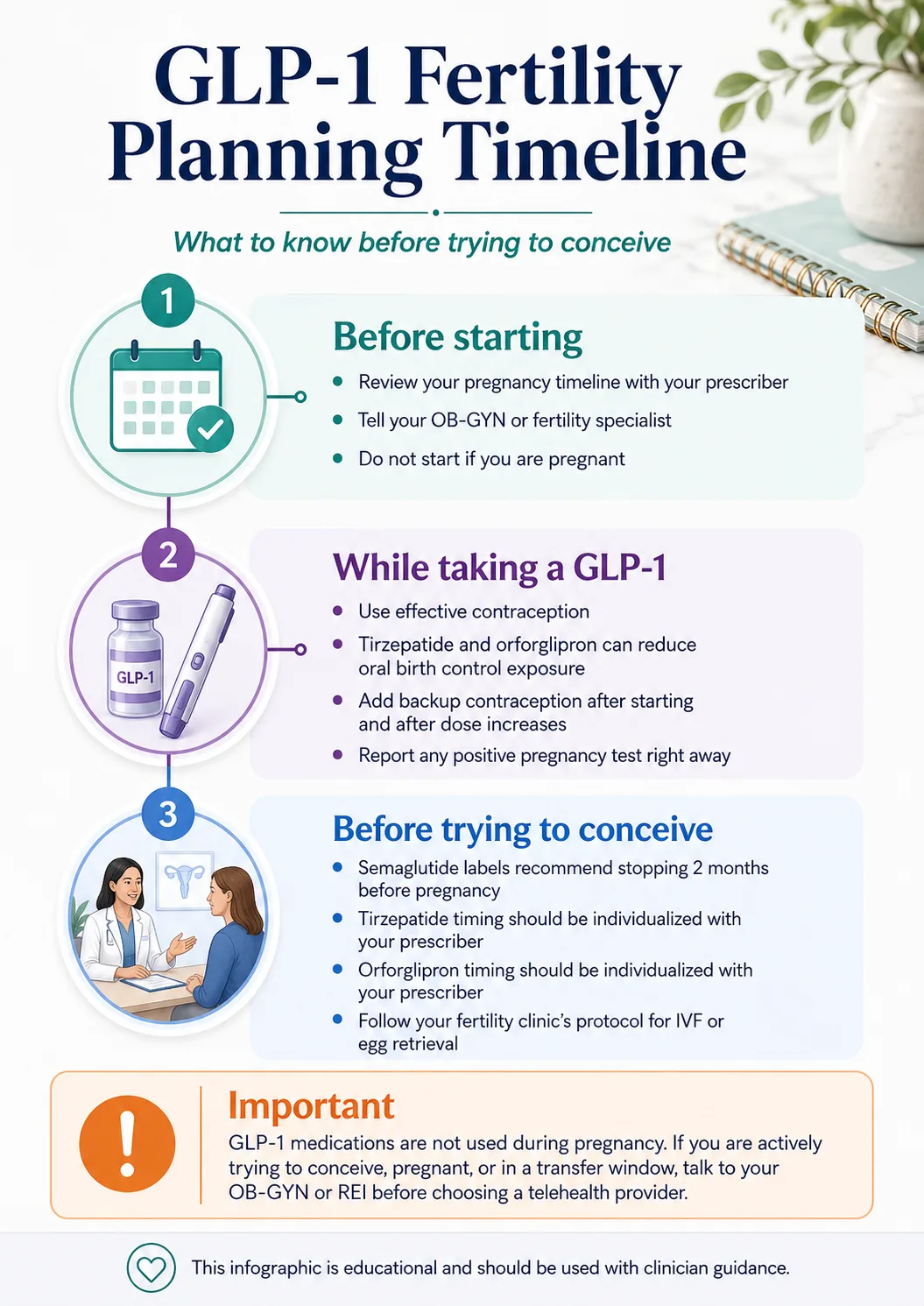
The short answer
The variation comes down to half-life — the time it takes your body to clear half a dose — and whether the FDA label explicitly addresses planned pregnancy.
Drug-by-drug timing breakdown
| Medication | Brand names | Half-life | FDA label guidance for planned pregnancy | Common clinical practice |
|---|---|---|---|---|
| Semaglutide | Wegovy, Ozempic, Rybelsus | ~7 days | Stop at least 2 months before planned pregnancy | 2 months (label-aligned) |
| Tirzepatide | Zepbound, Mounjaro | ~5 days | Discontinue when pregnancy is recognized; no specified planned-pregnancy washout in U.S. label | 4–8 week clinical buffer, REI-dependent |
| Orforglipron | Foundayo | 29–49 hours (oral) | Contraception during treatment; non-oral or barrier method for 30 days after initiation and dose escalation; discontinue when pregnancy recognized — no specified planned-pregnancy washout | Coordinate with prescriber |
| Liraglutide | Saxenda, Victoza | ~13 hours | Discontinue when pregnancy recognized | ~1 month buffer commonly used |
Sources: FDA prescribing information (DailyMed) for each medication; MotherToBaby semaglutide and tirzepatide fact sheets.
Why semaglutide and tirzepatide guidance differ
Semaglutide's product label explicitly addresses planned pregnancy with the 2-month stop window. Tirzepatide's U.S. label does not — it covers contraception during treatment and discontinuation upon pregnancy recognition, but doesn't give a semaglutide-style preconception buffer. The 4–8 week tirzepatide windows you'll see cited in fertility-clinic guidance are clinical safety buffers based on the drug's half-life and metabolic rebound concerns, not direct label instructions.
This is the kind of distinction most affiliate pages flatten. We won't.
What this means for your timing math
If you're on semaglutide and want to TTC in May, your last injection should be in early March at the latest — that's the label-aligned 2-month window. If you're on tirzepatide and want to TTC in May, your prescriber and REI will determine your stop date based on your dose history and clinic protocol, typically 4–8 weeks out. If you're on Foundayo, coordinate directly with your prescriber.
Special timing for IVF, IUI, and egg freezing
Fertility clinic protocols vary widely. Some specialists recommend a 2–3 month washout before IVF or conception per Fertility Centers of New England guidance; others cite shorter pre-retrieval anesthesia windows because GLP-1s slow gastric emptying and can raise aspiration risk under sedation. Your REI's protocol controls. Don't rely on a general guidance article — bring your medication name, dose, and last injection date to your fertility team well before any retrieval cycle.
Cleveland Clinic OB/GYN Deidre McIntosh, MD, in published patient guidance on GLP-1s and pregnancy, recommended a deliberate washout period before TTC because long-term outcomes for people who become pregnant while on these medications are still being studied.
The tirzepatide–birth control interaction most pages miss
The short answer
⚠ Important safety note
If you're considering Zepbound or Mounjaro and you're using oral contraceptives during your weight-loss phase, this is the single most important paragraph on this page.
The Reproductive Health Access Project, citing manufacturer pharmacokinetic data, reports that a single 5 mg tirzepatide dose reduced overall oral contraceptive exposure by approximately 20%. The Zepbound prescribing information formally instructs patients on oral contraceptives to either switch to a non-oral method (IUD, implant, injection, patch, or vaginal ring) or add a barrier method like condoms for 4 weeks after starting tirzepatide and for 4 weeks after each dose increase.
This interaction is mechanical, not metabolic — tirzepatide slows gastric emptying, which reduces absorption of pills you swallow. It does not affect non-oral hormonal contraception or non-hormonal methods.
This interaction does NOT apply to semaglutide (Wegovy, Ozempic, Rybelsus). Pharmacokinetic studies have not shown clinically meaningful reductions in oral contraceptive exposure with semaglutide. Liraglutide (Saxenda) and dulaglutide (Trulicity) similarly do not appear to affect oral contraceptive bioavailability.
Foundayo (orforglipron) has its own related guidance. Per the Foundayo prescribing information, patients should use effective contraception during treatment, switch to non-oral contraception or add a barrier method for 30 days after initiation and after each dose escalation, and discontinue when pregnancy is recognized.
The practical takeaway: if you're on tirzepatide or Foundayo and oral contraceptives during a fertility-planning phase, either switch your contraception method before your first dose or add a barrier method during the high-risk windows. If your plan is unintended-pregnancy avoidance during weight loss followed by a deliberate TTC window, getting the contraception choice right is the difference between a planned conception and an "Ozempic baby" that derails your timing.
Build your contraception + GLP-1 timing checklist
Build my contraception + GLP-1 timing checklist (60 seconds) →What's real and what's hype about GLP-1s, PCOS, and fertility
The short answer
What the evidence shows
GLP-1 receptor agonists can support fertility outcomes in women with PCOS — but indirectly, by treating the metabolic root cause, not by acting as fertility drugs.
PCOS affects an estimated 6–13% of reproductive-age women globally and is the most common cause of ovulatory infertility. The condition is driven by a combination of insulin resistance, elevated androgens (like testosterone), and disrupted ovulation. GLP-1s address several of these simultaneously: they improve insulin sensitivity, support meaningful weight loss, and can lower circulating androgens.
A 2023 meta-analysis of randomized controlled trials in women with PCOS found that GLP-1 receptor agonist use led to improvements in menstrual cyclicity and natural pregnancy rates compared to control interventions. The 2023 International Evidence-based Guideline for PCOS, endorsed by ASRM, states that anti-obesity medications including GLP-1s may be considered for weight management in adults with PCOS — alongside lifestyle interventions, with effective contraception in place when pregnancy is possible because pregnancy safety data are lacking.
What the evidence does NOT show
GLP-1s are not approved for PCOS or fertility treatment. They are approved only for type 2 diabetes (Ozempic, Mounjaro, Rybelsus) and chronic weight management (Wegovy, Zepbound, Foundayo, Saxenda). The fertility benefit is downstream of metabolic benefit, and the strongest evidence is in women with BMI ≥30 and biomarkers of insulin resistance. For women without PCOS, without obesity, or without insulin resistance, the fertility benefit is much less clear.
GLP-1s are also not a substitute for fertility medications. If your reproductive endocrinologist's plan is letrozole for ovulation induction or IVF, GLP-1s don't replace that plan — they can create a healthier metabolic environment for it. The order of operations is: optimize metabolic health on a GLP-1, complete the washout, then start fertility treatment.
The "Ozempic babies" phenomenon — what it means for your contraception plan
"Ozempic babies" are real. The explanation is straightforward: weight loss and metabolic improvement from GLP-1 therapy can restore ovulation in some people whose anovulation was weight-, PCOS-, or insulin-resistance-driven. If you've been told you can't get pregnant for years and you've now lost meaningful weight on a GLP-1, your body may have updated the diagnosis without telling you.
⚠ Important safety note
If you're on a GLP-1 and you're not actively trying to get pregnant, use effective contraception. This is especially urgent if you're on tirzepatide AND oral contraceptives — see the section above.
PCOS provider-fit mini comparison
| Provider | Best for PCOS readers because… |
|---|---|
| Sesame Care | Fertility + weight-loss programs in one ecosystem; lab orders for PCOS-relevant markers |
| Allara Health | Women's hormonal-health specialists, registered dietitians, GLP-1s like Wegovy or Zepbound when appropriate |
| Ro | Insurance / FDA-approved medication path when PCOS supports clinical context for coverage |
| Fyrtle | Fertility-first GLP-1 support if your timeline is tight |
For our deeper PCOS-specific provider comparison without the fertility-planning lens, see our Best GLP-1 for PCOS guide. For the medical washout details across all GLP-1s, see our GLP-1 Pregnancy & Birth Control guide.
If you're heading into IVF, IUI, egg freezing, or embryo transfer
The short answer
Before egg retrieval (IVF or egg freezing)
Egg retrieval involves sedation. GLP-1s slow gastric emptying, which increases the risk of aspiration during anesthesia. Fertility clinic protocols vary on the specific stop window. Bring your medication name, dose, last injection date, and any planned dose escalations to your clinic well before your retrieval cycle and follow their specific protocol.
Before embryo transfer
This is the most pregnancy-adjacent decision point. If you're doing a fresh transfer cycle, you want to be fully washed out before transfer because pregnancy could establish within days. If you're doing a frozen transfer, you have more flexibility on timing, but the same washout-before-conception principle applies. Coordinate dates with your REI before you start a GLP-1.
Before IUI or natural TTC
Treat IUI and natural TTC the same way: complete the standard pre-conception washout (label-aligned 2 months for semaglutide; clinical-buffer 4–8 weeks for tirzepatide; prescriber-coordinated for Foundayo) before any insemination cycle. Don't try to compress the timeline.
Before stimulation cycles
GLP-1s do not directly interact with stimulation medications like gonadotropins, but stopping a GLP-1 abruptly can affect appetite, weight, and insulin sensitivity in ways your fertility team should plan for. Fertility Centers of New England published guidance recommends coordinated planning between your fertility team and prescribing physician — which is the whole reason a coordinated provider model fits this use case better than uncoordinated providers.
What to bring to your fertility doctor
Print this and bring it to your next visit:
- Medication name and dose
- Last injection date
- Any planned dose escalations
- Planned retrieval, transfer, IUI, or natural TTC date
- Current contraception method
- Prescribing provider contact info
- Pharmacy or source details if compounded
- Your target conception date
Generate your fertility-clinic question checklist
Build my fertility-clinic checklist (60 seconds) →FDA-approved or compounded GLP-1: which is right for fertility planning?
The short answer
We're not anti-compounded. There are legitimate reasons people use compounded medications, and we cover them honestly elsewhere. But the fertility-planning context shifts the math.
Reason 1: FDA-approved labels carry pregnancy-specific guidance
The Wegovy, Zepbound, Mounjaro, Ozempic, and Foundayo labels all include explicit pregnancy warnings, contraception guidance, and (for semaglutide) discontinuation timing. Compounded preparations often lack this label-level specificity, leaving you and your prescriber to extrapolate from the FDA-approved version.
Reason 2: FDA's own statement matters when timing is tight
The FDA has issued multiple consumer-facing communications about compounded GLP-1 medications, including the November 2025 update "FDA's Concerns with Unapproved GLP-1 Drugs Used for Weight Loss." The FDA's verified language: compounded GLP-1 products are not FDA-approved, and FDA cannot verify their quality, safety, or efficacy.
Reason 3: We won't repeat marketing claims the FDA has called out
The FDA has explicitly warned against compounded GLP-1 marketing that claims products are "the same" as FDA-approved drugs, "generic" versions, contain "the same active ingredient," or are "clinically proven." Any provider making those claims is on shaky ground, and we won't repeat them.
Where compounded providers fit on this page
If you're 12+ months from TTC and cost is the deciding factor, a reputable compounded provider can save you money during the early weight-loss phase. The honest path is: use a compounded provider for the early phase, then switch to Ro or Sesame Care 4–6 months before your washout window so you've got an FDA-approved medication, a structured discontinuation plan, and a clinical relationship with someone who knows your fertility timeline.
For the broader compounded comparison without the fertility lens, see our Best Compounded GLP-1 Provider guide.
A note on MEDVi specifically
MEDVi is a legitimate provider in the broader compounded space, and we cover them in other guides. For a fertility-planning page specifically, we don't lead with them because the FDA issued a warning letter on February 20, 2026 stating that MEDVi's website displayed false or misleading claims about compounded semaglutide and tirzepatide, including "same active ingredient" language. The warning letter is about marketing claims, not medication safety per se — but on a fertility-sensitive YMYL page, we hold providers to a higher verification bar. If you've used MEDVi before and like them, that's your call. Bring the medication source disclosures to your OB-GYN and let them advise.
Red flags in a GLP-1 provider when fertility is on the line
The short answer
Use this checklist to screen any GLP-1 provider — affiliate or not — before you commit.
✅ A credible provider will:
- • Ask if you're pregnant or could be pregnant during intake
- • Ask about your TTC timeline
- • Ask about your contraception method
- • Ask if you have PCOS, diabetes, thyroid disease, or other endocrine conditions
- • Disclose the pharmacy or source of the medication (especially for compounded)
- • Provide clinician messaging access between visits
- • Have a documented cancellation and refund policy
- • Match the public pricing on their website at checkout
- • Use FDA-compliant language (not "same as," not "generic," not "same active ingredient," not "clinically proven" for compounded)
🚫 A red-flag provider will:
- • Skip pregnancy and TTC questions entirely during intake
- • Refuse to disclose the pharmacy or source
- • Make "same active ingredient as Wegovy" or "clinically proven" claims for a compounded product
- • Have no clinician access after the first prescription
- • Use pressure-based urgency ("only 12 spots left this month")
- • Have unclear or hostile cancellation terms
- • Show one price publicly and a different price at checkout
- • Have multiple recent FDA warning letters tied to GLP-1 marketing
If a provider fails three or more credible-provider checks, walk away. If they hit two or more red flags, walk away faster. The cost of a wrong provider during fertility planning isn't $200; it's compressed timing, and you can't get those weeks back.
How much does fertility-planning GLP-1 care actually cost?
The short answer
Sesame Care GLP-1 medication prices (cash-pay, April 29, 2026)
| Medication | Dose | Price |
|---|---|---|
| Wegovy pill | 1.5 mg or 4 mg | $149/month |
| Wegovy pill | 9 mg or 25 mg | $299/month |
| Wegovy pen | All doses | $199/month first 2 months, then $349/month |
| Zepbound KwikPen | 2.5 mg | $299/month |
| Zepbound KwikPen | 5 mg | $398/month |
| Zepbound KwikPen | 7.5 mg | $499/month |
| Zepbound KwikPen | 10, 12.5, or 15 mg | $698/month |
Sesame also accepts insurance for weight-loss medications; covered medication can run as low as $25/month on some commercial plans (varies widely by plan).
Ro Zepbound KwikPen pricing (cash-pay with manufacturer offer, April 29, 2026)
| Dose | Price |
|---|---|
| 2.5 mg | $299/month |
| 5 mg | $399/month |
| 7.5, 10, 12.5, or 15 mg | $449/month |
Missed refill timing can raise some refill prices to $499–$699/month. Insurance pricing is plan-specific.
LillyDirect Foundayo (orforglipron) cash-pay pricing
| Dose | Price |
|---|---|
| 0.8 mg | $149/month |
| 2.5 mg | $199/month |
| 5.5 mg or 9 mg | $299/month |
| 14.5 mg or 17.2 mg | $299/month with 45-day refill; $349/month otherwise |
Eden & compounded provider cash-pay pricing
| Provider | Medication | Price |
|---|---|---|
| Eden | Compounded semaglutide | $129 first month |
| Eden | Compounded tirzepatide | $249 first month |
| Enhance.MD | GLP-1 Core (semaglutide) | $49 first month → $212/month all doses |
| Enhance.MD | GLP-1 Advanced (tirzepatide) | $99 first month → $280/month |
| Yucca Health | GLP-1 injection (6-month semaglutide plan) | Starting at $146/month |
The other three cost buckets
Provider membership (recurring telehealth subscription)
- • Sesame Care weight-loss program: as low as $59/month with annual prepay
- • Sesame Care fertility program: $99/month for Costco members, $119/month otherwise
- • Ro Body program: $39 first month, then $149/month standard or $74/month with annual prepay
Fertility labs, imaging, and testing
- • Fertility hormone panel (AMH, FSH, LH, estradiol, TSH, prolactin): commonly $150–$400 cash-pay; often partially insurance-covered
- • PCOS-specific labs (fasting insulin, HOMA-IR, free testosterone, SHBG): commonly $100–$300 cash-pay
- • HSG or saline sonogram: typically $300–$1,500 depending on facility and insurance
- • Antral follicle count ultrasound: typically $200–$500
Fertility procedures (the big numbers)
- • IUI cycle: typically $500–$4,000 per cycle
- • IVF cycle: typically $15,000–$25,000 per cycle in the US, plus $5,000–$8,000 in stimulation medications
- • Egg freezing cycle: typically $10,000–$20,000 plus annual storage fees
The honest summary: a 12-month fertility-planning arc using Sesame's combined programs runs roughly $2,500–$4,500 in provider membership and labs before medication or procedures. With branded medication self-pay at Sesame's listed prices, add another $1,800–$8,400 over 12 months depending on dose and pen/pill choice. With insurance-covered medication via Ro, the medication line drops dramatically.
Is Sesame, Ro, or another GLP-1 provider available in your state?
The short answer
If your state isn't supported by your top provider choice, the fallback is your local OB-GYN or REI for prescription, paired with manufacturer programs (LillyDirect, NovoCare) or local pharmacies for medication.
What do the data and doctors actually say about GLP-1s before pregnancy?
The short answer
We're not doctors, and we don't pretend to be. Here's what credentialed clinicians and peer-reviewed sources have published, with attribution.
On preconception GLP-1 use
OB-GYN and weight-loss specialist Dr. Johanna G. Finkle of the University of Kansas Health System has published on the role of GLP-1 receptor agonists in people with infertility and pregnancy in a 2025 Obstetrics & Gynecology article (Finkle and Brost), and has been quoted in clinical reporting describing her use of GLP-1s for preconception weight loss in patients who want to reduce risk of gestational diabetes, hypertension, and preeclampsia.
On washout timing
Cleveland Clinic OB/GYN Deidre McIntosh, MD, in published patient guidance on GLP-1s and pregnancy, recommended a washout period between GLP-1 use and pregnancy because long-term outcomes for people who become pregnant while on these medications are still being studied.
On PCOS-specific evidence
A 2023 meta-analysis of randomized controlled trials in women with PCOS found that GLP-1 receptor agonists improved menstrual cyclicity and natural pregnancy rates compared to control interventions. The 2023 International Evidence-based Guideline for PCOS, endorsed by ASRM, lists anti-obesity medications including GLP-1s as a "may be considered" option for weight management in adults with PCOS, alongside lifestyle and effective contraception when pregnancy is possible.
On compounded medication risk
The FDA has issued multiple consumer-facing communications about unapproved GLP-1 drugs, including the November 2025 update "FDA's Concerns with Unapproved GLP-1 Drugs Used for Weight Loss," which warned about dosing errors, adverse-event reports, and misleading marketing claims. The agency's verified language: compounded GLP-1 products are not FDA-approved, and FDA cannot verify quality, safety, or efficacy.
On the tirzepatide–oral contraceptive interaction
The Reproductive Health Access Project, citing manufacturer pharmacokinetic data, reports a single 5 mg tirzepatide dose reduced overall oral contraceptive exposure by approximately 20%. The Zepbound prescribing information instructs patients on oral contraceptives to switch to a non-oral method or add a barrier method for 4 weeks after starting and after each dose increase.
On limited pregnancy exposure data
Limited early human exposure data — including a published case report and a study of 168 pregnant women with GLP-1 exposure summarized in MotherToBaby's semaglutide fact sheet — has not identified a clear birth-defect signal, but evidence remains limited. Contact your prescriber and OB-GYN immediately after a positive test if exposure occurred.
How we built this page
The short answer
Our scoring weights
| Category | Weight |
|---|---|
| Fertility-specific support or handoff | 25% |
| FDA-approved access and regulatory clarity | 20% |
| Clinician access, labs, and follow-up | 15% |
| Pricing transparency | 15% |
| Insurance and prior-authorization help | 15% |
| Timeline fit and disqualification handling | 5% |
| Trust signals (FDA actions, pharmacy disclosure, marketing language) | 5% |
What we explicitly did NOT do
- We did not invent a medical reviewer or display "Medically Reviewed By" text. We are the Weight Loss Provider Guide editorial team — an independent comparison resource for GLP-1 telehealth providers — and we say so.
- We did not use review or rating schema (we don't display star ratings).
- We did not claim any compounded medication is the "same as," "clinically proven," contains the "same active ingredient," or is "generic" relative to an FDA-approved version.
- We did not promise typical fertility results from any provider or any medication.
Refresh cadence
Pricing, provider availability, and FDA regulatory status change. We re-verify every commercial fact on this page monthly, and every medical or regulatory citation quarterly. The "Last verified" date at the top of this page reflects the most recent full re-verification cycle.
Frequently asked questions
Which GLP-1 is safest for women planning pregnancy?
The safer, more verifiable pick for fertility planning is an FDA-approved branded GLP-1 (Wegovy, Zepbound, Ozempic, Mounjaro, Foundayo, Saxenda) prescribed through a provider with structured medical oversight and a clear discontinuation path. Compounded versions are not the wrong choice for everyone, but they are not the right lead choice for someone planning pregnancy in the next 6–18 months because the FDA cannot verify their quality, safety, or efficacy and the labels lack the specific pregnancy guidance found on FDA-approved products.
How long before trying to conceive should I stop a GLP-1?
For semaglutide (Wegovy, Ozempic, Rybelsus), the product label recommends stopping at least 2 months before planned pregnancy. For tirzepatide (Zepbound, Mounjaro), the U.S. label says to discontinue when pregnancy is recognized — most fertility clinicians use a 4–8 week clinical buffer before TTC based on the drug's half-life. For Foundayo (orforglipron), the label provides contraception and pregnancy-recognition guidance but no planned-pregnancy washout window — coordinate timing with your prescriber.
Can I take Ozempic or Wegovy if I'm trying to get pregnant?
No. Ozempic, Wegovy, and other GLP-1 medications should be discontinued before trying to conceive. The semaglutide product label explicitly recommends stopping at least 2 months before pregnancy, and they are not approved for use during pregnancy.
Does Wegovy affect fertility?
Wegovy may indirectly improve cycle regularity or ovulation in some people when weight loss and metabolic improvement address obesity- or PCOS-related ovulatory dysfunction. It is not a fertility drug, and it is not known whether semaglutide itself directly affects fertility. It should be stopped before TTC.
Is Mounjaro or Zepbound safe for fertility planning?
Tirzepatide (Mounjaro, Zepbound) can support pre-conception weight loss in candidates whose weight is contributing to fertility challenges, but it should be stopped before TTC. It also has a documented interaction with oral contraceptives — reduced effectiveness for 4 weeks after starting and after each dose increase — so women using oral birth control during the GLP-1 phase should add a barrier method or switch to a non-oral form of contraception.
Can a GLP-1 help me get pregnant if I have PCOS?
In PCOS studies, GLP-1 receptor agonists improved menstrual cyclicity and natural pregnancy rates by addressing insulin resistance and supporting weight loss. They are not FDA-approved for PCOS or fertility treatment, and ASRM frames them as anti-obesity medications that may be considered for higher weight in adults with PCOS — not as fertility drugs. They should be stopped before TTC.
Does Zepbound or Mounjaro affect birth control pills?
Yes. Tirzepatide labeling instructs patients on oral contraceptives to switch to a non-oral method (IUD, implant, injection, patch, or ring) or add a barrier method for 4 weeks after starting and 4 weeks after each dose escalation, because tirzepatide-induced delayed gastric emptying can reduce oral contraceptive absorption.
Does Foundayo affect birth control?
Yes. Foundayo (orforglipron) labeling advises patients on oral contraceptives to use effective contraception during treatment, switch to non-oral contraception or add a barrier method for 30 days after initiation and after each dose escalation, and discontinue when pregnancy is recognized.
Is a GLP-1 a fertility treatment for PCOS?
No. GLP-1s may be considered for weight management in adults with PCOS alongside lifestyle interventions and effective contraception when pregnancy is possible, per the 2023 International Evidence-based Guideline for PCOS. They are not fertility drugs, and they do not replace ovulation induction medications like letrozole or clomiphene, IUI, or IVF.
What is the washout period for GLP-1 medications?
The washout period is the time between your last GLP-1 dose and TTC. For semaglutide, the product label specifies 2 months. For tirzepatide, the U.S. label says to discontinue at pregnancy recognition; most fertility clinicians use a 4–8 week clinical buffer before TTC. For Foundayo, the label has contraception/pregnancy-recognition guidance without a specified planned-pregnancy washout. For liraglutide, ~1 month is commonly used as a clinical buffer.
Will insurance cover my GLP-1 if I'm using it for PCOS-driven fertility issues?
Coverage is plan-specific. FDA-approved weight-loss indications generally center on obesity (BMI ≥30) or overweight (BMI ≥27) with at least one weight-related condition. PCOS may support the clinical context as a comorbidity but is not by itself a guaranteed coverage indication. Ro's free GLP-1 Insurance Coverage Checker is the fastest way to verify your specific commercial plan before committing; Ro does not coordinate coverage for government insurance plans.
Should I use a GLP-1 before IVF?
Possibly, but only with your fertility clinic's explicit timing guidance. Clinic protocols vary — some specialists recommend a 2–3 month washout before IVF or conception, others cite shorter pre-retrieval anesthesia windows. Plan the math backward from your target conception date with your REI's protocol controlling.
What happens if I get pregnant while on a GLP-1?
Stop the medication immediately and contact your prescriber and OB-GYN. Limited early human exposure data has not identified a clear birth-defect signal, but evidence remains limited. Early discontinuation minimizes any unknown risk during critical developmental windows.
Do I need a special doctor for GLP-1 if I'm planning pregnancy?
You don't need a fertility specialist to prescribe a GLP-1, but you do want a telehealth provider with FDA-approved medications, structured medical oversight, and the ability to coordinate with your OB-GYN or REI. Sesame Care's combined weight-loss + fertility programs are positioned for this, with the verification gap that direct cross-program clinician coordination should be confirmed with their support team. Ro's structured Body program plus your existing OB-GYN works well too.
What's the best GLP-1 provider if I have a small fertility planning runway and need to act fast?
If you're inside a 4-month window before TTC and you haven't started yet, you may not have time to lose meaningful weight on a GLP-1 and complete a clean washout. The right move is to talk to your OB-GYN or REI about whether to delay TTC by 6+ months for a planned weight-loss arc, or to skip the GLP-1 entirely and use other preconception strategies. Take our 60-second matching quiz for a personalized timeline before committing to anything.
The bottom line
If you're planning pregnancy in the next 6–18 months and you want one provider that can do both the weight-loss work and fertility-aware planning in the same ecosystem, Sesame Care is the strongest fit — and the only provider we found that genuinely treats fertility planning as a real program. If your real obstacle is insurance coverage of branded GLP-1s like Zepbound or Foundayo, Ro's free coverage checker and insurance concierge are the fastest way to find out what you'd actually pay before you commit.
If you're already actively trying to conceive, pregnant, or inside your fertility clinic's pre-transfer window, the right next step isn't a provider link — it's your OB-GYN or REI. We mean that. The cost of a wrong-timed GLP-1 decision in this window is measured in months of your fertility timeline, and you can't get those weeks back.
Either way, we'd rather help you ask the right questions than rush you into the wrong checkout.