GLP-1 Dehydration Symptoms: What's Normal, What's Not, and When to Get Help
By the Weight Loss Provider Guide editorial team · Last verified: August 6, 2026
Checked against current FDA prescribing information and Medication Guides, guidance from MedlinePlus and the National Kidney Foundation, a peer-reviewed analysis of 29,172 Reddit users who described at least one side effect, and 20 published semaglutide-associated kidney-injury cases. No provider sponsored this guide. This article contains no direct provider affiliate links.
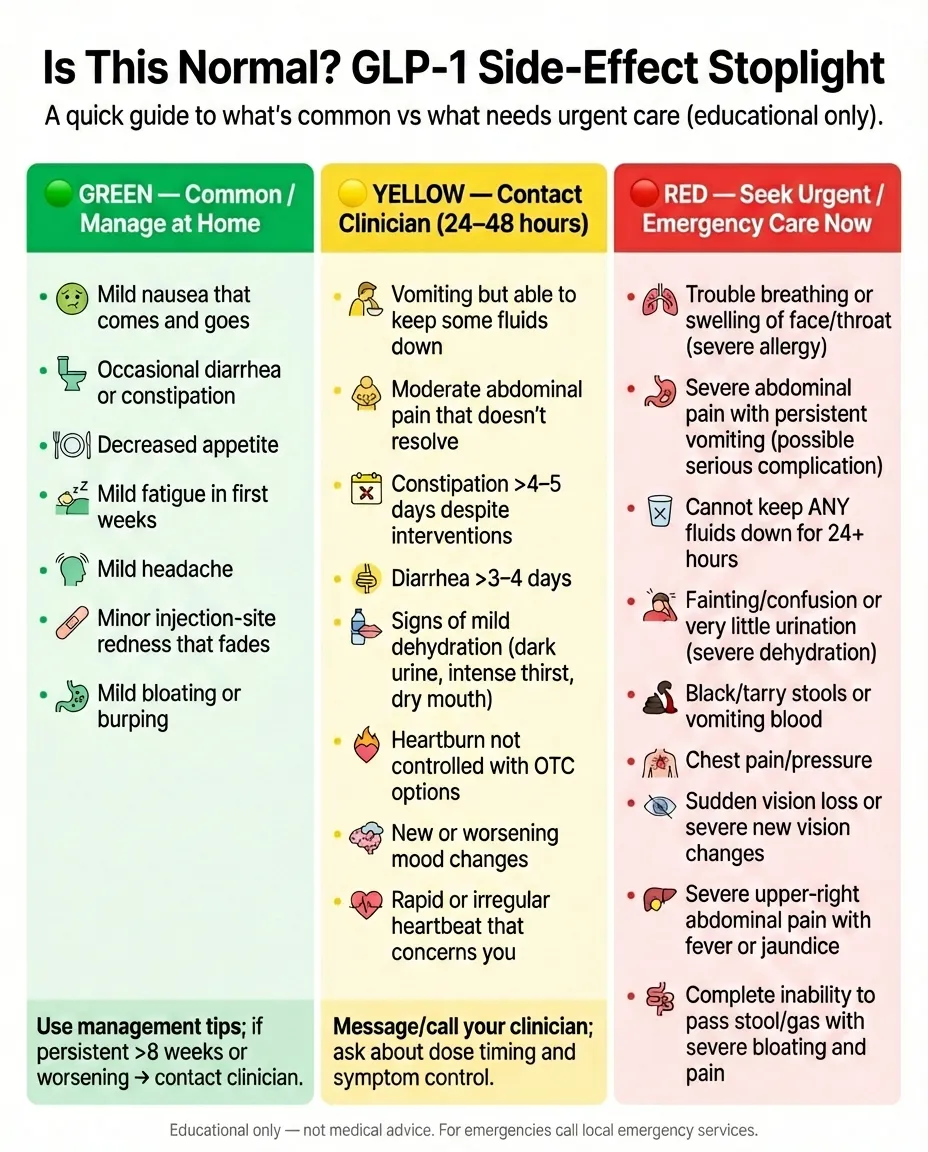
The most common GLP-1 dehydration symptoms are dry mouth, dark yellow urine, peeing less than usual, headache, tiredness, muscle cramps, and dizziness when you stand up. If those symptoms are mild, you can keep fluids down, and you are still peeing, start with small, steady sips and watch the pattern closely.1
A different set of symptoms means call your prescriber today: new unexplained swelling in your ankles, feet, legs, hands, or around your eyes. Passing much less urine. Vomiting or diarrhea that will not let up. Dizziness that keeps returning. Weakness that is getting worse.
Go in now — to the emergency department or call emergency services — if you have trouble breathing, chest pain or pressure, confusion, fainting, trouble staying awake, no urine at all, severe stomach pain that will not let up, blood in your vomit or stool, or you cannot keep any fluids down and you are getting weaker.12
Three things lower the threshold for calling: ongoing vomiting or diarrhea, a recent dose increase, and medicines that affect fluid balance or kidney blood flow. They do not make every mild symptom an emergency. They mean you should wait less and ask sooner.
Where you are right now
| Watch and hydrate | Call your prescriber today | Get help now | |
|---|---|---|---|
| What you're feeling | Dry or sticky mouth · dark yellow urine · headache · tiredness · cramps · mild lightheadedness when standing — and you can still drink and still pee | New unexplained swelling · peeing much less · repeated vomiting or diarrhea · dizziness that keeps coming back · worsening weakness · trouble keeping enough fluid down | Trouble breathing · chest pain or pressure · confusion · fainting · cannot stay awake · no urine at all · severe stomach pain · blood or coffee-ground material in vomit · black or bloody stool |
| What to do | Sit down if dizzy. Take small, frequent sips. Track urine and fluid loss. Check the pattern again over the next few hours | Call the clinic that prescribed your medication and give them your medication, dose, symptom timeline, urine changes, and full medicine list | Go to the emergency department or call emergency services. Bring your medication list if you can |
| Call earlier if | You have kidney disease, heart failure, a fluid limit, or you are an older adult · you recently started or increased your dose · you take an NSAID, ACE inhibitor, ARB, diuretic, SGLT2 inhibitor, insulin, or a sulfonylurea | Same | Do not wait for a callback when an emergency sign is present |
Now here's the part that bothers us.
The current FDA prescribing information for Ozempic tells prescribers to “inform patients of the signs and symptoms of acute kidney injury.” That instruction is in Section 17, Patient Counseling Information.3
Then you open the Medication Guide — the paper you actually get — and it lists warning symptoms for thyroid tumors. For pancreatitis. For gallbladder trouble. Twelve separate symptoms for low blood sugar, in its own table.
For dehydration and kidney injury? Zero stand-alone symptoms. It names what can cause the problem and what to report, but it never prints a clear list of what dehydration or acute kidney injury may feel like.3
We went and built the list. That's what this page is.
What are the most common GLP-1 dehydration symptoms?
The most common dehydration symptoms on a GLP-1 medication are dry or sticky mouth, dark yellow urine, urinating less often, headache, fatigue, muscle cramps, and dizziness on standing. No single symptom proves you're dehydrated — the pattern matters more, especially whether you've had fluid loss from vomiting or diarrhea and whether you're still passing normal amounts of urine.
Here's the full list of "your body is low on fluid" signs:
- Dry or sticky mouth. Your saliva feels thick. Lips crack.
- Dark yellow or amber urine. This can mean your urine is more concentrated. Red, brown, tea-colored, or cola-colored urine is different and needs medical attention rather than a hydration guess.
- Peeing less often. Fewer trips than normal for you.
- Headache, especially when it appears with low intake, vomiting, diarrhea, darker urine, or reduced urination.
- Heavy, flat tiredness. Not sleepy — drained.
- Dizzy or gray-out when you stand. Sit or lie down if this happens. Do not keep standing to “test” it when you feel faint.
- Muscle cramps, often in calves or feet.
- Constipation getting noticeably worse. Low fluid can contribute, but GLP-1-related digestive slowing and reduced food intake can also be part of it.
- Thirst — and this one comes with a catch.
Why "just wait until you feel thirsty" is bad advice here
Thirst is useful, but on a GLP-1 it should not be your only alarm bell.
A peer-reviewed Nature Health study analyzed 410,198 Reddit posts and identified 67,008 users who said they were taking semaglutide or tirzepatide. Of those users, 29,172 described at least one side effect. Here's what appeared in that side-effect-reporting group:4
| What people reported | Share of the 29,172 users who mentioned at least one side effect |
|---|---|
| Nausea | 36.9% |
| Vomiting | 16.3% |
| Fatigue | 16.7% |
| Diarrhea | 12.6% |
| Headache | 6.1% |
| Dizziness | 5.0% |
| Dehydration | 1.6% |
| Dry mouth | 1.1% |
| Thirst | 0.5% |
Read those top and bottom numbers again. Nausea, vomiting, and diarrhea — the things that can make fluid balance harder — were mentioned far more often than thirst.
That does not mean only one person in two hundred felt thirsty. This was an AI-assisted analysis of unprompted posts from a self-selected online group, not a clinical exam or a survey that asked everyone about thirst. It tells us what people chose to mention, not the true rate of any symptom. The paper is peer reviewed, but the posts are still self-reports.4
There's also limited research suggesting GLP-1 receptor activity may reduce how much people drink in certain settings. That's not settled science, and some semaglutide research found thirst ratings similar to placebo. We're not going to tell you every GLP-1 shuts off thirst in every person. What is settled: nausea, vomiting, diarrhea, early fullness, and reduced intake can leave you behind on fluid even if thirst does not feel dramatic.5
So don't use thirst alone as your gauge. Use these three instead:
- Color and amount. Dark yellow may mean concentrated urine. A sharp drop in the amount matters more than whether it is perfectly pale.
- Frequency. Are you going clearly less than normal for you?
- What happens when you stand. If normal standing makes you lightheaded, sit back down. Do not deliberately repeat the test when you feel faint.
One thing we're going to skip: the pinch-your-skin test. You'll see it everywhere. It's hard to read on yourself and it cannot rule dehydration in or out. Your fluid losses, ability to drink, urine output, mental state, and overall trend are more useful.
Which symptoms mean your kidneys might be struggling?
Possible acute-kidney-injury signs include making much less urine or no urine, new swelling in the legs, ankles, feet, hands, or around the eyes, shortness of breath, confusion, marked fatigue, nausea, and chest pain or pressure. These signs are not specific to kidney injury, but they deserve same-day clinical contact; trouble breathing, chest pain, confusion, fainting, or no urine require urgent evaluation.2
This is where almost every page on the internet lets you down. They give you one blended list. But dehydration and kidney trouble aren't the same thing, and they don't feel the same.
Here's the second list, from the National Kidney Foundation's own patient materials:
- Swelling — ankles, feet, legs, hands, or puffiness around the eyes
- Very little urine, or none at all
- Shortness of breath
- Confusion, or just feeling mentally "off"
- Nausea, especially when it appears with reduced urine, swelling, confusion, or breathing trouble
- Chest pain or pressure
- Flank pain — pain in the side of your back between the ribs and hip
- Seizures or coma in severe cases
Persistent foamy urine is not a basic dehydration sign. It can occur when protein is present in urine and deserves evaluation, especially with swelling. It is not proof of acute kidney injury by itself.
The one that trips everybody up
Swelling. Puffy ankles. A face that looks different in the mirror. Socks leaving deep marks.
Most people see that and think: swelling means too much fluid, so dehydration is off the table. And they wait.
Here's what we found. A systematic review published in Frontiers in Medicine in June 2026 pulled together 20 published semaglutide-associated kidney-injury cases from 18 studies. The authors published the whole case-by-case table.6
The paper did not summarize the presenting symptoms as counts, so we counted them row by row.
Swelling or edema was the most common kidney-side sign we tallied: seven of the twenty. Reduced urine appeared in five. Nausea, vomiting, or diarrhea as a group appeared in ten.
Thirst was not recorded in the presentation field for any of the twenty cases. One case did include dry oral mucosa.
Let that sit for a second. The sign many people wait for was not recorded. The sign that looks like the opposite of dehydration showed up in seven cases.
We'll walk through the rest of what those twenty cases showed further down. For now, just add swelling to your list.
Why the two lists matter
Because they mean different things:
- List A (dry mouth, dark yellow urine, headache, cramps) → if you can still drink and still pee, take small sips, rest, and watch the pattern.
- List B (new swelling, barely peeing, breathless, confused) → call today. And if it's breathing trouble, chest pain, confusion, fainting, or no urine — that's now.
You can have both at once. They can happen together. When in doubt, go with the more serious list.
When is it an emergency, and when should you just call?
Confusion, fainting, trouble breathing, chest pain, no urine, trouble staying awake, severe or persistent abdominal pain, blood in vomit or stool, or an inability to keep fluids down with worsening weakness require urgent medical evaluation. Repeated vomiting or diarrhea, new unexplained swelling, markedly reduced urination, or ongoing dizziness deserve same-day contact with the prescribing clinician. Mild symptoms with tolerated fluids, continued urination, and no worsening signs may be watched at home.12
Get help now
Don't finish reading this page. Go.
- Trouble breathing
- Chest pain or pressure
- Confusion, or acting unlike yourself
- Fainting, or can't stay awake
- No urine at all
- Cannot keep even small sips down while getting weaker, dizzier, or less alert
- Severe stomach pain that won't let up
- Blood in your vomit, or vomit that looks like coffee grounds
- Black or bloody stool
Some of those aren't dehydration at all. Severe stomach pain, especially pain that travels to your back, can be pancreatitis — a separate warning in all eight labels reviewed for this guide. Blood is its own emergency. Either way, the answer is the same: go.
Call your prescriber today
- New unexplained swelling, especially with reduced urine or shortness of breath
- Peeing much less than normal
- Repeated vomiting or diarrhea that is not settling
- Being unable to keep enough fluid down
- Dizziness that keeps returning after you sit, rest, and sip
- Weakness that's getting worse
- Symptoms that started after a dose increase
- You have kidney disease, heart failure, or you're on a fluid limit
Home monitoring is reasonable when
All of these are true: symptoms are mild, you can keep small amounts of fluid down, you're still peeing, nothing on the emergency list applies, and you're not getting worse.
Vomiting for more than 24 hours, being unable to keep fluids down for about 12 hours, or not urinating for about 8 hours are common adult call-now guideposts. Do not wait for a timer when symptoms are severe, worsening, or paired with a high-risk condition.7
What to actually say when you call
We think this is the real barrier. Not knowing the symptoms — knowing you won't sound serious enough.
So use this. Read it off your phone:
“I'm on [medication] at [dose]. My last dose was [date]. I've had [vomiting / diarrhea / trouble drinking] for [how long]. I can [keep small sips down / not keep fluids down]. I'm peeing [normally / less / barely / not at all]. I also take [ibuprofen / lisinopril / losartan / furosemide / Jardiance / Farxiga / insulin / whatever applies]. Do you want me evaluated or to check my kidney function and electrolytes before my next dose?”
That last question does a lot of work. It's specific, it's clinically reasonable, and it moves the conversation past "drink more water."
And about feeling dramatic: if you go in and it turns out not to be serious, you got assessed and you got peace of mind. That's a good outcome. It is not embarrassing.
You're not overreacting by checking.
🔵 Check your symptoms in 60 seconds
1. Do you have trouble breathing, chest pain or pressure, confusion, fainting, trouble staying awake, no urine, severe stomach pain, blood in vomit or stool, or a seizure?
Yes → Get help now. Do not keep using an online checker.2. If no: Are you making much less urine, newly swollen, repeatedly vomiting or having diarrhea, unable to keep enough fluid down, repeatedly dizzy, or getting weaker?
Yes → Call your prescriber today. Call sooner when you have kidney disease, heart failure, a fluid limit, or a medicine combination discussed below.3. If no: Are the symptoms mild, can you keep small sips down, are you still peeing, and are you stable or improving?
Yes → Watch and hydrate. Follow the mild-symptom plan below and move up a level if the pattern changes.This check does not diagnose dehydration or decide whether to take your next dose. It asks for no email and stores no health information.
What people are actually asking
We read through posts from people in this exact spot. A few of the things they say:
“It's just hard to get anything down.”
— Reddit user discussing difficulty drinking while taking Wegovy
“Dizziness is worrying me.”
— Reddit user discussing dizziness while taking semaglutide
And over and over: am I overreacting? Should I take my next shot? Could this hurt my kidneys?
These are real comments from people online, not medical evidence, and they don't tell us what caused any one person's symptoms. We include them because if you've been sitting there wondering whether you're being ridiculous — you're not the only one, and you're not.
Why your Medication Guide never gave you this list
The current Ozempic prescribing information tells prescribers in Section 17 to inform patients of the signs and symptoms of acute kidney injury. The accompanying Medication Guide gives clear symptom lists or descriptions for several other serious risks — including twelve symptoms for low blood sugar — but its dehydration entry gives the cause, hydration advice, and a direction to report persistent symptoms without printing a stand-alone list of dehydration or kidney-injury symptoms.3
This is the thing we couldn't get past, and it's why this page exists.
Open the current Ozempic label. Go to Section 17, Patient Counseling Information. Under "Acute Kidney Injury Due to Volume Depletion," it says:
“Inform patients of the signs and symptoms of acute kidney injury...”3
Clear enough. Your doctor is supposed to teach you the list.
Now flip to the Medication Guide. That's the plain-English patient sheet provided with the prescription. Here's what it gives you symptoms for:
| Warning in the Medication Guide | Does it list symptoms? | How many |
|---|---|---|
| Thyroid tumors | Yes | 4 symptom groups |
| Pancreatitis | Yes | A clear pain description |
| Vision changes | Yes | 1 direct warning |
| Low blood sugar | Yes | 12, in a formatted list |
| Serious allergic reaction | Yes | 5 symptom groups |
| Gallbladder problems | Yes | 4 symptom groups |
| Severe stomach problems | Yes, broadly | Severe or persistent stomach problems |
| Food or liquid getting into the lungs during surgery | No symptom list | A direction to tell the care team before a procedure |
| Dehydration leading to kidney problems | No stand-alone symptom list | Cause, hydration advice, and a direction to report persistent nausea, vomiting, or diarrhea |
The entire dehydration entry reads, in substance: diarrhea, nausea, and vomiting can cause fluid loss, which may cause kidney problems. Drink fluids. Tell your provider if nausea, vomiting, or diarrhea doesn't go away.
That's the whole thing. It tells you what causes it. It never tells you what it looks like.
Not one stand-alone symptom list for dehydration or acute kidney injury — for the warning where the label specifically directs your prescriber to teach you the signs.
And this isn't just Ozempic. We checked current patient counseling and Medication Guide language for Wegovy, Rybelsus/Ozempic tablets, Zepbound, Mounjaro, Saxenda, and Trulicity. The prescribing information tells clinicians to counsel patients about acute-kidney-injury signs, while the patient-facing dehydration language centers on gastrointestinal fluid loss and persistent symptoms without printing a full kidney-warning list.8
Meanwhile the low blood sugar section gets a formatted twelve-symptom table. Dizziness, sweating, confusion, headache, shakiness, hunger, blurred vision, slurred speech, fast heartbeat, weakness, irritability, feeling jittery.
We're not saying that's wrong. Low blood sugar is dangerous and it deserves the table. We're saying the same document, four inches lower, tells your doctor to teach you a list — and then doesn't print it.
So we printed it. That's Lists A and B above. Built from the National Kidney Foundation's patient materials, then checked against what actually showed up in twenty real published cases.
Why GLP-1 medications cause dehydration in the first place
GLP-1 medications raise dehydration risk mainly in indirect ways: nausea, vomiting, and diarrhea can remove fluid; nausea and early fullness can make drinking harder; and eating less can reduce water that normally comes from food. FDA labels repeatedly emphasize treatment initiation and dose escalation because gastrointestinal reactions and volume depletion deserve closer attention during those periods.38
Three doors, all open at once. That's the real answer.
Door one: fluid going out
Nausea, vomiting, diarrhea. In Ozempic's placebo-controlled trials, gastrointestinal side effects hit 32.7% of people at 0.5 mg and 36.4% at 1 mg, compared to 15.3% on placebo. Most reports of nausea, vomiting, and diarrhea occurred during dose escalation.3
Wegovy's current label reports severe GI reactions in 4.1% of adults on the injection versus 0.9% on placebo. The current tablet trials report 2% versus 0% on placebo.9
These percentages are not dehydration rates. They show why the fluid-loss pathway matters: gastrointestinal reactions are among the most common problems with these drugs, and repeated losses can outpace what you replace.
Door two: fluid coming in — and this is the sneaky one
The National Academies set population-level adequate total-water intakes at 3.7 liters a day for adult men and 2.7 liters for adult women. Those values include water from drinks and food, and were set for generally healthy, sedentary people in temperate climates — not as a prescription for every person taking a GLP-1. About 20% came from food in the underlying intake data.10
Soup. Fruit. Yogurt. Salad. Rice. That was water, and you were counting on it without knowing.
So when a GLP-1 sharply changes what and how much you eat, water from food may fall too. We cannot turn a percentage cut in calories into an equal percentage cut in water — foods have very different water content. A bowl of soup and a bowl of dry crackers can contain very different amounts of water.
You may not have changed anything about how you drink, and fluid coming in can still be lower.
Door three: the alarm doesn't ring
Covered above. Thirst was rarely mentioned in the online-post analysis, but that study cannot tell us how many people actually felt it. The safer point is simple: do not wait for thirst when vomiting, diarrhea, low intake, dark urine, or reduced urination is already telling you fluid may be falling behind.
Why dose increases matter
The labels are specific about this. Ozempic's warning says to monitor kidney function “especially during dosage initiation and escalation.” Wegovy's label goes further and notes that kidney-related adverse reactions occurred more frequently during dose titration.39
Practical version: be more deliberate about fluid and symptoms when you start and after a dose increase. There is no evidence-based universal three- or four-day danger window. Watch the whole period in which nausea, vomiting, diarrhea, or poor intake is active.
Which medicines can raise kidney risk when you're dehydrated?
NSAIDs such as ibuprofen and naproxen, ACE inhibitors, ARBs, and diuretics can make the kidneys less able to compensate during a low-fluid state. SGLT2 inhibitors can also make more glucose and water leave through urine. These are not automatic reasons to stop a prescription; they are reasons to call sooner and follow a clinician's sick-day plan.211
This is the section we'd tape to the fridge.
How your kidney protects itself
When you're low on fluid, your kidney has two backup levers. It squeezes the vessel on the way out of the filter, and it relaxes the vessel on the way in. That keeps enough pressure to keep filtering.
It needs both levers. Here's what disables them:
| The medicine | Common names | What it does to your kidney's backup plan |
|---|---|---|
| NSAIDs | Ibuprofen, Advil, Motrin, naproxen, Aleve | Breaks the "relax the vessel coming in" lever |
| ACE inhibitors | Lisinopril, ramipril, enalapril — most end in -pril | Breaks the "squeeze the vessel going out" lever |
| ARBs | Losartan, valsartan, olmesartan — most end in -sartan | Same lever as above |
| Diuretics ("water pills") | Furosemide (Lasix), hydrochlorothiazide, bumetanide | Actively removes more fluid. Makes the hole bigger |
Take an ACE inhibitor or ARB, a diuretic, and an NSAID together and clinicians often call it the “triple whammy.” In a large observational study, that combination was associated with a 31% higher rate of acute kidney injury than ACE-inhibitor-or-ARB plus diuretic treatment without the NSAID. The relative increase was greatest early after the NSAID was added.11
One more worth knowing: SGLT2 inhibitors — Jardiance, Farxiga, empagliflozin, dapagliflozin. They may be prescribed alongside a GLP-1 in type 2 diabetes and have important heart and kidney benefits for many people. They also cause glucose and water to leave through urine and carry volume-depletion warnings, which is why a clinician may give a sick-day plan for periods of poor intake or fluid loss.12
Now here's what we found
Open the Drug Interactions section of the Ozempic label. Section 7.
It has exactly two entries. Insulin-type diabetes drugs. And oral medications in general, because the drug slows your stomach.
NSAIDs, ACE inhibitors, ARBs, and diuretics are not listed in Section 7.
That does not mean the combination is harmless. It means this is not framed as a direct Ozempic drug-drug interaction. It is a sick-day body problem: low circulating volume plus medicines that change kidney blood flow or remove more fluid.
The warning and the interaction section sit in the same document and never fully meet.
What to do with this
If you take one of these medicine groups and you have ongoing vomiting, diarrhea, poor intake, reduced urine, or repeated dizziness, make the call sooner. Not because you did anything wrong. Because those medicines can make an ordinary low-fluid day harder on the kidneys.
Do not stop any of them on your own. Every one is treating something real, and stopping a prescription without guidance can create a different problem. The move is a call, not a decision.
Do not take extra over-the-counter ibuprofen or naproxen during a low-fluid illness without checking with a clinician or pharmacist, unless you already have a written sick-day plan that says otherwise. Acetaminophen is not an automatic safe swap for everyone either; liver disease, alcohol use, dose, and other medicines matter.
The move is a call, not a solo medication experiment.
What actually happened in 20 real cases
A 2026 systematic review gathered 20 published cases of kidney injury reported in association with semaglutide. The patients were 29 to 83 years old; reported injectable doses ranged from 0.25 mg to 2 mg weekly, one oral case used 7 mg daily, five doses were unreported, and two onset timings were unreported. Seventeen patients improved or recovered. Case reports cannot tell us how often this happens or prove semaglutide caused every injury.6
Twenty cases. Eighteen studies. Screened out of 1,039 papers. Ages 29 to 83. Thirteen women, seven men.6
The authors published the entire case table. We went through it row by row and counted. These numbers are ours, and anyone can check them against the same public table.
Six things it shows — and several push back on what people assume.
1. Swelling was the most common kidney-side sign we tallied
7 of 20. Leg swelling, ankle swelling, puffy feet, "progressive edema."
Reduced urine or oliguria: 5 of 20. Nausea, vomiting, or diarrhea as part of the presentation: 10 of 20.
Thirst recorded in the presentation column: zero.
2. It wasn't the high doses
Among injectable cases with a reported dose, doses ran from 0.25 mg to 2.0 mg weekly. The most common known injectable dose was 0.5 mg. One oral case used 7 mg daily, and five cases did not report a dose.6
Three cases happened at 0.25 mg. That's a starting step for injectable semaglutide, not a high maintenance dose.
3. The window was not only the first week
Onset ranged from within one week to five months. One case was reported at one week. In 17 of 20, onset developed over several weeks; two timings were not reported.
That does not create a five-month “risk window.” It means you should not treat week four as a magic line after which reduced urine, swelling, or severe stomach symptoms no longer count.
4. You don't need to already have kidney disease
The review's own authors say it plainly: at least 11 of the 20 had no history of kidney disease.6
That is not the same as saying those eleven people were otherwise healthy. Nearly all had other medical conditions or medicines in the room. But a normal past kidney history is not a reason to ignore a new warning pattern.
5. Other medicines were often in the room
This is the one that made us write the section above.
Twelve of the twenty cases listed the patient's other medications. Of those twelve, nine included an ACE inhibitor, an ARB, or a diuretic. Five included both a blood pressure drug and a water pill.
Furosemide plus lisinopril. Bumetanide plus lisinopril plus hydrochlorothiazide. Valsartan plus amlodipine. Sacubitril-valsartan plus furosemide plus spironolactone.
That pattern fits the known concern about low-volume states and kidney-active medicines. But case reports cannot prove those other medicines caused the injury, and the review had no control group.
6. Most of them got better. Not all.
Seventeen improved or fully recovered. Two outcomes were not reported.6
One did not recover. An 83-year-old woman. Her presenting symptom was increasing leg swelling. Five months into treatment. By the time she was found, her kidney function was down to an eGFR of 11.6
The only presenting symptom recorded in the review's table was swelling.
And the honest limit of everything on this page
One of the twenty had no recorded symptoms at all. No swelling. No nausea. Nothing in the presentation field. It was found through testing.6
We're not going to pretend a symptom list catches everyone. It doesn't. That's exactly why "can you check my kidney function?" is a fair thing to ask your prescriber, especially if you're in one of the higher-risk groups further down.
What this data can and can't tell you
We want to be square with you here, because a lot of pages would take these numbers and scare you with them.
- These are 20 published case reports worldwide, set against widespread semaglutide use. That is not a rate and it cannot be turned into one.
- Case reports get published because they're unusual. That skews toward over-representation.
- The review's authors note there was no control group and no formal causality scoring. They can't prove the drug caused it.
- Twelve cases had kidney biopsies, and the reported diagnoses were not all simple dehydration injuries. They included acute interstitial nephritis, focal segmental glomerulosclerosis, minimal change disease, and nephrotic syndrome.6
- The FLOW trial — 3,533 patients, published in the New England Journal of Medicine in 2024 — found semaglutide reduced major kidney events in people with type 2 diabetes and chronic kidney disease.13
So here's the honest reframe, and it's better news than the headline suggests:
Two things can be true. Semaglutide can improve long-term kidney outcomes in the right population, and rare kidney injuries can still be reported during treatment.
The label's best-established pathway is gastrointestinal fluid loss leading to volume depletion and acute kidney injury. But the published case reports also include kidney inflammation and diseases of the kidney filters. Hydration matters; not every kidney problem is fixed by drinking.
The part you can act on tonight is the warning pattern: ongoing fluid loss, inability to drink, much less urine, swelling, faintness, breathing trouble, or a risky medicine combination.
What each FDA label says about dehydration and your kidneys
All eight FDA-approved products reviewed for this guide carry a warning connecting gastrointestinal reactions, dehydration or volume depletion, and acute kidney injury. The warnings appear in different numbered sections but say substantially the same thing. Reported rates cannot be compared across products because the labels use different studies, populations, time periods, and units.38
We pulled the current prescribing information for eight products and put the same fields side by side. Any one of these labels is public. The original value is the standardized comparison: the same question, the same columns, eight current labels, and one verification date.
| Product | Drug | Warning section | Ties GI symptoms → dehydration → kidney injury? | Monitoring emphasized |
|---|---|---|---|---|
| Ozempic | Semaglutide | 5.6 — "Acute Kidney Injury Due to Volume Depletion" | Yes | Starting and dose increases |
| Wegovy | Semaglutide | 5.5 | Yes | Starting and dose increases |
| Rybelsus / Ozempic tablets | Semaglutide | 5.5 | Yes | Starting and dose increases |
| Zepbound | Tirzepatide | 5.3 | Yes | Starting and dose increases |
| Mounjaro | Tirzepatide | 5.5 | Yes | Starting and dose increases |
| Saxenda | Liraglutide | 5.6 | Yes | Starting and escalation |
| Trulicity | Dulaglutide | 5.5 | Yes | Starting and escalation |
| Foundayo | Orforglipron | 5.4 | Yes | Starting and dose increases |
Two things worth pulling out of that table.
A pill doesn't get you out of the warning. Rybelsus/Ozempic tablets and Foundayo are swallowed, not injected. They still carry a volume-depletion kidney warning because the pathway runs through gastrointestinal reactions and fluid balance, not the needle.8
Every single row says yes. Eight products, five active drugs, two manufacturers. Complete agreement on this warning.
The numbers, and why you can't rank them
Two labels publish actual rates:
| What the label reports | |
|---|---|
| Wegovy | Acute kidney injury in 7 patients (0.4 cases per 100 patient-years) vs 4 on placebo (0.2 per 100 patient-years). Risk was higher in people with prior kidney impairment, and occurred more often during dose titration.9 |
| Zepbound | Acute kidney injury in 0.5% of patients vs 0.2% on placebo.14 |
Now look at the units.
Wegovy reports cases per 100 patient-years. Zepbound reports a percentage of patients.
Those are different rulers. You cannot line them up. These were separate trials, different patients, different lengths of time, different designs — and FDA labels explicitly warn that adverse event rates from different trials can't be compared drug to drug.
So if you're here trying to figure out which GLP-1 is safest for your kidneys, we'll save you the trouble: the labels can't answer that. Anyone who tells you tirzepatide is kidney-safer than semaglutide based on these numbers is reading them wrong.
What the labels can tell you is that all eight carry the same warning, for the same reason, at the same points in treatment.
One more thing the Zepbound label mentions
Low blood pressure, occurring alongside GI side effects and dehydration. In pooled weight-reduction trials, hypotension was reported in 1.6% of Zepbound-treated patients versus 0.1% on placebo, and it was more frequent in people also taking blood-pressure medicine.14
That's one reason the stand-up-and-the-room-moves symptom matters. It's not in your head, and it's not specific enough to diagnose dehydration by itself.
Could this be something other than dehydration?
Dehydration symptoms overlap heavily with low blood sugar, low blood pressure, insufficient food intake, and more serious conditions like pancreatitis. Headache, dizziness, weakness, and nausea can come from any of these. Severe or persistent abdominal pain in particular should not be attributed to dehydration without evaluation.
Yes. And this matters more than most pages admit.
Here's an uncomfortable fact from those twenty cases: only 10 of 20 had nausea, vomiting, or diarrhea in their presentation. Half the time, the kidney problem showed up without obvious stomach symptoms leading the way.
So don't assume the reverse either. Let's sort the overlaps.
Dehydration vs. low blood sugar
Low blood sugar matters most if you also take insulin or a sulfonylurea (glipizide, glyburide, glimepiride). All eight FDA labels reviewed warn that combining a GLP-1 medicine with insulin or a sulfonylurea can raise hypoglycemia risk.38
Low blood sugar tends to bring: shakiness, sweating, sudden hunger, irritability, a fast heartbeat, confusion. Dehydration doesn't usually make you sweaty and shaky.
If you already monitor glucose, follow the glucose plan your clinician gave you. If symptoms are severe, you are confused, you cannot safely treat yourself, or you pass out, get emergency help.
Small irony worth noting: the Medication Guide gives you twelve symptoms to spot low blood sugar. It gives you zero for dehydration. Guess which one is easier to recognize at 2am.
Dehydration vs. low blood pressure
Enormous overlap. Dizzy on standing, weak, close to fainting.
Both can be happening at once — and weight loss, lower food and fluid intake, stomach losses, and blood-pressure medicines can all change what your old dose feels like. That's a conversation with your prescriber, not a self-adjustment.
Dehydration vs. just not eating enough
Headache, weakness, fatigue, lightheadedness, feeling shaky. All of that happens when calories drop hard and fast.
Drinking more water will not fix every symptom caused by very low food intake. If you've barely eaten in two days, water may not be the only missing piece.
Dehydration vs. something serious
Severe or persistent stomach pain — especially pain that travels toward your back — is not a dehydration symptom. Pancreatitis has its own warning in all eight labels reviewed for this guide, and it needs evaluation. Don't drink water and wait it out.
Same for gallbladder pain (usually upper right, under the ribs), which also has its own label warning.
Does dark urine always mean dehydration?
No — and this distinction is worth knowing.
Dark yellow or amber urine can mean concentrated urine. That can fit dehydration, especially when you are also drinking less or peeing less.
Red, brown, tea-colored, or cola-colored urine is a different thing. That can mean blood, muscle breakdown, a liver issue, or a kidney problem. It needs medical evaluation, not a glass of water. Especially with pain, fever, swelling, or reduced urine output.
Quick sorting table
| What you notice | Could be | What to do |
|---|---|---|
| Dizzy on standing | Dehydration, low blood pressure, low intake, medication effect | Sit down. Call if it repeats or you nearly faint |
| Shaky, sweaty, suddenly starving | Low blood sugar — especially on insulin or a sulfonylurea | Follow your glucose plan; get help if severe |
| Severe belly pain, maybe into the back | Pancreatitis, gallbladder, obstruction | Urgent evaluation. Not a hydration problem |
| Dark yellow urine + low intake | Concentrated urine from dehydration | Take small sips and monitor the amount; call if output drops or symptoms worsen |
| Red, brown, or cola-colored urine | Blood, kidney, liver, muscle, or medication cause | Medical evaluation |
| Headache alone | Dehydration, low food, sleep, illness | Look at the whole pattern |
| New swelling | Kidney strain, heart, or medication | Call today |
What to do right now if your symptoms are mild
For mild symptoms with continued urination and an ability to keep fluids down, small frequent sips are often easier to tolerate than a large volume at once. Track urine output and ongoing fluid loss, then move to clinician contact if symptoms are not improving, are getting worse, or are paired with a higher-risk condition.17
If you're on the Watch level, here's the plan:
- Sit down if you're dizzy. Don't tough it out standing.
- Sip small amounts often. The best amount is the amount you can keep down. A large chug can worsen nausea or come right back up.
- Consider an oral rehydration drink after meaningful vomiting or diarrhea if you do not have a kidney, heart, sodium, potassium, glucose, or fluid restriction that makes it a bad fit.
- Write down vomiting episodes, diarrhea episodes, roughly how much you drank, and how often you peed. You'll need this if you end up calling.
- Skip hard exercise and heat until this settles.
- Recheck the pattern over the next few hours. Better, same, or worse?
If you're not clearly improving, call. Do not turn “home monitoring” into another full day of trying harder when you are peeing less, getting weaker, or unable to replace what you are losing.
If nausea is what's stopping you from drinking
- Smaller sips, more often. Even a few sips at a time if that's what works.
- Try cold, or try room temperature. Use whichever you can keep down.
- Drink between meals if drinking with food makes the fullness worse.
- Suck on ice chips if liquid is too much.
- Don't try to out-drink persistent nausea. If nausea is what's blocking your fluids, the nausea is the problem to solve, and there are prescription options. Ask.
What not to do
- Don't chug a huge volume fast.
- Don't take salt tablets or potassium supplements without being told to.
- Don't assume an electrolyte packet handles serious dehydration.
- Don't book an IV drip clinic instead of being evaluated when you have warning signs.
- Don't take somebody else's anti-nausea medication.
- Don't change your GLP-1 dose on your own.
One detail from those twenty published cases: clinician-directed fluids were common, but they were not the only treatment. Some patients also needed steroids, dialysis, medication changes, or other care because the kidney diagnoses were not all simple dehydration.6
Getting help early can still be low-drama. Waiting until you are confused, barely urinating, or short of breath is where it stops being low-drama.
How much should you drink on a GLP-1?
There is no one fluid number that is right for every person taking a GLP-1. The National Academies' population reference is about 3.7 liters of total water a day for adult men and 2.7 liters for adult women, including water from food, but those figures were set for generally healthy, sedentary adults in temperate climates. Kidney disease, heart failure, pregnancy, heat, exercise, illness, medicines, and fluid restrictions can change what is safe for you.10
There is no single number that's right for everyone. But here's the real population reference instead of a vague “drink more.”
Total water per day, from all sources:
- Men: about 3.7 liters — roughly 125 ounces, or 15–16 cups
- Women: about 2.7 liters — roughly 91 ounces, or 11–12 cups
That includes water from food. If your eating dropped sharply, water from food may drop too. But do not force a guessed amount to “make up” the difference — foods have very different water content, and those population numbers are not a personal prescription.
Two rules of thumb you should ignore
"A gallon a day." More is not automatically better. Drinking very large amounts quickly can dilute the sodium in your blood and make you feel worse — headache, nausea, confusion. Adding salt on your own does not make forced water intake safe. Those are, unhelpfully, the same symptoms you were trying to fix.
"Half your body weight in ounces." At higher body weights this produces a number that isn't reasonable, and it ignores your climate, your activity, your medications, and any medical fluid limit.
What actually raises your needs
Heat. Exercise. Fever. Vomiting. Diarrhea. Pregnancy or breastfeeding. Certain blood pressure medications and diuretics.
Stop chasing clear urine
Clear urine is not the target. Pale yellow can be normal. The things worth tracking are whether your urine amount and frequency dropped compared with your normal, whether dizziness is improving, and whether you can keep fluids down.
⚠️ If you have kidney disease, heart failure, or your doctor has put you on a fluid limit — do not take a fluid target from a website. Yours is set by your clinician and it may be deliberately lower than these numbers. For you, too much fluid is its own problem.
Do you need electrolytes?
Electrolyte replacement is most useful after meaningful losses from vomiting, diarrhea, or heavy sweating, not as an automatic daily routine. Plain water may be enough for a mild shortfall without ongoing losses. None of the eight FDA labels reviewed recommends routine electrolyte supplementation, and no drink mix can diagnose or treat acute kidney injury.18
Short answer: not every day, and not automatically.
Plain water is fine for mild dryness with no vomiting or diarrhea.
An oral rehydration solution may make sense after meaningful vomiting or diarrhea because it contains a deliberate balance of water, glucose, and electrolytes. That does not make every sports drink or hydration powder a medical oral rehydration solution.
The options, honestly
| Option | Best for | The catch |
|---|---|---|
| Water | Mild shortfall, no active losses | Doesn't replace sodium |
| Oral rehydration solution | After vomiting or diarrhea | Sodium and potassium content may not fit kidney, heart, or restriction needs |
| Broth | Easy, cheap, tolerable when nauseated | Not a full rehydration formula |
| Sports drinks | Convenience after sweating | Built for taste and exercise, not medical rehydration. Often lots of sugar |
| Sugar-free electrolyte powders | People avoiding sugar | Amounts vary wildly between brands. "Sugar-free" doesn't mean better balanced |
| IV clinics | Clinician-directed rehydration | Not a diagnosis. Should never replace an ER visit when you have warning signs |
We're not naming brands and we don't earn anything from any of them on this page. Check more than the front-label promise. Look at sodium, potassium, carbohydrate or sugar, serving size, and how many servings the package expects you to drink.
Ask first if you have
Kidney disease. Heart failure. High potassium. A sodium or potassium restriction. A fluid limit. Or you take certain blood pressure or kidney medications. For you, a standard electrolyte packet isn't automatically safe.
What electrolytes can't do
Here's something we noticed while reading all eight labels: not one of them mentions electrolyte supplementation. They talk about fluid. They talk about monitoring kidney function. Electrolyte products don't appear.
And in those twenty published cases, treatment sometimes included IV fluids, but several patients also needed steroids, dialysis, or other care.6
An electrolyte packet may be a reasonable tool at the Watch level when it fits your health conditions and you have had meaningful fluid loss. It is not treatment for kidney injury, pancreatitis, bleeding, or severe low blood sugar. Don't let it become a reason to wait.
Should you skip your next dose?
No FDA-approved label reviewed for this guide gives patients a universal instruction to discontinue the medication whenever dehydration is suspected; the labels direct clinicians to monitor kidney function and instruct patients to report persistent symptoms. This differs from suspected pancreatitis, where the labels direct prompt discontinuation. Dose decisions should be made by the prescribing clinician.38
This is the question you actually came here with, isn't it.
We're not going to answer it for you, and here's why that's the right call.
Look at what the labels actually say. For suspected pancreatitis, Ozempic's label is direct: discontinue. Stop the drug.
For acute kidney injury from volume depletion, the same label says something different: monitor renal function. Report persistent symptoms.
Different verb. Different instruction. That's not sloppy drafting — it means the appropriate response is assessment, not automatic stopping.
Why stopping on your own doesn't solve the immediate problem
- Stopping does not replace fluid you already lost.
- It does not tell you whether dizziness came from dehydration, low blood pressure, low food intake, low blood sugar, or another illness.
- It does not tell you whether your kidney function or electrolytes changed.
- It may create confusion about when and at what dose to restart.
- It skips the chance to treat the cause — often persistent nausea — with a plan.
What a clinician may actually do
Depending on your symptoms and history, the clinician may tell you to hold, delay, continue, or change a dose. They may treat nausea, give you a specific fluid plan, review other medicines, order kidney-function or electrolyte tests, or send you for an in-person assessment.
Asking about your dose is not the same as asking to be taken off the medication forever. It is asking for the next safe instruction.
If you can't reach anyone
- Follow the emergency signs above. Those don't wait for a callback.
- Try the practice's after-hours line or on-call service.
- Call urgent care before going if you are unsure what they can evaluate; many can assess dehydration and order basic labs, but services vary.
- Don't let uncertainty about your next shot delay care for symptoms that need care.
Who is at higher risk?
Risk is elevated with ongoing fluid losses, recent treatment initiation or dose escalation, older age, pre-existing kidney or heart conditions, and concurrent use of diuretics, ACE inhibitors, ARBs, NSAIDs, or SGLT2 inhibitors. Published case data also shows that kidney injury can occur in people with no prior kidney disease.
Being on this list doesn't mean something will happen. It means your threshold for calling should be lower.
You just started, or just moved up a dose. Wegovy's label specifically notes kidney-related reactions occurred more often during dose titration. Every label flags initiation and escalation.
You have kidney disease. Wegovy's label found the risk was higher in people with prior kidney impairment. Don't follow a generic "drink more water" plan — yours may be different, and it may involve a limit.
You have heart failure or a fluid restriction. Aggressively self-hydrating can work directly against your care plan. Ask before you change anything.
You are an older adult, especially with several medicines. Thirst may be less reliable with age, medicine lists are often longer, and a fall from dizziness can do real harm.
You take insulin or a sulfonylurea. Overlapping symptoms, plus a real low-blood-sugar risk that the labels specifically warn about.
You take an NSAID, ACE inhibitor, ARB, diuretic, or SGLT2 inhibitor. See that section. This is an important practical reason to have a sick-day plan.
You're sick, sweating, or it's hot out. Fever, a stomach bug, a heat wave, a hard workout. Fluid loss stacks.
You use a compounded GLP-1 product. Compounded semaglutide and tirzepatide products are not FDA-approved, and FDA does not review their safety, effectiveness, or quality before marketing the way it reviews an approved drug. FDA has also reported dosing errors tied to different concentrations, syringe measurements, and instructions for compounded injectable semaglutide.15
The dehydration warning signs on this page still apply. But if you suspect a dosing error, the concentration is unclear, or symptoms are much more severe than expected, contact your prescriber, the dispensing pharmacy, Poison Control at 1-800-222-1222, or urgent medical care. Don't work it out from an article.
And one thing that is not protection: having no history of kidney problems. At least 11 of the 20 published cases were in people with none.
What to tell your prescriber
A useful clinical message includes the specific medication and dose, the date of the last dose and any recent increase, duration and frequency of vomiting or diarrhea, current fluid tolerance, urine output changes, and a full list of concurrent medications including over-the-counter NSAIDs.
There's a nice symmetry here. The label tells your prescriber to teach you the signs of kidney injury. If nobody did, you can bring the list yourself.
Copy this and fill in the blanks
"I'm taking [medication and dose]. My last dose was [date], and I [did / did not] increase my dose recently.
My symptoms started [when]. I've had [vomiting / diarrhea / trouble drinking] for [how long], and I can [keep small sips down / not keep fluids down].
I'm urinating [normally / less than usual / barely / not at all], and it looks [pale / dark yellow / amber / brown].
I also feel [dizzy / weak / short of breath / swollen / confused / stomach pain].
I also take [all medications, including over-the-counter ibuprofen or naproxen].
Do you want me evaluated, or to check kidney function and electrolytes before my next dose?"
Don't leave the over-the-counter stuff off that list. Ibuprofen counts. Aleve counts. People often forget to mention them because they do not feel like “real” prescriptions — and they can matter here.
Good questions to ask
- Do these symptoms need an in-person visit?
- Should we check my kidney function and electrolytes?
- What should I do about my next scheduled dose?
- Could any of my other medications be making this worse?
- What's a reasonable daily fluid target for me specifically?
- What symptoms should send me to urgent care?
Keep a short symptom log
Date and time. Medication and dose. What you managed to drink. Vomiting episodes. Diarrhea episodes. How often you peed and what color. Dizziness. Any swelling.
Even a few hours of concrete entries can be worth more to a clinician than a paragraph of "I've been feeling off." Do not delay care just to complete the log.
How we researched and verified this
This guide was built by reading current FDA prescribing information and Medication Guides for eight GLP-1 and dual GIP/GLP-1 products, then cross-checking them against guidance from MedlinePlus and the National Kidney Foundation and a 2026 systematic review of published case reports.
Weight Loss Provider Guide is an independent comparison resource for GLP-1 telehealth providers. We may earn compensation from providers discussed elsewhere on the site. No provider sponsored this guide, no provider payment determined the warning levels or medical content, and this article contains no direct provider affiliate links — because a page someone reads while they might be sick is the wrong place for a provider pitch.
What we actually verified
| What | Source | Verified |
|---|---|---|
| Ozempic Sections 5.6, 5.7, 7, 17, and the full Medication Guide | FDA prescribing information and Medication Guide | Aug 6, 2026 |
| Warning sections across 8 GLP-1 products | FDA prescribing information | Aug 6, 2026 |
| Wegovy and Zepbound kidney injury rates | FDA prescribing information | Aug 6, 2026 |
| Kidney injury symptom list | National Kidney Foundation patient materials | Aug 6, 2026 |
| Dehydration symptom list | MedlinePlus | Aug 6, 2026 |
| Total water intake and the ~20% from food | Institute of Medicine, Dietary Reference Intakes for Water, Potassium, Sodium, Chloride and Sulfate, 2005 | Aug 6, 2026 |
| Social-media side-effect counts | Sehgal et al., Nature Health 2026 — peer-reviewed version of record and supplementary tables | Aug 6, 2026 |
| All 20-case counts | Frontiers in Medicine 2026;13:1793349 — our own tally from the published tables | Aug 6, 2026 |
| Triple-whammy 31% association | Lapi et al., BMJ 2013 | Aug 6, 2026 |
| FDA concerns about compounded GLP-1 dosing errors and unapproved products | FDA | Aug 6, 2026 |
What we can't tell you
Whether you're dehydrated. Whether your kidneys are affected. Your personal fluid number. Whether to take your next dose. Whether something else entirely is causing your symptoms.
Those need a person who can examine you and run a test. This page is built to help you decide how fast to go find that person.
Corrections
If something here is wrong, tell us and we'll fix it and note the change. We update this page whenever a label revision, FDA safety communication, or new published research changes what's above.
Frequently asked questions
Can a GLP-1 cause dehydration headaches?
It can contribute, but a headache is not specific to dehydration. In the Nature Health analysis, headache was mentioned by 6.1% of the 29,172 Reddit users whose posts contained at least one side effect; that is not a clinical prevalence rate. Look at the full pattern: fluid loss, urine amount, urine color, dizziness, food intake, glucose risk, and whether the headache is severe or sudden.4
A sudden severe headache, or one with confusion, weakness on one side, trouble speaking, fainting, or vision loss, is not a home-hydration question.
Does dark urine always mean I'm dehydrated?
No. Dark yellow or amber can mean concentrated urine, which can fit dehydration. Red, brown, tea-colored, or cola-colored urine is different and needs medical evaluation — especially with pain, fever, swelling, or reduced output.
Why do I get dizzy when I stand up on a GLP-1?
Possible causes include low fluid volume, low blood pressure, low food intake, low blood sugar, anemia, illness, or a medicine effect. The Zepbound label specifically reports hypotension in association with gastrointestinal events and dehydration. If it repeats, nearly makes you faint, or comes with a racing heartbeat, chest pain, or shortness of breath, call or get urgent help based on severity.14
Can GLP-1 dehydration actually damage my kidneys?
Severe or prolonged volume depletion can reduce blood flow to the kidneys, and all eight FDA labels reviewed warn about acute kidney injury associated with dehydration from gastrointestinal reactions — in some postmarketing reports requiring hemodialysis.8
Context matters: trial rates were low, and semaglutide reduced major kidney outcomes in the FLOW trial population of people with type 2 diabetes and chronic kidney disease. One darker-than-usual bathroom trip is not proof of kidney damage. Persistent fluid loss, much less urine, swelling, confusion, fainting, or breathing trouble deserves attention.13
Do GLP-1 medications suppress thirst?
Possibly in some settings, but it is not established as a universal effect. Some limited research suggests GLP-1 signaling can reduce fluid intake, while a semaglutide appetite study found thirst ratings similar to placebo.5
In the online-post analysis, thirst was mentioned by 0.5% of users who described at least one side effect, compared with nausea at 36.9%. That tells us thirst was rarely mentioned. It does not prove most people never felt it.4
Should I drink electrolytes every day on a GLP-1?
Not automatically. They're most useful after real fluid loss — vomiting, diarrhea, heavy sweating. Daily use is often unnecessary and may not fit kidney, heart, sodium, or fluid restrictions. None of the eight labels reviewed recommends routine electrolyte supplementation.
Can I drink too much water?
Yes. Very large amounts taken quickly can dilute blood sodium and cause headache, nausea, weakness, confusion, seizures, or worse. The answer is not to add salt blindly. Use steady intake and follow a clinician-set target when a medical condition changes what is safe.16
How long does the dehydration risk last after I start?
The labels emphasize treatment initiation and dose escalation, but they do not give one universal end date. In the 20 published kidney-injury cases, reported onset ranged from within one week to five months, with two cases missing timing. Those case reports do not define a risk window; they show only that warning signs should not be ignored just because the first month went well.6
Can I take ibuprofen while on a GLP-1?
Ask your clinician or pharmacist, especially when you are vomiting, having diarrhea, drinking very little, or also taking an ACE inhibitor, ARB, or diuretic. Ibuprofen and naproxen can reduce the kidney's ability to maintain blood flow during a low-volume state.
The well-known 31% figure came from an observational study of the full “triple whammy” — an NSAID plus an ACE inhibitor or ARB plus a diuretic — compared with the blood-pressure-drug combination without the NSAID. It is not a claim that one occasional ibuprofen dose raises every GLP-1 user's risk by 31%.11
Is swelling a sign of dehydration?
Swelling is not a routine mild-dehydration sign. It can reflect kidney, heart, liver, vein, or medicine problems. In our re-count of the 20 published semaglutide-associated kidney cases, swelling or edema appeared in 7 of 20, making it the most common kidney-side sign we tallied, though gastrointestinal symptoms as a group appeared in ten.6
New unexplained swelling deserves a call, especially with reduced urine, shortness of breath, chest pressure, or rapid worsening.
Should I skip my next dose if I'm dehydrated?
Don't decide that from an article. The labels direct monitoring and reporting, not automatic discontinuation — unlike pancreatitis, where the same labels say discontinue. Call before your next dose if symptoms are persistent, worsening, or involve reduced urination.
What blood tests might my doctor order?
A clinician may order blood tests for creatinine, blood urea nitrogen, and electrolytes; the lab may report an estimated glomerular filtration rate (eGFR) calculated from creatinine. They may also order urine testing or other tests based on your symptoms. Whether those tests are needed depends on the examination, history, medicine list, and severity.
Do these warning signs apply to compounded semaglutide or tirzepatide?
The warning signs apply. But compounded products are not FDA-approved and aren't reviewed by the FDA the same way approved medications are. If you suspect a dosing error or your symptoms are unusually severe, contact your prescriber, the dispensing pharmacy, Poison Control (1-800-222-1222), or urgent care.
What if I have kidney disease or heart failure?
Don't follow a generic high-fluid plan. Both too little and too much fluid can cause problems for you, and your target may be deliberately lower. Contact the clinician who manages that condition, not just your GLP-1 prescriber.
When should I go to the ER?
Trouble breathing, chest pain or pressure, confusion, fainting, trouble staying awake, no urine, severe stomach pain, blood or coffee-ground material in vomit, black or bloody stool, a seizure, or inability to keep fluids down with worsening weakness or alertness.
Do not wait for a 12- or 24-hour timer when symptoms are severe or getting worse.
The short version
Two lists. Dry mouth, dark urine, headache, cramps, dizzy on standing — that's low fluid. Swelling, barely peeing, breathless, confused — that can mean kidney trouble, and it's a different level of urgent.
Three levels. Watch. Call today. Go now.
Five medicine groups. NSAIDs. ACE inhibitors. ARBs. Water pills. SGLT2 inhibitors. If you take any of them and you have ongoing vomiting, diarrhea, poor intake, reduced urine, or repeated dizziness, call sooner.
And one thing to let go of: waiting for strong thirst. In the large online-post study, thirst was one of the least-mentioned symptoms. That does not make it useless; it makes it a bad single gatekeeper.
If you take nothing else from this page, take the swelling. Seven of twenty published cases had swelling or edema in the presentation table. It's the sign people may dismiss because it looks backwards, and it was the most common kidney-side sign in our re-count.
One last thing worth checking
If you tried to reach a clinician today and couldn't — no callback, no after-hours line, just a chat box and a canned reply — that's not a small problem. That's a real gap in your care.
Some GLP-1 programs include actual clinician access with a real response time. Others are a prescription and an email address. The difference doesn't show up in the price, and you usually don't find out which kind you have until a day exactly like this one.
Worth knowing which one you're in before the next dose increase.
Still not sure which GLP-1 program is right for you? Take our free 60-second matching quiz.
Get my personalized GLP-1 path →The matching quiz compares programs on clinical support, medication type, insurance, and cost. It does not assess symptoms, tell you whether to take a dose, or replace medical care. Weight Loss Provider Guide may earn compensation from some providers shown after the quiz.
Related reading
- My creatinine came back high — could creatine be affecting it? — creatine supplements can raise serum creatinine and complicate interpretation, but an elevated result still needs clinician context
- GLP-1 electrolyte drinks — what to actually drink, and when plain water is enough
- GLP-1 vomiting — managing the side effect that drives most of this
- Understanding GLP-1 side effects — the full picture
- GLP-1 contraindications — who shouldn't take these
Sources
This is general health information, not medical advice. It cannot account for your history, other conditions, examination, labs, or medicines. Talk to the clinician who prescribed your medication. Call emergency services for emergency symptoms.
Footnotes
-
MedlinePlus. Dehydration and Dehydration: Medical Encyclopedia. Accessed August 6, 2026. ↩ ↩2 ↩3 ↩4 ↩5
-
National Kidney Foundation. Acute Kidney Injury: Causes, Symptoms, and Treatment. Accessed August 6, 2026. ↩ ↩2 ↩3 ↩4
-
U.S. Food and Drug Administration. Ozempic (semaglutide) prescribing information and Medication Guide, revised May 2026. Sections 5.6, 5.7, 7, 17, and Medication Guide. Accessed August 6, 2026. ↩ ↩2 ↩3 ↩4 ↩5 ↩6 ↩7 ↩8 ↩9 ↩10
-
Sehgal NKR, Tronieri JS, Ungar L, Guntuku SC. Self-reported side effects of semaglutide and tirzepatide in online communities. Nature Health. Published April 10, 2026. Counts above come from the version of record and supplementary tables. ↩ ↩2 ↩3 ↩4
-
Winzeler B, et al. Effects of glucagon-like peptide-1 receptor stimulation on water intake. Also: Blundell J, et al. Effects of once-weekly semaglutide on appetite, energy intake, thirst, and eating control. These limited studies do not establish a universal thirst-suppression effect. ↩ ↩2
-
Xiu X, Zheng P, Li Y, et al. A systematic review of semaglutide-associated kidney injury case reports. Frontiers in Medicine. 2026;13:1793349. Original tallies on this page were re-counted from Tables 1 and 2. ↩ ↩2 ↩3 ↩4 ↩5 ↩6 ↩7 ↩8 ↩9 ↩10 ↩11 ↩12 ↩13
-
MedlinePlus Medical Encyclopedia. Nausea and vomiting — adults. The time examples are call thresholds, not instructions to wait when severe symptoms are present. ↩ ↩2
-
Current FDA prescribing information reviewed August 6, 2026: Wegovy, Rybelsus and Ozempic tablets, Zepbound, Mounjaro, Saxenda, Trulicity, and Foundayo. ↩ ↩2 ↩3 ↩4 ↩5 ↩6 ↩7 ↩8
-
U.S. Food and Drug Administration. Wegovy prescribing information, 2026. Sections 5.5, 5.6, and 6.1. ↩ ↩2 ↩3
-
Institute of Medicine. Dietary Reference Intakes for Water, Potassium, Sodium, Chloride, and Sulfate. National Academies Press; 2005. See also the National Academies' summary of the water-intake reference values. ↩ ↩2
-
Lapi F, Azoulay L, Yin H, Nessim SJ, Suissa S. Concurrent use of diuretics, angiotensin-converting-enzyme inhibitors, angiotensin-receptor blockers, and non-steroidal anti-inflammatory drugs and risk of acute kidney injury. BMJ. 2013;346:e8525. ↩ ↩2 ↩3
-
Current FDA prescribing information for Jardiance, revised October 2025 and Farxiga, revised June 2026. Accessed August 6, 2026. ↩
-
Perkovic V, et al. Effects of Semaglutide on Chronic Kidney Disease in Patients with Type 2 Diabetes. New England Journal of Medicine. 2024;391:109–121. ↩ ↩2
-
U.S. Food and Drug Administration. Zepbound prescribing information, 2026. Sections 5.3 and 6.1. ↩ ↩2 ↩3
-
U.S. Food and Drug Administration. FDA's Concerns with Unapproved GLP-1 Drugs Used for Weight Loss and FDA alert on dosing errors associated with compounded injectable semaglutide products. Accessed August 6, 2026. ↩
-
National Kidney Foundation. Hyponatremia: Low Sodium Level in the Blood. Accessed August 6, 2026. ↩