GLP-1 and Adderall: Can You Take Them Together?
Medication combination guide · Last verified: August 7, 2026 · Evidence Matrix v1.1 By the Weight Loss Provider Guide Research Team — an independent comparison resource for GLP-1 telehealth providers.
For GLP-1 and Adderall, the current FDA labels we reviewed do not name Adderall as an interaction. We searched the prescribing information for Wegovy, Ozempic, Rybelsus, Zepbound, Mounjaro, Saxenda, Trulicity, and Foundayo. The word "Adderall" did not appear in any of them. Adderall XR's own current label lists seven kinds of clinically important interactions. GLP-1 medicines are not one of them.12
But "not listed" is not the same as "studied and proven safe." Our August 7, 2026 searches of PubMed and ClinicalTrials.gov did not find a completed or registered trial designed to test an approved GLP-1 with Adderall.3 What the labels do show are three places to pay attention: stomach timing, appetite and fluids, and heart rate.
Here's the part most quick answers miss. Several ADHD stimulant labels include high-fat-meal studies. Adderall XR peaked about 2.5 hours later after that meal. Vyvanse peaked about 1 hour later. Mydayis peaked about 5 hours later.
Those are meal studies, not GLP-1 studies. They cannot tell you that a GLP-1 will delay your medicine by the same number of hours. They can tell you which formulations showed a timing shift under a label-tested condition — and what is worth writing down if your medicine starts to feel different.4
Same drug class. Very different formulation behavior. We'll show you the full nine-row table in a minute.
This answer changes if: your GLP-1 is a pill instead of a shot · you just started or increased your dose · you have a heart condition or high blood pressure · you already struggle to eat enough · someone offered to add phentermine, Qsymia, or Contrave on top.
Known, possible, and unknown — the whole picture in one table
| What we found | What it means |
|---|---|
| Known | Adderall is not named as an interaction in any current GLP-1 label we reviewed. Adderall XR's interaction table names seven drug types, and GLP-1 medicines are absent. |
| Known | The GLP-1 labels warn that delayed stomach emptying may affect swallowed medicines. Adderall is swallowed. |
| Known | Adderall and several GLP-1 medicines each list appetite loss or reduced appetite and small average heart-rate increases. |
| Possible | Your stimulant may feel like it starts later, lasts longer, feels weaker, or feels stronger — especially after a treatment change. |
| Possible | Two medicines that reduce appetite may make eating and drinking enough genuinely hard. |
| Unknown | Our August 7, 2026 searches found no direct trial designed to test an approved GLP-1 with Adderall.3 |
| Unknown | Whether your Adderall blood level changes. Feeling different and being absorbed differently are not the same thing. |
| Unknown | What the two heart-rate averages do when combined. They came from separate studies and cannot be added together. |
What we could not verify: we did not find a direct combination trial. So this page cannot promise the pair is risk-free. Nobody should. What we can do is show you exactly what the labels say, where the evidence stops, and what to hand your prescribers.
🚨 Get help now, not from a website
Call 911 or go to the emergency room for chest pain, fainting, severe trouble breathing, or signs of a serious allergic reaction.
Get urgent medical help for severe or lasting belly pain, severe weakness or confusion, or being unable to keep fluids down and getting worse.
These symptoms need a real person looking at you. Do not wait for a website to sort them out.
Can GLP-1 and Adderall be taken together?
Answer: Current FDA labels for the major GLP-1 medicines do not name Adderall as a drug interaction. One widely used interaction checker also returns "no interactions found" for Adderall XR and semaglutide — while warning that this does not prove none exist.5 No direct combination trial was found in our August 7, 2026 search.3 Whether the pair is right for one person depends on the exact products, heart history, ability to eat and drink, and everything else they take.
Adults with ADHD and adults seeking weight treatment overlap more than many people realize — more on why in a second.
But here's what we want you to hold onto, because most articles get this wrong in one direction or the other:
"Not listed" means the labels do not flag it. It does not mean the pair was tested.
That cuts both ways. It means the labels we reviewed do not contain an Adderall-specific interaction warning. It also means you are not covered by a study that says the pair is safe for every person. The honest position is in the middle, and the middle is where the useful information lives.
Why so many people are asking this
This is not an odd pairing. A meta-analysis retained 42 studies and 728,136 people. Adults with ADHD had 1.55 times the odds of obesity compared with adults without ADHD.6
So if you're sitting there with a stimulant prescription in one hand and a GLP-1 starter box in the other, you are not an unusual case. The overlap has been in the research for years. Most quick consumer answers just stop before the useful part.
Who should get a real conversation first, not a form
These are not automatic disqualifiers. They are reasons to have an actual human review your chart:
- Known heart disease, an irregular heartbeat, or a history of fainting
- Blood pressure that is not well controlled or is not being watched
- A stomach-emptying problem such as gastroparesis, or ongoing vomiting
- A history of an eating disorder, or you already cannot reliably eat
- Other stimulants, decongestants, or anything else that can push your pulse up
- Insulin or a sulfonylurea, which brings a separate low-blood-sugar risk
The four questions that change your answer
- Which exact GLP-1 do you take, and is it a shot or a pill?
- Is your Adderall immediate release, extended release, or both?
- Did something change right after you started or increased either medicine?
- Can you still eat, drink, sleep, and get through your day?
Hold those four. The rest of this page answers them one at a time.
Is this a real interaction, or just two effects that overlap?
Answer: The evidence points to overlapping effects and a possible stomach-timing issue, not a proven direct drug interaction. No study found in our search measured Adderall levels before and after a GLP-1.3 What the labels do describe are three places these treatments can bump into each other: stomach timing, appetite and hydration, and heart rate.
What Adderall's interaction list actually contains
We pulled the current Adderall XR prescribing information, revised April 2026. Section 7.1 has a table titled "Drugs Having Clinically Important Interactions with Amphetamines." It has exactly seven entries:1
- MAO inhibitors
- Serotonergic drugs, including SSRIs, SNRIs, triptans, and others
- CYP2D6 inhibitors
- Alkalinizing agents, including some gastrointestinal antacids
- Acidifying agents, including vitamin C
- Tricyclic antidepressants
- Proton pump inhibitors, such as omeprazole
No GLP-1. No semaglutide. No tirzepatide. Nothing close.
Now flip it around. We searched the current labels for Wegovy injection and tablets, Ozempic injection and tablets, Rybelsus, Zepbound, Mounjaro, Saxenda, Trulicity, and Foundayo for the literal word "Adderall." Zero hits.2
That's the audit. You can repeat it yourself on DailyMed. Showing you the method matters more than asking you to trust us.
What the interaction checker says — and the caveat it prints itself
Run Adderall XR against semaglutide in Drugs.com's professional interaction checker and you get "no interactions found." Read the next sentence and it warns that this does not necessarily mean no interactions exist.5
That caveat is doing a lot of work, and quick answers often skip it.
The three places these drugs actually overlap
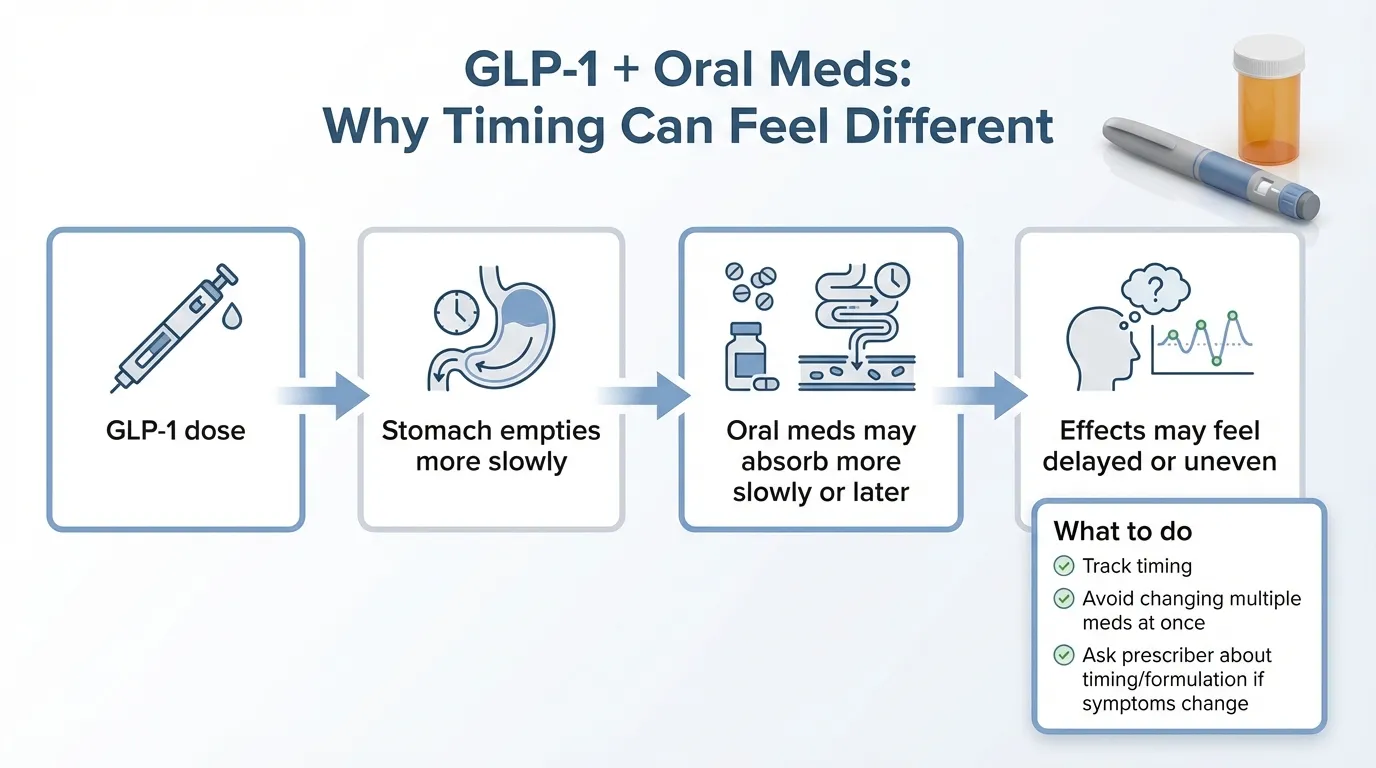
1. Stomach timing. GLP-1 medicines can delay stomach emptying. Adderall is swallowed. That creates a real reason to track timing, but it does not create a predictable number of hours.
2. Appetite and fluids. Adderall can reduce appetite. GLP-1 medicines are designed to reduce food intake. Stacked, some people may stop eating or drinking enough without noticing.
3. Heart rate and sleep. Adderall raises average heart rate and blood pressure. Several GLP-1 labels report small average heart-rate increases. Dehydration, poor sleep, caffeine, illness, and other stimulants can pile on top.
Notice what is not established: a metabolic interaction where one medicine is proven to block or speed up the breakdown of the other. The label-based issue is stomach timing and overlapping effects, not a proven CYP interaction.
Also on an antidepressant? Adderall's label flags serotonergic drugs and CYP2D6 inhibitors. That is a separate medication review.
Why does my Adderall feel different since I started a GLP-1?
Answer: Your stimulant's formulation may matter, but the exact effect of a GLP-1 is unknown. Several stimulant labels report what happened after a high-fat meal. Those studies found meal-related peak-time shifts from 5 hours later for Mydayis to no delay for Concerta and Dyanavel XR tablets. They are useful clues, not a GLP-1 prediction.
This is the part most quick answers leave out, so let us explain where the numbers come from before we show them.
The useful clue FDA labels already contain
Before approval, manufacturers often test a swallowed medicine with and without a high-fat meal. They measure how the meal changes the time to peak blood level, the peak level itself, and total exposure.
A high-fat meal and a GLP-1 are not the same test. Food can affect stomach movement, acidity, dissolution, coatings, and absorption. A GLP-1 can delay stomach emptying over a much longer window.
So do not read the numbers below as, "My GLP-1 will delay my medicine by this many hours." Read them as a label-based comparison of how nine stimulant formulations behaved in food-effect testing. The studies were not head-to-head, and they used different products and doses.4
That's the difference between real data and made-up precision. We're giving you the first one.
The table: nine stimulant food-effect results, side by side
| Your stimulant | What a high-fat meal did in its label | What that can — and cannot — tell you |
|---|---|---|
| Mydayis | d-amphetamine peak: +5.0 hrs (7.0 → 12.0); l-amphetamine: +4.5 hrs. Total exposure unchanged. | Large meal-related timing shift. It does not prove a GLP-1 will cause a five-hour delay. |
| Adderall XR | d-amphetamine peak: +2.5 hrs (5.2 → 7.7); l-amphetamine: +2.7 hrs. Total exposure unchanged. | Worth tracking if onset moves. It does not prove the dose became weaker. |
| Adzenys XR-ODT | Median peak: +2.0 hrs (5.0 → 7.0). Peak level fell; total exposure was similar. | Food changed both timing and peak level in this study. |
| Vyvanse capsule | Peak: about +1 hr (3.8 → 4.7). Peak level and total exposure were unchanged. | Smaller meal-related timing shift in this study. Still not a GLP-1 study. |
| Concerta | No difference in pharmacokinetics or pharmacodynamic performance after a high-fat breakfast. | The label did not find a food effect under its study conditions. |
| Focalin XR | No direct Focalin XR food study. A same-type racemic methylphenidate formulation showed a longer lag and variable peak delays. | There is no honest single-hour number for Focalin XR. |
| Dyanavel XR | Oral suspension: about +1 hr. Tablet: no median peak delay. | The dosage form matters even under the same brand. |
| Cotempla XR-ODT | Peak came 0.5 hr earlier (5.0 → 4.5); peak level fell 24%; total exposure rose 16%. | "Earlier" did not mean "stronger." Timing, peak, and total exposure moved in different directions. |
| Adderall IR | The label says the food effect has not been studied. | Genuinely unknown. Do not borrow the XR number. |
Read the top and bottom rows again. The range is real. But it does not create a five-fold GLP-1 effect, and it does not rank which medicine is "safe" with a GLP-1.
What it gives you is a better question: Did the start time move, did the whole day feel weaker, or did the medicine last into bedtime? Those are different problems.
Why Vyvanse's meal result is smaller
Vyvanse is a prodrug. Its label says it is converted to dextroamphetamine mainly in the blood through red blood cell activity. The label also says it is not metabolized by CYP450 enzymes.4
That helps explain why its high-fat-meal study changed the peak time by about one hour without changing peak level or total exposure. It still does not tell us what a GLP-1 will do in one person.
Why Adderall XR and Mydayis can show larger timing shifts
Adderall XR contains immediate-release and delayed-release beads. Mydayis contains one immediate-release bead type and two delayed-release bead types that release at different pH levels.14
A peer-reviewed review of stimulant formulations explains why that matters: gut pH and transit time can change how some extended-release portions release, which may shorten or lengthen the effect.7
That makes formulation a real thing to track. It does not make the meal table a dosing rule.
The good news buried in Zepbound's own label
Here's a number that should lower the panic a little.
Zepbound's label says its stomach-emptying effect is greatest after the first dose and gets smaller after later doses. The manufacturer measured that with acetaminophen:2
| When | What happened to the swallowed test drug |
|---|---|
| First 5 mg dose | Peak level fell 55%; peak arrived 1 hour later; total exposure did not change |
| Week 6, at 15 mg | No meaningful effect on peak level or peak time |
This does not prove Adderall behaves the same way. It does show that tirzepatide's stomach-emptying effect is not fixed at one strength forever. Trulicity and Mounjaro labels describe the same first-dose-largest pattern.
Practical version: starting and dose increases are checkpoints. Watch for a repeatable pattern. There is no universal "one bad week" rule, and symptoms do not always settle on the same clock.
But your Adderall might feel off for four different reasons
Before you blame the GLP-1, run through this. The next step is different for each one.
| What you notice | One possible explanation | What to record |
|---|---|---|
| Kicks in later, but works once it starts | Stomach or formulation timing may have shifted | Dose time and first clear effect |
| Flat all day, no punch | You may be eating far less, sleeping poorly, or sick | Meals, fluids, sleep, illness |
| Feels stronger, jittery, or runs into bedtime | Dehydration, caffeine, poor sleep, or a timing change may be adding up | Fluids, caffeine, sleep, start and end time |
| Nothing lines up with your shot or dose change | The GLP-1 may not be the cause | Stress, sleep, illness, and any pharmacy/manufacturer change |
On that dehydration line: Adderall XR's label says amphetamine recovery in urine depends partly on urine pH and urine flow. It also says kidney problems can prolong exposure.1 That makes low fluid intake a plausible thread to discuss, not a proven GLP-1–Adderall interaction.
Follow the fluid plan your clinician gave you. If vomiting or diarrhea keeps you from holding fluids down, call. See our GLP-1 electrolyte and dehydration guide for the separate hydration question.
What people report — and what those reports cannot prove
Public ADHD and GLP-1 discussions repeat the same themes: later onset, weaker effect, longer duration, no change at all, and worry about having no appetite left.
Those are personal reports, not proof that a GLP-1 caused the change. We include the themes because they show what people are trying to describe. The range is the finding: experiences vary, and a general article cannot tell you which group you will land in.
What it can do is help you turn "something feels off" into a timeline a clinician can use.
📋 Turn "something feels off" into something a clinician can use
Build My GLP-1 + Adderall Check-In Note →
Pick your exact medicines, write down what changed, and use the one-page note and seven-day log below.
No account. No email. The note does not submit or store your answers. And it will never tell you to change a dose — that's not its job, and it's not ours.
Does Adderall IR vs. XR matter — and what about injection day?
Answer: IR and XR matter because they are different formulations, but no direct GLP-1 study tells us which one changes more. Adderall IR's food effect has not been studied. Adderall XR contains immediate- and delayed-release beads and has a measured high-fat-meal peak delay. No injectable GLP-1 label tells you to skip or move Adderall on injection day. Oral semaglutide is the clear exception because its own label requires a 30-minute gap before any other swallowed medicine.
Quick guide by formulation
| Your Adderall | What you might notice | What to do |
|---|---|---|
| Immediate release | A change in how fast it starts or how soon it fades | Write down the timing. Do not take an extra dose to make up for a weak day. |
| Extended release | A later start, a longer tail, or medicine running into sleep | Log start time, end time, and sleep. Bring the pattern to your prescriber. |
| Both IR and XR | A messier daily pattern that is harder to read | List each dose separately in the check-in note. |
Injection day: there is no label rule, and that is the answer
We looked. None of the injectable GLP-1 labels we reviewed tells you to skip your stimulant, move it, or space it away from your shot.
The absence of a rule does not prove timing never matters. But it does mean nobody should invent an injection-day schedule for you from a blog post. Follow your prescriptions and any clinician instructions you already have. Do not create a new schedule on your own.
The morning collision: two labels, one time slot
Here is a real written conflict:
| Medicine | What its own label says |
|---|---|
| Adderall XR | Take upon awakening; avoid afternoon doses because of insomnia risk. |
| Wegovy tablets, Ozempic tablets, or Rybelsus | Take on an empty stomach in the morning with no more than 4 oz of plain water, then wait at least 30 minutes before food, drinks, or any other oral medicine. |
| Foundayo | Take once daily, with or without food. No separation rule from other pills is listed. |
If you take oral semaglutide and Adderall XR, you cannot take both at the exact same moment and follow both labels. Oral semaglutide's manufacturer requires the 30-minute gap.2
That is not our invented schedule. That is the written label rule. Follow it, do not add a longer gap on your own, and ask your pharmacist to confirm the order for your exact prescriptions.
And notice the fork: among the oral GLP-1 medicines in this guide, Foundayo has no morning separation rule. That is a real convenience point for a morning pill traffic jam. It also has the highest reported average heart-rate increase in our label table. Nothing is free.
If your GLP-1 is a shot, the 30-minute oral-semaglutide rule does not apply.
What does each GLP-1's label actually say if you also take Adderall?
Answer: No approved GLP-1 label we reviewed names Adderall, but the labels differ meaningfully on stomach emptying, other oral medicines, morning dosing, and heart rate. Oral semaglutide requires a 30-minute separation from other pills. Foundayo can be taken with or without food. Injectable products carry stomach-emptying warnings without an Adderall-specific timing rule.
GLP-1 + Adderall Label Evidence Matrix — v1.1
Last checked August 7, 2026. We searched each current prescribing information document for the literal word "Adderall," then recorded the product's oral-medicine language, dosing rule, and reported average heart-rate change.2
| GLP-1 medicine | "Adderall" in the label? | What the label says about pills and stomach emptying | Average heart-rate change reported | What that means for you |
|---|---|---|---|---|
| Wegovy injection (semaglutide) | Not found | Delays stomach emptying and may affect absorbed oral medicines; monitor medicines taken by mouth | About +1 to 4 bpm | Track onset, duration, appetite, fluids, and sleep after starting or increasing. Do not assume you need a timing change. |
| Ozempic injection (semaglutide) | Not found | Delays stomach emptying and may affect absorption of oral medicines; label says no clinically relevant absorption effect was seen with medicines studied | About +2 to 3 bpm | Same practical check: look for a repeatable change, not one odd day. |
| Wegovy tablets (semaglutide) | Not found | Empty stomach in the morning, no more than 4 oz of plain water, then wait at least 30 minutes before food, drinks, or other oral medicine | Label says heart-rate findings were similar to Wegovy injection | This has a real written morning rule. Follow it and ask your pharmacist where Adderall fits. |
| Rybelsus / Ozempic tablets (semaglutide) | Not found | Same empty-stomach, no-more-than-4-oz, 30-minute rule | About +1 to 3 bpm in placebo-controlled tablet trials | This also has a real written morning rule. |
| Zepbound (tirzepatide) | Not found | Delays stomach emptying; effect was greatest after the first dose and diminished after later doses | About +1 to 3 bpm | Starting and dose increases are checkpoints. Watch for a repeatable pattern. |
| Mounjaro (tirzepatide) | Not found | Delays stomach emptying; effect was greatest after the first dose and diminished after later doses | About +2 to 4 bpm, versus about +1 bpm with placebo | Same timing checkpoint, with its own trial average. |
| Saxenda (liraglutide) | Not found | Delays stomach emptying and may affect absorption of oral medicines | About +2 to 3 bpm | Report lasting racing or pounding at rest and keep an eye on food and fluids. |
| Trulicity (dulaglutide) | Not found | Delays stomach emptying; the delay was largest after the first dose and diminished with later doses | About +2 to 4 bpm | The first dose and treatment changes are useful checkpoints. |
| Foundayo (orforglipron) | Not found | Delays stomach emptying; the delay was largest after the first dose and diminished over time. Take with or without food. | About +4 to 5 bpm, versus about +0.5 bpm with placebo | No 30-minute morning separation rule, but the highest reported average heart-rate increase in this table. Raise that if you already take a stimulant. |
| Compounded semaglutide or tirzepatide | No single FDA-approved label exists | Concentration, directions, ingredients, and delivery device may differ by compounder and prescription | Approved-product trial averages cannot be assigned to a compounded preparation | Get the exact product name, concentration, dose in units and milligrams, written directions, and pharmacy or outsourcing-facility name. |
How to read this table: "Adderall was not found" means the label did not name it. It does not mean the pair was tested and cleared. The label may still contain broader warnings about swallowed medicines, stomach emptying, appetite, heart rate, or dehydration that matter to your decision.
⚠️ Compounded is not just another brand
A compounded GLP-1 is not FDA-approved, and FDA does not review it for safety, effectiveness, or quality before it reaches a patient. Depending on how it is compounded, it may come from a state-licensed pharmacy or an FDA-registered outsourcing facility. It is not an FDA-approved generic version of Wegovy, Ozempic, Mounjaro, or Zepbound.8
That matters on a page about formulation. With an approved product, you and your pharmacist can open one label and see the exact strength and instructions. With a compounded preparation, the concentration, directions, inactive ingredients, or device may differ. Ask for the written directions, concentration in mg/mL, prescribed dose in mg, dose in units if a syringe is used, and the compounder's name before you start.
Can two appetite suppressants at once be too much?
Answer: Yes, for some people. Adderall XR lists loss of appetite, and GLP-1 medicines reduce food intake and can make eating harder through lower appetite, nausea, vomiting, diarrhea, or early fullness. The useful question is not whether you hit a number a website picked. It is whether you can eat and drink consistently, function normally, and avoid ongoing weakness, dizziness, or vomiting.
Look at how strong the Adderall side alone is. From its own adult trial data:1
| Effect | Adderall XR | Placebo |
|---|---|---|
| Loss of appetite | 33% | 3% |
| Dry mouth | 35% | 5% |
| Weight loss | 10% | 0% |
One in three adults reported appetite loss. And that is before you add a medicine designed to turn down appetite and food intake.
Why this is the risk that actually catches people
Nausea announces itself. Not eating does not. There is no alarm. You just look up on Thursday and realize the last real meal was Tuesday.
That is what people describe over and over: having to force themselves to eat, or reaching the end of the day before noticing they forgot.
The cost is not just being hungry later. Too little food or fluid can show up as weakness, dizziness, dehydration, mood changes, poor sleep, and loss of muscle. It can also make it harder to tell whether your stimulant changed or your body is running on less food, fluid, and sleep.
Signs it is time to call, in plain terms
We are not going to hand you a calorie target or protein number. A web page does not know your body. Watch for function instead:
- You repeatedly cannot finish a normal meal
- Most of the day goes by and you realize you forgot to eat, again
- You feel dizzy or unusually weak, especially when standing
- You cannot keep fluids down
- Vomiting or diarrhea will not stop
- It is getting in the way of work, driving, or looking after your kids
- Weight is coming off faster than your clinician expected
- New fear around food, or old eating-disorder patterns creeping back
That last one deserves its own attention. Tell the prescriber before starting or increasing treatment. Our GLP-1 contraindications guide separates official label contraindications from warnings and situations that need a closer review.
Who to call for what
- Your prescriber — for medication effects and dosing
- Your pharmacist — for formulation and timing questions; give them a complete list if the prescriptions are filled at different pharmacies
- A registered dietitian — for an eating plan built for your needs
- Urgent care or the emergency room — for the red-flag symptoms at the top of this page
What about my heart?
Answer: Adderall XR's label reports average increases of about 2 to 4 mmHg in blood pressure and about 3 to 6 beats per minute in heart rate. GLP-1 labels report their own average heart-rate increases, ranging from about 1 to 5 bpm depending on the product. These figures came from separate studies in separate people and cannot be added together to predict what happens in one person.12
What the labels report, side by side
| Medicine | Reported average change |
|---|---|
| Adderall XR | Blood pressure +2 to 4 mmHg; heart rate +3 to 6 bpm |
| Wegovy injection | Heart rate +1 to 4 bpm |
| Ozempic injection | Heart rate +2 to 3 bpm |
| Rybelsus / Ozempic tablets | Heart rate +1 to 3 bpm |
| Zepbound | Heart rate +1 to 3 bpm |
| Mounjaro | Heart rate +2 to 4 bpm, versus about +1 bpm with placebo |
| Saxenda | Heart rate +2 to 3 bpm |
| Trulicity | Heart rate +2 to 4 bpm |
| Foundayo | Heart rate +4 to 5 bpm, versus about +0.5 bpm with placebo |
The thing we will not do, and neither should anyone else
You may see pages add these together — "Adderall raises your pulse 6 and Wegovy raises it 4, so expect 10."
That math is wrong and we are not doing it. Those numbers came from different trials, different patients, and different lengths of time. Averages from separate studies do not stack into a personal forecast. Anyone confidently giving you one combined number is guessing with a calculator.
One number worth knowing that averages hide
Averages smooth over the people with larger changes. Wegovy's label reports that 26% of adults had a maximum heart-rate increase of 20 bpm or more at any visit, compared with 16% on placebo. For a 10-to-19-bpm increase, it was 41% versus 34%.2
That does not tell you what the combination will do. It tells you why one average cannot settle the question for one person. You find a pattern by measuring only what your clinician asks you to measure, not by adding label averages.
What to actually watch
Track the vital signs your clinician asked for, plus symptoms:
- Resting pulse, if they asked, using the method or device instructions they gave you
- Blood pressure, if they asked
- Fluttering, racing, or pounding in your chest
- Chest discomfort
- Dizziness or near-fainting
- Shortness of breath
- Whether any of it lines up with your medicine, meals, fluids, caffeine, illness, or exercise
We are not going to give you a universal "safe pulse number." We do not know your baseline, age, fitness, heart history, or the threshold your clinician set. A number invented by a website is worse than no number. Use your clinician's threshold and the urgent-symptom list at the top of this page.
If you are layering coffee on top of all this, that is another variable. See GLP-1 and coffee.
Whose side effect is this — the GLP-1 or the Adderall?
Answer: Nausea, diarrhea, dizziness, lower appetite, and a faster heartbeat can show up during either treatment. Dry mouth and insomnia are much more clearly tied to Adderall. Timing can give you a clue, but it cannot prove which medicine caused a symptom.
Here is the overlap, using Adderall XR's adult trial numbers against placebo:1
| Symptom | Adderall XR | Placebo | Can it overlap with GLP-1 treatment? |
|---|---|---|---|
| Loss of appetite | 33% | 3% | ✅ Yes — GLP-1 medicines reduce appetite and food intake |
| Insomnia | 27% | 13% | ❌ Not a typical GLP-1 effect |
| Nausea | 8% | 3% | ✅ Yes — common with GLP-1 medicines |
| Dizziness | 7% | 0% | ✅ Yes — appears in GLP-1 labeling |
| Diarrhea | 6% | 0% | ✅ Yes — common with GLP-1 medicines |
| Fast heartbeat | 6% | 3% | ✅ Yes — several GLP-1 labels report heart-rate increases |
| Dry mouth | 35% | 5% | ⚠️ More clearly tied to Adderall; low intake or dehydration can add to it |
Five clear overlaps, one likely stimulant effect, and one symptom that can get worse when intake drops. No wonder people cannot tell.
The timing test
A weekly or dose-change rhythm points you toward the GLP-1. Symptoms may show up after a weekly shot or after an increase, then ease before the next dose. Not everyone follows that pattern.
A daily rhythm points you toward the stimulant. The symptom starts after the daily dose and repeats at about the same point in the day.
Neither rhythm means look wider. Sleep, illness, stress, caffeine, a new supplement, an acid reducer, or a pharmacy switching the generic manufacturer can all muddy the picture.
Why this matters: people sometimes blame the wrong medicine. Someone may blame Adderall for nausea that began with GLP-1 dose escalation, or blame the GLP-1 for insomnia that follows the stimulant every day. A log can expose the pattern. Guessing cannot.
Struggling to think clearly? Record when it happens, what you ate and drank, how you slept, and where it falls after each medicine. "Brain fog" is a symptom description, not a diagnosis.
The bigger risk usually isn't the GLP-1. It's what gets added next.
Answer: No current GLP-1 label we reviewed names Adderall as an interaction. But some weight-loss programs also use phentermine, Qsymia, or Contrave. Those are not interchangeable with a GLP-1. Each adds a separate stimulant, heart-rate, seizure, metabolism, or opioid issue that deserves its own medication review.9
We almost did not include this section, because it probably costs us money. We are including it because if we do not say it, somebody may reach the checkout before realizing the "add-on" is the bigger question.
You searched for the GLP-1 question. The GLP-1 may not be the medicine we would ask about first.
The add-on map
| If a program offers | What its own label says | Why it matters on Adderall |
|---|---|---|
| Phentermine (Adipex-P, Lomaira) | Phentermine is a sympathomimetic amine with pharmacologic activity similar to amphetamine. Its label says combining it with other weight-loss drug products is not recommended because safety and effectiveness have not been established. | This adds an amphetamine-like stimulant to a Schedule II stimulant. Blood pressure, pulse, sleep, anxiety, appetite, heart history, and misuse risk all need a real review. |
| Qsymia | Qsymia contains phentermine plus topiramate. Its label reports heart-rate increases and carries separate warnings tied to topiramate, including pregnancy risk, mood effects, cognitive effects, metabolic acidosis, and seizure risk if stopped suddenly. | The phentermine issue is still inside the capsule. The topiramate part adds a second set of questions. |
| Contrave | Contrave contains naltrexone plus bupropion. Bupropion can cause seizures and inhibits CYP2D6. Adderall XR's label says CYP2D6 inhibitors may increase Adderall XR exposure and serotonin-syndrome risk, and stimulants may lower the convulsive threshold. | This is not a blanket ban, but it is a real interaction review — especially with seizure history, uncontrolled blood pressure, an eating-disorder history, or other medicines. Contrave also cannot be used with chronic opioids. |
For contrast, CVS MinuteClinic says it does not prescribe compounded GLP-1 medicines or controlled weight-loss substances, including phentermine.9 That policy does not make every other clinic wrong. It shows that reputable programs can draw very different lines around add-on medicines.
The sentence to have ready
If a program offers you a "boost," "stack," or "accelerator," say this:
"I'm already on a Schedule II stimulant. What exactly is in this add-on, and why is it appropriate with my full medication list?"
A good clinician will have an answer, and it may be a fine answer. A sales script will not. That question sorts them in about four seconds.
What should you track, and for how long?
Answer: Track what changed before trying to explain why. Seven days of dose times, when focus starts and ends, appetite, meals, fluids, stomach symptoms, sleep, and any vital signs your clinician requested give your care team far more to work with than "my medication feels off."
Three days before, if you can
If you have not started yet, you have an advantage most people waste. Write down three ordinary days:
- What time you take each Adderall dose
- When you first feel it working
- When it wears off
- What you ate and drank
- How you slept
- Coffee and anything else with caffeine
- Pulse or blood pressure, only if your clinician asked
That is your baseline. Without it, you will be comparing week two against a memory, and memory is a terrible instrument.
Seven days after starting or increasing
Use the same fields, plus:
- Exact GLP-1 product, dose, and the day or time you took it
- Whether either medicine changed
- Nausea
- Vomiting
- Diarrhea or constipation
- Dizziness
- Heart fluttering, racing, or pounding
- Whether you kept food and fluids down
Look for a pattern, not a bad Tuesday
One rough day proves nothing. Everyone has rough days. What is useful is a repeated link to a start date, dose increase, daily dose, weekly shot, stomach symptoms, sleep, or low intake.
Then hand the pattern to a clinician. You collect the data. They read it. That division of labor is the whole point.
📊 Start the log before the first GLP-1 dose, not after
Start My 7-Day Medication Log →
Timing, appetite, stomach symptoms, sleep, and any vital signs your clinician asked for — in a printable format built to be handed across a desk.
You cannot tell what changed if you never wrote down where you started.
When should you call — and when is it urgent?
Answer: Contact your prescribing team promptly for a repeated change in how your stimulant works, ongoing trouble eating, lasting vomiting or diarrhea, dizziness, pounding or racing at rest, or disrupted sleep. Call 911 or go to the emergency room for chest pain, fainting, severe trouble breathing, or signs of a serious allergic reaction. Get urgent medical help for severe or lasting abdominal pain or being unable to keep fluids down and getting worse.
Call your team soon
- Adderall repeatedly feels much weaker or much stronger
- It consistently starts much later than it used to
- It is still going at bedtime and wrecking your sleep
- Your heart flutters, races, or pounds at rest more than once
- You keep not eating enough
- Vomiting or diarrhea will not quit
- Dizziness or weakness gets in the way of your day
- A clear new pattern started after a GLP-1 or Adderall change
- You are not sure how an oral GLP-1 timing rule fits with your stimulant
Use your prescriber's after-hours instructions. We are not going to invent a universal "within 24 hours" rule. Your practice's instructions and your own emergency plan beat ours.
Call 911 or go to the emergency room
- Chest pain
- Fainting or nearly fainting
- Severe trouble breathing
- Swelling of the face, lips, tongue, or throat; trouble swallowing; or other signs of a serious allergic reaction
- Anything that feels like an immediate emergency
Get urgent medical help
- Severe or persistent belly pain, especially if it goes to the back
- Confusion or severe weakness
- You cannot keep fluids down and are getting worse
- Repeated vomiting or diarrhea with signs of dehydration
While you are waiting to hear back
- Do not take an extra Adderall dose to make up for a weak day
- Do not take anyone else's medication
- Do not pile on caffeine
- Do not build a new schedule from a forum post
- Do not drive or do anything risky if you feel off
- Do follow the emergency instructions your prescriber or pharmacy already gave you
What should you ask each of your prescribers?
Answer: Many people taking both medicines have separate prescribers and records that do not fully connect. A pharmacist may see both prescriptions only when they are filled in the same system or you give a complete medication list. The highest-value step is making sure everyone has the same facts in writing: exact products, formulations, doses, start dates, and what changed.
Let's name the thing nobody names. You may have two prescribers. Their charts may not talk. Your ADHD prescriber may not know you started a GLP-1. Your GLP-1 prescriber may have "Adderall" in a medication box they never discussed with you.
You are the one person who can see both sides. That is not fair, but it is the situation, and it is fixable with one page of paper.
For your GLP-1 prescriber
- "Do you know I take Adderall — and do you know whether it is IR, XR, or both?"
- "Does the exact product you prescribed have an oral-medicine warning or morning timing rule?"
- "Which symptoms should make me call you?"
- "What eating or hydration problems would make you rethink the plan?"
- "Do you want me tracking blood pressure or pulse?"
- "Should we change the speed of dose escalation because I take a stimulant?"
- "Who do I call after hours?"
For your ADHD prescriber
- "My Adderall started working differently around [date]. Is that worth reviewing?"
- "Do you need the exact GLP-1 product and whether it is a shot or a pill?"
- "What should I record before our next appointment?"
- "Which heart-rate, blood-pressure, appetite, or sleep changes matter for me?"
- "Should a pharmacist review the exact products together?"
For your pharmacist — the safety net people forget
A pharmacist can check the exact formulations, not just the class names. If your medicines come from different pharmacies, bring the labels or a complete list.
- "Can you check the exact products and formulations, not just the drug classes?"
- "How should my Adderall schedule fit around this product's written instructions?"
- "Is my semaglutide oral or injectable?"
- "This one is compounded — what exactly are the concentration and written directions?"
- "Could anything else I take be contributing — a supplement, decongestant, antacid, or acid reducer?"
That last one is not filler. Adderall XR's current label separately flags alkalinizing agents, acidifying agents such as ascorbic acid, and proton pump inhibitors. They can change blood levels or peak timing.1
🖨️ One page. Three clinicians. Same information.
Print the Questions for Both Prescribers →
Put your timeline, exact formulations, written label rule, and questions on one sheet you can hand across a desk or upload to a portal.
GLP-1 + Adderall check-in note: copy or print this
Answer: Fill in the blanks before you call or message. This note does not score risk or tell you what to change. It gives your GLP-1 prescriber, ADHD prescriber, and pharmacist the same facts.
My exact medicines
| Question | My answer |
|---|---|
| GLP-1 brand or pharmacy name | |
| Active ingredient | |
| Shot or pill | |
| Strength and dose | |
| Date started | |
| Last dose increase and date | |
| Adderall IR, XR, or both | |
| Each Adderall strength and dose time | |
| Other prescriptions, over-the-counter medicines, and supplements | |
| Caffeine each day |
What changed
The change started on: ____________________
It began after:
[ ] First GLP-1 dose
[ ] GLP-1 dose increase
[ ] Adderall start or change
[ ] Pharmacy or manufacturer change
[ ] New medicine or supplement
[ ] Illness, vomiting, or diarrhea
[ ] No clear change
What I notice:
[ ] Starts later
[ ] Feels weaker
[ ] Feels stronger or jittery
[ ] Lasts longer
[ ] Wears off sooner
[ ] Runs into bedtime
[ ] Less appetite
[ ] Trouble eating
[ ] Nausea or vomiting
[ ] Diarrhea or constipation
[ ] Dry mouth
[ ] Dizziness or weakness
[ ] Racing, pounding, or fluttering at rest
[ ] Other: ____________________
The pattern repeats: ____________________________________________
What still works normally: ______________________________________
My seven-day medication log
| Day/date | GLP-1 dose/time | Adderall dose/time | First clear effect | Wore off | Food and fluids | Stomach symptoms | Sleep | Vitals only if clinician asked |
|---|---|---|---|---|---|---|---|---|
| Day 1 | ||||||||
| Day 2 | ||||||||
| Day 3 | ||||||||
| Day 4 | ||||||||
| Day 5 | ||||||||
| Day 6 | ||||||||
| Day 7 |
Copy this into a portal message
I take [exact Adderall product, IR/XR, dose, and times] and [exact GLP-1 product, shot/pill, and dose]. The GLP-1 was started or increased on [date]. Starting on [date], I noticed [what changed]. It happens [pattern]. I am also taking [other medicines, supplements, acid reducers, decongestants, and caffeine]. I can/cannot eat and drink normally. I do/do not have vomiting, diarrhea, dizziness, sleep trouble, or racing/pounding at rest. Should you review the timing, formulation, dose-escalation plan, or anything else I take?
Put these three questions at the bottom
- For the GLP-1 prescriber: Does my exact product have a written oral-medicine or morning timing rule?
- For the ADHD prescriber: Does this repeated change need a review of my stimulant formulation or schedule?
- For the pharmacist: Can you check the exact products together, including antacids, acid reducers, vitamin C, decongestants, and supplements?
Do not use this note to delay emergency care. Call 911 or go to the emergency room for chest pain, fainting, severe trouble breathing, or signs of a serious allergic reaction.
Will a weight-loss provider turn me down for being on Adderall?
Answer: Adderall is not on the contraindication list in the approved GLP-1 labels we reviewed. That means a prescribed stimulant is not an automatic label-based disqualifier. A clinician may still pause, ask questions, request records, or decide treatment is not right based on your heart history, blood pressure, eating, other medicines, or the exact program's rules.
Let's take the fear head-on, because we know it is there.
Being on a Schedule II stimulant does not automatically disqualify you. Say it clearly in the intake. Include whether it is IR, XR, or both, the dose, each dose time, and who prescribes it. Hiding it is the version of this that goes badly.
And the reverse fear: starting a weight medicine does not automatically cancel an ADHD prescription. Your ADHD prescriber still makes that decision. What they need is the full picture before they are asked to explain a new timing, appetite, sleep, blood-pressure, or heart-rate change.
What a good program asks you
Watch for these four. Their absence tells you something:
- Every medicine you take, including controlled substances, with the exact formulation
- Your heart history and blood pressure
- Whether you can currently eat and drink normally
- Who else prescribes for you
Here is the part we would rather not tell you
The fastest online path may begin with a form, not a live visit.
Ro's official pages describe an online health history reviewed by a clinician, and its telehealth FAQ says video is required only in a small number of states. Ro does not promise every person a live video visit before a prescription decision.10
If you take a Schedule II stimulant and want to talk in real time before anything is prescribed, that preference is reasonable.
So here is the damaging admission: Ro is not the best fit for everyone. If choosing the individual clinician and having video visits are your top priorities, Sesame Care is the cleaner fit. Sesame says its program includes a provider you choose, a video assessment, ongoing video visits, messaging, and labs.11
Ro earns its place for a different reason. It lists FDA-approved products including Zepbound and Foundayo, publishes a simple online intake path, offers a free insurance coverage checker, and says its insurance concierge submits prior-authorization paperwork for members.10
That second point lands differently for this audience. If you have spent years fighting insurance over a stimulant, you already know what paperwork help is worth.
Provider-stated facts we checked on August 7, 2026
| Decision fact | What the provider states | What we verified |
|---|---|---|
| Live visit before prescribing | Ro starts with an online history reviewed by a clinician; video is required in some states, not all | Not guaranteed for every patient |
| FDA-approved choices | Ro currently lists Zepbound and Foundayo among its available GLP-1 options | Both products have current FDA-approved labeling |
| Insurance help | Ro offers a free coverage report and says its concierge handles prior-authorization paperwork for members | The coverage checker and insurance-concierge descriptions were live |
| Ro membership price | $39 for the first month; then $74 to $149 per month depending on plan | $74/month requires annual prepayment; the month-to-month plan is $149; medication is separate |
| Choose a clinician and use video | Sesame says members can use a provider of their choice with video assessment and ongoing video visits | This is the clearest reason to route there instead |
Why an approved product, specifically, may matter here
This whole page has been about formulation — beads, coatings, release timing, exact strengths, and exact instructions.
With an FDA-approved product, that information is published in one prescribing-information document. You can read it. Your pharmacist can read it. Your ADHD prescriber can read it.
A compounded preparation does not have one FDA-approved product label. Its concentration, directions, ingredients, or delivery device may differ by compounder. That is not proof that every compounded drug is unsafe. It is a real information cost when the question depends on exact formulation.
That is our reasoning, and you are free to disagree with it.
If you are ready to start
Ro's current membership pricing is $39 for the first month, then as low as $74/month with an annual plan paid upfront. The ongoing month-to-month plan is $149. Medication cost is separate and depends on the product and coverage.10
✅ Does this sound like your situation?
You take a prescription stimulant, you want an FDA-approved GLP-1 with a label you and your pharmacist can read, and you would like help with insurance paperwork.
Check your eligibility with Ro →
List Adderall in the medication section yourself. Include IR or XR, every dose, and your prescriber's name. That is the first safety step, not the whole review.
Prefer to pick your own clinician and use video visits? Sesame Care is the better route for that priority.
Not sure which care model fits? Skip both and take the 60-second matching quiz.
What if you take Vyvanse, Concerta, Ritalin, or a non-stimulant?
Answer: Different ADHD medicines behave differently. Their high-fat-meal studies do not tell us what a GLP-1 will do. They do show why you cannot copy the Adderall XR number onto Vyvanse, Concerta, Ritalin LA, a patch, or a non-stimulant.
Quick orientation:
- Vyvanse (lisdexamfetamine) — its capsule food study moved the peak about 1 hour later without changing peak level or total exposure. It is converted to active dextroamphetamine mainly in the blood, not by CYP450 liver enzymes.4
- Concerta (OROS methylphenidate) — its label reports no difference in pharmacokinetics or performance after a high-fat breakfast.4
- Ritalin LA — food caused a longer lag and variable delays in both peaks. The first peak and total exposure were unchanged, while the second peak was about 25% lower.4
- Focalin XR — its label says there was no direct food-effect study with Focalin XR. A same-type racemic methylphenidate formulation had a longer lag and variable peak delays. There is no honest one-hour number to give you.4
- Adderall IR — its label says the food effect has not been studied. Honest gap.1
- Skin patches — methylphenidate and dextroamphetamine patches bypass the stomach. But access is not simple: the Daytrana brand is no longer marketed, an authorized generic methylphenidate patch remains available, and Xelstrym announced an all-strength supply disruption beginning in June 2026.12 Ask the prescriber and pharmacist what is actually obtainable before treating a patch as the easy answer.
- Non-stimulants — atomoxetine, guanfacine, clonidine, and viloxazine use different mechanisms, so this page's amphetamine timing numbers do not transfer. Their own instructions still matter. For example, guanfacine extended release says not to take it with a high-fat meal because exposure rises.12
We are not going to write mini-verdicts for medicines we have not audited for this exact question. If yours is not in the table, bring the product name and formulation to your pharmacist and use the check-in note's "other ADHD medication" line.
Is Adderall a weight-loss drug?
Answer: No. Adderall tablets are FDA-approved for ADHD and narcolepsy. Adderall XR is FDA-approved for ADHD. Neither product is approved for weight management. Both carry a boxed warning for abuse, misuse, and addiction.1
Weight loss on Adderall is a side effect. Side effects are not treatments.
We say this because a portion of people reading this page are quietly wondering whether the appetite suppression is a feature. It is not, and we are not going to help anyone treat it as one. In Adderall XR's adult trial, 10% reported weight loss versus 0% on placebo.1 That is a side-effect figure, not proof of healthy or lasting weight loss.
Combining medicines to push appetite lower on purpose is not a strategy. It can leave people dehydrated, underfed, weak, and losing muscle along with fat.
If a big part of why you are on a stimulant is the appetite effect, that is a real conversation worth having with your prescriber. It is not a failure. It is just worth naming out loud.
Frequently asked questions about GLP-1 and Adderall
Can I take Adderall and an injectable GLP-1 on the same day? The injectable GLP-1 labels we reviewed contain no rule requiring you to skip or move Adderall on injection day. Follow both prescriptions and any clinician instructions, and report any repeated change in onset, duration, appetite, sleep, blood pressure, or heart symptoms.
Does semaglutide make Adderall less effective? Not established. Semaglutide delays stomach emptying, so timing is a reasonable thing to watch. But feeling different and absorbing less are not the same thing. Our August 7, 2026 search found no study that measured Adderall blood levels with semaglutide.3
Does a GLP-1 delay Adderall XR by 2.5 hours? That has not been shown. The 2.5-hour number came from Adderall XR's high-fat-meal study, not a GLP-1 study. Use it as formulation evidence, not a forecast.
Can a GLP-1 make Adderall last longer? Some people report a longer effect, but reports cannot prove the cause. Log dose time, first clear effect, end time, meals, fluids, caffeine, and sleep, then give the pattern to your prescriber.
Can I take an oral semaglutide pill and Adderall at the same time in the morning? Not at the exact same moment. Wegovy tablets, Ozempic tablets, and Rybelsus require waiting at least 30 minutes after the semaglutide tablet before taking any other oral medicine. Follow that written rule and ask your pharmacist to confirm the order for your prescriptions.2
Can I take Zepbound and Adderall XR? Adderall is not named in Zepbound's label. Zepbound delays stomach emptying and reports an average heart-rate increase of roughly 1 to 3 bpm. Its stomach-emptying effect was greatest after the first dose and smaller after later doses. The pair still needs individual review.
Can I take Wegovy and Adderall? Adderall is not named in Wegovy's label. Wegovy delays stomach emptying, may affect swallowed medicines, and reports an average resting heart-rate increase of about 1 to 4 bpm. Tell both prescribers if the stimulant starts later, feels different, or lines up with poor intake, dizziness, or pounding at rest.
Can I take Ozempic and Adderall? No named Adderall interaction appears in the current Ozempic injection or tablet labels we reviewed. Ozempic injection has the broader stomach-emptying and oral-medicine warning. Ozempic tablets have the 30-minute morning rule.2
Can I take Mounjaro and Adderall? Adderall is not named in Mounjaro's label. Tirzepatide delays stomach emptying, with the effect greatest after the first dose and smaller after later doses. Ask for review if a repeatable change starts after beginning or increasing treatment.
Can I take Foundayo and Adderall? Adderall is not named in Foundayo's label. Foundayo can be taken with or without food and has no 30-minute morning separation rule. It also reports the highest average heart-rate increase in this guide's label table — roughly 4 to 5 bpm versus about 0.5 bpm on placebo — which is worth raising when you already take a stimulant.2
What about compounded semaglutide or tirzepatide? There is no single FDA-approved label covering compounded preparations, and FDA does not review compounded drugs for safety, effectiveness, or quality before they reach patients. Ask for the exact active ingredient, concentration in mg/mL, prescribed dose in mg, syringe units if used, written directions, and compounder's name. Do not assume the approved-product table describes your preparation.8
Should I move my Adderall earlier to beat the slow stomach? Not on your own. That is a timing change to a controlled substance, and it belongs to your prescriber. Bring the log and let them decide.
What if I throw up right after taking my Adderall? Do not automatically take another dose. There is no universal time cutoff that proves how much absorbed. Call the dispensing pharmacist or prescriber for instructions tied to your exact formulation.
Can the combination cause too much weight loss? Both treatments can reduce appetite, and the pair has not been established as a safe way to lose faster. Contact your care team if eating becomes hard, symptoms disrupt your life, or weight is coming off faster than planned.
Do antacids, vitamin C, or heartburn pills matter here? Yes. Adderall XR's label says alkalinizing agents can raise amphetamine blood levels, acidifying agents such as ascorbic acid can lower them, and proton pump inhibitors can make the peak arrive earlier. If you started an antacid or acid reducer because of GLP-1 stomach symptoms, mention it.1
Does a GLP-1 treat ADHD? No approved GLP-1 is indicated to treat ADHD. Our search found no direct GLP-1–Adderall trial.3 Personal reports in either direction are not a reason to change ADHD treatment.
What if I also take insulin or a sulfonylurea? Those medicines bring a separate low-blood-sugar risk with GLP-1 treatment that has nothing to do with Adderall. Make sure the GLP-1 prescriber knows and follow the glucose-monitoring plan they gave you.
How we checked this
Answer: We reviewed current FDA prescribing information and DailyMed labels, searched every reviewed GLP-1 label for the literal word "Adderall," rebuilt the stimulant food-effect table from product labels, checked PubMed and ClinicalTrials.gov for direct combination research, and separated provider claims from facts we could verify. Patient discussions were used only to identify questions and language, not to prove a medical claim.
✅ What we actually verified — August 7, 2026
- Current Adderall XR prescribing information, revised April 2026: the seven-entry interaction table, blood-pressure and heart-rate figures, adult side-effect rates, food-effect pharmacokinetics, kidney language, and boxed warning
- Current labels for Wegovy injection and tablets, Ozempic injection and tablets, Rybelsus, Zepbound, Mounjaro, Saxenda, Trulicity, and Foundayo
- Whether the literal word "Adderall" appears in each reviewed GLP-1 label — it does not
- The food-effect rows for Mydayis, Adderall XR, Adzenys XR-ODT, Vyvanse, Concerta, Focalin XR, Dyanavel XR, Cotempla XR-ODT, and Adderall IR
- Zepbound's acetaminophen data: first-dose peak down 55%, peak one hour later, exposure unchanged, and no meaningful peak effect at week 6 on 15 mg
- Oral semaglutide's 30-minute rule and Foundayo's with-or-without-food instruction
- The heart-rate figures in the GLP-1 matrix
- Phentermine, Qsymia, and Contrave label facts used in the add-on map
- FDA's distinction between compounded and FDA-approved medicines
- Ro's current membership pricing, care model, listed medicines, coverage checker, and insurance-concierge claims
- Sesame's provider-choice and video-visit claims
- An interaction-database check on Adderall XR with semaglutide
❌ What we could not verify
- A completed or registered clinical trial designed to test an approved GLP-1 with Adderall. Our August 7, 2026 searches did not find one.
- Whether your Adderall blood level changes on a GLP-1
- A universal timing rule for injectable GLP-1 medicines
- A universal pulse, blood-pressure, calorie, or protein threshold that applies to everyone
- Whether any one symptom was caused by the GLP-1, Adderall, food, fluids, sleep, illness, caffeine, or another medicine
Our source order
- FDA-approved prescribing information and DailyMed
- FDA regulatory and safety publications
- Peer-reviewed research
- Official provider pages for provider-stated price, process, and availability
- Established interaction databases, including their own caveats
- Patient reports — for questions and language only, never for medical claims
Primary sources
- Adderall XR, Vyvanse, and Mydayis current prescribing information1
- Current approved GLP-1 prescribing information used in the evidence matrix2
- Current stimulant labels used in the nine-row food-effect table4
- Drugs.com interaction-check result and its stated limitation5
- Cortese and colleagues' ADHD and obesity meta-analysis6
- Peer-reviewed review of extended-release ADHD formulations7
- FDA information on unapproved compounded GLP-1 products8
- Official labels and clinic policy used in the add-on map9
- Ro's official pricing, care-process, medicine, and insurance pages10
- Sesame's official weight-loss program page11
- Current patch and non-stimulant product information12
- The dated PubMed and ClinicalTrials.gov searches for direct combination research3
Who made this and why
Written by the Weight Loss Provider Guide Research Team. We are an independent comparison resource for GLP-1 telehealth providers. No clinician reviewed this page, and we are not going to pretend one did — the medical claims here trace to a label, FDA publication, or peer-reviewed source you can open yourself.
We built it because the pages we reviewed answered "is there an interaction?" and then stopped. They were not answering the question people were actually typing, which is "why does my medicine feel different, and what do I do about it?"
Disclosure: Weight Loss Provider Guide may earn compensation from some services linked on this site. No provider paid to be included here, and no commercial relationship shaped the evidence in this guide.
Corrections: If something here is wrong, tell us and we will fix it with a dated note rather than a silent edit.
Next scheduled review: September 2026, or sooner if FDA labeling, safety communications, provider terms, or new research changes.
What to do next
Do not change either medicine on your own. Follow your prescriptions and any urgent instructions from your clinician.
If something already feels different, write it down before you try to explain it. If you have not started yet, write down three ordinary days first so you have something real to compare against.
Then get your GLP-1 prescriber, ADHD prescriber, and pharmacist looking at the same facts.
Build My GLP-1 + Adderall Check-In Note →
Free. No email. The note does not submit or store your answers. It organizes your timeline and questions. It does not diagnose you and will never tell you to change a dose.
Still not sure which GLP-1 care model is right for you? Take our free 60-second matching quiz.
This guide is for information only and is not medical advice. It cannot account for your medical history, other medicines, or clinician's judgment. Do not start, stop, or change any prescription based on what you read here. If you are having a medical emergency, call 911 or go to the nearest emergency room.
Footnotes
-
U.S. Food and Drug Administration, current combined prescribing information for Adderall XR, Vyvanse, and Mydayis, revised April 2026; DailyMed, current Adderall tablet labeling, accessed August 7, 2026. ↩ ↩2 ↩3 ↩4 ↩5 ↩6 ↩7 ↩8 ↩9 ↩10 ↩11 ↩12 ↩13
-
Current U.S. prescribing information, accessed August 7, 2026: Wegovy injection and tablets; Ozempic injection; Rybelsus and Ozempic tablets; Zepbound; Mounjaro; Saxenda; Trulicity; and Foundayo. ↩ ↩2 ↩3 ↩4 ↩5 ↩6 ↩7 ↩8 ↩9 ↩10 ↩11
-
Searches run August 7, 2026: PubMed — semaglutide/tirzepatide/GLP-1 with Adderall or mixed amphetamine salts and ClinicalTrials.gov — semaglutide/tirzepatide/GLP-1 with Adderall or mixed amphetamine salts. No completed or registered trial designed to test the pair was identified in those searches. ↩ ↩2 ↩3 ↩4 ↩5 ↩6 ↩7
-
Food-effect and formulation sources, accessed August 7, 2026: the current Adderall XR, Vyvanse, and Mydayis prescribing information; DailyMed labels for Adzenys XR-ODT, Concerta, Focalin XR, Dyanavel XR, Cotempla XR-ODT, and Ritalin LA. ↩ ↩2 ↩3 ↩4 ↩5 ↩6 ↩7 ↩8 ↩9
-
Drugs.com, Adderall XR and semaglutide interaction check, accessed August 7, 2026. The result states that no interactions were found and also warns that this does not necessarily mean none exist. ↩ ↩2 ↩3
-
Cortese S, et al. Association Between ADHD and Obesity: A Systematic Review and Meta-Analysis. American Journal of Psychiatry. 2016;173(1):34-43. ↩ ↩2
-
Childress AC, et al. Novel Formulations of ADHD Medications: Stimulant Selection and Management. Focus. 2021. ↩ ↩2
-
U.S. Food and Drug Administration, FDA's Concerns with Unapproved GLP-1 Drugs Used for Weight Loss, accessed August 7, 2026. ↩ ↩2 ↩3
-
DailyMed labels for phentermine, Qsymia, and Contrave; CVS MinuteClinic, Weight Loss Program, accessed August 7, 2026. ↩ ↩2 ↩3
-
Ro official pages, accessed August 7, 2026: Body Program and available medicines, membership pricing, telehealth FAQ, and Ro's asynchronous care-model explanation. ↩ ↩2 ↩3 ↩4
-
Sesame, online weight-loss program, accessed August 7, 2026. ↩ ↩2
-
Daytrana, brand-status and authorized-generic notice; Xelstrym, 2026 availability update; DailyMed, guanfacine extended-release labeling, accessed August 7, 2026. ↩ ↩2 ↩3
Related GLP-1 medication safety guides
Related Articles
GLP-1 and Metformin Together: Is It Safe?
Evidence guide on taking GLP-1 medicines with metformin: timing for oral semaglutide, stomach symptoms, low-blood-sugar and kidney risks, sick-day steps, B12 monitoring, and 16 FAQs.
Best Zepbound Providers That Send Prescriptions to Walmart
Verified Walmart routing guide comparing your own doctor, Walmart-listed virtual care, Ro, Sesame, LillyDirect pickup, retail KwikPen, and the Medicare GLP-1 Bridge, with current prices and 20 FAQs.
Best GLP-1 Providers That Send Prescriptions to Amazon Pharmacy
Compare 10 GLP-1 providers plus your own doctor by Amazon Pharmacy evidence tier, insurance and prior-authorization help, current prices, Medicare Bridge rules, delivery limits, and 18 FAQs.
Best Wegovy Providers That Send Prescriptions to Amazon Pharmacy
Compare eight evidence-graded Wegovy routes to Amazon Pharmacy, including Amazon One Medical, Ro, Sesame, Walgreens, e-prescribe details, dose prices, insurance, and 22 FAQs.
Best Zepbound Providers That Send Prescriptions to Amazon Pharmacy
Compare 11 Zepbound routes by Amazon evidence grade, device, cash and insurance price, Medicare Bridge rules, e-prescribe details, delivery, and 15 FAQs.
Best GLP-1 Providers That Send Prescriptions to Sam's Club
Compare seven checked GLP-1 routes to Sam's Club, current counter prices, the $250 KwikPen gap, Medicare Bridge rules, delivery, pickup, and 19 FAQs.