This page is a patient-education triage guide — not medical advice.
It does not replace your prescriber, a 24/7 nurse line, or emergency services. If you have trouble breathing, face or throat swelling, collapse, seizure, unresponsiveness, or severe worsening pain — stop reading and call 911 now.
GLP-1 Side Effects: What’s Normal, What’s Serious, and When to Go to the ER
By WPG Research Team · Last verified against FDA prescribing information on April 21, 2026
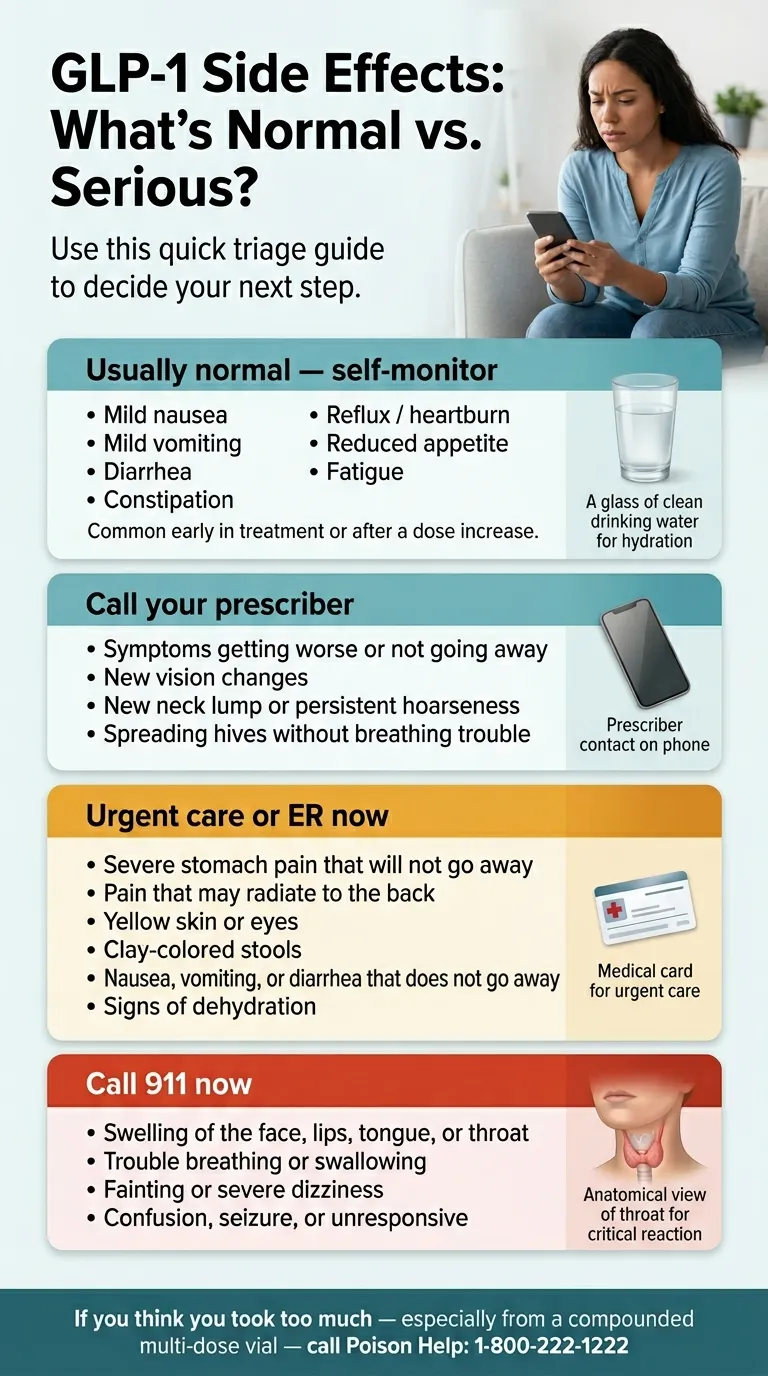
GLP-1 side-effect triage guide — four-tier framework. Last verified against FDA prescribing information April 21, 2026.
The short answer (before you scroll)
If you’re on a GLP-1 like Ozempic, Wegovy, Zepbound, or Mounjaro and trying to figure out if your side effect is normal or ER-worthy, here’s the line:
They cross into ER territory when any of these show up:
- Severe, persistent upper-abdominal pain that radiates to your back, with or without vomiting→ possible pancreatitis
- Severe right-upper-belly pain plus fever, yellowing skin or eyes, or clay-colored stools→ possible gallbladder emergency
- No gas or bowel movement for a day or more plus bloating, vomiting, and a swollen, tender belly→ possible bowel obstruction (ileus)
- You can't keep fluids down, your urine is dark, or you're dizzy standing up→ possible acute kidney injury from dehydration
- Face, lip, tongue, or throat swelling, trouble breathing, widespread hives, fainting, or severe dizziness after an injection→ call 911 — severe allergic reaction until proven otherwise
- Confusion, seizure, or unresponsive from low blood sugar — highest risk if you also take insulin or a sulfonylurea→ call 911
- You think you took too much — especially from a compounded multi-dose vial→ call Poison Help: 1-800-222-1222
Everything else on this page is how to match your exact symptom to the right next step — home care, prescriber call, urgent care, ER, or 911 — without guessing.
What this search sounds like in real life
People who end up on this page usually aren’t calmly researching. They’re scared. Community posts from real GLP-1 users sound like this:
“Can't even keep water down.”
“The smell of food makes me vomit.”
“I think I drew up the wrong amount, what do I do?”
Real community wording from Reddit threads — shared here as language context only, not medical evidence.
If any of those sound like you, you’re not overreacting for searching. You’re doing the right thing. The rest of this guide is built to help you decide in the next five minutes.
The GLP-1 Side-Effect Triage Matrix
Find your symptom in the left column, check the criteria, and take the matching action.
| Symptom pattern | Tier | Action |
|---|---|---|
| Face/lip/tongue/throat swelling, trouble breathing or swallowing, widespread hives, fainting, severe dizziness after an injection | Tier 4 — Call 911 | Call 911 immediatelyWegovy PI (hypersensitivity); Zepbound PI §5.6 |
| Confusion, seizure, can't be woken up, can't swallow glucose | Tier 4 — Call 911 | Call 911; give fast-acting glucose only if person can swallow safelyOzempic PI §5.5; Zepbound PI §5.7 |
| Chest pain, pressure, or shortness of breath that doesn't resolve | Tier 4 — Call 911 | Call 911 regardless of medicationACC/AHA universal guidance |
| Active suicidal thoughts or intent | Tier 4 — Call 911 | Text or call 988; 911 if imminentFDA Apr 3, 2026 Drug Safety Communication; MedlinePlus |
| Severe, unrelenting upper-abdominal pain, often radiating to the back, with or without vomiting | Tier 3 — ER now | Stop the medication. Go to the ER.FDA pancreatitis warning on every GLP-1 label |
| Severe right-upper-abdominal pain + any of: fever, yellowing of skin or eyes, clay-colored stools, or severe vomiting | Tier 3 — ER now | Go to the ERWegovy PI (acute gallbladder disease); Zepbound PI |
| Severe bloating + no gas or bowel movement for a day or more + persistent vomiting + distended, tender belly | Tier 3 — ER now | Go to the ER. Don't eat anything else.GLP-1 labels list ileus/intestinal obstruction in postmarketing experience; 4-symptom cluster is WPG's editorial framework |
| Can't keep fluids down, dark urine, very little urination, dizzy when standing | Tier 3 — ER now | Go to the ERGLP-1 labels warn of acute kidney injury from dehydration/volume depletion |
| You think you took too much — especially from a compounded multi-dose vial | Tier 3 — ER now | Call 1-800-222-1222 right now. ER if already vomiting, dizzy, or in pain.Zepbound Medication Guide; FDA compounded GLP-1 dosing-error alerts |
| Spreading hives or rash without airway symptoms | Tier 2 — Call prescriber | Call prescriber. Go to ER at first sign of airway or breathing changes.Zepbound PI §5.6 |
| New neck lump, persistent hoarseness, trouble swallowing that doesn't resolve | Tier 2 — Call prescriber | Call prescriber promptly. This is the thyroid C-cell tumor boxed warning.Wegovy, Zepbound PI Boxed Warning |
| Sudden vision change, especially in one eye (especially with diabetes) | Tier 2 — Call prescriber | Same-day call; ER for sudden severe lossOzempic PI |
| Moderate nausea, occasional vomiting, diarrhea, or constipation during the first weeks or after dose increase | Tier 1 — Self-monitor | Home care. Call prescriber if it lasts more than a few days or worsens.FDA PI §6.1 (every GLP-1); AGA 2022 |
| Mild injection-site redness, itching, or bruise resolving in 24–48 hours | Tier 1 — Self-monitor | Home care. Rotate injection sites.AAAAI 2024 |
| Reduced appetite, mild fatigue, occasional headache, heartburn | Tier 1 — Self-monitor | Home care. Call prescriber if persistent.FDA PI §6.1 |
Urgent care or ER? How to decide fast
Urgent care is built for things that need a clinician today but aren’t life-threatening. It is not built for abdominal imaging, IV rehydration for acute kidney injury, surgical consults, or managing anaphylaxis.
Neither urgent care nor ER
Self-monitor at home
Urgent care is fine
If your prescriber is unreachable
Go straight to the ER
Skip urgent care
Call 911
Don't drive yourself
How to tell if your GLP-1 side effect is normal vs. ER-worthy
Tier 1 — Self-monitor.
You feel lousy but you're keeping fluids down, you can walk around, your pain (if any) is dull and diffuse, and your symptoms track with your dose schedule. This is where most GLP-1 side effects live. Manage at home. Check in with your prescriber if anything drags on or gets worse.
Tier 2 — Call your prescriber today.
Something's off but it's not a present emergency. Hives that are spreading but not affecting your breathing. A new neck lump. Vision change. Persistent vomiting that hasn't yet crossed the hydration line. If your prescriber doesn't have a same-day callback or a 24/7 nurse line, urgent care is a reasonable alternative.
Tier 3 — ER right now.
The four GLP-1-specific ER patterns are pancreatitis, gallbladder emergency, bowel obstruction, and dehydration-driven kidney injury. If you match one, go — don't wait for a callback. Bring your medication with you.
Tier 4 — Call 911.
Airway. Severe hypoglycemia. Chest pain. Active suicidal intent. These aren't "wait for a callback" events.
When to call 911 on a GLP-1
Severe allergic reaction after an injection
Serious hypersensitivity reactions — including anaphylaxis and angioedema — are listed in the prescribing information for every GLP-1 receptor agonist. A 2024 Diabetes Care cohort study estimated anaphylaxis incidence at roughly 3–6 cases per 10,000 person-years across GLP-1 users — rare, but real. When it happens, the airway can close in minutes.
Before the ambulance arrives: if you have an EpiPen prescribed for a previous allergy, use it. Lie the person down with legs elevated unless they’re having trouble breathing (then let them sit up). Don’t give food or drink. Don’t “wait to see if it gets worse.”
Severe hypoglycemia
GLP-1 monotherapy rarely causes severe low blood sugar because the insulin effect is glucose-dependent. The real risk is when GLP-1s are combined with insulin or sulfonylureas (older diabetes pills like glipizide and glyburide).
Don’t give food or liquid to someone unresponsive or seizing. That’s how aspiration happens.
Chest pain or pressure
Not GLP-1-specific, but worth calling out. People on GLP-1s sometimes blame their medication and delay. GLP-1s have been shown to reduce cardiovascular events in large trials. Any new chest pain, pressure, or shortness of breath that doesn’t resolve quickly is a 911 call regardless of what’s in your medicine cabinet.
Active suicidal thoughts
On April 3, 2026, the FDA issued a Drug Safety Communication requesting removal of the suicidal-behavior-and-ideation warning language from Wegovy, Saxenda, and Zepbound labels, based on a comprehensive review that found no increased risk. MedlinePlus still instructs patients to report new or worsening depression or suicidal thoughts to their prescriber. If you’re having thoughts of harming yourself, call or text 988 (Suicide & Crisis Lifeline) now, or 911 if the danger is immediate.
When to go to the ER on a GLP-1
Pancreatitis — the pain pattern to recognize
Pancreatitis warnings appear in the prescribing information for every GLP-1 approved in the U.S. The pattern to recognize: severe, unrelenting upper-middle or upper-left abdominal pain that radiates through to the back, often with persistent nausea and vomiting. The pain doesn’t improve with position changes or over-the-counter painkillers.
General risk factors (higher baseline risk): prior pancreatitis, very high triglycerides, heavy alcohol use, current gallstones. But even without these, take the pain pattern seriously — a 2025 Cleveland Clinic Journal of Medicine review noted traditional risk factors didn’t cleanly predict post-GLP-1 pancreatitis in one obesity cohort.
Bowel obstruction (ileus) — the symptom cluster
Current GLP-1 labels include ileus and, in some cases, intestinal obstruction in their postmarketing experience sections. Because GLP-1s slow gastric emptying by design, a small number of users develop severe versions of this.
- No gas or bowel movement for a day or more.
- Vomiting that won’t stop.
- Belly that’s visibly bloated, distended, and tender.
- Pain that keeps building rather than easing.
Any one alone isn’t necessarily an emergency. All four together is. Go to the ER, don’t eat anything else, and bring your medication info.
Gallbladder emergency — pain + fever + jaundice
Severe right-upper-belly pain with fever, yellowing skin or eyes, dark urine, pale stools, or uncontrollable vomiting can signal a gallbladder or bile-duct emergency. For the full decision ladder, read our gallbladder symptoms and whether to pause your next GLP-1 dose.
The ER pattern: severe right-upper-abdominal pain — sometimes radiating to the right shoulder blade — combined with any of:
- Fever
- Yellowing of the skin or eyes (jaundice)
- Clay-colored stools or very dark urine
- Severe vomiting you can’t control
Those signs, especially together, point to acute cholecystitis, a bile-duct stone, or cholangitis. None of them waits well.
Acute kidney injury from dehydration
Current GLP-1 labels warn that severe GI symptoms can cause volume depletion and acute kidney injury, with post-marketing reports of cases requiring hemodialysis.
Higher-risk groups: older adults, anyone with chronic kidney disease, and anyone on ACE inhibitors, ARBs (like losartan), or diuretics. If that’s you, the threshold to go in is lower, not higher.
When to call your prescriber within 24 hours
- Persistent GI symptoms. Vomiting or diarrhea lasting a couple of days but you're still keeping some fluids down. If it crosses into 'can't keep anything down' or you're getting dizzy or seeing dark urine — ER trip, not a callback.
- Spreading rash or hives without airway symptoms. Monitor closely and go to the ER immediately if breathing or swallowing changes.
- New neck lump, persistent hoarseness, or trouble swallowing. Every GLP-1 carries a boxed warning about thyroid C-cell tumors based on rodent studies. New neck symptoms should be evaluated, not ignored.
- New vision changes (especially with diabetes). Call same-day. Sudden painless vision loss in one eye is an ER trip.
- Severe constipation without obstruction signs. Uncomfortable and you haven't gone in several days, but your belly isn't swollen and you're still passing gas — that's a call, not an ER.
- Mood or cognition changes. Worth reporting per MedlinePlus patient guidance, even after the April 2026 FDA warning-language update.
GLP-1 side effects that are normal and expected
FDA-label rates from two of the most common weight-loss prescriptions:
| Side effect | Wegovy 2.4 mg/wk | Zepbound (pooled) |
|---|---|---|
| Nausea | 44% | 25–29% |
| Diarrhea | 30% | 19–23% |
| Vomiting | 24% | 8–13% |
| Constipation | 24% | 11–17% |
| Abdominal pain | 20% | 9–10% |
| Headache | 14% | Not listed separately |
| Fatigue | 11% | 5–7% |
| Injection-site reactions | Not listed separately | 6–8% |
What actually helps (home management)
- Eat smaller, blander meals. Crackers, toast, broth-based soups. Lower-fat and lower-fiber at first.
- Hydrate aggressively — electrolyte drinks are fine. Avoid chugging large amounts at once on a slow stomach.
- Give dose increases time. Titration schedules are typically built around 4 weeks per dose so your gut can catch up.
- Ask your prescriber about slowing titration if you're struggling. Wegovy's label specifically allows a 4-week delay at a dose if it's not tolerated.
How much nausea, vomiting, or diarrhea is too much?
Still in Tier 1 (self-monitor)
You can still sip water and keep it down. Rest and ride it out.
Tier 3 — Go to the ER
You can’t keep any fluids down — no water, no broth, nothing. This is turning into acute kidney injury.
Other signs that tip vomiting or diarrhea into ER territory:
- Dark urine or urinating much less than normal
- Dizzy when you stand up
- Rapid or weak pulse
- Confusion
- Fever
- Severe abdominal pain
When stomach pain might be pancreatitis or gallbladder trouble
Clues that tip stomach pain into ER territory:
- Pain you can’t stay still through
- Pain that lasts and isn’t improving
- Pain that radiates to your back, shoulder blade, or chest
- Pain that’s sharp and localized rather than diffuse and crampy
- Pain with fever, vomiting you can’t control, yellowing skin, or clay-colored stools
- Pain that comes on suddenly and severely after a fatty meal
When constipation or bloating is an ER problem
Constipation on a GLP-1 makes sense. These drugs slow your gut on purpose. For most users, the fix is routine: more water, more fiber, a daily walk, a stool softener if needed.
What’s not routine — go to the ER if you have all of these together:
Rule of thumb: a swollen, distended belly plus vomiting plus no gas is a medical situation, not a laxative situation. See our GLP-1 constipation relief guide for the routine fixes →
Compounded GLP-1s: the extra emergencies to watch for
The multi-dose vial problem
Many compounded GLP-1s come in multi-dose vials with a separate syringe. You measure your own dose. Measuring gets complicated when your compounded vial is 5 mg/mL and another pharmacy’s is 2.5 mg/mL, when instructions say “10 units” but your syringe reads milliliters, or when you’re rushing or tired on your first self-injection.
The FDA has issued multiple alerts documenting patients injecting several times their intended dose — often from unfamiliarity with insulin-syringe markings or unclear dosing instructions. FDA safety pages have cited hundreds of adverse-event reports for compounded semaglutide and compounded tirzepatide, with hospitalizations.
What to do if you suspect overdose
- Call Poison Help at 1-800-222-1222 — 24/7, free, confidential. They’ll tell you whether you need to go in.
- Go to the ER immediately if you’re already vomiting severely, dizzy, in severe pain, or have low-blood-sugar symptoms.
- Bring everything with you — the vial, the syringe, the concentration label, your written dosing instructions, last dose date and time, and what dose you intended vs. what you think you took.
What to say when you arrive at urgent care or the ER
The script (pull up on your phone; hand to a family member if they’re driving)
“I’m on [drug and dose — e.g., semaglutide 1 mg weekly, or compounded tirzepatide 10 mg weekly], prescribed by [prescriber or telehealth provider name] for [weight management or type 2 diabetes] since [start date]. My last injection was [date and time].
My current symptoms started [when] and include [list them precisely — vomiting count, inability to keep fluids down, specific pain location, radiation of pain, fever, injection-site reaction, etc.].
I’m concerned this could be [pancreatitis / gallbladder issue / bowel obstruction / acute kidney injury / severe allergic reaction / possible dosing error from a compounded product]. Please consider GLP-1-related causes in your workup.”
![If you need urgent care or the ER: what to bring checklist — your medication pen, vial, or box; the label with drug name and strength; your dosing instructions; the date and time of your last dose; a list of your other medications; notes on symptoms and when they started. Also shows ER check-in script: I'm on a GLP-1 medication, my symptoms started at [time].](/images/glp1-side-effects-what-to-bring-er-urgent-care-checklist.webp)
What to bring to the ER or urgent care when you’re on a GLP-1 medication. If you think you took too much, call Poison Help: 1-800-222-1222.
What to bring
- The medication itself — vial, pen, or box
- The label (strength, concentration, expiration, pharmacy or compounder name)
- Your written dosing instructions if it's a compounded vial
- A list of all your other medications — especially insulin, sulfonylureas, ACE inhibitors, ARBs, diuretics, and blood thinners
- Relevant medical history — previous pancreatitis, gallbladder disease, kidney disease, thyroid history
Why dose phase changes what “normal” looks like
| Phase | What’s expected | What should raise alarm bells |
|---|---|---|
| Weeks 1–4 (starting dose) | Nausea, mild vomiting, constipation, fatigue, appetite loss, heartburn | Severe pain, can't keep fluids down, severe allergic reaction signs, suspected dosing error |
| Weeks 4–8 (first dose increase) | Nausea/vomiting often peaks again, new reflux, new bowel pattern | Same as above, plus pain radiating to back or right-upper belly |
| Weeks 8–16 (subsequent titration) | GI symptoms should gradually lessen; some 'dose-increase bumps' are normal | Any new severe pain, new mood changes, new vision changes, persistent vomiting |
| Maintenance (beyond week 16, stable dose) | Most users stabilize — side effects should be mild and occasional | Any new severe symptom is more likely a real clinical event. Lower your threshold to call. |
Are GLP-1 ER visits actually common?
The odds that any given GLP-1 side effect is a true emergency are low. The odds that you should ignore a severe, persistent, or red-flag symptom are zero. Both things can be true at the same time. The goal of this page is to help you tell them apart faster than an ambulance can arrive.
What we actually verified for this page
Primary sources
- FDA prescribing information for Wegovy, Ozempic, Rybelsus, Zepbound, Mounjaro, Saxenda, and Trulicity — accessed at accessdata.fda.gov in April 2026
- FDA Drug Safety Communications, including the April 3, 2026 communication requesting removal of suicidal-ideation warning language for Wegovy, Saxenda, and Zepbound; and the pulmonary aspiration warning added to GLP-1 labels beginning in late 2024
- FDA compounded GLP-1 resources, including the April 1, 2026 FDA clarification page on compounder policies and the FDA alerts on dosing errors associated with compounded injectable semaglutide
- MedlinePlus patient drug information for semaglutide and tirzepatide
Secondary clinical sources
- JAMA Internal Medicine meta-analysis (2022) — GLP-1 gallbladder disease risk (76 randomized trials)
- Diabetes Care (2024) — anaphylaxis incidence in new GLP-1 users
- Cleveland Clinic Journal of Medicine (2025) — pancreatitis monitoring in GLP-1 users
- Annals of Internal Medicine (2025) — U.S. ED visits attributed to semaglutide adverse events
- American Gastroenterological Association 2022 obesity pharmacotherapy guideline
- American Society of Anesthesiologists 2023 pre-operative GLP-1 guidance
If you find an error, email editorial@weightlossproviderguide.com. This page is re-checked against the FDA label every quarter and after any new Drug Safety Communication for GLP-1 receptor agonists.
GLP-1 side effects FAQ
If you need better ongoing support than what you’re getting
What a good GLP-1 program looks like when side-effect risk matters:
- A same-day or 24/7 clinical contact path — a nurse line, message thread with a guaranteed response window, or direct provider line
- A published escalation process — they tell you in advance what to do if X happens
- Transparent pharmacy sourcing — you can find out who's actually making your medication, and whether they're a 503A or 503B pharmacy if it's compounded
- Clear pricing with no hidden re-titration fees
- State licensing you can verify
- A titration schedule the prescriber actually enforces
The FDA-approved path
Ro, Sesame Care, Hims, and Hers prescribe FDA-approved GLP-1s — Wegovy, Zepbound, Ozempic, Mounjaro, and Foundayo — with standard prescribing information. Ro currently offers an insurance concierge plus a free coverage checker.
$39 for the first month · Then $149/mo ongoing (or as low as $74/mo annual) · Medication billed separately
The compounded path
Embody, MEDVi, SHED, and other compounded-GLP-1 providers are often more affordable — sometimes dramatically so — but require more diligence because compounded products are not FDA-approved. Embody is a strong choice for those who want a low starting price or a needle-free GLP-1 gum option, with 24/7 care-team messaging and clear HSA/FSA support.
Still not sure which GLP-1 program is right for you?
If you’ve resolved your immediate concern and you’re ready to think about ongoing care — the program that fits your budget, your state, and your preference for FDA-approved or compounded — our quiz narrows it down in about a minute.
Take the free 60-second GLP-1 matching quiz →Emergency numbers to save right now
Before you close this tab, take twenty seconds and save these into your phone contacts:
Emergency
Airway, breathing, cardiac, severe allergic reaction, unresponsive, seizure
Poison Help
Suspected overdose, dosing error, counterfeit product
Suicide & Crisis Lifeline
Active suicidal thoughts or crisis — call or text
24/7 GLP-1 prescriber line
Put the actual number in your phone contacts now — before you need it
If the “Your provider” box is blank because your current provider doesn’t have a 24/7 line, treat that as a signal.
Related guides
Weight Loss Provider Guide is an independent comparison resource for GLP-1 telehealth providers. This page is part of our patient-safety content, intentionally built to be useful whether or not you ever click an affiliate link. Advertising disclosure. Editorial standards.
Last verified against FDA prescribing information: April 21, 2026., or immediately after any new FDA Drug Safety Communication for GLP-1 receptor agonists.