GLP-1 and Metformin Together: Is It Safe, and Does It Help More?
By the WPG Research Team · Weight Loss Provider Guide, an independent comparison resource for GLP-1 telehealth providers Last verified: August 8, 2026
This is health information, not medical advice. Nothing on this page is a reason to start, stop, or change a prescription on your own.
The short answer
Yes. Taking a GLP-1 and metformin together is normal, deliberate, and very common — especially for type 2 diabetes. It is not a mistake. It is not a sign that something went wrong with you. The two drugs do different jobs, and many pivotal type 2 diabetes trials tested a GLP-1 or dual GIP/GLP-1 medicine on top of stable metformin.
But "safe together" is not the same as "everyone needs both." And it is definitely not the same as "metformin makes your GLP-1 work better." Those are three different claims, and only the first one is well supported.
Three things deserve a fresh look when a GLP-1 joins metformin:
- When you take your metformin may need to move.
- Sick days matter more now. Repeated vomiting, worsening diarrhea, trouble keeping fluids down, or signs of dehydration are reasons to call.
- One blood test almost nobody asks for: vitamin B12.
What changes this answer: your kidney function, whether you also take insulin or a sulfonylurea (that's where the low-blood-sugar risk actually lives), and whether your GLP-1 is a pill instead of a shot.
Here's the part that surprised us, and it's why we built this page: the current Mounjaro and Zepbound labels do not describe a dedicated study measuring what tirzepatide does to metformin levels in your blood. That is not proof that nobody ever checked. It means the public labels give us a different kind of evidence — thousands of people who took tirzepatide with metformin in clinical trials.
Quick answers, before you scroll
| Your question | The bottom line |
|---|---|
| Can I take both? | Usually yes, and it is routine in type 2 diabetes. It still has to fit your specific plan. |
| Do they cancel each other out? | No. They work in different ways. |
| Will metformin make me lose more weight? | Not proven. We found no large randomized trial in a general weight-loss population that added metformin to an established GLP-1 plan just to measure extra weight loss. |
| Which one is making me sick? | Diarrhea leans metformin. Nausea often leans GLP-1. Timing gives clues, not a diagnosis. |
| Will my blood sugar crash? | The risk is usually low with only these two. Insulin and insulin-releasing pills change the answer. |
| Do I take them at the same moment? | If you take oral semaglutide — Rybelsus, Ozempic tablets, or Wegovy tablets — wait at least 30 minutes before metformin. Foundayo has no 30-minute separation rule. Injections have no clock-based separation rule. |
| Should I stop metformin? | Not on your own, and not automatically. It often stays. |
| Anything to ask for? | Your eGFR, vitamin B12, and A1C. |
What sources did we actually check?
We didn't write this from other articles. We opened the source documents.
What we read, on August 8, 2026:
- The current U.S. prescribing information for Ozempic injection, Rybelsus and Ozempic tablets, Wegovy injection and tablets, Mounjaro, Zepbound, and Foundayo.
- Current immediate-release and extended-release metformin labels, plus formulation-specific labeling for Glumetza and the historical Fortamet release system. "Metformin ER" is not one release design.
- The transporter and drug-interaction sections in the current Foundayo prescribing information.
- We searched every one of those labels for a single word: metformin. We wrote down what each label said. We also wrote down what each label didn't say, which turned out to matter more.
- The 2026 American Diabetes Association Standards of Care, the 2023 international PCOS guideline, primary trials, and the two published reports that reached different conclusions about metformin and GLP-1 stomach effects.
What we will not claim, because we couldn't verify it:
- One universal number for how much extra weight metformin adds to a GLP-1. We found no verified number that applies across products and populations.
- One universal combined side-effect rate. You can't add percentages from different trials and call it real.
- That metformin "boosts" or "supercharges" any GLP-1.
- A dose, a schedule, or a stop date for you specifically.
- That anything proven about an FDA-approved product automatically applies to a compounded version of it.
Major evidence tables link to their sources, and the full source log near the end shows what we checked. You can check our work.
Can you take a GLP-1 and metformin together?
Yes. GLP-1 medicines and metformin are commonly prescribed together. Many pivotal type 2 diabetes trials tested the newer medicine on top of metformin. SURPASS-2, which compared tirzepatide with semaglutide, enrolled 1,879 adults who stayed on stable metformin during the 40-week trial. That does not mean every person needs both.
Let's clear the air on something first, because we hear it constantly.
Being handed a second drug for the same problem feels like a verdict. Like you failed the easy one, so now you get the serious one. That's a completely understandable read of the situation, and it's wrong.
These two medicines do different work.
Metformin mostly talks to your liver. Your liver quietly dumps sugar into your blood all day, and metformin tells it to ease up. It also helps your body use the insulin it already makes.
A GLP-1 medicine works somewhere else entirely. It helps your body release insulin at the right moment — when your blood sugar is actually high — and it slows how fast food leaves your stomach. It also turns down appetite signals in your brain.
Different jobs. Different parts of the body. That's why a doctor puts them together, the same way you'd use a smoke detector and a fire extinguisher. Neither one replaces the other.
Is metformin a GLP-1?
No. Metformin is a biguanide — an older class of blood sugar medicine that's been used in the U.S. since 1995 and elsewhere for decades before that. GLP-1 medicines are a separate class that copy a gut hormone your body makes after you eat.
They can improve some of the same things — blood sugar, and to different degrees, weight. That doesn't make them the same kind of drug.
One naming note that trips people up
Mounjaro and Zepbound contain tirzepatide, and tirzepatide is not technically a GLP-1-only drug. It works on two receptors: GLP-1 and GIP (another gut hormone). Doctors call it a dual GIP/GLP-1 receptor agonist.
Almost everyone searching lumps it under "GLP-1," which is fine for conversation. We're mentioning it because if your prescriber corrects you on it, now you know why.
What the drug labels actually say about metformin
FDA prescribing information is public, and each label handles metformin differently. Novo Nordisk's semaglutide labels describe metformin coadministration studies. The current Mounjaro and Zepbound labels do not describe a dedicated tirzepatide-metformin blood-level study — but Mounjaro has an entire clinical-study section headed "Use in Combination with Metformin." None of the labels we reviewed lists metformin as an interaction that requires a dose change.
This is the part we built by reading the labels side by side. It took a few hours of reading PDFs, and it's the most useful thing we found.
The audit anyone can repeat
For each GLP-1, we asked three questions:
- Does the current label describe a study measuring metformin levels in blood when the two drugs were combined?
- Was metformin in the background of the big outcome trials?
- Does the label's drug interaction section name metformin as something to watch?
Here's what came back.
| Medicine | Dedicated metformin blood-level study described? | Metformin in major trials? | Named as an interaction requiring a dose change? |
|---|---|---|---|
| Ozempic injection (semaglutide) | Yes. The label reports no clinically relevant effect on metformin exposure. | Yes, across parts of the SUSTAIN program | No |
| Rybelsus / Ozempic tablets (oral semaglutide) | Yes. A dedicated study found metformin total exposure rose about 32% while its peak level did not change. The prescribing information concludes no clinically significant interaction. | Yes, in type 2 diabetes studies | No |
| Wegovy injection and tablets (semaglutide) | Yes. The current label reports no clinically significant difference in metformin pharmacokinetics. | Metformin appeared as background therapy in diabetes studies; it was not required in the general obesity trials | No |
| Mounjaro / Zepbound (tirzepatide) | Not described in the current labels. Their interaction sections focus on delayed stomach emptying, acetaminophen, and oral contraceptives. | Yes for Mounjaro's diabetes program. Section 14.3 is titled "Use in Combination with Metformin." Zepbound's obesity trials answer a different question. | No |
| Foundayo (orforglipron, oral) | No metformin entry in the current label. Its lab testing did include the OCT and MATE transporters that matter for metformin. | Not established by the current weight-management label. Its pivotal label trials were obesity trials, not metformin-background diabetes trials. | No |
Sources: current U.S. prescribing information for Ozempic injection, Rybelsus and Ozempic tablets, Wegovy, Mounjaro, Zepbound, and Foundayo; Hausner et al., Clinical Pharmacokinetics 2017.
So what does that missing study actually mean?
Here's the honest read, and it's more reassuring than it first sounds.
The current tirzepatide labels do not describe a dedicated study measuring what tirzepatide does to metformin levels in your bloodstream. But Mounjaro's diabetes program included large trials with metformin in the background. SURPASS-2: 1,879 adults on metformin for 40 weeks. SURPASS-3: 1,444 adults on metformin with or without an SGLT2 inhibitor. SURPASS-4: 2,002 adults, with 95% using metformin.
That is thousands of trial participants and several thousand participant-years of observed use.
Those are two different kinds of evidence. A dedicated blood-level study can answer whether one drug changes the other's exposure. A large clinical trial can show what happened when many people took both under close follow-up. The clinical trials strongly support routine co-use in type 2 diabetes. They do not answer every narrow pharmacokinetic question.
Nobody says this out loud, so we will: a study that is not described in the label does not prove a hidden safety problem. It also does not let us claim the study never happened. The honest answer is exactly what the public record supports — the dedicated study is not in the current label, while large metformin-background trials are.
The same molecule, two forms, two study results
Here's a small thing we found by putting the label results side by side.
Semaglutide is the same molecule whether it is a shot or a pill. But the studies were not identical:
- With injectable semaglutide, the current labels report no clinically relevant change in metformin exposure.
- In a dedicated oral semaglutide study, metformin's total exposure rose about 32%, while its peak level did not change.
Different study results. Same practical label conclusion: the change was not considered clinically significant, and metformin is not listed as needing a dose adjustment because of semaglutide.
That conclusion comes from the prescribing information. We are not going to invent a separate reason or compare it with a narrow-window drug just to make the number sound less scary.
"No known interaction" versus "nobody checked"
This is the difference between a shrug and an actual answer.
One important way another drug can raise metformin levels is by blocking the transport proteins that move metformin through cells and the kidneys. They include OCT1, OCT2, MATE1, and MATE2K. Think of them as doors. When another drug blocks a door, metformin can back up.
That is one reason the metformin label names certain transporter-interacting drugs, including cimetidine, as combinations that may need closer monitoring.
So one useful question is: does this medicine block the transporters metformin uses?
Foundayo's current label answers that by name. In lab testing, orforglipron did not inhibit OATP1B1, OATP1B3, OATP2B1, OAT1, OAT3, OCT1, OCT2, MATE1, or MATE2K at clinically relevant concentrations.
Those last four are central to metformin transport. That is reassuring laboratory evidence. It is not the same as a dedicated human metformin interaction study.
Semaglutide labels also describe a low potential for clinically relevant transporter inhibition. Tirzepatide's current label focuses its oral-drug warning on delayed stomach emptying and does not name metformin as an interaction.
Does taking metformin with a GLP-1 make you lose more weight?
We found no large randomized trial in a general weight-loss population that took people already on a GLP-1 and added metformin just to measure extra weight loss. The closest direct evidence comes from PCOS research. A 2021 review included seven randomized trials with 464 participants; its combination-versus-GLP-1-alone analysis found similar results on the main outcomes, and the reviewers rated that evidence low quality. In the Diabetes Prevention Program, the metformin group lost an average of 2.1 kilograms over 2.8 years.
Okay. Here's the honest part, and it's going to cost us.
The reading mistake almost every page makes
You'll see article after article citing big trials as proof that metformin and a GLP-1 together beat either one alone. That's not what those trials tested.
Here's the rule, and once you see it you can't unsee it:
A trial proves a GLP-1 works on top of metformin when everyone entered already taking metformin.
A trial proves metformin adds something only when one group gets GLP-1 plus metformin and a comparable group gets the same GLP-1 without metformin.
Those are completely different questions. Most pivotal type 2 diabetes trials answer the first one. Direct metformin-add-on trials are rare.
| Study | Who was on metformin | What it actually compared | What it proves | What it does not prove |
|---|---|---|---|---|
| SUSTAIN 7 | Everyone entered on metformin | Semaglutide vs. dulaglutide | Semaglutide beat dulaglutide when each was added to metformin | Whether metformin added anything, because there was no semaglutide-without-metformin group |
| SURPASS-2 | Everyone stayed on stable metformin | Tirzepatide vs. semaglutide | Tirzepatide beat semaglutide when each was added to metformin | Metformin's own contribution |
| STEP 2 | Most participants used metformin as background therapy | Semaglutide 2.4 mg vs. placebo | Semaglutide worked in adults with type 2 diabetes receiving background care | That metformin improved the semaglutide result |
| PCOS review (7 randomized trials, 464 people total) | Varied; the review included direct combination comparisons | Included GLP-1 + metformin vs. GLP-1 alone | The direct analysis is closer to the add-on question. Main outcomes were similar. | A definitive answer for general obesity; the reviewers rated the evidence low quality |
Sources: SUSTAIN 7, PMID 29397376 · Mounjaro PI §14.3 · PCOS systematic review, PMID 34115034.
How to read that table: "studied with metformin" means they were used together. It does not mean metformin made the other drug work better.
The damaging admission
So let us say the thing that hurts.
If you are already on a GLP-1 for weight loss and you're thinking about adding metformin purely to lose more — the evidence isn't there. We found no large randomized general-obesity trial designed to isolate that add-on effect. The closest direct evidence, in PCOS, did not show a clear edge for the combination on the main outcomes.
And metformin's honest solo numbers are modest. In the Diabetes Prevention Program — 3,234 people, metformin 850 mg twice a day — the metformin group lost an average of 2.1 kg at 2.8 years. The placebo group lost 0.1 kg. The lifestyle group lost 5.6 kg.
For comparison, in SURPASS-2, tirzepatide 15 mg produced 11.2 kg at 40 weeks.
So when a clinic advertises metformin as a "GLP-1 booster," that's marketing sitting on top of an empty chair.
Now here's the good news, and it's most of you
If you were already on metformin for type 2 diabetes and your prescriber added a GLP-1 — that's a completely different situation, and it is a well-studied treatment path. Prediabetes is a separate branch with thinner combination evidence, which we cover below.
Large trials involving thousands of people have shown that GLP-1 and dual GIP/GLP-1 medicines can improve blood sugar and weight when added to background metformin. That is exactly what those trials were designed to show.
Your metformin isn't dead weight. It may still be doing a job the GLP-1 does not replace — leaning on your liver's sugar output — and generic metformin is often inexpensive. That's not a booster claim. That's two useful tools in the same box when both still have a job.
The real question isn't "is metformin adding weight loss?" It's "what problem is my metformin solving, and is that problem still there?" That's a question with an actual answer, and your prescriber has it.
🔹 Not sure which of these situations is yours?
The answer above splits four ways depending on why you're taking metformin and which GLP-1 you're on. Use the free Appointment Card below to sort the facts and bring one clear page to your prescriber.
→ Fill out your free Appointment Card
No email. Nothing saved. It will not tell you to start or stop anything — it tells you what to ask.
Why do you feel worse on both, and which drug is doing it?
Metformin's signature stomach side effect is diarrhea. Nausea is common with GLP-1 medicines, but the pattern depends on the product. Foundayo's trials reported both constipation and diarrhea at meaningful rates. In Mounjaro's placebo-controlled trials, diarrhea was reported by 17% of adults at the 15 mg dose versus 9% on placebo. Because both drugs affect the gut, people often blame the newer one by default, and that guess can be wrong.
If you started a GLP-1 recently and your stomach has turned against you, this section is the one you came for.
The symptom sorter — a clue, not a diagnosis
| What you are feeling | Leans metformin | Leans GLP-1 | The clue |
|---|---|---|---|
| Watery diarrhea, especially after metformin doses | ✅ Strong | Possible | Diarrhea is a common metformin effect and may track pill timing. |
| Nausea, especially after a shot or dose increase | Less typical | ✅ Strong | A pattern tied to injection day or dose escalation points toward the GLP-1. |
| Feeling full after a few bites | No | ✅ Strong | This fits appetite reduction and slower stomach emptying. If you cannot get enough fluid or food, call. |
| Constipation | Uncommon | ✅ Strong with some products | Foundayo trials reported constipation in 20% to 27% of treated adults versus 9% on placebo. Those same trials also reported diarrhea in 21% to 25% versus 11% on placebo. |
| Metallic taste | ✅ Strong | Not typical | A known metformin effect. |
| Burping, reflux, or bloating | Possible | ✅ Common | These are reported with GLP-1 medicines, but timing still matters. |
| Symptoms began the same week you started both | ❓ | ❓ | Starting both together makes the cause hard to sort. Bring the timeline to your prescriber. |
Real numbers from Mounjaro's placebo-controlled trials (placebo / 5 mg / 10 mg / 15 mg):
- Nausea: 4% / 12% / 15% / 18%
- Diarrhea: 9% / 12% / 13% / 17%
- Vomiting: 2% / 5% / 5% / 9%
- Constipation: 1% / 6% / 6% / 7%
Notice something: 9% of people on placebo reported diarrhea. Not everything is the drug.
Why we won't add the percentages together
You'll see pages that stack metformin's diarrhea rate on top of a GLP-1's nausea rate and present a "combination side effect rate."
Don't trust that number. It is invented. Those rates come from different trials, populations, doses, and formulations — plain metformin and extended-release metformin do not even report the same rates as each other. Adding them creates a statistic that no study produced.
There is useful combination evidence, but it answers a different question. A post-hoc analysis of 16,996 trial participants compared people starting a GLP-1 with and without metformin and found no overall increase in the occurrence or severity of stomach symptoms, or in stopping the GLP-1 because of them. That still does not create one universal "combined side-effect rate."
When it's more than annoying
| What is happening | What to do |
|---|---|
| Mild nausea, still eating and drinking normally | Track it. Follow the plan your prescriber gave you. |
| Symptoms are interfering with eating, sleeping, or work | Call the prescriber. Don't tough it out. |
| Repeated vomiting, or you can't keep fluids down | Get medical guidance promptly. This is the dehydration path — see the sick-day section below. |
| Severe or lasting stomach pain, especially if it goes to your back | Get evaluated promptly. |
| Fainting, confusion, trouble breathing | Call emergency services. |
One thing not to do: don't stop one drug on your own to test which is causing it. It sounds logical. It's how people end up with a blood sugar problem on top of a stomach problem. Bring the timeline to your prescriber instead — start dates, dose change dates, and when symptoms show up relative to meals.
When should you take your metformin now?
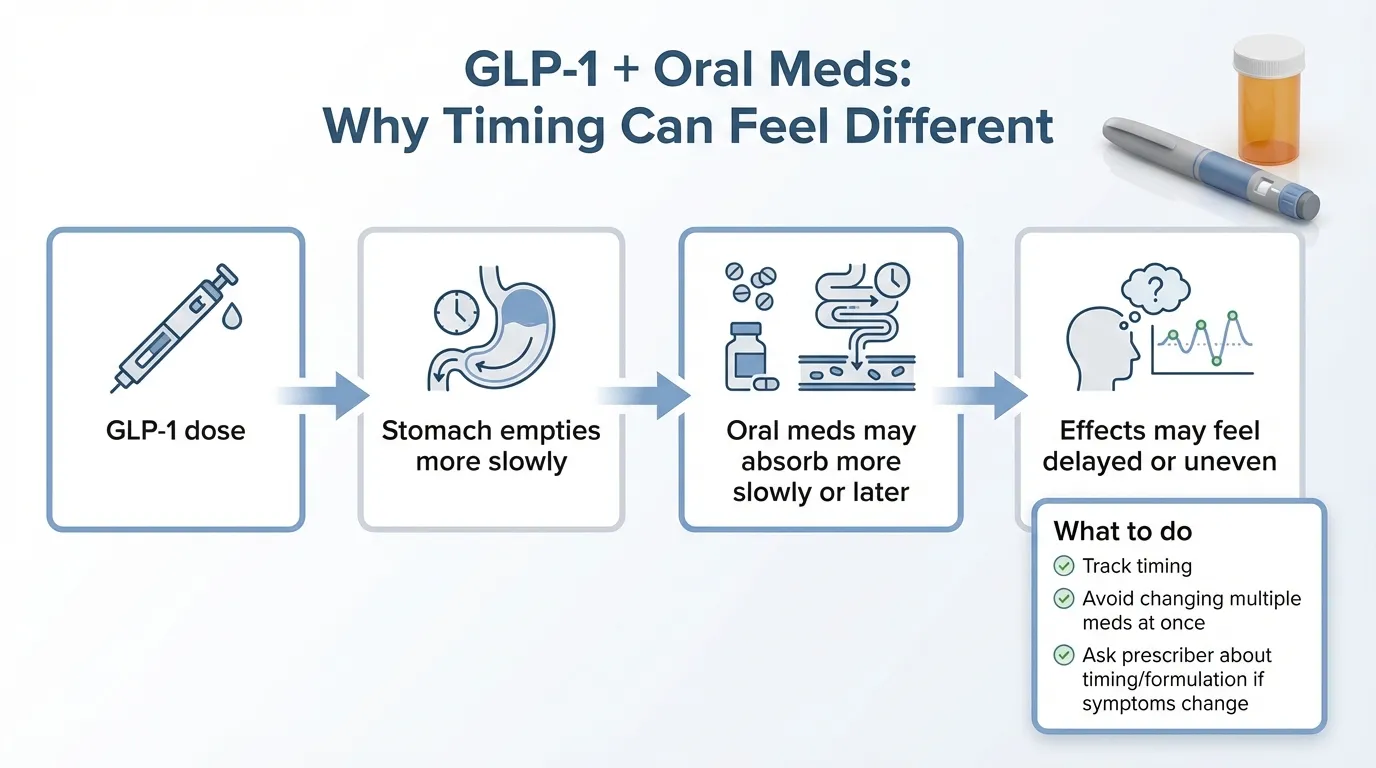
Follow the label on your exact metformin product. Immediate-release metformin is taken with meals, and many extended-release products are taken with the evening meal. In a six-patient case series, people who had been taking metformin before meals developed nausea or diarrhea after a GLP-1 was added; symptoms resolved within 48 to 72 hours and did not return when metformin was restarted immediately after eating. That is a useful clue, not a rule for everyone.
Checking your timing is free. Do not change a prescribed schedule on your own; bring the bottle and the timing question to your prescriber or pharmacist.
The six-patient finding
A case series followed six people with type 2 diabetes taking 2,000 to 2,500 mg of metformin daily. All six took it before meals or on an empty stomach. None had stomach side effects before the GLP-1 was added.
Then a GLP-1 was added. All six got sick — nausea, diarrhea, or both.
Here's the part almost nobody reports. Their symptoms went away within two to three days of pausing metformin, and did not come back when metformin was restarted right after eating instead of before. Three of the six then went all the way up to the maximum GLP-1 dose with no trouble at all.
The authors called it "side effect synergism" — the GLP-1 may have unmasked a metformin-timing problem in those six people.
The big counterweight: 16,996 participants
Six cases are a useful troubleshooting clue. They are not a general rule.
A separate post-hoc analysis pooled 16,996 participants from LEADER, STEP 2, SUSTAIN 6, and PIONEER 6. Of them, 12,928 — 76% — were taking metformin. Concomitant metformin did not increase the occurrence or severity of gastrointestinal symptoms during GLP-1 initiation and titration, and it did not increase GLP-1 discontinuation because of those symptoms.
Put both findings together: metformin does not appear to make GLP-1 stomach effects worse overall, but timing may still explain a problem in an individual person.
And metformin's own label explains why timing can matter
From the Glucophage prescribing information:
- Immediate-release metformin taken with food: peak level drops about 40%, total absorbed drops 25%, and it peaks 35 minutes later.
- Glucophage XR taken with food: total exposure goes up about 50%, with no change to the peak. The label notes both high-fat and low-fat meals had the same effect.
Read that twice. Plain metformin and extended-release metformin can respond to food in different ways. The labels still point in the same practical direction: take the product with food as instructed.
The label says with meals or with the evening meal. The more specific "immediately after eating" timing came from the six-patient case series, not from a large trial. If you already take metformin with food, this may change nothing for you. If you take it on an empty stomach and feel awful, that is a free detail to check before anyone assumes the GLP-1 dose is the whole problem.
The framing that matters: the first question after a rough start usually is "is my GLP-1 dose too high?" A better first question might be "am I taking my metformin the way its own label says?"
Which metformin do you actually have?
"Metformin ER" is not one release system. Your exact product and NDC matter. A pharmacist uses FDA therapeutic-equivalence information — not the letters "ER" alone — when deciding what can be substituted.
| What your bottle may say | Release system | Approximate peak | Label instruction |
|---|---|---|---|
| Metformin immediate release | Standard tablet | About 2 to 3 hours | With meals |
| Generic metformin ER using a Glucophage XR-style system | Polymer-based extended release | About 7 hours, with a reported range of 4 to 8 hours | With food; many labels specify the evening meal |
| Generic metformin ER using a Fortamet-style osmotic system | Water enters the tablet and pushes medicine out through a controlled opening | About 6 hours | With the evening meal. The inactive shell may appear in stool. Brand Fortamet was discontinued, but FDA said the withdrawal was not for safety or effectiveness. |
| Glumetza or a gastric-retentive ER equivalent | Gastric-retentive extended release | About 7 hours | With the evening meal |
That shell note can save a panicked phone call. Some extended-release tablets leave an inactive shell or soft mass in stool after the medicine has been released.
An honest open question about Glumetza
Here's something we looked for and could not find an answer to anywhere.
Glumetza uses a gastric-retentive release system designed to remain in the stomach while medicine is released.
GLP-1 medicines can slow stomach emptying.
We found no label-specific dose adjustment or timing rule for combining gastric-retentive metformin with a GLP-1. That is an evidence gap, not proof of harm.
We're not going to invent an answer. If you take Glumetza or a gastric-retentive generic, it is a fair and specific question for your pharmacist — and one more reason "metformin ER" is not a single thing.
If your GLP-1 is a pill, there's an actual clock rule
Oral semaglutide — Rybelsus, Ozempic tablets, and Wegovy tablets — comes with a strict instruction printed right on the label:
Take it on an empty stomach when you wake up, with no more than 4 ounces of plain water. Then wait at least 30 minutes before eating, drinking anything else, or taking any other oral medication.
Metformin is an oral medication. So it's covered by that rule.
Here's the clean resolution most pages miss: many metformin ER labels say to take the medicine with the evening meal. If yours does, there is usually no morning collision. The main conflict is metformin or another oral medicine scheduled inside oral semaglutide's first 30 minutes.
Foundayo (orforglipron) has no fasting, water-volume, or 30-minute separation rule. It can be taken with or without food. It still delays stomach emptying and can affect some oral medicines, so "no 30-minute rule" is not the same as "no interaction questions." If morning-medication logistics are a real problem in your life, that difference is worth knowing.
For a deeper look at why oral-medication timing can change, see our guide to GLP-1 delayed gastric emptying.
🔹 Get your timing on one page
Use the free card below to write down your GLP-1, your exact metformin product, when you take each one, your other blood-sugar medicines, and the questions you want answered.
→ Fill out your free Appointment Card
Free. Nothing stored. It never tells you to change a dose.
Free GLP-1 and metformin Appointment Card
Copy, print, or screenshot this. Fill in only what you know.
My medicines
- GLP-1 or dual GIP/GLP-1 medicine: ____________________
- Form: injection / tablet
- Dose written on my label: ____________________
- Metformin name on my bottle: ____________________
- Immediate release or ER/XR: ____________________
- Metformin dose written on my label: ____________________
- Other blood-sugar medicines, including insulin, glipizide, glyburide, glimepiride, repaglinide, or nateglinide: ____________________
My timing
- I take my GLP-1 at: ____________________
- I take metformin at: ____________________
- I take metformin before, during, or after food: ____________________
- My symptoms began on: ____________________
- My last dose increase was on: ____________________
- Symptoms are worst at this time or this many days after a dose: ____________________
My recent numbers, if I know them
- A1C and date: ____________________
- eGFR and date: ____________________
- Vitamin B12 and date: ____________________
Questions for my appointment
- What job is metformin doing in my plan now?
- Does my timing match the label on my exact metformin product?
- Do insulin or insulin-releasing pills change my low-blood-sugar plan?
- What is my sick-day plan if I cannot keep fluids down?
- Do I need an eGFR, A1C, or vitamin B12 test now?
- If pregnancy is possible, what needs to change and when?
Do not wait for a routine visit if you have repeated vomiting and cannot keep fluids down, severe or lasting stomach pain, fainting, confusion, trouble breathing, or signs of severe dehydration.
Will taking both drop your blood sugar too low?
Metformin rarely causes low blood sugar on its own, and adding a GLP-1 does not change that much. The risk climbs sharply with sulfonylureas and insulin. In the ATTAIN-2 trial, blood glucose below 54 mg/dL occurred in 7% of participants also taking a sulfonylurea compared with 0.5% of those who were not.
This fear comes up constantly, and the labels answer it cleanly.
What the drug labels actually tell prescribers
Both Mounjaro's and Foundayo's labels instruct prescribers to consider lowering the dose of insulin or insulin secretagogues when starting the GLP-1.
Neither one names metformin.
That's not an oversight. GLP-1 medicines increase insulin release in a glucose-dependent way, so the effect falls as blood sugar falls. Metformin lowers liver glucose output and does not stimulate insulin release. Sulfonylureas and injected insulin can push blood sugar lower in a different way, which is why they change the risk.
Mounjaro's own monotherapy trial makes the point: blood glucose below 54 mg/dL occurred in 0% of patients at every tirzepatide dose.
Check your list for these names
These are the drugs that actually change the answer:
- Glipizide (Glucotrol)
- Glyburide (DiaBeta, Glynase)
- Glimepiride (Amaryl)
- Any insulin — long-acting or mealtime
- Other insulin-releasing pills like repaglinide or nateglinide
If none of those are on your list, the combination is usually in the low-risk group for hypoglycemia — not a zero-risk group. Missed meals, illness, heavy alcohol use, and other medicines can still matter. If one of those drugs is on your list, that is not a reason to panic. It is a reason to make sure your prescriber has adjusted for it.
Signs of low blood sugar: shakiness, sweating, racing heart, sudden hunger, dizziness, confusion, weakness, blurry vision.
We're not going to hand you a personal glucose-testing schedule. That depends on your diagnosis, your other medicines, your recent numbers, and your history. Follow the plan your care team gave you — and if you don't have one, that's a question for your next visit.
Sick days, kidneys, and the rule nobody tells you
One practical safety concern with this combination is not a direct drug interaction. It is what happens when vomiting or diarrhea causes dehydration and kidney function drops. Metformin labels instruct temporary discontinuation in specific procedure and restricted-intake settings, and the GLP-1 labels we reviewed warn about acute kidney injury from volume depletion. Metformin is contraindicated below an eGFR of 30.
We want to handle this carefully, because it's the section that could scare you unnecessarily. So let's be precise.
This is not a special toxic reaction created by combining the two drugs. It's two ordinary facts that meet on a bad day.
Fact one: metformin's safety depends on your kidneys
Metformin leaves your body through your kidneys. When kidneys slow down, metformin can build up, and in rare cases that can lead to a serious condition called lactic acidosis — a buildup of acid in the blood that needs urgent treatment.
How rare? Genuinely rare. But it's serious enough that metformin carries a boxed warning about it, and the label sets clear kidney rules.
eGFR is your kidney filtering number. It comes from a routine blood test. Here's what metformin's label says:
| Your eGFR | What the label says |
|---|---|
| 45 or above | No metformin restriction based on eGFR alone; keep monitoring |
| 30 to 44 | Starting metformin is not recommended |
| Falls below 45 while you are already taking it | Prescriber should reassess the benefits and risks of continuing |
| Below 30 | Contraindicated — metformin should not be used |
| Any level | Measure eGFR at least once a year, and more often when kidney risk is higher |
The label also gives a specific iodinated-contrast rule: stop metformin at or before the procedure when eGFR is 30 to 60, when there is a history of liver disease, alcoholism, or heart failure, or when contrast will be given into an artery. Recheck eGFR 48 hours later and restart only if kidney function is stable. The label also calls for temporary discontinuation during surgical or other procedures that restrict food and fluid intake.
Fact two: a GLP-1 can create exactly that state
The GLP-1 and dual GIP/GLP-1 labels we reviewed warn about acute kidney injury from volume depletion. They connect many reported events with nausea, vomiting, diarrhea, or dehydration.
Now join them — because nobody else does
A bad stomach week can put you in the same low-fluid state that makes metformin safety depend more heavily on kidney function.
The GLP-1 kidney warnings do not tell metformin users what to do with metformin, and the metformin label does not name GLP-1 medicines in its dehydration or procedure instructions. So the two safety messages can still miss each other.
Here is the practical version: when metformin is in the mix, repeated vomiting, worsening diarrhea, trouble keeping fluids down, or signs of dehydration are specific reasons to call.
What counts as a call
- You've vomited repeatedly and can't keep fluids down
- Diarrhea that's getting worse instead of better
- You're urinating much less than usual, or your urine is very dark
- Dizziness when standing, unusual weakness, or confusion
- Muscle aches with trouble breathing (rare, but this is the lactic acidosis picture — get seen urgently)
What to say when you call
"I take metformin and [your GLP-1]. I've had [vomiting/diarrhea] for [how long] and I'm having trouble keeping fluids down. Should I hold my metformin, and when was my last kidney test?"
That's it. That sentence is the whole point of this section.
For more on replacing fluids during nausea, vomiting, or diarrhea, see our guide to GLP-1 electrolyte drinks.
Also tell your care team about metformin before: surgery, deep sedation, a long fasting period, or an iodinated-contrast study. The contrast hold depends on kidney function, route of contrast, and other risk factors. Your care team should tell you whether to hold it and when to restart.
The blood test almost nobody asks for
Metformin can lower vitamin B12 absorption, and risk rises with higher doses and longer use. Current metformin labeling calls for blood counts every year and vitamin B12 measurement every two to three years. The 2026 American Diabetes Association Standards also support periodic B12 assessment; the older-adults section calls for annual monitoring after more than four years of metformin use. Concern is higher at 1,500 mg a day or more and after four to five years. A GLP-1 may reduce food intake, but we found no trial showing that the pair causes more B12 deficiency than metformin alone.
This one is cheap, fixable, and hardly anyone brings it up.
One proven hit, one possible pressure
Metformin interferes with how your intestine absorbs vitamin B12. This has been documented for decades. The exact mechanism is not settled. Reduced uptake of the vitamin B12 carrier complex in the lower small intestine is one proposed part of it.
A GLP-1 can reduce how much you eat. Food is one source of B12.
So there can be two pressures in the same person: a proven metformin absorption effect and lower food intake. That overlap is a reason to test, not proof of a new drug interaction.
Why it matters more than it sounds
Low B12 causes: fatigue. Tingling or numbness in hands and feet. Weakness. Trouble concentrating. Mental fog.
Look at that list again. Those symptoms overlap with complaints people often blame on their GLP-1.
We're not saying B12 explains everyone's fatigue. We're saying it's a specific, cheap, testable alternative that costs one blood draw to rule in or out — and it's the kind of thing that gets missed for years.
What the guidance says
- Current metformin labeling says to measure blood counts every year and vitamin B12 every two to three years.
- The ADA Standards of Care recommends periodic B12 assessment in people taking metformin, especially when anemia or nerve symptoms are present. Its older-adults section calls for annual monitoring after more than four years of metformin use.
- The 2026 ADA text flags greater concern at 1,500 mg per day or more and after four to five years of use.
- The UK's medicines regulator issued a safety update in June 2022 after a European review concluded B12 reduction is a common metformin effect, with risk increasing at higher doses and longer duration.
Here is the gap that still matters: a label interval is not the same as a test that was actually ordered. Many people do not know when their last B12 level was checked.
The ask
Six words at your next appointment: "Can we check my B12 level?"
If you've been on metformin for years, or you're above 1,500 mg a day, or you've got fatigue and tingling you've been writing off — that is a specific, reasonable question to bring to your next visit.
If mental fog is your main complaint, ask about B12, hydration, food intake, sleep, and your other medicines instead of assuming the GLP-1 is the cause.
Should you stop metformin after starting a GLP-1?
Usually not, and not on your own. In the trials that established GLP-1 medicines for type 2 diabetes, metformin stayed in place. Whether it should continue for you depends on why it was prescribed, your current numbers, your kidney function, your tolerance, and what your prescriber is trying to achieve — not on whether the GLP-1 feels stronger.
The honest answer is short: it's not your call to make alone, and here's how to have the conversation.
The five questions that settle it
- Why was metformin prescribed? Type 2 diabetes? Prediabetes? PCOS? Off-label for weight? If you don't know, that's question one.
- Is that reason still there? Better numbers do not prove the diagnosis or treatment need has disappeared. Improvement often means the plan is working.
- What actually changed after the GLP-1 started? Your A1C, your weight, your side effects — specifics, not impressions.
- Which medicine is causing the burden? Cost, side effects, pill count. Name it.
- What's the plan if metformin comes out? More monitoring? A different target? Nothing?
Take those five to your appointment and you'll get a real answer instead of a shrug.
What would actually prompt stopping
- Kidney function drops below the thresholds in the section above
- Side effects that don't settle after a fair trial, including trying a different formulation
- Your prescriber concludes the goals are being met without it
- Pregnancy planning changes the whole medication picture
- The original reason genuinely no longer applies
What is not a reason to stop
- The GLP-1 feels stronger, so metformin seems redundant
- Someone in a Facebook group stopped theirs
- Your weight is down
- You'd rather take fewer pills
That last one is legitimate as a conversation. It's not legitimate as a decision you make alone at 11 p.m.
One more thing worth knowing: generic metformin is often inexpensive compared with newer medicines, but your actual price depends on formulation, pharmacy, and coverage. So "is it worth keeping?" is often less of a price question than a does it still have a job question.
Does the answer change for diabetes, prediabetes, or PCOS?
Yes, significantly. Type 2 diabetes has the strongest evidence for combining a GLP-1 with metformin. Prediabetes and PCOS have much weaker evidence for the combination specifically — current ADA guidance describes metformin as something to consider for selected high-risk adults with prediabetes, not as an automatic treatment for everyone, and the international PCOS guideline addresses metformin and GLP-1 medicines separately rather than recommending them together.
This is where most pages flatten a complicated picture into one word: "safe." The real answer branches.
Our evidence map
| Your situation | Strength of direct combination evidence | What is supported | What is not established | The question to ask |
|---|---|---|---|---|
| Type 2 diabetes | Strong for blood sugar control | GLP-1 and dual GIP/GLP-1 medicines have been extensively studied on top of metformin. | That everyone needs both, or that metformin adds extra weight loss on top of the newer drug | "What job is each medicine doing in my plan right now?" |
| Prediabetes | Low for the combination itself | ADA says metformin should be considered for selected adults at high risk. A GLP-1 may separately fit an FDA-approved weight-management indication. | That the pair is a standard automatic treatment for prediabetes | "Am I being treated for prediabetes, weight, or both — and how will we measure it?" |
| PCOS | Low and mixed | The international guideline supports metformin for selected metabolic concerns and says GLP-1 medicines may be considered for higher weight under general obesity guidance. | That combining them is better for everyone. The 2021 seven-trial review found similar main outcomes in its combination-versus-GLP-1-alone analysis, with low-quality evidence. | "Is metformin treating a specific problem that is still there after the GLP-1 started?" |
| Weight, no diabetes | Not established as an add-on strategy | An FDA-approved GLP-1 can have evidence for its labeled population. A person may separately have a reason for metformin. | Metformin as a proven universal booster that increases GLP-1 weight loss | "What medical problem is metformin solving for me?" |
Our grading, in plain terms: "Strong" means current guidance plus multiple large trials support using them together for that purpose. "Low" means each drug has a supported role, but direct evidence for combining them is limited. "Not established" means no direct evidence that adding metformin improves the outcome over the GLP-1 alone. These are our editorial summaries, not FDA grades.
If you have type 2 diabetes
You're in the best-evidenced group here. GLP-1 and dual GIP/GLP-1 medicines added to metformin have been studied in trial after trial, with consistent improvement in A1C.
A1C, if you're new to the term, is a blood test that shows your average blood sugar over roughly the last three months. It's the main scorecard in diabetes care.
One nuance worth knowing: modern diabetes treatment isn't a rigid ladder anymore. It used to be "metformin first, add something if it fails." Now a prescriber may choose a GLP-1 with proven cardiovascular benefit early, or choose treatment around heart and kidney disease, not because metformin failed. If that's your situation, nothing went wrong. The strategy just changed.
If you have prediabetes
Be careful here, because a lot of pages overstate this one.
ADA guidance describes metformin as something to consider for selected adults at higher risk — especially ages 25 to 59, BMI of 35 or higher, fasting glucose of 110 mg/dL or higher, A1C of 6.0% or higher, or a history of gestational diabetes. That's a targeted recommendation, not a blanket one.
If you have prediabetes and someone has you on two prescriptions, the fair question is: what is each one for, and how will we know if it's working?
The combination is not a blanket starting pathway for everyone with prediabetes.
If you have PCOS
PCOS deserves more honesty than it usually gets on pages like this.
Metformin has a long history in PCOS for insulin resistance and metabolic concerns. GLP-1 medicines are newer here and are generally considered under weight-management guidance rather than as a PCOS treatment specifically.
The international guideline covers them separately. It does not tell clinicians to combine them for everyone.
And one direct evidence base — a 2021 review of 7 randomized trials with 464 participants total — found the combination performed similarly to a GLP-1 alone on the main outcomes in its direct comparison. The reviewers rated the evidence low quality, so it is not the last word. It does not support an "always better together" claim.
Some people with PCOS have good reasons to take both. That's different from proving the combination is the right PCOS treatment for everyone.
One thing PCOS readers especially need to read: the next section.
What if you're pregnant, or might become pregnant?
GLP-1 medicines prescribed for weight management are not used during pregnancy. Semaglutide labeling instructs patients to discontinue at least two months before a planned pregnancy because the drug clears the body slowly. Tirzepatide labeling advises patients using oral hormonal contraceptives to switch to a non-oral method or add a barrier method for four weeks after starting and for four weeks after each dose increase.
This section is short, and it's the most important one on the page for some of you.
The two-month rule
Semaglutide has a long half-life — roughly one week. That means it takes a while to leave your system after your last dose. The label tells women to stop at least two months before a planned pregnancy.
If you're planning to try, that's a timeline you need on your calendar and in a conversation with your prescriber. Two months is not a small buffer to discover late.
The birth control problem with tirzepatide — and Foundayo's separate rule
This one catches people off guard.
Tirzepatide slows stomach emptying, and that can reduce how much of an oral birth control pill your body absorbs. The effect is biggest right after your first dose and after each dose increase.
So the tirzepatide labels advise: switch to a non-oral birth control method, or add a barrier method, for four weeks after starting and for four weeks after each dose escalation.
Foundayo has a separate label rule: use an effective non-oral contraceptive method for 30 days after starting and for 30 days after each dose escalation.
If you use an oral birth-control pill with Mounjaro, Zepbound, or Foundayo, put this question near the top of your next medication review.
Where metformin fits
Metformin's role in pregnancy is a different conversation with a different set of considerations, and it's genuinely a case-by-case decision your OB and prescriber should make together. What we can say plainly: a weight-loss GLP-1 should not be part of a pregnancy plan, and the transition off it needs to be planned, not improvised.
If you are pregnant now, think you may be pregnant, or plan pregnancy, contact the prescribing clinician promptly instead of waiting for a routine visit.
Why are people asking about GLP-1 and metformin?
We're including these because a lot of you tell us you feel silly for asking. You shouldn't. Here's what real people are saying in public forums:
"Should I continue… or lower or even stop the Metformin?"
"It could be rough to start both at the same time."
"The effect on my guts was not good at all."
Sources: public forum question about continuing metformin · public forum discussion about starting both · public forum discussion about stomach effects.
These are individual experiences shared online, not medical evidence. We use them to understand what people are worried about — nothing more. Never start, stop, or change a prescription based on a forum post, including a reassuring one.
What these tell us: the two questions people actually have are "do I still need this?" and "is what I'm feeling normal?" Which is exactly what this page is built to answer.
If you're not on a GLP-1 yet: how to start when you already take metformin
Taking metformin does not by itself decide whether a GLP-1 is right for you. Diagnosis, FDA indication, plan rules, medical history, and cost all matter. A type 2 diabetes diagnosis can support coverage for diabetes-labeled products such as Ozempic or Mounjaro, but it does not automatically make a weight-management product covered. Wegovy, Zepbound, and Foundayo have their own labeled indications and plan rules.
Here is the honest structural thing first, because it shapes everything else:
Do not assume a weight-loss telehealth program will take over your metformin, insulin, kidney monitoring, or full diabetes plan. Some programs offer broad medication support; others stay in the weight-management lane. Confirm the scope before you pay.
With that understood, there are three different right answers depending on who you are.
Affiliate disclosure: Weight Loss Provider Guide may earn compensation if you choose a provider through certain links. That does not change your price. We checked the provider-stated facts below on August 8, 2026, before making any recommendation.
Provider-stated versus verified on August 8, 2026
| Provider | Provider-stated offer we checked | What is verified now | What you still need to confirm |
|---|---|---|---|
| Ro Body | $39 first month; then $149 monthly, or $74 per month on an annual plan paid upfront. Medication is separate. Insurance concierge and a free coverage checker are offered. | Ro's checker currently lists Ozempic, Wegovy, and Zepbound autoinjector pens. Ro also lists Foundayo as a cash-pay option, not as a drug in that checker. | Your plan's actual decision, medication cost, whether the assigned team will manage metformin, and whether your exact product is available in your state. |
| Embody | Compounded weekly GLP-1 injections starting at $79 per month and compounded GLP-1/GIP injections starting at $129 per month, with medication included. | Embody states that these are compounded products filled by 503A pharmacies. Compounded drugs are not FDA-approved. | Why compounding is medically needed for you, the filling pharmacy, exact active ingredient and form, concentration, syringe, dose units, and current total price. |
| Sesame Care | A weight-loss membership listed at $59 per month with an annual plan; medication is separate. Patients choose a clinician and begin with a live video visit. | Sesame offers clinician choice, visits, messaging, lab support, and insurance paperwork within the program it describes. | Whether the specific clinician will review and manage your full medication list, diabetes, kidney issue, insulin, sulfonylurea, or pregnancy plan. |
Provider sources checked August 8, 2026: Ro pricing and medication list · Embody pricing and compounded-drug disclosure · Sesame program details.
Provider pages change. Recheck the checkout page and terms before paying.
If you have type 2 diabetes: check coverage before you pay cash
This is the single most valuable thing we can tell this group.
If you have type 2 diabetes, an insurer may cover an FDA-approved diabetes medicine such as Ozempic or Mounjaro when its rules are met. A diagnosis is not a guarantee. Prior authorization, step therapy, formulary rules, and the exact drug still matter.
Ro is the route we'd point you to when the main problem is checking coverage and getting prior-authorization help. Its free checker currently covers Ozempic, Wegovy, and Zepbound autoinjector pens. Ro separately lists Foundayo as a cash-pay weight-management option.
Pricing checked August 8, 2026: $39 for the first month, then $149 per month — or $74 per month with an annual plan paid upfront. Medication is billed separately.
The honest limitation, stated plainly: Ro Body is a weight-management program. Do not assume it replaces the clinician who manages metformin or your whole diabetes plan. Confirm that before paying. But when the problem is insurance paperwork for a drug the checker supports, that narrow lane can be useful.
→ Check whether Ro can run coverage for your medicationIf coverage is not happening and you are looking at cash-pay options
Different situation, different answer.
Some people take metformin for PCOS, insulin resistance, prediabetes, or another reason that does not create insurance coverage for a weight-management drug. Other people meet a weight-management indication but their plan excludes the medicine.
Start by comparing current cash-pay programs for FDA-approved products. Then understand the extra line you cross if you consider a compounded product.
Embody currently advertises compounded weekly GLP-1 injections starting at $79 per month and compounded GLP-1/GIP injections starting at $129 per month, with medication included.
You need to understand what compounded means before you choose it. Compounded drugs are not FDA-approved. FDA does not review them before marketing for safety, effectiveness, or quality. FDA says compounded drugs should be used only when an available FDA-approved drug cannot meet a patient's medical needs.
That is not a claim that nobody should ever use one. It means cost alone does not turn a compounded copy into an FDA-approved equivalent. Before you pay, ask why compounding is medically needed for you, which pharmacy will fill it, the exact ingredient and form, the concentration, the syringe size, and whether your instructions are in milligrams, milliliters, or "units." FDA has reported dosing errors with compounded injectable semaglutide when concentrations and syringe units were misunderstood.
→ Review Embody's current compounded-injection optionsIf you need one clinician looking at everything
Complex situation — insulin, a sulfonylurea, kidney concerns, several prescribers who do not talk to each other, or pregnancy planning?
Do not assume a single-lane weight-loss service is enough. Sesame Care lets you choose an individual clinician and starts with a live video visit. Before you book, confirm that the clinician will review your full medication list and manage the issue you actually need handled. Or go to your primary care clinician or an endocrinologist. There is no shame in the boring answer being the right one.
→ Book a Sesame clinician and confirm the visit scopeLeave any intake that does this
We'd rather you walk away than get burned:
- Tells you metformin will "supercharge" or "boost" your GLP-1 results
- Prescribes without asking about your kidney function or your other diabetes medications
- Will not tell you clearly whether the product is FDA-approved or compounded
- Presents trial results from a brand-name drug as proof for a compounded one
- Calls a compounded product "generic," "the same as," or "clinically proven" like an FDA-approved product
- Gives you no clear way to reach a human if you get serious side effects
How did we verify this page?
We built this page from current U.S. prescribing information, official drug labels, current clinical guidance, and primary research — not from other articles. Where a trial used metformin as background therapy, we labeled it that way rather than presenting it as proof that the combination outperforms a GLP-1 alone.
You should know how a page like this was made before you trust it.
Where we got our information, in order of weight
- Current U.S. prescribing information and DailyMed labels
- Current professional clinical guidance (ADA and the international PCOS guideline)
- Primary randomized trials and pooled trial analyses
- Systematic reviews and meta-analyses
- Manufacturer provider pages for current price and program claims
- Public forums — used only to understand what people are worried about, never as evidence of safety or effectiveness
The rule we applied to every study
We sorted every piece of evidence into one of two boxes:
- Background metformin study — everyone was on metformin, so the trial can't tell you what metformin contributed.
- Direct combination comparison — one group got GLP-1 plus metformin, another got the GLP-1 alone.
Most pivotal type 2 diabetes trials used metformin as background therapy. The PCOS evidence includes direct combination comparisons, but it is small and low quality. That is why this page keeps those two evidence boxes separate.
Source log
| Document | Version or publication | Checked | What we pulled from it |
|---|---|---|---|
| Metformin immediate-release prescribing information and current ER labeling | Current DailyMed labels | Aug. 8, 2026 | Food effects, eGFR thresholds, boxed warning, B12 interval, contrast and procedure holds |
| Glumetza label and historical Fortamet labeling/status | Current plus historical formulation record | Aug. 8, 2026 | Release systems, peak times, food instructions, shell note, discontinued-brand context |
| Ozempic injection PI | Current | Aug. 8, 2026 | Metformin coadministration, background-therapy trials, pregnancy timing |
| Rybelsus and Ozempic tablets PI | 2026 | Aug. 8, 2026 | 30-minute rule and metformin interaction conclusion |
| Wegovy PI | 2026 | Aug. 8, 2026 | Injection/tablet timing, metformin pharmacokinetics, pregnancy timing |
| Mounjaro PI | Revised April 2026 | Aug. 8, 2026 | Interaction section, SURPASS metformin-background trials, hypoglycemia, contraception |
| Zepbound PI | Current | Aug. 8, 2026 | Kidney warning, oral-medication caution, contraception |
| Foundayo PI | Current | Aug. 8, 2026 | Transporter panel, hypoglycemia split, stomach side effects, oral-contraceptive rule |
| ADA Standards of Care: prevention section and older-adults section | 2026 | Aug. 8, 2026 | Selected high-risk prediabetes use and B12 monitoring, including annual monitoring after more than four years in older adults |
| International evidence-based PCOS guideline | 2023 | Aug. 8, 2026 | Separate roles for metformin and GLP-1 medicines |
| PCOS systematic review, PMID 34115034 | 2021 | Aug. 8, 2026 | Seven randomized trials, 464 participants, direct combination analysis |
| Diabetes Prevention Program, DOI 10.1056/NEJMoa012512 | 2002 | Aug. 8, 2026 | 3,234-participant trial and the 0.1 kg, 2.1 kg, and 5.6 kg weight changes |
| Cristiano et al., American Heart Journal, DOI 10.1016/j.ahj.2022.10.025 | 2022 | Aug. 8, 2026 | Six-patient before-versus-after-eating case series |
| Klein et al., PMID 38048543 | 2024 | Aug. 8, 2026 | 16,996-participant analysis finding no overall metformin-related increase in GLP-1 stomach effects |
What we didn't do
- Add side-effect percentages from unrelated trials together
- Treat background metformin as proof of added benefit
- Apply brand-name drug evidence to compounded products
- Recommend a dose, schedule, or stop date to anyone
- Rank providers before the medical question was answered
Frequently asked questions about GLP-1 and metformin
Can I take metformin and Ozempic on the same day? Yes. Ozempic injection has no clock-based separation requirement from metformin. Ozempic tablets are different: take the tablet alone on an empty stomach, then wait at least 30 minutes before metformin or any other oral medicine.
Should I take metformin in the morning or at night now that I'm on a GLP-1? Follow your exact product's label — immediate-release with meals and many extended-release products with the evening meal. A six-patient case series found that moving metformin from before meals to immediately after eating resolved symptoms in those six people. A much larger 16,996-participant analysis found no overall increase in GLP-1 stomach effects with metformin, so the case series is a clue for troubleshooting, not a universal rule.
Is metformin a GLP-1? No. Metformin is a biguanide. It lowers the sugar your liver releases and improves how your body responds to insulin. GLP-1 medicines copy a gut hormone and work through a different pathway entirely.
Will my doctor take me off metformin? Not automatically. In the trials that established GLP-1 medicines for type 2 diabetes, metformin stayed in place. Stopping depends on why it was prescribed, your current numbers, kidney function, and your prescriber's judgment.
Can metformin and a GLP-1 together cause low blood sugar? It is uncommon with only those two, but not impossible. The risk rises with sulfonylureas or insulin. In Foundayo Trial 2, low blood sugar below 54 mg/dL occurred in 7% of participants using a sulfonylurea versus 0.5% of those who were not.
Does metformin help you lose more weight on Wegovy or Zepbound? It is not proven. We found no large randomized general-obesity trial that added metformin to an established Wegovy or Zepbound plan just to isolate extra weight loss. In the Diabetes Prevention Program, the metformin group lost 2.1 kg on average at 2.8 years.
Can I take metformin at the same time as Rybelsus, an Ozempic tablet, or a Wegovy tablet? Not at the same moment. Oral semaglutide must be taken alone on an empty stomach with up to 4 ounces of plain water. Wait at least 30 minutes before food, other drinks, or any other oral medicine — including metformin.
Do I need to stop metformin before surgery or a contrast scan? Sometimes. For iodinated contrast, the label's hold rule depends on eGFR, liver disease, alcoholism, heart failure, and whether contrast is given into an artery. It also calls for a hold during procedures that restrict food and fluids. Your care team should tell you when to stop and restart.
Why has my diarrhea gotten worse since starting the shot? Both drugs can affect the gut, and diarrhea is a common metformin effect. A six-patient report suggests timing can matter in some people, while a 16,996-participant analysis found no overall increase in GLP-1 stomach effects with metformin. Bring the start dates, dose changes, and meal timing to your prescriber rather than stopping either drug yourself.
Can the combination hurt my kidneys? The two drugs don't create a unique kidney toxicity together. The concern is that dehydration from vomiting or diarrhea can reduce kidney function, and reduced kidney function is what makes metformin risky. Metformin is contraindicated below an eGFR of 30.
What if my eGFR is between 30 and 45? Metformin's label says starting it is not recommended in that range, and that if your eGFR drops below 45 while you're already taking it, your prescriber should reassess whether to continue. That's a clinical decision, not a self-assessment.
Can I take both for PCOS? Some people do, under clinician supervision. But a review of seven trials in 464 participants found the combination performed similarly to a GLP-1 alone on primary outcomes, and rated that evidence low quality. The international PCOS guideline addresses the two medications separately rather than recommending the combination.
Can I take both for prediabetes? Sometimes, but each medicine should have a clear reason. ADA guidance describes metformin as something to consider for selected high-risk adults, not as an automatic prediabetes treatment — and a GLP-1 would generally be prescribed under a separate weight-management indication.
How long do the stomach side effects last? There is no honest single number. Trial data shows nausea, vomiting, and diarrhea are most common during dose increases and decrease over time. If symptoms are stopping you from eating, drinking, working, or sleeping, that's a call to your prescriber — not something to wait out.
Can a GLP-1 replace metformin? Sometimes a treatment plan changes that way, but a GLP-1 doesn't erase the reason metformin was prescribed. That's an individualized decision based on your numbers and your goals.
Should I check my vitamin B12? It is worth asking. Current metformin labeling calls for B12 measurement every two to three years. ADA guidance supports periodic assessment and calls for annual monitoring after more than four years in older adults, with greater concern at 1,500 mg a day or more and after four to five years. Low B12 can cause fatigue, tingling, weakness, and mental fog — symptoms that can be blamed on the wrong thing.
What is the bottom line on GLP-1 and metformin?
Taking two medicines for one problem feels like a red flag. It usually isn't.
Metformin and a GLP-1 do different jobs. Many pivotal type 2 diabetes trials were built on people taking both. If your prescriber put you on both, that's a plan, not a panic button.
What we'd want you to walk away with:
- Check when you take your metformin. Follow the exact bottle label. Immediate-release is taken with meals; many ER products are taken with the evening meal. The "immediately after eating" clue comes from six cases, not a universal rule.
- Know your sick-day rule. Repeated vomiting, worsening diarrhea, trouble keeping fluids down, or dehydration signs plus metformin are reasons to call.
- Ask when your B12 was last checked. Current labeling gives a two-to-three-year B12 interval. ADA guidance calls for annual monitoring after more than four years in older adults. It may explain symptoms you have been blaming on the wrong drug.
- Don't stop anything on your own. Bring the five questions instead.
And if you're on a GLP-1 for weight loss and someone's told you metformin will boost it — that claim doesn't have a trial behind it. We'd rather tell you now than let you find out in three months.
Still not sure which GLP-1 program is right for you? Take our free 60-second matching quiz.
Get a personalized action plan based on your diagnosis, insurance situation, budget, and whether you want an FDA-approved medication or need to discuss other cash-pay options.
Weight Loss Provider Guide is an independent comparison resource for GLP-1 telehealth providers. We publish what we verify and flag what we can't. Found something out of date? Tell us — we'll check it and update the page.
Last verified: August 8, 2026
Related GLP-1 medication guides
Related Articles
Best Zepbound Providers That Send Prescriptions to Walmart
Verified Walmart routing guide comparing your own doctor, Walmart-listed virtual care, Ro, Sesame, LillyDirect pickup, retail KwikPen, and the Medicare GLP-1 Bridge, with current prices and 20 FAQs.
Best GLP-1 Providers That Send Prescriptions to Amazon Pharmacy
Compare 10 GLP-1 providers plus your own doctor by Amazon Pharmacy evidence tier, insurance and prior-authorization help, current prices, Medicare Bridge rules, delivery limits, and 18 FAQs.
Best Wegovy Providers That Send Prescriptions to Amazon Pharmacy
Compare eight evidence-graded Wegovy routes to Amazon Pharmacy, including Amazon One Medical, Ro, Sesame, Walgreens, e-prescribe details, dose prices, insurance, and 22 FAQs.
Best Zepbound Providers That Send Prescriptions to Amazon Pharmacy
Compare 11 Zepbound routes by Amazon evidence grade, device, cash and insurance price, Medicare Bridge rules, e-prescribe details, delivery, and 15 FAQs.
Best GLP-1 Providers That Send Prescriptions to Sam's Club
Compare seven checked GLP-1 routes to Sam's Club, current counter prices, the $250 KwikPen gap, Medicare Bridge rules, delivery, pickup, and 19 FAQs.
Best GLP-1 Providers That Send Prescriptions to Kroger
Compare five verified GLP-1 routes to Kroger, current care fees, eight clinic states, pharmacy pickup rules, the cash-price trap, and 20 FAQs.