GLP-1 Vomiting: What’s Normal, When to Call, and What to Do Right Now
By Weight Loss Provider Guide Editorial Team · Last fact-checked: · Editorial policy
Last updated: .
Important: This is information, not medical advice.
If your symptoms are severe, or you’re not sure, call your prescriber, go to urgent care, or call 911. This guide helps you make a smart next move — it does not replace a real clinician.The bottom line, before you scroll
GLP-1 vomiting is common — but “common” is not the same as “ignore it.” In FDA prescribing information, 24% of people on Wegovy 2.4 mg reported vomiting (vs. 6% on placebo). On Zepbound, vomiting ran from 8% at 5 mg to 13% at 15 mg. Foundayo reported 13–24% depending on dose. Most people get past it. In pooled semaglutide 2.4 mg trial data, individual vomiting episodes lasted a median of about 2 days.
It becomes urgent when: you can’t keep liquids down, you see blood or coffee-ground material in your vomit, you have severe belly pain radiating to your back, you’re dizzy or fainting, urine has gone dark, or you suspect a dose error from a compounded vial.
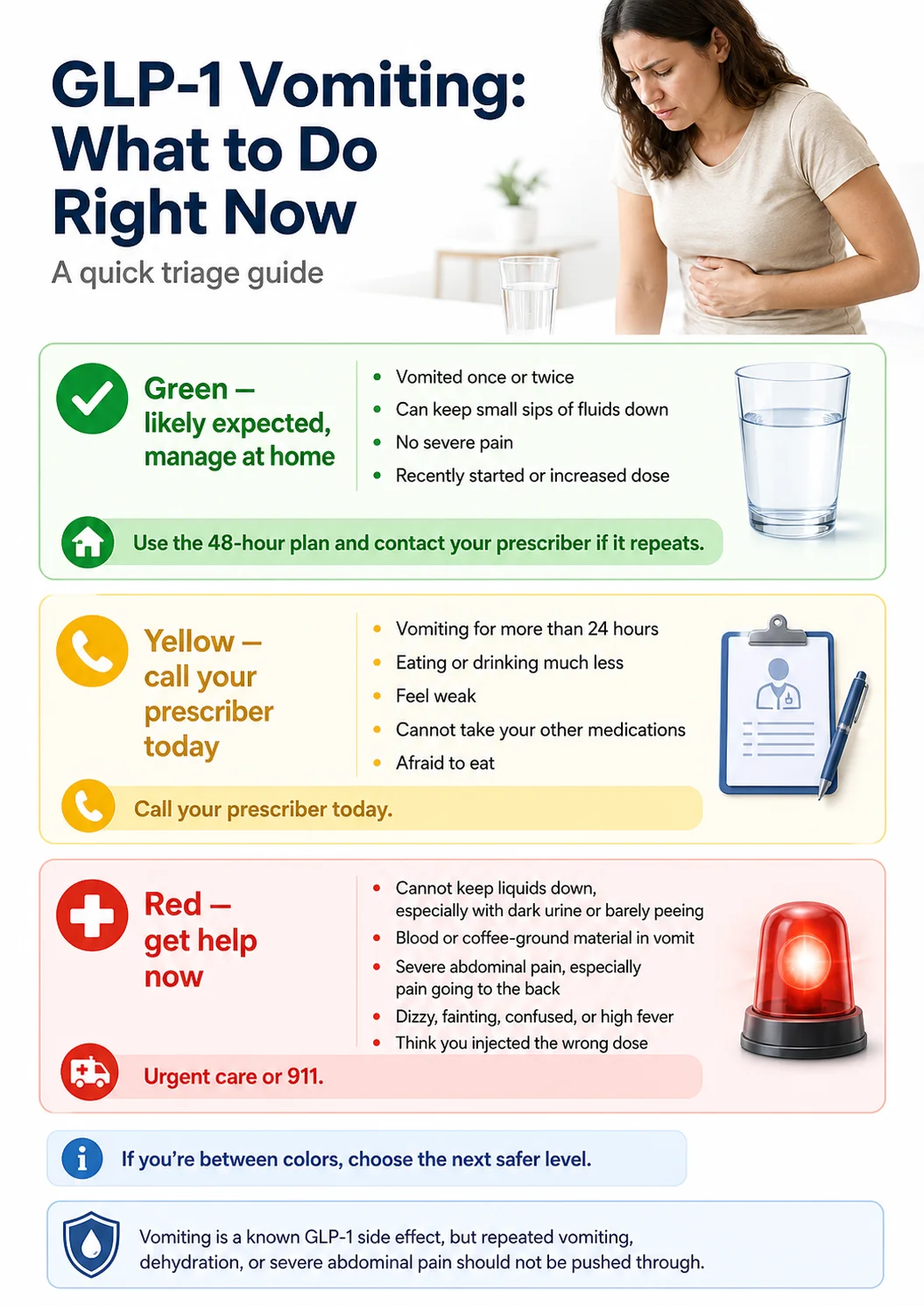
🟢 Green — manage at home
- • One or two mild episodes
- • Can keep small sips down
- • No severe pain
- • Recently started or increased dose
→ Use the 48-hour plan below. Call prescriber if it repeats.
🟡 Yellow — call prescriber today
- • Vomiting >24 hours
- • Eating or drinking much less
- • Feel weak
- • Can’t take other medications
- • Afraid to eat
→ Call your prescriber today.
🔴 Red — get help right now
- • Can’t keep liquids down
- • Blood or coffee-ground material in vomit
- • Severe belly pain (especially to back)
- • Dizzy, fainting, confused
- • Dark urine or barely peeing
- • High fever
→ Urgent care or call 911.
If you’re not sure which color you are — be in the next color up. Default to safer.
On this page
- → 60-second interactive triage tool
- → Is GLP-1 vomiting normal, or is something wrong?
- → When to call, when to go to urgent care, when to call 911
- → The 48-hour stabilization plan
- → How long does GLP-1 vomiting last?
- → Vomiting rates by drug and dose (FDA-label table)
- → Could this be a dosing mistake? (Compounded GLP-1 risk)
- → Should you stop, pause, or push through?
- → Why vomiting spikes after a dose increase
- → What’s different about each GLP-1 drug
- → When your current provider isn’t helping
- → Frequently asked questions
- → Sources and methodology
60-second GLP-1 vomiting triage tool
Answer these 8 questions for a single clear action. If you’re not sure, choose the safer level. The static decision table is available below for screen readers and browser-based access without JavaScript.
60-Second GLP-1 Vomiting Triage
Answer honestly — your safety depends on it
Question 1 of 8
Do you see blood or dark "coffee-ground" material in your vomit?
This tool does not provide medical advice. When in doubt, choose the safer level.
Is GLP-1 vomiting normal, or is something wrong?
GLP-1 medications do two things that make some people throw up. First, they slow how fast your stomach empties — food sits longer, you feel full sooner, you stop eating earlier. But food sitting longer can also feel like nausea, bloating, and sometimes vomiting, especially if you eat too much or too fast.
Second, GLP-1s signal a part of your brainstem called the area postrema — the area that controls the urge to vomit. Activate it and your body decides it should empty your stomach. That’s pharmacology, not punishment.
What “common” looks like in real life: queasiness for the first day or two after your weekly shot, maybe one rough episode, sometimes a few more after a dose increase, then it fades. Most people get through it with hydration and smaller meals.
The part most pages won’t tell you
One useful piece of evidence: a 2025 pooled analysis of the SURMOUNT trials (Diabetes, Obesity and Metabolism) found weight loss was similar in patients who experienced GI side effects and patients who didn’t. Vomiting is not a sign the medication is “working.” It’s a side effect. You don’t have to suffer to get the result.
Three patterns that aren’t normal
These are the patterns that mean call someone, not push through:
- Vomiting that’s getting worse instead of better after week 4. Most GI side effects peak in the first few weeks at each dose, then fade. Escalating intensity is a signal to pause, not press.
- Vomiting undigested food hours after eating. This pattern can indicate delayed stomach emptying. Wegovy, Zepbound, and Foundayo prescribing information all warn these medications are not recommended in patients with severe gastroparesis.
- Vomiting that started weeks or months into a stable maintenance dose, with no dose change. Stable doses shouldn’t suddenly produce vomiting. Something else may be going on — gallbladder, pancreas, infection, or a dose error from a compounded vial. Get it checked.
When to call your provider, when to go to urgent care, when to call 911
| Your situation | What to do |
|---|---|
| One or two mild vomiting episodes; can sip fluids; no severe pain | Manage at home with the 48-hour plan |
| Vomiting more than 24 hours; reduced fluids; new belly discomfort | Call your prescriber today |
| You have diabetes, use insulin or a sulfonylurea, and are vomiting and eating less | Call your prescriber today; check blood sugar more often |
| Can’t keep fluids down; dark urine; barely peeing; dizzy on standing; can’t keep meds down | Urgent care today |
| Blood or coffee-ground material in vomit; severe belly pain (especially radiating to back); fever; fainting; confusion; trouble breathing | ER / call 911 |
| Severe vomiting after a compounded vial — and the dose looks off | Call Poison Control (1-800-222-1222) + your prescriber. Urgent care if severe. Call 911 first if person collapses or can’t be awakened. |
| New vomiting weeks into a stable maintenance dose, with bloating and constipation | Call your prescriber — possible gastroparesis evaluation |
Why these specific thresholds?
A few are pulled directly from FDA-approved prescribing information. The Wegovy and Zepbound labels both say to stop and call your healthcare provider right away if you have severe stomach pain that won’t go away, with or without nausea or vomiting — and note pain can sometimes go from stomach to back. That’s because severe abdominal pain — not vomiting alone — is the warning sign for pancreatitis, a rare but serious GLP-1 side effect.
The same labels flag dehydration as a path to acute kidney injury. A published 2025 case report (Cureus) described a patient who developed kidney injury after rapid GLP-1 dose escalation caused gastroparesis-like vomiting and dehydration. Rare — but real. And preventable when people don’t push through 48+ hours of zero fluid intake.
The diabetes carve-out matters because the Ozempic, Mounjaro, and Wegovy labels warn that combining a GLP-1 with insulin or a sulfonylurea raises hypoglycemia risk. If you’re vomiting and not eating well, that risk goes up.
The harder topic: gastroparesis after GLP-1s
Some people develop persistent gastroparesis-like symptoms on GLP-1 medications. Reported case rates in clinical trials are low. Some postmarketing reports and case literature describe symptoms that persist after stopping the drug, but the long-term rate is not yet established.
Most readers here don’t have it. The signs are specific: feeling full after a few bites, vomiting hours after eating, vomiting undigested food, severe bloating that doesn’t fit the dose pattern. If that sounds like you — flag it to your prescriber and ask whether a gastric emptying study is appropriate.
The 48-hour GLP-1 vomiting stabilization plan
Hours 0–6: stop the cascade
- No solid food. Your stomach is overwhelmed. Adding food on top makes it worse.
- Tiny sips, not gulps. 1–2 ounces of water, electrolyte drink (Pedialyte, DripDrop, LMNT), or clear broth every 10–15 minutes.
- Sit upright. Don’t lie flat. Gravity helps your stomach empty downward instead of up.
- No carbonation. No alcohol. Both make things worse.
- Ask before taking other things. Coffee and NSAIDs (ibuprofen) may irritate further — ask your prescriber whether to pause them.
- If you just vomited, give your stomach 30–60 minutes empty before the next sip. Forcing fluid in too soon usually buys you another episode.
Hours 6–24: reintroduce slowly
When you can hold sips down for an hour, start food. Bland and small.
- Start with: crackers, toast, plain rice, a banana, applesauce, plain broth.
- Portions: a few bites at a time. Six to eight mini-meals per day, not three normal meals.
- Avoid: anything fried, fatty, spicy, very sweet, or rich. Raw vegetables until stable. Dairy if you usually struggle with it.
- Keep sipping fluids between meals. Steady intake, not large volumes at once.
Hours 24–48: stabilize
- Continue small frequent meals.
- Add lean protein: a scrambled egg, plain chicken, plain Greek yogurt if you tolerate dairy.
- Track hydration based on your body, not a number. Light urine, normal peeing, no dizziness when standing = getting enough. If you have kidney disease, heart failure, or a fluid restriction from your prescriber, follow that instead.
- By hour 36, you should be visibly improving. Fewer episodes, holding down more food, more energy. If not — call your prescriber before hour 48.
Adjuncts to ask your prescriber about (don’t start these alone)
Some prescribers will prescribe short-term anti-nausea medication while you stabilize. Common ones include ondansetron (Zofran), prochlorperazine (Compazine), and metoclopramide (Reglan). Each has tradeoffs. Ondansetron can worsen constipation — already a common GLP-1 problem. Metoclopramide carries a small risk of movement-disorder side effects. Don’t start any of them without your prescriber’s direction.
What NOT to do
- Don’t double-up your next dose to “make up” for vomiting one out.
- Don’t start loperamide (Imodium) for diarrhea-plus-vomiting unless your prescriber said so.
- Tell your clinician if you use cannabis. Cannabis can independently cause cyclic vomiting (cannabinoid hyperemesis), and the team evaluating you needs that information.
- Don’t push your next dose if you’re still actively sick. Hold and call your prescriber. Expert consensus supports avoiding escalation while symptoms persist.
How long does GLP-1 vomiting last?
The duration data nobody surfaces:
- Median individual episode duration (semaglutide 2.4 mg, STEP trials): nausea ~8 days, vomiting ~2 days, diarrhea ~3 days (Wharton et al., 2022). Applies to the semaglutide 2.4 mg trial data — not every GLP-1, every dose, or severe/persistent vomiting.
- When most GI side effects happen: during dose escalation (the first ~20 weeks of stepping up).
- After a dose increase: symptoms often peak in the first few days and improve as your body adapts.
Permanent discontinuation rates from GI side effects (per FDA prescribing information)
| Medication | GI discontinuation rate | Placebo |
|---|---|---|
| Wegovy 2.4 mg | 4.3% | 0.7% |
| Zepbound 5 mg / 10 mg / 15 mg | 1.9% / 3.3% / 4.3% | 0.5% |
| Mounjaro 5 mg / 10 mg / 15 mg | 3.0% / 5.4% / 6.6% | 0.4% |
| Foundayo 5.5 mg / 9 mg / 17.2 mg | 3% / 6% / 6% | 0.7% |
Translation: most people get past the worst of it. A real but small group doesn’t. Both groups are valid. Neither one means you “failed.”
Vomiting rates by GLP-1 drug and dose — the comparison most pages skip
Important caveat before reading this table:
These rates come from different clinical trials, different patient populations, different study designs. Don’t read this as “drug X is worse than drug Y.” Read it as: vomiting is a labeled, known side effect across the whole class, the rates vary by drug and dose, and higher doses generally produce more.| Medication | Dose | Vomiting (drug) | Vomiting (placebo) | Source |
|---|---|---|---|---|
| Wegovy injection (semaglutide) | 2.4 mg/week | 24% | 6% | Wegovy Prescribing Information |
| Wegovy HD injection (semaglutide) | 7.2 mg/week | 22% | 6% placebo; 16% Wegovy 2.4 mg comparator | Wegovy HD PI (FDA approval Mar 19, 2026) |
| Ozempic injection (semaglutide) | 0.5 mg/week | 5% | 2.3% | Ozempic Prescribing Information |
| Ozempic injection (semaglutide) | 1 mg/week | 9.2% | 2.3% | Ozempic Prescribing Information |
| Zepbound injection (tirzepatide) | 5 mg/week | 8% | 2% | Zepbound PI (SURMOUNT-1) |
| Zepbound injection (tirzepatide) | 10 mg/week | 11% | 2% | Zepbound PI |
| Zepbound injection (tirzepatide) | 15 mg/week | 13% | 2% | Zepbound PI |
| Mounjaro injection (tirzepatide) | 5 mg/week | 5% | 2% | Mounjaro PI (SURPASS) |
| Mounjaro injection (tirzepatide) | 10 mg/week | 5% | 2% | Mounjaro PI |
| Mounjaro injection (tirzepatide) | 15 mg/week | 9% | 2% | Mounjaro PI |
| Saxenda injection (liraglutide) | 3 mg/day | 16% | 4% | Saxenda PI |
| Foundayo tablet (orforglipron) | 5.5 mg/day | 13% | 4% | Foundayo PI (FDA approval Apr 1, 2026) |
| Foundayo tablet (orforglipron) | 9 mg/day | 21% | 4% | Foundayo PI |
| Foundayo tablet (orforglipron) | 17.2 mg/day | 24% | 4% | Foundayo PI |
| Compounded semaglutide / tirzepatide | varies | No FDA-approved label rate | — | FDA safety alerts on compounded GLP-1s |
Source: FDA-approved prescribing information for each medication, via DailyMed and accessdata.fda.gov. Verified May 5, 2026.
Patterns worth flagging
- Higher doses generally cause more vomiting — but it’s not a perfectly clean ranking. Mounjaro is an exception: vomiting was about 5% at both 5 mg and 10 mg, then jumped to 9% at 15 mg.
- Mounjaro and Zepbound are the same molecule (tirzepatide), but their label rates differ. Different trials, different patient populations (Mounjaro tested in type 2 diabetes; Zepbound tested in obesity). Same drug. Different rates on paper.
- Foundayo (orforglipron, FDA-approved April 1, 2026) sits at the high end at maximum dose. If you’re sensitive to GI side effects, that’s worth discussing with your prescriber before maxing out Foundayo.
- Compounded products don’t appear with rates because there’s no FDA-approved label for them. That’s not a comment on whether they’re appropriate — it’s a fact about what data exists.
Real-world data vs. trial data
A 2026 arXiv preprint (Self-Reported Side Effects of Semaglutide and Tirzepatide in Online Communities) analyzed 410,198 Reddit posts from May 2019 to June 2025 — 67,008 of which were from self-reported users — and found vomiting mentioned in 16.3% of side-effect-related posts. Reddit data isn’t a population prevalence estimate and skews toward people who had problems worth posting about, but the directional signal is consistent: vomiting is a real, meaningful side effect.
Could this be a dosing mistake? (Especially with compounded GLP-1s)
FDA-approved injectable GLP-1 products (Wegovy, Ozempic, Zepbound, Mounjaro) use standardized manufacturer dosing systems — usually a prefilled pen calibrated to the dose. You can’t easily make a measurement error.
FDA has identified compounded semaglutide products dispensed in multiple-dose vials at varying concentrations, which can require conversions between mg, mL, and syringe units. The vial label might say “5 mg/mL.” Your syringe is marked in units. Your prescriber’s instructions are in mg. Now you’re doing math, often without a demonstration.
The most common dose-error scenarios documented by FDA:
- A patient is told to take 0.25 mg. They draw to 25 units. At their vial concentration, 25 units = 2.5 mg or more — 10x the intended dose.
- A patient uses a U-100 insulin syringe when the prescriber assumed a different syringe type.
- A patient receives a refill at a different concentration than the previous vial and doesn’t notice.
The compounded-vial dose-check checklist
If you’re vomiting hard after a compounded dose and anything about your last injection felt off, run through this before your next dose:
- What’s the medication name on the vial label? (Should match what your prescriber prescribed.)
- What concentration does the label say? (e.g., “2.5 mg/mL,” “5 mg/mL,” “10 mg/mL” — this matters.)
- What units do your prescriber’s instructions use — mg, mL, or units?
- What kind of syringe are you using? (U-100 insulin? Standard mL? They’re not interchangeable.)
- How many units did you draw on your last dose?
- Has the vial concentration changed from your previous refill?
- Did the pharmacy or provider give you written, dose-specific instructions? (Verbal only is a yellow flag.)
- Did anyone show you how to draw the dose at least once?
- Do your instructions match the syringe markings — or do you have to do math in your head?
If any of those answers feel uncertain — stop.
Don’t take the next dose. Call the pharmacy or prescriber and walk through it together. If symptoms are severe — severe vomiting, fainting, confusion, severe abdominal pain — go to urgent care or the ER and bring the vial and instructions with you.You can also call Poison Control at 1-800-222-1222 if you suspect you took too much. They handle medication overdose questions 24/7, and the call is free and confidential. If the person collapses, has a seizure, has trouble breathing, or can’t be awakened — call 911 first.
After the urgent step is handled, report suspected compounded-medication errors to FDA MedWatch at fda.gov/medwatch.
What FDA actually says about compounded GLP-1s
- Compounded products are not FDA-approved and are not equivalent to FDA-approved medications.
- FDA has received adverse-event reports involving compounded semaglutide and tirzepatide, including nausea, vomiting, abdominal pain, dehydration, acute pancreatitis, and gallstones in overdose reports.
- On April 30, 2026, FDA proposed excluding semaglutide, tirzepatide, and liraglutide from the 503B bulks list. If finalized, the legal landscape for compounding these drugs would change.
Should you stop, pause, or push through? An honest decision guide
Three reasons “just push through it” is often wrong
- Dehydration is the most common path from “uncomfortable” to “ER.” A few hours of vomiting and zero fluids can cause real kidney injury, especially in people on blood pressure medications.
- You can lose your faith in the medication. Pushing through severe symptoms often makes people quit GLP-1 treatment forever, when a smaller-dose plan would have worked.
- Severe symptoms are sometimes a signal of something else. Pancreatitis. Gallstones. Gastroparesis. Dose error. Pushing through buries the signal.
Three reasons “stop cold turkey” is also often wrong
- Appetite comes back. Studies show substantial weight regain over months to a year after GLP-1 discontinuation.
- You lose metabolic momentum you’ve been building.
- Most cases resolve with smaller adjustments, not full stops.
The middle path: hold and re-stabilize
- Hold your current dose. Don’t escalate next week. Stay at this dose for an extra 4–8 weeks until you’ve been symptom-free for at least 2 weeks.
- Or step back down. If your last dose increase is clearly the trigger, going back to the prior dose is reasonable. Some people maintain at a lower dose for the long haul.
- Add an antiemetic short-term if your prescriber agrees.
- Then reassess. There’s no rule that says you have to climb to the highest dose. Many people find their “personal best dose” — meaningful weight loss, manageable side effects — at a lower maintenance dose. That’s a success, not a partial outcome.
The 5-question script for your provider call
Hi, I’m taking [drug name] at [dose]. I started on [date] / increased to this dose on [date]. I’ve vomited [X] times in the last [Y hours]. I [can / can’t] keep fluids down. I [do / don’t] have severe abdominal pain. My last dose was [date]. My questions are:
- Should I hold my current dose or step back down?
- Can you prescribe an anti-nausea medicine short-term?
- Do I need to come in or get any labs?
- What signs should make me call back today, and what should send me to the ER?
- When should we revisit my dose plan?
Two and a half minutes. Total clarity. You’ll know what to do when you hang up.
What if your provider isn’t responsive?
A good GLP-1 prescriber answers side-effect questions inside a business day. They slow or hold titration when you’re symptomatic. They prescribe anti-nausea support when it’s warranted. They take you seriously.
If yours doesn’t — if you’ve been ignored, told to “just push through” with no plan, or your messages sit for days — that’s a fixable problem. Your medication doesn’t have to change. Your provider can.
Not sure which GLP-1 program is right for you?
Take the free 60-second matching quiz — we’ll surface programs based on response speed, written dose instructions, and side-effect support.
Why vomiting spikes after a dose increase — and how to blunt it
The pre-step-up checklist
- Time it for a weekend or any window where you can rest if you feel terrible.
- Eat lighter the day before — small, low-fat meals, plenty of fluids.
- Front-load hydration the day of and after the increase.
- Have an antiemetic on hand if your prescriber prescribed one.
- Skip alcohol for 48 hours around the increase.
When NOT to step up
What’s different about each GLP-1 medication when it comes to vomiting
Wegovy (semaglutide injection)
- • Vomiting rate at 2.4 mg: 24% in trials, vs. 6% on placebo
- • GI discontinuation: 4.3% on Wegovy vs. 0.7% on placebo
- • Label note: The escalation schedule (slow climb over 16+ weeks) exists specifically to reduce GI side effects. The label supports delaying the next step-up if you’re not tolerating the current dose.
- • Watch for: severe abdominal pain (pancreatitis warning); right-upper belly pain plus fever or yellowing skin (gallbladder).
Wegovy HD (semaglutide injection, 7.2 mg)
- • Vomiting rate at 7.2 mg: 22% in its trial, vs. 16% on the 2.4 mg comparator and 6% on placebo
- • Label note: FDA-approved March 19, 2026, as a higher-dose option for patients who plateau on 2.4 mg.
- • Watch for: the same red flags as standard Wegovy.
Ozempic (semaglutide injection)
- • Vomiting rate: 5% at 0.5 mg, 9.2% at 1 mg, vs. 2.3% on placebo
- • Label note: Ozempic is FDA-approved for type 2 diabetes, not weight loss.
- • Watch for: if you have diabetes and use insulin or sulfonylureas, vomiting + low food intake can cause hypoglycemia. Check blood sugar more often.
Zepbound (tirzepatide injection)
- • Vomiting rate: 8% at 5 mg, 11% at 10 mg, 13% at 15 mg, vs. 2% placebo
- • GI discontinuation: 1.9% (5 mg), 3.3% (10 mg), 4.3% (15 mg)
- • Label note: Persistent new vomiting on a stable maintenance dose past month three is a red flag for something other than the medication.
- • Watch for: the same pancreatitis and gallbladder warnings as Wegovy.
Mounjaro (tirzepatide injection)
- • Vomiting rate: 5% at 5 mg, 5% at 10 mg, 9% at 15 mg, vs. 2% placebo
- • Label note: Mounjaro is the same molecule as Zepbound (tirzepatide) — different trial population (diabetes). The Mounjaro label warns that the medication can reduce the effectiveness of oral hormonal contraceptives after initiation and dose escalation; consider adding a non-oral or barrier method.
Foundayo (orforglipron tablet, oral)
- • Vomiting rate: 13% at 5.5 mg, 21% at 9 mg, 24% at 17.2 mg, vs. 4% placebo
- • GI discontinuation: 3% (5.5 mg), 6% (9 mg), 6% (17.2 mg)
- • Label note: Foundayo is the first oral, non-peptide GLP-1, FDA-approved April 1, 2026. It’s a daily tablet, not a weekly injection — symptoms are tied to daily dosing. The Foundayo label advises people using oral hormonal contraceptives to switch to non-oral contraception or add a barrier method for 30 days after starting and for 30 days after each dose escalation.
- • Watch for: the contraception window, and pancreatitis/gallbladder warnings. Foundayo is not recommended in severe hepatic impairment.
Saxenda (liraglutide injection)
- • Vomiting rate: 16% at 3 mg/day, vs. 4% placebo
- • Label note: Older daily injectable GLP-1. Daily dosing means symptoms can be more constant rather than peaked weekly.
Compounded semaglutide / compounded tirzepatide
- No FDA-approved label rate exists for compounded products.
- Compounded products are not FDA-approved and are not equivalent to FDA-approved medications.
- The single biggest risk specific to compounded products is dose-measurement error from vials and syringes — see the dose-error checklist above.
- Sudden severe vomiting after a dose change, especially after a vial refill at a different concentration, is a signal to stop and check. Report adverse events to FDA MedWatch.
When your current provider isn’t helping
Signs your program isn’t supporting you well
- Side-effect messages sit in a portal for days unanswered
- You’re told to “just push through” with no specific plan
- No anti-nausea medication offered despite repeated vomiting
- No written, dose-specific instructions for compounded medication
- No plan for what happens if you can’t tolerate the current dose
- No honest discussion of FDA-approved alternatives if you’ve outgrown the program
If that’s not what you’re getting, you don’t have a medication problem. You have a provider-fit problem. Those are easier to solve than people think.
Not sure which GLP-1 program is right for you?
Take the free 60-second matching quiz — we’ll surface programs based on response speed, written dose instructions, and side-effect support.
How people actually describe this
Patterns that come up consistently in GLP-1 communities (r/glp1, r/WegovyWeightLoss, and similar):
- Vomiting that hits 12 to 24 hours after the weekly injection, then fades
- A rough first week after each dose increase, then better
- Worse symptoms on days when meals were larger, fattier, or eaten quickly
- Sulfur burps before vomiting (the “rotten egg” smell that comes from food sitting in the stomach longer)
These are voice-of-customer patterns from public communities, not medical evidence. Your experience may differ. We share them because the panic you might be feeling tonight is not unusual — and most people on the other side of these episodes do find a workable plan.
When you’re past the worst — what comes next
Once you’re 48 hours symptom-free, you can usually return to your normal eating pattern, but keep portions modest and keep the highest-fat foods off the menu for another week. Re-evaluate your titration plan with your prescriber before the next step-up. If this episode was severe, ask whether holding at your current dose — instead of climbing — is the right move for the next 4 to 8 weeks. For many people, it is.
Frequently asked questions about GLP-1 vomiting
Not sure which GLP-1 program is right for you?
Take the free 60-second matching quiz — we’ll surface programs based on response speed, written dose instructions, and side-effect support.
How we built this guide
We’re an editorial team that builds independent comparison and information resources for the GLP-1 telehealth space. Here’s what we verified and what we didn’t.
What we verified
- ✅ Vomiting and nausea rates from FDA-approved prescribing information for Wegovy, Wegovy HD (March 2026 approval), Ozempic, Zepbound, Mounjaro, Saxenda, and Foundayo (April 2026 approval), via DailyMed and accessdata.fda.gov
- ✅ GI-related discontinuation rates from each medication’s FDA prescribing information
- ✅ Vomiting episode duration data from Wharton et al., 2022 (Diabetes, Obesity and Metabolism) — pooled semaglutide 2.4 mg STEP trial data
- ✅ Red-flag thresholds against the explicit “stop and call” guidance in the Wegovy and Zepbound labels
- ✅ FDA safety alerts on compounded GLP-1 dosing errors, including documented cases of 5x to 20x dose miscalculations
- ✅ FDA’s April 30, 2026 proposed rule excluding semaglutide, tirzepatide, and liraglutide from the 503B bulks list
- ✅ Hypoglycemia risk warnings for GLP-1s combined with insulin or sulfonylureas (Ozempic, Mounjaro, Wegovy labels)
- ✅ Oral contraceptive warnings on the Mounjaro and Foundayo labels
- ✅ Pulmonary aspiration warnings on GLP-1 labels related to anesthesia and deep sedation
- ✅ Real-world Reddit prevalence data from the 2026 arXiv preprint (n=67,008 self-reported users)
- ✅ Expert consensus on managing GLP-1 GI adverse events (Almandoz et al., 2023, Journal of Clinical Medicine)
What we didn’t verify
- ⚠️ Wegovy tablet (25 mg) vomiting rate — left out rather than publish a placeholder
- ⚠️ Long-term post-discontinuation persistence rates of gastroparesis-like symptoms — data still emerging
- ⚠️ Per-clinic compounded dose-error rates — only aggregate FDA alert data is public
Sources
- Wegovy® (semaglutide) Prescribing Information. Novo Nordisk. 2026. accessdata.fda.gov
- Wegovy HD® (semaglutide 7.2 mg) Prescribing Information. Novo Nordisk. FDA approval March 19, 2026. accessdata.fda.gov
- Ozempic® (semaglutide) Prescribing Information. Novo Nordisk. 2025. accessdata.fda.gov
- Zepbound® (tirzepatide) Prescribing Information. Eli Lilly. 2026. DailyMed
- Mounjaro® (tirzepatide) Prescribing Information. Eli Lilly. 2026. pi.lilly.com
- Foundayo™ (orforglipron) Prescribing Information. Eli Lilly. FDA approval April 1, 2026. DailyMed
- Saxenda® (liraglutide) Prescribing Information. Novo Nordisk.
- Jastreboff AM, et al. Tirzepatide Once Weekly for the Treatment of Obesity. NEJM. 2022. (SURMOUNT-1)
- Wharton S, et al. Gastrointestinal tolerability of once-weekly semaglutide 2.4 mg. Diabetes, Obesity and Metabolism. 2022.
- Rubino DM, et al. GI tolerability and weight reduction associated with tirzepatide in SURMOUNT-1 to -4. Diabetes, Obesity and Metabolism. 2025.
- Almandoz JP, et al. Clinical Recommendations to Manage Gastrointestinal Adverse Events in Patients Treated with GLP-1 Receptor Agonists. Journal of Clinical Medicine. 2023.
- Wilding JPH, et al. Weight regain and cardiometabolic effects after withdrawal of semaglutide. Diabetes, Obesity and Metabolism. 2022.
- Self-Reported Side Effects of Semaglutide and Tirzepatide in Online Communities. arXiv preprint. 2026.
- Cureus. Intractable Vomiting in the Setting of GLP-1 RA and Cannabis Usage. 2025.
- Cureus. Unmasking Semaglutide-Induced Gastroparesis: The Dangers of Rapid Dose Escalation. 2025.
- FDA. FDA alerts health care providers, compounders and patients of dosing errors associated with compounded injectable semaglutide products. fda.gov
- FDA. FDA’s Concerns with Unapproved GLP-1 Drugs Used for Weight Loss. fda.gov
- Poison Control: 1-800-222-1222 / poison.org
- FDA MedWatch: fda.gov/medwatch
Author: Weight Loss Provider Guide Editorial Team. Last fact-checked and re-verified: .