GLP-1 and Lactation: Can You Breastfeed While Taking One?
By the WPG Research Team · Weight Loss Provider Guide, an independent comparison resource for GLP-1 telehealth providers
Last verified: August 5, 2026 · Next evidence review: September 5, 2026
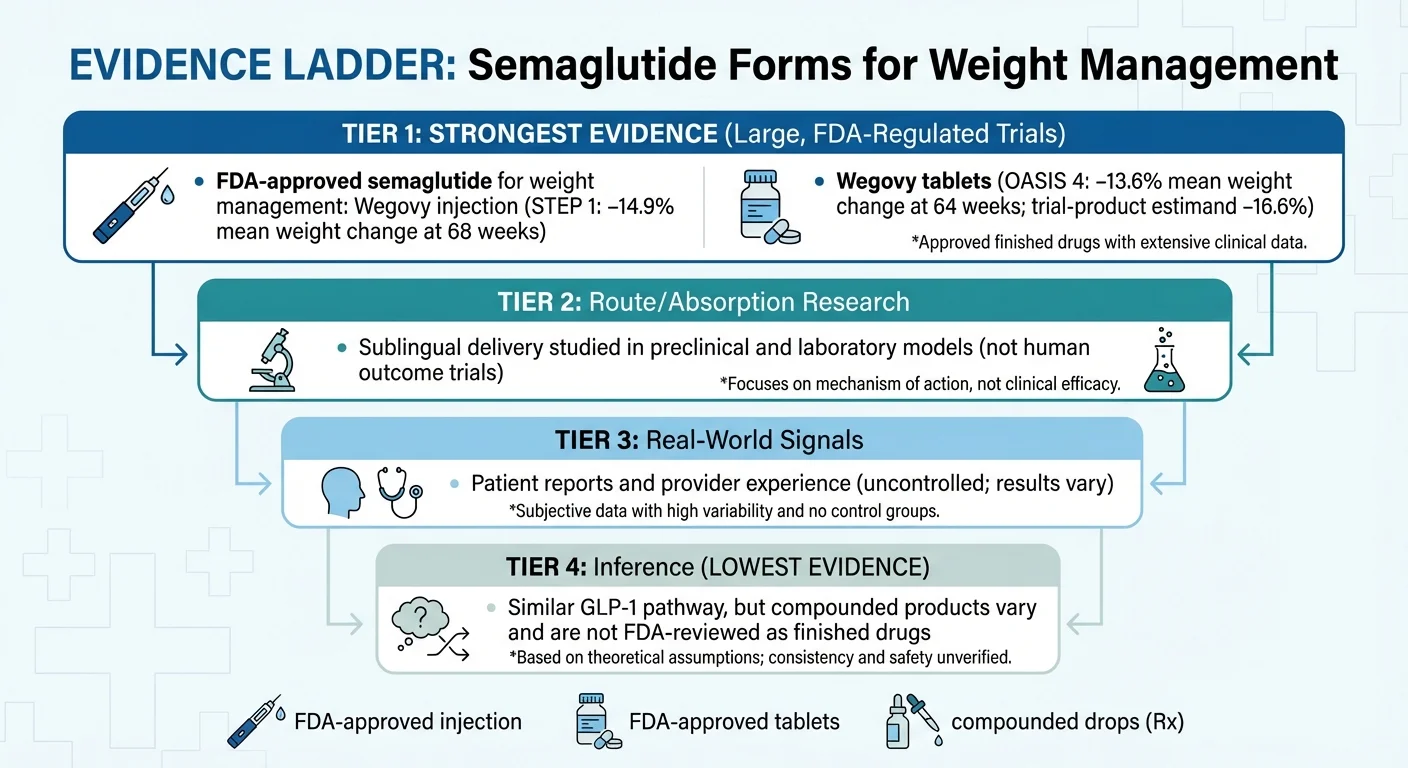
Here is the short answer on GLP-1 and lactation: there is no single class-wide answer. There are four questions. It depends on whether you take a shot or a pill, why you are taking it, how old your baby is, and how much of your baby's food comes from your milk.
The two main human milk datasets covered 195 samples. Injectable semaglutide was not measurable in any of 24 samples from eight mothers. In the main tirzepatide study, 164 of 171 samples were undetectable; low amounts were found in seven, adding up to less than 0.02% of one 5 mg dose. That is reassuring about milk transfer. It is not proof of long-term safety. Semaglutide LactMed Zepbound prescribing information
The pills are a different question. Current U.S. labels say breastfeeding is not recommended during treatment with Wegovy tablets, Rybelsus, Ozempic tablets, and Foundayo. For the semaglutide tablets, the concern centers on SNAC, an added ingredient that helps the pill work. Foundayo contains a different drug and has no human milk study. Wegovy prescribing information Rybelsus and Ozempic tablets prescribing information Foundayo prescribing information
The other practical concern is not the low transfer measured in the current studies. It is whether appetite loss, nausea, vomiting, diarrhea, or poor fluid intake makes it harder for you to eat and drink enough while making milk. No human study has shown that a GLP-1 directly lowers milk production. InfantRisk Center Semaglutide LactMed
If you want a GLP-1 only for weight loss and you are still nursing, waiting is the lowest-uncertainty choice. Not because the shots have been proven dangerous. Because the studies were small, short, did not include newborns or premature babies, and did not cover the full range of weight-loss doses or normal long-term use.
If you need one for diabetes or another real medical reason, do not stop your medicine because of an article — including this one. That is a conversation, not a rule.
Start here: find yourself in this table
| Your situation | The bottom line |
|---|---|
| Weight loss only, still nursing | Waiting is the lowest-uncertainty path. There is a good reason, and it is not the one most pages explain. |
| Taking a GLP-1 shot for a medical reason | Small human studies are reassuring about transfer for injectable semaglutide and tirzepatide. They do not settle full-dose, newborn, long-term, or milk-supply questions. |
| Considering an oral semaglutide pill — Wegovy tablets, Rybelsus, or Ozempic tablets | Current U.S. labels say breastfeeding is not recommended during treatment because SNAC and/or its metabolites are present in milk and may build up in an infant. |
| Considering Foundayo | Its current U.S. label says breastfeeding is not recommended. There are no human milk data. |
| Baby is newborn, premature, or exclusively breastfed | Highest uncertainty. The reassuring semaglutide infant observations did not include babies like yours. |
| Comfort-nursing a toddler once or twice a day | Lower milk-exposure context than exclusive newborn feeding. It is still not a proven safety cutoff. |
| You already took a dose | Do not panic and do not make sudden changes. Jump to that section. |
| Fully weaned or exclusively formula feeding — no breast milk | Lactation is not your blocker. This page is not really for you. |
What we actually verified for this page
We did not summarize other articles. We read the source documents. Here is exactly what:
✓ Current U.S. lactation language for the main GLP-1 products and formulations — Wegovy injection and tablets, Ozempic injection and tablets, Rybelsus, Zepbound, Mounjaro, Foundayo, Saxenda, Victoza, Trulicity, exenatide products, and lixisenatide
✓ The June 2026 Wegovy label — the version that gives the shot and pill different lactation instructions
✓ Current LactMed records for semaglutide, tirzepatide, orforglipron, liraglutide, dulaglutide, exenatide, lixisenatide, and metformin
✓ The peer-reviewed semaglutide milk study, the tirzepatide label study, and the small repeated-dose tirzepatide preprint described by LactMed
✓ FDA safety alerts on compounded semaglutide dosing errors and unapproved GLP-1 products
✓ Original cross-checks and math we did ourselves, shown below so you can check themWhat we did not do: we did not take these medicines, test anyone's milk, invent a doctor's name to put at the top of this page, or let any company pay to change what is written here.
One limit worth seeing: product labels and LactMed do not always contain the same evidence. A label may say the manufacturer has no human milk data while LactMed includes an independent study published later. We show both instead of pretending the sources say the same thing.
Table of contents
- Can you take a GLP-1 while breastfeeding?
- What does the 2026 GLP-1 and lactation evidence show by drug?
- Why is the pill different from the shot?
- How much actually gets into breast milk?
- What those studies did not test
- Will a GLP-1 dry up my milk?
- How many calories do I actually need?
- How long should I wait after having a baby?
- What if I have obesity and low supply already?
- Does my baby's age change the answer?
- Does pumping and dumping help?
- What about birth control?
- How long does it stay in my body?
- Is breast milk already full of GLP-1?
- What if I already took a dose?
- Are compounded GLP-1s the same?
- Why do sources disagree?
- What if I need it for diabetes or another medical reason?
- What can I do right now instead?
- What to watch, and who to call
- When can I start after weaning?
- FAQ
Can you take a GLP-1 while breastfeeding?
There is no single yes-or-no answer for the whole drug class. Injectable semaglutide was not measurable in the published eight-mother study. Tirzepatide was undetectable in 164 of 171 samples after one 5 mg dose and present at low levels in seven. Current U.S. labels for these injections tell clinicians to weigh breastfeeding benefits, the mother's medical need, and possible infant effects. Oral semaglutide products that contain SNAC and Foundayo instead say breastfeeding is not recommended during treatment. Semaglutide LactMed Zepbound prescribing information Wegovy prescribing information Foundayo prescribing information
Let us be honest about why you have read five pages and still do not know.
It is because most of them answer the wrong question. They ask “is this drug safe?” — which nobody can fully answer yet — instead of the four questions that actually change your answer.
Question 1: Shot or pill? These are not the same. Not even when the medicine inside is semaglutide. We will show you why in a minute, and it is the single most useful thing on this page.
Question 2: Why are you taking it? Weight loss only is a different calculation from type 2 diabetes. Not because your weight does not matter — it does. But if you are managing a disease, there is a risk on both sides of the decision. If you are only after weight loss, waiting mainly costs time. If you are treating disease, delaying or stopping treatment may carry medical costs too.
Question 3: How old is your baby? A three-week-old who gets every calorie from your milk is in a completely different situation from a fourteen-month-old who eats scrambled eggs and nurses at bedtime.
Question 4: How much of your baby's food is your milk? Exclusive breastfeeding, mixed feeding, and comfort nursing are three different exposure settings.
Change any one of those four and the answer moves.
One thing nobody will tell you plainly
There is no single class-wide U.S. rule here.
The current labels do not use one instruction for every GLP-1. Even two forms of semaglutide can have different wording. Wegovy tablets say breastfeeding is not recommended. Wegovy injection tells clinicians to weigh breastfeeding benefits, maternal need, and possible infant effects. Zepbound uses that same benefit-risk structure. Foundayo says it is not recommended for nursing women. Wegovy prescribing information Zepbound prescribing information Foundayo prescribing information
So when a website says every GLP-1 is “contraindicated” during breastfeeding — meaning officially forbidden — that is too broad. Some products have label language advising against breastfeeding. Some do not. A telehealth program may also refuse to treat anyone who is nursing under its own clinical policy.
That policy is real and should be respected. But a program policy, a label recommendation, and a formal contraindication are three different things. Blending them is how this topic got so confusing.
What we are not going to do here
We are not going to tell you that wanting your body back is selfish. It is not. You grew a person. You are feeding a person. You are allowed to want to feel like yourself.
And we are not going to sell you anything on this page. Weight Loss Provider Guide is an independent comparison resource for GLP-1 telehealth providers, and we make money when readers sign up with one. We have deliberately put zero provider links in this guide. Not because the programs are bad. Because pointing a nursing mother toward a checkout button while she is trying to work out what the evidence means for her baby would be a rotten thing to do.
🔧 Get your own evidence map, not the average answer
Our GLP-1 + Breastfeeding Planner takes your exact medicine and form, your reason for taking it, your baby's age, and your feeding pattern. It gives you the current evidence for your situation and a printable list of questions for your prescriber, your child's clinician, and your lactation professional.
→ Build My Question List (free, no email, takes about 90 seconds)
It will never tell you a drug is safe or unsafe, tell you to start or stop, give you a dose, or recommend a provider. It tells you what is known, what is not, and exactly what to ask.
What does the 2026 GLP-1 and lactation evidence show by drug?
The evidence is strongest — but still small — for injectable semaglutide and tirzepatide. Oral semaglutide tablets that contain SNAC and Foundayo carry current U.S. language saying breastfeeding is not recommended. Liraglutide, dulaglutide, exenatide, and lixisenatide still have no published human milk-level studies in their current LactMed records. Semaglutide LactMed Tirzepatide LactMed Orforglipron LactMed Liraglutide LactMed Dulaglutide LactMed Exenatide LactMed Lixisenatide LactMed
We read the lactation section for each product and put the same questions across every row. That matters because a table that mixes label language, animal data, human milk measurements, and expert opinion in one “safe or unsafe” column hides more than it explains.
The 2026 GLP-1 Lactation Evidence Ledger
WPG Evidence Ledger · Version 1.0 · Verified August 5, 2026
| Medicine and form | What the current U.S. label says | Human milk evidence | Infant evidence | Milk-production evidence | Evidence status and biggest gap |
|---|---|---|---|---|---|
| Wegovy injection / Ozempic injection (semaglutide) | Wegovy injection uses a benefit-risk discussion. Ozempic injection does not carry the SNAC tablet warning. | Eight mothers using 0.25–1 mg weekly gave 24 samples at 0, 12, and 24 hours. Semaglutide was not measurable below 1.7 ng/mL. | Infants were 4–23 months old, mixed fed, and exposed for 3–9 weeks. Mothers reported normal growth and development. No infant blood levels were measured. | None published. | Small, reassuring transfer study. Biggest gaps: newborns, premature infants, exclusive feeding, higher Wegovy doses, later sampling, repeated long-term exposure, and long-term infant outcomes. |
| Wegovy tablets / Rybelsus / Ozempic tablets (oral semaglutide + SNAC) | Breastfeeding is not recommended during treatment. | In manufacturer oral-tablet data, semaglutide was below the milk assay's quantification limit, but SNAC and/or its metabolites were present. | No adequate infant-outcome data. Labels raise concern that infants may clear SNAC less efficiently. | None published. | Current label advises against breastfeeding. Do not transfer the injection answer to the tablet. |
| Zepbound / Mounjaro (tirzepatide injection) | Uses a benefit-risk discussion, not a class-wide ban. | In 11 women after one 5 mg dose, 164 of 171 samples were undetectable. The amount in the other seven totaled less than 0.02% of the maternal dose. LactMed also describes a five-woman repeated-dose preprint at 2.5–5 mg weekly. | The label study collected no infant outcomes. In the five-woman preprint, mothers reported no effects they linked to tirzepatide. | None published. | Small human dataset, including very limited repeated use. Biggest gaps: steady state at usual weekly treatment, doses over 5 mg, newborns, exclusive feeding, infant blood levels, supply, and long-term outcomes. |
| Foundayo (orforglipron tablet) | Not recommended for nursing women. | No human milk data. Orforglipron-related material was present in rat milk at three times the plasma concentration. | No human infant data. | No human data. | No human lactation dataset. LactMed says an alternative may be preferred, especially with a newborn or premature infant. |
| Saxenda / Victoza (liraglutide injection) | Uses product-specific benefit-risk language rather than the SNAC tablet warning. | No published human milk-level data in LactMed. Large peptide size and likely digestion in the infant gut are theoretical reasons transfer and absorption may be low. | No published human infant-outcome data in LactMed. | None published. | Theory only. LactMed advises caution, especially with a newborn or premature infant. |
| Trulicity (dulaglutide injection) | No oral-SNAC warning. Product labeling and LactMed do not provide a human milk dataset. | No published human milk-level data in LactMed. | No published human infant-outcome data in LactMed. | None published. | Theory only. Large size is reassuring in theory; human evidence is absent. |
| Byetta / Bydureon (exenatide injection) | No oral-SNAC warning. | No published human milk-level data in LactMed. | No published human infant-outcome data in LactMed. | None published. | No human transfer data. LactMed notes its shorter half-life may make it a theoretical option within the class when treatment is needed, while still advising caution. |
| Adlyxin (lixisenatide injection) | No oral-SNAC warning. | No published human milk-level data in LactMed. | No published human infant-outcome data in LactMed. | None published. | Theory only. Caution remains appropriate, especially for a newborn or premature infant. |
| Compounded semaglutide, tirzepatide, blends, gum, drops, lozenges, or other custom forms | No compounded product has an FDA-approved prescribing label or an FDA-reviewed Section 8.2 lactation section. | No single branded-product study can establish transfer for every pharmacy, concentration, salt form, additive, or route. | No dependable product-specific infant-outcome dataset across these custom products. | No dependable product-specific dataset. | Product-specific uncertainty. Check the exact active ingredient, form, concentration, added ingredients, pharmacy, and directions. Do not automatically transfer branded-injection evidence. |
Row sources: Wegovy label, Ozempic injection label, oral semaglutide label, Zepbound label, Mounjaro label, Foundayo label, Saxenda label, and the current LactMed records for semaglutide, tirzepatide, orforglipron, liraglutide, dulaglutide, exenatide, and lixisenatide. The human transfer evidence comes from the peer-reviewed semaglutide study, the tirzepatide label study, and the repeated-dose tirzepatide preprint summarized by LactMed.
Three things this table shows that almost nobody says out loud
One: for semaglutide, the warning follows the formulation, not just the drug name.
Look at the first two rows. Same active medicine. Different form. Different added ingredients. Different lactation instruction. That is not a mistake. That is the whole story, and we will unpack it in the next section.
Two: Foundayo is not “the same pill without a needle.”
Foundayo was approved in April 2026. It is orforglipron, a small-molecule GLP-1 receptor agonist, not semaglutide and not a peptide injection. There are no human milk data. Its label reports orforglipron-related material in rat milk at three times the plasma level and says the product is not recommended for nursing women. Animal data cannot tell us the human infant dose, but they are the actual reason this row should not be blended with the injectable studies. Foundayo prescribing information
Three: “no data” is not the same as “danger” — and it is also not the same as “fine.”
Several drugs in that table have no published human milk study. That means no measured answer. It does not mean harm was found. It also means molecular size alone cannot give you infant outcomes, long-term development, or milk-supply data.
Why the label and LactMed can disagree without either one being wrong
The Wegovy injection label says the manufacturer has no data on subcutaneous semaglutide in human milk. LactMed includes an independent eight-mother study and says semaglutide was not detectable in those samples. The Zepbound label includes the manufacturer's single-dose study. LactMed adds a small repeated-dose preprint and warns that the single-dose result may understate what happens after the drug reaches steady state. Different evidence entered the sources on different schedules. Wegovy prescribing information Semaglutide LactMed Zepbound prescribing information Tirzepatide LactMed
That is why this ledger has separate columns for label language, human milk evidence, infant evidence, and what is still missing. One “safe” score would erase the part you actually need.
Why is the pill treated differently from the shot?
For oral semaglutide, the difference is not just the semaglutide. It is SNAC, an added ingredient that helps the medicine get through your stomach. In the oral-tablet lactation study, semaglutide was below the level the lab could measure in milk, but SNAC and/or its byproducts were present. Because infants may clear SNAC more slowly than adults, the Wegovy, Rybelsus, and Ozempic tablet labels advise against breastfeeding during treatment. Wegovy prescribing information Rybelsus and Ozempic tablets prescribing information
This is the section we would want you to read if you only read one.
What SNAC actually is
Semaglutide is a big, fragile molecule. Swallow it plain and very little gets into your bloodstream.
So Novo Nordisk added a helper called SNAC — salcaprozate sodium. Think of it as a bodyguard. It helps the semaglutide survive long enough to be absorbed through the stomach. Without SNAC, there is no current oral semaglutide tablet.
The shot does not need that bodyguard. It skips the stomach. So semaglutide injections do not contain SNAC.
That is why “shot or pill?” is not a cosmetic question. It changes what is in the product and what the label says.
And here is the part that flips everything
The Wegovy tablet label says semaglutide was below the lower limit of quantification in human milk. Plain English: the assay could not measure it at or above its reporting limit.
The semaglutide was not the part the label could measure. SNAC and/or its metabolites were.
The label also says the activity of enzymes involved in clearing SNAC may be lower in infants than in adults. That creates a concern that SNAC levels could build up more in a newborn or infant than they would in you.
Then the label explains why the tablet warning is different: non-SNAC semaglutide formulations exist. LactMed reaches the same practical split and says only injectable semaglutide forms should be used during breastfeeding. Wegovy prescribing information Semaglutide LactMed
Read that twice. The current evidence does not say “needle bad, pill gentle.” For semaglutide during lactation, the pill has the extra ingredient and the stronger warning.
That does not turn the injection into a proven-safe product. It means the injection and tablet should never be treated as one answer.
One honest note about SNAC
We are not going to pretend SNAC is scary based on nothing. Here is what the current Wegovy label reports underneath the warning: in a rat pre- and postnatal study, SNAC was given at 1,000 mg per kilogram per day from day 7 of pregnancy through day 20 of lactation. Researchers saw longer gestation, more stillbirths, and lower pup viability. Exposure levels were not measured. Wegovy prescribing information
That is a high-dose animal study. It is not a study of nursing women taking a Wegovy tablet. It cannot tell you what would happen to a human infant. But it is part of the evidence regulators used instead of guessing.
Foundayo is a different pill entirely
Do not group it with the semaglutide tablets. Foundayo contains orforglipron, a different active drug. It has no SNAC and no human milk study. Its label reports drug-related material in rat milk at three times the plasma concentration and says Foundayo is not recommended for nursing women. LactMed now has an orforglipron entry and says an alternative may be preferred, especially while nursing a newborn or premature infant. Foundayo prescribing information Orforglipron LactMed
So there are two different reasons an oral product may land in the “do not breastfeed during treatment” column:
- Oral semaglutide: the SNAC concern.
- Foundayo: a different drug, no human milk data, animal milk transfer, and its own label recommendation.
“Pill” is not one safety category. The exact product is the question.
How much of the drug actually gets into breast milk?
In the published injectable semaglutide study, researchers tested 24 milk samples from eight nursing mothers and did not measure semaglutide in any one. In the main tirzepatide study, 164 of 171 samples were undetectable; low levels were measured in seven, and the total amount across 28 days was less than 0.02% of one 5 mg dose. Those are reassuring transfer findings. They are not a guarantee of safety at every dose, feeding stage, or length of treatment. Semaglutide milk study Zepbound prescribing information
Here is what was actually done, because the details matter more than the headline.
The semaglutide study
Published in Nutrients in August 2024 by researchers connected with Texas Tech University Health Sciences Center.
| What | Detail |
|---|---|
| Mothers | 8 |
| Dose | 0.25 to 1 mg per week, by injection |
| Samples | 24 total — at 0, 12, and 24 hours after the shot |
| Lab sensitivity | Lower limit of detection: 1.7 ng/mL |
| Result | Semaglutide was not detected in any sample |
| Modeled infant exposure | Average modeled relative infant dose: 1.12%; highest modeled estimate: 1.26% if milk contained drug at the assay limit |
| Babies | 4 to 23 months old, mixed fed, exposed for 3 to 9 weeks |
| Baby outcomes | Mothers reported normal growth and development; infants were not examined under a formal long-term outcome protocol |
| Missing | Infant blood levels, newborns, premature infants, exclusive feeding, milk production, full Wegovy dose range, and long-term development |
A relative infant dose, or RID, compares the infant's estimated weight-adjusted dose through milk with the mother's weight-adjusted dose. Ten percent is often used as a screening benchmark in lactation references. It is not a magic line that proves a medicine is safe below it or dangerous above it. The drug, infant age, toxicity, length of exposure, and quality of the data still matter. Semaglutide milk study
The tirzepatide study
The main data are now in the Zepbound and Mounjaro labels.
| What | Detail |
|---|---|
| Mothers | 11 |
| Dose | One 5 mg injection |
| Samples | 171, collected over 28 days |
| Result | Undetectable below 4 ng/mL in 164 of 171 samples |
| Total in the other 7 | Less than 0.02% of the maternal dose |
| Last measurable level | Day 5 |
| Baby outcomes | Not collected in the label study |
| Milk-production outcomes | Not collected |
| Main limit | One dose does not show what happens after months of weekly treatment and drug accumulation |
LactMed also describes a separate five-woman preprint in which mothers used 2.5 to 5 mg weekly. A few samples had amounts below the assay's quantification limit, none were quantifiable, and mothers did not report infant effects they linked to tirzepatide. That adds a small piece of repeated-use evidence. It is still five women, and it had not yet become a full peer-reviewed infant-outcome study as of this verification. Tirzepatide LactMed
What 195 milk samples can and cannot tell you
The 24 semaglutide samples and 171 tirzepatide samples give us 195 directly measured milk samples across the two core datasets.
They can tell us this:
- Injectable semaglutide was below the assay's detection limit in the 24 samples collected.
- Tirzepatide was below the assay's detection limit in most samples, with low measured amounts in seven.
- Neither dataset showed a large amount moving into milk under the tested conditions.
They cannot tell us this:
- What happens at every approved dose.
- What happens after months or years of treatment.
- What happens in a newborn, premature infant, or exclusively breastfed young baby.
- What the infant's blood level would be.
- Whether milk volume or milk composition changes.
- Whether there are long-term growth or development effects.
That is the difference between reassuring transfer data and proven safety.
Why large injectable molecules are expected to transfer poorly
There is real science behind why the milk amounts were low.
Molecules generally cross into milk more easily when they are small. Semaglutide is about 4,114 daltons, tirzepatide about 4,814, and liraglutide about 3,751. These are large peptide molecules. LactMed therefore expects low milk transfer and poor infant absorption for several injectable drugs in this class. Semaglutide LactMed Tirzepatide LactMed Liraglutide LactMed
There is a second reason for cautious reassurance. Peptides are usually broken down in the digestive tract. A tiny amount swallowed in milk may not become the same amount in the infant's bloodstream.
But “large molecule” is supporting theory, not an infant-outcome study. It does not rule out every transfer pathway. It does not measure infant blood. And it does not answer the nutrition or milk-supply question.
So: hard to move into milk, likely hard to absorb if swallowed, and low in the small studies we have.
That is genuinely reassuring. Now here is the part where we tell you why it is not the end of the story.
What those studies didn't test (read this before you relax)
The studies did not cover the whole real-world treatment picture. Injectable semaglutide was studied at 0.25 to 1 mg per week, while current Wegovy maintenance options include 1.7, 2.4, and, for eligible adults, 7.2 mg weekly. Tirzepatide's main study used one 5 mg dose; 5 mg is a maintenance dose, but normal treatment is weekly and may rise to 10 or 15 mg. Wegovy prescribing information Zepbound prescribing information
This is our damaging admission, and we are putting it in the middle of the page instead of burying it.
We did this math ourselves from the published study doses and current labels. You can check every line.
The dose-and-use gap
| Drug | What was tested in milk | Current treatment context | What that means |
|---|---|---|---|
| Semaglutide | 0.25–1 mg weekly | Wegovy maintenance may be 1.7 or 2.4 mg weekly; 7.2 mg is now an adult high-dose option for eligible patients | The tested range equals about 15%–59% of 1.7 mg, 10%–42% of 2.4 mg, and 3.5%–14% of 7.2 mg. One milligram can still be an Ozempic maintenance dose, so the gap is largest when applying the study to higher-dose Wegovy use. |
| Tirzepatide | One 5 mg dose in the label study | Zepbound maintenance doses are 5, 10, or 15 mg weekly; steady state is reached after about 4 weeks | Five milligrams is not merely a starter dose. The problem is that it was given once, not every week to steady state, and it did not test 10 or 15 mg. |
| Tirzepatide preprint | 2.5–5 mg weekly in 5 women | Very small repeated-use evidence | Helpful, but too small to settle higher doses, newborns, infant blood levels, supply, or long-term outcomes. |
Put plainly: the semaglutide study did not cover the full Wegovy dose range, and the main tirzepatide study did not copy normal weekly treatment. Those are not the same tests as full-dose, steady-state care.
LactMed says the quiet part out loud about the tirzepatide label study: a single dose does not account for the accumulation that happens with normal weekly use, so steady-state milk amounts may be higher than that study suggests. Tirzepatide LactMed
That does not mean the amount becomes high. It means the one-dose number should not be sold as the last word.
The sampling-window gap
Here is an original cross-check that took opening two documents side by side.
The semaglutide milk study collected samples at 0, 12, and 24 hours after the injection.
The current Wegovy label says the highest semaglutide blood concentration after an injection is reached about 1 to 3 days after the dose.
One to three days is 24 to 72 hours.
So the study's last planned sample landed at the front edge of the label's blood-peak window. It did not collect planned samples at 48 or 72 hours. Semaglutide milk study Wegovy prescribing information
That comparison does not prove milk levels would peak later. Milk and blood do not always follow the same curve. It does show that the study did not sample through the whole blood-peak window, which is a fair reason to avoid overclaiming certainty.
The infant gap
The semaglutide infants were 4 to 23 months old, mixed fed, and observed through maternal reports for 3 to 9 weeks. The tirzepatide label study did not collect infant outcomes at all.
No core dataset gave us:
- A newborn group.
- A premature-infant group.
- An exclusively breastfed young-infant group.
- Infant blood measurements.
- A formal long-term development assessment.
- A direct milk-volume or milk-composition study.
Now here is the pivot, and we mean it
None of this means the injections are dangerous.
Everything measured still points in a reassuring direction. Injectable semaglutide was not detected in the samples. Tirzepatide was undetectable in most samples and low in the rest. The molecules really are large. Infant oral absorption is expected to be poor.
What it means is that the confidence should match the evidence.
The evidence is eight semaglutide mothers, 24 early samples, older mixed-fed infants, and no direct supply data — plus an 11-woman tirzepatide single-dose study and a five-woman repeated-dose preprint.
That is a promising start. It is not a settled answer.
Which is exactly why the question you should be asking is not only “is the drug safe?” It is “is now the right time, for this exact product, for this exact reason, with this exact baby?”
And that question has a much better answer.
Will a GLP-1 dry up my milk?
No human study has shown that a GLP-1 medicine directly lowers milk production. The practical concern is indirect: appetite loss, nausea, vomiting, diarrhea, or dehydration can make it harder to eat and drink enough while making milk. That concern is real. It is not the same as proof that the drug itself “dries up” milk. InfantRisk Center Semaglutide LactMed Tirzepatide LactMed
This is the part almost every page skips, because it is less dramatic than asking whether the drug is in the milk.
The risk chain, with each link labeled honestly
- The medicine can reduce appetite. That is one reason these drugs work.
- You may eat much less. InfantRisk points to an adult type 2 diabetes study in which tirzepatide reduced energy intake by as much as about 39%. That was not a breastfeeding study. InfantRisk Center
- Making milk takes extra energy. The CDC says a well-nourished breastfeeding mother generally needs about 330 to 400 more calories per day than she ate before pregnancy, with needs changing by body size, activity, and how much milk she makes. CDC maternal diet guidance
- Stomach side effects can make the problem worse. Nausea, vomiting, and diarrhea can reduce both food and fluid intake. These are known side effects in current GLP-1 labels.
- Milk supply could fall if your body is not getting what it needs. That is biologically reasonable and supported by normal lactation care. But no study has measured a direct GLP-1-caused drop in milk volume.
That last line matters. We are not going to turn a reasonable concern into a proven side effect.
What is known, and what is still only a concern
| Question | What the evidence says |
|---|---|
| Has a study shown semaglutide directly lowers human milk volume? | No. LactMed found no published information on milk production as of May 15, 2026. |
| Has a study shown tirzepatide directly lowers human milk volume? | No. LactMed found no published information on milk production as of April 15, 2026. |
| Can these medicines reduce appetite and cause stomach side effects? | Yes. That is well documented in the product labels and adult studies. |
| Can poor intake or dehydration make lactation harder? | Yes, as a practical lactation concern. The exact effect differs from person to person. |
| Is there a proven dose at which supply falls? | No. No validated cutoff exists. |
| Is there a proven feeding schedule that prevents supply changes? | No. |
It is not only calories
If your appetite drops hard, the problem may be the quality of what you can eat as much as the amount.
Iron, calcium, folate, vitamin D, protein, and other nutrients matter to your own health. Breastfeeding does not make you immune to low intake. Your body may use its own stores to protect milk production for a while, which can leave you feeling weak, dizzy, cold, foggy, or worn down.
That does not mean every breastfeeding person on a GLP-1 becomes deficient. It means nutrition deserves a plan, not a guess.
A registered dietitian can help set a personal intake plan around your body, feeding pattern, health conditions, and medicine. A prenatal vitamin or multivitamin may fill some gaps, but it cannot replace food, fluid, or treatment for a true deficiency.
One more thing that is not unique to GLP-1s
Fast weight loss from any cause can raise gallstone risk. GLP-1 labels also warn about gallbladder problems. InfantRisk advises slow, steady loss during breastfeeding rather than a hard drop, but no single weekly number fits every postpartum body. InfantRisk Center
The clean answer is this:
The drug has not been proven to shut off milk. The bigger practical risk is that you may stop feeling hungry before your body stops needing food.
How many calories do I actually need while breastfeeding?
There is no safe universal calorie floor that a webpage or calculator can give every breastfeeding person. The CDC's general estimate is about 330 to 400 extra calories per day compared with pre-pregnancy intake, but your total need depends on your body size, activity, health, milk output, and whether you nurse fully or only once a day. CDC maternal diet guidance
We went looking for one clean number to give you. There is not one.
The draft version of this page promised a personalized calorie floor, protein target, and fluid target from a few inputs. We cut that promise. It sounded useful, but it would have given medical-looking precision the evidence cannot support.
What the main sources actually give you
| Source | What it says | How to use it |
|---|---|---|
| CDC | A well-nourished breastfeeding mother generally needs about 330–400 extra calories per day compared with pre-pregnancy intake | A broad population estimate, not your personal minimum |
| InfantRisk | Offers a practical lactation nutrition calculator and commonly discusses a roughly 2,000-calorie baseline plus added milk-production needs | Specialist guidance that still depends on the person's size and milk output |
| Your clinician or registered dietitian | Can use your full history, body size, feeding pattern, symptoms, and goals | The right place for an individual target |
A person who is 5 feet 2 inches and comfort-nurses a toddler does not have the same need as a taller person exclusively nursing twins. Pretending they do would be easy to code and wrong to publish.
What to track instead of chasing one magic number
Use these as discussion points, not pass-fail tests:
- Are you regularly getting meals or snacks even when hunger is quiet?
- Are you able to keep food and fluid down?
- Are nausea, vomiting, or diarrhea lasting or getting worse?
- Is your usual milk pattern changing?
- Is your baby feeding and growing as expected?
- Are you feeling dizzy, faint, weak, confused, or unusually exhausted?
- Do you have a medical condition that changes your nutrition or fluid needs?
InfantRisk suggests roughly 2 to 3 liters of water per day as a practical starting point for many breastfeeding mothers, especially when stomach symptoms are present. That is not a universal prescription. Kidney, heart, endocrine, and other conditions can change fluid needs. InfantRisk Center
Eating when you are not hungry
This is the practical skill nobody teaches.
- Small and often may work better than big meals. A few bites six times may be easier than three full plates.
- Put useful food first. Protein, whole grains, fruit, vegetables, dairy or fortified alternatives, beans, nuts, and healthy fats give more back per bite.
- Do not trust appetite alone at first. Appetite is exactly what the medicine changes. A simple food and symptom log can show your care team what is happening.
- Liquid food can be easier. Milk, a balanced smoothie, soup, or another tolerated option may work when solid food does not.
- Do not push through ongoing vomiting or dehydration. Those need clinical help, not a stronger meal plan.
🔧 Check the weak spots before your appointment
The GLP-1 + Breastfeeding Nutrition Check-In asks about your feeding pattern, appetite, stomach symptoms, fluids, and supply changes. It gives you a one-page list of possible gaps and questions to bring to your prescriber, pediatric clinician, or dietitian.
→ Run My Nutrition Check-In (free, no email, about 90 seconds)
It does not give a calorie deficit, goal weight, dose, or personal medical minimum. It helps you show your care team what may need attention.
How long should I wait to start a GLP-1 after having a baby?
No FDA label sets one universal postpartum start date for GLP-1 treatment. If treatment is optional, InfantRisk says it may be wise to wait until at least 7 months and that 9 to 12 months may lower uncertainty further because solid food is established and breast milk is less likely to be the baby's only food. That is specialist guidance, not a proven safety cutoff or a law. InfantRisk Center
This is the number many people came for. It needs the right label on it.
The timing table — with the evidence level shown
| Where you are | Practical direction | What supports it |
|---|---|---|
| Birth to 6 weeks | Usually wait when the goal is weight loss alone | Early recovery, feeding establishment, and high uncertainty; not an FDA drug cutoff |
| 6 weeks to 6 months, exclusively breastfeeding | Waiting is the lowest-uncertainty path when treatment is optional | Milk may be the baby's only food, and no core study covered an exclusively breastfed young infant |
| Around 7–9 months, solids started | A more reasonable time to have the full conversation | InfantRisk expert guidance; solids add another nutrition source |
| Around 9–12 months | Lower nutrition and milk-exposure uncertainty than early exclusive feeding | InfantRisk expert guidance; still not proof of drug safety |
| Toddler, occasional comfort nursing | Lowest milk-exposure setting discussed on this page | Less milk dependence; no validated “safe after this age” line |
| Diabetes or another important medical need, any stage | Different calculation | The risk of untreated or undertreated disease belongs in the decision too |
Why the first six months change the question
If a baby is exclusively breastfed, milk is the baby's only food for that period.
If the mother's food and fluid intake falls sharply, there is less backup than there is after solids are established. That is the logic behind the InfantRisk timing suggestion.
It is not proof that month seven is safe and month six is dangerous. Biology does not flip on one birthday. It is a way to think about how much the baby depends on milk and how stable the feeding system is.
What about a six-week or three-month postpartum rule?
You may hear clinicians suggest waiting at least six weeks or several months so the parent has time to heal and feeding has time to settle.
That can be reasonable individual advice. It is not a class-wide instruction found in every GLP-1 label, and it should not be published as though one date fits every birth, recovery, feeding plan, or medical need.
And here is the reframe we want you to keep
Waiting is a plan. It is not a punishment.
You can choose a review date today. Put it on the calendar. Ask your clinician what needs to be true by then: feeding pattern, recovery, lab work, contraception, pregnancy plans, or a different diabetes plan.
That turns “I am not allowed” into “I know what I am waiting for.”
What if I have obesity and my supply is already low?
Obesity is associated with a higher chance of delayed milk coming in, but low supply has many causes and weight alone does not explain one person's feeding problem. A 216-person cohort found delayed lactogenesis in 57.9% of mothers with a pre-pregnancy BMI of 30 or higher versus 46.4% below 30. A 2024 systematic review also found a higher risk of delayed lactogenesis, while noting that the available data did not show lower infant milk intake across the board. Obesity and delayed lactogenesis cohort 2024 systematic review
This is the most complicated case on the page, and it deserves care instead of blame.
If milk has been hard, that is not proof that you failed. Feeding can be affected by birth events, early milk removal, latch, infant health, retained placenta, thyroid disease, diabetes, insulin resistance, breast surgery, medicines, pain, stress, and many other things.
What research says about obesity and lactation
A higher BMI has been linked with delayed lactogenesis II — the point when fuller milk production turns on after birth.
Researchers have proposed several reasons:
- Differences in hormonal signaling after birth.
- Insulin resistance and metabolic health.
- Inflammation.
- Birth and hospital factors that occur more often with obesity.
- Mechanical feeding and pumping challenges.
These are possible contributors, not a one-person diagnosis.
Insulin appears to have a real role in the mammary gland, and poor metabolic health has been studied as a possible part of low supply. But the biology is still being worked out. Insulin and lactation review
The genuinely interesting question
GLP-1 medicines can improve blood sugar and insulin sensitivity and can reduce body weight over time.
So could treating the metabolic problem eventually help milk production?
It is a fair research question.
And the genuinely frustrating answer
We do not know.
No study has shown that starting semaglutide, tirzepatide, or another GLP-1 improves milk supply in mothers with obesity or insulin resistance. LactMed's current metformin record also notes that metformin has been tried as a milk-supply treatment, but there is no evidence that it works for that purpose. Metformin LactMed
The possible long-term metabolic benefit and the immediate appetite effect also move on different timelines. Appetite may change right away. Any benefit tied to weight loss or longer-term metabolic change would take longer.
That is why “a GLP-1 might fix my low supply” is not a sound reason to start one during lactation.
What to bring to the appointment
Ask for two separate problems to be worked up instead of being blended into one:
- Why is supply low? Ask an IBCLC and the baby's clinician to look at milk removal, feeding, growth, and possible medical causes.
- Why is a GLP-1 being considered? Weight loss alone, type 2 diabetes, sleep apnea, cardiovascular risk, or another reason can change the balance.
You deserve help with both. You do not have to make one problem carry the whole weight of the other.
Does my baby's age and feeding pattern change the answer?
Yes, a lot. The semaglutide infants were 4 to 23 months old and mixed fed. The tirzepatide label study measured milk but did not collect infant outcomes. No core study covered newborns, premature infants, or a group of young babies getting all of their nutrition from breast milk. Semaglutide LactMed Zepbound prescribing information
That gap is easy to miss.
When you read “no adverse effects were reported,” picture who those semaglutide infants actually were:
- Not newborns. The youngest was four months old.
- Not a premature-infant group.
- Not exclusively breastfed. Every infant was mixed fed.
- Not followed for years. Exposure was 3 to 9 weeks.
- Not tested with infant blood samples.
- Not assessed in a formal long-term development study. Mothers reported normal growth and development.
That does not erase the reassuring finding. It tells you how far you can carry it.
Four situations, four levels of uncertainty
Newborn or premature infant. Highest uncertainty. Drug clearance may be less mature, milk dependence is high, and the available infant observations do not represent this group. LactMed specifically calls for caution with newborn or preterm infants in several GLP-1 entries.
Exclusively breastfed young infant. Milk is the only food, so both drug exposure and any change in milk production matter more. The main human datasets did not study this exact group.
Older baby eating solids. The child has another nutrition source and may drink less milk. That lowers the exposure setting. It does not create proof of safety.
Toddler comfort nursing. This is probably the lowest milk-exposure situation discussed here. InfantRisk describes overall risk as likely minimal when a toddler nurses only a few times for comfort. That is expert judgment, not a tested cutoff. InfantRisk Center
“Partly weaned” is still nursing
If any breast milk is going to your child — at the breast, in a bottle, once each morning, or only at bedtime — lactation still belongs in the medication discussion.
“Almost weaned” and “fully weaned” are different answers.
Does pumping and dumping make it okay?
There is no proven one-feed or one-day “pump and dump” schedule for a long-acting GLP-1. Discarding milk does not make the medicine leave your blood faster. For injectable semaglutide and tirzepatide, the available milk-transfer data are already low; for oral semaglutide tablets and Foundayo, the current labels say breastfeeding is not recommended during treatment rather than offering a short waiting window. Wegovy prescribing information Zepbound prescribing information Foundayo prescribing information
Pump and dump can make sense for a substance that rises and clears over a short, known period.
Weekly GLP-1 injections do not clear that way.
The half-life problem
Half-life is how long it takes the amount of a drug in the body to fall by about half.
| Drug | Approximate half-life | What the current source says |
|---|---|---|
| Semaglutide | About 1 week | Current Wegovy labeling says it can remain in circulation about 5 to 7 weeks after the last 2.4 mg or 7.2 mg injection or 25 mg tablet |
| Tirzepatide | About 5 to 6 days | Weekly dosing reaches steady state after about 4 weeks |
| Liraglutide | About 13 hours | Shorter acting than semaglutide or tirzepatide, but there are still no human lactation data |
Semaglutide and tirzepatide values come from their current U.S. labels; the liraglutide value comes from the current Saxenda label. Wegovy prescribing information Zepbound prescribing information Saxenda prescribing information
Throwing away one or two feeds does not change those timelines.
Why “not detected in these samples” is not the same as “clear after one feed”
The semaglutide study did not find drug in the 24 samples it tested. The tirzepatide study found low amounts in seven samples, with the last measurable level on day five.
Those results answer what happened under those study conditions. They do not create a universal feed-by-feed clearance chart.
This is also why we do not give a home formula such as “wait five half-lives, then nurse.” Milk transfer, infant absorption, dose, repeated use, feeding pattern, and formulation all matter.
When pumping can still help
Pumping is not useless. It is just not a detox.
If your care team recommends a temporary feeding pause for a specific reason, pumping may:
- Protect milk production.
- Relieve fullness.
- Lower the chance of plugged ducts or mastitis.
- Preserve the option to return to nursing.
But it does not make your liver or kidneys clear the medicine faster.
And one more point: pumping milk and feeding it by bottle is still lactation. The route from breast to baby changed. The milk did not.
What about birth control?
This is drug-specific. Tirzepatide labels tell people using oral hormonal birth control to switch to a non-oral method or add a barrier method for 4 weeks after starting and for 4 weeks after every dose increase. Foundayo gives a similar instruction for 30 days after starting and after every dose increase. Do not apply one contraceptive rule to the whole GLP-1 class. Zepbound prescribing information Foundayo prescribing information
This belongs on a postpartum page because an unplanned pregnancy can change the entire medical picture.
Tirzepatide — Zepbound and Mounjaro
In a drug-interaction study, one 5 mg tirzepatide dose lowered the peak blood concentration of three oral-contraceptive components by about 55% to 66%. Total exposure fell by about 20% to 23%, and peak timing was delayed. The label therefore gives a clear four-week backup instruction. Zepbound prescribing information
| When | Current tirzepatide label instruction |
|---|---|
| Starting treatment | Use a non-oral hormonal method or add a barrier method for 4 weeks |
| Every dose increase | Repeat that backup step for 4 weeks |
| Hormonal method that is not taken by mouth | The label says it should not be affected by this stomach-emptying interaction |
Foundayo — orforglipron
Foundayo delays stomach emptying too. Its label says to use a non-oral method or add a barrier method for 30 days after starting and for 30 days after each dose increase.
Here is the damaging detail: the Foundayo label also says its effect on oral-contraceptive absorption has not been tested in a clinical trial. The backup instruction is precautionary because delayed stomach emptying may change absorption. Foundayo prescribing information
The original timing math
This is our calculation from the current dose schedules, not a claim that everyone reaches the top dose.
Zepbound doses may be raised no faster than every four weeks. A person who increases at every allowed step from 2.5 mg through 15 mg could move from one four-week backup window straight into the next for roughly 24 weeks.
Foundayo dose increases are separated by at least 30 days. A person who moves through every step could also spend much of the escalation period inside one backup window after another.
That is not a reason to avoid the medicines. It is a reason to plan contraception before the first dose instead of trying to remember six moving dates later.
Do not make the opposite mistake
The tirzepatide and Foundayo instructions do not prove that every other GLP-1 can never affect an oral medicine.
Different products have different stomach-emptying effects and label instructions. Bring the exact birth-control brand and exact GLP-1 product to the prescriber or pharmacist. Ask what applies to that pair.
The useful question is:
“Does this exact medicine change how my oral birth control is absorbed, and what backup does its current label require?”
How long does a GLP-1 stay in my body after I stop?
It depends on the drug. Semaglutide has a half-life of about one week and can remain in circulation for roughly 5 to 7 weeks after the last high-dose Wegovy injection or 25 mg tablet. Tirzepatide's half-life is about 5 to 6 days. These body-clearance numbers do not create a validated breastfeeding restart clock. Wegovy prescribing information Zepbound prescribing information
Two questions get blended here.
“How long until it is out of my body?”
That is a pharmacology question. The answer changes by drug and dose.
| Medicine | Approximate body-clearance fact |
|---|---|
| Semaglutide | Half-life about 1 week; current Wegovy label says present in circulation about 5–7 weeks after the last 2.4 mg or 7.2 mg injection or 25 mg tablet |
| Tirzepatide | Half-life about 5–6 days; repeated weekly dosing reaches steady state in about 4 weeks |
| Liraglutide | Half-life about 13 hours |
| Orforglipron | Different small-molecule drug; use its own current label rather than a semaglutide timeline |
Sources: Wegovy label, Zepbound label, Saxenda label, and Foundayo label.
“How long until I can breastfeed?”
There is no class-wide answer and no label-backed calculator that turns half-life into a personal nursing date.
For oral semaglutide tablets and Foundayo, the label says breastfeeding is not recommended during treatment. It does not give a universal restart interval after the last pill.
For injections, current labels and LactMed use product-specific benefit-risk language and milk evidence rather than a pump-and-dump clock.
A clinician may use the exact drug, dose, time since last dose, child age, feeding pattern, and reason for treatment to make a plan. That is different from a webpage saying “wait X days.”
“How long before another pregnancy?”
This is also product-specific.
Current semaglutide labeling says to stop at least 2 months before a planned pregnancy because of its long half-life. Do not copy that two-month rule onto tirzepatide, Foundayo, or the whole class without checking the exact current label. Wegovy prescribing information
That correction matters. “All GLP-1s need a two-month washout” sounds simple. It is not what every label says.
Wait — is breast milk already full of GLP-1?
Human breast milk naturally contains GLP-1. In one small study of 13 women about a month after birth, GLP-1 was higher in milk collected later in a feed than earlier. Among the 10 mother-infant pairs with follow-up data, higher later-feed GLP-1 was linked with slower infant weight gain through 6 months. That was a correlation, not proof that milk GLP-1 caused the difference. Natural GLP-1 in human milk study
We found this while reading the semaglutide paper, and it genuinely changes how the question feels.
Your milk already contains an appetite-related hormone that GLP-1 medicines are designed to imitate.
That does not mean a GLP-1 medicine is automatically safe in milk. Your own hormone and a long-acting drug are not the same exposure.
What the 13-person study actually found
- The mothers were studied about 4 to 5 weeks after birth.
- GLP-1 was measured in earlier-feed and later-feed milk.
- Later-feed milk had a higher GLP-1 concentration.
- Higher later-feed GLP-1 was associated with less infant weight gain through 6 months in a very small follow-up group.
- The study could not prove cause and effect.
The active-transport question
The semaglutide milk-study authors noted that natural GLP-1 exists in milk and raised an unanswered idea: a GLP-1-like medicine might use an active transport route rather than only leaking across by molecule size.
They also raised a theoretical infant-satiety question — whether meaningful exposure could make an infant feel full sooner.
No study has shown that happening. The semaglutide samples had no measurable drug, and the infants were not shown to feed less because of semaglutide.
This is not a hidden danger we uncovered. It is a research question that stops “the molecule is large” from becoming false certainty.
And it is a genuinely amazing piece of biology: milk contains signals, not just calories. We should be curious without pretending curiosity is proof.
What if I already took a dose while breastfeeding?
One dose is not proof that harm happened. It is also not proof that continuing is right. The best next step is to collect the exact product, dose, timing, infant age, and feeding details and give them to your prescriber and your child's clinician. Do not make an abrupt treatment or weaning decision from an article.
If this is why you are here, take a breath.
The measured injection data are reassuring about transfer. The important job now is to turn “I took something” into a clear set of facts.
Do not do these things right now
- Do not stop a prescribed diabetes medicine on your own. Poorly controlled blood sugar can carry its own risks.
- Do not wean in a panic. Sudden weaning can be painful and can raise the chance of breast inflammation or mastitis.
- Do not assume the worst. The human milk findings for injectable semaglutide and tirzepatide were low.
- Do not assume the product does not matter. A shot, an SNAC tablet, Foundayo, and a compounded vial are different questions.
- Do not use an online half-life calculator as your whole plan.
Gather these ten facts
Write them down before you call. It makes the conversation far more useful.
- Exact brand name and active drug.
- Shot, tablet, vial, pen, gum, drops, or another form.
- FDA-approved product or compounded product.
- Exact dose and concentration, if known.
- Date and time taken.
- First dose or repeated treatment.
- Your child's age and whether they were born early.
- Exclusive breastfeeding, mixed feeding, solids plus nursing, or occasional comfort nursing.
- Your symptoms — especially vomiting, severe nausea, diarrhea, poor intake, dizziness, or low blood sugar.
- Any change in feeding, alertness, wet diapers, or your usual milk pattern.
Then call, in this order
- Your prescriber, to discuss the medicine and whether the plan changes.
- Your child's clinician, to discuss the child and what to monitor.
- An IBCLC or other qualified lactation professional, if feeding or supply is affected.
When Poison Help belongs here
If this was an overdose, a vial-measuring mistake, a double dose, a wrong concentration, or you have severe symptoms, call Poison Help at 1-800-222-1222 or seek urgent care. Current GLP-1 labels direct overdose questions to Poison Help or a medical toxicologist. Wegovy prescribing information Foundayo prescribing information
That is different from a normal prescribed dose with no emergency symptoms.
🔧 Turn the panic into one page your care team can use
The Care-Team Note builder takes those ten facts and formats them into one printable page, with the current evidence for the selected product and a short list of unanswered questions.
→ Create My Care-Team Note (free, nothing to sign up for)
Walk in with the facts instead of trying to remember everything while you are anxious and holding a baby.
Are compounded GLP-1s the same question?
No. Compounded drugs are not FDA-approved, and FDA does not verify their safety, effectiveness, or quality before they are marketed. The human milk studies measured specific injectable drug preparations under specific conditions. You should not assume those results apply to a compounded product with a different concentration, added ingredient, route, or label. FDA compounding questions and answers FDA GLP-1 concerns
We need to be plain about this because much of the GLP-1 advertising online is for compounded products.
Compounding can serve a real medical need for an individual patient when the law's conditions are met. It is not the same thing as FDA approval, and a compounded drug is not an FDA-approved generic.
Why the branded study does not automatically transfer
One: the exact product can differ.
The strength per milliliter, inactive ingredients, added vitamins, and instructions can change from one compounded preparation to another.
Two: the route can differ.
A study of an injection does not prove what happens with a lozenge, gum, under-the-tongue liquid, nasal product, or another custom route.
Three: the evidence belongs to the tested formulation.
A reassuring branded-injection milk result is not a blank check for every product sold under the words “semaglutide” or “tirzepatide.”
Four: measuring mistakes have happened.
FDA received reports of compounded injectable semaglutide dosing errors, including adverse events that required hospital care. Problems included different concentrations, confusion between milligrams and “units,” and patients measuring medicine from multi-dose vials. FDA compounded semaglutide dosing alert
Five: fake labels have appeared.
In June 2026, FDA said it was aware of fraudulent compounded semaglutide and tirzepatide with false pharmacy information. In some cases, the pharmacy named on the label did not exist or did not make the product. FDA GLP-1 concerns
The lactation questions to ask about a compounded product
Bring the bottle, vial, box, or a clear photo. Ask:
- What is the exact drug substance?
- What is the concentration in mg/mL?
- What volume equals the prescribed dose?
- What other ingredients are present?
- What route is it made for?
- Which pharmacy compounded it?
- Is the pharmacy name and contact information real and current?
- What lot number and beyond-use date are shown?
- What evidence applies to this exact route and formula?
- Does the prescriber still recommend it while milk is going to the child?
What we are not saying
We are not saying every compounded product is fake, contaminated, or inappropriate.
We are saying the evidence is product-specific. During lactation, you do not get to borrow certainty from a formulation that was never tested.
We have not linked to a provider in this section, and we will not. Not while you are still nursing.
Why do the FDA label, LactMed, and my doctor all say different things?
They may be using different evidence, asking different questions, or updating at different times. A U.S. label gives the approved wording for one exact product. LactMed adds published lactation research and its own expert summary. Your clinicians then apply that evidence to your medical need and your child's situation. LactMed database
This is the most disorienting part of the topic, so let us map it.
Real example: Wegovy injection
The current Wegovy label says the manufacturer does not have human milk data for injected semaglutide.
LactMed says injected semaglutide was not measurable in milk from eight mothers.
Both statements can be true. The label's sentence describes the data in the approved product labeling. LactMed includes the independent 2024 study.
The mistake is turning either source into something it does not say:
- The label's “no data” is not proof of harm.
- LactMed's “not detectable” is not proof at every dose, age, or treatment length.
Real example: tirzepatide
The Zepbound label includes the 11-woman, one-dose milk study.
LactMed includes that study and the small five-woman repeated-dose preprint. LactMed also points out that a one-dose study does not capture normal drug buildup at steady state.
That is not a contradiction. It is a wider evidence file.
Real example: one brand, two forms
Wegovy injection and Wegovy tablets share semaglutide, but the tablet contains SNAC and the injection does not.
The label therefore gives them different lactation language.
A page that says “Wegovy is safe” or “Wegovy is forbidden” without naming the form has already lost the plot.
Who to use for what
| What you need to know | Best starting source |
|---|---|
| What the current U.S. product label says | DailyMed or FDA prescribing information |
| Whether the drug has been measured in human milk | LactMed and the original study |
| What happened in the tested infants | The original study and LactMed |
| Whether the result applies to your child's age and feeding pattern | Your child's clinician |
| Whether your medical need justifies treatment now | Your prescriber |
| How feeding, supply, and weaning fit the plan | An IBCLC or other qualified lactation professional |
| What happened with a compounded product error | FDA safety alerts and the exact pharmacy/prescriber records |
How to spot a stale page
As of August 5, 2026:
- A page saying there are no human milk data for injectable semaglutide is missing the 2024 eight-mother study.
- A page saying tirzepatide was never found in any milk sample is wrong; seven low samples were measured in the label study.
- A page saying Foundayo has no LactMed entry is stale; the entry was revised April 15, 2026.
- A page that does not separate Wegovy tablets from Wegovy injection may predate the June 2026 label split.
- A page that gives one answer for “all GLP-1 pills” is missing the difference between SNAC-containing semaglutide tablets and orforglipron.
Those are fast checks. They will not tell you whether a page is perfect. They will tell you whether its spine is current.
What if I need a GLP-1 for diabetes or another medical reason?
That is a different decision from weight loss alone. Current injection labels tell clinicians to weigh the benefits of breastfeeding, the mother's need for treatment, and possible infant effects. Do not stop a diabetes medicine because of this page; ask what the untreated condition could do and whether a better-studied lactation option can meet the same medical goal. Wegovy prescribing information Zepbound prescribing information
The real comparison is not “medicine risk versus no risk.”
It may be:
- The known and unknown risks of this medicine.
- The risks of high blood sugar or another untreated condition.
- The benefits of breastfeeding.
- The infant's age and health.
- The evidence for another treatment.
Weight loss alone versus treatment of disease
| Why treatment is being considered | How this page frames the decision |
|---|---|
| Weight loss alone | Waiting until full weaning is the lowest-uncertainty path |
| Type 2 diabetes | Do not stop treatment from an article; compare the need for control with the evidence for this drug and alternatives |
| Cardiovascular risk, sleep apnea, or another approved use | Ask how much benefit is expected now and what happens if treatment waits |
| Reason is unclear | Get the actual diagnosis and treatment goal before choosing a product |
Better-studied alternatives may exist
Metformin is one example, not a recommendation for every person. LactMed reports low milk levels, with infants generally receiving less than 0.5% of the mother's weight-adjusted dose. It also cites a sizeable prospective study that found no adverse effects in breastfed infants, while advising extra caution with newborns, premature infants, and infants with kidney problems. Metformin LactMed
Insulin and other medicines may also have more lactation experience, depending on the condition. The best option depends on blood sugar, other health problems, side effects, and treatment goals.
The three-person care team
Your prescriber understands the condition and treatment choices.
Your child's clinician understands the child's health, feeding, and growth.
An IBCLC or other qualified lactation professional understands milk removal, supply, and feeding plans.
One person may not have all three views. Ask them to share the plan rather than making you carry messages between separate answers.
The question that makes the trade-off clear
“What is the medical risk of waiting, and is there a better-studied treatment that can control the condition while I am still giving breast milk?”
That question is much more useful than a class-wide “Is it safe?”
What can I do right now instead?
Waiting does not mean doing nothing. You can protect feeding, treat medical problems that make postpartum life harder, rebuild strength when you are cleared, and set a real date to review medication. The goal is not to punish your body until you are allowed to use a drug. It is to use this window on purpose.
Here is what can move the decision forward without pretending to prescribe you a diet.
Protect regular nourishment
When life is built around a baby, “eat well” is useless advice.
Try to make the easiest foods in the house useful foods: eggs, yogurt, cheese, milk or a fortified alternative, beans, canned fish, rotisserie chicken, nut butter, fruit, frozen vegetables, soup, whole-grain toast, or whatever fits your culture and health needs.
You do not need perfect meals. You need enough chances to eat.
Ask whether a medical problem is hiding under “postpartum exhaustion”
Tiredness, hair loss, feeling cold, dizziness, mood changes, and weight changes can have many causes after birth.
Ask your clinician whether your symptoms call for an exam or tests for problems such as anemia, thyroid disease, diabetes, or another condition. Do not order a random lab panel because a webpage told you to. Bring the symptoms.
Rebuild strength when your body is ready
Walking and resistance work can support health and muscle. The right start time depends on the birth, bleeding, pain, pelvic-floor symptoms, surgery, blood pressure, and other recovery details.
Ask the clinician who knows your recovery what is safe now. Twenty careful minutes that you can repeat is more useful than a hard plan that hurts and disappears.
Protect sleep where you can
We know. A page telling a new parent to sleep is almost insulting.
Still, any real chance to protect a block of rest is worth treating as health care. Ask for help with one feed, one early-morning shift, one nap, or one household job. You do not need to “earn” rest by finishing everything first.
See an IBCLC if supply or feeding is part of the decision
An IBCLC is an International Board Certified Lactation Consultant. They can look at milk removal, latch, pumping, pain, feeding behavior, and supply patterns in a way a weight-loss page cannot.
If the whole GLP-1 decision is being driven by feeding trouble, work on the feeding trouble directly too.
Talk to a qualified prescriber now — about the plan, not a checkout
You do not have to wait until weaning day to have the appointment.
Ask what would need to be true before treatment starts. Ask whether the reason is weight loss alone or a medical condition. Ask what form would be considered. Ask how pregnancy plans and contraception fit.
Then choose a review date.
What you will not find in this section: a calorie deficit, goal weight, personal start date, or promise that one routine will protect supply. Those need your body and your medical history, not our confidence.
The five questions to bring
- “What exact drug and form are we discussing?”
- “What happens medically if I wait until full weaning?”
- “What happens medically if I do not wait?”
- “What would we track in me, my milk pattern, and my child?”
- “What fact would make us pause, stop, or choose another treatment?”
That first question is the fastest test of whether the conversation is specific enough.
What to watch in your baby, and who to call
No validated infant-monitoring protocol for GLP-1 use during lactation has been published. If treatment is chosen, your child's clinician may want to follow feeding, hydration, alertness, and growth, while your own care team follows intake, stomach side effects, blood sugar when relevant, and milk-supply concerns. The plan should use your child's normal pattern and growth curve, not a number copied from this page.
Child-side discussion points
Bring up:
- Feeding less than the child's normal pattern.
- A clear drop in wet diapers from the child's normal pattern.
- Unusual sleepiness or difficulty waking to feed.
- Ongoing vomiting or diarrhea.
- A change in weight gain or growth curve.
- Any new symptom that worries you.
These signs are not proof that a GLP-1 caused a problem. They are reasons to tell the child's clinician the full story.
Parent-side discussion points
Tell your prescriber about:
- Ongoing vomiting or diarrhea.
- Trouble keeping fluids down.
- Dizziness, fainting, weakness, or confusion.
- Very low food intake.
- Symptoms of low blood sugar if you use insulin or another medicine that can cause it.
- Severe or lasting stomach pain.
- A clear change in the usual milk pattern.
- A rapid change in weight that was not the plan.
Some of those symptoms can need urgent care even when lactation is not involved.
Milk-side discussion points
An IBCLC or other qualified lactation professional may ask about:
- Feeding frequency and milk removal.
- Swallowing and transfer at the breast.
- Pump output only if pump output was already a useful measure for you.
- Pain, engorgement, plugged areas, or mastitis symptoms.
- Supplementation or weaning plans, if those are being considered.
Pump ounces are not a perfect test of supply. Do not let one low session become a verdict on your body.
Who to call
| Problem | First call |
|---|---|
| Medicine continuation, dose, side effects, blood sugar | Your prescriber |
| Feeding, wet diapers, alertness, growth | Your child's clinician |
| Latch, pumping, milk removal, supply, weaning | IBCLC or qualified lactation professional |
| Overdose, wrong concentration, major dosing error | Poison Help: 1-800-222-1222 or urgent medical care |
| Suspected serious drug reaction or product-quality problem | Your clinician first; consumers may also report through FDA MedWatch |
FDA MedWatch accepts voluntary reports from patients and consumers. A report can help the agency find safety signals, but a report by itself does not prove the medicine caused the event. FDA MedWatch
When can I start or restart after weaning?
The labels reviewed do not set one required waiting period between the last breastfeed and starting a GLP-1. Once milk feeding has truly ended, the decision returns to normal treatment questions: medical eligibility, recovery, current medicines, contraception, and plans for another pregnancy.
Once you are actually done nursing, this page stops being the main decision tool.
“Done” means no milk is going to the child
That means:
- No direct nursing.
- No bottles of newly pumped milk.
- No once-a-day comfort feed.
- No “only at bedtime.”
Stored milk that was pumped before treatment creates a separate practical question, but your body is fully weaned when it is no longer making and giving milk to the child.
There is no universal post-weaning countdown
The current labels do not say every person must wait one week, one month, or two months after the last feed before starting.
The prescriber may still want to consider:
- Whether birth recovery is complete.
- Whether another condition needs treatment first.
- Whether you are pregnant or could become pregnant.
- Which medicines you already take.
- Whether the exact product affects oral birth control.
- Whether you plan another pregnancy soon.
Future pregnancy may be the bigger timing issue
Semaglutide labeling says to stop at least two months before a planned pregnancy. Other drugs have their own current instructions. Starting a medicine that you would soon need to stop may or may not make sense.
That is a treatment-planning question, not a reason to invent a waiting period after weaning.
If you are fully weaned or not giving breast milk, this page is no longer your blocker
The next decision is about eligibility, FDA-approved versus compounded treatment, insurance or self-pay cost, support, and pregnancy planning.
That is a different question, and we built a different page for it.
→ See GLP-1 options for postpartum, non-breastfeeding readers
If you are still giving any breast milk, skip that link. It is not for you yet — and we would rather tell you that than take the click.
GLP-1 and lactation FAQ
Can you take Ozempic while breastfeeding?
Ozempic is injected semaglutide. In the only published semaglutide milk study, injected semaglutide was not measurable in 24 samples from eight mothers taking 0.25 to 1 mg weekly. That is reassuring about transfer, but the study did not cover newborns, exclusive feeding, infant blood levels, long-term outcomes, or every Ozempic dose. Semaglutide LactMed
Can you take a Wegovy injection while breastfeeding?
The current Wegovy injection label uses a benefit-risk discussion rather than saying breastfeeding is not recommended. The small human milk study is reassuring, but it tested no more than 1 mg weekly; current Wegovy maintenance doses can be higher. This needs a drug-form, dose, reason-for-treatment, and infant-specific decision. Wegovy prescribing information
Can you take Wegovy tablets while breastfeeding?
Current U.S. labeling says breastfeeding is not recommended during Wegovy tablet treatment. Semaglutide was below the milk assay's reporting limit, but SNAC and/or its metabolites were present, and the label raises concern that infants may clear SNAC less efficiently. Wegovy prescribing information
Can you take Rybelsus while breastfeeding?
Rybelsus is an oral semaglutide product that contains SNAC. Its current U.S. label says breastfeeding is not recommended during treatment. Do not apply the injection study to the tablet. Rybelsus and Ozempic tablets prescribing information
Can you take Ozempic tablets while breastfeeding?
Current Ozempic tablet labeling gives the same oral-semaglutide lactation warning: breastfeeding is not recommended during treatment because SNAC and/or its metabolites are present in milk and may build up in an infant. This is different from Ozempic injection. Rybelsus and Ozempic tablets prescribing information
Can you take Zepbound or Mounjaro while breastfeeding?
Tirzepatide was undetectable in 164 of 171 milk samples after one 5 mg dose, and the total amount in the other seven was less than 0.02% of the dose. LactMed says a mother who requires tirzepatide does not automatically need to stop breastfeeding, while advising caution with a newborn or premature infant. The largest gaps are normal steady-state treatment, doses above 5 mg, long-term infant outcomes, and milk production. Tirzepatide LactMed
Is Foundayo okay while breastfeeding?
Current U.S. labeling says breastfeeding is not recommended during Foundayo treatment. There are no human milk or infant-outcome data, and the label reports orforglipron-related material in rat milk at three times the plasma concentration. LactMed says an alternative may be preferred, especially with a newborn or premature infant. Foundayo prescribing information Orforglipron LactMed
Does semaglutide pass into breast milk?
It was not measurable in the limited injectable study: eight mothers gave 24 samples at 0, 12, and 24 hours after doses of 0.25 to 1 mg weekly. That finding applies to those samples and conditions. It does not prove zero transfer at every dose, time point, or length of use. Semaglutide milk study
Does tirzepatide pass into breast milk?
A small amount did appear in seven of 171 samples after one 5 mg dose; 164 samples were undetectable. The total detected amount was less than 0.02% of the dose. The main study did not copy normal weekly treatment to steady state. Zepbound prescribing information
What does a relative infant dose under 10% mean?
Ten percent is a common screening guide, not a universal safety guarantee. The medicine's toxicity, oral absorption, infant age, amount of milk, exposure length, and quality of the evidence still matter. The semaglutide study's modeled RID was 1.12% on average and 1.26% at the highest estimate, based on assuming drug was present at the assay limit even though it was not measured. Semaglutide milk study
Can a GLP-1 reduce milk supply?
No human study has shown a direct GLP-1 effect on milk volume. Appetite loss, vomiting, diarrhea, and poor fluid intake may make it harder to support milk production. Treat that as a real monitoring concern, not as a proven “milk-drying” side effect. Semaglutide LactMed Tirzepatide LactMed
Can I take a GLP-1 if I only nurse once a day?
That is a lower milk-exposure setting than exclusive newborn feeding, but it is not a tested safety cutoff. The child may receive less milk, yet the exact drug, form, reason for treatment, and child health still matter.
Is it different if I am nursing a toddler?
Yes. A toddler who eats meals and nurses for comfort is less dependent on milk than a newborn. InfantRisk describes this as a likely low-risk setting for tirzepatide, but that is expert judgment, not proof that every GLP-1 and every toddler situation is safe. InfantRisk Center
What if my baby is newborn or premature?
This is the highest-uncertainty setting. The semaglutide infants were at least four months old, and the tirzepatide label study had no infant outcomes. LactMed repeatedly calls for extra caution with newborn and premature infants. Semaglutide LactMed Tirzepatide LactMed
Does pumping and dumping help after Ozempic, Wegovy, Mounjaro, or Zepbound?
There is no validated one-feed pump-and-dump schedule. These medicines stay in the body for days or weeks, and discarding milk does not speed body clearance. Pumping can still protect supply during a clinician-directed feeding pause.
How long after stopping a GLP-1 can I breastfeed?
There is no class-wide waiting period supported by current labels. Semaglutide, tirzepatide, liraglutide, oral semaglutide, and Foundayo have different pharmacology and lactation language. Use the exact product, dose, last-use date, and feeding situation with the care team rather than a universal online countdown.
How long should I wait after giving birth before starting?
No FDA label gives one postpartum start date. If treatment is optional, InfantRisk suggests waiting until at least 7 months and says 9 to 12 months may lower uncertainty further. That is specialist guidance based mainly on feeding and nutrition, not a trial-proven safe date. InfantRisk Center
Can I take a GLP-1 while breastfeeding if I have type 2 diabetes?
This needs an individual risk-benefit decision because untreated diabetes matters too. Do not stop medicine on your own. Ask about the exact GLP-1 and better-studied alternatives; metformin, for example, has low milk levels and more infant experience in LactMed, though it is not right for every person. Metformin LactMed
Will a GLP-1 affect my birth control?
Tirzepatide may reduce oral hormonal contraceptive effectiveness, so its label calls for a non-oral method or added barrier method for 4 weeks after starting and after every dose increase. Foundayo gives a similar 30-day instruction. Check the exact label rather than using a class-wide rule. Zepbound prescribing information Foundayo prescribing information
Is compounded semaglutide or tirzepatide different during breastfeeding?
Yes. Compounded products are not FDA-approved, and concentration, route, added ingredients, and labeling may differ. The branded-injection milk studies do not automatically prove what happens with a custom vial, blend, gum, drop, or lozenge. FDA compounding questions and answers
Is microdosing safer while breastfeeding?
No study has established a safe “microdose” during lactation. A lower dose may change exposure, but it does not answer the infant-age, long-term, milk-supply, or compounded-product questions. “Microdose” is not a lactation evidence category.
Are there long-term studies of children exposed through breast milk?
No adequate long-term development study was found for GLP-1 exposure through human milk. In the semaglutide report, infants were exposed for 3 to 9 weeks and their mothers reported normal growth and development. That is useful early information, not long-term proof. Semaglutide LactMed
How we researched this guide
We used current U.S. prescribing information, LactMed, original human milk research, FDA safety material, CDC nutrition guidance, and peer-reviewed lactation research for medical and regulatory claims.
We used no customer review, forum post, provider sales page, or affiliate payout as proof of safety.
Our source order
- Current U.S. prescribing information from DailyMed or FDA.
- LactMed, the NIH drug-and-lactation database.
- Original peer-reviewed human milk and lactation studies.
- FDA and CDC safety or nutrition guidance.
- Specialist lactation guidance for practical judgment, clearly labeled as guidance.
- Other sources for context only.
How the evidence ledger was built
For every drug or formulation, we recorded:
- Active drug.
- Brand and form.
- Current U.S. label wording.
- Label revision date.
- Human milk study: yes or no.
- Number of mothers.
- Single-dose or repeated use.
- Dose range.
- Number and timing of samples.
- Detection or quantification limit.
- Milk finding.
- Infant ages and feeding pattern.
- Infant blood data.
- Infant outcome data.
- Milk-production data.
- Newborn or premature representation.
- Biggest remaining gap.
- Source and last verification date.
That is why the ledger has separate columns for what the label says, what was actually measured, and what is still missing.
Download the 2026 GLP-1 Lactation Evidence Ledger as CSV
The file is free, needs no email, and should carry the same version and verification date as this page.
What we did not do
- We did not prescribe a medicine.
- We did not test milk or infant blood.
- We did not call a drug safe because it is a large molecule.
- We did not turn “not measured” into “nothing can happen.”
- We did not call a compounded product the same as an FDA-approved one.
- We did not invent a medical reviewer or credentials.
- We did not add provider links to an active-lactation decision.
- We did not build a fake safety score.
Who made this and why
This page was created by the WPG Research Team for Weight Loss Provider Guide, an independent comparison resource for GLP-1 telehealth providers.
This page contains no provider recommendation for a person who is still giving breast milk. The site may earn commissions on other pages when a reader chooses a provider, but no commission changes the evidence ledger or the answer on this page.
The reason this page exists is simple: the drug, the form, the infant, and the feeding pattern were being flattened into one answer. They are not one answer.
Corrections and updates
We recheck the core labels and LactMed monthly while this evidence is moving quickly.
| Item | Review cadence | Update trigger |
|---|---|---|
| Wegovy injection and tablet label | Monthly | New revision, new dose, or changed lactation language |
| Ozempic injection and tablet / Rybelsus labels | Monthly | Changed SNAC, lactation, or formulation language |
| Zepbound and Mounjaro labels | Monthly | New milk, infant, supply, dose, or contraception data |
| Foundayo label and LactMed entry | Monthly | Human milk study, changed recommendation, or new label revision |
| LactMed records for all listed drugs | Monthly | New revision date or new evidence |
| Human milk and infant studies | Monthly | New peer-reviewed study or material preprint |
| FDA compounded-GLP-1 warnings | Monthly | New dosing, fraud, quality, or enforcement notice |
| CDC nutrition guidance | Quarterly | Changed calorie or lactation guidance |
| Evidence ledger and tool rules | Same day as source change | Any change to a row, warning, or decision output |
If you find a source we missed, send the exact link and section. A correction should show what changed, why, and when — not quietly replace the page and pretend it was always right.
What's still unknown
We would rather end with an honest list than a confident slogan.
- Repeated full-dose semaglutide treatment during lactation.
- Tirzepatide at steady state above 5 mg.
- Newborn and premature infant exposure.
- Exclusively breastfed young infants.
- Drug levels in infant blood.
- Long-term growth and development.
- Direct measurement of milk volume.
- Changes in milk composition.
- Whether the proposed active-transport pathway matters for these medicines.
- Whether any infant-satiety effect occurs.
- Product-specific data for compounded preparations.
- Human lactation data for Foundayo.
- Human milk studies for liraglutide, dulaglutide, exenatide, and lixisenatide.
- A validated monitoring plan for a parent and child when treatment is chosen.
- A validated postpartum age at which treatment becomes “safe.”
That is a long list.
It is why our answer is “here is what was measured, here is what the label says, and here is what changes your decision” rather than a class-wide yes or no.
Last verified: August 5, 2026. Next evidence review: September 5, 2026.
This topic changed materially in 2026. Wegovy gained a higher-dose injection and a tablet formulation with separate lactation language, Foundayo entered the market, and LactMed added or updated several relevant records. Monthly review is not decoration here. It is part of the answer.
Still nursing and still not sure?
Take about two minutes with the GLP-1 + Breastfeeding Planner. Enter the exact product, why you are considering it, your child's age, and how you are feeding. You will get the current evidence status, the largest gap for your situation, and a printable question list for your appointment.
The planner will never tell you a drug is safe or unsafe, tell you to start or stop, give a dose, set a calorie deficit, or name a provider while you are still giving breast milk.
Whatever you decide, you should get to decide it with real information. That is all this page was ever meant to do.
Sources
- Semaglutide — LactMed
- Tirzepatide — LactMed
- Orforglipron — LactMed
- Liraglutide — LactMed
- Dulaglutide — LactMed
- Exenatide — LactMed
- Lixisenatide — LactMed
- Metformin — LactMed
- Subcutaneous Semaglutide during Breastfeeding — original study
- Wegovy prescribing information
- Ozempic injection prescribing information
- Rybelsus and Ozempic tablets prescribing information
- Zepbound prescribing information
- Mounjaro prescribing information
- Foundayo prescribing information
- Saxenda prescribing information
- InfantRisk Center: Zepbound and breastfeeding
- CDC: Maternal diet and breastfeeding
- FDA: Compounding and the FDA
- FDA alert on compounded semaglutide dosing errors
- FDA concerns with unapproved GLP-1 drugs
- FDA MedWatch
Related GLP-1 evidence guides
Related Articles
Retatrutide vs Tirzepatide
Triple agonist vs dual agonist: trial data, side effects, availability, and what you can actually do today.
Willow vs Ozempic
Willow telehealth service vs FDA-approved Ozempic: real pricing, safety, eligibility, and regulatory differences compared.
How to Start GLP-1 for Weight Loss
Step-by-step guide to starting GLP-1 medication: eligibility, provider paths, titration, costs, and what to expect.
GLP-1 in Massachusetts
MA insurers cut GLP-1 coverage in 2026. 7 telehealth providers shipping to MA from $149/mo, real pricing, insurance workarounds, Medicare GLP-1 Bridge, and verification checklist.
GLP-1 in West Virginia
7 GLP-1 providers verified for WV — real prices from $149/mo, Medicaid/PEIA truth, WV telehealth law requirements, and which path fits your budget.
GLP-1 in Georgia
7 GLP-1 telehealth providers shipping to Georgia compared with real prices — compounded from $149/mo, Wegovy pill from $149/mo, insurance navigation, and Medicaid rules.