Eden vs Willow GLP-1: Which Provider Is Actually Better in 2026?
Disclosure: Some links on this site are affiliate links. If you purchase through these links, we may earn a commission at no extra cost to you. Thank you for supporting our site.·For informational purposes only—not medical advice.
Eden affiliate update
If you were looking at Eden for a low-cost compounded GLP-1 program, Embody is the closest replacement we'd check next. Embody offers low first-month pricing, semaglutide and tirzepatide options, weekly injections, a needle-free GLP-1 gum option, no insurance requirement, and 24/7 support if you qualify.
Check Embody Eligibility →Bottom line: If you're comparing Eden vs Willow for GLP-1 weight loss, here's the short version. Eden is the better choice for most people. It costs less ($209–$229/month vs. Willow's $299), ships to all 50 states (Willow covers around 33), offers both compounded and brand-name FDA-approved GLP-1s, and includes nutrition coaching, a community app, and 24/7 provider messaging. Willow wins one specific matchup: if you've been turned away by other providers due to your weight. Willow is widely reported to have no strict BMI threshold — making it one of the few telehealth platforms willing to prescribe GLP-1s for what they frame as “cosmetic weight loss.” If you don't meet standard eligibility criteria elsewhere, Willow may be your best option.
But before you pick either one, there's something you need to understand. Both Eden and Willow primarily prescribe compounded GLP-1 medications. Compounded meds are not FDA-approved — and the FDA has published specific warnings about quality variability in compounded GLP-1 products. That sounds alarming, and we're not going to pretend the concern doesn't exist. But context matters. Brand-name GLP-1s like Wegovy run $1,000–$1,500/month without insurance. Compounded versions are prepared by state-licensed pharmacies using the same active pharmaceutical ingredient at a fraction of the cost. The key is choosing a reputable provider — and we'll show you exactly how to vet that below.
This is the full comparison — verified pricing, state availability, medication options, eligibility, support, cancellation policies, safety context, and the FAQ that covers every follow-up question we've seen people ask. By the time you finish, you'll know which provider fits your situation.
Medical Disclaimer: This content is for informational purposes only and does not constitute medical advice, diagnosis, or treatment. Compounded medications are not FDA-approved and have not been reviewed by the FDA for safety, effectiveness, or quality. Clinical trial data cited refers to FDA-approved medications (Wegovy, Zepbound). Always consult a licensed healthcare provider before starting any medication.
Eden vs Willow at a Glance: The Full Comparison Table
We verified this data directly from each provider's website in March 2026. Where a claim couldn't be independently confirmed, we labeled it “provider-stated.” Prices can change — always confirm on the provider's site before enrolling.
| Feature | Eden | Willow |
|---|---|---|
| Compounded Semaglutide (Monthly) | $209/mo on 3-month plan ($129 first month) · $229/mo on monthly plan ($149 first month) | $299/mo (flat, every dosage) |
| Compounded Tirzepatide (Monthly) | $329/mo ($249 first month) | Starts at $399/mo |
| Brand-Name GLP-1s Available? | Yes — Ozempic, Wegovy, Mounjaro, Zepbound | No (compounded only) |
| Oral/Tablet Option | Yes — Drops, oral kits | Yes — Sublingual tablets, sublingual drops |
| BMI / Eligibility | Standard FDA criteria (BMI 30+ or 27+ with conditions); provider makes final determination | No strict BMI threshold widely reported; prescribes for “cosmetic weight loss” (provider-stated) |
| State Availability | All 50 states (per Eden) | ~33 states |
| Diabetes Eligible? | Check with provider | No — Cannot accept individuals with diabetes |
| Billing Model | Monthly plan or discounted 3-month plan; cancel anytime | Monthly subscription |
| Price Increases at Higher Doses? | No — same price at every dose (per Eden) | Semaglutide: flat. Tirzepatide: “starts at” pricing; fee may change per informed consent. |
| Coaching & Lifestyle Support | Yes — Nutritionist coaching, community app, workouts, meal plans | Minimal — clinical support only |
| Provider Messaging | 24/7 | Same-day messaging (response within 24 hours per FAQ) |
| Shipping | Free (expedited) | Free 2-day |
| HSA/FSA Accepted | Yes | Yes |
| Charged Before Approval? | No — not charged until provider approves (per Eden) | Yes — payment at signup; refund if no prescription is issued |
| Trustpilot Rating | 4.2★ (2,500+ reviews) | 3.6★ (290+ reviews) |
| Cancel Policy | Cancel anytime, no fees; active orders already sent to pharmacy can't be canceled | Cancel anytime; request must be received ≥2 full calendar days before next shipping date |
All pricing verified March 2026. Compounded medications are NOT FDA-approved and have not been reviewed by the FDA for safety, effectiveness, or quality. “Provider-stated” means we sourced the claim from the provider's own website. Always verify directly before enrolling.
Which One Should You Choose? (Based on Your Actual Situation)
This is where most comparison pages fail. They list features and leave you to figure it out. Here's the decision framework.
Pick Eden if you:
- Want the lowest monthly cost for compounded semaglutide ($209–$229/mo vs. Willow's $299)
- Want the option of brand-name FDA-approved GLP-1s (Wegovy, Ozempic, Mounjaro, Zepbound)
- Live anywhere in the U.S. — Eden serves all 50 states; Willow covers only ~33
- Want coaching and community alongside your medication
- Meet standard GLP-1 eligibility criteria (BMI 30+ or 27+ with a weight-related condition)
- Want multiple medication formats — injections, oral drops, custom kits
- Prefer not being charged until a provider actually approves your plan
Pick Willow if you:
- Have been turned away by other providers due to your BMI or weight
- Want month-to-month billing with no multi-month plan required
- Prefer sublingual tablets or drops — Willow specifically markets semaglutide and tirzepatide in sublingual form
- Value same-day prescriptions and guaranteed 2-day shipping
- Don't need lifestyle coaching — just the medication and a clinician
- Live in one of Willow's ~33 available states
- Do not have diabetes (Willow explicitly cannot accept individuals with diabetes)
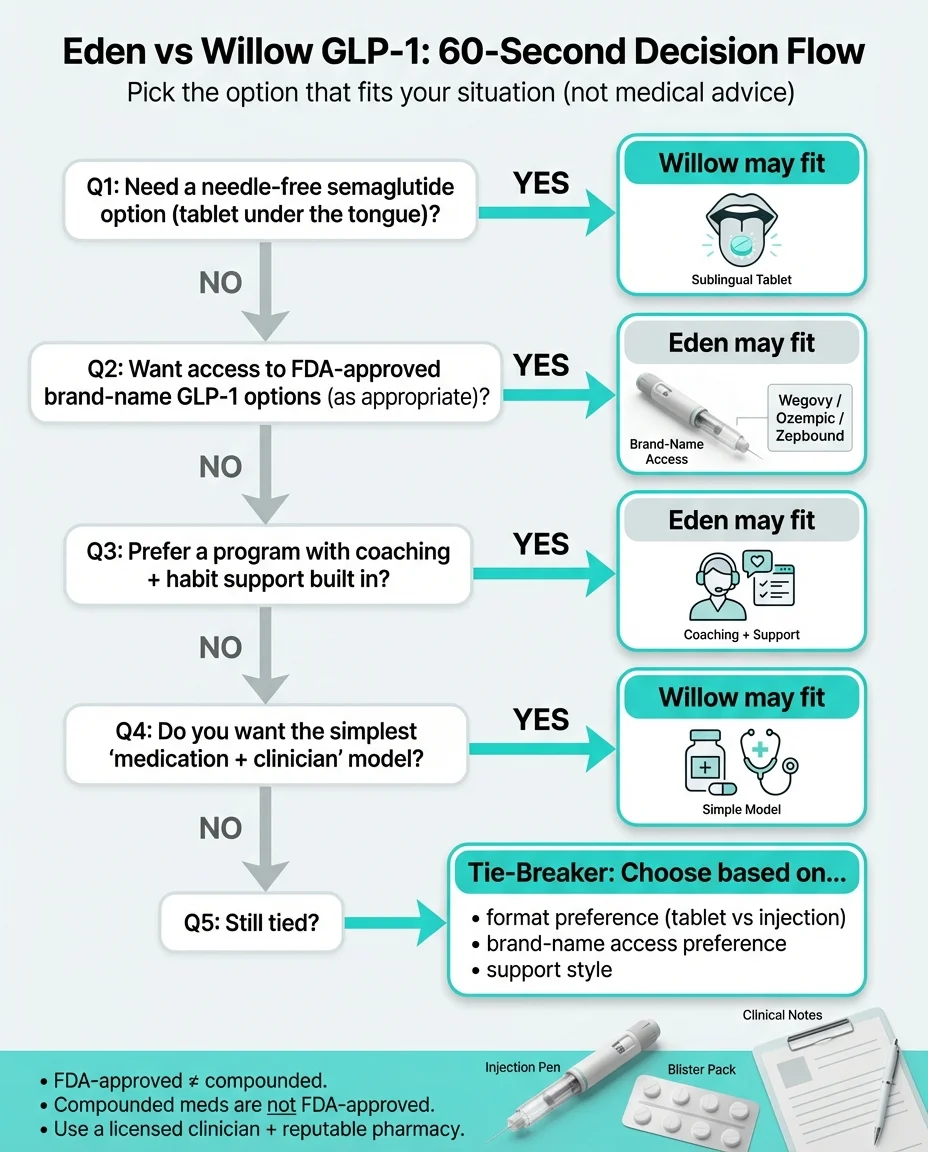
Eden vs Willow GLP-1: 60-Second Decision Flow (not medical advice)
What Are Eden and Willow? (And What They Are NOT)
Quick disambiguation: “Eden” refers to TryEden.com. “Willow” refers to StartWillow.com. If you landed here searching for the Willow breast pump — different company entirely.
Important distinction: Neither Eden nor Willow is a medical provider itself. Both are technology platforms that connect you with independent, licensed healthcare providers who evaluate whether a GLP-1 prescription is appropriate for you. Eden states this explicitly in its disclosures. Willow's informed consent says the same — they assign a physician from their affiliated medical practice to review your case and make prescribing decisions independently.
This is the standard telehealth model — the same structure used by Hims, Hers, Ro, and every major online health platform. The question isn't whether the model works — it's whether the specific platform executes it well. That's what the rest of this page digs into.
Eden GLP-1 injection vial
Willow semaglutide injection vial
Quick definitions
- GLP-1: Glucagon-like peptide-1. A hormone your body naturally produces to regulate appetite and blood sugar. GLP-1 receptor agonist medications (semaglutide, tirzepatide) mimic this hormone to reduce hunger and promote weight loss.
- Semaglutide: The active ingredient in Ozempic (for diabetes) and Wegovy (for weight loss). Available as injection or oral form.
- Tirzepatide: The active ingredient in Mounjaro (for diabetes) and Zepbound (for weight loss). A dual GLP-1/GIP agonist — clinical trials show even greater weight loss than semaglutide alone.
- Compounded: Prepared by a compounding pharmacy using the active pharmaceutical ingredient, but NOT the manufacturer's FDA-approved product. Not reviewed by the FDA for safety, effectiveness, or manufacturing quality.
- Brand-name / FDA-approved: The manufacturer's product (Wegovy, Ozempic, etc.), reviewed and approved by the FDA. More expensive. Considered the gold standard.
How Do Eden and Willow Actually Work? (Step by Step)
Eden: What to expect
- Complete a quick health assessment on tryeden.com — your weight, goals, medical history, current medications
- A licensed provider reviews your information — typically same business day. No video call required for most patients.
- If approved, choose your medication — compounded semaglutide, compounded tirzepatide, brand-name options, oral drops, or a custom weight loss kit
- Medication ships to your door — free expedited shipping
- Ongoing support — 24/7 provider messaging, nutritionist coaching, community app with workouts and meal plans
One thing we like: You're not charged until a provider actually approves your plan. If you're not approved, you don't pay. That removes the “what if I get denied and have to chase a refund” anxiety that comes with platforms that charge upfront.
Willow: What to expect
- Take a 2-minute assessment quiz on startwillow.com — basic eligibility and health questions
- Choose your medication plan — semaglutide (injection or sublingual) or tirzepatide (injection or drops)
- Enter payment information — Willow charges at signup (refund if no prescription is issued)
- A licensed physician reviews your case — same-day approval is possible
- Medication ships free with 2-day delivery — includes supplies and instructions
- Follow-up support — unlimited same-day doctor messaging; FAQ states responses within 24 hours
One thing we like: The speed. Same-day prescriptions and 2-day shipping means you can realistically go from signing up to medication in hand within a few days.
Where delays actually happen (both platforms)
Most delays aren't about the provider — they're about pharmacy fill time and shipping logistics. Expect 3–7 days from sign-up to medication in hand for either platform. If your state requires specific telehealth steps (like a video consultation), that can add a day or two.
Pricing: What You'll Actually Pay (Month 1, Month 6, and the Fine Print)
Price is the #1 factor for most people comparing GLP-1 providers. Here's the verified breakdown.
Eden pricing (verified March 2026)
Compounded GLP-1 (semaglutide):
- 3-month plan: $129 first month, then $209/month
- Monthly plan: $149 first month, then $229/month
Compounded GLP-1 + GIP (tirzepatide):
- $249 first month, then $329/month
What's included: Medication, free expedited shipping, provider consultations, 24/7 messaging, nutritionist coaching, community app access. No membership fees. No dose-based price increases — Eden specifically markets “same price at every dose.”
Eden's flat pricing deserves emphasis. Many telehealth providers charge $199/month at starting doses, then quietly bump to $399 or more as your dose increases. Eden charges the same whether you're on a starting dose or the maintenance dose. Over a 6-month treatment, that adds up.
Willow pricing (verified March 2026)
Compounded semaglutide: $299/month — “for every dosage” per their product page.
Compounded tirzepatide: Starts at $399/month. Note: Willow's informed consent states that your subscription fee “may be increased or decreased if your prescription changes, such as by a dosage increase or frequency of refills.” So while semaglutide is explicitly marketed as flat pricing, tirzepatide uses “starts at” language and your cost could change as treatment progresses.
The 6-month cost reality check
Most GLP-1 treatments run at least 6 months for meaningful results. Here's what that looks like:
| Provider / Plan | 6-Month Cost (Semaglutide) | 6-Month Cost (Tirzepatide) |
|---|---|---|
| Eden (3-month plan) | ~$1,174 ($129 + $209×5) | ~$1,894 ($249 + $329×5) |
| Eden (monthly plan) | ~$1,294 ($149 + $229×5) | Same as above |
| Willow | ~$1,794 ($299×6) | ~$2,394+ ($399×6, may increase) |
Assumes current first-month promotional pricing. Verify directly on each provider's site before enrolling.
Eden comes out $500–$620 cheaper over six months for semaglutide depending on plan. That's a meaningful difference — roughly two extra months of treatment for the same total cost.
The hidden cost checklist (ask before you sign up)
- Is the consultation fee included? (Both: yes)
- Are shipping and supplies included? (Both: yes)
- Will my price increase when my dose goes up? (Eden: no. Willow semaglutide: no. Willow tirzepatide: possible per informed consent.)
- Is lab work included or extra? (Eden: not required/not included. Willow: not typically required.)
- Is anti-nausea medication available? (Ask your provider — both platforms mention ondansetron/Zofran availability.)
- What's the cancellation/refund policy? (Detailed below.)
- Can I use my HSA or FSA? (Both: yes.)
Medication Options: What Can Each Provider Actually Prescribe?
Eden's medication menu
Eden has the widest selection of any provider we've reviewed:
- Compounded semaglutide — weekly injection
- Compounded semaglutide with MIC + B12 — adds methionine, inositol, choline, and vitamin B12
- Oral medication kits — compounded, may include metformin, bupropion, topiramate, vitamin B12, or naltrexone
- Compounded tirzepatide — weekly injection (dual GLP-1/GIP agonist)
- Brand-name GLP-1s — Ozempic, Wegovy, Mounjaro, Zepbound (at premium pricing)
- Custom Weight Loss Kit — non-GLP-1 option combining multiple ingredients
Why this matters: If you want to start with affordable compounded medication and eventually transition to brand-name, Eden lets you do that without switching providers. That flexibility is hard to find elsewhere.
Willow's medication menu
Willow keeps it focused:
- Compounded semaglutide — weekly injection
- Compounded tirzepatide — weekly injection
- Semaglutide sublingual tablets — taken under the tongue daily
- Tirzepatide sublingual drops — taken under the tongue daily
- Ondansetron (Zofran) — available for side effect management
No brand-name GLP-1s. If you eventually want FDA-approved Wegovy or Zepbound, you'd need to switch providers.
Willow's sublingual options are worth noting. They dissolve under the tongue and are absorbed directly into the bloodstream, bypassing the digestive system. That's a real advantage if you're needle-averse. Keep in mind that oral/sublingual compounded GLP-1s are newer to market and have less published data on absorption and efficacy compared to injections.
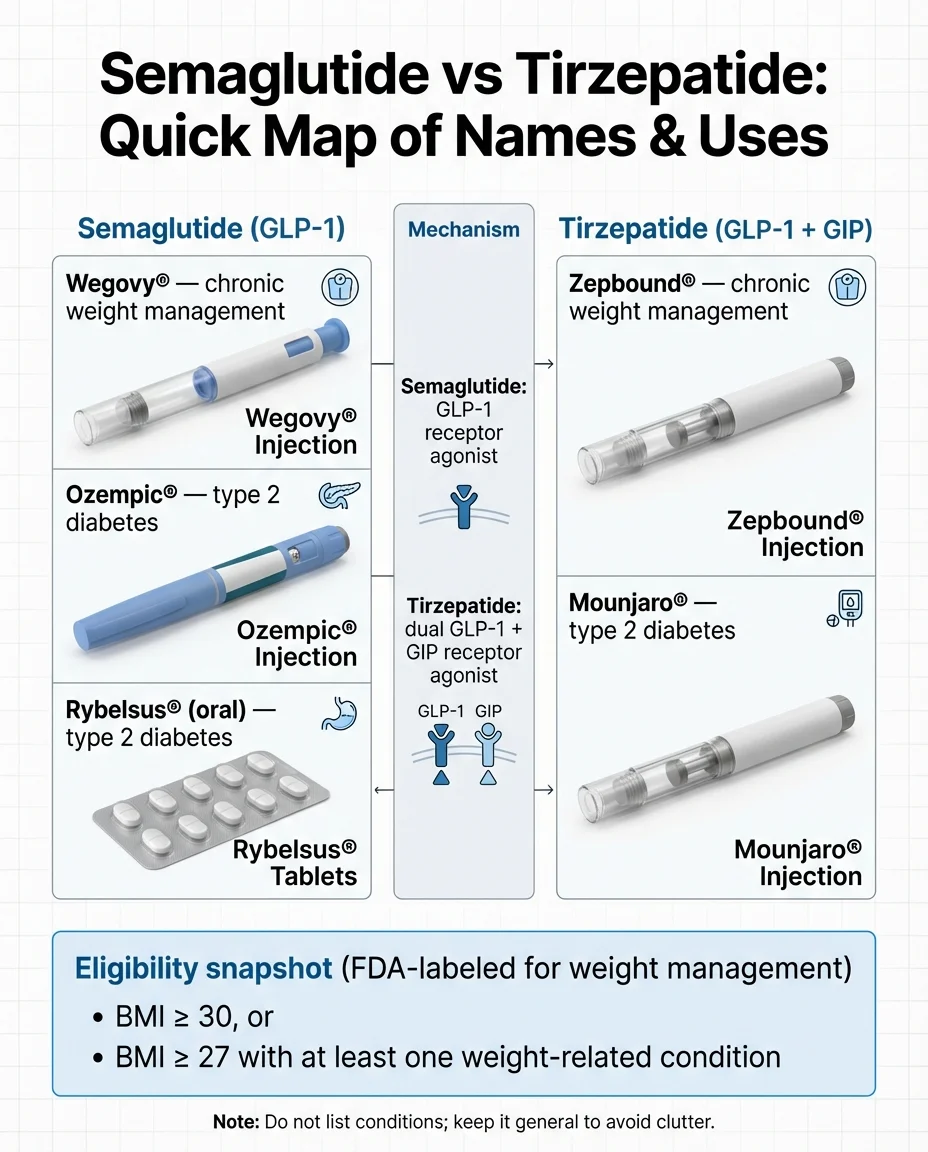
Semaglutide vs Tirzepatide: Quick Map of Names & Uses
Semaglutide vs. tirzepatide: Which is more effective?
Clinical trials show tirzepatide produces greater average weight loss than semaglutide. In the SURMOUNT-1 trial, adults taking the highest dose of tirzepatide (Zepbound) lost an average of approximately 22.5% of their body weight over 72 weeks. The STEP 1 trial showed semaglutide (Wegovy) produced about 14.9% average weight loss over 68 weeks.
Tirzepatide costs roughly $100–$130/month more than semaglutide through either provider. Whether that premium is worth it depends on your budget and goals — discuss with your provider. For a deeper comparison, see our semaglutide vs tirzepatide guide.
Eligibility: Who Can Actually Qualify?
This is one of the main reasons people compare Eden and Willow in the first place.
The standard medical criteria
FDA-approved GLP-1 medications for weight loss (Wegovy, Zepbound) are indicated for adults with a BMI of 30 or higher, or a BMI of 27 or higher with at least one weight-related condition such as type 2 diabetes, hypertension, or high cholesterol. Most telehealth providers follow these criteria or something close to them. Check your eligibility with our GLP-1 BMI eligibility calculator.
Eden's approach
Eden's website references standard GLP-1 eligibility criteria — BMI 30+ or 27+ with weight-related conditions. All treatment decisions are made by the licensed provider assigned to your case. Eden also notes that physicians may prescribe compounded medications off-label “as needed to meet patient requirements.” In practice, this may mean some flexibility depending on your individual health profile, but eligibility is not guaranteed.
What standard eligibility looks like in real life:
| Height | Weight at BMI 27 | Weight at BMI 30 |
|---|---|---|
| 5'2" | ~148 lbs | ~164 lbs |
| 5'5" | ~162 lbs | ~180 lbs |
| 5'7" | ~172 lbs | ~191 lbs |
| 5'10" | ~188 lbs | ~209 lbs |
| 6'0" | ~199 lbs | ~221 lbs |
Approximate. Use an online BMI calculator for your exact numbers.
Willow's approach
Willow is widely reported — by third-party reviewers who have tested the platform — to have no strict BMI threshold. One reviewer at 5'7" and 133 lbs was approved for compounded tirzepatide. Willow's FAQ states they're “available to adults 18+ who are not pregnant or breastfeeding, and who don't have certain medical conditions that make treatment unsafe.” They don't mention a BMI floor.
Important Willow restriction: Willow explicitly states it “can't accept individuals with diabetes” (pre-diabetes and hypertension are welcome). If you have diabetes, Willow is not an option — talk to your endocrinologist about GLP-1 treatment.
State Availability: Can You Get It Where You Live?
This is a dealbreaker for a lot of people — and most comparison pages skip it.
Eden states it serves all 50 states for GLP-1 programs (per tryeden.com).
Willow is available in approximately 33 states. Per their informed consent, you must be located in one of the following: Arizona, California, Colorado, Connecticut, Florida, Georgia, Hawaii, Idaho, Illinois, Indiana, Iowa, Kentucky, Maryland, Michigan, Minnesota, Missouri, Montana, Nebraska, Nevada, New Hampshire, New Jersey, New York, North Carolina, Ohio, Oklahoma, Oregon, Pennsylvania, South Carolina, Tennessee, Texas, Virginia, Washington, or Wisconsin.
If Willow doesn't serve your state, the decision is made for you. Eden covers all 50.
States NOT served by Willow (at time of writing): Alabama, Alaska, Arkansas, Delaware, Kansas, Louisiana, Maine, Mississippi, New Mexico, North Dakota, Rhode Island, South Dakota, Vermont, West Virginia, Wyoming, and the District of Columbia. Willow states they plan to expand — but as of March 2026, these states are excluded.
Support and Ongoing Care: What Happens After You Start?
Getting the prescription is step one. What happens when you're three weeks in, dealing with nausea, or hitting a plateau — that's where support quality matters.
Eden's support model
Eden positions itself as more than a prescription service. Membership includes:
- 24/7 provider messaging — reach your prescribing clinician anytime
- Nutritionist coaching — guidance on protein intake, meal structure, habit-building
- Community app — on-demand workouts, recipes, meal plans, connection with other members
For someone who's new to GLP-1s and worried about managing side effects, adjusting to the medication, or maintaining muscle mass while losing fat, this ecosystem gives you a lot of support touchpoints. It's the closest thing to having a weight loss team without joining a clinical program. Learn more about preventing muscle loss on GLP-1s.
Willow's support model
- Unlimited same-day doctor messaging — FAQ states responses within 24 hours
- Follow-up consultations — included in your plan
- No structured coaching, meal plans, or community features
If you know what you're doing and just want affordable medication with clinical oversight, Willow's lighter model might actually be what you prefer. Less noise. Fewer emails. Just the medication and a doctor who's available when you need them. That said, user reviews are mixed on Willow's support responsiveness. Some patients report quick, helpful interactions. Others mention delays. For a deeper look, see our full Willow GLP-1 review.
Shipping and Reliability: How Delivery Works
Eden shipping
Free expedited shipping on all plans. Medications ship from state-licensed compounding pharmacies. Many patients report receiving medication within a few days of approval.
Willow shipping
Free 2-day shipping on every order. Willow is transparent about temperature handling — their FAQ addresses what happens if medication arrives outside safe temperature ranges and outlines a replacement policy. For a temperature-sensitive injectable, that transparency matters.
What to do if your shipment is delayed or arrives warm
- Contact support immediately — don't wait.
- Don't use medication that arrived warm or with a broken cold pack. GLP-1 medications need refrigeration.
- Request a replacement. Reputable providers reship at no cost.
- Document everything — photos of packaging and temperature indicators speed up resolution.
Billing, Cancellation, and Flexibility
Nobody wants to get locked into something that isn't working.
Eden
- Monthly or 3-month plan options for compounded GLP-1s. The 3-month plan offers a lower monthly rate ($209 vs. $229). Brand-name medications are available separately.
- Cancel anytime — no cancellation fees, no long-term contracts. However, canceling won't cancel active orders already sent to the pharmacy.
- Not charged until approved. If your provider doesn't prescribe, you pay nothing.
Willow
- Monthly subscription. No multi-month commitment required.
- Cancel anytime — but your cancellation request must be received at least 2 full calendar days before your next shipping date. Requests received after that cutoff are processed before the following shipping date.
- Charged at signup. If no prescription is issued, Willow returns your payment.
- Medications are compounded specifically for you and cannot be returned once filled.
Our take: If you're confident about starting GLP-1s and want the lowest total cost, Eden's 3-month plan is hard to beat. If you want to minimize risk and test the waters with zero multi-month commitment, Willow's month-to-month model lets you try one month and reassess.
Side Effects and Safety: What You Need to Know
Side effects come from the medication, not the platform. Whether you get semaglutide from Eden, Willow, or your local doctor's office, the side effect profile is the same. For detailed tips, see our guide on how to take GLP-1 safely.
Common side effects (most people experience at least one)
- Nausea — the most common, especially the first 2–4 weeks. Usually subsides as your body adjusts. See our GLP-1 nausea relief guide.
- Diarrhea or constipation — digestive changes are normal during adjustment.
- Headache and fatigue — typically mild and temporary.
- Injection site reactions — minor redness or itching.
These are dose-dependent — they tend to be worse when your dose increases, then improve. This is why providers use gradual titration, starting you low and increasing slowly.
Serious but rare risks
FDA prescribing information for semaglutide (Wegovy) and tirzepatide (Zepbound) includes warnings about:
- Thyroid C-cell tumors — a boxed warning based on animal studies. Not confirmed in humans, but GLP-1s should not be used by people with a personal or family history of medullary thyroid carcinoma.
- Pancreatitis — seek medical attention immediately for severe abdominal pain.
- Gallbladder problems — GLP-1 medications may increase gallstone risk.
- Kidney injury — usually related to dehydration from GI side effects. Stay hydrated.
Managing side effects
Both Eden and Willow allow you to message your clinician about side effects. Common adjustments include slowing your dose titration, prescribing ondansetron (Zofran) for nausea, adjusting meal timing, or temporarily reducing your dose. Don't suffer in silence — that's the whole point of medically supervised treatment. For a complete side effect toolkit, visit our GLP-1 SOS side effect relief tool.
The Compounded vs. FDA-Approved Question (Read This Before You Decide)
This is the elephant in the room, and we're addressing it directly. For a more detailed deep-dive, read our compounded semaglutide safety guide.
What “compounded” means
Compounded medications are prepared by compounding pharmacies — not the original drug manufacturer. They use the active pharmaceutical ingredient (semaglutide or tirzepatide), but the final product is NOT the manufacturer's FDA-approved version. Compounded medications are not FDA-approved. The FDA has not reviewed them for safety, effectiveness, or manufacturing quality.
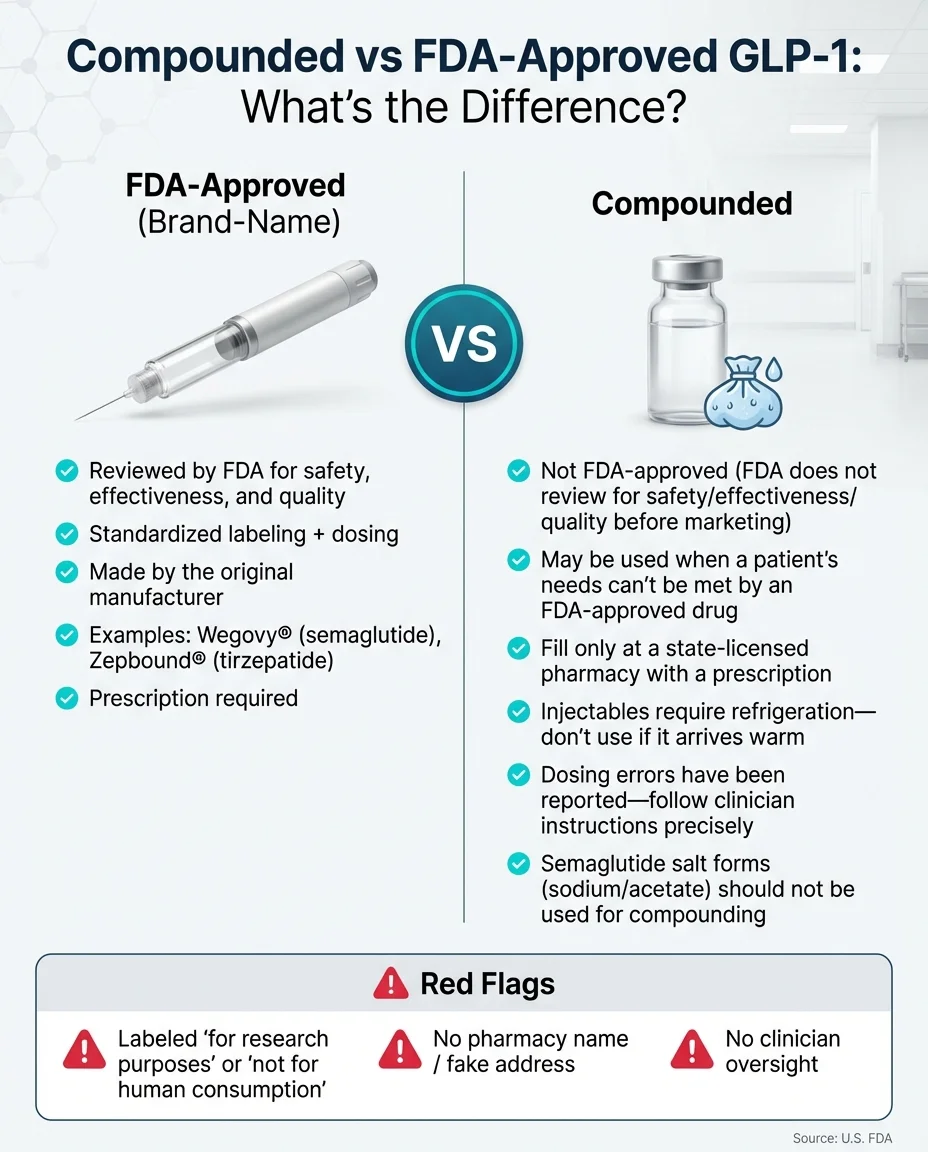
Compounded vs FDA-Approved GLP-1: What's the Difference? (Source: U.S. FDA)
Why compounded GLP-1s exist
Brand-name GLP-1s cost $1,000–$1,500 per month without insurance. Most insurance plans don't cover them for weight loss. Compounded alternatives fill a massive access gap — they've been legally available under specific conditions, particularly during documented drug shortages.
What the FDA has said
The FDA has published concerns about compounded GLP-1 products, specifically warnings about products marketed as GLP-1 medications that may contain incorrect ingredients, incorrect dosing, or that haven't been properly manufactured. The FDA has also flagged concerns about products using salt forms of semaglutide that differ from the FDA-approved molecule. This is a legitimate concern. Source: FDA — “FDA's Concerns with Unapproved GLP-1 Drugs Used for Weight Loss,” fda.gov.
How to reduce your risk
- Choose a provider that uses state-licensed compounding pharmacies — Eden states its network includes pharmacies licensed by the State Board of Pharmacy or FDA-licensed 503(a) outsourcing facilities. Willow also works with licensed compounding pharmacies.
- Ask about the specific ingredient form — semaglutide base (not a salt form) is what corresponds to the FDA-approved molecule.
- Verify cold-chain shipping — GLP-1 medications are temperature-sensitive. Your provider should ship in temperature-controlled packaging.
- Make sure you have real clinical oversight — a licensed provider should review your health history, monitor progress, and adjust treatment.
- If your insurance covers brand-name GLP-1s, use them. Wegovy and Zepbound remain the gold standard.
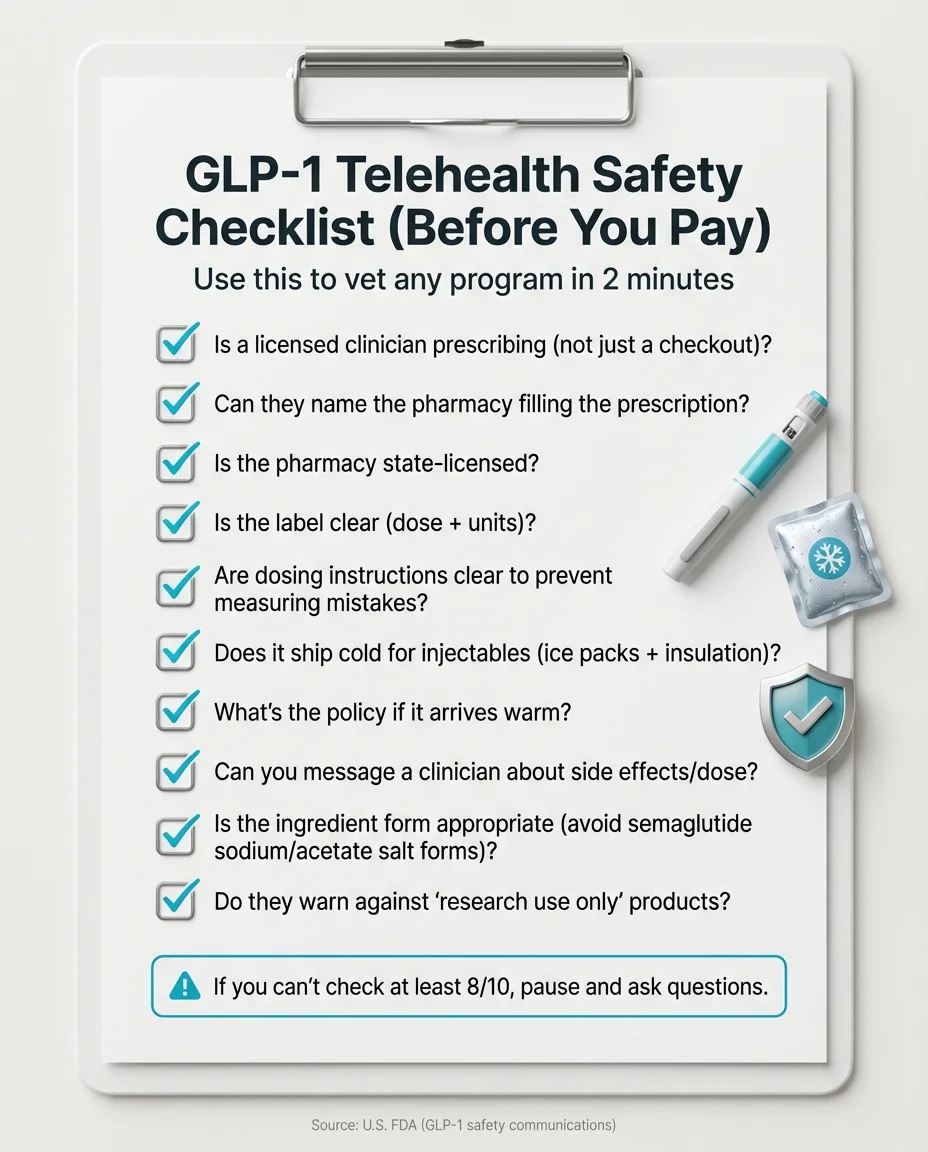
GLP-1 Telehealth Safety Checklist: Use this to vet any program in 2 minutes (Source: U.S. FDA)
What Real Users Are Saying
We pulled these from Trustpilot and provider review pages. Individual results vary — but patterns tell you a lot about what to expect.
Eden user feedback
Eden holds a 4.2-star rating on Trustpilot across 2,500+ reviews.
What people praise: Fast approval, responsive 24/7 support, effective medication, flat pricing that doesn't increase with dose, coaching and community features.
What people complain about: Some reports of shipping delays, occasional wait times on chat support, and the 3-month plan feeling like a commitment for first-time users.
Representative reviews from Trustpilot: Patients frequently describe significant weight loss — with multiple reviewers reporting 20–45+ pounds lost over 3–6 months. Several specifically praise named support agents for resolving billing and prescription issues quickly. Eden's community and coaching features are mentioned positively by people who want structure beyond just the medication.
Willow user feedback
Willow holds a 3.6-star rating on Trustpilot across 290+ reviews.
What people praise: Easy sign-up, fast shipping, effective medication, no BMI barrier, the option for sublingual tablets and drops.
What people complain about: Mixed support responsiveness, some pharmacy delays, the smaller review base makes patterns harder to assess, and some users report frustration with the cancellation timing requirement.
Representative reviews from Trustpilot: Multiple reviewers report losing 14–26+ pounds within 2–3 months. The ease of the process — from quiz to doorstep delivery — is consistently highlighted. Willow's physician team receives positive mentions for same-day messaging and informative dosing guidance.
An honest note about reviews: Every GLP-1 provider has negative reviews. Shipping goes wrong sometimes. Customer service has bad days. The question isn't “does this provider have zero complaints?” — it's “do they resolve issues, and do the majority of patients have a positive experience?” For Eden, the volume and consistency of reviews suggests yes. For Willow, the smaller review base makes the picture less clear, but the overall trend is positive.
Setting Realistic Expectations: Who GLP-1 Treatment Works Best For
GLP-1s tend to work best for people who:
- Have struggled with appetite control despite genuine effort with diet and exercise
- Are willing to commit to at least 3–6 months of consistent treatment
- Can pair medication with basic nutrition improvements — more protein, more vegetables, less processed food
- Will maintain or start some form of physical activity (even walking counts)
- Understand this is a tool, not a magic wand — you still need to eat and move intentionally
This might not be the right move if you:
- Are looking for a quick fix for a vacation in 3 weeks (these medications work over months, not days)
- Have an active eating disorder — GLP-1s suppress appetite, which can complicate disordered eating patterns. Talk to a mental health professional first.
- Are pregnant, breastfeeding, or planning to become pregnant soon
- Have a personal or family history of medullary thyroid carcinoma or MEN type 2
- Can't commit to the ongoing monthly cost — starting and stopping repeatedly isn't ideal
This isn't to scare you off. Most people who start with realistic expectations and a basic commitment to healthier habits see meaningful results. Eden reports an average weight loss of 29.3 lbs over six months among a sample of 111 members (self-reported, combined with diet and exercise). Clinical trials show approximately 15% body weight loss for semaglutide and up to 22.5% for tirzepatide.
The people who get the best results are the ones who treat GLP-1 medication as a head start — a biological advantage that quiets the constant food noise and gives you the breathing room to build habits that keep the weight off long-term.
What the first month actually looks like
Week 1: You take your first dose (usually the lowest available — 0.25mg for semaglutide). Most people feel nothing dramatic. Maybe slightly less hungry. Some notice mild nausea. This is normal.
Weeks 2–3: Appetite suppression becomes more noticeable. The “food noise” — that constant mental chatter about what to eat next — starts quieting down. You're naturally eating smaller portions without feeling deprived. Some people lose 3–5 lbs, mostly water weight.
Week 4: Your provider may increase your dose. This is when side effects are most likely to flare briefly (nausea, fatigue). It passes. By now, most people feel a genuine shift in their relationship with food. The cravings aren't gone completely, but they've lost their urgency.
Months 2–3: This is where the real momentum builds. Most patients report steady weight loss of 1–2 lbs per week. Energy improves. Clothes fit differently. People start to notice. The medication is doing its job — but the habits you're building during this window are what determine whether the results last.
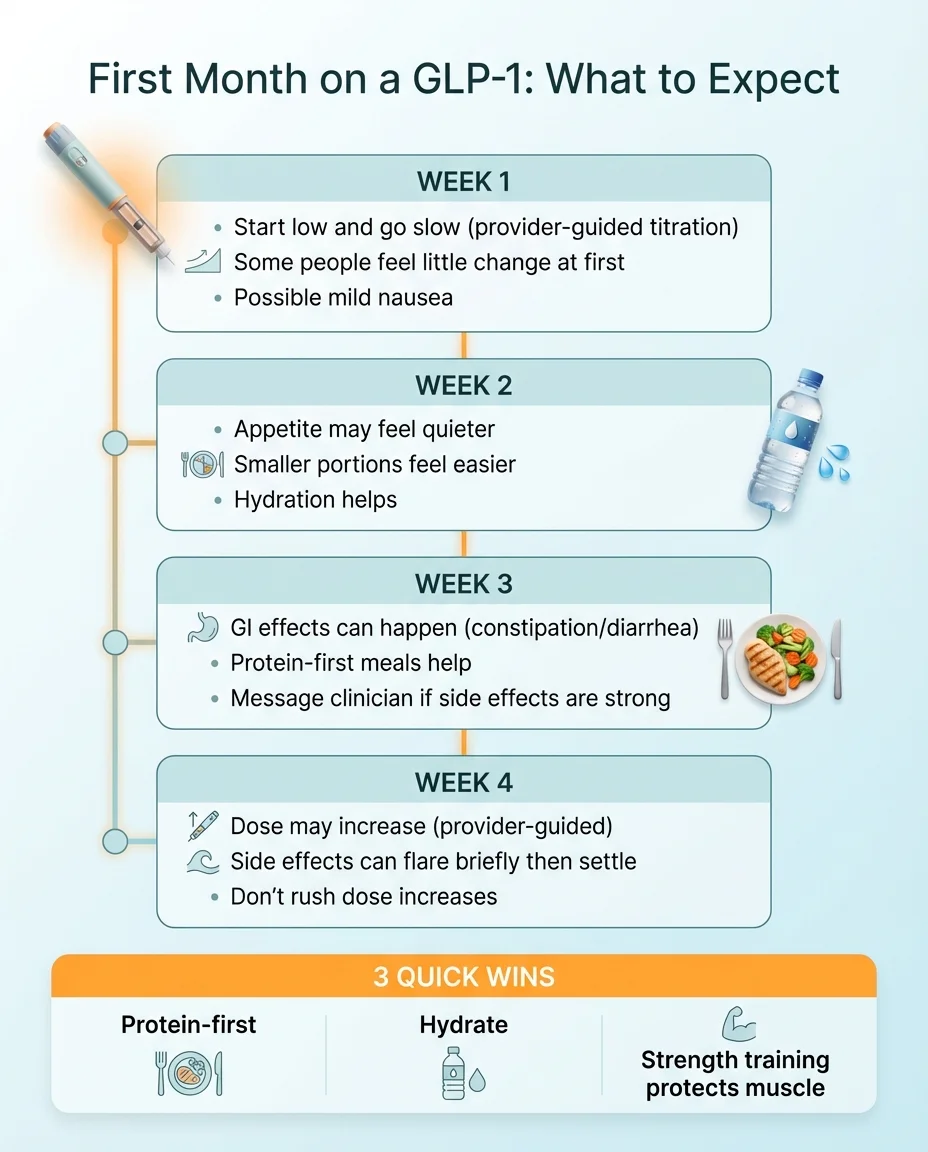
First Month on a GLP-1: What to Expect (Week-by-Week Timeline)
How We Evaluated This Comparison
We built this comparison by:
- Verifying pricing directly on tryeden.com and startwillow.com (March 2026) — including checking the GLP-1 treatment page, informed consent, and FAQ on each site
- Reading each provider's informed consent, FAQs, and terms of service to confirm policies on states, eligibility, billing, and cancellation — not relying on marketing copy alone
- Reviewing customer feedback across Trustpilot and ConsumerAffairs to identify patterns in both positive and negative experiences
- Cross-referencing safety claims with FDA published guidance on compounded GLP-1 medications
- Citing clinical trial data from FDA prescribing information for semaglutide (Wegovy) and tirzepatide (Zepbound)
- Comparing provider claims against their own legal documents — when marketing says one thing and the informed consent says another, we flagged it (for example, Willow's tirzepatide pricing language vs. their informed consent on fee changes)
We earn affiliate commissions from some links on this page. That helps fund our research. Our analysis would be exactly the same without those commissions — we'd recommend the same provider in the same situations. If a provider didn't meet our standards, it wouldn't appear on this page. Read our full ranking methodology.
What we didn't do: We didn't sign up, pay, and complete a full treatment cycle with each provider. Our comparison is based on published information, verified claims, and aggregated user experiences — not firsthand treatment outcomes.
7 Tips for Getting the Most From Your GLP-1 Treatment (Whichever Provider You Choose)
Once you've picked your provider and started treatment, these practical habits will help you maximize results:
1. Prioritize protein.
GLP-1 medications reduce appetite, which means you'll eat less overall. Make sure what you do eat is protein-forward. Aim for 25–30g of protein per meal. This protects muscle mass, keeps you fuller between meals, and supports your metabolism. Chicken, fish, Greek yogurt, eggs, cottage cheese, and protein shakes are your friends. Use our GLP-1 protein calculator to find your daily target.
2. Stay hydrated.
GLP-1s slow gastric emptying, which can cause constipation and dehydration if you're not drinking enough. Aim for at least 64 oz of water daily — more if you're active. This also helps reduce nausea, one of the most common early side effects.
3. Don't skip meals.
Even though your appetite is reduced, eating regular, balanced meals matters. Skipping meals can lead to muscle loss, energy crashes, and poor nutrition. Think of the medication as making it easier to eat right, not as a reason to eat nothing.
4. Move your body.
You don't need to run marathons. Walking 30 minutes a day, doing bodyweight exercises, or following a basic strength routine 2–3 times per week makes a measurable difference in how much fat vs. muscle you lose. Eden's community app includes workout content for this exact purpose.
5. Track your progress beyond the scale.
The scale matters, but it's not the whole picture. Take measurements. Notice how your clothes fit. Pay attention to your energy, sleep quality, and how you feel after meals. These non-scale victories keep you motivated during weeks when the number doesn't move.
6. Communicate with your provider.
If you're experiencing side effects, don't tough it out. Message your clinician. Dose adjustments, anti-nausea medication, and timing changes can make a huge difference. Both Eden and Willow offer provider messaging for exactly this reason.
7. Think long-term.
GLP-1 treatment is most effective when you use the appetite reduction as a window to build sustainable habits. The medication quiets the cravings. Your job is to use that quiet to establish the eating patterns, movement routines, and mindset shifts that keep the weight off — whether you stay on medication long-term or eventually taper off. Learn more about what happens when you stop taking GLP-1.
Frequently Asked Questions: Eden vs Willow GLP-1
Is Eden legit?
Yes. Eden (tryeden.com) is a legitimate telehealth platform. They work with licensed healthcare providers and state-licensed compounding pharmacies. Pricing is transparent and disclosed upfront. They hold a 4.2-star rating on Trustpilot across 2,500+ reviews.
Is Willow legit?
Yes. Willow (startwillow.com) is a legitimate telehealth weight loss clinic. They are LegitScript-certified, list 40+ physicians, and their Chief Medical Officer is a GLP-1 patient himself. They hold a 3.6-star rating on Trustpilot across 290+ reviews.
Does Eden offer FDA-approved GLP-1s like Wegovy or Zepbound?
Yes. Eden is one of the few telehealth platforms that offers both compounded and brand-name FDA-approved GLP-1 medications, including Ozempic, Wegovy, Mounjaro, and Zepbound. Brand-name options are significantly more expensive than compounded.
Does Willow offer brand-name GLP-1s?
No. Willow prescribes compounded semaglutide and compounded tirzepatide only. If you want brand-name medication, you would need a different provider.
Is compounded semaglutide FDA-approved?
No. Compounded semaglutide is NOT FDA-approved. It has not been reviewed by the FDA for safety, effectiveness, or manufacturing quality. The FDA has published specific concerns about unapproved GLP-1 products sold online, including variability in ingredients and dosing. This applies to compounded medications from every telehealth provider.
Does Willow ship to my state?
Willow serves approximately 33 states. Per their informed consent, those states are: AZ, CA, CO, CT, FL, GA, HI, ID, IL, IN, IA, KY, MD, MI, MN, MO, MT, NE, NV, NH, NJ, NY, NC, OH, OK, OR, PA, SC, TN, TX, VA, WA, and WI. If your state is not listed, Eden serves all 50.
Why doesn't Willow accept people with diabetes?
Willow's FAQ states they "can't accept individuals with diabetes." This likely relates to the clinical complexity of managing GLP-1 medications alongside diabetes treatment. If you have diabetes, talk to your endocrinologist or primary care doctor about GLP-1 options.
How fast do I get medication after signing up?
For both, expect 3–7 days from sign-up to medication in hand. Willow advertises same-day prescriptions and 2-day shipping. Eden offers free expedited shipping. Your mileage may vary based on pharmacy processing and your state.
Do Eden or Willow take insurance?
Neither accepts insurance for GLP-1 prescriptions. Both accept HSA and FSA payments, which can effectively save you 25–35% through pre-tax dollars. If your insurance covers brand-name GLP-1s, you may be better off going through your primary care doctor.
Can I switch from Eden to Willow (or vice versa)?
Yes. There is no lock-in. Cancel your current subscription, sign up with the new provider, and they will do their own medical evaluation. If you are on Eden's 3-month plan, you may want to complete that cycle before switching.
What happens if I'm not approved?
With Eden, you are not charged until approved — nothing to refund. With Willow, you pay at signup, but their informed consent states payment is returned if no prescription is issued.
If I stop taking GLP-1 medication, will I regain weight?
Research suggests weight regain is common after stopping, particularly if lifestyle changes are not maintained. A study found participants regained roughly two-thirds of lost weight within a year of discontinuing semaglutide. Use your time on medication to build sustainable habits.
Is oral or sublingual semaglutide effective for weight loss?
FDA-approved oral semaglutide (Rybelsus) is currently approved for type 2 diabetes, not weight loss. Compounded sublingual semaglutide (offered by Willow and others) uses the active pharmaceutical ingredient in a different delivery mechanism. Published evidence on compounded oral or sublingual semaglutide for weight loss is more limited than for injections.
What are the biggest red flags of unsafe GLP-1 telehealth?
Watch for: no clear pharmacy disclosure, prices dramatically below market, no health intake questionnaire, claims that compounded products are "FDA-approved" (they are not), no provider messaging or follow-up, and pressure to buy without a clinician review.
How long do most people stay on GLP-1 medication?
Most treatment plans run 6–12+ months. Some people use GLP-1s long-term for maintenance; others use them for 6–12 months to reach their goal and taper off while maintaining lifestyle changes.
Can I drink alcohol while on semaglutide or tirzepatide?
GLP-1 medications are not specifically contraindicated with alcohol, but many patients report increased sensitivity — feeling effects faster and more intensely. The medications slow gastric emptying, which can change how alcohol is processed. Most providers recommend moderation.
Will GLP-1 medication make me lose muscle?
Weight loss from any method typically includes some muscle loss alongside fat loss. Minimize this by eating adequate protein (aim for 0.7–1g per pound of body weight daily) and doing resistance training. Eden's coaching ecosystem can help with this.
How is Eden different from Hims, Hers, or Ro?
Eden offers broader medication options (compounded and brand-name GLP-1s in multiple formats), flat pricing that does not increase with dose, and an integrated coaching and community platform. The main practical differences come down to eligibility flexibility, pricing structure, and whether you want coaching included. Eden's semaglutide pricing ($209–$229/mo) is competitive with or lower than most competitors.
How is Willow different from other GLP-1 providers?
Willow's main differentiator is accessibility — they are widely reported to approve patients regardless of BMI, which no other major provider does. They also offer sublingual semaglutide tablets and tirzepatide drops for people who prefer not to inject. Trade-offs include limited state availability (33 states), no brand-name options, and less support infrastructure.
What should I ask customer support before paying?
Good questions for any GLP-1 provider: (1) Which compounding pharmacy fills your prescriptions, and is it state-licensed? (2) What specific form of semaglutide do you use — base form or a salt form? (3) How is medication shipped, and is it temperature-controlled? (4) What happens if my shipment arrives warm? (5) How quickly can I reach a provider if I have side effects? (6) What is the exact total monthly cost at my likely maintenance dose?
Is tirzepatide worth the extra cost over semaglutide?
Clinical data suggests tirzepatide produces greater average weight loss than semaglutide — roughly 22% vs. 15% body weight reduction in major trials. At $100–$130/month more, that is a meaningful premium. If budget is not your primary concern and you want the strongest clinical results, tirzepatide is worth discussing with your provider.
Can I take GLP-1 medication while on other prescriptions?
GLP-1 medications can interact with certain drugs, particularly insulin, sulfonylureas, and some oral medications whose absorption may be affected by delayed gastric emptying. Always disclose your full medication list during your health assessment. Your provider will evaluate potential interactions before prescribing.
What if I can't afford either Eden or Willow?
If the monthly cost is a barrier: Use your HSA/FSA (pre-tax savings of 25–35%). Ask your primary care doctor about brand-name GLP-1s — if your insurance covers Wegovy or Zepbound, the cost may be lower. Look into manufacturer savings programs and copay cards.
Your 5-Step Action Checklist
You've read the comparison. You understand the trade-offs. Here's how to move forward:
Step 1: Check your eligibility. Meet standard BMI criteria (27+ with conditions or 30+)? Both Eden and Willow are options. Below those thresholds and denied elsewhere? Willow is likely your best shot. Have diabetes? Skip Willow.
Step 2: Confirm state availability. If Willow doesn't serve your state (~17 states excluded), that narrows it to Eden.
Step 3: Decide your budget and commitment level. Want the lowest monthly cost? Eden's 3-month plan at $209/mo. Want zero multi-month commitment? Willow's month-to-month at $299/mo or Eden's monthly plan at $229/mo.
Step 4: Choose your medication preference. Injectable semaglutide (most proven)? Both offer it. Sublingual tablets or drops? Willow. Tirzepatide (strongest clinical results)? Both, at $100+/mo more. Brand-name option down the road? Only Eden.
Step 5: Start your assessment. Take the quiz. You're not committing by filling out a questionnaire — you're just seeing if you qualify.
Our Final Take: Eden vs Willow
You've read the full comparison. Here's where we land.
Eden: Best overall value for most people
Eden wins on cost, state availability, medication variety, and support. If you meet standard eligibility criteria, Eden delivers the most for the money — lower pricing, brand-name options if you want them later, and a coaching ecosystem that helps you build habits beyond just the medication.
The numbers speak for themselves. At $209/month on the 3-month plan, Eden is $90/month cheaper than Willow for semaglutide. Over six months, that's $500–$620 in savings — enough to cover roughly two-and-a-half additional months of treatment. Add in the coaching, community, 24/7 support, and the fact that Eden serves all 50 states, and it's clear why Eden is the stronger option for most people entering the GLP-1 space.
Eden members have reported an average weight loss of 29.3 pounds over six months (self-reported data from 111 members, combined with diet and exercise). That's life-changing weight loss — the kind that affects how you feel getting dressed in the morning, how much energy you have with your kids, and how you show up at work. And it starts with a free health assessment that takes about three minutes.
Best for: Budget-conscious patients, people who want coaching alongside medication, anyone who might want brand-name GLP-1s later, people in states Willow doesn't serve, people who want the widest medication format options.
The trade-off: The 3-month plan gets you the best price but is a bigger upfront commitment if you've never tried GLP-1s. (Eden's monthly plan at $229/mo is still $70 cheaper than Willow with no multi-month lock-in — so you have options.)
Willow: Best for people who've been denied elsewhere
Willow fills a real gap in the market. If your BMI doesn't meet standard criteria and other providers have turned you away, Willow's permissive eligibility may be your best path to starting GLP-1 treatment. The streamlined process, sublingual tablet and drop options, and same-day approval are genuine differentiators that matter if you've been frustrated by gatekeeping at other platforms.
Willow reviewers consistently mention the ease of the process and the effectiveness of the medication. Multiple Trustpilot reviews describe 14–26+ pounds lost within the first 2–3 months. For someone who's been told “no” by every other provider, that kind of result is transformative.
Best for: People below standard BMI thresholds, anyone who's been denied by other platforms, people who prefer sublingual tablets or drops over injections, people who want pure month-to-month simplicity.
The trade-off: Higher monthly cost ($299 vs. $209–$229), no brand-name options, limited to 33 states, cannot accept people with diabetes, and a lighter support infrastructure compared to Eden. The smaller Trustpilot review base (290+ vs. 2,500+) also makes it harder to assess long-term consistency.
Ready to Get Started?
You've done the hard part — the research, the comparing, the back-and-forth. That phase is over.
Here's what nobody tells you about choosing a GLP-1 provider: the difference between the top options is smaller than the difference between starting and not starting. Both Eden and Willow are legitimate platforms with licensed providers and real medications. Either can work. What matters most is picking the one that fits and beginning.
Eden (Factual Data):
You won't be charged unless a provider approves your plan. Starting at $129 first month on the 3-month plan. The assessment takes about 3 minutes, and most people hear back the same business day.
If Willow is your best fit:
Same-day approval available. Medication ships free with 2-day delivery. If you've been denied elsewhere, this is worth trying.
Take Willow's 2-Minute QuizHere's what we've learned from covering this space: the people who get results aren't the ones who found the “perfect” provider. They're the ones who stopped researching and started. Every week you spend comparing is a week you could have been experiencing less hunger, steadier energy, and the quiet confidence that comes from progress you can actually see.
Six months from now, you'll either be glad you started — or you'll still be reading comparison pages. The research is done. The numbers are in front of you. The next step is a 3-minute quiz.
Sources
- FDA — “FDA's Concerns with Unapproved GLP-1 Drugs Used for Weight Loss” — fda.gov
- FDA Prescribing Information — Wegovy (semaglutide injection) for chronic weight management
- FDA Prescribing Information — Zepbound (tirzepatide injection) for chronic weight management
- Eden official website — tryeden.com — pricing and program details verified March 2026
- Willow official website — startwillow.com — pricing, FAQ, and informed consent verified March 2026
- Willow Informed Consent — startwillow.com/informed-consent — state availability, billing, and cancellation policies
- Trustpilot — Eden reviews (trustpilot.com/review/tryeden.com) — 2,500+ reviews, 4.2★
- Trustpilot — Willow reviews (trustpilot.com/review/startwillow.com) — 290+ reviews, 3.6★
- Jastreboff AM, et al. — “Tirzepatide Once Weekly for the Treatment of Obesity” — NEJM, 2022 (SURMOUNT-1 trial)
- Wilding JPH, et al. — “Once-Weekly Semaglutide in Adults with Overweight or Obesity” — NEJM, 2021 (STEP 1 trial)
Full Affiliate Disclosure
WeightLossProviderGuide.com is an independent resource. Some links on this page are affiliate links, meaning we may receive a commission if you sign up through them at no additional cost to you. This commission helps us maintain the site, verify pricing, and keep our content updated.
Our editorial recommendations are not influenced by affiliate relationships. We recommend providers based on verified pricing, published policies, clinical standards, and aggregated user feedback. If a provider didn't meet our standards, it wouldn't appear on this page — regardless of whether they offer an affiliate program. See our full advertising disclosure.
Medical Disclaimer
This content is for informational purposes only and does not constitute medical advice, diagnosis, or treatment. Always consult a licensed healthcare provider before starting any medication, including GLP-1 receptor agonists. Compounded medications are not FDA-approved and have not been reviewed by the FDA for safety, effectiveness, or manufacturing quality. Individual results vary. The decision to prescribe medication is made solely by a licensed healthcare provider based on your individual medical profile. See our full medical disclaimer.