How to Verify a Compounding Pharmacy License Before Buying a GLP-1
By the Weight Loss Provider Guide Research Team · Last verified: August 8, 2026 · What we actually checked ↓
Weight Loss Provider Guide is an independent comparison resource for GLP-1 telehealth providers.
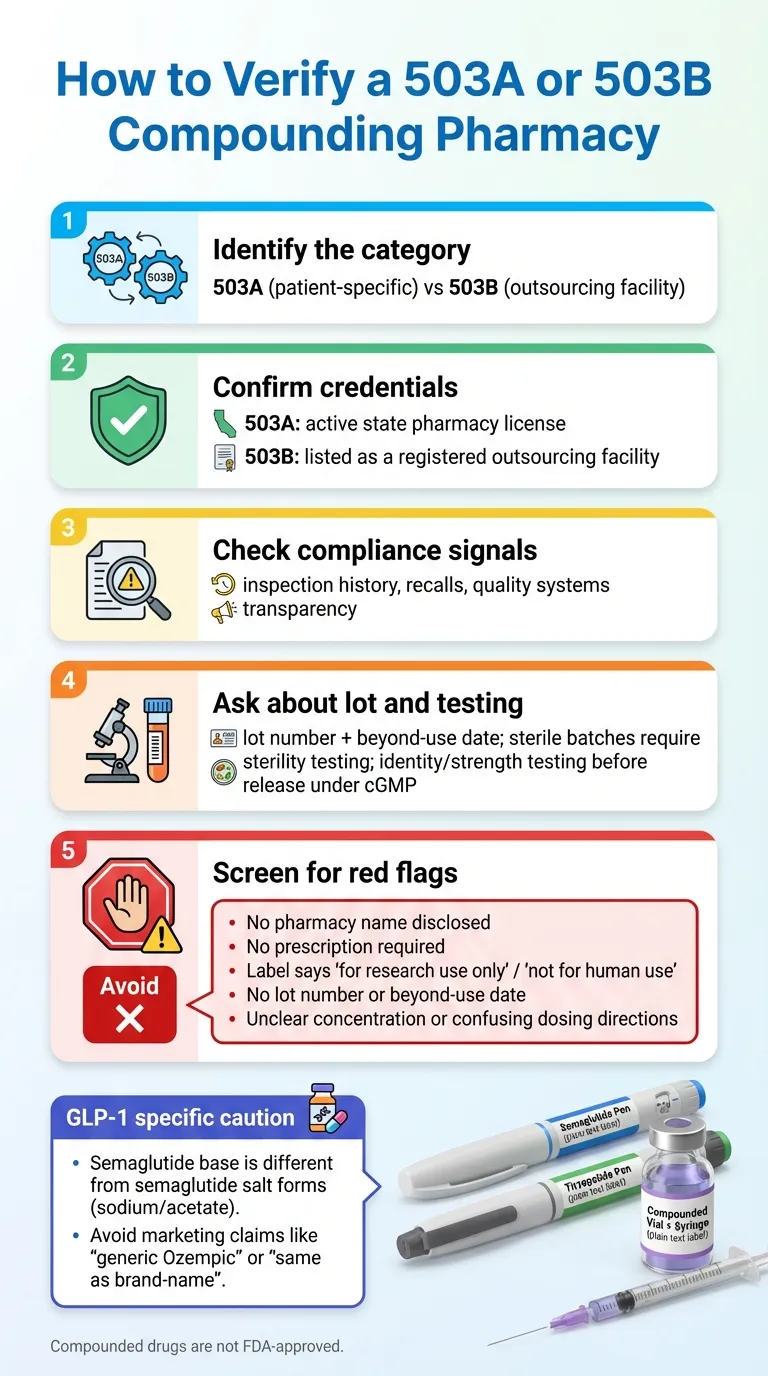
Here is how to verify a compounding pharmacy license before buying a GLP-1: get the pharmacy's exact legal name, then search it in the Board of Pharmacy database for the state where you live — not the state where the pharmacy sits. Confirm the record is active, the address matches, and the permit covers your state. If your GLP-1 is an injection, check whether your state requires a separate sterile-compounding credential or shows sterile authority on the main record. If nobody will name the pharmacy, don't pay yet.
That takes about ten minutes and costs nothing.
FDA status: Compounded drugs are not FDA-approved. FDA does not verify their safety, effectiveness, or quality before they are marketed. FDA says they should be used only when a patient's medical needs cannot be met by an FDA-approved drug.
Here's the part that trips almost everyone up. The company taking your money may not be the pharmacy. It's a telehealth brand. So when you type its name into a state pharmacy database, you get nothing — and you have no idea whether "nothing" means danger or just means you searched the wrong thing.
We'll fix that in the next two minutes. And we'll show you the one permit that actually matters for an injection, which almost no guide on this topic mentions.
The four checks, at a glance
| # | Check | Where you look | Time | What it proves | What it does not prove |
|---|---|---|---|---|---|
| 1 | Licensed in your state | Your state's Board of Pharmacy | ~2 min | It holds active pharmacy authority in your state | Anything about quality |
| 2 | Sterile compounding authority | Same board; it may be a separate permit or part of the main record | ~3 min | It holds the sterile authority your state requires for an injection | That your vial was sterile |
| 3 | 503A or 503B, plus FDA history | FDA's 503B table + FDA compounding action records | ~2 min | Whether a claimed 503B registration matches the exact address and what FDA has posted | That a clean search means no inspection or no problem |
| 4 | Warning letters, recalls, discipline | FDA + your state board | ~3 min | Its public track record | That a clean record means a clean vial |
Three outcomes. Only three.
- License checks cleared — the paperwork holds up. Move on to the product questions.
- Pause — something doesn't line up. Get an answer before you pay.
- Stop — the record is missing, dead, or unauthorized. Don't pay, and don't use the vial.
We say "license checks cleared." We never say "safe," "approved," or "legit." A license is a business permit. It is not a lab test on your medicine, and any page that tells you otherwise is selling you something.
▶ Run your first check now
Jump to the 54-jurisdiction directory, open your state's official record, and save a screenshot with today's date.
Find my state's official pharmacy record →
Free. No account or email needed.
Why people get stuck here (it's not you)
Real questions from people trying to do exactly this:
"How do I know that pharmacy is good? Just assume that it is if the provider has picked them?" — r/tirzepatidecompound
"I can't even seem to figure out what pharmacy it's coming from." — r/glp1
We include these for one reason: to show you that the confusion is built into the system, not into you. These are questions about paperwork, not evidence about any medicine, provider, or pharmacy.
The reason it's confusing is structural. Federal tools are built around pharmacy names. You're buying from a telehealth brand. Those are two different worlds, and nobody built a bridge.
Until now. Let's build it.
How do I verify a compounding pharmacy license before buying a GLP-1?
Answer capsule: Verifying a compounding pharmacy license involves six steps: get the pharmacy's exact legal name and address, check the Board of Pharmacy record in the patient's state, check the pharmacy's home-state record if it is located elsewhere, confirm sterile compounding authority for injectable products, check FDA's outsourcing facility table if 503B status is claimed, and review disciplinary and enforcement records. The basic status checks linked here are public and free to access.
Here are the six steps in plain order.
Step 1 — Get the name. The exact legal name, the street address, and a phone number. "Our partner pharmacy network" is not a name. You cannot check a record that has no name attached to it.
Step 2 — Check your own state first. Not the pharmacy's state. Yours. A pharmacy in Texas needs permission from your state's board before it can dispense a prescription to you.
Step 3 — Then check its home state. If the pharmacy is in another state, it needs a valid license there too. That's two records, not one.
Step 4 — If it's a shot, find sterile authority. This is the step nearly every other guide skips. In several states, the regular out-of-state license is not enough to ship you an injection. A separate sterile credential is required. Other states show sterile authority on the main record or require you to ask the board.
Step 5 — If anyone said "503B," check FDA's list. A 503B facility should appear on FDA's public table at the exact address. A 503A pharmacy does not register as a 503B outsourcing facility, so it will not appear on that table. It can still appear in FDA inspection, warning-letter, recall, or enforcement records.
Step 6 — Look for trouble. Board discipline. FDA warning letters. Recalls. Read what you find before you decide what it means.
Then save it. Screenshot, date, done. If a pharmacy's status changes next month, you'll have a dated record of what the page showed the day you paid.
The fast path vs. the long path
| Your situation | What you actually have to check |
|---|---|
| Local compounding pharmacy in your own state | One facility record |
| Online pharmacy in another state (most common) | Your state's permit + its home-state license |
| Compounded injection from out of state | Both of the above + sterile compounding authority |
| Someone claims "503B" | Both of the above + FDA's table, matching the exact address |
| Brand-name Wegovy, Zepbound, or Foundayo | There is no compounding facility to check. If you buy online, you can still verify the dispensing pharmacy in your state. |
Whose license am I even checking?
Answer capsule: Up to four separate businesses can be involved in a single compounded GLP-1 order: the telehealth platform, the prescriber, the dispensing pharmacy, and sometimes a separate compounding facility. The records you need belong to the dispensing pharmacy and, when it is separate, the compounding facility. The telehealth brand that collected payment may not be a pharmacy and may not appear in a Board of Pharmacy database.
This is the whole reason people give up. So let's be very clear about who's who.
The telehealth brand. The website. The logo on your credit card statement. It arranges the visit and takes your money. It may not be a pharmacy. Searching its name in a pharmacy database gets you nothing, and that "nothing" means nothing.
The prescriber. A doctor, nurse practitioner, or physician assistant. Has a state medical license. That's a different database.
The dispensing pharmacy. The one that puts your name on a label and mails the box. This is the license you're checking.
The compounding facility. Sometimes the same as the dispensing pharmacy. Sometimes not. If a separate facility mixed the medicine, you want to check that one too.
FDA has said this out loud. In March 2026, FDA sent warning letters to 30 telehealth companies. One of the two main problems it named was "obscuring product sourcing" — in other words, putting the telehealth brand on a compounded drug so the real source is harder to see. That's not our opinion about sourcing being murky. That's the federal regulator's.
"They won't tell me which pharmacy" — sometimes that's fine
Here's a fair point most safety guides get wrong.
A telehealth company may not know your exact pharmacy at signup because the answer depends on your state and on what the clinician actually prescribes. That can be a real operating limit. It is not a blank check.
So the honest standard isn't "name my pharmacy before I create an account." It's this:
- Before you pay: they should be able to tell you the possible pharmacies. A list is a reasonable answer.
- Before your medicine ships or you inject it: you should get the exact one, by legal name and address.
If they'll give you a list up front and the specific name once it's assigned, they're being straight with you. If they won't name it after it's been assigned — that's your answer. That's a Stop.
Which state's Board of Pharmacy do I check?
Answer capsule: Check the state where the patient receives the medication first, then the state where the pharmacy is physically located. FDA's BeSafeRx FAQ says an online pharmacy should be licensed both in the state where it operates and in the state where the patient lives. Checking only one of the two leaves half the licensing picture unverified.
This is where a lot of otherwise-good advice goes wrong.
We found public guides telling readers to check "the state where the pharmacy operates, not where you live." That's backwards for what you care about. The pharmacy's home license says it can operate there. Your state's record shows whether it holds the pharmacy authority needed to dispense to you. You need both.
The permit that covers you usually has "nonresident" or "out-of-state" in its name. It's a separate record from the home-state license, even when both are on the same board's website.
| Situation | Records to open |
|---|---|
| You and the pharmacy are in the same state | That state's facility record |
| Pharmacy is in another state | Your state's nonresident permit + its home-state license |
| A separate 503B facility makes it | The dispensing pharmacy's records + FDA's table for that exact facility address |
| Pharmacy not assigned yet | Save this page. Finish once you have the real name. |
| They won't name it after it's assigned | Stop. |
Not sure whether you need one record or two? Use the fast-path table above: start with your state, then add the pharmacy's home state if it is somewhere else.
Find your state's official pharmacy license lookup
Answer capsule: FDA's BeSafeRx directory lists an official pharmacy-verification destination for all 50 states, the District of Columbia, Guam, Puerto Rico, and the U.S. Virgin Islands. Search for the facility or pharmacy, not an individual pharmacist, and start with the pharmacy's exact legal name or license number.
FDA maintains a directory covering all 54 jurisdictions. It also gives readers a blunt instruction: "If your online pharmacy is not listed, you should not use that pharmacy."
Good advice — with one giant catch we'll get to in a moment.
Three things that save you ten minutes of frustration:
- Choose "facility" or "pharmacy," not "pharmacist." Most boards make you pick. Pick wrong and you get a list of people instead of businesses.
- Type less, not more. State databases are picky. Two or three words of the pharmacy's name beats the full legal name with commas and "LLC."
- Try the DBA. A pharmacy's legal name and the name on your box are often different. Search both, plus the license number and the street address.
The 54-jurisdiction lookup directory
Sites marked ✓ are ones we opened and walked through ourselves. Unmarked sites are the official destinations FDA links to, but we have not personally confirmed each one's search fields and permit wording. We're telling you that instead of pretending we checked all 54.
| Jurisdiction | Official lookup site | Notes |
|---|---|---|
| Alabama | albop.com | |
| Alaska | commerce.alaska.gov | |
| Arizona | pharmacy.az.gov | |
| Arkansas | arbopharmprod.glsuite.us | |
| California ✓ | pharmacy.ca.gov | Separate categories for pharmacies, sterile compounding, nonresident sterile compounding, and outsourcing facilities. Pick the right one. |
| Colorado | colorado.gov | |
| Connecticut ✓ | elicense.ct.gov | State says its data updates instantly and counts as primary-source verification |
| Delaware | delpros.delaware.gov | |
| District of Columbia | dchealth.dc.gov | |
| Florida | appsmqa.doh.state.fl.us | Sterile shipments need a separate permit — see below |
| Georgia | verify.sos.ga.gov | |
| Hawaii | pvl.ehawaii.gov | |
| Idaho | idbop.mylicense.com | |
| Illinois | ilesonline.idfpr.illinois.gov | |
| Indiana | mylicense.in.gov | |
| Iowa | pharmacy.iowa.gov | |
| Kansas | pharmacy.ks.gov | |
| Kentucky | secure.kentucky.gov | |
| Louisiana | secure.pharmacy.la.gov | |
| Maine | pfr.maine.gov | |
| Maryland ✓ | mdbop.mylicense.com | Facility search covers name, permit type, status, number, city, state, county, ZIP |
| Massachusetts | checkahealthlicense.mass.gov | Sterile shipments need a separate license — see below |
| Michigan | michigan.gov | |
| Minnesota | bopgl.hlb.state.mn.us | |
| Mississippi | elicense.mbp.state.ms.us | |
| Missouri | pr.mo.gov | |
| Montana | ebizws.mt.gov | |
| Nebraska | nebraska.gov | |
| Nevada | bop.nv.gov | |
| New Hampshire | forms.nh.gov | |
| New Jersey | newjersey.mylicense.com | |
| New Mexico | rld.nm.gov | |
| New York | op.nysed.gov | |
| North Carolina ✓ | ncbop.org | Choose "Facility." Portal shows the date its data was last current. |
| North Dakota | nodakpharmacy.com | |
| Ohio | elicense.ohio.gov | |
| Oklahoma | ok.gov | |
| Oregon | orbop.mylicense.com | |
| Pennsylvania | pals.pa.gov | |
| Rhode Island | health.ri.gov | |
| South Carolina | verify.llronline.com | |
| South Dakota | doh.sd.gov | |
| Tennessee | dhlrapps.health.tn.gov | |
| Texas ✓ | pharmacy.texas.gov | Databases update Monday–Friday. Out-of-state sterile compounders are "Class E-S." |
| Utah | secure.utah.gov | |
| Vermont | sos.vermont.gov | |
| Virginia | dhp.virginiainteractive.org | |
| Washington | fortress.wa.gov | |
| West Virginia | wvbop.com | |
| Wisconsin | licensesearch.wi.gov | |
| Wyoming | wybopprod.glsuite.us | |
| Guam | web.guamhplo.org | |
| Puerto Rico | Routed through nabp.pharmacy | FDA's directory currently routes here rather than to a direct territorial portal |
| U.S. Virgin Islands | dlca.vi.gov |
The catch in FDA's own advice
Now back to that blunt instruction: if your online pharmacy is not listed, don't use it.
Follow that literally using the telehealth brand's name and here's what happens. You type in the company you're paying. It isn't there — because it may not be a pharmacy. You can reject a real platform for the wrong reason.
The advice still has the right instinct. It just needs one correction for telehealth: look up the pharmacy behind the brand, not the brand.
That single swap is the difference between ten minutes of useful work and ten minutes of dead ends.
What should a valid pharmacy license record show?
Answer capsule: A pharmacy license record should show the exact legal business name, a matching physical address, a facility permit number, an active or current status, an expiration date, the permit type, and any restrictions or linked disciplinary orders. A result for an individual pharmacist, a similarly named business, or a different address does not verify the pharmacy.
You found a record. Now read it properly. Five fields matter.
- Name — legal name or DBA, and it should match what you were told.
- Address — including the suite number. A big pharmacy company can have one clean location and one with problems.
- Status — Active, Current, Clear, Good Standing. States use different words for the same thing.
- Expiration date — active near expiration is still active. Note the date.
- Restrictions, conditions, or linked orders — often a small link at the bottom. Click it.
Read your result here
| What the record says | What it means | Do this next |
|---|---|---|
| Active or current, name and address match | Baseline cleared | Move to the sterile, 503B, and enforcement checks |
| Active with probation, conditions, or a restriction | Pause | Read the full order. Call the board if the practical effect isn't obvious. |
| Pending | Not active authority | Don't count it as a pass |
| Expired or inactive | Stop | Don't pay or use it while it stays that way |
| Suspended, revoked, surrendered, closed | Stop | Don't proceed |
| Nothing found | Retry before you conclude | Search the DBA, the license number, and the street address first |
| Address doesn't match what you were told | Pause | Confirm which exact location will fill your prescription |
That "nothing found" row does a lot of work. An empty result can mean you searched a brand name, a former name, or the wrong search type — not that the pharmacy is fake. Retry three ways before you panic.
Found your record? Save it before it changes. Take a screenshot that shows the legal name, permit number, status, expiration date, and today's date. Keep it with your order records.
How do I check sterile compounding authority for an injectable GLP-1?
Answer capsule: An injectable compounded GLP-1 is a sterile preparation, and several states require a pharmacy to hold a second, separate credential — beyond a general out-of-state pharmacy license — before it may ship one across state lines. The name of that credential differs by state: California calls it a nonresident sterile compounding pharmacy license, Florida calls it a nonresident sterile compounding permit, and Texas classifies it as Class E-S.
This is the section that makes this page worth bookmarking.
Almost every guide on this topic stops at "check the state board." If you're buying a shot, that's stopping one step early.
Anything you inject has to be made sterile. States regulate that authority in different ways, because the way it fails is different. A subpotent drug can fail you. A contaminated injection can cause a serious infection.
Several states require a second permit on top of the regular license. Other states show sterile authority inside the main record or make you ask the board. That split is exactly why people find one record, feel relieved, and stop.
The sterile permit register
| State | Is a general out-of-state license enough? | The second credential you're looking for | Legal basis |
|---|---|---|---|
| California | No | Nonresident Sterile Compounding Pharmacy license | California Board of Pharmacy; BPC §4127.2 |
| Florida | No | Nonresident Sterile Compounding Permit | Florida Board of Pharmacy; §465.0158 F.S. |
| Texas | No | Class E-S nonresident sterile compounding pharmacy — and the pharmacist-in-charge must also hold a Texas pharmacist license | Texas State Board of Pharmacy Class E rules |
| Massachusetts | No | Nonresident sterile compounding license (separate from the nonresident license) | M.G.L. c.112 §39J(c), (d) |
| Other states | Varies | Some states expose a separate sterile category; some fold it into the main permit; some require you to ask the board | Confirm with your board |
Those four we read at the state's own rule or statute. For any other state, don't guess from the word "active." Either find a sterile category in the database or ask the board and save the answer in writing.
If your GLP-1 is a tablet, drop, troche, or gum, this step doesn't apply the same way. Non-sterile compounding follows different standards. Skip the sterile permit and don't waste time hunting a record that shouldn't exist for your product.
The California trick — use it even if you don't live there
Here's something we haven't seen anywhere else, and it costs you thirty seconds.
California will not issue or renew a nonresident sterile compounding license until its board physically inspects the out-of-state facility — and the pharmacy pays for that inspection. California's own board page says a pharmacy shipping sterile compounded drugs into the state must "Be separately licensed with the board as a nonresident sterile compounding pharmacy."
California's license search also lets you pick "Non-Resident Sterile Compounding" as a category and search it directly. And California law says the board's website can be accepted as verification of a license.
Put that together:
If an out-of-state pharmacy holds California's nonresident sterile compounding license, a state regulator has walked through its actual building.
That is one of the strongest free public permit signals in this guide: it confirms separate sterile authority and a California Board inspection of that location. You do not have to live in California to look it up. If your pharmacy is on that list, that tells you more than a logo on a seller's website.
Florida gives you a second useful signal. A nonresident pharmacy or outsourcing facility may not ship a compounded sterile product into Florida without the state's separate nonresident sterile compounding permit.
This is the check people skip. Don't skip it. Use the register above. If your state is not one of the four named rows, ask its Board of Pharmacy whether sterile authority is separate or part of the main record.
Is it a 503A pharmacy or a 503B outsourcing facility — and what does FDA's list actually prove?
Answer capsule: A 503A pharmacy is state-licensed and does not register as a 503B outsourcing facility, so it will not appear on FDA's Registered Outsourcing Facilities table. It may still appear in FDA inspection, warning-letter, recall, or enforcement records. A 503B outsourcing facility registers with FDA at a specific address. As of FDA's August 4, 2026 update, that table listed 97 registered facilities, and 39 of them — about 4 in 10 — showed "Not yet inspected."
Two terms, defined once, then we'll use them freely.
503A — a state-licensed pharmacy that compounds under the conditions of section 503A, usually for an identified patient based on a prescription. It does not register as a 503B outsourcing facility, so it will not appear on FDA's Registered Outsourcing Facilities table. It can still appear in FDA inspection, warning-letter, recall, or enforcement records.
503B — a facility at one geographic address that compounds sterile drugs, elects to register with FDA, and must meet section 503B conditions, including current good manufacturing practice rules. It may compound with or without patient-specific prescriptions.
In the 2026 JAMA Health Forum study below, 22 of 23 analyzed suppliers had an active state license, three were 503B facilities, and two were counted in both groups.
So if nobody claimed 503B and the pharmacy is operating under 503A, no result on the Registered Outsourcing Facilities table is expected. That search alone does not clear it. Move to FDA's compounding action records and the state board.
What we found when we counted FDA's own table
We opened FDA's Registered Outsourcing Facilities table on August 4, 2026 and counted every row by hand. Two numbers stood out, and neither one is published anywhere else that we can find.
Number one: 39 of 97 registered facilities showed "Not yet inspected." That's 40.2%. So "FDA-registered" and "FDA-inspected" are not the same thing — and FDA's own table proves it, row by row. Registration means FDA accepted complete registration information and the annual fee was paid. "Not yet inspected" means the current table shows no completed FDA inspection for that address.
Number two: of the 58 facilities that had been inspected, 55 had a Form 483 issued. That's 94.8%. Only three did not.
A Form FDA 483 lists conditions an FDA investigator considers objectionable after an inspection. And here's why that second number matters more than the first: in this table, a 483 was common; it was not a verdict. If you look up a pharmacy, see "Form 483: Yes," and run for the hills, you'll rule out almost every inspected facility in this snapshot. FDA says a 483 is not a final agency decision that anyone broke the law.
Read the action column instead. That's where a warning letter shows up, and a warning letter is a different animal.
Recount these yourself. FDA updates that table weekly, so our numbers are a snapshot with a date on it, not a permanent fact.
How to read the table like someone who's done it before
| Column | What it's telling you |
|---|---|
| Facility name and city | Match the exact address, not just the company. One company can run several sites with different records. |
| Most recent registration date | Facilities must re-register every year. If they don't pay by December 31, they drop off the list on January 1. |
| Last inspection | "Not yet inspected" means FDA's current table shows no completed inspection for that address |
| Form 483 issued? | Inspector left observations. Common. Not a verdict. |
| Recall conducted? | A recall is a real event. Take it seriously. |
| Action based on last inspection | "Open" = FDA hasn't decided yet, not cleared. A warning letter here is your loudest signal. |
Two footnotes on that page are worth more than most articles about it.
FDA says one column of its own table — whether a facility intends to compound from bulk ingredients — "has not been verified by FDA." It's the facility's own self-report.
And FDA says the table leaves out state board actions entirely, and tells you to go check the state board. The federal regulator is pointing at the same records we are.
One example of why this matters. ProRx LLC appears on that table with a warning letter dated April 7, 2026. FDA records also show an August 22, 2024 recall of in-date sterile products and an October 15, 2025 recall of one tirzepatide injection lot and various semaglutide injection lots, both tied to lack of sterility assurance. A reader who checked only a state license would have missed that history. A reader who checked the action column and FDA's compounding records would have found it.
How do I check disciplinary actions, warning letters, and recalls?
Answer capsule: Search the pharmacy's exact legal name and address in FDA's warning letter database, FDA's recall and enforcement reports, and the disciplinary actions section of the relevant state Board of Pharmacy. An older, closed matter is not the same as a current restriction, so the date, the finding, the facility address, and the current status all need to be read before drawing a conclusion.
Three places, and they don't talk to each other:
- Your state board's discipline or "actions" page
- FDA's warning letters
- FDA's recalls and enforcement reports
Search the legal name, the DBA, any former name, and the address. Match the address — a warning letter to a company's Houston site tells you little about its New Jersey site.
What each finding actually means for you
| What you find | What to do |
|---|---|
| Nothing at all | Continue. Absence isn't proof nothing ever happened. |
| Old, closed matter, no current restriction | Read it, note it, continue |
| A Form 483 with no follow-up action | Read it in context. It is not a final agency finding. |
| Current probation or conditions on the license | Pause. Read the whole order. |
| Active suspension or revocation | Stop. |
| A warning letter tied to this facility | Pause, and read what it says. It may concern advertising, quality, sterility, or another issue. |
| A current recall covering your product or lot | Stop and follow the recall instructions |
| "Not yet inspected" 503B | FDA's current table shows no completed inspection for that address. Weigh that. |
The trap almost nobody warns you about
Warning letters sent to telehealth sellers name the seller. Warning letters sent to pharmacies name the pharmacy. Those are two different searches with two different answers.
So a clean search on the pharmacy name tells you nothing about the brand you're buying from — and a warning letter to the brand doesn't necessarily say anything about the pharmacy's compounding. Check both names. It takes an extra minute.
This isn't hypothetical
On July 17, 2026, researchers at the University of Colorado Anschutz published a secret-shopper study in JAMA Health Forum. They identified 103 unique weight-loss clinics and medical spas in Oklahoma and West Virginia. After 25 did not respond and three were excluded, 75 businesses were analyzed, all offering compounded GLP-1s.
They identified 24 supplier facilities and analyzed 23 after excluding one multistate supplier whose exact location was unknown. Of those:
- 4 of 21 state-licensed suppliers whose sterile status could be confirmed lacked an active sterile-compounding license
- 1 of 23 had received two FDA warning letters since 2023, both tied to sterile-compounding practices
- 3 of 22 had faced state pharmacy board discipline since 2023
- 3 of 23 had open Form FDA 483s issued since 2023, all tied to sterile-compounding practices
Do not add those numbers together. The groups can overlap, and the denominators differ.
The paper's practical point is the same: you need the supplying pharmacy's name before you can check its records.
That's the whole page in one sentence. Get the name. Everything else is public.
How can I tell if the pharmacy name on my vial is real?
Answer capsule: Compare the exact name, address, and phone number on the medication label against an independently located official license record, then call the pharmacy using the number from that official record rather than the number printed on the label. FDA has reported compounded GLP-1 products with fraudulent labels naming pharmacies that did not exist, and others naming real licensed pharmacies that denied making the product.
That second half deserves a second read. FDA has documented labels that named pharmacies which did not exist, and labels that named real licensed pharmacies which said they had nothing to do with the product.
Which means the label is a claim, not proof.
Do this before you inject anything from a source you haven't verified:
- Photograph the label. Whole thing, readable, including the lot number.
- Compare it to the official record. Name, street address, suite number. Small mismatches matter.
- Find the phone number yourself. From the board's record, not from the vial. If the label is fake, so is the number.
- Call and ask.
What to say when you call
"I received a product labeled as coming from [pharmacy name and address]. The lot number is [lot]. Can you confirm your facility prepared or dispensed this, and that this label format matches your records? I got this phone number from the state Board of Pharmacy record."
Twenty seconds. And if the pharmacy says they didn't make it, you have a serious problem and a clear next step — see the reporting section below.
Do the badges mean anything? NABP, PCAB, LegitScript, and "FDA registered"
Answer capsule: Badges cover different things. LegitScript is a website and merchant credential recognized by major advertising platforms, card networks, and payment providers. PCAB/ACHC and NABP compounding accreditation are compounding-specific, but neither replaces a license. ACHC has a public organization finder. NABP uses a request form instead of a simple browsable compounding list.
You've seen the seals. Here's what each one actually covers.
| The badge | What it covers | Can you check it right now? | What it does not tell you |
|---|---|---|---|
| LegitScript certified | The website and merchant | Yes, public status checker | Not the pharmacy license, sterile authority, or a test of your product |
| PCAB / ACHC accredited | Compounding practice, checked against ACHC standards | Yes, public organization finder | It's not a license, and it's not a test of your vial |
| NABP Compounding Pharmacy Accreditation | Compounding practice, including applicable USP standards | Request form, not a public list | It's not a license, and it's not a test of your vial |
| NABP Digital Pharmacy (used to be VIPPS) | The pharmacy's online dispensing practice | Yes | Not compounding-specific |
| NABP Verify | One pharmacist's license standing | Via the badge | Nothing about the pharmacy at all |
| "FDA registered" | Could mean a 503B facility, or an ingredient supplier, or something else | Only if you know which registry | It never means FDA approved the medicine |
Three of those get mixed up constantly. LegitScript is about the website and merchant. NABP Verify is about one pharmacist, not a pharmacy. And "FDA registered" is not "FDA approved" — FDA is clear that registering as an outsourcing facility does not mean the agency approved the facility or its products.
We tried to verify NABP compounding accreditation. Here's what happened.
Guide after guide on this topic tells you to "confirm NABP accreditation." So we tried.
NABP's page titled "Accredited Compounding Pharmacies" is not a list. It's a form. You type in the pharmacy's name and address — plus your own name, email, phone number, company, and a "Reason for Request" — and then, in NABP's words, staff "will process the request and contact you."
NABP launched the program in January 2020 and said a list of accredited sites would be posted soon.
As of August 8, 2026, the public page is still a request form, not a list.
Meanwhile ACHC — the group behind PCAB accreditation — has a public searchable directory that answers the question in about fifteen seconds.
So flip the order of your checklist. Check PCAB/ACHC, because you actually can. If a pharmacy claims NABP compounding accreditation, ask for the certificate with dates on it and check the expiration yourself.
And whatever the badge: click it. A useful seal should lead to a certifier-controlled status page or a dated certificate. A logo image alone proves nothing.
The honest limit: what a license can't tell you
Answer capsule: A pharmacy license confirms that a regulator issued the listed authority to the listed business as of the date of the search. It does not confirm that any specific vial is sterile, contains the labeled amount, or was lawfully compounded. FDA cited one semaglutide injection lot from a 503A pharmacy at 79.876% of labeled potency.
We're going to tell you the weak point in everything you just read, because you deserve to know it before you spend money.
A valid license does not mean anyone tested your vial.
FDA's January 16, 2026 warning letter to Boothwyn Pharmacy, a 503A facility, says one semaglutide injection lot tested at 79.876% of labeled potency and one tirzepatide combination injection lot failed sterility testing. FDA also records a July 9, 2025 voluntary recall of in-date drugs tied to out-of-specification results.
Licensing covers the facility and the practice. It does not cover the batch in the box on your porch.
So why did we just spend 4,000 words on it?
Because the four checks together do something a single check can't. Check 1 tells you it holds the state pharmacy authority shown for you. Check 2 tells you it holds the sterile authority your state requires for an injection. Check 3 shows whether a claimed 503B address is registered and what FDA has posted about a 503A or 503B facility's history. Check 4 tells you whether someone already found a public problem. That's a real picture. The license alone is just a business permit.
And because these checks catch serious paperwork failures: no pharmacy at all, a dead license, no authority in your state, or a name on a vial that nobody will stand behind.
Now — if what you want is a finished product reviewed through FDA's approval system for safety, effectiveness, and quality, licensing checks will never give you that. Licensing checks cannot turn a compounded product into an FDA-approved one. For that, choose an FDA-approved medication. You can still check the online dispensing pharmacy, but there is no compounding facility in the chain. Jump to that path →
Not sure which lane you belong in? Our free 60-second matching quiz asks about your state, your budget, and whether you want brand-name or compounded — then gives you a written action plan, including whether a pharmacy check even applies to you.
The license is fine. Is the product allowed?
Answer capsule: A pharmacy license and the legality of a specific compounded product are separate questions. Since FDA declared the semaglutide and tirzepatide shortages resolved, compounding of these drugs has been limited to specific circumstances, and a valid pharmacy license does not by itself establish that a particular compounded GLP-1 may lawfully be made.
Two different questions. A fully licensed pharmacy can still be compounding something it shouldn't.
The short version: the shortages that made broad GLP-1 compounding possible ended. FDA confirmed the tirzepatide shortage resolution on December 19, 2024 and the semaglutide shortage resolution on February 21, 2025. The broad shortage-based enforcement windows ended in 2025. Compounding can still be lawful in narrower cases when every 503A or 503B condition is met. Under 503A, one route is an identified patient for whom a prescriber determines and documents a significant clinical difference.
One pattern the JAMA study found after the shortages ended was added ingredients: 44 of 75 businesses offered an additive, and 42 offered a B vitamin. An added ingredient does not automatically make a copy lawful. FDA said in April 2026 that adding vitamin B12 does not, by itself, settle the significant-difference question.
We're not going to tell you compounded semaglutide is legal or illegal for you. It depends on the facility type, the ingredients, the prescription, your medical situation, timing, and your state. Anyone giving you a flat yes or no on the internet is guessing.
What you can do is ask your prescriber what documented clinical difference the compounded version makes for you as the identified patient, and ask the pharmacy which 503A or 503B condition it relies on. A clear written answer gives you something concrete to evaluate and save.
For the rule split, see our companion guide to 503A vs. 503B compounding pharmacies.
Exactly what to ask before you pay
Answer capsule: Before payment, request the pharmacy's legal name, physical address, and license number; the permit authorizing it to serve the patient's state; whether it operates as a 503A pharmacy or 503B facility for the order; where sterile compounding authority can be verified for injectables; and whether a separate facility compounds the product.
Copy this. Paste it into their chat or support email. It works because it asks for facts, not reassurance.
Before I pay, please send me:
- The exact legal name, physical address, and license number of the pharmacy that will fill my prescription.
- The permit that lets that pharmacy serve a patient in [YOUR STATE].
- Whether it's operating as a 503A pharmacy or a 503B outsourcing facility for my order.
- If my medication is injectable, where I can verify its sterile compounding authority.
- Whether a separate facility compounds the product before the dispensing pharmacy ships it.
- A phone number where I can speak with a licensed pharmacist.
- The exact medication name, form, strength, and any added ingredients that will be on my label.
If the pharmacy depends on my state, please list the possible pharmacies now and confirm the final one before my prescription ships.
What a good answer looks like: a name, a city and state, and either a license number or "yes, here's our license." Or a short list, plus a promise to confirm the exact one.
What a bad answer looks like: "All our pharmacies are licensed and FDA registered." That's a sentence, not an answer. Ask again, and note what happens.
If you want to go further, you can also ask what product- or lot-specific testing information is available for your medication. Some pharmacies will share a certificate of analysis — a lab report on a specific batch. A useful one names the testing lab, the lot number, the test date, and the reported results. If sterility was tested, it should show that result too. Compare the lot number on the paper to the lot number on your vial. If they don't match, it's the wrong paper.
We're not going to promise every pharmacy will hand a consumer one of these. Ask, write down what you got, and note what's still unknown.
What should I do if a check fails?
Answer capsule: Do not pay for or use a compounded medication while a missing, expired, mismatched, or unauthorized pharmacy record remains unresolved. Save the evidence, ask the provider and pharmacy in writing, contact the relevant state Board of Pharmacy, and report suspected fraudulent labeling or product quality problems to FDA through MedWatch.
Different failures need different moves.
You haven't paid yet, and no record turns up. Retry three ways first: DBA, license number, address. Still nothing? Ask the provider directly, in writing. A written refusal is useful evidence. Then walk.
A package already arrived and something's off. Don't throw the vial away — it's your proof. Photograph the label with the lot number. Contact your prescriber or pharmacist before changing or stopping treatment, especially during a dose change.
The license is expired or inactive. Don't use it while it stays that way. Call the pharmacy and the board. Sometimes it's a renewal lag. Sometimes it isn't.
Your state's permit is missing. Call your board and ask directly: does this pharmacy currently hold the permit needed to dispense to a patient in this state? Save the answer.
The pharmacy says they didn't make it. That's the serious one. Stop using it. Report it.
The state portal is down. Screenshot the outage, retry later, call the board. Never accept a screenshot from the seller as a substitute for the official record.
Where to report
- Your state Board of Pharmacy — for licensing problems and unlicensed shipping
- FDA MedWatch — for side effects or product quality problems
- FDA's report-unlawful-sales form — for websites selling illegally
- NABP's suspicious-site form — for a suspicious selling website
One thing that matters more than any of this: if you feel unwell, get medical care first. Don't sit on a symptom while you research a license number.
A check came back bad and you still want treatment? That's a completely reasonable place to be. The quiz will show you which programs disclose their pharmacy up front, and which FDA-approved routes skip the question entirely.
If you'd rather not do any of this
Answer capsule: Buyers who want to avoid guessing about a compounding pharmacy have two options: choose a program that publicly names its possible pharmacy partners so the assigned one can be checked, or choose an FDA-approved GLP-1, which has no compounding facility in the chain. Embody currently advertises GLP-1 injections from $79 per month and GLP-1/GIP injections from $129 per month. Ro membership starts at $39 for the first month, then $74 to $149 per month; medication is separate.
We built this page so you'd never need to take a company's word for it. But some readers will finish it and think, I'd rather just pick someone who makes this easy. Fair.
Here's the honest sorting.
If you want compounded, pick a program that names its pharmacies
This is the only standard this page measures, so it's the only one we'll rank on: does the company tell you which pharmacies it works with, by name, before you pay?
Embody does. Its current public site names RedRock Pharmacy, Health Warehouse, Precision Compounding Pharmacy, and Triad Rx, with addresses and phone numbers. Current advertised starting prices are $79/month for GLP-1 injections and $129/month for GLP-1/GIP injections. Its old $99 first-month semaglutide offer is marked NO LONGER ACTIVE in its current terms.
We are not pre-clearing those pharmacies for you, and we won't. That's the point. Because Embody names them, you can run all four checks yourself in ten minutes — before you pay, and again on whichever pharmacy gets assigned to your prescription. That's a company handing you the tools to audit it. Treat that as the signal it is, then go verify.
Now the trade-off, plainly: the Embody offer reviewed here is compounded, not FDA-approved brand-name medication. If FDA premarket review for safety, effectiveness, and manufacturing quality is your priority, Ro is the better fit and you should go there instead — it's the next section. Embody's current terms say the price does not rise when the dose changes within the same medication and treatment plan. The exact prescription, plan term, eligibility, assigned pharmacy, and checkout total still matter. If that's the trade you want to make, make it with your eyes open.
Enhance.MD also names three current partners in its FAQ: Tru Meds Rx, Strive Pharmacy, and Pharmacy Hub. It says you may use your own pharmacy, but medication is then billed separately.
Provider-stated vs. what we verified on the live page — August 8, 2026
| Provider | What the provider states | What we verified on the provider's live page | What is still unknown until your order |
|---|---|---|---|
| Embody | Four named pharmacy partners; GLP-1 injections from $79/month; GLP-1/GIP injections from $129/month | Those names, addresses, phone numbers, prices, and the inactive $99 offer appear on Embody's current public pages | Your assigned pharmacy, prescription, state eligibility, plan term, and final total |
| Enhance.MD | Tru Meds Rx, Strive Pharmacy, and Pharmacy Hub; your own pharmacy is allowed with medication billed separately | Those statements appear in Enhance.MD's current FAQ | Your assigned pharmacy, prescription, license status, and final total |
| Ro | FDA-approved options, insurance support, $39 first month, then $74-$149/month depending on plan; medication separate | Ro's current pricing page shows those terms, and FDA approved Foundayo on April 1, 2026 | Your prescription, eligibility, coverage, medication cost, and dispensing pharmacy |
That middle column verifies what the provider published. It does not clear any named pharmacy. Run the four checks on the exact pharmacy assigned to you.
Does that sound like your situation? Check whether Embody is available in your state and what it would cost you — then run the four checks on the pharmacy they name.
Check Embody's current eligibility and pharmacy list → · Affiliate link. See disclosure below.
Want another program that names current partners? See Enhance.MD's pharmacy FAQ →
If you want to skip the question entirely
Choose an FDA-approved GLP-1 and the compounding checks on this page become irrelevant to that product. There's no compounding facility in the chain. FDA reviewed evidence for the product's safety, effectiveness, and manufacturing quality before approval. That's a real difference, and for some people it's worth every dollar.
Ro lists FDA-approved options including Zepbound (tirzepatide) and Foundayo (orforglipron). Its current pricing page says cash prices match LillyDirect, NovoCare, and TrumpRx, and its insurance concierge helps with coverage paperwork. It also has a free coverage checker, so you can find out what your plan may pay before you commit.
Pricing: get started for $39 for the first month, then $74 to $149/month depending on the membership plan. Medication costs are separate.
Want to know what your insurance would cover before you decide anything? Ro's coverage checker is free. No compounding facility to verify for an FDA-approved product, but you can still verify the dispensing pharmacy.
Check my insurance coverage for an FDA-approved GLP-1 → · Affiliate link.
If you're still not sure
Then don't pick yet. Two minutes of questions beats a month of second-guessing.
Get my personalized GLP-1 action plan →
What we actually verified — and what we didn't
Answer capsule: This guide is based on primary sources reviewed on August 8, 2026, including FDA's BeSafeRx state directory, FDA's Registered Outsourcing Facilities table dated August 4, 2026, four state statutes and board pages on sterile compounding licensure, and NABP's compounding accreditation page. Portal workflows for five states were manually inspected; the remaining jurisdictions are linked from FDA's directory but were not individually walked through.
Most pages on this topic don't show their work. Here's ours.
| What we checked | How | Status |
|---|---|---|
| Sterile compounding requirements in CA, FL, TX, MA | Read each state's own statute, rule, or board page | ✓ Verified |
| NABP's accredited-compounding page is a request form, not a browsable list | Loaded the live page and read the form | ✓ Verified from the live request form |
| 97 registered 503B facilities; 39 marked "Not yet inspected"; 55 of 58 inspected had a Form 483 | Counted by hand from FDA's table dated 8/4/2026 | ✓ Verified — snapshot only, recount before relying on it |
| FDA's stated objection to obscured product sourcing | FDA press release, March 3, 2026 | ✓ Verified |
| FDA's state license directory covering all 54 jurisdictions | FDA BeSafeRx | ✓ Verified |
| California's separate license categories and inspection requirement | California Board of Pharmacy | ✓ Verified |
| State portal workflows: CA, CT, MD, NC, TX | Opened and walked through each | ✓ Verified |
| Remaining 49 jurisdiction portal workflows | Linked from FDA's directory | Not individually verified |
| JAMA Health Forum supplying-pharmacy figures | Opened the full primary paper and checked the methods, results, and Table 2 | ✓ Verified |
| Embody, Enhance.MD, and Ro partner/pricing statements | Opened each provider's current official page on 8/8/2026 | ✓ Provider-stated facts verified; pharmacy licenses not cleared |
| Foundayo approval | FDA approval announcement and 2026 novel-drug list | ✓ Verified |
What we did not do: we did not inspect any pharmacy, test any medication, or verify any individual pharmacy's current status for you. We are not a certifier. This page teaches you to read public records; it does not clear any pharmacy.
Who made this: the Weight Loss Provider Guide Research Team. No physician wrote or reviewed this page, and we're not going to pretend otherwise. It's a records-verification guide, and every regulatory claim in it points at a source you can open yourself.
Why it exists: because the brand, the doctor, and the pharmacy are three different companies now, and nobody updated the consumer advice to match.
How we make money: some links on this page are affiliate links, and we may earn a commission if you sign up through them. That has no effect on the four checks, the license register, or the pause/stop rules — those come from state and federal records. Partner status doesn't get anyone into the directory or out of a bad public record.
Found an error? Tell us. We'd rather fix it than defend it. Every claim on this page has a date on it because pharmacy status changes, and a check that was true in August isn't automatically true in December.
Frequently asked questions
Is it free to check a compounding pharmacy license? The official license-status searches linked here are free to access. Requesting copies of a full disciplinary order may involve a records fee.
Is a 503A pharmacy FDA registered? Not as a 503B outsourcing facility. A 503A pharmacy is licensed and overseen mainly by its state Board of Pharmacy, so it does not appear on FDA's Registered Outsourcing Facilities table. It can still appear in FDA inspection, warning-letter, recall, or enforcement records.
Is a 503B outsourcing facility FDA approved? No. Registering as an outsourcing facility means FDA received the required registration information and the fee was paid. It does not mean FDA approved the facility, inspected it, or approved anything it makes.
Does "active" mean the pharmacy has no disciplinary history? No. A license can read Active while carrying probation, conditions, or a past order. Look for a discipline or actions link on the record and open it.
Why can't I find the pharmacy's name from my box? The record may use the legal business name instead of the name on your label. Search the license number, the street address, the legal name, and any former name before you conclude it isn't there.
What if the license expires in a few weeks? An active license near its expiration date is still active. Note the date and check again after the renewal if you'll still be filling prescriptions there.
Can one pharmacy ship compounded GLP-1s to all 50 states? Some hold licenses in many states. But "we ship nationwide" is a marketing line, not a record. Verify the permit for your state specifically.
Does PCAB accreditation replace a state license? No. Accreditation is separate from licensure. ACHC distinguishes accreditation from state and nonresident licensing requirements.
Does LegitScript certification mean the pharmacy is licensed? No. LegitScript certification covers the website and merchant and is recognized by major advertising and payment platforms. It is not a pharmacy license, sterile-compounding authority, or a test of your medication.
How do I verify sterile compounding if my state doesn't show it? Call or email your Board of Pharmacy and ask whether the public record shows sterile compounding authority for that facility, or whether there's another record to check. Save the reply.
Does sterile-compounding authority mean my vial was sterile? No. It shows the facility held the authority your state requires. It does not test your vial or prove a specific lot was sterile.
What does "not yet inspected" mean on FDA's 503B table? It means FDA's current table shows no completed inspection for that registered address. As of the August 4, 2026 update, 39 of 97 registered facilities carried that status.
Is a Form FDA 483 proof a facility broke the law? No. A Form FDA 483 lists conditions an investigator considers objectionable and is not a final agency determination. In our August 4 count, 55 of the 58 inspected facilities had one.
Should I check the prescriber's license too? Yes, and it's a separate database — your state medical board, not the pharmacy board. Worth five minutes if anything else about the operation feels off.
Can I verify the pharmacy before I pay? Ask for the legal name before you pay. If assignment genuinely depends on your state or your prescription, ask for the list of possible pharmacies now, and verify the exact one before your medication ships.
Is a license number printed on a website good enough? No. Type it into the official database yourself and confirm the name, address, status, and permit type all match. Numbers on websites are claims.
Can a license tell me which form of semaglutide was used? No. FDA has noted that semaglutide sodium and semaglutide acetate are different active ingredients from the one in approved semaglutide drugs, and has questioned the lawful basis for using them in compounding. That's a product question for your prescriber and pharmacy, not a licensing question.
How often should I recheck? Before your first order, any time the pharmacy changes, around a renewal or expiration date, and whenever you see news about a warning letter or recall.
Where do I report a fake label? Start with the pharmacy and the provider, then your state Board of Pharmacy and FDA MedWatch. A suspicious selling website can also be reported to NABP and to FDA.
The bottom line
Answer capsule: Verifying a compounding pharmacy before buying a GLP-1 requires the pharmacy's exact legal name, a license check in the patient's state, a home-state check if the pharmacy is out of state, sterile compounding authority for injectables, and a review of enforcement records. These checks confirm the pharmacy is authorized to serve the patient; they do not confirm the quality of any specific medication.
Start with your own state. Add the pharmacy's home state if it's somewhere else. If it's a shot, find the sterile authority your state requires. Check FDA's table if anyone said 503B, then search FDA's compounding action records either way. Read the enforcement records. Save what you found, with the date.
Stop if the record is missing, dead, or doesn't cover your state. Pause if something doesn't match and you don't know why. Cleared means the paperwork holds — not that your vial is perfect.
Ten minutes. Free. And you'll know more about your own medicine than most people who've been taking it for a year.
Your checklist
- I have the pharmacy's exact legal name and address
- I checked the Board of Pharmacy in my state
- I checked its home state, if different
- I found sterile compounding authority (injectables only)
- I checked FDA's table, if 503B was claimed
- I read any restrictions, orders, warning letters, or recalls
- The label matches the official record
- I saved the date, the source, and the result
- I know what these checks can't tell me
Still not sure which GLP-1 program is right for you?
Take our free 60-second matching quiz.
Answer a few questions about your state, your budget, and whether you want brand-name or compounded. You'll get a written action plan — including which pharmacy checks apply to your situation and which ones don't.
Affiliate disclosure: Weight Loss Provider Guide is an independent comparison resource for GLP-1 telehealth providers. Some links on this page are affiliate links, and we may earn a commission if you sign up through them at no extra cost to you. Commissions do not affect the license register, the verification steps, or the pause and stop rules on this page, all of which come from state and federal records.
This page is for general information. It is not medical advice, legal advice, or a certification of any pharmacy or medication. Talk to a licensed clinician about your own treatment, and contact your state Board of Pharmacy about a specific license.
Keep going
- Which GLP-1 providers name their 503A pharmacy partners
- What pharmacy does Embody use?
- Compounded semaglutide recall tracker
- Counterfeit Ozempic lot number register
- 503A vs. 503B compounding pharmacies, explained
- What to do when your provider changes pharmacies
- FDA-approved vs. compounded GLP-1s
Sources
- FDA — Locate a State-Licensed Online Pharmacy (BeSafeRx)
- FDA — BeSafeRx Frequently Asked Questions
- FDA — Registered Outsourcing Facilities, updated 8/4/2026
- FDA — Questions and Answers: Outsourcing Facility Registration
- FDA — Compounding and the FDA: Questions and Answers
- FDA — FDA Warns 30 Telehealth Companies Against Illegal Marketing of Compounded GLP-1s
- FDA — What Telehealth Companies Should Know When Promoting Compounded Drugs
- FDA — FDA's Concerns with Unapproved GLP-1 Drugs Used for Weight Loss
- FDA — Compounding: Inspections, Recalls, and Other Actions
- FDA — ProRx LLC Warning Letter, April 7, 2026
- FDA — ProRx LLC Warning Letter, March 4, 2025
- FDA — Boothwyn Pharmacy Warning Letter, January 16, 2026
- FDA — GLP-1 shortage and compounding policy timeline
- FDA — Foundayo approval, April 1, 2026
- California Board of Pharmacy — Sterile and Nonresident Sterile Compounding
- Florida Board of Pharmacy — Nonresident Sterile Compounding Permits
- Texas State Board of Pharmacy — Class E and E-S Requirements
- Massachusetts — M.G.L. c.112 §39J
- NABP — Compounding Pharmacy Accreditation
- NABP — Accredited Compounding Pharmacies Request Page
- NABP — January 2020 Compounding Accreditation Announcement
- ACHC — PCAB Compounding Pharmacy Accreditation
- LegitScript — Healthcare Merchant Certification for Payments Companies
- DiStefano MJ, et al. JAMA Health Forum, July 17, 2026
- Embody — Current GLP-1 pricing and named partner pharmacies
- Embody — Current terms and inactive $99 promotion
- Enhance.MD — Current pharmacy FAQ
- Ro — Current Weight Loss Program Pricing