GLP-1 Providers That Use 503B Pharmacies (2026)
This guide compares public source disclosures and current FDA regulatory context. It is not medical advice. Eligibility, contraindications, and side effects must be reviewed with a licensed prescriber. Advertising disclosure.
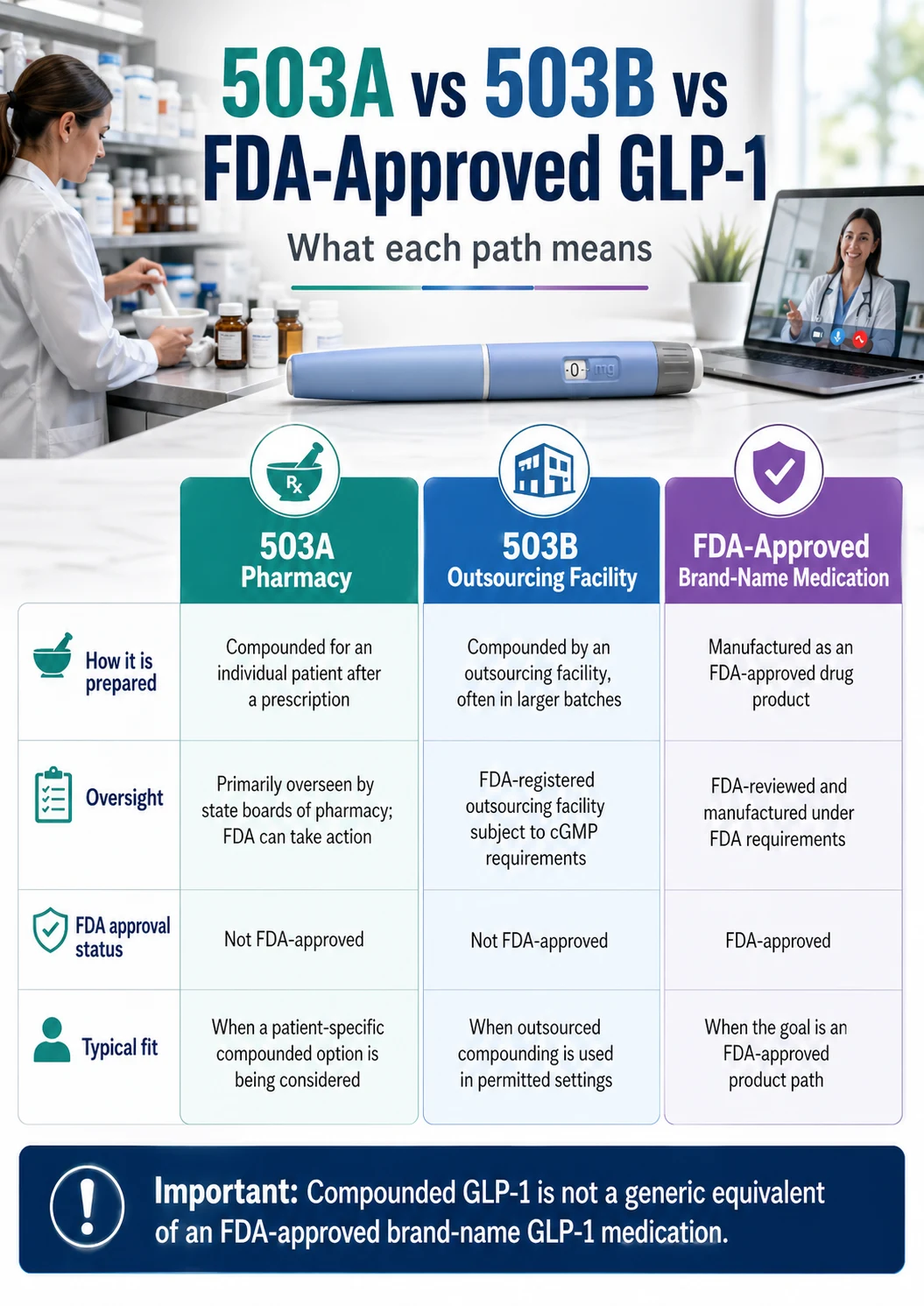
Bottom line up front
If you searched “GLP-1 providers that use 503B outsourcing facilities,” you’re trying to lower your risk before you pay. Smart move. Here’s the honest answer in one screen:
Several online GLP-1 programs publicly disclose 503B outsourcing facility sourcing — most credibly Waters Wellness (Tennessee route), Vigor Compounding, Fifty410, Contour Health, Aayu Well, Rift, FormBlends, and Alan Health. A 503B outsourcing facility is an FDA-registered outsourcing facility subject to current good manufacturing practice (cGMP) requirements, adverse-event reporting, and FDA risk-based inspection.
But here’s what every other “503B GLP-1 providers” page is too polite to say:
- One. A 503B label does not mean your GLP-1 is FDA-approved. The FDA does not review compounded medications for safety, effectiveness, or quality before they’re sold.
- Two. FDA registration is not the same as FDA inspection. Many registered 503B facilities have not yet been inspected.
- Three. As of the FDA’s April 1, 2026 compounding policy update, semaglutide and tirzepatide are not on the 503B Bulks List or the FDA drug shortage list, which severely narrows what a 503B can legally compound for those molecules.
- Four. On February 20, 2026, the FDA issued warning letters to several providers in this category — including Fifty 410, Alan Health, and MEDVi — citing false or misleading claims about compounded semaglutide and tirzepatide.
- Five. Big names you’ve probably seen — MEDVi, Eden, Shed, Hims, Sesame — do not publicly verify as current 503B compounded GLP-1 sources, and we’re not going to pretend they do.
If your real underlying concern is “I want regulated, reviewed medication, not internet roulette,” the cleanest 2026 answer isn’t compounded at all — it’s the FDA-approved path through Ro, where you can get Foundayo (orforglipron), Wegovy pen, Wegovy pill, Zepbound pen, or Zepbound KwikPen at LillyDirect-, NovoCare-, and TrumpRx-matched cash pricing with insurance concierge support. Get started for $39 the first month, then as low as $74/month with annual plan paid upfront. Medication cost is separate.
If you specifically want compounded medication from a more transparent pharmacy source, the page below shows you who actually discloses what — and exactly how to verify it yourself in under five minutes.
Quick verdict: which providers disclose 503B publicly?
We reviewed each provider’s public-facing disclosures, cross-referenced FDA warning-letter records, and scored disclosure quality (not medical safety) on a 10-point editorial rubric. Here’s the short version.
| Provider | Public 503B disclosure | FDA enforcement context | Best fit | Score |
|---|---|---|---|---|
| Waters Wellness (TN route) | High — names route as FDA-registered 503B outsourcing facilities for TN injectables | None found | Regional users in listed shipping states | 8/10 |
| Vigor Compounding | High — operates from a 503B outsourcing facility | None found | Pharmacy-direct identity over telehealth UX | 7/10 |
| Fifty410 | High — site says meds come from FDA-registered 503A and 503B compounding pharmacies; FAQ names ProRx or BPI | FDA warning letter Feb 20, 2026 | Broad national 503A/503B-disclosed telehealth — read with warning-letter context | 6/10 |
| Contour Health | Medium — says compounded semaglutide and tirzepatide are prepared by state-registered 503B pharmacies | None found | Price-visible compounded shoppers | 6/10 |
| Aayu Well | Medium — visible 503B claim and pricing | None found | Mid-priced 503B-disclosed compounded route | 6/10 |
| Rift | Lower — claims 503A and 503B partners; few specifics | None found | Readers willing to ask before paying | 5/10 |
| FormBlends | Lower — claims 503B but active purchase status unclear | None found | Watchlist; verify before paying | 4/10 |
| Alan Health | Lower — references “503a + 503b medications” | FDA warning letter Feb 20, 2026 | Verify carefully; demoted behind providers without warning-letter context | 3/10 |
| MEDVi, Eden, Shed, Hims, Hers, Sesame | Not verified as current 503B compounded GLP-1 sources | MEDVi received an FDA warning letter dated Feb 20, 2026 | See alternative-path section below | n/a |
Disclosure scoring rubric (10 points total): public 503B claim (2) · names pharmacy/facility (2) · explains 503A/503B mix (1) · clarifies state/formulation differences (1) · pricing visible (1) · clearly says compounded ≠ FDA-approved (1) · active purchase status clear (1) · avoids “same as,” “generic,” or “clinically proven” framing for compounded (1).
Scoring is editorial and measures public disclosure quality only — not medical safety, not FDA endorsement, not a guarantee of outcomes. Compounded medications are not FDA-approved and are not reviewed by the FDA for safety, effectiveness, or quality before they are marketed.
What is a 503B outsourcing facility — in plain English?
Answer capsule: A 503B outsourcing facility is an FDA-registered outsourcing facility under Section 503B of the Federal Food, Drug, and Cosmetic Act. It is subject to cGMP requirements, adverse-event reporting, and FDA risk-based inspection. Registration alone does not mean the facility has been inspected by the FDA or that it has been determined to be cGMP-compliant.
A 503B outsourcing facility is registered with the FDA and subject to cGMP — current good manufacturing practice — which is the regulatory framework the FDA uses for commercial pharmaceutical manufacturing. Outsourcing facilities are added to a list the FDA intends to inspect according to a risk-based schedule. They’re required to report adverse events to FDA via MedWatch.
A 503A pharmacy is a traditional state-licensed compounding pharmacy. It compounds medications one prescription at a time for a specific patient, follows USP standards (chapters <795>, <797>, and <800>), and is primarily overseen by your state board of pharmacy. The FDA can still inspect and act, but the routine oversight rhythm is different.
Both can be lawful when the pharmacy or facility meets the conditions that apply to its model. Both can be run well. The regulatory regime is genuinely different, and the difference shows up most clearly when something goes wrong — 503B issues are easier to check on a public FDA page; 503A issues usually surface through state boards plus FDA compounding-action records.
| Question | 503A pharmacy | 503B outsourcing facility |
|---|---|---|
| Primary regulator | State board of pharmacy | FDA (federal) |
| Manufacturing standard | USP <795>/<797>/<800> | Subject to cGMP requirements |
| Patient-specific prescription required? | Yes | No (can compound for office use without one) |
| Bulk batches allowed? | No | Yes |
| Routine FDA inspection? | No | Subject to risk-based FDA inspection |
| FDA adverse event reporting required? | No (limited) | Yes (MedWatch) |
| FDA-approved drug? | No | No |
That last row is the one most pages bury. Compounded medications are not FDA-approved, regardless of whether the pharmacy is 503A or 503B. The FDA does not review compounded drugs for safety, effectiveness, or quality before they’re marketed. That’s true at every compounding tier. We’ll come back to what that actually means for your decision.
The damaging admission no other “503B providers” page will tell you
Answer capsule: A 503B label is a stronger source-transparency signal than a vague “licensed pharmacy” claim, but it does not erase the need to verify the specific pharmacy, formulation, state availability, and lawful basis for your prescription. Independent accreditation and a clean inspection record matter more than the label alone.
Here’s the part most “best 503B providers” pages skip.
- One. The Partnership for Safe Medicines reported in 2025 that it found 39 registered 503B outsourcing facilities that had never been inspected by the FDA. Of those 39, 23 advertised sterile injectable drugs or the ability to compound them, and 9 specifically advertised GLP-1s. Registration is elective and means the facility submitted required information; it does not prove an inspection has happened.
- Two. Empower Pharmacy — one of the most prominent 503B GLP-1 compounders during the shortage — was the subject of investigative reporting in 2025 alleging quality shortcuts and starting-material concerns. A 503B stamp doesn’t prevent that.
- Three. Three of the providers most visible to consumers in this category — Fifty 410, Alan Health, and MEDVi — each received an FDA warning letter dated February 20, 2026 citing false or misleading claims about compounded semaglutide and tirzepatide. That’s not the same as a recall or a safety alert, but it is on the public record and a reasonable reader deserves to know about it.
- Four. The post-shortage rules narrowed dramatically. Tirzepatide came off the FDA shortage list in December 2024 and semaglutide in February 2025. Neither is on the 503B Bulks List. Per the FDA’s April 1, 2026 compounding policy update, 503B outsourcing facilities cannot legally compound essentially-a-copy versions of these drugs. So a lot of the “503B GLP-1” marketing copy floating around the internet is either out of date or referring to a different molecule (liraglutide, which remains in shortage as of early 2026).
Pivot: If you understand what 503B actually proves, you can use it correctly. A 503B disclosure means the provider is willing to tell you their pharmacy operates under federal manufacturing rules and FDA inspection authority. That’s stronger source transparency than a vague “we use a licensed pharmacy” line. It just isn’t the only thing that matters. Independent accreditation (LegitScript, NABP, PCAB), a publicly named pharmacy partner, and a clean inspection record are stronger together.
If your priority is strict regulatory oversight of the actual medication you receive, the cleanest 2026 answer isn’t even compounded — it’s an FDA-approved GLP-1 through a telehealth provider that handles insurance for you. We cover that path explicitly later on this page.
See FDA-approved GLP-1 options through RoAre 503B-compounded semaglutide and tirzepatide still legal in 2026?
Answer capsule: Only in narrow lanes. Semaglutide and tirzepatide are no longer on the FDA shortage list and are not on the 503B Bulks List, which means 503B outsourcing facilities cannot legally produce essentially-a-copy versions of those drugs. Limited exceptions remain for non-copy formulations and patient-specific clinical justifications, but the broad shortage-era window is closed.
Here’s the timeline that matters:
| Date | Event |
|---|---|
| December 19, 2024 | FDA resolved the tirzepatide shortage. Enforcement grace periods: 60 days for 503A pharmacies (until February 18, 2025), 90 days for 503B outsourcing facilities (until March 19, 2025). |
| February 21, 2025 | FDA resolved the semaglutide shortage. Same structure: 60 days for 503A (until April 22, 2025), 90 days for 503B (until May 22, 2025). |
| April 24, 2025 | Federal court denied the Outsourcing Facilities Association's preliminary injunction motion, leaving FDA's policy intact. |
| September 16, 2025 | FDA issued more than 55 warning letters to telehealth companies marketing compounded GLP-1s with misleading claims. |
| February 6, 2026 | FDA announced enhanced enforcement against non-FDA-approved compounded GLP-1 drugs, specifically naming Hims & Hers. |
| February 9, 2026 | Novo Nordisk sued Hims & Hers for patent infringement related to compounded semaglutide. |
| February 20, 2026 | FDA issued warning letters to several telehealth providers in this category, including Fifty 410, Alan Health, and MEDVi. |
| March 9, 2026 | Reuters reported Novo Nordisk dropped the Hims & Hers lawsuit as part of a branded GLP-1 distribution agreement, with rights reserved. |
| April 1, 2026 | FDA reaffirmed that semaglutide and tirzepatide are not on the 503B Bulks List or shortage list, and specifically named semaglutide + B12 (cyanocobalamin) combinations as a potential "essentially a copy" risk depending on route of administration and strength. |
What does this mean for you, the patient?
- Liraglutide, while at least one presentation remains on the FDA shortage list (verify FDA’s current shortage database on your purchase day — Olympia Pharmaceuticals lists compounded liraglutide injection prepared by an FDA-registered 503B outsourcing facility, intended to address current FDA-identified shortages).
- Non-copy formulations or products that are not essentially copies of an FDA-approved drug.
- Patient-specific products with documented significant differences (rare in 503B; more common in 503A).
- Compounded semaglutide that’s essentially a copy of Wegovy, Ozempic, or Rybelsus.
- Compounded tirzepatide that’s essentially a copy of Zepbound or Mounjaro.
- Combinations the FDA may treat as essentially copies (the semaglutide + B12 example sits in this gray zone).
So when a provider says “we use a 503B outsourcing facility for your GLP-1,” in 2026 the right follow-up question is: “For my exact medication, formulation, dose, and state — what lawful basis applies?” If they can’t answer that crisply, that’s information.
The 2026 503B Source Transparency Matrix (full audit)
Answer capsule: Each provider was reviewed against its public-facing disclosures, scored on disclosure quality, and cross-referenced against FDA warning-letter records. Where a provider does not publicly name its pharmacy partner, we mark it that way rather than guess. Most telehealth provider rows reflect provider-stated information, not independent verification of the exact fulfillment facility for an individual prescription.
Every entry below was checked against the provider’s public-facing disclosures (homepage, FAQ, terms, pharmacy/source pages, checkout flow where accessible) and FDA warning-letter records.
| Provider | Public 503B disclosure | Named facility public? | Price visible? | 503A/503B/Brand mix | FDA enforcement context | Verification next step | Score |
|---|---|---|---|---|---|---|---|
| Waters Wellness (TN) | Yes — TN location says injectable GLP-1s are manufactured by FDA-registered 503B outsourcing facilities; NC location compounds sterile injectables under 503A. | Not directly named, but state/location disclosure is unusually specific. | Pricing not standardized in public extract. | TN = 503B route; NC = 503A route. | None found in public records as of late April 2026. | Confirm your state ships from the TN 503B route. | 8/10 |
| Vigor Compounding | Yes — operates from a 503B outsourcing facility; references quality assurance standards for sterility, potency, and precision. | Vigor itself is the named entity. | Not consumer-standardized. | 503B-direct. | None found. | Confirm your state and whether a separate prescriber is required. | 7/10 |
| Fifty410 | Yes — site states meds come from FDA-registered 503A and 503B compounding pharmacies; FAQ names ProRx or BPI for some compounded GLP medication. | Partially — ProRx and BPI named in FAQ for some products. | Yes — compounded meds start at $116/month per FAQ; current semaglutide tiers shown at $199/month or $299 for a 3-month supply, tirzepatide at $133/month for a 3-month starter. | 503A and 503B both used. | FDA warning letter dated Feb 20, 2026 (Aspen Aesthetics dba Fifty 410) citing false or misleading claims about compounded semaglutide and tirzepatide. | Read warning-letter context; ask which pharmacy and source type apply to your state. | 6/10 |
| Contour Health | Yes — says compounded semaglutide and tirzepatide are prepared by state-registered 503B pharmacies, with mixed 503A/503B language elsewhere. | Not in public extract. | Yes — semaglutide/tirzepatide from $149/month, tirzepatide from $299. | Provider-stated state-registered 503B/503A. | None found. | Verify pharmacy name and state availability; classify as provider-stated, not independently verified 503B fulfillment. | 6/10 |
| Aayu Well | Yes — says compounded alternatives come from FDA-registered 503B pharmacies. | Not in public extract. | Yes — semaglutide from $250/month. | 503B route per provider. | None found. | Verify pharmacy name and post-shortage lawful basis. | 6/10 |
| Rift | Yes — says it partners with US-licensed 503A and 503B compounding pharmacies regulated by FDA and state boards. | Not in public extract. | Not in public extract. | Mixed 503A/503B. | None found. | Need pharmacy name, pricing, and state-by-state confirmation. | 5/10 |
| FormBlends | Yes — GLP-1 page says medication is prepared by an FDA-registered 503B outsourcing facility, but homepage says product catalog and compliance requirements are still being finalized. | Not in public extract. | Not consumer-standardized. | 503B route per provider. | None found. | [NEEDS VERIFICATION] active purchase status before featuring. | 4/10 |
| Alan Health | Yes — references "503a + 503b medications". | Not in public extract. | Yes — from $158/month after promo. | Mixed. | FDA warning letter dated Feb 20, 2026 citing false or misleading claims about compounded semaglutide and tirzepatide. | Verify carefully; do not rely on marketing copy. | 3/10 |
| MEDVi | No current 503B verification in reviewed source; site language describes state-licensed pharmacies. | n/a | Yes — GLP-1 injections from $179/month, tablets from $249/month. | 503A/state-licensed only per current public copy. | FDA warning letter #721455 dated Feb 20, 2026 (MEDVi LLC dba MEDVi) involving GLP-1 marketing and source presentation. | Treat as non-503B for purposes of this query. | Not verified 503B |
| Eden | No current 503B verification in reviewed source. | n/a | Yes on Eden program pages. | 503A/state-licensed. | None found. | Treat as non-503B for this query. | Not verified 503B |
| Shed | Mixed public language: one Shed page says it has partnered with both 503A and 503B pharmacies; current educational content says 503A partners may fill patient-specific prescriptions when appropriate. | n/a | Pricing on program pages. | Provider-stated mixed. | None found. | Do not classify as verified 503B GLP-1 fulfillment without provider confirmation of exact pharmacy route for the user's prescription. | Not verified 503B |
| Hims & Hers | Hims's 10-K says certain compounded GLP-1 products were previously produced by 503B outsourcing facilities, but Hims currently uses only 503A compounding pharmacies for compounded GLP-1 fulfillment; Hims acquired the 503B-registered MedisourceRx in 2024. | MedisourceRx publicly named in acquisition reporting. | Yes for FDA-approved Wegovy and Ozempic via the March 2026 Novo Nordisk distribution agreement. | Currently 503A (compounded) + FDA-approved Wegovy/Ozempic. | FDA named Hims in February 2026 enforcement statement; Novo Nordisk sued February 9, 2026 then dropped the suit per March 9, 2026 reporting as part of the branded distribution agreement. | Use FDA-approved path only. | Not a current 503B pick |
| Sesame Care | Sesame announced in October 2024 it had selected a 503B compounding pharmacy for compounded semaglutide; current program page emphasizes brand-name FDA-approved options. | n/a | Yes — Success by Sesame program starts at $99/month with annual subscription messaging as low as $59/month; medication cost is separate. | Brand-name FDA-approved focus today. | None found. | [NEEDS VERIFICATION] for current 503B compounded access; treat as FDA-approved marketplace route. | Not verified as current 503B |
Methodology footer: Every row was built from public provider disclosures and FDA records as of late April 2026. Where information is incomplete, we say so. We re-verify quarterly. Compounded medications referenced are not FDA-approved and have not been reviewed by the FDA for safety, effectiveness, or quality. This page is editorial — not medical advice.
The 503B-disclosed providers, broken down honestly
Below are the providers that publicly disclose 503B GLP-1 sourcing, in the order we’d evaluate them today. The point isn’t to push a specific affiliate — it’s to tell you what each one actually says, what they don’t say, and what to ask before you give them your card.
Waters Wellness — strongest location-specific 503B disclosure
Waters Wellness is the unicorn here. They explicitly say their Tennessee location dispenses injectable GLP-1 medications manufactured by FDA-registered 503B outsourcing facilities, while their North Carolina location compounds sterile injectable GLP-1 medications under Section 503A. They list which states each location ships to.
Why this matters: every other “we use 503B” claim on the internet is a national one. National claims are hard to verify because pharmacy fulfillment can vary by state. Waters Wellness’s location-specific framing is closer to how compounded medication actually works, and it puts the verification burden in the right place.
What we’d ask before paying: confirm your state is on the Tennessee shipping list, and that your specific medication and dose route through the 503B path rather than the 503A path. The 503B claim only applies to certain shipping configurations.
Who this isn’t for: anyone outside their listed shipping states, or anyone whose medication routes through their North Carolina 503A path who specifically wants 503B.
Vigor Compounding — pharmacy-direct 503B identity
Vigor positions itself as a 503B outsourcing facility rather than a consumer telehealth marketplace. Their public copy emphasizes 503B identity and references quality assurance standards for sterility, potency, and precision.
Who this fits: readers who care more about pharmacy identity than a clean consumer telehealth UX. If you’ve decided that which pharmacy compounds your medication matters more than how easy the patient portal is, this kind of pharmacy-direct positioning is unusual and worth considering.
What we’d ask before paying: whether you’ll need a separate prescriber, whether they ship to your state, and what specific GLP-1 formulations are currently available given the post-shortage rules.
Fifty410 — broadest national 503A/503B disclosure (with material warning-letter context)
Fifty410 publicly says its medications come from FDA-registered 503A and 503B compounding pharmacies. The FAQ names ProRx or BPI for some compounded GLP medication. The FAQ also lists compounded medications starting at $116/month, while current product pages show semaglutide pricing at $199/month or $299 for a 3-month supply, and tirzepatide at $133/month on a 3-month starter program.
The material context you need to know: the FDA issued a warning letter dated February 20, 2026 to Aspen Aesthetics dba Fifty 410, after reviewing the website in December 2025, alleging false or misleading claims about compounded semaglutide and tirzepatide products. This is not a recall or a clinical safety alert, and the provider has the opportunity to respond and correct. But it is part of the public record on the FDA’s website, and a reader filtering on regulatory transparency deserves to see it.
What we’d ask before paying: which specific pharmacy fulfills your prescription based on your state, whether your medication runs on the 503A patient-specific track or the 503B track, and how Fifty410 has responded to the February 2026 warning letter.
Damaging admission: the warning letter context puts Fifty410 below Waters Wellness and Vigor on our editorial ranking even though Fifty410’s national disclosure language is broad. If transparent compounded sourcing without enforcement context is your priority, Waters Wellness (TN route) or Vigor are cleaner choices. If you’re comfortable evaluating providers with disclosed warning letters as long as you ask the right verification questions, Fifty410 still warrants consideration.
Contour Health — visible pricing, provider-stated state-registered 503B
Contour says compounded semaglutide and tirzepatide are prepared by state-registered 503B pharmacies, with mixed 503A/503B language elsewhere on the site. They show GLP-1 pricing starting at $149/month, with tirzepatide from $299/month.
A note on terminology: “state-registered 503B” is Contour’s own wording, not “FDA-registered 503B.” We’re not upgrading their language. The combination of a 503B reference plus visible pricing puts them in the consideration set, but classify them as provider-stated rather than independently verified 503B fulfillment.
What we’d ask before paying: which pharmacy specifically, what your state’s fulfillment route looks like, whether the $149 figure is for a starter dose or a full standard dose (this varies a lot in this industry), and how Contour reconciles the state-registered vs FDA-registered language.
Aayu Well — visible 503B claim with mid-tier pricing
Aayu Well says compounded alternatives come from FDA-registered 503B pharmacies and shows semaglutide starting at $250/month. Their disclosure quality is similar to Contour’s but priced higher.
What we’d ask before paying: the same questions — pharmacy name, state availability, current active legal basis given the post-shortage rules.
Rift — broad 503A/503B disclosure, but verify before paying
Rift’s site says it partners with US-licensed 503A and 503B compounding pharmacies regulated by FDA and state boards. Public-facing pages don’t go deep enough to verify which fulfillment route applies to which state, or to find consistent pricing.
What we’d ask before paying: all of it — pharmacy name, route, pricing, state coverage. Rift may be a good fit, but the public information available right now puts the verification burden squarely on you.
FormBlends — explicit 503B language, active status needs verification
FormBlends’s GLP-1 page says medication is prepared by an FDA-registered 503B outsourcing facility, while the homepage indicates the product catalog and compliance requirements are still being finalized. That tension is a flag for “verify active purchase status before paying.”
Who should wait: anyone who needs to start medication this month. Anyone comfortable spending 24-48 hours on verification before paying might find a fit here.
Alan Health — 503A + 503B language with material warning-letter context
Alan Health references “503a + 503b medications” and shows starting pricing from $158/month after a promo. We’re listing them for completeness because they appear in this category, but the FDA issued a warning letter dated February 20, 2026 to Alan Health Technologies citing false or misleading claims about compounded semaglutide and tirzepatide products.
That warning letter, combined with the marketing copy issues the FDA flagged, drops Alan Health below the providers without similar enforcement context. Verify carefully and do not rely on marketing copy when making your decision.
The big-name GLP-1 providers that are NOT verified 503B
Answer capsule: Several providers you’ve probably seen in ads or comparison pages don’t currently verify as 503B GLP-1 sources. We’d rather tell you that plainly than blur the answer to keep an affiliate relationship comfortable.
MEDVi
MEDVi has visible pricing (GLP-1 injections from $179/month, tablets from $249/month) and broad availability. Current public copy describes compounded medications as dispensed by state-licensed pharmacies and clearly states that compounded medications are not FDA-approved.
Important context: the FDA issued a warning letter to MEDVi LLC dated February 20, 2026 (warning letter 721455), involving GLP-1 marketing and source presentation. We’re noting this because it’s part of the public record and your search is specifically about regulatory transparency. MEDVi may be a fit for other GLP-1 buyers — we cover them on dedicated review pages — but for “providers that use 503B outsourcing facilities” specifically, we don’t have current verification supporting that claim.
If you want a non-503B compounded route, you can still evaluate MEDVi alongside the warning-letter context — but we’d send you to our MEDVi review page for the full picture rather than pretend they answer the 503B question.
Eden
Eden is one of the strongest broad-default GLP-1 providers in our broader comparison — but for this specific search, we don’t have current verification of 503B GLP-1 fulfillment. Eden positions as a state-licensed compounding network and emphasizes 24/7 messaging, both compounded and FDA-approved Wegovy/Zepbound options, and HSA/FSA eligibility. None of that is bad — it’s just not a 503B answer.
If you decide you want compounded medication and are comfortable with a 503A patient-specific route from a well-vetted provider, Eden is a reasonable evaluation. But for this page, if 503B is your specific filter, Eden isn’t a verified match. See our Eden review page for the full picture.
Shed
Shed has mixed public language: one Shed page says it has partnered with both 503A and 503B compounding pharmacies; their current educational content says their 503A partners may fill patient-specific prescriptions when appropriate. Shed is also one of the few providers we’ve seen explicitly tell users to ask which pharmacy will dispense the medication, which is the kind of consumer transparency we want to see more of.
That mixed disclosure isn’t enough to classify Shed as verified 503B GLP-1 fulfillment without provider confirmation of the exact pharmacy route for your prescription. Shed is a stronger fit for readers specifically researching compounded oral, sublingual, or no-injection routes (these route more naturally through 503A patient-specific channels in 2026), but exact formulation, pharmacy route, and legal basis still need confirmation. See our Shed review page for more.
Hims and Hers
This one’s worth a little extra detail because Hims is genuinely confusing on this question.
Hims’s 10-K (filed for fiscal year ending December 2025) says certain compounded GLP-1 products were previously produced by 503B outsourcing facilities, but says Hims currently uses only 503A compounding pharmacies for compounded GLP-1 fulfillment and dispensing. Hims acquired the 503B-registered MedisourceRx in 2024, but the current operational picture for compounded GLP-1 is 503A.
The litigation timeline went like this:
- The FDA specifically named Hims & Hers in its February 6, 2026 enforcement statement.
- Novo Nordisk sued Hims & Hers on February 9, 2026 for patent infringement related to compounded semaglutide.
- Reuters reported on March 9, 2026 that Novo Nordisk dropped the lawsuit as part of a branded GLP-1 distribution agreement giving Hims access to Wegovy and Ozempic, with rights reserved.
So today: Hims is a legitimate FDA-approved GLP-1 option for someone who specifically wants the Hims male-coded brand experience (or Hers for the female-coded brand experience), with broad access to FDA-approved Wegovy and Ozempic through the Novo Nordisk distribution agreement. They’re not a current 503B compounded answer. We’d send you to our brand-name FDA-approved review hub for the brand path.
Sesame Care
Sesame announced in October 2024 that it had selected a 503B compounding pharmacy for compounded semaglutide. Their current weight-loss program page emphasizes brand-name FDA-approved options including Wegovy pill, Foundayo, Zepbound, and Ozempic, with transparent starting prices for several. The Success by Sesame program currently starts at $99/month with annual subscription messaging as low as $59/month, with medication cost separate.
We don’t have current verification of an active 503B compounded GLP-1 path on Sesame’s public pages. Sesame is a strong FDA-approved marketplace alternative — especially for shoppers who want to compare provider choice or use Costco-member pricing on Wegovy/Ozempic. We just won’t sell them as a current 503B answer when the public-facing emphasis is brand-name. Compare it on our Sesame review page.
How to verify a 503B claim yourself in under 5 minutes
Answer capsule: The FDA publishes a public table of registered outsourcing facilities, including registration date, last inspection date, Form 483 status, recalls, and action based on last inspection. Combined with five questions you can copy-paste to a provider’s support chat, you can confirm or disprove any “503B” claim before you give them your card.
This is the part of the page you should bookmark.
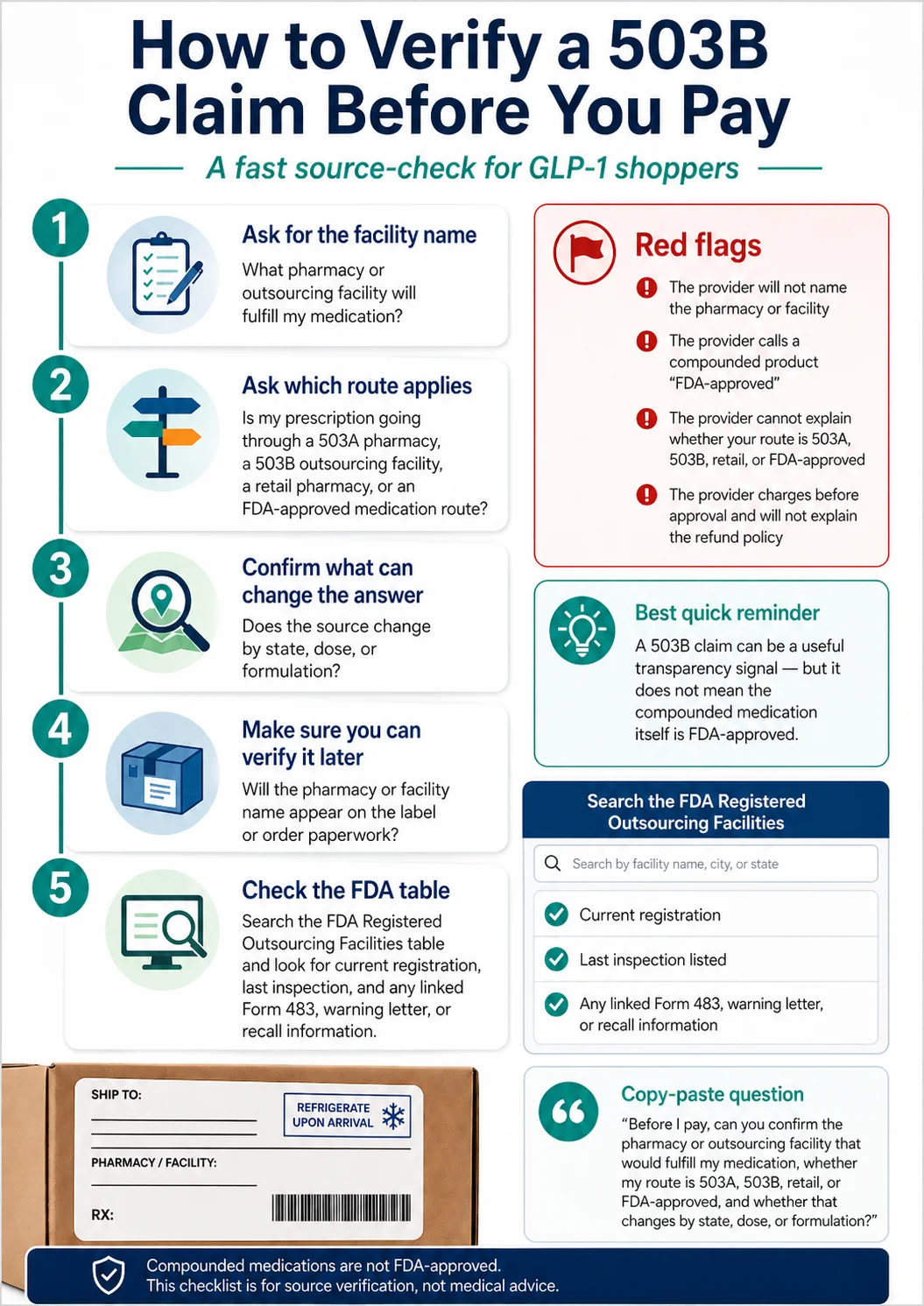
The 5 questions to ask before paying
Send these to the provider’s support chat or email:
- What pharmacy or outsourcing facility will compound or dispense my medication?
- Is that facility 503A, 503B, retail, or brand-name fulfillment for my exact prescription?
- Does the answer change by my state, dose, or whether the medication is injectable, oral, or sublingual?
- Will the pharmacy or facility name appear on the shipping label or prescription label so I can verify it after the order arrives?
- What happens if my prescription cannot be legally or clinically fulfilled — am I refunded automatically, and how is that handled?
If you want a copy-paste version:
“Before I complete payment, can you confirm the pharmacy or outsourcing facility that would fulfill my prescription if I’m approved? I’m specifically trying to understand whether my medication would come from a 503A pharmacy, a 503B outsourcing facility, a retail pharmacy, or a brand-name manufacturer route. Please also confirm whether this depends on my state, medication, or formulation, and confirm your refund policy if my prescription can’t be fulfilled.”
A provider acting in good faith should be able to answer this in a single response. If they evade, repeat marketing language without specifics, or refuse — that is the answer.
The FDA list lookup (90 seconds — most pages skip this)
Once you have a pharmacy name, take 90 seconds to do this:
- Go to
fda.gov/drugs/human-drug-compounding/registered-outsourcing-facilities. - Search the table for the pharmacy name.
- Check four columns:
- Date of most recent registration — confirms the facility is currently registered.
- Last inspection date — facilities flagged “Not yet inspected” are not necessarily bad, but it’s worth knowing.
- Action based on last inspection — flags Form 483 observations, warning letters, recalls, or closeouts.
- Recall column — flags any recent recalls.
The table is updated weekly and lists facilities whose registration information was complete by the latest data lock date. Facilities that registered after that date won’t appear yet.
How do I check whether the 503B facility was actually inspected?
The FDA table includes the last inspection date next to each facility. If the entry says “Not yet inspected,” registration alone doesn’t tell you whether FDA has examined the facility’s manufacturing operation. Some facilities operate for months between registration and first inspection. That’s a category-wide reality, not a specific provider issue, but it’s part of why the verification framework matters.
Independent accreditation lookups (the second-tier verification)
Beyond the FDA list, three accreditations are stronger verification signals than a bare “licensed pharmacy” claim across both 503A and 503B tiers:
- LegitScript (
legitscript.com) — verifies online pharmacies and telehealth merchants. - NABP (
nabp.pharmacy) — National Association of Boards of Pharmacy accreditation. - PCAB (
achc.org) — Pharmacy Compounding Accreditation Board.
A pharmacy with a clean FDA inspection record plus two or three of these accreditations gives you more verification depth than the 503B label alone.
Red flags during verification
Walk away if you see any of these:
- Provider refuses to name the pharmacy.
- Provider uses “FDA-approved facility” language for a compounded product (a facility can be FDA-registered, but a compounded product itself is not FDA-approved).
- Provider mixes “503B” and “FDA-approved drug” — these are two independent things.
- Pharmacy is not on the FDA outsourcing facility table, but the provider claims 503B.
- Provider charges your card before clinician approval and won’t explain the refund policy.
Want the verification checklist for compounded GLP-1 providers?
Our companion guide includes the full red-flag audit, FDA tool links, and the 7-question pharmacy script.
When to choose 503B, 503A, or FDA-approved GLP-1 medication
Answer capsule: Choose based on your real constraint, not the label that sounds best. 503B may matter if you specifically want a more federally-supervised pharmacy source. 503A may matter for patient-specific compounded formulations. FDA-approved is the cleaner regulatory route if your underlying concern is that the medication itself be reviewed for safety, effectiveness, and quality.
| Your situation | Your best path | What to do next | Why this route fits |
|---|---|---|---|
| “I want FDA-approved medication, or insurance/prior-authorization help.” | FDA-approved through Ro (primary) or Sesame (secondary) | Run Ro’s free GLP-1 Insurance Coverage Checker | FDA reviewed the medication itself; insurance concierge handles paperwork |
| “I want compounded medication, but specifically from a more federally-supervised pharmacy source.” | 503B-disclosed provider (Waters Wellness TN, Vigor, Fifty410, Contour, Aayu Well, etc.) | Use the 5 questions above before paying | Provider tells you the pharmacy operates under federal manufacturing rules |
| “I need a patient-specific compounded formulation (custom dose, microdose, oral/sublingual).” | 503A patient-specific compounded route | Eden, Shed, MEDVi, and similar are reasonable to evaluate | 503A is the legal lane for patient-specific compounding in 2026 |
| “I want oral or no-injection options.” | Compounded oral/sublingual through 503A or FDA-approved Wegovy pill / Foundayo via Ro | Foundayo and Wegovy pill are FDA-approved oral GLP-1 options; Shed is the strongest compounded-oral specialist | Different mechanisms, different regulatory paths |
| “I want the lowest possible monthly price.” | Cost-first comparison | See our cheapest GLP-1 without insurance page | Different filter than this page |
| “I’m anxious about compounding risk in general.” | FDA-approved through Ro | Don’t fight your gut | The FDA-approved path doesn’t require compounded-pharmacy source verification |
| “I’m not sure which path I’m in.” | The 60-second matching quiz | Routes you based on your actual constraints | Three paths, your fit decides |
The FDA-approved alternative: if “regulated medication” is your real priority, this is the cleanest answer
Answer capsule: If your underlying concern is medication oversight rather than the compounded route specifically, FDA-approved GLP-1s through Ro deliver stronger regulatory assurance than any compounded path — and the 2026 cash-pay pricing has changed enough to make this realistic for many self-pay buyers.
If you got this far on a page about 503B outsourcing facilities, the underlying thing you actually want is medication you can trust. Read this carefully, because it’s the part most readers don’t realize until they’re already three tabs deep.
FDA-approved GLP-1s have always existed. What changed in 2026 is that they’re now genuinely affordable at telehealth prices, with insurance support that didn’t exist in the early shortage era.
Ro is the primary FDA-approved telehealth path for GLP-1 weight loss in 2026.
What Ro currently offers:
- Foundayo (orforglipron) — Eli Lilly’s once-daily oral GLP-1 pill, FDA-approved
- Wegovy pen (semaglutide injection)
- Wegovy pill (oral semaglutide)
- Zepbound pen (tirzepatide)
- Zepbound KwikPen at lower cash-pay pricing
- A dedicated insurance concierge that handles prior-authorization paperwork on your behalf
- A free GLP-1 Insurance Coverage Checker so you can see what your insurance will actually pay before you commit
- Pricing matched to LillyDirect, NovoCare, and TrumpRx on the medications themselves; for example, Zepbound KwikPen cash-pay pricing on Ro is currently shown at $299/month for 2.5 mg, $399/month for 5 mg, and $449/month for 7.5–15 mg with the manufacturer offer
Ro membership pricing: Get started for $39 the first month, then as low as $74/month with annual plan paid upfront (the standard monthly plan is $149/month). Medication cost is separate and depends on which medication and whether insurance covers it.
The reciprocal logic that makes this fit your search:
- You searched 503B because you want federally-supervised medication.
- FDA-approved medication is more federally-supervised than any compounded medication, period.
- Some FDA-approved cash-pay options now start in the same range as many compounded programs, especially lower-dose oral options and starter-dose KwikPen pricing.
- So if your underlying constraint is regulatory oversight of the medication itself, you can get a stronger version of what you wanted — though you still need to verify medical eligibility, contraindications, coverage, and final cost with Ro before you commit.
Who Ro is NOT for:
- If you specifically need a custom compounded dose your prescriber can document a clinical justification for — Ro is not a 503A patient-specific compounding shop.
- If you need a provider that specifically handles oral compounded sublingual lozenges or microdose protocols — that’s Shed’s lane, not Ro’s.
- If your prescriber has ruled out branded GLP-1s for a specific medical reason — talk to them first.
Damaging admission for Ro: there’s a membership fee on top of medication, and medication cost is separate. Some compounded providers don’t charge a separate membership. If “no membership fee” is your top priority, see our cash-pay GLP-1 comparison page for providers built around that model. But because Ro charges that membership, you get an insurance concierge that does the prior-authorization paperwork for you, which is the difference between “I qualify on paper” and “my insurance actually paid for this.”
Ro Body — FDA-approved GLP-1 with insurance concierge
From $39 first month
As low as $74/mo with annual plan. Medication cost separate.
Foundayo · Wegovy pen/pill · Zepbound pen/KwikPen · LillyDirect/NovoCare/TrumpRx-matched cash pricing
Check Ro’s FDA-approved GLP-1 options & run the free insurance coverage checkIf you want a brand-name marketplace alternative with provider choice and Costco-member pricing on Wegovy/Ozempic, Sesame Care (Success by Sesame program from $99/month, medication cost separate) is the secondary option to evaluate.
What questions should you ask before entering your card?
Answer capsule: The safest checkout is one where you know what you’re paying, who prescribes, who compounds or dispenses, and what happens if you’re not approved. Pharmacy and source questions sit at the center of this for compounded providers; payment-flow and refund questions matter at every tier.
Payment and approval questions
- Do I pay before clinician approval, or only after?
- If I’m not approved, is the charge refunded automatically?
- Is there a separate membership fee on top of medication?
- Does the price increase as my dose increases?
- Is shipping included?
- How do I cancel — and does cancellation cancel pending shipments, or only future ones?
- Who do I contact if a shipment arrives warm or with insufficient ice packs?
Pharmacy and source questions
- What pharmacy or outsourcing facility will fulfill my medication?
- Is it 503A, 503B, retail, or brand-name fulfillment for my exact prescription?
- Will the pharmacy name appear on my shipping label or prescription label?
- Can I verify it on the FDA Registered Outsourcing Facilities table or my state’s pharmacy license lookup?
- What happens if my exact medication can’t be legally fulfilled (e.g., the formulation runs into a regulatory issue)?
If a provider treats these questions like an inconvenience, that is the answer.
What are the biggest risks of choosing a 503B-compounded GLP-1?
Answer capsule: The biggest risk is misunderstanding what 503B proves. Federal registration and cGMP obligations are meaningful, but compounded GLP-1 medications are still not FDA-approved finished products. The FDA itself has documented specific safety concerns in this category.
Risk 1: Not FDA-approved
The FDA states plainly: compounded drugs are not FDA-approved and are not reviewed by the FDA for safety, effectiveness, or quality before marketing. This applies to any compounded medication regardless of whether it’s 503A or 503B.
Risk 2: Shipping and refrigeration failures
The FDA has received complaints about compounded injectable GLP-1 products arriving warm or with inadequate ice packs. The agency recommends not using injectable GLP-1 drugs that arrive warm or with insufficient refrigeration. If yours shows up warm, contact the provider before injecting.
Risk 3: Counterfeit and label fraud
The FDA has documented compounded GLP-1 products with labels naming pharmacies that did not actually compound the product. This is part of why “Will the pharmacy name appear on the label?” is one of our 5 verification questions.
Risk 4: Dosing errors
The FDA has reported adverse events — some requiring hospitalization — associated with dosing errors involving compounded injectable semaglutide and tirzepatide products. Compounded vials with patient-drawn doses introduce a step that prefilled pens don’t have, and the math errors in that step have hospitalized people.
Risk 5: Regulatory whiplash
The compounded GLP-1 landscape has changed faster than any other category in telehealth. The FDA issued more than 55 warning letters to telehealth companies in September 2025 alone. The agency announced enhanced enforcement in February 2026, followed by additional warning letters dated February 20, 2026 to providers including Fifty 410, Alan Health, and MEDVi. Eligibility, contraindications, and side effects must be reviewed with a licensed prescriber.
What we actually verified (and what we didn’t) for this page
We’re putting this in a visible box because most “best 503B providers” pages don’t show their work, and that’s how stale information ends up ranking.
- Each provider’s public-facing pharmacy disclosures as of late April 2026
- FDA warning-letter records on the FDA’s enforcement actions database
- Current FDA shortage status of semaglutide, tirzepatide, and liraglutide
- FDA’s April 1, 2026 compounding policy update
- Visible pricing on each provider where available
- Each provider’s stated 503A vs 503B vs brand-name positioning
- Hims’s 10-K SEC filing language regarding current 503A compounded GLP-1 fulfillment
- The March 9, 2026 Reuters reporting on the Novo Nordisk / Hims lawsuit resolution
- We did not complete checkout for every provider. Some specifics (final pharmacy name, dose-by-dose pricing) only surface inside the actual checkout flow.
- We did not call every provider’s support line.
- We did not verify every reader’s state-specific availability.
- We checked the FDA Registered Outsourcing Facilities table only where a provider publicly named a specific facility or where the provider itself is the facility. Most telehealth providers reviewed did not publicly name the exact fulfillment facility.
- We did not inspect pharmacy labels or receive shipments firsthand.
- We did not medically evaluate whether a specific compounded medication is appropriate for a specific reader. That’s between you and your prescriber.
Refresh cadence: quarterly minimum, with event-driven updates whenever FDA enforcement actions, lawsuits, or provider pharmacy changes are announced. The next scheduled verification is in July 2026.
Frequently asked questions about 503B GLP-1 providers
Is 503B better than 503A for GLP-1s?
Not automatically. 503B facilities are FDA-registered and subject to current Good Manufacturing Practice (cGMP) requirements and risk-based FDA inspection — that is stricter on paper than typical 503A oversight. But a well-run 503A pharmacy with LegitScript, NABP, or PCAB accreditation and a clean state inspection record can be substantively as safe as an average 503B. The specific pharmacy's record matters more than the designation.
Does 503B mean a compounded GLP-1 is FDA-approved?
No. A 503B outsourcing facility is FDA-registered, but compounded medications themselves are not FDA-approved. The FDA does not review compounded drugs for safety, effectiveness, or quality before they are marketed. This is true at every compounding tier — 503A or 503B.
Can 503B pharmacies still legally compound semaglutide in 2026?
Only in narrow lanes. Semaglutide is no longer on the FDA shortage list and is not on the 503B Bulks List. Per the FDA's April 1, 2026 compounding policy update, 503B outsourcing facilities cannot legally produce semaglutide products that are essentially copies of FDA-approved drugs. Limited circumstances (non-copy formulations, certain combinations with documented clinical justification) may apply, but the broad shortage-era window is closed.
Can 503B pharmacies still legally compound tirzepatide?
Same answer. The tirzepatide shortage was resolved in December 2024, and the molecule is not on the 503B Bulks List. The 503B enforcement grace period closed March 19, 2025. Do not assume broad 503B availability without verification.
What about liraglutide?
Liraglutide remains on the FDA shortage list as of early 2026 (verify the current FDA shortage database on your purchase day). 503B-compounded liraglutide is currently within scope — Olympia Pharmaceuticals lists compounded liraglutide injection prepared by an FDA-registered 503B outsourcing facility, intended to address current FDA-identified shortages. Liraglutide is a daily injection rather than weekly, with a different side-effect curve than semaglutide; it is not a one-to-one substitute.
Is Fifty410 a 503B GLP-1 provider?
Fifty410 publicly says its medications come from FDA-registered 503A and 503B compounding pharmacies, and the FAQ names ProRx or BPI for some compounded GLP medication pricing. The FDA also issued a warning letter dated February 20, 2026 to Aspen Aesthetics dba Fifty 410 citing false or misleading claims about compounded semaglutide and tirzepatide. Read both pieces of context before paying.
Is MEDVi a 503B provider for GLP-1?
No current verification of 503B GLP-1 fulfillment from MEDVi's public pages. MEDVi positions as a state-licensed compounded route. Separately, the FDA issued a warning letter to MEDVi LLC dated February 20, 2026 (warning letter 721455) involving GLP-1 marketing and source presentation. For this specific search, we are not classifying MEDVi as a current 503B answer.
Is Eden a 503B provider?
Not from current public sources. Eden positions as a state-licensed compounding network, which is a 503A-style model. Eden is genuinely strong as a broad-default GLP-1 provider for many users — just not as the answer to "which providers use 503B outsourcing facilities."
Is Shed a 503B provider?
Mixed. Shed has said it has partnered with both 503A and 503B compounding pharmacies, while current educational content describes 503A partners filling patient-specific prescriptions when appropriate. Shed is a stronger fit for compounded oral, sublingual, and lozenge formats — those route through 503A patient-specific channels in 2026. Do not classify Shed as verified 503B GLP-1 fulfillment without provider confirmation of your prescription's exact pharmacy route.
Did Hims use 503B outsourcing facilities for compounded GLP-1?
Hims's most recent 10-K says certain compounded GLP-1 products were previously produced by 503B outsourcing facilities, but Hims now uses only 503A compounding pharmacies for compounded GLP-1 fulfillment. Hims acquired the 503B-registered MedisourceRx in 2024. Following the March 9, 2026 reporting on the Novo Nordisk distribution agreement, Hims now sells FDA-approved Wegovy and Ozempic; that is a current FDA-approved option, not a current 503B compounded option.
How do I look up a 503B facility on the FDA's site?
Go to fda.gov/drugs/human-drug-compounding/registered-outsourcing-facilities. The table is updated weekly. Search for the pharmacy or facility name. Check date of most recent registration, last inspection date, action based on last inspection, and any recall flags. Facilities that registered after the latest data lock date will not appear yet.
What if my provider will not tell me which pharmacy they use?
Walk away. Any provider operating in good faith should be able to name the pharmacy partner that prepares your medication. Refusal or evasion is information.
Should I just go with FDA-approved GLP-1 instead?
If your underlying concern is regulatory oversight rather than the compounded route specifically, FDA-approved is the cleaner answer. Through Ro, you can get Foundayo (orforglipron), Wegovy pen, Wegovy pill, Zepbound pen, or Zepbound KwikPen at LillyDirect/NovoCare/TrumpRx-matched cash pricing, with insurance concierge support. Get started for $39 the first month, then as low as $74/month with annual plan paid upfront. Medication cost is separate. Run the free GLP-1 Insurance Coverage Checker first to see what your insurance will actually pay.
Still not sure which GLP-1 program is right for you?
If you’ve read this far, you’re past the “should I do GLP-1?” decision and into the “which path?” decision. That’s the right question — and the answer depends on three things most providers won’t ask you directly: your state, your insurance status, and whether you genuinely need a custom compounded formulation or you’d be fine with an FDA-approved one if the price worked.
Take our free 60-second matching quiz. It sorts you into one of three lanes — FDA-approved through a brand-name path, 503B-disclosed compounded, or 503A patient-specific compounded — based on what actually fits, not what an affiliate funnel wants you in.
Find My Path — the 60-second matching quiz
Three paths: FDA-approved brand-name, 503B-disclosed compounded, or 503A patient-specific. Your fit decides.
Methodology and editorial disclosures
Weight Loss Provider Guide is an independent comparison resource for GLP-1 telehealth providers. We earn affiliate commission when readers start with some of our partners; affiliate relationships do not change which providers we recommend, and we list providers we don’t have affiliate relationships with on this page wherever they’re the honest answer.
This page was researched and written by the Weight Loss Provider Guide editorial team using public provider disclosures, FDA primary sources (the Registered Outsourcing Facilities table, the FDA compounding policy page, FDA enforcement actions database, FDA drug shortage status), regulatory legal analysis, the Hims 10-K SEC filing, and current reporting on the Hims/Novo Nordisk distribution agreement. Compounded medications referenced are not FDA-approved and are not reviewed by the FDA for safety, effectiveness, or quality before marketing.
This page is editorial and is not medical advice. Talk to your prescriber about whether a specific GLP-1 medication is appropriate for you.
Last verified: April 29, 2026.
If you found a factual error, found that a provider’s disclosure has changed, or want to know when we re-verify this page, contact our editorial team. We track corrections publicly.
Sources
- U.S. Food and Drug Administration. "Registered Outsourcing Facilities (503B)." Updated weekly.
- U.S. Food and Drug Administration. "Human Drug Compounding — Section 503B." Updated April 2026.
- U.S. Food and Drug Administration. "FDA Drug Shortages — semaglutide injection products." Resolved February 21, 2025.
- U.S. Food and Drug Administration. "FDA Drug Shortages — tirzepatide injection products." Resolved December 19, 2024.
- U.S. Food and Drug Administration. "Compounding and the FDA: Questions and Answers." April 1, 2026 update.
- U.S. Food and Drug Administration. Warning Letter to Aspen Aesthetics dba Fifty 410. February 20, 2026.
- U.S. Food and Drug Administration. Warning Letter to Alan Health Technologies. February 20, 2026.
- U.S. Food and Drug Administration. Warning Letter #721455 to MEDVi LLC dba MEDVi. February 20, 2026.
- U.S. Food and Drug Administration. Statement on enhanced enforcement against non-FDA-approved compounded GLP-1 drugs. February 6, 2026.
- U.S. District Court. Outsourcing Facilities Association v. FDA — denial of preliminary injunction. April 24, 2025.
- Reuters. "Novo Nordisk drops Hims & Hers lawsuit as part of branded GLP-1 distribution agreement." March 9, 2026.
- Hims & Hers Health, Inc. Form 10-K, fiscal year ending December 2025. SEC EDGAR.
- Partnership for Safe Medicines. 2025 report on uninspected 503B outsourcing facilities advertising sterile injectables.
- Eli Lilly and Company. Open letter on compounded tirzepatide testing and impurity findings. March 12, 2026.
- United States Pharmacopeia. Chapters <795>, <797>, and <800> on pharmaceutical compounding standards.
- LegitScript Pharmacy Verification Program — public directory.
- National Association of Boards of Pharmacy (NABP) — accredited pharmacy directory.
- Pharmacy Compounding Accreditation Board (PCAB) administered by ACHC.
- Olympia Pharmaceuticals. Public-facing compounded liraglutide product page (FDA-registered 503B outsourcing facility).
- Sesame Care. October 2024 announcement on selection of a 503B compounding pharmacy for compounded semaglutide.