GLP-1 Providers That Use 503A Pharmacies (April 2026, Verified)
Pricing, pharmacy partners, and FDA enforcement actions change. Re-check before paying.
If you’re searching for GLP-1 providers that use 503A pharmacies, you’re already past the beginner question. You know “compounded” doesn’t mean “FDA-approved.” You know 503A is the state-licensed, patient-specific compounding track. What you don’t know is which providers actually use 503A pharmacies in 2026, which ones name the pharmacy publicly, and which ones are quietly hoping you won’t ask.
This guide contains affiliate links. We may earn a commission at no cost to you. Full disclosure.
For 503A pharmacy disclosure quality in April 2026, one provider stands out: Enhance.MD. Enhance.MD names three 503A pharmacy partners in its public terms of service — Rite-Away Pharmacy, Vios Compounding Pharmacy, and TruMedsRx. That’s the most named-partner transparency we found among the affiliate-listed compounded telehealth platforms in this audit. If your priority is the lowest first-month price on a cash-pay compounded program, Embody is the low-cost option to weigh next — from $99 for the first month of compounded semaglutide injection (then $299/month), with weekly tirzepatide injections or a needle-free GLP-1 gum as alternatives. Embody’s shipped options are compounded, not FDA-approved, and it doesn’t name its dispensing pharmacy publicly, so confirm the pharmacy and your state during intake.
If 503A’s regulatory uncertainty isn’t worth it to you, Ro Body is the cleanest FDA-approved alternative: $39 for the first month, then as low as $74/month with annual prepay (medication billed separately), with FDA-approved Wegovy, Foundayo, Zepbound, and other branded GLP-1 access.
Quick Decision
| If this is you | Start here | Why |
|---|---|---|
| You want named pharmacy partners disclosed up front | Enhance.MD | Three 503A partners listed in terms of service |
| You want the lowest first-month price on a cash-pay program | Embody | From $99 first month (compounded semaglutide injection); needle-free GLP-1 gum option |
| You want FDA-approved Wegovy, Zepbound, or Foundayo instead | Ro Body | $39 first month; insurance concierge; medication billed separately |
| You’re not sure which lane fits your situation | Take the 60-second matching quiz | Personalized routing, no phone number required |
For readers who want named-pharmacy transparency, the lowest first-month price, or an FDA-approved alternative.
Why You Searched for “503A” Specifically (and What That Tells Us)
Most people searching this exact phrase fall into one of three groups. You probably recognize yourself.
Group 1: Your last provider just changed pharmacies. A lot of compounded GLP-1 platforms restructured their pharmacy networks in 2025 and 2026 after the FDA’s enforcement deadlines. If you got a vague email about “updated pharmacy partners,” or your shipment came from a different label this month, you’re trying to figure out whether the new arrangement is legitimate.
Group 2: You read the news. Maybe Hims’s February 2026 oral semaglutide cancellation, followed by Novo Nordisk’s lawsuit and the March 2026 settlement that ended the dispute and moved Hims toward branded GLP-1 access. Maybe the FDA’s April 1, 2026 clarification on what counts as “essentially a copy” of a brand-name drug. Whatever the trigger, you got nervous and started Googling pharmacy types.
Group 3: You did your homework. You read on Reddit or in a comparison article that 503A is the patient-specific track that’s still legal post-shortage, and 503B is the bulk-batch outsourcing-facility track that mostly lost its legal authority for GLP-1s in 2025. Now you want a provider that’s actually using 503A — not one that’s hand-waving about “licensed pharmacies.”
All three groups need the same thing: a clean list of which legitimate providers are operating in the 503A lane in April 2026, who names their partners, who doesn’t, and how to verify the answer in five minutes before paying. That’s what this page is.
What a 503A Pharmacy Actually Is (in Plain English)
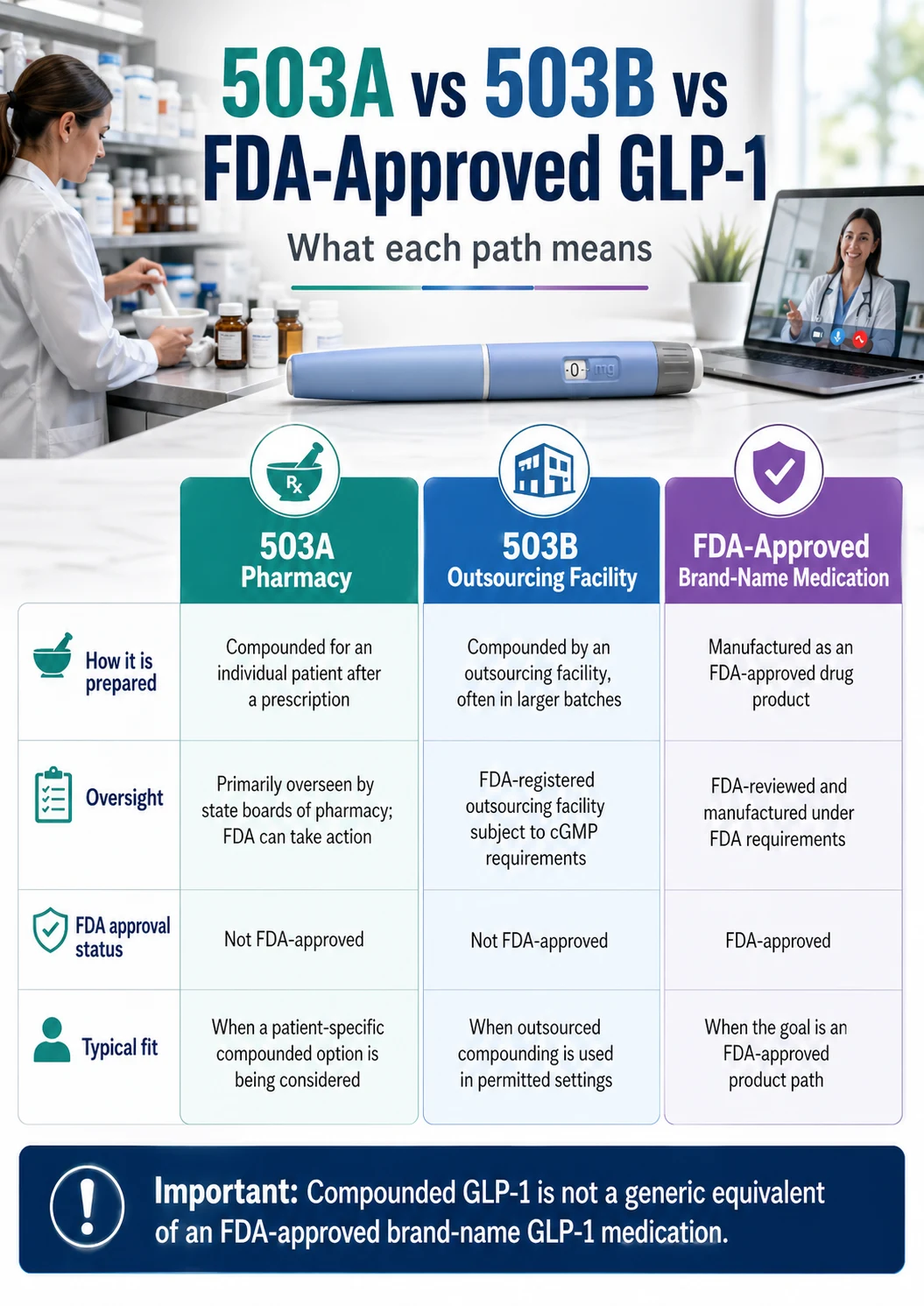
A 503A pharmacy is a state-licensed compounding pharmacy that prepares medications for individual patients based on prescriptions. The “503A” comes from Section 503A of the federal Food, Drug, and Cosmetic Act — the law that carved out a legal pathway for traditional pharmacy compounding back in 1997, then strengthened it after the 2012 New England Compounding Center contamination tragedy that killed 64 people. State boards of pharmacy regulate 503A facilities. The FDA can also act on them, but day-to-day oversight is state-level.
For compounded GLP-1s specifically — semaglutide and tirzepatide — the FDA says that for products that would otherwise be “essentially copies” of commercially available brand-name drugs, the prescriber must determine and document a significant difference for the identified patient. That patient-specific clinical justification is what separates a defensible 503A compounded GLP-1 prescription from one that’s vulnerable to enforcement action.
Three things 503A is not:
- Not FDA-approved. The finished compounded product doesn’t go through FDA review for safety, effectiveness, or quality. Any provider that tells you otherwise is misrepresenting the law.
- Not a generic. Generics are FDA-approved copies of brand-name drugs whose patents have expired. Compounded semaglutide is not a generic Ozempic. Compounded tirzepatide is not a generic Mounjaro. The FDA has issued dozens of warning letters specifically targeting “same active ingredient” and “generic Wegovy” marketing language.
- Not the same as 503B. A 503B outsourcing facility is FDA-registered, follows current Good Manufacturing Practice (cGMP) standards similar to a manufacturer, and can produce larger batches without an individual prescription — but only when the drug is on the FDA shortage list or appears on the 503B Bulks List. Semaglutide and tirzepatide are on neither list as of April 2026, which is why most 503B facilities exited the GLP-1 space.
The honest tradeoff: 503B has stricter manufacturing oversight when it’s allowed to operate. 503A has the patient-specific clinical pathway that survives a resolved drug shortage. For compounded GLP-1s in 2026, 503A is the more durable legal pathway — which is why the compounded telehealth providers worth shortlisting in this category are the ones operating through one or more disclosed 503A pharmacy partners.
What pharmacy language actually proves (and what it doesn’t)
| Provider phrase | What it proves | What it does NOT prove | Verification action |
|---|---|---|---|
| “Licensed pharmacy” | Pharmacy holds a state license | Whether it’s 503A, 503B, or retail; what it actually does | Ask for the pharmacy name |
| “503A pharmacy” | Operates under Section 503A | The pharmacy is named, accredited, or has no warning letters | Look up named pharmacy in FDA database |
| “FDA-registered facility” | The facility filed registration paperwork | The compounded products are FDA-approved | Confirm 503A vs 503B and check status |
| “Third-party tested” | Some testing is performed | Specific tests, frequency, lot coverage, or patient access to results | Request a Certificate of Analysis |
| “USP 797 compliant” | Pharmacy claims to follow sterile-compounding standards | Compliance has been verified by an accreditation body | Ask whether PCAB or ACHC has audited |
This table is the lens. Read every provider’s pharmacy page through it.
Is Compounded GLP-1 From a 503A Pharmacy Still Legal in 2026?
Yes — but the door is narrower than it was, and providers who advertise like it’s still 2024 are headed for a warning letter.
Here’s the timeline that matters:
| Date | Event |
|---|---|
| October 2, 2024 | FDA initially determined the tirzepatide shortage was resolved. |
| December 19, 2024 | FDA re-evaluated and reaffirmed the tirzepatide shortage as resolved. |
| February 18, 2025 | Enforcement-discretion period ended for 503A pharmacies compounding tirzepatide. |
| February 21, 2025 | FDA declared the semaglutide injection shortage resolved. |
| March 19, 2025 | Enforcement-discretion period ended for 503B outsourcing facilities compounding tirzepatide. |
| April 22, 2025 | Enforcement-discretion period ended for 503A pharmacies compounding semaglutide. |
| May 22, 2025 | Enforcement-discretion period ended for 503B outsourcing facilities compounding semaglutide. |
| September 9, 2025 | FDA issued more than 50 warning letters to GLP-1 compounders and telehealth platforms for misleading direct-to-consumer marketing. |
| January 16, 2026 | FDA issued a warning letter to Boothwyn Pharmacy, a 503A facility, for sterility and quality violations on compounded GLP-1 products. |
| February 6, 2026 | FDA announced steps to restrict GLP-1 active pharmaceutical ingredients used in non-FDA-approved compounded products. |
| February 9, 2026 | Novo Nordisk filed patent infringement litigation against Hims & Hers over compounded semaglutide. (Settled and dropped in March 2026 as part of a broader access agreement.) |
| February 20, 2026 | FDA issued warning letter #721455 to MEDVi for misbranding compounded GLP-1 marketing. |
| March 3, 2026 | FDA announced 30 warning letters to telehealth companies for similar violations. |
| April 1, 2026 | FDA published a compliance clarification expressly defining what counts as "essentially a copy" of a commercially available drug. |
That April 1, 2026 clarification is the one that changed how legitimate providers operate now. The FDA said two things that matter to you:
- A 503A pharmacy can’t regularly or in inordinate amounts compound something that’s “essentially a copy” of a commercially available drug. The agency specifically called out semaglutide combined with vitamin B12 — if the strengths are within 10% of the brand product, FDA considers it essentially a copy.
- The FDA stated it does not currently intend to take action against a 503A compounder filling four or fewer prescriptions per calendar month for any one “essentially a copy” formulation. (This is current FDA enforcement intent, not a permanent statutory carve-out.)
Translation: a real 503A operation in 2026 prepares patient-specific medications based on individualized clinical justification — usually one of three documented pathways:
- Documented allergy to an inactive ingredient in the FDA-approved product (e.g., polysorbate 80).
- Dose strength not commercially available — a microdose, a step-up titration strength the brand doesn’t sell, or a custom strength the prescriber documents as clinically necessary.
- Different delivery route — sublingual, oral drops, or dissolvable tablets when the patient cannot self-inject.
If your provider’s intake form took 90 seconds and the output was a generic “personalized formulation,” that’s not the same thing as a clinician documenting a specific clinical reason an FDA-approved drug doesn’t fit your case. We’ll show you how to tell the difference in the verification section below.
Sources: FDA, “FDA clarifies policies for compounders as national GLP-1 supply begins to stabilize” (last updated April 2026); FDA Warning Letters database; Foley & Lardner, “FDA Clarifies Policies for Pharmacy Compounders of GLP-1 Products” (April 2026); Wilson Sonsini, “FDA Sends Warning Letters to More Than 50 GLP-1 Compounders” (October 2025); Reuters, March 2026 Novo Nordisk/Hims & Hers settlement coverage.
Not sure if compounded 503A or FDA-approved is right for your situation?
Take the free GLP-1 path quiz — it takes 60 seconds, no phone number required.
Which GLP-1 Providers That Use 503A Pharmacies Name Their Pharmacy Partners?
Of the major telehealth platforms operating in or adjacent to the 503A compounded GLP-1 lane in April 2026, only a handful publicly identify which pharmacy will fill a patient’s prescription. Among affiliate-eligible providers, Enhance.MD is the one that meets that named-pharmacy bar — it lists three pharmacy partners in its public terms of service. Embody is worth knowing as a low first-month-price cash-pay alternative, but it doesn’t name its dispensing pharmacy publicly, so it belongs in the verify-at-intake group rather than the named-disclosure tier. The rest either stop at “our network of licensed compounding pharmacies” or carry FDA warning letters that disqualify them from a top-tier recommendation on a page about pharmacy compliance.
The matrix below is the one no other comparison article publishes. Every cell is dated, sourced, and reverified periodically.
The 503A GLP-1 Provider Transparency Matrix (April 2026)
| Provider | 503A Disclosure | Named Pharmacy Partner(s) | Pharmacy Type | Key Concerns |
|---|---|---|---|---|
Top transparency Enhance.MD | Public 503A language | Rite-Away Pharmacy (San Antonio, TX), Vios Compounding Pharmacy (Livonia, MI), TruMedsRx (Fairfax, VA) | 503A | No FDA warning letter found in this audit. Enhance.MD’s FAQ does include “same active ingredients” language we’re flagging as a compliance-watch item per FDA guidance. |
Lowest first-month price Embody | Compounded GLP-1 disclosed; explicit 503A pharmacy not named publicly | Not named publicly — confirm at intake | Not verified (confirm 503A status at intake) | Shipped options are compounded, not FDA-approved. Cash-pay (no insurance; HSA/FSA accepted). Confirm dispensing pharmacy and state eligibility during intake. |
| OrderlyMeds (non-affiliate benchmark) | Public 503A language | PerfectRx/PerfectionRx, ProRx, Casa, Pharmacy Hub, SmartPharmaRx | 503A | No specific concern identified |
| Fifty 410 (non-affiliate benchmark) | Public 503A + 503B language | Not named publicly | 503A or 503B | No specific concern identified — confirm which pharmacy type fills your prescription |
| Thrive by Mira (non-affiliate benchmark) | Public language | Strive Pharmacy (state-registered 503A and 503B) | 503A + 503B | Strive is named in active Eli Lilly litigation over compounded tirzepatide |
| Agile Telehealth | Compounded GLP-1 disclosure visible; explicit 503A [needs verification] | Not named publicly | Not verified | Confirm 503A status with support before paying |
| MANÜ Telehealth | Claims 503A pharmacy fulfillment | Not named publicly | 503A (per disclosure) | Marketing language warrants careful review; verify pricing and pharmacy |
| Yucca Health | Licensed pharmacy language only; explicit 503A [needs verification] | Not named | Not verified | Confirm 503A status before paying |
| bmiMD | Licensed State Board compounding facility language; explicit 503A [needs verification] | Not named | Not verified | Confirm 503A status before paying |
| Willow | Licensed compounding pharmacy language; explicit 503A [needs verification] | Not named | Not verified | Named in April 2025 Eli Lilly compounded-tirzepatide litigation; case reportedly dismissed September 2025. Verify current docket status. |
| SHED | Public 503A/503B education in blog content; actual dispensing pharmacy not named in materials we reviewed | Not named in sampled materials | 503A + 503B (per blog) | Confirm dispensing pharmacy before paying |
| MyStart Health | Explicit Section 503A language | Not named publicly | 503A (per disclosure) | FDA Warning Letter MARCS-CMS #714755 (September 9, 2025) for unlawful sale of unapproved and misbranded drugs to U.S. consumers — see disclosure below |
| Direct Meds | Certified U.S. pharmacy language; explicit 503A [needs verification] | Not named | Not verified | FDA Warning Letter (September 9, 2025) for “Same active ingredient as Ozempic and Wegovy” and “Clinically proven ingredients” claims — see disclosure below |
| MEDVi | Pharmacy type not verified in reviewed public materials | Not named publicly | Not verified | FDA Warning Letter #721455 (February 20, 2026) for misbranding — see disclosure below |
Public 503A language means the provider explicitly references Section 503A or 503A-licensed pharmacies in publicly accessible materials — not just “licensed U.S. pharmacy.”
Named Pharmacy Partner(s) means the provider tells you, in writing, which pharmacy will fill your prescription. This is rare. Most providers stop at “our network of licensed compounding pharmacies.”
Key Concerns flags any FDA warning letters, ongoing manufacturer litigation, or disclosure gaps that would change a reasonable reader’s decision. Where we couldn’t independently verify a claim, the cell reads “[needs verification]” instead of guessing. We re-verify every cell in this matrix monthly. If you spot something we got wrong, email editorial@weightlossproviderguide.com — we correct verified errors within five business days.
Enhance.MD
3 named 503A pharmacy partners
Rite-Away · Vios Compounding · TruMedsRx
Public terms-of-service disclosure of all three pharmacy partners — the cleanest pharmacy-disclosure starting point in this audit.
Check Enhance.MD’s named-pharmacy programThe Full Provider Breakdown
1. Enhance.MD — Best for Named Pharmacy Transparency
Why it ranks first: Enhance.MD lists three pharmacy partners by name in its public terms of service: Rite-Away Pharmacy in San Antonio, Texas; Vios Compounding Pharmacy in Livonia, Michigan; and TruMedsRx in Fairfax, Virginia. The terms also state that compounded medications are prepared “in accordance with federal Section 503A guidelines.” That’s two pieces of disclosure — pharmacy names plus the regulatory pathway — that almost no other major telehealth platform provides up front.
The clinical setup matches the disclosure. Enhance.MD operates through three named medical groups (Enhance Wellness PC, EnhanceMD CA PC, and iThriveMD PC) and explicitly states that prescribing decisions rest with independent licensed clinicians, not the platform itself. Pricing tiers are visible (Core, Advanced, Elite) and cancellation/refund language is published, including a 48-hour pharmacy-send window for refund eligibility.
TruMedsRx is the partner that’s easiest to verify independently. It’s a compounding mail-order pharmacy headquartered in Fairfax, Virginia, licensed in 48 states. You can confirm its license through the Virginia Board of Pharmacy public lookup in under a minute.
Best for: readers who want to see their pharmacy partner before paying — not “we use licensed pharmacies” but the actual name. Also a strong fit for anyone who wants a more clinical, lab-guided program feel rather than a fast-checkout consumer experience.
Honest tradeoff (the only damaging admission you’ll see on this page):
Enhance.MD does not have the cheapest entry price in compounded telehealth — its tiered programs run higher than the lowest-friction signup options like Yucca or some other “starter” plans. If your top priority is the absolute lowest first-month price, Embody’s intro pricing — from $99 for the first month of compounded semaglutide injection — will save you money up front. But because Enhance.MD invests in named-pharmacy transparency and three medical groups instead of one prescriber pool, you get something the cheapest options don’t have: a verifiable trail from your prescription to a specific pharmacy you can look up before you pay.
Compliance-watch note (in the spirit of full transparency): Enhance.MD’s FAQ contains “same active ingredients” language describing compounded GLP-1 medications. The FDA has flagged similar phrasing in warning letters to other compounders. We have not seen Enhance.MD receive an FDA letter for this language as of our verification date, but it’s worth knowing the agency’s current posture on that exact wording when you read any provider’s marketing.
If pharmacy disclosure isn’t worth a few extra dollars per month to you, Embody (below) is the lower-cost cash-pay option to compare next — just plan to confirm its dispensing pharmacy at intake.
Check Enhance.MD eligibility & named-pharmacy options2. Embody — Best Low-Cost Cash-Pay Starter
Why it ranks here: Embody is a cash-pay telehealth GLP-1 program built around a low entry price. The Embody Start Program begins at $99 for the first month of compounded semaglutide injection, then $299/month for standard refills; compounded tirzepatide injection starts at $149 for the first month, then $399/month. If you’d rather skip needles entirely, Embody also offers a needle-free GLP-1 gum — the option that sets it apart from most injection-only compounders.
There’s no insurance requirement — Embody is cash-pay and advertises HSA/FSA acceptance. Intake is a fast online flow that a licensed provider reviews, you get 24/7 care-team messaging, and if a provider approves treatment, medication ships to your door.
Where it fits on a 503A page: Embody’s shipped options are compounded semaglutide and tirzepatide — not FDA-approved finished drugs. Embody doesn’t name its dispensing pharmacy in the public materials we reviewed, so treat it as a verify-at-intake provider rather than a named-pharmacy one: ask which pharmacy will fill your prescription, and confirm it’s licensed in your state, before you pay. U.S. availability is broad, but confirm your state during intake.
Best for: cash-pay patients who want the lowest first-month price and a needle-free GLP-1 gum option.
Embody’s shipped compounded GLP-1 options are not FDA-approved finished drugs. A licensed provider determines whether treatment is medically appropriate. Prices, pharmacy availability, shipping timelines, and state eligibility can change and should be confirmed during intake.
Check Embody eligibility & pricing3. Ro Body — The FDA-Approved Off-Ramp
If reading the previous two sections made you uncomfortable, this is where you stop and reroute. Ro Body is the cleanest single-source telehealth path to FDA-approved GLP-1 medication in 2026.
Ro carries a broad FDA-approved GLP-1 menu. As of the verification date at the top of this page, Ro’s pricing page lists:
- Wegovy® pill (semaglutide) — $149 first month, $199–$299 thereafter (cash pay)
- Foundayo™ pill (orforglipron) — $149 first month, $199–$299 thereafter (cash pay; same as LillyDirect® pricing)
- Zepbound® KwikPen (tirzepatide) — $299 first month, $399–$449/month thereafter (cash pay; matches LillyDirect® pricing)
- Wegovy® pen (semaglutide) — $199 first month, $199–$349 thereafter (cash pay)
- Ozempic® (semaglutide) — $900–$1,100/month without insurance, picked up at your pharmacy. Ro notes Ozempic is FDA-approved for type 2 diabetes and “prescribed off-label for weight loss if appropriate.”
- Eligible GLP-1s through insurance: includes Zepbound® pen, Ozempic®, or Wegovy® pen — copays vary by plan.
Membership pricing as of April 2026: Ro Body membership is $39 for the first month, then as low as $74/month with annual prepay, or $149/month month-to-month. Medication is billed separately from the membership — that’s an important distinction Ro states clearly on its pricing page.
The membership comes with two things that matter on insured paths: a free GLP-1 Insurance Coverage Checker and an insurance concierge that handles prior-authorization paperwork. Ro’s insurance concierge can work with many commercial plans. Ro states it currently can’t help coordinate GLP-1 coverage for government insurance plans, with one exception: Federal Employee Health Benefits Program (FEHB) members can join the membership and access the concierge.
Best for:
- Anyone with commercial insurance that might cover Wegovy or Zepbound (run the Coverage Checker first — it’s free)
- Anyone who doesn’t want the regulatory complexity of compounded medication
- Anyone whose clinical situation doesn’t map clearly to one of the 503A justification pathways (allergy, dose strength not commercially available, or alternative delivery route)
- Anyone who simply wants the FDA-reviewed product
You’re not “wasting” the research you did on 503A pharmacies if you choose this path. You’re applying it: you read enough to understand the regulatory tradeoff and decided FDA-approved is worth the price difference.
Ro Body
$39 first month
Then as low as $74/month with annual prepay (medication billed separately)
Free GLP-1 Insurance Coverage Checker. Wegovy, Foundayo, Zepbound, and other branded GLP-1 access.
Check Ro Body’s free GLP-1 Insurance Coverage Checker4. Honest Disclosures: Providers With FDA Warning Letters
Three providers we’d otherwise rank in the affiliate-eligible tier carry active FDA warning letters as of our verification date. We’re disclosing them in plain language because the alternative — leaving them off this page entirely or hiding the regulatory facts — would help us in the short term and hurt you. On a page literally about pharmacy compliance, the warning letters are the story.
MyStart Health — FDA Warning Letter #714755 (September 9, 2025)
The FDA sent MyStart Health, LLC a warning letter on September 9, 2025 (MARCS-CMS #714755), classified under “Unlawful Sale of Unapproved and Misbranded Drugs to United States Consumers Over the Internet (Telehealth).” MyStart was one of more than 50 GLP-1 compounders and telehealth platforms warned in that wave; the agency cited “Generic Ozempic” and “same active ingredients and results” claims as false or misleading.
MyStart’s own current website includes explicit Section 503A disclosure language — meaning the platform discloses the regulatory pathway under which its compounded medications are prepared. We have not verified that the website language flagged in the warning letter has been updated as of our verification date.
If you’re considering MyStart: the all-inclusive monthly pricing model is genuinely useful for some readers. But on a page about pharmacy and FDA compliance, an unresolved warning letter on file plus an unnamed pharmacy partner is more disclosure burden than we can carry as a top-tier recommendation. If you proceed, send the 7-question script (below) to MyStart support before you pay, and ask specifically whether the website language flagged in the warning letter has been corrected.
Direct Meds — FDA Warning Letter (September 9, 2025)
The FDA sent Direct Meds (Bluffdale, Utah) a warning letter on September 9, 2025, citing “Same active ingredient as Ozempic and Wegovy” and “Clinically proven ingredients” claims. Per the FDA, those statements “imply that the products are the same as an FDA-approved product when they are not.”
Direct Meds publishes some of the more aggressive sublingual and injection pricing in the compounded space ($249 sublingual semaglutide; $297 injection). The pricing isn’t the issue. The unresolved warning letter is.
If you specifically want oral or sublingual compounded semaglutide, the verify-before-paying step here matters more than usual. Confirm with Direct Meds support that the website language flagged by the FDA has been corrected, ask which 503A pharmacy fills your specific prescription, and weigh that against starting somewhere with cleaner regulatory standing.
MEDVi — FDA Warning Letter #721455 (February 20, 2026)
On February 20, 2026, the FDA issued warning letter #721455 to MEDVi, LLC. The letter — publicly available through the FDA’s warning-letter database — identified misbranding violations on MEDVi’s website. Specifically, the FDA cited:
- Compounded product labels and website imagery that “suggest MEDVi is the compounder of those drugs when in fact it is not.” Per the letter, those representations are false or misleading.
- Marketing claims including “Same active ingredient as Wegovy® and Ozempic®” and “Same active ingredient as Mounjaro® and Zepbound®” — which the FDA determined imply the products have been FDA-approved or evaluated for safety and effectiveness when they have not.
The FDA letter did not cite contamination, sterility failures, or adverse events tied to MEDVi’s actual medications. It cited misbranding, source-labeling, and “same active ingredient” claims. MEDVi was warned ahead of the broader March 2026 enforcement wave that hit 30 other telehealth companies for similar violations, so the issue isn’t unique to MEDVi.
That said, MEDVi does not publicly name its pharmacy partner in materials we reviewed, and the platform’s prescribing infrastructure (OpenLoop Health) experienced a January 2026 data breach affecting approximately 1.6 million records — a separate privacy issue worth knowing if you’re evaluating their broader operational practices.
If you’re already on MEDVi: the warning letter alone isn’t an emergency. Ask MEDVi support directly for two pieces of information: (1) the name of the pharmacy filling your prescription, and (2) confirmation that the website language flagged in the warning letter has been corrected. Save the response.
If you’re considering MEDVi for the first time: Embody offers compounded semaglutide and tirzepatide in injectable form — plus a needle-free GLP-1 gum option — and carries no FDA warning letter in our review. That’s the simpler default.
We’re not linking to any of these three providers from this page. If you want to evaluate them further, you can find them directly. Our job here is to make sure you have the regulatory information that should inform that decision.
Sources: FDA Warning Letter to Matthew Stern, CEO MyStart Health LLC (#714755, September 9, 2025); FDA Warning Letter to Direct Meds (September 9, 2025); FDA Warning Letter to MEDVi, LLC dba MEDVi (#721455, February 20, 2026); FDA, “FDA Warns 30 Telehealth Companies Against Illegal Marketing of Compounded GLP-1s” (March 3, 2026).
5. The “Verify Before Paying” Tier
These providers use compounding language but didn’t surface explicit, verifiable Section 503A disclosure in materials we sampled, and they don’t carry FDA warning letters in our review. That doesn’t make them illegitimate. It means the verification step is on you before you pay. Use the 7-question script in the next section.
- Yucca Health — strong async, low-friction value path with clear “as low as” pricing and BNPL options like Klarna. Licensed pharmacy language confirmed; explicit 503A status not confirmed in sampled materials. Best fit for value shoppers who’ll send the verification email.
- bmiMD — describes medication as formulated within a licensed State Board of Pharmacy compounding facility, says it works with licensed sterile compounding pharmacies, and discloses that compounded medications are not FDA-approved. Microdose-style positioning. Explicit 503A status not confirmed in sampled materials.
- Willow — flat $299/month positioning, licensed compounding pharmacy language. Explicit 503A status not confirmed. Material context: Willow was named in April 2025 Eli Lilly compounded-tirzepatide litigation; the case was reportedly dismissed in September 2025. Confirm current docket status before relying on this.
- SHED — publishes detailed educational content on 503A vs 503B in its blog, but the specific dispensing pharmacy for an individual prescription wasn’t named in materials we reviewed. Best fit for needle-averse readers if support confirms a 503A partner for your state and formulation.
For all four, the verification approach is the same: send the 7-question script below before checkout. Clean answer? You can proceed. Vague language (“our network of licensed pharmacies”)? You have your answer.
Pharmacies You’ll See Named (and What to Know About Each)
The most common compounding pharmacies that come up in real GLP-1 conversations — Reddit threads, BBB complaint patterns, provider FAQs — are these. Treat this section as a name-recognition primer, not a recommendation list. The pharmacy itself isn’t what you choose; you choose a provider that uses a pharmacy.
- TruMedsRx — Fairfax, Virginia. Licensed in 48 states. Self-described as a 503A compounding mail-order pharmacy serving 85,000+ patients. One of Enhance.MD’s three named partners.
- Vios Compounding Pharmacy — Livonia, Michigan. One of Enhance.MD’s three named partners.
- Rite-Away Pharmacy — San Antonio, Texas. One of Enhance.MD’s three named partners.
- Strive Pharmacy — A 503A compounding pharmacy with notable industry transparency: per its public “Higher Standards” page, Strive describes voluntary PCAB and NABP accreditation, weekly randomized batch testing, a stated ±3% potency variance target (industry standard is ±10%), and a stated 99.9%+ sterility/endotoxin pass rate. Strive is named as Thrive by Mira’s pharmacy partner. Material concern: Eli Lilly filed litigation against Strive Pharmacy related to compounded tirzepatide formulations. The litigation was active as of January 2026 and should be re-checked on the federal docket before relying on Strive as your fulfillment pharmacy.
- PerfectRx/PerfectionRx, ProRx, Casa, Pharmacy Hub, SmartPharmaRx — Named as 503A pharmacy partners by OrderlyMeds in its public FAQ.
- Empower Pharmacy — Operates both 503A and 503B operations. Empower’s GLP-1 page describes 503A PCAB-accredited compounding capability. Empower is a direct pharmacy source rather than a consumer-facing telehealth provider; you’re more likely to see it referenced through a clinical platform than to use it directly.
- Hallandale Pharmacy — Frequently mentioned in Reddit GLP-1 threads and in past partnerships with various telehealth platforms. Operates as a 503A. Material concern: Hallandale received an FDA warning letter in 2020 for sterility violations at a previous facility location. Customer review patterns are mixed.
- Belmar Pharma Solutions — Six facilities in Colorado and Florida, four decades of operating history. Named in pharmacy networks used by some platforms.
- Boothwyn Pharmacy — Received an FDA warning letter on January 16, 2026 for insanitary conditions and strength/quality/purity noncompliance on compounded GLP-1 products. Avoid any platform that names Boothwyn as its current dispensing pharmacy.
If a provider’s support team names a pharmacy you don’t recognize, the verification path is straightforward: search the FDA Warning Letters database, look up the pharmacy on the relevant state board of pharmacy license database, and check the NABP Safe Site Search directory. We walk through the exact steps in the next section.
Run a pharmacy through the 503A verification checklist
Includes the 7-question script and direct links to every government tool below.
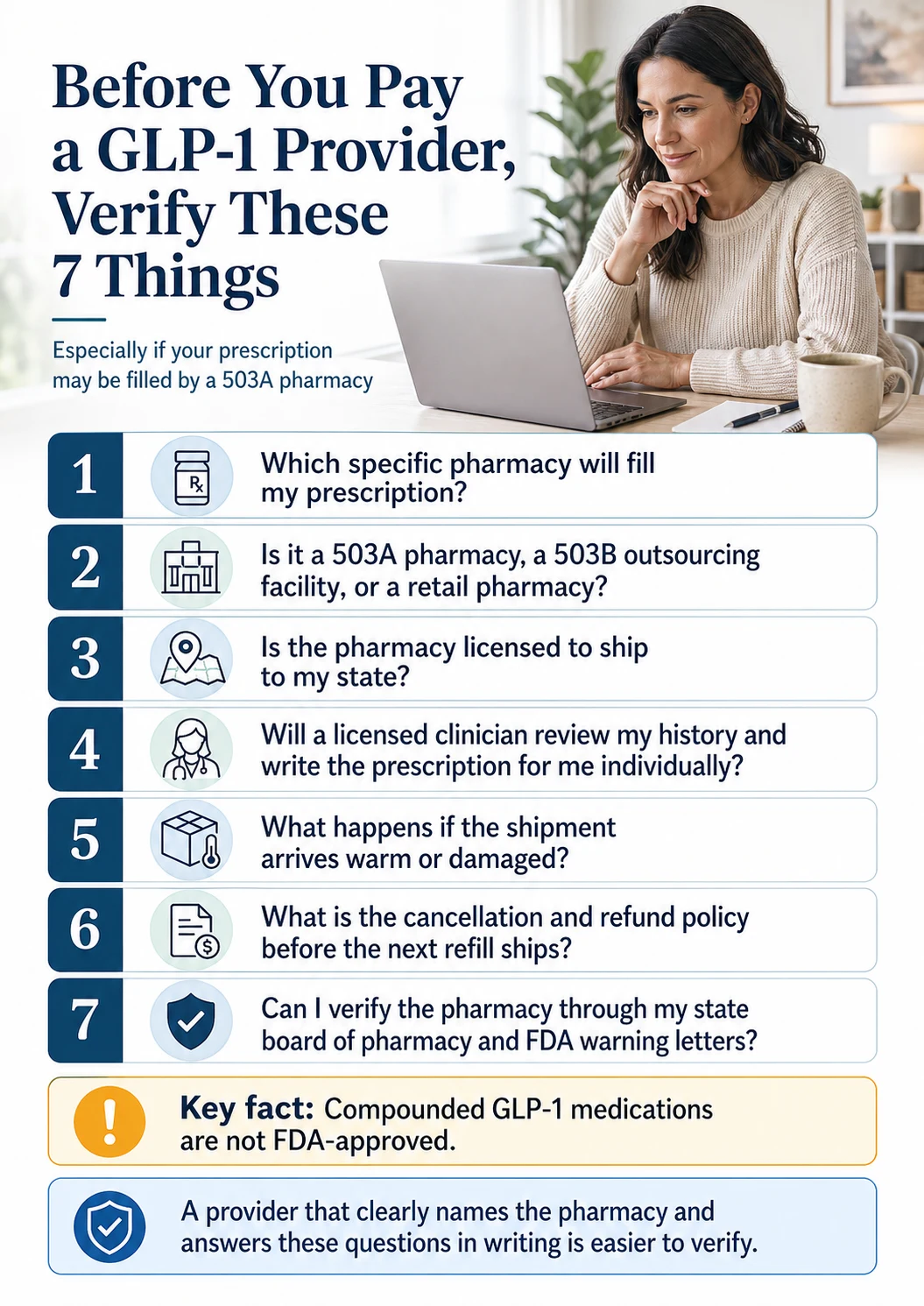
How to Verify a 503A Pharmacy in Five Minutes (the 7-Question Script)
This is the part you save for later. It’s the most useful single asset on this page, and it works for any GLP-1 provider — not just the ones we ranked. Send this exact script to the provider’s support team before you enter payment information. Save the response. If anything ever goes wrong with your prescription, you’ll have written documentation of what was promised at signup.
Subject: Pharmacy and dispensing questions before signup
Hi —
Before I complete enrollment, I want to confirm a few details about how my prescription will be filled. Could you answer the following?
- Which specific pharmacy will dispense my GLP-1 prescription if I’m approved? (Please provide the pharmacy name.)
- Is that pharmacy a 503A compounding pharmacy, a 503B outsourcing facility, or a retail pharmacy?
- What state is the pharmacy licensed in, and is it licensed to ship to my state of residence?
- Can you confirm the pharmacy’s current state board of pharmacy license number so I can verify it independently?
- Will the prescription be written for me individually after a licensed clinician reviews my medical history, or is it fulfilled from a pre-authorized batch?
- What is your policy if my shipment arrives warm or with damaged cold-chain packaging? Do you replace at no charge, and is there a time window for reporting?
- What is the cancellation and refund policy before my next refill ships, and how do I cancel — through the patient portal, by email, or by phone only?
Thanks for confirming these in writing before I sign up.
If the answer comes back with a named pharmacy, a clear 503A or 503B label, a state license number you can verify on a state board of pharmacy lookup, and reasonable replacement and cancellation terms, you’re working with a legitimate operation and you can proceed.
If the answer comes back with vague language like “our network of licensed pharmacies” or “we work with FDA-registered facilities” without specifics, or if the response avoids one or more questions, that is information. You don’t have to draw a hostile conclusion — just acknowledge that you don’t have the disclosure you asked for, and decide whether to proceed without it or switch to a more transparent provider.
The four government and accreditation tools to keep open in browser tabs while you do this:
- FDA Warning Letters database —
fda.gov/inspections-compliance-enforcement-and-criminal-investigations/warning-letters. Search the pharmacy name. If a warning letter exists in the past three years, it’ll surface here. - State Board of Pharmacy License Lookup — every U.S. state maintains one. Search “[state name] board of pharmacy license lookup.” Confirm the pharmacy holds an active, unrestricted license.
- NABP Safe Site Search —
safe.pharmacy/buy-safely/. The National Association of Boards of Pharmacy maintains a directory of accredited online pharmacies (VIPPS) and a “Not Recommended” list of sites that fail their safety standards. - FDA BeSafeRx —
fda.gov/drugs/buying-using-medicine-safely/besaferx-your-source-online-pharmacy-information. The FDA’s consumer-facing guidance for verifying online pharmacy safety, including the warning signs of an illegal operation.
The whole verification takes under five minutes once you know where to look. You only ever have to do this once per provider — if they pass, you’re done. If they fail, you saved yourself $200–$400/month and an unknown amount of regulatory headache.
Get the verification checklist + email scripts
One-page reference, plus pre-filled email templates you can send a provider before checkout. No phone number required.
When 503A Compounded Isn’t Right For You: The FDA-Approved Path
There are specific situations where compounded 503A GLP-1 — even with a great provider and a verified pharmacy — is the wrong choice. We’d rather lose you to a more appropriate path than convert you to a fit you’d reverse later.
Choose an FDA-approved brand-name path if any of these apply:
- You have insurance. Many commercial plans cover branded GLP-1s outright (especially for Type 2 diabetes indications) or cover them after a prior authorization. The cost difference between an insured Wegovy or Zepbound prescription and self-paying $200/month for compounded is usually substantial, and copays vary widely by plan.
- Your clinical situation doesn’t map to a 503A justification pathway. If you have no documented allergy to inactive ingredients, you don’t need a non-commercial dose strength, and you can self-inject — your case doesn’t have a defensible clinical reason to choose compounded over FDA-approved. A provider that approves you anyway is taking on regulatory risk you’ll inherit.
- You want regulatory certainty. Compounded products are not FDA-reviewed. If you don’t want to think about pharmacy partnerships, warning letters, or court rulings, FDA-approved is the path that lets you stop thinking about all of it.
- You’re risk-averse with novel medications. GLP-1s themselves are well-studied at this point, but compounded versions add a second layer of variability (sourcing, sterility, formulation) that the brand product doesn’t carry.
Brand-name options to ask about:
- Wegovy (semaglutide) — FDA-approved for chronic weight management. Available as a pen and a once-daily pill.
- Zepbound (tirzepatide) — FDA-approved for chronic weight management; also has an FDA-approved indication for moderate-to-severe obstructive sleep apnea added in December 2024.
- Foundayo™ (orforglipron) — newer FDA-approved oral GLP-1 for chronic weight management.
- Ozempic (semaglutide) — FDA-approved for Type 2 diabetes; sometimes prescribed off-label for weight loss when clinically appropriate.
- Mounjaro (tirzepatide) — FDA-approved for Type 2 diabetes; may be prescribed off-label for weight management. Note that Mounjaro is not currently available through Ro Body — Zepbound is the tirzepatide brand Ro lists for weight loss.
Ro Body is the program we recommend most often for this lane because of menu breadth and the insurance concierge. As of April 2026: $39 first month, then as low as $74/month with annual prepay or $149/month month-to-month, with medication billed separately. If you’re insurance-eligible, the free GLP-1 Insurance Coverage Checker is the highest-value step you can take before paying for self-pay anything.
For the boxed warning and contraindication details on any FDA-approved GLP-1 — including the warnings for personal or family history of medullary thyroid carcinoma (MTC) or Multiple Endocrine Neoplasia syndrome type 2 (MEN 2) — refer to the FDA prescribing information for the specific product (Wegovy, Zepbound, Foundayo, Ozempic, Mounjaro). A clinician should review your individual risk profile.
Check Ro Body’s free GLP-1 Insurance Coverage CheckerFor FDA-approved telehealth options beyond Ro, see our deeper guide to the best brand-name GLP-1 telehealth providers.
Honest Risks of 503A Compounded GLP-1s
Three categories of risk apply to compounded 503A GLP-1s that don’t apply (or apply less) to FDA-approved brand-name medication. Knowing these isn’t a reason to walk away — it’s a reason to choose carefully.
Risk 1: Regulatory durability.
Your provider’s pharmacy partner could lose its compounding authority. The FDA issued a warning letter to a 503A pharmacy (Boothwyn) on January 16, 2026, and to dozens of telehealth platforms across the September 2025 and March 2026 enforcement waves. Manufacturers are litigating against compounders — Eli Lilly has filed suits against Strive, Empower, Fella, Willow, Henry Meds, and Mochi Health among others. If a pharmacy you depend on gets hit, your provider has to switch you to a different partner mid-treatment. Providers that publicly name their pharmacy partners tend to also communicate transitions transparently. Providers with unnamed networks tend to manage these transitions opaquely.
Risk 2: Product quality.
503A pharmacies don’t follow current Good Manufacturing Practice (cGMP) standards the way FDA-approved manufacturers and 503B outsourcing facilities do. Quality depends on the individual pharmacy’s compliance with USP 795, USP 797, and USP 800 — the United States Pharmacopeia standards governing non-sterile compounding, sterile compounding, and hazardous drug compounding respectively. As of July 31, 2025, the FDA reported 605 adverse-event reports associated with compounded semaglutide and 545 associated with compounded tirzepatide. Eli Lilly published testing of compounded tirzepatide samples showing roughly half had potency below labeled amounts, with some samples containing no tirzepatide at all, plus bacterial contamination, high endotoxin levels, and chemical impurities. On March 12, 2026, Eli Lilly published an open letter describing a previously undocumented chemical impurity that forms when tirzepatide is combined with vitamin B12. None of this means every compounded dose is dangerous. It means the variability is real, and the verification (third-party testing, Certificates of Analysis where available, USP 797 compliance) is what separates a careful operation from an indefensible one.
Risk 3: Clinical justification.
If your provider’s clinical justification for compounding is generic — a 90-second intake form, a checkbox for “individualized formulation” — the prescription itself may not survive enforcement scrutiny. The April 1, 2026 FDA clarification specifically said the significant-difference determination under 503A is “patient-specific and must be made and documented by the prescribing practitioner. Generalized or formulaic significant-difference language may not satisfy FDA’s requirements.” If you ever needed to defend why you were on a compounded medication rather than the FDA-approved equivalent, “the platform’s intake form said it was personalized” is not a strong answer.
Risks that don’t change between brand and compounded. Every GLP-1 user faces the same drug-class side effect profile regardless of source: nausea, vomiting, diarrhea, and constipation are the common ones, dose-dependent. Less common but serious risks include pancreatitis and gallbladder disease. GLP-1 medications carry boxed warnings for personal or family history of MTC or MEN 2 — refer to the FDA prescribing information for any specific product (Wegovy, Zepbound, Foundayo, Ozempic, Mounjaro) for the complete warning, contraindication, and adverse-reaction information. These are class-level concerns, not compounding-specific concerns. Talk to a clinician about your individual risk profile.
Sources: FDA, “FDA’s Concerns with Unapproved GLP-1 Drugs Used for Weight Loss” (cumulative July 31, 2025 adverse-event figures); Eli Lilly published compounded-sample testing summary; Eli Lilly open letter (March 12, 2026); Foley & Lardner, “FDA Clarifies Policies for Pharmacy Compounders of GLP-1 Products” (April 2026); Holland & Knight, “Eli Lilly Strikes Back Against Pharmacy Compounders and Telehealth Platforms” (June 2025).
What We Actually Verified for This Page
We’re putting our work where you can see it. Every claim above traces to one of these sources, accessed on or before the verification date at the top of this page.
Verified from public records (April 29, 2026):
- FDA April 1, 2026 “essentially a copy” clarification language and the four-prescription enforcement intent
- FDA Warning Letter #721455 to MEDVi, dated February 20, 2026 (FDA Warning Letters database)
- FDA Warning Letter #714755 to Matthew Stern, CEO MyStart Health LLC, dated September 9, 2025
- FDA Warning Letter to Direct Meds, dated September 9, 2025
- FDA Warning Letter to Boothwyn Pharmacy, January 16, 2026
- FDA shortage resolution timeline (tirzepatide initially Oct 2, 2024; re-evaluated Dec 19, 2024; semaglutide Feb 21, 2025) and enforcement-discretion deadlines
- Enhance.MD’s named pharmacy partners (Rite-Away, Vios, TruMedsRx) per published terms of service
- OrderlyMeds’ named pharmacy partners (PerfectRx/PerfectionRx, ProRx, Casa, Pharmacy Hub, SmartPharmaRx) per public FAQ
- Strive Pharmacy’s published quality standards (PCAB and NABP voluntary accreditations, weekly batch testing, stated ±3% potency variance, stated 99.9%+ sterility/endotoxin pass rate) per Strive’s public “Higher Standards” page
- Strive Pharmacy named in active Eli Lilly compounded-tirzepatide litigation
- Ro Body’s current pricing structure ($39 first month, as low as $74/month annual prepay, $149/month month-to-month) and FDA-approved menu (Wegovy pill, Foundayo pill, Zepbound KwikPen, Wegovy pen, Ozempic, eligible insurance options) per Ro’s public pricing page
- Ro’s stated government-insurance limitation (with FEHB exception)
- FDA cumulative adverse-event reports for compounded GLP-1 as of July 31, 2025
- Active litigation across Novo Nordisk, Eli Lilly, and Outsourcing Facilities Association court filings; Novo/Hims March 2026 settlement
Not independently verified (stated as provider claims rather than confirmed facts):
- Each provider’s internal clinical-justification documentation process (we report what providers publicly disclose; we cannot inspect intake records)
- Specific dispensing pharmacy for a given state and formulation (this varies — confirm via the 7-question script before paying)
- Real-time supply continuity at any pharmacy partner (changes weekly)
- Whether the website language flagged in MyStart, Direct Meds, or MEDVi warning letters has been corrected as of this verification date
- Each named pharmacy’s current USP 797 sterility test results (request testing documentation from the provider for verification)
- Current Willow litigation docket status (case reportedly dismissed September 2025; verify before relying)
[needs verification] markers anywhere in this page indicate cells we couldn’t independently confirm as of the verification date. We update those on the monthly scan.
Frequently Asked Questions
Are 503A pharmacy GLP-1 medications FDA-approved?
No. 503A is a regulatory pathway for state-licensed compounding pharmacies, not FDA approval for the finished compounded product. The FDA does not review compounded medications for safety, effectiveness, or quality before they reach patients. A provider that markets compounded GLP-1 as "FDA-approved" or implies that status is misrepresenting the law — the FDA has issued warning letters specifically targeting that language.
Is 503A safer than 503B for compounded GLP-1?
Neither is universally safer. 503B outsourcing facilities follow stricter cGMP manufacturing oversight when they're allowed to operate. 503A pharmacies follow state board oversight and rely on USP 795/797/800 compliance. For compounded GLP-1s in 2026, 503A is the more durable legal pathway because semaglutide and tirzepatide are no longer on the FDA shortage list, which removes 503B's legal authority to compound them outside narrow exceptions.
Can a 503A pharmacy still legally compound semaglutide or tirzepatide in 2026?
Yes, under a narrow patient-specific pathway. The compounding must be based on an individual prescription with documented clinical justification — typically a documented allergy to an inactive ingredient in the FDA-approved product, a need for a dose strength not commercially available, or a need for a different delivery route (sublingual or oral). The FDA's April 1, 2026 clarification stated the agency does not currently intend to take action against a 503A compounder filling four or fewer prescriptions per calendar month for any one "essentially a copy" formulation.
Which GLP-1 providers publicly name their 503A pharmacy partners?
As of April 2026, Enhance.MD names three pharmacy partners in its public terms of service: Rite-Away Pharmacy, Vios Compounding Pharmacy, and TruMedsRx. OrderlyMeds names PerfectRx/PerfectionRx, ProRx, Casa, Pharmacy Hub, and SmartPharmaRx in its public FAQ. Thrive by Mira names Strive Pharmacy. Most other providers stop at "our network of licensed compounding pharmacies" without specifics.
Why won't some providers tell me which pharmacy fills my prescription?
Providers cite competitive reasons, supply-chain flexibility, or simply policy preference for not naming partners publicly. The practical impact is that you can't independently verify the pharmacy's licensing, warning-letter status, or quality systems before paying. You can still ask support directly via the 7-question script — even if the provider doesn't publish partner names, customer service may answer when asked individually.
What does "essentially a copy" mean for compounded GLP-1?
It's the FDA's standard for whether a compounded product crosses the line into competing with an FDA-approved drug. Per the April 1, 2026 clarification, a compounded product is "essentially a copy" if it has the same active ingredient(s) as the commercially available drug in the same, similar, or easily substitutable strength. The agency's specific example: a compounded semaglutide + B12 formulation where both ingredients fall within 10% of commercial product strengths. Routine compounding of "essentially a copy" formulations exceeds the four-prescription-per-month enforcement intent the FDA published.
Can I ask a GLP-1 provider for a Certificate of Analysis?
Ask whether a Certificate of Analysis (CoA) or lot-specific testing documentation is available for your medication and what it covers — potency, sterility, endotoxin, or other testing. Some 503A pharmacies will produce a CoA on request through the prescribing telehealth platform; others will not. Don't assume every 503A pharmacy will provide a patient-facing CoA. If a provider can produce one, that's a meaningful disclosure signal. If they can't, ask why.
What happens if my compounded GLP-1 arrives warm or with broken cold-chain packaging?
Don't use it. Contact the pharmacy and the prescriber immediately. The FDA explicitly advises against using injectable compounded GLP-1 products that arrive warm or insufficiently refrigerated — the medications' stability and sterility cannot be assured. A legitimate provider should replace damaged shipments at no charge. Confirm the cold-chain replacement policy in writing before signing up; this is question #6 in the verification script above.
Is there a generic Ozempic, Wegovy, Zepbound, or Mounjaro?
No, and providers cannot legally market compounded products as "generic" versions of FDA-approved drugs. Generics are FDA-approved copies of brand-name medications whose patents have expired and which have gone through the FDA's abbreviated new drug application process. Compounded semaglutide and compounded tirzepatide are neither FDA-approved nor generics. The FDA has issued multiple warning letters in 2025 and 2026 specifically targeting "generic Ozempic," "generic Wegovy," and "same active ingredient" marketing language.
What's the cheapest legitimate 503A compounded GLP-1 program in April 2026?
Pricing varies and changes frequently. Several cash-pay programs lead with low first-month intro pricing — Embody, for example, starts at $99 for the first month of compounded semaglutide injection, though standard refills run higher (around $299/month). Cheapest is rarely the same as best fit. Pharmacy disclosure quality, warning-letter status, clinical justification pathway, cancellation policy, and your specific situation should weigh more heavily than $30–$50 a month. Verify current pricing on each provider's site at signup.
What happens to my treatment if my provider's pharmacy partner gets a warning letter?
In most cases, the provider switches you to a different pharmacy partner. Continuity depends on how quickly the platform can route your prescription to a compliant facility and how transparent they are about the change. Providers that publicly name their partners typically also communicate transitions clearly. Providers with unnamed networks tend to manage these changes opaquely. The protective move is to subscribe to a provider whose partners you can name and look up before you ever need to.
Is the 503A pathway for GLP-1 going to disappear?
A complete shutdown is unlikely. Patient-specific 503A compounding for individual clinical needs is protected under federal law and survives a resolved drug shortage. What's narrowing is the mass-market 503A model — telehealth platforms compounding "essentially a copy" formulations for anyone who fills out an intake form. The FDA, manufacturers, and courts have steadily narrowed that market through 2025 and 2026. The legitimate clinical-need case for 503A compounded GLP-1 — documented allergies, non-commercial dose strengths, alternative delivery routes — remains intact.
Bottom Line: Which 503A GLP-1 Provider Should You Start With?
If you’ve read this far, you’re not the reader who needs to be sold. You’re the reader who needs the right answer.
- Start with Enhance.MD if your top priority is named pharmacy partner transparency. They list three 503A pharmacies in their terms of service, which is more disclosure than any other affiliate-eligible compounded platform offers.
- Start with Embody if you want the lowest first-month price on a cash-pay compounded program — from $99 for the first month of semaglutide injection (then $299/month) — or a needle-free GLP-1 gum option. Confirm its dispensing pharmacy and your state at intake.
- Start with Ro Body if compounded medication’s regulatory uncertainty isn’t worth the cost difference for you. $39 first month, then as low as $74/month with annual prepay (medication billed separately), with FDA-approved Wegovy, Foundayo, Zepbound, and other branded options — and an insurance concierge that may save you most of your medication cost if you’re covered.
- Take the matching quiz if you genuinely don’t know which lane fits — compounded vs. FDA-approved, injectable vs. oral, insurance vs. self-pay. The quiz takes 60 seconds and routes you to a specific recommendation. We don’t ask for a phone number and we don’t sell anything except your own clarity.
Whatever you choose, do the verification step before you pay. The 7-question script is the most useful five minutes you’ll spend in this entire research process. Save it. Use it on every provider, including the ones we recommended. We’d rather you trust our process than trust us blindly.
Your next-step options:
For named-pharmacy transparency · for the lowest first-month price · for FDA-approved instead.
Still not sure which GLP-1 program is right for you?
No phone number. No spam. Just a 60-second matching quiz that routes you to a specific recommendation.
About This Page
Published by: Weight Loss Provider Guide — an independent comparison resource for GLP-1 telehealth providers.
How we built this: Every claim in this article traces to a public record we link to. Pharmacy partner names come from each provider’s own publicly accessible materials (terms of service, FAQ, blog posts). Regulatory record cells are sourced from the FDA Warning Letters database, state board of pharmacy databases, and published industry analyses (Foley & Lardner, Spencer Fane, Buchanan Ingersoll, Frier Levitt, Pharmacy Times, Wilson Sonsini, Holland & Knight). Where we couldn’t independently verify a claim, the cell reads “Not publicly disclosed” or “[needs verification].”
Why we built this: We earn affiliate revenue from some of the providers listed (specifically Enhance.MD, Embody, and Ro Body). We disclose this openly. The matrix order is determined by the quality of public 503A pharmacy disclosure for this specific search term — not by commission rate. Our incentive is to be more accurate than the providers’ marketing, because that’s what makes this page useful enough that you trust the next one we publish.
What we did not do: We did not invent author credentials. We did not fabricate testimonials or attributions. We did not add medical reviewer attribution we don’t have the authority to claim. We did not assert “same active ingredient” or “clinically proven” for any compounded medication. We did not feature any provider with an active FDA warning letter as a top recommendation, even when our default affiliate priority list would otherwise include them — three providers (MyStart Health, Direct Meds, MEDVi) sit in the honest-disclosure section instead of the recommended-tier for that reason.
Found an error? Email editorial@weightlossproviderguide.com and we will correct verified errors within five business days. Persistent uncorrected errors hurt us more than they hurt you. We don’t argue with verified facts.
Update approach: FDA warning-letter database scans, pharmacy partner verification on each provider’s public materials, and pricing rechecks, with the verification date below updated when a check is completed. Triggered same-week updates for major regulatory announcements, court rulings, or news events.
Last verified: April 29, 2026
Sources
- U.S. Food and Drug Administration. "FDA clarifies policies for compounders as national GLP-1 supply begins to stabilize." Updated April 2026.
- U.S. Food and Drug Administration. "FDA's Concerns with Unapproved GLP-1 Drugs Used for Weight Loss."
- U.S. Food and Drug Administration. Warning Letter #721455 to MEDVi, LLC dba MEDVi, February 20, 2026.
- U.S. Food and Drug Administration. Warning Letter #714755 to Matthew Stern, CEO MyStart Health LLC, September 9, 2025.
- U.S. Food and Drug Administration. Warning Letter to Direct Meds, September 9, 2025.
- U.S. Food and Drug Administration. "FDA Warns 30 Telehealth Companies Against Illegal Marketing of Compounded GLP-1s." March 3, 2026.
- U.S. Food and Drug Administration. "BeSafeRx: Your Source for Online Pharmacy Information."
- National Association of Boards of Pharmacy. "Find Safe Online Pharmacies." safe.pharmacy
- Foley & Lardner. "FDA Clarifies Policies for Pharmacy Compounders of GLP-1 Products." April 2026.
- Spencer Fane. "FDA and Novo Nordisk Warn of GLP-1 Telehealth Compounding Take Down — What's Next?" February 2026.
- Wilson Sonsini. "FDA Sends Warning Letters to More Than 50 GLP-1 Compounders and Manufacturers." October 2025.
- Pharmacy Times. "FDA and Novo Nordisk Warned of GLP-1 Telehealth Compounding Takedown. What's Next?" 2026.
- Holland & Knight. "Eli Lilly Strikes Back Against Pharmacy Compounders and Telehealth Platforms." June 2025.
- Buchanan Ingersoll & Rooney PC. "Oral Semaglutide and the GLP-1 Compounding Reckoning." February 2026.
- Frier Levitt. "The Return of 503B Compounding of GLP-1 Medications." January 2026.
- Alliance for Pharmacy Compounding. "Compliance alert: 503Bs and GLP-1 compounding." 2025.
- Strive Pharmacy. "Higher Standards." strivepharmacy.com/higher-standards
- Ro. "Weight Loss Program Pricing." ro.co/weight-loss/pricing
- Reuters. "Novo Nordisk and Hims & Hers reach agreement; lawsuit dropped." March 2026.
- Enhance.MD. Terms of Service (named pharmacy partners).
This page is informational and does not constitute medical advice. GLP-1 medications require evaluation by a licensed clinician. We are not a medical practice, a pharmacy, or a manufacturer. Talk to a qualified healthcare provider before starting, stopping, or changing any medication.