Don't Qualify for Zepbound? Now What [2026]
By the Weight Loss Provider Guide Editorial Team · Last verified: August 28, 2026 · Next price check: September 1, 2026 · Next formulary check: October 1, 2026
We may earn a commission if you start with some providers linked on this page. LillyDirect, NovoCare, and CMS are not affiliates. Compounded GLP-1 products are not FDA-approved finished drugs. This page is not medical advice.
If you're asking, “I don't qualify for Zepbound—now what?”, the first thing to figure out is who told you no — because six different systems can say those exact words, and they mean six completely different things.
Only a clinical safety no is a true stop sign.
A doctor saying no can be a health decision. An insurance company saying no is a contract decision. A savings card saying no is a program-rule decision. Medicare saying no might mean the wrong device was written on your prescription. These are not the same problem, and they don't have the same fix.
Here's the part almost nobody tells you: brand-name Zepbound can start at $299 per 28-day fill under Lilly's current self-pay offer. The regular price can be higher, and the offer has rules. The Medicare GLP-1 Bridge opened a $50-per-fill door for eligible Part D beneficiaries on July 1. And if CVS Caremark handles your prescriptions, October 1 may change the answer—but only if your plan sponsor adopts the formulary change and covers weight-management drugs.
But there's one version of "no" you should never try to get around, and we'll show you how to spot it.
Start here: find your line in the table below.
| Who said no | What it usually means | Your first move |
|---|---|---|
| Your doctor or nurse practitioner | A health or safety decision | Ask for the exact reason. Don't go shopping. |
| Your insurance company | A contract decision, not a medical finding | Get the exact wording in writing. |
| The pharmacy or savings card | A program rule was missed | Check whether the self-pay route is open to you. |
| Medicare | It can be the wrong device, wrong route, or missing criterion | Check KwikPen vs. vial or pen, and Bridge vs. Part D. |
| An online weight-loss site | Could be a service limit, or it could be safety | Ask which one it was. |
| You're honestly not sure | Very common | Use the six-gate table below. |
Best for: Anyone who got turned down for Zepbound and can't tell whether it was medical, insurance, or paperwork.
Not for: Anyone hunting for a company that will ignore a safety warning their doctor gave them. We're not going to help with that, and you'll understand why by the end of this page.
Key numbers: Under Lilly's current self-pay offer, brand Zepbound starts at $299 per 28-day fill and reaches $449 when the higher-dose refill rule is met; regular prices can reach $699. Eligible Medicare Part D members in eligible plan types pay $50 per monthly fill through the Bridge. At the 2.5 mg starting dose, choosing the KwikPen instead of the noncovered single-dose pen can change the current price by $200 per fill.
Why trust this page
We're Weight Loss Provider Guide — an independent comparison resource for GLP-1 telehealth providers. We don't sell medicine and we're not an insurance company.
For this page, we read the things most articles only link to: Eli Lilly's own pricing terms on the doctor-facing side of its site, Medicare's official rulebook for its new program, and six real published denial rulings from state hearings where people fought a Zepbound “no” and a hearing officer wrote down exactly what happened.
That last one is where the most useful finding on this page came from. We'll get there.
Don't Qualify for Zepbound? Now What Should You Do First?
Six separate systems can tell you that you "don't qualify" for Zepbound: the FDA-approved label, your prescriber's safety judgment, your insurance plan, Eli Lilly's payment programs, the Medicare GLP-1 Bridge, and an individual telehealth company. Each one is answering a different question, and a "no" from one does not mean a "no" from the others. Identifying which one stopped you determines every step that follows.
This is the part page-one articles skip. They treat "qualify" like one test you either pass or fail. It isn't. It's six gates, and you only need to get through the ones that apply to you.
Here's the full board.
The six gates
| # | Gate | Who decides | What it's really asking | Is it a safety call? | Usually fixable? | What it does not mean |
|---|---|---|---|---|---|---|
| 1 | The FDA label | Your prescriber, reading the approved uses | Does your situation fall inside an FDA-approved use? | Not by itself | Sometimes | That no treatment for weight is available. |
| 2 | Your prescriber's judgment | Your doctor or NP | Is this drug safe for you specifically? | Yes | Depends — ask | That the reason is your weight. |
| 3 | Your insurance plan | The plan or its pharmacy manager | Will we pay under our current rules? | No | Often | That you're not medically eligible. |
| 4 | Lilly's payment programs | The savings-card processor or LillyDirect | Does this fill meet our program terms? | No | Usually | That you can't get the drug. |
| 5 | The Medicare GLP-1 Bridge | Medicare's central processor | Do you meet this program's rules? | No | Sometimes | That Medicare will never cover it. |
| 6 | One telehealth company | The platform plus its clinician | Can we legally and safely serve you? | Sometimes | Depends — ask | That the reason was necessarily medical. |
Read that last column again. That's the one that keeps people from giving up.
How to tell which gate stopped you
Look at where the message came from.
- A letter or app message from your insurance company? Gate 3.
- A message from the pharmacy or a card that got declined at the counter? Gate 4.
- Your doctor said it in the room, or in a portal message? Gate 1 or 2.
- A Medicare letter, or a pharmacy saying "not eligible for the Bridge"? Gate 5.
- An online form that ended with "we can't treat you"? Gate 6.
Still not sure? The message usually names the sender near the top. If it doesn't, call the number on your insurance card and ask one question: “Was this a coverage decision or a clinical decision?” Ask for the answer in writing.
What the exact words on your denial mean
The specific phrase used in a Zepbound denial determines the correct response. “Missing documentation” is a paperwork problem that can often be corrected. “Not a covered benefit” is a contract exclusion that a standard prior-authorization appeal usually cannot rewrite. “Contraindicated” is a safety decision that should not be worked around. Reading the exact wording before acting prevents weeks of effort spent on the wrong process.
Don't summarize your letter as "denied." The exact words are the instructions.
| What it says | Which gate | What it means in plain English | Is it final? | Ask this |
|---|---|---|---|---|
| “Prior authorization required” | Insurance | Nobody said no yet. They want a review first. | Not a denial at all | “What form and criteria apply to my plan?” |
| “Criteria not met” | Insurance or Medicare | The request did not show one or more required rules. | Often fixable | “Which criterion failed, and what number or record did you use?” |
| “Missing” or “insufficient documentation” | Insurance | The file did not contain everything the reviewer required. | Often fixable | “What exactly was missing?” |
| “Not a covered benefit” or “weight-loss drugs are excluded” | Insurance | The plan excludes this benefit or drug category. | Usually a hard wall for a standard PA | “Is there a benefit exception, a separate covered indication, or an employer GLP-1 program?” |
| “Step therapy required” | Insurance | Try a preferred drug first, unless an exception applies. | It's a to-do list, not a verdict | “Which drug, how long, and what counts as failure or intolerance?” |
| “Non-formulary” | Insurance | It isn't on the preferred list. Different from excluded. | Often fixable | “Can my doctor file a formulary exception?” |
| “Current BMI does not qualify” | Insurance or Medicare | A continuation request may have been treated as a new start. | Depends | “Did you use my starting BMI or today's?” |
| “Savings card not eligible” | Lilly program | A program rule was not met. This is not medical. | Not medical at all | “Does a LillyDirect self-pay offer apply to my device and dose?” |
| “Not eligible for the Medicare Bridge” | Medicare | It can be the wrong device, route, plan type, sequence, or criterion. | Sometimes fixable | “Was the KwikPen prescribed? Did the pharmacy submit the claim first?” |
| “We're unable to treat you” | Telehealth site | Could be a service limit. Could be safety. Two very different things. | Depends entirely | “Was that a service rule or a medical decision?” |
| “Contraindicated” | Your prescriber | A real safety conflict. | Treat this as a stop sign | “What exactly, and is it permanent?” |
Write your phrase down. Circle which gate it belongs to. That's your whole map.
🔍 Before you fight anything, find out what your plan actually says
Most people appeal before they know what their plan covers. That's backwards — and it costs weeks.
Ro runs a free GLP-1 insurance coverage check. You don't need a paid membership or a payment card. You do need your insurance-card details and an email so Ro can send the report.
Fair warning so you're not surprised: the checker covers the Ozempic pen, Wegovy pen, and Zepbound single-dose pen. It doesn't check the Zepbound vial, KwikPen, Wegovy pill, or Foundayo. Still, it answers the first question you need answered.
→ Check what my plan says about Zepbound — free coverage report
Sponsored affiliate link. No paid membership is needed for the check. Insurance information and an email are required.
The $200 mistake: which Zepbound is on your prescription?
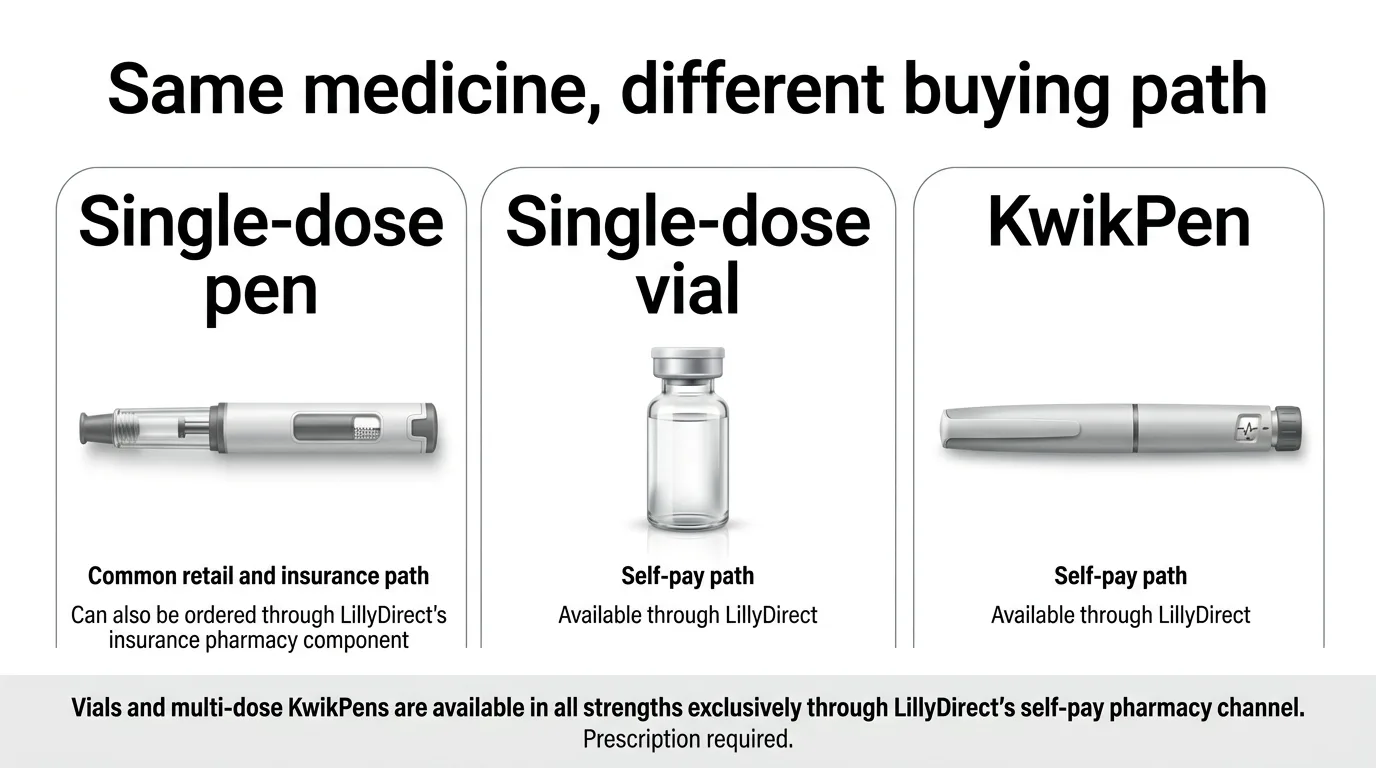
Zepbound comes in three devices: a single-dose pen, a single-dose vial, and the multi-dose KwikPen. They contain the same FDA-approved active drug in the same dose strengths, but the devices, instructions, payment routes, and supplies differ. Under Lilly's current offers, a commercially insured person whose plan does not cover Zepbound can pay $499 for the single-dose pen, while the KwikPen starts at $299 and reaches $449 when the higher-dose refill rule is met. The KwikPen is also the only Zepbound formulation covered under the Medicare GLP-1 Bridge.
This is the finding we'd most want you to walk away with.
We pulled it from Eli Lilly's own terms — the version on the doctor-facing part of their site, which patients almost never see. Here's the whole board on one screen.
Same drug. Three devices. Very different prices.
| Payment route | Single-dose pen | Single-dose vial | KwikPen (multi-dose) |
|---|---|---|---|
| Eligible commercial plan covers it | As low as $25 per fill with the savings card; terms and limits apply | LillyDirect self-pay route, not the commercial covered-card track shown here | Not the covered-card track shown here |
| Commercial plan doesn't cover it | $499 per fill under the current noncovered savings-card offer | Current LillyDirect self-pay offer: $299 / $399 / $449 by dose | Current LillyDirect self-pay offer: $299 / $399 / $449 by dose |
| No insurance | Not the self-pay route shown by Lilly | Current LillyDirect self-pay offer: $299 / $399 / $449 by dose | Current LillyDirect self-pay offer: $299 / $399 / $449 by dose |
| Medicare GLP-1 Bridge | ❌ Not covered | ❌ Not covered | ✅ $50 per monthly fill — the only Zepbound device covered |
| Current annual offer limit | Up to 13 fills | Check the current LillyDirect terms | Up to 11 fills |
| Separate injection supply | No separate needle: it is built into the single-dose pen | Syringe and needle required | Pen needle required |
What the current self-pay offer costs: $299 for 2.5 mg. $399 for 5 mg. $449 for 7.5, 10, 12.5, and 15 mg when the higher-dose refill rule is met. These are offer prices, not guaranteed permanent prices. Taxes and fees may apply.
One month means 28 days — four vials, or one KwikPen. Not a calendar month.
Read that again if you have commercial insurance
Two people. Same plan. Same denial. Same dose.
One was handed a prescription for the single-dose pen. At the 2.5 mg starting dose, she pays $499 per fill under the current noncovered commercial offer.
The other was handed a KwikPen prescription. At 2.5 mg, he pays $299 per fill under the current self-pay offer.
That's the clean $200 gap. At higher doses, the gap changes. The fix starts with one message to the doctor's office.
The 45-day rule that catches people
On 7.5 mg and up, that $449 price only holds if you refill within 45 days of when your last one arrived.
Miss it and the price jumps to $499 for 7.5 mg, or $699 for 10, 12.5, and 15 mg.
Set a phone reminder for day 35. That's it. That's the whole trick.
Four honest limits we're not going to bury
We'd rather you hear these from us than find out at the pharmacy counter.
1. The KwikPen offer allows up to 11 fills under the current annual terms. A full year contains about 13 separate 28-day fill cycles. So 11 fills do not cover every 28-day cycle in a full year. Your exact gap depends on when you start, and the current terms expire December 31, 2026. Plan for it.
2. Lilly's commercial savings cards exclude government-funded plans. The current terms list Medicare, Medicare Part D, Medicare Advantage, Medigap, Medicaid, TRICARE, VA, DoD, and state drug-assistance programs. Skip to the Medicare section below if that is your coverage — you may have a separate $50 door.
3. If your employer uses an "alternate funding" vendor, you're blocked. That's a company some employers hire to push you into manufacturer assistance before the plan pays anything. Lilly's terms specifically bar those members from the card. If HR has ever told you to apply for a drug assistance program before your plan would cover something, ask if this applies to you.
4. Supplies depend on the device. The single-dose pen has its own built-in needle. The vial needs a syringe and needle. The KwikPen needs a separate pen needle, including under Medicare's Bridge. Budget for only the supply your device uses.
The one message that might save you $200
Send this through your doctor's portal:
"My insurance won't cover Zepbound and I'm paying cash. Could you send the prescription as the Zepbound KwikPen through LillyDirect instead of the single-dose pen? The self-pay price is lower on the KwikPen."
That's it. It gives the office a clear, specific request.
💊 The cheapest path, and we make nothing from it
If you already have a prescription and you only want the medicine, go to LillyDirect. Under the current offer, the medicine is $299 to $449 per 28-day fill when its rules are met. There is no telehealth membership fee, and we earn nothing when you use it. Needles or syringes may be separate, depending on the device.
If you don't have a prescription yet, or you want someone handling the insurance side while you start, Ro sells the same KwikPen at the same Lilly price — $299 to $449 — and wraps a clinician and an insurance team around it. Membership is $39 the first month, then $149, or as low as $74 a month if you pay for the year up front.
→ See Ro's current Zepbound prices and what's included
Sponsored affiliate link. Medication is billed separately from membership.
What BMI do you actually need for Zepbound?
Zepbound's FDA-approved label covers adults with obesity, or adults with overweight plus at least one weight-related condition — commonly described as a BMI of 30 or higher, or 27 or higher with a qualifying condition. Insurance plans may set stricter rules on top of that, and the Medicare GLP-1 Bridge uses a different set of criteria entirely. There is no single BMI number that applies across all three.
Three rulebooks. They don't agree. Here's exactly where they split.
| Your situation | FDA label | Commercial plan | Medicare Bridge |
|---|---|---|---|
| BMI 35, nothing else | ✅ Inside the adult weight-management indication | Check the plan's current criteria | ✅ Meets the Bridge BMI-only path if all other program rules apply |
| BMI 32, no other condition | ✅ Inside the adult weight-management indication | Check the plan's current criteria | ❌ Does not meet a Bridge path by BMI alone |
| BMI 30 + high blood pressure | ✅ Inside the indication | The plan may use its own condition and step rules | ⚠️ Only if the Bridge's uncontrolled hypertension rule is met: above 140/90 despite two blood-pressure medicines |
| BMI 28 + prediabetes | ✅ Inside the indication | Depends on the plan's condition list | ✅ Meets a listed Bridge path if all other rules apply |
| BMI 28 + high cholesterol | ✅ Inside the indication | Depends on the plan's condition list | ❌ High cholesterol is not on the Bridge list |
| Haven't tried other drugs yet | ✅ The FDA label does not require step therapy | ⚠️ A plan can require step therapy | ✅ The Bridge criteria do not list step therapy |
| Which BMI counts | Current adult indication | New-start and continuation rules vary by plan | BMI at the time GLP-1 therapy was started |
Look at row two. A person with a BMI of 32 and no other health conditions falls inside the FDA-approved adult weight-management indication — and does not qualify for the Medicare Bridge by BMI alone. A commercial plan can still add its own rules. That's why “I meet the FDA criteria” doesn't settle payment by itself.
Which conditions count
If your BMI is between 27 and 29.9, one documented weight-related condition can put you inside the FDA-approved adult indication. The label does not give one closed list. Its clinical-study examples include:
- High blood pressure
- High cholesterol (dyslipidemia)
- Obstructive sleep apnea
- Cardiovascular disease
The weight-management trials also included adults with type 2 diabetes. Plans can use their own condition lists, so ask for the exact list that applies to your request rather than assuming the FDA examples are the plan's full list.
Here's the part worth acting on: a condition can be real and still be missing from the file sent to the plan. You may have mentioned high blood pressure years ago and never had it coded in the records used for the request. Ask your doctor's office to check what was actually submitted. That one question can fix a missing-record denial without a long appeal.
If a doctor said no for a safety reason, please stop here
A prescriber's decision that Zepbound is unsafe for a specific patient is different from an insurance denial and should not be worked around by applying to another company. Zepbound's label has two contraindication bullets covering three situations: a personal or family history of medullary thyroid carcinoma, multiple endocrine neoplasia syndrome type 2, and a known serious allergic reaction to tirzepatide or any ingredient. Other conditions appear as warnings or “not recommended” situations that require individual clinical judgment rather than an insurance workaround.
We're an affiliate site. We make money when people start with a provider. So understand that this section costs us money, and we're writing it anyway.
If your doctor said Zepbound isn't safe for you, do not go find a website that will say yes. That's the one version of "no" on this page that you should take seriously and leave alone.
What's an actual hard stop
Zepbound's label covers three hard-stop situations in two contraindication bullets:
- You or someone in your family had medullary thyroid carcinoma — a specific, uncommon type of thyroid cancer
- You have MEN 2 — a rare inherited condition
- You had a serious allergic reaction to tirzepatide or something in the shot
What's not automatically a hard stop
This trips people up constantly. The label uses careful language, and the difference matters:
- Severe gastroparesis (stomach that empties too slowly): the label says Zepbound is "not recommended." That is not the same as contraindicated. It's a judgment call your doctor makes about you.
- Pregnancy: the label says to stop the medicine when pregnancy is recognized.
- A history of pancreatitis, gallbladder trouble, kidney issues, or eye problems from diabetes: these details belong in the safety review. They are not all label contraindications, but they can change a prescriber's decision.
One important note on thyroid history: the label bars medullary thyroid cancer specifically. Intake forms often just ask "thyroid cancer." Those aren't the same thing. If you have thyroid cancer in your family, get the type from your relative and give it to a doctor. Don't decide on your own either way.
Ask these seven questions instead
Send them to your prescriber. Copy and paste:
- What exactly caused this decision?
- Is it a listed contraindication, a warning, or your clinical judgment?
- Would it apply to other GLP-1 medicines too, or just this one?
- Is there a test or record that would clarify it?
- Is this permanent, or could it change?
- What options would you consider instead?
- What symptoms should send me to urgent care?
A second opinion is reasonable when the reason is unclear or complex. It is not reasonable as a way to find someone who'll click past a known danger.
Does an insurance denial mean you're not medically eligible?
No. An insurance denial is a statement that the plan will not pay under its current rules. It is not a medical finding. In the six Massachusetts public hearing records reviewed for this page, step therapy and missing records appeared again and again. That sample shows how denials happen; it is not a national Zepbound-denial rate.
We wanted to know what actually gets people denied. Not what articles say. What happens.
So we pulled published rulings from Massachusetts fair hearings — public records where someone fought a Zepbound denial and a hearing officer wrote down the exact reasoning. Here's what six of them show.
The Denial Docket
| Case | BMI shown in ruling | What the plan said | The blocker shown in the record | Result |
|---|---|---|---|---|
| 2511025 | 28.3 | The request did not show BMI 30 or higher or a documented associated illness | She had already been on Wegovy, was switched to Zepbound, and the continuation request was handled under new-start rules | Denied |
| 2410692 | 29 | BMI above 27 with sleep apnea and at least three months of semaglutide were required | He had the qualifying condition. Step therapy still blocked him | Denied — and the semaglutide rule was later removed from the drug list |
| 2511707 | About 38 | The record did not show enough reason to skip a phentermine trial | BMI about 38 and still denied. The required step, not the weight alone, controlled the result | Upheld |
| 2506857 | Criteria met | Phentermine was preferred; the file had to show why it could not be taken or a poor response after three months | Required step and documentation | Denied |
| 2516116 | Not stated | A policy required patients with diabetes and obesity to try Mounjaro first | The same active drug under a different brand was the required step | Policy example; not used as an outcome count |
| 2505725 | Not stated in the summary used here | The drug was not covered, and the record did not establish cardiovascular disease | Benefit/formulary rule plus missing clinical records | Denied |
Massachusetts Medicaid fair hearing decisions, public record. These show patterns, not national statistics.
Three things this tells you
One: BMI alone was not the whole story in several rulings. One person was denied at a BMI around 38 because a preferred-drug step was still required. Another was denied at 28.3 after prior treatment had already lowered her weight.
Two: step therapy and records were recurring gatekeepers in this small sample. Several cases turned on a required trial, a missing condition, or the way a continuation request was filed. Not every case was fixable, and this sample cannot tell us how common each reason is nationwide.
Three — and this is the one to remember: rules change, and denials don't update themselves. In case 2410692, the hearing officer noted in a footnote that between the denial and the hearing, the plan removed the semaglutide requirement from its drug list.
The rule that denied him no longer existed by the time anyone reviewed it.
So check the date on your denial against your plan's current criteria. Ask: "Has this policy been updated since my denial date?" It's a short question, and sometimes the answer changes the whole fight.
How often do appeals actually work?
Honest answer: there is no public national Zepbound appeal rate.
Two broad datasets get close, and neither answers the drug-specific question:
| Closest current dataset | What it found | Why it does not answer a Zepbound appeal |
|---|---|---|
| 2025 standard prior authorizations, reported by large insurers and analyzed by KFF in August 2026 | Of appealed denials, 43% were overturned in the federally facilitated ACA Marketplace, 47% in Medicaid managed care, and 67% in Medicare Advantage | The federal reporting excludes prescription drugs and combines all other medical items and services. |
| 2024 HealthCare.gov post-service claims, analyzed by KFF in March 2026 | Insurers overturned about 34% of internal appeals, and fewer than 1% of denied in-network claims were appealed | It combines medical and prescription-drug claims after service and excludes prior-authorization requests. |
The first dataset is about prior authorization but not drugs. The second includes prescription-drug claims but not prior authorization. Neither can tell you your odds on a Zepbound request.
That fewer-than-1% number is still the real story: almost nobody in that post-service dataset challenged the denial.
Be careful with any page promising a 43%, 67%, 80%, or any other universal success rate for a Zepbound appeal. The older 80.7% figure came from Medicare Advantage Part C organization determinations, not Part D prescription-drug requests. The newer 67% Medicare Advantage figure also excludes prescription drugs. Use your denial reason — not a borrowed headline percentage — to decide whether an appeal is worth it.
What the records say in plain English
The person can meet the medical idea of treatment and still lose because the file did not show the exact trial, diagnosis, date, or baseline number the plan required.
That's the whole section in one sentence.
📋 If the paperwork is the problem, you don't have to be the one fixing it
Here's the honest catch with the reversible paperwork denials on this page: the work is mostly clerical. Someone has to call the plan, get the exact criterion, chase the right chart notes, and resubmit. Doctors' offices are buried. That's why so many denials just sit.
Ro's insurance team does that part. They file the prior authorization, follow up, and handle the appeal if it's denied. Membership is $39 the first month, then $149 — or as low as $74 a month with the annual plan paid up front. If you turn out not to be eligible for a GLP-1, the first month is refunded.
And if the appeal doesn't land, Ro says its team can explain FDA-approved cash-pay options. Its current price page lists the Zepbound KwikPen at the same cash prices as LillyDirect. You stay inside the same membership, but the clinician still decides which medication is appropriate.
→ See what Ro's insurance team handles for you
Sponsored affiliate link.
The honest tradeoff before you click anything
Here's the one thing we'd want a friend to know before signing up for anything.
Ro is not the cheapest way to get Zepbound. If you already have a prescription and all you want is the medicine, LillyDirect avoids Ro's membership fee — and we earn nothing when you go there. Under Lilly's current offer, the medicine itself is $299 to $449 per 28-day fill when the offer rules are met. If price is your only concern, go to LillyDirect. Skip us.
But because Ro charges for care instead of just selling you a box, you get the part LillyDirect doesn't do: a clinician who adjusts your dose, an insurance team that fights the denial, and a place to land if the appeal fails. If your denial might still be reversible, the difference can be large. Across 11 fills—the current KwikPen offer cap—the gap between a $25 covered fill and a $299 cash fill is about $3,014. Against a $449 cash fill, it is about $4,664. Those are current-offer examples, not a promise that your plan will approve the drug or that prices will stay the same.
The right answer depends on which of those two things you actually need.
One hard limit, stated plainly: Ro says Medicare, Medicare Supplement, and TRICARE members may still be eligible for certain cash-pay options. Its current insurance page specifically names FEHB members as eligible for insurance-concierge support, and says Medicaid and some other government-funded plans are not eligible for treatment. Lilly's commercial savings cards also exclude government-funded plans. Your coverage door is different, and the Medicare Bridge may be cheaper.
Your denial might expire on October 1
CVS Caremark announced on May 28, 2026 that Zepbound will become an additional preferred option on its commercial formularies effective October 1, 2026 for plan sponsors that choose weight-management coverage. The change can affect millions of members, but the primary announcement does not give a precise 25-to-30-million count. Employers can still exclude weight-loss drugs, so coverage is not automatic.
If CVS Caremark manages your prescriptions, read this twice.
Zepbound stopped being a preferred option on some Caremark commercial formularies in July 2025. That led some members to get denials, switch drugs, or pay cash, depending on the employer's plan.
On May 28, 2026, CVS announced it's coming back — as a preferred option, on October 1, 2026.
That's 34 days after this August 28 verification.
Lilly's own site adds a detail worth knowing: some employers are turning it back on earlier. Yours might already have.
Is Caremark your pharmacy manager?
Look at your insurance card. If it says CVS Caremark anywhere, or your prescriptions route through Caremark's website or app, yes.
The one question to ask HR
Being on the preferred list doesn't mean your plan pays. Your employer still decides whether to cover weight-loss drugs at all. So ask exactly this:
"Does our plan use the CVS Caremark standard formulary, and are we adopting the October 1 change that adds Zepbound back as a preferred option? If we are, does our plan cover GLP-1 medications for weight management?"
Two answers, one email. That tells you whether October 1 is likely to change your plan or whether you need a different path today.
What to do in the meantime
If October 1 is likely to fix your problem, you have a choice: wait, or bridge the gap with cash pay. Two 28-day starting-dose fills under the current offer cost $598 and cover 56 days. That's a real number you can weigh against going without.
On Medicare? The rules changed on July 1
The Medicare GLP-1 Bridge launched July 1, 2026 and runs through December 31, 2027. Eligible Medicare Part D beneficiaries enrolled in eligible plan types pay a flat $50 per monthly fill for covered GLP-1 medications used for weight management. For Zepbound, only the KwikPen is included — single-dose vials and single-dose pens are not covered under the Bridge.
This is the biggest change in Medicare weight-loss coverage in years, and it's already live. A lot of articles still describe it in the future tense.
What you get
- $50 a month, flat. Same price at every dose.
- Covers Zepbound KwikPen, Wegovy (shot and pill), and Foundayo.
- Uses a separate Medicare Bridge process rather than your Part D plan's ordinary formulary. Only eligible Part D plan types can participate, but the individual Part D sponsor does not choose the Bridge drug list.
- You don't need a Part D denial first.
- CMS says the prior-authorization decision is made within 72 hours after a complete request is submitted. The request may take 24 to 72 hours to reach the prescriber after the pharmacy claim.
The $50 doesn't count toward your deductible or your yearly out-of-pocket cap, and Extra Help doesn't reduce it further. Pen needles aren't included.
Who qualifies
Medicare's rules are its own. A prescriber has to attest that you are 18 or older and, at the time you started GLP-1 therapy, you had one of the BMI-and-condition paths below. The prescriber also has to attest that the medicine is being used for weight management with current, ongoing lifestyle changes, including structured nutrition and physical activity consistent with the FDA label.
- BMI 35 or higher, on its own; or
- BMI 30 or higher plus one of: heart failure with preserved ejection fraction, uncontrolled high blood pressure (still above 140 systolic or 90 diastolic while on two BP medicines), or chronic kidney disease stage 3a or higher; or
- BMI 27 or higher plus one of: prediabetes, a previous heart attack, a previous stroke, or symptomatic peripheral artery disease.
The detail that helps people who already lost weight
Read that again: at the time you started. Not today.
Medicare spells this out with its own example. Someone who started in September 2024 at a BMI of 37 and is at 34 today — the doctor attests to the BMI 35 rule, using the starting number.
If your weight came down because the medicine worked, that history is what counts. Bring your starting weight and the date.
Four reasons Medicare says no that aren't about you
1. The wrong device was prescribed. Only the KwikPen is in the Bridge. If your prescription says vials or single-dose pens, the claim will not use the Zepbound Bridge path. Ask whether the prescription should be changed to the KwikPen; the prescriber still decides whether that device is right for you.
2. The order was backwards. The pharmacy has to send the claim to the Bridge first. Then the prior authorization request comes back to your doctor. If the doctor's office tries to file the authorization before the pharmacy submits, the system returns a "patient not found" error. That's a sequencing problem, not a denial.
3. You have a condition that's already covered. If you have type 2 diabetes, moderate-to-severe sleep apnea, or MASH (a liver condition), Medicare says those go through your regular Part D plan, not the Bridge — even if you'd otherwise qualify. That's not a rejection. It's a redirect to a different door.
4. The medicine is being prescribed to reduce heart attack or stroke risk. If cardiovascular-risk reduction is one of the prescribing goals — even if weight is also a goal — CMS says it routes to Part D.
There's no appeal — but there is a resubmit
The Bridge has no appeals process. What it does have: your prescriber can resubmit if information was entered wrong or new details are available. That's the fix.
If your doctor's office has questions, Medicare runs a call line for prescribers: 855-273-0102, Monday through Friday, 8am to 7pm Eastern.
We're not sending you to a paid provider here. CMS says the prescriber does not have to be enrolled in Medicare; the prescriber must not be on Medicare's Preclusion List. A telehealth visit may still be an option, but a paid membership is separate from the $50 medicine copay and is not required by the Bridge. Start with the official Medicare GLP-1 Bridge instructions and bring the criteria above to your prescriber.
What if your BMI is lower now because the medicine worked?
A lower current BMI does not erase a treatment history. Continuation rules vary by plan, and some use baseline weight or documented response rather than today's BMI alone. The Medicare GLP-1 Bridge explicitly uses BMI at the time therapy was initiated. The Massachusetts case reviewed below shows how a continuation request can fail when it is handled under new-start rules.
This is one of the cruelest ways to get denied.
You did everything right. You lost the weight. And the system looked at today's number and said you don't qualify.
Look back at the Denial Docket above. Case 2511025: BMI 28.3, denied for not being 30 or over — and she'd been on treatment the whole time. Her refill got processed as a brand-new request.
The question that fixes it
Ask your doctor's office and your plan:
"Was this submitted as continuation of care, and did it include my starting BMI and my documented response to treatment?"
If the answer is no, ask whether the office can correct and resubmit it as continuation of care. Whether a formal appeal is also needed depends on the plan and the denial letter.
What to gather
- Your weight and BMI before you started, with dates
- Your weight and BMI now
- The percent you've lost
- Your original approval, if you have it
- A note from your prescriber saying treatment is working and should continue
Continuation thresholds vary. One Massachusetts rule in the records reviewed for this page used a 5% weight-loss test, but your plan may use a different number, time window, or maintenance rule. Ask for the exact continuation criteria in writing. Your documented response matters; today's size is not the whole record.
The painful question people ask
“Should I gain 15 pounds just to get insurance approval?”
No. Please don't. Ask whether your starting BMI and continuation history were submitted. That's the real correction to check, and it doesn't cost you the progress you worked for.
And if you're running low on medicine while this gets sorted out, call your prescriber or pharmacist. Don't stretch doses or change your schedule based on something you read online. That includes this page.
The sleep apnea door
Zepbound has a second FDA approval, granted in December 2024, for moderate-to-severe obstructive sleep apnea in adults with obesity. A plan may review that indication under different rules than weight management, even when it excludes weight-loss coverage. The FDA trials used an apnea-hypopnea index of 15 or higher, but your plan's exact test, record, and prior-authorization rules can differ.
If your plan flatly excludes weight-loss drugs, this is sometimes the way through.
Sleep apnea is a breathing condition with its own FDA-approved Zepbound indication. That can mean different criteria and a different coverage answer, but only your plan can confirm the benefit path.
What plans usually want
- A sleep study confirming the diagnosis
- An AHI of 15 or higher (that's the "moderate-to-severe" line)
- A BMI of 30 or higher documented
- Any PAP or CPAP records the plan specifically asks for. The FDA indication itself does not say every patient must first fail CPAP.
The good news, and the catch
Good news: a plan may use a separate sleep-apnea rule instead of its weight-management step rules. Ask whether phentermine or another weight-loss step applies to this indication; do not assume it does or does not.
The catch nobody mentions: the FDA-recommended maintenance doses for sleep apnea are 10 mg and 15 mg. Treatment still starts at 2.5 mg and rises in steps. If coverage falls through after you reach maintenance and you pay cash, those doses sit at the top of Lilly's current price ladder — $449 when the refill rule is met and $699 at the regular current price.
Worth knowing before you pick this path, not after.
And to be clear: don't chase a diagnosis you don't have. If you snore and you're tired, that's worth mentioning to a doctor for your own sake. But a sleep study exists to find out whether you have sleep apnea, not to unlock a prescription.
Same medicine, different name: can you get Mounjaro instead?
Mounjaro and Zepbound both contain tirzepatide and are made by Eli Lilly. As of August 28, 2026, Mounjaro is FDA-approved to improve blood sugar in adults and children age 10 or older with type 2 diabetes, and to reduce major cardiovascular-event risk in adults with type 2 diabetes at high risk. Zepbound is the tirzepatide brand approved for chronic weight management and obstructive sleep apnea in adults with obesity. Plans list the brands and indications separately, so a denial for one does not predict the answer for the other.
Same molecule. Different label. Sometimes wildly different coverage.
If you have type 2 diabetes, this is a real door — and some plans now push you through it whether you like it or not.
One example from the Denial Docket: effective October 1, 2025, MassHealth started requiring patients who have both diabetes and obesity to try Mounjaro first before Zepbound would be approved. Same medicine. Different brand. That was the required step.
The five-name script
Don't ask your plan "do you cover Zepbound?" Ask about all five by name. Plans list them separately and the answers genuinely differ:
- Zepbound single-dose pen
- Zepbound single-dose vial
- Zepbound KwikPen
- Mounjaro
- Wegovy
Write down all five answers. People are regularly surprised by at least one.
One honest limit: without type 2 diabetes, Mounjaro is not the FDA-approved tirzepatide brand for weight management. A prescriber may make an individual off-label decision, but it is not an insurance loophole and a plan can still deny it.
If tirzepatide is closed, what else is actually approved?
A denial for Zepbound does not predict coverage for other FDA-approved weight-management medicines. Plans list drugs and indications differently. CVS Caremark said it removed its new-to-market block on Foundayo effective June 1, 2026 for plan sponsors that approved the change. Do not assume an older medicine is covered more easily—ask for the current formulary and step rules.
Zepbound isn't the only approved option, and sometimes the covered one beats the perfect one.
| Option | What it is | Current manufacturer cash-pay example | What to ask your plan |
|---|---|---|---|
| Wegovy pen | Weekly semaglutide shot | NovoCare lists $199 for the first two eligible starter-dose fills for new patients through December 31, 2026, then $349; other dose/form offers differ | “Is the pen covered, and which dose or step rules apply?” |
| Wegovy pill | Daily semaglutide tablet | NovoCare lists $149 to $299 by dose as of this check; the 4 mg offer changes after August 31, 2026 | “Is the tablet listed separately from the pen?” |
| Foundayo | Daily oral orforglipron, FDA-approved April 2026 | Lilly lists $149 at 0.8 mg, $199 at 2.5 mg, and $299 at 5.5 or 9 mg. The 14.5 and 17.2 mg doses are $299 when the 45-day offer rule is met and $349 at the regular current price. | “Did our plan adopt the June 1 Caremark change, and which doses are covered?” |
| Saxenda | Daily liraglutide shot | Varies by pharmacy, coverage, and current manufacturer terms | “Is Saxenda on the formulary, and is step therapy required?” |
| Contrave, Qsymia, orlistat | Oral non-GLP-1 options | Varies by drug, pharmacy, and insurance | “Which one is preferred, for how long, and what counts as failure or intolerance?” |
The thing people miss about the "worse" options
In their pivotal trials, older weight-loss medicines generally produced less average weight loss than Zepbound did in its pivotal trials. That's true. It is not a head-to-head promise for one person.
But two things make them worth a real look:
One: a medicine you can actually get beats one you can't. A drug that's covered and started this month does more for you than a better drug you're still fighting for in December.
Two: trying one often satisfies step therapy. If your plan wants you to try phentermine before approving Zepbound, then trying phentermine — properly documented, with dates and outcomes — is the thing that opens the Zepbound door later. It's not a detour. It's the path.
One caution: if the reason you can't take Zepbound is medical, it may apply to other GLP-1 medicines too. Switching brands doesn't switch your body. Ask your doctor directly.
What if your doctor won't help, or one website turned you down?
A telehealth platform can decline a patient for reasons unrelated to medical eligibility, including state licensing limits, service scope, or incomplete records. A decline based on a clinician's safety judgment is different and should not be resolved by applying elsewhere. Asking which type of decision was made determines whether seeking another provider is appropriate.
Two very different situations get confused here constantly.
If it was a service reason, another clinician is fine
These have nothing to do with your health:
- The service does not have a clinician licensed in your state
- They don't handle Medicare or your type of coverage
- They don't manage a condition you have
- Your records were incomplete
- They don't carry the product you want
- State rules or the service's policy require a live visit, and its model is questionnaire-only
If it was a safety reason, stop
We said it above and we'll say it once more: a clinician's safety judgment is not a "no" to shop around.
The exact sentence to send
"Was I declined because your service can't support my situation, or because the reviewing clinician thinks Zepbound would be unsafe for me?"
Ask them to answer in writing. That answer tells you whether moving to another service is reasonable or whether you need to sit down with your own doctor.
And if your own doctor just won't file the paperwork
Very common, and it's usually not personal. Prior authorizations create heavy administrative work, and many offices are drowning in it.
Ask three things in order:
- "Do you think this denial can't be won, or is it that the office doesn't have time?"
- "Can I file the appeal myself if you sign the medical necessity letter?"
- “Can we do a peer-to-peer review?” — that's your doctor talking directly to the plan's reviewer so the exact medical question can be answered in real time.
If you get nowhere, a different prescriber is a legitimate next step.
🩺 If you need a clinician who'll actually engage with this
Sometimes the blocker isn't your insurance. It's that nobody will sit down and work through it with you.
Sesame Care lets you choose a clinician and use a video visit. It advertises appointments and prescriptions as soon as the same day, but availability and clinical decisions vary by state and provider. You see the visit price before you book. Its current weight-loss page lists multiple FDA-approved options, including Zepbound, Wegovy, and Foundayo, so the visit is not built around only one drug.
Be aware of the tradeoff: Sesame's own cash prices for the Zepbound KwikPen run $299 at 2.5 mg, $398 at 5 mg, $499 at 7.5 mg, and $698 at 10–15 mg. Above the starting dose, that's more than LillyDirect. Sesame's value is the clinician and the choice, not the drug price.
→ See Sesame clinicians and visit prices in your state
Sponsored affiliate link. Membership runs $59/month on an annual plan or $99 monthly; medication is billed separately.
Is compounded tirzepatide a fallback if you don't qualify?
Compounded tirzepatide is not Zepbound and is not an FDA-approved finished drug. The FDA does not review compounded drugs for safety, effectiveness, or quality before they are marketed. In April 2026 the FDA proposed not including tirzepatide on the 503B bulks list used by outsourcing facilities; the comment period closed July 30, 2026, and we found no published final determination as of August 28, 2026. That proposal is about the 503B bulks list—not a final blanket ban on every patient-specific compounded prescription.
Short answer: much less than it was two years ago, and the math has changed.
Two things worth knowing before you consider it
First, the legal ground shifted. The shortage-based enforcement-discretion period ended in 2025. In April 2026, the FDA proposed not adding tirzepatide to the 503B bulks list, saying the available evidence did not show a clinical need for outsourcing facilities to compound it from bulk drug substance. That proposal is not final. Compounding can still turn on different 503A or 503B rules and the facts of an individual prescription, so availability can change and should never be treated as guaranteed.
On March 3, 2026, the FDA warned 30 telehealth companies about misleading marketing of compounded GLP-1 products. The FDA also says it had received more than 730 adverse-event reports associated with compounded tirzepatide as of May 31, 2026. Those reports do not prove the compounded product caused every event, and FDA says the total is probably underreported because many state-licensed pharmacies do not have the same reporting duty as manufacturers.
Second — and this is the practical one — don't assume compounded means cheaper. Brand-name Zepbound now starts at $299 per 28-day fill under Lilly's current self-pay offer. Compare the total compounded-program price—membership, clinician fee, shipping, supplies, and every dose—against the brand price that applies to you. The old “brand is always over $1,000” shortcut is stale.
Claims that should make you close the tab
The FDA has specifically flagged this kind of marketing. If a site says any of these, that's your signal:
- "Generic Zepbound"
- "Same as Zepbound"
- "Clinically proven to work the same"
- "FDA-approved pharmacy" or "FDA-licensed pharmacy" — no such designation exists
And the compliance point that matters most
If your "no" came from a doctor for a medical reason, switching to a compounded product does not fix it. A safety concern is about you and the medicine, not about the label on the box.
FDA's consumer guidance says compounded drugs should be used only when a patient's medical needs cannot be met by an FDA-approved drug. A plan exclusion by itself does not prove that standard. If a licensed prescriber identifies a patient-specific need for compounding, read the safety guide first. It's a different decision that deserves its own review.
→ Read our GLP-1 telehealth safety checklist before choosing any compounded provider
Your 10-minute sorting plan
Resolving a Zepbound denial does not require completing every step at once. The first priority is identifying the exact wording and the decision-maker, because those two facts determine which process applies. Paperwork errors may be corrected or resubmitted; benefit exclusions and true safety stops need a different path.
You don't have to fix all of this today. Do these eight things and you'll know exactly where you stand.
1. Write down who said no. Doctor, insurance, pharmacy or card, Medicare, a website, or not sure.
2. Copy the exact phrase. Word for word. Not "denied."
3. Note whether this is a new start or a refill. This can change which BMI and continuation rules apply.
4. Note who pays for your prescriptions. Commercial, Medicare, Medicaid, TRICARE, or nobody.
5. Ask yourself: did anyone name a safety reason? If yes, go back to the safety section and stop there.
6. Make one phone call. Number on your insurance card. Ask these six, in order:
- "Is Zepbound excluded from my plan, or was a prior authorization denied?"
- "Which exact criterion wasn't met?"
- "What BMI, date, and records did the reviewer use?"
- "Has this policy changed since my denial date?"
- "Which GLP-1 medications does my plan cover — Zepbound pen, Zepbound vial, Zepbound KwikPen, Mounjaro, Wegovy?"
- "What's my appeal deadline, and can you email me the criteria?"
Get the rep's name and a reference number.
7. Pick one path. Correction, resubmission, appeal, exception, device swap, Medicare Bridge, cash-pay, or a different medicine.
8. Put one date on your calendar. The deadline on your letter. Or day 35 if you're on the cash-pay refill clock. Or October 1 if you're on Caremark.
That's it. Eight steps, one phone call, one date.
What we actually verified
Verified August 28, 2026.
| Claim or asset checked | Source type | What was verified | Checked |
|---|---|---|---|
| Zepbound self-pay prices, savings-card terms, three device tracks, 45-day rule, fill caps, government-plan exclusion, alternate-funding exclusion | Manufacturer-stated | Eli Lilly's current coverage and savings terms. We did not test-purchase every route. | August 28, 2026 |
| Medicare GLP-1 Bridge dates, plan eligibility, clinical criteria, covered products, claim sequence, decision timing, resubmission, prescriber phone line | Government-verified | CMS Medicare GLP-1 Bridge provider instructions | August 28, 2026 |
| CVS Caremark's October 1 Zepbound change and June 1 Foundayo change | PBM announcement | CVS Health's May 28, 2026 release. Employer adoption was not assumed. | August 28, 2026 |
| Zepbound indications, dosing, contraindications, warnings, and device instructions | FDA-approved labeling / manufacturer-hosted | FDA-approved Zepbound prescribing information, plus device-specific instructions for use | August 28, 2026 |
| Mounjaro's current diabetes age range and expanded cardiovascular-risk indication | Manufacturer announcement of FDA action | Lilly's August 28, 2026 announcement: blood-sugar indication for adults and children age 10 or older with type 2 diabetes; cardiovascular-risk indication for certain high-risk adults with type 2 diabetes | August 28, 2026 |
| Wegovy pen and tablet cash-pay examples | Manufacturer-stated | NovoCare's current Wegovy savings page. The listed 4 mg tablet offer is scheduled to change after August 31, 2026. | August 28, 2026 |
| Foundayo approval, indication, cash prices, and high-dose 45-day rule | FDA / Manufacturer-stated | FDA's approval announcement and Lilly's current Foundayo savings terms | August 28, 2026 |
| The Denial Docket | Public records | Six linked Massachusetts fair-hearing rulings: Appeal Nos. 2410692, 2505725, 2506857, 2511025, 2511707, and 2516116. These are case examples, not national statistics. | August 28, 2026 |
| Compounding status and marketing actions | FDA / Federal Register | FDA's proposed 503B bulks-list evaluation, the July 30 comment-deadline extension, FDA's 30-company warning-letter announcement, and FDA's adverse-event totals | August 28, 2026 |
| Ro coverage-checker scope, membership price, refund language, cash-pay prices, and insurance-concierge claims | Provider-stated | Ro's insurance page, pricing page, and coverage checker. We did not enroll or submit a live insurance request. | August 28, 2026 |
| Sesame membership and listed Zepbound cash prices | Provider-stated | Sesame's current online weight-loss page. We did not book a visit or buy medicine. | August 28, 2026 |
| Current prior-authorization appeal context | Independent dataset analysis | KFF's August 13, 2026 analysis of 2025 insurer-posted metrics: 43% ACA Marketplace, 47% Medicaid managed care, and 67% Medicare Advantage; the reporting excludes prescription drugs and combines other medical items and services | August 28, 2026 |
| Post-service claims appeal context | Independent dataset analysis | KFF's 2024 ACA Marketplace claims-denials analysis: medical and prescription-drug claims combined after service; excludes prior authorization; not Zepbound-specific | August 28, 2026 |
| ACA internal-appeal timing | Government guidance | HealthCare.gov's internal-appeals guidance: generally 30 days for care not yet received, 60 days after care, and 72 hours for urgent-care appeals; other plan types can follow different rules | August 28, 2026 |
| Internal matching quiz length and inputs | Site-owned asset | Find My GLP-1 Path: eight questions plus state and age, about two minutes, no signup or email | August 28, 2026 |
What we could not verify: whether your employer adopted the CVS Caremark change, whether it adopted it early, or whether your plan covers weight-management drugs at all. Only your HR team, benefits administrator, plan documents, or pharmacy manager can answer that for your plan.
What we did not do: we did not check anyone's individual benefits, guarantee any approval, determine anyone's medical eligibility, invent a testimonial, or list a medical reviewer we don't have.
Who wrote this: the Weight Loss Provider Guide editorial team. Weight Loss Provider Guide is an independent comparison resource for GLP-1 telehealth providers. We may earn a commission when readers start with some providers on this page. It doesn't change your price, and it didn't change what we recommended — LillyDirect and CMS pay us nothing and both are named ahead of paid options where they're the better answer.
What people say about the fight itself
We won't invent quotes. These are real and attributed.
“I was not expecting insurance help. Usually patients are their own advocate, so I was thrilled to not have to fight for my coverage.” — Ro Body member testimonial. Ro publicly discloses that members shown in its testimonials were paid. This describes one service experience, not a medical result or the likelihood that any appeal is approved.
"I do not want to have to trial and fail a drug in order to be approved for the drug my doctor prescribed." — Appellant testimony, Massachusetts fair hearing Appeal No. 2410692, public record.
Individual experiences vary. These describe one person's situation, not a typical outcome.
Frequently asked questions
What do I do first if I don't qualify for Zepbound?
Find out who said no. A doctor, an insurance plan, a savings card, Medicare, and a telehealth site can all use those words and mean different things. Then copy the exact wording of the denial. Those two facts determine every step after.
What BMI do you need for Zepbound?
The FDA label covers adults with obesity, or adults with overweight plus at least one weight-related condition — commonly a BMI of 30 or higher, or 27 or higher with a qualifying condition. Your insurance plan may require more. The Medicare GLP-1 Bridge uses different rules: BMI 35 alone, BMI 30 with one of three specific conditions, or BMI 27 with one of four.
What conditions count as weight-related?
The Zepbound label gives examples such as high blood pressure, high cholesterol, obstructive sleep apnea, and cardiovascular disease, and its weight-management trials also included adults with type 2 diabetes. Plans can use their own condition lists. A qualifying condition can still be missing from the records sent to the plan, so ask for the exact plan list and what was actually submitted.
Can I get Zepbound if my plan excludes weight-loss drugs?
Usually not through a standard prior authorization, because a benefit exclusion is different from a missing-document denial. Ask whether the plan allows a benefit exception, whether a separate FDA-approved indication such as moderate-to-severe OSA has its own coverage route, whether your employer runs a separate GLP-1 program, or whether current cash pay fits your budget. Under Lilly's current offer, brand Zepbound starts at $299 per 28-day fill.
How much is Zepbound without insurance in 2026?
Under LillyDirect's current self-pay offer, a 28-day fill is $299 for 2.5 mg, $399 for 5 mg, and $449 for 7.5 through 15 mg for eligible vial or KwikPen fills. The $449 higher-dose offer requires refilling within 45 days of the prior delivery. The regular current prices are $499 for 7.5 mg and $699 for 10, 12.5, and 15 mg. Lilly says the offers can change or end; the KwikPen savings card currently expires December 31, 2026.
Why does the device on my prescription matter?
Under Lilly's current offers, a commercially insured person whose plan does not cover Zepbound can pay $499 for the single-dose pen, while the KwikPen starts at $299 and reaches $449 when the refill rule is met. The KwikPen is also the only Zepbound device covered by the Medicare GLP-1 Bridge. The active drug and dose strengths are the same; the device, instructions, supplies, and payment route are not.
Does Medicare cover Zepbound now?
Yes, through the Medicare GLP-1 Bridge for people who meet its rules and are enrolled in eligible Part D plan types. The Bridge launched July 1, 2026 and runs through December 31, 2027. Eligible members pay $50 per monthly fill, but only for the Zepbound KwikPen — vials and single-dose pens are not included.
Why did Medicare reject my Zepbound if I meet the criteria?
Four reasons CMS's rules can produce a rejection that is not a failure of the Bridge's weight criteria: the prescription was written for vials or single-dose pens instead of the KwikPen; the prior authorization was filed before the pharmacy submitted the claim, which returns a "patient not found" error; you have type 2 diabetes, sleep apnea, or MASH, which route through regular Part D instead; or cardiovascular-risk reduction is one of the prescribing goals, even when weight is also a goal.
My BMI dropped because Zepbound worked. Will I lose coverage?
Not necessarily. Continuation rules vary by plan, and some use baseline weight or documented response. Medicare's Bridge explicitly uses BMI at the time you started GLP-1 therapy. Ask whether the request was submitted as continuation of care and whether it included your starting BMI and response to treatment.
Should I gain weight to qualify again?
No. Ask instead whether your starting BMI and your documented response to treatment were submitted. That's the first correction to check.
Can I take Mounjaro instead of Zepbound?
If you have type 2 diabetes, possibly. Mounjaro and Zepbound both contain tirzepatide, but plans list the brands and indications separately. As of August 28, 2026, Mounjaro is approved to improve blood sugar in adults and children age 10 or older with type 2 diabetes and for cardiovascular-risk reduction in certain high-risk adults with type 2 diabetes; it is not the FDA-approved tirzepatide brand for chronic weight management. Without diabetes, it is not a coverage workaround.
Is Zepbound covered for sleep apnea?
It can be. Zepbound has been FDA-approved since December 2024 for moderate-to-severe obstructive sleep apnea in adults with obesity. A plan may review that indication under different rules than weight management. The FDA trials used AHI 15 or higher, but plan rules differ; ask exactly which sleep-study and PAP or CPAP records your plan requires.
How long does an appeal take?
It depends on your plan type, state, whether the request is pre-service or post-service, and whether it is urgent. For ACA Marketplace coverage, a standard pre-service internal appeal generally has a 30-day decision window and an urgent appeal can move much faster. Use the deadline and timing printed on your own denial letter; do not assume every plan follows the same clock.
What if my doctor won't file the appeal?
Ask whether they think it cannot be won or whether the office simply lacks time — those are different answers. Ask whether you can file your part of the appeal, what the prescriber must sign, and whether a peer-to-peer review is available. A peer-to-peer call lets the clinician answer the plan reviewer's exact medical question in real time.
Is compounded tirzepatide the same as Zepbound?
No. Compounded tirzepatide is not an FDA-approved finished drug, and the FDA does not review compounded products for safety, effectiveness, or quality before they are marketed. The FDA proposed not including tirzepatide on the 503B bulks list in April 2026. The comment period closed July 30, 2026, and we found no final determination as of August 28, 2026. That proposal is not a final blanket ban on every patient-specific compounded prescription.
What happens on October 1, 2026?
CVS Caremark makes Zepbound an additional preferred option on its commercial formularies for plan sponsors that choose weight-management coverage. Your employer or plan sponsor still decides whether your plan covers weight-loss drugs, so October 1 is not an automatic approval date.
One last thing
You were told no. That's a hard thing to hear about something you'd already decided you wanted.
But go back and look at the six gates. Most are not a new medical verdict about your body. They're contracts, paperwork, devices, and program rules. Several can be corrected without changing your body at all.
Find out which one stopped you. Ask the one question that goes with it. That's the whole job today.
Still not sure which GLP-1 program is right for you? Take our free two-minute matching quiz.
→ Get my personalized action plan
Eight quick questions plus a state and age check. One clear next step. No signup or email required.
Related guides
- Zepbound prior authorization: what's required and how long it takes
- How to appeal a Wegovy or Zepbound denial
- Best GLP-1 providers if insurance denies Zepbound
- BMI too low for a GLP-1? Your options
- GLP-1 telehealth safety checklist
- Find My GLP-1 Path — free two-minute quiz
Weight Loss Provider Guide is an independent comparison resource for GLP-1 telehealth providers. We don't provide medical advice. Talk to a licensed healthcare provider before starting, stopping, or changing any medication.
Last verified: August 28, 2026 · Next price check: September 1, 2026 · Next formulary check: October 1, 2026 · Full re-verification due: November 28, 2026 · Author: Weight Loss Provider Guide Editorial Team · Publisher: Weight Loss Provider Guide
Related Zepbound and GLP-1 guides
Related Articles
Don't Qualify for Wegovy? Now What [4 Reasons, 2026]
Denied Wegovy? Identify the reason, compare safety, coverage, program, and records paths, and review verified cash-pay and Medicare Bridge options.
Eden GLP-1 Alternatives: 5 Real Options (2026)
Compare five Eden GLP-1 alternatives with verified 2026 prices, fees, FDA status, cancellation terms, and the best fit for your budget.
Eden Brand Name GLP-1 Cost: What Wegovy, Zepbound, Ozempic and Mounjaro Really Cost Through Eden
See Eden brand-name GLP-1 prices, the required membership, manufacturer cash prices, and the real monthly and annual cost difference.
How to Get GLP-1 Prescribed Online (Step-by-Step)
Learn how to get GLP-1 prescribed online safely. Eligibility, costs, insurance, pharmacy verification, and step-by-step guide.
Questions to Ask Before Your First GLP-1 Telehealth Consult (2026 Checklist)
Use this GLP-1 telehealth consult checklist to verify cost, pharmacy, medication source, follow-up, and red flags before you pay.
Share GLP-1 Records With Your Primary Care Doctor
Send GLP-1 records to your PCP fast: what to share, how to request records, portal scripts, MyChart options, and a one-page handoff sheet.