Questions to Ask Before Your First GLP-1 Telehealth Consult: The 2026 Checklist
You booked a GLP-1 telehealth consult — or you're about to — and you want to walk in prepared, not ambushed. Good instinct. The telehealth GLP-1 category is full of legitimate programs and a meaningful minority of ones that will auto-renew you into confusion, charge for a consult you didn't know was billable, or hand you a compounded vial with no straight answer about what's in it.
The seven questions to ask before your first GLP-1 telehealth consult that matter most are in the table below. The remaining 23 — sorted by when to ask each one, with the green answer you want to hear, the yellow answer that means "ask a follow-up," and the red answer that means "walk away before paying" — are below that. Our complete 30-point checklist takes about 15 minutes to work through before booking and saves you months of billing or medication surprises.
The 7 questions to ask before your first GLP-1 telehealth consult
Last verified: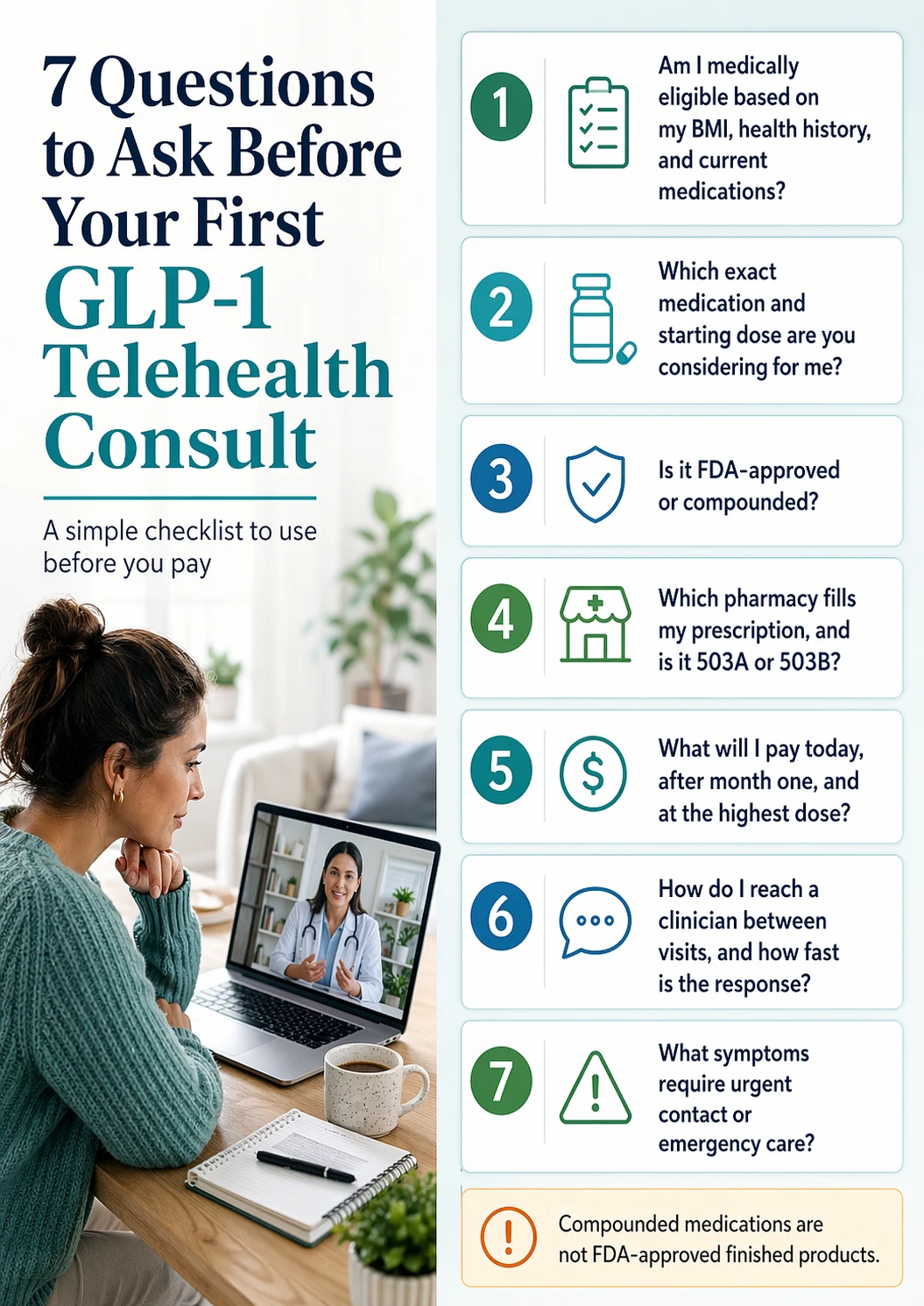
| # | Ask this first | 🟢 Green answer | 🟡 Yellow answer | 🔴 Red answer |
|---|---|---|---|---|
| 1 | Am I medically eligible based on BMI, history, and current medications? | Clinician references your BMI, specific conditions, and the contraindication screen in their review. | "You qualify" with no specifics. | "Everyone qualifies" or approval without a medical intake. |
| 2 | Which exact medication and formulation, at what starting dose? | Names the molecule (semaglutide, tirzepatide, or orforglipron), formulation, and dose with rationale. | Names the medication but not the starting dose. | Vague "GLP-1" with no specifics. |
| 3 | Is it FDA-approved for my use, off-label, or compounded? | Clear distinction. FDA-approved means reviewed by FDA as a finished product. Compounded means a licensed pharmacy prepared it — and compounded drugs are not FDA-approved. | Correctly distinguishes but doesn't explain implications. | "FDA-approved compounded" or "same as Wegovy." Neither is accurate. |
| 4 | Which pharmacy fills my prescription? | Names the pharmacy or pharmacy pathway and type (503A or 503B) on request, with accreditations. | "We'll assign a pharmacy after approval" — legitimate if followed by a named pharmacy. | Refuses to name or verify pharmacy identity. |
| 5 | What will I pay today, after month one, and at the highest maintenance dose? | Specific numbers for all three, in writing. | "Starting at" number only, with month-two details after signup. | No pricing details until a card is entered. |
| 6 | How do I reach a clinician — not customer support — between visits, and how fast? | Named portal or hotline that routes to a clinician with a defined response window. | Portal message first, routed to a clinician within 24 hours. | "Contact customer support." |
| 7 | What symptoms require urgent contact or emergency care? | Specific list matching the FDA label warnings for the medication prescribed. | Generic "if you feel bad, message us." | No escalation plan beyond "some nausea is normal." |
| A provider who answers all seven plainly, in writing, before you pay is the kind of provider this checklist was built to help you find. | ||||
Not sure which GLP-1 provider answers these questions transparently for your situation?
Why generic "questions to ask your doctor" lists don't work for telehealth
A telehealth GLP-1 platform is actually three separate businesses stacked on top of each other:
The platform (the brand you see in the ads) is usually a technology company, not a medical provider.
The clinicians are typically independent licensed physicians or nurse practitioners working through a medical group the platform contracts with. MEDVi and Prime Health, for example, both disclose in their terms that they are technology platforms connecting patients with independent clinician groups like OpenLoop Health.
The pharmacy is a separate licensed pharmacy — sometimes a state-licensed 503A compounding pharmacy, sometimes a 503B outsourcing facility that's FDA-registered and inspected, sometimes a retail mail-order pharmacy for brand-name medication.
This three-part structure is why generic "ask your doctor" lists miss. You have to ask the platform's support team about billing and pharmacy identity before you get to a clinician, then ask the clinician about medical fit during the visit, then check your own experience after the visit. Different questions. Different moments. Different people.
The three-phase framework (and how to use it)
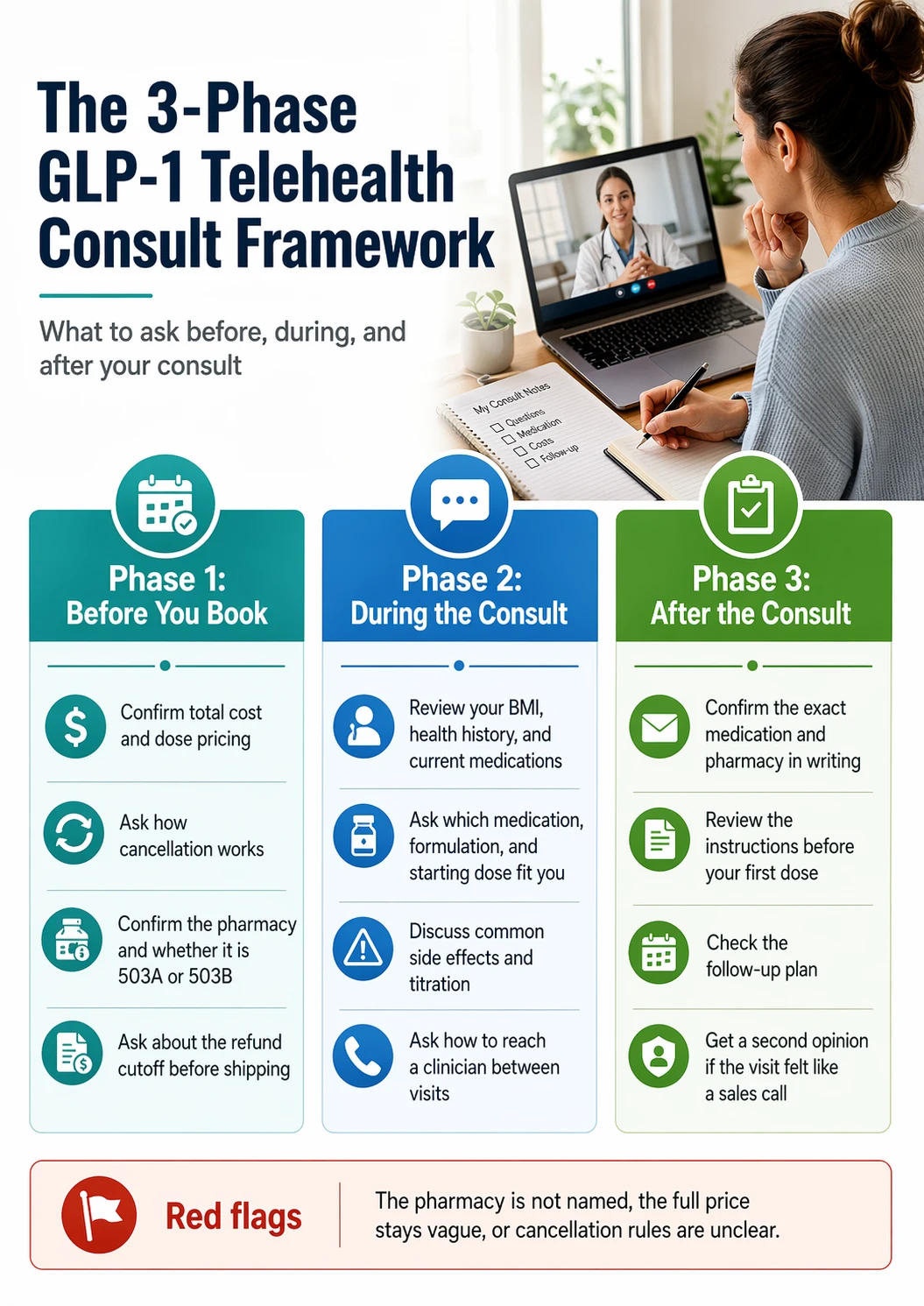
Pre-consult (9 questions)
Ask the support team or chatbot before you book, so you don't discover a hidden consult fee or a phone-only cancellation process after you're on the hook.
During-consult (11 questions)
For the licensed clinician during the visit. This is where medical fit, medication choice, and titration get decided.
Post-consult self-check (10 items)
After you hang up, rate your own visit. Did this actually feel like medical care, or a sales call?
Phase 1: Pre-consult questions to ask before you book or pay
Last verified:| # | Question | 🟢 Green | 🟡 Yellow | 🔴 Red |
|---|---|---|---|---|
| 1 | What's the monthly price at the highest dose? | Flat rate at every dose, disclosed upfront. Examples: Remedy Meds ($299/mo semaglutide, $399/mo tirzepatide flat); MyStart Health (price-lock). | Price scales modestly with dose, disclosed upfront. | "Pricing varies" with no specific numbers. |
| 2 | Is the consult free if I don't qualify or choose not to proceed? | $0 if you don't qualify, $0 if you choose not to order. | A disclosed consult fee refunded if not approved. | A hidden consult fee that only appears in checkout fine print — documented for at least one 2026 platform per independent review. |
| 3 | Which pharmacy fills my prescription, and is it a 503A or 503B facility? | Names the pharmacy or pharmacy type on request, confirms accreditation (PCAB, NABP Verified Pharmacy, ACHC, or LegitScript). | "We'll assign a pharmacy after approval" — legitimate if pharmacy is named once assigned. | "We partner with licensed pharmacies" with refusal to name, verify, or describe the pharmacy type. |
| 4 | Given the FDA's April 2026 compounding policy clarification, what's the specific basis for compounding semaglutide or tirzepatide for me? | Clear reference to patient-specific 503A compounding and a documented significant difference for the identified individual patient. | References "503A" without specifics about your situation. | Hand-wavy "it's still legal" with no detail. |
| 5 | What's your billing cycle — monthly or every 28 days? | Clear answer. Either is fine; 28 days means 13 charges per year, so knowing matters. | "Monthly" when actual cycle is 28 days. | Refusal to confirm. |
| 6 | How do I cancel — in the portal or only by phone? | Cancel anytime in your portal, no phone call, no retention script. | Cancel online but confirmation requires a chat. | Phone-only with a scripted retention call — a common complaint pattern across the category. |
| 7 | What's the refund policy once medication ships? | Clear: prescription medication is non-refundable once shipped (standard pharmacy practice), with a defined cancellation cutoff before the next cycle. | A money-back guarantee with conditions visible before payment. | Guarantee in marketing with strict "no refunds or exchanges" in the consent document. |
| 8 | Do you accept HSA/FSA, and will you provide an itemized receipt or letter of medical necessity? | Yes to all. | HSA/FSA card accepted, no letter of medical necessity issued. | HSA/FSA 'works' but no itemized receipt available. |
| 9 | In my state, is the visit synchronous video, asynchronous portal review, or either? | Specific answer tied to your state's rules. | "We're available in your state" with no detail on visit type. | "We operate in all 50 states" with no nuance. |
The three pre-consult questions that actually decide your experience
Pricing at every dose, not just the starting dose
GLP-1 therapy is a titration — your dose typically steps up over the first three to six months as your body adapts. A program that looks affordable at 0.25 mg might be meaningfully more expensive at 2.0 mg. Flat-rate providers and dose-tiered providers are both legitimate; opacity isn't. Ask for the number at the highest dose you might realistically reach. Remedy Meds and Prime Health use flat-rate models: $299/month for semaglutide and $399/month for tirzepatide at every dose. Eden uses flat-rate branded pricing. Every one of these is disclosed publicly. A provider that won't confirm the highest-dose price is the exception, not the rule.
The compounding pharmacy and its accreditation
This is the single question most telehealth platforms hope you won't ask. A 503A pharmacy is a state-licensed compounding pharmacy that prepares patient-specific prescriptions; it's regulated by the state board of pharmacy and isn't required to follow cGMP. A 503B outsourcing facility is registered with the FDA, subject to FDA inspection, and required to follow cGMP. Both can be legal venues for compounded GLP-1s when the applicable FDA conditions are met — but compounded drugs themselves are not FDA-approved regardless of which facility prepared them. The FDA explicitly encourages consumers to ask which pharmacy fills a compounded prescription. Additional accreditations to ask about: PCAB, NABP Verified Pharmacy Program, ACHC, and LegitScript. A provider that won't name the pharmacy is telling you something important about how they operate.
Cancellation and billing cycle
Billing is the most common theme in public consumer reviews across the GLP-1 telehealth category in 2026 — auto-renewal charges that caught people off guard, 28-day billing cycles that mean 13 charges per year instead of 12, cancellation processes that require a phone call with retention scripts, and non-refundable ships. You can't avoid the standard pharmacy rule — prescription medication is typically non-refundable once it leaves the pharmacy — but you can avoid surprises by knowing the cancellation cutoff and getting cancellation terms in writing before you pay.
See providers that already publish most of these answers on their site — we've reviewed the best GLP-1 telehealth providers and noted which ones disclose pricing, pharmacy, and cancellation terms upfront.
Phase 2: Questions to ask the licensed clinician during the consult
Last verified:| # | Question | 🟢 Green | 🟡 Yellow | 🔴 Red |
|---|---|---|---|---|
| 10 | Am I clinically appropriate based on my BMI and history — and what specifically did you check? | Clinician references your BMI, specific history, and the contraindication screen. | Clinician confirms eligibility but doesn't cite specifics. | "You qualify" with no specifics. |
| 11 | Based on my medical history, does anything change your recommendation? | Specific clinical reasoning tied to your actual history. | Generic reassurance. | Dismissal, no follow-up questions. |
| 12 | Which medication, formulation, and starting dose — and why that one? | Names molecule, formulation, dose, and rationale tied to your goals and history. | Names medication but not rationale. | One-size-fits-all. |
| 13 | Is this FDA-approved or compounded — and what does that mean for me? | Clear, accurate distinction. | Correctly distinguishes but doesn't explain implications. | "Same as Wegovy" or "FDA-approved compounded." Neither is accurate. |
| 14 | What's the titration schedule, and what triggers a dose increase or hold? | Clear schedule (typically starting 0.25 mg semaglutide or 2.5 mg tirzepatide, stepping up every 4 weeks) with explicit hold criteria for side effects. | Schedule provided without hold criteria. | "We'll figure it out." |
| 15 | If I have severe side effects between visits, how do I reach a clinician — within how long? | Named messaging portal or hotline that routes to a clinician with a defined response time. | Portal message, 24-hour response from support who escalates. | "Contact customer support." |
| 16 | What drug interactions should I watch given my current medications? | Specific call-outs. For tirzepatide (Zepbound, Mounjaro), the FDA label warns that delayed gastric emptying may reduce the effectiveness of oral hormonal contraceptives; patients are advised to switch to a non-oral method or add a barrier method for 4 weeks after starting and 4 weeks after each dose escalation. Insulin and sulfonylureas may need dose adjustment. | Generic "watch for interactions." | Clinician never asked for your med list. |
| 17 | What weight loss is realistic at 3, 6, and 12 months for me? | Specific ranges tied to trial data and your profile. | Honest but generic ranges. | "You'll lose 30 pounds in 3 months." |
| 18 | How long will I stay on the medication, and what happens if I stop? | Honest discussion of long-term therapy, weight regain after discontinuation, taper strategy, lifestyle handoff. | Acknowledges but avoids the taper question. | "We'll cross that bridge later." |
| 19 | What labs do you require or accept, and what's the follow-up cadence? | Provider explains their lab policy — required, recent labs accepted, ordered through a partner like Quest, or a stated clinical reason they aren't needed — with a follow-up cadence. | Labs recommended but optional. | No labs, no explanation, no follow-up plan. |
| 20 | What's your guidance on protein intake and strength training during weight loss? | Clinician discusses adequate protein and resistance training, with guidance appropriate for your medical history. | Mentions protein and exercise. | "Just take the medication." |
The three Phase 2 questions that separate medicine from a prescription mill
The contraindication screen
GLP-1 prescribing information carries an FDA boxed warning: the medications are contraindicated in people with a personal or family history of medullary thyroid carcinoma (MTC) — a rare type of thyroid cancer accounting for about 1–2% of thyroid cancers per the American Thyroid Association — or a diagnosis of multiple endocrine neoplasia syndrome type 2 (MEN2). More common thyroid issues (papillary thyroid cancer, Graves disease, Hashimoto thyroiditis, hypothyroidism treated with levothyroxine) are not contraindications. Pancreatitis is a warning — not an absolute contraindication — and requires individualized discussion. Pregnancy and planned pregnancy are avoid/stop-treatment issues. A good clinician asks the specific questions — not the general ones — and reasons from your actual answers.
For a full walkthrough, see our guide to GLP-1 contraindications and eligibility.
The titration and hold criteria
Titration is the biggest variable in whether you tolerate the medication. For semaglutide (Wegovy, Ozempic), the standard titration is 0.25 mg weekly for 4 weeks, stepping up through 0.5, 1.0, 1.7, and 2.4 mg maintenance over about 16–20 weeks. For tirzepatide (Zepbound, Mounjaro), it's 2.5 mg weekly for 4 weeks, stepping up through 5, 7.5, 10, 12.5, and up to 15 mg maintenance. For orforglipron (Foundayo), FDA's April 2026 approval includes a once-daily oral dose with its own escalation schedule.
The hold criteria matter as much as the schedule — if nausea is severe, a competent clinician will hold or drop a dose rather than push through. Prescription mills don't have hold criteria. They have a calendar.
How you reach a clinician between visits
Obesity medicine physicians interviewed in major coverage of the telehealth category have consistently identified clinician access between visits as a key quality differentiator. Some providers offer unlimited clinician messaging in the patient portal. Others route everything through customer service. Ask specifically: "If I message in the portal at 9 a.m. on a Tuesday, when will a clinician — not a support rep — respond?" A specific answer ("within 4 business hours") is good. "Our team will respond" is not.
Realistic weight-loss expectations: trial-context reference
Don't settle for "results vary." Ask the clinician what's realistic for your profile, then sanity-check against the trial data for the medication prescribed.
| Medication | Study population | Duration | Approximate mean weight reduction |
|---|---|---|---|
| Wegovy (semaglutide 2.4 mg weekly) | STEP 1 trial, adults with overweight/obesity without diabetes | 68 weeks | ~15% mean reduction at maintenance dose |
| Zepbound (tirzepatide 5, 10, or 15 mg weekly) | SURMOUNT-1 trial, adults with obesity without diabetes | 72 weeks | ~15–21% mean reduction at maintenance doses |
| Foundayo (orforglipron 36 mg daily, highest dose) | ATTAIN-1 trial reported in 2025 | 72 weeks | ~12.4% mean reduction at highest dose |
| Saxenda (liraglutide 3 mg daily) | Clinical development program | 56 weeks | Modest compared with newer agents; commonly reported as % of patients achieving ≥5% weight loss rather than a single mean |
| These are averages across trial populations — individual results vary significantly based on adherence, dose, lifestyle changes, and starting weight. Sources: FDA prescribing information and published trial results. | |||
For people on insulin or a sulfonylurea
If you currently take insulin, glipizide, glimepiride, or glyburide, your Phase 2 conversation needs to include dose-adjustment planning before you start. See our detailed guide on GLP-1 and hypoglycemia risk with insulin and sulfonylureas — and bring those specific questions to your clinician.
Phase 3: The 10-question post-consult self-check
Check each box. Be honest with yourself.
Post-consult self-check
- Did the clinician ask about my full medical history — not just my BMI?
- Did they specifically ask about MTC or MEN2 family history?
- Did they ask about my current medications and supplements?
- Did they address labs — either requiring baseline, accepting recent, ordering them, or giving a clinical reason they aren't needed for me?
- Did they explain side-effect management and when to contact them?
- Did they explain the titration schedule and hold criteria?
- Did they tell me the specific medication, formulation, and pharmacy?
- Did they give me time to ask questions — or rush to "approve and ship"?
- Did they document a follow-up plan with a specific cadence?
- Did the visit feel like medical care or a sales call?
6 or more "yes": strong transparency signal
Move forward with reasonable confidence.
Fewer than 6 "yes": get a second opinion before paying
A second consult with a different free-consultation provider takes another 15–30 minutes. Worth the hour.
If your consult failed this self-check, we can show you providers that pass our transparency tests for your situation.
Copy-and-paste scripts for your consult
Script 1 — The short version (paste into any intake form)
"Before I enter payment or start treatment, please confirm: the exact medication and formulation you're recommending; whether it is FDA-approved or compounded; the pharmacy that will fill it; my total monthly cost today, after month one, and at the highest dose I might reach; what follow-up is included; how I reach a clinician between visits; the cancellation policy and the cutoff before the next charge; and what symptoms should prompt urgent contact."
Script 2 — If you want FDA-approved brand-name medication and hope to use insurance
"I'm most interested in FDA-approved medications — Wegovy, Zepbound, or Foundayo. Which of these do you prescribe, do you check my insurance and handle prior authorization, what is the cash-pay price for each if insurance denies, and what pharmacy fills the prescription? Please also confirm whether the medication cost is separate from the membership fee."
Script 3 — If you're considering compounded semaglutide or tirzepatide
"I understand compounded medications are not FDA-approved finished products and are not reviewed by FDA for safety, effectiveness, or quality. Please tell me: which pharmacy compounds the medication, whether it's a 503A or 503B facility, what accreditations the pharmacy holds, what concentration I'll receive, what unit markings on the syringe correspond to my prescribed dose, and what written instructions I receive with the first shipment. Given the FDA's April 2026 compounding policy clarification, please also explain the specific basis for compounding semaglutide or tirzepatide for me — including whether there is a documented significant difference for my individual situation compared with the commercially available product."
Script 4 — If you're worried about billing surprises
"Before my card is charged, please send me in writing: the total cost today, the total cost in month two and beyond, whether the price changes at higher doses, whether shipping and labs are included or charged separately, the exact date of my next charge, how I cancel (portal or phone), the cutoff to cancel before the next cycle, and the refund policy if I cancel before medication ships versus after."
Script 5 — If you have a medical history flag (thyroid, pancreatitis, GI, pregnancy plans)
"Before we proceed, I want to confirm the contraindication screen. I have [specific history]. Given that history, what is your clinical reasoning for prescribing a GLP-1? What specific symptoms should prompt me to stop the medication? And what is your recommendation for coordinating with my primary care doctor or specialist during treatment?"
Save these. Paste them. They're the difference between a consult you walked into blind and one you walked into prepared.
The red-flag answers that mean walk away — even from a provider we recommend
"We can't disclose our pharmacy partner."
The FDA explicitly encourages consumers to ask which pharmacy fills a compounded prescription. A reputable telehealth provider will name the pharmacy or confirm the type (503A or 503B) and its accreditations. "Partner facility" with no name, no type, and no accreditation isn't an answer.
No medical-history review, no medication review, no contraindication screen, and no explanation of lab policy.
Responsible GLP-1 prescribing involves reviewing your history, your current medications, and your contraindication risk, plus a coherent lab policy. A program where none of that happens is skipping the medical layer of medicine.
"Oh, we're charging you $80 for the consult since you didn't place an order."
A charge that appears only in the checkout fine print and is billed if you complete a consult but don't order has been documented for at least one 2026 telehealth brand in independent reviews. Legitimate free-consultation providers charge $0 if you don't qualify and $0 if you choose not to proceed — confirm this in writing before you book.
"Our money-back guarantee requires you to stay enrolled for at least five consecutive months with documented adherence."
This isn't dishonest if disclosed upfront. It's a walk-away when the marketing says "money-back guarantee" and the fine print makes the guarantee essentially unreachable.
"Cancel by calling this number during business hours, Monday through Friday."
Phone-only cancellation with a scripted retention call is a friction pattern commonly reported in consumer reviews. It's not illegal, but it's a signal about how the company thinks about you. Look for portal-based cancellation with emailed confirmation.
One damaging admission — and the reframe
Telehealth GLP-1 is not the right path for every reader. If you have complex medical history — prior pancreatitis without a clear cause, active cardiovascular disease, significant kidney disease, severe gastroparesis, active pregnancy plans within the next three months, Type 1 diabetes, a history of severe disordered eating, or multiple complex medications that need in-person coordination — a telehealth platform is not the right venue for your first GLP-1 conversation. The asynchronous model is built for the straightforward majority and can miss the nuance in a complex case.
If that's you, we'd rather lose the click than see you harmed. See your primary care physician, an endocrinologist, or a board-certified obesity medicine physician in person first. Bring these same 30 questions with you. They work in-office too.
For everyone else — adults with a BMI of 30 or greater (or 27 or greater with a weight-related condition, consistent with NIDDK guidance), no family history of MTC or MEN2, not currently pregnant, reasonably straightforward medical history, and a budget that can accommodate the realistic range for your route — telehealth is a legitimate, often more affordable, often more accessible path. The rest of this page is built for you.
Which telehealth route fits you — and which questions matter most
| If this sounds like you | Route | Top starting point | Next step |
|---|---|---|---|
| You want FDA-approved brand medication and you have or hope to use insurance | FDA-approved with insurance support | Ro — free GLP-1 Insurance Coverage Checker, insurance concierge for prior authorization, carries Zepbound® and Foundayo™. Ro Body: $39 first month, then $149/month, or as low as $74/month annual. Medication billed separately. | Check insurance with Ro → |
| You want FDA-approved brand medication but you're paying cash and want a verified low price | FDA-approved self-pay | Sesame Care — Costco members: Ozempic and Wegovy injections at $349/month, Wegovy pill as low as $149/month. Broad FDA-approved formulary. | See Sesame pricing → |
| You want a cash-pay program with low first-month pricing, fast intake, and a needle-free GLP-1 gum option | Compounded, low-start cash-pay | Embody — from $99 first month (semaglutide injection), then $299/mo ongoing. Offers weekly injections and needle-free GLP-1 gum. Compounded medications are not FDA-approved. Broad U.S. availability confirmed during intake. | Check Embody Eligibility → |
| You want the deepest compounded menu — injections, tablets, or both — with a cash-pay structure | Compounded, deep menu | MEDVi — broad compounded menu (semaglutide, tirzepatide, multiple formats). Program starts at $179. ⚠ Material disclosure: FDA issued a warning letter to MEDVi on February 20, 2026 citing misleading marketing claims. Compounded medications are not FDA-approved. If you consider MEDVi, ask during your consult to see current medication labels and confirm the compounding pharmacy. | Compare MEDVi carefully → |
| You're needle-averse and want an oral, sublingual, or lozenge format | Oral / no-needle compounded | SHED — compounded GLP-1 lozenges starting at $199/month. Also offers injections, sublingual drops, and brand-name Wegovy and Zepbound. Note: lozenge format is compounded and is not FDA-approved. | See oral GLP-1 options → |
| You're not sure yet | Route-matching quiz | — | Take the free quiz → |
The Phase 1 questions that matter most by route
FDA-approved with insurance: focus on (a) which medications the provider carries, (b) whether they check insurance before prescribing, (c) whether they handle prior authorization (Ro's insurance concierge process typically takes about 2–3 weeks), and (d) the cash-pay price if insurance denies.
FDA-approved cash-pay: focus on (a) the exact medication price by dose, (b) whether the visit fee is separate, (c) pharmacy pickup options (Costco-member pricing through Sesame is particularly strong), and (d) refill timing.
Compounded: focus on (a) the 503A vs 503B pharmacy question, (b) the basis for compounding under the FDA's April 2026 clarification — is there a documented significant difference for your individual situation, (c) the exact formulation and concentration, (d) dosing instructions with clear unit markings, and (e) the cancellation cutoff.
Oral or needle-averse compounded: add (a) why the oral or lozenge format is appropriate for you versus FDA-approved injectable options, (b) the specific clinical reasoning supporting the formulation, and (c) whether the provider also carries FDA-approved alternatives in case you want to switch.
Compounded vs. FDA-approved GLP-1s: why the questions change
The words that matter
A compliant provider never says:
"FDA-approved compounded semaglutide" — inaccurate. Compounded medications are not FDA-approved finished products.
"Same as Wegovy" or "same as Ozempic" — inaccurate. A compounded formulation may differ in concentration, inactive ingredients, delivery device, and labeling from the FDA-approved product.
"Generic Ozempic" — inaccurate. There is no FDA-approved generic version of semaglutide for weight management.
The April 2026 FDA compounding policy clarification
The FDA issued a policy clarification on April 1, 2026 stating explicitly that semaglutide and tirzepatide are not on the 503B bulks list and are not on the FDA drug shortage list. For 503A patient-specific compounding, FDA considers whether the compounded product is essentially a copy of the commercially available product and whether the prescriber has determined a documented significant difference for the identified individual patient.
FDA also stated it does not, at this time, intend to take action against a 503A compounder for compounding a product that is essentially a copy of a commercially available drug if the compounder fills four or fewer prescriptions for that compounded drug during a calendar month. This is an enforcement-discretion statement, not a legal safe harbor.
Which FDA-approved GLP-1 medications are labeled for what, as of April 2026
| Medication | Molecule | Format | FDA-labeled use |
|---|---|---|---|
| Wegovy | Semaglutide | Subcutaneous injection (pen) + oral tablet | Chronic weight management |
| Zepbound | Tirzepatide | Subcutaneous injection (pen and KwikPen) | Chronic weight management, plus moderate-to-severe obstructive sleep apnea in adults with obesity |
| FoundayoNEW | Orforglipron | Oral tablet, once daily | Chronic weight management — FDA's first new molecular entity approval under the National Priority Voucher program (approved April 1, 2026) |
| Saxenda | Liraglutide | Subcutaneous injection (pen) | Chronic weight management |
| Ozempic | Semaglutide | Subcutaneous injection (pen) | Type 2 diabetes — may be prescribed off-label for weight loss when clinically appropriate |
| Mounjaro | Tirzepatide | Subcutaneous injection (pen) | Type 2 diabetes — may be prescribed off-label for weight loss when clinically appropriate |
| Rybelsus | Semaglutide | Oral tablet | Type 2 diabetes |
| "FDA-approved" is not the same as "FDA-approved for weight loss." Ozempic, Mounjaro, and Rybelsus are approved for Type 2 diabetes; your clinician may prescribe them off-label for weight loss when clinically appropriate. Source: FDA prescribing information via DailyMed, April 2026. | |||
What actually happens on a telehealth GLP-1 consult
Before the visit (20–30 minutes)
You fill out a structured online questionnaire covering height, weight, BMI, complete medical history, current medications, allergies, prior weight-loss attempts, pregnancy status, and your specific goals. Upload recent labs if you have them; the provider may order labs if you don't. This is when the intake scripts in the previous section are most useful.
Clinician review (same day to 48 hours)
A licensed physician or nurse practitioner reviews your intake. Some platforms use synchronous video visits at a scheduled time; others use asynchronous review where the clinician responds within 24 to 48 hours through the patient portal. State telehealth rules vary — confirm with the provider what applies in your state.
The visit itself (10–30 minutes)
If synchronous, you'll have a video call with the clinician. If asynchronous, you'll receive a message in your portal with the treatment decision, rationale, and next steps. This is when you deploy the Phase 2 questions. If async, reply through the portal with your questions before accepting the prescription.
Prescription and pharmacy fulfillment
Once you accept the treatment plan and pay, the prescription is issued. Brand-name medication goes to a retail pharmacy you choose or a mail-order pharmacy. Compounded medication is prepared by a 503A or 503B facility; shipping typically takes 2–7 business days after approval and compounding, in temperature-controlled packaging.
First dose
You should receive written instructions on injection technique (for injectables) or oral administration (for tablets and lozenges). If anything is unclear, message the portal before administering the first dose. Do not guess at units, concentration, or injection sites.
Follow-up visit
Scheduled at 4 to 6 weeks. Expect to discuss side effects, tolerability, and whether to increase the dose.
The billing friction patterns we see across the category
Pattern #1 — The 28-day billing cycle
Many platforms bill every 28 days, not monthly. Over a year, that's 13 billing periods instead of 12. If you expected a December charge and got one on November 27, your calendar didn't lie — the cycle did. Ask: "Is my billing cycle monthly or every 28 days?"
Pattern #2 — The intro-price escalation
"First month $179" sometimes becomes "month two $299." This is legal if disclosed, but the disclosure is often in a terms document people don't read carefully. Ask: "What will I be charged in month two, month three, and at my highest dose?"
Pattern #3 — The checkout consult fee
Documented for at least one 2026 telehealth brand: a consult fee buried in the checkout fine print and charged if you complete a consult but don't place a medication order. Legitimate free-consultation providers charge nothing until you choose a plan — verify this in writing before booking.
Pattern #4 — The retention-script cancellation
Phone-only cancellation with a scripted retention call is not illegal, but it's a friction pattern reported across the category. Look for platforms that let you cancel in the portal and email you a confirmation.
Pattern #5 — The non-refundable-once-shipped cycle gap
Prescription medication is non-refundable once shipped — standard pharmacy practice, not unique to any platform. The friction is the gap between when the cycle renews and when medication ships. If you cancel on day 2 of a new cycle and medication already shipped on day 1, you typically owe for that cycle. The workaround: ask when medication is prepared and shipped in the cycle, then set a calendar reminder several days before. Confirm your specific provider's cutoff.
What we actually verified for this guide
We reviewed the published pricing, pharmacy disclosures, cancellation terms, refund policies, and state availability pages of GLP-1 telehealth platforms referenced in this guide in April 2026, and cross-referenced FDA's April 2026 compounding policy clarification, current FDA prescribing information, NIDDK obesity medication guidance, and the FDA's published warning letters. Individual provider details can change quickly; where we could not verify a specific current fact, we recommend confirming directly with the provider before paying.
Verified in April 2026
- Foundayo (orforglipron) FDA approval on April 1, 2026.
- Ro Body Membership: $39 first month, $149/month ongoing, or as low as $74/month annual. Free GLP-1 Insurance Coverage Checker. Insurance concierge for prior authorization.
- Sesame Care Costco-member pricing: Ozempic and Wegovy injections at $349/month; Wegovy pill as low as $149/month with an active prescription.
- Yucca Health: semaglutide as low as $146/month on the 6-month plan. Licensed U.S. pharmacy fulfillment. Provider review within 24 hours. 2-Day Air shipping.
- SHED: compounded GLP-1 lozenges starting at $199/month, plus injections, sublingual drops, and brand-name options.
- Eden: flat-rate branded pricing, HSA/FSA acceptance, no separate membership fee on the core plan.
- MEDVi: program starting at $179. FDA warning letter dated February 20, 2026 cited MEDVi for false or misleading marketing claims about compounded GLP-1 products.
- Hims & Hers: March 2026 strategic agreement with Novo Nordisk to offer Ozempic, Wegovy pen, and Wegovy pill on the platforms.
- FDA April 1, 2026 compounding policy clarification.
Flagged as needs verification
- Current Bing autocomplete and PAA snapshots (vary by device and location; confirm in a live browser at publish time).
- Current state-by-state synchronous-video-required list for telehealth GLP-1 prescribing (state rules evolve; confirm via CCHP and your state medical board).
- Remedy Meds and Prime Health pricing and guarantee specifics — consistent through early 2026 but verify before publish.
- MEDVi's current pharmacy partner and whether the marketing claims cited in the February 2026 warning letter have been updated on the site.
Methodology note
This guide was produced by the Weight Loss Provider Guide research team based on published FDA and NIDDK guidance, current FDA prescribing information for each medication named, provider public pricing and policy pages as of April 2026, and public consumer review patterns on Trustpilot, BBB, Sitejabber, and Reddit. Consumer reviews were used to identify recurring friction patterns and voice-of-customer language — not as medical evidence. We did not test any provider's telehealth consult firsthand for this piece. We are not a medical provider. This page is not medical advice.
Frequently asked questions
Sources and references
FDA
- FDA prescribing information: Wegovy, Zepbound, Foundayo, Ozempic, Mounjaro, Saxenda, Rybelsus.
- FDA, "Compounding and the FDA: Questions and Answers."
- FDA, "FDA clarifies policies for compounders as national GLP-1 supply begins to stabilize," April 1, 2026.
- FDA, "FDA Approves First New Molecular Entity Under National Priority Voucher Program" (Foundayo), April 1, 2026.
- FDA Warning Letter to MEDVi, LLC, MARCS-CMS 721455, February 20, 2026.
- FDA alerts on dosing errors associated with compounded injectable semaglutide products.
Medical & regulatory
- NIDDK, "Prescription Medications to Treat Overweight & Obesity."
- American Thyroid Association, "Medullary Thyroid Cancer."
- Foley & Lardner, "FDA Clarifies Policies for Pharmacy Compounders of GLP-1 Products" (April 2026).
- CCHP, State Telehealth Laws and Reimbursement Policies Report, Fall 2025.
- Wegovy STEP 1, Zepbound SURMOUNT-1, Foundayo ATTAIN-1 trial results and FDA prescribing information.
Consumer voice-of-customer (not medical evidence)
- Trustpilot, BBB, Sitejabber aggregated reviews (2025–2026).
- Reddit r/Semaglutide, r/Tirzepatide threads.
- Medical Foundation of NC, "Before You Sign Up for Online GLP-1s" (2026).
Still not sure which GLP-1 program is right for you?
Take the free 60-second matching quiz. Answer a few questions about your state, insurance status, medication preference, and any medical history flags, and we'll show you the providers that currently publish transparent answers to most of the questions in this checklist for your specific situation. No email required.
Take the free 60-second GLP-1 path quizThis guide was produced by the Weight Loss Provider Guide research team. Weight Loss Provider Guide is an independent comparison resource for GLP-1 telehealth providers. Some links on this page are affiliate links; we may earn a commission if you purchase through them at no additional cost to you. Nothing in this guide is medical advice. A licensed healthcare provider must determine whether any medication is appropriate for you. Last verified: . Next scheduled re-verification: quarterly.