Don't Qualify for Wegovy? Now What [4 Reasons, 2026]
By the Weight Loss Provider Guide Editorial Team · Published August 28, 2026
Medical sources last checked: August 28, 2026 · Prices last verified: August 28, 2026
Affiliate disclosure: We may earn a commission if you join Ro or Sesame through links on this page. It does not change your price. It also does not change the safety stops, cash prices, or non-affiliate options we put first.
If someone told you that you don't qualify for Wegovy, now what you do next depends entirely on who said it and why. A clinician can say no for safety. A telehealth program can say no because of its own rules. Your insurance can say no because of coverage. A pharmacy can stall because of stock, paperwork, or a prescription problem.
Bottom line: a true Wegovy contraindication is the clearest hard stop. Other medical risks can also make Wegovy inappropriate. An insurance exclusion, a missing record, a step-therapy rule, or an automated website rejection is a different kind of "no" and may still leave another door open.
Here's the part almost nobody tells you: NovoCare's published cash-program terms do not add a second BMI screen. They require a valid prescription for an FDA-approved Wegovy use. The pill starts at $149 a month. New patients can get the 0.25 mg and 0.5 mg pens for $199 per fill for their first two fills under the current offer.
The best path changes if you're on Medicare or Medicaid, if your plan flatly excludes weight-loss drugs, or if a clinician found a real medical reason to say no. We'll cover all three.
But first, figure out which “no” you actually got. Because if you skip this step, you might spend $300 solving the wrong problem.
Don't qualify for Wegovy? Now what kind of “no” did you get?
Four kinds of “no” can stop a Wegovy request, and each one uses a different rulebook. A clinician is judging safety. A telehealth program is applying its own treatment and service rules. An insurance plan is deciding what it will pay for. A pharmacy is checking the prescription, stock, and payment path. Knowing which one stopped you tells you whether the door is actually closed.
| The kind of “no” | What it usually means | Can this change? |
|---|---|---|
| Safety no | A clinician found a health reason Wegovy may not be right for you | Sometimes, but not by shopping for the fastest “yes” |
| Label or records no | You did not fit the labeled use as documented, or a required record was missing | Often, if the record was wrong, old, or incomplete |
| Program no | That service cannot treat your state, age, or medical situation | Often, because a different care setting may work |
| Money no | Your plan will not pay, or the pharmacy cannot finish the claim | Often, through a correction, appeal, covered alternative, or cash route |
And then there's the fifth thing, which isn't a “no” at all: Novo Nordisk's NovoCare cash program. It uses licensed partner pharmacies, charges fixed self-pay prices, and fills a valid prescription written for an FDA-approved use. It does not prescribe Wegovy.
Three of the four “no” types may have nothing to do with whether Wegovy is medically safe for your body. Let's find yours.
🔎 Before you read further — did someone actually tell you no?
- No, I'm checking before I apply. → Start with our Wegovy eligibility guide instead. This page is for people who already got turned down.
- Yes, and they said my BMI is too low. → Read our BMI too low for GLP-1 guide. It goes deeper on that one reason than we can here.
- Yes, and it was my insurance. → Go to the insurance-denial section.
- Yes, but I honestly don't know why. → Keep reading. This whole page is for you.
Wegovy now comes in three versions. That's good news for you.
Wegovy is one medicine sold in three practical versions: a daily tablet, the standard weekly pen, and the higher-dose Wegovy HD pen. The current label lists ten strengths. The approved doors are weight management, heart-risk reduction, and—only for the standard injection—noncirrhotic MASH with F2 to F3 liver fibrosis. A "no" on one use or version does not automatically answer the others.
Most pages you'll read about Wegovy were written before the tablet, MASH use, and 7.2 mg HD dose existed. Here's what's actually available now, with the cash prices published by NovoCare.
| Wegovy form and dose | Place in treatment | FDA-labeled use | NovoCare cash price |
|---|---|---|---|
| Tablet, 1.5 mg | First titration dose | Part of the approved adult tablet schedule for weight management and heart-risk reduction | $149/month |
| Tablet, 4 mg | Second titration dose | Part of the approved adult tablet schedule | $149 through Aug. 31, 2026; then $199/month |
| Tablet, 9 mg | Third titration dose | Part of the approved adult tablet schedule | $299/month |
| Tablet, 25 mg | Recommended maintenance dose | Adult weight management and heart-risk reduction | $299/month |
| Standard pen, 0.25 or 0.5 mg | Starter doses | Part of the approved injection schedule | $199 for each of the first two fills for eligible new patients; then $349/month |
| Standard pen, 1, 1.7, or 2.4 mg | Titration and standard maintenance doses | Weight management; heart-risk reduction; the 2.4 mg injection is also the labeled MASH dose | $349/month |
| Wegovy HD pen, 7.2 mg | Higher adult maintenance dose | Adult weight management | $399/month |
Prices were read from NovoCare's current price guide and cash-program terms on August 28, 2026. One month means one box of four pens or one bottle of 30 tablets. The $199 pen offer is limited to eligible new patients, the 0.25 mg and 0.5 mg doses, and the first two fills under the current offer terms.
Novo Nordisk publishes a $1,349.02 list price per package for Wegovy. That number is real. It is not the same as the current manufacturer cash price above.
The three doors into Wegovy
This part matters more than most people realize, so read it slowly.
Door 1 — Weight. The label covers adults with obesity, or adults who are overweight and have at least one weight-related health problem. The standard injection also covers patients ages 12 and older with obesity. This is the door most people try, and the one many plans restrict most heavily.
Door 2 — Heart risk. Wegovy injection and tablets are approved to lower the risk of cardiovascular death, heart attack, and stroke in adults who already have established cardiovascular disease and are overweight or have obesity. Read that again: this is a separate labeled use. Coverage can still be denied, but your plan may apply different criteria than it uses for weight management.
Door 3 — MASH. The standard Wegovy injection is approved for adults with noncirrhotic MASH and moderate to advanced liver fibrosis, consistent with stages F2 to F3. This was an accelerated approval based on improvement in MASH and fibrosis, with continued approval tied to confirmatory evidence. The tablet and 7.2 mg HD pen do not carry this MASH indication.
Doors 2 and 3 are not loopholes. You can't talk your way through them. But if you have established heart disease, or diagnosed MASH with F2 to F3 fibrosis, and nobody checked the matching labeled use, that is a conversation worth having with your doctor.
Quick note before you keep going: yes, you can pay cash and skip the insurance fight. We break down every price below. But do not do that yet. If your “no” came from a clinician for a medical reason, paying cash somewhere else doesn't fix it—it just moves it. Read the next section first. It's short.
The one “no” that nothing on this page can fix
Wegovy's label lists two do-not-use situations: a personal or family history of medullary thyroid carcinoma, or MEN 2; and a past serious allergic reaction to semaglutide or an ingredient in the product. If either applies to you, Wegovy is closed. No appeal, cash payment, or different website changes that.
We're putting this early on purpose. It's the least fun part of the page, and you deserve to know it before you spend money.
Here's the honest version: if a clinician found one of those two things in your history, we can't help you get around it. And we won't try. That's the whole reason you can trust everything else on this page.
But most people who worry about this don't actually have it
Intake forms often ask, “Have you had thyroid cancer?” The label bars one specific type. The American Thyroid Association says medullary thyroid cancer makes up about 1% to 2% of U.S. thyroid cancers, and inherited forms account for up to 25% of diagnoses. Papillary and follicular cancers are different types.
So do not clear yourself, and do not disqualify yourself. Get the specific type from your relative or your records, and hand that to a clinician. A broad form may not tell the difference. A clinician can.
These are warnings, not automatic walls
Lots of people get told no over things that are not on Wegovy's do-not-use list. The label flags these as issues a clinician needs to assess:
- A history of pancreas problems, including pancreatitis
- Gallbladder trouble
- Kidney problems, especially when vomiting or diarrhea causes dehydration
- Type 2 diabetes with diabetic retinopathy
- Upcoming surgery, anesthesia, or deep sedation
- Insulin or other medicines that can lower blood sugar
- Other semaglutide products or another GLP-1 medicine, which the label says should not be used with Wegovy
None of those means “you're fine, ignore it.” Most are also not the same as a formal contraindication. They're a clinical conversation.
Pregnancy is its own category
Wegovy is not a weight-loss route during pregnancy. For weight management or heart-risk reduction, the label directs stopping Wegovy when pregnancy is recognized and advises stopping at least two months before a planned pregnancy. The MASH indication has different risk-benefit wording, so that decision belongs with the prescriber and OB team. There is no product recommendation in this section, and there shouldn't be.
Severe gastroparesis: the obvious GLP-1 switch doesn't fix it
Gastroparesis means your stomach empties too slowly. Wegovy is not recommended in severe cases. A lot of people hear that and immediately think, “Fine, I'll ask for Zepbound instead.”
Zepbound's label also says it is not recommended in severe gastroparesis, and Zepbound carries the same MTC and MEN 2 contraindication. Foundayo's label does too. So the obvious GLP-1 switch is not a clean workaround. That is not us being cautious. It is what the current labels say.
And the line we won't cross
A medical “no” is not fixed by switching to a compounded product. If the reason was your health history, it follows you everywhere. Anyone who tells you otherwise is selling you something, and we'd rather lose the sale than be that.
If any of this section describes you: skip to what else is FDA-approved, or find a clinician who specializes in obesity medicine through the Obesity Medicine Association's provider directory. We earn nothing from that link. It's just the right one.
Everyone else—the good news starts now.
My insurance denied Wegovy. Is that final?
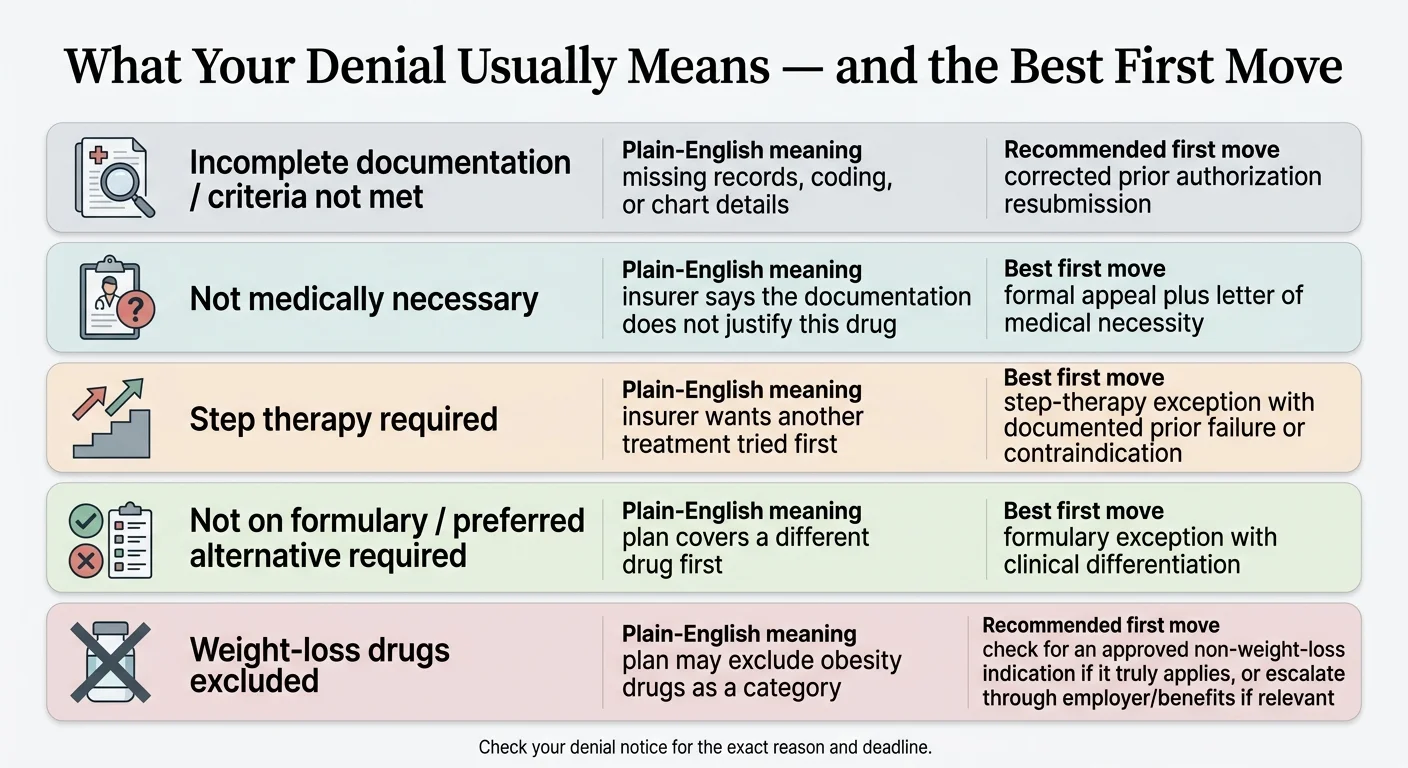
No. The next move depends on the exact reason in your letter. “Not medically necessary” is a medical judgment you can challenge. “Not a covered benefit” is a contract rule that medical records usually cannot erase. “Step therapy required” is a denial with a to-do list. “Missing information” means the plan did not get everything it required.
Go get the letter. Circle the exact reason. Then match it here.
| What the letter says | What it usually means | Can you fight it? | Do this now |
|---|---|---|---|
| “Not medically necessary” | A reviewer decided the submitted record did not meet the plan's medical criteria | Yes. Internal appeal and, in many cases, external review may be available | Ask for the exact criteria and the records the reviewer used |
| “Not a covered benefit” or “excluded” | The plan document excludes the drug or the weight-loss-drug category | Usually not with more medical evidence alone. First confirm that it is a true exclusion, not a mislabeled medical denial | Ask for the plan provision in writing; if it is job-based coverage, ask whether the plan is self-funded |
| “Step therapy required” | The plan wants a listed drug tried first, or wants proof that it cannot be used | Often. Complete the step or document the plan's allowed exception | Ask which drug, how long the trial must last, and what counts as an exception |
| “Missing information” | The request lacked a required field, chart note, diagnosis, weight, date, or prior-treatment record | Often, and a corrected resubmission may be faster than a formal appeal | Ask for the exact missing item and have the prescriber's office resubmit it |
The two questions almost nobody asks
1. Is your plan self-funded? With a self-funded job plan, the employer or plan sponsor pays claims and hires an insurer or administrator to run the network and paperwork. That means the benefit design may have been chosen or accepted by the plan sponsor, not created by the company name on your card. Ask HR for the Summary Plan Description and the section that lists prescription exclusions. Sometimes the next useful conversation is with benefits—not another medical appeal.
2. Does your plan treat each drug, form, and labeled use the same way? Call and ask about these one at a time:
- Wegovy standard pen
- Wegovy tablets
- Wegovy HD
- Wegovy for established cardiovascular disease
- Zepbound, including the exact pen or vial form your prescriber is considering
- Ozempic only when it is being considered for its FDA-approved type 2 diabetes use
A no on one does not prove a no on every other item. Formulary status and prior-authorization rules can differ by drug, dose form, and labeled use.
What outside review actually covers
If your internal appeal fails, federal rules allow external review for certain denials. The key dividing line is this:
External review covers eligible denials that involve medical judgment, such as medical necessity. It generally does not rewrite a plan contract that excludes the benefit itself.
So “not medically necessary” may go to an independent reviewer. “Weight-loss drugs are not a covered benefit” usually does not become covered just because an outside doctor likes the treatment. Knowing which one you have can save you weeks.
For letters, deadlines, and the step-by-step process, see our Wegovy and Zepbound appeal guide. This page is about whether to appeal. That one is about how.
Not sure what your plan actually covers?
Ro's free insurance checker contacts your plan and reports coverage for the Ozempic pen, Wegovy pen, and Zepbound autoinjector pen. It does not currently check Wegovy tablets, Wegovy HD, Foundayo, or Zepbound KwikPen. You enter the information from your insurance card; Ro says no treatment request or prescription is submitted during the free check.
→ Check your Wegovy pen coverage free
We may earn a commission if you later join Ro. The coverage check is free, and the relationship did not change the limits we listed above.
What actually wins a Wegovy appeal? Seven denial records and one real win
We checked seven official Massachusetts hearing records involving Wegovy or Zepbound denials, then added one published New York external-review decision that was overturned. The pattern is blunt: exclusions do not become benefits because a drug is FDA-approved; alternate indications need the exact diagnosis; step therapy needs the exact trial or exception; and continuation appeals are strongest when the record shows the starting numbers and the treatment response.
Most pages about appealing a Wegovy denial describe the process in the abstract. These records show the words that actually changed—or failed to change—the decision.
| Record | What the record shows | What decided it | The lesson |
|---|---|---|---|
| Massachusetts Appeal 2304749 | Wegovy was requested for weight loss under a program that excluded drugs used solely for that purpose | FDA approval did not create a covered benefit | “It's FDA-approved” is not a contract argument. Find the actual covered-benefit language |
| Massachusetts Appeal 2514230 | The record discussed a family history of cardiovascular disease, while the available alternate Wegovy route required established cardiovascular disease | Family history was not the required diagnosis | An alternate indication needs the exact diagnosis in the chart |
| Massachusetts Appeal 2510925 | Wegovy was not covered for weight treatment, while a cardiovascular route existed for adults with established cardiovascular disease | The appeal turned on whether that covered diagnosis was documented | “Most people are not covered” may still leave a narrow door—but only if you meet it |
| Massachusetts Appeal 2510621 | The plan's weight-loss policy preferred or authorized a different drug rather than Wegovy | Prior success with Wegovy did not erase the formulary rule by itself | Ask whether this is an exclusion, preferred-drug rule, or formulary exception problem |
| Massachusetts Appeal 2506857 | The plan required a phentermine step; the member did not want it because of anxiety that was described as controlled with medication | Preference alone did not satisfy the exception | “I'd rather not” is weaker than a documented contraindication, adverse reaction, or failed trial |
| Massachusetts Appeal 2505725 | The member feared regaining weight after reaching a normal weight, but the record did not establish the plan's required cardiovascular diagnosis | Fear of regain and family history did not match the written criteria | The reviewer decides from the submitted criterion, not the fear you understandably feel |
| Massachusetts Appeal 2504819 | Zepbound required an adequate phentermine trial—described as at least 90 days—unless there was an adverse reaction or contraindication | The required trial or exception was not documented | Step therapy is a checklist. Get the checklist before you appeal |
| New York Case 202209-153866 | A member started at 187 pounds, reached 163 pounds after about six months, and had lost more than 5% | The external reviewer found the continuation request medically necessary and overturned the denial | Continuation can win when baseline, response, and maintenance criteria are in the record |
A necessary caveat: the seven Massachusetts matters involve MassHealth or managed-care rules, and the New York case involved a different commercial plan. They do not predict your outcome or create a national success rate. They are useful because they expose the recurring decision points: exclusion, indication, preferred drug, step therapy, and documentation.
The five lessons, in plain words
- “It's FDA-approved” does not make an excluded benefit appear. Coverage is a contract question.
- A different labeled use only helps when the exact diagnosis and records support it.
- Step therapy has written rules. Do the required step, or document a listed reason you cannot.
- Prior success matters most in a continuation appeal when the baseline and response are both shown.
- The best appeal attacks the stated denial reason—not the unfairness of the whole system.
The exact question to ask your plan
Call the number on your card and read this:
“I'm calling about a Wegovy denial. Can you tell me three things? One: was this denied as not medically necessary, excluded from my benefit, or subject to a preferred-drug or step-therapy rule? Two: can you send me the exact criteria and plan language in writing? Three: what specific record, diagnosis, trial, or exception would change this decision?”
Write down the answers. Those three answers determine everything you do next.
Don't want to run the paperwork yourself?
Ro says its insurance concierge handles prior-authorization paperwork for supported insurance-covered drugs and can file an appeal after a denial. At this time, Ro's insurance pathway supports the Wegovy standard pen, Zepbound autoinjector pen, and Ozempic—not every form on this page. Membership is $39 for the first month, and Ro's pricing page says that $39 is refunded if its provider finds you ineligible for GLP-1 treatment.
→ Start Ro's clinical review — $39 refunded if you're not eligible for GLP-1s
Medication is billed separately. Coverage is not guaranteed.
I'm on Medicare or Medicaid. What changed on July 1, 2026?
Regular Medicare Part D generally does not cover a drug when it is prescribed only for weight loss. On July 1, 2026, CMS opened a separate temporary program called the Medicare GLP-1 Bridge. Eligible Part D beneficiaries can get covered Wegovy forms for a flat $50 copay. The Bridge runs through December 31, 2027 and sits outside the normal Part D payment flow.
So “Medicare doesn't cover Wegovy for weight management” is no longer the whole answer. The regular Part D benefit and the Bridge are two different doors.
Who qualifies for the $50 price
You must be at least 18, the drug must be prescribed for weight management with ongoing lifestyle changes, and you must meet one of these paths based on your BMI when GLP-1 treatment began:
- BMI 35 or higher — no listed added diagnosis is required
- BMI 30 or higher, plus heart failure with preserved ejection fraction, uncontrolled high blood pressure above 140/90 despite two blood-pressure medicines, or chronic kidney disease at stage 3a or worse
- BMI 27 or higher, plus prediabetes, a prior heart attack, a prior stroke, or symptomatic peripheral artery disease
The Bridge currently includes all Wegovy formulations, all Foundayo formulations, and Zepbound KwikPen. It does not include the Zepbound single-dose pen or vial.
The detail that saves people
The BMI CMS uses is your BMI when you first started GLP-1 therapy—not today's.
CMS gives its own example: a person who started GLP-1 treatment in September 2024 at a BMI of 37 and has a BMI of 34 when the request is filed in July 2026 can still meet the 35-or-higher path. The prescriber attests to the starting number.
If you lost weight on a GLP-1 and then got dropped because your BMI came down, this paragraph is why you should pull your old weight record and call your prescriber.
When the prescription goes through regular Part D instead
The Bridge is only for a weight-management prescription. CMS says a GLP-1 prescription intended for a Part D-covered indication should go through the Part D plan instead. Examples include a diabetes drug prescribed for type 2 diabetes, Zepbound prescribed for moderate-to-severe obstructive sleep apnea, the standard Wegovy injection prescribed for qualifying MASH, or Wegovy prescribed for cardiovascular-risk reduction.
That does not mean the plan must approve every drug automatically. It means the request belongs in the regular Part D system, where the formulary and prior-authorization rules still matter.
One detail that is easy to misread: a prior heart attack, prior stroke, or symptomatic peripheral artery disease can help a person meet the Bridge's BMI-27 path when the prescription is for weight management. If the prescription is specifically for cardiovascular-risk reduction, CMS says it should be routed to Part D.
The honest catches
We're not going to sell you a program without the fine print:
- The $50 does not count toward your Part D deductible or true out-of-pocket costs
- The Part D low-income subsidy, also called Extra Help, does not lower the $50 Bridge copay
- The program ends December 31, 2027, unless policy changes again
- The pharmacy starts the Bridge claim; the prior-authorization request then goes to the prescriber
- CMS says the approval or denial is sent within 72 hours after a completed request is submitted
- There is no formal Bridge appeal, but the prescriber can resubmit corrected, updated, or added information
If you're on Medicaid
This one is state by state. A published Massachusetts record can tell you what MassHealth did; it cannot tell you what your state will do. Call your state Medicaid office and ask for the current anti-obesity agent criteria or preferred-drug-list rule. Ask whether Wegovy is covered for weight management, a different labeled use, continuation, or only after a preferred drug.
Your next step here isn't a product. Start with the official Medicare GLP-1 Bridge page, then take your starting BMI and diagnosis records to the prescriber.
→ See the Bridge paperwork and prescriber steps
No affiliate link in this section, and there won't be one. Government coverage and cash-pay eligibility differ by program, and a paid telehealth offer is not the first question to solve here.
A website turned me down. Does that mean I don't qualify?
Not necessarily. A telehealth rejection may be a program decision rather than a medical finding. The service may not have an available clinician licensed for your state, may exclude your age or medical situation, may require a live visit or records it does not have, or may stop the intake before a licensed clinician reviews it.
This is the single most misread “no” in this whole category. People treat an automated rejection like a diagnosis. It usually isn't one.
Three reasons a website says no that may not be a Wegovy safety finding
1. No available clinician can treat your case in your state. That can be a licensing, staffing, or service-area limit.
2. The program's own rules are narrower than the FDA label. A service may exclude certain ages, diagnoses, medicines, care needs, or levels of risk because it is not built to manage them remotely.
3. The form screens broadly before a clinician sees it. A form that asks “any thyroid cancer?” is broader than a label that names MTC. Broad questions can flag a case for human review—or end an intake before that review happens.
The question that tells you which one you got
Message support and ask this, word for word:
“Was I declined because a licensed clinician reviewed my history and decided Wegovy isn't appropriate, or because your program cannot treat my situation? If a clinician reviewed it, can you tell me the specific reason?”
Those are two completely different answers. One is clinical. One is operational. Ask for the answer in writing.
Before you pay another program, check these five things
Reciprocity note: we'd rather you not waste money, even if the money goes to a company we work with.
- Is the intake fee refundable if you're not eligible?
- Does the membership start before a clinician approves treatment?
- Is medication billed separately from the membership?
- Does the program have a clinician who can serve your state and manage your medical needs?
- How do you cancel, and how much notice does it take?
Ro publishes a clear answer on the first question, which is why it remains one option for rejected readers: its pricing page says the $39 first month is refunded if you're not eligible for GLP-1s. Medication is separate, and the ongoing membership ranges from $74 to $149 a month depending on the billing plan.
When to stop shopping and see someone in person
If several programs keep stopping at the same health question, treat that as a strong sign to stop shopping and get a fuller clinical review. A second opinion can correct a missing record or a bad care-setting match. It cannot safely erase a real contraindication—and looking for the website that says yes fastest is how people get hurt.
What if it's my BMI?
The weight-management label covers adults with obesity, or adults who are overweight and have at least one documented weight-related health condition. If a number stopped you, two things matter most: whether this is a new start or continuation after weight loss, and whether the submitted record left out a real diagnosis you already have.
We're keeping this short on purpose, because we already wrote the long version.
The starting-versus-current split is the big one. The Medicare GLP-1 Bridge specifically uses BMI at the start of GLP-1 therapy. Commercial continuation rules vary by plan, so get the exact written criteria instead of assuming they use the same rule. Pull your original weight, height, treatment date, and response records before you call.
Get measured properly. Use a real scale and an accurate height. Correct a bad measurement. Do not change your numbers to pass a form. An inaccurate record makes your care less safe, and it makes every appeal you may need later weaker.
Do not go diagnosis shopping. If you already have high blood pressure, high cholesterol, sleep apnea, prediabetes, or another relevant condition, make sure it is documented and submitted. If you do not know, ask for a normal clinical review—not a diagnosis chosen to unlock a drug.
→ The five real paths when your BMI is too low — new starts, continuation after weight loss, missing records, and what to ask.
One more thing, and we mean it kindly: if your BMI is in the healthy range and you're still chasing weight-loss medicine, that is worth talking through with someone who understands eating disorders and body image. The National Alliance for Eating Disorders helpline is free and staffed by licensed, specialized therapists. There's no product recommendation in this paragraph and there won't be.
Can I just pay cash for Wegovy and skip the whole fight?
Yes—if a licensed prescriber decides Wegovy is appropriate and writes it for an FDA-approved use. NovoCare's cash terms do not list a second BMI screen at the pharmacy. The pill starts at $149 a month. Eligible new patients can get the 0.25 mg and 0.5 mg pens for $199 per fill for their first two fills, then the standard pen price is $349.
If your “no” was about money or coverage—not safety—this section may be your answer. Here are the current real routes to Wegovy, priced.
| How you get it | What you pay | Who this is for | The catch |
|---|---|---|---|
| Commercial plan covers it + Novo savings offer | As little as $25/month | Eligible people whose commercial plan covers Wegovy | Maximum savings is $100 per month; government beneficiaries are excluded from this savings offer |
| Medicare GLP-1 Bridge | $50 flat copay | Eligible Part D beneficiaries using a covered form for weight management | Outside Part D; no deductible, out-of-pocket, or Extra Help credit; ends Dec. 31, 2027 |
| NovoCare cash — tablet 1.5 mg | $149/month | Cash payers starting the daily tablet schedule | Higher titration doses cost more |
| NovoCare cash — tablet 4 mg | $149 through Aug. 31, then $199 | Cash payers on the second tablet step | Time-limited 4 mg offer |
| NovoCare cash — tablet 9 or 25 mg | $299/month | Cash payers at later tablet doses | Medication only; prescriber still required |
| NovoCare cash — standard pen, new patient | $199 for each of first two fills | Eligible new self-pay injection patients | Only 0.25 mg and 0.5 mg; current offer deadlines apply |
| NovoCare cash — standard pen | $349/month | Cash payers at standard pen doses | Does not count toward insurance costs |
| NovoCare cash — Wegovy HD | $399/month | Adults prescribed the 7.2 mg dose | Adult weight-management use only |
| Costco Pharmacy through Success by Sesame | $349 medication + care from $59/month | Costco members who want care plus a self-pay Wegovy injection | The $59 rate uses annual billing; care, medication, and Costco membership are separate |
| Retail at published list price | $1,349.02 per package | A cash buyer who misses the direct offers | This is list price, not the current manufacturer cash offer |
What “no BMI test” really means
It does not mean you can order Wegovy like a supplement. It means the cash pharmacy is not making a second independent treatment decision after the prescription arrives. The prescriber is the clinical gatekeeper.
NovoCare's terms require a valid prescription, a valid prescriber ID, and an FDA-approved use. NovoCare does not write the prescription. Its licensed pharmacy partners validate and fill it.
The cash program is open to people who are uninsured and to people with commercial or government insurance who choose to self-pay. But you agree not to send the purchase to insurance or count it toward your deductible or out-of-pocket limit.
The trade-off, said plainly
Cash purchases sit outside your insurance. Nothing you spend through the NovoCare cash program counts toward your deductible or out-of-pocket maximum, and no claim gets filed. If your commercial plan covers Wegovy and you qualify for the savings offer, as little as $25 a month beats $349 every time.
The date that matters this week
The 4 mg Wegovy tablet is $149 through August 31, 2026. Under NovoCare's current terms, the prescription must be written and received by the deadline, with shipment allowed through September 30. After the offer, the published 4 mg price is $199. That's Novo's footnote, not a countdown we invented.
If what you need is a prescriber
Ro offers the Wegovy tablet, standard pen, and Wegovy HD when prescribed. Ro publishes the same base manufacturer cash prices: $149 to $299 for Wegovy tablets, $199 for the first two eligible starter-pen fills, $349 for standard pen doses, and $399 for Wegovy HD. Membership is $39 for the first month, then as low as $74/month with an annual plan paid up front, or $149 month to month. Medication is billed separately.
Straight talk, because you've earned it: Ro is not the cheapest way to get Wegovy. If price is the only thing you care about and you already have a clinician willing to manage treatment, have that clinician send the prescription through the manufacturer cash path. We earn nothing from NovoCare, and we'd still tell you to do it.
Ro earns its extra fee when you need a prescriber, ongoing care, or help with supported commercial-insurance paperwork. Its insurance concierge handles prior authorization and says it can file an appeal after a denial. Getting coverage can save hundreds a month, but approval is never guaranteed. Ro also says it refunds the $39 if its provider finds you ineligible for GLP-1s.
Does that sound like your situation? → See Ro's current Wegovy pricing and check eligibility
One more path, and only for one specific person:
If your plan truly excludes weight-loss drugs, you meet the medical criteria, you've run the approved-drug cash math, and you're done fighting, some people consider a patient-specific compounded option. Compounded medications are not FDA-approved. FDA does not review the finished compounded drug for safety, effectiveness, or quality before sale, and shortage-era mass copying of semaglutide ended in 2025. Read the full evidence and legal limits before you decide anything.
→ Read the compounded section before you decide
Is compounded semaglutide a way around a Wegovy "no"?
No—and this is the most important paragraph on this page for your safety. Compounded semaglutide is not an FDA-approved version of Wegovy. FDA does not review compounded drugs for safety, effectiveness, or quality before they are marketed. Paying cash can get you around an insurance problem. It cannot get you around a medical one.
Let's be direct about how this actually plays out.
Someone gets denied. They search. Within an hour a website offers a monthly injection for less than they expected, no insurance, approved in minutes. It feels like a solution.
Sometimes a properly prescribed, patient-specific compounded drug can meet a medical need. Often the ad is selling the same unresolved question with a lower price tag.
The three things to know
1. Insurance can be bypassed with cash. A real contraindication cannot. If a clinician found a genuine safety reason, no amount of money changes the medicine's effect on your body.
2. Compounded is not “generic Wegovy.” There is no FDA-approved generic Wegovy. FDA says unapproved GLP-1 versions do not go through its premarket review for safety, effectiveness, and quality. A registered or state-licensed pharmacy is not the same thing as an FDA-approved drug.
3. The broad shortage route already narrowed. FDA declared the semaglutide injection shortage resolved in February 2025, and its shortage-related enforcement-discretion periods ended in 2025. Patient-specific compounding may still be lawful when the federal requirements are met; it is not an open license to make routine copies for everyone.
In April 2026, FDA also proposed not adding semaglutide, tirzepatide, or liraglutide to the 503B bulks list because it found no clinical need for outsourcing facilities to compound them from bulk substances. The public comment deadline was extended to July 30, 2026. As of August 28, 2026, we did not find a final determination.
The screening test you can run in five seconds
Open any site you're considering and look for these claims. Any one is a reason to slow down and verify what is really being sold:
- “Generic Wegovy”
- “The same as Wegovy” or “interchangeable with Wegovy” without explaining that the finished product is not FDA-approved
- “Clinically proven” when the claim is being applied to that exact compounded product without supporting evidence
- “FDA-approved facility,” “FDA-licensed product,” or wording that makes registration sound like product approval
- A guarantee of approval before a licensed clinician reviews your case
There is no product link in this section. That's deliberate.
If Wegovy really is out, what else is FDA-approved?
Wegovy is not the only FDA-approved medicine for chronic weight management. Depending on why it is out, a clinician may consider Zepbound, Foundayo, Saxenda, Contrave, Qsymia, or orlistat. The reason that blocks Wegovy does not block every one of them. Contrave, Qsymia, and orlistat, for example, do not carry Wegovy's MTC and MEN 2 contraindication.
Here's how the doors line up. This is orientation, not a prescribing guide. A clinician who knows your history makes the call.
| If this is why Wegovy is closed | What may still be open | The question to ask your doctor |
|---|---|---|
| MTC or MEN 2 in you or your family | Non-GLP-1 options such as Contrave, Qsymia, orlistat, and other clinician-selected routes. Wegovy, Zepbound, Foundayo, and Saxenda all carry this contraindication | “Which non-GLP-1 option fits my history?” |
| A serious allergic reaction to semaglutide | A different active ingredient may still be considered, but the reaction details matter | “Did the reaction rule out semaglutide only, or does it change the whole treatment plan?” |
| Severe gastroparesis | Non-GLP-1 options may be more relevant. Wegovy, Zepbound, and Foundayo all say they are not recommended here | “Which options do not share this stomach-emptying concern?” |
| You cannot use injections | Wegovy tablets, Foundayo, Contrave, Qsymia, orlistat, or another oral plan | “Is a daily tablet appropriate for me?” |
| Obesity with moderate-to-severe sleep apnea | Zepbound has an FDA-approved sleep-apnea indication in adults with obesity | “Does the sleep-apnea indication fit my diagnosis and plan?” |
| Your plan will not pay for Wegovy | A covered preferred drug, a different labeled use, manufacturer cash Wegovy, or another approved medicine | “Which medicine that fits me does my plan actually cover?” |
The honest fine print on the alternatives: Contrave is contraindicated with uncontrolled high blood pressure, seizure disorder or history, anorexia or bulimia, chronic opioid use, and several other situations. Qsymia is contraindicated in pregnancy, glaucoma, hyperthyroidism, recent MAOI use, and certain allergies. Orlistat has its own pregnancy and digestive-system limits. Zepbound, Foundayo, and Saxenda share important thyroid restrictions with Wegovy. Each option trades one set of limits for another. That's normal, and it's why this is a clinical conversation—not a checkout.
If you're here, Wegovy may not be your answer. That's not a failure. It's information you needed before you spent money on it.
To find out what a clinician can actually prescribe you
Sesame Care lets you choose from available video-visit providers and publicly lists Wegovy, Zepbound, Saxenda, Contrave, and orlistat among weight-management options. It separately lists medicines such as Ozempic, Mounjaro, Rybelsus, and metformin as diabetes drugs that may affect weight. Sesame also says its providers do not prescribe controlled weight-loss medicines such as Qsymia or phentermine. That is a real limitation, and it matters if one of those is the option your doctor wants considered.
Success by Sesame starts at $59 a month with annual billing, with medication billed separately. For Costco members with a valid prescription, Sesame says self-pay Wegovy or Ozempic injections are $349 a month at Costco Pharmacy; the Wegovy tablet starts at $149.
→ See Sesame's current weight-management options
We may earn a commission if you join Sesame. Provider availability, prescribing, and price can vary, and medication is not included in the care fee.
Don't qualify for Wegovy? Now what should you do first?
Your first move depends on which kind of “no” you got and what coverage you have. Find your row.
| If this is you | Do this first | What it may cost |
|---|---|---|
| Letter says “not medically necessary” | Get the criteria and records, then appeal the exact medical judgment | Usually free to file |
| Letter says “not a covered benefit” or “excluded” | Confirm the plan language; ask HR about a self-funded plan; then price covered alternatives and cash | Varies |
| Letter says “try another medication first” | Get the written step rule; complete it or document an allowed exception | Depends on the required drug |
| Letter says “missing information” | Ask for the exact missing item and have the office resubmit it | Usually free |
| You're on Medicare Part D and the prescription is for weight management | Check the Medicare GLP-1 Bridge criteria using your BMI at GLP-1 initiation | $50/month if eligible |
| A website rejected you, but a clinician never reviewed you | Ask whether it was a program stop; then get a real clinical review | Cost of a visit or program |
| BMI 27–29.9 and no documented condition was submitted | Review your real medical record with a clinician; do not change or invent numbers | Cost of a visit |
| Your BMI dropped because treatment worked | Pull the starting BMI, treatment date, and response record; ask for continuation criteria | Usually free to gather records |
| You have established heart disease and nobody checked that use | Ask whether Wegovy's cardiovascular indication fits you and how your plan treats it | Free to ask |
| You have qualifying MASH with F2–F3 fibrosis | Ask about the standard Wegovy injection's MASH indication and Part D or plan criteria | Varies |
| MTC or MEN 2 applies to you or your family | Wegovy is out; ask about non-GLP-1 options | See the alternatives above |
| Everything checks out and coverage is the only wall | Compare the current NovoCare tablet and pen cash prices before paying list price | $149–$399/month |
What we actually verified
We think you should be able to check us. Here's exactly what we read, what kind of source it was, and when.
| Claim area | Source type | What we checked | Last checked |
|---|---|---|---|
| Wegovy uses, doses, contraindications, warnings, pregnancy, severe gastroparesis | FDA-approved prescribing information | Current injection and tablet label, including 7.2 mg and MASH | Aug. 28, 2026 |
| NovoCare cash eligibility and prices | Manufacturer program terms and price guide | Valid-prescription rule, FDA-approved-use rule, partner pharmacies, each dose price, deadlines, government self-pay terms | Aug. 28, 2026 |
| Medicare GLP-1 Bridge | CMS primary source | Dates, $50 copay, eligibility, BMI-at-initiation rule, covered forms, Part D routing, 72-hour decision rule, no formal appeal | Aug. 28, 2026 |
| Insurance external review | Federal consumer guidance | Medical-judgment denials that may qualify for outside review | Aug. 28, 2026 |
| Appeal patterns | Official state decision records | Seven Massachusetts hearing records and one New York overturned medical-necessity case | Aug. 28, 2026 |
| Compounding status | FDA and Federal Register | End of shortage enforcement discretion, unapproved-product risks, proposed 503B bulks decision, July 30 comment deadline | Aug. 28, 2026 |
| Ro pricing, refund, checker, and insurance service | Provider-stated terms | $39 refund language, $74–$149 ongoing care fee, medication prices, checker scope, prior-authorization and appeal service limits | Aug. 28, 2026 |
| Sesame pricing, medicine list, and Costco route | Provider-stated terms | Care from $59 with annual billing, medication separate, listed weight medicines, controlled-drug limitation, Costco $349 injection price | Aug. 28, 2026 |
Medical and regulatory sources
- Current Wegovy Prescribing Information
- NovoCare Wegovy cash-program terms
- NovoCare Wegovy price guide
- CMS Medicare GLP-1 Bridge overview
- CMS Medicare GLP-1 Bridge information for prescribers
- HealthCare.gov external-review rules
- FDA concerns with unapproved GLP-1 drugs
- FDA compounding policy after the semaglutide shortage
- FDA's proposed 503B bulks-list decision
What we did not do
- We did not review your medical records
- We did not test whether any specific provider would prescribe to you
- We did not verify every insurer, employer plan, state rule, pharmacy, or provider in the country
- We did not calculate an appeal success rate from the eight public records above
- This page is not medical, legal, or insurance advice, and nothing here guarantees a prescription or coverage
Who we are: Weight Loss Provider Guide is an independent comparison resource for GLP-1 telehealth providers. We earn commissions from some companies named on this page and none from others. NovoCare, CMS, the Obesity Medicine Association, the state agencies, and the National Alliance for Eating Disorders pay us nothing. We named the lowest verified manufacturer route before the paid care programs on purpose.
Found something wrong? Tell us. We publish corrections with dates.
Frequently asked questions
Why would I be denied Wegovy if my doctor prescribed it?
Because a prescription and payment approval are two different decisions. Your clinician decides whether a medicine is appropriate. Your plan decides whether it will pay under its contract and prior-authorization rules. A plan can deny payment for a medicine your clinician prescribed.
Can I get Wegovy if my BMI is 27?
Possibly. The adult weight-management label covers people who are overweight and have at least one weight-related health condition. Whether you meet that use depends on your actual BMI, documented diagnosis, and a clinician's judgment. Do not add a condition or change a weight to pass a form.
Does insurance have to cover Wegovy because it's FDA-approved?
No. FDA approval means the drug may be marketed for listed uses. Insurance coverage comes from your plan contract. An excluded benefit does not become covered merely because the drug is approved.
What's the difference between “not medically necessary” and “not covered”?
“Not medically necessary” is a judgment about whether your submitted case met clinical criteria. It can often be appealed and may qualify for external review. “Not covered” or “excluded” usually means the plan document leaves out the drug or benefit category. Medical evidence alone usually cannot rewrite that contract.
Is it worth appealing a Wegovy denial?
It can be. Appeal when the stated problem is medical necessity, an incorrect record, missing information, continuation criteria, or a step-therapy exception you can document. First confirm the reason. A true benefit exclusion needs a different strategy.
How much does Wegovy cost without insurance in 2026?
Under NovoCare's current cash terms, the 1.5 mg tablet is $149 a month; 4 mg is $149 through August 31, 2026 and then $199; 9 mg and 25 mg are $299. Eligible new patients can get the 0.25 mg and 0.5 mg pens for $199 per fill for their first two fills, after which standard pen doses are $349. Wegovy HD is $399. The published list price is $1,349.02 per package.
Does NovoCare Pharmacy check your BMI?
NovoCare's published cash-program terms do not list a second BMI screen. They require a valid prescription, a valid prescriber ID, and an FDA-approved use. A licensed prescriber makes the treatment decision; NovoCare's pharmacy partners validate and fill the prescription.
Can I buy Wegovy without a prescription?
No. Wegovy is a prescription drug in the United States. FDA advises getting a prescription from a doctor and filling it through a state-licensed pharmacy. Do not buy a product advertised as prescription-free Wegovy.
Does Medicare cover Wegovy now?
There are two routes. Regular Part D can cover GLP-1 drugs when prescribed for a Part D-covered indication and the plan's rules are met. Separately, the Medicare GLP-1 Bridge runs from July 1, 2026 through December 31, 2027 and offers eligible beneficiaries covered Wegovy forms for a $50 copay when prescribed for weight management.
What if my BMI dropped because Wegovy worked and now I've lost coverage?
Pull your starting BMI, treatment date, current weight, and response record. The Medicare GLP-1 Bridge uses BMI at GLP-1 initiation, and CMS gives an example of someone who started at 37, fell to 34, and still met the starting-BMI rule. Commercial-plan continuation criteria vary, so ask for your plan's exact rule.
My insurance dropped Wegovy on January 1. Can it do that?
Plans can change formularies and preferred drugs under their plan rules and notice requirements. The public Massachusetts records on this page show weight-loss coverage changes, preferred-drug rules, and required phentermine steps. Ask for the current formulary, the effective date, the notice, and any exception process in writing.
Is compounded semaglutide a legal way around a Wegovy denial?
It is not a way around a medical denial. Compounded drugs are not FDA-approved, and FDA does not review the finished compounded drug for safety, effectiveness, or quality before sale. The broad shortage-based copying window ended in 2025. Patient-specific compounding may still occur when federal and state requirements are met, but it is not generic Wegovy.
What can I take instead of Wegovy?
Depending on why Wegovy was declined, a clinician may discuss Zepbound, Foundayo, Saxenda, Contrave, Qsymia, or orlistat. MTC or MEN 2 also blocks Zepbound, Foundayo, and Saxenda, so that situation points toward non-GLP-1 options. Other safety reasons lead to different choices.
Can a different telehealth company approve me if the first one said no?
Sometimes, when the first stop was an automated form, service-area limit, program rule, or missing record. A second clinician can correct a bad care-setting match. No legitimate provider can promise approval before review, and repeated stops on the same health question are a sign to get a fuller clinical evaluation rather than keep shopping.
Should I report a higher weight so the online form accepts me?
No. An inaccurate record makes care less safe because the clinician is deciding from false information. It also weakens any later appeal because your documented history is the evidence. Correct a bad measurement. Do not invent one.
Still not sure which path is yours?
You came here because someone told you no. Here's what we hope you're leaving with: in many cases, that “no” was a rule, record, program limit, or payment decision—not a verdict on you. If it was a true safety stop, that matters too. The right answer is not to force the wrong door. It is to identify the door and take the next honest step.
To narrow this down to one next move for your situation:
Still not sure which GLP-1 program is right for you? Take our free 60-second matching quiz.
→ Get my personalized GLP-1 action plan
No medical information is required to use the matching quiz. A licensed clinician makes every treatment decision.
Related guides
- Wegovy eligibility: who qualifies and what records matter
- What to do if your BMI is too low for a GLP-1
- How to appeal a Wegovy or Zepbound denial
- Wegovy prior authorization: what your plan actually asks for
- Are compounded GLP-1s a way around the rules?
- Medicare GLP-1 Bridge paperwork and prescriber steps
- What to do when a Medicare GLP-1 Bridge request is denied
Related Wegovy and GLP-1 guides
Related Articles
Eden GLP-1 Alternatives: 5 Real Options (2026)
Compare five Eden GLP-1 alternatives with verified 2026 prices, fees, FDA status, cancellation terms, and the best fit for your budget.
Eden Brand Name GLP-1 Cost: What Wegovy, Zepbound, Ozempic and Mounjaro Really Cost Through Eden
See Eden brand-name GLP-1 prices, the required membership, manufacturer cash prices, and the real monthly and annual cost difference.
How to Get GLP-1 Prescribed Online (Step-by-Step)
Learn how to get GLP-1 prescribed online safely. Eligibility, costs, insurance, pharmacy verification, and step-by-step guide.
Questions to Ask Before Your First GLP-1 Telehealth Consult (2026 Checklist)
Use this GLP-1 telehealth consult checklist to verify cost, pharmacy, medication source, follow-up, and red flags before you pay.
Share GLP-1 Records With Your Primary Care Doctor
Send GLP-1 records to your PCP fast: what to share, how to request records, portal scripts, MyChart options, and a one-page handoff sheet.
GLP-1 Provider Stopped Prescribing? 4-Path Plan
Your GLP-1 refill stopped. Here's exactly what to do today — 7-day plan, transfer script, and verified 2026 pricing for every path.