For informational purposes only—not medical advice.
Best GLP-1 for Men (2026): Which One Actually Works — and Which Program Should You Pick?
You typed “best GLP-1 for men” because you've seen the results — a coworker dropped 30 pounds, your buddy finally lost the gut, or you watched your wife start medication and thought why not me? — and now you want the straight answer without wading through a dozen vague articles that all say “talk to your doctor.”
The best GLP-1 medication for most men focused on fat loss is tirzepatide (brand names: Zepbound, Mounjaro). It produced about 21% body weight loss at the highest dose in its pivotal trial (SURMOUNT-1) — more than any other GLP-1 on the market. If you prefer a pill over a needle, the new Wegovy tablet (FDA-approved December 2025) delivered roughly 14% weight loss in its pivotal trial. Both are strong options.
The best GLP-1 program for most men paying out of pocket is MEDVi (semaglutide from $179 first month, $299/mo ongoing). It offers fast approval, physician oversight, and flexible delivery options — injection or daily tablet — with 24/7 support team access and no insurance required.
But “most men” doesn't mean you. Your pick depends on your budget, whether you want brand-name or are open to compounded, and what matters most — speed, cost, support, or a specific medication. That's what the rest of this page is for.
Affiliate Disclosure: This page contains affiliate links. If you use our links to sign up with a provider, we may earn a commission at no extra cost to you. This doesn't affect our ratings, our editorial process, or what we recommend. Full editorial policy.
Last Updated: March 5, 2026 · Sources: JAMA Internal Medicine, New England Journal of Medicine, FDA.gov · Medical Disclaimer at bottom of page
Illustrative graphic. Actual program experience may vary.
What Is the Best GLP-1 for Men Right Now? (The 20-Second Answer)
If you need a fast answer and want to get on with your day:
Best for maximum fat loss: Tirzepatide (Zepbound/Mounjaro) — outperformed semaglutide in a head-to-head trial published in the New England Journal of Medicine (2025). About 21% average weight loss at the highest dose. Weekly injection.
Best if you hate needles: Wegovy tablet (oral semaglutide, 25 mg) — daily pill, FDA-approved for weight management. Take on an empty stomach with up to 4 oz of water, then wait 30 minutes before eating.
Best weekly injection with the most long-term data: Wegovy injection (semaglutide 2.4 mg) — years of cardiovascular outcome data, also approved for heart risk reduction and certain liver conditions.
If you have type 2 diabetes: Talk to your prescriber. Ozempic and Mounjaro are indicated for blood sugar management and may be covered by insurance for that purpose.
Skip these entirely: “GLP-1 supplements,” “GLP-1 patches,” “GLP-1 boosters,” and anything sold over the counter as a GLP-1 alternative. None of them are real GLP-1 receptor agonists. The FDA has warned consumers about unapproved products marketed as GLP-1 drugs.
→ Jump to the program comparison table if you already know what medication you want and need to pick a provider.
Zepbound vs. Wegovy Pill vs. Wegovy Shot — How Do the Medications Compare?
Before you pick a program, you need to know which medication fits your life. Here's the honest breakdown:
| Zepbound (tirzepatide) | Wegovy Injection (semaglutide) | Wegovy Tablet (semaglutide) | |
|---|---|---|---|
| What it is | Dual GLP-1/GIP receptor agonist | GLP-1 receptor agonist | GLP-1 receptor agonist (oral) |
| How you take it | Weekly injection (prefilled pen) | Weekly injection (prefilled pen) | Daily pill, empty stomach |
| FDA-approved for | Weight management; obstructive sleep apnea | Weight management, CV risk reduction, MASH (liver) | Weight management; CV risk reduction |
| Avg. weight loss | ~21% (SURMOUNT-1, 15 mg) | Up to ~15% | ~14% (OASIS 4) |
| Dose escalation | 2.5 mg → 5 mg (4 wks) → higher per clinician | 0.25 → 0.5 → 1 → 1.7 → 2.4 mg (monthly) | 1.5 → 4 → 9 → 25 mg (monthly) |
| Common side effects | Nausea, diarrhea, decreased appetite, constipation | Nausea, diarrhea, vomiting, constipation | Same GI profile; strict dosing protocol |
| Best for men who… | Want maximum fat loss + can handle weekly injections | Want proven cardiovascular data + weight loss | Want no needles + can follow daily empty-stomach routine |
| Not ideal if… | You need daily pill convenience | You want the highest % weight loss available | You can't reliably do the 30-min fasting window each morning |
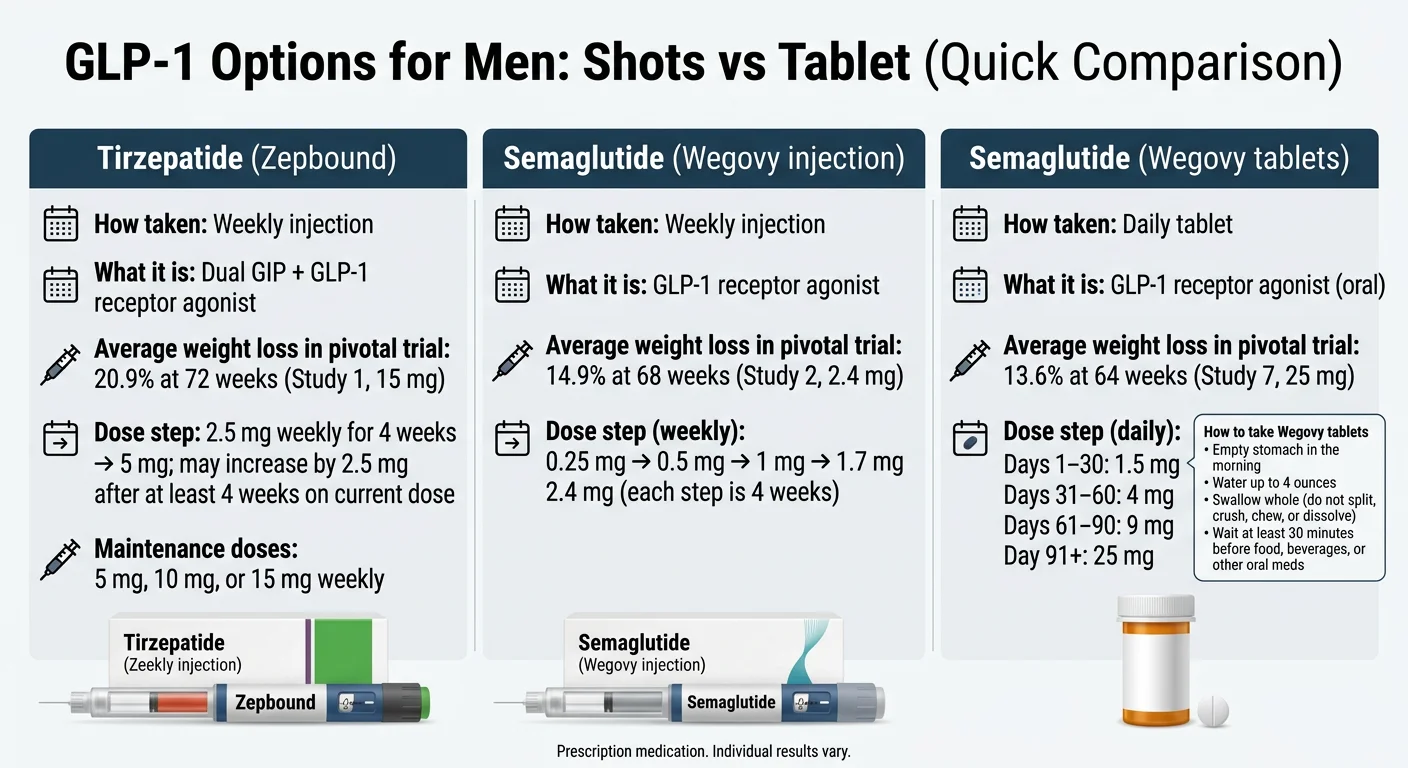
Prescription medication. Individual results vary.
One thing that matters for men specifically: the medication is only half the equation. If you're not pairing it with resistance training and adequate protein, you'll lose muscle along with fat. We cover the muscle protection plan later — don't skip it.
What Is the Best GLP-1 Program for Men (Paying Cash)?
This is where most pages fall apart. They list medications but never help you figure out where to actually get them — or what you'll really pay after month one.
We reviewed over 10 telehealth GLP-1 programs. Below are the ones worth your time, with pricing we verified in March 2026.
| Provider | Month 1 | Ongoing Price | Medication Options | Support | Cancel Policy | Best For |
|---|---|---|---|---|---|---|
| MEDVi | $179 | $299 (sema); $349+ (tirz) | Compounded semaglutide or tirzepatide (injection or tablet) | 24/7 support + provider | Cancel anytime, 72hr notice | Best overall value + support |
| Embody | $99 | $299 | Compounded semaglutide or tirzepatide; needle-free GLP-1 gum | 24/7 messaging | Cancel anytime | Low first-month price + needle-free gum |
| TrimRX | Varies | Varies | Compounded semaglutide/tirzepatide | Provider messaging | Varies | Budget-focused |
| Yucca Health | ~$146* | Varies | Compounded semaglutide | Telehealth visits | Varies by plan | Low monthly starting price |
| SkinnyRX | Varies | Varies | Compounded semaglutide | Provider access | Varies | Straightforward program |
| Hims | From $199 | $199 (6-mo plan) | Compounded + brand-name GLP-1s; oral kits from $69/mo | 24/7 messaging, app | Varies by commitment | Brand-name option available |
Pricing is cash-pay (no insurance). Compounded medications are prepared by licensed compounding pharmacies and are prescribed by licensed providers — but they are not FDA-approved products. See our compounded safety section for what to ask before starting. Prices verified March 2026 and are subject to change.
Important: The “month 1” price is almost never what you'll pay long-term. Always check the ongoing price before you commit. We flag this in every provider review below.
“Lost 16 lbs in 10 weeks — no side effects. Down two sizes. I wish I’d started sooner.”
— Verified MEDVi patient on ConsumerAffairs ★★★★★
Which Program Fits YOUR Situation? (Pick Your Path)
Not everyone needs the same thing. Here's the shortcut:
You're a man over 50 and worried about muscle and testosterone → Start with MEDVi. Their tirzepatide option offers the most aggressive fat loss, and emerging research (more below) suggests GLP-1 treatment may actually support testosterone recovery in men with excess weight. Pair with resistance training — non-negotiable at this age.
You're under 40 and want to drop 20–40 lbs while still lifting → MEDVi or Embody. Ask your provider about tirzepatide and follow the muscle preservation protocol in this guide.
You're on a tight budget (under $200/mo) → MEDVi's semaglutide program at $179/mo is the most affordable entry point we found with full provider support. Yucca Health also advertises low starting prices — verify the ongoing rate and what's included before committing.
Your insurance covers GLP-1s → Skip telehealth for now. Go through your primary care doctor or an endocrinologist for brand-name Wegovy or Zepbound. Your copay may be lower than any cash-pay program.
You hate needles → MEDVi offers a daily tablet option, and Embody offers a needle-free GLP-1 gum. The new Wegovy pill (brand-name, through your doctor or Hims) is another strong choice if you can follow the empty-stomach dosing instructions every morning.
You want FDA-approved brand-name medication only → Hims offers both compounded and brand-name GLP-1s. Or go through your doctor. Brand-name will cost more, but some men prefer the certainty.
You're pre-diabetic or have Type 2 diabetes → Talk to your doctor first — seriously. GLP-1s can address both weight and blood sugar, and your diabetes medication may already be a GLP-1 (like Ozempic or Mounjaro). Insurance coverage is more likely for diabetes-indicated use. See our guide on GLP-1 for prediabetes.
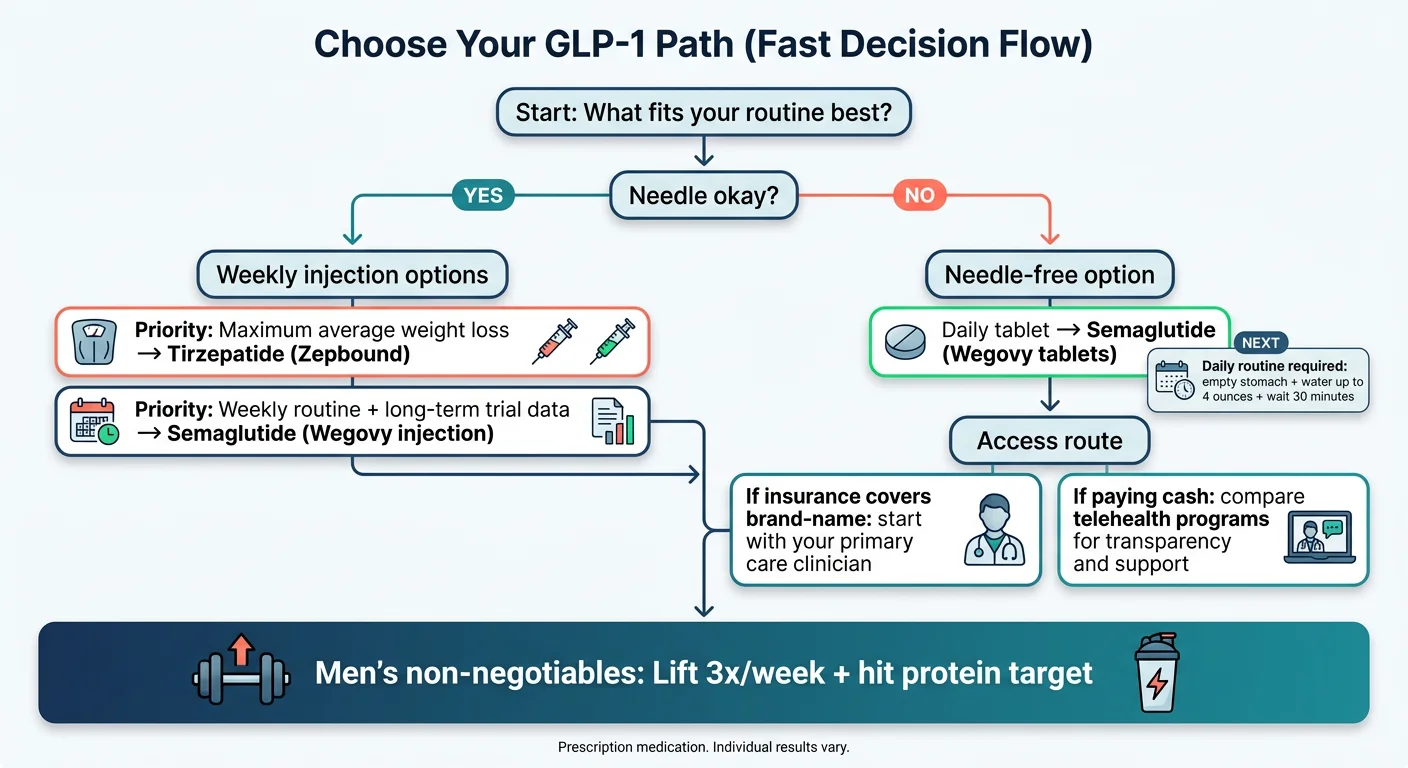
Prescription medication. Individual results vary.
Do GLP-1s Work Differently for Men? What the Research Actually Says
This is the section most GLP-1 pages skip entirely — and it's the one men actually need.
Men Lose Less Weight on GLP-1s Than Women (But It Still Changes Your Life)
Let's start with the honest number. A March 2026 systematic review and meta-analysis published in JAMA Internal Medicine — led by researchers at Johns Hopkins Bloomberg School of Public Health and covering 64 randomized clinical trials — found that in the 6 trials (19,906 participants) that reported weight-loss outcomes by sex, men lost an average of 6.78% of their starting body weight on GLP-1s, compared to 10.88% for women.
That's a real gap. For a 250-pound man, 6.78% means about 17 pounds. Not the dramatic “I lost 50 pounds” story you see on social media. Those stories are real too — they just represent the high end, not the average.
But here's what that headline number misses:
Even moderate weight loss in men produces outsized health improvements. A 5–10% reduction in body weight is clinically significant. It can meaningfully improve blood pressure, blood sugar, cholesterol levels, sleep apnea severity, joint pain, and cardiovascular risk markers. For a man carrying 30, 50, or 80 extra pounds, losing 15–25 of them can feel like getting 10 years of your life back.
The researchers noted the sex difference may relate to estrogen interactions, differences in how the medications are metabolized, and the fact that women typically start with lower body weight. The key takeaway: GLP-1s absolutely work for men — just set your expectations based on data, not Instagram.
GLP-1s and Testosterone: This Is Actually Good News
Here's where it gets interesting — and where most men's fears are backward.
If you're worried GLP-1 treatment will tank your testosterone, the evidence says the opposite. Research presented at ENDO 2025 (the Endocrine Society's annual meeting) found that men treated with GLP-1 medications experienced significant increases in both total and free testosterone levels.
A November 2025 meta-analysis published in BMC Urology confirmed it: GLP-1 receptor agonist use was associated with significantly increased bioavailable testosterone and improved blood sugar control.
The mechanism makes sense when you think about it. Excess body fat — especially visceral fat around your midsection — contains an enzyme called aromatase that converts testosterone into estrogen. As you lose fat, that conversion drops. Your testosterone rises. Your hormonal balance starts to normalize.
A pharmacist at Legacy Community Health put it simply: “While GLP-1s are not FDA-approved to treat hormone imbalance, the weight loss they promote can actually help improve reproductive health. So far, studies have not shown negative effects on sperm count or erectile function.”
Bottom line: For overweight men with low-normal testosterone, GLP-1 treatment doesn't hurt your T — it may be one of the better things you can do for it.
Will You Lose Muscle? Yes — But You Can Control How Much
This is the one legitimate trade-off, and you should know about it.
Meta-analyses of GLP-1 trials show that approximately 25–33% of total weight lost can come from lean mass — not just fat. That means if you lose 20 pounds, roughly 5–7 of those might be muscle. For a man who cares about strength and body composition, that matters.
But here's the critical part: this is not a medication problem. It's a lifestyle problem. The muscle loss happens because men on GLP-1s eat less (that's the point), and if they don't deliberately protect their muscle through training and nutrition, the body breaks down both fat and muscle for energy.
The fix is straightforward and well-documented:
- Lift weights at least 3 times per week. Compound movements — squats, deadlifts, bench press, rows. Progressive overload. This is the single most powerful muscle-preservation tool you have.
- Hit your protein target. Aim for 0.7–1.0 grams of protein per pound of your goal body weight, every day. If your appetite is suppressed, protein shakes count.
- Don't skip meals entirely. Some men on GLP-1s go most of the day without eating because they're not hungry. Your muscles don't care that you're not hungry — they need fuel.
If you do these three things, you can lose primarily fat while maintaining most of your lean mass. A 2025 review in Taylor & Francis specifically addressed this issue for men, concluding that combining GLP-1 therapy with resistance training and (when indicated) testosterone support represents a strong approach for male body composition.
Think of it this way: the GLP-1 handles the fat loss. Your job is to protect the muscle. Both parts matter.
GLP-1s, Erections, and Sexual Health: What You Actually Need to Know
We know you're wondering. Most men won't ask their doctor about this, so we'll cover it here.
The FDA adverse event database from 2003 to 2024 recorded only 182 cases of male sexual dysfunction among millions of GLP-1 users. That's an extremely low rate.
More encouraging: research presented at ENDO 2025 suggested GLP-1s may actually improve erectile function, likely through improved blood flow from weight loss and reduced vascular inflammation. Separately, a 2025 systematic review found that GLP-1 treatment in obese men improved sperm concentration, motility, and morphology — meaning fertility may benefit, not suffer.
The clinical takeaway: GLP-1 medications appear to be safe for male sexual health, and the weight loss they produce may actively improve erectile function, hormone levels, and fertility. If you have specific concerns, bring them to your prescriber — but don't let fear of sexual side effects stop you from starting treatment.
Provider Reviews: The Details That Matter
Below, we break down each provider using the same criteria so you can compare fairly. We focus on what men specifically need to know: pricing transparency, medication options, and how easy it is to get started and get out if needed.
MEDVi — Best Overall for Men Paying Cash
The short version: MEDVi offers the best combination of price, support, and speed for men who want to start GLP-1 treatment without insurance. Approval is often same-day, medication ships to your door, and you get 24/7 support team access plus licensed provider oversight.
Pricing:
- Semaglutide injections: $179 first month, $299/mo ongoing (includes physician review, personalized plan, medication, and shipping)
- Tirzepatide injections: Starting from $349/mo (verify current pricing on MEDVi's site)
- Daily tablets: Pricing varies — check with MEDVi for current rates
- No hidden fees, no contracts
- HSA/FSA cards accepted (coverage not guaranteed — check with your plan)
Medications offered:
- Compounded semaglutide (injection)
- Compounded tirzepatide (injection)
- Daily dissolvable GLP-1 tablets
- B12 often included with injections
- Brand-name options (Wegovy, Ozempic) available upon request — insurance may reimburse
How it works:
- Complete a brief online health assessment (~5 minutes)
- A licensed provider reviews your information (usually within 24 hours)
- If approved, your prescription ships directly to your door
- Ongoing: 24/7 support team messaging plus access to licensed providers for dosage adjustments, side effect management, and questions
Medical oversight: MEDVi works with OpenLoop Health, a network of US-licensed physicians. Labs (through partner labs including LabCorp) are included when medically necessary — no extra charge.
What real men are saying: One verified reviewer on ConsumerAffairs (December 2025) — a man, 5'8”, over 50 — described losing 20 pounds in two months on tirzepatide. He reported appetite suppression that felt automatic, with early nausea that resolved within two weeks. Another reviewer credited MEDVi with helping him break through a post-gastric-sleeve plateau, noting improvements in cholesterol, blood pressure, and A1C levels.
The honest downside: MEDVi's compounded medications are not FDA-approved products. They're prescribed by licensed physicians and prepared by licensed compounding pharmacies (Belmar Pharma Solutions, Beluga Health) — but they're not the exact same product as brand-name Wegovy or Zepbound. For the vast majority of men, this is a reasonable trade-off that saves hundreds of dollars per month. But if you specifically need FDA-approved brand-name medication, MEDVi isn't your best fit.
Best for: Men paying cash who want fast treatment start, strong ongoing support, and the most affordable entry price we've found.
“Lost 16 lbs in 10 weeks — no side effects. Down two sizes. I wish I’d started sooner.”
— Verified MEDVi patient on ConsumerAffairs ★★★★★
Embody — Best Low-Cost Starter with a Needle-Free Gum Option
The short version: Embody is a cash-pay telehealth program offering compounded semaglutide and tirzepatide as weekly injections — plus a needle-free GLP-1 gum, its key differentiator. If you want a low first-month price and the option to skip needles, Embody gives you that flexibility.
Pricing: From $99 the first month for semaglutide injection, then $299/mo ongoing. Other forms cost more — semaglutide gum from $149, tirzepatide injection from $149, tirzepatide gum from $199 — with refills running $299–$449/mo depending on medication and form. No insurance; HSA/FSA accepted. Cancel anytime.
What stands out: 24/7 care-team messaging, a needle-free GLP-1 gum option, both semaglutide and tirzepatide, and a fast online intake — if a licensed provider approves treatment, medication ships to your door. Good option for men who want the lowest first-month price or want to avoid injections.
Honest downside: The $99 is a first-month intro price — ongoing refills are higher, so confirm your medication and form's ongoing rate before starting. Embody's shipped options are compounded, not FDA-approved finished drugs, and it does not bill insurance.
Best for: Men who want the lowest first-month price or a needle-free GLP-1 gum option.
TrimRX — Budget-Friendly Option
The short version: TrimRX focuses on making compounded GLP-1 treatment accessible at competitive prices. A good option to evaluate if budget is your primary concern.
Best for: Men who want to keep monthly costs as low as possible and don't need premium support features. Read our full TrimRX review.
Yucca Health — Competitive Pricing, Verify the Details
The short version: Yucca advertises some of the lowest starting prices in the space (around $146/mo on a 6-month plan). The catch: make sure you understand what plan structure gets that price and what ongoing costs look like.
Honest note: Low-price leaders in telehealth GLP-1 often require multi-month commitments for their advertised rates. Ask specifically: what's the month-to-month price? What's included? What's the cancellation process? Read our full MEDVi vs Yucca comparison.
SkinnyRX — Straightforward Programs
The short version: SkinnyRX offers compounded semaglutide programs with a no-frills approach. Less marketing gloss, more functional access. Read our full SkinnyRX review.
Hims — Best If You Want Brand-Name FDA-Approved Medication
The short version: Hims is one of the few telehealth platforms that offers both compounded GLP-1s and brand-name FDA-approved medications (Wegovy, Ozempic). They also have oral medication kits starting at $69/mo for men who want to try a non-injectable approach first.
Pricing: Injectable GLP-1 plans from $199/mo on a 6-month plan (paid upfront). Oral kits from $69/mo on a 10-month plan.
Honest downside: The best pricing requires longer plan commitments (6–10 months paid upfront). Not available in all 50 states for GLP-1s. And Hims is a general men's health platform — not a GLP-1 specialist — so the depth of weight-loss-specific clinical support may differ from dedicated programs.
Best for: Men who want FDA-approved brand-name medication through a recognized telehealth platform and are comfortable with a longer payment commitment.
Why Do Men Search “Best GLP-1” Instead of Just “Wegovy” or “Zepbound”?
Because the question isn't really about the drug. It's about permission, safety, and not making an expensive mistake.
Most men typing this search have already decided they're interested in GLP-1 treatment. What they haven't decided is whether it's the right move — for them, specifically, as a man. And that hesitation comes from somewhere real.
The “I don't want to get smaller” fear. Women's weight loss goals and men's weight loss goals are fundamentally different. Most men don't want to just see a smaller number on the scale — they want to lose the gut while keeping (or building) their shoulders, chest, and arms. The fear of looking skinny-fat or losing the strength they've built is legitimate, and it's why the muscle preservation section of this guide exists.
The “this is for women” perception. GLP-1 marketing has skewed heavily toward women. Most before-and-after photos feature women. Most testimonials are from women. Men see this and wonder: does this actually work for me the same way? (Answer: yes, though the average weight loss is somewhat lower — see our data above.)
The “am I giving up?” identity question. There's a stubborn cultural narrative that real men should be able to fix their weight through discipline alone. That narrative ignores biology. Obesity has hormonal, genetic, and metabolic components that willpower doesn't override. Using a GLP-1 isn't admitting defeat — it's deploying an effective tool.
The pricing skepticism. Men tend to research purchases heavily before committing. A $179–$299/month medical commitment triggers the “is this a scam?” filter. It should. That's why we verify pricing, check pharmacy credentials, and publish our methodology.
If any of this sounds like what's been running through your head — good. You're being thoughtful, not weak. Now let's keep going.
Are GLP-1 Patches, Supplements, or “Boosters” Real?
Your search results are full of searches for “best GLP-1 supplement for men,” “GLP-1 patches,” and “GLP-1 boosters.” Let's be direct: none of these are real GLP-1 medications.
There is no FDA-approved GLP-1 receptor agonist available over the counter. Period. The products marketed as “GLP-1 supplements” typically contain things like berberine, cinnamon, probiotics, or turmeric — ingredients that may have minor metabolic benefits but do not replicate what prescription GLP-1 medications do.
The FDA has specifically warned consumers about products falsely marketed as GLP-1 drugs for weight loss. Some contain undisclosed active ingredients. Others make claims that have no clinical basis. A few are outright dangerous.
Red flags to watch for:
- “No prescription needed” for anything claiming GLP-1 effects
- “GLP-1 patch” (no FDA-approved GLP-1 comes in patch form)
- “Natural GLP-1 booster” (no supplement meaningfully amplifies this for weight loss)
- “Research peptide” sold directly to consumers without a prescription
If you want real results, you need a real prescription from a real provider. The good news: access has never been easier or more affordable. Programs like MEDVi start at $179/mo for compounded semaglutide — less than many people spend on supplements that don't work.
What Side Effects Should Men Expect?
GLP-1 side effects are well-documented and mostly temporary. Here's what to expect and what to watch for:
Normal and Expected (Usually Resolves in 2–4 Weeks)
Nausea is the most common side effect, especially during the first few weeks and after dose increases. It tends to fade as your body adjusts. Eating smaller meals, staying hydrated, and avoiding greasy foods helps.
Reduced appetite — this is technically the mechanism of action, not a side effect. But it can feel extreme at first. Some men describe “forgetting to eat.” You still need to eat. Especially protein.
GI issues (constipation, diarrhea, or both) are common early on. Fiber, water, and time typically resolve them.
Fatigue during the first couple of weeks is normal. Your body is adjusting to eating significantly less.
Talk to Your Provider If You Experience
- Severe, persistent abdominal pain (potential pancreatitis or gallbladder issues)
- Persistent vomiting that prevents you from keeping fluids down (dehydration risk)
- Signs of allergic reaction (rash, swelling, difficulty breathing)
- Significant mood changes or depression
Contraindications — Who Should NOT Take GLP-1s
These medications are not for everyone. They are generally not recommended for people with:
- A personal or family history of medullary thyroid carcinoma (MTC) or Multiple Endocrine Neoplasia syndrome type 2 (MEN2)
- A history of pancreatitis
- Certain medication interactions — always disclose your full medication list to your prescriber
Any legitimate GLP-1 program will screen for these before prescribing. If a provider doesn't ask about your medical history, that's a red flag. Learn more about GLP-1 risks and downsides.
How to Lose Fat Without Getting Weaker: The Men's GLP-1 Muscle-Preservation Playbook
This is the section we wish every GLP-1 page had. Most don't, because most GLP-1 content isn't written with men in mind. Here's the protocol. It's simple, but you have to actually do it.
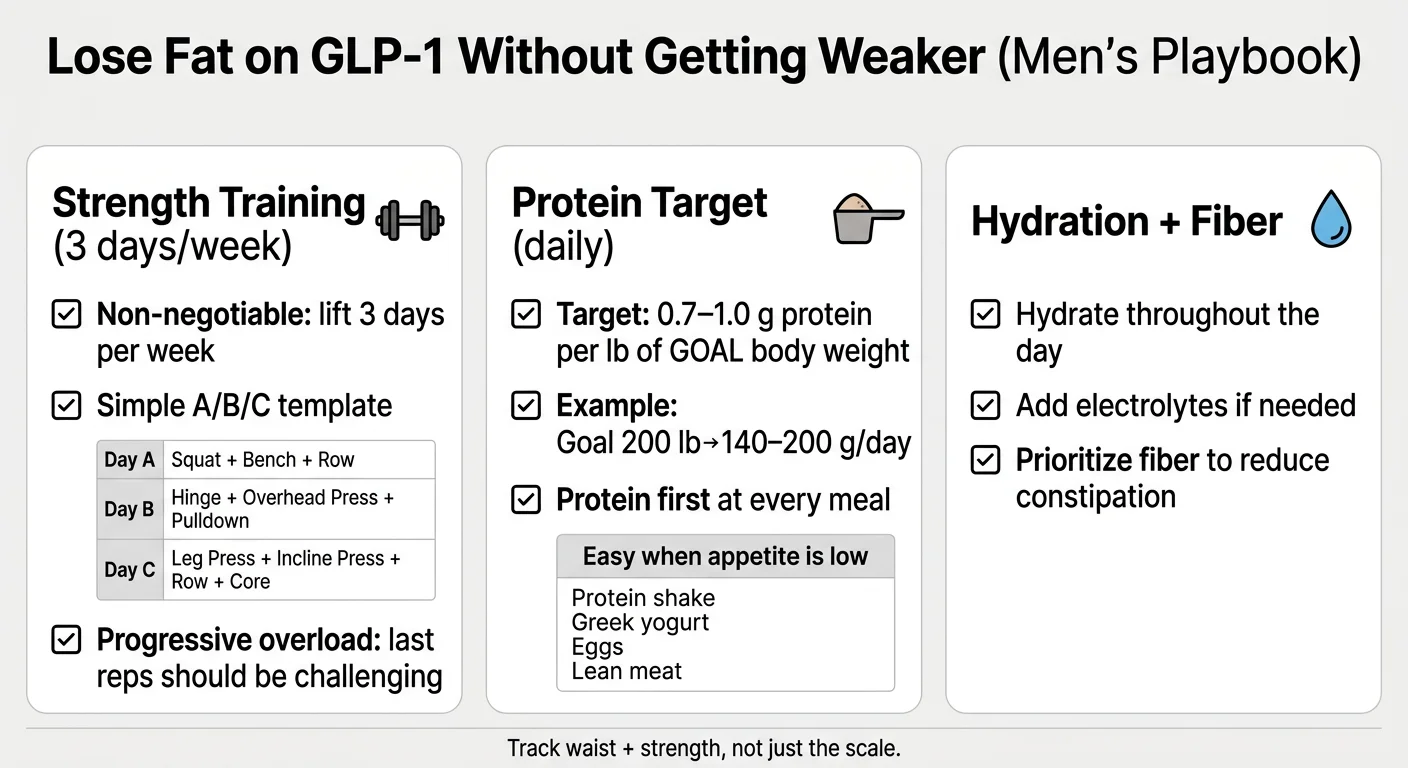
1. Resistance Training: 3 Days Per Week, Non-Negotiable
You don't need a complicated program. You need progressive overload with compound movements:
- Day A: Squat variation, bench press, rows
- Day B: Deadlift variation, overhead press, pull-ups/pulldowns
- Day C: Repeat A or add leg press, incline bench, cable work
Lift heavy enough that the last 2–3 reps of each set are genuinely challenging. If you can do 15 easy reps, the weight is too light to send a muscle-preservation signal.
2. Protein: 0.7–1.0g Per Pound of Goal Body Weight
If you weigh 240 and want to be 200, aim for 140–200g of protein per day. This sounds like a lot when your appetite is suppressed. Solutions that work:
- Protein shakes (whey or casein — 30–50g per shake)
- Greek yogurt, cottage cheese, eggs
- Prioritize protein at every meal, even if meals are small
- Consider timing: 25–40g of protein within a couple hours of training
3. Don't Skip Meals Entirely
When GLP-1s suppress your appetite, it's tempting to ride the wave and eat almost nothing. Resist that urge. Your muscles need amino acids throughout the day. Three smaller protein-rich meals beat one large meal or no meals at all.
4. Electrolytes and Hydration
Eating less means fewer electrolytes from food. Supplement sodium, potassium, and magnesium — especially if you're active. Dehydration on GLP-1s is a real risk that can cause headaches, fatigue, and in severe cases, kidney stress.
5. Track Body Composition, Not Just Scale Weight
The scale doesn't tell you whether you're losing fat or muscle. If possible, track waist circumference, progress photos, and strength levels. If your lifts are maintaining or improving while your waist shrinks, you're on the right track.
The men who get the best results on GLP-1s are the ones who treat the medication as one tool in a system — not the entire system. The medication handles appetite and hormonal signaling. You handle training, protein, and hydration. Together, the results are dramatically better than either alone.
What to Expect Month by Month on GLP-1 Treatment
Men want timelines. Here's a realistic one based on clinical data and real user reports:
Weeks 1–2: You'll notice appetite suppression, possibly within days. Nausea is most common during this window. You're on the lowest dose. Scale may or may not move yet. Focus on building protein and training habits now, while motivation is high.
Weeks 3–6: This is when most men see the first measurable weight loss — typically 3–7 pounds. Clothes start fitting differently. Energy levels may fluctuate. Side effects usually start tapering. Your dose may be increased at week 4.
Months 2–3: Weight loss accelerates as your dose increases. Expect 1–2 pounds per week on average. Appetite will feel dramatically different — food noise quiets down. This is the critical period to maintain protein intake even though you're not hungry.
Months 4–6: Steady progress. Most men have lost 10–20+ pounds by this point. Strength in the gym should be maintained or improving if you followed the protocol. Blood work improvements often visible here. The medication feels routine. Confidence builds.
Months 6–12: Rate of loss naturally slows as you approach a new set point. This is normal, not failure. Focus on body composition — waist circumference, how you look, how you perform — rather than the scale. Discuss with your provider whether to continue, maintain dose, or start tapering.
What most men don't expect: The psychological shift. Multiple men in reviews describe feeling “free” from constant food thoughts. The mental bandwidth that opens up when you're not battling cravings all day is something people rarely talk about, but it's one of the most meaningful changes. Learn more about what happens when you stop taking GLP-1s.
How Much Does GLP-1 Treatment Actually Cost in 2026?
Let's break down what you'll really pay, because the pricing landscape is confusing by design.
With Insurance
If your insurance covers GLP-1s for weight management, brand-name Wegovy or Zepbound may cost $25–$150/mo in copays depending on your plan. But coverage is far from universal — a 2025 Kaiser Family Foundation survey found that only 19% of large employer plans covered GLP-1s for weight loss. Check if HSA/FSA works for you.
Brand-Name Cash Price (No Insurance)
Brand-name Wegovy or Zepbound without insurance runs $1,000–$1,400/mo at most pharmacies. Manufacturer savings programs can reduce this significantly. For Wegovy pills specifically, Novo Nordisk offers self-pay pricing by dose: the starting 1.5 mg dose is $149/mo, with higher doses at $199–$299/mo depending on the tier.
Telehealth Programs (Compounded)
| Program | Month 1 | Month 2+ | 6-Month Total |
|---|---|---|---|
| MEDVi (semaglutide) | $179 | $299 | ~$1,674 |
| Embody | $99 | $299 | ~$1,594 |
| Yucca Health | ~$146* | Varies | Verify |
| Hims (injectable) | $199 | $199 (6-mo plan) | ~$1,194* |
| Hims (oral kit) | $69 | $69 (10-mo plan) | ~$414* |
*Hims pricing requires longer commitments paid upfront. Yucca pricing may require a multi-month plan. Always verify current rates. See our full cheapest GLP-1 without insurance breakdown.
Is Compounded Semaglutide or Tirzepatide Safe and Legal in 2026?
This is the trust section. We're going to be straight with you because your health depends on understanding this.
What “compounded” means: A compounding pharmacy creates a medication based on a physician's prescription, tailored to the patient. This is legal and has been part of medicine for decades. However, compounded medications are not FDA-approved as finished products. They haven't gone through the same regulatory review process as brand-name drugs. Learn more about compounded semaglutide.
The FDA's position: The FDA has publicly expressed concerns about unapproved GLP-1 drugs marketed for weight loss, particularly those that make misleading claims or come from pharmacies that don't meet quality standards. The FDA declared that the shortage of tirzepatide (Zepbound/Mounjaro) has been resolved, which limits when compounding pharmacies can produce copies. The regulatory landscape around compounded semaglutide continues to evolve.
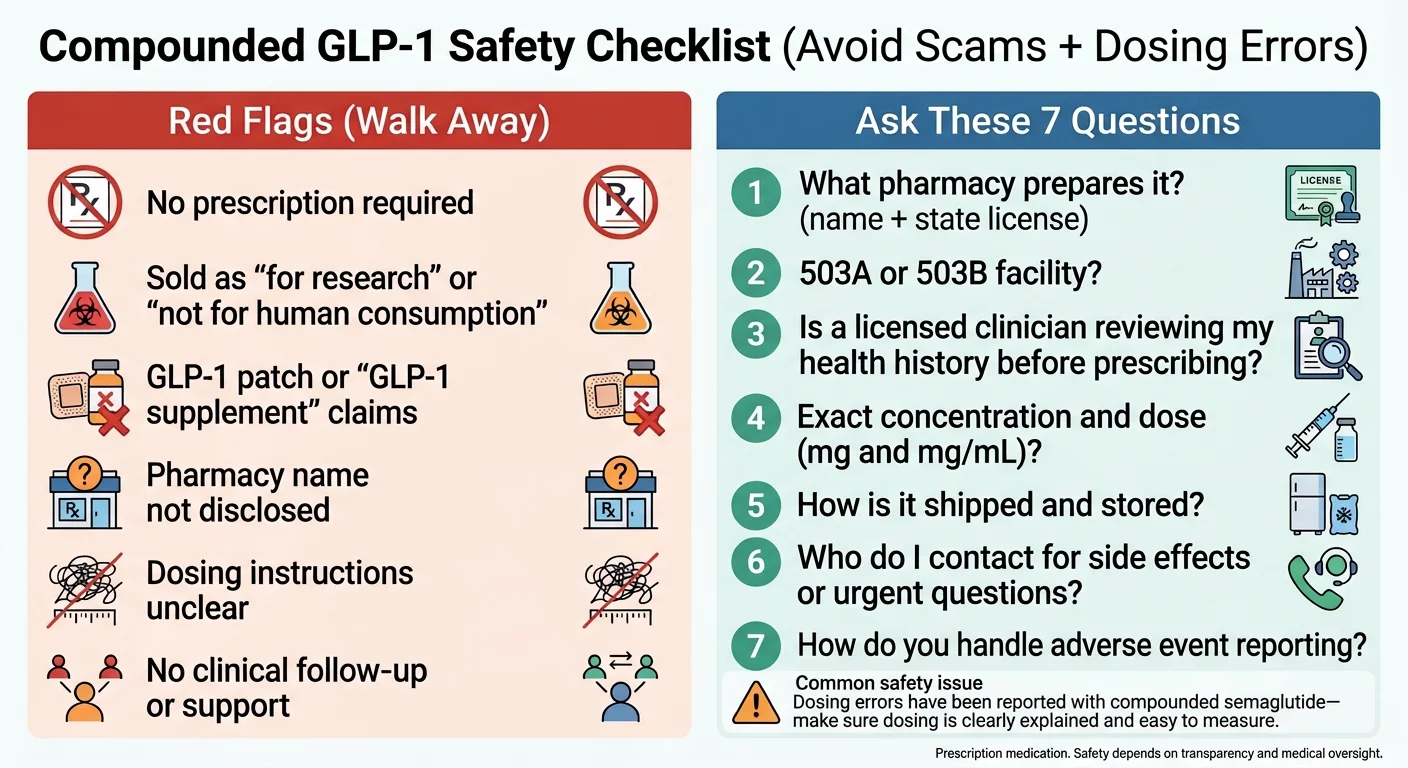
The Compounded GLP-1 Safety Checklist (Before You Start Any Program)
Before signing up for any program that offers compounded medications, ask these questions:
- What pharmacy prepares your medications? Get the name. Look it up.
- Is the pharmacy licensed as a 503A or 503B facility? Both are legal; 503B facilities have more oversight and are FDA-registered.
- Is a licensed physician actually reviewing my health history before prescribing? If you can get medication without a medical evaluation, walk away.
- What's the exact medication and dosage I'll receive? You should know precisely what's in your injection or tablet.
- How is the medication shipped and stored? Temperature-sensitive medications need proper cold-chain handling.
- What's the protocol for reporting adverse events? Legitimate programs have a process for this.
- What happens if I have a bad reaction at 2 AM? 24/7 support access matters more than you think.
MEDVi's pharmacy partners (Belmar Pharma Solutions and Beluga Health) are licensed facilities. Not every program in this space can say the same. Do your homework.
What Happens When You Stop Taking GLP-1 Medication?
We're not going to sugarcoat this: most people regain some weight after stopping GLP-1 treatment. Studies consistently show this. But context matters:
- The weight regain is usually partial, not total. Most people don't return to their starting weight, especially if they've maintained exercise and nutrition habits during treatment.
- The health benefits persist longer than the scale suggests. Cardiovascular improvements, metabolic changes, and habit formation carry forward even if some weight returns.
- Many men use GLP-1s as a “runway” to build sustainable habits. Think of it as buying yourself 6–12 months of dramatically reduced appetite to lock in training consistency, better food choices, and healthier routines.
- Some men stay on GLP-1s long-term. This is increasingly common and medically supported. Obesity is a chronic condition — there's no medical reason to treat GLP-1s as a short-term fix if ongoing treatment is warranted.
Read our in-depth guide: What happens when you stop taking GLP-1 medication.
Can I Take GLP-1s With Testosterone Replacement Therapy (TRT)?
Yes — and the combination may be particularly effective for men.
Emerging research suggests that GLP-1 medications and TRT address complementary pathways: GLP-1s drive fat loss and improve metabolic health, while testosterone supports muscle preservation, energy, mood, and body composition.
For men with both obesity and documented low testosterone (generally below 300 ng/dL), the clinical rationale for combining therapies is growing. A 2025 review noted that testosterone's anabolic effects can help counteract the lean-mass loss that sometimes accompanies GLP-1-driven weight loss.
Important: This combination requires proper medical supervision. Both medications have monitoring requirements (TRT needs periodic blood work for hematocrit, PSA, etc.; GLP-1s need metabolic monitoring). Don't self-prescribe. Work with a provider who understands both therapies.
How We Ranked These Programs (Our Methodology)
We believe you should be able to check our work. Here's exactly how we scored the programs on this page:
Pricing transparency (25%): Is the full cost — first month AND ongoing — clearly stated? Are there hidden fees for labs, shipping, or provider visits? Does the program use bait-and-switch intro pricing?
Medical oversight quality (20%): Are prescriptions written by licensed, US-based physicians? Is there a real health evaluation before prescribing? Is ongoing provider access available?
Medication quality and options (15%): What pharmacy partners prepare the medications? Are they licensed and inspectable? Is there a choice between injection and oral?
Male-specific suitability (15%): Does the program acknowledge or address men's health concerns — muscle preservation, testosterone, sexual health? Or is it generic weight-loss content?
User experience (10%): How fast is the approval process? Is the platform easy to navigate? What do real users say?
Cancellation and flexibility (10%): Can you cancel without a fight? Is there a refund policy? Are you locked into long-term contracts?
Review aggregation (5%): We checked ConsumerAffairs, Trustpilot, and BBB ratings for each provider.
What we didn't do: We did not personally take every medication from every provider. We are not doctors. We are a research and comparison team that evaluates publicly available information, published clinical data, and real user experiences. We earn affiliate commissions from some providers on this page — and we disclose that because we think you deserve to know. Read our full editorial standards.
FAQ: Every Question Men Ask About GLP-1s (Answered)
What is the best GLP-1 for men?
For maximum weight loss, tirzepatide (Zepbound/Mounjaro) leads the clinical data — about 21% body weight reduction at the highest dose in its pivotal trial. For a weekly shot with the most long-term cardiovascular evidence, Wegovy injection (semaglutide) is the strongest choice. For the best cash-pay program, we recommend MEDVi starting at $179/mo for semaglutide.
What's the best GLP-1 for men over 50?
The same medications work for men over 50 — a Johns Hopkins analysis found similar effectiveness across age groups (under 65 vs. 65+). However, muscle preservation becomes more critical after 50. Prioritize resistance training, adequate protein, and consider discussing testosterone monitoring with your provider.
What's the best GLP-1 for men over 40?
Both tirzepatide and semaglutide are effective for men in their 40s. At this age, you're likely balancing career demands, family life, and fitness. A weekly injection (minimal time investment) paired with a basic lifting routine 3x/week is the practical sweet spot.
Which GLP-1 causes the most weight loss?
Tirzepatide (Zepbound). The SURMOUNT-5 trial published in the New England Journal of Medicine (2025) showed tirzepatide produced significantly greater weight and waist circumference reductions than semaglutide over 72 weeks — about 20% vs. 14% on average.
Is the Wegovy pill as effective as the shot?
Close, but the shot has a slight edge. In its pivotal trial, the Wegovy tablet achieved approximately 13.6% body weight loss at 64 weeks, while the Wegovy injection achieved approximately 14.9% in its key weight-management trial. The pill requires strict daily dosing: empty stomach, up to 4 oz of water, wait 30 minutes before eating or drinking anything else.
How fast do men lose weight on GLP-1s?
Most men notice appetite changes within the first week or two. Visible weight loss typically appears by weeks 4–8. The medication works gradually — dose escalation happens monthly. Expect steady progress, not overnight transformation.
Will GLP-1s affect my testosterone or libido?
Current evidence suggests GLP-1s may improve testosterone levels in men with excess weight, by reducing fat mass and improving metabolic function. A meta-analysis found significant increases in bioavailable testosterone after GLP-1 treatment. Negative effects on libido or sexual function have not been consistently reported in clinical trials.
Can I take GLP-1s while on TRT?
Yes, with medical oversight. The combination is gaining clinical interest as a strategy for men with both obesity and low testosterone. GLP-1s address weight and metabolic health; TRT supports muscle, energy, and hormonal balance. Ensure your provider is monitoring both therapies.
Do GLP-1s cause erectile dysfunction?
No reliable evidence supports this. FDA adverse event data from 2003–2024 showed only 182 reports of male sexual dysfunction among millions of GLP-1 users. Research suggests the weight loss may actually improve erectile function.
Can you buy GLP-1 over the counter?
No. All GLP-1 receptor agonists require a prescription. Anything sold OTC claiming to be a "GLP-1" is not the real thing. Be especially skeptical of "GLP-1 supplements," "GLP-1 patches," and "GLP-1 boosters."
Are GLP-1 supplements or patches legitimate?
No. There are no FDA-approved GLP-1 receptor agonists in supplement or patch form. Products using these terms are typically combinations of vitamins, herbs, or probiotics that do not replicate the effects of prescription GLP-1 medications. The FDA has warned consumers about products falsely marketed this way.
Is compounded semaglutide safe?
Compounded semaglutide from a licensed compounding pharmacy, prescribed by a licensed physician, is a legal and widely used pathway to GLP-1 treatment. However, compounded medications are not FDA-approved as finished products. Quality depends on the pharmacy. Use our safety checklist to evaluate any program before starting.
How much do GLP-1 programs cost without insurance?
Cash-pay telehealth programs range from about $146–$349/mo for compounded options, depending on the medication. Brand-name Wegovy or Zepbound without insurance runs $1,000+/mo, though manufacturer programs can bring this down. MEDVi starts at $179 for compounded semaglutide ($299 ongoing).
What happens when you stop taking GLP-1s?
Most people regain some weight after discontinuing. The degree depends on lifestyle habits maintained during treatment. Medical guidance recommends tapering gradually rather than stopping abruptly. Some men choose to stay on GLP-1s long-term, similar to other chronic disease medications.
How long should men stay on GLP-1s?
There's no universal answer. Some men use them for 6–12 months to reach a target weight, then taper off while maintaining exercise and nutrition habits. Others stay on them longer-term. Obesity is a chronic condition, and ongoing treatment is medically appropriate for many people.
Can I drink alcohol on GLP-1s?
Technically yes, but many men find their alcohol tolerance decreases significantly on GLP-1s. The combination can worsen nausea and GI symptoms. Many users report naturally drinking less because the medication reduces the appeal of alcohol alongside food cravings.
What should I eat if I have no appetite on GLP-1s?
Focus on protein-dense, nutrient-rich foods even when you're not hungry. Protein shakes, Greek yogurt, eggs, lean meats, and cheese are all easy to consume in small amounts. Eat something every 4–6 hours even if you don't feel hungry. Your muscles need fuel.
What's the difference between a 503A and 503B compounding pharmacy?
A 503A pharmacy compounds medications based on individual prescriptions, typically under state regulation. A 503B outsourcing facility can produce larger batches and is registered with the FDA, subject to additional federal oversight including periodic inspections. Both are legal. 503B facilities generally offer more regulatory transparency.
Will my doctor judge me for asking about GLP-1s?
Unlikely. Most primary care physicians and endocrinologists are well aware of GLP-1 medications and recognize obesity as a medical condition, not a character flaw. If your doctor dismisses your interest without discussion, consider seeking a second opinion.
How do GLP-1s compare to bariatric surgery for men?
GLP-1 medications produce less dramatic weight loss than bariatric surgery (which can result in 25–35% body weight reduction) but are non-surgical, reversible, and carry fewer acute risks. For men with BMI over 40, or over 35 with serious comorbidities, surgery may still be the stronger option.
Can I take GLP-1s if I have sleep apnea?
Yes — in fact, Zepbound (tirzepatide) is specifically FDA-approved for obstructive sleep apnea in addition to weight management. Sleep apnea disproportionately affects men, and weight loss from any GLP-1 typically improves symptoms.
Is there a GLP-1 specifically designed for men?
No GLP-1 medication is formulated specifically for one sex. The same medications (semaglutide, tirzepatide, liraglutide) are prescribed to both men and women. However, the way men experience them — including effects on testosterone, muscle mass, and body composition — differs enough that men benefit from male-specific guidance.
What does 'Ozempic face' mean, and should men worry about it?
'Ozempic face' is a colloquial term for facial volume loss that can occur with significant weight loss — from any method, not just GLP-1s. For most men losing a moderate amount of weight (15–30 lbs), it's a non-issue.
Can I combine a GLP-1 with phentermine or other weight-loss drugs?
Some providers prescribe combination approaches (e.g., oral medication kits with metformin, bupropion, or topiramate alongside GLP-1s). This should only be done under medical supervision. Don't combine medications on your own.
What's the difference between Ozempic and Wegovy?
Both contain semaglutide. Ozempic is FDA-approved for type 2 diabetes and cardiovascular risk reduction. Wegovy is FDA-approved for weight management. They're dosed differently. Ozempic is sometimes prescribed off-label for weight loss, but Wegovy is the version specifically indicated for it.
How do I verify a compounding pharmacy?
Ask the GLP-1 program for the pharmacy name. Check the pharmacy's state license through your state Board of Pharmacy. For 503B outsourcing facilities, you can search the FDA's registered facility database. Look for recent inspection reports and any warning letters.
Your Next Step
You've read the research. You've seen the data. You know which medications work, what they cost, and which concerns are legitimate versus overblown.
Now it comes down to three paths:
Path 1: You have insurance that covers GLP-1s. Call your doctor or insurance company. Ask specifically about Wegovy or Zepbound coverage for weight management. If it's covered, that's your best move.
Path 2: You want to start quickly, paying cash. MEDVi is where we'd point most men. Semaglutide from $179 to start, 24/7 support, fast approval, and flexible medication options. The assessment takes five minutes.
Path 3: You're still not sure. That's fine. Bookmark this page. Talk to your doctor at your next visit. Or scroll back to our comparison table and decision framework to narrow your options. The medication will still be here when you're ready.
What won't wait is the cost of doing nothing. Every month of carrying excess weight is a month of elevated blood pressure, compromised sleep, joint stress, and hormonal imbalance. GLP-1 medication doesn't fix everything — but combined with training and nutrition, it gives your body the reset it's been unable to achieve on willpower alone.
You're not weak for considering this. You're being strategic. There's a difference.
“Lost 16 lbs in 10 weeks — no side effects. Down two sizes. I wish I’d started sooner.”
— Verified MEDVi patient on ConsumerAffairs ★★★★★
Sources and References
- Alexander, G.C. et al. “GLP-1 Weight-Loss Drugs Comparably Effective for Patients Across Age, Race, and Starting Weight.” JAMA Internal Medicine, March 2026. Johns Hopkins Bloomberg School of Public Health.
- Aronne, L.J. et al. “Tirzepatide as Compared with Semaglutide for the Treatment of Obesity.” New England Journal of Medicine, 393(1), 26–36. 2025.
- Orra, S.H. et al. “Effect of GLP-1 agonists on testosterone levels: a systematic review and meta-analysis.” BMC Urology, 25(1):311. November 2025.
- Portillo Canales, S. et al. “GLP-1 Medications May Improve Low Testosterone in Men.” Presented at ENDO 2025, San Francisco. July 2025.
- ICS-EUS 2025, Abstract #166. “Effects of GLP-1 Receptor Agonists on Testosterone Levels and Semen Parameters in Men: A Systematic Review.”
- U.S. Food and Drug Administration. “FDA's Concerns About Unapproved GLP-1 Drugs Used for Weight Loss.” Updated 2025.
- FDA Prescribing Information: Wegovy (semaglutide) injection. Revised 2025.
- FDA Prescribing Information: Wegovy tablets (oral semaglutide). Approved December 2025.
- FDA Prescribing Information: Zepbound (tirzepatide). 2023/2024.
- Kaiser Family Foundation. “2025 Employer Health Benefits Survey.” October 2025.
- Obesity Medicine Association. “Top Weight Loss Medications.” Updated February 2026.
- Norton, R. PharmD, AAHIVP. Commentary on GLP-1s and men's health. Legacy Community Health. July 2025.
- MEDVi verified customer reviews via ConsumerAffairs and Trustpilot. Accessed March 2026.
- Idris, I. “Potential new therapies to preserve lean muscle mass loss when used in combination with GLP-1 receptor agonists.” Diabetes, Obesity and Metabolism Now. 2024.
- Tandfonline. “The male hormone reset: how GLP-1RAs, lifestyle and testosterone transform obesity-linked problems.” 2025.
- Ivim Health. “GLP-1 for Men: Benefits & Hormone Effects.” September 2025.
This page is for informational purposes only and is not medical advice. Always consult a licensed healthcare provider before starting any medication. GLP-1 receptor agonists are prescription medications with potential risks and side effects. Compounded medications referenced on this page are not FDA-approved products. Individual results vary. WeightLossProviderGuide.com may receive compensation from providers featured on this page — see our methodology for how we evaluate and rank programs independently of our affiliate relationships.