SURMOUNT-1 Through SURMOUNT-5 Summaries: What These Five Tirzepatide Trials Actually Found
By Weight Loss Provider Guide
Published: August 4, 2026 · Last verified: August 4, 2026 · Dataset version: 1.0
These are the SURMOUNT-1 through SURMOUNT-5 summaries, all in one place, with the numbers labeled so you can tell them apart.
The short answer: Across the two 72-week placebo-controlled trials, the treatment-regimen average ranged from 12.8% weight loss in SURMOUNT-2's 10 mg group to 20.9% in SURMOUNT-1's 15 mg group. The frequently quoted 22.5% is also a real SURMOUNT-1 result, but it comes from a different statistical question called the efficacy estimand. SURMOUNT-3 and SURMOUNT-4 use different starting clocks, so their larger total percentages cannot be dropped into the same ranking without explanation.
What changes the answer: If you have type 2 diabetes, SURMOUNT-2 is the closest of these five trials, with treatment-regimen averages of 12.8% and 14.7%. If you're comparing tirzepatide with Wegovy, only SURMOUNT-5 tested them head-to-head: 20.2% versus 13.7% under its primary modified treatment-regimen analysis. And if you're wondering what happened after withdrawal, SURMOUNT-4 found 14.0% average regain from week 36 to week 88 in the group switched to placebo—but that group still finished 9.9% below its original starting weight. These are group averages, not personal forecasts. (Current Zepbound prescribing information; SURMOUNT-4 primary paper; SURMOUNT-5 primary paper)
Here's the part almost nobody mentions. Four of these trials appear in the FDA-approved Zepbound prescribing information under different names. The fifth one—SURMOUNT-5, the head-to-head comparison with semaglutide—doesn't appear in the label at all. We pulled the current label and built the crosswalk. It's further down this page, and it prevents an easy mix-up between the label's “Study 5” and the entirely different trial named SURMOUNT-5.
SURMOUNT-1 Through SURMOUNT-5 Summaries at a Glance
Each trial answered a different question, and tirzepatide produced greater average weight reduction than its comparator in the population studied. The results are not a five-number leaderboard: the populations, lead-ins, baselines, comparators, doses, durations, and statistical methods changed from trial to trial.
| Trial | Who was studied | How long | Compared against | Headline treatment-regimen result |
|---|---|---|---|---|
| SURMOUNT-1 | 2,539 adults with obesity or overweight, without type 2 diabetes | 72 weeks | Placebo | −15.0% / −19.5% / −20.9% by dose vs. −3.1% |
| SURMOUNT-2 | 938 adults with obesity or overweight and type 2 diabetes | 72 weeks | Placebo | −12.8% / −14.7% vs. −3.2% |
| SURMOUNT-3 | 579 adults who first lost at least 5% during an intensive lifestyle lead-in | 72 weeks after a 12-week lead-in | Placebo | −18.4% more vs. +2.5% regained from randomization |
| SURMOUNT-4 | 670 adults who had already received tirzepatide for 36 weeks | 52 more weeks | Continued tirzepatide vs. placebo withdrawal | −5.5% more vs. +14.0% regained from rerandomization |
| SURMOUNT-5 | 751 adults with obesity—or overweight plus an obesity-related complication—without diabetes | 72 weeks | Semaglutide 1.7 or 2.4 mg | −20.2% vs. −13.7% |
The table leads with the treatment-regimen or modified treatment-regimen result because that is the broader randomized-group estimate used for the primary analysis shown here. It is a modeled estimate for the assigned groups regardless of premature treatment discontinuation—not a simple average of only the people who completed every dose, and not a raw “everyone who quit” count. The estimand section below explains the distinction.
What we actually verified
We're an independent comparison resource for GLP-1 telehealth providers, and we want you to know exactly how this page was built.
What we did:
- Downloaded the current FDA-approved Zepbound prescribing information, updated April 22, 2026, and pulled the label figures directly from it.
- Checked each trial's headline result against its primary paper in the New England Journal of Medicine, The Lancet, Nature Medicine, or JAMA.
- Recorded the ClinicalTrials.gov registry number for all five trials.
- Separated the treatment-regimen and efficacy estimands instead of treating them as interchangeable.
- Recorded where each trial's percentage clock begins.
- Counted how many people entered each lead-in versus how many reached the decisive randomized comparison.
- Checked every arithmetic transformation used on this page.
What we did not do: We did not run a trial. We did not obtain participant-level data or independently reanalyze it. We are not presenting this as medical review, and nothing here is medical advice. We read the source documents, normalized their definitions, and translated them into plain English.
Who paid for the trials: Eli Lilly funded all five and participated in their design or analysis as disclosed in the publications. That doesn't invalidate a randomized trial—but you should know it, and we'd rather tell you than have you find out somewhere else.
What this page does not transfer: The evidence below belongs to the injectable tirzepatide products and protocols that were actually studied. It does not establish the safety, effectiveness, quality, or equivalence of a compounded, oral, sublingual, gum, drop, or custom-dose product.
Why Does SURMOUNT-1 Get Quoted as Both 20.9% and 22.5%?
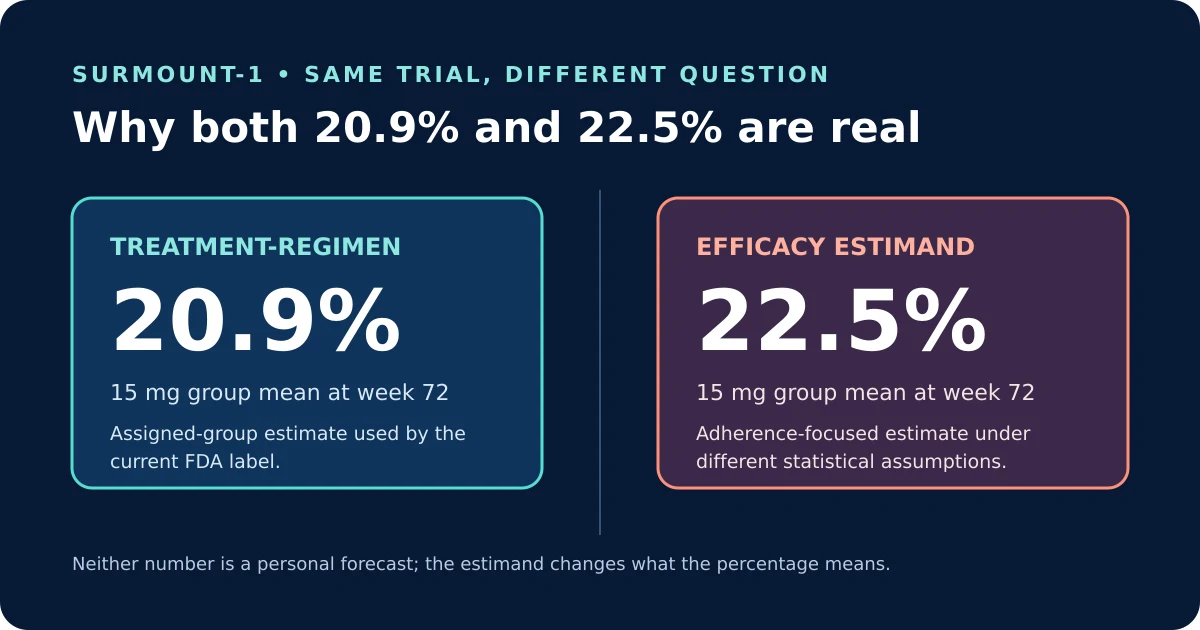
Both figures come from SURMOUNT-1, and both are legitimate—but they answer different statistical questions. The 20.9% figure is the 15 mg treatment-regimen estimate used in the current FDA label. The 22.5% figure is the efficacy-estimand result, which estimates the effect under the trial's adherence-focused assumptions. (SURMOUNT-1 primary paper; current Zepbound prescribing information)
This one distinction explains most of the confusion you've run into.
The language varies slightly by trial, but the practical split is:
- Efficacy estimand — an adherence-focused, hypothetical estimate of what the treatment effect would have been under the trial's specified assumptions if participants had remained on assigned treatment as intended.
- Treatment-regimen estimand — an estimate of the average effect in the randomized groups regardless of premature treatment discontinuation, using the trial's prespecified methods for observed and missing follow-up data.
- Modified treatment-regimen estimand in SURMOUNT-5 — the primary head-to-head analysis, which included data collected before and after treatment discontinuation except data after certain intercurrent events specified in the protocol.
In plain English: the efficacy estimate asks a closer-to-“if treatment were followed as planned” question. The treatment-regimen estimate asks a broader “what was the average randomized-group effect even when treatment did not go perfectly?” question.
That does not mean the treatment-regimen number is a raw average of every person who started, or that the efficacy number simply deletes everyone who quit. Both are modeled statistical estimates with prespecified methods for missing data and events such as discontinuation. Neither is fake. They answer different questions.
The SURMOUNT Baseline & Estimand Ledger
We built this table because we couldn't find one place that put the major mean weight-change estimates, both ways, beside the clock that produced them.
| Trial | Arm and measurement clock | Adherence-focused estimate (efficacy) | Regardless-of-discontinuation estimate | Gap |
|---|---|---|---|---|
| SURMOUNT-1 | 15 mg, randomization to week 72 | −22.5% | −20.9% | 1.6 points |
| SURMOUNT-1 | 10 mg, randomization to week 72 | −21.4% | −19.5% | 1.9 points |
| SURMOUNT-1 | 5 mg, randomization to week 72 | −16.0% | −15.0% | 1.0 point |
| SURMOUNT-1 | Placebo, randomization to week 72 | −2.4% | −3.1% | runs backward |
| SURMOUNT-2 | 15 mg, randomization to week 72 | −15.7% | −14.7% | 1.0 point |
| SURMOUNT-2 | 10 mg, randomization to week 72 | −13.4% | −12.8% | 0.6 point |
| SURMOUNT-2 | Placebo, randomization to week 72 | −3.3% | −3.2% | 0.1 point |
| SURMOUNT-3 | Lifestyle lead-in start through randomized-treatment week 72 (84 weeks total) | −26.6% | −24.3% | 2.3 points |
| SURMOUNT-3 | Randomization to week 72 | −21.1% | −18.4% | 2.7 points |
| SURMOUNT-4 | Continued tirzepatide, week 36 to week 88 | −6.7% | −5.5% | 1.2 points |
| SURMOUNT-4 | Switched to placebo, week 36 to week 88 | +14.8% | +14.0% | 0.8 point |
| SURMOUNT-4 | Continued tirzepatide, original week 0 to week 88 | −26.0% | −25.3% | 0.7 point |
| SURMOUNT-4 | Switched to placebo, original week 0 to week 88 | −9.5% | −9.9% | runs backward by 0.4 point |
| SURMOUNT-5 | Tirzepatide, randomization to week 72 | −21.6% | −20.2% | 1.4 points |
| SURMOUNT-5 | Semaglutide, randomization to week 72 | −15.4% | −13.7% | 1.7 points |
Sources: the five primary trial publications and the current FDA prescribing information. SURMOUNT-5 calls its primary column the modified treatment-regimen estimand. The “gap” is our arithmetic from the published means; it is descriptive, not a pooled or inferential analysis.
Three things jump out.
One. In the active-treatment rows, the adherence-focused estimate is usually larger. That's why it often becomes the marketing number. But the gap is not a universal correction factor: it changes by trial, arm, missing-data pattern, and estimand.
Two. Look at SURMOUNT-1's placebo row. It runs the opposite way—2.4% versus 3.1%. That's a real published result, and it's a useful reality check on anyone who tells you one estimand is automatically “inflated” by a fixed amount.
Three. SURMOUNT-5 did report both approaches. Its primary modified treatment-regimen result was 20.2% versus 13.7%; the efficacy-estimand analysis was 21.6% versus 15.4%. The trial was open-label and had no placebo group, but that does not make 20.2% a third, unclassifiable kind of number. It makes it the primary estimate from a different trial design. (SURMOUNT-5 primary paper)
Our rule on this page: we lead with the treatment-regimen or modified treatment-regimen number because it answers the broader randomized-group question and aligns with the current label where the trial is included. We show the efficacy estimate beside it when that explains a number you've seen elsewhere.
What readers keep asking
These are real questions people posted publicly. They're here because the language is honest—not as medical evidence.
“Dr. told me the average is only 20% loss—thoughts?” — r/Zepbound
“Does the weight come back no matter what?” — r/Zepbound
One more, paraphrased from a public post in r/GLPGrad: people keep citing the SURMOUNT trials as proof that everyone who stops Zepbound regains everything. That reading is wrong, and we show why below. (Public discussion)
Where Does the Percentage Clock Start?
The five trials did not all start counting at the same moment. SURMOUNT-1, SURMOUNT-2, and SURMOUNT-5 start the main clock at randomization. SURMOUNT-3 first ran a 12-week intensive lifestyle program and randomized only successful responders. SURMOUNT-4 first gave everyone tirzepatide for 36 weeks, then rerandomized those who reached that point. A bigger percentage does not always mean a stronger result—sometimes it means the clock started earlier.
This is the single most useful idea on this page. If you take one thing away, take this.
| Trial | What happened before the decisive comparison |
|---|---|
| SURMOUNT-1 | Nothing. The primary 72-week clock starts at drug randomization. |
| SURMOUNT-2 | Nothing. The primary 72-week clock starts at randomization in people with type 2 diabetes. |
| SURMOUNT-3 | A 12-week intensive lifestyle lead-in. Only people who lost at least 5% were randomized. That randomized group had already lost 6.9% on average. |
| SURMOUNT-4 | A 36-week open-label tirzepatide lead-in. The rerandomized group had already lost 20.9% on average. |
| SURMOUNT-5 | Nothing. The primary 72-week clock starts at head-to-head randomization. |
So when you see “26.6% weight loss” attached to SURMOUNT-3, that number includes weight lost during the lifestyle program before randomization. It's a real result. It just isn't the same kind of result as SURMOUNT-1's 20.9%.
The 340 People Who Never Reached the Decisive Comparison
Here's a piece of arithmetic we did ourselves from the published participant flows.
| Trial | Entered the relevant trial or lead-in | Reached the decisive randomized comparison | Difference |
|---|---|---|---|
| SURMOUNT-1 | 2,539 | 2,539 | 0 |
| SURMOUNT-2 | 938 | 938 | 0 |
| SURMOUNT-3 | 806 | 579 | 227 |
| SURMOUNT-4 | 783 | 670 | 113 |
| SURMOUNT-5 | 751 | 751 | 0 |
| Total | 5,817 | 5,477 | 340 |
Two of the five trials used lead-ins designed so that only some entrants reached the decisive comparison.
In SURMOUNT-3, 227 of 806 entrants (28.2%) did not reach randomization. Of those, 141 people—17.5% of the 806 who entered—did not meet the protocol's 5% lifestyle weight-loss threshold. The remaining nonrandomized entrants were excluded for other reasons reported in the trial flow.
In SURMOUNT-4, 113 of 783 entrants (14.4%) did not reach rerandomization at week 36. Adverse events were the most common reason for discontinuation before rerandomization, accounting for 6.8% of the 783 entrants. (Current Zepbound prescribing information)
Why this matters to you: SURMOUNT-3's headline describes people who had already responded to an intensive lifestyle program. SURMOUNT-4's randomized comparison describes people who had already remained through 36 weeks of tirzepatide and reached a maximum tolerated dose of 10 or 15 mg. Neither is a trick—those trials were designed to ask those questions. But if you're trying to figure out whether 26% is a number you might see, you deserve to know who was in the room when it was measured.
(The 5,817, 5,477, 340, 28.2%, 17.5%, and combined-flow comparison are our arithmetic from published counts. This is not a pooled efficacy analysis, and we deliberately do not calculate one combined average across the five trials—the populations, clocks, comparators, and estimands are too different for that number to mean anything.)
Which SURMOUNT Trial Is Closest to My Situation?
Match the trial to the question you're asking, not to the biggest percentage. Adults without diabetes who haven't started treatment line up most closely with SURMOUNT-1. Adults with type 2 diabetes line up with SURMOUNT-2. Successful intensive-lifestyle responders line up with SURMOUNT-3. Continuation or withdrawal questions require SURMOUNT-4. Direct tirzepatide-versus-Wegovy questions require SURMOUNT-5.
Use this table to find your row, then read that trial's section below.
| If this is you… | Closest trial | What it tells you | What it cannot tell you |
|---|---|---|---|
| Considering starting, without diabetes | SURMOUNT-1 | Average loss by assigned fixed dose over 72 weeks | Your personal result or ideal dose |
| Considering starting, with type 2 diabetes | SURMOUNT-2 | Average results in a type 2 diabetes population | Whether diabetes alone caused the difference from SURMOUNT-1 |
| Already responded to intensive diet-and-activity treatment | SURMOUNT-3 | What tirzepatide added after a successful 12-week lead-in | What happens without first meeting that lead-in threshold |
| Already taking tirzepatide and deciding whether to continue | SURMOUNT-4 | Continued treatment versus withdrawal after a 36-week lead-in | Whether tapering, lower-dose maintenance, or switching works differently |
| Choosing between tirzepatide and Wegovy | SURMOUNT-5 | Direct 72-week average comparison | Which drug is safer or right for your medical history |
| Primarily asking about obesity and sleep apnea | SURMOUNT-OSA | AHI, remission/mild-disease, and weight results in OSA | Whether you should stop PAP therapy |
Find My Closest SURMOUNT Trial
Answer four questions:
- Do you have type 2 diabetes? Yes / No / Not sure
- Where are you in treatment? Not started / Taking tirzepatide / Considering stopping / Already completed major lifestyle-driven loss
- Are you comparing tirzepatide with semaglutide? Yes / No
- Is moderate-to-severe obstructive sleep apnea your main question? Yes / No / Not sure
Your result shows:
- The closest trial and registry number
- Why it matches
- The ways it does not match
- Where that trial's percentage clock begins
- The treatment-regimen and efficacy estimates when both are available
- The comparator and duration
- Three questions to take to a licensed clinician
This matcher organizes evidence. It does not determine whether medication is appropriate for you, predict your result, diagnose a condition, or replace a licensed clinician.
Evidence navigator
Find my closest SURMOUNT trial
Match the evidence question—not the biggest percentage. This organizes published trial details; it does not determine treatment or predict your result.
Closest evidence: SURMOUNT-1
You are considering starting tirzepatide and do not have type 2 diabetes.
Clock: Randomization to week 72. Limit: It does not predict your personal result or ideal dose.
Take the trial, its registry number, and three questions to a licensed clinician. This result is evidence navigation, not medical advice.
SURMOUNT-1: The Trial Most People Are Quoting
SURMOUNT-1 randomly assigned 2,539 adults with obesity—or overweight plus at least one weight-related condition—and without type 2 diabetes to tirzepatide 5 mg, 10 mg, 15 mg, or placebo for 72 weeks. Treatment-regimen average weight change was −15.0%, −19.5%, and −20.9% by dose, compared with −3.1% on placebo. It was published in the New England Journal of Medicine in 2022. (Primary paper; current label)
Registry number: NCT04184622. This is the trial that made tirzepatide famous, and it's the source of nearly every big number you've seen.
The Full Results
| Result at 72 weeks | Placebo | 5 mg | 10 mg | 15 mg |
|---|---|---|---|---|
| Average weight change | −3.1% | −15.0% | −19.5% | −20.9% |
| Lost at least 5% | 34.5% | 85.1% | 88.9% | 90.9% |
| Lost at least 10% | 18.8% | 68.5% | 78.1% | 83.5% |
| Lost at least 15% | 8.8% | 48.0% | 66.6% | 70.6% |
| Lost at least 20% | 3.1% | 30.0% | 50.1% | 56.7% |
Treatment-regimen estimates from the current FDA-approved prescribing information.
Read that bottom row twice. On the 15 mg assigned-dose arm, 56.7% lost at least a fifth of their starting body weight by week 72 under the treatment-regimen analysis. That's the number we'd put on a poster if we made posters.
But notice the spread. Nine in ten reached 5% or more. Just over half reached 20% or more. The 20.9% average sits inside a wide range of real outcomes. Some people lost far more. Some lost much less.
Who Was in It?
Average age was 45, with a range from 18 to 84. Sixty-eight percent were women. Average starting weight was 104.8 kg—about 231 lb—and average BMI was 38.
One gap worth naming: in the pooled safety population from SURMOUNT-1 and SURMOUNT-2, only 13 of 2,519 Zepbound-treated participants were 75 or older. That is not a SURMOUNT-1-only count. If you're in your late seventies or older, the trial safety evidence is genuinely limited, and that's a fair thing to raise with a clinician. (Current label, geriatric use)
What Does 20.9% or 22.5% Look Like in Pounds?
Simple arithmetic on the published group averages—not a prediction:
| Starting weight | 20.9% arithmetic | 22.5% arithmetic |
|---|---|---|
| 200 lb | 41.8 lb | 45.0 lb |
| 250 lb | 52.3 lb | 56.3 lb |
| 300 lb | 62.7 lb | 67.5 lb |
We're showing you the math, not making you a promise. A group average tells you what happened to a crowd. It doesn't tell you what will happen to one person.
Arithmetic translation
Calculate what a published average equals at my starting weight
This translates the SURMOUNT-1 group means of 20.9% and 22.5% into pounds. It is not an expected-loss calculator or personal forecast.
20.9% group mean
41.8 lb
22.5% group mean
45.0 lb
Reference checks: 200 lb → 41.8 lb / 45.0 lb; 250 lb → 52.3 lb / 56.3 lb; 300 lb → 62.7 lb / 67.5 lb.
Every result displays the source trial, dose, clock, and estimand beside the arithmetic. The tool labels it an “arithmetic translation of a group mean,” never “expected loss.”
One Detail Worth Knowing
At week 72, body-weight data was missing for 21.6% of the placebo group, compared with roughly 10% of participants assigned to the tirzepatide arms. The trial did not simply discard those missing outcomes; it used prespecified imputation methods and available follow-up data. That's normal trial practice. But if you've ever wondered why a treatment-regimen estimate is not the same as a raw completer average, this is part of the answer. (Current label, Study 1 table notes)
The Three-Year Prediabetes Follow-Up
A prespecified subgroup of 1,032 SURMOUNT-1 participants had obesity and prediabetes. They remained in the trial for 176 weeks, followed by a 17-week off-treatment period.
At week 176, treatment-regimen mean weight change was −12.3% with 5 mg, −18.7% with 10 mg, and −19.7% with 15 mg, versus −1.3% with placebo. During the 176-week treatment period, type 2 diabetes was diagnosed in 1.3% of the pooled tirzepatide group and 13.3% of the placebo group; after the 17-week off-treatment period, the corresponding cumulative figures were 2.4% and 13.7%. The published hazard ratio at week 176 was 0.07, which corresponds to about a 93% lower hazard in the pooled tirzepatide group during that treatment period—not a guarantee that an individual person's risk falls by 93%. (Three-year SURMOUNT-1 paper)
By those reported cumulative estimates, 98.7% of the pooled tirzepatide group and 86.7% of the placebo group remained free of a type 2 diabetes diagnosis through week 176. The difference between the estimates was 12.0 percentage points. That absolute difference is easier to interpret than the hazard ratio, but it is still a group result—not an individualized forecast.
The efficacy-estimand 15 mg result was larger, at −22.9%. The same two-number pattern shows up again.
Important: this is not “SURMOUNT-6.” It's a longer analysis of people already enrolled in SURMOUNT-1.
For more on what this means if you have prediabetes specifically, see our guide to GLP-1 medications and prediabetes.
SURMOUNT-2: What Changes When You Have Type 2 Diabetes?
SURMOUNT-2 tested tirzepatide in 938 adults who had obesity or overweight and type 2 diabetes. Treatment-regimen average weight change at 72 weeks was −12.8% with 10 mg and −14.7% with 15 mg, versus −3.2% with placebo. Those averages were lower than SURMOUNT-1's—but the two studies were not a randomized test of whether diabetes itself caused the difference. (SURMOUNT-2 primary paper; current label)
Registry number: NCT04657003. Published in The Lancet in 2023.
| Result at 72 weeks | Placebo | 10 mg | 15 mg |
|---|---|---|---|
| Average weight change | −3.2% | −12.8% | −14.7% |
| Lost at least 5% | 32.5% | 79.2% | 82.8% |
| Lost at least 10% | 9.5% | 60.5% | 64.8% |
| Lost at least 15% | 2.7% | 39.7% | 48.0% |
| Lost at least 20% | 1.0% | 21.5% | 30.8% |
The efficacy-estimand means were −13.4% with 10 mg, −15.7% with 15 mg, and −3.3% with placebo. That is why 15.7% appears in some SURMOUNT-2 summaries while the current FDA label leads with 14.7%.
Why Are the Numbers Lower Than SURMOUNT-1?
The average weight reductions were lower in SURMOUNT-2's type 2 diabetes population than in SURMOUNT-1's population without diabetes.
Here's the honest caveat: SURMOUNT-1 and SURMOUNT-2 were separate trials. Nobody was randomly assigned to have diabetes or not have diabetes. The groups also differed in age, background medication use, and other baseline characteristics. SURMOUNT-2 participants averaged 54 years old, compared with 45 in SURMOUNT-1, and participants were receiving diabetes treatment. So we can say the averages were lower. We can't say diabetes alone caused the full difference.
What Happened to HbA1c and Hypoglycemia?
Average HbA1c started around 8.0% and fell by 2.1 percentage points in both tirzepatide dose groups, compared with 0.5 percentage point on placebo. That's a large average change in blood glucose control alongside the weight result. (Current label, cardiometabolic table)
A safety point belongs right here: plasma glucose below 54 mg/dL was reported in 4.2% of Zepbound-treated participants versus 1.3% on placebo. In the label's analysis of Zepbound-treated participants, hypoglycemia was reported in 10.3% of people using a sulfonylurea and 2.1% of those not using one. The current label says concomitant insulin or an insulin secretagogue can increase hypoglycemia risk and that dose reduction of those medicines may be necessary under clinical supervision. (Current label, hypoglycemia and interactions)
If you use insulin or a sulfonylurea, this is not a footnote. It is a specific medication-management conversation to have before starting or changing treatment.
SURMOUNT-3: What Did Tirzepatide Add After Lifestyle Change Worked?
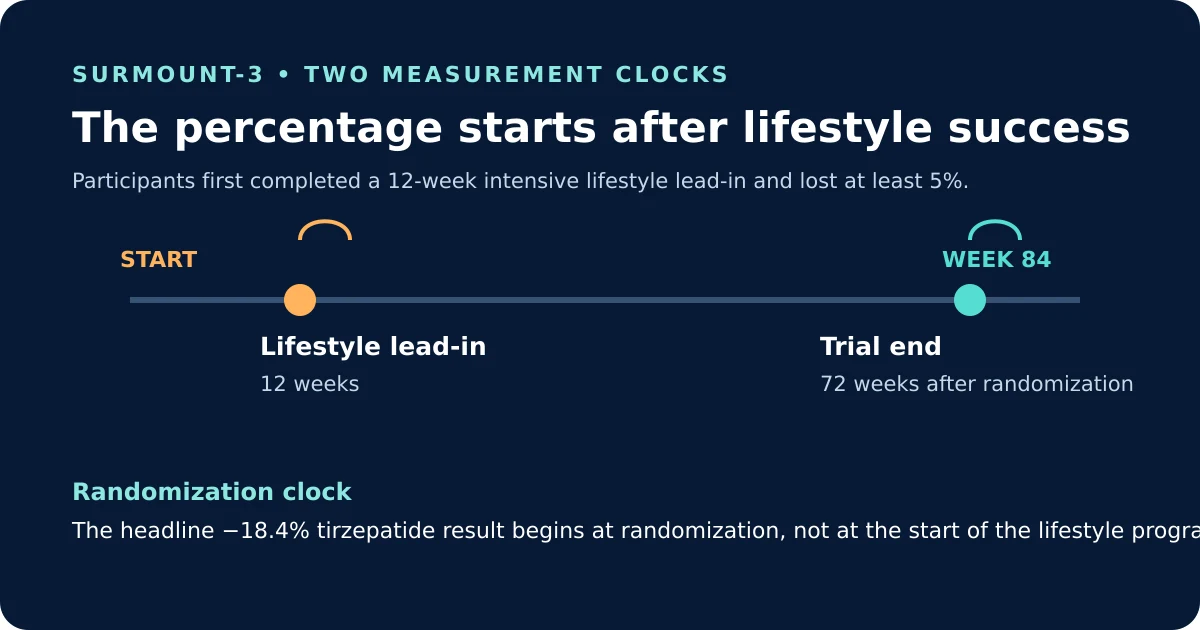
SURMOUNT-3 asked a different question: what happened when tirzepatide was added after participants had already lost at least 5% during a 12-week intensive lifestyle program? From randomization, the treatment-regimen mean was another 18.4% loss with tirzepatide while the placebo group regained 2.5%. (SURMOUNT-3 primary paper; current label)
Registry number: NCT04657016. Published in Nature Medicine in 2023.
The Filter That Shaped This Trial
806 people entered the 12-week intensive lifestyle program
        ↓
579 lost at least 5% and reached randomization
        ↓
227 did not reach randomization
    (141 did not meet the 5% threshold)
The lifestyle phase was serious: eight counseling sessions over 12 weeks with a dietitian, a calorie target of about 1,200 calories a day for women and 1,500 for men, and at least 150 minutes of physical activity a week. The 579 people who reached randomization had lost an average of 6.9% before receiving randomized study treatment.
Two Clocks, Two Very Different Numbers
Clock one—from randomization forward:
- Tirzepatide: −18.4% treatment-regimen; −21.1% efficacy
- Placebo: +2.5% treatment-regimen; +3.3% efficacy
Clock two—from the start of the lifestyle program:
- Tirzepatide: −24.3% treatment-regimen; −26.6% efficacy
- Placebo: −4.5% treatment-regimen; −3.8% efficacy
That +2.5% on placebo is quietly one of the most revealing numbers in the trial. These were people who had just succeeded at losing at least 5% through an intensive program. Under the randomized placebo-plus-standard-lifestyle phase, they regained 2.5% on average from the new, lower baseline while the tirzepatide group continued downward.
That isn't a character verdict. The trial shows that even successful intensive-lifestyle responders, on average, regained some weight under the placebo-supported maintenance condition. It does not prove one biological cause for every person's regain.
Why 26.6% and 20.9% Don't Belong Side by Side Without an Explanation
Five reasons:
- Different starting point: lifestyle-program entry versus drug-randomization day
- Different population: only people who first lost at least 5% reached randomization
- Different dosing approach: maximum tolerated 10 or 15 mg versus fixed assigned doses
- Different statistical approach
- Different total timeline: 84 weeks including lead-in versus 72 weeks
If someone shows you a chart ranking SURMOUNT results from biggest to smallest without those columns, they've made a mistake—or they're hoping you won't check.
SURMOUNT-4: What Actually Happened When People Stopped?
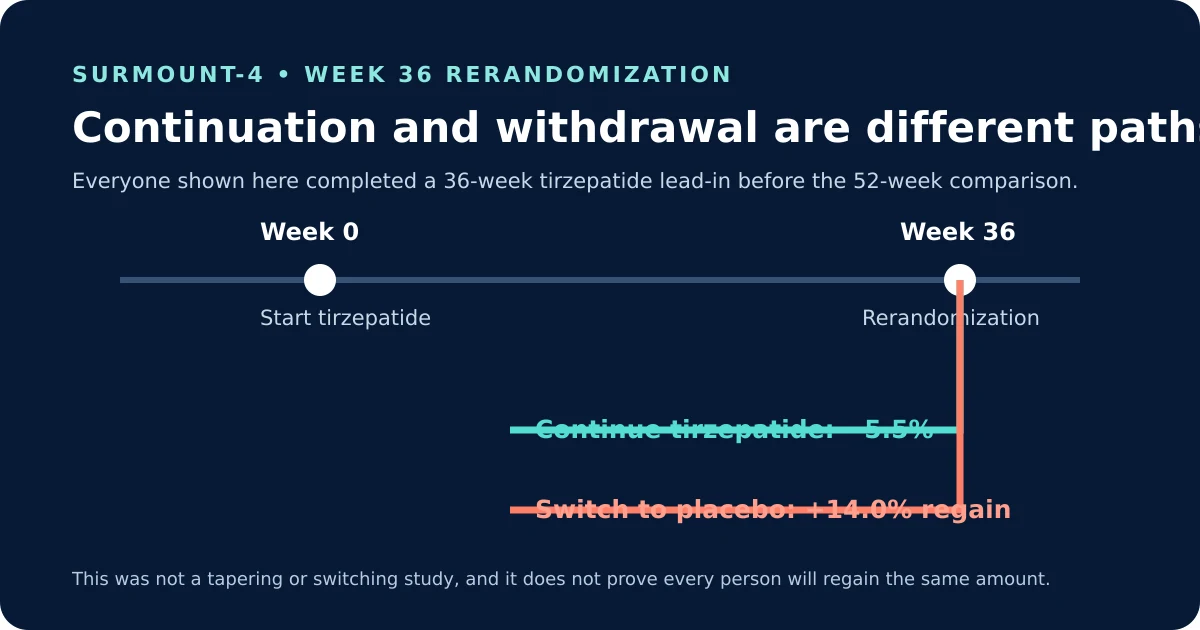
SURMOUNT-4 gave 783 adults open-label tirzepatide for 36 weeks. The 670 people who reached rerandomization had lost an average of 20.9%. They were then assigned either to continue tirzepatide or switch to placebo for another 52 weeks. Those who continued lost another 5.5%; those switched to placebo regained 14.0%—but still finished 9.9% below their original starting weight. (SURMOUNT-4 primary paper; current label)
Registry number: NCT04660643. Published in JAMA in 2024. This is the trial people are really asking about when they ask whether the weight comes back.
What the Trial Found
| From week 36 to week 88 | Continued tirzepatide | Switched to placebo |
|---|---|---|
| Treatment-regimen average weight change | −5.5% | +14.0% |
| Efficacy-estimand average weight change | −6.7% | +14.8% |
| Maintained at least 80% of the week-36 loss | 89.5% | 16.6% |
| Total efficacy-estimand change from week 0 to week 88 | −26.0% | −9.5% |
| Total treatment-regimen change from week 0 to week 88 | −25.3% | −9.9% |
Read That Last Row Again
The group switched to placebo regained a lot. That's real, and we're not going to soften it.
But at week 88—a full year after withdrawal—they still averaged 9.9% below their original starting weight. The trial did not find that everyone regained everything. That's a claim that circulates widely online, and it isn't what the group result says.
The 2026 Follow-Up Analysis—and the Number People Misread
A 2026 post hoc analysis in JAMA Internal Medicine looked at 308 people in the placebo-withdrawal group who had lost at least 10% during the lead-in. It found that 82.5% regained at least 25% of the weight they had lost during the lead-in. (SURMOUNT-4 post hoc analysis)
That sentence gets misquoted constantly. Here's what it means:
If you lost 40 pounds, regaining 25% of that lost amount means gaining back 10 pounds.
It does not mean regaining 25% of your original body weight.
The analysis also found that greater regain was associated with greater reversal of prior improvements in waist circumference, blood pressure, lipids, glycemia, and insulin resistance. That's the clinically meaningful part worth raising with a clinician.
What SURMOUNT-4 Did Not Test
This matters as much as what it did test:
- It did not compare a gradual taper with switching to placebo.
- It did not test switching to a different medication.
- It did not randomize people to lower maintenance doses.
- It did not test a separate structured behavioral-maintenance program.
- It did not represent everyone who starts tirzepatide: 14.4% of the 783 entrants discontinued before rerandomization, and 6.8% did so because of adverse events.
- The randomized comparison included people who had remained through 36 weeks and reached 10 or 15 mg as their maximum tolerated dose.
So if you're asking “what if I taper carefully?”—SURMOUNT-4 genuinely cannot answer it. It also cannot tell you what happens after a switch to another medicine or an individualized maintenance plan.
The Practical Takeaway
The largest continuation results on this page came from ongoing treatment. SURMOUNT-4 is the clearest randomized evidence among these five trials that switching to placebo after a 36-week tirzepatide lead-in led to substantial average regain over the following year.
That turns part of the question from clinical evidence into practical access: can you stay on the prescribed treatment if you and your clinician decide continued use is appropriate? For many U.S. patients, the answer comes down to coverage or cash cost.
If continued access is the obstacle, check the benefit before assuming the answer is no. Ro's current free tool checks coverage for the Zepbound pen, Wegovy pen, and Ozempic pen and sends a personalized report. It does not currently check coverage for Zepbound KwikPen.
→ Check Zepbound pen coverage with Ro—free report
Affiliate disclosure: Weight Loss Provider Guide may earn a commission if you later enroll through Ro. The coverage report itself is currently advertised by Ro as free. Ro did not fund, review, or influence this trial analysis.
SURMOUNT-5: Did Tirzepatide Beat Semaglutide Head to Head?
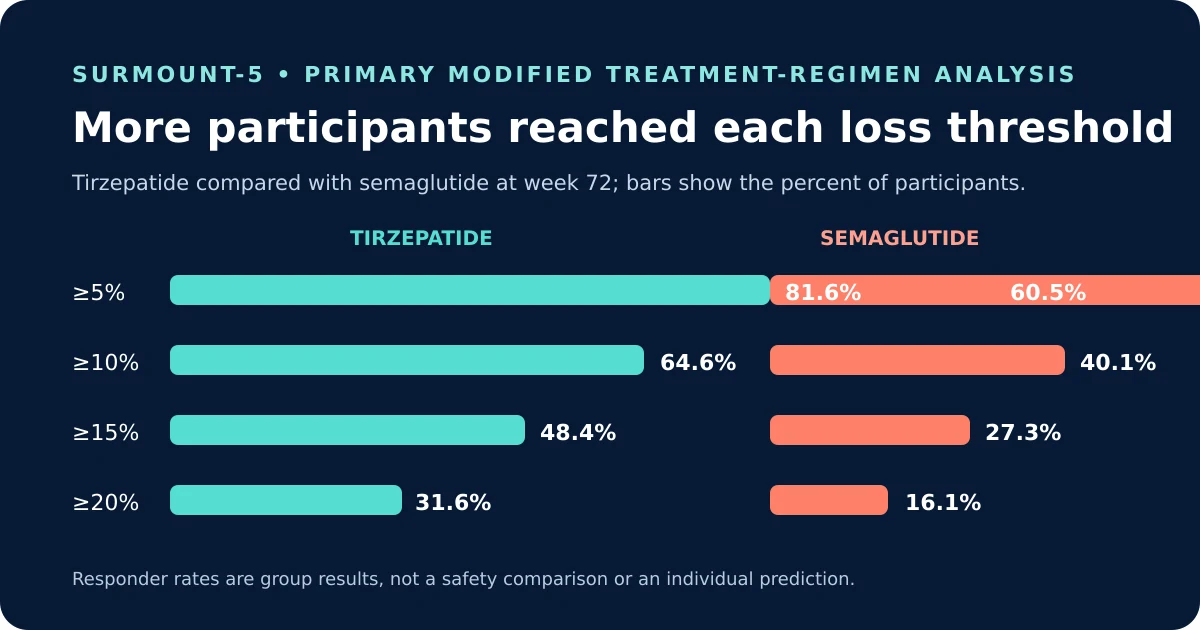
Yes. SURMOUNT-5 randomly assigned 751 adults with obesity—or overweight plus at least one prespecified obesity-related complication—and without diabetes to maximum tolerated tirzepatide or semaglutide for 72 weeks. Under the primary modified treatment-regimen estimand, tirzepatide reduced body weight by 20.2% versus 13.7% with semaglutide, and waist circumference by 18.4 cm versus 13.0 cm. (SURMOUNT-5 primary paper)
Registry number: NCT05822830. Published in the New England Journal of Medicine in 2025.
Before this trial, people often compared SURMOUNT-1 with Wegovy's STEP 1 trial—two separate populations and protocols. SURMOUNT-5 put the treatments in the same randomized trial.
The Primary Modified Treatment-Regimen Results
| At 72 weeks | Tirzepatide | Semaglutide |
|---|---|---|
| Average weight change | −20.2% | −13.7% |
| Average absolute weight change | −22.8 kg | −15.0 kg |
| Waist-circumference change | −18.4 cm | −13.0 cm |
| Lost at least 10% | 81.6% | 60.5% |
| Lost at least 15% | 64.6% | 40.1% |
| Lost at least 20% | 48.4% | 27.3% |
| Lost at least 25% | 31.6% | 16.1% |
The efficacy-estimand means were −21.6% with tirzepatide and −15.4% with semaglutide.
Tirzepatide was superior on the prespecified weight and waist endpoints shown here. That is a strong head-to-head average-treatment result in this trial population. It is not a declaration that one medicine is automatically the right choice for every person.
Two Limitations That Change How Confidently You Should Quote It
It was open-label. Participants and investigators knew which treatment had been assigned. There was no placebo and no blinding. That does not erase a 6.5-percentage-point primary difference, but it is a real design limitation.
Both groups used maximum tolerated dosing. Tirzepatide participants used 10 or 15 mg; semaglutide participants used 1.7 or 2.4 mg. Not everyone in the semaglutide group reached 2.4 mg, and not everyone in the tirzepatide group reached 15 mg. The study compared maximum tolerated strategies within those dose ranges—not a forced 15 mg versus 2.4 mg contest.
What “Superior” Does Not Mean Here
The trial showed greater average weight reduction with tirzepatide in this population. It did not establish:
- That tirzepatide is safer
- That tirzepatide is better tolerated for every patient
- That tirzepatide is right for your medical history
- A cardiovascular-risk-reduction indication for tirzepatide in adults with obesity without diabetes
- Which treatment your insurance will cover
- What happens with a compounded or oral product
On side effects specifically: the paper says the trial was not powered to compare safety or tolerability. Any page telling you SURMOUNT-5 proved tirzepatide is gentler on the stomach is reading more into the data than the trial can carry.
The clean conclusion is still decisive: tirzepatide produced greater mean weight loss than semaglutide under both the primary modified treatment-regimen analysis and the supportive efficacy analysis in SURMOUNT-5. The medication decision still has to account for contraindications, tolerability, other outcome evidence, access, and the individual in front of the clinician.
For the full medication-choice comparison—including coverage, cost, and current indications—see our guide to semaglutide vs. tirzepatide.
Which SURMOUNT Trials Supported Zepbound's FDA Approvals?
Zepbound's original November 2023 weight-management approval was established in two 72-week placebo-controlled trials: SURMOUNT-1 and SURMOUNT-2, which the FDA materials call Study 1 and Study 2. The current April 2026 label also summarizes SURMOUNT-3 and SURMOUNT-4 as Study 3 and Study 4. The later sleep-apnea approval rests on two SURMOUNT-OSA studies called Study 5 and Study 6. SURMOUNT-5 is not in the current label. (FDA original approval announcement; current label; FDA OSA approval announcement)
We built the crosswalk so the two numbering systems can be checked in one place.
| Trial name in the research | Registry number | What the current FDA label calls it | Role in the label |
|---|---|---|---|
| SURMOUNT-1 | NCT04184622 | Study 1 | One of the two 72-week trials establishing original weight-management effectiveness |
| SURMOUNT-2 | NCT04657003 | Study 2 | One of the two 72-week trials establishing original weight-management effectiveness |
| SURMOUNT-3 | NCT04657016 | Study 3 | Intensive-lifestyle lead-in study summarized in the current label |
| SURMOUNT-4 | NCT04660643 | Study 4 | Randomized-withdrawal study summarized in the current label |
| SURMOUNT-OSA, PAP not used | NCT05412004 | Study 5 | One of two studies supporting the OSA indication |
| SURMOUNT-OSA, PAP used | NCT05412004 | Study 6 | One of two studies supporting the OSA indication |
| SURMOUNT-5 | NCT05822830 | Not in the label | Head-to-head comparison with semaglutide; not cited as evidence establishing the original approvals |
The Mix-Up This Creates
“Study 5” is not SURMOUNT-5.
Label Study 5 is a 234-person obstructive-sleep-apnea trial. SURMOUNT-5 is the 751-person weight comparison with semaglutide. They share a number and nothing else.
If you're reading the FDA label beside a news article—which is exactly what a pharmacist, benefits reviewer, researcher, or person preparing an appeal may do—these are easy to confuse.
Why Isn't SURMOUNT-5 in the Label?
SURMOUNT-5 began in 2023, before Zepbound's original November 2023 approval, but its head-to-head findings were published in 2025. FDA's original approval announcement said effectiveness was established in two randomized, double-blind, placebo-controlled trials—SURMOUNT-1 and SURMOUNT-2—and the current label does not include SURMOUNT-5.
This isn't a knock on the trial. It's the best direct randomized evidence comparing tirzepatide and semaglutide for mean weight loss in adults with obesity without diabetes. It simply was not part of the evidence FDA cited as establishing Zepbound's original weight-management approval.
If you're citing SURMOUNT-5 in a coverage appeal, describe it accurately as postapproval head-to-head evidence, not as the pivotal trial that produced the original FDA approval.
What Is Zepbound Approved for Right Now?
As of the current April 2026 prescribing information, Zepbound is indicated, alongside a reduced-calorie diet and increased physical activity:
- To reduce excess body weight and maintain weight reduction long term in adults with obesity, or adults with overweight plus at least one weight-related comorbid condition.
- To treat moderate-to-severe obstructive sleep apnea in adults with obesity.
The label does not currently include a cardiovascular-risk-reduction indication for adults with obesity without diabetes. It also says coadministration with another tirzepatide-containing product or any GLP-1 receptor agonist is not recommended. (Current label)
Are There Other SURMOUNT Trials Besides 1 Through 5?
Yes. The wider program includes SURMOUNT-OSA, regional trials such as SURMOUNT-CN and SURMOUNT-J, and outcomes trials such as SURMOUNT-MMO. Those studies answer different questions and should not be silently mixed into a page whose title promises SURMOUNT-1 through SURMOUNT-5.
SURMOUNT-OSA
SURMOUNT-OSA used one master protocol with two 52-week randomized, double-blind, placebo-controlled studies and 469 total participants with obesity and moderate-to-severe obstructive sleep apnea. One study enrolled people who were unable or unwilling to use positive airway pressure; the other enrolled people who were using it. These studies led to FDA's December 2024 approval of Zepbound as the first medication approved to treat moderate-to-severe OSA in adults with obesity. (SURMOUNT-OSA primary paper; FDA approval)
| At 52 weeks | Not using PAP | Using PAP |
|---|---|---|
| Change in apnea-hypopnea events per hour | −25.3 vs. −5.3 on placebo | −29.3 vs. −5.5 on placebo |
| Reached remission or mild, nonsymptomatic OSA | 42.2% vs. 15.9% | 50.2% vs. 14.3% |
| Body-weight change | −17.7% vs. −1.6% | −19.6% vs. −2.3% |
Two details from the label rarely make it into short summaries. First, participants in the PAP study suspended PAP for seven days before the week-52 endpoint assessment. Second, the label says these studies did not evaluate the timing or appropriateness of PAP discontinuation in people who had been compliant with PAP. Promising evidence is not a green light to put the machine in a closet.
One more thing we noticed. SURMOUNT-1 was 68% women, while the two OSA studies were 67% and 72% men. The enrolled populations had nearly opposite sex distributions. The trials document that contrast; they do not establish one reason for it.
SURMOUNT-MMO
SURMOUNT-MMO, registry number NCT05556512, is evaluating whether tirzepatide reduces major morbidity and mortality outcomes in adults with obesity without diabetes. Lilly's public trial page lists the study period through October 2027. Until an applicable trial reports and FDA approves a corresponding claim, no tirzepatide product carries an FDA-approved cardiovascular-risk-reduction indication specifically for adults with obesity without diabetes. (ClinicalTrials.gov record; Lilly trial page; current label)
What Side Effects Showed Up—and Which Discontinuation Number Is Which?
Gastrointestinal adverse reactions were the most common problem across the program and occurred most often during dose escalation. In the pooled placebo-controlled weight trials, 56% of participants in each Zepbound dose group reported gastrointestinal adverse reactions versus 30% on placebo; 4.8% to 6.7% permanently stopped treatment because of any adverse reaction, depending on dose, versus 3.4% on placebo. (Current Zepbound prescribing information)
Trial adverse-event percentages cannot be directly compared with percentages from a different trial as though the conditions were identical. The current FDA label is the right source for present-day warnings and contraindications; the primary papers are the right source for what happened inside each trial.
The Most Common Adverse Reactions in the Pooled Registration Trials
| Adverse reaction | Placebo | 5 mg | 10 mg | 15 mg |
|---|---|---|---|---|
| Nausea | 8% | 25% | 29% | 28% |
| Diarrhea | 8% | 19% | 21% | 23% |
| Constipation | 5% | 17% | 14% | 11% |
| Vomiting | 2% | 8% | 11% | 13% |
| Abdominal pain | 5% | 9% | 9% | 10% |
| Dyspepsia | 4% | 9% | 9% | 10% |
| Injection-site reactions | 2% | 6% | 8% | 8% |
| Fatigue | 3% | 5% | 6% | 7% |
| Hair loss | 1% | 5% | 4% | 5% |
Most nausea, vomiting, and diarrhea events occurred during dose escalation and decreased over time.
Across SURMOUNT-1 and SURMOUNT-2, 4.8%, 6.3%, and 6.7% of participants receiving 5, 10, and 15 mg permanently discontinued treatment because of adverse reactions, versus 3.4% on placebo. The narrower rate for discontinuation because of gastrointestinal adverse reactions was 1.9%, 3.3%, and 4.3% by dose versus 0.5% on placebo.
The Three Discontinuation Numbers—This Is Where Reporting Goes Wrong
SURMOUNT-5 reported three different discontinuation measures. They are not interchangeable.
| What was measured | What it means | Tirzepatide | Semaglutide |
|---|---|---|---|
| Discontinued from the trial because of adverse events | Stopped participating in the trial | 1.6% | 1.6% |
| Discontinued trial treatment because of adverse events | Stopped the assigned medication; could remain in follow-up | 6.1% | 8.0% |
| Discontinued trial treatment because of gastrointestinal adverse events | Narrower subset of the row above | 2.7% | 5.6% |
Three numbers, one trial, all correct. A source that cites 1.6% as the medication-discontinuation rate has mixed up the endpoint.
And remember: SURMOUNT-5 was not powered to compare safety or tolerability. Even the 6.1% versus 8.0% difference cannot carry a universal “better tolerated” conclusion on its own. (SURMOUNT-5 safety table)
Three Label Details That Are Easy to Miss
Hair loss was not evenly reported by sex. In the pooled Studies 1 and 2, hair loss was reported in 7.1% of women and 0.5% of men receiving Zepbound, versus 1.3% and 0% on placebo. The label says the reports were associated with weight reduction. No Zepbound-treated participant discontinued study treatment because of hair loss.
Oral hormonal contraceptives can be affected. Tirzepatide delays gastric emptying and may reduce the effectiveness of oral hormonal contraceptives. The label advises switching to a non-oral method or adding a barrier method for four weeks after starting and four weeks after every dose escalation.
Anti-tirzepatide antibodies were common in testing, but the label does not identify a clinically significant loss of effectiveness. Antibodies were detected in 64.5% of Zepbound-treated participants in Studies 1 and 2. The label says no clinically significant effect on pharmacokinetics or effectiveness has been identified, while hypersensitivity and injection-site reactions were more frequent among participants who developed antibodies.
Those are the facts. “Antibodies in nearly two thirds” sounds frightening without the next sentence; “they never mattered” would also go beyond the label.
The Serious Warnings and Contraindications
Zepbound carries a boxed warning based on thyroid C-cell tumors found in rats. Whether tirzepatide causes thyroid C-cell tumors, including medullary thyroid carcinoma, in humans is unknown.
Zepbound is contraindicated for:
- A personal or family history of medullary thyroid carcinoma
- Multiple Endocrine Neoplasia syndrome type 2
- A known serious hypersensitivity to tirzepatide or any Zepbound excipient
The current label also warns about:
- Severe gastrointestinal adverse reactions; Zepbound is not recommended in severe gastroparesis
- Acute kidney injury due to volume depletion
- Acute gallbladder disease
- Acute pancreatitis
- Serious hypersensitivity reactions
- Hypoglycemia, particularly with insulin or an insulin secretagogue
- Diabetic-retinopathy complications in people with type 2 diabetes
- Pulmonary aspiration during general anesthesia or deep sedation
- Potential effects on absorption of oral medicines
- Fetal harm; the label says to discontinue Zepbound when pregnancy is recognized
Tell the clinician managing any planned surgery or procedure that you're taking a GLP-1 receptor agonist. Seek medical care for severe or persistent symptoms rather than using an online article as a treatment protocol.
Postmarketing reports listed in the current label include ileus, intestinal obstruction, and severe constipation including fecal impaction, among other events. Because these reports are voluntary and come from a population of uncertain size, their frequency and causal relationship cannot always be reliably estimated.
One recent change: the label's “Recent Major Changes” section says the warning titled “Suicidal Behavior and Ideation” was removed in February 2026. We're reporting the label change, not turning it into a broader claim that psychiatric symptoms never matter.
Read the full current label with your prescriber. We're summarizing, not substituting.
Do These Results Apply to Compounded or Oral Tirzepatide?
No direct transfer is justified. SURMOUNT-1 through SURMOUNT-5 studied once-weekly subcutaneous tirzepatide supplied under clinical-trial protocols. Compounded preparations—including oral, sublingual, drop, gum, or custom-concentration injectable products—were not evaluated in these five trials. The results do not establish the safety, effectiveness, quality, or equivalence of a compounded product.
We need to be direct about this, because it's where a lot of people get misled.
What Was Actually Tested?
Once-weekly subcutaneous tirzepatide under standardized study protocols, with prespecified doses, titration, monitoring, comparators, follow-up, and product controls.
Zepbound's current label includes single-dose pens and vials, multi-dose vials, and KwikPen presentations. Those approved presentations are not the same thing as saying every product sold with “tirzepatide” in its description has the trial evidence.
What Wasn't Tested?
SURMOUNT-1 through SURMOUNT-5 did not test:
- A compounded tirzepatide product
- Oral or sublingual tirzepatide
- Drops or gum
- Custom concentrations
- Microdosing protocols
- A telehealth company's proprietary compounded formulation
- A different salt, ingredient source, or manufacturing process
Why “It Contains Tirzepatide” Isn't Enough
A claim that a product contains tirzepatide does not establish equivalence in formulation, concentration, stability, route, absorption, manufacturing controls, dosing, quality, or clinical performance. A trial result belongs to the product and protocol that were actually studied.
Compounded drugs are not FDA-approved. FDA does not verify their safety, effectiveness, or quality before they are marketed. Federal law can permit patient-specific compounding under limited conditions, but that legal pathway does not transfer evidence from an approved product to a compounded one. (FDA compounding Q&A)
FDA's current GLP-1 materials describe concerns including dosing errors, misleading labels, fraudulent or illegally marketed products, and adverse events. In March 2026, FDA announced 30 warning letters to telehealth companies over false or misleading compounded-GLP-1 promotion. FDA has specifically objected to claims that a non-FDA-approved compounded product is the same as, equivalent to, or clinically proven to produce the results of an approved product. (FDA concerns about unapproved GLP-1s; FDA March 2026 announcement)
We're not telling you that every compounded product produces the same risk or that compounding is categorically unlawful. We're telling you something narrower and firmer: the percentages on this page cannot be used as clinical proof for a product that was not studied.
If a website quotes SURMOUNT figures immediately beside a compounded oral, sublingual, gum, drop, or custom-dose offer without that distinction, slow down.
If you came here to check whether these trial results validate a compounded version, the honest answer is no—and that may change the path you want to compare.
Our free 60-second matching quiz asks about brand-name versus compounded preference, insurance, state, budget, and access, then returns an action plan without pretending the evidence is interchangeable.
What Did SURMOUNT-1 Through SURMOUNT-5 Not Answer?
These trials do not predict an individual's result, do not cover every population or formulation, cannot detect every rare or very long-term harm, and do not resolve the best way to discontinue treatment. They also do not answer the real-world questions of cost, coverage, adherence, and continued clinical access.
Six honest gaps:
They can't predict your result. Averages describe groups. In SURMOUNT-1's 15 mg treatment-regimen analysis, 56.7% reached at least 20% weight reduction—which means 43.3% did not. Both groups are real.
They didn't test every formulation. These five trials studied subcutaneous tirzepatide under trial protocols. They are not oral-compounded evidence.
They didn't solve every stopping strategy. SURMOUNT-4 did not have a taper arm, lower-dose randomized-maintenance arm, switch arm, or separate structured behavioral-maintenance arm.
They can't catch every rare or very long-term harm. A few thousand participants followed for one to three years cannot reliably identify every event that may emerge only after wider or longer use. That's one reason labeling and postmarketing surveillance continue to change.
Trial conditions aren't ordinary care. Participants received protocol-driven follow-up, structured dose management, study-supplied medication, and standardized outcome assessment. Real-world access and adherence can look different.
Eli Lilly funded all of them. The company participated in trial design or analysis as disclosed in the publications. Randomization and peer review matter—but sponsor involvement is still a fact you deserve to see without digging.
Can You Actually Get the FDA-Approved Medication Behind This Evidence?
The FDA-approved tirzepatide product for chronic weight management is Zepbound; Mounjaro is the tirzepatide brand approved to improve glycemic control in adults and pediatric patients 10 years of age and older with type 2 diabetes. Both are prescription medicines. What a person pays for Zepbound depends on presentation, dose, insurance, manufacturer offers, pharmacy channel, and any telehealth membership fee.
Everything above assumes more than a prescription decision. It assumes you can start, obtain follow-up care, and maintain access for as long as you and your clinician decide treatment is appropriate.
Check Coverage Before Assuming the Answer Is No
For many people, coverage is the largest cost variable. Plans can exclude weight-management treatment, require prior authorization, limit covered presentations, or apply different rules to a Zepbound pen and Zepbound KwikPen.
The OSA indication created an additional FDA-approved use, but an indication is not the same as automatic insurance coverage. A plan still sets its own benefit and prior-authorization rules.
Check the actual benefit before building your decision around an assumption.
Our One Honest Caveat About Ro
Here's something we'd rather tell you up front.
Ro charges a membership fee in addition to medication cost, and its free coverage checker currently checks the Zepbound pen—not Zepbound KwikPen. If you already have a clinician, know your benefit, and only need a one-time prescription service, an ongoing membership may be more than you need.
But because Ro offers FDA-approved medication rather than presenting a compounded product as interchangeable with the trials, it fits a reader who came here specifically for the evidence behind approved tirzepatide. And if prior authorization, plan calls, continued monitoring, and coverage paperwork are the obstacle, the insurance report and concierge are aimed at the problem that can determine whether treatment remains accessible.
That's the trade. We think it is a credible route for the right reader—not the only route, and not automatically the cheapest one.
Provider-Stated vs. Verified on August 4, 2026
We verified the following against Ro's public pricing and coverage-checker pages. We did not complete enrollment, receive a prescription, or test a claim with an insurance plan.
| Provider-stated claim | What the current public page says | What it means before you click |
|---|---|---|
| First month | $39; Ro says it refunds that charge if the person is not eligible for a GLP-1 through the program | Medication is still separate |
| Ongoing membership | $74/month with a 12-month prepaid plan; $89/month on a 6-month plan; $99/month on a 3-month plan; $149/month month to month | “As low as $74” requires annual prepayment |
| Medication cost | Not included in the membership fee | Add medication or insurance copay to membership |
| Free coverage checker | Checks Ozempic pen, Wegovy pen, and Zepbound pen and sends a personalized report | It does not submit a prescription or treatment request |
| KwikPen coverage | Ro says it cannot currently check coverage for Zepbound KwikPen | Cash-pay KwikPen is a different access route |
| Current KwikPen cash prices | $299 for 2.5 mg, $399 for 5 mg, and $449 for 7.5–15 mg with the stated manufacturer offer | Dose and offer terms matter; re-check before enrollment |
| Insurance support | Membership includes a dedicated insurance concierge and ongoing provider support | Useful when prior authorization or follow-up is the actual blocker |
(Ro pricing page; Ro coverage checker)
If you already know you want to explore FDA-approved tirzepatide, see the two charges, check the benefit, and decide with the full cost in front of you.
→ See current Zepbound pricing and check coverage at Ro
Affiliate disclosure: Weight Loss Provider Guide may earn a commission if you enroll through this link. Ro did not influence the trial rankings, numbers, or conclusions on this page.
Pricing and public policy details verified August 4, 2026. Re-check the destination page before enrolling; prices, offers, covered presentations, and plan terms can change.
What Should I Ask My Doctor After Reading This?
Bring the trial that matches your situation, ask how you differ from the people in it, and ask what the plan is if treatment becomes intolerable or inaccessible. Trial evidence is most useful as a starting point for a clinical conversation, not as a substitute for one.
Seven questions worth writing down:
- Which of these trials most closely resembles my health and treatment situation?
- In what important ways am I different from the participants in that trial?
- Which result should we use—the treatment-regimen estimate, the efficacy estimate, or another outcome?
- What would count as meaningful progress for my health, not merely a number on the scale?
- How will we manage adverse effects and medication interactions during dose increases?
- What's the clinical plan if I lose coverage, cannot tolerate the dose, become pregnant, need surgery, or have to stop?
- If I use insulin or a sulfonylurea, how will hypoglycemia risk be managed?
Bring your medication list, relevant conditions, prior treatment history, and insurance information. And bring the one question you actually came here with—that's the one that matters most.
Create my printable SURMOUNT clinician question list
- Which SURMOUNT trial most closely resembles my health and treatment situation?
- Which estimate should we use, and why?
- What is the plan if I lose coverage, cannot tolerate the dose, become pregnant, need surgery, or have to stop?
Bring your medication list, relevant conditions, prior treatment history, and insurance information to the conversation.
Frequently Asked Questions About SURMOUNT-1 Through SURMOUNT-5
These short answers resolve the naming, design, stopping, formulation, and applicability questions most likely to send someone back to search.
Is SURMOUNT the Same as SURPASS?
No. SURMOUNT is the tirzepatide clinical-development program centered on obesity and weight-management questions. SURPASS is a separate program centered on type 2 diabetes. The same molecule appears in both programs, but the populations, endpoints, comparators, and trial names should not be quoted interchangeably.
Is 22.5% Wrong?
No. It is SURMOUNT-1's 15 mg efficacy-estimand result. The current FDA label uses the 20.9% treatment-regimen estimate. Both are accurate answers to different statistical questions.
Is “Study 5” the Same as SURMOUNT-5?
No. In the current Zepbound label, Study 5 is a 234-person obstructive-sleep-apnea study. SURMOUNT-5 is the 751-person comparison with semaglutide, and it is not included in the label.
Which Trials Established the Original Weight-Management Approval?
FDA's November 2023 announcement says effectiveness was established in two randomized, double-blind, placebo-controlled trials: SURMOUNT-1 and SURMOUNT-2, called Study 1 and Study 2 in FDA materials. The current label also summarizes SURMOUNT-3 and SURMOUNT-4 as Study 3 and Study 4.
Did Everyone Regain Their Weight After Stopping in SURMOUNT-4?
No. The group switched to placebo regained 14.0% on average from week 36 to week 88, but still finished 9.9% below its original week-0 starting weight. The average does not say every individual followed the same path.
Did SURMOUNT-4 Test Tapering Off Slowly?
No. It compared continued maximum tolerated tirzepatide with switching to placebo after the 36-week lead-in. It did not randomize participants to gradual dose reduction.
Was SURMOUNT-5 Blinded?
No. It was open-label: participants and investigators knew which medication had been assigned. That's a real limitation, though the result was consistent across the prespecified weight and waist endpoints.
Did SURMOUNT-5 Compare Zepbound with Ozempic?
It compared tirzepatide 10 or 15 mg with semaglutide 1.7 or 2.4 mg—the dose range used for obesity treatment under the Wegovy brand, not an Ozempic-dose comparison.
Did SURMOUNT-5 Prove Tirzepatide Has Fewer Side Effects?
No. The trial was not powered to compare safety or tolerability. It also reported multiple discontinuation measures, and they cannot be substituted for one another.
Do SURMOUNT Results Apply to Compounded Tirzepatide?
No direct transfer is justified. These five trials studied once-weekly subcutaneous tirzepatide under controlled protocols. A compounded product was not tested, and the results do not establish its safety, effectiveness, quality, or equivalence.
Was an Oral Version Tested in SURMOUNT-1 Through SURMOUNT-5?
No. All five used once-weekly subcutaneous administration.
Is the Three-Year SURMOUNT-1 Analysis a Separate Trial Called SURMOUNT-6?
No. It is a longer analysis of the SURMOUNT-1 subgroup with obesity and prediabetes.
Does a 20.9% Average Mean Most People Lost About 20.9%?
No. An average summarizes a distribution. In the 15 mg treatment-regimen analysis, 56.7% reached at least 20% weight reduction, which means many lost more and many lost less.
What Does “Maximum Tolerated Dose” Mean?
The protocol titrated participants toward specified higher doses while allowing their final study dose to reflect tolerability within the trial rules. It does not mean everyone reached the maximum marketed dose, and it is not a recommendation for an individual dose.
Does SURMOUNT-4 Prove Treatment Must Continue Forever?
No. It provides randomized evidence that withdrawal after a successful 36-week lead-in caused substantial average regain over the next 52 weeks. It does not test every duration, taper, switch, maintenance dose, or long-term strategy.
Do the Trials Tell Me Whether Insurance Will Cover Zepbound?
No. Clinical evidence and insurance benefits are different questions. Coverage depends on the current plan, indication, prior-authorization criteria, presentation, and benefit rules.
How We Built This Page
We used the current FDA-approved prescribing information, the primary peer-reviewed publication for each trial, trial registry records, and clearly labeled later analyses. Every major number is tied to a population, a measurement clock, an estimand, a comparator, and a date.
Weight Loss Provider Guide is an independent comparison resource for GLP-1 telehealth providers. This page exists because the same trial keeps getting quoted with different percentages and no explanation of where the measurement began or which analysis produced the number. We wanted one page where you don't have to open five journal articles and build your own spreadsheet.
Our Source Order
- Current FDA-approved prescribing information for current indications, contraindications, warnings, and label tables
- The primary peer-reviewed paper for each trial's design and results
- ClinicalTrials.gov records for registry identifiers and current study status
- Later peer-reviewed analyses, always labeled as extensions, secondary analyses, or post hoc work
- Official provider pages for current commercial claims
- Public forums for reader language only—never for medical, safety, or regulatory evidence
How We Handled Conflicts
When two sources appeared to disagree, we checked:
- Is this a treatment-regimen result or an efficacy-estimand result?
- Does the percentage begin at original enrollment, randomization, or rerandomization?
- Is “discontinued” referring to the trial, the assigned treatment, or a narrower adverse-event category?
- Is the result primary, secondary, exploratory, or post hoc?
- Did the FDA label change after the paper was published?
- Is one source describing an approved product while another is marketing a compounded product?
Anything we could not reconcile was excluded rather than silently forced into the table.
The Original Data Assets on This Page
- SURMOUNT Baseline & Estimand Ledger v1.0 — the major mean results beside their clocks and estimands
- Percentage Clock comparison — where the decisive measurement begins in each trial
- 5,817 → 5,477 participant-flow arithmetic — entered versus reached the decisive comparison
- FDA label crosswalk — trial name versus label study number
- Three discontinuation measures decoder — trial withdrawal versus treatment discontinuation
- Provider-stated vs. verified access table — current Ro pricing and coverage-checker limits
- Trial matcher and starting-weight calculator — personalized evidence navigation without pretending to predict outcomes
Download: SURMOUNT-1 through SURMOUNT-5 comparison dataset v1.0 (CSV)
The downloadable file includes standardized field names, primary-source URLs, the verification date, and the dataset version.
Corrections
If you find an error, tell us. Material numerical corrections should be logged below rather than changed silently. The visible “Last verified” date should change only after a substantive source review—not after a formatting edit.
Primary Sources
- Zepbound (tirzepatide) current prescribing information, updated April 22, 2026
- Mounjaro (tirzepatide) current prescribing information, updated April 22, 2026
- Jastreboff AM, et al. Tirzepatide Once Weekly for the Treatment of Obesity. N Engl J Med. 2022;387:205-216
- Jastreboff AM, et al. Tirzepatide for Obesity Treatment and Diabetes Prevention. N Engl J Med. DOI: 10.1056/NEJMoa2410819
- Garvey WT, et al. Tirzepatide once weekly for the treatment of obesity in people with type 2 diabetes (SURMOUNT-2). Lancet. 2023
- Wadden TA, et al. Tirzepatide after intensive lifestyle intervention (SURMOUNT-3). Nature Medicine. 2023;29:2909-2918
- Aronne LJ, et al. Continued Treatment With Tirzepatide for Maintenance of Weight Reduction (SURMOUNT-4). JAMA. 2024;331:38-48
- Horn DB, et al. Cardiometabolic Parameter Change by Weight Regain on Tirzepatide Withdrawal. JAMA Internal Medicine. 2026
- Aronne LJ, et al. Tirzepatide as Compared with Semaglutide for the Treatment of Obesity (SURMOUNT-5). N Engl J Med. 2025;393:26-36
- Malhotra A, et al. Tirzepatide for the Treatment of Obstructive Sleep Apnea and Obesity. N Engl J Med. 2024;391:1193-1205
- ClinicalTrials.gov: NCT04184622, NCT04657003, NCT04657016, NCT04660643, NCT05822830, NCT05412004, and NCT05556512
- FDA original Zepbound weight-management approval announcement
- FDA first OSA-medication approval announcement
- FDA compounding questions and answers
- FDA concerns with unapproved GLP-1 products
- FDA March 2026 announcement on compounded-GLP-1 marketing warning letters
Version History
v1.0 — August 4, 2026. First publication. Trial means, thresholds, safety tables, label study numbers, current indications, and commercial access claims rechecked against the April 2026 Zepbound label, primary publications, FDA pages, and Ro's public pages.
Next scheduled review: November 2026, or sooner if the Zepbound label changes, a primary correction is issued, a new SURMOUNT analysis changes interpretation, or a cited commercial term changes.
Still Not Sure Which GLP-1 Program Is Right for You?
Take our free 60-second matching quiz.
You'll get a personalized action plan based on your insurance, state, budget, formulation preference, and whether you want brand-name medication or another route. It's not a diagnosis, an eligibility determination, or a prescription—it's a starting point built around the distinctions this page just made clear.
→ Get My Personalized GLP-1 Action Plan
Weight Loss Provider Guide is an independent comparison resource for GLP-1 telehealth providers. We may earn a commission from some links on this site. No provider paid for placement in this article, and no provider reviewed it before publication. This page is educational and is not medical advice. Talk to a licensed clinician about your situation.
Related evidence guides
Related Articles
Best Tirzepatide Online
Verified online programs offering tirzepatide compared by pricing, legitimacy, and results.
Best Tirzepatide Without Membership Fee
7 tirzepatide providers with $0 membership fees compared by real pricing, refill traps, and cancellation rules.
Microdosing Tirzepatide
Complete guide to tirzepatide microdosing including dosage charts, safety, and medical guidance.
Oral Tirzepatide FDA Status
Current FDA approval status for oral tirzepatide and the best available alternatives today.
What Is GLP-1?
A complete beginner's guide to GLP-1 medications, how they work, and what to expect.
Best GLP-1 Telehealth Providers
Ranked and reviewed telehealth providers offering GLP-1 prescriptions for weight loss online.