How to Get GLP-1 Weight Loss Medication in North Carolina
By the WPG Research Team · Last Updated: March 17, 2026 · Pricing Last Verified: March 2026 · Affiliate Disclosure · Full editorial policy
How to get GLP-1 in North Carolina — yes, North Carolina residents can legally get GLP-1 medication, online or in person. The safest, fastest path depends on your insurance, budget, and whether you want FDA-approved or compounded treatment. We built this guide to help you figure that out in under 60 seconds.
Here's the bottom line: If you have commercial insurance (Blue Cross NC, Cigna, Aetna, UnitedHealthcare), start with your doctor or a telehealth provider that handles prior authorization. Coverage is highly plan-specific — some NC plans cover GLP-1 weight-management treatment, others don't. Blue Cross NC has published a GLP-1 weight-management program for eligible plans. Commercially insured patients may be able to lower their Wegovy or Zepbound costs through manufacturer savings cards.
If you're on NC Medicaid, good news: coverage for GLP-1 weight-loss medications was reinstated on December 12, 2025. Wegovy is the preferred drug. Talk to your Medicaid provider first — don't default to a cash-pay membership.
If you're paying cash, the most affordable FDA-approved option right now is the Wegovy pill starting at $149/month (1.5mg dose). Note that telehealth programs like Ro charge a separate membership fee on top of medication cost. Compounded semaglutide through providers like MEDVi starts at $179/month, but those products are not FDA-approved.
If you're on the NC State Health Plan (teachers, state employees, retirees), GLP-1 coverage for weight-loss-only use was excluded effective April 1, 2024. Coverage continues for other FDA-approved indications like Type 2 diabetes. For weight loss, cash-pay programs are the more realistic path unless plan rules change.
Below, we break down every path available to you — with verified pricing, NC-specific insurance details, honest tradeoffs, and a step-by-step process so you can stop searching and start treatment.
What Is the Fastest Legitimate Way to Get GLP-1 in North Carolina?
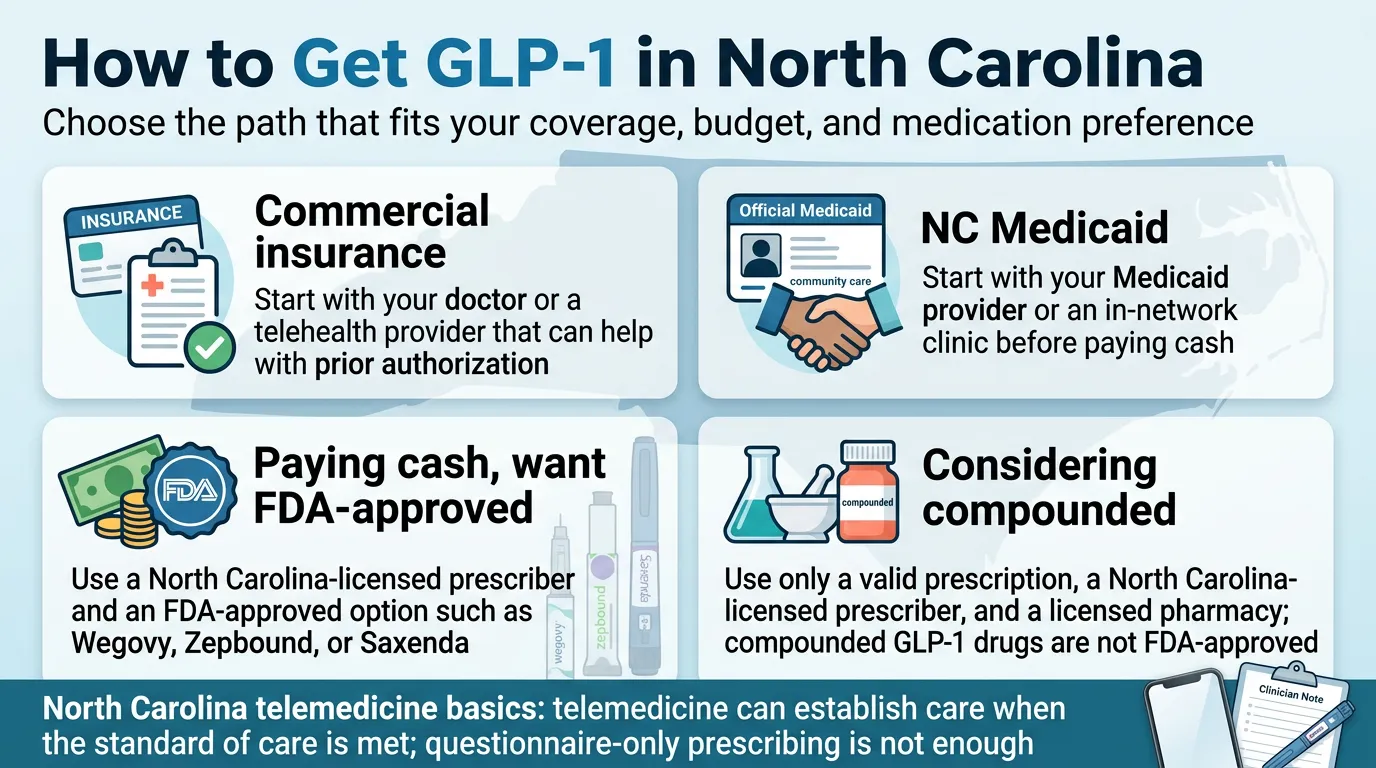
There are four real paths. Which one fits you depends on your insurance situation and how you feel about FDA-approved vs. compounded medication.
Path 1 — Through your existing doctor or an NC weight-loss clinic
Best if you have decent insurance coverage, prefer in-person care, or have a complex medical history. Your doctor can prescribe Wegovy, Zepbound, or Ozempic (off-label) and submit prior authorization to your insurer.
Path 2 — Through NC Medicaid
Best if you're one of the 3.1+ million North Carolinians covered by Medicaid. Coverage was restored December 12, 2025. Your Medicaid provider can prescribe preferred drugs (Wegovy) with prior authorization.
Path 3 — Through a licensed telehealth provider (FDA-approved)
Best if you want speed and convenience, prefer brand-name medication, and want everything handled from your phone. Ro is the strongest option here — they offer FDA-approved GLP-1s, include an insurance concierge, and ship directly to your NC address.
Path 4 — Through a telehealth provider offering compounded GLP-1s
Best if cost is your top priority and you understand the tradeoffs. Compounded GLP-1 medications are not FDA-approved and do not go through the same regulatory review as brand-name products. The FDA has warned about quality and dosing risks with compounded GLP-1s. But for many people paying entirely out of pocket, this category provides an accessible entry point. MEDVi is one of the more established options in this space.
The rest of this guide walks through each path in detail. But first — let's put them side by side.
Ro Body
Takes 2 minutes — a licensed provider reviews your answers, no commitment required
Quick Comparison: 4 Ways to Get GLP-1 in North Carolina
| Your Doctor / NC Clinic | NC Medicaid | FDA-Approved Telehealth | Compounded Telehealth | |
|---|---|---|---|---|
| Best for | Insured patients, complex histories | Medicaid members | Speed + brand-name preference | Lowest upfront cash cost |
| Medication type | FDA-approved | FDA-approved (preferred list) | FDA-approved | Not FDA-approved |
| Insurance help? | Yes — your provider handles PA | Built-in (Medicaid) | Ro includes insurance concierge | Generally no |
| Starting cost | Copay varies ($0–$300+) | $0 with PA approval | Membership $39 first mo + medication from $149/mo | $179/mo first month |
| NC-specific note | Any NC-licensed provider can prescribe | Coverage reinstated Dec 2025 | Must use NC-licensed providers | Legal in NC when properly prescribed |
| Main downside | Appointment wait times, some PCPs hesitant | Prior authorization required, preferred-drug rules | Membership fee + medication = higher total | Not FDA-approved, quality varies by pharmacy |
| Best next step | Call your doctor | Contact your Medicaid plan | Start with Ro | Research MEDVi |
Pricing last verified: March 2026. Costs may change. Always confirm at checkout.
Ro Body
Answer a few health questions — find out if your insurance covers more than you think
Which GLP-1 Provider Works in North Carolina? (Provider Comparison)
We evaluated telehealth GLP-1 providers available to NC residents across medication type, pricing transparency, clinical support, and cancellation flexibility. Here's how the top options compare.
| Provider | Ships to NC? | FDA-Approved Meds? | Compounded? | Insurance Support? | Starting Price | Additional Fees | Wegovy Pill? | FSA/HSA? | Cancel Policy |
|---|---|---|---|---|---|---|---|---|---|
| Ro | Yes | Yes (Wegovy, Zepbound, Ozempic) | Not a core offering | Yes — insurance concierge | Medication from $149/mo (Wegovy pill, 1.5mg) | $39 first mo, then $149/mo membership | Yes | Yes | Cancel anytime (48hr notice) |
| Hims/Hers | Yes | Shifting toward broader FDA-approved assortment | Available on limited scale | No | Actual price depends on product and plan | All-in pricing, prepaid plans | Verify current availability | Yes | Prepaid, generally non-refundable |
| MEDVi | Yes | Ozempic at premium price | Yes (primary offering) | No | $179 first month; $299/mo ongoing | Month-to-month, auto-renews every 28 days | No | Yes | Month-to-month; no refund after Rx issued |
| WeightWatchers Clinic | Yes | Yes | No | Yes | $25 first month (12-month commitment); $74/mo after | GLP-1 medication cost NOT included | Check availability | Yes | Prepaid terms apply |
| Walgreens Weight Mgmt | Yes | Yes | No | No | $49/visit + medication from $149/mo | No subscription needed | Yes | Yes | Per-visit |
Pricing last verified: March 2026. Subject to change.
Our take: For most NC residents, Ro offers the strongest combination of FDA-approved medication and insurance support. The membership cost is real money on top of medication — but it includes lab testing at Quest, a dedicated insurance concierge, coaching, and nurse check-ins. If your insurance ends up covering medication, the membership can pay for itself.
Can You Legally Get GLP-1 Online in North Carolina?
Yes. And this is worth understanding, because it affects which providers you can trust.
North Carolina's Medical Board has a clear position on telemedicine: care delivered to a patient in North Carolina is treated as occurring in North Carolina, regardless of where the clinician is physically located. Clinicians treating NC patients via telehealth should generally be licensed in NC and are held to the same standard of care as in-person practice.
Here's what NC rules actually say about telehealth prescribing:
A provider-patient relationship can be established through telemedicine without a prior in-person visit — as long as the standard of care is met. This is why legitimate telehealth platforms can legally prescribe GLP-1 medication to NC residents after a proper evaluation.
However, the NC Medical Board also states that prescribing based solely on answers to a set of questions, without a real clinical review, is inappropriate. That matters. If a provider is handing out prescriptions based on a 3-minute quiz with no follow-up — that's a red flag, not a convenience feature.
GLP-1 medications (semaglutide, tirzepatide, liraglutide) are not controlled substances, which makes the telehealth prescribing process more straightforward. A licensed NC provider can prescribe GLP-1 medication via video consultation, and in some cases through an asynchronous review depending on the platform and state-specific requirements.
The North Carolina Board of Pharmacy allows pharmacies to dispense telemedicine-generated prescriptions using professional judgment.
What this means for you: Getting GLP-1 medication online in North Carolina is legal, legitimate, and increasingly common. The key is making sure your provider is doing it the right way.
How to Verify a GLP-1 Provider Is Legitimate in NC
This is where most guides fall short. We want you to be able to verify any provider — not just the ones we recommend.
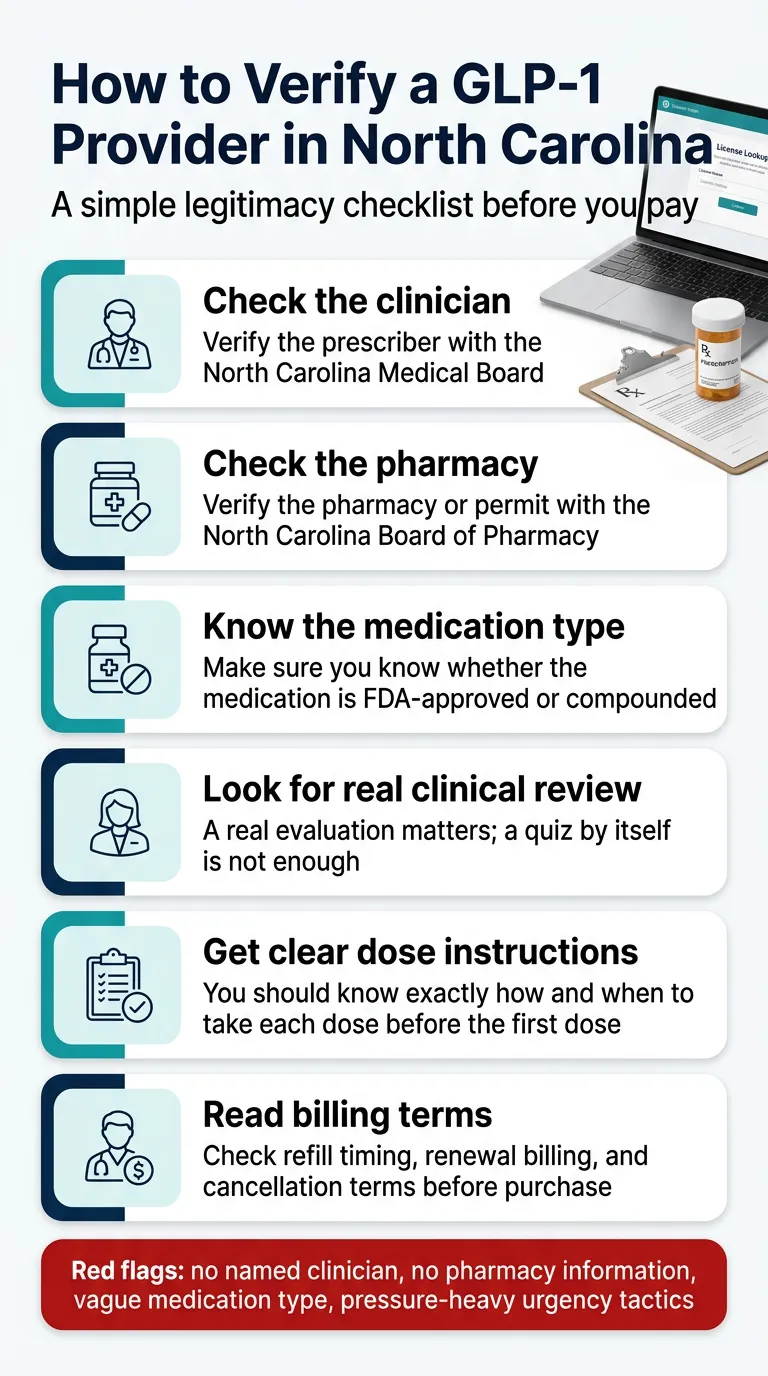
Check the clinician's NC license. The NC Medical Board maintains a public license verification portal at portal.ncmedboard.org. Any provider prescribing medication to you in North Carolina should have a verifiable, active NC license.
Check the pharmacy. The NC Board of Pharmacy has its own verification tool at portal.ncbop.org. If you're getting compounded medication, the pharmacy should be a licensed 503A or 503B facility.
Verify whether you're getting FDA-approved or compounded medication. Many telehealth sites use soft language like "prescription-grade" or "pharmaceutical-quality" without clearly stating whether the product is FDA-approved. If it's compounded, they should say so plainly.
Check the dose instructions. The FDA has issued specific warnings about dosing errors with compounded semaglutide — particularly around confusion between milligrams and units. If your dose instructions are unclear, contact your provider before your first injection.
Review the cancellation and billing terms. Some providers advertise a low first-month price but don't make ongoing costs easy to find. Check the FAQ, terms of service, or support pages for renewal pricing before you pay.
Look for real clinical support. Can you message your provider about side effects? Is there a nurse line? Are follow-up visits included? Medication alone isn't treatment — ongoing medical support is what separates legitimate programs from pill mills.
NC GLP-1 Provider Red Flags
No NC-licensed clinician identified anywhere on the site
Questionnaire-only prescribing with no real clinical review
No pharmacy information provided
Vague language about whether medication is FDA-approved or compounded
Unclear cancellation or renewal terms
No side-effect guidance or follow-up support
Aggressive countdown timers and "limited supply" urgency tactics
Should You Choose FDA-Approved or Compounded GLP-1?
This is one of the biggest decisions you'll make, and we want to be straight with you about it.
FDA-Approved GLP-1 Medications for Weight Loss
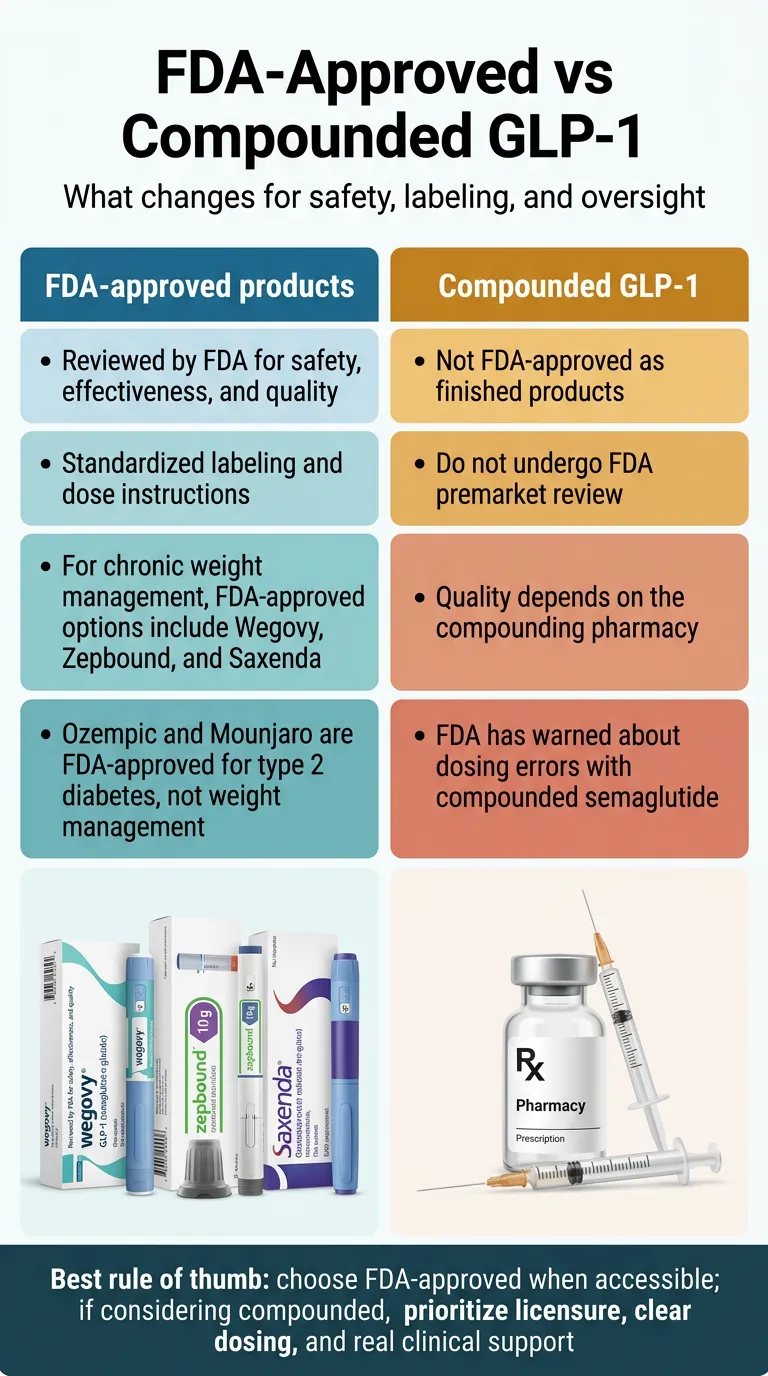
Three GLP-1 medications currently have FDA approval specifically for weight management:
- Wegovy (semaglutide) — available as injection and pill (the first oral GLP-1 approved for weight loss)
- Zepbound (tirzepatide) — a dual GLP-1/GIP receptor agonist
- Saxenda (liraglutide) — an older option, daily injection
Additionally, Ozempic (semaglutide) and Mounjaro (tirzepatide) are FDA-approved for Type 2 diabetes and sometimes prescribed off-label for weight loss at a provider's discretion.
FDA-approved means these medications went through rigorous clinical trials, are manufactured under strict quality controls, and their safety, effectiveness, and dosing have been verified by the FDA.
Compounded GLP-1 Medications
Compounded GLP-1 medications are prepared by compounding pharmacies based on a provider's prescription. They became widely available during the GLP-1 shortage that began in 2022, when demand far exceeded supply for brand-name drugs.
Here's what you need to know: compounded medications are not FDA-approved as finished products. The FDA does not evaluate them for safety, effectiveness, or quality in the same way it evaluates brand-name drugs.
The FDA resolved the semaglutide shortage in early 2025 and has announced intent to take action against mass-marketed non-FDA-approved GLP-1 products. Hims & Hers announced in March 2026 that its U.S. weight-loss strategy is shifting toward a broader assortment of FDA-approved medications, with compounded semaglutide offered only on a limited scale when clinically necessary.
How to Decide
Choose FDA-approved if:
- Your insurance covers it (even partially)
- You want the most well-documented safety and efficacy profile
- You prefer consistent, factory-manufactured medication
- You're new to injections and want the simplest dosing
- You can afford the cash-pay price or qualify for savings programs
Compounded may be reasonable if:
- You have no insurance coverage and cost is a real barrier
- Your provider determines it's clinically appropriate for you
- The compounding pharmacy is a licensed, reputable facility
- You're comfortable doing your own due diligence
- You understand this is a category with less regulatory oversight
Our honest take: FDA-approved is the safer default when you can access it. The Wegovy pill at $149/month (1.5mg dose) and injectable Wegovy promotional pricing have made brand-name options far more affordable than they were even a year ago. If you're considering compounded, make sure you're doing it with eyes open — not just because it was the first thing that showed up in an ad.
Ro Body
A licensed provider evaluates your health profile and tells you if you qualify — free
Does Insurance Cover GLP-1 in North Carolina?
Coverage varies so widely in North Carolina that there's no single answer. But we can give you a clear framework for YOUR situation.
If You Have NC Medicaid — Yes, Coverage Was Reinstated
On December 12, 2025, NC Medicaid reinstated coverage for GLP-1 medications used to treat obesity, reversing a cut from earlier that fall.
Here's what was restored:
- Wegovy — added back to the Preferred Drug List (preferred)
- Zepbound — added back (non-preferred; may require trying Wegovy first or documented clinical reason)
- Saxenda — added back (non-preferred)
Prior authorization IS required. Your provider will need to submit documentation showing you meet the clinical criteria. Initial eligibility is based on standard obesity/overweight criteria with weight-related conditions. The 5% pretreatment-weight-loss maintenance rule applies as a continuation/renewal criterion, not as a barrier to getting started.
If you're on NC Medicaid, this is almost certainly your best path — talk to your Medicaid provider before signing up for any cash-pay telehealth program.
NC Medicaid Managed Care Plans:
- Healthy Blue: healthybluenc.com
- WellCare of NC: wellcare.com/north-carolina
- UnitedHealthcare Community Plan: uhccommunityplan.com
- AmeriHealth Caritas NC: amerihealthcaritasnc.com
- Carolina Complete Health: carolinacompletehealth.com
When you call, ask: "Has your plan updated its formulary to reflect the December 2025 GLP-1 reinstatement? Can my provider submit a prior authorization for Wegovy?"
NC Medicaid also continues to cover Wegovy and Zepbound for non-weight-loss indications — including cardiovascular risk reduction and obstructive sleep apnea.
If You Have Blue Cross NC
Blue Cross and Blue Shield of North Carolina is the state's largest insurer, and coverage for GLP-1 weight-loss medication varies by specific plan. Some BCBS NC plans include a "GLP-1 for Weight Management" program for eligible members enrolled in a pharmacy plan. Others restrict coverage to diabetes indications only.
What you should do:
- Call the number on the back of your member ID card
- Ask specifically: "Does my plan cover Wegovy or Zepbound for weight management?"
- Ask about prior authorization requirements
- Ask what your out-of-pocket cost would be after deductible
If covered, you may qualify for manufacturer savings cards. Commercially insured patients may lower Wegovy costs through the WeGoTogether savings program, and Zepbound has its own savings card program.
If Blue Cross NC denies your request, an appeal process exists. Eli Lilly publishes letters of medical necessity and appeal resources for Zepbound. Many initial denials are reversed on appeal — particularly if your provider documents appropriate clinical criteria.
If You're on the NC State Health Plan
In January 2024, the NC State Health Plan Board of Trustees voted to exclude GLP-1 and GIP-GLP-1 medications from coverage when used for weight loss, effective April 1, 2024.
This affects state employees, teachers, university staff, and retirees. Coverage remains for Type 2 diabetes, cardiovascular risk reduction, and other non-weight-loss FDA-approved indications. The plan has continued to explore future options, but for weight-loss-only use, the exclusion makes cash-pay programs the more realistic path unless plan rules change.
Your options:
- Cash-pay through a telehealth provider (Ro, Hims/Hers, MEDVi)
- Use FSA or HSA funds (GLP-1s prescribed for weight management are eligible)
- Ask your HR department whether your employer has purchased a supplemental rider
What to Say When You Call Your Insurance Company
Write down the answers to these questions:
- "Does my plan cover Wegovy or Zepbound for weight management?"
- "Is coverage limited to specific indications like diabetes, or does it include obesity?"
- "What prior authorization criteria apply?"
- "What is my out-of-pocket cost after deductible?"
- "If denied, what is the appeals process and timeline?"
- "Can I use a manufacturer savings card on top of my plan coverage?"
Having these answers before you choose a provider can save you hundreds of dollars and weeks of frustration. If your plan says no, ask for the denial reason in writing — it's your right, and it's the starting point for an appeal.
If You Have Other Employer Insurance
Many large employers nationwide are restricting GLP-1 weight-loss coverage in 2026 due to cost pressures. Some are offering optional "riders" that employees can purchase for continued coverage. Don't assume — check your specific plan formulary. And don't assume a denial is final. Prior authorization and appeals are standard parts of the process.
If You Have Medicare
Medicare Part D does not cover medications prescribed solely for weight loss due to a long-standing statutory exclusion.
However, two significant developments are on the horizon:
- Medicare GLP-1 Bridge (July 2026–December 2027): CMS extended this demonstration through December 31, 2027, giving eligible Medicare Part D enrollees access to certain GLP-1 medications at an estimated $50 per month. This operates outside normal Part D coverage — your plan doesn't have to opt in.
- BALANCE Model (date TBD): A longer-term voluntary model where CMS negotiates drug pricing with manufacturers on behalf of Part D plans. CMS has delayed Medicare Part D BALANCE implementation — check cms.gov for current status rather than relying on a fixed January 2027 date.
In the meantime, Wegovy can be covered under Medicare Part D when prescribed for cardiovascular risk reduction in adults with established cardiovascular disease — that's a covered FDA-approved indication separate from weight loss.
For weight-loss-only prescriptions today, cash-pay through a telehealth provider remains the primary option until the Bridge launches in July 2026.
How Much Do GLP-1s Actually Cost in North Carolina?
Let's cut through the marketing and look at real numbers.
Medication Pricing (March 2026)
| Medication | Type | Cash Price (Monthly) | With Commercial Insurance + Savings Card | Notes |
|---|---|---|---|---|
| Wegovy Pill | FDA-approved oral | $149 (1.5mg & 4mg through August 31, 2026); $199 (4mg after August 31, 2026); $299 (9mg, 25mg) | As low as $25/mo with savings card | First oral GLP-1 for weight loss. Made in NC. |
| Wegovy Injection | FDA-approved | $199/mo promotional (0.25mg & 0.5mg through December 31, 2026); $349/mo regular | As low as $25/mo with savings card | Promo pricing for starter doses only |
| Zepbound | FDA-approved | $299–$449/mo (vials, dose-dependent) | As low as $25/mo with savings card | Dual GLP-1/GIP. Vials are cheaper than pens |
| Ozempic | FDA-approved (off-label for weight loss) | ~$1,028 list price | Varies by plan | Approved for diabetes; sometimes prescribed off-label |
| Compounded Semaglutide (MEDVi) | Not FDA-approved | $179 first mo; $299/mo ongoing | N/A | Flat rate regardless of dose |
| Compounded Tirzepatide (MEDVi) | Not FDA-approved | $279 first mo; $399/mo ongoing | N/A | Flat pricing |
Pricing last verified: March 2026. Subject to change.
Don't Forget: Membership Fees Change the Math
Telehealth platforms often charge a membership or platform fee on top of medication cost. Here's what that looks like over six months:
- Ro + Wegovy Pill: $39 +(first month membership) + $149 × 5 (ongoing) + medication ($149–$299/mo depending on dose and timing) = total varies significantly by dose and insurance outcome. If insurance covers the medication, you'd pay only membership + copays.
- MEDVi Compounded Semaglutide: $179 (month 1) + $299 × 5 = $1,674 total. No separate membership fee. But medication is not FDA-approved.
- Through your doctor with insurance: If your plan covers Wegovy and you use a savings card, medication could be as low as $25/month plus office visit copays. This is the cheapest path when insurance cooperates.
How to Reduce Your Costs
- Check your insurance first. Even if you think it won't cover GLP-1s, it's worth a phone call.
- Apply for manufacturer savings cards. The Wegovy WeGoTogether program and Zepbound savings card can reduce costs for commercially insured patients.
- Consider the Wegovy pill. Starting at $149/month for the 1.5mg dose, it's the most affordable FDA-approved GLP-1 available.
- Use FSA/HSA funds. GLP-1 medications prescribed for weight management are eligible expenses.
- Ask about manufacturer direct options. NovoCare (for Wegovy) and LillyDirect (for Zepbound) offer cash-pay pricing that's competitive with or better than some telehealth platforms — though you'll need a prescription from somewhere.
Ro — Best Overall for NC Residents Who Want FDA-Approved GLP-1s
Best for: People who want guaranteed FDA-approved medication, need insurance help, and value a structured program with clinical support.
Not best for: NC Medicaid or Medicare beneficiaries (Ro cannot coordinate GLP-1 coverage for government insurance plans), or people who want the absolute lowest upfront cost.
Ro's Body Program pairs FDA-approved GLP-1 medication with lab testing at Quest Diagnostics (included), a dedicated insurance concierge, 1:1 coaching, weekly nurse check-ins, and an app for tracking progress.
What sets Ro apart from most telehealth GLP-1 providers is the insurance concierge. They don't just hand you a prescription and wish you luck — they contact your insurance company, submit prior authorization paperwork, and work to secure coverage on your behalf. If your medication gets covered, your cost drops to a copay. If it doesn't, they'll pivot you to cash-pay options.
Ro offers Wegovy (injection and pill), Zepbound, and Ozempic. All FDA-approved. The process starts with an online health intake, followed by provider review. If your provider orders lab work, testing at any Quest Diagnostics location is included in your membership at no extra cost. Once your treatment plan is set, medication ships to your door — or if you're going through insurance, a prescription is sent to your pharmacy.
The coaching and curriculum are more structured than most telehealth competitors. You get a 12-month evidence-based weight-loss curriculum, unlimited messaging with your care team, and regular nurse check-ins to monitor progress and adjust dosing.
What It Costs
- $39 for the first month of membership, then $149/month ongoing
- Medication is billed separately: Wegovy pill from $149/mo at the 1.5mg dose
- Injectable Wegovy from $199/mo (promotional for starter doses through December 31, 2026)
- Zepbound vials from $299/mo through LillyDirect
The Honest Downside
That $149/month membership on top of medication cost isn't nothing. When you add it up, Ro is more expensive month-to-month than a compounded provider with no membership fee. But what the membership buys — lab work, insurance navigation, clinical support, nurse access — is significant. For many people, the insurance concierge alone pays for itself if it gets your medication covered. And because Ro only prescribes FDA-approved medication, you're getting products that have been through the full FDA review process.
Ro Body
Ro's concierge handles the insurance paperwork — you just answer health questions
Hims & Hers — Best for a Smoother All-Online Experience
Best for: People who want a streamlined digital experience, prefer to skip insurance entirely, and want clear upfront pricing.
Not best for: People who want heavy clinical hand-holding, those who need insurance navigation, or anyone in AL, AR, LA, or MS (NC is available).
Hims (for men) and Hers (for women) are sister platforms under the same parent company. In March 2026, Hims & Hers announced a strategic shift for its U.S. weight-loss business toward a broader assortment of FDA-approved medications, with compounded semaglutide available only on a limited scale when clinically necessary.
This is a meaningful change. For most of the past two years, Hims & Hers built its weight-loss business on compounded GLP-1s. Now, with a deal in place with Novo Nordisk, they're transitioning toward selling FDA-approved Wegovy and Ozempic directly through their platform. For NC residents, this shift means you're increasingly likely to receive FDA-approved medication through this platform.
Hims/Hers currently lists North Carolina as eligible for its weight-loss services. The platform offers online intake, provider review, and medication delivery. The onboarding experience is designed for minimal friction — health questions, provider review, treatment plan, delivery.
What It Costs
Actual price depends on the product and subscription plan purchased. Plans are prepaid — typically 3, 6, 10, or 12-month commitments. No separate membership fee. FSA/HSA eligible. Insurance is not accepted.
The Honest Downside
The prepaid model can feel rigid. If you want to try one month before committing, this platform isn't built for that. And because they don't accept insurance, you're paying the full advertised price regardless of what your plan might cover elsewhere. On the other hand, pricing is transparent — no hidden fees, no surprise membership charges.
MEDVi — Budget Option for Compounded GLP-1s
Best for: People paying entirely out of pocket who are drawn to the lowest advertised starting price and prefer month-to-month flexibility.
Not best for: People who want FDA-approved medication, those who are risk-averse about compounded products, or anyone who needs insurance integration.
MEDVi is a telehealth platform focused on compounded GLP-1 medication at a lower price point. The platform advertises included medication, physician review, unlimited messaging, and 24/7 support.
What It Costs
Compounded semaglutide injections start at $179 for the first month. Ongoing cost is $299/month, auto-renewing every 28 days. Compounded tirzepatide starts at $279 first month, then $399/month. MEDVi markets "no membership or hidden fees," but their support materials describe a month-to-month renewing membership structure, and once a prescription is issued, refunds are not available.
The Honest Downside
MEDVi's marketing emphasizes the $179 first-month price more prominently than the higher ongoing cost. The company's site materials also include disclosures noting that compounded GLP-1s are not FDA-approved or evaluated for safety, efficacy, or quality by the FDA. That's standard for compounded medication, but you should understand it before you start.
The important context: Compounded GLP-1 medications are not FDA-approved as finished products. For some NC residents, MEDVi-type pricing is the difference between accessing GLP-1 treatment and not. If brand-name medication is out of your budget and your insurance won't cover it, a compounded option through a provider whose pharmacy sourcing you've verified is a legitimate consideration — just go in with eyes open.
Local NC Clinics — Best for In-Person Care and Complex Cases
Best for: NC Medicaid patients, people with complex medical histories, those who prefer face-to-face provider relationships, and anyone with good insurance coverage for office-based weight management.
North Carolina has strong medical weight-loss infrastructure, especially in the Triangle, Charlotte, and Triad areas. Major health systems including Duke Health, UNC Health, Atrium Health, Wake Forest Baptist, and Novant Health all operate obesity medicine or weight-management programs.
If you have NC Medicaid, a local in-network provider is almost always your best starting point — they can navigate Medicaid's prior authorization requirements and prescribe from the preferred drug list.
If you have a complex medical history — multiple medications, endocrine conditions, history of pancreatitis, GI issues, or previous bariatric surgery — in-person care with a board-certified obesity medicine physician gives you a level of evaluation that telehealth can't always match.
How to find an NC provider: The American Board of Obesity Medicine (ABOM) and the Obesity Medicine Association (OMA) both have provider directories searchable by location. Your PCP can also refer you to a weight-management specialist.
Manufacturer-Direct Savings — Don't Overlook These
Even if you don't use a telehealth membership, you can access competitive pricing through the drug manufacturers themselves.
Novo Nordisk (Wegovy, Ozempic): NovoCare Pharmacy offers the Wegovy pill starting at $149/month and the Wegovy injection at promotional pricing for starter doses. The WeGoTogether savings card may lower costs to as low as $25/month for commercially insured patients. Free shipping available.
Eli Lilly (Zepbound, Mounjaro): LillyDirect offers Zepbound vials at lower prices than pens, plus a savings card program for commercially insured patients. They also publish appeal resources if your insurance denies coverage.
These manufacturer programs require a prescription — so you'll still need a provider to write the Rx. But the medication itself may cost less through manufacturer channels than through some telehealth membership models.
We include these even though they're not affiliate partners because they're genuinely useful — and sometimes the best option.
Step by Step: How the Process Actually Works
Whether you go telehealth or in-person, here's what the GLP-1 prescription process looks like in North Carolina.
The Telehealth Path (Most Common)
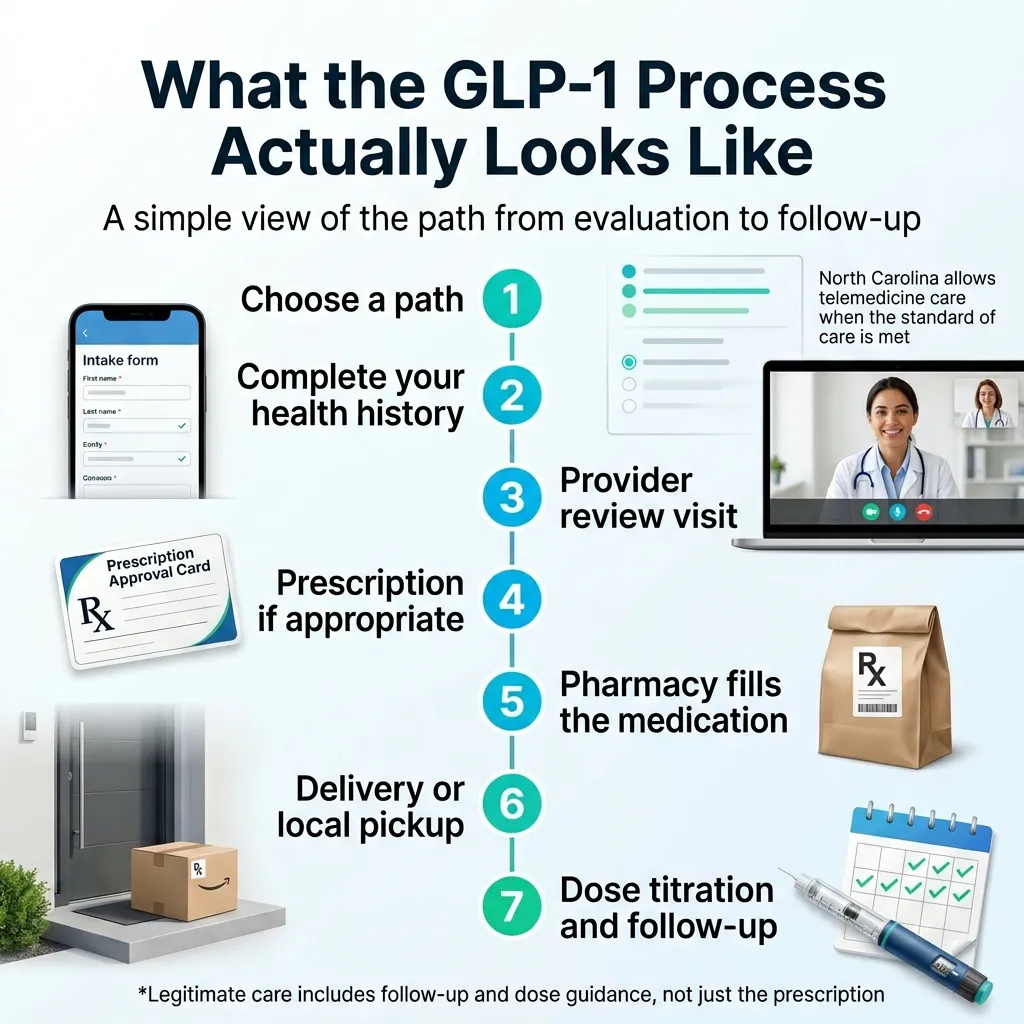
- Step 1: Choose a provider. Use the comparison table above. Consider your insurance, budget, and whether you prefer FDA-approved or compounded medication.
- Step 2: Complete a health assessment. You'll answer questions about your medical history, current medications, weight-loss goals, and relevant conditions.
- Step 3: Consult with a licensed provider. Depending on the platform and NC telehealth requirements, this may be a video visit, phone call, or asynchronous review. The provider evaluates your eligibility and determines if GLP-1 treatment is appropriate.
- Step 4: Lab work (if required). Some providers (like Ro) include lab testing. Others may ask you to get labs separately.
- Step 5: Prescription and delivery. If approved, your provider writes a prescription. Medication ships to your NC address.
- Step 6: Start treatment. You'll begin at a low dose (titration) and gradually increase over weeks or months.
- Step 7: Ongoing support. Regular check-ins, messaging access, dose adjustments, and side-effect management.
The In-Person Path
- Schedule with your PCP or an NC weight-loss clinic
- Get evaluated — BMI, health history, medications, goals
- If appropriate, provider prescribes and submits prior authorization (if applicable)
- Pick up at pharmacy or arrange delivery
- Regular follow-up visits for monitoring
Do You Qualify for GLP-1 Medication?
Standard FDA eligibility criteria:
- BMI of 30 or higher (obesity), OR
- BMI of 27 or higher with at least one weight-related health condition — such as Type 2 diabetes, high blood pressure, high cholesterol, obstructive sleep apnea, PCOS, or cardiovascular disease
- Age 18+ for most medications (Wegovy is approved for ages 12+ for obesity)
Conditions that require individualized medical review:
- Personal or family history of medullary thyroid carcinoma (MTC) or MEN 2 — this is a boxed warning on all GLP-1 weight-loss medications
- History of pancreatitis — a labeled precaution, discuss with your provider
- Severe gastroparesis or significant GI disease
- Current pregnancy or breastfeeding
- Active eating disorder — your provider should evaluate risk vs. benefit
- Patients on other diabetes medications (risk of hypoglycemia)
What BMI 27 actually looks like: At 5'4", that's about 157 lbs. At 5'7", about 173 lbs. At 5'10", about 188 lbs. Many people qualify and don't realize it.
Ro Body
Take the free 2-minute eligibility quiz
What Are the Side Effects?
Most people experience some side effects, especially in the first few weeks. Here's the full picture.
Common (usually temporary): Nausea, diarrhea, constipation, stomach pain, headache, and fatigue. These are most noticeable when you start treatment and when your dose increases.
Less common: Vomiting, dizziness, bloating, acid reflux.
Rare but serious: Pancreatitis, gallbladder problems, kidney issues, and a boxed warning about the risk of thyroid C-cell tumors (observed in animal studies — the clinical significance in humans is being monitored).
The practical reality: Starting at a low dose and increasing gradually (titration) is specifically designed to minimize side effects. Smaller meals, hydration, and avoiding greasy food during the adjustment period all help. Most side effects improve within a few weeks.
Your provider should be monitoring you throughout treatment and adjusting your dose as needed. If side effects are severe or persistent, talk to your provider — don't just tough it out.
Need help managing side effects? See our GLP-1 nausea guide and constipation relief guide.
What Kind of Results Can You Realistically Expect?
Clinical trials give us good benchmarks:
- Wegovy (semaglutide 2.4mg injection): Participants lost an average of ~15% of their body weight over 68 weeks in the STEP 1 trial.
- Zepbound (tirzepatide 15mg): Participants lost an average of ~21% of their body weight over 72 weeks in the SURMOUNT-1 trial.
- Wegovy pill (oral semaglutide 25mg): The OASIS 4 trial showed significant weight loss comparable to the injectable.
Real-world expectations: Results depend heavily on combining medication with dietary changes and physical activity. Your provider will help you set realistic goals.
A Note About Muscle Loss
Any significant weight loss involves some muscle loss alongside fat loss. The mitigation is straightforward: strength training and adequate protein intake. Discuss specifics with your provider — it's one of the most important things you can do to protect your long-term health while losing weight. See our muscle preservation guide for details.
A North Carolina Connection
The Wegovy pill is manufactured end to end in North Carolina's Triangle region — the active pharmaceutical ingredient is produced at Novo Nordisk's facility in Clayton, and the tablets are formed and packaged at their Durham site. More than 2,000 Novo Nordisk employees work in North Carolina. If you're an NC resident, the most affordable FDA-approved GLP-1 literally comes from your backyard.
What Happens After You Start — and What Most People Don't Think About
The First 4 Weeks
Your provider will start you on the lowest available dose. For semaglutide, that's typically 0.25mg per week. For tirzepatide, it's 2.5mg per week. This titration period gives your body time to adjust and minimizes side effects.
During this phase, you'll likely notice reduced appetite before significant scale movement. That's normal. Some people notice changes on the scale quickly; others don't see much until month two.
Nausea is the most common early complaint. Here's what helps: eat smaller, more frequent meals. Prioritize protein at every meal. Stay hydrated throughout the day. Avoid large, heavy, or greasy meals — your stomach is processing food more slowly now. Ginger tea and peppermint can also help with mild nausea.
Months 2–6: Where Real Changes Happen
Most people see the most dramatic changes during this window. Your dose gradually increases to a therapeutic level, appetite suppression becomes consistent, and the weight loss accelerates.
This is also when building lasting habits matters most. GLP-1 medication gives you a window of reduced hunger and cravings — use it to build eating patterns and exercise routines you can sustain long-term.
Focus on three things: protein intake (to preserve muscle mass), strength training (even basic bodyweight exercises count), and sleep. These three factors have an outsized impact on how well the medication works and how you feel throughout the process. See our GLP-1 diet plan for details.
What If You Stop Taking GLP-1 Medication?
Research consistently shows that weight regain is common after discontinuation. This isn't a failure of the medication — obesity is a chronic condition, similar to high blood pressure or diabetes, and it often requires ongoing management. Many providers now recommend long-term or maintenance therapy rather than a fixed treatment period.
If you're considering stopping, discuss a tapering plan with your provider first. Some people successfully transition to a lower maintenance dose. Others leverage the medication period to make permanent lifestyle changes. The key is having a plan before you stop — not just running out of refills and hoping for the best. See our discontinuation guide.
Can You Switch Providers or Medications Mid-Treatment?
Yes. If you start with one telehealth provider and want to switch — whether for cost, service quality, or medication type — most platforms can onboard patients who are already on GLP-1 treatment. Your new provider may adjust your dose or titration schedule, especially if you're switching between semaglutide and tirzepatide.
About the GLP-1 Shortage
The semaglutide shortage has been largely resolved since early 2025. The Wegovy pill provides an additional supply pathway. Spot shortages at individual pharmacies can still occur — if your specific dose is temporarily unavailable, your provider should have a plan.
When Should You Think Twice About a Telehealth GLP-1 Program?
If your insurance already covers brand-name GLP-1 medication at a reasonable copay, an online membership might not be your cheapest option. Going through your doctor and using a manufacturer savings card could bring your monthly cost to as low as $25 — less than most telehealth programs.
Other times to pause:
- If your medical history involves multiple endocrine conditions, active eating disorder, or complicated medication regimens — an in-person obesity medicine specialist may serve you better
- If the provider won't clearly tell you whether medication is FDA-approved or compounded, what pharmacy they use, or how to reach a real person for help
- If dose instructions you receive are confusing — the FDA has specifically warned about dosing errors with compounded semaglutide. Do not proceed until you've clarified with your provider
What If Your Insurance Denied GLP-1 Coverage?
This happens a lot — and it's not always the end of the road. Here's how to respond:
- Step 1: Get the denial in writing. Call your plan and request the specific reason for denial. Common reasons include: not meeting prior authorization criteria, step therapy requirements, or the drug being excluded from your formulary.
- Step 2: Ask your prescribing provider to appeal. Many denials are paperwork-based, not clinical. Your provider can submit additional documentation — BMI records, comorbidity history, prior weight-loss attempts — that satisfies the PA criteria.
- Step 3: Use manufacturer appeal resources. Eli Lilly publishes letters of medical necessity and appeal templates for Zepbound. Novo Nordisk offers similar support for Wegovy through NovoCare.
- Step 4: If the appeal fails, pivot to cash-pay options. The Wegovy pill at $149/month, Zepbound vials through LillyDirect, or a telehealth provider like Ro (which can help coordinate this pivot) are your next best moves.
- Step 5: Try again next plan year. Formularies change annually. A drug that's excluded this year might be covered next year — especially as more employers and plans add GLP-1 weight-management benefits.
How We Evaluated These Options
Our team evaluated telehealth GLP-1 providers for NC residents across these criteria: NC legality and licensure compliance, medication type (FDA-approved vs. compounded), price transparency, insurance support, clinical support quality, cancellation flexibility, pharmacy sourcing, and third-party verification.
We earn commission from some providers on this page. That's how we fund this guide. But our recommendations are based on the criteria above, not commission rates. We've also included manufacturer-direct options (NovoCare, LillyDirect) that we earn nothing from — because sometimes they're the best choice.
Free Tools to Help You Decide
We built these to make your decision easier — no sign-up required.
NC GLP-1 Path Finder Quiz
Answer a few quick questions about your insurance type, budget, and preferences. We'll match you with the best-fit GLP-1 path for your specific situation in North Carolina.
Take the QuizMonthly Cost Reality Calculator
Compare actual 6-month costs across providers, including membership fees, medication at different doses, and what happens after promotional pricing expires.
Calculate Your CostsGLP-1 BMI Eligibility Calculator
Check if your BMI meets the eligibility criteria for GLP-1 weight-loss medication.
Check Your BMIYour Next Step
You've done the research. You've seen every path available to you in North Carolina — insurance, Medicaid, FDA-approved telehealth, compounded telehealth, local clinics, and manufacturer-direct savings.
Now it comes down to which one fits.
Want FDA-approved medication with insurance help?
Start with RoWant simple self-pay access to brand-name meds?
Start with HimsStart with HersWant the lowest cash-pay starting price?
Start with MEDViHave NC Medicaid?
Contact your Medicaid provider and ask about Wegovy coverage under the restored criteria
Have good insurance?
Call your plan first. You might be pleasantly surprised.
Not sure yet?
Take our free 60-second matching quizWhatever path you choose, you're making a decision backed by some of the strongest clinical evidence in modern medicine. GLP-1 medications are the most effective pharmacological weight-loss tools developed to date, and they're changing outcomes for millions of people.
You found this guide because you were ready. Now you know exactly how to move forward.
Ro Body
Free eligibility assessment — 2 minutes
Frequently Asked Questions About GLP-1 in North Carolina
This guide is updated regularly. Bookmark it for the latest NC pricing and coverage changes.
We earn commission from some providers on this page. This never influences our recommendations. See our editorial standards for details.
This content is for informational purposes only and does not constitute medical advice. GLP-1 medications require a prescription and should be used under the supervision of a licensed healthcare provider.
Sources: FDA prescribing information for Wegovy and Zepbound · NC DHHS Medicaid bulletin (Dec. 19, 2025) · NC Medical Board Position Statement on Telemedicine · NC Board of Pharmacy · Wilding et al., NEJM 2021 (STEP 1) · Jastreboff et al., NEJM 2022 (SURMOUNT-1) · Novo Nordisk OASIS 4 trial data · Ro.co pricing and program pages · Hims & Hers investor announcement (Mar. 9, 2026) · MEDVi pricing and support pages · NovoCare savings programs · LillyDirect and Zepbound access resources · FDA compounding guidance and enforcement updates · Blue Cross NC provider bulletins · NC State Health Plan Board of Trustees records (Jan. 2024) · CMS Medicare GLP-1 Bridge page · CMS BALANCE Model page · Axios Raleigh (Jan. 2026) · TIME (Jan. 2026) · NC Biotechnology Center · Duke Lifestyle and Weight Management Center