How to Get GLP-1 Approved for Weight Loss in 2026
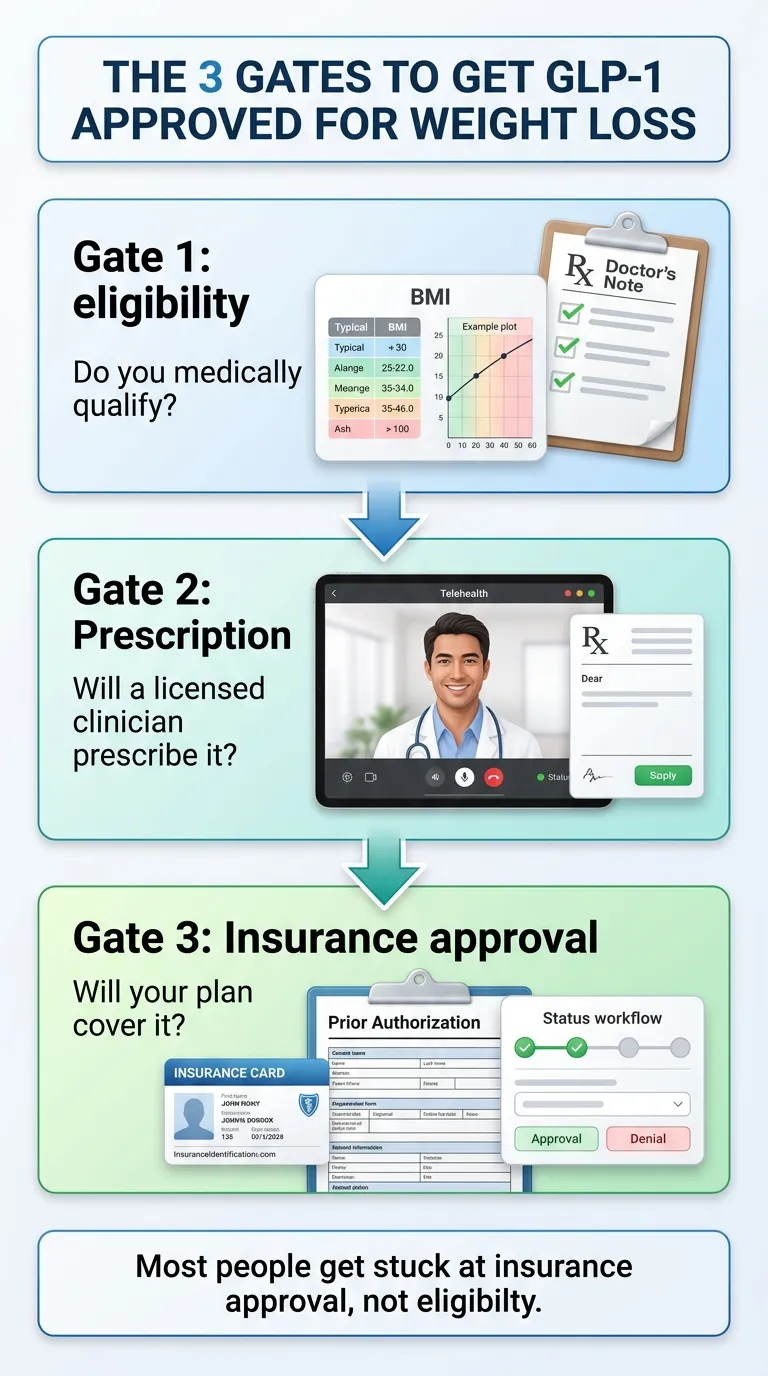
Here's what most pages won't tell you upfront: figuring out how to get GLP-1 approved for weight loss isn't one step. It's up to three separate gates — and most people get stuck because they're treating it as one.
Gate 1 is clinical eligibility — do you medically qualify? Gate 2 is prescription — will a licensed clinician prescribe it? Gate 3 is insurance — will your plan actually cover it? You can clear gates 1 and 2 in days. Gate 3 is where most people stall, get denied, or waste weeks fighting a system that was never going to say yes.
If your BMI is 30 or higher — or 27+ with a weight-related condition like high blood pressure, prediabetes, or sleep apnea — you likely clear gate 1. A licensed clinician (your doctor or a telehealth provider) can handle gate 2, often within 24–48 hours. For gate 3, your path depends entirely on your insurance situation: some employer plans cover it, many explicitly exclude weight-loss drugs, and Medicare coverage began July 2026 under a new federal program.
If your plan won't cover it, FDA-approved GLP-1 options now start at $149/month through manufacturer cash-pay programs (Wegovy pill and Foundayo, lower doses — pricing is dose-dependent and some introductory offers are time-limited). That's the landscape. Below, we break down every path — so you know exactly what to do based on your specific situation.
Best for: adults trying to figure out whether they need doctor approval, insurance approval, or both — and what to do when one of those gates closes.
Not for: emergency medical care, pregnancy-specific medication questions, or a specific provider review. If you already know which provider you want, see our full provider comparison.
Not sure which approval path fits your situation?
Take our free 60-second GLP-1 matching quiz to get a personalized recommendation.
What Does "Approved" Actually Mean for GLP-1 Weight Loss?
When people search how to get GLP-1 approved for weight loss, they're usually collapsing three completely different decisions into one word. This is the single biggest source of confusion — and the reason so many people get stuck, get denied, or give up before they even start.
| Gate | What it means | Who decides | How long it takes |
|---|---|---|---|
| FDA-approved | The medication itself is cleared for weight loss | The FDA (already done — multiple GLP-1 options are approved) | Not your problem — this gate is open |
| Clinically prescribed | A licensed clinician evaluates your health and writes a prescription | Your doctor, specialist, or telehealth provider | 1–7 days through telehealth; 1–4 weeks through a PCP |
| Insurance-approved | Your plan agrees to cover the cost | Your insurance company, via prior authorization | 5–30+ days — or never, if your plan excludes weight-loss drugs |
The reason people get conflicting answers online is that most pages only address one of these gates. Yale Medicine explains clinical candidacy well but barely touches insurance. Manufacturer pages walk you through their brand but can't explain what happens when your plan says no. Telehealth provider pages often skip straight to "sign up" without explaining what "approval" even means for your situation.
We're going to walk through all three gates, in order, so you know exactly where you stand.
Do You Actually Qualify for a GLP-1 for Weight Loss?
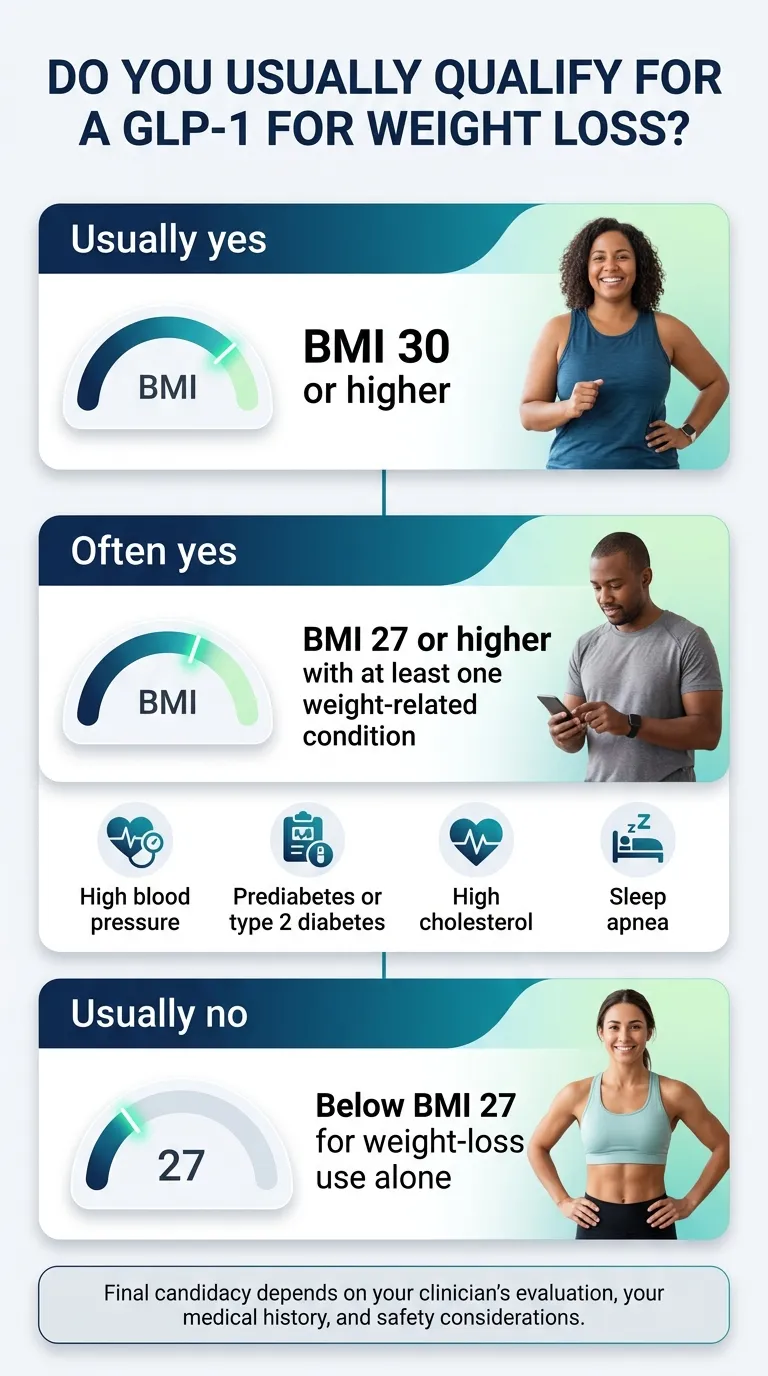
For FDA-approved weight-loss medications in this class, adults generally need a BMI of 30 or higher, or a BMI of 27 or higher with at least one weight-related health condition. You do not need a diabetes diagnosis. Final candidacy depends on your full medical history, side-effect risk profile, and a clinician's evaluation.
The BMI thresholds
BMI 30+ (obesity)
You typically qualify based on BMI alone. No additional conditions required for most FDA-approved weight-management indications.
BMI 27–29.9 (overweight)
You may qualify if you also have at least one weight-related condition. The FDA's approved labeling consistently references hypertension, type 2 diabetes, and dyslipidemia. Many clinicians and insurers also consider sleep apnea, PCOS, NAFLD/NASH, cardiovascular disease, and osteoarthritis — but specifics vary by plan and provider. (Source: FDA prescribing information for Wegovy, Zepbound, and Foundayo.)
BMI below 27
You generally do not qualify for FDA-approved weight-management indications.
Important nuance: These are the FDA eligibility criteria for a prescription. Your insurance company may set higher thresholds for coverage — some plans require BMI 35+ or specific comorbidities beyond what the FDA requires. That's gate 3, and we cover it below.
BMI is an imperfect screening tool. It doesn't measure body composition, muscle mass, or metabolic health. But it's the metric every provider and insurer uses as a starting point, so you need to know your number. Use our BMI eligibility calculator to check.
FDA-approved options for chronic weight management in 2026
| Medication | Active ingredient | How you take it | Approved for | Notable |
|---|---|---|---|---|
| Wegovy injection | Semaglutide (GLP-1) | Once-weekly injection | Weight management, CV risk reduction, MASH | Extensive cardiovascular outcome data (SELECT trial) |
| Wegovy pill | Semaglutide (GLP-1) | Daily oral tablet | Weight management, CV risk reduction | Must take on empty stomach, wait 30 min before eating |
| Zepbound | Tirzepatide (GIP/GLP-1) | Once-weekly injection | Weight management, obstructive sleep apnea | Dual-receptor mechanism; highest average weight loss in trials (~20%) |
| Foundayo | Orforglipron (GLP-1) | Daily oral tablet | Weight management | FDA-approved April 1, 2026; take any time of day, no food/water restrictions |
| Saxenda | Liraglutide (GLP-1) | Daily injection | Weight management | Older option; less weight loss than semaglutide/tirzepatide in head-to-head data |
Ozempic (semaglutide) and Mounjaro (tirzepatide) are FDA-approved for type 2 diabetes, not weight management. Clinicians may prescribe them off-label for weight loss, but insurance coverage differs significantly depending on the indication.
Who should NOT take GLP-1 medications
These medications are not safe for everyone. You should not take them if you have a personal or family history of medullary thyroid carcinoma (MTC) or multiple endocrine neoplasia syndrome type 2 (MEN2), if you are pregnant or planning to become pregnant soon, or if you've had a severe allergic reaction to a GLP-1 medication in the past.
History of pancreatitis, eating disorders, and certain gallbladder conditions require careful evaluation with your clinician — they aren't always absolute disqualifiers, but they change the risk conversation. See our full GLP-1 contraindications guide for the complete breakdown.
→ Think you qualify? Check your eligibility and see your best approval path.
Check My EligibilityWhat Documents Do You Need Before Asking Your Doctor or Insurer?
Approval moves faster when you show up prepared. Across insurer prior-authorization requirements, manufacturer PA resources, and clinician intake forms, the same documentation keeps coming up. We assembled this into a single checklist — because right now, getting all of this in one place requires opening five different tabs.
Your GLP-1 approval packet
Gather these before your appointment or telehealth intake:
For the prescription (Gate 2)
- Current height and weight (for BMI calculation)
- List of current medications including supplements
- Relevant medical history with dates of diagnosis (especially weight-related conditions)
- Brief history of previous weight-loss attempts (what you tried and why it didn't sustain)
- Recent lab work if available: lipid panel, A1C, thyroid function
For insurance coverage (Gate 3)
- Insurance card and plan details
- Summary of Benefits and Coverage document (request from HR or insurer)
- Insurer-specific prior authorization forms (your doctor's office can often pull these)
- Documentation of lifestyle modification programs if your plan requires it
Questions to ask your insurer in one call
Before you go through the clinical process, one phone call to the number on the back of your insurance card can save weeks of wasted effort. Ask these questions — in this order:
- 1"Is [medication name] on my plan's formulary for weight management?"
- 2"Does my plan have an exclusion for weight-loss medications or anti-obesity medications?"
- 3"If it's covered, what are the prior authorization requirements?"
- 4"Is there a step-therapy requirement?" (This means trying a cheaper drug first.)
- 5"What BMI and comorbidity documentation do you need?"
- 6"Is there a preferred pharmacy or specialty pharmacy requirement?"
→ Know your insurance situation already? See your fastest path now.
Find My PathWhat Are Insurers Usually Looking For on a GLP-1 Prior Authorization?
Prior authorization (PA) is the process where your insurance plan reviews your prescription before agreeing to cover it. For GLP-1 weight-management medications, PA is required by the vast majority of plans that offer any coverage at all.
The five most common PA criteria across major commercial insurers, based on manufacturer PA reference guides (e.g., Novo Nordisk's Wegovy PA Quick Reference Guide) and insurer documentation:
Documented BMI meeting the plan's threshold
Often BMI ≥30, or ≥27 with a qualifying comorbidity. Some plans set a higher bar at BMI ≥35.
Documented comorbidity with ICD-10 codes
Diagnosis codes must appear in the chart notes. Vague mentions don't count; the specific code needs to be there.
Evidence of prior lifestyle modification
Typically 3–6 months of documented diet/exercise attempts. Some plans require participation in a structured weight-management program.
Step therapy compliance (when required)
Some plans require you to try a less expensive medication first, such as Saxenda (liraglutide), before approving Wegovy or Zepbound.
Reauthorization data
After 3–12 months, many plans require proof that treatment is working — often ≥5% body weight loss — to continue coverage.
The critical distinction: formulary restriction vs. plan exclusion
Formulary restriction
The drug is covered but requires PA and specific criteria. Perfect documentation can get you approved. Worth fighting.
Plan exclusion
Your plan doesn't cover weight-loss medications at all. No amount of perfect documentation will change this through normal PA channels.
In 2025, only 19% of firms with 200+ workers covered GLP-1s primarily for weight loss, according to Kaiser Family Foundation employer benefits data. Among those that did cover them, 34% required participation in a dietitian, case manager, or lifestyle program. (Source: KFF 2025 Employer Health Benefits Survey.)
That means for the majority of employer plans, weight-loss GLP-1 coverage either doesn't exist or comes with significant hurdles. If your plan excludes obesity drugs, skip ahead to what to do when your plan excludes weight-loss drugs. For a complete walkthrough of the PA process — including appeal strategies and letter of medical necessity guidance — see our GLP-1 prior authorization guide.
How Long Does GLP-1 Approval Take?
A fast approval can happen in days. Incomplete submissions, manual reviews, and plan-specific bottlenecks can stretch timelines to weeks. Here's the realistic timeline across pathways.
| Pathway | Time to prescription | Time through insurance PA | Time to first dose |
|---|---|---|---|
| Telehealth (cash pay) | 24–48 hours | N/A — no insurance involved | 3–7 days |
| Telehealth (with insurance) | 24–48 hours | 5–14 days typical | 1–3 weeks |
| Primary care doctor | 1–4 weeks (appointment wait) | 5–14 days after submission | 2–6 weeks |
| Obesity medicine specialist | 2–6 weeks (referral + appointment) | Often faster due to stronger documentation | 3–8 weeks |
| Retail clinic (Walgreens/CVS) | Same day to 1 week | Usually not handled by the clinic | Varies |
CMS requires certain impacted payers to send standard PA decisions within 7 calendar days and urgent decisions within 72 hours. (Source: CMS Interoperability and Prior Authorization Final Rule, CMS-0057-F.) Real-world processing depends on documentation completeness.
What slows it down
- • Missing diagnosis codes
- • Incomplete chart notes
- • Missing prior weight-loss documentation
- • Submitting to the wrong pharmacy
- • Not following up after 5 business days
What speeds it up
- • Having your approval packet ready
- • Clinician submits PA same day as prescription
- • Call insurer within 48 hours to confirm receipt
What If Your Plan Excludes Weight-Loss Drugs Completely?
This is the fork most GLP-1 approval guides bury — and it's the one that matters most for the majority of readers. If your employer plan or insurance specifically excludes "weight-loss medications" or "anti-obesity medications," prior authorization will not override that exclusion. A perfect PA submission hitting a plan exclusion is like a perfect key in the wrong lock.
How to confirm a true exclusion in one call
Call the number on your insurance card and ask: "Does my plan have a blanket exclusion for anti-obesity medications or weight-loss drugs?" If they say yes, ask for the exact exclusion language in writing. Some "exclusions" have carve-outs — your employer may offer a separate weight-management program with different rules, or coverage may exist for a secondary indication (cardiovascular risk reduction, sleep apnea).
When an appeal can work — and when it can't
Appeals can work when the denial is due to a documentation gap — wrong diagnosis code, missing lab values, incomplete weight history. But appeals almost never work against a true plan exclusion. If the plan design says "no weight-loss drugs," better documentation won't change the plan design.
If your denial letter cites specific missing criteria rather than a blanket exclusion, work with your clinician to fix the gaps and resubmit. Ask your clinician to request a peer-to-peer review with the insurance company's medical reviewer — this takes the decision out of an administrative checkbox and puts it in front of a physician who can evaluate clinical nuance.
Your realistic fallback ladder when insurance says no
1. Check for a secondary covered indication
Wegovy is FDA-approved for cardiovascular risk reduction in adults with obesity/overweight and established heart disease. Zepbound is FDA-approved for obstructive sleep apnea. If either applies to you, your clinician may be able to prescribe under a covered indication. This is a legitimate clinical use — but only applies if you actually have the condition.
2. Brand-name FDA-approved medications at manufacturer cash-pay pricing
| Medication | Cash-pay pricing (April 2026) | Key details | Source |
|---|---|---|---|
| Wegovy pill | $149–$299/mo by dose | $149 applies to specific lower doses; some intro pricing expires Aug. 31, 2026 | NovoCare |
| Wegovy injection | $199–$349/mo by dose | $199 is a limited-time intro for new patients on 0.25/0.5 mg doses | NovoCare / Ro |
| Foundayo | $149–$349/mo by dose | Lower doses start at $149; higher maintenance doses reach $349 | LillyDirect |
| Zepbound KwikPen | $299–$449/mo by dose | Requires refill within 45-day window; higher doses may exceed $449 if window is missed | LillyDirect |
Verify current pricing before committing — some introductory offers are time-limited. For patients with commercial insurance that covers the drug, manufacturer savings cards can reduce copays to as low as $25/month.
3. Clinician-managed cash-pay telehealth programs
This is the most affordable route, but requires understanding a key distinction: compounded GLP-1 medications are not FDA-approved as finished products. They are prepared by state-licensed compounding pharmacies and have not undergone the same FDA review for safety, effectiveness, or quality as brand-name drugs. (Source: FDA, "FDA's Concerns with Unapproved GLP-1 Drugs Used for Weight Loss.")
4. Wait for public-program coverage if applicable
Medicare's GLP-1 Bridge launched in July 2026. Medicaid coverage varies by state and is expanding. Details below.
If your insurance won't cover GLP-1 and you want FDA-approved brand-name medication with clinical support, Ro handles insurance PA, carries Wegovy (pen and pill), Zepbound, and Foundayo.
Ro Body membership starts at $39 for the first month, then as low as $74/month with an annual plan. Medication cost is separate.
Who Should You Start With: Your PCP, a Specialist, or Telehealth?
The fastest safe path depends on your situation. Here's the honest comparison — not just who's cheapest, but who's actually best for the approval gate you're stuck at.
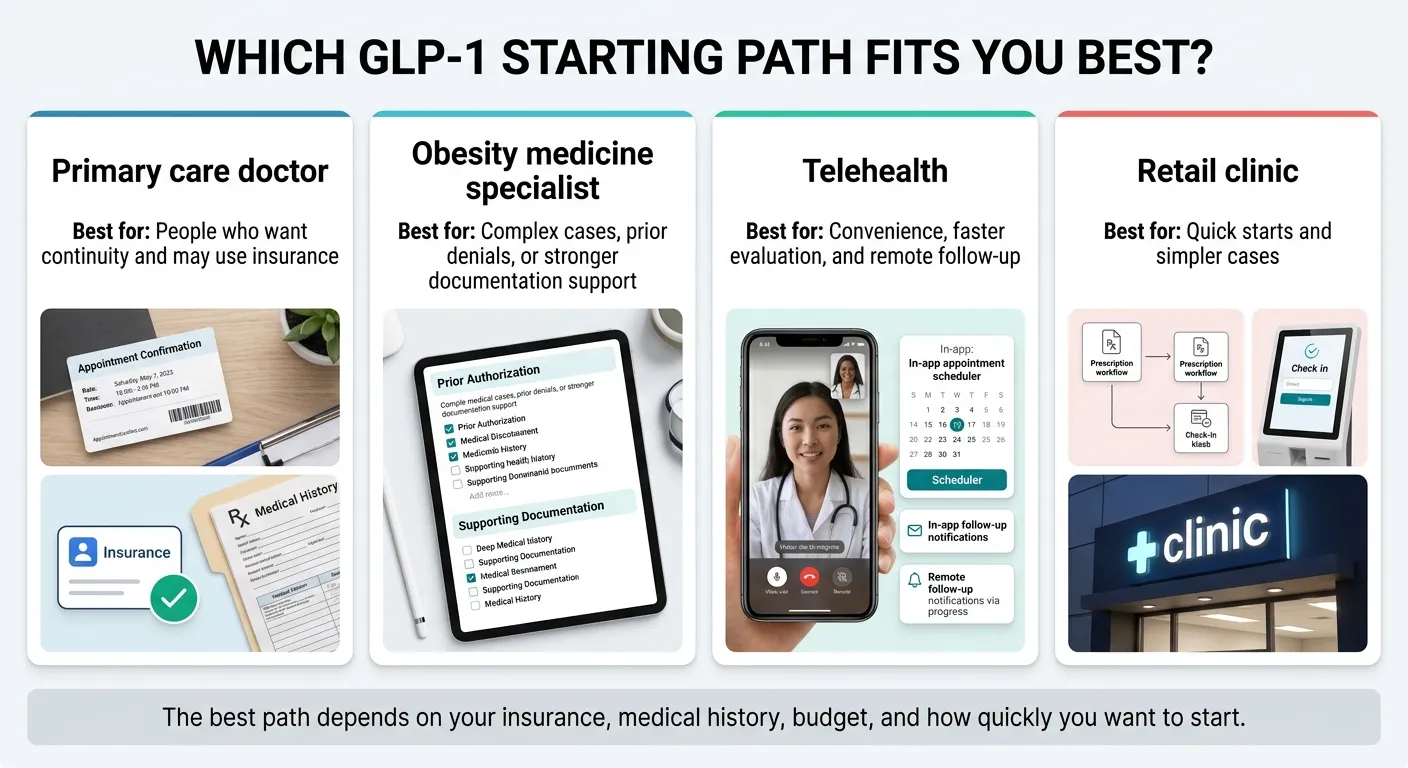
| Factor | Primary care doctor | Obesity specialist | Telehealth — FDA-approved (e.g., Ro) | Telehealth — cash-pay compounded | Retail clinic |
|---|---|---|---|---|---|
| Best for | Existing relationship, insurance, continuity | Complex history, denials, appeals | Convenience + brand-name + insurance help | Budget, speed, no insurance | Quick start, simple cases |
| Time to first dose | 2–6 weeks | 3–8 weeks | 5–14 days | 3–7 days | 1–2 weeks |
| Insurance accepted | Yes | Yes | Yes (Ro handles PA) | No (cash-pay only) | Varies — Walgreens states it does not currently handle insurance/PA |
| Medications | All FDA-approved | All FDA-approved | Wegovy, Zepbound, Foundayo | Compounded semaglutide/tirzepatide (not FDA-approved) | FDA-approved only |
| PA support | Depends on office | Strong — their specialty | Ro states it checks insurance and handles PA | N/A | Limited |
| Cost | Office visit + medication | Office visit + medication | Membership $39 first mo, then $149/mo (or $74/mo annual) + medication | $129–$299/mo all-inclusive | $49 visit + medication separate |
Sources: Ro pricing page, Walgreens weight management page, provider intake documentation. Where noted "provider-stated," we verified against the provider's current public pages but did not independently test the service.
When to go with your PCP
If you have a doctor you trust who's comfortable prescribing weight-management medications, and you want insurance coverage, this is the most straightforward clinical path. Bring your approval packet and ask directly: "I'd like to discuss GLP-1 medication for weight management. Based on my BMI and health history, do I qualify?"
Not every PCP is experienced with these prescriptions. If your doctor says no for reasons that don't feel clinical, you're entitled to a second opinion.
When to go with an obesity medicine specialist
This path makes the most sense if you've been denied by insurance before, have a complex medical history, or need the strongest possible documentation for an appeal. Obesity medicine specialists file prior authorizations as a core part of their practice. The tradeoff is longer wait times. Find a board-certified specialist through the American Board of Obesity Medicine directory.
When telehealth makes more sense
Telehealth is faster, but "faster" means different things depending on whether you're using insurance or paying cash.
For FDA-approved medications with insurance support
Ro is the strongest option we've found for this specific intent — getting approved. Ro states on its public pages that it checks insurance coverage and handles prior authorization through an insurance concierge. Their membership includes access to Wegovy (pen and pill), Zepbound (KwikPen), and Foundayo, plus coaching and ongoing clinical support.
What we verified from Ro's current public pages:
- • Ro Body membership: $39 first month, then $149/month or as low as $74/month with annual prepay
- • Medication cost is additional and varies by drug, dose, and coverage
- • Insurance concierge handles PA paperwork (source: ro.co/weight-loss/insurance)
- • If never prescribed, purchase price refunded
The honest tradeoff: Ro does not offer the cheapest cash-pay path. If your only priority is the lowest monthly out-of-pocket cost and you're open to a compounded product (which is not FDA-approved), a cash-pay compounded program will cost less. But Ro stays in the FDA-approved lane with insurance support — the better fit if your real goal is getting brand-name treatment approved and covered.
Check Insurance and Eligibility with RoWhen a cash-pay compounded program makes sense
If your plan excludes obesity drugs, you've confirmed there's no covered indication that applies, and brand-name cash pricing is still out of reach — a clinician-managed compounded program can make treatment more accessible. But you need to go in with clear eyes.
Compounded GLP-1 medications are not FDA-approved as finished products. They have not undergone the same FDA review for safety, effectiveness, or quality as brand-name drugs. The FDA has cautioned consumers about misleading marketing — in March 2026, the agency issued warning letters to more than 30 telehealth companies for violations related to compounded GLP-1 marketing. (Source: FDA press announcement, March 2026.)
Embody — our secondary cash-pay recommendation
Embody is a cash-pay telehealth GLP-1 program built around a low first-month price and fast online intake. It offers weekly semaglutide or tirzepatide injections plus a needle-free GLP-1 gum option — a useful differentiator if you're needle-averse. Its shipped medications are compounded GLP-1s, not FDA-approved finished drugs.
What we verified from Embody's current public pages:
- • Semaglutide injection: from $99 the first month, then $299/month ongoing
- • Tirzepatide injection: from $149 the first month, then $399/month ongoing
- • Needle-free GLP-1 gum option for patients who prefer not to inject
- • Cash-pay only — no insurance required (HSA/FSA accepted)
- • Broad U.S. availability; state eligibility is confirmed during intake
- • 24/7 messaging with care team
The honest tradeoff: Embody is not the right choice if your top priority is getting insurance to cover FDA-approved brand-name medication. Ro, your PCP, or an obesity specialist is a better first move for that. Embody does not handle insurance PA, and its shipped options are compounded — not FDA-approved finished drugs. But when the plan itself is the blocker and you've exhausted the insurance path, Embody offers a low starting price with clinician oversight.
Check Embody EligibilityRed flags for any online GLP-1 service
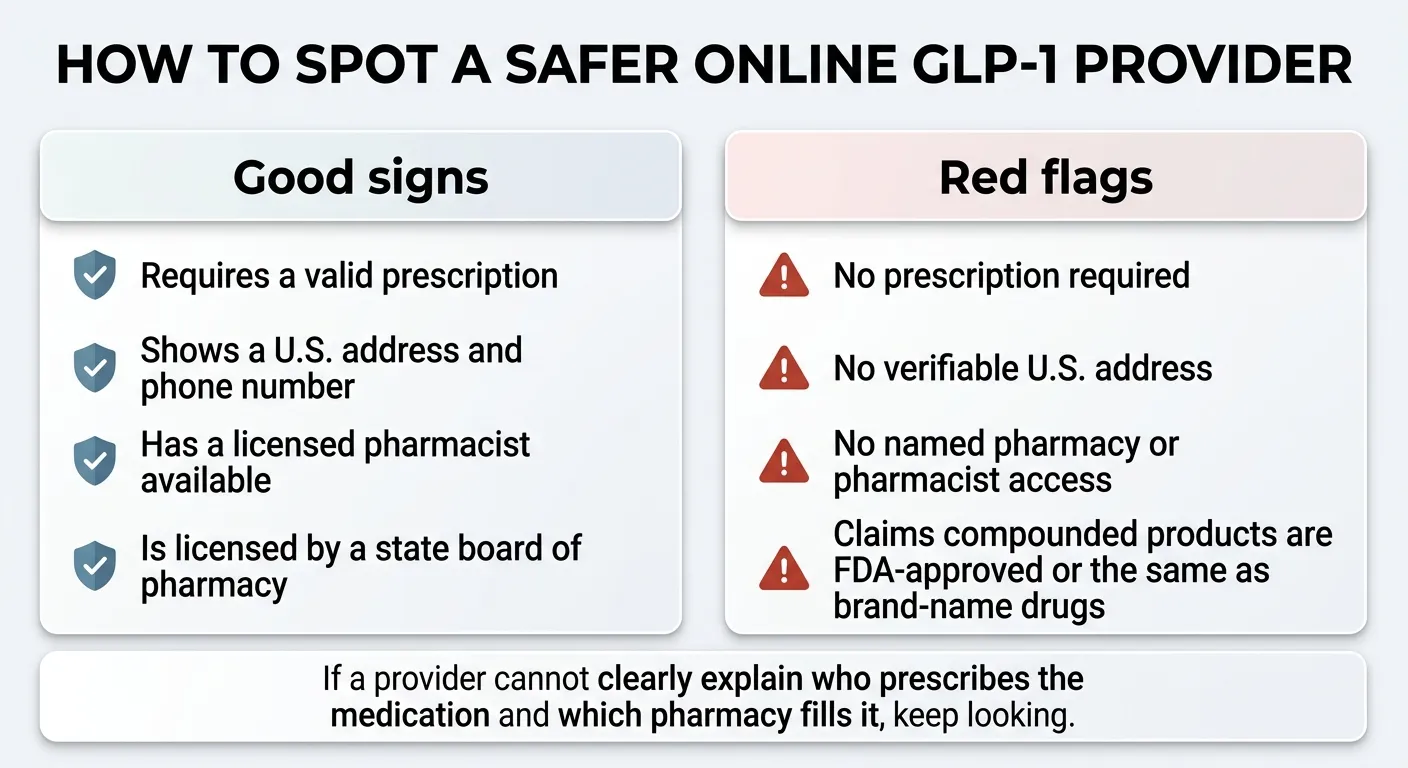
The FDA's BeSafeRx program warns that many unsafe online pharmacies sell prescription drugs without requiring a valid prescription — which is illegal. Beyond that, watch for:
- No medical evaluation required before prescribing
- No verifiable U.S. physical address or state pharmacy license
- No named compounding pharmacy (the pharmacy should be identifiable and verifiable)
- Claims that compounded products are "FDA-approved" or equivalent to brand-name drugs — they are not
- Pricing dramatically below market rates ($100/month or less for injectable GLP-1s) without explanation
- No pharmacist or provider accessible for questions
A note on our provider methodology: We feature Ro as the primary recommendation on this page because its public capabilities best match the approval-focused intent of this search: insurance support, PA handling, and a full FDA-approved formulary. We feature Embody as the secondary cash-pay option because of its low first-month price and needle-free GLP-1 gum option. We chose not to feature MEDVi as a primary recommendation — on February 20, 2026, the FDA issued warning letter #721455 to MEDVi, LLC for claims the FDA determined to be false or misleading regarding compounded GLP-1 products. (Source: FDA Warning Letters database.) For our full provider comparison, see our Best GLP-1 Online Programs page.
Brand-Name vs. Compounded GLP-1 — What Changes the Approval Path?
Brand-name (FDA-approved)
Wegovy, Zepbound, Foundayo, Saxenda — manufactured by Novo Nordisk or Eli Lilly, FDA-approved for specific indications, covered by some insurance plans (with PA), and eligible for manufacturer savings programs.
Best when:
- • You have insurance that covers it (or might)
- • You want the strongest regulatory certainty
- • You qualify for a manufacturer savings card
- • You're on Medicare (Bridge covers brand-name only)
Compounded (not FDA-approved)
Prepared by state-licensed compounding pharmacies. Not FDA-approved as finished products. Not covered by insurance. Only gates 1 and 2 apply.
Sometimes considered when:
- • Your plan excludes weight-loss drugs
- • Brand-name cash pricing exceeds your budget
- • You understand and accept the regulatory tradeoffs
What Should You Do If Your GLP-1 Request Is Denied?
A denial is not the end. But the right next move depends on the reason — and most people don't bother to find out why before they give up or resubmit blindly. Don't do that.
| Denial reason | What it actually means | What to do |
|---|---|---|
| Missing documentation | Your PA submission was incomplete — missing BMI, diagnosis codes, or prior weight-loss history | Fix the gaps and resubmit. This is the most common and most fixable denial. |
| Step therapy required | Your plan wants you to try a cheaper medication first (often Saxenda/liraglutide) | Ask your clinician about step therapy compliance or a clinical exception if there's a medical reason to skip it. |
| Criteria not met | Your documented BMI or comorbidities didn't meet the plan's specific threshold | Ask your insurer for the exact criteria in writing, then work with your clinician to document what's missing. |
| Plan exclusion | Your plan doesn't cover weight-loss drugs at all | Stop fighting the PA. Explore covered secondary indications, employer exception requests, or cash-pay options. |
| Non-preferred medication | The drug you requested isn't the plan's preferred GLP-1 | Ask which GLP-1 is preferred under your plan, or have your clinician request a formulary exception. |
Peer-to-peer review is often the most effective escalation for documentation-based denials. Ask your clinician to request a direct conversation with the insurance company's medical reviewer — this puts the decision in front of a physician who can evaluate clinical nuance rather than leaving it with an administrator checking boxes.
For the complete PA process, appeal strategies, and letter of medical necessity guidance, see our full prior authorization guide.
→ Denied by insurance and ready to explore alternatives?
Find your best path based on your specific situation — takes 60 seconds.
How Do Medicare and Medicaid Change the Answer in 2026?
Public-program readers need a separate answer because the rules are changing faster than almost any other part of the GLP-1 landscape.
Medicare: the GLP-1 Bridge program (July 2026)
Key date: July 1, 2026
Currently, standard Medicare Part D does not cover GLP-1 medications for weight loss alone. That changes on July 1, 2026, when the Medicare GLP-1 Bridge launches. (Source: cms.gov/medicare/coverage/prescription-drug-coverage/medicare-glp-1-bridge, last updated April 6, 2026.)
Eligible drugs
- • Wegovy (injection and tablets)
- • Zepbound (KwikPen formulation only)
- • Foundayo (added April 6, 2026)
Cost & enrollment
- • Fixed $50 copay per monthly fill
- • Must be enrolled in a standalone PDP or MA-PD plan
- • Runs July 1, 2026 through December 31, 2027
Eligibility criteria — three tiers (you only need to meet one):
| Tier | BMI threshold | Qualifying conditions | Measured when |
|---|---|---|---|
| Tier 1 | BMI ≥35 | None required beyond BMI | At time of GLP-1 therapy initiation |
| Tier 2 | BMI ≥30 | Heart failure with preserved ejection fraction (HFpEF), OR uncontrolled hypertension (SBP >140 or DBP >90 despite 2+ antihypertensives), OR chronic kidney disease stage 3a or above | At time of GLP-1 therapy initiation |
| Tier 3 | BMI ≥27 | Prediabetes (per ADA guidelines), OR prior myocardial infarction, OR prior stroke, OR symptomatic peripheral artery disease | At time of GLP-1 therapy initiation |
If you're on Medicare and think you'll qualify, talk to your provider now about documenting your BMI and conditions so the prior authorization can be submitted when the program opens. See our full Medicare GLP-1 coverage guide for preparation steps.
Medicaid: state-by-state and volatile
As of January 2026, only 13 state Medicaid fee-for-service programs cover GLP-1s for obesity treatment, according to KFF. That number decreased from 16 states after October 2025, when California, New Hampshire, Pennsylvania, and South Carolina dropped coverage (North Carolina later reinstated). (Source: KFF, "Medicaid Coverage of and Spending on GLP-1s.")
The BALANCE Model may expand Medicaid coverage starting May 2026 for states that opt to participate, but participation is voluntary. Not all states will opt in. When covered, Medicaid GLP-1 access is typically subject to prior authorization with strict criteria. See our Medicaid GLP-1 coverage guide for state-specific details.
What's the Fastest Legitimate Path for Your Situation?
We've covered the gates, the pathways, and the pitfalls. Here's the routing decision, simplified.
"I have commercial insurance and want brand-name FDA-approved medication."
Start with Ro's insurance concierge or your PCP. Gather your approval packet. Be prepared for PA. If denied for documentation reasons, fix and resubmit — and ask for a peer-to-peer review.
Check insurance eligibility with Ro"My plan excludes weight-loss drugs and I've confirmed it."
Stop fighting the PA. Check for secondary covered indications (CV risk, sleep apnea). If none apply, explore manufacturer cash-pay pricing ($149–$449/month) or clinician-managed cash-pay programs.
Check Embody eligibility"I'm on Medicare."
The GLP-1 Bridge launched July 1, 2026. Document your BMI and qualifying conditions with your provider, and make sure you're enrolled in an eligible PDP or MA-PD plan.
See our Medicare guide"I'm on Medicaid."
Check your state's specific formulary. Only 13 states currently cover GLP-1s for obesity. The BALANCE Model may expand this starting May 2026.
Check your state"I want a pill, not an injection."
Two FDA-approved oral options exist: the Wegovy pill (daily on empty stomach) and Foundayo (daily at any time — no food/water restrictions). Both start at $149/month for lower doses through manufacturer cash-pay programs.
Check eligibility with Ro"I still don't know my best path."
That's exactly what our quiz is for. Tell us your BMI, insurance situation, and preferences — we'll show you the fastest legitimate path.
Take the Free 60-Second GLP-1 QuizFrequently Asked Questions
How We Verified This Page
Weight Loss Provider Guide is an independent comparison resource for GLP-1 telehealth providers. We earn affiliate commissions when you visit a provider through our links and make a purchase. This does not affect the information presented, our methodology, or our recommendations.
| Claim category | What we checked | Primary source |
|---|---|---|
| FDA-approved medications | Current approved weight-management indications, contraindications, active ingredients | FDA press announcements and prescribing information |
| Employer coverage data | % of large firms covering GLP-1s for weight loss; program requirements | KFF 2025 Employer Health Benefits Survey |
| Medicare GLP-1 Bridge | Eligibility tiers, eligible drugs, copay, dates, plan enrollment requirements | CMS Medicare GLP-1 Bridge FAQ page (updated April 6, 2026) |
| Medicaid coverage | Number of states covering GLP-1s for obesity, states that dropped coverage | KFF Medicaid GLP-1 tracking |
| CMS PA timelines | Standard and urgent response-time rules | CMS Interoperability and Prior Authorization Final Rule (CMS-0057-F) |
| Ro pricing and capabilities | Membership cost, insurance concierge, cancellation terms | Ro public pages: pricing, insurance, terms of use |
| Embody pricing and policies | Starting prices by medication and form, ongoing refill pricing, intake process | Embody public pages (joinem.co) |
| MEDVi regulatory status | FDA warning letter, date, specific findings | FDA Warning Letters database (Letter #721455, Feb. 20, 2026) |
| Online pharmacy safety criteria | Red flags for unsafe pharmacies | FDA BeSafeRx program |
What we did NOT do
We did not fabricate credentials, invent a medical reviewer, make up testimonials, or use forum posts as evidence for medical or regulatory claims.
Provider-stated vs. independently verified
Some claims (e.g., "Ro handles PA," "Embody offers a low first-month price") are provider-stated — meaning we verified they appear on the provider's current public pages, but did not independently test the service. Pricing was verified against provider pages in April 2026 and is subject to change.
By Weight Loss Provider Guide Editorial Team •
Still not sure which GLP-1 program is right for you?
Take our free 60-second matching quiz and we'll point you to the fastest path for your situation.
Take the Free GLP-1 QuizRelated Articles
How to Get GLP-1 Without Being Overweight: 6 Paths [2026]
How to get GLP-1 without being overweight: the 6 situations that still qualify in 2026, current pricing, and the shortcuts to walk away from.
Don't Qualify for a GLP-1? 5 Online Options [2026]
Don't qualify for a GLP-1? Decode 5 kinds of no, learn what can be revisited, and take the safest next step without paying another wasted fee.
Don't Qualify for Zepbound? Now What [2026]
Denied Zepbound? Decode six different kinds of no, compare the exact fix for each gate, and check current insurance, Medicare, cash-pay, and appeal paths.
Don't Qualify for Wegovy? Now What [4 Reasons, 2026]
Denied Wegovy? Identify the reason, compare safety, coverage, program, and records paths, and review verified cash-pay and Medicare Bridge options.
Eden GLP-1 Alternatives: 5 Real Options (2026)
Compare five Eden GLP-1 alternatives with verified 2026 prices, fees, FDA status, cancellation terms, and the best fit for your budget.
Eden Brand Name GLP-1 Cost: What Wegovy, Zepbound, Ozempic and Mounjaro Really Cost Through Eden
See Eden brand-name GLP-1 prices, the required membership, manufacturer cash prices, and the real monthly and annual cost difference.