GLP-1 Provider After Clinic Closes: What To Do First
By WPG Research Team · Published: August 29, 2026 · Last verified: August 29, 2026
Weight Loss Provider Guide is an independent comparison resource for GLP-1 telehealth providers. We may earn a commission if you start a program through one of our links. It never changes what we tell you to do first — and the first four things on this page cost nothing and send you nowhere.
The short answer
If you need a GLP-1 provider after clinic closes, your care doesn't have to stop. But your old prescription and your old dose do not move to a new company automatically. A new clinician has to look at you and make a new decision.
Do these four things, in this order:
- Check your safety first. If you might have taken a wrong amount, that's a different problem than finding a new doctor. Skip to the safety check below.
- Photograph your medicine label — front, back, and the box. Do it before you throw anything away.
- Call the pharmacy printed on that label — not the clinic. That pharmacy is a separate business and it's probably still open. It can print your whole fill history in minutes. And if you were on brand-name medicine, you might still have refills sitting there.
- Start one new intake before your supply runs out. You do not need your medical records to do this.
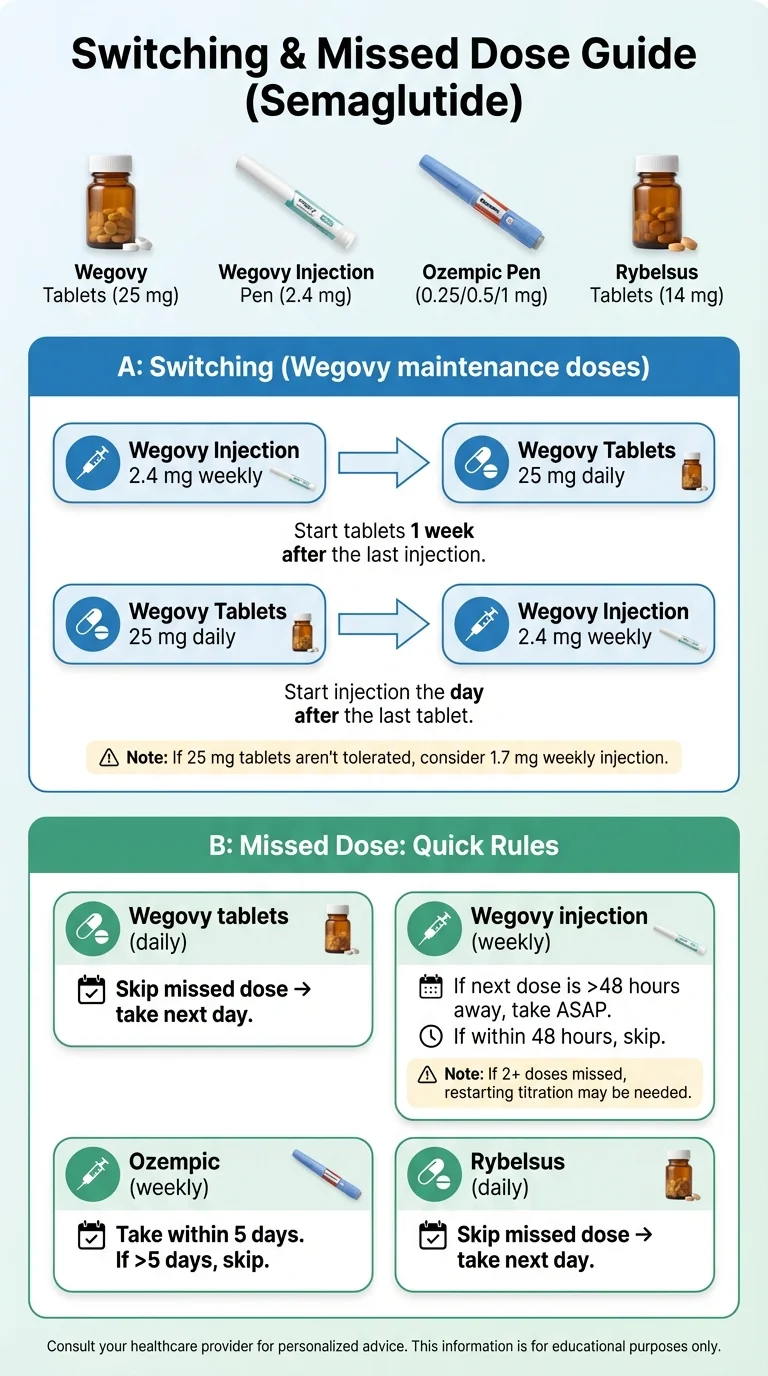
Here's the part almost nobody tells you: you probably have more time than you think. The "you have 14 days before you restart at the lowest dose" rule you keep reading is an oversimplification of the Wegovy injection label. After two or more consecutive missed doses, the label discusses reinitiating dose escalation at a lower dose to reduce gastrointestinal risk; it does not set a one-size-fits-all personal restart dose. Zepbound's and Mounjaro's labels give a late-dose window but no restart threshold. Foundayo's label discusses seven or more consecutive missed doses. We read all of them and put them in one table below.
And if you prepaid for months you'll never get: your card dispute clock probably starts the day you found out they closed — not the day you paid. It can run up to 540 days from the charge. Most people assume that money's gone. Usually it isn't.
What changes the answer: which medicine you were on, whether it was FDA-approved or compounded, how many days it's been since your last dose, and whether you paid ahead.
Three clocks are running right now
| Clock | What it is | Your window |
|---|---|---|
| 🕐 Medicine | How long before a clinician would think about restarting you lower | 4 days to 14+ days — depends on your exact drug |
| 🕑 Proof | Getting your formal records out of a closed practice | Up to 30 days under federal law — but 4 faster sources exist |
| 🕒 Money | Disputing a charge for something you never got | 120 days from when you found out, up to 540 days from the charge |
None of these three clocks is the one you're worried about. You're worried about starting over at 0.25 mg. Let's deal with that first.
Start here: is this an emergency, a dose question, or a paperwork problem?
Answer capsule: Most clinic closures are paperwork and access problems, not medical emergencies. But a possible dosing mistake is different and needs a different response. The FDA has documented serious dosing errors with compounded injectable semaglutide, including people who took up to 20 times the intended dose because vial strengths and syringe markings differed between pharmacies. Sort your situation before you shop for anything.
Read these four boxes. Find yourself. Then act.
🔴 RED — Call 911 now. Someone has collapsed, is having a seizure, can't breathe, or can't be woken up. Stop reading and call.
🟠 ORANGE — You might have taken the wrong amount. This includes: you took more than the directions said, you used the wrong line on the syringe, you think you repeated a dose, your new vial looks like a different strength than the old one, or you honestly can't tell if the number on your instructions meant milligrams or syringe units.
Call Poison Control at 1-800-222-1222 or use poison.org. It's free, it's 24/7, and you will not get in trouble. Then talk to a pharmacist. Do not take anything else until you have.
This is the single most dangerous moment in a clinic closure and it is why we put it above everything else. When a clinic disappears and you get your next vial somewhere new, the strength can be different even when the medicine name is the same. The number of syringe units you used last month may not mean the same amount this month. The FDA has warned about exactly this.
🟡 YELLOW — No emergency, but your next dose is unclear. You've missed one or more doses. Or the label is gone. Or you don't know what pharmacy made it. Or your new vial looks different from your old one.
Call a pharmacist before you inject or swallow anything. Then keep reading — the rest of this page is built for you.
🟢 GREEN — This is a paperwork problem. No scary symptoms. You still have your label. What you actually need is a new prescriber, your records, and maybe your money back.
Keep reading. You're in the right place.
One rule that applies to everyone reading this: don't double up a dose to catch up, and don't use a dose chart you found online. Every GLP-1 label says not to double up. And no chart on the internet knows what's in your specific vial.
What to do in the next 30 minutes
Answer capsule: Before contacting any new provider, save the physical evidence of your treatment. Photograph the medication label and box, record your last dose date, and save your order confirmations, shipping notices, portal messages, and card statements. This packet is what lets a new clinician review your dose history, and it's also what a bank needs if you paid for medicine that never shipped.
You're going to feel like you should be researching providers right now. Don't. Spend 30 minutes saving proof first. Everything after this gets easier because of it.
Photograph these, right now
- The medicine label — front and back. Get the small print.
- The outer box, including any pharmacy sticker.
- Anything with a lot number, expiration date, or NDC number on it.
Do not throw away the box or an empty vial until this whole thing is settled. That label is the most valuable piece of paper you own this week. It names your exact medicine, your strength, your prescriber, and — this is the part people miss — the pharmacy that actually made and shipped it. That pharmacy is a different company from your clinic. It's probably still answering the phone.
Write down these five things
- Your medicine name (exactly as printed)
- Your dose and how often you took it
- The date of your last dose
- How much medicine you have left
- When your next dose was supposed to be
Save these before anything disappears
Order confirmations. Shipping emails. Portal messages from your clinician. Your invoice. The cancellation and renewal terms you agreed to. Any prior authorization paperwork. Recent lab results. Your weight history. Notes on side effects.
If your patient portal still loads — download everything today. Portals are often run by an outside software company and sometimes keep working for a while after the clinic goes dark. That window closes without warning.
And don't do these
- Don't buy from a peptide site, a "research use only" seller, or someone in a Facebook group. This is the exact moment people get hurt.
- Don't hide the gap from your new clinician. They need the truth to keep you safe.
- Don't cancel the credit card the charges came from before you file a dispute.
- Don't sign up with two providers at once without telling both.
Take 60 seconds and get your own plan. Not sure which parts of this apply to you? Our free matching tool asks what you were on, when your last dose was, and whether you prepaid — then builds your personal checklist. → Build my clinic-closure plan · Free. No email required.
Is my clinic actually closed, or just running late?
Answer capsule: A slow refill and a closed business look identical from the outside for about a week. Check the portal, phone line, email, shipping tracking, the dispensing pharmacy, and your state's license lookup before deciding. If the pharmacy has no active prescription on file and no shipment was ever created, treat it as a closure and start a replacement plan — even if the company hasn't announced anything.
Plenty of people land on this page and the clinic isn't actually gone. It's overwhelmed, or the pharmacy is backed up, or one person quit and the inbox is buried. Here's how to tell in about 15 minutes.
The 15-minute closure check
| Check | Signs it's just a delay | Signs it's a closure |
|---|---|---|
| Main phone number | Rings, voicemail is normal, someone calls back | Disconnected, full mailbox, no callback in 48 hours |
| Patient portal | Loads, messages send | Login fails, site is down, app pulled from the store |
| Auto-reply with a real date, or a human answers | Bounces back undeliverable | |
| Shipping tracking | A real tracking number with real scans | No shipment ever created after they charged you |
| The dispensing pharmacy (call the number on your vial) | "Yes, we have your prescription, it's in process" | "We don't have an active prescription for you" |
| Your billing statement | Charges match what you received | Charges continued with nothing shipped |
| State license lookup (search your prescriber's name on your state medical board site) | License active, no notes | License lapsed, surrendered, or restricted |
| Business registry (your Secretary of State's business search) | Active | Dissolved, revoked, or administratively closed |
One phone call beats all of this: call the pharmacy on your vial. They can tell you in 90 seconds whether a live prescription exists. That single answer usually settles it.
Say it carefully
If you post about this or write to your bank, describe what happened — not what you suspect. Say "the clinic stopped responding" or "the company hasn't fulfilled my order." Don't call it fraud, theft, or abandonment unless someone official has said so. It protects you, and honestly, it also gets you better results from banks and licensing boards.
How long can I go without a dose before I have to start over?
Answer capsule: It depends entirely on which medication you were taking, and the labels differ far more than most sources admit. Wegovy injection's FDA label discusses reinitiating dose escalation at a lower dose after two or more consecutive missed doses to reduce gastrointestinal risk; that is not a one-size-fits-all personal restart instruction. Foundayo's label discusses seven or more consecutive missed doses. Zepbound and Mounjaro give a four-day rule for taking a late dose, then state no restart threshold.
This is the fear underneath every other question on this page. Am I going back to square one?
So we went and read the labels. All of them. Here's what they actually say.
The Restart Clock
| Your medicine | What the label says about a missed dose | Does the label discuss dose reinitiation? |
|---|---|---|
| Wegovy injection (semaglutide) | If your next dose is more than 2 days away, take the missed one as soon as you remember. Less than 2 days away — skip it. | Yes, conditionally. After 2 or more consecutive missed doses, the label discusses reinitiating dose escalation at a lower dosage to reduce gastrointestinal risk. It does not give a one-size-fits-all personal restart dose. |
| Wegovy HD (semaglutide 7.2 mg) | Same 2-day rule | Same conditional reinitiation language; ask a clinician what applies to you. |
| Wegovy tablets (semaglutide 25 mg, daily) | Skip the missed dose. Take the next one the next day. | No restart number stated |
| Ozempic injection (semaglutide) | Take it within 5 days. After that, skip it. | No restart number stated |
| Zepbound (tirzepatide) | Take it within 4 days (96 hours). After that, skip it. | No restart number stated anywhere in the label |
| Mounjaro (tirzepatide) | Take it within 4 days (96 hours). After that, skip it. | No restart number stated |
| Foundayo (orforglipron, daily pill) | Take it as soon as you remember. Never double up. | Yes. "If 7 or more consecutive doses are missed, reinitiate dosage escalation at a lower dosage." That's 7 days. |
| Saxenda (liraglutide, daily) | — | Yes. If more than 3 days have elapsed since the last dose, reinitiate at 0.6 mg daily and follow the label's escalation schedule. |
| Compounded semaglutide or tirzepatide | There is no FDA label for a compounded product. | No published rule exists. Your new clinician decides. |
Primary-source check completed August 29, 2026: Wegovy, Ozempic, Zepbound, Mounjaro, Foundayo, and Saxenda labels — specifically the missed-dose and dose-escalation sections. Compounded drugs are not FDA-approved and the FDA does not review them for safety, quality, or effectiveness before they're sold.
What this table actually means for you
The "14-day rule" everyone quotes is an oversimplification of the Wegovy injection label. It got copied onto every GLP-1 by websites that never opened a label. Three things fall out of reading them properly:
1. If you're on Foundayo, 14 days is double the real number. The label says seven consecutive missed doses. Somebody telling you "you've got two weeks" is giving you twice the room the label allows.
2. If you're on Zepbound or Mounjaro, there is no number to break. After the 4-day window, the label goes quiet. That's not a loophole and it's not bad news — it means the decision belongs to a clinician looking at your history, not to a rule you already failed. For a stranded Zepbound patient, that's genuinely better news than what most sites tell you.
3. Wegovy injection and Saxenda use different conditional reinitiation language, while Foundayo names seven or more consecutive missed doses. None of those statements tells you to choose a personal restart dose without a clinician. The rule most people are repeating is unsourced for many drugs — and where a label does speak, its exact wording matters.
If you were on a compounded GLP-1, there's no label to check at all. That's not a knock on compounding pharmacies. It's just how unapproved products work — there's no FDA-reviewed labeling with a missed-dose section. It's also the strongest reason to get in front of a clinician this week instead of waiting to see what happens.
Read this part carefully: the table above tells you what the manufacturers wrote for prescribers. It is not instructions for you. Don't restart, change, or resume a dose based on it. What it gives you is a realistic sense of how much room you have — and the exact thing to say to the next clinician who sees you.
Is my prescription dead now?
Answer capsule: Not necessarily. GLP-1 medications are not controlled substances, so a non-controlled prescription is generally valid for up to a year from the date it was written, and remaining refills usually stay in the pharmacy's system. Someone on brand-name medication filled at a retail pharmacy may still have refills waiting. Someone on a compounded plan filled through the clinic's own partner pharmacy usually does not.
Here's where the answer splits hard. Page after page treats "my clinic closed" like one situation. It's two, and they barely overlap.
The two doors
| What you're checking | Door A — you were on brand-name at a regular pharmacy (CVS, Walgreens, Costco, a local pharmacy) | Door B — you were on compounded medicine shipped by the clinic's own pharmacy |
|---|---|---|
| Where your prescription lives | In a pharmacy's system, separate from the clinic | Usually with one partner compounding pharmacy tied to that clinic |
| Do refills survive? | Often yes. GLP-1s aren't controlled substances. Remaining refills usually stay in the system. The pharmacist may still want to verify your prescriber, and rules vary by state — but it costs one call to find out. | Usually no. When the clinic goes, the arrangement usually goes with it. |
| Fastest move today | Call the pharmacy and ask if you have refills left. Free. Five minutes. Can buy you 30 days. | Start a new intake today. There's no bridge to buy time with. |
| Proving your dose | Pharmacy fill history — clean and complete | Vial label + card statements + shipping emails |
| Restart risk | Lower — your exact product has a published label rule | Higher — no label exists for what you took, so a clinician starts from scratch |
The exact words to say when you call the pharmacy
"Hi — I'm a patient and my prescribing clinic has closed. I'm not asking you to change anything. I need to know two things: do I have any refills left on my [medicine name] prescription, and can you send me my complete fill history for the last 12 months?"
Be ready for a "no." A pharmacist can decline to fill if they can't verify your prescriber, and state rules differ. But this one call is free, it takes five minutes, and for a lot of people it's the difference between a calm month and a scramble.
Also worth knowing: if you do have refills, most pharmacies can move a non-controlled prescription to a different pharmacy at your request. Ask the new pharmacy to pull it. They do this all day long.
Print this before you talk to anyone. One page. Your medicine, dose, escalation dates, last dose, pharmacy, side effects. It turns a five-day back-and-forth with a new clinician into one message. → Download the Closed-Clinic Handoff Sheet (PDF) · Free. No email required.
How do I prove my dose if I can't get my records?
Answer capsule: You almost never need the formal medical chart to be seen by a new clinician. Four faster sources prove your treatment today: the label on the vial or box, the dispensing pharmacy's fill history, your card statements showing refill dates, and your shipping emails. Request the formal records too, but don't wait on them — under federal HIPAA rules, providers generally have up to 30 days to respond.
Every other page on this topic tells you to go get your medical records. That advice isn't wrong. It's just slow — and it's the sixth-fastest thing you can do.
The Proof Stack
| # | Where the proof is | How fast | What you get |
|---|---|---|---|
| 1 | The box or vial in your fridge | Right now | Medicine name, strength, lot, expiration, pharmacy name, prescriber name |
| 2 | The dispensing pharmacy ← the one nobody thinks of | Same day, one call | Full fill history: medicine, strength, quantity, every fill date, prescriber |
| 3 | Your card or bank statement | Minutes | Every charge date — which rebuilds your refill timeline when the portal is gone |
| 4 | Your shipping emails | Minutes | Ship dates, quantities, sometimes the dose right in the subject line |
| 5 | Your insurance claims history (only if you used insurance) | Same day, online | Every filled prescription, prescriber, and date — plus what your plan already approved |
| 6 | The records custodian, state board, or federal complaint | ~30 days | The formal chart |
Rows 1 through 4 take under an hour and they're enough for most intakes. You do not need the chart to get seen. You need to prove three things: the medicine, the dose, and the date of your last shot. Four sources you already control can do that today.
If you do need the formal chart, here's the ladder
- Call the old number and listen. Closed practices often name a records custodian on the outgoing message or post a notice on the door.
- Try the portal. If it loads, download everything immediately.
- Ask whoever bought the practice, if anyone did.
- Contact your state medical board. Have your name, date of birth, the clinician's name, and the last known address ready. Boards require closure notification and can tell you where the records went — or open a file if the clinic never filed one.
- Contact your state health department, which usually tracks the named custodian.
- File a complaint with the HHS Office for Civil Rights at hhs.gov/ocr if a custodian ignores you, blows the deadline, or demands unreasonable fees.
Two things worth knowing about your rights: under HIPAA, providers generally have 30 calendar days to give you a copy of your record, and an unpaid bill is not a legal reason to withhold it. People get told otherwise all the time.
Copy and paste this records request
Subject: Request for complete medical and billing record
I was a patient at [clinic name] at [address]. I am requesting an electronic copy of my complete record, including my prescription and medication history, dose and titration history, last fill date, visit notes, lab results, side-effect notes, dispensing pharmacy information, prior-authorization documents, and billing record.
If you are not the custodian of records for this practice, please tell me who is.
Please confirm you received this and tell me when and how the record will be delivered.
[Your full name] · [Date of birth] · [Phone] · [Email]
Can I get my money back if I prepaid?
Answer capsule: Often yes, and the deadline is probably not the one you're thinking of. For a prepaid ongoing service that stopped, a card-network dispute may use a 120-day clock tied to when the service ended or you learned it would not be provided — not simply the date of payment — with network-specific outer limits. The exact reason code, dates, and issuer process control the result. Separately, U.S. credit card billing-error protections generally require written notice within 60 days of the statement showing the charge.
If you prepaid for three, six, or twelve months and the shipments stopped, read this section twice. It's the part of this page that can put four figures back in your bank account.
The Money Clock
| Route | The window most people think they have | The window that actually applies when a business closes |
|---|---|---|
| Visa (dispute condition 13.1, services not received) | 120 days from the purchase | The network rule can measure 120 days from the last date you expected the service or from the day you were told it wouldn't be provided. Confirm the applicable date with your issuer; an outer limit can also apply. |
| Mastercard (reason code 4853, goods or services not provided) | 120 days from the purchase | The network rule can measure 120 days from the day you were made aware the service ceased, for terminated ongoing services. Confirm the applicable date and any outer limit with your issuer. |
| Amex / Discover | 120 days | Give them the date you learned of the closure, in writing, and ask which window applies |
| Federal billing-error rules (credit cards) | — | Written notice within 60 days of the statement showing the charge. This is a separate right — use both. |
| Debit cards | — | Weaker protections. Call the number on your card the same day you find out. |
Here's what almost nobody in this situation knows. Every "my business closed, can I get a refund" article leads with the 60-day rule and stops. But for a prepaid ongoing service that got terminated — which is exactly what your GLP-1 plan was — a card-network rule may count from the day you found out, not the day you paid. The network, reason code, and issuer decide which deadline applies.
Primary-source check completed August 29, 2026: Visa's Dispute Management Guidelines and Mastercard's Chargeback Guide. These are network rules, not a promise that an issuer will accept a dispute; tell your issuer the actual service and notice dates and ask which reason code and deadline apply.
Plain version: if you prepaid back in the spring and only found out last week, your window probably just opened. It didn't close.
What to say to your bank, word for word
"I'm disputing a charge for a prepaid service that was never delivered. The merchant has closed. I was made aware of the closure on [DATE]. I'd like to file this as services not received. I have my receipt, my shipment history showing what did and did not arrive, and evidence the business is closed."
Attach: the charge, the plan terms showing what you paid for, proof of what actually shipped, and a screenshot of the closure notice, dead website, or disconnected number.
Ask for a refund in writing first
Banks like to see that you tried. Send this even if you're sure nobody's reading it:
Subject: Refund request for unfulfilled order
I paid $[amount] on [date] for [program/medication/visits]. It was due by [date] and was never provided. I contacted you on [dates] by [phone/email/portal] with no resolution. Please cancel all future charges and refund the unfulfilled amount to my original payment method.
Who else to tell
Your state attorney general's consumer protection division. Your state medical board and state pharmacy board if it was a licensed clinic. The FTC at reportfraud.ftc.gov.
Honest expectation-setting: these rarely get your money back directly. What they do is create the record that stops the same operator from doing it to the next person. That's worth ten minutes.
This is general consumer information, not legal advice. Banks apply their rules case by case. Start with the number on the back of your card.
Get the whole money packet. Refund letter, cancellation letter, dispute checklist, and the list of who to report to — in one download. → Download the refund and dispute pack · Free. No email required.
Which replacement path fits me?
Answer capsule: Choose the type of care before choosing the company. People who want brand-name medication or plan to use insurance need an FDA-approved route with prior-authorization support. People paying cash who were on compounded medication need a clinician willing to review their prior prescription, plus clear pharmacy, pricing, and cancellation terms.
You've handled the medicine, the proof, and the money. Now the actual decision.
There are only five real paths. Find yours.
| If this is you | Start here | Why |
|---|---|---|
| "I want to use my insurance, or I want brand-name Wegovy or Zepbound" | Ro | Published insurance concierge and prior-authorization support, plus the broadest FDA-approved menu |
| "I was paying cash for compounded medicine and I want a clinician to look at my current dose" | Embody | The only provider we found that publishes a current-patient handoff policy |
| "I want to pick my own clinician and see brand prices by dose" | Sesame Care | Marketplace model, you choose the provider, no membership required |
| "I want FDA-approved medicine with no monthly subscription at all" | Walgreens Virtual Healthcare (we earn nothing from this one) | $49 per visit, no membership, available in a published list of states |
| "I don't know what I was even taking" | Nobody yet. Call the pharmacy first. | Picking a provider before you know your product is how dosing mistakes happen |
If you're in that last row, stop here and go back to the Proof Stack. Get your label details first. A new clinician can't safely help you until somebody knows what was in that vial. We'd rather lose you for a week than send you into an intake blind.
Which GLP-1 provider is best after a clinic closes?
Answer capsule: Among providers we reviewed, Embody publishes the clearest current-patient handoff policy — it asks transferring patients to submit proof of their existing prescription and states a clinician may continue the current dose when appropriate. Ro is the strongest route for FDA-approved medication and commercial insurance, with published membership pricing of $39 for the first month and as low as $74 per month on an annual plan. No provider can guarantee a prescription or that a prior dose will be continued.
We built a score for exactly one thing: how much a provider tells a stranded patient before that patient hands over money or personal information.
That's it. It doesn't measure medical quality, safety, or how much weight anyone loses. It measures whether the company will tell you, in public, what happens when someone shows up mid-treatment with a closed clinic behind them.
How we scored it
| What we scored | Points |
|---|---|
| Publishes a current-patient handoff policy | 25 |
| Publishes clear timing (review, decision, shipping, insurance) | 15 |
| Publishes support and insurance continuity process | 20 |
| Publishes full pricing, renewal, and cancellation terms | 20 |
| Clear about FDA-approved vs. compounded, and state availability | 10 |
| Marketing doesn't blur compounded with FDA-approved | 10 |
A blank means we couldn't find it published — not they refuse to do it.
The Clinic-Closure Continuity Scorecard
| Provider | Best for | Handoff policy published? | Published price | Main limitation | Score |
|---|---|---|---|---|---|
| Embody | Cash-pay compounded patient with proof of a prior prescription | ✅ Yes — explicitly asks transferring patients for proof of current prescription; clinician may continue current dose when appropriate | monthly GLP-1 injections from $79; GLP-1/GIP from $129; medication included per the provider | No insurance billing, no brand-name medicine; plan length is chosen at checkout | 84 |
| Ro | FDA-approved medicine + insurance help | ⚠️ No public same-dose promise; intake reviews treatment history | $39 first month, then $74–$149/mo depending on plan. Medication billed separately | Membership sits on top of medication cost; insurance route can take 2–3 weeks | 81 |
| Sesame Care | Choosing your own clinician; brand prices by dose | ⚠️ None found | Ongoing care from $59/mo; medication separate | No concierge; cost varies by clinician and medicine | 67 |
| Yucca Health | Fast async review, no live video visit | ⚠️ None found | $125/mo semaglutide, $225/mo tirzepatide on 6-month plans | Six-month prescription structure with early renewal billing; no itemized HSA/FSA receipts | 65 |
| Walgreens Virtual Healthcare (no affiliate relationship) | FDA-approved care with zero subscription | ⚠️ Says it serves people "starting or continuing" a GLP-1; no dose policy found | $49 per visit; medication separate | Adults 18–64, self-pay focus, published state list only | 63 |
| MEDVi | See the section below | ⚠️ None found | Verify at checkout | ⚠️ FDA warning letter #721455, February 20, 2026 | Not scored |
Prices are provider-stated and verified on the date shown in our verification box. Compounded medications are not FDA-approved. No provider on this list guarantees a prescription.
We included Walgreens even though we earn nothing from it. For some readers it's genuinely the right answer, and a comparison that only lists companies that pay us isn't a comparison.
Embody — the clearest published handoff policy we found
Answer capsule: Embody is a cash-pay telehealth program offering compounded semaglutide and tirzepatide. It is the only provider in our review that publicly addresses transferring patients, asking them to submit proof of their current prescription so a licensed clinician can review whether continuing the current dose is appropriate. Published starting prices are $79 /month for GLP-1 injections and $129 /month for GLP-1/GIP injections, with medication included per the provider.
If you were paying cash for compounded medicine and your clinic vanished, this is the one to look at first. Here's why, in plain terms.
Almost nobody publishes what happens to a transferring patient. We looked. Most telehealth companies have a great page about starting fresh and nothing at all about someone showing up mid-treatment. That silence is a problem when you're holding a vial and a dose history and just need somebody to look at it.
Embody puts it on the site. It asks current GLP-1 patients to submit proof of their existing prescription. Then a licensed clinician reviews it and decides whether continuing your current dose is appropriate.
That's not a promise. Read that sentence again — "when appropriate" is doing real work there, and it should. No honest company can promise a stranger a specific dose before a clinician has looked at them.
But it is the exact question you're asking, answered in public, before you spend a dollar. Right now that's rare.
What else we verified: Embody's current pricing and patient-transfer FAQ was checked on August 29, 2026.
- Weekly GLP-1 injections from $79; GLP-1/GIP injections from $129
- Medication included in the program price, per the provider
- Cash-pay only; HSA and FSA accepted
- 24/7 access to the care team, per the provider
- Plan lengths are selected during checkout — read them before you click
The honest tradeoff
Embody does NOT bill insurance and does NOT carry FDA-approved brand-name medicine like Wegovy or Zepbound. If using your insurance benefits is your priority, Ro is the better route — jump to the next section and we'll show you how to check your coverage for free.
But here's the flip side, and for a lot of people it's the whole point: because Embody skips the insurance layer entirely, there's no benefit check, no prior-authorization wait, and no denial letter. You upload your proof, a clinician reviews it, and the price you see is the price you pay. When you're counting doses in your fridge, "no waiting on a claim" isn't a small thing.
Compounded medications are not FDA-approved. The FDA does not review them for safety, quality, or effectiveness before they're sold, and they should be used when a patient's medical need can't be met by an available FDA-approved drug — a determination only a licensed clinician can make.
Does that sound like your situation? Bring your label photo, your pharmacy name, your dose history, and your last dose date. → See if Embody can review your current prescription A prescription isn't guaranteed, and continuing your prior dose isn't guaranteed. Confirm pricing, plan length, and state availability during intake.
Ro — best for FDA-approved medicine and insurance help
Answer capsule: Ro offers FDA-approved GLP-1 medications including Zepbound (tirzepatide) and Foundayo (orforglipron), matches manufacturer direct pricing, and provides an insurance concierge that files prior-authorization paperwork plus a free GLP-1 insurance coverage checker. Membership is $39 for the first month, then as low as $74 per month with an annual plan paid upfront, with medication billed separately.
Take this path if any of these are true: you were on brand-name medicine, you have insurance you want to use, or you just decided you're done with products that can get pulled off the market.
That last reason matters more than people realize. The thing that closed your clinic is still happening. More on that below. FDA-approved medicine can't disappear the same way.
What Ro gives you that a shipping-only company doesn't:
- A free GLP-1 insurance coverage checker — a real benefits check in minutes. Free, even if you never join.
- An insurance concierge that files the prior-authorization paperwork for you. When your clinic closed, your old prior authorization lost the prescriber who signed it. Somebody has to redo that. This is who.
- FDA-approved options including Zepbound (tirzepatide) and Foundayo (orforglipron), with medication priced to match manufacturer-direct pricing.
- Eligibility decisions in about two days, per Ro. Cash-pay treatment can start in under a week. The insurance route usually takes two to three weeks.
The limits, said plainly: the membership is separate from the medication cost. Ro's free coverage checker covers Ozempic, Wegovy, and Zepbound autoinjector pens — not every product it sells. And Ro doesn't coordinate Medicare, Medicare supplements, or TRICARE. If you're on a government plan, that's a real gap, and you should ask before you pay.
You lost a prescriber. You didn't lose your progress. Find out in a few minutes what your plan actually covers — before you decide anything else. → Check your GLP-1 coverage with Ro — free Get started for $39, then as low as $74/month with an annual plan paid upfront. Medication costs are separate.
Three more options worth knowing about
Answer capsule: Sesame Care is a marketplace where patients choose a specific clinician and see brand-name pricing by product, with ongoing care from $59 per month. Walgreens Virtual Healthcare offers a $49 video visit with no subscription for self-pay adults 18 to 64 in a published list of states. Yucca Health advertises asynchronous review within 24 hours on six-month plans priced at $125 monthly for semaglutide and $225 for tirzepatide.
Sesame Care — pick your own clinician
You choose the specific provider, do a video visit, and get brand-name options priced by product and dose. Ongoing care starts around $59/month, with medication billed separately.
Best for someone who wants a real human they picked, not a queue. The tradeoff: no insurance concierge, and cost varies depending on which clinician and which medicine you choose.
→ See brand-name GLP-1 prices by dose on Sesame Care
Walgreens Virtual Healthcare — no subscription at all
$49 per visit. No membership. A licensed clinician by video, FDA-approved options only. Built for self-pay adults ages 18–64 in a published list of states.
We don't earn anything from this one. We're including it because if you hate subscriptions and just want one visit with one bill, it may be your best answer. Check whether your state is on the list.
Yucca Health — fastest published async review
Review stated within 24 hours, no live video visit required. $125/month for semaglutide or $225/month for tirzepatide on six-month plans.
Real limitation, stated up front: it runs on a six-month prescription structure with recurring billing through that period, and it doesn't provide itemized receipts or letters of medical necessity for HSA/FSA reimbursement. If you just got burned by a prepay, a six-month commitment is probably the wrong shape for you right now. Month-to-month costs more per month and is the right call eight weeks after a closure.
→ Check compounded treatment availability in your state
Why we're not recommending MEDVi on this page
Answer capsule: On February 20, 2026, the FDA issued MEDVi LLC warning letter #721455 concerning false or misleading marketing and labeling of compounded GLP-1 medications, including claims that implied FDA approval or review. The letter does not establish that any specific prescription was unsafe, and MEDVi continues to operate. We are keeping it out of the recommended set on this page because the reader arriving here was just harmed by a company they trusted.
We're telling you this instead of quietly leaving them off the list, because you deserve to know we made a choice.
MEDVi has competitive entry pricing and a deep menu. On a different page, that might earn a spot. Not on this one. Sending someone who just got burned by an unregulated clinic to a company under an open FDA misbranding letter would undo everything else on this page.
You can still choose them. You now have the same information we have.
What real people say about starting over somewhere new
These are individual service experiences from public review sites. They don't prove medical results, medication safety, or what a typical patient experiences. We're showing the good and the bad from the same sources, because showing only one side isn't worth reading.
"Quick to get approved and checked by a physician, thorough 'exam' online." — Debra Campagna, Ro, invited review, August 19, 2026 (Trustpilot)
The counterpoint: other recent Ro reviewers report confusion about the membership fee being separate from the medication cost. That's exactly why we listed both charges above instead of one "starting at" number.
"The healthcare provider was very calming and professional… She explained side effects and risks." — Lashauna Ivory, Embody, invited review, August 2026 (Trustpilot)
The counterpoint: other recent Embody reviewers report unanswered emails, long phone hold times, and shipping delays. If fast human support during a crisis is your top need, factor that in.
"Very prompt and efficient visit, listened to my concerns." — Helen R, Sesame, review dated July 12, 2026 (Trustpilot)
Individual experiences vary. Reviews marked "invited" were solicited by the company. We show that label on purpose.
Will my new provider keep me at my current dose?
Answer capsule: It's the new clinician's decision, and documentation is the biggest factor. A same-medication continuation supported by a photographed prescription label, a pharmacy fill history, and a confirmed last-dose date is the strongest case a patient can present. A self-reported dose with no paperwork is commonly treated as starting over.
Nobody — not us, not a provider's marketing page — can promise you a dose. What you can do is make it easy to say yes.
The evidence ladder
| How strong your case is | What you're bringing |
|---|---|
| Strongest | Prescription label + current dose + last fill date + full dose history + clinician messages |
| Good | Prescription label + current dose + last dose date |
| Weak | You telling them your dose, with no paperwork |
| Talk to a clinician first | You missed 2+ weeks, had bad side effects, or don't know what the product was |
Write exactly this in the intake box
"My previous clinic closed. I was taking [medicine] at [dose], [weekly/daily], since [date]. My last dose was [date]. The dispensing pharmacy was [name]. I can upload my prescription label, pharmacy fill history, and dose dates now. Please advise on dose continuation."
Then upload the label photo. That one paragraph plus one photo does more than three days of emails.
When switching is the wrong move right now
Talk to a clinician before you start any intake if you've missed two or more weeks and feel unsure; you've had severe nausea, vomiting, or signs of dehydration; you've had gallbladder or pancreas-type symptoms; you're pregnant, planning to be, or breastfeeding; you have surgery or anesthesia coming in the next 30 days; you take insulin or a sulfonylurea; or you're not sure what you were actually taking.
And if any of these apply to you, don't use a link on this page at all. Personal or family history of medullary thyroid cancer or MEN 2. Active pancreatitis or severe gastroparesis. An active eating disorder. See an in-person clinician instead. We'd rather lose the click.
What if I'm at goal weight or my BMI is lower now?
Answer capsule: A lower current BMI does not automatically disqualify someone from continued care, but eligibility rules vary by provider and insurer. Many insurance policies base approval on baseline BMI — the measurement before any GLP-1 treatment began — rather than current BMI, which is why starting-weight documentation matters as much as current weight.
This is a real fear and it deserves a straight answer.
If your BMI dropped below the usual starting thresholds while you were in treatment, you're not automatically out. But you have to show the whole story, not today's number.
Bring all of this: your starting weight and BMI before any GLP-1, your current weight, weight-related conditions you had at the start, how you responded to treatment, side effects, and your current dose.
Here's a detail worth knowing if insurance is involved. Several major insurance policies we've reviewed base approval on baseline BMI — defined as the measurement taken before any GLP-1 or GLP-1/GIP medication — not on your current number. One large national formulary policy states the test as "at baseline, patient had a BMI ≥30," with baseline defined as prior to any GLP-1 treatment. That's a good thing for you. It means the weight you lost doesn't erase your eligibility on paper. But it only works if you can document where you started.
Do not shade your answers on an intake form to try to qualify. Not because we're scolding you — because a clinician working from wrong numbers can't dose you safely, and because a claim built on bad information falls apart later.
What happens to my prior authorization?
Answer capsule: A prior authorization approval is generally tied to a plan and a prescriber, so a clinic closure often means new paperwork even when coverage itself hasn't changed. Deductibles and out-of-pocket maximums track with the plan year and do not reset when a prescriber changes.
Good news and bad news, and the good news is bigger than people expect.
What carries over
- Your deductible and out-of-pocket maximum. These follow your plan year, not your doctor. You don't lose that progress.
- HSA and FSA eligibility.
- Manufacturer savings cards for the same medication.
What does not carry over
- Your prior authorization, in most cases, if the prescriber changes or the medicine changes. New prescriber usually means new paperwork.
- Savings cards if you switch to a different manufacturer's product.
- Prepaid telehealth memberships. Most are non-refundable once medicine has shipped.
What to ask your insurer today
Call the member services number on your card and ask these five things. Write down the answers.
- Is my prior authorization for [medicine] still active, and what are its dates?
- Is it tied to a specific prescriber?
- If I have a new prescriber, is a new prescription enough or does the PA have to be resubmitted?
- What documentation was used to approve it?
- What's the case or reference number?
That last one matters. A reference number saves your new clinician an hour.
This is the part Ro is genuinely built for — its insurance concierge handles this paperwork. Be realistic about timing though: Ro states the insurance path commonly takes two to three weeks. If your fridge is nearly empty, run the free coverage check now and ask a pharmacist about the gap in the meantime.
Find out what your plan still covers before you spend anything. → Run Ro's free GLP-1 coverage check · Takes a few minutes. No membership required to check.
How do I know the next provider is legit?
Answer capsule: A legitimate telehealth provider identifies the licensed clinician, states clearly that a prescription is not guaranteed, distinguishes FDA-approved medication from compounded medication, discloses the dispensing pharmacy, and publishes full pricing, renewal, and cancellation terms. The FDA has specifically warned that marketing which blurs compounded products with approved drugs is a consumer warning sign.
You trusted a company once and it went dark. That instinct to double-check everything now? Keep it. Here's how to use it.
The five claims that should stop you cold
The FDA has issued warning letters over these exact marketing claims. If you see one on a provider's site, that's your signal to slow down:
- "Same active ingredient as Ozempic/Wegovy" — the FDA has cited this language specifically.
- "Generic Ozempic" or "generic Wegovy" — no generic version of these exists.
- "Clinically proven" applied to a compounded product.
- Company-branded labeling that makes it sound like the telehealth company manufactured the medicine.
- "FDA-licensed" or "FDA-approved facility" — no such designation exists.
That's a five-second check you can run on any tab you have open right now.
Ten questions to ask before you pay
- Will a clinician review my prior prescription and dose history?
- What proof should I upload?
- What happens to my money if I'm not approved?
- Which pharmacy will dispense this?
- Is the medication FDA-approved or compounded?
- Which states do you serve?
- Are labs required, and what do they cost?
- How long from intake to first shipment, typically?
- What's the cancellation policy and notice period?
- What's my total cost in month two, including any membership fee?
If they answer all ten in writing, calmly, you found a good one. If they dodge two or more, keep shopping.
And don't prepay a year to a company you met yesterday. Month-to-month costs more per month. Eight weeks after a closure, that's the right trade.
Why did this happen — and how do I not go through it again?
Answer capsule: Most 2026 clinic closures trace to one cause: the business ran on compounded GLP-1s and that pathway narrowed sharply. The FDA declared the semaglutide shortage resolved on February 21, 2025 and the tirzepatide shortage resolved in December 2024, closing the routine compounding window, then issued warning letters to more than 30 telehealth companies in March 2026 and proposed removing semaglutide, tirzepatide, and liraglutide from the 503B bulks list on April 30, 2026.
This wasn't bad luck and it wasn't your fault for picking wrong. A lot of people are going through this at the same time.
What changed
| Date | What happened |
|---|---|
| Dec 2024 | FDA declares the tirzepatide shortage resolved |
| Feb 21, 2025 | FDA declares the semaglutide shortage resolved — the legal basis for routine copying goes away |
| Apr–May 2025 | Compounding deadlines hit: April 22 for 503A pharmacies, May 22 for 503B outsourcing facilities |
| Mar 2026 | FDA issues warning letters to 30+ telehealth companies over compounded GLP-1 marketing |
| Mar 2026 | Hims and Hers both partner with Novo Nordisk for FDA-approved medicine and pull back from compounded |
| Apr 30, 2026 | FDA proposes removing semaglutide, tirzepatide, and liraglutide from the 503B bulks list |
Two terms, defined once: a 503A pharmacy is a regular compounding pharmacy that makes medicine for one specific patient at a time. A 503B outsourcing facility is a larger operation that can make batches. The "bulks list" is the list of raw ingredients those facilities are allowed to work with.
Roughly 60% of med spas had built weight-loss programs on compounded semaglutide. The clinics closing right now are the ones that couldn't survive that shift.
Your five-minute quarterly backup
Whatever you choose next, do this once every three months. Set a reminder.
- Photograph your current medicine label.
- Ask your pharmacy for your fill history and save the PDF.
- Download your latest visit summary from the portal.
- Write down your last dose date and current dose in your phone notes.
- Save a copy of your cancellation and refund terms.
Five minutes. It turns a future closure from a crisis into an annoyance.
And one habit that matters more than all five: don't prepay more than you'd be genuinely okay losing.
What we actually verified
We're an independent comparison resource for GLP-1 telehealth providers. Here's exactly what we checked and what we didn't, so you can judge for yourself.
Verified at the primary source:
- FDA prescribing information via DailyMed for Wegovy (injection and tablets), Zepbound, Mounjaro, Ozempic, and Saxenda — specifically the missed-dose and dose-escalation sections
- Eli Lilly medical information for Foundayo (orforglipron) missed-dose guidance
- FDA guidance on unapproved GLP-1 drugs and its alert on dosing errors with compounded injectable semaglutide
- FDA warning letter #721455 to MEDVi LLC, dated February 20, 2026
- HHS Office for Civil Rights guidance on your right to access your medical records
- FTC consumer guidance on billing disputes for goods and services never received
- Visa and Mastercard published dispute rules for services not provided
- Provider pricing, FAQ, terms, and insurance pages for Embody, Ro, Sesame Care, Yucca Health, and Walgreens Virtual Healthcare
Provider-stated, not independently tested: Review and approval timing. Shipping speed. 24/7 support availability. Same-day prescription availability. "Starting at" prices. Whether medication is included at every plan length.
Not verified, and we won't pretend otherwise: Whether you personally will qualify. Whether any specific provider will continue your specific dose. Exact state availability at the moment you apply. Pharmacy stock. Insurance approval. Typical support response times. Clinical quality or medical outcomes.
How we rank: we separate three things on purpose — medical and regulatory facts (from FDA labels and FDA.gov), commercial facts (from provider pages, with dates), and our editorial judgment about who fits which situation. When we say Embody publishes the clearest handoff policy, that's a fact about their website. When we say it's the best fit for a cash-pay compounded patient, that's our conclusion.
Found something out of date? Send us the source and the date. We update the verified date only after we've actually rechecked.
Frequently asked questions
Can I transfer my GLP-1 prescription to a new provider?
Not the way you'd transfer a prescription between two pharmacies. Online GLP-1 companies can't hand your prescription to each other. A new clinician has to review you and write a new one. What can move is your evidence — your label, your fill history, and your dose dates.
Can my pharmacy still refill it if the clinic closed?
Sometimes. GLP-1s are not controlled substances, so a non-controlled prescription is generally valid up to a year from when it was written, and remaining refills usually stay in the pharmacy's system. The pharmacist may want to verify your prescriber first, and state rules vary. It's one free phone call and it's worth making today.
Will a new provider start me at the same dose?
No comparison site can promise that, including us. The clinician decides after reviewing your medicine, your dose history, your last dose date, your side effects, and how long the gap has been. Complete paperwork makes a continuation review much more straightforward.
How long can I go without a dose?
It depends on your exact medicine. Wegovy injection's label says restart dose escalation lower if two or more consecutive doses are missed. Foundayo's says seven or more consecutive missed doses. Zepbound and Mounjaro give a four-day window for a late dose and then state no restart threshold. See the Restart Clock table above — and let a clinician make the actual call.
How do I get my medical records from a closed clinic?
Try the portal first, then look for a records custodian named on the clinic's phone message or door notice. If that fails, contact your state medical board and state health department — they usually track who holds records after a closure. If a custodian ignores you, file a complaint with the HHS Office for Civil Rights at hhs.gov/ocr.
What if I lost the medication label?
Call the dispensing pharmacy and ask for your fill history and the label details. Don't rely on a remembered syringe line or a photo of somebody else's vial. If the pharmacy also closed, check your state pharmacy board and tell your new clinician exactly what can't be verified.
Can I get a refund if I prepaid and the clinic closed?
For a credit-card billing error, send written notice to the card issuer within 60 days after the first statement that showed the charge. Your issuer may offer other dispute or chargeback rights, but those deadlines vary.
What if I already missed three or four weeks?
Start a new intake and tell the clinician exactly how long the gap has been. Don't resume your old dose on your own — after a longer gap, some people have more side effects restarting at the same amount. That's a clinical decision, not a personal one.
Can I switch from compounded to brand-name Wegovy or Zepbound?
Yes, and it's the most common move in 2026. It's not just a packaging change though — a clinician decides the product, the dose, and the timing. Compounded medications are not FDA-approved and are not interchangeable with brand-name medicine.
What if my clinic closed while my prior authorization was pending?
The request generally has to be resubmitted by your new prescriber. Ask your insurer for the case number and what documentation was already submitted — it saves your new clinician a lot of time. Your deductible and out-of-pocket totals don't reset.
Can I use my HSA or FSA at a new provider?
Usually, but confirm before you pay. Ask whether the provider gives an itemized receipt, since some don't — and without one, reimbursement gets difficult. Yucca Health, for example, states it does not provide itemized receipts or letters of medical necessity.
Can I use two GLP-1 providers at the same time?
Don't, unless both clinicians know. Overlapping GLP-1 prescriptions create real safety, pharmacy, and insurance problems. Wegovy's prescribing information warns against using it with other semaglutide products or other GLP-1 receptor agonists.
Should I report the clinic to anyone?
If it's about clinical care, your state medical board. If it's about the pharmacy, your state pharmacy board. If it's about billing, your card issuer and your state attorney general's consumer division. If it's about deceptive advertising, the FTC at reportfraud.ftc.gov. It rarely gets your money back, but it creates the record.
Is compounded semaglutide or tirzepatide still legal?
It's not a simple yes or no. Compounded drugs aren't FDA-approved, and whether a specific prescription is permitted depends on the pharmacy, the ingredients, applicable federal and state rules, and a documented patient-specific need. The FDA's position is that compounded drugs should be used when a patient's medical needs can't be met by an available FDA-approved drug.
Who do I call tonight?
911 for emergency symptoms. Poison Control at 1-800-222-1222 if you might have taken a wrong amount. Your dispensing pharmacy for questions about your product or label. Your card issuer for an urgent charge problem.
Your next step
A closed clinic doesn't mean you start over. It doesn't mean your records are gone. And it usually doesn't mean your money is gone either.
Protect your safety first. Save the label. Call the pharmacy. Build your one-page handoff. Then let a clinician decide what's right for you.
Which door you walk through depends on four things: whether you were on FDA-approved or compounded medicine, whether insurance is in the picture, what you can prove, and how fast you need to be seen.
You did the hard part already. You got yourself into treatment, you stayed with it, and you got results. A company closing its doors doesn't undo any of that.
Still not sure which GLP-1 program is right for you? Take our free 60-second matching quiz.
It asks what you were taking, when your last dose was, whether you prepaid, and whether you want FDA-approved or compounded care — then shows you the lane that fits.
→ Get my personalized replacement plan Free. No email required. No pressure.
Related guides: How to switch GLP-1 providers mid-treatment (use this one if your current clinic is still open and you're choosing to leave) · GLP-1 maintenance programs after weight loss · GLP-1 providers with flat-rate pricing · GLP-1 providers that handle prior authorization · How to verify a compounding pharmacy license
This article is for information only and is not medical advice. GLP-1 medications require a prescription from a licensed clinician based on a clinical evaluation. Weight Loss Provider Guide is an independent comparison resource for GLP-1 telehealth providers — we don't prescribe medication, we don't determine eligibility, and nothing here replaces a conversation with your own clinician. Pricing and availability change often; verify before you pay.
Compounded medications are not FDA-approved, and the FDA cannot verify their quality, safety, or effectiveness before marketing. Wegovy® and Ozempic® are registered trademarks of Novo Nordisk A/S. Mounjaro®, Zepbound®, and Foundayo™ are trademarks of Eli Lilly and Company. Weight Loss Provider Guide is not affiliated with or endorsed by Novo Nordisk or Eli Lilly.
More GLP-1 transition and safety guides
Related Articles
GLP-1 Medication Refrigerator Log: 31-Day 2026 [Free PDF]
Free 31-day GLP-1 medication refrigerator log with min/max fields, a 7-day fridge test, and a printable temperature excursion record.
Best GLP-1 Provider No Waiting Period: 5 Routes
Best GLP-1 provider no waiting period in 2026: 5 verified routes that skip insurance prior-auth delays and ship medication in days, not weeks.
How Fast Does Eden GLP-1 Ship? 2026 Timeline + Delays [Verified]
Eden says 7–10 business days — but real delivery ranges from 3 days to 2+ weeks. We verified every stage. See the actual timeline before you pay.
Fast Shipping GLP-1: Fastest Providers Compared
We verified how fast 7 GLP-1 providers actually deliver — real approval-to-door timelines, cold-chain safety, free shipping options, and which ones
What to Do If Your GLP-1 Provider Changes Pharmacies 2026
GLP-1 provider changed pharmacies? Verify pharmacy license, dose, label, concentration, cold shipping, and red flags before your next injection.
GLP-1 Sharps Container Disposal at Home: Rules
GLP-1 sharps container disposal at home: what goes in sharps, when it's full, state rules, and free container options.