GLP-1 Delayed Gastric Emptying: What’s Normal, What’s Not, and What to Do
By Weight Loss Provider Guide Editorial Team — an independent comparison resource for GLP-1 telehealth providers · · Editorial standards · Affiliate disclosure
Built from current FDA prescribing information, the October 2024 multi-society perioperative guidance, the 2025 SPAQI consensus statement, and the 2026 OCULUS randomized clinical trial.
Educational reference, not medical advice. If you have severe pain, persistent vomiting, signs of dehydration, or symptoms before an upcoming procedure, talk to a clinician — don’t take a quiz, don’t read a fifth article, just call.
The 60-second answer
GLP-1 delayed gastric emptying means your stomach is releasing food into the small intestine more slowly than usual. That slowing is not a malfunction — it’s a designed effect of every drug in this class, and it’s a big part of why Ozempic, Wegovy, Mounjaro, Zepbound, Rybelsus, and the newly approved Foundayo reduce appetite and blunt blood sugar spikes.
For most people the effect is moderate. The largest meta-analysis to date (Hiramoto et al., 2024,Am J Gastroenterol) pooled five gastric emptying scintigraphy studies and found a solid-meal half-emptying delay of 36.0 minutes versus placebo — meaningful, but small relative to a normal 6–8 hour pre-op fast. The slowing is strongest in the first weeks and partially adapts with continuous use.
Three things change the answer:
- Severity. Persistent vomiting, dehydration, severe pain, or vomiting food from hours earlier is not “the medication working.” That’s a call-your-clinician day.
- Procedures. The picture changed in March 2026: the OCULUS randomized trial found patients who continued their GLP-1 before upper endoscopy without a clear-liquid prep had a 25% rate of clinically significant retained gastric volume vs 3.1% in those who held one dose — but in the subgroup that combined endoscopy with colonoscopy bowel prep, neither group had retained contents. Procedure prep matters as much as the drug decision.
- Oral medications. Tirzepatide and Foundayo have specific birth-control timing rules in their FDA labels. Most people aren’t told this at the pharmacy.
The rest of this page sorts you into the right lane, gives you a printable note for your clinician or anesthesia team, and ends the search.
What to do right now: the action table
Find your situation, take the next step:
| Your situation | What it likely means | Best next step |
|---|---|---|
| Mild fullness, smaller appetite, mild nausea after starting or increasing dose | Expected stomach-slowing effect | Smaller, lower-fat meals; track symptoms; mention at next check-in |
| Symptoms started after a dose increase and are interfering with meals | Possible dose intolerance | Message your prescriber before the next planned increase |
| Repeated vomiting, can't keep fluids down, signs of dehydration | This is not a "push through it" situation | Same-day call to prescriber or urgent care depending on severity |
| Severe or persistent abdominal pain, especially with vomiting | Could overlap with serious GI/pancreatitis-type warnings | Seek urgent medical care |
| Vomiting undigested food from hours earlier | Possible significant gastric retention | Same-day call to prescriber |
| Known gastroparesis or prior delayed gastric emptying diagnosis | Higher-risk situation | Don't start or continue without prescriber review — most FDA labels say not recommended in severe gastroparesis |
| Surgery, colonoscopy, endoscopy, or anesthesia coming up | Risk-stratified decision; clear-liquid prep matters | Tell the procedure team your drug, dose, and last dose date |
| Starting or increasing tirzepatide (Zepbound/Mounjaro) and you take oral birth control | Specific FDA-label warning applies | Use a non-oral or backup method for 4 weeks per the label |
| Starting or increasing Foundayo (orforglipron) and you take oral birth control | Specific FDA-label warning applies | Use a non-oral or backup method for 30 days per the label |
Want a personalized version of this?
Take our free 60-second GLP-1 path quiz. We’ll ask about your medication, dose stage, and what you’ve already tried, and you’ll get a copyable note for your prescriber plus a personalized action plan you can keep. No pressure, no provider pitch — it’s a tool, not a sales pipeline.
Get my personalized GLP-1 path →What does GLP-1 delayed gastric emptying actually mean?
Quick answer: Delayed gastric emptying means food leaves your stomach more slowly than baseline. Semaglutide, liraglutide, dulaglutide, and orforglipron are GLP-1 receptor agonists. Tirzepatide is a dual GIP/GLP-1 receptor agonist, activating a second receptor on top of the GLP-1 one. All of them slow gastric emptying as part of how they work.
How it actually works
Every time you eat, your gut releases a hormone called GLP-1(glucagon-like peptide-1). It tells your pancreas to release insulin, tells your brain you’re full, and tells your stomach to slow down so glucose enters your bloodstream gradually instead of all at once. Natural GLP-1 lasts about 2–3 minutes — broken down almost instantly. GLP-1 medications are engineered versions with the breakdown blocked. They keep the signal going for hours (short-acting) or days (long-acting weekly injectables like semaglutide and tirzepatide).
So when someone says “the GLP-1 is slowing my stomach”, they’re really saying:the medication is doing exactly what it’s designed to do.
Short-acting vs. long-acting matters more than you think
- Short-acting GLP-1s (twice-daily exenatide, lixisenatide) cause stronger acute slowing because their levels swing up and down between doses.
- Long-acting GLP-1s (weekly semaglutide, weekly tirzepatide, weekly dulaglutide, daily liraglutide, daily oral semaglutide, daily orforglipron) cause an initial strong slowing that partially diminishes over weeks as your body adapts. The tirzepatide and Foundayo labels both specifically state the gastric-emptying delay is largest after the first dose and diminishes over time — that wording is right out of the FDA prescribing information.
A quick translator for the words floating around
| Term you’ll see online | What it actually means | When to use it |
|---|---|---|
| Delayed gastric emptying | Stomach empties more slowly than baseline (a measurement) | Talking about the mechanism or a symptom pattern |
| Slowed gastric motility | The stomach muscles contract less vigorously | Same idea, slightly different framing |
| Gastric retention / retained gastric contents | Food or fluid still in the stomach when it shouldn't be | Endoscopy or pre-op finding |
| Gastroparesis | A clinical diagnosis — significantly delayed emptying + persistent symptoms + no blockage | Only if a doctor diagnosed it |
| Stomach paralysis | Lay term, mostly TikTok and lawsuit ads | Don't use this with a clinician — it isn't a clinical diagnosis |
If you remember one thing: “my stomach feels slow” is a symptom; “I have gastroparesis” is a diagnosis. They are not interchangeable, and the difference matters for what you do next.
Is what you’re feeling normal — or a red flag?
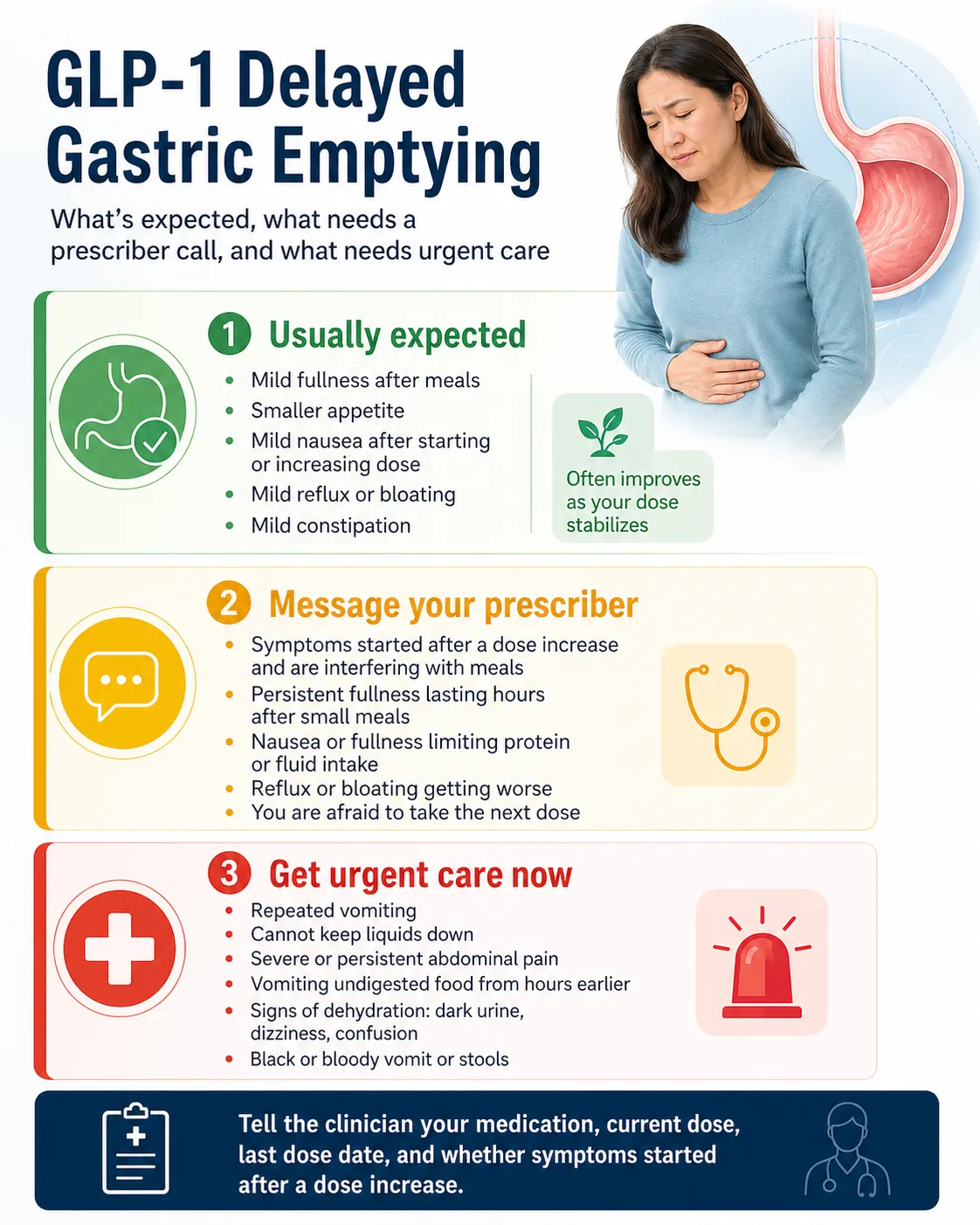
Quick answer: Mild fullness, reduced hunger, occasional nausea after a dose change, and softer stools or mild constipation are common during initiation and dose escalation, and often ease as the dose stabilizes. Persistent vomiting, severe abdominal pain, dehydration, inability to keep liquids down, or vomiting undigested food from hours earlier warrant a same-day call.
The honest version: most users will have some GI symptoms, most will be mild-to-moderate, most will improve with time and dietary tweaks, and a small minority will need real intervention. Knowing which lane you’re in is the whole game.
The self-check
| Symptom pattern | Likely normal | Talk to prescriber soon | Seek urgent care |
|---|---|---|---|
| Mild fullness 1–3 hours after eating | ✓ | ||
| Less hunger / quieter “food noise” | ✓ | ||
| Soft stools or mild constipation early in treatment | ✓ | ||
| Mild nausea after dose increase, easing as dose stabilizes | ✓ | ||
| Mild reflux, manageable with dietary tweaks | ✓ | ||
| Persistent fullness >4 hours after small meals, lasting weeks | ✓ | ||
| Nausea/fullness limiting protein or fluid intake | ✓ | ||
| Reflux or bloating worsening week-over-week | ✓ | ||
| Constipation persisting despite hydration/fiber | ✓ | ||
| Vomiting more than 1–2 days, especially undigested food from hours earlier | ✓ | ||
| Severe or persistent abdominal pain | ✓ | ||
| Inability to keep liquids down >24 hours | ✓ | ||
| Signs of dehydration: dark urine, dizziness, confusion | ✓ | ||
| Black or bloody vomit or stools | ✓ | ||
| Fever with GI symptoms | ✓ |
A note on dose escalation: Most people who develop concerning symptoms developed them right after a dose increase. The fix is almost always to stop escalating until symptoms settle — not to push through. This is standard practice, not failure.
The four things you should not do
- ⚠Don’t keep increasing your dose through severe GI symptoms.
- ⚠Don’t restart at your old high dose after a break without prescriber guidance — the gastric-slowing effect is back to “first dose” intensity.
- ⚠Don’t self-diagnose gastroparesis based on a TikTok or a Reddit thread.
- ⚠Don’t hide your GLP-1 from your surgery, anesthesia, or ER team. Ever.
Delayed gastric emptying vs. gastroparesis — they’re not the same
Quick answer: Delayed gastric emptying is a measurable slowing on a spectrum. Gastroparesis is a clinical diagnosis that requires significantly delayed emptying plus persistent symptoms plus the absence of a mechanical obstruction. Most people on a GLP-1 have some delayed gastric emptying. Few develop true gastroparesis.
How gastroparesis is actually diagnosed
The standard test is gastric emptying scintigraphy — you eat a small meal containing a trace amount of radioactive material, then a scanner tracks how quickly food leaves your stomach over four hours. The diagnostic criteria are concrete:
- More than 60% of the meal retained at 2 hours, or
- More than 10% retained at 4 hours
…plus persistent upper-GI symptoms (nausea, vomiting, early fullness, abdominal pain) typically lasting weeks, plus exclusion of mechanical causes like obstruction or ulcer disease.
Can I take a GLP-1 if I already have gastroparesis?
The FDA prescribing information for Wegovy, Ozempic, Zepbound, Mounjaro, and Foundayo all state the medication is not recommended in patients with severe gastroparesis. That’s not a soft suggestion; it’s prescribing-information language. If you already have a gastroparesis diagnosis (especially severe), starting or continuing a GLP-1 is a clinician-level decision — bring your scintigraphy result, your symptom pattern, and a list of every medication you take to that conversation.
Risk factors for drug-induced gastroparesis
- Pre-existing diabetes-related neuropathy
- Maximum doses
- Rapid dose-escalation schedules
- Prior GI motility issues
- Prior abdominal surgery affecting the vagus nerve
If you don’t have any of those and your symptoms are mild, the math is reassuring. If you have any of those and your symptoms are severe, call your prescriber.
How long does the effect last? (Drug-by-drug, in real numbers)
Quick answer: While you’re on the drug, slowing happens with every dose but partially adapts over weeks of continued use. After stopping, the medication takes roughly 4–5 half-lives to clear — about 5 weeks for semaglutide, 3 weeks for tirzepatide, 5–10 days for Foundayo, and about 3 days for liraglutide. Gastric motility generally normalizes as drug levels fall.
Last verified April 25, 2026. Sources: current FDA prescribing information for each drug (accessdata.fda.gov, DailyMed), the 2024 multi-society perioperative guidance, the 2025 SPAQI consensus statement, and the Hiramoto et al. meta-analysis (Am J Gastroenterol, 2024). Verify each row against the live FDA label before relying on it for a clinical decision; we re-verify quarterly and after any major label revision.
The 2026 GLP-1 Delayed Gastric Emptying Reference Table
| Drug (brand) | Dosing | Half-life | ~95% clearance | Documented gastric emptying delay | Aspiration warning? | Oral-med absorption note? |
|---|---|---|---|---|---|---|
| Semaglutide injectable (Ozempic, Wegovy) | Weekly SC | ~7 days (165–184 hrs) | ~5 weeks | Pooled solid-meal half-time prolonged ~36 min in scintigraphy meta-analysis; stronger in early treatment, partially fades with tachyphylaxis | Yes (label revised Nov 2024) | Yes — caution for narrow-therapeutic-index drugs |
| Semaglutide oral (Rybelsus) | Daily oral | ~7 days | ~5 weeks | Similar mechanism; smaller absolute effect in some studies | Yes | Yes — strict empty-stomach administration required |
| Tirzepatide (Mounjaro, Zepbound) — dual GIP/GLP-1 receptor agonist | Weekly SC | ~5 days | ~3 weeks | Greatest after first 5 mg dose; diminishes over time per label | Yes | Yes — non-oral or backup contraception for 4 weeks after start and after each dose increase |
| Orforglipron (Foundayo, FDA-approved April 1, 2026) | Daily oral | ~29–49 hours (per FDA label) | ~5–10 days | Delayed gastric emptying confirmed in label; FDA required postmarketing studies including ultrasound evaluation of retained gastric contents | Yes | Yes — non-oral or backup contraception for 30 days after start and after each dose increase; simvastatin limited to 20 mg/day with concomitant use |
| Liraglutide (Saxenda, Victoza) | Daily SC | ~13 hours | ~3 days | At 1.8 mg, 1-hr gastric retention reduced ~13% vs placebo; at 3.0 mg, ~23%; effect normalizes by 5 hrs post-meal | Yes (class warning) | Yes |
| Dulaglutide (Trulicity) | Weekly SC | ~5 days | ~3 weeks | Modest delay; per label, largest after first dose and diminishes with subsequent doses | Yes (class warning) | Yes |
| Exenatide ER (Bydureon BCISE) | Weekly SC | ~2 weeks | ~6–10 weeks | Label confirms delayed gastric emptying; magnitude vs long-acting class is mixed in the literature | Yes (class warning) | Yes |
| Exenatide IR (Byetta) | Twice daily SC | ~2.4 hours | ~12 hours | Strong acute delay | Yes (class warning) | Yes |
About compounded semaglutide and tirzepatide: Compounded GLP-1s prepared by a compounding pharmacy are not FDA-approved products, are not covered by these labels, and have not undergone FDA premarket review for safety, quality, or effectiveness. We don’t claim equivalence between compounded and FDA-approved products, and neither should anyone you’re considering doing business with.
Surgery, colonoscopy, anesthesia: what current guidance actually says
Quick answer: Recommendations have evolved fast. The 2023 ASA advice was a blanket “hold for a week.” The October 2024 multi-society guidance shifted to risk stratification and a 24-hour clear-liquid diet. The 2025 SPAQI consensus refined fasting protocols. And in March 2026, the OCULUS randomized clinical trial showed that a clear-liquid prep day before upper endoscopy was the decisive factor — patients who continued their GLP-1 and had bowel prep had no clinically significant retained gastric volume. Tell your procedure team your drug, dose, and last dose date.
Guidance evolution at a glance
| When | Source | What it said | What’s still useful |
|---|---|---|---|
| June 2023 | ASA consensus-based guidance | Hold weekly GLP-1s 1 week; hold daily ones day-of-procedure, regardless of indication or procedure type | Original framework, still cited as a fallback if holding is the chosen path |
| October 2024 | Multi-society guidance (ASA, AGA, ASMBS, SAGES, ISPCOP) | Most patients can continue with risk stratification; high-risk patients individualized; 24-hour clear-liquid diet often recommended | The mainstream framework still used by most anesthesia teams in 2026 |
| 2024 (also) | Hiramoto et al. meta-analysis (Am J Gastroenterol) | Pooled solid-meal gastric emptying delay of 36 minutes vs placebo; no significant liquid emptying delay | Quantified the problem — the delay is real but small relative to a 6–8 hour fast |
| May 2025 | SPAQI multidisciplinary consensus statement | Updated perioperative GLP-1 management with refined fasting protocols and shared-decision framework | Adds nuance for higher-risk patients and longer-acting drugs |
| March 2026 | OCULUS randomized clinical trial (JAMA Internal Medicine) | Continuing GLP-1/GIP before upper endoscopy → 25% clinically significant retained gastric volume vs 3.1% if held; but 0% in either arm when paired with a clear-liquid prep day | The clear-liquid day before is doing the heavy lifting — this matches how the 2024 guidance was already being applied |
What the OCULUS findings actually mean: The 25% retention rate in the no-prep continuation group is real. But in patients undergoing endoscopy with a colonoscopy and clear-liquid bowel prep, neither the continue group nor the hold group had clinically significant retained gastric volume (zero out of 13 vs. zero out of 12). The clear-liquid day is the single most important variable.
Practical 2026 framework: Most patients can continue their GLP-1 if they follow a clear-liquid diet for 24 hours before the procedure. This is now supported by both the 2024 multi-society guidance and the strongest randomized trial published to date.
Procedure-specific notes
- Upper endoscopy / EGD:Highest concern. The 2026 OCULUS trial showed a 46.7% clinically significant residual gastric volume rate in the EGD-only continue-medication arm without a clear-liquid prep. With a clear-liquid prep day, both arms had 0%. If you’re not doing the prep day, the case for holding one dose is now stronger.
- Colonoscopy:Bowel prep already requires 24+ hours of clear liquids. Most colonoscopy patients on GLP-1s can continue — but tell your GI team in case they want to adjust the prep protocol.
- General surgery / general anesthesia:Decision belongs to your anesthesia team. Bring the script below.
- Emergency surgery:Treated as “full stomach” regardless of GLP-1 status. Standard rapid sequence induction protocols apply. You don’t have a decision to make here; the team does.
Who counts as “higher risk”
- Active dose escalation (vs. stable maintenance for months)
- Maximum dose
- Current GI symptoms in the 24–48 hours before the procedure
- Pre-existing gastroparesis or another motility disorder
- Upper endoscopy specifically (where retained gastric contents are most consequential)
Your printable conversation script for the pre-op visit
Copy this, fill in the blanks, and bring it to your pre-op screening:
Birth control, oral medications, and absorption: the part nobody warned you about
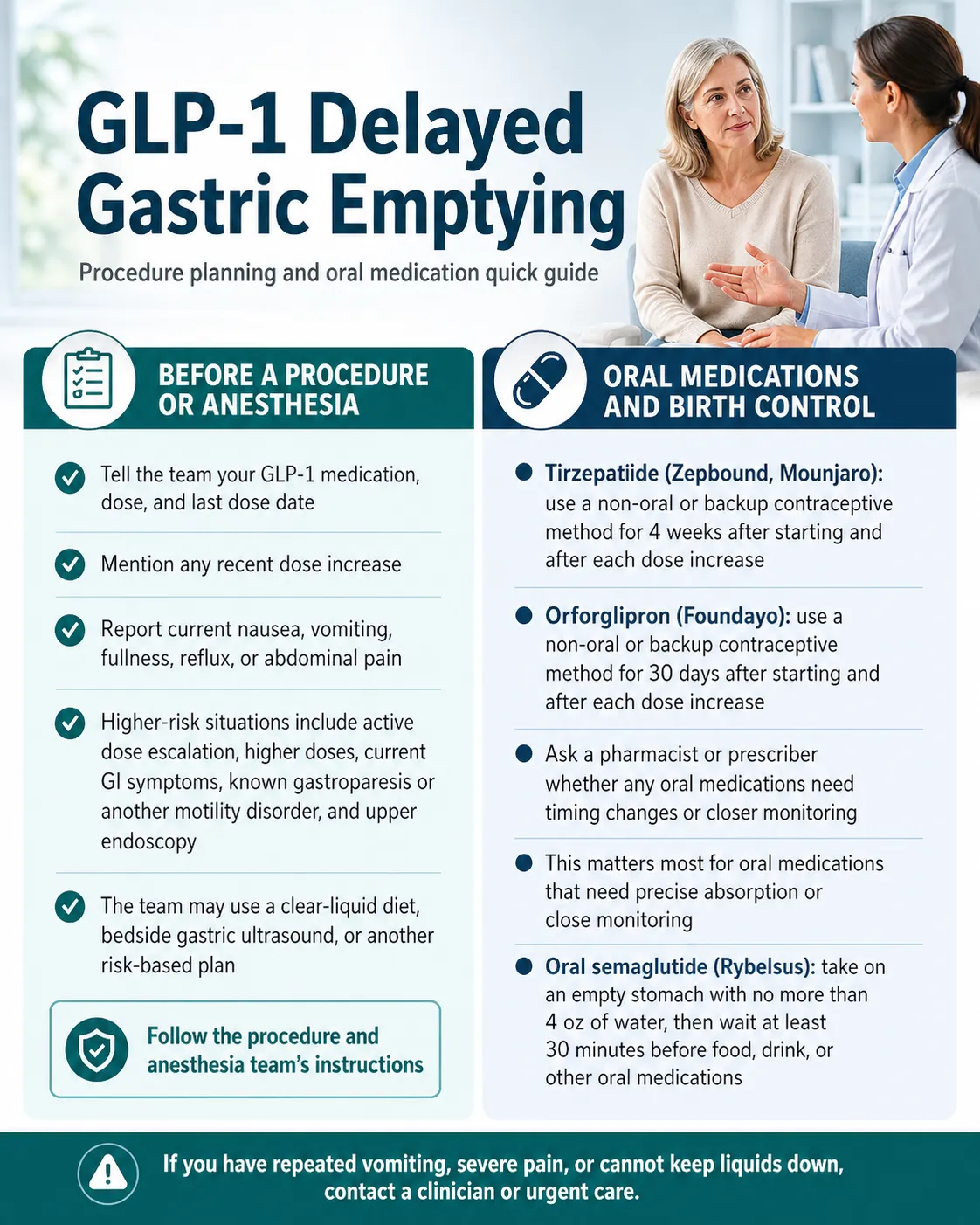
Quick answer: Several GLP-1 labels warn that delayed gastric emptying may affect oral medication absorption — and two of them have specific birth-control timing rules buried in the prescribing information. Tirzepatide (Zepbound, Mounjaro): use a non-oral or backup contraceptive method for 4 weeks after starting and after each dose escalation. Foundayo (orforglipron, FDA-approved April 2026): 30 days after starting and after each dose escalation. Most patients don’t get told this clearly. Now you have been.
Label-specific oral medication rules
| Drug | Oral contraceptive guidance | Other oral-med callouts | Source |
|---|---|---|---|
| Tirzepatide (Zepbound, Mounjaro) | Non-oral method or barrier contraception for 4 weeks after start and after each dose escalation | Caution with narrow-therapeutic-index drugs | FDA prescribing information |
| Foundayo (orforglipron) | Non-oral method or barrier contraception for 30 days after start and after each dose increase | Simvastatin max 20 mg/day with concomitant use, even when staggered by 2 hours; CYP3A4-metabolized so other interactions possible | FDA prescribing information |
| Semaglutide (Ozempic, Wegovy) | General oral-med caution; no specific contraceptive timing window | Monitor narrow-therapeutic-index or clinically monitored drugs | FDA prescribing information |
| Rybelsus (oral semaglutide) | General oral-med caution | Strict empty-stomach administration: ≤4 oz water, wait 30+ minutes before eating, drinking, or other oral medications | FDA prescribing information |
| Liraglutide, dulaglutide, exenatide | Class-level oral-med absorption warning | No specific contraceptive timing window in current labels | FDA prescribing information |
Other oral medications worth a pharmacist conversation
The shorter the therapeutic window of a drug, the more delayed gastric emptying matters:
- Levothyroxine (Synthroid) — narrow therapeutic window; absorption is sensitive to timing and food
- Warfarin — narrow therapeutic window; routinely monitored, but tell your INR clinic about the GLP-1
- Anti-seizure medications — narrow therapeutic windows
- Transplant immunosuppressants — narrow therapeutic windows; coordinate with transplant team
- Diabetes medications (especially sulfonylureas and insulin) — risk of hypoglycemia changes when you eat less
- Digoxin — narrow therapeutic window
- Simvastatin with Foundayo specifically — Foundayo’s label limits simvastatin to 20 mg/day with concomitant use, even when dosing is staggered by 2 hours
Copyable question for your pharmacist. Takes about 90 seconds to answer and prevents a whole class of problems.
How to manage the symptoms day-to-day
Quick answer: For mild-to-moderate symptoms, smaller and lower-fat meals, slower bites, steady hydration between meals (not all at once), staying upright after eating, and slower dose escalation usually do more than any prescription remedy. This isn’t a gastroparesis diet — most users on a GLP-1 don’t need that level of restriction.
What usually works
- ✓Smaller meals, more often — a “normal” portion now feels enormous
- ✓Slow your pace. Put the fork down between bites. Stop before you feel fully full
- ✓Lower-fat meals during flares. Fat is a strong slower of gastric emptying on its own
- ✓Lower-fiber early on, especially with raw fibrous vegetables
- ✓Hydration between meals, not all at once with food
- ✓Stay upright at least 30 minutes after meals to reduce reflux
- ✓Avoid carbonated drinks and alcohol during symptom flares
- ✓Slow dose escalation if symptoms aren’t tolerable — this is the playbook
What doesn’t usually work
- ✗Eating fast because “I have a meeting”
- ✗Big late-night meals
- ✗Lying down within 30 minutes of eating
- ✗Carbonated drinks with meals
- ✗High-fat / fried / very greasy meals during a flare
- ✗Forcing yourself to “finish” a normal-portion meal
- ✗Pushing through to the next dose when the current one isn’t tolerable
When dose adjustment makes more sense than pushing through
- Symptoms worsening rather than stabilizing
- New severe symptoms specifically after a dose increase (consider stepping back down)
- Inability to maintain adequate nutrition or hydration
- Symptoms that feel different from typical GI side effects — severe pain, fever, blood — warrant evaluation regardless of dose strategy
Most prescribers will hold or back-titrate a dose without drama. The ones who won’t aren’t the ones you want. See also: our guide to managing GLP-1 fatigue and GLP-1 constipation relief.
Is the effect permanent? What happens after you stop?
Quick answer: For most users, the gastric-slowing effect is reversible. As the medication clears (about 4–5 half-lives — roughly 3 weeks for tirzepatide, 5 weeks for semaglutide, 5–10 days for Foundayo, 3 days for liraglutide), gastric emptying generally normalizes. If symptoms persist beyond the expected clearance window, that warrants clinical evaluation.
The typical post-discontinuation timeline (semaglutide example)
- Weeks 1–2: Drug levels still high. Slowing continues. Hunger still suppressed. You don’t feel much different yet.
- Weeks 3–4: Drug levels falling. Fullness eases. “Food noise” starts coming back. Some people notice cravings returning by week 4.
- Weeks 5–6: Drug effectively cleared. Gastric motility usually back to baseline. Hunger and meal-size preferences typically normalize.
For tirzepatide, compress that timeline by ~40% (clearance is faster). For Foundayo, faster still — most of the effect should fade within 5–10 days. For liraglutide, it’s mostly resolved within days. For exenatide ER, it takes longer (6–10 weeks for full clearance).
When persistent post-stopping symptoms warrant evaluation
If GI symptoms haven’t improved 4–8 weeks after the drug should be cleared, talk to a clinician. Possible explanations include:
- Pre-existing motility disorder that was masked or made worse by the drug
- Diabetes-related neuropathy
- A separate, unrelated GI condition that happened to start during the same period
- Functional dyspepsia
- Less common causes that warrant proper workup
Don’t assume “the drug broke me.” It’s much more often that a separate condition is contributing — and that’s diagnosable and treatable.
A quick word on stopping for the right reasons: Stopping a GLP-1 has its own consequences. Hunger return. Weight regain — trial data suggest about two-thirds of lost weight returns within roughly 12 months on average without a structured plan. If your side effects are tolerable, the right move is usually dose adjustment + dietary management + a slower titration plan. If your symptoms are severe or persistent, work with your prescriber on a safe taper, switch, or pause.
Compounded vs. FDA-approved GLP-1s: what changes for delayed gastric emptying?
Quick answer: Compounded semaglutide and tirzepatide are not FDA-approved products, are not covered by FDA prescribing information, and have not undergone FDA premarket review for safety, quality, or effectiveness. We don’t claim equivalence between compounded and FDA-approved products.
What FDA has specifically said
- Compounded drugs are not FDA-approved and have not undergone FDA review for safety, quality, or effectiveness.
- FDA has issued warnings about dosing errors with compounded injectable semaglutide, including reports of adverse events and hospitalizations tied to measurement mistakes.
- FDA has warned about illegally marketed and counterfeit GLP-1 products, which may contain wrong, harmful, too little, too much, or no active ingredient.
- FDA has issued enforcement-related letters to telehealth companies regarding the marketing of compounded GLP-1s.
What to do if you’re using a compounded product
- Tell every clinician — and especially every anesthesia team — exactly what you’re taking. Don’t say “Ozempic” if you’re on compounded semaglutide.
- Verify the prescribing clinician (real licensure, real practice) and the dispensing pharmacy (name, state license, ideally outsourcing-facility status).
- Confirm dose units in the syringe (not just the dose label) — this is where reported dosing errors happen.
- Know the program’s protocol for vomiting, dehydration, severe symptoms, or unexpected events.
- Understand whether the program screens for gastroparesis or severe GI history before starting.
Honest limitation: On a medical safety page, we lean toward FDA-approved options where the label warnings, prescribing information, and post-market surveillance are most defensible. If a compounded path is the right fit for your situation, our best compounded semaglutide guide discusses both lanes with verification timestamps.
When to message your prescriber, when to switch, when to seek urgent care
Message your prescriber
- Symptoms started or worsened after a dose increase
- Persistent fullness limiting nutrition or fluid intake
- Reflux or bloating getting worse week-over-week
- You’re afraid to take the next dose
- You want to discuss holding or back-titrating
Consider switching
- You’re tolerating some of the effect but a specific drug is consistently worse
- You hit a plateau and another drug class might work better
- Prescriber has tried slower titration and it didn’t change the picture
- Clinical decision, not a marketing decision
Seek urgent care
- Can’t keep fluids down for more than a few hours
- Signs of dehydration (dark urine, dizziness, confusion)
- Severe or persistent abdominal pain
- Vomiting undigested food from hours earlier — repeatedly
- Fever, blood in vomit or stool, severe abdominal distension
Want a calmer second opinion?
If you’re still figuring out whether your current GLP-1 path is right for you, our free 60-second matching quiz takes your medication, symptoms, and goals and gives you a personalized starting point — including questions worth asking your current prescriber before you change anything.
Get my personalized GLP-1 action plan →If you’re vomiting persistently, dehydrated, in severe pain, or have an upcoming procedure, please contact a clinician — don’t take a quiz.
Frequently asked questions
Still figuring out your GLP-1 path?
If your symptoms are severe right now
If you’re vomiting persistently, can’t keep fluids down, are dehydrated, are in severe pain, are vomiting undigested food repeatedly, or have signs of bleeding, please contact a clinician or seek urgent care today. No quiz, no comparison, no provider link is the right next step in that situation. Use the printable note above to make the conversation faster.
If you’re not sure what your next step should be
Take our free 60-second GLP-1 path quiz. We’ll ask about your situation, your medications, what you’ve already tried, and what you’re trying to accomplish, and we’ll generate a personalized action plan you can use as a discussion guide with your prescriber. It costs nothing, asks for no credit card, and the output is yours to keep.
Get my personalized GLP-1 path →If you specifically want FDA-approved branded medication or want to use insurance
Ro currently offers the broadest FDA-approved GLP-1 lineup we’ve reviewed: Foundayo, Wegovy pill, Wegovy pen, Zepbound pen, and Zepbound KwikPen, with insurance concierge support and a free GLP-1 Insurance Coverage Checker. Ro Body membership pricing: get started for $39 the first month, then as low as $74/month with annual plan paid upfront, or $149/month month-to-month. Medication is billed separately. Best fit if you want FDA-approved branded medication, want to use insurance, or specifically want oral Foundayo. Verify current pricing before signup.
Check Ro's current FDA-approved GLP-1 access →If you’re comparing cash-pay options
Embody is a cash-pay telehealth GLP-1 program with a low first-month price — from $99 for the first month of semaglutide injection, then $299/month ongoing (tirzepatide injection is $149 first month, then $399/month) — plus a needle-free GLP-1 gum option for needle-averse patients, no insurance requirement (HSA/FSA accepted), and 24/7 support if a provider approves treatment. Embody’s shipped options are compounded GLP-1 medications, not FDA-approved finished drugs. MEDVi is a deep-menu cash-pay option with licensed clinician review; MEDVi’s own page discloses that compounded GLP-1 medications are not FDA-approved. Prices, pharmacy availability, shipping timelines, and state eligibility can change and should be confirmed during intake — both companies update frequently.
Sources
- FDA Prescribing Information — Ozempic (semaglutide), label revision November 2024. accessdata.fda.gov; DailyMed.
- FDA Prescribing Information — Wegovy (semaglutide injection and tablet), current revision. accessdata.fda.gov; DailyMed.
- FDA Prescribing Information — Mounjaro (tirzepatide), 2025 revision. accessdata.fda.gov; DailyMed.
- FDA Prescribing Information — Zepbound (tirzepatide), 2025 revision. accessdata.fda.gov; DailyMed.
- FDA Prescribing Information — Rybelsus (oral semaglutide). DailyMed.
- FDA Prescribing Information — Foundayo (orforglipron), April 2026. NDA 220934. Eli Lilly.
- FDA Prescribing Information — Saxenda / Victoza (liraglutide). accessdata.fda.gov.
- FDA Prescribing Information — Trulicity (dulaglutide). DailyMed.
- FDA Prescribing Information — Bydureon BCISE / Byetta (exenatide). DailyMed.
- Wadhwa A, et al. Multi-Society Clinical Practice Guidance for the Safe Use of GLP-1 Receptor Agonists in the Perioperative Period. Clin Gastroenterol Hepatol. October 2024. PMC11666732.
- American Society of Anesthesiologists. New Multi-Society GLP-1 Clinical Practice Guidance Released. October 29, 2024.
- American Society for Gastrointestinal Endoscopy. ASGE Position Statement on Periendoscopic Management of Patients on GLP-1 RAs and SGLT-2 Inhibitors. Gastrointest Endosc. 2024–2025.
- Society for Perioperative Assessment and Quality Improvement (SPAQI). Multidisciplinary consensus statement on perioperative management of patients taking GLP-1 receptor agonists. 2025. PubMed PMID: 40379536.
- Ahmad AI, Garg S, Jacobs J, et al. Holding vs Continuing GLP-1/GIP Agonists Before Upper Endoscopy: The OCULUS Randomized Clinical Trial. JAMA Internal Medicine. March 2026. doi:10.1001/jamainternmed.2026.0027.
- Hiramoto B, McCarty TR, Lodhia NA, et al. Quantified Metrics of Gastric Emptying Delay by GLP-1 Agonists: A Systematic Review and Meta-Analysis. Am J Gastroenterol. 2024;119(6):1126-1140.
- Jalleh RJ, et al. Clinical Consequences of Delayed Gastric Emptying With GLP-1 Receptor Agonists and Tirzepatide. J Clin Endocrinol Metab. January 2025;110(1):1-15.
- Cleveland Clinic Journal of Medicine. Should glucagon-like peptide 1 receptor agonists be withheld during the preoperative period? April 2025;92(4):209.
- AGA Rapid Clinical Practice Update on Management of Patients Taking GLP-1 Receptor Agonists Prior to Endoscopy. Clin Gastroenterol Hepatol. 2023;22(4):705-707.
- Mayo Clinic. Gastroparesis — symptoms, causes, diagnosis, and treatment. mayoclinic.org.
- National Institute of Diabetes and Digestive and Kidney Diseases (NIDDK). Information on GLP-1 medicines and weight management.
- FDA. FDA’s Concerns with Unapproved GLP-1 Drugs Used for Weight Loss. fda.gov.
- FDA. FDA alerts health care providers, compounders and patients of dosing errors associated with compounded injectable semaglutide products. fda.gov.
- FDA. FDA Warns 30 Telehealth Companies Against Illegal Marketing of Compounded GLP-1s. fda.gov.
- FDA. FDA Approves First New Molecular Entity Under National Priority Voucher Program (Foundayo). April 2026.
- Eli Lilly. FDA approves Lilly’s Foundayo (orforglipron). News release, April 1, 2026.
This page is for general educational information and does not provide medical advice. Always discuss your specific situation with a qualified healthcare professional. We re-verify the drug reference table quarterly and immediately after any FDA label revision.