Gallbladder Symptoms: When to Pause GLP-1 Treatment
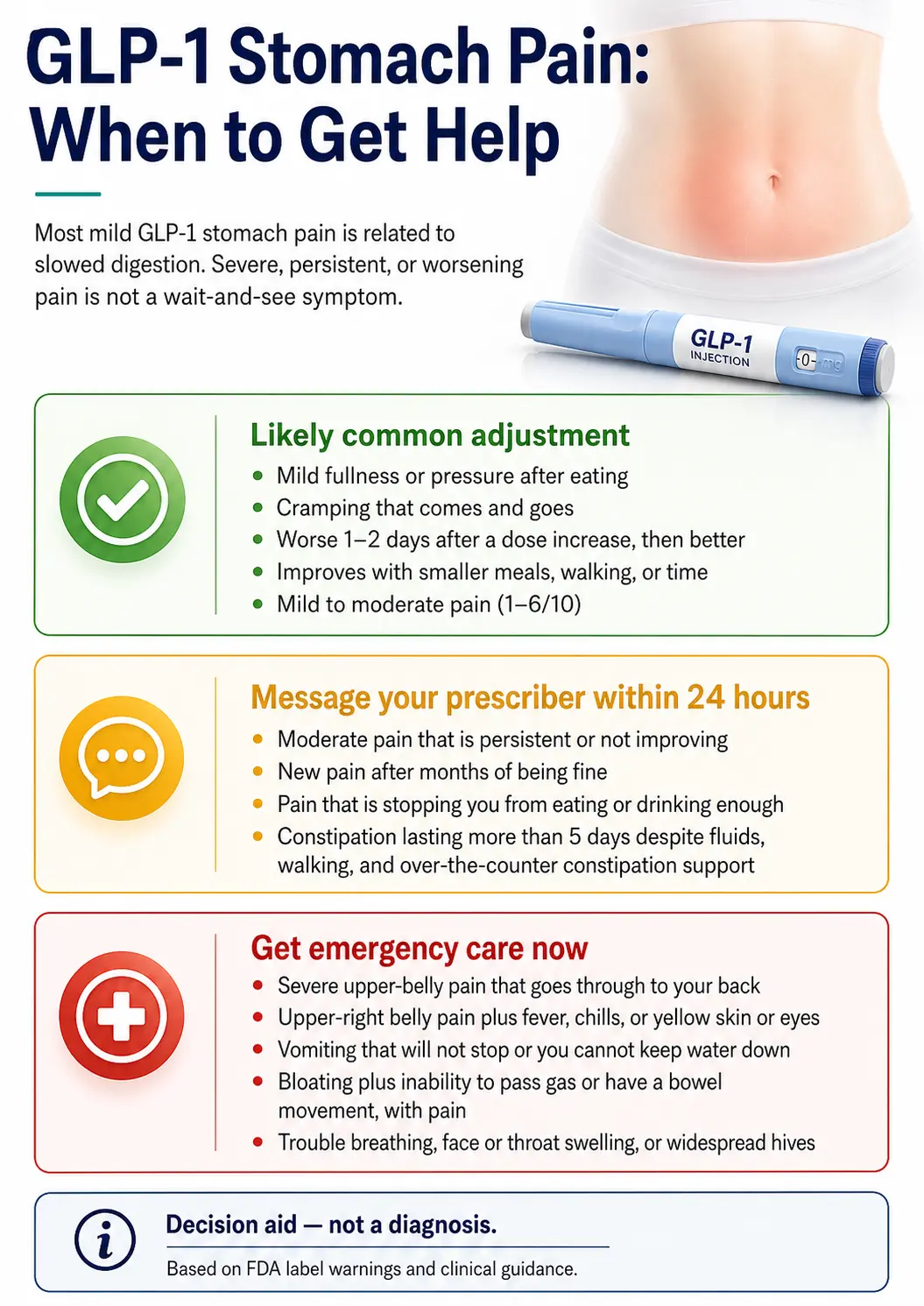
Bottom line up front: The answer to “gallbladder symptoms: when to pause GLP-1 treatment?” depends on the symptoms, not one blanket stop rule. New or repeating pain under your right ribs means contact your prescriber before your next dose and ask whether to hold it. Pain lasting several hours, severe or worsening upper-belly pain—including severe or persistent pain spreading to the back—yellow skin or eyes, fever or chills, repeated vomiting, tea-colored urine, pale stools, or trouble breathing needs urgent medical care now.
We compared seven current U.S. prescribing-information documents covering eight selected brand and formulation rows. In the labels we reviewed, the gallbladder sections call for testing and follow-up when gallbladder disease is suspected. The pancreatitis sections give a different instruction: discontinue the drug when pancreatitis is suspected. You cannot safely tell those two problems apart from your couch.
Skipping a dose does not dissolve a gallstone. If something is wrong in there, it is still wrong on Monday.
Your care ladder, right now
| What is happening | What it could mean | What to do |
|---|---|---|
| Chest pressure, trouble breathing, fainting, new confusion, or you cannot stay awake | A heart, breathing, or other life-threatening emergency—not something to sort out online | Call 911 now. Do not drive yourself. |
| Severe or worsening upper-belly pain, including severe or persistent pain that spreads to your back; yellow skin or eyes; fever or shaking chills; repeated vomiting; tea-colored urine; pale or clay-colored stools; or right-side pain lasting several hours | A gallbladder infection, blocked bile duct, gallstone pancreatitis, or another urgent abdominal problem | Get urgent medical care now. Go to the ER when pain is severe, worsening, or paired with these warning signs. |
| A sharp or steady episode under the right ribs or high in the middle of your belly that followed a meal and then eased, with no warning signs above | A pattern that can fit a gallbladder attack, but symptoms alone cannot confirm it | Contact your prescriber before your next dose. If the pain was severe, lasted several hours, or comes back, get same-day care. |
| Mild all-over nausea, bloating, burping, reflux, or constipation with no focused right-side pain and none of the warning signs above | Common GLP-1 stomach effects are possible | Follow your usual plan. See our full GLP-1 side effects guide and tell your prescriber if symptoms are getting worse. |
The National Institute of Diabetes and Digestive and Kidney Diseases says to seek care right away for gallbladder-attack symptoms such as belly pain lasting several hours, nausea and vomiting, fever or chills, jaundice, tea-colored urine, or light-colored stools. It also says severe or worsening belly pain, vomiting, fever or chills, a fast heartbeat, shortness of breath, or jaundice can be warning signs of severe pancreatitis. (NIDDK: gallstone symptoms; NIDDK: pancreatitis symptoms)
Read this line twice: fever raises the concern level, but no fever does not prove you are safe. If the pain is bad, steady, and still there after several hours, that alone is enough reason to get medical care.
This page cannot tell you what is causing your pain. Nothing online can. It can help you figure out how fast you need to be seen and what to say when you get there.
Copy the 60-second message for your prescriber
Published by Weight Loss Provider Guide, an independent comparison and information resource for GLP-1 telehealth providers.
Last verified: August 5, 2026. We opened seven current U.S. prescribing-information documents and compared eight brand/formulation rows side by side. We then checked symptom, testing, treatment, compounding, and surgery claims against FDA, NIH, MHRA, ASA, manufacturer, and peer-reviewed sources. This page contains no provider links or sponsored placements. Weight Loss Provider Guide may earn commissions on other pages. On this page, “GLP-1” includes GLP-1 receptor agonists and dual GIP/GLP-1 medicines such as tirzepatide. This is health information, not medical advice. Nobody here is your doctor. See our editorial standards, corrections policy, advertising disclosure, and medical disclaimer.
What does gallbladder pain feel like on a GLP-1?
Answer capsule: A gallbladder attack usually causes steady pain in the upper right side or upper middle of the belly. It may follow a heavy meal, happen in the evening or at night, last several hours, and spread toward the right shoulder blade or back. Nausea or vomiting may come with it, but symptoms alone cannot confirm the cause.
Your gallbladder is a small pouch under your liver, on the right side. It stores bile—the fluid your body uses to digest fat. After you eat, the gallbladder squeezes bile into your intestine. If a stone blocks the way, pressure can build and cause pain.
Here is what people often mean when they describe a gallbladder-type pattern:
Where it starts. Under the right rib cage or high in the middle of the belly. It is often more focused than ordinary all-over nausea or bloating.
Where it can go. The right shoulder, the area under the right shoulder blade, or the back. MedlinePlus lists steady upper-right or upper-middle pain that may spread to the back or below the right shoulder blade as a recognized cholecystitis pattern. Pain location is a clue, not a diagnosis. (MedlinePlus)
When it hits. Gallbladder attacks often follow heavy meals and commonly happen in the evening or at night. (NIDDK)
How long it lasts. An attack may last several hours. The episode can end when the blockage moves, but that does not mean the stone disappeared or the problem cannot return.
What may come with it. Nausea, vomiting, bloating, or tenderness. Fever, chills, jaundice, dark urine, pale stools, or pain that will not let up changes the action from “call” to “get seen now.”
One warning on chest pain. Do not talk yourself into “it is probably just my gallbladder.” If you have chest pressure, trouble breathing, sweating, faintness, or severe weakness, call 911. Getting checked and being wrong costs you an afternoon. Getting it wrong the other way costs more.
Is this a gallbladder problem or just normal GLP-1 stomach stuff?
Answer capsule: Common GLP-1 side effects are often spread out and vague—general nausea, bloating, reflux, constipation, or diarrhea—and often appear after starting treatment or moving up a dose. Gallbladder-type pain is more likely to be focused under the right ribs or high in the middle, may follow meals, and may return in episodes. Pain that lasts several hours, is severe or worsening, or comes with fever, jaundice, or repeated vomiting needs medical care, not a wait-and-see guess. Severe or persistent pain spreading to the back raises concern for pancreatitis; pain reaching the right shoulder blade can also occur with gallbladder disease.
Here is our honest admission, and it is the reason to trust the rest of this page: we cannot tell you which one you have. No article can. Early gallbladder trouble, pancreatitis, ordinary GLP-1 nausea, reflux, constipation, ulcers, heart trouble, and other problems can overlap enough that clinicians use an exam, blood work, and imaging instead of guessing.
But here is what we can do, and it is the whole point. Location, how long it lasts, whether it spreads, and what comes with it can tell you how fast you need to be seen. That is a different question from “what is it,” and it is a question you can act on at home right now.
| What you are feeling | What it may fit | What to do |
|---|---|---|
| Mild nausea or fullness that started when you began the drug or moved up a dose | Common GLP-1 effect | Use your normal plan. Report it if it is getting worse or not easing. |
| Cramping with constipation, no sharp or steady right-side pain | A bowel-related symptom is possible | See the general side effects guide. |
| Focused pain under the right ribs or high in the middle that keeps returning after meals | A gallbladder pattern is possible | Contact your prescriber before your next dose. |
| Upper-right or upper-middle pain that stays for several hours | A gallbladder attack, inflammation, blockage, pancreatitis, or another cause is possible | Get same-day medical care; use the ER if the pain is severe or worsening. |
| Right-side pain with fever, chills, jaundice, dark urine, pale stools, or repeated vomiting | Infection or blockage is possible | Get urgent medical care now. |
| Severe or worsening upper-belly pain that spreads to the back | Pancreatitis is possible, but location alone cannot prove it | Get urgent medical care now. |
| Chest pressure, trouble breathing, faintness, or confusion | A heart, breathing, or other emergency is possible | Call 911. |
Two other things people tell us all the time, and both are worth naming:
“I do not want to waste an ER trip.” You are not overreacting. Severe pain, jaundice, fever or chills, repeated vomiting, breathing trouble, or pain that keeps getting worse is what urgent medical care is for.
“I do not want them to take me off it.” We know. This is the fear underneath most of these searches, and it is a fair one—you finally found something that works. Getting checked is how you protect that progress. A short evaluation is a much smaller detour than a blocked duct, an infection, or pancreatitis that was allowed to get worse.
Could this be your pancreas instead? This one changes the answer.
Answer capsule: Pancreatitis can cause upper-belly pain that may spread to the back and may come with nausea, vomiting, fever, a fast heartbeat, a swollen or tender belly, shortness of breath, or jaundice. This changes the answer because the U.S. labels reviewed here direct discontinuing the medication when pancreatitis is suspected, while their gallbladder sections direct testing and follow-up. Gallstones are also the most common cause of acute pancreatitis, so the two problems can happen together.
This is the most important section on this page.
Your pancreas sits behind your stomach. The bile duct and pancreatic duct meet near the intestine. A gallstone can pass into the common bile duct, block that shared outlet, and inflame the pancreas. NIDDK calls gallstones the most common cause of acute pancreatitis. (NIDDK)
Here is the useful comparison—and its limit:
| A gallbladder pattern may look like | A pancreatitis pattern may look like | |
|---|---|---|
| Where | Upper right or upper middle; may reach the right shoulder blade or back | Upper abdomen; may spread to the back |
| How it behaves | Often steady during an attack; one attack may end and another may happen later | May begin slowly or suddenly, become severe or constant, and last for days |
| What may come with it | Nausea, vomiting, tenderness; fever or jaundice raises concern for complication | Nausea, vomiting, fever, fast heartbeat, swollen or tender belly; people often look and feel seriously ill |
| Can location diagnose it? | No | No |
| What the selected U.S. label sections say | Obtain gallbladder or diagnostic studies and clinical follow-up when suspected | Discontinue the medication when pancreatitis is suspected and start appropriate management |
The U.S. label language for pancreatitis is built around severe or persistent upper-abdominal pain that may spread to the back, with or without nausea or vomiting. The labels do not tell a person at home to prove pancreatitis first. They tell clinicians what to do when it is suspected.
The United Kingdom strengthened its class warning on January 29, 2026 after rare reports of severe, necrotizing, and fatal pancreatitis. The UK Medicines and Healthcare products Regulatory Agency tells clinicians to discontinue immediately when pancreatitis is suspected and not restart if the diagnosis is confirmed. That stronger “do not restart” instruction is UK MHRA guidance; it is not wording we found in the current U.S. labels reviewed for this page. (MHRA Drug Safety Update)
So here is the practical rule: if your upper-belly pain is severe, keeps getting worse, is persistent and spreads to your back, or comes with repeated vomiting, fever, a racing heart, trouble breathing, jaundice, or a seriously ill feeling, get medical care now. Do not try to sort it out yourself. You cannot.
A lipase blood test may be part of the workup, but it is not a home answer or a stand-alone diagnosis. Clinicians use the pain story, exam, blood tests, and sometimes imaging together.
What does your GLP-1 label actually say about pausing?
Answer capsule: Across the seven current U.S. prescribing-information documents reviewed for this page, the gallbladder sections direct testing and clinical follow-up when gallbladder disease is suspected. The pancreatitis sections give a direct discontinue instruction when pancreatitis is suspected. That split is useful, but it does not mean taking your next dose through new focused pain is automatically safe—contact your prescriber before dosing.
This is the original comparison built for this page. Every figure in the first eight rows comes from the medication’s current U.S. prescribing information as verified on August 5, 2026. The final row shows why compounded finished products cannot be placed inside the same FDA-label comparison.
Current FDA label action matrix: gallbladder disease versus pancreatitis
| Medication row | Current U.S. label | Gallstones reported | Gallbladder inflammation or broader event | Gallbladder-section action | Pancreatitis-section action |
|---|---|---|---|---|---|
| Wegovy injection (semaglutide) | Revised 03/2026 | 1.6% vs 0.7% placebo in adult weight-reduction trials | Cholecystitis: 0.6% vs 0.2% | Gallbladder studies and clinical follow-up if gallstones are suspected | Discontinue if pancreatitis is suspected |
| Wegovy tablets (semaglutide) | Same 03/2026 label | 2.5% vs 1.0% placebo in adult weight-reduction trials | Not separately reported in the adult tablet sentence | Gallbladder studies and clinical follow-up if gallstones are suspected | Discontinue if pancreatitis is suspected |
| Ozempic injection (semaglutide) | Revised 05/2026 | 1.5% at 0.5 mg and 0.4% at 1 mg; none in placebo | Not separately reported in that placebo-controlled label sentence | Gallbladder studies and clinical follow-up if gallstones are suspected | Discontinue if pancreatitis is suspected |
| Rybelsus (semaglutide tablets, 14 mg trial) | Combined label revised 01/2026 | 1.1% vs 0.9% in a four-year cardiovascular-outcomes trial | Cholecystitis: 1.1% vs 0.7% | Gallbladder studies and clinical follow-up if gallstones or cholecystitis are suspected | Discontinue if pancreatitis is suspected |
| Zepbound (tirzepatide) | Revised 04/2026 | 1.1% vs 1.0% | Cholecystitis: 0.7% vs 0.2%; cholecystectomy: 0.2% vs 0 | Diagnostic studies and follow-up if cholecystitis is suspected | Discontinue if pancreatitis is suspected |
| Mounjaro (tirzepatide) | Revised 01/2026 | Included in a combined 0.6% acute-gallbladder-event rate vs 0% placebo | Combined event included cholelithiasis, biliary colic, and cholecystectomy | Diagnostic studies and clinical follow-up if gallstones are suspected | Discontinue if pancreatitis is suspected |
| Saxenda (liraglutide) | Revised 02/2026 | 2.2% vs 0.8% | Cholecystitis: 0.8% vs 0.4% | Gallbladder studies and clinical follow-up if gallstones are suspected | Discontinue if pancreatitis is suspected |
| Foundayo (orforglipron tablets) | Revised 04/2026 | 1.0% vs 0.7% | Acute cholecystitis: 0.4% vs 0.3% | Diagnostic studies and follow-up if cholecystitis is suspected | Discontinue if pancreatitis is suspected |
| Compounded semaglutide or tirzepatide | No FDA-approved prescribing information exists for a compounded finished product | No FDA-label trial rate | No FDA-label trial rate | No FDA-approved label instruction | No FDA-approved label instruction |
Do not use this table to rank medications. These numbers came from different studies, with different patients, doses, follow-up periods, and methods. FDA labels warn that adverse-event rates from one drug’s trials cannot be directly compared with rates from another drug’s trials. Read each row against its own placebo or control—not across rows.
What the selected labels actually show. Wegovy’s gallbladder section says testing and follow-up are indicated if gallstones are suspected. Its pancreatitis section says to discontinue if pancreatitis is suspected. Zepbound says to obtain diagnostic studies and follow-up if gallbladder inflammation is suspected, then separately says to discontinue if pancreatitis is suspected. Foundayo uses the same basic split.
Seven label documents. Eight selected brand/formulation rows. Same action split in every row we reviewed.
Why “which GLP-1 is safest for my gallbladder?” is a trick question
Almost every article on this topic makes the same mistake. It lines up percentages from different drugs and implies the smallest number wins.
You cannot do that. A 2.2% in one trial and a 1.1% in another are not measuring the same people under the same conditions.
What you can read is the drug-versus-control gap inside one row. Even then, a row is not proof that the medication caused one person’s symptoms.
Zepbound is a useful example of why the details matter. Cholelithiasis was 1.1% with Zepbound and 1.0% with placebo. Cholecystitis was 0.7% versus 0.2%, and cholecystectomy was 0.2% versus none. Those are separate reported outcomes. The label does not show that the same stones caused the later events, and it does not prove an individual cause. That is exactly why the numbers must be described, not spun.
The Ozempic row is another warning against inventing a dose story. The label reports cholelithiasis in 1.5% at 0.5 mg and 0.4% at 1 mg, with none in placebo. The higher-dose number being lower does not prove the higher dose protects the gallbladder. The trials were not designed to support that conclusion.
What if you are on compounded semaglutide or tirzepatide?
Say it plainly: compounded GLP-1 medications are not FDA-approved, and there is no FDA-approved prescribing information for a compounded finished product.
FDA does not review a compounded drug’s safety, effectiveness, or quality before it is marketed. Compounding can fill a real medical need, but FDA says compounded drugs should be used when a patient’s needs cannot be met by an FDA-approved drug. Federal and state requirements apply to the people and facilities that compound them; that is not the same thing as FDA approval of the finished medication. (FDA compounding questions and answers)
That does not change what you should do today. The warning signs and care ladder do not become less urgent because the product is compounded. Get seen.
What changes is the information you bring:
- Which pharmacy made it
- The exact product and formulation on the label
- The concentration
- The amount you were told to take in both milligrams and units, if units were used
- The date and amount of your last dose
- A photo of the vial or package label
- The phone number for the prescribing clinician or on-call service
Do not assume a compounded vial can be matched dose-for-dose to an FDA-approved pen or tablet. FDA has warned that compounded injectable semaglutide and tirzepatide can come in different concentrations and that confusion between milligrams, milliliters, and “units” has contributed to dosing errors. Bring the container or a clear photo so the clinician can see exactly what you used. (FDA concerns with unapproved GLP-1 drugs)
Gallbladder symptoms: when to pause GLP-1 treatment before your next dose
Answer capsule: Skipping a dose does not dissolve a gallstone or treat inflammation, so a self-directed pause is not a substitute for medical care. If you have new or repeating focused pain under the right ribs or high in the middle of your belly, contact your prescriber before the next scheduled dose and ask whether to hold it. If symptoms are severe, worsening, or paired with warning signs, urgent evaluation comes first and the dose question waits.
Four phrases get mixed up constantly here. They mean different things.
| Phrase | What it means on this page | Who decides |
|---|---|---|
| Hold or pause | A short, temporary stop while the cause is evaluated | Your treating clinician or urgent-care team |
| Discontinue | The instruction used in the selected U.S. labels when pancreatitis is suspected | The clinician evaluating suspected pancreatitis; do not self-diagnose it at home |
| Restart | A separate decision after the diagnosis, tests, treatment, and time off are clear | Your treating clinician |
| Stop for good | A permanent treatment decision | Not something to conclude from a blog post or one unexplained pain episode |
If your symptoms are severe: do not spend time debating the next dose. Get medical care. Tell the team the drug, dose, and last dose date, and follow the instructions they give you.
If your symptoms are new but not severe: contact your prescriber today and ask directly, “Should I hold my next dose until I am evaluated?” Do not treat silence from a patient portal as clearance to take it.
If the dose is due soon and you cannot reach the prescriber: use any after-hours or nurse line your program offers. If the pain has lasted several hours, is returning, or is getting worse, use same-day care instead of waiting for a message. A clinician-directed hold is a much smaller problem than taking another dose through symptoms nobody has evaluated.
William Hinojosa, DO, a general surgeon quoted by Norman Regional Health System, gives patients with pain or fever a practical real-world recommendation: hold the next dose, contact primary care, and get evaluated, often with an ultrasound. That is one surgeon’s clinical recommendation. It is not a universal FDA rule, and we are labeling it that way on purpose. (Norman Regional Health System)
Before you call, take 60 seconds. Write down your medication and dose, when you took the last dose, when the next is due, where the pain is, how long it lasts, and whether you have fever, vomiting, yellowing, dark urine, pale stools, breathing trouble, or pain reaching the back. There is a copy-and-paste version below.
They found gallstones, but you feel fine. Now what?
Answer capsule: Gallstones found on imaging without symptoms often need no treatment. The selected U.S. labels reviewed here do not make silent gallstones an automatic stop rule. Tell your prescriber about the finding, then learn the symptoms that would change the plan.
Lots of people have gallstones and never know it. They turn up by accident on a scan done for something else.
NIDDK says gallstones that are not causing symptoms probably do not need treatment. William Hinojosa, DO, also says asymptomatic stones alone are not a reason for his patients to stop a GLP-1. That is practical clinical commentary, not a class-wide FDA dosing instruction. (NIDDK treatment guidance; Norman Regional)
| Your situation | What it means | Next step |
|---|---|---|
| Stones found on a scan, no pain, no fever, no jaundice, no vomiting | Silent or asymptomatic stones | Tell the prescriber; do not make an automatic stop decision from the scan alone. |
| A new post-meal pain episode under the right ribs that later stops | The stones may no longer be silent | Contact the prescriber before the next dose; same-day care if it lasted several hours or was severe. |
| Pain with fever, chills, jaundice, dark urine, pale stools, or repeated vomiting | A complication may be present | Get urgent medical care now. |
Two things to do even when you feel fine:
Tell your prescriber the scan found stones. Not so the prescriber must stop your medication—so it is in your chart and you know what would change the plan.
Know your tripwires. New focused pain under the right ribs. Pain lasting several hours. Fever. Chills. Yellow eyes. Dark urine. Pale or clay-colored stools. Repeated vomiting. Once one of those appears, “silent stones” is no longer the whole story.
What tests will they run for possible gallbladder disease?
Answer capsule: Evaluation usually starts with your symptom history, a physical exam, blood work, and imaging. NIDDK calls ultrasound the best imaging test for finding gallstones. Blood tests can show signs of infection or inflammation involving the gallbladder, bile ducts, liver, or pancreas, but no one test explains every cause of upper-belly pain.
Knowing what may happen makes the visit less scary. Here is the usual path.
Questions. Where the pain is. When it started. How long it lasts. Whether food sets it off. Whether it spreads. Fever, vomiting, yellowing, urine and stool changes. Your medication, dose, last dose, and any recent dose increase. Any known stones. How fast your weight has changed. Every one of those details can change the workup.
Hands on your belly. A clinician may press under your right ribs while you breathe in and check for tenderness or guarding. That is one clue. Do not try to perform or interpret a gallbladder exam on yourself.
Blood work. A clinician may check for infection or inflammation, liver and bile-duct changes, and pancreatic involvement. Lipase is commonly used when pancreatitis is being considered, but it is one part of the diagnosis—not a magic yes-or-no answer.
Ultrasound. It uses sound waves, has no ionizing radiation, and is the best imaging test for finding gallstones according to NIDDK. The clinician decides whether you need it and how urgently. (NIDDK diagnosis guidance)
Sometimes more. Depending on the first results, a clinician may use CT, MRI or MRCP, a HIDA scan, endoscopic ultrasound, or ERCP. ERCP can also be used to remove a stone from the common bile duct. You do not need to order your own test menu. The team chooses based on the question it still needs to answer.
| Test or step | What it may help answer | What it cannot prove by itself |
|---|---|---|
| History and exam | Where the pain is, how urgent the pattern looks, and which organs may be involved | The exact cause in every case |
| Blood tests | Whether there are signs of infection, inflammation, bile-duct or liver changes, or pancreatic involvement | Whether a visible gallstone is present |
| Ultrasound | Whether gallstones are visible and whether the gallbladder looks abnormal | Every cause of upper-belly pain or every stone in a bile duct |
| MRCP or endoscopic ultrasound | Whether a bile-duct stone or duct problem may be present | Whether every symptom came from that finding |
| HIDA scan | How bile moves and whether the gallbladder appears blocked or is not emptying normally | Every other abdominal diagnosis |
| ERCP | Whether a duct stone is present and, in some cases, removal of that stone | Whether the gallbladder itself should later be removed |
One honest note: a normal ultrasound does not explain every upper-abdominal symptom. If pain keeps happening, keeps worsening, or comes with warning signs, keep seeking an answer.
Copy the questions to bring to the visit
Will stopping your GLP-1 make gallstones go away?
Answer capsule: No. Stopping a medication does not remove stones that have already formed. Gallstones causing no symptoms often need no treatment, but symptomatic or complicated gallstones need their own medical plan, and gallbladder-removal surgery is the usual treatment for symptomatic gallstones.
This is one of the most common questions people ask, and the answer is short.
| A pause may do | A pause cannot do |
|---|---|
| Keep another dose from being taken while a clinician evaluates the problem | Dissolve a stone that already exists |
| Give the treating team time to decide whether treatment should change | Clear a blocked bile duct |
| Separate the immediate safety decision from the later restart decision | Cure gallbladder inflammation or infection |
| Protect time for testing and follow-up | Prove the GLP-1 caused the stone |
| Replace blood work or imaging |
If stones are causing symptoms, NIDDK says the usual treatment is surgery to remove the gallbladder, called cholecystectomy. That does not mean every reader with one pain episode needs surgery. The plan depends on what the tests show, whether attacks repeat, whether a duct is blocked, whether inflammation or pancreatitis occurred, and whether surgery is safe for you. (NIDDK treatment guidance)
If you need your gallbladder out, what happens to your GLP-1?
Answer capsule: Most patients can continue a GLP-1 before elective surgery under current multi-society guidance, but that is not a blanket rule. Active nausea, vomiting, constipation, stomach pain, dose escalation, higher doses, or another condition that slows stomach emptying can change the plan. Your surgeon, anesthesiologist, and prescriber must decide together.
Almost nobody writes about this, and if you end up needing surgery, it is the thing that trips people up.
GLP-1 medications can slow stomach emptying. That matters for anesthesia because food or liquid left in the stomach can come back up and enter the lungs during general anesthesia or deep sedation.
The guidance changed. In June 2023, the American Society of Anesthesiologists gave broad advice to hold daily GLP-1 drugs on the day of a procedure and weekly drugs for one week. On October 29, 2024, ASA and four other medical societies replaced that broad approach with a risk-based plan. Most patients can continue. The team may use a 24-hour liquid-only plan, stomach ultrasound, anesthesia changes, a delay, or a medication hold when the person is at higher risk. (Current ASA patient guidance)
Here is the part that applies to you specifically. ASA says constipation, nausea, vomiting, stomach pain, breathing trouble, the dose-escalation phase, higher doses, and other conditions that slow stomach emptying can raise risk. A person with active symptoms may need the elective procedure delayed until those symptoms are gone.
So this is not yours to solve from a general rule. The sentence “most people can continue” is not permission to hide active belly symptoms. Tell the team.
What you need to say is simple:
- The drug name
- Whether it is an injection or tablet
- The dose
- The exact date and time of the last dose
- Whether the dose recently changed
- Whether you have nausea, vomiting, constipation, bloating, stomach pain, or trouble breathing
- Whether the surgery is planned or urgent
Write it on the form and say it out loud to the anesthesiologist. Those can be two different people reading two different pieces of paper.
Emergency surgery is handled differently. ASA advises treating urgent or emergency patients as having a full stomach and using full-stomach precautions. You do not have to manage that plan. You have to tell the team what you took and when.
Can you go back on a GLP-1 after gallbladder surgery?
There is no universal restart date in the selected U.S. labels, and be suspicious of any page that gives everyone one.
Eli Lilly says it cannot give blanket treatment recommendations for tirzepatide in people with a history of gallbladder disease or prior gallbladder removal and sends the decision back to the treating clinician. That is the manufacturer refusing to pretend one answer fits everyone. (Lilly Medical: Mounjaro; Lilly Medical: Zepbound)
Gallbladder removal is not listed as a contraindication in the selected labels reviewed here. After surgery, your liver still makes bile. It flows into the intestine instead of being stored in the gallbladder. NIDDK says people can live normally without a gallbladder. (NIDDK)
Restart timing depends on what happened, how recovery is going, whether pancreatitis was involved, whether a stone remained in a duct, whether you are eating and drinking normally, and how long you were off the medication.
Ask these five questions:
- What exactly was diagnosed?
- Did I have pancreatitis at any point?
- Have my liver and pancreas tests returned to an acceptable range?
- Do I restart at my old dose, or do I need to restart lower because I have been off it?
- What symptoms should make me stop and call again?
That last one is the question people forget, and it is the one that protects you next time.
And the question underneath the question: you may be scared that a pause will undo your progress. A short clinical pause is not the same as ending treatment forever. An untreated gallbladder infection, blocked duct, or pancreatitis matters more than protecting one dose. The math is not close.
How much does a GLP-1 really raise your gallbladder risk?
Answer capsule: A 2022 JAMA Internal Medicine review combined 76 randomized trials with 103,371 participants and found a 37% relative increase in gallbladder or biliary disease with GLP-1 receptor agonists. The average absolute increase was much smaller: about 27 extra events per 10,000 people treated for one year. Risk was higher in weight-loss trials and in higher-dose and longer-duration groups.
You need both numbers because either one alone gives you the wrong picture.
| Measure from the 2022 review | Result | Plain-English meaning |
|---|---|---|
| Trials | 76 | A large combined randomized-trial dataset |
| Participants | 103,371 | Population evidence, not a diagnosis for one person |
| Overall relative risk | 1.37 | 37% higher relative risk than control groups |
| Absolute risk difference | 27 extra events per 10,000 people per year | About one extra event per 370 people treated for one year, averaged across the included trials |
| Weight-loss trials | RR 2.29 | Stronger association in trials using treatment for weight loss |
| Type 2 diabetes or other trials | RR 1.27 | Smaller but still increased association |
| Higher-dose groups | RR 1.56 | Increased association in the review’s higher-dose category |
| Lower-dose groups | RR 0.99 | No statistically clear increase in that subgroup |
| Longer than 26 weeks | RR 1.40 | Increased association with longer treatment in the review |
| 26 weeks or less | RR 0.79 | No statistically clear increase in that subgroup |
The study authors warn that the absolute increase was small and should be weighed against the benefits of treatment. They also could not use patient-level data to tell you who will have an event. The weight-loss trials often used higher doses and longer treatment, so the review cannot cleanly separate the medication effect from dose, duration, and the amount or speed of weight loss. (He et al., JAMA Internal Medicine, 2022)
What the study cannot tell you: whether your pain is your gallbladder, which drug is safest for you, whether the medication caused your stone, or whether you should take your next dose. It is a population number. You are one person with a specific symptom, which is why the answer keeps coming back to getting looked at.
Why can gallbladder problems happen during GLP-1 treatment?
Answer capsule: Rapid weight loss can release extra cholesterol into bile and keep the gallbladder from emptying normally, which raises gallstone risk. GLP-1 treatment may also affect gallbladder movement. Current labels describe different observations about weight loss, but they do not prove one single cause for every event.
The weight-loss part is well established and is not specific to these drugs. NIDDK says quick weight loss can make the liver release extra cholesterol into bile and can stop the gallbladder from emptying properly. Previously silent stones can also become symptomatic during rapid weight loss. (NIDDK)
But here is where the labels need to be read carefully.
| Source | What it says | What it does not prove |
|---|---|---|
| Wegovy label | Substantial or rapid weight loss can raise gallstone risk, but acute gallbladder disease remained more common than placebo even after accounting for the degree of weight loss | The exact mechanism in one patient |
| Saxenda label | Gallbladder event rates were greater than placebo even after accounting for the degree of weight loss | That every event was directly caused by liraglutide |
| Zepbound label | Acute gallbladder events were associated with weight reduction | That weight loss was the only cause |
| Foundayo label | Acute gallbladder events were associated with weight reduction | That the medication had no separate effect |
| 2022 meta-analysis | Higher risk appeared with weight-loss use, higher doses, and longer duration; the authors discuss reduced gallbladder motility and marked weight loss as possible contributors | Which mechanism caused one person’s event |
These are different observations, not two manufacturers proving opposite explanations. Wegovy and Saxenda say weight loss did not fully explain the trial difference. Zepbound and Foundayo say the events were associated with weight reduction. None of those statements settles the whole mechanism.
Who already has higher baseline risk: women, older adults, people with obesity, people with a family history of gallstones, people who already have stones, and people losing weight quickly. Those factors affect the starting risk; they do not prove what caused one person’s pain. (NIDDK: Definition and facts; NIDDK: Dieting and gallstones)
Can you lower your gallbladder risk without quitting?
Answer capsule: There is no guaranteed way to prevent gallbladder problems during GLP-1 treatment. Avoiding crash dieting, following the prescribed dose-escalation plan, eating a balanced diet, and telling the prescriber about past stones are sensible steps. None of them treats active pain or replaces medical care.
Four things are worth discussing with your prescriber. None is a guarantee.
Do not crash-diet on top of the medication. These drugs can already cut appetite hard. Adding a very-low-calorie plan without clinical supervision can make weight loss much faster than intended. NIDDK links fast weight loss with extra cholesterol in bile and poorer gallbladder emptying. If your weight is dropping unusually fast, that is information your prescriber needs—not a failure. (NIDDK)
We are not going to publish one magic number of pounds per week. You will see “two pounds a week” repeated online as if it is a universal gallbladder cutoff. It is not. Starting weight, total percentage lost, time, eating pattern, past stones, and other health conditions all matter.
Do not cut healthy fat to zero. NIDDK says healthy fats such as fish oil and olive oil can help the gallbladder contract and empty regularly, while unhealthy fats in fried foods and desserts should be limited. That is prevention guidance, not a treatment for active pain and not permission to test your symptoms with a fatty meal. (NIDDK)
Follow the titration schedule. Move up on the plan your prescriber gave you, not faster. If side effects are making it hard to eat or drink, tell the prescriber instead of forcing the next increase.
Tell them about your history before you start or restart. Previous gallstones, a previous attack, pancreatitis, or gallbladder surgery belongs in the decision. If you have not started yet, our contraindications guide covers the questions to ask.
One thing we are not going to recommend as a blanket answer: ursodiol. NIDDK says ursodiol can help prevent stones in people losing weight quickly through very-low-calorie diets or weight-loss surgery. That is not the same as a universal recommendation for every GLP-1 user. If your history makes you wonder about it, ask your own clinician. (NIDDK)
Exactly what to tell your prescriber
Answer capsule: A short, specific symptom timeline helps a clinician judge urgency and decide whether the next dose should be held. The details that matter most are the medication and dose, dates of the last and next doses, pain location and duration, whether it spreads, and whether you have fever, vomiting, jaundice, dark urine, pale stools, breathing trouble, or a known gallstone history.
You will get a faster, more useful answer if you lead with facts instead of only saying, “I have stomach pain.”
Have these ready:
- Medication and exact formulation
- Dose and concentration, if compounded
- Date and time of your last dose
- Date your next dose is due
- Whether you moved up recently
- Where the pain is, exactly
- When it started
- How long each episode lasts
- Whether it comes and goes or stays
- Whether food seems to set it off
- Whether it spreads to your shoulder, back, or chest
- Fever or chills—yes or no
- Vomiting and whether you can keep fluids down
- Yellow skin or eyes—yes or no
- Dark or tea-colored urine—yes or no
- Pale or clay-colored stools—yes or no
- Trouble breathing, fast heartbeat, faintness, or confusion—yes or no
- Known gallstones or past gallbladder problems
- Whether your gallbladder has been removed
- Roughly how much weight you have lost and over how long
Copy this and fill in the blanks:
I take [medication, formulation, and dose]. My last dose was [date and time]. My next dose is due [date and time]. Since [when], I have had pain [where] that lasts [how long] and [does / does not] spread to my back or shoulder. I [have / have not] had fever, chills, vomiting, yellow skin or eyes, dark urine, pale stools, breathing trouble, faintness, or confusion. I [can / cannot] keep fluids down. Should I be evaluated urgently, and should I hold my next dose until you tell me otherwise?
If you are heading to urgent care or the ER, say this out loud:
I take [drug, formulation, and dose]. My last dose was [date and time]. My upper-belly pain started [when]. It is [where], lasts [how long], and [does / does not] spread to my back or shoulder. I am worried about my gallbladder, bile ducts, or pancreas.
That last sentence gives the team useful context. Your symptom facts matter more than asking for one specific test. The clinician decides whether blood work, lipase, ultrasound, or another test fits the situation.
Three questions to ask before you leave the visit:
- Should I hold my next dose?
- What diagnosis are you considering, and do I need imaging?
- What symptoms mean I should return right away?
Our full side effects guide has a longer ER preparation checklist.
Frequently asked questions
My shot is due today and my side hurts. What do I do?
If the pain is severe, worsening, has lasted several hours, is persistent and spreads to your back, or comes with fever, chills, repeated vomiting, jaundice, dark urine, pale stools, breathing trouble, faintness, or confusion, get medical care now and let that team decide about the dose. If it is new but not severe, contact your prescriber before dosing and ask whether to hold it. Do not treat an unanswered portal message as permission.
How long does a gallbladder attack last?
A gallbladder attack may last several hours. NIDDK says pain lasting several hours is a reason to see a doctor right away. The pain may stop when the blockage moves, but more attacks are likely after a first one. (NIDDK)
Can gallbladder pain come and go?
Yes. One whole attack can stop and another can happen later. During an attack, the pain may be steady rather than pulsing in waves. A severe episode that stopped on its own still belongs in your chart.
Can I have a gallbladder problem with no fever?
Yes. Fever or chills raise concern for infection, but their absence does not rule out gallstones, blockage, or inflammation. Do not use “no fever” as your only reason to ignore pain that is severe, worsening, or lasting several hours.
Which GLP-1 is least likely to cause gallbladder problems?
The label table cannot answer that. The numbers came from separate studies with different patients and follow-up. FDA labels warn against comparing adverse-event rates across different drug trials. The honest use of the table is drug versus its own control, not drug versus drug.
Does a higher dose make gallbladder problems more likely?
The 2022 JAMA Internal Medicine review found a stronger association in its higher-dose subgroup than its lower-dose subgroup. That is a population pattern, not proof that one dose increase caused one attack. Timing alone is not proof. (JAMA Internal Medicine)
Does stopping semaglutide or tirzepatide make gallstones go away?
No. Existing stones do not disappear because a GLP-1 was paused. They need their own evaluation and treatment decision.
Can gallstones cause pancreatitis?
Yes. NIDDK says gallstones are the most common cause of acute pancreatitis. A stone can block the shared bile and pancreatic outlet and inflame the pancreas. (NIDDK)
Can I take a GLP-1 after my gallbladder was removed?
It may be possible, but timing and dose are individual decisions. Gallbladder removal is not listed as a contraindication in the selected labels reviewed here. Tell the prescriber why the gallbladder was removed, whether pancreatitis occurred, whether a duct stone remained, and how long you have been off treatment.
Do I need routine gallbladder ultrasounds while taking a GLP-1?
The selected U.S. labels reviewed here do not require routine ultrasound screening for everyone. Their gallbladder sections call for studies when gallstones or gallbladder inflammation are suspected. Imaging is driven by symptoms, history, and clinical judgment.
What if the pain moves into my chest?
Do not assume it is the gallbladder. Chest pressure, trouble breathing, sweating, faintness, or severe weakness can be an emergency. Call 911.
Does having gallstones prove my GLP-1 caused them?
No. Past silent stones, sex, age, family history, obesity, rapid weight loss, eating patterns, other medical conditions, and medication exposure may all matter. A timeline alone cannot pin the cause on one factor.
I am on a compounded GLP-1. Do these warnings apply to me?
Treat the symptoms with the same urgency. What changes is the product information: compounded medications are not FDA-approved, and no FDA-approved prescribing information exists for the compounded finished product. Bring the vial or package, concentration, prescribed amount, pharmacy name, and last-dose details.
What if my pain stopped before anyone could see me?
Write down when it started, where it was, how long it lasted, what you ate, and what came with it. Contact the prescriber before the next dose. If it lasted several hours, was severe, or comes back, get same-day care even if you feel normal between episodes.
Can I restart after confirmed pancreatitis?
Do not restart on your own. The selected current U.S. labels say to discontinue when pancreatitis is suspected. The UK MHRA goes further and says not to restart if pancreatitis is confirmed. Your treating clinician must apply the guidance that governs your medication and situation.
How we researched this
Answer capsule: We compared seven current U.S. prescribing-information documents covering eight selected brand/formulation rows, then checked symptom, testing, treatment, compounding, surgery, and population-risk claims against NIH, FDA, MHRA, ASA, manufacturer, and peer-reviewed sources. We did not use patient forums as medical evidence.
What we actually verified—August 5, 2026
- Opened the current U.S. prescribing information for Wegovy, Ozempic injection, Rybelsus/Ozempic tablets, Zepbound, Mounjaro, Saxenda, and Foundayo
- Recorded the label revision date for each document
- Recorded gallstone, cholecystitis, cholecystectomy, or combined acute-gallbladder-event rates exactly as each selected label reports them
- Confirmed the selected gallbladder sections direct studies and clinical follow-up when gallbladder disease is suspected
- Confirmed the selected U.S. pancreatitis sections direct discontinuation when pancreatitis is suspected
- Confirmed that “do not restart if pancreatitis is confirmed” is an MHRA instruction in the January 29, 2026 UK update, not wording found in the selected current U.S. labels
- Confirmed the October 29, 2024 shift from a broad perioperative hold approach to a risk-based multi-society plan under which most patients can continue
- Confirmed that active nausea, vomiting, constipation, stomach pain, dose escalation, higher doses, and other delayed-emptying risks can change the surgery plan
- Confirmed that compounded drugs are not FDA-approved and FDA does not verify their safety, effectiveness, or quality before marketing
- Cross-checked gallstone symptoms, urgent warning signs, diagnosis, treatment, diet, and rapid-weight-loss information against NIDDK
- Reviewed the 2022 JAMA Internal Medicine meta-analysis of 76 randomized trials and 103,371 participants
- Confirmed William Hinojosa, DO, and his practical hold-and-evaluate recommendation from Norman Regional Health System
- Confirmed both Lilly Medical pages decline to give a blanket tirzepatide recommendation after gallbladder disease or removal
What this page does not do
- Diagnose the cause of your pain
- Replace emergency care
- Tell every reader to stop treatment
- Tell any reader that taking the next dose is safe
- Rank medications by comparing percentages from different trials
- Claim that a medication caused one person’s gallstone
- Give one restart date for everyone
- Claim a medical review that did not happen
Where our editorial judgment starts
The four-level action ladder at the top is Weight Loss Provider Guide’s synthesis of NIH warning signs, current label instructions, and the practical next-dose problem readers are trying to solve. It is not itself an FDA dosing rule. We label that line clearly so you can tell the difference between what a regulator says, what a source says, and what this page concludes.
We are not a telehealth provider, and there are no provider links or sponsored placements on this page. That is on purpose. We do not think a page someone reads while deciding whether to go to the ER is the right place for a provider pitch.
Primary sources
- Wegovy U.S. prescribing information, revised March 2026
- Ozempic injection U.S. prescribing information, revised May 2026
- Rybelsus and Ozempic tablets U.S. prescribing information, revised January 2026
- Zepbound U.S. prescribing information, revised April 2026
- Mounjaro U.S. prescribing information, revised January 2026
- Saxenda U.S. prescribing information, revised February 2026
- Foundayo U.S. prescribing information, revised April 2026
- NIDDK: Definition and facts for gallstones
- NIDDK: Symptoms and causes of gallstones
- NIDDK: Diagnosis of gallstones
- NIDDK: Treatment for gallstones
- NIDDK: Dieting and gallstones
- NIDDK: Eating, diet, and nutrition for gallstones
- NIDDK: Symptoms and causes of pancreatitis
- MedlinePlus: Acute cholecystitis
- FDA: Compounding and the FDA—questions and answers
- FDA: Concerns with unapproved GLP-1 drugs used for weight loss
- He et al., JAMA Internal Medicine, 2022
- ASA: Drugs for diabetes or weight loss—what to know before surgery
- MHRA Drug Safety Update, January 29, 2026
- Norman Regional Health System: William Hinojosa, DO
- Lilly Medical: Mounjaro after gallbladder disease or removal
- Lilly Medical: Zepbound after gallbladder disease or removal
Related guides
- GLP-1 side effects: what is normal and what is an emergency
- GLP-1 contraindications: who should not take these medications
- GLP-1 Learning Center
If you have symptoms right now, get medical care first.
Severe or worsening pain, pain lasting several hours, fever or chills, yellow skin or eyes, repeated vomiting, dark urine, pale stools, trouble breathing, faintness, or confusion means get evaluated before you do anything else—including finishing this page.
Once you are medically safe and thinking about what comes next: still not sure which GLP-1 program is right for you? Take the free 60-second matching quiz → No email is required to see your result.