Compounded GLP-1 Refund Policies Compared: When Your Money Stops Being Refundable
By the Weight Loss Provider Guide Research Team · Last verified: August 24, 2026
Weight Loss Provider Guide is an independent comparison resource for GLP-1 telehealth providers. We earn commissions from some companies listed here and not from others. See our advertising disclosure.
Here is the short version of compounded GLP-1 refund policies compared across 12 telehealth programs shoppers commonly put in the same decision set: most change-of-mind refunds close before the package ships. The cutoff may be intake completion, clinician approval, prescription transmission, pharmacy processing, or the first 48–72 hours of a billing term.
The safest structure before medical approval is a card hold instead of a completed charge. Yucca Health and bmiMD publish that structure. If the clinician says no, the hold is released. Willow publishes the clearest pre-pharmacy refund route, but its own documents give three different deadlines, so the safe deadline is the earliest one. Embody publishes the lowest month-to-month semaglutide price in this comparison at $79, but it charges at checkout and its refund documents disagree. Shed's terms publish the most complete cash results guarantee, but one current Shed landing page says the remedy is “your next month is on us,” and a successful terms claim does not cancel the rest of a multi-month plan.
This changes if: you want an FDA-approved brand such as Zepbound® or Foundayo™. Ro publishes that its $39 start fee is refunded if you are not eligible, while its membership and medication charges are separate. And if you are looking at a prepaid 6- or 12-month plan, the amount exposed is not one month. It can be the full prepaid total on day one.
Now the part nobody tells you. Several companies say prescription medication cannot be returned under federal or state pharmacy law. The drug-return rules we checked are about whether medication can go back into pharmacy stock for reuse or resale. They do not decide whether a company must refund your money. Your contract, the facts, your payment method, and state consumer law still matter. That distinction is in section 5, and if you have already been refused, skip to section 14.
Start here: where is your order right now?
Your refund rights are not the same on Monday as they are on Wednesday. They change based on what has already happened to your order. Pick the one that matches you.
- I haven't paid yet → Which policy fits your biggest worry
- I just paid and no one has reviewed me yet → Providers that don't charge until a doctor approves
- I'm approved, but it hasn't reached the pharmacy → Refunds before the pharmacy
- My order already shipped → Refunds after shipping
- They already said no → What to do if they refuse
- I need my real cancel-by date → Use the deadline worksheet
What we actually verified
On August 24, 2026, we read the published refund pages, terms of service, help-center articles, pricing pages, and FAQs for 12 GLP-1 telehealth programs that shoppers commonly compare while considering compounded treatment.
For each program, we recorded when money moves, what event closes the refund window, how future billing is stopped, how prepaid months are handled, and what happens if a package arrives damaged, wrong, missing, or warm.
We also read FDA guidance, the federal credit-card billing-error rule, current FTC negative-option materials, and the drug-return rules in Texas, Missouri, Michigan, Virginia, and New Jersey.
What we did not do: we did not buy medication, submit a refund request, test a checkout, or measure support response time. Everything here comes from published documents. Where two documents from the same company disagree, we show both. We did not publish points that the company's own documents did not support.
Policy links go straight to the company's own document and are not affiliate links. Commercial links are placed only after a decision has been resolved, not inside the evidence tables.
1. When does a compounded GLP-1 payment stop being refundable?
Answer capsule: A compounded GLP-1 payment usually becomes non-refundable at one of five points: card capture, clinician approval, prescription transmission, pharmacy processing, or shipment. Most policies close the window before tracking appears, so waiting for a shipping email is often waiting too long.
Think of your order as moving through five gates. Most people assume the refund window stays open until the box leaves the building. It usually doesn't.
Gate 1 — Card authorized.
An authorization is your bank setting money aside. A capture is the completed charge. Two different things. Yucca Health and bmiMD publish that checkout starts with a hold, not a completed charge.
Gate 2 — A clinician reviews and approves you.
This is the big one. Yucca charges after a provider approves treatment and issues the prescription. At bmiMD, the hold becomes a charge after approval; if you cancel after approval but before pharmacy processing, bmiMD keeps a $50 fee.
Gate 3 — The prescription is issued and sent to the pharmacy.
Willow's FAQ says you can receive a full refund if you cancel before the prescription is sent to the pharmacy. Its informed consent also says the initial order must be cancelled within 24 hours for a full refund. Follow whichever deadline comes first.
Gate 4 — The pharmacy starts processing.
Now the pharmacy is filling or compounding the medication. Many policies treat that as final even if you do not have tracking yet.
Gate 5 — It ships.
Change-of-mind refunds are generally over. A different process takes over for damaged, wrong, lost, or warm packages. That's section 12.
The trap: the clock isn't always yours to stop
Here's the part that costs people real money.
Some gates close because of something you do. Others close because of something the company does. Embody's refund page says the medication is generally ordered when the intake is submitted, or at the end of a video visit if one is required. Its terms use a different test: once the medication has been prescribed, compounded, processed, or shipped. Either way, the safe time to cancel is before the intake or visit is complete—not after you wait for tracking.
That is why “I cancelled before it shipped” can still be too late. Shipment is only the last gate.
The other trap: renewals that run early
Yucca Health publishes that renewals are processed five to seven days early so shipping stays on schedule. Hims also says it may process a medication-plan renewal up to two days before the scheduled date.
If your Yucca renewal date is the 15th and you plan to cancel “before my renewal,” you may already be a week late. The real math is:
Earliest possible charge date = scheduled renewal date − published early-processing window.
For a Yucca customer with a displayed renewal date of the 15th, the earliest processing date can be the 8th. Treat the 8th—not the 15th—as the line you cannot cross.
2. Compounded GLP-1 refund policies compared: the full table
Answer capsule: Across the 12 GLP-1 telehealth programs checked on August 24, 2026, the first no-refund point ranges from clinician approval to prescription transmission, pharmacy processing, or a stated hourly deadline. Yucca and bmiMD start with a card hold. Willow publishes a pre-pharmacy refund route. Several programs publish conflicting documents or split charge rules, so one landing-page sentence is not enough.
This is the whole landscape on one screen. Each row is a provider-stated rule checked against the linked official document. Our calculations are labeled in section 10. “No after shipment” means no change-of-mind cash refund; damaged, wrong, missing, or warm packages may still qualify for review or replacement.
| Program | When money moves | First no-refund point or fee | Stop the next charge | After shipment | Guarantee or special rule |
|---|---|---|---|---|---|
| Embody | At checkout for the selected billing period | Refund page: medication ordered, generally at intake or end of video visit. Terms: prescribed, compounded, processed, or shipped | Conflict: refund page says 72 hours; terms say 5 days | No change-of-mind refund; damaged or wrong medication reviewed for replacement | No published weight-loss-results guarantee with terms we could evaluate |
| Yucca Health | Card hold first; charge after provider approval and prescription | Charge is final after approval and prescription submission, except duplicate or billing error | Renewals may process 5–7 days early | No change-of-mind refund; missing or damaged package must be reported within 48 hours | No results guarantee published |
| bmiMD | Card hold first; charge after approval | $50 cancellation fee after approval but before pharmacy processing; final after processing | Give at least 48 business hours before the processing date | No after fulfillment; damage or error must be reported quickly | No results guarantee found in bmiMD's own current policy |
| Willow | Payment is submitted with the order | Full refund before prescription transmission, but informed consent also gives a 24-hour initial-order deadline | Conflict: 2 business days before processing vs. 2 full calendar days before shipping | No change-of-mind refund | No results guarantee published |
| Shed | At checkout; standard subscriptions have a 2-month minimum after approval | Standard monthly fees are non-refundable once charged; longer-plan refunds depend on whether a future cycle is unfulfilled | At least 72 hours before the next scheduled shipment | No return or restocking; shipment problems follow a separate review | Current terms describe a cash 120-Day Guarantee; one current landing page says “your next month is on us.” A successful terms claim does not cancel the remaining subscription |
| TrimRx | At purchase | Standard refunds are limited to initial medical ineligibility or billing error; written requests must be made within 28 days | Separate cancellation rule controls future renewals | No change-of-mind refund after medication processing or shipment | 3-Month Results Guarantee is marketed, but full conditions are shown at signup rather than in the public terms |
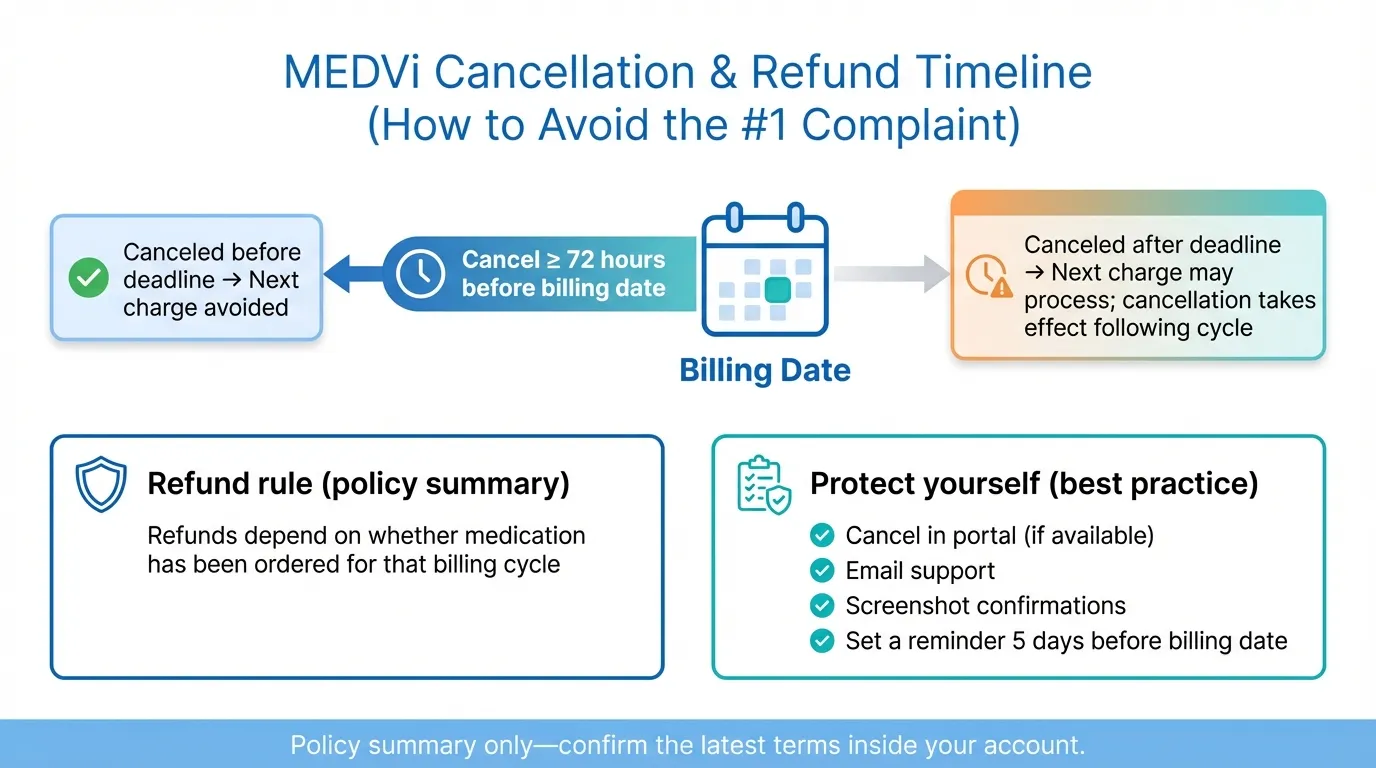
| MEDVi | At checkout | Standard cancellation/refund window is 72 hours from the start of the term | At least 72 hours before the billing date; billing runs every 28 days | No change-of-mind refund | Policy says results are not guaranteed; plans of 2+ months may receive refunds for later months whose medication has not shipped |
| Eden | Membership and medication are separate charges | Active medication orders already sent to the pharmacy continue; membership fees and medication charges follow separate rules | End treatment before the next cycle; contact support immediately for a pending order | No medication return after shipment | Six-month warranty is limited to eligible membership fees, not medication; general terms also allow refund or credit |
| Gala GLP-1 | At intake/checkout | Published refund route is medical disqualification; other completed services and medication orders are final | At least 72 hours before the next charge | No change-of-mind refund; errors or damage reviewed | No results guarantee published |
| Hims / Hers | Weight-loss membership and medication are separate charges | Membership fees are non-refundable, including month one; initial medication-plan cancellation has a 48-hour window | At least 2 days before the medication-plan renewal | No change-of-mind medication return | No results guarantee published |
| Ro | $39 start fee, then membership and medication are separate | $39 is refunded if you are not eligible; later fees follow the selected plan | At least 48 hours before the next membership charge | No change-of-mind medication return | Medical-eligibility refund, not a results guarantee |
| IVIM Health | At checkout under the selected plan | Refund page says prescribed medication is non-refundable and sends cancellation questions to the terms; the terms add limited refunds for certain unshipped portions minus a stated fee | Give at least 48 hours before renewal | No change-of-mind refund; report damaged or lost shipments within 72 hours | No results guarantee published; save the refund page, terms, and membership agreement because the rule is split across them |
Policies and prices checked August 24, 2026. These can change without notice. Confirm the governing document before you pay.
Ro and the FDA-approved options currently highlighted by Hims/Hers are included as comparison lanes because shoppers put them in the same decision set. Their rows are not evidence that every program in this table currently sells compounded medication.
Why we didn't rank these 1 through 12
Because a single ranking would hide the most important thing on this page: a program can be strong at one gate and unforgiving at the next.
bmiMD is one of the best before approval because it starts with a hold. After approval, a $50 fee can attach before the pharmacy processes the order. Both facts are true. A score of “8.2/10” would tell you neither.
So we labeled by stage instead. Find the gate you are standing at, then read that row.
If your goal is to keep the smallest amount exposed on a monthly semaglutide plan, Embody publishes a $79 month-to-month price with no separate membership fee. But it charges at checkout, and a prepaid plan exposes more than $79. Read the refund conflict before you buy.
→ See the current Embody price breakdown and plan trade-offs
3. Which refund policy fits your biggest worry?
Answer capsule: No program has the best refund policy at every stage. A card hold protects against medical denial. A written pre-pharmacy window protects a fast change of mind. A monthly plan limits the size of one mistake. A published results guarantee protects only people who complete every condition.
Different people are protecting against different things. Find yours.
“What if I pay and then get told I don't qualify?”
Best structure: Yucca Health. Runner-up: bmiMD.
Both publish a card hold before approval. If a clinician decides treatment is not appropriate, the hold is released rather than refunded after capture. Yucca's FAQ, refund policy, and terms all say that medical denial does not become a completed charge.
One honest note: a released hold can remain “pending” for a few days while your bank clears it. That is not the same as a posted charge.
If medical denial is your main fear, this is the structure built for you.
“What if I change my mind after I sign up?”
Best published route: Willow—but act inside 24 hours.
Willow's FAQ says a full refund is available before the prescription is sent to the pharmacy and says refunds take 5–10 business days. Its informed consent adds a stricter rule: the initial order must be cancelled within 24 hours for a full refund. The FAQ says to message the care team; it does not promise a one-click portal button.
Willow currently advertises plans starting at $299. The exact medication price can vary by treatment and dose. What you are paying for here is not the cheapest plan. It is a written pre-pharmacy exit—provided you use it fast.
If you need a clear chance to change your mind after ordering, save both Willow documents and treat 24 hours as the deadline.
→ Read our Willow review and current pricing notes · Read Willow's FAQ
“What if I get stuck in a long contract?”
Best fit: a true monthly plan. Embody is the lowest published semaglutide month-to-month price in this table.
Embody publishes $79 for month-to-month compounded semaglutide and $129 for month-to-month compounded tirzepatide, with no separate membership fee and no dose-based price increase within the same plan. The trade-off is that it charges before the clinician visit and its refund documents disagree.
“I want a guarantee that I'll actually lose weight.”
Best documented guarantee: Shed.
Shed's current terms publish the 120-day threshold, participation rules, and cash refund calculation. One current landing page instead says “your next month is on us.” We use the terms for the comparison because they contain the full conditions, but you should save the page you entered through and ask which remedy applies. The other catch belongs in the same sentence: a successful terms claim does not cancel the rest of a multi-month subscription. Full breakdown in section 11.
“I'd rather have the FDA-approved brand.”
Best fit in this comparison: Ro.
Compounded medications are not FDA-approved. Ro's current weight-loss path includes FDA-approved options such as Zepbound® and Foundayo™, a free insurance-coverage checker, and prior-authorization support. Ro says its cash-pay medication prices match LillyDirect, NovoCare, and TrumpRx. Ro also publishes that its $39 start fee is refunded if you are not eligible. Membership and medication are separate: the annual membership is $888 paid upfront, or $149 month to month, and medication is extra.
If FDA approval or insurance paperwork is your deciding fact, use the approved-brand lane instead of forcing a compounded plan to fit.
→ Check GLP-1 insurance coverage with Ro · Compare providers that work with insurance
“I want a no-questions-asked refund, any time, for any reason.”
There isn't one. Not in the 12 programs we checked.
If that is your requirement, do not prepay. Start monthly, keep the first amount small, and treat month one as the trial you are paying for. Or ask your own clinician about an FDA-approved prescription your insurance may cover.
Who should close this page right now
We'd rather lose you here than have you find out later. This page is not the next step if:
- You are pregnant, trying to become pregnant, or breastfeeding. Talk to a clinician before using any GLP-1 medication.
- You have a personal or family history of medullary thyroid carcinoma or Multiple Endocrine Neoplasia syndrome type 2. Semaglutide and tirzepatide labels carry a boxed warning about this risk.
- You need a program that bills insurance directly. → See GLP-1 providers that work with insurance
- You want only an FDA-approved brand. → Compare FDA-approved GLP-1 paths
- You are having a medical emergency. Call 911.
4. "Cancel anytime" and other phrases that don't mean what you think
Answer capsule: A cancellation policy governs future charges; a refund policy governs money already paid. A company can truthfully advertise "cancel anytime" while refusing to return the payment it took an hour ago, because those are two separate rules. Reading the refund policy — not the cancellation policy — is what tells you whether your money is protected.
This is where most people get caught, so let's slow down for sixty seconds.
Cancel means: stop the next charge.
Refund means: give back money already taken.
Credit means: keep the money, give you store value instead.
Replacement means: send another package, keep the money.
Return means: physically send the medication back — which, for a prescription made for you specifically, usually isn't an option at all.
Charge reversal means: a hold that was never completed, released back to you.
Six different outcomes. Only one of them puts cash back in your account.
Now here's the decoder. When you see the phrase on the left, the question on the right is the one you actually need answered:
| The phrase on the website | What you still need to ask |
|---|---|
| "Cancel anytime" | Does that refund this month's charge, or only stop the next one? |
| "No contract" | Are prepaid months refundable if I stop early? |
| "Risk-free" | Risk-free until exactly what event? |
| "Money-back guarantee" | What result, what time period, what records, what deadline? |
| "Full refund if you're not approved" | Am I charged before or after the doctor reviews me? |
| "No returns on prescriptions" | Are damaged, wrong, warm or lost packages replaced or refunded? |
| "Flexible" | Flexible before the pharmacy, or after? |
Print that. Seriously. It's six questions and it's the difference between a $79 mistake and a $1,900 one.
5. Is it true that federal law stops them from refunding you?
Answer capsule: The drug-return rules these policies cite control whether a pharmacy may put dispensed medication back into active stock for reuse or resale. They do not decide whether a seller must return a customer's money. A refund still depends on the contract, the facts, the payment method, and any consumer law that applies.
There are no affiliate links in this section. Not one. This part is here because it is true and because you should have it.
Read enough refund policies and you start seeing the same sentence: federal or state law prohibits returning prescription medication. That sentence can make it sound as if the law also forbids a cash refund.
So we read the cited rules.
| Source | What it is | What it controls | Does the cited text decide whether the customer gets money back? |
|---|---|---|---|
| FDA Compliance Policy Guide 460.300 | Non-binding FDA guidance | Whether a pharmacist should return drugs to stock after they leave the pharmacist's possession | No |
| Texas Health & Safety Code §431.021(w) | State law | Accepting an unused prescription for resale or re-dispensing | No |
| Missouri 20 CSR 2220-3.040 | State rule | Accepting drugs from patients for reuse or resale | No |
| Michigan R 338.503 | State rule | Returning or exchanging prescription drugs for resale and putting them back in active stock | No |
| Virginia Code §54.1-3411.1 | State law | Returning dispensed drugs for re-dispensing, subject to stated exceptions | No |
| New Jersey N.J.A.C. 13:39-7.16 | State rule | Accepting returned medication while keeping it out of stock for reuse or resale | No |
Look at what every one of those rules has in common.
They are about the medication: whether it can go back on a shelf, whether it can be given to another patient, and whether its storage can still be trusted.
They do not set a refund policy for a telehealth company.
And here's the proof from inside the industry
Shed's current terms say both things in the same document:
- Shipped medication is non-refundable and cannot be returned or restocked.
- A member who meets every condition of the 120-Day Guarantee can receive back the amount actually paid for the guarantee period, including medication and pharmacy or clinical fees.
Shed can refund money without taking the medication back or reselling it. The restocking rule and the money decision are separate.
What this means for you—and what it doesn't
Let's be careful here, because this is the part people misread.
This does not mean a company automatically owes you a refund. You may have agreed to a valid cutoff. A provider may also have already performed a non-refundable service or sent a valid prescription to a pharmacy.
What it does mean is that “the medication cannot be returned to stock” is not the same sentence as “the law forbids us from refunding your money.” If a company refuses, ask which contract clause applies and what event closed the window.
Use this:
“I understand the medication cannot be returned to pharmacy stock. I am not asking for it to be resold. Please identify the specific refund-policy clause that applies to my charge, the date the cutoff event occurred, and whether any unshipped or unperformed part is refundable.”
That question is harder to answer with a script.
We are a comparison resource, not lawyers. This is general information, not legal advice or a claim that any company acted unlawfully. For advice about your facts, contact a consumer attorney or your state attorney general's consumer-protection office.
6. Four companies, multiple documents, different answers
Answer capsule: A refund promise can appear on a marketing page, a refund page, an informed-consent form, and binding terms. Those documents do not always match. When they conflict, save all versions, follow the earliest or strictest deadline, and ask in writing which document governs before you pay.
Most people read one document. There can be three or four. And they do not always match.
Embody: 72 hours, or 5 days?
Embody's navigation links to a page labeled “100% Refund Policy.”
The refund page says a medically disqualified patient receives a full refund. Otherwise, a refund is available only before medication is ordered, which the page says generally happens when the intake is submitted or the video visit ends. It says to cancel at least 72 hours before the billing date.
The terms say sales are final once medication has been prescribed, compounded, processed, or shipped. They also say cancellation must be submitted at least 5 days before the end of the prescription period.
Two documents. Two deadlines. Two descriptions of the cutoff.
The practical advice is simple: use the 5-day deadline and cancel before you finish the intake or visit. Then ask support to confirm in writing which version applies to your order.
Willow: 2 business days, 2 calendar days, or 24 hours?
Willow's FAQ says cancellation requests should arrive at least 2 business days before the next processing date. Its informed consent says cancellation must occur 2 full calendar days before the next shipping date. The same consent also says an initial order must be cancelled within 24 hours for a full refund.
Business days and calendar days are not the same. Over a holiday weekend, that gap can be several days.
Follow the earliest deadline: for a new order, act within 24 hours and before the prescription reaches the pharmacy.
TrimRx: “every penny,” or medication cost with conditions?
TrimRx markets a 3-Month Results Guarantee. Its own published pages describe a refund of medication cost for eligible new patients who follow the plan, take the medication, complete required check-ins, and submit the claim through the stated guarantee channel. The full conditions are shown during signup rather than in the public terms.
The published terms are narrower for ordinary refunds: medical ineligibility at the initial consultation or a billing error. They also say a written refund request must be made within 28 days of the original payment.
That 28-day clock is not a promise that every request within 28 days will be paid. It is the outside deadline for a request that already fits a stated refund ground.
Shed: cash refund, or one free month?
Shed's terms effective June 10, 2026 promise a cash refund for an eligible member who meets the 120-day conditions. A current Shed landing page says the remedy is “your next month is on us.” Those are not the same remedy.
We use the current terms for the guarantee table because they contain the full eligibility rules and refund calculation. Still, save the landing page you entered through and ask support to confirm the remedy in writing before you choose a long plan.
The rule this gives you
If a guarantee's conditions are not available before you pay, treat it as marketing—not protection.
That is not cynicism. It is how you read a contract.
7. Which compounded GLP-1 providers don't charge until a doctor approves you?
Answer capsule: Yucca Health and bmiMD publish a card authorization before clinician review rather than a completed charge. If the clinician declines treatment, the hold is released. Eden does not belong in this group under its current terms because it now separates a paid membership from a separate medication transaction.
If you take one thing from this article, take this: the best refund policy is the one you never have to use.
Two programs in this comparison are built that way.
Yucca Health
Best fit for: someone whose main fear is paying and then being medically declined.
You choose a plan and authorize payment. A temporary hold appears. A licensed provider reviews the intake. Yucca says the review is usually asynchronous and typically completed within 24 hours. The charge is completed only if the provider approves treatment and issues the prescription. If the provider declines, the hold is released.
Yucca's current FAQ, refund policy, and terms agree on that core point. They also agree that duplicate charges and billing errors can be refunded.
What you should know going in, plainly:
- Once the provider approves treatment and submits the prescription, the charge is final outside a billing error.
- Renewals may process 5–7 days early.
- A missing, damaged, or wrong package must be reported within 48 hours, not 24.
- Yucca says it does not accept insurance and does not provide an itemized receipt or letter of medical necessity.
- Its terms require binding arbitration in Los Angeles County and include a class-action waiver.
- Current published semaglutide prices are $146 month to month, $140 per month on a 3-month plan, and $125 per month on a 6-month plan. Tirzepatide is $258, $248, and $225 per month on those same lengths. Confirm the total at checkout.
bmiMD
Best fit for: someone who wants no completed charge after a medical denial and can decide quickly after approval.
bmiMD's refund page says the checkout amount starts as an authorization hold. If you are not eligible, the hold is released. If you are approved, the charge is captured and the prescription moves toward the pharmacy.
The number that matters: if you cancel after approval but before the pharmacy processes the order, bmiMD keeps a $50 non-refundable fee. Once the pharmacy processes it, the sale is final. bmiMD now recommends sending renewal cancellation at least 48 business hours before the processing date.
That $50 is a real cost, and it is also clearer than a policy that publishes only a wall.
bmiMD's current published policy does not include a weight-loss-results guarantee. Do not rely on one unless support provides the governing terms in writing before payment.
The one question to ask before you type your card number
“Will my card only be authorized before the doctor reviews me, or will the amount be fully captured before a prescription is approved?”
Ask it in the chat window. Screenshot the answer.
If being charged before medical approval is what is stopping you, choose the structure that removes that fight.
The one thing we'd change about our top pick
We recommend Embody more than any other compounded program on this site, and on this page we owe you the trade-off in plain language.
Embody does not hold your money while a doctor decides. You are charged at checkout. Its refund page says medication is generally ordered when the intake is submitted or the video visit ends, while its terms use a different cutoff. If paying before approval is your dealbreaker, Yucca Health or bmiMD are genuinely better for you, and you should go there instead.
But here is why the trade exists. Embody publishes compounded semaglutide at $79 month to month and compounded tirzepatide at $129 month to month, with no separate membership fee and no dose-based increase inside the same plan. Yucca's current month-to-month semaglutide rate is $146. Over three months, that is $438 at Yucca versus $237 at Embody—a $201 difference. That price math does not prove the programs, pharmacies, or care are identical. It shows the size of the trade.
So the honest framing is: Embody trades a short, conflicted refund window for a lower ongoing price and a smaller monthly charge. If you already know you want to start and your worry is a large commitment, that can be a good trade. If your worry is being declined after paying, it is not.
Does that trade match your situation? Read the plan lengths and refund cutoff before you choose.
8. Can you get a refund before the prescription reaches the pharmacy?
Answer capsule: Sometimes, but the useful window can be measured in hours. Willow publishes the clearest full-refund route before prescription transmission, with a separate 24-hour initial-order deadline. bmiMD allows cancellation before pharmacy processing but keeps $50. Eden, Hims/Hers, and Embody each split the answer across different charges or documents.
This is the stage where people lose money without realizing the door has closed.
Willow is the clearest. Its FAQ says a full refund is available before the prescription goes to the pharmacy and says the refund takes 5–10 business days. Its informed consent says a new order must be cancelled within 24 hours. Message the care team; the current FAQ does not promise a portal cancellation button.
bmiMD lets you out after approval but before pharmacy processing, minus $50.
Eden now has two charge streams. The membership charge is separate from the medication order. Ending treatment stops future cycles, but an active order that has already been sent to the pharmacy continues. Contact support at once if an order is still pending; do not assume “End Treatment” reverses a completed medication charge.
Hims / Hers also separates the membership from medication. The membership fee is non-refundable, while the medication-plan terms publish a 48-hour initial cancellation window.
Embody is stricter. Its refund page ties eligibility to whether medication has been ordered, and says that usually happens at intake submission or the end of the video visit. “It has not shipped” is not the controlling fact.
Ask this exact question
Do not ask only “has it shipped?” Ask:
“Has my prescription been transmitted to the pharmacy? If yes, has the pharmacy started processing it? Which part of my payment is a membership fee, clinical fee, or medication charge?”
Those answers decide which rule applies.
A missing tracking number does not prove your refund window is still open.
By the time you receive a shipping email, you may be two gates past the deadline.
If a change-of-mind window is your deciding factor, Willow publishes the clearest route—but treat 24 hours as the real deadline.
9. What happens if the doctor says you don't qualify?
Answer capsule: Medical denial is the clearest refund route in this category, but the result can be a released hold, a refund of the initial charge, or a refund that excludes a membership or consultation fee. Ask which charge was taken and which part is refundable.
Good news: this is the one situation where the published policies are most likely to protect you.
There are three possible outcomes:
- No completed charge. The authorization hold is released. (Yucca, bmiMD.)
- The initial program charge is returned. (Ro publishes this for its $39 start fee; Willow publishes a refund when no prescription is sent; Gala and Embody publish medical-disqualification routes.)
- Only part comes back. A membership, consultation, or administrative fee may be separate. (Eden and Hims/Hers make this split especially important.)
Ro publishes it most plainly: the $39 start fee is refunded if you are not eligible for GLP-1 treatment. That is a narrow promise, and it is clear.
TrimRx publishes a full refund if the provider finds you medically ineligible during the initial consultation, except where the patient knowingly left out disqualifying information. The written request still has to meet the 28-day deadline in the terms.
What to save, right now
- The clinician's denial message
- The prescription-status page
- The charge date and amount
- The order number
- A screenshot of the refund policy and terms as they read today
- A screenshot showing whether the charge is pending or posted
The message to send
“My clinician determined I am not eligible for treatment. Please confirm whether a prescription or medication order was created, identify each separate charge and any fee you consider non-refundable, and return the refundable balance under your medical-disqualification policy. Please reply in writing.”
No affiliate button here. Somebody who just got told no does not need a sales pitch.
10. Prepaid 6- and 12-month plans: where the real money gets stuck
Answer capsule: A low advertised monthly rate can hide a large term commitment or one-step charge. The useful numbers are the total commitment, what checkout actually captures, and what the written terms let you recover if you stop early.
The four-figure risk starts with the same math: a monthly-looking rate attached to a multi-month commitment.
Here is the money-at-risk view using current published prices and terms.
| Program | Flexible start | Largest published term total or verified one-step charge | What the terms say about unused time |
|---|---|---|---|
| Embody semaglutide | $79 month to month | $828 published 12-month total | Terms list a $69/month equivalent and make the bundle commitment generally non-refundable; confirm whether checkout captures the full total or uses installments |
| Embody tirzepatide | $129 month to month | $1,428 published 12-month total | Terms list a $119/month equivalent; confirm capture timing at checkout |
| Yucca semaglutide | $146 month to month, charged only after approval | $750 billed every 6 months | The 6-month rate is $125/month; the charge is final after approval and prescription submission |
| Yucca tirzepatide | $258 month to month, charged only after approval | $1,350 billed every 6 months | The 6-month rate is $225/month; the charge is final after approval and prescription submission |
| Willow | Starts at $299 | At least $299 | Current public pricing says treatment and dose affect the final amount; do not assume a fixed 6-month total |
| Shed | Starts at $159/month on the current weight-loss page | At least 2 monthly charges under the standard minimum | Standard subscriptions have a 2-month minimum; multi-month checkouts may use one payment or installments, and a guarantee claim does not end the remaining subscription |
| bmiMD | Monthly options available | $0 before approval; then $50 if cancelled before pharmacy processing | Once pharmacy processing begins, unused subscription time is not refunded |
| MEDVi | 28-day billing cycle | One 28-day charge | On plans of 2+ months, later months whose medication has not shipped may be refundable under the written policy |
| Eden | $39 first-month membership plus separate medication | Membership + medication charge | Membership becomes $99/month; medication remains separate; no single “all-in hold” protects both charges |
| Hims / Hers | $39 first-month membership plus separate medication | Non-refundable membership + medication charge | Membership becomes $149/month; medication billing follows its own schedule and cancellation rule |
| Ro | $39 start fee | $888 annual prepaid membership | The $39 is refunded if ineligible; medication is extra |
| IVIM Health | Depends on selected plan | Full checkout amount | Terms describe limited refunds on certain unshipped medication less a fee; the separate refund page is stricter |
Price math verified August 24, 2026 from provider-published pages. “Monthly equivalent” is not the same as monthly billing.
Embody's terms say unused portions of a bundle are generally not refunded, except where its stated exceptions or law apply.
MEDVi publishes the most useful unshipped-month clause in this comparison: on a plan of two or more months, later months may be refunded when medication for those months has not shipped. That is better than most prepaid language. It does not make the current month refundable, and it does not erase the rest of MEDVi's public record in section 18.
Shed's guarantee can return the amount paid for the covered 120-day period if every condition is met. It does not automatically cancel later cycles in a longer plan. You must cancel the subscription separately under the ordinary cancellation rule.
Buy-now-pay-later adds a second contract. Cancelling with the provider does not automatically cancel Klarna, Affirm, or Afterpay. Get written confirmation from both.
The rule we'd give a friend
Start monthly. Move to a prepaid plan after you know the medication agrees with you, the price is sustainable, and the company answers its messages.
The discount will still be there. Your prepaid money may not be.
At Embody, three month-to-month semaglutide payments total $237. Its published 12-month semaglutide commitment totals $828. The annual equivalent saves $10 a month, but the commitment risk is much larger than $10. Confirm at checkout whether the selected plan is captured in full or in installments.
Flexibility costs $10 a month in that example. That is cheap insurance until you know you want the full year.
11. Are the GLP-1 money-back guarantees real?
Answer capsule: A guarantee is only as strong as the published conditions, what it actually refunds, and whether it also ends future billing. Shed's current terms publish a detailed cash guarantee, while one current Shed landing page says “your next month is on us.” Eden limits its warranty to eligible membership fees and separately reserves the choice of refund or credit. TrimRx markets a guarantee whose full terms are shown at signup. MEDVi's refund policy says results are not guaranteed despite a footer badge.
The bottom line: it depends on whether you can read the rules before you pay.
| Program | Published promise | Threshold and required actions | What comes back | The catch |
|---|---|---|---|---|
| Shed | Current terms: 120-Day Guarantee for eligible new members. One current landing page says “your next month is on us” | Lose at least 5% of baseline body weight or reach the goal recorded at enrollment within 120 days; attend 4 monthly coaching visits; log at least 2 weights each month; complete at least 60 daily check-ins; submit provider follow-up forms; first-time use of that medication class | Current terms: cash equal to the eligible amount actually paid for the guarantee period, including medication and pharmacy or clinical fees | The landing-page remedy conflicts with the terms; a successful terms claim does not cancel the remaining subscription, so ordinary cancellation still applies |
| TrimRx | 3-Month Results Guarantee for eligible new patients | Follow the plan, take the medication, and complete required check-ins for 3 consecutive months; full conditions are shown at signup | Provider describes medication-cost reimbursement for an eligible claim | The public terms do not contain the full guarantee rules; get them before paying |
| Eden | Six-month “Money Back Warranty” | Current terms require 26 consecutive doses and detailed participation/verification rules | The detailed warranty section limits recovery to eligible membership fees paid during the first 6 months—not medication | A separate general clause says Eden may issue a refund or program credit, creating a document conflict |
| MEDVi | Money-back badge appears in the site footer | No public result threshold or claim steps | Not published | The written refund policy says there is no guarantee of results or effectiveness |
| Embody | “100% Refund Policy” page | Medical disqualification and order-stage refund rules, not a published weight-loss result threshold | Depends on the order stage | Do not treat the page title as a results guarantee |
Three things this table tells you
1. Watch what is actually refunded. Eden's warranty does not refund medication. Shed's eligible cash calculation can include medication and clinical or pharmacy fees.
2. Watch the word “or.” Eden's general terms allow a refund or program credit. Credit keeps the money inside the program. Cash returns it to you.
3. Watch what happens next. Shed's terms say a guarantee claim does not end the rest of a multi-month subscription. A member can win the claim and still be billed later unless they also cancel.
Shed's terms are demanding. Four coaching appointments. Sixty daily check-ins. Weight logs twice a month. Follow-up forms. That is not a casual promise. The terms make those conditions public before checkout. The separate landing-page remedy still needs written clarification before you rely on it.
The honest limitation: a 120-day results guarantee does not help somebody who wants out in week two. For a short exit, choose a monthly plan or a pre-pharmacy cancellation route instead.
If you will do the check-ins and want every major condition in writing before you pay, Shed is the clearest guarantee in this set.
12. Can you get a refund after your compounded GLP-1 ships?
Answer capsule: Change-of-mind refunds are generally unavailable after compounded medication ships. A separate process applies when the package is damaged, wrong, missing, or arrives at an unsafe temperature. The usual remedy is review or replacement, not cash.
Once it ships, the question changes. It is no longer “can I get out of this?” It is “did something go wrong with this order?”
Those questions get different answers.
| What happened | Likely outcome |
|---|---|
| Changed my mind | Generally no refund |
| Do not want treatment anymore | Generally no refund; talk to the prescribing clinician before changing treatment |
| Wrong medication or strength | Error review; replacement or refund may be offered |
| Vial or package arrived damaged | Replacement is common after evidence review |
| Package never arrived | Carrier and address investigation |
| Arrived warm or ice packs melted | Pharmacy or clinical review before use |
| Delivered to the wrong address | Address and carrier investigation |
Replacement is not the same as a refund. A company can send another package and keep the payment. That may solve the order problem, but it does not put cash back in your account.
The 48-hour clocks nobody mentions
Report windows are short:
- Yucca Health requires a missing, damaged, or incorrect package to be reported within 48 hours.
- bmiMD asks members to report damaged or incorrect medication within 48 hours of delivery.
- Willow publishes a temperature standard and a replacement process for a shipment delayed long enough to create a temperature risk.
- Embody says the pharmacy will usually replace damaged or incorrect medication after evidence review; cash refunds are considered case by case.
Inspect the box the day it lands. Not the weekend after.
Photograph everything before you open it
- The whole unopened package
- The shipping label
- Any temperature indicator
- The medication container
- Any damage or leaking
- The packing materials and ice packs
- The delivery timestamp
Redact your name, address, and prescription details before posting anything publicly.
Do not decide on your own whether warm medication is safe
This matters more than the money. FDA says not to use an injectable compounded GLP-1 product that arrives warm or without proper refrigeration. Contact the pharmacy or provider for instructions and a replacement review.
Call the pharmacy. Not a forum.
13. How to ask for a compounded GLP-1 refund
Answer capsule: Refund requests are most effective in writing, submitted as early as possible, and framed around the specific order stage rather than dissatisfaction. Identifying whether the prescription has been transmitted to the pharmacy, and asking which policy clause applies, produces a more useful answer than a general complaint.
Speed matters more than eloquence. Send something today.
Gather this first
Order number · charge amount · charge date · plan length · current order status · whether a clinician has decided · a screenshot of the prescription status · your cancellation attempt with date and time · a screenshot of the refund policy as it reads today.
The template
Subject: Refund request — order [ORDER NUMBER]
I'm requesting a refund of $[AMOUNT] charged on [DATE]. My account currently shows [STATUS].
Please confirm in writing:
- Whether a clinician approved and issued a prescription, and on what date.
- Whether the prescription has been sent to the pharmacy.
- Whether preparation or shipment has begun.
- Which part of your current refund policy applies to my situation.
- The amount that will be returned, and any amount being kept.
I requested cancellation on [DATE AND TIME] through [CHANNEL]. Confirmation is attached.
Please also confirm that future renewals have been stopped.
Those five numbered questions do a lot of work. They're hard to answer with a canned reply, and the answers tell you exactly which gate you're standing at.
If a doctor declined you, add this
"My clinician determined I'm not eligible. Please apply your medical-disqualification provision and identify any consult or administrative fee that is separately non-refundable."
If the package was wrong or damaged, add this
"The package arrived [DAMAGED / WRONG / WARM / INCOMPLETE]. I've kept the packaging and attached photos. Please tell me whether the remedy is a replacement, a refund, or another review — before I use the medication."
What not to do
- Don't threaten a chargeback in your first message. Ask for the written decision first.
- Don't open five separate support tickets. Keep one thread.
- Don't claim a package never arrived if tracking shows delivery.
- Don't post your prescription details publicly.
- Don't stop taking a prescribed medication because of a billing dispute. Those are separate decisions. Talk to your clinician about the medical one.
14. What to do if they refuse—or keep charging you
Answer capsule: Ask for the written reason, stop future billing separately from the refund dispute, and use a card dispute only when the documented facts fit. For a credit-card billing error, the Fair Credit Billing Act gives you 60 calendar days from the statement date to send written notice to the issuer's billing-disputes address.
You have more moves than most people realize. One of them has a hard deadline that may already be running.
Step 1—Get the reason in writing
Ask what exact event closed the window, when it happened, which policy version applied, and whether any unshipped, unperformed, duplicate, or incorrectly billed part is refundable.
A written denial is more useful than a phone call because it commits the company to a reason you can compare with its own policy.
Step 2—Escalate inside the company first
Reply in the same thread. Ask for a billing supervisor. Keep the case number. Three business days is a reasonable response deadline for a non-emergency billing issue.
Step 3—Deal with the financing company separately
If you used Affirm, Klarna, or Afterpay, contact that lender too. Ask whether the merchant has submitted a cancellation or refund and how your payment schedule will change. Do not assume one company updated the other.
Step 4—Use the credit-card dispute process when the facts fit
The Fair Credit Billing Act covers credit-card billing errors. Examples can include a duplicate charge, the wrong amount, an unauthorized charge, something not delivered as agreed, a charge after a documented cancellation, or a refund the merchant approved but never posted.
To preserve the federal billing-error process, send written notice within 60 calendar days after the statement that first showed the charge. Use the billing-disputes address, not the payment address. The issuer generally has 30 days to acknowledge the notice.
Documented grounds can include:
- A duplicate charge
- A charge after a confirmed cancellation
- The wrong amount
- Something not provided as agreed
- A refund the company approved but never posted
- An unauthorized recurring charge
What is not automatically a billing error: changing your mind after an agreed no-refund cutoff. Be exact about what happened. A dispute built on an inaccurate description helps nobody.
Debit cards follow different rules and deadlines. Contact the bank immediately instead of assuming the credit-card process applies.
Step 5—Check whether the arbitration opt-out is still open
Many agreements require individual arbitration and waive class actions. Some let you opt out within a short period.
Embody's terms publish a 30-day arbitration opt-out window and provide contact instructions. If you joined in the last month, read that section now. Other providers use different language and deadlines.
Step 6—Know what federal subscription law actually says today
The FTC's 2024 “click-to-cancel” negative-option rule was vacated by the Eighth Circuit on July 8, 2025, before it took effect. In February 2026, the FTC removed the vacated 2024 text from the Code of Federal Regulations. In March 2026, the agency opened a new rulemaking inquiry. There is no current nationwide FTC rule that simply makes every online subscription cancelable with one click.
ROSCA—the Restore Online Shoppers' Confidence Act—still applies to online negative-option plans and requires a simple mechanism to stop recurring charges. Many states also have their own automatic-renewal laws.
Your rights can depend on where you live, how you paid, and what the company promised. Your state attorney general's consumer-complaint page is free and often has a plain-language guide.
Step 7—Keep proof that future billing stopped
Save the cancellation confirmation. Watch the next two statements. A refund decision and a future-billing stop are two separate things.
This section is general consumer information, not legal advice. Your rights depend on the facts, your payment method, your agreement, and your state's law.
15. How to protect your money before you pay
Answer capsule: Most refund disputes can be reduced at checkout by confirming when the card is captured, what event closes the window, how each fee is treated, and how early the next charge may run. Save a dated copy of the policy before you pay.
Five minutes now prevents most of what is in this article.
The seven questions to answer before you enter your card
- Will my card be authorized or fully charged before a clinician reviews me?
- What exact event makes this payment non-refundable?
- Are the consultation, membership, and medication charged separately—and refunded separately?
- Can I get a refund after approval but before pharmacy processing?
- What happens to unused months if I stop early on a prepaid plan?
- How are damaged, missing, wrong, or warm shipments handled, and how fast must I report them?
- Which channel and what deadline control cancellation?
Your refund-deadline worksheet
Fill this in before checkout:
| Field | Your answer |
|---|---|
| Program and exact plan | |
| Amount that will be captured today | |
| Is it a hold or a completed charge? | |
| First event that makes the current charge final | |
| Scheduled renewal date | |
| Published early-processing window | |
| Published cancellation notice | |
| Earliest possible charge date | |
| Your personal send-by date | |
| Support channel and confirmation number |
Use this formula:
Earliest possible charge date = scheduled renewal date − early-processing window.
Personal send-by date = earliest possible charge date − the notice period − your own safety buffer.
Yucca example: a displayed renewal date of the 15th and a 5–7-day early-processing window means the charge can run as early as the 8th. Send cancellation before the 8th and keep proof.
Save a dated copy of the policy
Screenshot the refund page and terms page with the date visible. These pages can change quietly. Your copy shows what was published when you paid.
Set the reminder before you pay, not after
Put two reminders on your calendar: one at your personal send-by date and one two business days earlier. Do not rely on the provider's reminder email.
Get everything in writing
Use a portal message or email. If a support agent says something the written policy does not, ask the agent to put it in the message thread. Then save it.
Still not sure which structure fits your state, budget, and risk? Use the path finder instead of guessing from one headline price.
16. Are compounded GLP-1 medications FDA-approved?
Answer capsule: No. Compounded semaglutide and tirzepatide are not FDA-approved. FDA does not review a compounded product for safety, effectiveness, or manufacturing quality before it is marketed. A refund policy says nothing about whether the medication is medically appropriate.
We have to say this clearly because a refund comparison can accidentally make a program sound endorsed.
Compounding means a licensed pharmacy prepares a medication for an individual patient under the conditions allowed by law. A compounded semaglutide or tirzepatide product is not an FDA-approved generic of Wegovy®, Ozempic®, Zepbound®, or Mounjaro®.
FDA says patients should use a compounded GLP-1 only when their medical need cannot be met by an FDA-approved drug. That is a clinical decision, not an affiliate decision.
A strong refund policy tells you how a company handles money. It tells you nothing about the medicine. Those are separate questions.
If FDA approval matters to you, use the approved-product lane.
Ro currently lists FDA-approved weight-loss options including Zepbound® and Foundayo™, publishes a $39 eligibility refund, and offers insurance and prior-authorization support. Membership and medication are separate charges.
→ Check GLP-1 insurance coverage with Ro · Compare approved GLP-1 paths
17. How we compared these refund policies
Answer capsule: We used each company's current terms, refund policy, FAQ, informed consent, and pricing page. We recorded conflicts instead of resolving them for the provider. We used reviews only to locate possible friction, never as proof of a policy or a medical claim.
Here is exactly what we did, so you can judge it.
What counted as evidence, in order:
- Current terms of service and refund policy
- Official informed-consent form, FAQ, or help center
- Official pricing and checkout language
- A dated written support response, when one was publicly available
- Archived screenshots
- Customer reviews only as a lead—not proof
What we measured: the five gates in section 1, plus separate fees, prepaid-month handling, medical-disqualification treatment, future-renewal rules, and shipment-problem remedies.
Where documents disagreed, we published both versions and told you to follow the strictest or earliest rule. We did not choose the friendlier version.
Where a company published nothing, we wrote “not published” instead of guessing. A guarantee, cancellation method, or refund route appears here only when the company's own current document supports it.
Legal claims were checked against FDA guidance, state statutes or rules, the Consumer Financial Protection Bureau, federal statute, the FTC, and the Eighth Circuit decision.
What we did not do: we did not purchase medication, test checkout, submit a refund claim, or measure service behavior. This page reports what the documents say, not how every individual case will be handled.
Our commercial relationships: Weight Loss Provider Guide earns commissions from some companies listed here. That did not change any policy row. Unfavorable terms stayed in. Direct policy links are uncompensated. Read the advertising disclosure.
Original comparison assets on this page
This review adds four original comparison assets built from the source set:
- A five-gate refund model that shows exactly when the answer changes
- A money-at-risk table that separates monthly equivalents from published term totals and verified one-step charges
- A cross-document conflict and split-rule register for Embody, Willow, Shed, Eden, MEDVi, and IVIM
- A refund-deadline worksheet that converts early processing and notice rules into one send-by date
Those are our calculations and decision tools. Provider statements remain labeled as provider statements.
18. What do public records add—and what can't customer reviews prove?
Answer capsule: Customer reviews can show where people report friction, but they cannot prove the governing policy, the reason for a charge, or what is typical. We did not use individual testimonials to rank these programs. We did use primary regulatory records and a dated BBB profile where those records changed the money-risk decision.
Individual customer quotes are not used as policy evidence here. An isolated review cannot show what is typical, which document governed a charge, or whether a complaint was resolved.
The one program we're flagging directly
MEDVi has a useful clause for unshipped months on plans of two or more months, and we credited it in section 10. You should also know the rest of the public record before acting on that clause.
FDA issued Warning Letter #721455 to MEDVi, LLC on February 20, 2026. The letter addressed drug claims and misbranding issues on a site associated with the company. MEDVi's current site now states that it does not make compounded medication and that compounded drugs are not FDA-approved. Those are real current disclosures.
The Better Business Bureau profile showed an F rating, 711 complaints, and 122 unanswered complaints when checked on August 24, 2026. BBB is not a government agency and complaint counts do not prove every allegation. But an F rating and a large unanswered count matter on a page about billing and refunds.
MEDVi's footer displays a money-back badge while its written cancellation policy says results and effectiveness are not guaranteed. That document conflict remains.
We are not linking a commercial CTA to MEDVi from this page. If the unshipped-month clause is what attracted you, the safer version of that goal is to avoid prepaying at all. Start monthly and keep the first amount small.
19. Frequently asked questions
Does “cancel anytime” mean I get a refund?
No. It usually means future renewals stop. The current membership, clinician review, prescription, or medication order may already be non-refundable.
Can I cancel a compounded GLP-1 order before it ships?
Sometimes, but shipping is usually not the cutoff. Approval, prescription transmission, pharmacy processing, or an hourly deadline can happen first.
Can I get a refund if the clinician says I don't qualify?
Usually there is a stated protection, but it may be a released hold rather than a refund. Ask whether a membership or consultation fee is separate.
Why is there still a pending amount after I was denied?
It may be an authorization hold that was released but has not yet fallen off your bank account. Ask the provider to confirm the void and ask the bank when pending authorizations clear.
Can I get a refund after the prescription has been written?
It depends. Yucca treats the charge as final after approval and prescription submission. Willow publishes a window before the prescription reaches the pharmacy, with a stricter 24-hour initial-order rule. bmiMD allows cancellation before pharmacy processing but keeps $50.
The prescription is at the pharmacy but has not shipped. Any chance?
Lower, but ask immediately. Ask whether processing has started, which charge is at issue, and which policy clause applies.
Can I return compounded medication after delivery?
Generally not for reuse or resale. A damaged, wrong, missing, or temperature-affected package follows a separate replacement or review process.
What if the package arrived warm?
Do not use an injectable compounded GLP-1 that arrives warm or without proper refrigeration. Photograph it and contact the pharmacy or provider for instructions.
Are unused months of a prepaid plan refundable?
Only if the written terms say so. MEDVi publishes a route for certain later unshipped months. Shed may refund unfulfilled future cycles in limited circumstances, but its guarantee does not itself cancel the subscription. IVIM's refund page and terms must be read together: the page says prescribed medication is non-refundable, while the terms add a limited route for certain unshipped portions minus fees. Ask what amount is still unshipped before prepaying.
Is a money-back guarantee unconditional?
Almost never. Shed's guarantee requires four coaching visits, 60 daily check-ins, twice-monthly weight logs, follow-up forms, and the stated weight result. It also does not cancel the rest of a longer subscription.
Does cancelling the provider cancel a buy-now-pay-later plan?
Not automatically. Get written confirmation from the provider and the lender.
Are consultation or membership fees refundable?
It varies. Hims/Hers says its weight-loss membership is non-refundable, including month one. Eden's guarantee covers eligible membership fees but not medication. Ask about each charge separately.
How long should a refund take?
Willow publishes 5–10 business days. Eden's terms allow up to 30 days after an approved request. The card issuer may add more time.
Can I dispute the charge with my credit-card company?
Yes when the facts fit a billing error, such as a duplicate, wrong amount, unauthorized charge, charge after documented cancellation, or something not delivered as agreed. Send written notice within 60 calendar days of the statement that first showed the charge.
Can I get a refund because of side effects?
There is no universal rule. Contact the clinician about the medical decision first. Ask billing separately whether the plan has a medical-stop or unused-month provision.
Does the refund policy differ between semaglutide and tirzepatide?
It can when the program uses different plan lengths, prices, pharmacies, or checkout terms. Check the exact order you are buying.
Should I stop taking medication because I cancelled billing?
No. Billing and treatment are separate. Follow the prescribing clinician's instructions and talk to the clinician before changing treatment.
What if the marketing page and terms disagree?
Save both. Ask which governs. Follow the earliest or strictest rule until you receive a written answer. We found material conflicts or rules split across documents at Embody, Willow, Shed, Eden, MEDVi, and IVIM.
Which compounded GLP-1 refund policy is best?
The one that protects the gate you fear. For medical denial, Yucca or bmiMD has the cleanest structure. For a fast change of mind, Willow has the clearest published route. For a small monthly semaglutide charge, Embody has the lowest published figure in this table. For a documented results guarantee, Shed is the clearest—but only if you will meet every condition and cancel separately.
Your next step
Here is the whole page in seven lines.
- Haven't paid yet? Choose a card hold, a monthly plan, or an approved-brand lane based on the risk you actually fear.
- Just paid, not reviewed yet? Ask whether the amount is pending or posted. Screenshot the answer.
- Approved but not at the pharmacy? Message support now. Some windows are measured in hours.
- At the pharmacy? Ask whether processing has started and which charge is refundable.
- Already shipped? Change-of-mind is likely over. A wrong, damaged, missing, or warm package is a different claim.
- Been refused? Ask for the exact clause and date. Then check the 60-day credit-card deadline if the facts support a billing error.
- Still choosing? Fill out the deadline worksheet before checkout.
And one last thing worth saying out loud: wanting to protect your money does not mean you are paranoid, and it does not mean you should not start. You are reading the fine print first. That is what a serious buyer does.
You have done the hard part. Now pick the structure that fits.
Still not sure which GLP-1 path fits your budget, insurance, and risk?
Sources
Company documents
All company documents below were checked August 24, 2026.
- Embody: Refund Policy · Terms & Conditions · Current pricing
- Yucca Health: Refund Policy · Terms of Service · FAQ · Semaglutide pricing · Tirzepatide pricing
- bmiMD: Return and Refund Policy · Cancellation guidance
- Willow: FAQ · Informed Consent
- Shed: Terms and Conditions · Current “Shed Promise” landing page · Current semaglutide pricing
- TrimRx: Terms and Conditions · Published guarantee explanation
- MEDVi: Cancellation and Refund Policy
- Eden: Terms of Service · Current GLP-1 pricing
- Gala GLP-1: Refund Policy
- Hims / Hers: Hims Terms and Conditions · Hims weight-loss pricing · Hers Terms and Conditions · Hers weight-loss options
- Ro: Weight-loss pricing · GLP-1 insurance checker
- IVIM Health: Refund Policy · Terms and Conditions · Membership Agreement
FDA, pharmacy, and consumer-law sources
- FDA, Compounding and the FDA: Questions and Answers
- FDA, FDA's Concerns with Unapproved GLP-1 Drugs Used for Weight Loss
- FDA, Compliance Policy Guide Sec. 460.300, Return of Unused Prescription Drugs to Pharmacy Stock
- Texas Health & Safety Code §431.021(w)
- Missouri 20 CSR 2220-3.040
- Michigan Administrative Code R 338.503
- Virginia Code §54.1-3411.1
- New Jersey N.J.A.C. 13:39-7.16
- Consumer Financial Protection Bureau, How do I dispute a charge on my credit card bill?
- Restore Online Shoppers' Confidence Act, 15 U.S.C. §8403
- Custom Communications, Inc. v. FTC, Eighth Circuit, July 8, 2025
- FTC / Federal Register, removal of the vacated 2024 Negative Option Rule, February 12, 2026
- FTC, Negative Option Rule docket and March 2026 rulemaking inquiry
Regulatory and public-record source
- FDA, Warning Letter #721455 to MEDVi, LLC, February 20, 2026
- Better Business Bureau profile for MEDVi, checked August 24, 2026
Compounded medications are not FDA-approved and have not been evaluated by FDA for safety, effectiveness, or manufacturing quality before marketing. This page is general information, not medical or legal advice. Prescription decisions are made by licensed clinicians based on individual evaluation. Talk to a qualified clinician before starting, stopping, or changing medication.
Policies and prices can change without notice. Everything here was verified on the date shown. Confirm the company's current terms before paying.
Related Articles
Compounded Semaglutide After Wegovy Denial: 4 Paths [2026]
Compare verified brand and compounded prices, current compounding rules, appeal steps, baseline-BMI evidence, and the safest next move after a Wegovy denial.
Zepbound Providers That Take FSA
Which Zepbound providers accept your FSA card at checkout? We verified 7. See real prices, direct card vs reimbursement, and your cheapest path. April 2026.
Best GLP-1 That Ships Fastest
9 GLP-1 providers ranked by real delivery speed — approval, processing, and transit broken into 3 stages. SkinnyRx delivers in 2–5 days with free overnight shipping.
Best GLP-1 Provider for Couples
We calculated the real 2-person cost at 5 GLP-1 providers — including hidden membership fees most couples miss. MEDVi, Eden, TrimRx, Ro, and Hims/Hers compared for 2026.
GLP-1 Providers That Accept Medicare
We verified every major online GLP-1 provider's Medicare policy. Only Form Health (91/100), knownwell (88/100), and Shapely (76/100) clearly accept Medicare for clinical visits.
GLP-1 Providers That Accept Medicaid
We verified which GLP-1 telehealth providers actually accept Medicaid, which ones do not, and what to do if your state or plan won't cover Wegovy or Zepbound.