Can I Get a GLP-1 Prescription Online? Yes — Here’s the Safe Way
Sources: FDA, HHS, CMS, prescribing information, pharmacy verification standards · Full affiliate disclosure
Yes — a licensed telehealth clinician can prescribe GLP-1 medication online after a real medical evaluation. Depending on the provider and medication, the prescription can be shipped to your door or sent to a pharmacy for pickup. The intake itself can take just a few minutes, though approval timelines, insurance review, and delivery vary by provider and path.
That’s the short answer. But the smarter question — and the reason we built this guide — is how do you do this safely? Because not every online GLP-1 provider deserves your trust. The FDA has issued warnings about counterfeit GLP-1 products, mislabeled medications, and companies that skip the medical evaluation entirely (source: FDA.gov). We spent weeks verifying providers, cross-referencing FDA and HHS guidance, checking pharmacy licensing, and comparing real pricing. Below you’ll find our 7 Safety Checks, the actual costs broken down by path, and a clear recommendation based on your specific situation.
Start Here — Choose Your Path
Check eligibility on Ro — for people who want brand-name GLP-1s, insurance support, and ongoing clinical care
Check eligibility on RoSee MEDVi pricing — for people paying cash who need predictable monthly costs
See MEDVi pricingTake our free 60-second path quiz — for people who want a personalized recommendation
Take the free quizFull provider comparison — for people in research mode who want standardized data across all major platforms
See full comparisonIf you want the full picture first — read on. Every section below answers the next question your brain is going to ask.
Is It Legal to Get a GLP-1 Prescription Online?
Yes — online prescribing is legitimate when the clinician is licensed or otherwise legally permitted to practice where the patient is located, and the prescription is filled through a state-licensed pharmacy.
This isn’t a loophole. Telehealth is real medical care. A licensed clinician (physician, nurse practitioner, or physician assistant) evaluates your medical history, confirms you’re a candidate, and writes a prescription that gets filled at a licensed pharmacy. That’s the same standard as an in-person visit. The delivery method changed, not the medical standard.
The key legal detail most people miss: The clinician needs to be authorized to practice where you are located at the time of care, not just the state where they’re based. HHS notes that telehealth providers must comply with state licensure requirements based on patient location (source: telehealth.hhs.gov). Reputable platforms handle this automatically — they only match you with clinicians who are authorized in your state.
What crosses the line
Any website that does any of the following is a red flag and should be avoided:
- Ships GLP-1 medication without requiring a prescription
- Doesn't ask about your medical history, current medications, or allergies
- Cannot identify the clinician or clinical practice responsible for your care when asked
- Sells medication labeled "for research purposes only"
- Cannot name a pharmacy you can verify with the relevant state board of pharmacy
The FDA’s BeSafeRx program says a safe online pharmacy should require a valid prescription, provide a U.S. physical address and phone number, be licensed by the state board of pharmacy, and have a licensed pharmacist available for questions (source: FDA BeSafeRx).
The honest reality: The GLP-1 space grew so fast that legitimate providers and questionable ones got mixed together in the public conversation. That’s exactly why we built this guide — and specifically the 7 Safety Checks framework below.
The 7 Safety Checks Before You Click
We built this checklist from FDA guidance, HHS telehealth standards, and NABP (National Association of Boards of Pharmacy) criteria. Run any online GLP-1 provider through these seven checks before you commit. Every provider we recommend passes all seven.
A real prescription is required.
If you can add medication to a cart without a medical evaluation, leave. GLP-1s are prescription-only for a reason — they're not appropriate for everyone, and dosing matters.
The clinician is licensed where you are located.
Ask or verify. Legitimate platforms confirm this during intake. If a provider can't tell you who reviewed your case and where they practice, that's a problem.
The pharmacy is named and verifiable.
You should be able to find the pharmacy's name and confirm it through the relevant state board of pharmacy or the NABP's safe pharmacy search. If the provider won't name the pharmacy, ask why.
FDA-approved and compounded medications are clearly distinguished.
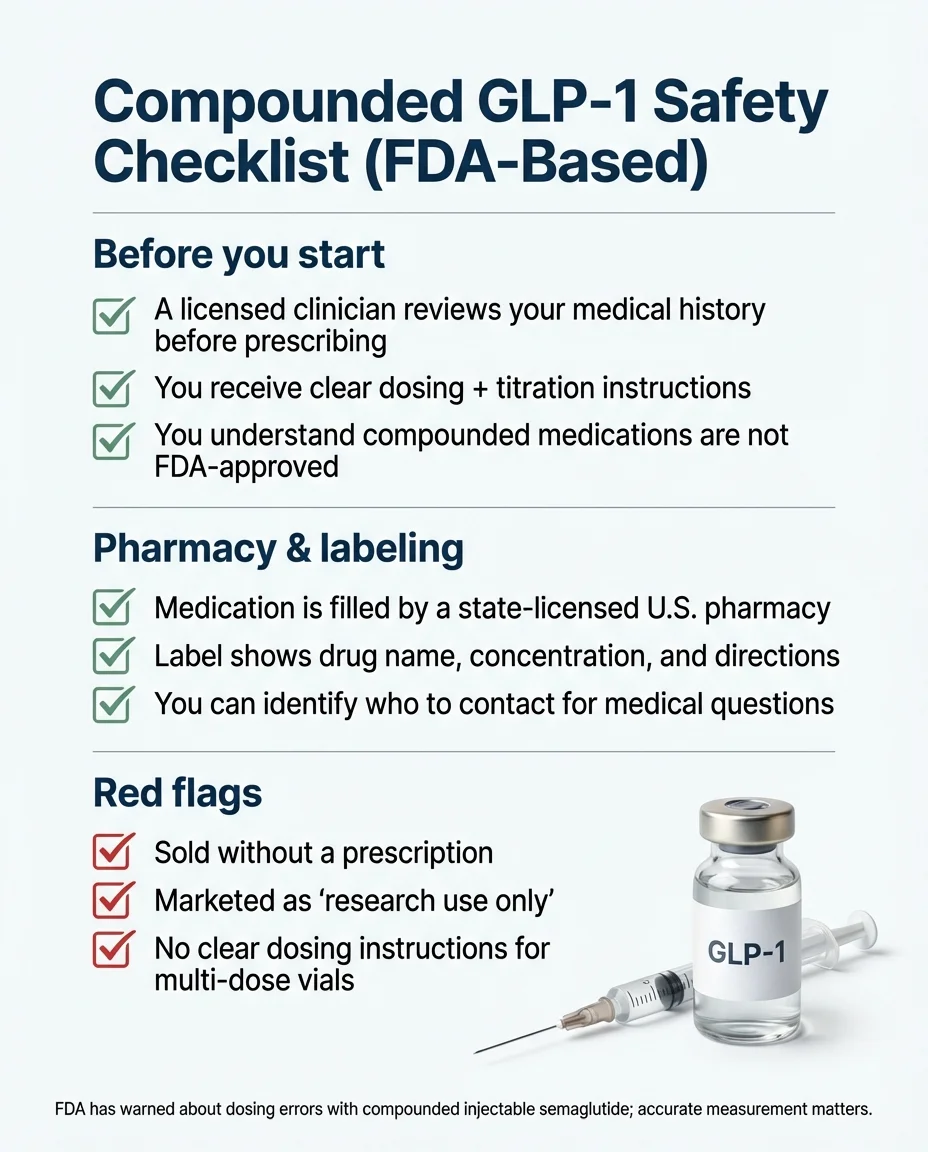
This matters more than most people realize. FDA-approved medications (Wegovy, Zepbound, Ozempic) have been tested in large clinical trials and manufactured under strict FDA oversight. Compounded medications are prepared by specialty pharmacies and have not undergone FDA pre-market review for safety, effectiveness, or quality. Both may be prescribed in lawful circumstances — but they are not equivalent. Any provider who implies they are is misleading you.
Full pricing is visible, including after introductory offers.
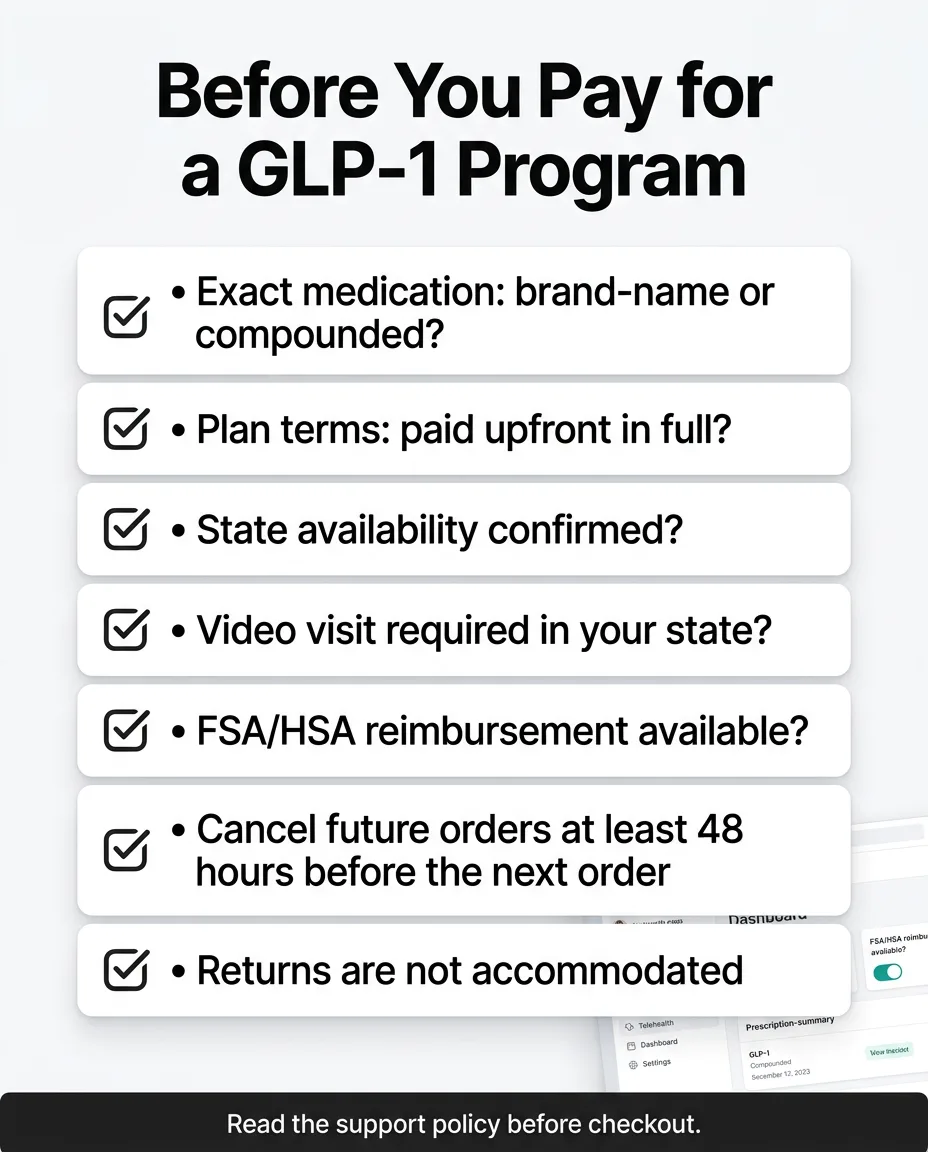
Some platforms advertise $99/month but don't mention the dose-increase pricing, the separate membership fee, or what happens after month three. Look for: program/membership fee + medication cost + what the maintenance dose costs (not just the starter dose).
Follow-up care and side-effect support are included.
GLP-1 treatment isn't a one-time prescription. It involves dose titration (starting low, gradually increasing), side-effect management (nausea is common early on), and ongoing monitoring. If a provider's job ends when they write the script, that's not adequate care.
Cancellation and support are easy to find.
Can you cancel without calling three times? Is there a customer support number or chat? Read the cancellation policy before signing up. If it's buried or vague, factor that into your decision.
Want us to match you to a verified provider?
Our quiz runs you through the key questions — insurance status, budget, medication preference — and gives you a specific recommendation in 60 seconds.
How Does Getting a GLP-1 Online Actually Work?
The process is simpler than most people expect. Here’s what happens, step by step:
You complete an online health assessment (5–15 minutes)
This covers your medical history, current medications, weight, height, allergies, and weight-loss goals. Some platforms do this entirely through a questionnaire. Others include a brief video visit. Either way, this is a medical evaluation — not a signup form.
A licensed clinician reviews your case
A real physician or nurse practitioner reviews everything, checks for contraindications, and decides whether a GLP-1 is medically appropriate for you. Some providers order lab work at this stage — typically a blood panel covering A1C, thyroid function, and metabolic markers. Ro, for example, offers a free lab draw at Quest Diagnostics locations or an at-home blood test kit. Timelines vary by provider. Ro says eligibility can be determined within about 2 days, with a first dose arriving in under a week for cash-pay patients. Insurance paths often take 2–3 weeks.
Your prescription is filled and shipped (3–7 days)
If approved, the clinician writes a prescription. It goes to a licensed pharmacy — either a retail chain or a specialty pharmacy depending on the medication type. Injectable medications ship in temperature-controlled packaging. The Wegovy pill ships like any other prescription. Some medications can also be sent to a local pharmacy for pickup.
Ongoing care — not optional
Good providers don't disappear after the first prescription. You'll have check-ins to adjust dosing, manage side effects, and track progress. GLP-1 treatment involves a titration schedule (starting low and gradually increasing over weeks or months). Skipping follow-ups or jumping doses is how people end up miserable with nausea they didn't need to have. This is one of the most important differentiators between good and mediocre online GLP-1 providers.
That’s it. No office visit. No waiting room. Just a medical process that happens to take place on your phone.
Check your eligibility on Ro — FDA-approved GLP-1s, insurance support includedDo I Qualify for a GLP-1 Prescription?
Qualification depends on BMI, weight-related health conditions, medical history, current medications, and clinician judgment. Here’s the clinical baseline, from FDA-approved labeling:
You may qualify if:
- Your BMI is 30 or higher (the clinical threshold for obesity), OR
- Your BMI is 27–29.9 AND you have at least one weight-related health condition
Common qualifying conditions: high blood pressure, high cholesterol, obstructive sleep apnea, type 2 diabetes, or cardiovascular disease. Final determination is individualized.
Source: FDA AccessData prescribing information
Important safety information:
Do not use GLP-1 medications if you have a personal or family history of medullary thyroid carcinoma (MTC) or Multiple Endocrine Neoplasia syndrome type 2 (MEN2). Tell your clinician if you have had pancreatitis, gallbladder disease, severe GI symptoms, diabetic retinopathy, kidney problems, or if you are pregnant, planning pregnancy, or breastfeeding.
Quick BMI Reference
| Height | BMI 27 Weight | BMI 30 Weight |
|---|---|---|
| 5'2" | 148 lbs | 164 lbs |
| 5'4" | 157 lbs | 175 lbs |
| 5'6" | 167 lbs | 186 lbs |
| 5'8" | 177 lbs | 197 lbs |
| 5'10" | 188 lbs | 209 lbs |
| 6'0" | 199 lbs | 221 lbs |
| 6'2" | 211 lbs | 234 lbs |
If you’re at BMI 27–29.9, you’d need a documented weight-related condition to qualify. Many people have these conditions without realizing it — high blood pressure is notoriously under-diagnosed, and many adults with sleep apnea don’t know they have it.
One thing worth knowing: BMI isn’t the only factor your clinician considers. They’ll also look at your medication history, past weight-loss attempts, overall health picture, and your goals. Two people with the same BMI might get different recommendations. That’s not a rejection; that’s personalized medicine. Most providers don’t charge unless you’re approved for treatment.
Check your eligibility — free, takes about 5 minutesWhat GLP-1 Medications Are Actually Available Online?
The GLP-1 landscape changed dramatically in 2025 and 2026. Here’s what’s actually on the table right now:
FDA-Approved for Weight Loss
| Medication | Form | Active Ingredient | Clinical Trial Weight Loss | Key Note |
|---|---|---|---|---|
| Wegovy (injection) | Weekly injection pen | Semaglutide | ~15% body weight at 68 weeks | FDA-approved for chronic weight management |
| Wegovy (pill) | Daily oral tablet | Semaglutide | ~14% at 64 weeks | Approved Dec 2025 — first GLP-1 pill for weight loss. No needles. |
| Zepbound | Weekly injection pen/vial | Tirzepatide | Up to ~21% body weight at 72 weeks | Dual-action (GLP-1 + GIP). Higher average weight loss. |
| Saxenda | Daily injection | Liraglutide | ~5–8% body weight | Older option. Less weight loss than newer medications. |
Weight-loss percentages are from manufacturer-sponsored clinical trials with structured lifestyle support. Individual results vary. Sources: Wegovy prescribing information, Zepbound.lilly.com, Wegovy pill results
FDA-Approved for Diabetes (Sometimes Prescribed Off-Label for Weight Loss)
| Medication | Form | Notes |
|---|---|---|
| Ozempic | Weekly injection | FDA-approved for type 2 diabetes. May be prescribed off-label for weight loss if a provider deems it appropriate. |
| Mounjaro | Weekly injection | FDA-approved for type 2 diabetes. Contains the same active ingredient as Zepbound. |
Can I Get a GLP-1 Pill Prescription Online?
Yes — and this is one of the biggest recent changes in the GLP-1 space.
The Wegovy pill (oral semaglutide) was FDA-approved in December 2025 and is now available through telehealth platforms including Ro. It’s the first FDA-approved GLP-1 pill specifically for weight loss.
It’s a daily pill — same active ingredient as Wegovy injections (semaglutide). In the OASIS 4 clinical trial, it produced about 14% average weight loss at 64 weeks (source: Wegovy.com results page).
Current pricing through Ro and NovoCare
• Self-pay: Starts at $149/mo for Wegovy tablets at lower doses
• Higher maintenance doses: Up to $299/mo
• With commercial insurance: May pay as little as $25/mo with the Wegovy savings offer
Sources: Wegovy.com pricing, Ro pricing
FDA-Approved vs. Compounded GLP-1s — What You Need to Know
This is where most online guides either confuse people or mislead them. We’re going to be direct.
FDA-Approved Medications
- Rigorous clinical trials with tens of thousands of patients
- Manufactured under strict FDA oversight
- Consistent dosing, quality control, and safety monitoring
- Wegovy, Zepbound, Ozempic, Mounjaro
- May work with insurance or manufacturer savings programs
Compounded Medications
- Not FDA-approved — not reviewed for safety or effectiveness
- Prepared by specialty compounding pharmacies
- Not the same as FDA-approved products
- Typically cost $129–$399/month (more affordable)
- Legal when prescribed through licensed 503A pharmacies
Where things stand in March 2026
The FDA declared the semaglutide injection shortage resolved in February 2025, and the tirzepatide shortage resolved in December 2024 (source: FDA GLP-1 compounder guidance). That narrowed compounding authority significantly:
- • 503B outsourcing facilities were required to wind down semaglutide production by May 2025
- • 503A pharmacies (traditional patient-specific compounding) continue to operate under existing law for valid patient-specific prescriptions
- • Multiple telehealth platforms continue to offer compounded GLP-1s through licensed 503A pharmacies
- • The legal landscape is actively evolving — the Outsourcing Facilities Association has sued the FDA
The FDA has also warned about fraudulent compounded labels, dosing errors, salt forms of semaglutide (not the same as the FDA-approved base form), and products sold “for research purposes” or “not for human consumption.”
The honest admission you need to hear
The fastest cash-pay path online is not always the easiest to verify. Some providers blur the line between brand-name and compounded medication in their marketing. FDA-approved and compounded are different categories with different standards, different oversight, and different risk profiles.
Our position: If your budget allows, FDA-approved is the stronger choice. But we recognize that brand-name GLP-1s cost $300–500+ per month even at discounted cash-pay prices, and that’s genuinely out of reach for many people. We won’t pretend that everyone can afford FDA-approved, and we won’t pretend compounded is the same thing. They serve different needs at different price points.
Can I Get a GLP-1 Prescription Online With Insurance?
Yes — sometimes. But insurance is usually the part that slows things down, not the online visit itself. Some commercial plans cover GLP-1s for weight loss with a reasonable copay. Others exclude weight-loss medications entirely. Some cover GLP-1s only for type 2 diabetes. It depends on your specific plan, which medication, and sometimes which diagnosis code your provider uses. The frustrating truth is that there’s no way to know without checking.
How Ro’s insurance concierge works
Ro says this process typically takes about 2–3 weeks. During that time, you’re not paying for medication — just the membership. If your insurance comes through, your cost could be just a copay. You lose nothing by checking (sources: Ro insurance page, Ro pricing).
Manufacturer savings programs worth knowing about
- Novo Nordisk (Wegovy): Eligible commercially insured patients may pay as little as $25/mo. Self-pay Wegovy tablets start at $149/mo. Self-pay Wegovy pens start at $199/mo for eligible new users on an introductory offer. (source: Wegovy.com)
- Eli Lilly (Zepbound): Self-pay single-dose vials available through LillyDirect at $299–$449/mo depending on dose. (source: LillyDirect)
Medicare coverage is expanding — slowly
CMS has announced the Medicare GLP-1 Bridge, a short-term demonstration running July 1 through December 31, 2026. Eligible beneficiaries can access Wegovy (injection and tablets) and Zepbound through a central prior-authorization process. Participating pharmacies collect a $35–$75 copay depending on the medication.
Eligibility requires (source: CMS.gov Medicare GLP-1 Bridge):
- • BMI ≥35, OR
- • BMI ≥30 plus heart failure with preserved ejection fraction (HFpEF), uncontrolled hypertension, or CKD stage 3a+, OR
- • BMI ≥27 plus pre-diabetes, prior heart attack, prior stroke, or symptomatic peripheral artery disease
This is not universal Medicare coverage — eligibility is narrower than many headlines suggest. But it’s the first real crack in Medicare’s long-standing exclusion of weight-loss medications.
Medicaid: Coverage varies dramatically by state. Some programs cover GLP-1s for diabetes; fewer cover them for weight management. Check your state’s drug formulary.
See if your insurance covers GLP-1s through Ro — free check, no commitmentHow Much Does It Actually Cost?
There are two costs: the program/clinician fee and the medication cost. Some providers bundle them. Others charge separately. Here’s the breakdown:
FDA-Approved Paths (Verified March 2026)
| Path | Program Fee | Medication Cost | Total Monthly | Best For |
|---|---|---|---|---|
| Ro + insurance | $149/mo (after $39 first month) | Your plan's copay (varies) | $149 + copay | Anyone with commercial insurance |
| Ro + Wegovy pill (cash) | $149/mo | Starts at $149/mo (dose-dependent, up to $299) | $294–$444/mo | No insurance, want FDA-approved, no needles |
| Ro + Zepbound vials (cash) | $149/mo | $299–$449/mo (dose-dependent) | $444–$594/mo | No insurance, want tirzepatide |
| Ro + Wegovy pen (cash) | $149/mo | $199/mo intro for starting doses, then $349/mo | $344–$494/mo | Starting brand semaglutide injection |
Ro pricing source: ro.co/weight-loss/pricing/. Medication prices reflect manufacturer programs through NovoCare and LillyDirect. Intro offers have expiration dates — verify current terms.
Compounded Paths (Provider-Stated Pricing, March 2026)
| Provider | Stated Monthly Cost | Medication | Notes |
|---|---|---|---|
| MEDVi | ~$179–$299/mo (provider-stated, all-in) | Compounded semaglutide or tirzepatide | Provider states pricing stays flat with dose increases. Visits, medication, shipping stated as included. |
| Eden | Flat monthly (provider-stated) | Compounded semaglutide | Provider states coaching, messaging, and shipping included. |
| TrimRX | $199/mo+ (provider-stated) | Compounded semaglutide or tirzepatide | Straightforward process. |
| Willow | $149–$299/mo range (provider-stated) | Compounded semaglutide | Competitive entry pricing. |
| Yucca Health | Varies (provider-stated) | Compounded semaglutide | Personalized telehealth approach. |
Compounded pricing sourced from provider websites. These are provider-stated figures — we have not independently audited internal billing. Compounded medications are not FDA-approved. Verify current pricing before committing.
Three things most pricing pages don’t tell you
The starter dose is always cheapest.
Many providers advertise their lowest dose price in their marketing. Ask what the maintenance dose costs — that's what you'll pay for most of your treatment. The difference can be significant: a provider advertising "$149/month" may cost $299+ at your maintenance dose. Always ask: "What will this cost at my full dose?"
Brand-name list prices are misleading.
Wegovy's list price is $1,349/month. Almost nobody pays that. Between manufacturer savings programs, NovoCare, LillyDirect, and insurance, the real cost is dramatically lower for most people. If you see a comparison that uses list prices, it's painting an inaccurate picture.
Some compounded "all-in" pricing still increases.
Some providers say their pricing is "all-in" but charge more at higher doses. Others genuinely lock in your rate. MEDVi states that pricing stays flat as you titrate — verify current terms at checkout. Eden also advertises flat-rate pricing regardless of dose.
Choose Your Path: The Right Next Step for Your Situation
Here’s where we stop giving you information and start giving you direction.
“I want FDA-approved medication and help with insurance”
Your best next step: Ro
Ro offers FDA-approved options including Wegovy (injectable and pill), Zepbound, and Ozempic when clinically appropriate. What makes them stand out is what happens after the prescription. Their insurance concierge contacts your insurer directly, submits prior authorization, and finds the lowest available price whether you’re covered or not.
Here’s what the Ro Body Program includes:
- Monthly provider check-ins to adjust dosing
- Unlimited messaging with your care team
- Side-effect management from GLP-1 specialists
- Nutrition, exercise, and coaching curriculum
- Insurance concierge at no extra charge
- LegitScript certification
Membership: $39 first month, then $149/mo. Medication is separate.
• Wegovy pill: Starting at $149/mo (lower doses), up to $299/mo
• Wegovy pen: $199/mo intro for starting doses, then $349/mo
• Zepbound vials: $299–$449/mo depending on dose
• With insurance: you pay your plan’s copay instead
If the membership fee gives you pause, consider this: if your insurance covers GLP-1s, the concierge could save you hundreds per month. Many people are covered and don’t know it because they’ve never had someone navigate the prior authorization process on their behalf. That $149/mo pays for itself the first time your medication cost drops from $350 to a $25 copay.
“I’m not fighting against my own body anymore. It’s been consistent, real results.” — Ro member (source: Ro.co; member was compensated for this testimonial)
“I need the most affordable option and I don’t have insurance”
Your best next step: MEDVi
MEDVi specializes in making GLP-1 treatment accessible at a price point that works without insurance. Their stated monthly pricing is flat — the provider says it includes medication, consultations, and shipping, and that it doesn’t increase when your dose goes up. That flat-pricing structure matters more than it sounds. Monthly costs typically range from $179–$299 depending on the medication and plan (provider-stated).
What the MEDVi experience looks like:
- Complete an online health assessment
- Get matched with a licensed provider who reviews your case
- If approved, your medication is prescribed and shipped to you
- Regular check-ins with your provider to adjust dosing and monitor progress
- Messaging support for questions between visits
“Lost 16 lbs in 10 weeks — no side effects. Down two sizes. I wish I’d started sooner.”
— Verified MEDVi patient on ConsumerAffairs ★★★★★
“I’m not sure what I need yet”
Take the free 60-second GLP-1 path quiz — no email required, no commitment, just clarity.
Take the free 60-second quiz“I want to compare everything side by side”
What to Expect After You Start
You’ve been prescribed. The package arrived. Here’s what the first few months typically look like — because the gap between “I signed up” and “this is working” is where most anxiety lives, and where most other guides leave you hanging.
The adjustment period
You start at the lowest dose. Most people notice reduced appetite within the first few days — sometimes even the first day. The most common side effects are gastrointestinal: nausea, constipation, diarrhea, and abdominal discomfort. These are listed in the FDA-approved labeling for all GLP-1 medications, and they're the primary reason your provider starts you at a low dose and increases gradually. For most people, early nausea is mild — more "I'm not that hungry" than "I feel terrible." Practical tips: eat smaller meals, cut back on greasy or heavy foods temporarily, stay well-hydrated, and don't lie down immediately after eating.
Appetite shifts become more noticeable
Portions naturally get smaller. Many people describe reduced cravings, especially for high-calorie, high-sugar foods. Some describe this as the "food noise" quieting down — that constant background hum of thinking about what to eat, fighting cravings, and negotiating with yourself around food starts to fade. Early side effects typically begin to improve at this stage as your body adjusts.
Dose increases and real momentum
Your provider titrates your dose upward according to a set schedule. This is standard for all GLP-1 medications — Wegovy typically involves a 16–20 week escalation, while Zepbound follows a similar gradual approach. Each increase brings more appetite suppression and, usually, more consistent weight loss. This is also when the medication starts to feel like it's working with you rather than something new you're adjusting to.
Results become visible
Significant weight loss accumulates during this period. For a 200-pound person, even a 10% loss is 20 pounds — enough that clothing fits differently, energy levels improve, and people around you start asking questions. This is also where health markers often begin to shift. Blood pressure, cholesterol, and blood sugar numbers frequently improve alongside weight loss — one reason GLP-1s are increasingly recognized not just as weight-loss medications but as metabolic health tools.
Peak clinical results
| Wegovy injection | ~15% body weight loss at 68 weeks |
| Wegovy pill | ~14% at 64 weeks |
| Zepbound | Up to ~21% at 72 weeks in adults without diabetes |
These are averages from trials with structured lifestyle support. Individual results vary. For a 250-pound person, 15–20% loss is 37–50 pounds — a transformation in how you feel, how you move, and often in how many medications you need for other conditions.
On Side Effects — The Complete Picture
The most common side effects across all GLP-1 medications are gastrointestinal: nausea, vomiting, diarrhea, constipation, and abdominal pain. These are generally mild to moderate and improve over time with dose titration. The prescribing information for both Wegovy and Zepbound lists these prominently.
Less common but worth knowing about: headache, fatigue, dizziness, and injection-site reactions (for injectable forms). Most of these resolve on their own.
Rare but serious — seek medical attention for:
- Severe or persistent abdominal pain (could indicate pancreatitis or gallbladder problems)
- Signs of allergic reaction
- Changes in vision (especially for people with diabetes)
- Signs of kidney problems
The prescribing information also includes a boxed warning about thyroid C-cell tumors observed in animal studies — this is why GLP-1s are contraindicated for people with a personal or family history of medullary thyroid carcinoma or MEN2. Your provider should review all warnings with you. The titration schedule exists specifically to minimize side effects. Rushing through doses is the single biggest controllable reason people have a rough time early on.
On Weight Regain — The Question Everyone’s Thinking
We won’t sugarcoat this: research shows some weight regain is common after stopping GLP-1 medications. This is consistent across multiple studies and is one of the most important things to understand before starting treatment.
This is why obesity medicine specialists increasingly view these as long-term treatments for a chronic condition — similar to blood pressure or cholesterol medication. You wouldn’t stop blood pressure medication because your numbers improved and then be surprised when they went back up. The same logic applies here.
That said, people who use the treatment window to build better eating habits, increase physical activity, and engage with coaching or support tend to maintain more of their results long-term. That’s one reason we favor providers who include lifestyle support alongside the prescription — Ro’s Body Program, for example, pairs medication with nutrition, exercise, and coaching specifically for this reason.
When Getting GLP-1s Online Might Not Be Your Best Option
We’d lose credibility if we told you this is the right path for everyone. It’s not. And the fact that we’re willing to say “this might not be for you” is exactly why you should trust us when we say it is.
Consider seeing your doctor in person if:
You already have a physician who knows your history and is willing to prescribe GLP-1s.
Continuity of care matters, especially with complex health situations. A doctor who's managed your health for years has context that a telehealth intake form can't fully capture. If your PCP is open to prescribing and your insurance works through their office, that may be your best and simplest path.
Your insurance covers GLP-1s at a low copay through your existing network.
If your PCP can write the prescription and your plan covers it at a $25–50 copay through your local pharmacy, going through telehealth might actually cost more once you factor in membership fees. Check with your doctor's office first — a five-minute phone call could save you months of research.
You have a medical history that requires closer monitoring.
Multiple interacting medications, kidney function concerns, complicated diabetes management, unresolved thyroid issues, or a history of eating disorders — these situations benefit from in-person clinical relationships.
Something about an online provider doesn't feel right.
Run them through the 7 Safety Checks above. If they don't pass, walk away. There are plenty of legitimate options — no reason to gamble on one that raises flags.
You prefer in-person medical relationships.
Some people simply feel more comfortable sitting across from a doctor. That's valid. Telehealth is convenient, but convenience isn't the only factor in a medical decision.
One more thing: if you start with an online provider and the experience doesn’t meet your expectations, you can switch. Your prescription and medical records can transfer to a local doctor, a different telehealth platform, or back to your PCP. You’re never locked in to a single provider. And if you go the telehealth route, tell your regular doctor — good care is coordinated care.
Why Trust This Guide
We’re the Weight Loss Provider Guide research team. We independently research, compare, and verify online GLP-1 providers.
What we verify
- Active medical licensing and pharmacy credentials for providers we recommend
- Pricing accuracy against provider websites (last verified March 2026)
- FDA regulatory status of medications offered
- Cancellation policies and support accessibility
What we source from
- FDA.gov — prescribing information, BeSafeRx, drug shortage database
- HHS telehealth.hhs.gov — licensure and cross-state prescribing rules
- CMS.gov — Medicare GLP-1 Bridge demonstration details
- STEP trials (semaglutide), SURMOUNT trials (tirzepatide), OASIS trials (oral semaglutide)
- Manufacturer websites: Wegovy.com, Zepbound.lilly.com, Ro.co, LillyDirect, NovoCare
Our affiliate relationship, stated plainly
Some links on this page earn us a commission when you sign up with a provider. This never changes our recommendations. We recommend Ro as our top choice for FDA-approved GLP-1s because they passed all 7 safety checks and offer the strongest combination of clinical care, insurance support, and pricing — not because of the commission structure. We recommend MEDVi as our top compounded choice because of their transparent flat-pricing model and licensed pharmacy network. If we removed every affiliate link from this page, the information and recommendations would be identical. We update this guide when pricing changes, new medications launch, or the regulatory landscape shifts. Last full review: March 2026.
Frequently Asked Questions
Your Next Step
You came here with a question: can I get a GLP-1 prescription online?
The answer is yes — through the right clinical and pharmacy pathway. The best chance of a good experience starts with a legitimate provider, clear expectations, and follow-up care that continues after the first prescription.
The people who have the best experience with GLP-1s are the ones who start with a verified provider, follow the titration schedule, stay in contact with their care team, and give it time to work. The medication can do its part. But it only helps if you start.
Here’s the fastest path forward:
Insurance support + FDA-approved medications:
Check your eligibility on RoMost affordable compounded option:
See current MEDVi pricingNot sure yet:
Take the free 60-second path quizStill not sure which GLP-1 program is right for you?
Take our free 60-second matching quiz — the fastest way to cut through the noise and get a specific recommendation based on your insurance, budget, and goals.
Get my personalized GLP-1 matchRelated Guides
Medical disclaimer: This guide is for informational purposes only and does not constitute medical advice. Always consult with a licensed healthcare provider before starting any medication. GLP-1 medications require a valid prescription from a licensed clinician. Compounded medications are not FDA-approved.
This guide is independently researched and regularly updated by the Weight Loss Provider Guide team. Last updated March 25, 2026.