Are GLP-1 Pills Safe? What's Actually Safe, What's Risky, and Who Should Avoid Them
By the Weight Loss Provider Guide Research Team · Last verified: April 20, 2026
Last updated: April 20, 2026. Next scheduled verification: May 20, 2026.
Reviewed against current U.S. prescribing information and FDA safety pages. Weight Loss Provider Guide is an independent comparison resource. We earn commissions on some provider links elsewhere on this site — that does not affect this page's editorial judgment. Disclosure →
Are GLP-1 pills safe? Short answer: some are, some aren't, and a lot of what's sold online as a "GLP-1 pill" isn't really one. As of April 2026, four oral GLP-1 medications are FDA-approved in the U.S. — Rybelsus, Ozempic tablets, the Wegovy tablet, and Foundayo. Used in the right person with the right clinician, these have documented safety profiles from large Phase 3 trials. Used in the wrong person — or sourced from a place the FDA hasn't reviewed — the picture looks very different.
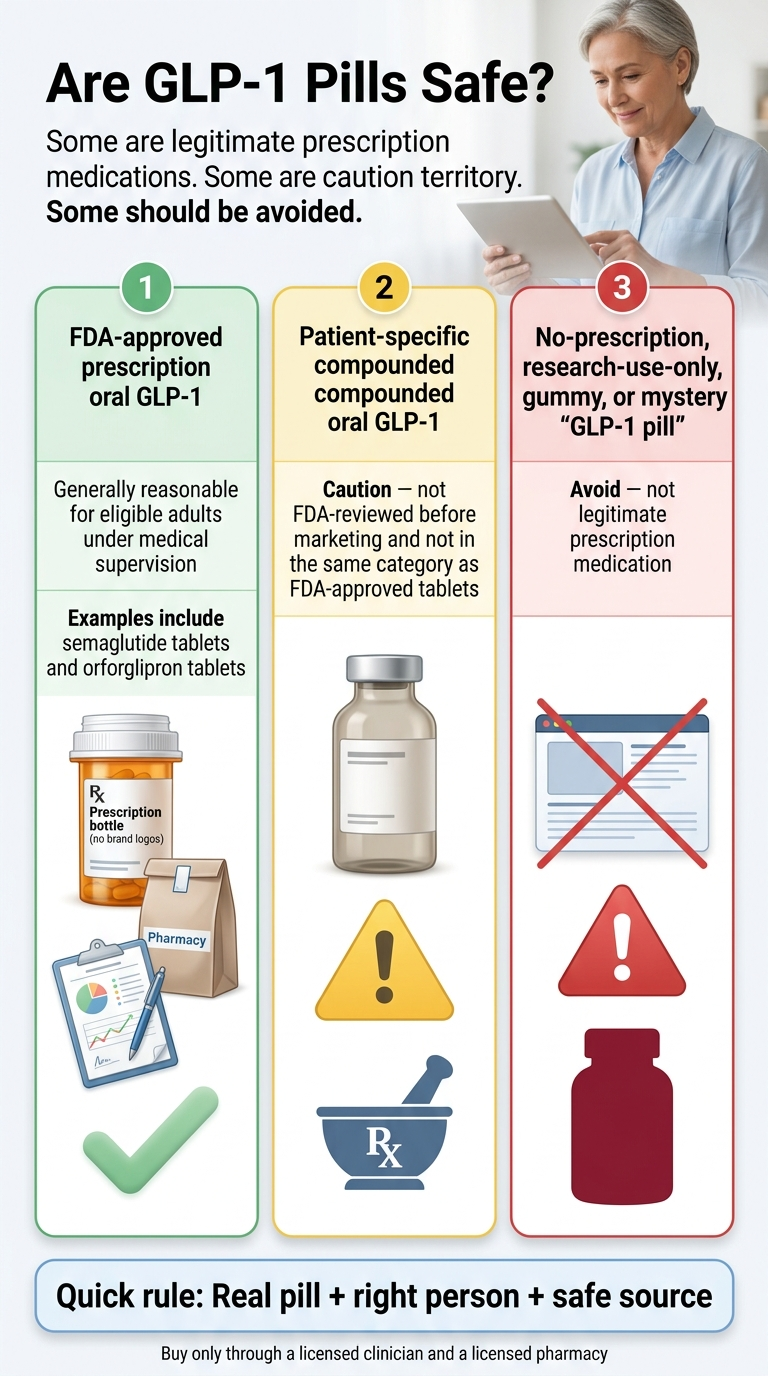
"GLP-1 pills" now covers at least three completely different categories, and lumping them together is how people get hurt or ripped off. This page separates them clearly and hands you a safety screen.
| What you're looking at | Safety verdict |
|---|---|
| FDA-approved prescription oral GLP-1 from a licensed clinician and pharmacy (Rybelsus, Ozempic tablets, Wegovy tablet, Foundayo) | Generally reasonable for eligible adults — under medical supervision |
| Patient-specific 503A compounded oral GLP-1 (tablets, drops, troches) | Caution — not FDA-reviewed, narrow lawful use, unknown bioavailability |
| No-prescription, "research use only," gummy, or drop "GLP-1 pills" | Avoid — not legitimate prescription medication |
Best for FDA-approved oral GLP-1s: adults with obesity, overweight-with-comorbidity, or type 2 diabetes who want a needle-free option and can work with a clinician on dosing, labs, and follow-up.
Not for: anyone with a personal or family history of medullary thyroid carcinoma (MTC) or Multiple Endocrine Neoplasia type 2 (MEN 2), anyone with a serious hypersensitivity to the active ingredient, anyone pregnant or breastfeeding, anyone with severe gastroparesis, or anyone shopping a no-prescription "GLP-1 pill."
1. Which "GLP-1 pills" are actually FDA-approved right now?
Rybelsus (oral semaglutide, 3 / 7 / 14 mg)
Approved in 2019. First oral GLP-1 ever approved by the FDA. Indicated for type 2 diabetes — and, more recently, to reduce the risk of major adverse cardiovascular events in adults with type 2 diabetes at elevated risk. Weight loss happens on Rybelsus, but it's off-label at these doses and usually smaller than on the higher-dose weight-loss drugs.
Ozempic tablets (oral semaglutide, 1.5 / 4 / 9 mg)
Approved February 4, 2026. Same active ingredient as Rybelsus (semaglutide), same SNAC absorption technology, but a new bioequivalent formulation with enhanced bioavailability. Indicated for type 2 diabetes and cardiovascular risk reduction. Full U.S. launch is expected Q2 2026, so retail pharmacy availability may be limited in the near term.
Wegovy tablet (oral semaglutide, 1.5 / 4 / 9 / 25 mg maintenance)
Approved December 2025, launched January 2026. First oral GLP-1 approved specifically for chronic weight management. Titrates over 90 days: 1.5 mg (days 1–30), 4 mg (days 31–60), 9 mg (days 61–90), then 25 mg from day 91 onward. In the OASIS-4 trial, adults lost an average of 13.6% of body weight over 64 weeks on 25 mg versus 2.2% on placebo. Must be taken on an empty stomach with no more than 4 oz of water, and you must wait 30 minutes before eating, drinking, or taking other oral medications.
Foundayo (orforglipron)
Approved April 2026. Fundamentally different: Foundayo is a non-peptide small molecule — not a version of semaglutide. That matters for how it's taken: unlike semaglutide tablets, Foundayo can be swallowed any time of day, with or without food or water. In the ATTAIN-1 trial, adults at the highest dose lost a mean of about 12.4% of body weight over 72 weeks versus about 0.9% on placebo.
What does NOT count as an FDA-approved GLP-1 pill
- Sublingual semaglutide drops
- Orally disintegrating tablets (ODTs) compounded with semaglutide or tirzepatide
- "Research use only" peptides
- Anything labeled "GLP-1 activating" supplement
- GLP-1 gummies
- Any tablet sold without a prescription
None of those have been reviewed by the FDA for safety, effectiveness, or quality before marketing. Section 8 goes deeper on that.
Oral GLP-1 Safety Verification Matrix (April 20, 2026)
| Product category | Examples | FDA-approved? | Legal to sell in U.S.? |
|---|---|---|---|
| FDA-approved oral GLP-1 | Rybelsus; Ozempic tablets; Wegovy tablet; Foundayo | Yes | Yes, with prescription |
| Patient-specific 503A compounded oral GLP-1 | Custom-compounded semaglutide or tirzepatide tablets/capsules from a state-licensed compounding pharmacy with an individualized prescription | No | Only in narrow, patient-specific cases since FDA shortage status ended in 2025 |
| Unregulated or non-studied oral products | Sublingual drops; ODTs; nasal sprays; "research peptides"; semaglutide sodium/acetate salt forms; GLP-1 gummies; retatrutide or cagrilintide products | No | Generally no — not lawful for human use without a prescription and FDA oversight |
Sources: current U.S. prescribing information for Rybelsus, Ozempic tablets, and Wegovy tablet (accessdata.fda.gov); Lilly ACHIEVE-1 and ATTAIN-1 press releases; Novo Nordisk OASIS-4 announcement (Dec 22, 2025); FDA, FDA's Concerns with Unapproved GLP-1 Drugs Used for Weight Loss.
2. So, are GLP-1 pills safe? Here's what "safe" actually depends on
We call this the Real Pill, Right Person, Safe Source framework. Most "is this safe?" questions collapse into one of those three buckets.
Real pill
Is this one of the four FDA-approved oral GLP-1s, or is it something else? If a website says "same as Wegovy" about a compounded product, that claim is specifically something the FDA has flagged as false or misleading in warning letters. Real oral GLP-1s are Rybelsus, Ozempic tablets, the Wegovy tablet, or Foundayo. Full stop.
Right person
Do you have a condition that takes GLP-1s off the table? Section 3 walks through the real list. Some are true contraindications in the product labels. Others aren't hard stops but change the conversation with your clinician in meaningful ways.
Safe source
A licensed prescriber in your state, a licensed pharmacy, a real prescription. Not "research use only." Not "no prescription needed." Not a telehealth site that approves you in 30 seconds with no human review. Section 9 covers the red flags.
Not sure if an oral GLP-1 fits your situation?
Compare Rybelsus, Ozempic tablets, the Wegovy tablet, and Foundayo side by side — pricing, telehealth availability, and clinician-review model.
Compare FDA-approved oral GLP-1 providers →3. Who should not take GLP-1 pills
Formal contraindications — do not take an FDA-approved oral GLP-1
- Personal or family history of medullary thyroid carcinoma (MTC). All four FDA-approved oral GLP-1s carry a boxed warning for thyroid C-cell tumors based on rodent studies. Whether GLP-1s cause MTC in humans has not been established — but they are contraindicated in people with this history.
- Multiple Endocrine Neoplasia type 2 (MEN 2). Same reason.
- Prior serious hypersensitivity (e.g., anaphylaxis, angioedema) to the active ingredient — semaglutide for Rybelsus, Ozempic tablets, and the Wegovy tablet; orforglipron for Foundayo.
Strong reasons to avoid or to involve a specialist first
- Pregnancy or active plans to become pregnant. For semaglutide tablets, the labeling advises stopping at least 2 months before a planned pregnancy because of semaglutide's long half-life. Foundayo's label uses different language — this is a specific conversation with your clinician.
- Breastfeeding. Current labels for both semaglutide tablets and Foundayo recommend against use while breastfeeding.
- Severe gastroparesis or severe persistent GI disease. GLP-1s slow gastric emptying by design.
- History of pancreatitis. Acute pancreatitis is a rare but serious reported event with GLP-1 therapy.
- Severe gallbladder disease or recurrent gallstones. Rapid weight loss of any kind raises gallstone risk.
- Diabetic retinopathy. Rapid improvement in blood sugar can temporarily worsen retinopathy. Ophthalmology input matters here.
- Severe kidney disease. Dehydration from GI side effects is the main risk; kidney function should be monitored.
- Current use of insulin or a sulfonylurea for type 2 diabetes. Your other diabetes medications may need to be adjusted to avoid hypoglycemia.
- Currently taking another GLP-1 (Ozempic injection, Wegovy injection, Mounjaro, Zepbound, Rybelsus, Saxenda). You should not be on two GLP-1s at the same time.
- Oral hormonal contraception as your only birth control method — specific to Foundayo. See section 10.
- Scheduled surgery or anesthesia. Tell your surgical team and anesthesiologist you're on a GLP-1.
For the fuller list of precautions, see our full GLP-1 contraindications guide.
Quick-reference contraindications table
| Situation | Verdict |
|---|---|
| Personal or family history of MTC | Formal contraindication |
| Multiple Endocrine Neoplasia type 2 (MEN 2) | Formal contraindication |
| Prior serious hypersensitivity to semaglutide or orforglipron | Formal contraindication |
| Pregnancy or active plans to become pregnant | Avoid — clinician-led discussion on timing |
| Breastfeeding | Avoid per current labels |
| Severe gastroparesis | Strong reason to reconsider or consult a specialist |
| History of pancreatitis | Talk to a clinician first |
| Severe gallbladder disease or recurrent gallstones | Talk to a clinician first |
| Diabetic retinopathy history | Talk to a clinician first |
| Severe kidney disease | Talk to a clinician first |
| On insulin or sulfonylurea for T2D | Talk to a clinician first — dose adjustment likely |
| Currently on another GLP-1 | Do not combine — one GLP-1 at a time |
| Oral contraception as sole method (Foundayo) | Use backup method during titration |
| Scheduled surgery or anesthesia | Inform surgical team; follow their hold/fasting guidance |
The 30-second Oral GLP-1 Safety Screen
A quick way to see whether a GLP-1 pill is likely a green, yellow, or red conversation with your clinician.
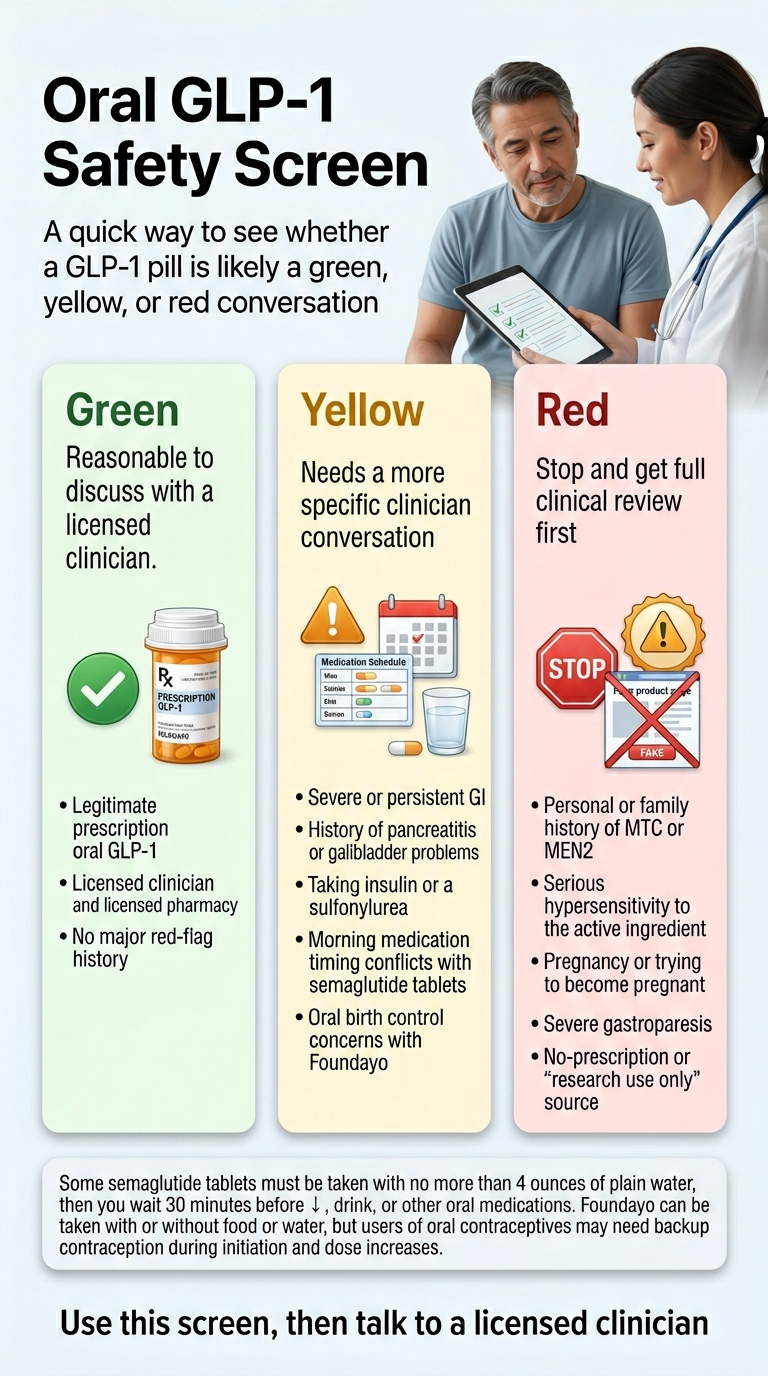
🟢 Green — Reasonable to discuss
- Legitimate prescription oral GLP-1
- Licensed clinician and licensed pharmacy
- No major red-flag history
🟡 Yellow — Specific clinician conversation needed
- Severe or persistent GI issues
- History of pancreatitis or gallbladder problems
- Taking insulin or a sulfonylurea
- Morning med-timing conflicts
- Oral birth control (Foundayo)
🔴 Red — Stop and get full clinical review first
- Personal/family history of MTC or MEN 2
- Serious hypersensitivity to active ingredient
- Pregnancy or trying to conceive
- Severe gastroparesis
- No-prescription or "research use only" source
Some semaglutide tablets must be taken with no more than 4 oz of plain water, then wait 30 minutes before eating or taking other medications. Foundayo can be taken with or without food or water, but users of oral contraceptives may need backup contraception during initiation and dose increases.
Want a personalized take on your situation?
Compare FDA-approved oral GLP-1 providers — pricing, telehealth model, and which medication each platform offers.
Compare oral GLP-1 options →4. Common side effects vs. the ones that mean "call someone now"
Trial-level side effects: Foundayo (orforglipron) — ACHIEVE-1
| Side effect | Orforglipron 36 mg | Placebo |
|---|---|---|
| Diarrhea | 26% | 9% |
| Nausea | 16% | 2% |
| Dyspepsia (indigestion) | 15% | 7% |
| Constipation | 14% | 4% |
| Vomiting | 14% | 1% |
| Discontinuation due to adverse event | 8% | 1% |
No hepatic safety signal was observed in ACHIEVE-1. Mild pancreatitis cases have been reported across the orforglipron Phase 3 program; the FDA has required postmarketing studies on pancreatitis. Source: Lilly, investor.lilly.com.
Trial-level side effects: Wegovy tablet (oral semaglutide 25 mg) — OASIS-4
- About 74% of participants on oral semaglutide 25 mg experienced any gastrointestinal adverse event, versus about 42% on placebo.
- Most commonly reported: nausea, vomiting, diarrhea, constipation, and abdominal pain.
- Most were mild to moderate. Mean weight loss was 13.6% at 64 weeks vs. 2.2% on placebo.
Trial-level side effects: Rybelsus and Ozempic tablets
- Severe GI reactions: approximately 0.6% to 2.0% of participants depending on dose.
- GI-related discontinuation: approximately 4% to 8% of participants depending on dose.
- Most common: nausea, vomiting, diarrhea, abdominal pain, constipation, decreased appetite.
Less common but serious — know these
- Acute pancreatitis. Severe, persistent abdominal pain that may radiate to the back, often with nausea and vomiting that don't improve. Stop the medication and seek emergency care.
- Gallbladder disease / gallstones. More common during rapid weight loss of any kind.
- Severe dehydration and acute kidney injury. Usually from prolonged GI side effects. Call your clinician if you can't keep fluids down.
- Hypoglycemia. Mostly in people combining a GLP-1 with insulin or a sulfonylurea. Keep a fast-acting sugar source accessible early in treatment.
- Severe hypersensitivity (anaphylaxis, angioedema). Rare. Stop the medication and seek emergency care for swelling of the face/throat, trouble breathing, or a severe rash.
- Pulmonary aspiration under anesthesia. GLP-1s delay gastric emptying. Tell your surgical team if you're on one.
Expected vs. urgent: quick guide
| Symptom | Usually expected | Call your clinician | Seek emergency care |
|---|---|---|---|
| Mild nausea, especially after dose increase | ✓ | ||
| Loose stools or constipation | ✓ | ||
| Decreased appetite, early fullness | ✓ | ||
| Fatigue, mild headache | ✓ | ||
| Persistent vomiting, can't keep fluids down | ✓ | ||
| Mild abdominal pain that doesn't resolve | ✓ | ||
| Lump or swelling in neck, hoarseness | ✓ | ||
| Severe, persistent abdominal pain radiating to the back | ✓ | ||
| Swelling of face, lips, tongue, or throat | ✓ | ||
| Difficulty breathing | ✓ | ||
| Severe hypoglycemia (confusion, loss of consciousness) | ✓ |
5. Real-world side effects that aren't fully captured in trials
What the Reddit analysis found
Across those 67,008 users, about 43.5% described at least one side effect. Well-known GI effects showed up as expected — nausea (36.9%), vomiting (16.3%), constipation (15.3%), diarrhea (12.6%). What was more interesting was what trials don't highlight:
- Menstrual cycle changes — intermenstrual bleeding, heavy bleeding, irregular cycles.
- Temperature-related symptoms — chills, hot flashes, feeling unusually cold.
- Fatigue — the second most commonly reported symptom overall in the dataset.
- Psychiatric symptoms — about 13% of users who reported any side effect mentioned anxiety, depression, or insomnia.
The honest framing
The researchers were clear these findings cannot prove GLP-1 medications caused these symptoms. Reddit users are not a representative sample: they skew younger, more male, more U.S.-based, and people who had a good experience are less likely to post. These are signals worth watching in formal surveillance and future prospective studies.
If you're on a GLP-1 and you notice menstrual changes, persistent fatigue, unusual temperature sensitivity, or mood shifts, bring it up with your clinician. These aren't in the primary label prominently, but they're being taken seriously.
Source: Sehgal et al., Nature Health, April 2026 (summarized in Medscape, April 16, 2026).
6. Are GLP-1 pills safer than injections?
Where pills actually are easier
- No needles. If needle anxiety is your main barrier, this is a legitimate reason to choose a pill.
- No sharps disposal. Travel and storage are simpler.
- Foundayo specifically — no timing rule at all. Any time of day, with or without food or water.
Where pills are actually harder
- Semaglutide tablets require empty-stomach dosing. Up to 4 oz of water, then wait at least 30 minutes before eating, drinking, or taking other oral medications.
- That 30-minute window conflicts with other morning meds. Levothyroxine, omeprazole, and other empty-stomach medications all want that same window.
- Semaglutide tablets can affect how other oral medications are absorbed. The current label describes a roughly 33% increase in levothyroxine exposure when co-administered.
- GI discontinuation can be higher with orals. In ACHIEVE-1, 8% of people on Foundayo 36 mg discontinued due to adverse events versus 1% on placebo.
The efficacy gap — because "safe" and "effective" are related questions
| Medication | Mean weight loss | Trial / timeframe |
|---|---|---|
| Wegovy tablet 25 mg (oral) | ~13.6% | OASIS-4, 64 weeks |
| Foundayo 17.2 mg (oral) | ~12.4% | ATTAIN-1, 72 weeks (completers) |
| Injectable Wegovy 2.4 mg weekly | ~15% | STEP 1, comparable timeframe |
| Injectable Zepbound (tirzepatide) | 20%+ | SURMOUNT Phase 3 |
A better question to ask yourself
Not "are pills safer than shots?" Ask: which routine is safer for my life and my medications? If you take levothyroxine every morning, semaglutide tablets stack awkwardly on top of that. Foundayo doesn't. If you're fine with injections and want the highest likelihood of double-digit weight loss, a weekly shot still leads. If you hate injections and your mornings are reasonably consistent, an oral GLP-1 is a legitimate, supervised route.
7. Wegovy tablet vs. Foundayo vs. Rybelsus vs. Ozempic tablets: which safety tradeoff fits you?
| Feature | Rybelsus | Ozempic tablets | Wegovy tablet | Foundayo |
|---|---|---|---|---|
| Active ingredient | Semaglutide | Semaglutide (bioequivalent, enhanced bioavailability) | Semaglutide | Orforglipron (non-peptide small molecule) |
| Manufacturer | Novo Nordisk | Novo Nordisk | Novo Nordisk | Eli Lilly |
| FDA-approved for | Type 2 diabetes (2019); MACE reduction | Type 2 diabetes (Feb 2026); MACE reduction | Weight management + MACE reduction (Dec 2025) | Weight management (Apr 2026) |
| Doses | 3 / 7 / 14 mg | 1.5 / 4 / 9 mg | 1.5 / 4 / 9 / 25 mg | 0.8 → 17.2 mg (6-step titration) |
| Timing rule | Empty stomach, morning, ≤4 oz water, 30-min wait | Same as Rybelsus | Same as Rybelsus; titrate to 25 mg over 90 days | None — any time, with or without food or water |
| Headline efficacy | Weight loss off-label; smaller than 25 mg dose | Weight loss off-label; similar to Rybelsus | ~13.6% at 64 weeks (OASIS-4) | ~12.4% at 72 weeks (ATTAIN-1, 17.2 mg) |
| Availability | Available since 2019 | FDA-approved Feb 2026; U.S. launch Q2 2026 | Launched January 2026 | LillyDirect April 2026; broader retail expected after |
| Boxed warning | Thyroid C-cell tumors | Thyroid C-cell tumors | Thyroid C-cell tumors | Thyroid C-cell tumors |
| Key interaction to know | ~33% increase in levothyroxine exposure | Same as Rybelsus | Same as Rybelsus, plus 30-min window conflicts | Can reduce oral contraceptive effectiveness during titration |
Who each one fits best
Wegovy tablet fits best if…
- You have obesity or overweight-with-comorbidity (weight-loss indication)
- You want the most established semaglutide safety base
- You don't take other empty-stomach morning medications
- You're willing to build a reliable morning dosing habit
Foundayo fits best if…
- Dosing flexibility is non-negotiable — chaotic mornings, multiple meds, heavy travel
- You don't rely on oral contraception as your sole birth control, or can use a backup
- You have a weight-loss goal (not primarily a diabetes diagnosis)
- You want to avoid the 30-minute morning fasting window
Rybelsus or Ozempic tablets fit best if…
- Your primary goal is type 2 diabetes management or cardiovascular risk reduction
- Weight loss is a secondary benefit, not the primary goal
- Rybelsus is already available; Ozempic tablets launch Q2 2026
Something is off if…
- Your reason for choosing between these four pills is purely "which is cheapest online"
- Price is real, but the safety question doesn't come down to a $20/month swing
- It comes down to your history, your other meds, and which routine you'll actually maintain
8. Are compounded oral GLP-1s, drops, or "GLP-1 gummies" safe?
What the FDA has actually said
- Compounded drugs do not go through FDA's review for safety, effectiveness, or quality before they're marketed.
- Some products sold as "semaglutide" are actually salt forms — semaglutide sodium or semaglutide acetate — which are chemically different from the active ingredient in FDA-approved drugs and have not been shown to be safe and effective.
- The FDA has received adverse event reports, some requiring hospitalization, potentially related to dosing errors on compounded semaglutide products.
- Retatrutide and cagrilintide cannot be used in compounding under federal law and have not been found safe and effective for any condition.
- Some products labeled as "compounded" may not actually have been compounded at a licensed pharmacy — in some cases the pharmacy named on the label doesn't exist.
Source: FDA, FDA's Concerns with Unapproved GLP-1 Drugs Used for Weight Loss (updated 2026).
The enforcement shift in 2025 and 2026
- September 2025: FDA issued more than 55 warning letters to online sellers of compounded GLP-1s, citing misleading direct-to-consumer marketing.
- February 2026: FDA publicly stated its intent to take further action against non-FDA-approved GLP-1 drugs.
- February 9, 2026: Novo Nordisk sued Hims & Hers, alleging patent infringement and continued compounding of semaglutide products — including a compounded oral semaglutide tablet.
- Hims subsequently discontinued its compounded oral semaglutide offering.
Why oral compounded GLP-1s are a different category than compounded injections
Oral delivery of GLP-1s is hard. Peptides like semaglutide are broken down in the stomach. Novo Nordisk spent years developing the SNAC absorption technology that's in Rybelsus, Ozempic tablets, and the Wegovy tablet. Lilly avoided the peptide problem entirely by developing a non-peptide small molecule (orforglipron, a.k.a. Foundayo). Sublingual drops, ODTs, and "oral compounded semaglutide" don't have that development work behind them. Formulations like sublingual drops, ODTs, and nasal sprays haven't been studied in humans.
What we will not say about compounded oral products
- Not "same as Wegovy"
- Not "generic semaglutide"
- Not "generic Foundayo"
- Not "clinically proven" for compounded formulations
- Not "same active ingredient as the FDA-approved drug" when it's a salt form or different formulation
Those are specifically the kinds of claims the FDA has flagged as false or misleading in recent warning letters.
If you're currently on a compounded oral product, the honest next step is: bring it up with a licensed clinician and favor the transition to an FDA-approved oral GLP-1 if you're eligible for one. The FDA-approved options are now available at more price points than six months ago.
Looking to switch to an FDA-approved oral GLP-1?
Compare providers offering Wegovy tablet, Foundayo, and Rybelsus — with real pricing and clinician-review models.
See FDA-approved oral GLP-1 providers →9. How to buy GLP-1 pills safely online
The 6-step safe-online check
- Is a real prescription required? If the checkout page lets you skip a clinician visit, that's a red flag.
- Is the dispensing pharmacy state-licensed in the U.S.? You should be able to verify the pharmacy through the NABP's Safe Pharmacy resource.
- Does the site name the actual FDA-approved product by brand? "Semaglutide" alone is not enough — a legitimate pathway tells you whether you're being prescribed Rybelsus, Ozempic tablets, the Wegovy tablet, or Foundayo.
- Is pricing visible before you enter payment info? Legitimate telehealth shows prices up front.
- Is the cancellation policy clear? Look for a specific, written description of how to cancel and how refunds work.
- Does the marketing avoid banned claims? "Same as Wegovy," "generic Ozempic," "clinically proven" (on compounded products), or "FDA registered" are all signals the FDA has called out in warning letters.
Signal / yellow flag / red flag
| Safe signal | Yellow flag | Red flag |
|---|---|---|
| Requires a visit with a licensed clinician in your state | Automated approval with minimal human review | "No prescription needed" |
| Names the specific FDA-approved medication and dose before checkout | Names only the active ingredient generically | "Research use only" or "not for human consumption" |
| Dispensing pharmacy is U.S. state-licensed and verifiable | Dispensing pharmacy is vaguely named or unnamed | Pharmacy can't be verified or is offshore |
| Written cancellation and refund policy on the site | Cancellation terms only available after signup | You have to call or email to find out how to cancel |
| Pricing visible before payment info | Pricing only shown after intake | Hidden fees or a subscription that renews before you've seen the medication |
| Marketing describes the product accurately | Marketing is vague | "Same as Wegovy" / "same as Ozempic" on a compounded product |
| Medical questions answered by licensed clinicians | Medical questions answered only by bot or non-clinician support | No medical contact available at all |
For detailed walkthroughs on verifying pharmacies and evaluating telehealth providers, see our full guide to getting GLP-1s safely online.
10. Special situations that change the answer
GLP-1 pills and thyroid medication
Semaglutide tablets (Rybelsus, Ozempic tablets, and the Wegovy tablet) all have the same empty-stomach dosing rule: up to 4 oz of water, 30-minute wait before anything else by mouth. Levothyroxine has almost the exact same rule. That's a real practical conflict and needs to be worked out with your clinician before you start. The current semaglutide-tablet prescribing information describes a roughly 33% increase in levothyroxine exposure when co-administered, so thyroid levels should be checked after starting or escalating. Foundayo doesn't have the morning-window issue, which is one reason people on thyroid replacement often find it more practical.
Foundayo and oral birth control
Foundayo can reduce the effectiveness of oral hormonal contraceptives, particularly in the first weeks after starting and during each dose escalation. Foundayo's label recommends using a non-oral contraceptive method or a barrier method during those windows until you reach your maintenance dose. If oral birth control is your only method and you can't use a backup, this is a real consideration, not a footnote.
Pregnancy and planned pregnancy
For semaglutide tablets, the labeling advises stopping at least 2 months before a planned pregnancy because of semaglutide's long half-life. For Foundayo, discuss the specific stopping timeline with your clinician. None of the FDA-approved oral GLP-1s are recommended during pregnancy.
Surgery, anesthesia, and delayed gastric emptying
Because GLP-1s delay gastric emptying, they've been linked to aspiration risk during anesthesia. The FDA has required Lilly to complete postmarketing studies on retained gastric contents and pulmonary aspiration for Foundayo. Tell your surgical team and anesthesiologist that you're on a GLP-1. Don't stop without talking to them first.
Diabetic retinopathy
Rapid improvement in blood sugar can temporarily worsen retinopathy. Ophthalmology input before starting an oral GLP-1 is important if you have a history of diabetic retinopathy.
Severe gastroparesis or severe persistent GI disease
GLP-1s slow gastric emptying by design. In people whose stomachs already empty too slowly, that can cause serious problems. This is a strong reason to avoid or to get specialist input before starting.
History of pancreatitis or severe gallbladder disease
Not a hard contraindication across all labels, but prescribers weigh this carefully because acute pancreatitis is a rare but serious reported event with GLP-1 therapy. Rapid weight loss of any kind also raises gallstone risk. Talk to a clinician before you start.
Severe kidney disease
Dehydration from GI side effects is the main risk. Kidney function should be monitored, especially early in treatment.
11. How we built this safety verdict — and what we actually verified
What we actually verified on April 20, 2026
- The current FDA-approved status of all four oral GLP-1 medications: Rybelsus (2019, T2D), Ozempic tablets (February 4, 2026, T2D, Q2 2026 launch), Wegovy tablet (December 2025, weight management), and Foundayo (April 2026, weight management)
- The current U.S. prescribing information for each, including the shared Rybelsus + Ozempic tablets label and the Wegovy tablet label on accessdata.fda.gov
- The FDA's public page on unapproved GLP-1 drugs and the FDA's February 2026 public statement on enforcement
- Trial-level adverse event data for orforglipron from Lilly's ACHIEVE-1 Phase 3 press release
- Published results from the ACHIEVE-3 head-to-head trial against oral semaglutide 14 mg (The Lancet, February 2026)
- The University of Pennsylvania / Nature Health Reddit analysis of 400,000+ GLP-1 user posts (Sehgal et al., April 2026)
- The FDA warning letter history for compounded GLP-1 products (September 2025 and subsequent)
What we did NOT verify
- Whether a GLP-1 pill is right for you specifically. That's a decision for you and a licensed clinician.
- Individual insurance coverage or plan pricing. Verify with your carrier.
- Long-term (5+ year) real-world safety of orforglipron. Foundayo is new. The FDA has required Lilly to complete multiple postmarketing studies — cardiovascular outcomes, liver injury, retained gastric contents and pulmonary aspiration, lactation exposure, pregnancy outcomes, and an MTC registry.
Who wrote this
The Weight Loss Provider Guide research team. We are an independent comparison resource for GLP-1 telehealth providers. We do not practice medicine and do not provide medical advice. This page is editorially independent. We earn a commission on some of the provider links elsewhere on our site. We do not accept payment to misrepresent regulatory status, and we do not rank compounded oral products above FDA-approved products for commercial reasons.
Medical disclaimer
This page is for informational purposes only and is not medical advice. Talk to a licensed clinician about your specific situation.
12. Frequently asked questions
Still not sure which GLP-1 program is right for you?
Take our free 60-second matching quiz. You'll get a personalized action plan based on your goals, your existing medications, your insurance, and whether a pill or injection actually fits your situation — not a generic recommendation.
Take the free 60-second GLP-1 quiz →Already sure an FDA-approved oral option is right for you? Compare Rybelsus, Ozempic tablets, the Wegovy tablet, and Foundayo side by side →