How to Get GLP-1 in New York: Every Legit Path, Real Costs, and Your Next Step
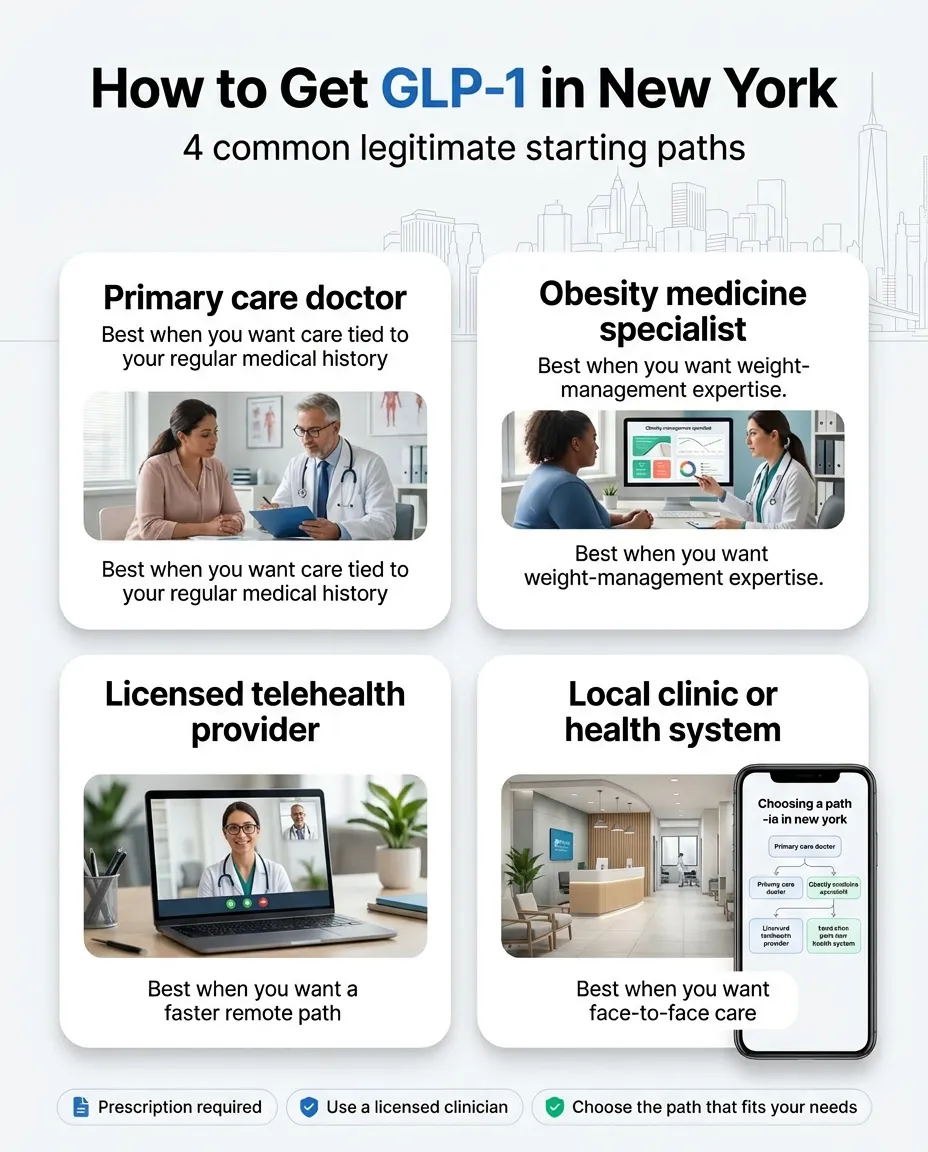
If you've been searching how to get GLP-1 in New York — bouncing between telehealth ads, confusing insurance rules, and clinic pages that only want to sell you their thing — we built this page to end that loop. Here's the short version: You can legally get GLP-1 medication in New York through four routes — your primary care doctor, an obesity medicine specialist, a licensed telehealth provider, or a local clinic. Telehealth is often the fastest cash-pay route, while a PCP or specialist is typically strongest for insurance-based prescribing. The Wegovy pill launched in January 2026, so you can now skip injections entirely if you prefer. Cash-pay starts at $149/month for FDA-approved oral semaglutide.
But here's what none of the provider pages will tell you: New York Medicaid explicitly does not cover GLP-1 for weight loss. And insurance coverage varies based on your plan's formulary, prior-authorization criteria, and how your prescription is written. We break all of that down below — including the legitimate alternatives that actually exist.
The rest of this guide answers every question that would otherwise send you back to searching. Which path fits your insurance status, your budget, and your comfort level. What each medication actually costs after the promo pricing ends. How to spot the scam operators. What happens when you stop taking it. And how to start this week if you're ready.
By the WPG Research Team | Reviewed against FDA, CMS, New York State, and official provider source documents | Last Updated: March 2026 | Pricing Last Verified: March 2026. Affiliate disclosure: We earn a commission when you start treatment through some links on this page. This never changes our recommendations. See our full editorial policy.
Your GLP-1 Path Finder: Jump to Your Situation
| Your Situation | Best Starting Point | Jump To |
|---|---|---|
| I have employer/commercial insurance | Start with a provider that fights for coverage (like Ro) | Insurance Path |
| I'm on New York Medicaid | Cash-pay is your realistic option right now | Medicaid Reality |
| I'm on Medicare | $50/mo pilot launching mid-2026 — but cash-pay works now | Medicare Path |
| No insurance, lowest cost | Telehealth + oral Wegovy ($149/mo) or compounded options | Budget Path |
| I want a pill, not a shot | Wegovy pill — FDA-approved, available now | Pill Path |
| I want in-person care | PCP, obesity specialist, or NYC clinic | In-Person Path |
| I just want to compare providers | Side-by-side table with verified pricing | Comparison Table |
How Do the Top Options for New Yorkers Compare?
We verified pricing and New York availability across major providers in March 2026. Here's how they line up:
| Provider | Serves NY? | Medication Type | Monthly Cost | Insurance Help? | Pill Available? | Best For |
|---|---|---|---|---|---|---|
| Ro | Yes | Brand-name FDA-approved only (Wegovy, Zepbound, Ozempic) | $39 first month, then $149/mo membership + meds from $149/mo | Concierge handles prior auth | Wegovy pill | Insured patients who want help getting coverage + brand meds |
| Hims / Hers | Yes | Branded GLP-1s + compounded semaglutide + oral medication kits (not GLP-1) | From $69/mo (oral kits, 10-mo plan) or $199/mo (compounded injectable, 6-mo plan) | Cash-pay for most options | Oral kits available (different formulation) | Cash-pay patients who want affordable access + app-based support |
| GoodRx Care | Yes | Brand-name FDA-approved | $39/mo care fee + meds from $149/mo | No | Wegovy pill | No-subscription flexibility with brand-name meds |
| Walgreens | Yes | Brand-name FDA-approved | $49 per visit (no subscription) + meds from $149/mo | Self-pay only | Wegovy pill | People who trust a pharmacy brand; eligible adults 18–64 |
| NYC In-Person Clinic | Yes (varies) | Varies — brand or compounded | $200–$600+ | Varies | Usually injection | Patients who want face-to-face care |
Promotional pricing changes frequently. Costs shown reflect what we verified in March 2026.
Ro
$39 +First Month — Insurance Concierge Included
Which Path Is Right for You? (Pick Your Situation)
There is no one "best" way to get GLP-1 in New York. The right move depends on your insurance, your budget, and honestly, your comfort level. Here's a straight answer for each scenario.
I Have Commercial Insurance Through My Employer
Your best move: Start with a telehealth provider that handles insurance navigation for you — specifically one with a concierge team that will submit prior authorization on your behalf and fight denials.
Here's why this matters: getting insurance to cover GLP-1 medication often requires prior authorization, which means your provider has to convince your insurance company that the medication is medically necessary for you. Some telehealth platforms just hand you a prescription and wish you luck. Others, like Ro's Body program, include an insurance concierge team as part of their membership. They check your coverage, handle the paperwork, and push for approval. If your plan covers GLP-1 medication, you pay only your copay for the drug itself. If it doesn't, they'll tell you — and you can pivot to cash-pay options without having wasted weeks.
The membership costs $39 for the first month, then $149 monthly — which includes lab testing, coaching, and that insurance concierge. Medication is billed separately based on what your insurance covers. If you find out your plan doesn't cover GLP-1 medications, you can cancel or switch to cash-pay options.
What to do right now: Call the number on the back of your insurance card and ask: "Does my plan cover Wegovy or Zepbound for chronic weight management? What are the prior authorization requirements?" That 5-minute call will tell you whether the insurance path is worth pursuing.
Pro tip: About 19% of large employer plans covered GLP-1s for weight loss in 2025, and that number is growing fast. Even if your plan doesn't cover it today, check again during open enrollment — many companies are adding coverage.
I Have New York Medicaid
This is the part nobody else is telling you clearly, so we will.
New York Medicaid (NYRx) does not cover GLP-1 medications for weight loss. For weight-loss use, NYRx treats GLP-1s as a State Plan exclusion under regulation 18 NYCRR § 505.3(g)(3). Weight loss has never been a Medicaid-covered indication in New York. GLP-1 agonists — including Ozempic, Wegovy, and Mounjaro — are specifically named as excluded for weight-loss indications. (Source: NYRx Drug Class Coverage Overview)
If you have type 2 diabetes, that's a different story — GLP-1s like Ozempic and Mounjaro are covered by NYRx for diabetes management. So if you carry both diagnoses, talk to your provider about prescribing for your diabetes indication.
What about the federal changes? The CMS BALANCE model could expand Medicaid GLP-1 coverage to participating states starting May 2026. But New York has not confirmed participation as of March 2026. We're watching this closely and will update this page the moment something changes.
Your realistic options right now:
- Wegovy pill (oral semaglutide): $149–$299/month depending on dose. FDA-approved. No insurance needed.
- Compounded options through telehealth: Starting around $79–$99/month for initial doses through platforms like Hims/Hers. (More on compounded vs. brand-name below — it's an important distinction.)
- HSA/FSA: If you have access to a Health Savings Account or Flexible Spending Account through any source, GLP-1 medications qualify as eligible medical expenses. That can save you 20–35% depending on your tax bracket.
We know this isn't the answer you wanted. But knowing the truth upfront saves you weeks of fighting a system that currently says no — and lets you spend that energy on paths that actually work.
I'm on Medicare
Current rule: Medicare Part D does not cover GLP-1 medications prescribed solely for weight loss. Full stop. It does cover them for type 2 diabetes and, in some cases, cardiovascular risk reduction.
What's changing: The Medicare GLP-1 Bridge — a short-term demonstration program — launches July 1, 2026 and runs through December 31, 2027 (CMS extended the Bridge after delaying BALANCE Part D implementation). Eligible Medicare Part D beneficiaries can access Wegovy (injection and tablets) and Zepbound for weight management at a $50/month copay. The program operates outside of the regular Part D benefit, so Part D plans don't need to opt in. (Source: CMS Medicare GLP-1 Bridge FAQ)
Important nuance: If your doctor prescribes Wegovy or Zepbound for a use already coverable under regular Part D — such as Zepbound for obstructive sleep apnea or Wegovy for cardiovascular risk reduction — that goes through your normal Part D plan, not the Bridge.
What to do right now: If you can't wait for the pilot, cash-pay options are your best path. The Wegovy pill at $149/month for the lowest dose is the most affordable FDA-approved option. You can also look into manufacturer patient assistance programs — Novo Nordisk offers programs for people at or below 400% of the federal poverty level.
I Don't Have Insurance and Want the Lowest Cost
The math, laid out honestly:
| Option | Monthly Cost | FDA-Approved? | Notes |
|---|---|---|---|
| Wegovy pill (oral semaglutide, starting dose) | $149/mo | Yes | Lowest FDA-approved option. Through NovoCare, Ro, GoodRx, or Walgreens. |
| Wegovy injection (starting doses, promo pricing) | $199/mo first 2 months | Yes | Promotional pricing for 0.25mg and 0.5mg doses. $349/mo after. |
| Zepbound vial (tirzepatide) | From $299/mo | Yes | Available through LillyDirect. |
| Compounded semaglutide injection (Hims/Hers) | ~$199/mo (6-mo plan) | No | Not FDA-approved. Made by compounding pharmacies. |
| Hims/Hers oral medication kits | From $69/mo (10-mo plan) | Not GLP-1 | Combination oral meds (metformin, bupropion, naltrexone) — different mechanism than GLP-1. |
If you want the lowest possible cost on an FDA-approved GLP-1: the Wegovy pill at $149/month is currently the winner. It's the first oral GLP-1 approved for weight loss, it's widely available at major U.S. pharmacies including CVS and Costco as well as through telehealth providers, and you don't need to inject anything.
If you want the absolute cheapest weight-loss medication option and you're comfortable with compounded products, platforms like Hims and Hers offer lower starting prices — but read our brand vs. compounded breakdown below before deciding. That distinction matters more in 2026 than it did a year ago.
I Want a Pill, Not an Injection
Good news — 2026 is the year this became a real option.
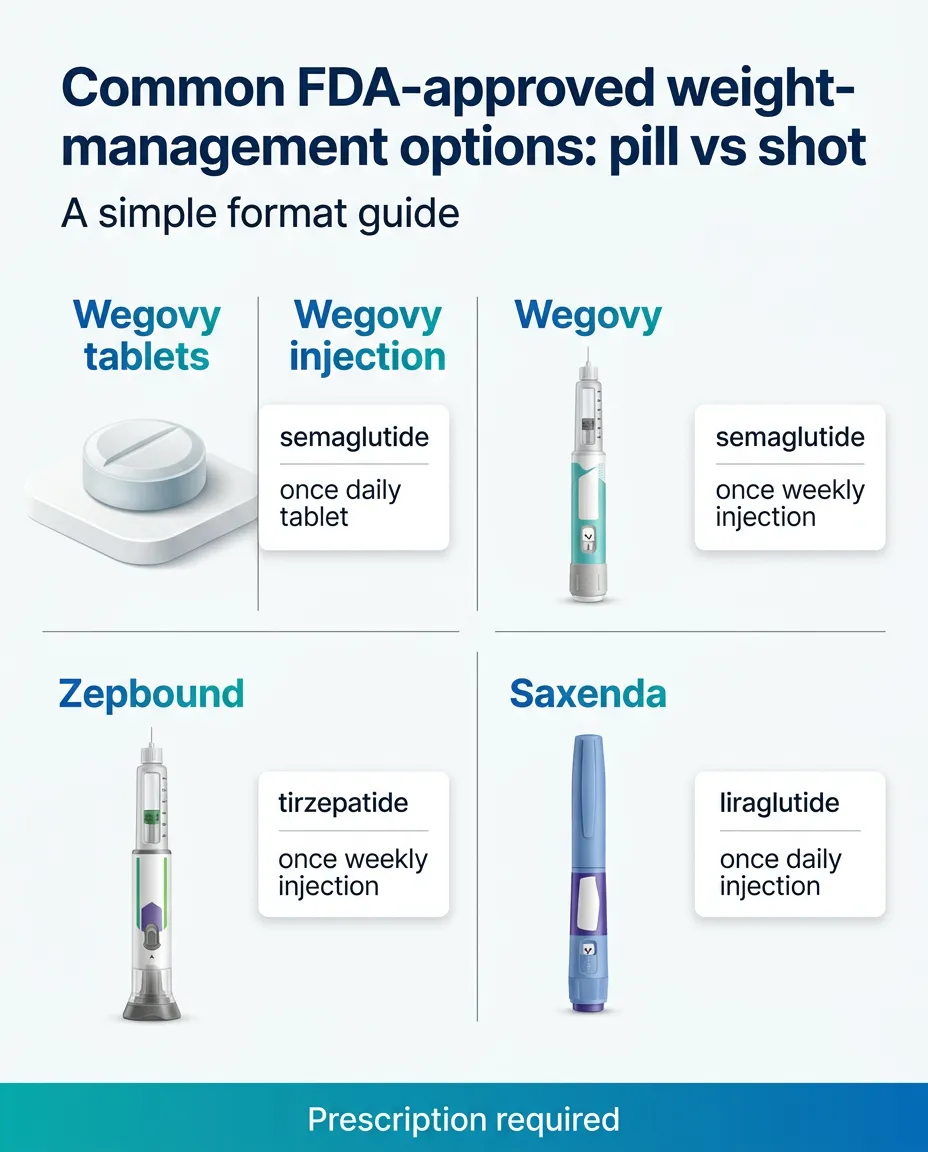
Wegovy pill (oral semaglutide) launched in the U.S. in January 2026. It's FDA-approved for weight loss in adults with obesity (BMI ≥30) or overweight (BMI ≥27) with at least one weight-related condition. You take it daily, first thing in the morning on an empty stomach, and wait 30 minutes before eating or drinking.
In the OASIS 4 trial (307 adults with obesity or overweight), those who stayed on the Wegovy pill for 64 weeks lost an average of 16.6% of their body weight. In the full intent-to-treat analysis (including patients who didn't complete the trial), the average was 13.6%. At week 64, 76% of patients lost at least 5% of body weight, and 47% lost at least 15%. (Source: Wharton et al., New England Journal of Medicine, 2025; Novo Nordisk FDA approval press release, December 2025)
Pricing:
- 1.5mg dose: $149/month
- 4mg dose: $149/month (through August 31, 2026, then $199/month)
- 9mg dose: $299/month
- 25mg dose: $299/month
Available through Ro, GoodRx Care, Walgreens Weight Management, and NovoCare Pharmacy.
Now available: Eli Lilly's Foundayo (orforglipron) was FDA-approved April 1, 2026. It's a once-daily oral GLP-1 pill with no food or water restrictions. Self-pay pricing starts at $149/month for the lowest dose. Available through Ro, LillyDirect, and GoodRx Care Direct.
I Want In-Person Care With a Doctor I Can See
Best route: Ask your primary care doctor about GLP-1 prescribing, or get a referral to an obesity medicine specialist. If you want to find a board-certified specialist in your area, the Obesity Medicine Association has a free searchable provider directory at obesitymedicine.org/find-a-provider.
Major New York health systems with structured weight management programs include Mount Sinai, NYU Langone, and Weill Cornell. These programs typically include comprehensive metabolic evaluation, medication management, nutrition counseling, and behavioral support. Expect longer wait times (2–6 weeks for initial consult) and higher out-of-pocket costs than telehealth, but you get the most thorough medical supervision available.
When in-person makes the most sense:
- You have complex health conditions (heart disease, kidney issues, severe GI problems)
- You've had bariatric surgery in the past
- You want your weight management integrated with your existing care team
- You strongly prefer face-to-face medical relationships
A note on NYC medspas and boutique clinics: Many NYC "wellness clinics" now offer GLP-1. Some are excellent. Some are essentially subscription services with minimal medical oversight. Before signing up, verify that the prescribing provider holds a current New York medical license (you can check at nysed.gov/professions), that they require a real medical intake including health history and labs, and that they have a clear follow-up schedule. If a clinic is offering GLP-1 without asking about your medical history, that's a red flag.
Ro
$39 +First Month — Brand-Name FDA-Approved GLP-1
The 4 Legitimate Routes to Get GLP-1 in New York (Detailed)
Let's go deeper on each path. We're going to be specific about what you'll experience, what it'll cost, and where each option has real weaknesses.
Path 1: Licensed Telehealth (Fastest for Most New Yorkers)
This is how most New Yorkers are starting GLP-1 treatment in 2026. The process is straightforward:
- You complete an online health questionnaire (2–5 minutes)
- A New York-licensed provider reviews your information
- If a video visit is required (depends on the platform and your state's telehealth rules), you schedule one — usually available within 24–48 hours
- If you're eligible, you're prescribed GLP-1 medication
- Your medication is shipped to your door or sent to a local pharmacy
New York law requires that telehealth prescriptions, lab orders, and follow-up care meet the same standard as in-person visits. (Source: NY DOH Telehealth Provider Manual) That means a legitimate telehealth GLP-1 provider serving New York patients must use NY-licensed clinicians and can't cut corners on medical evaluation.
Here's a closer look at the top telehealth options serving New York:
Ro (Best for: People With Insurance)
Ro's Body program is built around brand-name, FDA-approved GLP-1 medications — Wegovy (both injection and pill), Zepbound, and Ozempic. What sets Ro apart from most telehealth platforms is the insurance concierge. Their team handles prior authorization, fights denials, and works to get your insurance to cover as much of the medication cost as possible.
The membership runs $39 for the first month, then $149/month. That includes the insurance navigation, lab work (through Quest or a home kit), one-on-one coaching, weekly nurse check-ins, and a 12-month structured weight-loss curriculum. Ro generally cannot coordinate GLP-1 coverage for government insurance plans (Medicare, Medicaid, TRICARE).
Medication is billed separately. If insurance covers your GLP-1, you'll pay whatever copay your plan requires. If you're paying cash, Wegovy pills start at $149/month and Wegovy injections start at $199/month (promotional pricing for the first two months at lower doses).
The program's structured approach — pairing medication with coaching and labs — is designed to help you build sustainable habits alongside the medication. For anyone with commercial insurance, this is where we'd start.
Who should skip Ro: If you're on Medicaid or Medicare, Ro can't coordinate government insurance for GLP-1s. If you're uninsured and budget is your top concern, the $149/month membership plus cash-pay medication prices may add up compared to other options.
Hims / Hers (Best for: Self-Pay Users Who Want Low Entry Pricing)
Hims (for men) and Hers (for women) are the same company under the hood — NYSE-traded, one of the largest telehealth platforms in the U.S. They offer branded GLP-1 options (Ozempic, Wegovy, Mounjaro), compounded semaglutide injections, and oral weight-loss medication kits.
Their compounded injectable plans start at approximately $199/month on a 6-month plan. Oral weight-loss medication kits (a combination of metformin, bupropion, naltrexone, and vitamin B12) start at $69/month on a 10-month plan. Important distinction: these oral kits are not GLP-1 medications — they work through a different mechanism entirely.
Self-reported platform data from over 13,000 Hims & Hers customers on compounded GLP-1 injections showed an average weight loss of 20.9 pounds within 6 months. (Source: forhers.com, self-reported customer check-in data — not a clinical trial)
Who should skip Hims/Hers: If you want help navigating insurance, Hims doesn't do that for compounded options. If you only want FDA-approved finished products, their branded options are available but pricier, and the compounded options are not FDA-approved. Compounded GLP-1 injectable availability in NY can vary — check their site for current status.
Also Available in New York:
- GoodRx Care Direct: No subscription model. Brand-name meds. Provider visits included. Wegovy pill from $149/month. Good for people who don't want another monthly membership.
- Walgreens Weight Management: Video visits start at $49. Brand-name meds only. Familiar pharmacy brand. No subscription required.
- Lemonaid Health: Cash-pay model. GLP-1 injections starting at $129/month (promotional). Clean onboarding experience.
- WeightWatchers Clinic: GLP-1 + the WW behavioral program. Insurance team helps with coverage. Clinic members on GLP-1s lost an average of 21% of body weight in 12 months. (Source: weightwatchers.com)
- Sesame: Choose your own provider. Same-day prescriptions possible. Good for people who want control over which clinician they see.
Path 2: Your Primary Care Doctor
If you already have a PCP in New York, this may be the simplest path — especially if you have insurance.
How to bring it up: You don't need a fancy script. Something like "I've been researching GLP-1 medications for weight management and I'd like to know if I might be a candidate" works fine. Most PCPs are now familiar with GLP-1 prescribing, though some are still cautious or may refer you to a specialist.
What to expect: Your doctor will check your BMI, review your health history, and likely order labs (metabolic panel, A1C, possibly thyroid function). If you meet prescribing criteria, they can write the prescription and submit prior authorization to your insurance company.
Timeline: 1–3 weeks from appointment to medication, depending on prior auth turnaround.
The upside: Integrated care. Your PCP already knows your full medical history, can monitor your labs over time, and can adjust your treatment in the context of everything else going on with your health.
The downside: Some PCPs still aren't comfortable prescribing GLP-1s for weight management, particularly if they haven't received obesity medicine training. If your doctor says no, a telehealth provider is a solid backup — you're not doing anything wrong by getting a second opinion.
Path 3: Obesity Medicine Specialist
For patients with complex health histories — multiple comorbidities, prior bariatric surgery, endocrine conditions, severe GI issues — an obesity medicine specialist offers the deepest level of expertise.
Yale Medicine's guidance recommends looking for a clinician who has experience managing obesity as a chronic condition over time, whether that's a PCP with obesity medicine training, an endocrinologist, or a board-certified obesity medicine specialist. (Source: yalemedicine.org)
How to find one: The Obesity Medicine Association maintains a free, searchable provider directory that includes New York clinicians. You can filter by location, insurance, and specialty. This is a non-commercial resource we recommend regardless of which path you choose: obesitymedicine.org/find-a-provider
Cost: Varies widely. Some specialists accept insurance. Others run cash-pay or concierge programs ranging from $200–$600+ per month.
Best for: Anyone with a complicated medical picture, anyone who wants the most comprehensive monitoring, and anyone who values having a specialist quarterback their treatment.
How to Get the Lowest Cash Price: Manufacturer Direct Programs
You might not know this, but you can get GLP-1 medication shipped directly from the drug manufacturers — you just need a prescription from any licensed provider. These aren't a separate "route" to care — they're a fulfillment option that can save you real money after your provider writes the prescription.
NovoCare Pharmacy (Novo Nordisk): Your doctor sends a prescription to NovoCare. Wegovy pen starts at $199/month for the first two months (promotional, lowest doses), then $349/month. Wegovy pill: $149–$299/month. Free home delivery.
LillyDirect (Eli Lilly): Zepbound vials starting at $299/month. Also available with insurance for patients with coverage.
TrumpRx.gov (Live since February 2026): The government's direct-to-consumer pricing portal offers cash-pay discounts on GLP-1 medications. At launch: Wegovy pill from $149/month, Wegovy injection from $199/month, Zepbound from $299/month — depending on dose. Cash-pay only (not available to patients enrolled in government insurance programs). TrumpRx doesn't sell drugs directly — it routes you to manufacturer discount programs. (Source: White House Fact Sheet, February 2026)
These programs are especially useful if you already have a doctor willing to prescribe but want the lowest possible brand-name cash price.
Path 4: NYC Clinics and Local Programs
New York City has dozens of clinics offering GLP-1 treatment, from major health systems (Mount Sinai, NYU Langone, Weill Cornell) to independent practices and medspas.
The advantage: Face-to-face care, in-office injections if you prefer not to self-inject, and the ability to build a long-term relationship with your provider.
The caution: Quality ranges enormously. A board-certified obesity medicine physician running a structured program is very different from a medspa that added GLP-1 to its menu last month. Before committing, ask:
- Is the prescribing provider a licensed MD, DO, NP, or PA?
- What's the follow-up schedule?
- Do they order labs?
- What happens if I experience side effects?
- Is the medication brand-name or compounded, and what pharmacy fills it?
Outside NYC: If you're on Long Island, in Westchester, the Hudson Valley, or Upstate, telehealth is often the most practical option since it doesn't require commuting. All the major telehealth platforms serve the entire state of New York — location within the state doesn't matter as long as the provider holds a NY license.
New York Telehealth vs. In-Person: Which Produces Better Results?
This is a question that comes up a lot, and the honest answer is: for most people, outcomes are comparable. A growing body of research suggests that virtual obesity care can be just as effective as in-person treatment, even across diverse backgrounds and geographies. The key isn't the delivery method — it's whether you have consistent medical oversight, access to your provider when questions come up, and a structured treatment plan.
Telehealth wins on speed, cost, and convenience. In-person wins on depth of medical evaluation and the comfort of a face-to-face relationship. Neither is categorically better. The "best" option is the one you'll actually stick with for the long term — because consistency matters more than the channel.
| Factor | Telehealth | In-Person |
|---|---|---|
| Speed to start | 3–7 days | 2–6 weeks |
| Monthly cost (typical) | $149–$250 + meds | $200–$600+ |
| Insurance coordination | Some platforms (Ro) | Most accept insurance |
| Follow-up ease | Message/video from home | Scheduled office visits |
| Best for complex cases? | Adequate for most | Better for complicated histories |
| Medication monitoring | Remote check-ins + labs | In-person exams + labs |
| Convenience | No commute, no waiting room | Scheduling, travel, wait times |
Our honest recommendation: If you don't have complex medical conditions, start with telehealth — it gets you started faster and costs less. If you have multiple health conditions, a history of bariatric surgery, or you simply feel more comfortable with in-person care, find a board-certified specialist. There's no wrong answer here.
Who Qualifies for GLP-1 Weight-Loss Treatment?
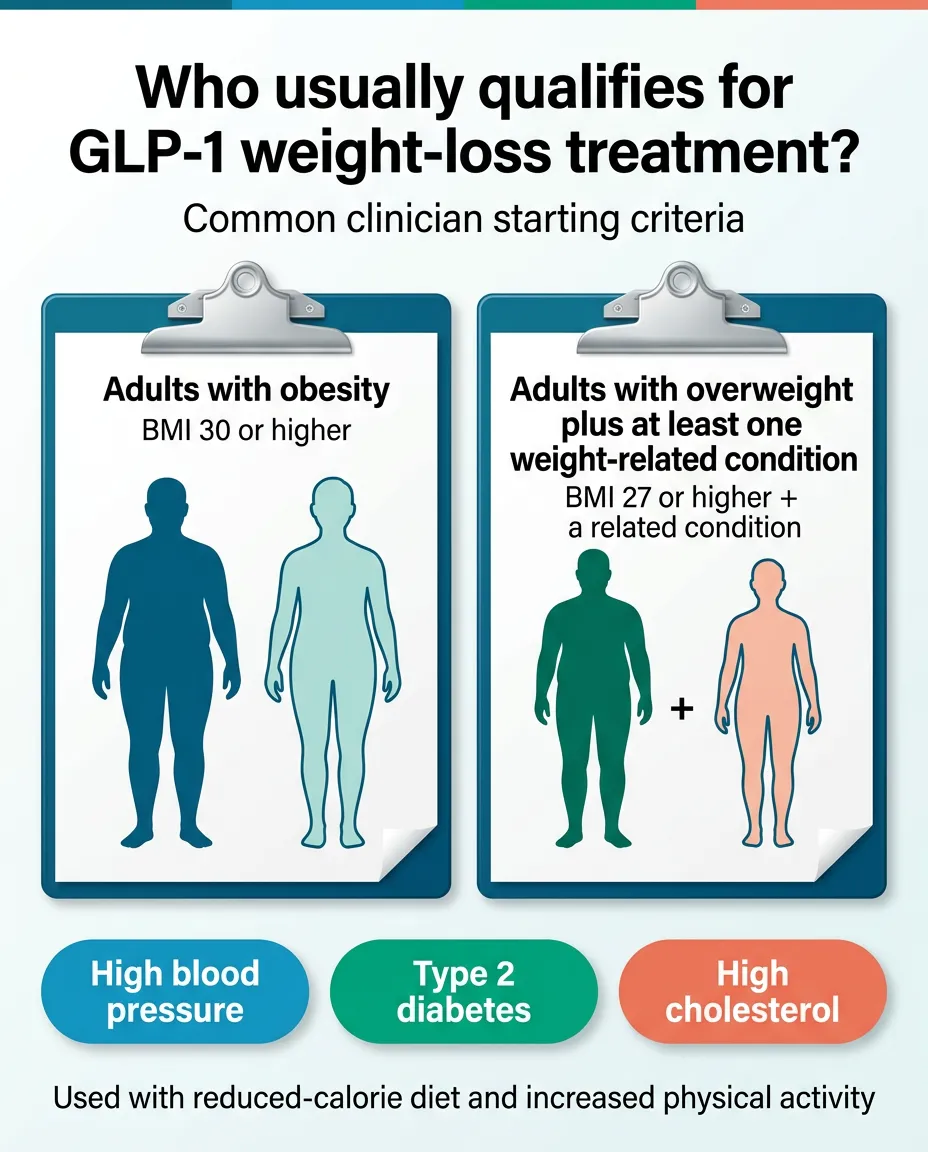
GLP-1 medications for weight management are FDA-approved for adults who meet specific criteria:
Standard eligibility:
- BMI of 30 or higher (obesity), OR
- BMI of 27 or higher (overweight) with at least one weight-related health condition — such as type 2 diabetes, high blood pressure, high cholesterol, obstructive sleep apnea, or cardiovascular disease
Note: Wegovy injection is also FDA-approved for pediatric patients aged 12 and older with obesity. Wegovy tablets are approved for adults only.
What a legitimate provider will assess:
- Your current BMI and weight history
- Existing medical conditions and medications
- Personal and family history of medullary thyroid carcinoma (MTC) or Multiple Endocrine Neoplasia type 2 (MEN 2) — these are absolute contraindications
- History of pancreatitis
- Pregnancy or breastfeeding status
- Kidney and gallbladder health
When a provider might say no: If you have a personal or family history of MTC or MEN 2, if you're pregnant or planning to become pregnant soon, if you have active pancreatitis, or if your BMI doesn't meet prescribing criteria. A legitimate provider will also screen for eating disorders, since GLP-1 medications affect appetite signaling.
Red flag: If a provider offers GLP-1 without asking about any of this — no health history, no contraindication screening, just "sign up and we'll ship it" — that's not a provider you want prescribing your medication. This is still a prescription drug with a black box warning. The screening exists to protect you.
(Source: Wegovy prescribing information, FDA; Zepbound prescribing information, FDA)
Does Insurance Cover GLP-1 in New York? The Full Breakdown
This is one of the most searched follow-up questions, and for good reason — the answer is genuinely complicated.
Commercial / Employer Insurance
Coverage depends entirely on your specific plan. There's no statewide mandate in New York requiring commercial plans to cover GLP-1 for weight loss.
The good news: The number of employer plans covering GLP-1s is growing. A Kaiser Family Foundation survey found that roughly 19% of large employer plans covered GLP-1s for weight loss in 2025, up significantly from prior years.
How to check:
- Call the number on your insurance card
- Ask specifically: "Does my plan cover Wegovy (semaglutide) for chronic weight management?"
- Ask the same for Zepbound (tirzepatide) — different plans cover different drugs
- Ask about prior authorization requirements and any step therapy rules
If your plan covers it:
- With a Novo Nordisk savings card (WeGoTogether): Wegovy could be as low as $25/month for eligible commercially insured patients
- With a Lilly savings card: Zepbound copay could also be significantly reduced
- A telehealth provider like Ro will handle the prior authorization process for you
If your plan denies coverage:
- Ask your doctor whether you have an FDA-approved indication beyond weight management. For example, Wegovy is approved for cardiovascular risk reduction in adults with established cardiovascular disease plus obesity or overweight. Zepbound is approved for moderate-to-severe obstructive sleep apnea in adults with obesity. If you have one of these conditions, your provider can assess whether prescribing for that labeled use is appropriate — and coverage is often more straightforward.
- File an appeal. Your provider can write a letter of medical necessity.
- If all else fails, cash-pay options starting at $149/month are often less expensive than people expect.
New York Medicaid (NYRx)
We covered this above, but it bears repeating because it's one of the most important New York-specific facts on this page.
NYRx does not cover GLP-1 medications for weight loss. The regulation is explicit: agents used for weight loss or weight gain are excluded under 18 NYCRR § 505.3(g)(3). GLP-1 agonists — including Ozempic, Wegovy, Mounjaro, and Zepbound — are specifically called out in NYRx documentation as excluded for weight-loss indications.
If you have type 2 diabetes, GLP-1 medications are covered for glycemic control. If your doctor diagnoses both obesity and diabetes, getting covered through the diabetes indication is possible.
Governor Hochul proposed evaluating GLP-1 access for high-cardiovascular-risk Medicaid members in 2025. No policy change has taken effect. The federal BALANCE model could change this starting May 2026, but only if New York opts in — which has not happened as of this writing.
We will update this section immediately if New York's Medicaid policy changes. Bookmark this page.
Medicare
Medicare Part D does not currently cover GLP-1 medications for weight loss. It does cover them for type 2 diabetes and cardiovascular risk reduction.
What's changing in 2026:
- July 1, 2026: The Medicare GLP-1 Bridge launches — extended through December 31, 2027 after CMS delayed BALANCE Part D implementation. Eligible Part D beneficiaries can access Wegovy (injection and tablets) and Zepbound for weight management at a $50/month copay. The Bridge operates outside the regular Part D benefit. (Source: CMS Medicare GLP-1 Bridge)
- BALANCE Model (date TBD): The full BALANCE model for participating Medicare Part D plans has been delayed — check cms.gov for a confirmed launch date.
- Important: If your prescription qualifies under regular Part D (e.g., Zepbound for sleep apnea, Wegovy for cardiovascular risk reduction), it goes through your normal Part D plan — not the Bridge.
HSA and FSA
Here's something many people miss: GLP-1 medications and telehealth consultations are eligible medical expenses for Health Savings Accounts and Flexible Spending Accounts. Even if your insurance doesn't cover the medication itself, you can use pre-tax HSA/FSA dollars to pay for it. Depending on your tax bracket, that's effectively a 20–35% discount.
Which GLP-1 Medications Can You Actually Get in New York Right Now?
This landscape changes fast. Here's what's available as of March 2026, and what the practical differences mean for you.
FDA-Approved for Weight Loss
Wegovy (semaglutide) — Injection
- Manufacturer: Novo Nordisk
- How it works: Once-weekly self-injection
- Average weight loss in trials: ~15% of body weight over 68 weeks (STEP 1 trial, NEJM)
- Cash price: $199/mo first 2 months (promo), then $349/mo
- Also FDA-approved for: Cardiovascular risk reduction
Wegovy (semaglutide) — Pill
- Manufacturer: Novo Nordisk
- How it works: Daily pill, taken on an empty stomach with water, 30 minutes before food
- Average weight loss in trials: ~13.6% in the full trial population; ~16.6% among patients who completed treatment (OASIS 4 trial, NEJM, 2025)
- Cash price: $149–$299/month depending on dose
- Launched: January 2026
Zepbound (tirzepatide) — Injection
- Manufacturer: Eli Lilly
- How it works: Once-weekly self-injection. Dual-action — targets both GLP-1 and GIP receptors
- Average weight loss in trials: Up to ~20% of body weight at highest dose (SURMOUNT-1 trial)
- Cash price: From $299/mo (vials through LillyDirect)
- Also FDA-approved for: Obstructive sleep apnea in adults with obesity
Saxenda (liraglutide) — Injection
- Manufacturer: Novo Nordisk
- How it works: Daily self-injection
- Average weight loss: Less than semaglutide or tirzepatide (typically 5–8%)
- Generally not a first choice in 2026 given stronger alternatives available
FDA-Approved for Diabetes (Sometimes Used Off-Label)
Ozempic (semaglutide) and Mounjaro (tirzepatide) are FDA-approved for type 2 diabetes, not weight loss. Doctors can prescribe them off-label for weight loss, and many do. However, insurance is less likely to cover them for weight loss since that's not their approved indication. Rybelsus is an oral semaglutide approved for diabetes — it can also be prescribed off-label but produces less weight loss than the Wegovy pill, which has higher doses.
What About Compounded GLP-1?
This deserves its own section because it's one of the biggest decision points for New Yorkers paying out of pocket.
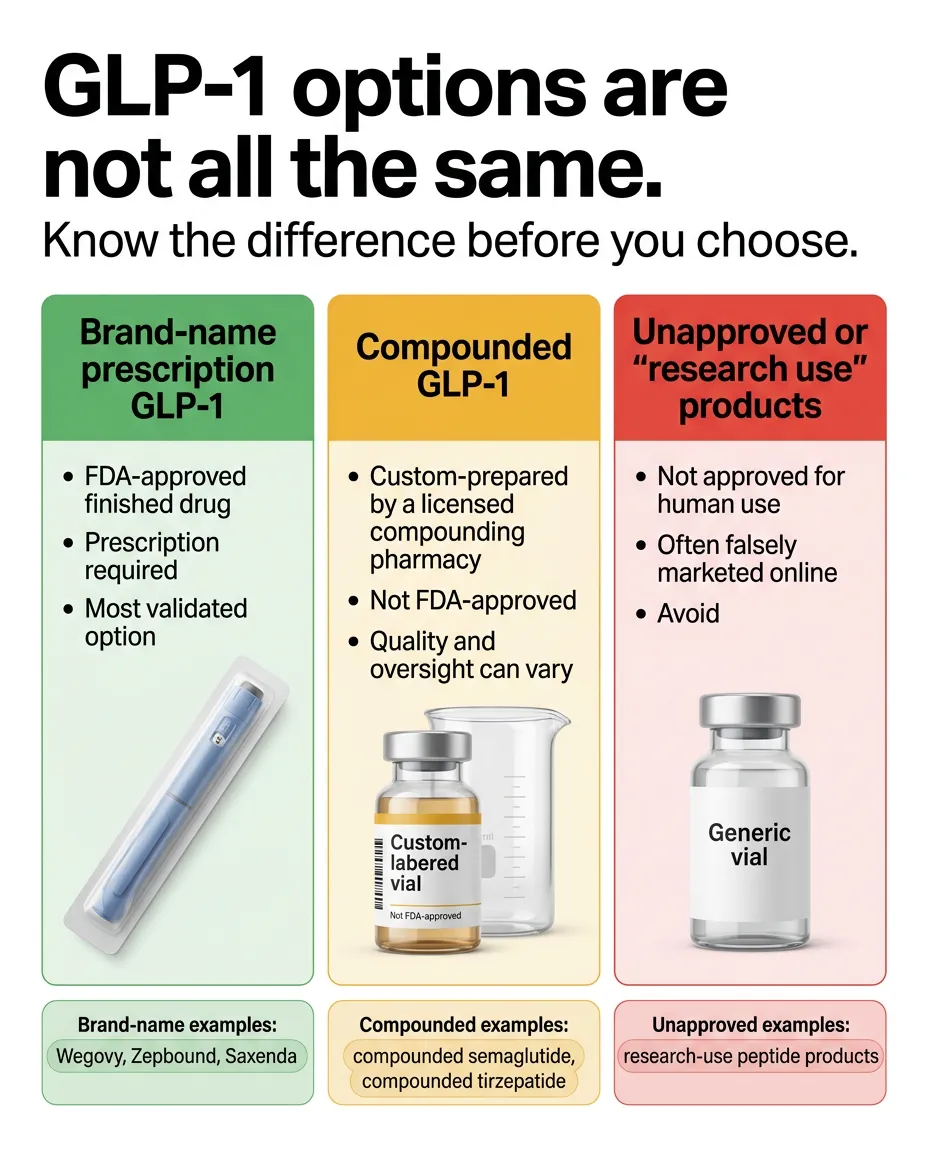
Brand-Name vs. Compounded GLP-1: What You Need to Know
This is where we need to be straight with you, because this is a decision that affects both your wallet and your safety.
| Factor | Brand-Name (Wegovy, Zepbound, etc.) | Compounded Semaglutide |
|---|---|---|
| FDA-approved? | Yes — safety, efficacy, and manufacturing verified | No — FDA does not verify before sale |
| Who makes it? | Novo Nordisk or Eli Lilly in FDA-inspected facilities | Compounding pharmacies (quality varies significantly) |
| Prescription required? | Yes | Yes |
| Cost | $149–$499/mo depending on drug and dose | $79–$199/mo |
| FDA position | Recommended | FDA has actively warned consumers about risks (February 2026) |
| Legal status | Always legal with prescription | Legal during drug shortages; landscape is evolving |
What the FDA says: The FDA has stated that compounded GLP-1 medications are not reviewed for safety, effectiveness, or quality before marketing. The agency has documented dosing errors, contamination risks, fraudulent labels, inadequate refrigeration during shipping, illegal online sales, and "research use" products sold for human injection. With the national semaglutide and tirzepatide injection shortages now officially resolved, FDA enforcement activity against mass-marketed compounded GLP-1 products has increased. (Source: FDA's Concerns with Unapproved GLP-1 Drugs)
Our honest take: Brand-name medications are the gold standard — you know exactly what you're getting, the manufacturing is regulated, and the clinical trial data was generated using these specific products. For anyone who can afford it, brand-name is the safer bet.
But we also live in the real world. Many New Yorkers don't have insurance coverage, can't afford $349/month for brand-name Wegovy, and face a Medicaid system that won't cover it. Compounded options from reputable telehealth platforms that source from licensed U.S. pharmacies have made GLP-1 treatment accessible to people who otherwise couldn't afford it. If you go this route, choose a well-established platform — one that's transparent about its pharmacy sources and provides real medical oversight.
The Wegovy pill changed this calculus. At $149/month for the starting dose, FDA-approved oral semaglutide is now in the same price neighborhood as many compounded options. If cost was your main reason for considering compounded, it's worth pricing out the Wegovy pill first.
Hims / Hers
From $69/mo — Multiple Options Available
How to Spot a Scam: The Provider Legitimacy Checklist
The GLP-1 boom has attracted legitimate providers and predatory operators in roughly equal measure. New York's licensing requirements help, but you still need to be careful — especially online.
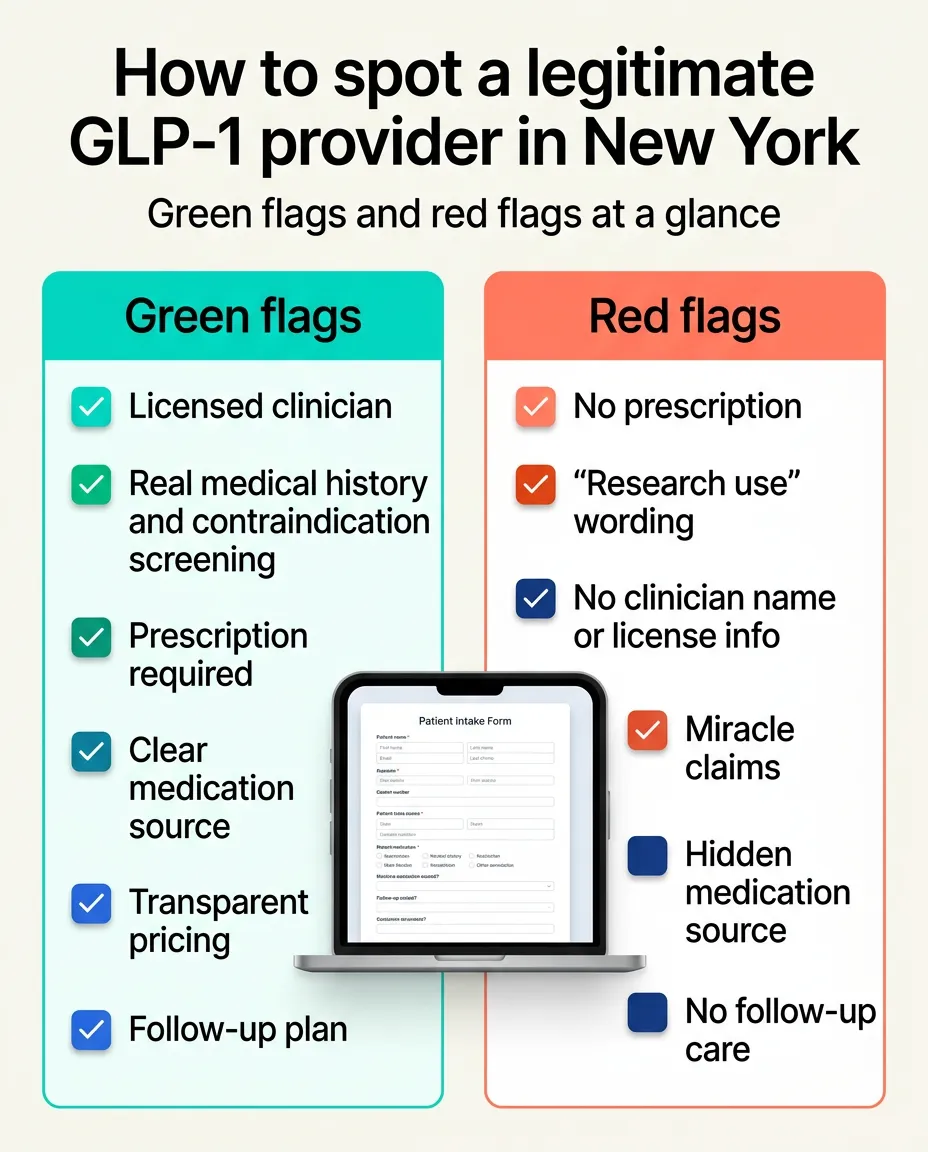
A legitimate GLP-1 provider will always:
- Use a New York-licensed prescriber (MD, DO, NP, or PA)
- Require a real health history and screen for contraindications
- Source medication from a licensed U.S. pharmacy
- Tell you clearly what medication you're getting and where it comes from
- Have a follow-up schedule for dosing, side effects, and labs
- Disclose pricing clearly — including what happens after promotional periods
Walk away immediately if:
- No medical intake or health screening
- "Research use only" language anywhere on the site
- Medication sourced from overseas or unlicensed pharmacies
- No identifiable prescriber or medical director
- Miracle language: "guaranteed results," "no side effects"
- They sell GLP-1 without a prescription
- Pricing is hidden until after you've committed
How to verify a New York clinician's license: Go to nysed.gov/professions and search by name. This is free and takes 30 seconds. If the prescriber's name isn't listed or their license is expired, don't proceed.
FDA has documented cases of fraudulently labeled, contaminated, and illegally marketed GLP-1 products reaching consumers — including products labeled for "research use" that were sold for human injection. (Source: FDA)
This isn't meant to scare you. The vast majority of established telehealth platforms and clinics operate legally. But the few bad actors can do real harm, so take 2 minutes to verify before you hand over your credit card.
What Actually Happens After You Start: The First 8 Weeks
If you've decided to move forward, here's what the next two months typically look like — so there are no surprises.
Week 1: Intake and Prescription
You complete your health assessment (online or in-person). Your provider reviews it, potentially orders labs, and if you're a good candidate, writes a prescription. If using telehealth, medication ships to your door or a local pharmacy. Most people start treatment within 3–7 days of their initial assessment.
Weeks 1–4: Starting Dose
All GLP-1 medications begin at the lowest dose and gradually increase — this is called titration. It exists to minimize side effects, especially nausea. During this period, you'll likely notice your appetite decreasing. Some people feel it within the first few days. Others take a couple of weeks. Most patients lose 2–3% of their starting body weight in the first month.
Weeks 4–8: First Dose Increase
Your provider will increase your dose according to the standard titration schedule. Side effects (if any) may briefly resurface as your body adjusts to the higher dose. This is normal. By week 8, many people report noticeably reduced cravings, smaller portions that feel satisfying, and more energy.
What about labs? Most legitimate providers will order baseline labs before prescribing (metabolic panel, A1C, possibly kidney and thyroid function) and repeat them periodically. Some platforms include labs in their program; others ask you to get them through your PCP.
What if your pharmacy says it's out of stock? The national semaglutide and tirzepatide injection shortages are officially resolved as of 2025, but intermittent local disruptions still happen. If your pharmacy can't fill it, ask them to check other locations, contact your provider about alternative formulations, or ask about NovoCare/LillyDirect direct-ship options. (Source: FDA)
What maintenance looks like: After reaching your maintenance dose (typically over 16–20 weeks), you'll settle into a routine — weekly injection or daily pill, periodic check-ins with your provider, and labs every few months. Most people describe it as something that fades into the background of their routine.
The Honest Downside (And Why It's Not a Dealbreaker)
We promised no gatekeeping, so here's the thing most GLP-1 marketing pages won't say out loud.
GLP-1 medication works best as an ongoing treatment — not a short-term fix. Most obesity medicine specialists treat it the same way a cardiologist treats blood pressure medication. When you take it, it works. When you stop, the biological factors that drive weight gain tend to return.
A Cleveland Clinic analysis of nearly 8,000 patients published in March 2026 found that among those who stopped GLP-1 treatment for obesity, 55% experienced some weight regain in the following year — but the average regain was modest. A separate 2026 BMJ meta-analysis found weight regain after stopping obesity medications averaging about 0.4 kg per month, with projected return toward baseline in under two years without continued treatment. (Sources: Cleveland Clinic Newsroom / Diabetes, Obesity and Metabolism; BMJ 2026)
The takeaway is not "everyone gains it all back" — and it's also not "regain is tiny." It's this: have a maintenance plan with your clinician before you start. Many patients who stopped their initial medication successfully transitioned to alternative treatments, lifestyle modifications, or restarted medication later. Only about 1% transitioned to bariatric surgery.
The real takeaway: GLP-1 medication is a tool, not a temporary hack. It works with your biology to help you eat less, feel satisfied, and lose weight. For many people, using it long-term is the plan — and that's okay. You wouldn't judge someone for staying on blood pressure medication. As one patient put it: "We don't judge people for being on statins for cholesterol. Why should GLP-1s be different?" (Source: NPR, February 2026)
With costs coming down — the Wegovy pill at $149/month, more insurance plans covering GLP-1, Medicare coverage launching mid-2026 — long-term treatment is becoming more financially realistic every quarter.
What this means for you: Go in with realistic expectations. This isn't a 3-month program. It's a long-term strategy for managing weight in a way that actually works with your body instead of against it. And for people who commit to it, the results speak for themselves.
Side Effects: What to Actually Expect
Most side effects are mild, most common in the first few weeks, and most fade as your body adjusts. Here's what the data and real-world experience show.
Common (especially early in treatment):
- Nausea — reported in 44% of Wegovy-treated adults vs. 16% on placebo in clinical trials. Usually mild-to-moderate. Tends to fade as your body adjusts and your dose stabilizes.
- Diarrhea — reported in 30% vs. 16% on placebo.
- Vomiting — reported in 25% vs. 6% on placebo.
- Constipation, abdominal pain, stomach discomfort — also common, typically manageable.
How to minimize them: The titration schedule exists for this exact reason. Starting low and increasing slowly gives your body time to adapt. If a dose increase hits you hard, your provider can slow the schedule or adjust. This is one reason medical oversight matters. For tips on managing nausea, read our guide on what to eat on GLP-1 to reduce nausea.
Rare but serious — discuss with your doctor:
- Pancreatitis (seek immediate medical attention for severe, persistent abdominal pain)
- Gallbladder problems (risk increases with substantial or rapid weight loss)
- Thyroid tumors (boxed warning: do not use if you or a family member has a history of medullary thyroid carcinoma or MEN 2)
- Kidney problems (usually related to dehydration from GI side effects)
The honest framing: GI side effects are the main reason some people stop GLP-1 treatment. They're real, and you should expect some adjustment period. But the titration process is specifically designed to manage this, and most patients find them tolerable — especially weighed against the health risks of untreated obesity.
(Source: Wegovy prescribing information, FDA)
What Real Results Look Like
We're not going to sell you a fantasy. Here's what clinical data and verified customer reports actually show.
From clinical trials:
- Semaglutide 2.4mg (Wegovy): Average weight loss of 14.9% of body weight over 68 weeks. About one-third of participants lost 20% or more. (Source: STEP 1 trial, Wilding et al., New England Journal of Medicine, 2021)
- Tirzepatide (Zepbound): Average weight loss of up to 20.9% at the highest dose over 72 weeks. (Source: SURMOUNT-1 trial, Jastreboff et al., NEJM, 2022)
- Oral semaglutide (Wegovy pill): Average weight loss of 16.6% at the highest dose over 64 weeks. (Source: Novo Nordisk Phase 3 data)
From real-world reports:
- Hims & Hers customers on compounded GLP-1 injections self-reported losing an average of 20.9 pounds in 6 months. 97% reported improvement in overall health. (Source: forhers.com — self-reported platform data from 13,458 customers, not a clinical trial)
- A WW Clinic study found members on GLP-1 medication lost an average of 21% of body weight over 12 months. (Source: weightwatchers.com)
What this means practically: If you weigh 200 pounds, a 15% loss is 30 pounds. A 20% loss is 40 pounds. Clinical trials use structured protocols, so real-world results may vary — but the data consistently shows meaningful, sustained weight loss for people who stick with treatment.
Beyond the scale: Weight loss of this magnitude typically improves blood pressure, blood sugar control, cholesterol, energy levels, joint pain, sleep quality, and self-confidence. Researchers continue to study additional health benefits of GLP-1 medications beyond weight and metabolic outcomes.
What's Changing: Key Dates to Watch
Policy and pricing are moving fast. Here are the confirmed developments that could affect your options:
- July 1, 2026: Medicare GLP-1 Bridge launches ($50/month copay for eligible Part D beneficiaries, extended through December 31, 2027)
- BALANCE Medicaid: BALANCE model Medicaid opt-in timeline remains uncertain — NY participation not yet confirmed
- BALANCE Medicare Part D (date TBD): CMS delayed BALANCE Medicare Part D implementation — check cms.gov for current status
- FDA pipeline: Eli Lilly's orforglipron (oral GLP-1, no fasting required) is under FDA review. If approved, more competition means more options.
We update this guide when official FDA, CMS, or New York State sources change. Bookmark this page.
Frequently Asked Questions
How We Researched This Guide
We believe you should know how we arrived at our recommendations — especially on a health topic.
- We compared over a dozen telehealth platforms, manufacturer programs, and NYC clinic options for New York availability, pricing, medication type, and support features
- Pricing was verified directly on provider websites and through manufacturer pricing pages in March 2026
- New York Medicaid coverage policy was confirmed through official NYRx documentation published by the state's fiscal intermediary
- Medicare and federal program information sourced from CMS.gov press releases and policy documents
- Clinical data cited from peer-reviewed publications (New England Journal of Medicine, Diabetes, Obesity and Metabolism, BMJ)
- FDA safety information sourced directly from FDA.gov
- We update this guide when pricing, availability, or policy changes occur — check the "Last Updated" date at the top
About our affiliate relationships: We earn a commission when you start treatment through some links on this page. This is how we fund the research and keep this guide free. It does not change our recommendations. Every provider listed here was evaluated using the same criteria. We include non-affiliate options (like the OMA provider directory) because our goal is to help you find the right path — even when that path doesn't pay us.
Still Not Sure? Here's Your Next Step.
You made it through the most comprehensive GLP-1 guide for New York on the internet — which means you're serious about this. Here's how to turn that research into action.
If you know your path:
Have insurance and want someone to fight for coverage?
Their insurance concierge team has helped thousands of patients get approved for brand-name GLP-1s.
Paying cash and want an FDA-approved option?
The Wegovy pill starts at $149/month. Available through Ro, GoodRx, Walgreens, and NovoCare.
Want to explore all options including lower-cost paths?
Check current Hims/Hers pricing and availability for New York.
Want to find a specialist near you?
Use the free OMA Provider Directory to find a board-certified obesity medicine clinician in your area.
Still not sure which GLP-1 program is right for you?
Take our free 60-second matching quiz →Medical Disclaimer: This guide is for informational purposes and does not constitute medical advice. GLP-1 medications require a prescription from a licensed healthcare provider. Individual results vary. Always discuss treatment options, risks, and benefits with a qualified clinician before starting any new medication. See our full medical disclaimer.
Affiliate Disclosure: WeightLossProviderGuide.com earns commissions from some providers listed on this page. This does not affect our rankings, analysis, or editorial integrity. Our methodology is published and available for review. See our full advertising disclosure.
Last Updated: March 2026 | Pricing Last Verified: March 2026
Related Articles
How to Get GLP-1 in Florida
Florida GLP-1 guide: telehealth law, real provider costs from $149/mo, insurance navigation, and how to verify any provider before paying.
How to Get GLP-1 in New Jersey
New Jersey GLP-1 guide: NJ telehealth rules, FDA-approved and compounded paths, NJ Medicaid coverage, insurance navigation, and verified provider costs.
How to Get GLP-1 in North Carolina
North Carolina GLP-1 guide: NC Medicaid reinstated coverage, Blue Cross NC options, State Health Plan exclusion, telehealth rules, and verified provider costs from $149/mo.
GLP-1 for Prediabetes
Can GLP-1 medications prevent type 2 diabetes? Evidence, costs, eligibility, and next steps for prediabetes.
Oral Semaglutide vs Injectable
Comparing oral and injectable semaglutide forms by effectiveness, convenience, and price.
SELECT Trial Explained
The SELECT semaglutide cardiovascular trial explained: 6.5% vs 8.0%, the 20% hazard reduction, eligibility, limitations, Medicare, and side effects.