GLP-1 Cost (2026): What You'll Actually Pay
Disclosure: Some links on this site are affiliate links. If you purchase through these links, we may earn a commission at no extra cost to you. Thank you for supporting our site. For informational purposes only—not medical advice.
On this page
The Fast Answer
GLP-1 cost in 2026 depends on your path—not the medication itself. The same medicine can be $25 for one person and $1,300+ for another because they're standing on different "pricing layers" (insurance coverage, savings eligibility, self-pay programs, and government rules).
If you've been seeing "$1,000–$1,350/month" everywhere and feeling anxious—yes, those list prices are real, but they're not what many people end up paying once they use the correct "cost pathway."
Here's what most people actually pay in 2026:
| Your Situation (U.S.) | Typical "What You Pay" Range | The Path That Gets You There |
|---|---|---|
| Commercial insurance covers your GLP-1 | $25–$100/month (sometimes higher) | Insurance copay + manufacturer savings card (if eligible) |
| Commercial insurance does NOT cover it | $349–$499/month (Wegovy pen or Zepbound pen) | Manufacturer savings/self-pay programs |
| Paying cash for brand-name | $149–$449/month (depending on drug + dose) | Manufacturer self-pay programs (NovoCare / LillyDirect) |
| Medicare/Medicaid (2026 is changing) | Often restricted, but new demo models may reduce OOP to ~$50/month for eligible people | CMS demonstration + BALANCE model (participation/eligibility rules apply) |
| Telehealth + compounded GLP-1 | Varies widely (advertised prices commonly in the low hundreds per month) | Cash-pay subscription programs (compounded products are not FDA-approved as finished products—FDA guidance) |
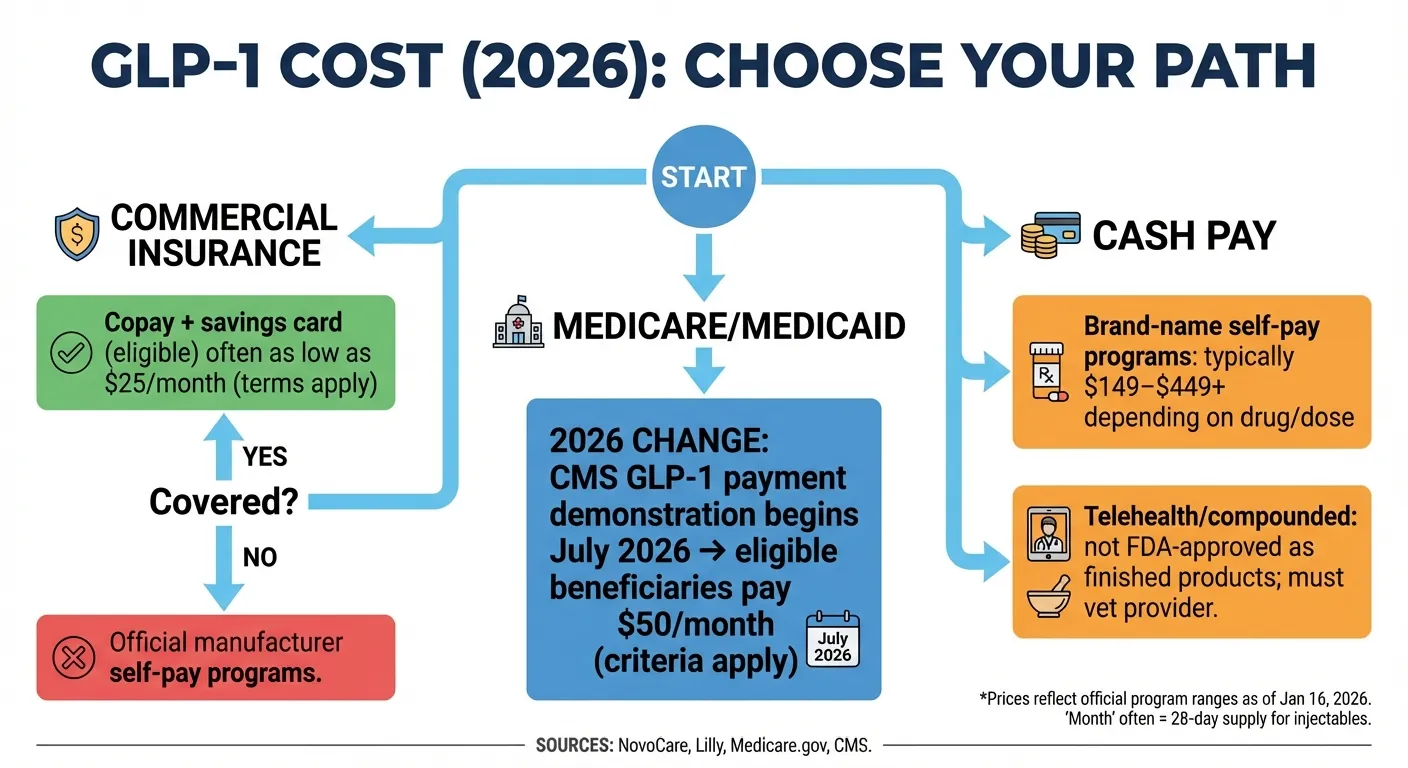
Start Here: The 60-Second "Real Cost" Estimator
Answer these in order. This is the shortest route to the number you'll actually pay.
1) Do you have insurance?
- Yes → go to #2
- No → go to #4
2) Is your insurance commercial (employer/ACA plan)?
- Yes → go to #3
- No (Medicare/Medicaid/VA/TRICARE) → jump to Medicare & Medicaid in 2026
3) Does your plan cover the specific GLP-1 you want?
Yes (covered): You're usually aiming for copay + savings card (often as low as $25 for Wegovy/Ozempic/Zepbound for eligible commercially insured patients).
No (not covered): You're usually aiming for manufacturer self-pay / cash pricing:
- Wegovy pen: $199/month (first 2 fills for new patients—limited window) then $349/month self-pay
- Zepbound pen: as low as $499/month with the savings program when commercial insurance does not cover
- Zepbound vials (self-pay): $299–$449/month depending on dose/refill timing
- Ozempic (self-pay): $199/month (first 2 fills for new patients—limited window) then $349–$499/month
4) If you're cash-paying (no insurance or not using insurance), what do you want most?
- FDA-approved brand-name: use the official manufacturer programs (see cash section)
- Lowest monthly cost + convenience: telehealth/compounded programs may be cheaper, but come with important tradeoffs (see compounded section)
If you follow that flow, you'll avoid the #1 pricing trap: walking into a retail pharmacy uninsured and paying the "walk-up" price.
The Official Price Reality in 2026
Let's put the confusing numbers into one clear view.
"List Price" / WAC (What Headlines Quote)
These are list prices (or wholesale acquisition cost) before discounts and programs. Novo Nordisk publishes Wegovy and Ozempic pricing on NovoCare. Lilly publishes savings details on their pricing pages—WAC figures below are reported by third-party sources like GoodRx:
| Medication | Active Ingredient | Reported List Price / WAC | Source |
|---|---|---|---|
| Wegovy pen | semaglutide | $1,349.02 per package | NovoCare |
| Wegovy pill | semaglutide | $1,349.02 per package | NovoCare |
| Ozempic | semaglutide | $1,027.51 per pen package | NovoCare |
| Zepbound pen | tirzepatide | ~$1,086 (WAC) for 4 pens (28 days) | Lilly Pricing Info |
| Mounjaro pen | tirzepatide | ~$1,080 (WAC) for 4 pens (28 days) | Lilly Pricing Info |
Important detail: Manufacturers often define "1 month" as 28 days (4 weeks), not a calendar month.
"What You Actually Pay" (Official Programs People Use)
The programs below are the legitimate reason you're seeing much lower numbers in 2026.
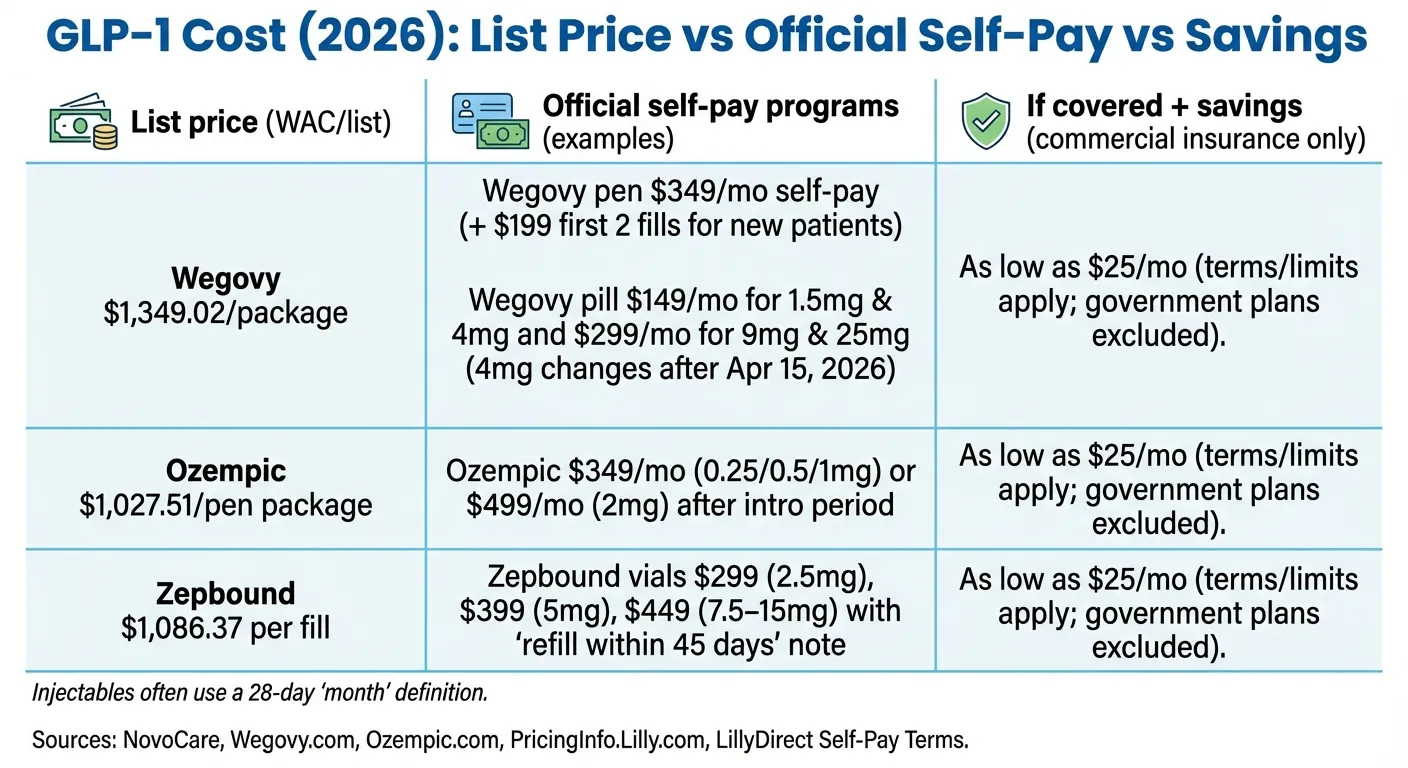
| Medication | If Commercial Insurance Covers It | If Not Covered / Self-Pay (Official Programs) |
|---|---|---|
| Wegovy pen | As low as $25/month for eligible patients (savings limits apply) | $199/month (first 2 fills for new patients; limited window) then $349/month self-pay |
| Wegovy pill | Coverage varies | $149/month (1.5 mg & 4 mg), $299/month (9 mg & 25 mg); 4 mg offer changes after Apr 15, 2026 |
| Ozempic | As low as $25/month for eligible patients (savings limits apply) | $199/month (first 2 fills; limited window) then $349/month (0.25/0.5/1 mg) or $499/month (2 mg) |
| Zepbound pen | As low as $25 for eligible patients with coverage (program limits apply) | As low as $499/month (commercial insurance but not covered) |
| Zepbound vials | N/A (self-pay channel) | $299/month (2.5 mg), $399/month (5 mg), $449/month (7.5–15 mg) with refill timing rules |
This table is your "receipt map." Almost every other GLP-1 cost article on the internet fails because it stops at the list price and never shows you the actual pathways.
Why GLP-1 Prices Feel Random (But Aren't)
When you search "GLP-1 cost," you're not just looking for a price—you're looking for certainty and control.
Here's the mental state most searchers are in:
- Overwhelmed by conflicting numbers
- Suspicious of affiliate hype
- Emotionally tired of "maybe insurance will cover it"
- Anxious that they'll start something they can't afford long-term
- Motivated because they've either struggled for years or just got a health scare
So instead of giving you generic averages, this guide answers the questions you're actually asking:
- What will I pay?
- What's the lowest legitimate option in my situation?
- What steps do I take today to get that price?
- What traps do I avoid?
- What changes in 2026 that could shift this?
Your "GLP-1 Cost Worksheet"
This is the fastest way to turn a confusing conversation into a number you can budget.
Step A — Fill in your insurance facts
- Plan type: Employer / ACA / Medicare / Medicaid / None
- Deductible remaining: $_____
- Coinsurance for specialty meds: ____%
- Out-of-pocket max remaining: $_____
- Does plan cover GLP-1 for weight management? Yes / No / Unknown
Step B — Get these three quotes (same day)
- Insurance price quote (test claim): $_____ / 28-day fill
- Insurance price + savings card (if eligible): $_____ / 28-day fill
- Official self-pay program price: $_____ / 28-day fill
Step C — Choose the cheapest sustainable number
The best price is the one you can keep paying in month 4, month 9, and month 18—not just month 1.
How to Get Your Exact Price in 10 Minutes
Most people waste weeks arguing with themselves instead of doing this:
1) Ask your pharmacy to run a "test claim"
You can do this even before you commit.
Script: "Hi—can you run a test claim for [medication name + dose] with my insurance and tell me my out-of-pocket cost for a 28-day supply? I'm not filling today; I just need the estimate."
This reveals:
- Whether the drug is covered
- Your deductible impact
- Whether prior authorization blocks it
- Your expected copay/coinsurance
2) If the claim is covered, stack a savings card (commercial insurance only)
- Wegovy: savings offer references "as low as $25/month" for eligible commercially insured patients; maximum savings apply.
- Ozempic: similar "as low as $25/month" for eligible commercially insured patients; maximum savings apply.
- Zepbound: "as low as $25" for eligible commercially insured patients with coverage (program rules apply).
Critical: These offers typically exclude government beneficiaries (Medicare/Medicaid/TRICARE/VA) and have monthly/annual limits.
3) If the claim is not covered, price the official self-pay options immediately
Don't wait for a denial letter before you compare.
- Wegovy pen self-pay: $199 first 2 fills (limited window) then $349/month
- Wegovy pill self-pay: $149 or $299 depending on dose; offer timing matters
- Zepbound: $499/month for pen when commercial insurance does not cover; or vials $299–$449/month via self-pay
- Ozempic self-pay: $199 first 2 fills (limited window) then $349–$499/month
Commercial Insurance: How to Pay the Least
This section is for employer plans and ACA marketplace plans.
Step 1 — Confirm coverage (don't assume)
Coverage can vary by:
- Plan design
- Employer choices
- Diagnosis/indication (what it's prescribed for)
- Prior authorization rules
Step 2 — Know the two gates that block most people
- Formulary status (covered vs excluded)
- Utilization management (prior auth, step therapy, quantity limits)
Step 3 — Build a clean "documentation packet" for prior authorization
You are not trying to game the system—you're trying to make your medical record match reality.
A strong packet usually includes:
- Current weight/BMI and history
- Weight-related conditions (if present)
- Documentation of lifestyle attempts
- Provider notes supporting medical need
(This is not a guarantee. Requirements differ by plan.)
Step 4 — Use the savings offer if you're eligible
If the medication is covered and you have commercial insurance, savings cards can materially reduce out-of-pocket costs for eligible patients (subject to program terms/limits).
Step 5 — If you're denied, treat it like a decision tree (not a dead end)
You generally have three rational paths:
- Appeal (if the reason is fixable via documentation)
- Switch to a covered alternative (if your plan covers a different GLP-1)
- Use official self-pay (if you want speed and predictable pricing)
The #1 Pricing Mistake: "Insurance Must Be Cheaper Than Cash"
Not always.
If you have:
- A high deductible that resets soon, or
- Coinsurance based on a high list price, or
- A plan that covers the drug but puts it on a specialty tier
…it is possible for official self-pay to be cheaper (and more predictable) than using insurance.
The simple break-even math
Compare:
- Insurance route: (your copay/coinsurance) + (deductible impact)
- Self-pay route: official program price
Pick the lower sustainable route.
Paying Cash for Brand-Name GLP-1s
If you want FDA-approved brand-name medication and you're paying cash, 2026 is materially better than prior years because the manufacturers now publicly support lower cash pricing.
1) Wegovy Pen Self-Pay Pricing (Novo Nordisk)
Wegovy.com outlines a self-pay pathway, including:
- $199/month for the first 2 fills for new patients (limited window + limited doses)
- $349/month self-pay price for Wegovy pen (all strengths)
2) Wegovy Pill Self-Pay Pricing (Novo Nordisk)
Wegovy now has an oral tablet option (Wegovy pills), and the official price guide lists:
- $149/month for 1.5 mg and 4 mg
- $299/month for 9 mg and 25 mg
- 4 mg pricing changes after April 15, 2026 (per the price guide)
3) Ozempic Self-Pay Pricing (Novo Nordisk)
Ozempic.com savings page includes:
- $199/month for the first 2 fills for new patients (limited window; specific low doses)
- Then $349/month for 0.25/0.5/1 mg pens or $499/month for 2 mg pens (self-pay pathway)
4) Zepbound Self-Pay (Lilly) — Pens vs Vials
Zepbound has two primary self-pay styles:
A) Zepbound pen savings (if commercial insurance doesn't cover):
- "As low as $499 for a 1-month supply" for eligible patients with commercial drug insurance that does not cover it
B) Zepbound vials (paying without insurance):
- $299/month (2.5 mg; starting dose)
- $399/month (5 mg)
- $449/month (7.5 mg, 10 mg, 12.5 mg, 15 mg) with refill timing rules
Zepbound's published terms clarify:
- "Month" is defined as 28 days and a 1-month supply for vials is 4 vials
- Regular (non-discount) vial pricing can be significantly higher at upper doses if refill timing rules are not met
What you should do if you're cash-paying
Decide in this order:
- Brand-name vs compounded
- If brand-name: choose the program that matches your drug (Novo vs Lilly)
- Compare starter dose pricing vs maintenance dose pricing (don't get surprised)
- Confirm what counts as "1 month" (often 28 days)
Medicare & Medicaid in 2026
This is where online articles are most often wrong—because rules change, and people mix up "weight loss" vs other FDA-approved indications.
Medicare Part D: What You Can and Can't Do
- Manufacturer savings cards generally exclude government beneficiaries (including Medicare)
- Out-of-pocket cost sharing rules for Part D changed under recent reforms, including an annual cap that is indexed after 2025 and payment smoothing options
The 2026 Medicare Numbers That Affect Your GLP-1 Budget
Medicare's official materials show:
- Maximum Part D deductible for 2026: $615
- Out-of-pocket cap for 2026: $2,100
- The Medicare Prescription Payment Plan allows beneficiaries to spread prescription costs across the year instead of paying large amounts early
The Major 2026 Policy Development: CMS GLP-1 Payment Demonstration + BALANCE Model
CMS announced a GLP-1 payment demonstration designed to expand access and lower costs, with patient out-of-pocket costs described as under $50/month in the announcement materials (eligibility and participation rules apply).
What this means practically:
If you are on Medicare or Medicaid and you've been "stuck" with no affordable path, 2026 is one of the first years where policy mechanisms—not just coupons—may change your out-of-pocket reality, depending on your eligibility and the program's rollout.
Medicaid: Why Your State Matters
Medicaid coverage varies by state and by managed care plan. The CMS BALANCE model is designed to create a pathway for more consistent access and lower prices, but state participation and implementation details matter.
Action step: If you're on Medicaid, your fastest answer is still:
- Check your state's preferred drug list / formulary
- Ask what the prior authorization criteria are
- Ask if your state is participating in relevant CMS models
The Indication Problem: Why "Weight Loss" vs "Heart Disease" vs "Diabetes" Changes Coverage
Even when the drug is the same molecule, insurance behavior can be different based on the FDA-approved use and payer rules.
Wegovy's cardiovascular indication (why it matters for coverage): The FDA approved Wegovy as the first weight-loss medication also indicated to reduce serious cardiovascular events in adults with established cardiovascular disease and obesity/overweight. This matters because coverage decisions often follow FDA indications and payer policy categories.
Zepbound's weight management indication: FDA approved Zepbound (tirzepatide) for chronic weight management in adults with obesity or overweight with at least one weight-related condition, alongside diet and physical activity.
Telehealth & Compounded GLP-1
You're seeing compounded GLP-1 everywhere because it often collapses the price to something people can actually pay.
Reuters reported in January 2026 that Novo Nordisk's CEO flagged about 1.5 million U.S. patients using compounded GLP-1 versions and described them as "unapproved alternatives," often cheaper than branded medications.
The Honest Tradeoff
Brand-name GLP-1:
- FDA-approved finished product
- Stronger supply chain controls
- Often higher cost unless you can access official programs
Compounded GLP-1 via telehealth:
- Often lower monthly cost
- Convenience (med + visits bundled)
- But compounded finished products are not FDA-approved as finished products, and quality/consistency can vary by pharmacy and sourcing (you must vet carefully)
The 9-Point "Don't Get Scammed" Checklist for Telehealth GLP-1
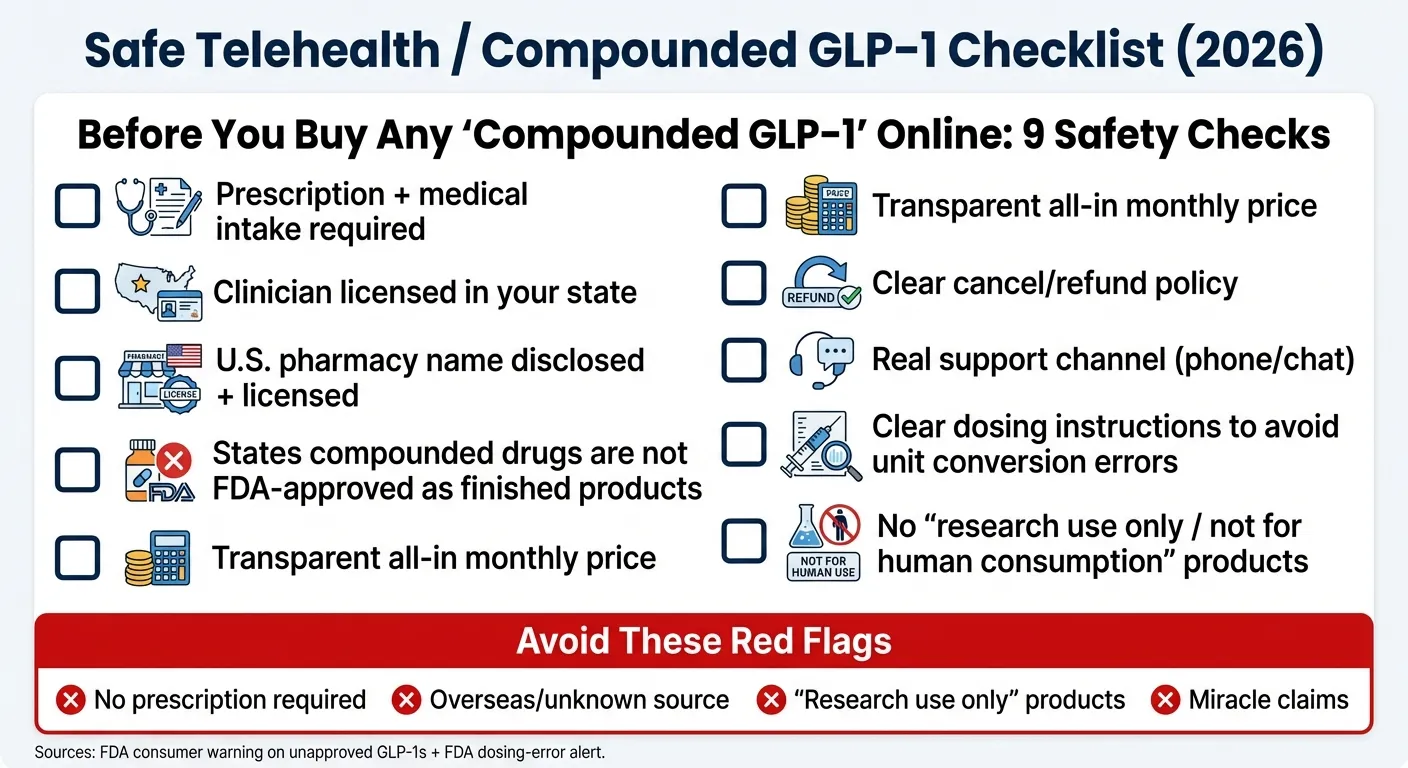
Before you pay, you should be able to answer yes to all of these:
- Do they require a prescription and a real medical intake?
- Is the clinician licensed in your state?
- Do they clearly disclose the pharmacy or pharmacy network?
- Do they explain what the medication actually is (brand vs compounded)?
- Do they show a total monthly price (not "starting at" only)?
- Do they disclose cancellation/refund policies?
- Do they provide a way to contact support?
- Do they have clear contraindication screening?
- Do they explicitly tell you what to do if you have side effects?
If you can't get clear answers, don't enroll.
Red flags to avoid:
- No prescription required
- Overseas/unknown source
- "Research use only" products
- Miracle claims
For step-by-step guidance on finding a legitimate provider, see our complete guide to getting GLP-1 prescribed online.
A Note on Telehealth Programs
If your top priorities are predictable monthly cost and a bundled telehealth program, and you're comfortable with the compounded model, there are legitimate cash-pay options available. Compare programs based on:
- Total all-in monthly price
- What's included (visits, shipping, support)
- Pharmacy licensing and sourcing transparency
- Cancellation terms
For our evaluation of top programs, see our cheapest GLP-1 without insurance guide.
MEDVi — Want predictable monthly pricing?
Physician oversight, medication, and shipping in one transparent price
The "Hidden Costs"
Even when the medication price looks clean, total cost can shift because of:
1) Provider Visits
- Some programs bundle visits
- Some charge separately
- Some require labs before prescribing
2) Lab Work
Your clinician may order labs depending on your history and medications.
3) Supplies (Especially for Vials)
Vials often require:
- Syringes/needles
- Alcohol swabs
- Sharps container
4) Side Effect Management
Some people need OTC remedies or occasional prescriptions for nausea/constipation. See our GLP-1 side effects guide for what to expect.
Rule: When comparing options, compare all-in monthly cost, not just "the vial price."
Cost Planning: What Your First 90 Days vs Month 6 Can Look Like
GLP-1 therapy often starts low and titrates. Costs can change if pricing differs by dose or if a program has introductory pricing.
Examples from official programs:
- Wegovy pen: intro pricing for new patients is limited to the first two fills for certain low doses (time-limited); ongoing self-pay pricing differs
- Ozempic: similar "first two fills" pricing then higher ongoing self-pay
- Zepbound vials: pricing depends on dose and refill timing; missing timing rules can trigger higher "regular" pricing at higher doses
The budgeting move: Plan your long-term budget using the maintenance pricing, not just the intro price.
FAQ
How much do GLP-1 medications cost per month in 2026?
It depends on the path. Manufacturer list prices for popular GLP-1s can be around $1,000–$1,349 per typical supply, but official savings and self-pay programs can bring that down to $149–$449/month (or $25 for eligible commercially insured patients using savings programs).
What's the cheapest legitimate brand-name GLP-1 option without insurance?
As of the official price guide, Wegovy pills have listed self-pay pricing at $149/month for certain doses (with timing rules), while Zepbound vials can be $299/month for the starting dose. Which is "cheapest" depends on what's medically appropriate for you.
What's the cheapest GLP-1 path overall?
Often it's either:
- Commercial insurance coverage + savings card (if eligible), or
- A cash-pay bundled telehealth/compounded program (if you accept the tradeoffs)
How much does Wegovy cost in 2026 without insurance?
Wegovy's list price is $1,349.02 per package, but Wegovy.com describes self-pay pricing options such as $349/month for the pen and dose-based self-pay pricing for Wegovy pills (including $149/month for certain doses).
How much does Zepbound cost without insurance?
Zepbound's WAC for pens is listed at $1,086.37 for a 28-day carton of 4 pens, but the savings and self-pay options can reduce the price substantially (including vials at $299–$449/month depending on dose and refill timing).
How much does Ozempic cost without insurance?
Novo Nordisk reports Ozempic's list price (WAC) at $1,027.51 per pen package, and Ozempic.com describes a self-pay savings pathway that can be $349–$499/month after introductory pricing, depending on dose.
Do manufacturer savings cards work with Medicare?
Savings programs typically exclude "governmental beneficiaries," including Medicare, per the published terms on manufacturer savings pages.
What is the CMS GLP-1 payment demonstration and why does it matter?
CMS announced a GLP-1 payment demonstration and the BALANCE model aimed at expanding access and lowering costs, with materials referencing beneficiary out-of-pocket costs under $50/month for eligible participants (details depend on the program rules).
What are the 2026 Medicare Part D cost caps I should know?
Medicare's published materials show a $615 maximum deductible and an out-of-pocket cap of $2,100 for 2026.
Is it "legal" to get compounded GLP-1 online?
Telehealth prescribing is legal when done by appropriately licensed clinicians and fulfilled by appropriately licensed pharmacies, but the key is that compounded finished products are not FDA-approved finished products and quality can vary—so you must vet the provider and pharmacy.
How do I compare brand-name self-pay to a telehealth program?
Compare:
- Total monthly price (all-in)
- What's included (visits, shipping, support, labs)
- Brand-name vs compounded
- Cancellation/refund terms
Glossary
| Term | Definition |
|---|---|
| List Price / WAC | Manufacturer-reported base price before discounts |
| Formulary | Your plan's drug list |
| Prior Authorization (PA) | Plan requires documentation before covering |
| Copay | Fixed dollar amount you pay |
| Coinsurance | Percentage of the cost you pay |
| 28-day supply | How "one month" is often defined for these programs |
Sources & Methodology
We prioritize:
- Official manufacturer pricing/savings pages (Wegovy.com, Ozempic.com, Zepbound/LillyDirect)
- Manufacturer price disclosures and WAC disclosures
- CMS / Medicare official materials for policy and cost caps (Medicare.gov, CMS.gov)
- FDA approvals and prescribing information for indications
Update policy: We re-check official pricing pages and government policy sources monthly, and sooner if major changes occur. If any program changes materially, we update the tables and log the change.
Change log:
- January 16, 2026: Updated/verified manufacturer self-pay and savings pricing; added CMS demonstration/BALANCE references; verified Wegovy pill self-pay pricing details.
Your Next Step
If you have commercial insurance:
- Run a test claim
- If covered: add the savings card
- If not covered: compare the official self-pay programs immediately
If you're paying cash:
- Decide: brand-name self-pay vs telehealth/compounded
- Compare maintenance pricing (not just intro pricing)
- Budget for the full year
If you're on Medicare/Medicaid:
- Know your Part D cap rules and payment plan option
- Track CMS updates for the GLP-1 demonstration/BALANCE model and eligibility
MEDVi
$179 first month, $299/month ongoing. No contract required.
Related Guides
How we rank + verify
Last verified: March 20, 2026
What we verified: Manufacturer WAC pricing from Novo Nordisk and Eli Lilly official disclosures. Self-pay program terms from Wegovy.com, Ozempic.com, and LillyDirect. Medicare Part D 2026 parameters from CMS.gov. CMS GLP-1 demonstration announcement details.
Sources: NovoCare, Wegovy.com, Ozempic.com, PricingInfo.Lilly.com, LillyDirect, CMS.gov, Medicare.gov, FDA prescribing labels
Related Articles
Learn how to get GLP-1 prescribed online safely. Eligibility, costs, insurance, pharmacy verification, and step-by-step guide.
Oral GLP-1 is here. Compare FDA-approved Wegovy tablets vs compounded programs—pricing, safety, side effects, and how to buy online.
How GLP-1 medications like Ozempic and Wegovy work for weight loss. Mechanism map, clinical trial results, side effects, and decision framework.
A comprehensive guide to GLP-1 medication side effects, how to manage them, and when to contact your doctor. Based on FDA prescribing information.
This content is educational only and does not replace professional medical advice. Always consult a qualified healthcare provider before starting any medication.