Short-Term GLP-1 Treatment Providers: 9 Picks for a 1-to-6-Month Plan (2026)
By Weight Loss Provider Guide Research Team · Last verified: · Editorial policy · Affiliate disclosure
Next scheduled verification: June 2026.
Weight Loss Provider Guide is an independent comparison resource. If you use our links, we may earn a commission at no extra cost to you. Our rankings are based on publicly verifiable pricing, cancellation terms, FDA status, and editorial fit — not affiliate payout rates.
The honest answer up front.
If you searched “short term GLP-1 treatment providers,” you probably want one of two things — a 3-month plan with no subscription trap, or month-to-month flexibility so you can stop anytime. Here are the picks for both, verified this week against each provider’s published terms and FDA records.- Best FDA-approved + month-to-month + insurance support: Ro — $39 for the first month, then as low as $74/month with annual plan paid upfront ($149/month if you stay monthly). Cancel anytime.
- Best FDA-approved + cancel-anytime telehealth subscription: GoodRx Care Direct — $39/month telehealth subscription, FDA-approved medication priced separately.
- Best FDA-approved + no subscription at all: Walgreens Weight Management — $49 per visit, no recurring charge.
- Best for needle-averse patients + low starter price: Embody — from $99 first month for compounded semaglutide injections or $149 for needle-free GLP-1 gum; cash-pay with 24/7 support.
- Best async, lowest-friction compounded: Yucca Health — async provider review, ~24-hour turnaround, “change or cancel treatment at any time” per their published page.
One thing nobody is telling you, and we will.
GLP-1 medications were not designed for short-term weight loss. The University of Utah Health weight management team puts it plainly — “GLP-1s are not meant for a short-term or cosmetic weight loss.” Randomized trials show that most adults who stop after a defined window regain a meaningful share of the weight within roughly 12 months unless they have a real exit plan in place. That doesn’t mean a 3-to-6-month plan is impossible or unreasonable — it means you need an off-ramp plan before your first dose. We cover that below.Two important regulatory disclosures up front.
Two providers on this page — Fifty410 and MEDVi — received FDA warning letters on February 20, 2026 for false or misleading marketing claims about compounded GLP-1 products. Both are still operating, but a reasonable short-term searcher needs to know this before paying. We disclose the full context inside each provider’s section and mark it in the comparison table.Not sure which path fits your situation?
Take the free 60-second quiz — we’ll match you to the right provider based on your timeline, budget, state, and insurance status.
On this page
- → Quick comparison: 9 providers scored
- → Should you even take a GLP-1 short-term?
- → When a short-term plan makes sense (and when it doesn’t)
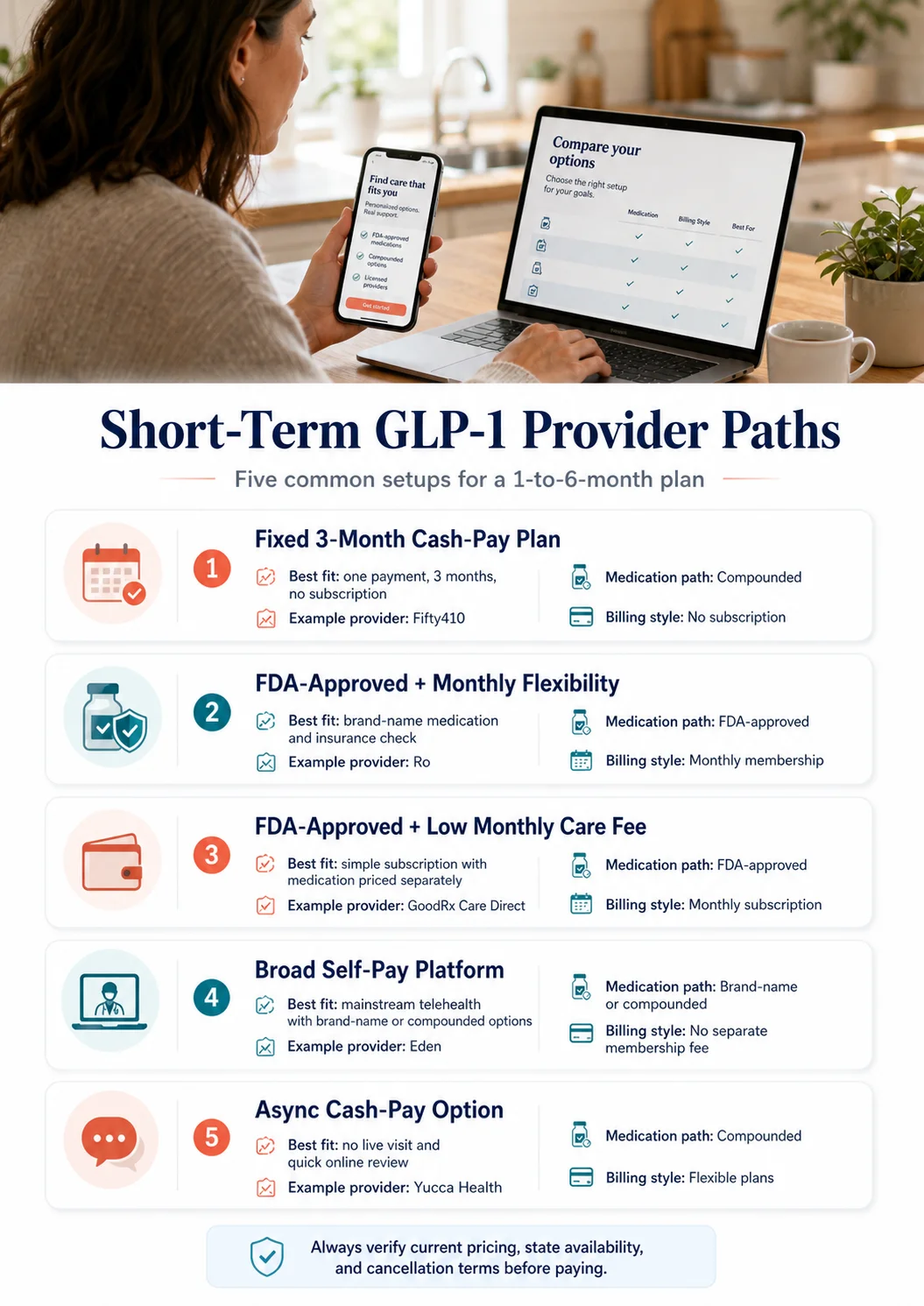
- → The 5 paths a short-term searcher can take
- → Which providers are easiest to cancel?
- → How much will 3 months really cost?
- → Ro — FDA-approved + month-to-month
- → GoodRx Care Direct — FDA-approved + cancel-anytime sub
- → Walgreens — no subscription FDA-approved
- → Embody — low starter price + GLP-1 gum
- → Sesame Care — FDA-approved with provider choice
- → Yucca Health — async, lowest-friction compounded
- → Em (Embody) — mid-priced flexible compounded
- → Providers with active FDA warning letters
- → The 4-step exit playbook
- → 8-point checklist before you pay anyone
- → State availability
- → Insurance, HSA/FSA, and Medicare GLP-1 Bridge
- → Compounded vs FDA-approved: the line we never blur
- → Frequently asked questions
- → The bottom line
Quick comparison: 9 short term GLP-1 treatment providers scored on what actually matters
We compared every provider on the seven things that decide whether a “short-term” plan stays short-term — or quietly turns into a 12-month auto-renewal. Scores reflect fit for someone who specifically wants a 1-to-6-month plan, not overall provider quality.
| Provider | Best for | First-month cost | Subscription? | Medication type | FDA warning? | Short-term fit |
|---|---|---|---|---|---|---|
| Ro | FDA-approved + flexibility + insurance help | $39 (membership) | Monthly, cancel anytime | FDA-approved (Wegovy, Zepbound, Foundayo, Ozempic) | No | 92 |
| GoodRx Care Direct | FDA-approved + cancel-anytime sub | $39 (membership) | Monthly, cancel anytime | FDA-approved only | No | 88 |
| Walgreens | FDA-approved + no subscription | $49 per visit + medication | None | FDA-approved only | No | 86 |
| Embody | Low starter price + needle-free gum option | From $99 first month | Monthly refills; cancel anytime | Compounded GLP-1 (injections/gum) | No | 84 |
| Sesame Care | Brand-name + provider choice | Care from $59/mo + medication | Subscription | FDA-approved | No | 80 |
| Yucca Health | Async, BNPL-friendly | $175 first month (monthly plan) | Monthly default; multi-month optional | Compounded | No | 78 |
| Em (Embody) | Mid-priced flexible compounded | $149 first month (verify current rate) | “No contract” — monthly | Compounded | No | 74 |
| Fifty410 | True 3-month no-subscription billing | From ~$199/mo or ~$299 for 3-month bundle | None | Compounded only | Yes (Feb 20, 2026) | 66 |
| MEDVi | Low-cost no-contract compounded | $179 first month | Month-to-month | Compounded | Yes (Feb 20, 2026) | 62 |
How we scored: 25 points for billing structure (no subscription = highest), 20 for cancellation friction, 20 for clarity around what happens after month three, 15 for first-month value, 10 for compounded-vs-FDA-approved transparency, 10 for practical access (state availability, HSA/FSA, BNPL, insurance). Active FDA warning letters reduce the final score because they are material information for a reader making a YMYL medical and financial decision. Verified May 5, 2026.
We don’t take payment from providers in exchange for ranking. We do earn a commission when readers click through to some of these — disclosed throughout. We never claim a compounded medication has been “clinically proven” or is equivalent to a brand-name FDA-approved drug.
Should you even take a GLP-1 short-term? The honest medical answer
GLP-1 medications are designed as long-term obesity care, not as a 90-day cosmetic cut. Multiple major medical centers and peer-reviewed trials show that most people regain a significant share of lost weight within roughly 12 months of stopping. A defined-window plan (3 to 6 months) is something you can discuss with a clinician, but it works dramatically better when paired with an off-ramp plan you build before your first dose.
The hard truth most affiliate pages won’t tell you: when researchers at Yale, the University of Utah, MUSC, and Cleveland Clinic talk about how long someone should be on a GLP-1, they don’t say “3 months.” They say long-term, the same way doctors talk about blood pressure medication. The University of Utah Health team is direct: “GLP-1s are not meant for a short-term or cosmetic weight loss.” Cleveland Clinic explains that when you stop, hunger returns, food noise can return, and the biological drivers of weight regain reassert themselves.
The randomized data backs them up. The STEP 1 trial extension (Wilding et al., 2022) followed people who took semaglutide for 68 weeks and then stopped — at one year off the medication, participants had regained roughly two-thirds of the weight they had lost. The STEP 4 trial (JAMA, 2021) found the same direction: people who stopped semaglutide after the run-in period gained weight while those who continued lost more. The 2025 SURMOUNT-4 post-hoc analysis (tirzepatide withdrawal) and the 2026 Lancet eClinicalMedicine systematic review confirmed similar regain patterns across both drug classes.
But here’s the trust-building pivot: a defined-window plan can work if you go in with eyes open. The reader who beats the regain trajectory:
- Builds nutrition and resistance-training habits during the medication window
- Doesn’t quit cold turkey — talks to their provider about a step-down
- Asks the provider whether maintenance dosing makes sense
- Re-evaluates at month 6 instead of pre-committing to “stop forever”
The provider you pick matters less than the plan you build. We’ll show you both.
When a short-term GLP-1 plan actually makes sense (and when it doesn’t)
A 3-to-6-month GLP-1 trial is reasonable to discuss with a clinician if you have a clear bridge purpose, financial reality, or pre-event window — and unreasonable for cosmetic weight loss, undefined goals, or anyone with the medical contraindications below.
Reasonable reasons to consider a defined-window plan
- Financial reality. You can afford 3 months but not indefinite therapy. Better to start with a real plan than to wait.
- Coverage gap. You’re waiting on prior authorization, the next plan year, or the new Medicare GLP-1 Bridge (July 1 – December 31, 2027) for eligible Medicare Part D members.
- Pre-event or pre-surgical window. Wedding, reunion, surgery prep, military fitness test, structured pre-op weight loss requirement.
- Tolerability trial. You want to know if you can handle the medication before signing up for a year.
- Plateau-breaker after habit work. You’ve already done the lifestyle work and want medical support to break through.
When short-term GLP-1 is the wrong frame
- You want to lose 5 to 10 cosmetic pounds. GLP-1s are designed for adults with a BMI of 30+, or 27+ with a weight-related condition.
- You’re pregnant, breastfeeding, or planning to be in the next ~3 months.
- You have a personal or family history of medullary thyroid carcinoma (MTC) or MEN2. These are absolute contraindications.
- You have active or past pancreatitis, severe gastrointestinal disease, gastroparesis, or an active eating disorder. These need an in-person clinician.
- You’re managing complex diabetes medications. The combinations need real coordination.
If any of those apply to you, this isn’t the page for you — and we’d rather lose you to your primary care doctor than ship you to a telehealth provider who’ll prescribe over a 5-minute intake.
The 5 paths a short-term GLP-1 searcher can take
“Short term” is not one query — it’s five. The right provider depends on whether you want a true no-subscription pay-per-visit structure, FDA-approved medication with cancel-anytime billing, broad self-pay flexibility, FDA-approved with insurance help, or a needle-free niche format.
| Your situation | The path that fits | Top pick |
|---|---|---|
| “I want FDA-approved medication, monthly billing, cancel anytime.” | FDA-approved + flexibility | Ro |
| “I want FDA-approved medication and the cheapest possible monthly subscription I can quit.” | FDA-approved + cancel-anytime sub | GoodRx Care Direct |
| “I want zero subscription — pay only when I see a provider.” | FDA-approved + no subscription | Walgreens |
| “I want a familiar telehealth brand with broad menu and self-pay flexibility.” | Broad in-network self-pay | Embody |
| “I have insurance — check coverage first.” | FDA-approved + insurance support | Ro (insurance concierge) or Sesame |
| “I’m needle-averse.” | Oral/sublingual options | FDA-approved Wegovy pill or Foundayo via Ro or GoodRx; compounded oral or GLP-1 gum via Embody |
| “I want absolute lowest first-month cost with no contract.” | Low-friction compounded | Em ($149 first month) |
Which short-term GLP-1 providers are easiest to cancel?
Cancellation friction varies dramatically. Walgreens is the strictest “pay only when you visit” model — there’s nothing to cancel. Yucca Health’s published page says you can change or cancel treatment at any time. Embody offers monthly refills with no long-term contract. Hims and Hers require 3-, 6-, 10-, or 12-month prepaid plans that are non-refundable after purchase — that structure is incompatible with short-term flexibility.
| Provider | Min commitment | Cancellation method | Notice required | Refund on shipped medication |
|---|---|---|---|---|
| Walgreens | None | No subscription | None | N/A — pay per visit |
| Yucca Health | None on monthly | Provider portal | Per published page | Generally none after fulfillment |
| Ro Body | None | Account portal | Cancel anytime | Membership only; medication separate |
| GoodRx Care Direct | None | Account portal | Cancel anytime | Subscription only; medication separate |
| Embody | None | Member portal | Cancel before fulfillment | None after pharmacy fulfillment |
| Fifty410 | None | Reorder when ready | None — no auto-charge | N/A — no auto-renewal |
| MEDVi | None | Portal or chat | 72 hours before next bill | None on shipped medication |
| SHED | 2 months | Account portal | 72 hours before next bill | None after shipment |
| Hims/Hers | 3, 6, 10, or 12 months | Account portal | Per plan terms | Non-refundable after purchase |
How much will 3 months of GLP-1 treatment really cost?
A truthful 3-month total depends on whether the medication is included in the price, whether there’s a separate membership fee, and whether the dose changes mid-program. Headline “as low as $X/month” prices almost always assume the longest prepaid plan — not the monthly cancel-anytime plan a short-term searcher actually wants.
| Provider | Care/membership over 90 days | Medication starting cost over 90 days | What’s separate |
|---|---|---|---|
| Ro (Wegovy pill, lowest dose) | $39 first month + ~$149 next two ≈ $337 | From ~$149/mo × 3 = ~$447 | Pill priced separately |
| GoodRx Care Direct (Wegovy pill) | $39/mo × 3 = $117 | From ~$149/mo × 3 = ~$447 | Medication separate |
| Walgreens (FDA-approved) | $49 × 3 visits = $147 | From $149/mo × 3 = ~$447 | Labs may be separate |
| Sesame (annual care + branded med) | Care from $59/mo × 3 = $177 | From $149/mo × 3 = ~$447 | Labs may be separate |
| Yucca Health (semaglutide+, monthly) | Bundled | $175 first month + standard refills | Free 2-day shipping included |
| Embody (compounded) | Bundled — verify current rate | $99 first month + standard refills | None typical |
| Fifty410 (compounded sema) | $0 — no subscription | From ~$299 for 3-month bundle, or ~$199/mo monthly | None typical; shipping included |
| MEDVi (compounded sema) | Bundled | $179 first month + $299 × 2 = ~$777 | None typical |
Three things to read carefully before you pay anywhere:
- Is medication included or separate? Embody, Yucca, Fifty410, and MEDVi bundle. Ro, GoodRx, Walgreens, and Sesame separate them. The headline number tells you nothing if you don’t know which model you’re looking at.
- What happens at dose escalation? Some providers lock in the same price as your dose increases. Others raise the price.
- What’s the auto-renewal trigger? Fifty410 and Walgreens have none. Most subscription providers auto-bill until you cancel — usually with a 72-hour or 21-day notice rule.
Ro — best FDA-approved + month-to-month path
Short-term fit score: 92
Ro Body is the strongest short-term-friendly path for FDA-approved GLP-1 medications. Get started for $39, then as low as $74/month with annual plan paid upfront ($149/month if you stay monthly). You can cancel anytime, get the lowest cash-pay prices on Wegovy, Zepbound, and Foundayo (matched to LillyDirect®, NovoCare®, and TrumpRx pricing), and Ro’s insurance concierge handles prior authorization paperwork at no extra charge.
Why we put Ro first for FDA-approved short-term searchers
If you want flexibility and you want FDA-approved medication (not compounded), Ro is the cleanest fit on the market. The membership is cash-pay only, but if you decide to stop after month three, you cancel through the portal. No 12-month contract. No prepaid lock-in on the membership.
The medication options on Ro are also the broadest FDA-approved menu in telehealth: Wegovy® pill (oral semaglutide approved for weight loss), Wegovy® pen, Zepbound® pen, Zepbound® KwikPen®, Foundayo™ (orforglipron oral pill, FDA-approved April 1, 2026), and Ozempic® (off-label for weight loss when clinically appropriate). Ro says its FDA-approved GLP-1 cash-pay medication prices match LillyDirect, NovoCare, and TrumpRx, with options starting at $149/month.
The insurance piece is where Ro genuinely earns it. Ro’s insurance concierge actually fights for prior authorization, submits the paperwork, and follows up with your insurer. They also publish a free GLP-1 Insurance Coverage Checker that takes 30 seconds — most readers should run this before paying anyone in cash, because it can mean the difference between $1,300/month retail and a $25 copay.
- Cancel anytime through the portal — no minimum commitment
- Broadest FDA-approved formulary in telehealth (Wegovy pen/pill, Zepbound, Foundayo, Ozempic)
- Insurance concierge handles prior authorization at no extra charge
- Free GLP-1 Insurance Coverage Checker (30 seconds)
- Cash-pay prices matched to LillyDirect and NovoCare
- Included labs, 1:1 health coaching, licensed provider check-ins
- Does NOT offer compounded oral semaglutide, sublingual tablets, or microdose compounded options
- No HSA/FSA accepted at checkout
- Membership fees non-refundable once charged
- Ro Body unavailable in HI, LA, MS, VA
Best for: Anyone who wants FDA-approved medication, anyone with commercial insurance worth checking, anyone who values being able to cancel through a portal in two clicks.
Not for: Anyone who specifically wants compounded oral or microdose options, anyone on Medicare or Medicaid who can’t access cash-pay alternatives.
GoodRx Care Direct — best FDA-approved + cancel-anytime subscription
Short-term fit score: 88
GoodRx for Weight Loss (Care Direct) is a $39/month telehealth subscription that connects you to licensed providers who can prescribe FDA-approved GLP-1 medications. Medication is priced separately, but GoodRx negotiates manufacturer-direct cash prices: the Wegovy pill is from $149/month for the 1.5 mg dose, Foundayo from $149/month, and Wegovy and Ozempic injection pens from $199/month for the first two fills of the lowest doses (then $349/month). Cancel the subscription anytime.
Why GoodRx Care Direct is a real short-term option
This is the newest entrant on this list (launched November 2025) and quietly one of the cleanest FDA-approved cancel-anytime structures in the category. The math: $39/month subscription fee plus medication (Wegovy pill from $149/mo for the 1.5 mg dose, Foundayo from $149/mo, Wegovy/Ozempic pens from $199/mo intro for the lowest doses). Cancel the subscription anytime through GoodRx. All medications are FDA-approved — no compounded options.
The math works out to roughly $564 minimum for the Wegovy pill path over 3 months (≈$117 in care fees + ≈$447 in medication for the lowest doses). For comparison, that beats almost every “low-cost” compounded program once you add up the membership fees compounded providers don’t show in the headline.
Throughout early 2026, the FDA issued warning letters to more than 30 telehealth companies for misleading marketing of compounded GLP-1s. GoodRx Care Direct doesn’t carry compounded medications at all, which removes one significant regulatory variable from your decision.
- $39/month subscription — cancel anytime
- All FDA-approved medications, no compounded options
- Wegovy pill and Foundayo from $149/month
- Launched November 2025 — newest clean FDA-approved option
- No compounded options
- $39/month is a recurring charge until you cancel
- Pens from $199/mo intro, then $349/month at standard rates
Best for: Anyone who wants FDA-approved medication with the lowest possible care subscription, anyone who specifically wants the new oral options (Wegovy pill or Foundayo).
Not for: Anyone who wants compounded medication or zero recurring charges.
Walgreens Weight Management — best no-subscription FDA-approved benchmark
Short-term fit score: 86
Walgreens runs a $49 per visit FDA-approved GLP-1 program with no subscription required and no long-term commitment. Medications start from $149/month for eligible doses. Labs are required for additional refills. Walgreens does not handle insurance prior authorization through this program.
Why Walgreens is on this list
For a reader who specifically wants “no subscription + brand-name medication + a name they recognize,” Walgreens is one of the cleanest fits we’ve verified. You pay $49 for a video visit with a Walgreens Weight Management clinician, you get FDA-approved medication if appropriate, and you don’t sign up for anything ongoing — you pay $49 again only when you need another visit. The first few months include monthly follow-up visits as your dose escalates; after that, you need labs (HbA1c plus a metabolic panel) for additional refills.
- $49 per visit — no subscription, no auto-renewal
- FDA-approved brand-name medications from $149/month
- Well-known national pharmacy brand
- No minimum commitment — pay only when you need a visit
- No insurance or prior authorization support — out-of-pocket only
- Labs required for additional refills
- Not available in all states
Best for: Anyone who specifically wants a national-pharmacy-brand experience with no subscription whatsoever.
Not for: Anyone who wants insurance support, anyone whose state doesn’t have Walgreens Weight Management coverage.
Embody — best for needle-free GLP-1 gum + low starter price
Short-term fit score: 84
Embody is a cash-pay telehealth GLP-1 program for people who want a low starting price, fast online intake, weekly semaglutide or tirzepatide injections, or a needle-free GLP-1 gum option. Plans start at $99 for the first month of semaglutide injection ($149 for semaglutide gum or tirzepatide injection); standard refills run $299–$449/month depending on medication and form. If a licensed provider approves treatment, medication ships to your door with 24/7 support. Embody's shipped options are compounded GLP-1 medications, not FDA-approved finished drugs.
Why Embody fits a short-term trial
For many short-term searchers, the “needle-free” aspect of Embody’s GLP-1 gum is the deciding factor. It provides a niche alternative to weekly injections that is often easier to trial for a defined 3-month window. Because Embody is a cash-pay program, there are no complex insurance hoops to jump through, and the intake process is designed for speed.
The pricing structure is straightforward for a trial: a low first-month entry price followed by standard refill rates. There is no long-term contract requirement, making it a viable bridge for those waiting on insurance or who want to test their tolerability of compounded GLP-1 medications before committing to a longer path.
- Lowest first-month starting price ($99 semaglutide injection)
- Unique needle-free GLP-1 gum option (semaglutide and tirzepatide)
- Fast online intake (often within 24 hours) and ship-to-door delivery
- Cash-pay model with no insurance requirement; HSA/FSA accepted
- 24/7 care-team messaging and clinician oversight
- Shipped medications are compounded, not FDA-approved finished drugs
- Standard monthly refill prices ($299–$449) are higher than intro rates
- Broad U.S. availability, confirmed at intake
- No branded Wegovy/Ozempic/Zepbound dispensed
Best for: Cash-pay patients who want the lowest first-month price and a needle-free GLP-1 gum option.
Not for: Anyone requiring FDA-approved brand-name drugs or insurance coverage.
Sesame Care — best FDA-approved with provider choice and labs
Short-term fit score: 80
Sesame Care offers FDA-approved GLP-1 access (Wegovy, Zepbound, Ozempic, Foundayo) with provider choice and labs as part of the experience. Care starts as low as $59/month with annual plan; medications are priced separately starting from $149/month. The strongest fit for readers who want to pick their provider and get labs included.
Why Sesame fits a specific kind of short-term searcher
Sesame is structured differently from most telehealth platforms — instead of being assigned a provider, you choose one from their network. They have one of the broadest FDA-approved formularies in self-pay telehealth, and Costco members get specific pricing on certain medications through Sesame’s partnership.
The honest math for short-term:
The annual plan brings care to ~$59/month — which is great if you’re committed for a year. Monthly cancel-anytime is more expensive per month. Add medication (separate, from $149/month for the lowest-priced FDA-approved options) and you’re looking at a 3-month cost in the range of $626+ minimum.- Choose your own provider from Sesame’s marketplace
- Broad FDA-approved formulary (Wegovy, Zepbound, Ozempic, Foundayo)
- Labs included in some plans
- Costco member discounts on certain medications
- Lowest care price requires the annual plan — not truly short-term-friendly
- No compounded medication options
- Medication priced separately on top of care subscription
Best for: Brand-name shoppers who want to pick their provider, Costco members, anyone who wants labs included.
Not for: Anyone who specifically wants compounded medication or wants the absolute lowest monthly care subscription.
Yucca Health — best async, lowest-friction compounded
Short-term fit score: 78
Yucca Health is the lowest-friction async GLP-1 path we verified — no live video visit required, provider review typically within 24 hours, “change or cancel treatment at any time” per their published page, and BNPL options through Klarna, Affirm, and Afterpay. Compounded semaglutide+ starts at $175 for the first month on monthly billing, with multi-month plans available from as low as $146/month on the 6-month plan.
Why Yucca makes the short-term list
Yucca’s intake is the simplest in the category. You complete an online questionnaire, a licensed U.S. provider reviews it asynchronously (no scheduled video visit), and you typically hear back within 24 hours. Their published product pages explicitly state “Change or cancel treatment at anytime!” — which we verified on both the semaglutide+ and tirzepatide+ product pages on tryyucca.com.
For short-term searchers, three things matter at Yucca
- The first-month price is honest. $175 first month for semaglutide+ on monthly billing isn’t an intro rate that doubles month two without warning.
- Multi-month plans are optional, not mandatory. Yucca lists 3- and 6-month plans with discounts (semaglutide+ from as low as $146/month on the 6-month plan) — but you don’t have to pick one.
- BNPL flexibility. Klarna, Affirm, and Afterpay are accepted, which is real for a cost-conscious flex-shopper.
“The app is very easy to navigate, and my medication arrived clearly labeled.”
— Mathylsha R., Verified Patient, published on tryyucca.com. Selected for what it’s actually telling you — that the operational experience is solid. Not for medical efficacy. Individual results vary.
- No live video visit required — async intake, ~24-hour review
- Cancel or change treatment at any time per published page
- BNPL accepted (Klarna, Affirm, Afterpay)
- Free 2-day UPS shipping
- Tirzepatide+ with B12 also available
- Compounded only — no FDA-approved brand-name options
- Lowest per-month pricing requires committing to the 6-month plan
Best for: Anyone who hates scheduling video visits, anyone who wants BNPL, anyone who values speed.
Not for: Anyone who wants brand-name medication or a real-time provider call.
Em (Embody) — mid-priced flexible compounded with notable transparency
Short-term fit score: 74
Em (joinem.co) offers compounded semaglutide and tirzepatide with promotional first-month pricing (from $149 first month based on recent verification — confirm current rate at sign-up) and no contract. Refills run higher than the first month. The platform includes a metabolic report and 1:1 guidance in the first month, plus 24/7 specialist support.
Why Em earned a spot
Em positions itself with one of the lowest first-month prices for a compounded GLP-1 program with real provider review — recent verification showed $149 for the first month including a metabolic report and 1:1 guidance, plus access to 24/7 specialist support. There’s no contract, billing is monthly, and the first-month value (intake, labs review, plan, medication) is genuinely different from “discount semaglutide and call us if you need us.”
What sets Em apart is something we noticed buried on their site: their FAQ explicitly states “GLP-1 medications (not FDA approved) are designed for long-term use and are not intended as a short-term solution. If treatment is stopped, the factors that previously contributed to weight gain may return.” That’s an unusual level of honesty for a compounded GLP-1 provider — and we credit it.
- $149 first month (verify current rate) — lowest verified first-month among compounded options
- No contract — monthly billing
- Metabolic report and 1:1 guidance included in first month
- 24/7 specialist support
- Oral tirzepatide chewable available (needle-averse option)
- HSA/FSA accepted
- Unusual transparency about GLP-1 being designed for long-term use
- Refill pricing is higher than Yucca’s monthly
- Compounded only — not FDA-approved brand-name
- Intro pricing ($99–$149) jumps to higher rates at refill — verify carefully
Best for: Anyone who wants real first-month value (metabolic report + guidance), anyone who prefers needle-averse compounded options.
Not for: Anyone optimizing strictly for lowest long-term per-month price.
Compounded providers with active FDA warning letters: what you should know
On February 20, 2026, the FDA issued warning letters to two compounded GLP-1 providers featured in many “best short-term” comparison pages: Fifty410 (warning letter #721481) and MEDVi (warning letter #721455). Both letters cited false or misleading marketing claims on the providers’ websites — specifically, language that implied FDA approval or evaluation of compounded products. The letters did not address medication safety, but they are material information for a reader making a YMYL medical and financial decision.
In March 2026, the FDA issued additional warning letters to more than 30 telehealth companies for similar marketing violations across the compounded GLP-1 industry. A warning letter is an enforcement communication, not a finding of guilt — companies have the opportunity to respond and correct cited issues, and many do successfully. But a reasonable short-term searcher needs to know this context before choosing.
Fifty410 — true 3-month no-subscription billing structure
Short-term fit score: 66 (scored down for active FDA warning letter)
On the operational side, Fifty410 is the cleanest no-subscription compounded billing structure we verified. Their FAQ literally states programs are “ideal for short-term flexibility and trying different options.” No membership fee, no auto-renewal, no card on file, no contract, and you pay only after a licensed provider approves you. Compounded semaglutide programs start around $199/month with a 3-month bundle from approximately $299. Medication ships all at once after approval. Their Trustpilot rating sits at 5 stars across thousands of reviews.
On the regulatory side, you need to know:
On February 20, 2026, the FDA issued warning letter #721481 to Aspen Aesthetics dba Fifty 410, citing false or misleading marketing claims on their website. The letter specifically called out two issues: (1) the products displayed on the website included “Fifty 410” on the pictured label, suggesting Fifty410 was the compounder of those drugs when in fact it was not, and (2) the website used the phrase “clinically proven ingredients” — which the FDA stated implied that Fifty410’s products had been FDA-approved or evaluated for safety and effectiveness when they had not.
Fifty410 was given 15 working days to respond to the FDA. The letter did not address medication safety. The full warning letter is publicly available on FDA.gov.
What this means for a short-term searcher:
The cleanest no-subscription billing structure on the market is paired with active FDA enforcement context for marketing claims. If you specifically want a 3-month cash-pay program with no auto-renewal and you’re comfortable with the regulatory context, Fifty410 fits that intent. If regulatory uncertainty is a concern, Yucca Health and Em are compounded options without active FDA warning letters.See Fifty410’s current pricing → (not an affiliate link — featured for completeness)
MEDVi — low-cost no-contract compounded
Short-term fit score: 62 (scored down for active FDA warning letter)
MEDVi offers month-to-month compounded semaglutide and tirzepatide programs with no contract and no auto-charge if you don’t reorder. Pricing starts at $179 for the first month, with refills at $299. The platform includes telehealth consultations and provider access, with pricing that doesn’t increase at dose escalation.
On the regulatory side, you need to know:
On February 20, 2026, the FDA issued warning letter #721455 to MEDVi LLC dba MEDVi, citing false or misleading marketing claims — specifically language suggesting its compounded products were equivalent to FDA-approved drugs or had been FDA-evaluated. MEDVi requires 72-hour notice before each billing cycle for cancellation. The full warning letter is publicly available on fda.gov.
- $179 first month — lowest first-month among the providers with active warning letters
- Month-to-month — no annual contract required
- Pricing doesn’t increase with dose escalation
- Active FDA warning letter #721455 (February 20, 2026)
- 72-hour cancellation notice required before each billing cycle
- Compounded only — not FDA-approved brand-name
- Some states excluded — check with support team
If regulatory uncertainty is a concern, the safer compounded alternatives without active warning letters are Yucca Health and Em (Embody).
View MEDVi pricing — read full FDA warning letter disclosure above first →The 4-step exit playbook: how to stop a GLP-1 without regaining everything
If you’re going to use a GLP-1 for a defined window, build this plan before your first dose — not after you decide to stop.
Step 1: Build lifestyle scaffolding during the medication window
The four things that predict post-GLP-1 weight maintenance better than the drug choice itself:
- Your protein target. Adequate protein helps preserve lean mass during weight loss. Your specific number depends on your body composition, activity level, and goals.
- Resistance training. GLP-1 weight loss includes some lean mass loss; resistance training is the most consistent way to mitigate it. Even 2-3 sessions a week makes a difference.
- Fiber and hydration. Both reduce GLP-1 GI side effects and build the satiety mechanisms that have to do the work after stopping.
- Sleep and stress. Both directly affect appetite hormones. The window where the medication is suppressing food noise is the easiest time to fix sleep and stress habits — don’t waste it.
Step 2: Don’t stop cold turkey — talk to your provider about a step-down
Before stopping, ask your prescribing clinician whether tapering, dose reduction, or a maintenance strategy is appropriate for your situation. Research published in 2025 (cited in the 2026 Lancet eClinicalMedicine systematic review) explored gradually reducing semaglutide doses to the minimum dose that maintains weight, rather than abrupt discontinuation. A typical step-down conversation might cover reducing to a lower maintenance dose for several months before stopping entirely.
Step 3: Ask whether maintenance dosing or a transition medication fits your case
Some providers offer a maintenance microdose protocol. The honest caveats:
- Microdose GLP-1 protocols are almost exclusively compounded (not FDA-approved), and long-term efficacy data is limited.
- Other transitions worth discussing with your clinician: metformin, naltrexone-bupropion, phentermine, or other obesity medications that may fit your situation better.
Step 4: Re-evaluate at month 6 — don’t pre-commit to “stop forever”
Here’s the reframe that changes everything: instead of “I’ll quit at month 6,” try “at month 6, I’ll evaluate weight stability, side effect tolerance, cost, and habit traction, and I’ll decide then.”
Want help building your specific exit plan?
Take the matching quiz — we’ll route you to the right provider for your timeline and exit strategy.
What to verify before paying any short-term GLP-1 provider (the 8-point checklist)
Eight items determine whether a short-term GLP-1 provider is genuinely flexible or quietly locks you in. Verify each one before you pay anyone — including the providers we recommend on this page. Use this on any provider page, not just the ones we list:
- Is medication included or separate? Two providers can both quote “$199” — at one, that’s the medication; at the other, that’s just the membership.
- What is the real monthly cost after the intro month? Ask the chat. Get it in writing.
- What’s the cancellation notice? 72 hours? 21 days? Cancel via portal, or only by phone during business hours (a tell that retention is the real product)?
- Are doses already shipped refundable under any condition? At most providers: no.
- Does price increase as your dose escalates? MEDVi, Yucca, and Embody lock the same price across doses. Some other providers don’t.
- Is the medication FDA-approved or compounded? Both can be reasonable choices for the right patient — but you need to know which you’re getting.
- Which pharmacy actually fills it? A 503A pharmacy is state-licensed for patient-specific compounding; a 503B outsourcing facility operates under stricter FDA oversight. “We don’t say” is not an answer.
- What happens if you develop a side effect in week one? Confirm 24/7 messaging access, side effect support, and the dose-adjustment protocol before you have a problem.
We screenshot every provider page we cite, every 30 days, and update this article when material terms change.
Are these short-term GLP-1 providers available in your state?
State availability varies by provider and changes as licensing, regulations, and pharmacy partnerships shift. Here’s the quick snapshot:
- Available in most states: Ro, GoodRx Care Direct, Walgreens, Sesame Care, Yucca Health, Embody.
- Available in most states with some exclusions: Embody (excludes MS and LA), Fifty410 (verify state-specific live-visit requirements), MEDVi (some states excluded).
If a provider doesn’t operate in your state, the matching quiz will route you to one that does.
Insurance, HSA/FSA, and the Medicare GLP-1 Bridge
Three things can dramatically change the cost of a short-term GLP-1 plan: insurance coverage, HSA/FSA eligibility, and the new Medicare GLP-1 Bridge demonstration.
If you have commercial insurance worth checking, run the coverage check first. Brand-name Wegovy and Zepbound retail at $1,300–$1,600/month without insurance. With insurance and a successful prior authorization, your cost can drop to a copay. Ro’s GLP-1 Insurance Coverage Checker is free, takes 30 seconds, and doesn’t require committing to anything.
HSA/FSA reimbursement is broader than most readers realize. Many GLP-1 program costs may be HSA/FSA eligible when medically necessary and properly documented. Verify with the provider and your account administrator before assuming reimbursement applies. See our HSA/FSA GLP-1 guide for which platforms accept HSA cards directly.
The Medicare GLP-1 Bridge is real, and short-term searchers should know about it.
CMS announced the Bridge demonstration on December 23, 2025. It runs July 1, 2026 through December 31, 2027. Eligible Medicare Part D beneficiaries can access:- All formulations of Foundayo™ (orforglipron tablets)
- All formulations of Wegovy® injection and tablets
- The KwikPen® formulation of Zepbound® (the single-dose vial and single-dose pen formulations are NOT included)
Eligibility: Adults 18+ with a BMI ≥35 (or ≥30 with one of the qualifying conditions: heart failure with preserved ejection fraction, uncontrolled hypertension as defined by CMS, or chronic kidney disease stage 3a or above), prescribed for weight reduction with structured nutrition and physical activity. A provider must submit a prior authorization request. Verify beneficiary cost-sharing with CMS and your plan documents before assuming any specific out-of-pocket amount.
See our full Medicare GLP-1 Bridge guide for eligibility details.
The BALANCE Model (Better Approaches to Lifestyle and Nutrition for Comprehensive hEalth) is the parallel demonstration for Medicaid, launching as early as May 2026. State Medicaid agencies must opt in, and CMS notes that the model “will not guarantee coverage for any individual.” Eligible drugs through BALANCE include all formulations of Mounjaro®, Ozempic®, Rybelsus®, Wegovy®, plus Foundayo and the Zepbound KwikPen.
Compounded vs FDA-approved: the line we never blur
Compounded GLP-1 medications and FDA-approved brand-name medications are different products with different regulatory standing. Compounded products are not FDA-approved finished drug products, are not the same as Wegovy, Ozempic, Zepbound, or Mounjaro, and have not been reviewed by the FDA for safety, effectiveness, or quality as finished products.
FDA-approved brand-name GLP-1 medications include:
- Wegovy® (semaglutide injection and tablet — Novo Nordisk; tablet approved December 2025 for weight management)
- Zepbound® (tirzepatide injection — Eli Lilly; pen, vial, and KwikPen formulations)
- Foundayo™ (orforglipron tablet — Eli Lilly; FDA-approved April 1, 2026 for weight management)
- Saxenda® (liraglutide injection — Novo Nordisk)
- Ozempic® (semaglutide injection — FDA-approved for type 2 diabetes; sometimes prescribed off-label for weight loss when clinically appropriate)
- Mounjaro® (tirzepatide injection — FDA-approved for type 2 diabetes; sometimes prescribed off-label for weight loss when clinically appropriate)
- Rybelsus® (oral semaglutide — FDA-approved for type 2 diabetes)
The regulatory environment shifted significantly in 2025–2026:
- February 21, 2025: FDA removed semaglutide from the official drug shortage list.
- April 22 and May 22, 2025: Grace periods for shortage-era 503A and 503B compounding ended.
- 2026 ongoing: FDA continues to issue warning letters to telehealth companies for misleading claims about compounded GLP-1s — including the 30+ company action in March 2026.
- April 30, 2026: FDA proposed excluding semaglutide, tirzepatide, and liraglutide from the 503B bulks list. Public comments are due by June 29, 2026.
Translation for a short-term searcher:
The regulatory ground for compounded GLP-1s is shifting. Ask your provider directly which pharmacy is doing the compounding, under which section of the FDCA (503A or 503B), and what their plan is if FDA enforcement tightens further. See our 503A pharmacy guide and 503B outsourcing facilities guide for more detail.A note on cited clinical trial data: Clinical trial data cited on this page (STEP 1, STEP 4, SURMOUNT-4, etc.) comes from FDA-approved medications studied in trials. These data should not be treated as proof that any compounded formulation will produce the same result.
Frequently asked questions about short-term GLP-1 providers
What we actually verified for this page
- Provider pricing pages and program terms (Ro, Embody, Yucca Health, MEDVi, Em, SHED, Sesame Care, Walgreens, GoodRx Care Direct, Fifty410)
- Cancellation, refund, and billing policies where publicly published
- FDA-approved medication availability per provider
- FDA Warning Letter database (specifically letter #721455 to MEDVi, LLC, and letter #721481 to Aspen Aesthetics dba Fifty 410, both dated February 20, 2026, available at fda.gov)
- FDA press release on the March 2026 30-company warning letter action
- CMS Medicare GLP-1 Bridge documentation
- CMS BALANCE Model documentation
- Peer-reviewed sources: STEP 1 trial extension (Wilding et al., 2022), STEP 4 (Rubino et al., JAMA 2021), SURMOUNT-4 post-hoc analysis (JAMA Internal Medicine 2025), 2026 Lancet eClinicalMedicine systematic review
- Medical authority sources: University of Utah Health, Cleveland Clinic, Yale Medicine, MUSC Health
- Public Trustpilot reviews and provider-published verified-patient quotes
Refresh cycle: This page is reviewed periodically for pricing changes, FDA enforcement updates, and policy changes. The “Last verified” timestamp at the top of the page reflects the most recent review.
Still not sure which short-term GLP-1 provider is right for you?
We built a free 60-second quiz that takes your real situation — your timeline, budget, insurance status, state, format preference, and biggest concern (cost? safety? cancellation? regain?) — and routes you to the specific provider whose published terms actually fit.
Take the free 60-second matching quizThe quiz costs nothing. Same framework we use to write this page.
The bottom line
Short-term GLP-1 use is not what the medical evidence recommends — but flexible, defined-window GLP-1 access is real, legitimate, and increasingly affordable. Nine providers offer credible short-term-friendly paths in 2026, each best for a specific situation:
- For most readers wanting FDA-approved medication with flexibility, Ro is the strongest fit — $39 first month, cancel anytime, lowest cash-pay branded prices, free insurance coverage check.
- For readers wanting the lowest-friction FDA-approved monthly subscription, GoodRx Care Direct’s $39/month telehealth fee plus FDA-approved medication starting at $149/month is the cleanest path.
- For readers wanting zero subscription at all, Walgreens at $49 per visit is the cleanest FDA-approved option.
- For readers wanting a low-cost starter program with both weekly injections and a needle-free gum option, Embody is the strongest path.
If you’re going to use a GLP-1 for a defined window, the provider you pick matters less than the off-ramp plan you build before your first dose. Build the four-step exit playbook — lifestyle scaffolding, step-down conversation, maintenance options discussion, re-evaluate at month 6 — and a 3-to-6-month plan can work.
If you skip the playbook, the trial data says you’ll probably regain a meaningful share of the weight. We’d rather you know that going in than learn it the hard way.
Sources
- U.S. Food and Drug Administration. Warning Letter to MEDVi, LLC dba MEDVi (#721455). February 20, 2026. fda.gov
- U.S. Food and Drug Administration. Warning Letter to Aspen Aesthetics dba Fifty 410 (#721481). February 20, 2026. fda.gov
- U.S. Food and Drug Administration. FDA Warns 30 Telehealth Companies Against Illegal Marketing of Compounded GLP-1s. March 2026. fda.gov
- U.S. Food and Drug Administration. FDA Proposes to Exclude Semaglutide, Tirzepatide, and Liraglutide from 503B Bulks List. April 30, 2026. fda.gov
- Centers for Medicare & Medicaid Services. Medicare GLP-1 Bridge. cms.gov
- Centers for Medicare & Medicaid Services. BALANCE Model. cms.gov
- Wilding JPH, et al. Weight regain and cardiometabolic effects after withdrawal of semaglutide: The STEP 1 trial extension. Diabetes, Obesity and Metabolism. 2022.
- Rubino D, et al. Effect of Continued Weekly Subcutaneous Semaglutide vs Placebo on Weight Loss Maintenance: The STEP 4 Randomized Clinical Trial. JAMA. 2021.
- Cardiometabolic Parameter Change by Weight Regain on Tirzepatide Withdrawal in Adults With Obesity: A Post Hoc Analysis of the SURMOUNT-4 Trial. JAMA Internal Medicine. 2025.
- Trajectory of weight regain after cessation of GLP-1 receptor agonists: a systematic review and nonlinear meta-regression. The Lancet eClinicalMedicine. 2026.
- University of Utah Health. Common GLP-1 Questions, Answered by Weight Loss Experts. healthcare.utah.edu, March 2026.
- Cleveland Clinic. How Long Should You Be on a GLP-1?. health.clevelandclinic.org
- MUSC Health. Life after Ozempic: What happens when you stop a GLP-1?. musc.edu, April 2026.
- Provider terms verified directly from public pages: ro.co/weight-loss/pricing, joinem.co, tryyucca.com, fifty410.com/pricing/semaglutide, goodrx.com/care/services/glp-1-weight-loss, walgreens.com/topic/virtual-healthcare/weight-loss.jsp, sesamecare.com/service/online-weight-loss-program, glp.medvi.org
Weight Loss Provider Guide is an independent comparison resource for GLP-1 telehealth providers. We earn affiliate commissions from some providers; we don’t accept payment for ranking position. We never claim a compounded medication has been “clinically proven” or is the same as a brand-name FDA-approved drug.