How to Pay for GLP-1 When Medicare Says No: 6 Real Paths in 2026
Weight Loss Provider Guide Editorial Team ·
Weight Loss Provider Guide is an independent comparison resource for GLP-1 telehealth providers. We may earn a commission when you visit a provider through our links, at no additional cost to you. This page is not medical, insurance, tax, or legal advice.
The bottom line, before you scroll
If Medicare just denied your Wegovy, Zepbound, Ozempic, Mounjaro, or Foundayo prescription, here’s the truth: almost every weight-loss-only request gets denied for the same reason — federal law has banned Medicare Part D from covering weight-loss drugs since 2003. That’s not your doctor’s fault, your pharmacy’s fault, or yours. It’s the rule.
The good news: you have six legal ways to pay, and most readers can find a $50/month path or significantly cheaper-than-retail options. The cheapest one — the new Medicare GLP-1 Bridge — pays for Wegovy, the Zepbound KwikPen, and Foundayo for $50/month flat for eligible Part D beneficiaries. It launches July 1, 2026 and runs through December 31, 2027.
→ Take our free 60-second matching quizWe’ll tell you whether to chase the Bridge, fix your prior authorization, file an appeal, or compare cash-pay options before you spend a dollar.
Quick decision: where do you start?
| If this sounds like you | Start here | Why |
|---|---|---|
| Medicare denied for "weight-loss exclusion" | Path 1: Bridge | $50/month if BMI/condition criteria match |
| You have Type 2 diabetes, established CV disease, or sleep apnea | Path 2: Regular Part D | Already covered today under the right indication |
| Income near the federal poverty line | Path 3: Low-Income Help | Extra Help can drop covered Part D drugs to $4.90–$12.65 |
| Coupon was rejected because of Medicare | Path 4: Manufacturer Direct | Coupons are blocked, but cash-pay is not |
| You can commit to 12 months and want lowest cash price | Path 5: Wegovy Subscription | $249/mo locked in |
| Denial says "PA required" or wrong diagnosis | Path 6: Appeal/Exception | Procedural denials get reversed |
How to pay for GLP-1 when Medicare says no: the 6 verified paths at a glance
The path you should try first depends on your diagnosis, your BMI, your income, and your Part D enrollment. Here’s the full landscape, ordered by typical out-of-pocket cost.
| # | Path | Best for | Typical cost | When |
|---|---|---|---|---|
| 1 | Medicare GLP-1 Bridge (Wegovy, Zepbound KwikPen, Foundayo) | Part D enrollees with BMI ≥35, or ≥30 + HFpEF/uncontrolled hypertension/CKD 3a+, or ≥27 + prediabetes/prior heart attack/prior stroke/symptomatic PAD | $50/month flat | July 1, 2026 → Dec 31, 2027 |
| 2 | Regular Part D for a covered indication (T2D, established CV disease, OSA) | Anyone with documented T2D (Ozempic, Mounjaro, Rybelsus), established CV disease + obesity (Wegovy), or moderate-to-severe sleep apnea + obesity (Zepbound) | $35–$300/mo; as low as $4.90–$12.65 with Extra Help | Today |
| 3 | Low-Income Help (Extra Help, MPPP, SPAPs, dual-eligible Medicaid) | Lower-income Part D enrollees with a covered GLP-1 prescription | $0–$12.65/mo for covered Part D drugs with full Extra Help | Today |
| 4 | Manufacturer-direct cash-pay (LillyDirect, NovoCare) | Anyone whose denial is final and who's paying out of pocket | $149–$499/mo by drug and dose | Today |
| 5 | Telehealth multi-month Wegovy subscription | Self-pay patients who can commit to 3, 6, or 12 months | $249–$329/mo for Wegovy injection; $249–$289/mo for Wegovy pill | Now (launched March 31, 2026) |
| 6 | Formal exception / appeal of the denial | Anyone whose denial may have been miscoded or who has a covered indication not properly documented | $0 to file; if approved, standard Part D copay | Today (5 levels) |
Paths 3 and 6 cost nothing to try. If you’re already paying full retail at the pharmacy, you should probably try them in parallel with whatever cash-pay path you choose. Many denials are procedural and can be fixed when the missing prior authorization, diagnosis documentation, or formulary exception is supplied.
What we actually verified for this page:
CMS Medicare GLP-1 Bridge page (including the April 6, 2026 update adding Foundayo and the April 21, 2026 extension through Dec 31, 2027), KFF’s BALANCE Model brief, FDA approval letters for Wegovy’s cardiovascular indication and Zepbound’s sleep apnea indication, NovoCare Pharmacy’s published Wegovy pricing, LillyDirect’s Zepbound and Foundayo terms pages, the Novo Nordisk Wegovy subscription program announcement (March 31, 2026), and Ro’s published GLP-1 pricing and government-plan limitations.
What’s important:
Novo Nordisk’s current Patient Assistance Program no longer accepts Medicare Part D beneficiaries for Ozempic, and Wegovy is not on Novo’s PAP. Lilly Cares’ current list does not include Zepbound, Mounjaro, or Foundayo. That’s why the “free medication” path you may have seen on older guides is not a reliable route for Medicare GLP-1 readers in 2026.
Last verified: April 28, 2026. Plan-specific costs and state Medicaid details still need confirmation with your prescriber, plan, pharmacist, or a free SHIP counselor before you act.
Why does Medicare deny GLP-1, and what should you do first?
Quick answer: Medicare Part D is prohibited by federal law from covering medications prescribed solely for weight loss. The exclusion was written into the Medicare Modernization Act of 2003 and is still in force in 2026. If your prescription was for weight loss only, Medicare’s denial wasn’t a clerical error. It was the law working exactly the way it was designed to — and the fix doesn’t involve the pharmacy.
More than one in three Medicare beneficiaries qualifies as obese, and another 35% are overweight. The denial isn’t about you. It’s about a 2003 statute that predates today’s FDA-approved anti-obesity GLP-1 market.
Three things that can change the answer:
- Your doctor is prescribing a GLP-1 for a different FDA-approved reason — Type 2 diabetes, cardiovascular risk reduction, or obstructive sleep apnea — and Part D does cover it for that purpose.
- You qualify for the new Medicare GLP-1 Bridge starting July 1, 2026.
- You qualify for Extra Help, a State Pharmaceutical Assistance Program, or dual-eligible Medicaid coverage.
Read the denial letter, not just the drug name
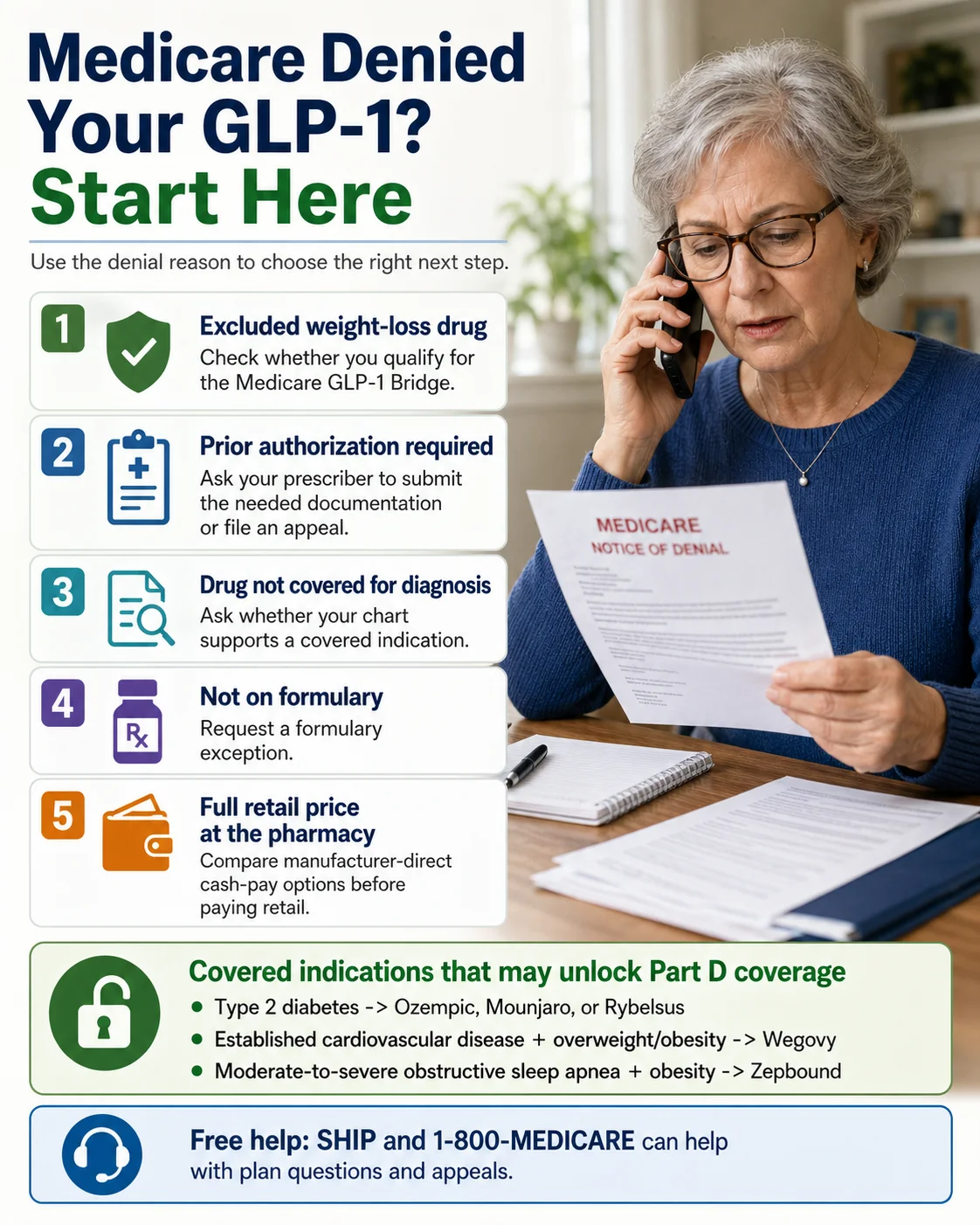
Before you do anything, read what your plan’s denial letter actually says. Same drug, different denial language, totally different next move:
| What the letter says | What it usually means | Who fixes it | First move |
|---|---|---|---|
| "Excluded weight-loss drug" | The 2003 weight-loss exclusion | Prescriber + Bridge prep | Path 1 (Bridge) |
| "Prior authorization required" | Plan wants documentation. Often a paperwork problem. | Prescriber + plan | Path 6 (appeal/exception) |
| "Drug not covered for diagnosis" | Diagnosis on file doesn't match what your plan covers | Prescriber + plan | Path 2 (covered indication) |
| "Not on formulary" | Plan didn't include this drug. Formulary exception may work. | Prescriber + plan | Path 6 (formulary exception) |
| "Savings card not accepted" | Federal anti-kickback law blocks Medicare patients from manufacturer copay cards | Skip the coupon path entirely | Path 3, 4, or 5 |
| Pharmacy quote of $1,200–$1,600 | Plan didn't cover; you're being asked to pay retail | Don't pay it | Path 3, 4, or 5 |
Know your denial reason? Take the 60-second quiz and we’ll route you straight to the right path.
Can the Medicare GLP-1 Bridge bring my cost down to $50/month?
Quick answer: The Medicare GLP-1 Bridge is a CMS demonstration program that covers Wegovy (injection and tablets), the Zepbound KwikPen, and Foundayo at a flat $50/month copay for eligible Medicare Part D beneficiaries. It runs from July 1, 2026 through December 31, 2027 — extended in April 2026 after CMS announced the broader BALANCE program would not launch in Medicare Part D as originally planned.
Who qualifies — the three Bridge eligibility tiers
CMS created three eligibility tiers. You only need to meet one of them. The BMI threshold is judged at the time you started GLP-1 therapy — so if you’ve already lost weight, your starting BMI still counts.
| Tier | BMI requirement | Required clinical condition |
|---|---|---|
| Tier 1 | ≥ 35 | None — BMI alone qualifies |
| Tier 2 | ≥ 30 | At least one of: heart failure with preserved ejection fraction (HFpEF); uncontrolled hypertension (>140 systolic or >90 diastolic on two blood-pressure meds); chronic kidney disease (CKD) stage 3a or above |
| Tier 3 | ≥ 27 | At least one of: prediabetes (per ADA guidelines); prior heart attack; prior stroke; symptomatic peripheral artery disease |
Source: CMS Medicare GLP-1 Bridge eligibility criteria, updated April 6, 2026.
What the Bridge covers (and doesn’t)
✅ Covered by the Bridge
- ✓Wegovy injection (all doses)
- ✓Wegovy tablets (all doses)
- ✓Zepbound KwikPen only
- ✓Foundayo (orforglipron, all formulations)
❌ Not covered by the Bridge
- ✕Zepbound single-dose vials
- ✕Zepbound single-dose pens (non-KwikPen)
- ✕Compounded GLP-1s
- ✕Ozempic for weight loss
- ✕Mounjaro for weight loss
- ✕Rybelsus for weight loss
Important: The Bridge covers the Zepbound KwikPen but not Zepbound vials or single-dose pens. If you’ve been getting Zepbound from LillyDirect as vials, your Bridge prescription will need to be written for the KwikPen formulation. Talk to your prescriber.
How the Bridge actually works — step by step
| Step | What happens | Who does it |
|---|---|---|
| 1 | Confirm enrollment in eligible plan type (PDP, MA-PD, SNP, EGWP) | You |
| 2 | Confirm BMI and qualifying condition documentation in chart | Prescriber + you |
| 3 | Submit prior authorization to CMS central processor (Humana / LI NET) — NOT your Part D plan | Prescriber |
| 4 | Pharmacy bills central processor using BIN 028918, PCN MEDDGLP1BR | Pharmacy |
| 5 | You pay $50 at the counter | You |
| 6 | Plan ahead — Bridge currently expires Dec 31, 2027 | You + prescriber |
The dedicated codes — BIN 028918, PCN MEDDGLP1BR — are how pharmacies route Bridge claims correctly to CMS’s central processor instead of your Part D plan. CMS has confirmed Humana will operate the central processor.
The honest tradeoff
The $50 copay does not count toward your $2,100 Part D out-of-pocket cap, and the Low-Income Subsidy (“Extra Help”) does not reduce it below $50. If $50/month is genuinely unaffordable, skip down to Path 3 (Low-Income Help). For everyone else: if you qualify, this is the path most readers should pursue first. It’s that good a deal.
Want a one-page Bridge prep checklist for your prescriber? The Bridge launched July 1, 2026 — the most useful thing you can do this week is get your prescriber’s chart squared away so the prior authorization is ready to submit on day one.
→ Get the Bridge eligibility checklist (free)When is regular Part D better than the Bridge?
Quick answer: Medicare Part D can cover Wegovy, Zepbound, Ozempic, Mounjaro, and Rybelsus today — but only when prescribed for an FDA-approved indication other than weight loss. If you have Type 2 diabetes, established cardiovascular disease, or moderate-to-severe sleep apnea, your prescription may need to be re-documented under the correct medical reason. This is not a workaround. It’s the right paperwork for what you actually have.
The three regular Part D indication paths
| Your diagnosis | Drug Part D may cover | Where does the PA go? |
|---|---|---|
| Type 2 diabetes | Ozempic (semaglutide), Mounjaro (tirzepatide), Rybelsus (oral semaglutide), Trulicity (dulaglutide), Victoza (liraglutide) | Your Part D plan / PBM |
| Established cardiovascular disease + obesity/overweight | Wegovy (semaglutide) — for major adverse cardiovascular event reduction | Your Part D plan / PBM |
| Moderate-to-severe obstructive sleep apnea + obesity | Zepbound (tirzepatide, all formulations) | Your Part D plan / PBM |
Important: this isn’t “code it differently”
We’re not telling you to ask your doctor to write a fake diagnosis. Insurance fraud is illegal and not what we’re describing. What we are describing is making sure your chart fully reflects what’s actually true about your health. Many GLP-1 denials happen because the prescription said “obesity” only and didn’t mention the patient’s documented prediabetes, prior heart attack, sleep apnea, or kidney disease that was sitting in the chart. Re-documenting an existing real diagnosis correctly is normal medicine.
Regular Part D vs Bridge — where each prior authorization goes
| Prescription scenario | Goes through | Why |
|---|---|---|
| Wegovy for cardiovascular risk reduction | Regular Part D plan | FDA-approved CV indication |
| Zepbound for moderate-to-severe OSA | Regular Part D plan | FDA-approved OSA indication |
| Ozempic, Mounjaro, Rybelsus for Type 2 diabetes | Regular Part D plan | FDA-approved T2D indication |
| Wegovy for weight management | Bridge central processor (after July 1, 2026) | Weight-loss exclusion in Part D |
| Zepbound KwikPen for weight management | Bridge central processor (after July 1, 2026) | Weight-loss exclusion in Part D |
| Foundayo for weight management | Bridge central processor (after July 1, 2026) | Weight-loss exclusion in Part D |
Path 3 — Low-Income Help: Extra Help, MPPP, SPAPs, and dual eligibility
Quick answer: If your income is near the federal poverty level, your cheapest path isn’t the manufacturer Patient Assistance Program — it’s Extra Help (Low-Income Subsidy), which can cap your copay on covered Part D drugs at $5.10 for generics and $12.65 for brand-name drugs in 2026, and $4.90 per covered drug if you have full Medicaid or are a Qualified Medicare Beneficiary (QMB). It won’t reduce the Bridge $50 copay, but it can dramatically cut costs for any GLP-1 covered under Path 2.
Important update on Manufacturer PAPs (most older guides have not updated this):
Novo Nordisk’s current Patient Assistance Program lists Ozempic but no longer accepts Medicare Part D beneficiaries for it, and Wegovy is not on Novo’s PAP at all. Lilly Cares’ current available-medications list does not include Zepbound, Mounjaro, or Foundayo. That’s why “free medication” is not a reliable route for Medicare GLP-1 readers in 2026.
Extra Help (Low-Income Subsidy)
- What it does: Caps your copay on covered Part D drugs at up to $5.10 (generic) / $12.65 (brand-name) in 2026. After total drug costs reach the $2,100 cap, you pay $0.
- Who qualifies: Income roughly at or below 150% of the federal poverty level (about $23,940 for one person in 2026; about $32,460 for two), with limited resources.
- What it covers for GLP-1s: Any GLP-1 covered under regular Part D — Ozempic, Mounjaro, Rybelsus for Type 2 diabetes; Wegovy for cardiovascular risk reduction; Zepbound for sleep apnea. It does not cover the Bridge $50 copay.
- How to apply: Through the Social Security Administration (SSA.gov/extrahelp) or a free SHIP counselor.
Medicare Prescription Payment Plan (MPPP)
- What it does: Spreads your covered Part D drug costs across the year in monthly payments. It does not lower the total cost — but it stops you from paying $400+ in any single month. Annual out-of-pocket for covered Part D drugs is still capped at $2,100 in 2026.
- What it covers for GLP-1s: Any GLP-1 covered under regular Part D. It does not apply to the Bridge.
- How to opt in: Through your Part D plan directly. Available to all Part D enrollees in 2026.
State Pharmaceutical Assistance Programs (SPAPs)
Some states run their own senior pharmaceutical aid programs that wrap around Part D. Eligibility, drug coverage, and benefits vary widely by state. Search “[your state] pharmaceutical assistance program” or call your local SHIP counselor.
Dual eligibility (Medicare + Medicaid)
If you’re dual-eligible and live in one of the 13 states where Medicaid covers GLP-1s for obesity (as of January 2026), you may have an additional path your Medicare-only neighbors don’t. The 13 states have changed in recent years — confirm with your state Medicaid office.
What are the cheapest cash-pay GLP-1 prices on Medicare in 2026?
Quick answer: If you’re paying cash, the cheapest legitimate option for FDA-approved Wegovy is NovoCare Pharmacy ($199/mo for the first two fills, then $349/mo ongoing; $149–$299/mo for the pill). The cheapest legitimate option for FDA-approved Zepbound is LillyDirect ($299/mo for 2.5mg vial, up to $449/mo for higher doses). Foundayo through LillyDirect runs $149–$349/mo by dose.
Wegovy through NovoCare Pharmacy
| Product | Dose | Cash-pay price |
|---|---|---|
| Injection (intro offer, first 2 fills) | 0.25 mg or 0.5 mg | $199/month |
| Injection (ongoing) | All doses | $349/month |
| Pill (limited-time intro through Aug 31, 2026) | 1.5 mg or 4 mg | $149/month |
| Pill (ongoing) | 9 mg or 25 mg | $299/month |
Source: NovoCare, verified April 28, 2026.
Zepbound through LillyDirect (vials and KwikPen)
| Product | Dose | Self Pay Journey price | Regular price |
|---|---|---|---|
| Single-dose vial | 2.5 mg | $299/month | (intro dose) |
| Single-dose vial | 5 mg | $399/month | — |
| Single-dose vial | 7.5 mg | $449/month | $499/month |
| Single-dose vial | 10–15 mg | $449/month | $699/month |
| KwikPen | 2.5 / 5 mg | $299–$399/month | — |
| KwikPen | 7.5–15 mg | $449/month | Higher list pricing applies |
Source: Zepbound Self Pay Journey Program, LillyDirect, verified April 28, 2026. You must refill within 45 days to keep the Self Pay Journey pricing. Vials also available for pickup at Walmart Pharmacy locations.
Foundayo through LillyDirect
Foundayo (orforglipron), the oral GLP-1 approved by the FDA in 2026, is available through LillyDirect at $149, $199, $299, or $349/month depending on dose. For some readers, this is the cheapest FDA-approved cash-pay GLP-1 on the market.
GoodRx and SingleCare vs. manufacturer-direct: Wegovy’s retail list price is around $1,349/month. Compare any quoted discount-card price against NovoCare and LillyDirect before paying retail — for most readers paying cash, manufacturer-direct comes out lower than discount-card retail. And remember: you can’t combine a discount card with Medicare on the same fill.
Affiliate disclosure: We may earn a commission if you sign up through our link. We mention Ro because it matches LillyDirect/NovoCare pricing and carries all five major FDA-approved GLP-1s. This is the only provider link in this section.
Want help comparing FDA-approved cash-pay options without paying retail? Ro carries Wegovy injection, Wegovy pill, Zepbound, the Zepbound KwikPen, and Foundayo, and matches LillyDirect / NovoCare pricing on the medication itself. Get started for $39 (first month), then as low as $74/month with annual plan paid upfront.
Important: Ro’s own website states it cannot coordinate GLP-1 medication coverage for government insurance plans (Medicare, Medicaid, TRICARE, and similar). Ro is the right fit when you’ve already decided cash-pay is your route — not as a Part D appeal solution. For Part D coverage questions, work with your prescriber, your plan, or a free SHIP counselor instead.
→ See current self-pay pricing on RoCan the new Wegovy multi-month subscription save you money?
Quick answer: Novo Nordisk launched a multi-month Wegovy subscription program on March 31, 2026 through partner telehealth providers. The 12-month subscription locks Wegovy injection at $249/month (saving $1,200/year vs. month-to-month) and the Wegovy pill at $249/month for 9mg/25mg doses. This is the cheapest cash-pay Wegovy path if you can commit to the subscription length.
| Subscription length | Wegovy injection | Wegovy pill (9mg / 25mg) |
|---|---|---|
| 3 months | $329/mo | $289/mo |
| 6 months | $299/mo | $269/mo |
| 12 months | $249/mo | $249/mo |
Source: Novo Nordisk subscription program announcement, March 31, 2026. Launched through Ro, WeightWatchers, LifeMD, with Hims & Hers, Sesame Care, and others coming online soon.
Important tradeoffs:
- Lock-in: You’re committing to the full subscription. Read the off-ramp terms before subscribing.
- Some platforms add a separate clinician/membership fee on top of the subscription.
- The subscription covers Wegovy only. Zepbound has its own separate LillyDirect pricing under Path 4.
- Best for established patients who’ve already titrated without intolerable side effects. Newer patients are usually better off month-to-month first.
Should I appeal a Medicare GLP-1 denial?
Quick answer: If your denial was for a GLP-1 that might qualify under a covered indication (T2D, CV disease, OSA), or if your plan denied for “prior authorization required” or “drug not on formulary,” you have the right to a five-level Medicare Part D appeal. Appeals cost nothing to file. Most successful appeals turn on a Letter of Medical Necessity from your prescriber that ties the prescription to the FDA-approved indication and to your plan’s specific clinical criteria.
When an appeal is worth your time
| Denial reason | Worth appealing? | What evidence helps | Who to call |
|---|---|---|---|
| Prior authorization required (no PA was filed) | ✅ Yes | Complete PA with diagnosis documentation | Prescriber + plan |
| Drug not covered for diagnosis | ✅ Yes | Records showing covered indication exists | Prescriber + plan |
| Plan missing records | ✅ Yes | Supply the missing records | Plan + pharmacy |
| Wrong formulation prescribed | ✅ Yes | New prescription matching covered formulation | Prescriber |
| Pharmacy routed claim incorrectly | ✅ Yes | Pharmacy resubmits | Pharmacy |
| Not on formulary | ✅ Yes (formulary exception) | Letter of Medical Necessity | Prescriber + plan |
| Weight-loss exclusion (no other indication) | ⏸ Wait for July 1 | Bridge eligibility prep | Prescriber |
| Not eligible Part D plan type | ❌ No | (Plan-change decision) | SHIP |
| Wanted Zepbound vials via Bridge | ❌ No | (Bridge covers KwikPen only) | Prescriber |
| Wanted to use $25 manufacturer coupon | ❌ No | (Federal law blocks this) | — |
The five appeal levels (in plain English)
Coverage determination / formulary exception
Your plan reviews the request — usually within 72 hours (24 hours expedited).
Redetermination
Your plan reviews again, usually with a different reviewer.
Independent Review Entity (IRE)
An outside contractor reviews on CMS's behalf.
Office of Medicare Hearings and Appeals (Administrative Law Judge)
A formal hearing. The 2026 amount-in-controversy threshold is $200.
Medicare Appeals Council, then federal court
The 2026 federal court threshold is $1,960. Rare for a single prescription.
What goes into a strong Letter of Medical Necessity
- Your starting BMI and current BMI
- Documented comorbidities (diabetes, prediabetes, heart disease, sleep apnea, kidney disease, hypertension)
- Prior treatment failures (diet, exercise, medications you’ve tried that didn’t work)
- The specific FDA-approved indication being claimed
- References to your plan’s formulary criteria and why your case meets them
- The prescriber’s clinical reasoning for choosing this drug at this dose
Free help with your appeal
- State Health Insurance Assistance Program (SHIP). Free counselors in every state. Helps with costs, complaints, and appeals.
- Medicare Rights Center. Free help line and self-help guides.
- Your prescriber’s office. Many practices have insurance navigators who do this routinely. Ask.
- 1-800-MEDICARE. Direct line.
- GLP-1 providers that handle prior authorization for you — our internal guide on practices and providers with insurance navigators who handle Part D appeals.
Can I use GoodRx, SingleCare, or a manufacturer copay card if I’m on Medicare?
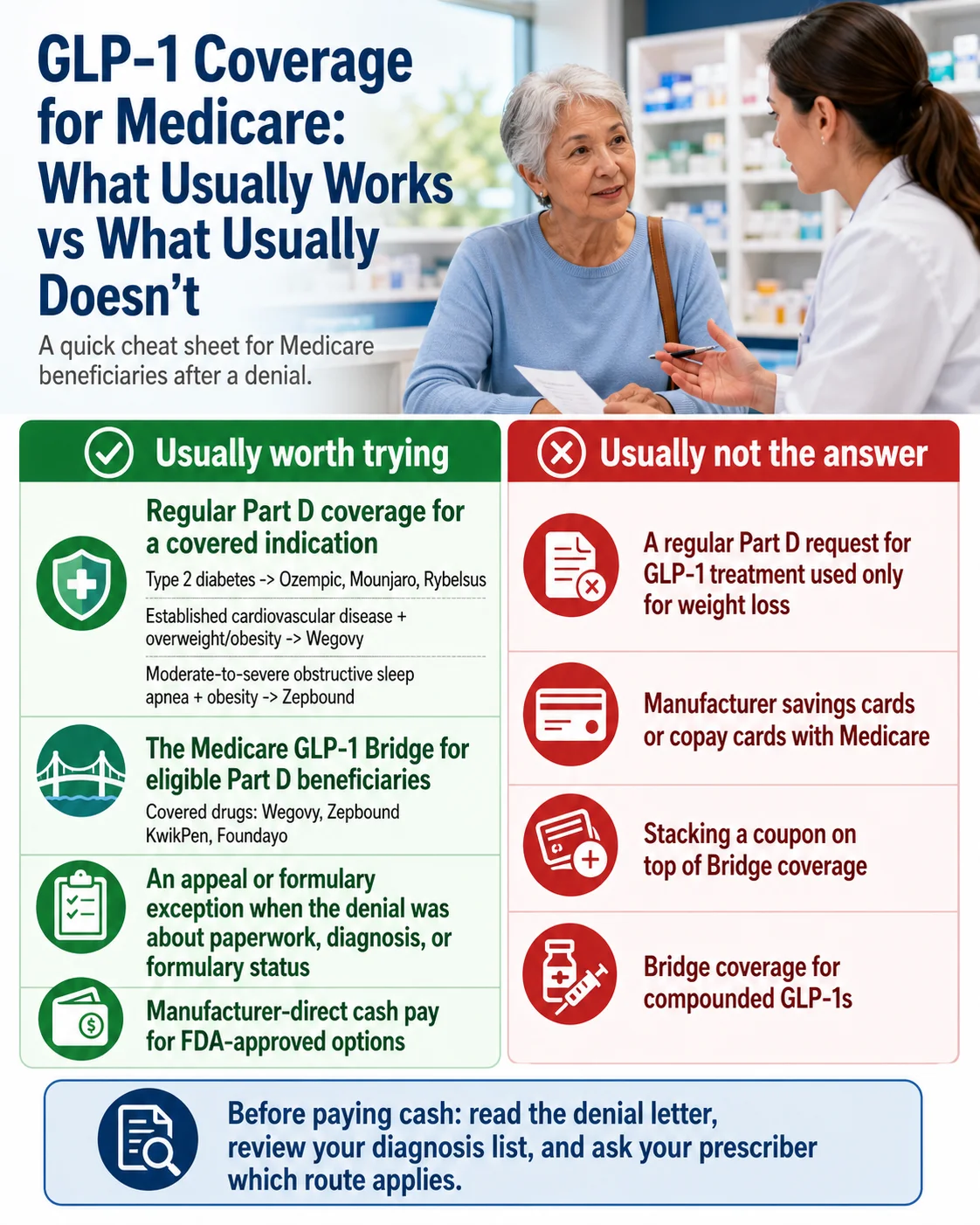
Quick answer: Manufacturer copay/savings cards (like the Wegovy Savings Card and Zepbound Savings Card) are blocked for anyone on Medicare, Medicaid, or Tricare under federal anti-kickback law. The “$25/month” advertising never applied to you. Discount cards like GoodRx and SingleCare can be used to pay cash out-of-pocket, but you cannot combine them with Medicare on the same fill — and they cannot be applied to Medicare GLP-1 Bridge claims.
| Method | Available to Medicare patients? | Notes |
|---|---|---|
| Wegovy Savings Card / Zepbound Savings Card ($25/month) | ❌ No | Federal anti-kickback law excludes Medicare/Medicaid/Tricare |
| GoodRx, SingleCare (as cash-pay alternative) | ⚠️ Yes, but mutually exclusive with Medicare | Compare against NovoCare/LillyDirect direct pricing first |
| Stacking GoodRx + Bridge $50 | ❌ No | CMS excludes coupons from Bridge claims |
| Stacking GoodRx + regular Part D | ❌ No | Pick one or the other |
What about HSAs and FSAs?
Quick answer: If you already have an HSA, you can use existing funds to pay for qualified medical expenses — but once you’re enrolled in Medicare, you generally cannot keep contributing to an HSA. IRS Publication 969 confirms an HSA-eligible individual cannot be enrolled in Medicare.
This matters for newer Medicare enrollees: if you’re 65 or older and just enrolled in the last few months, check your HSA balance — those existing funds can help bridge cash-pay GLP-1 costs while you sort out your coverage path. But don’t make new contributions; the IRS will catch it on your tax return.
What about compounded GLP-1s?
Quick answer: Compounded GLP-1s are not FDA-approved, are not covered by the Medicare GLP-1 Bridge, and the FDA’s enforcement landscape tightened significantly in 2025. For a Medicare-aged reader who was just denied a brand-name GLP-1, compounded is almost never the right first move.
- It’s not FDA-approved. The FDA does not verify the safety, effectiveness, or quality of compounded drugs before they are marketed.
- The FDA has issued ongoing warnings about unapproved GLP-1 products and has documented adverse events tied to compounded semaglutide and tirzepatide.
- It’s not Bridge-eligible. $50/month FDA-approved Wegovy will be available to most readers in two months.
- The price gap has shrunk. With NovoCare Wegovy at $199–$349/mo, LillyDirect Zepbound at $299–$449/mo, and Foundayo at $149–$349/mo, FDA-approved cash-pay isn’t $1,300 anymore.
We don’t push compounded affiliate offers from this page. If you’ve thought it through and you believe compounded is right for your situation, talk it through with a licensed clinician and verify the compounding pharmacy is licensed in your state.
What flat-out doesn’t work (so you don’t waste time)
| ❌ What doesn’t work | Why |
|---|---|
| Manufacturer copay/savings cards (Wegovy Savings Card, Zepbound Savings Card) | Federal anti-kickback law excludes anyone enrolled in Medicare, Medicaid, or Tricare |
| Stacking GoodRx with Medicare on the same fill | You must choose one or the other. They cannot be combined. |
| Stacking any coupon on top of the Bridge $50 | CMS explicitly excludes coupons and discount programs from Bridge claims. |
| Expecting the Bridge $50 to count toward your $2,100 Part D out-of-pocket cap | It doesn't. The Bridge runs outside Part D's payment flow. |
| Expecting Extra Help / LIS to drop the Bridge copay below $50 | It doesn't. |
| Using the Bridge for Zepbound vials or non-KwikPen pens | Bridge currently covers Wegovy injection + tablet, the Zepbound KwikPen only, and Foundayo. |
| Using the Bridge for Ozempic or Mounjaro for weight loss | Those are covered through regular Part D for diabetes — they're not Bridge drugs. |
| Manufacturer PAP for free Wegovy or Zepbound | Not currently listed for Medicare patients in 2026 by either Novo PAP or Lilly Cares. |
| HSA strategies for new Medicare enrollees | An HSA-eligible individual cannot be enrolled in Medicare per IRS Pub 969. You can spend down existing HSA funds, but can't keep contributing. |
How much will you actually pay? Total annual cost by path
| Path | Monthly cost | Annual cost (year 1) | Counts toward $2,100 cap? |
|---|---|---|---|
| Bridge (Wegovy / Zepbound KwikPen / Foundayo) | $50 | $600 | ❌ No |
| Part D for T2D / CVD / OSA with full Extra Help (brand-name) | $12.65 | ~$152 | ✅ Yes ($0 after $2,100 cap) |
| Part D for T2D / CVD / OSA with full Medicaid / QMB | $4.90 | ~$59 | ✅ Yes |
| Part D for T2D / CVD / OSA without Extra Help | $35–$300 | $420–$2,100 (capped) | ✅ Yes |
| LillyDirect Zepbound 2.5mg vial | $299 | $3,588 | ❌ No |
| LillyDirect Zepbound 5mg vial | $399 | $4,788 | ❌ No |
| LillyDirect Zepbound 7.5–15mg vial / KwikPen | $449 | $5,388 | ❌ No |
| NovoCare Wegovy injection (intro 2 mo + ongoing) | $199 → $349 | $4,486 (year 1) | ❌ No |
| NovoCare Wegovy pill 1.5mg or 4mg (intro pricing) | $149 | $1,788 | ❌ No |
| NovoCare Wegovy pill 9mg / 25mg | $299 | $3,588 | ❌ No |
| Foundayo through LillyDirect | $149–$349 | $1,788–$4,188 | ❌ No |
| Wegovy 12-month subscription (telehealth) | $249 | $2,988 | ❌ No |
Two things to notice:
- The Bridge is roughly 5–10× cheaper than every cash-pay path. If you qualify, the math isn’t close.
- Extra Help with a covered indication (Path 2) is the cheapest path of all — but only if your prescription qualifies under a covered Part D indication and you meet Extra Help’s income/resource limits.
What real Medicare patients are saying
We don’t make up testimonials. Here’s actual language from public Medicare/GLP-1 forums:
“Medicare denied the coverage. Out of pocket would be $1,600.”
— public Reddit post in r/medicare
“Wegovy and Medicare. How are you paying for it?”
— public Reddit post in r/medicare
For expert clinical perspective, Dr. Gillian Goddard, a board-certified endocrinologist at NYU Grossman School of Medicine, told U.S. News & World Report in March 2026 that direct manufacturer cash-pay is increasingly the answer Medicare-aged patients land on: “You still need a prescription from your doctor, and the price is based on the dose prescribed. The lowest doses are the least expensive, and higher doses are more expensive.”
What to do this week
Most readers are sitting on a denial letter. Here’s a short prioritized action list, ordered by impact:
If you might qualify for the Bridge: schedule a telehealth or in-person visit with your prescriber in May or June. Bring your starting BMI, your full diagnosis list, and the eligibility tiers from this page. Ask them to be ready to submit the Bridge prior authorization the moment July 1, 2026 hits.
If you have Type 2 diabetes, established CV disease, or moderate-to-severe sleep apnea: ask your prescriber whether your chart supports a covered Part D indication, and request a corrected prescription if so. This route works today, before the Bridge launches.
If your income qualifies you for Extra Help: apply through SSA.gov/extrahelp or with help from a SHIP counselor. Combined with a Path 2 covered indication, this is often the single cheapest route on the page.
If your denial says "prior authorization required" or you suspect a paperwork error: call SHIP (1-877-839-2675) or 1-800-MEDICARE and request help with a Part D appeal.
If you're paying cash today: compare LillyDirect, NovoCare, and the Wegovy multi-month subscription based on your prescribed drug and dose. Don't pay retail.
Want a personalized version of this list?
→ Take our free 60-second matching quizWhat to ask your doctor (the exact script)
Most patients freeze in the appointment because they don’t know what words to use. Read this aloud, or hand your prescriber a copy:
Copy-paste prescriber script
“Can you help me identify whether this prescription should go through the Medicare GLP-1 Bridge, regular Part D, or cash-pay? I want to avoid paying out of pocket if the denial was caused by the wrong indication, the wrong formulation, or the wrong prior-authorization route. Specifically:
- (a) What’s my BMI in your chart at the time we started GLP-1 therapy, and which Bridge tier do I match?
- (b) Does my chart support an FDA-approved indication other than weight loss — Type 2 diabetes, established cardiovascular disease, or moderate-to-severe sleep apnea — that Part D would cover today?
- (c) If I qualify for the Bridge, can your office be ready to submit the prior authorization to the CMS central processor on July 1?
- (d) If I qualify for Extra Help and my prescription is covered under regular Part D, what’s my actual copay?”
Write it down. Take it with you. That four-question script is the most useful thing on this page for most readers.
Frequently asked questions
Does Medicare cover Wegovy in 2026?
Medicare Part D doesn't cover Wegovy when it's prescribed solely for weight loss — that's a federal statutory exclusion from 2003. However, Part D can cover Wegovy when it's prescribed to reduce major cardiovascular events in adults with established cardiovascular disease who are overweight or obese, an indication the FDA approved in 2024. Separately, the Medicare GLP-1 Bridge demonstration covers Wegovy at $50/month for eligible Part D beneficiaries from July 1, 2026 through December 31, 2027.
Why won't Medicare pay for my Ozempic for weight loss?
The Medicare Modernization Act of 2003 prohibits Part D from covering medications used solely for weight loss. Ozempic is FDA-approved for Type 2 diabetes — not weight loss — so Medicare Part D plans cover it for diabetes but not when it's prescribed off-label for weight management. Ozempic is not included in the Medicare GLP-1 Bridge; the Bridge covers only Wegovy, the Zepbound KwikPen, and Foundayo.
Can I appeal a Medicare GLP-1 denial?
Yes. Medicare provides five appeal levels for any Part D coverage denial, starting with a coverage determination or formulary exception request to your plan. A Letter of Medical Necessity from your prescriber that ties the prescription to a covered FDA-approved indication and to your plan's specific clinical criteria is the most important factor. Many denials are procedural and can be fixed when complete documentation is filed — but appeals will not generally overturn the federal weight-loss exclusion or Bridge eligibility criteria.
How much does Wegovy cost without insurance in 2026?
Wegovy's retail list price is around $1,349/month. The cheapest legitimate self-pay path is NovoCare Pharmacy: $199/month for the first two fills at the lowest injection doses (intro pricing), then $349/month ongoing. The Wegovy pill (FDA-approved December 2025) starts at $149/month for the lowest dose with limited-time intro pricing. The Wegovy 12-month subscription through partner telehealth providers locks in $249/month for the injection.
What is the Medicare GLP-1 Bridge?
The Medicare GLP-1 Bridge is a CMS demonstration program that pays for Wegovy, the Zepbound KwikPen, and Foundayo at a flat $50/month for eligible Medicare Part D beneficiaries. It launched July 1, 2026 and was extended through December 31, 2027 after CMS announced on April 21, 2026 that the broader BALANCE Model would not roll out in Medicare Part D as planned. The Bridge operates outside the regular Part D benefit, uses Humana as the central processor, and uses dedicated codes (BIN 028918, PCN MEDDGLP1BR) for pharmacy claims.
Does the Wegovy or Zepbound Savings Card work with Medicare?
No. Federal anti-kickback law excludes anyone enrolled in Medicare, Medicaid, or Tricare from using manufacturer copay/savings cards. The "$25/month" advertising for the Wegovy Savings Card and Zepbound Savings Card does not apply to Medicare beneficiaries.
Can I get a free GLP-1 if I'm on Medicare with low income?
Probably not for free, but you can usually get one significantly cheaper. Manufacturer Patient Assistance Programs do not currently list Wegovy, Zepbound, Mounjaro, or Foundayo for Medicare beneficiaries — that's worth knowing because some older guides still suggest otherwise. The realistic low-income path is Extra Help (Low-Income Subsidy), which can cap your copay on covered Part D drugs at up to $5.10 (generic) / $12.65 (brand) in 2026, plus the Medicare Prescription Payment Plan to spread costs across the year, plus your state's SPAP if one exists.
When does the Medicare GLP-1 Bridge end?
The Bridge currently runs through December 31, 2027. CMS originally planned for the Bridge to run only July–December 2026 and then bridge into the BALANCE Model in Medicare Part D in January 2027. On April 21, 2026, CMS announced that BALANCE would not launch in Medicare Part D as planned, and the Bridge was extended through 2027. The status of any successor program after 2027 has not been finalized.
What if my BMI is lower now because the medication worked?
You still qualify based on your starting BMI. CMS clarified that Bridge eligibility is judged at the time GLP-1 therapy was initiated, not at the time of the prior-authorization request. If you started at a BMI of 37 and have dropped to 30 since, your prescriber attests you met the original BMI ≥35 criterion at the time therapy began.
What if Medicare denied Wegovy but I have heart disease?
Ask whether the request was submitted under Wegovy's FDA-approved cardiovascular risk-reduction indication through regular Part D — not as a weight-loss prescription. The FDA approved Wegovy in 2024 to reduce cardiovascular death, heart attack, and stroke risk in adults with established CV disease who are overweight or obese. This is a Part D-covered indication today, before the Bridge launches.
What if Medicare denied Zepbound but I have sleep apnea?
Ask whether your chart supports Zepbound's FDA-approved indication for moderate-to-severe obstructive sleep apnea in adults with obesity, which the FDA approved in December 2024. If it does, your prescriber can resubmit through regular Part D under the OSA indication.
What is the Medicare Prescription Payment Plan, and does it lower my GLP-1 cost?
The Medicare Prescription Payment Plan (MPPP) is a 2025+ Medicare benefit that lets you spread your covered Part D drug costs across the year in monthly payments. It does not lower your total cost — your annual Part D out-of-pocket is still capped at $2,100 in 2026 — but it stops you from paying $400+ in any single month. It applies only to drugs covered under regular Part D, not the Bridge.
Can a telehealth provider help after Medicare denies my GLP-1?
Sometimes — but with limits. Ro's own page states it cannot coordinate GLP-1 medication coverage for government insurance plans like Medicare, Medicaid, or TRICARE. So telehealth is the right fit when you've decided on a cash-pay path, not when you need help with a Part D coverage appeal. For Part D coverage and appeals, work with your prescriber, your plan, or a free SHIP counselor.
Is compounded semaglutide the same as Wegovy?
No. Compounded products are not FDA-approved and are not interchangeable with FDA-approved branded medications. With NovoCare Wegovy now at $199–$349/month, the price gap that used to make compounded look attractive has shrunk. For most older adults with comorbidities, an FDA-approved option with regulated supply and clinical oversight is what we'd prioritize first.
Should I switch Part D plans?
Maybe, but don't switch based on one medication without help. Plan formularies, prior authorization rules, and specialty tier placement vary widely. Use SHIP/Medicare counseling to compare your full medication list and overall plan benefits during open enrollment (October 15 – December 7, 2026 for 2027 coverage). Switching wrong can cost more on your other medications than it saves on a GLP-1.
Final word — and your next step
You’re not stuck. Medicare’s denial sounds final, but it’s almost never final once you understand which of the six paths fits your situation. The cheapest path for most readers — the Medicare GLP-1 Bridge — pays $50/month and started July 1, 2026. If your chart supports a different FDA-approved indication, you might already be covered today through regular Part D, and Extra Help can drop that to as little as $4.90–$12.65/month for covered drugs. If neither of those works, manufacturer-direct cash-pay at $149–$499/month is dramatically cheaper than retail.
Don’t pay $1,300 at the pharmacy counter without checking these first.
→ Take our free 60-second matching quizAnswer a few questions about your Medicare type, your BMI, your conditions, and your timeline — we’ll show you the single cheapest legitimate path for your situation.
Sources and verification
CMS Medicare GLP-1 Bridge: cms.gov/medicare/coverage/prescription-drug-coverage/medicare-glp-1-bridge
CMS BALANCE Model (Bridge extension through Dec 31, 2027): cms.gov/priorities/innovation/innovation-models/balance
KFF on the BALANCE Model (April 2026 brief): kff.org/medicare/what-to-know-about-the-balance-model-for-glp-1s-in-medicare-and-medicaid
FDA approval, Wegovy for cardiovascular risk reduction: fda.gov press release, March 2024
FDA approval, Zepbound for obstructive sleep apnea: fda.gov press release, December 2024
NovoCare Wegovy savings and direct pricing: novocare.com
Novo Nordisk Wegovy multi-month subscription (March 31, 2026): PR Newswire
LillyDirect Zepbound Self Pay Journey Program: zepbound.lilly.com/savings
LillyDirect Foundayo terms: lilly.com/lillydirect/medicines/foundayo
Medicare.gov Extra Help and 2026 drug cost limits: medicare.gov/basics/costs/help/drug-costs
IRS Publication 969 (HSA + Medicare): irs.gov/publications/p969
Medicare appeals threshold for 2026 ($200 ALJ / $1,960 federal court): Federal Register, December 2025
Last verified: . Next scheduled verification: May 28, 2026.
Weight Loss Provider Guide is an independent comparison resource for GLP-1 telehealth providers. Pricing, availability, and program details change frequently — verify current information with your prescriber, your Medicare plan, the manufacturer, or a free SHIP counselor before acting on any specific number on this page. This page is not medical, insurance, tax, or legal advice. GLP-1 medications are prescription-only and are not appropriate for everyone; only a licensed clinician can determine whether treatment is right for you.