GLP-1 in Utah: Every Option Compared — Costs, Providers & How to Start (2026)
Disclosure: Some links on this site are affiliate links. If you purchase through these links, we may earn a commission at no extra cost to you. Thank you for supporting our site.·For informational purposes only—not medical advice.
If you’re searching for GLP-1 in Utah, here’s the bottom line: you have more options than you think, and you don’t need to pay $400+ a month at a local med spa to get started.
We reviewed pricing and program details for 12+ providers that serve Utah — local clinics in Salt Lake City, Provo, Ogden, and St. George alongside nationwide telehealth platforms that ship directly to your door. We verified what we could, labeled the rest, and found something that surprised us: most Utah residents are overpaying by $100–$200/month for comparable compounded GLP-1 prescriptions. (We’ll show you exactly where the markup is — and how to avoid it.)
Over 299,000 GLP-1 doses were dispensed in Utah last year — a 6.1% increase from 2023 (Axios Salt Lake City). You’re not early. You’re right on time.
The quick verdict:
- No insurance or your plan won’t cover it? A telehealth provider like MEDVi is the fastest and most affordable path for most Utah residents — $179 first month, $299/mo after, includes doctor review, medication, and shipping. No contract, no membership fees, no clinic visits.
- Insurance covers Wegovy or Zepbound? Use it. Ask your doctor to submit a prior authorization. That’s the cheapest path if your plan actually covers it.
- On Utah Medicaid? You may qualify for GLP-1 coverage with prior authorization — $0 or near-zero cost.
- Want in-person care? Local Utah clinics range from $249–$500+/month for compounded GLP-1 prescriptions. The extra cost is primarily for in-person support and overhead.
Best value for most Utah residents
Maximum weight loss results
How Much Does GLP-1 Cost in Utah? (2026 Pricing Compared)
Cost is the #1 barrier. So let’s handle it first.
We reviewed publicly available pricing and program details from major providers serving Utah residents — telehealth platforms, local clinics, and the insurance/Medicaid path. Prices below are sourced from each provider’s website or published materials as of the date noted. Where we couldn’t independently verify, we’ve labeled it “provider-stated.”
Utah GLP-1 Provider Comparison Table
| Provider | Type | Monthly Cost | Medication | Insurance? | In-Person? | Best For |
|---|---|---|---|---|---|---|
| MEDVi | Telehealth | $179 first mo / $299 refill | Compounded semaglutide or tirzepatide (injections or tablets) | Cash-pay only (HSA/FSA accepted) | No — ships to all of Utah | Budget-conscious, no-insurance, fast start |
| TrimRX | Telehealth | From ~$199/mo (semaglutide injection) | Compounded semaglutide or tirzepatide | Cash-pay only | No — ships statewide | Flat-rate seekers, oral + injection options |
| Eden | Telehealth | Varies by plan | Compounded semaglutide or tirzepatide | Cash-pay only | No — ships statewide | Coaching + medication combo |
| Intermountain Health | Health System (Virtual) | $49 consult + med cost | Brand-name Wegovy or Zepbound | Yes | Virtual available | Insured patients wanting established care |
| Simply Wellness (SLC) | Local Clinic | ~$300–$500+/mo | Compounded | No | Yes — Salt Lake City | Prefers face-to-face, SLC residents |
| Health & Vitality (Orem) | Local Clinic | From $249/mo | Compounded | No | Yes — Utah County | Utah County, in-person accountability |
| Potere Health MD (St. George) | Local Clinic + Virtual | Varies (transparent pricing) | Compounded | No | Yes + virtual option | Southern Utah residents |
| Summit Primary Care (West Jordan) | Local Clinic | From $299/mo | Compounded | No | Yes | West side SLC metro |
| Your Insurance + Local Pharmacy | Traditional | Copay varies ($25–$500+) | Brand-name (Wegovy, Zepbound, Ozempic) | Required | Doctor visit required | Insured with confirmed GLP-1 coverage |
| Utah Medicaid | Government | $0 or minimal | Brand-name with PA | Medicaid | Doctor visit + prior auth | Medicaid-eligible Utah residents |
Prices shown are as of February 2026. Compounded medications are NOT FDA-approved as finished products. See our compounded vs. brand-name section for details. Pricing verification dates noted per provider.
What jumps out from this table: Many Utah clinics use compounded GLP-1 prescriptions sourced from U.S. compounding pharmacies — similar to what telehealth providers ship for less. The price difference is largely overhead: rent, front desk staff, medical equipment. Telehealth cuts that out. Whether the tradeoff is worth it depends on how much you value in-person care. (Compounded products are not FDA-approved as finished drugs, so pharmacy sourcing and clinical oversight matter regardless of which path you choose.)
Estimated Annual Costs (for perspective)
MEDVi
~$3,468/year
First month $179 + 11 months × $299
Local Utah Clinic ($350/mo)
~$4,200/year
12 months × $350 average
Brand-Name Without Insurance
~$14,400–$18,000/year
Wegovy or Zepbound retail price
Brand-Name With Good Insurance
~$300–$1,200/year
With insurance + copay card
Verify your exact cost. Free 5-min assessment, no commitment.
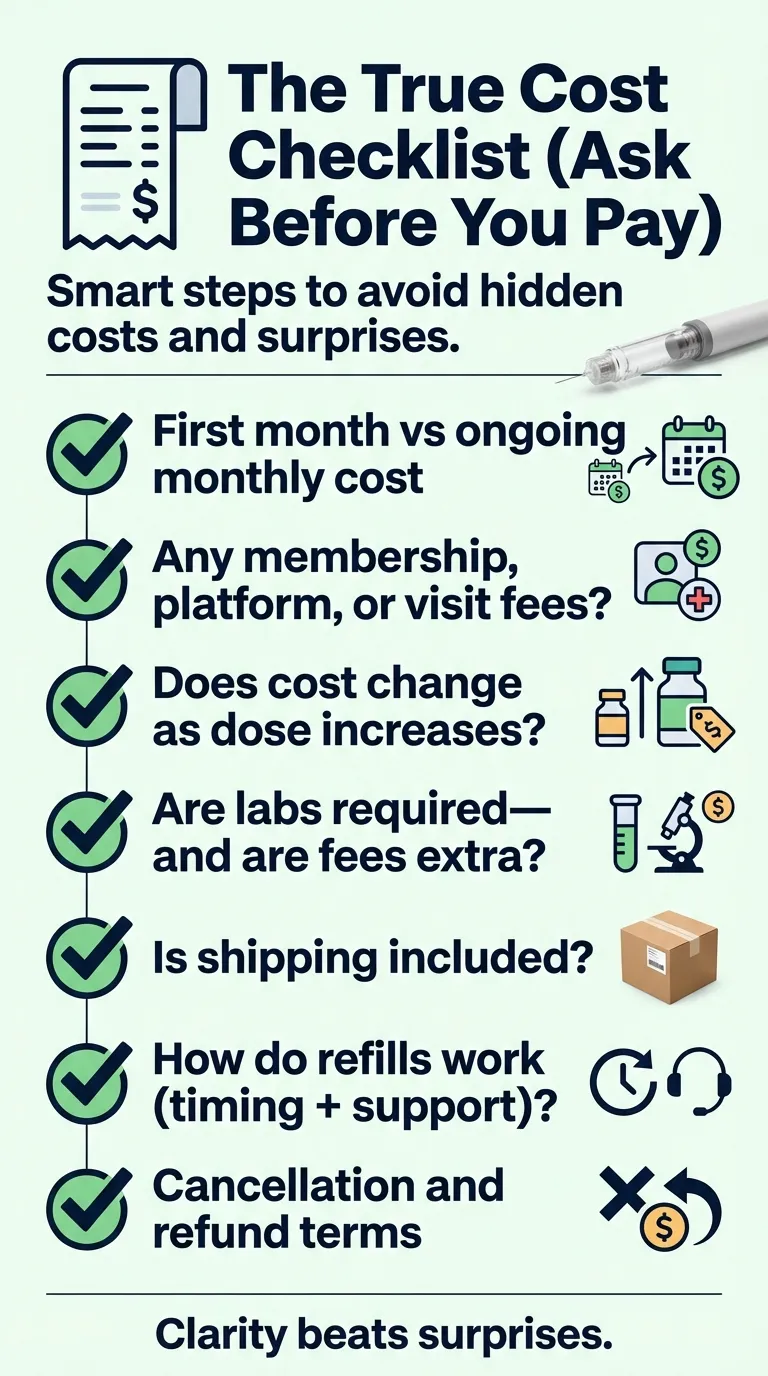
The “True Cost” Checklist (Before You Commit to Any Provider)
Sticker prices can be deceiving. Before you sign up with any GLP-1 provider — telehealth or local — ask these questions to understand your real monthly cost:
- 1
What’s the first-month price vs. ongoing refill price?
Many providers advertise a low introductory price that increases significantly. MEDVi is transparent about this: $179 first month, $299/mo after.
- 2
Is there a separate membership or platform fee?
Some telehealth providers charge $79–$149/month on top of medication costs. MEDVi and TrimRX don’t. Always confirm.
- 3
Does the price increase as my dose goes up?
Some local clinics charge more at higher doses — $50+/month more per dose level. Ask upfront what your cost looks like at a maintenance dose, not just a starter dose.
- 4
Are labs included?
If your provider requires blood work, is that covered or an extra cost? MEDVi includes free lab work through its partner labs (LabQuest, LabCorp, and Bioreference).
- 5
Is shipping included?
Most telehealth providers include free shipping. Verify this.
- 6
What’s the cancellation policy?
Month-to-month with no contract is ideal. Watch for multi-month commitments that lock you in.
- 7
What about the refund policy?
MEDVi advertises a money-back guarantee (terms apply — review the current refund policy on their site before enrolling). Not all providers offer this.
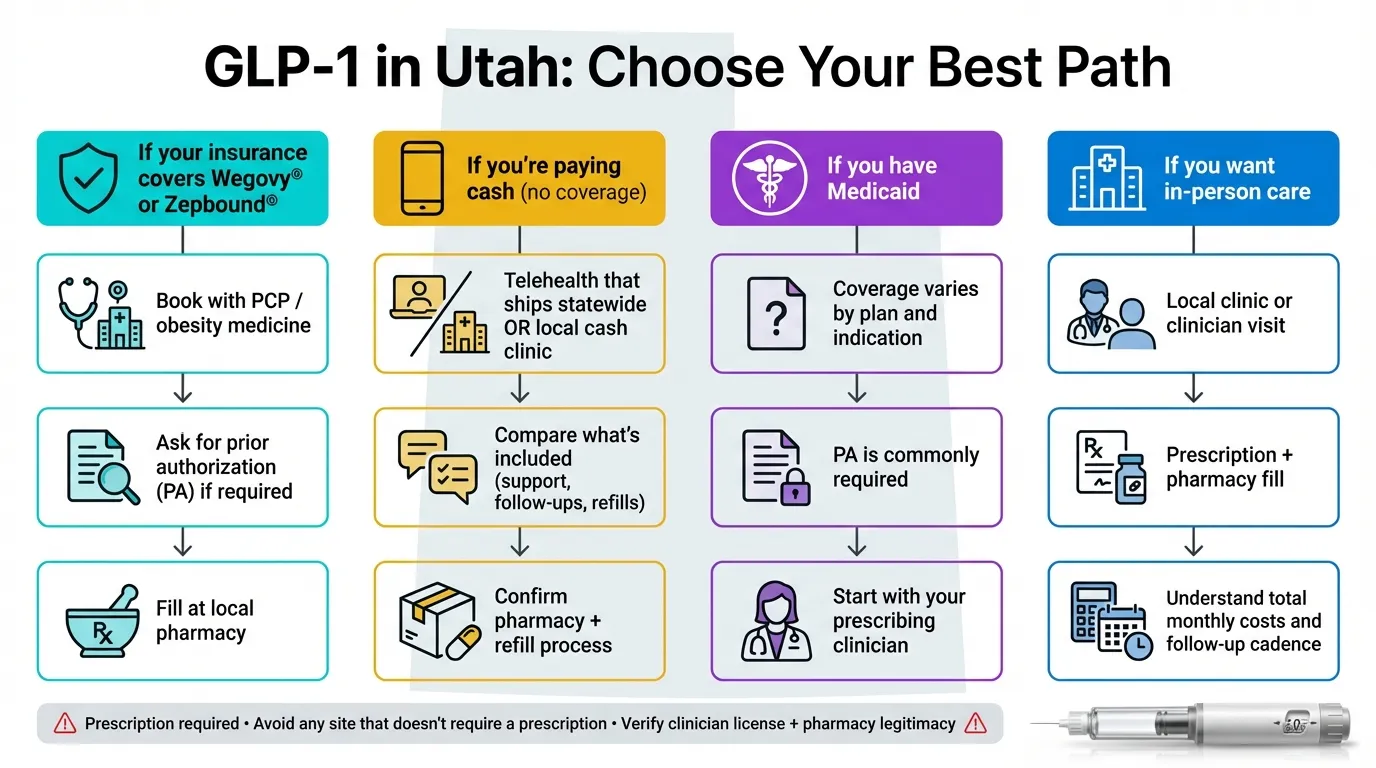
Which Path Is Right for You? (Utah GLP-1 Decision Guide)
Not every option fits every person. Here’s how to find yours in 30 seconds:
“I don’t have insurance — or my plan won’t cover GLP-1 for weight loss.”
This is the most common situation in Utah, and it’s not as bad as it sounds. Telehealth is your best path. MEDVi starts at $179/month — that includes the doctor review, your personalized plan, the medication itself, and free shipping to your Utah address. No contract. No hidden membership fee. Cancel anytime. For context, that’s less than most people spend on eating out each month.
“My insurance covers Wegovy or Zepbound.”
Use your insurance. Call your insurer and ask specifically: “Does my plan cover Wegovy (semaglutide) or Zepbound (tirzepatide) for weight management?” If yes, schedule with your PCP or an obesity medicine specialist. They’ll submit the prior authorization. Check manufacturer savings cards too — Novo Nordisk’s Wegovy Savings Offer may let eligible commercially insured patients pay as little as $25 per 28-day supply (terms and limits apply).
“I’m on Utah Medicaid.”
Good news you might not know: Utah Medicaid does cover certain GLP-1 medications for weight loss with prior authorization. Your provider will need to document your BMI, confirm you’re on a diet and exercise program, and submit the state’s PA form. If approved, cost is minimal or zero. We break down the full requirements below.
“I’m on Medicare.”
Trickier. Medicare Part D does not currently cover GLP-1s for weight loss alone. It does cover them for Type 2 diabetes and cardiovascular risk reduction. The federal BALANCE Model may expand Medicare GLP-1 coverage starting mid-2026 — but details are still being finalized by CMS. Right now, cash-pay telehealth is your most practical option.
“I want in-person care from a Utah clinic.”
Totally valid. If face-to-face accountability matters to you, local clinics in SLC, Provo, Ogden, and St. George offer GLP-1 programs starting from $249/month. Just know what you’re comparing: many local clinics prescribe compounded semaglutide from U.S. pharmacies — similar to what telehealth providers ship for $100–$200 less per month. The extra cost is primarily for the office visit and in-person support.
“I only want FDA-approved brand-name medication (no compounded).”
We respect that. Intermountain Health offers Wegovy and Zepbound through a virtual weight loss program with a $49 consultation fee, plus the cost of the medication itself. If your insurance covers it, this is the cleanest path. If you’re paying cash for brand-name, expect $900–$1,500+/month — which is why most cash-pay patients choose compounded.
Ships to all Utah addresses. No contract, cancel anytime.
Best Telehealth GLP-1 Providers for Utah Residents
These are the providers we reviewed that serve all of Utah via telehealth. Same template for each: what you get, what it costs, the honest tradeoff, and who it’s best for.
What it is: MEDVi is a telehealth platform based in Delaware that connects you with licensed providers through the OpenLoop Health network. They specialize exclusively in GLP-1 medication — that’s all they do, and they do it well.
How it works:
- Complete a free online health evaluation (takes about 5 minutes)
- A licensed provider reviews your info — typically within 24 hours
- If approved, your medication ships directly to your Utah address
- You get unlimited 24/7 messaging with your care team for questions, side effects, or dose adjustments
What’s included in the price:
- Physician review and prescription
- Personalized treatment plan + metabolic report
- The medication itself (compounded semaglutide or tirzepatide)
- Free shipping
- Unlimited provider messaging and 24/7 support
- No membership fees, no contracts
Pricing:
- • Compounded semaglutide injections (weekly): $179 first month, $299/mo refills
- • Compounded semaglutide tablets (daily): $249 first month
- • Compounded tirzepatide: available at higher price points
- • Brand-name Ozempic: listed at $1,999/mo (availability subject to change)
- • HSA/FSA accepted
Utah availability: All of Utah. No in-person visit required for Utah residents.
What real patients say:
“Very easy and convenient for a very busy working lady.”
“The company, staff, and doctors are amazing — they take care of everything.”
“Pricing is competitive and support is included!”
MEDVi has approximately 10,000 reviews on Trustpilot as of February 2026, with about 79% rated five stars (Trustpilot — MEDVi Reviews).
The honest tradeoff: MEDVi doesn’t include structured lifestyle coaching — no meal plans, no workout programs, no nutrition tracking. You get expert medication management and support, but diet and exercise changes are on you. That’s fine for most people, but if you want hand-holding on the lifestyle side, look at Eden instead.
A small number of Trustpilot reviewers have mentioned occasional billing hiccups or scheduling confusion. These appear to be isolated incidents, not systemic issues — and MEDVi’s 24/7 support team resolves them quickly. The company also advertises a money-back guarantee for patients who don’t see results (terms apply).
What the process actually looks like:
You’ll fill out a health questionnaire online — medical history, current medications, weight loss goals. A licensed provider reviews your submission. If labs are needed, MEDVi includes free lab work through its partner labs (LabQuest, LabCorp, and Bioreference). Once approved, you’re prescribed a starting dose (usually 0.25mg semaglutide weekly), and the medication ships directly to your Utah address. Most people go from “I signed up” to “medication in hand” within 3–7 days.
Ready to Check If You Qualify?
MEDVi’s free eligibility check takes about 5 minutes. No commitment, no credit card required to find out if GLP-1 is right for you. If approved, medication ships directly to your Utah address within days.
Affiliate link. We may earn a commission at no extra cost to you. See our ranking methodology and full disclosure.
What it is: TrimRX is a telehealth platform offering compounded GLP-1 medications with both injectable and oral options. They emphasize flat-rate pricing and a straightforward process.
Pricing:
- • Injectable semaglutide: from ~$199/month
- • Oral semaglutide: from $179/month
- • Injectable GLP-1 + GIP (tirzepatide): from $349/month
- • Oral GLP-1 + GIP: from $330/month
- • All plans include doctor consultation, medication, and free shipping
- • Free dosage increases and unlimited doctor consultations included
The honest tradeoff: Some Trustpilot reviewers have reported pricing changes at higher doses that didn’t match the “flat rate” advertising. TrimRX has been responsive to these concerns and has resolved them when flagged — but it’s worth confirming your refill pricing at your specific dose before you commit. A few reviewers have also reported shipping delays.
What it is: Eden pairs GLP-1 medication with lifestyle coaching in one flat monthly rate. If you want more than just a prescription — actual support around food, habits, and accountability — Eden fills that gap that most telehealth providers leave empty.
What makes it different: Most telehealth GLP-1 providers hand you the medication and say “good luck with the lifestyle changes.” Eden doesn’t. They build coaching into the program so you’re not trying to figure out nutrition and habit changes on your own. That matters because the research consistently shows that GLP-1 medications work best when combined with lifestyle modifications.
The honest tradeoff: Coaching adds value but also adds cost. If you already know what to eat and just need the medication to manage your appetite, you may be paying for support you don’t use. The coaching component also means slightly more structure and check-ins — great for accountability-seekers, potentially annoying for “just send me my meds” people.
Local Utah GLP-1 Clinics: In-Person Providers by City
Some people want to sit across from a provider. We get it. Here are the major in-person options by region.
Salt Lake City & Surrounding Area
- •Simply Wellness — Personalized GLP-1 programs in SLC with semaglutide and tirzepatide. Emphasizes one-on-one practitioner support. Pricing varies; expect $300–$500+/month (as advertised — contact clinic to confirm).
- •Modern SLC Med Spa (Holladay) — GLP-1 as part of a broader med spa offering. Free consultations available.
- •Before-N-After — GLP-1 injections in SLC. Focuses on weight loss treatments.
- •Genesis Lifestyle Medicine SLC — National chain with a Salt Lake City location offering GLP-1 programs.
- •Intermountain Health — Virtual weight loss program offering brand-name Wegovy and Zepbound. $49 consult + medication cost. Good option for insured patients.
Utah County (Provo, Orem, Pleasant Grove)
- •Health & Vitality (Orem) — Claims some of the lowest pricing in Utah County. Starting at $249/month for compounded semaglutide with B12 (as advertised). Monthly nurse practitioner consultations included.
- •Iris Interventional (Pleasant Grove) — Starting at $249 for first dose, with pricing that increases $50/month as your dose goes up (as advertised — confirm current pricing). Free 15-minute phone consultations.
Ogden & Northern Utah
- •Restore Care (Ogden) — Led by Dr. John Lowe, an internist and obesity medicine specialist. Offers a physician-led approach.
- •TOM Weight Loss — Utah-based telehealth clinic serving the entire state, including Ogden, Layton, and Logan. Membership model with physician-directed care.
St. George & Southern Utah
- •Potere Health MD — Local clinic in St. George with transparent pricing and virtual appointment options. Ships compounded medication to all of Utah. They’re vocal about exposing hidden pricing tactics used by other providers — a good sign.
How to Evaluate Any Local Utah Clinic
- Verify the provider’s license at Utah DOPL License Lookup
- Ask for total monthly cost — including medication, visits, labs, and shipping. “Starting at” prices almost always mean a low introductory dose.
- Ask which pharmacy compounds their medication and whether it’s a 503A or 503B facility
- Ask about cancellation — is there a contract? What happens if you want to stop?
- Compare to telehealth — if the clinic uses compounded GLP-1 prescriptions similar to what telehealth providers offer, understand what the price premium is actually buying you
Same compounded medication, shipped to your door for less.
Does Insurance Cover GLP-1 in Utah?
Short answer: sometimes. It depends on your diagnosis, your plan, and your insurer’s willingness to go through prior authorization.
Utah Commercial Insurance
Coverage varies wildly by employer and plan. Here’s the reality in 2026:
The not-great news:
According to GoodRx research, insurance coverage for GLP-1 weight loss medications has actually gotten more restrictive in 2026, not less. The number of commercially insured Americans with no Wegovy coverage increased by 42% compared to 2025 — leaving over 41 million people without coverage. Over 88% of people who do have coverage still face prior authorization requirements.
Major Utah insurers to check:
- • SelectHealth
- • Regence BlueCross BlueShield of Utah
- • UnitedHealthcare
- • DMBA
- • PEHP (Utah public employees)
What to do:
- Call the number on the back of your insurance card
- Ask: “Does my plan cover Wegovy (semaglutide) or Zepbound (tirzepatide) for chronic weight management?”
- If yes, ask about prior authorization requirements and what documentation your doctor needs to submit
- Check manufacturer savings — Novo Nordisk’s Wegovy Savings Offer and Eli Lilly’s savings card for Zepbound may reduce your copay significantly (terms and eligibility apply)
If the answer is no — and for many Utah residents it will be — cash-pay telehealth becomes the practical path. MEDVi at $179–$299/month is often less than what insured patients pay in copays for brand-name medications anyway.
Does Utah Medicaid Cover GLP-1 for Weight Loss?
Yes — with conditions. Utah is one of only 13 states that currently covers GLP-1 medications for obesity treatment under Medicaid (as of January 2026, per KFF Medicaid research).
Utah Medicaid requirements for GLP-1 weight loss coverage:
- Patient must be 18 years or older
- Must be on a medically appropriate exercise program AND a calorie-restricted diet (documented by your provider)
- Provider must document BMI and weight-related conditions
- Prior authorization form must be submitted (available from Utah Medicaid pharmacy program)
- Coverage is for specific FDA-approved GLP-1 medications — not compounded versions
Important context: Only 9% of GLP-1 prescriptions in Utah went to Medicaid patients last year. That’s partly because the PA process can be cumbersome and many Medicaid patients don’t know coverage exists. If you’re eligible, it’s worth pursuing — this could be $0 treatment.
Medicare
Medicare Part D does not cover GLP-1 medications for weight loss purposes alone. Coverage exists for Type 2 diabetes (Ozempic, Mounjaro) and cardiovascular risk reduction (Wegovy) if you meet the clinical criteria. The CMS BALANCE Model, announced in December 2025, aims to expand Medicare and Medicaid GLP-1 access starting mid-2026. A separate Medicare GLP-1 demonstration is planned for July 2026 (CMS). For now, Medicare patients looking at GLP-1 for weight loss are limited to cash-pay options.
Most Utah residents save vs. brand-name. HSA/FSA accepted.
How Do GLP-1 Medications Actually Work?
You’ve probably already heard the basics. Here’s the version that actually helps you make a decision.
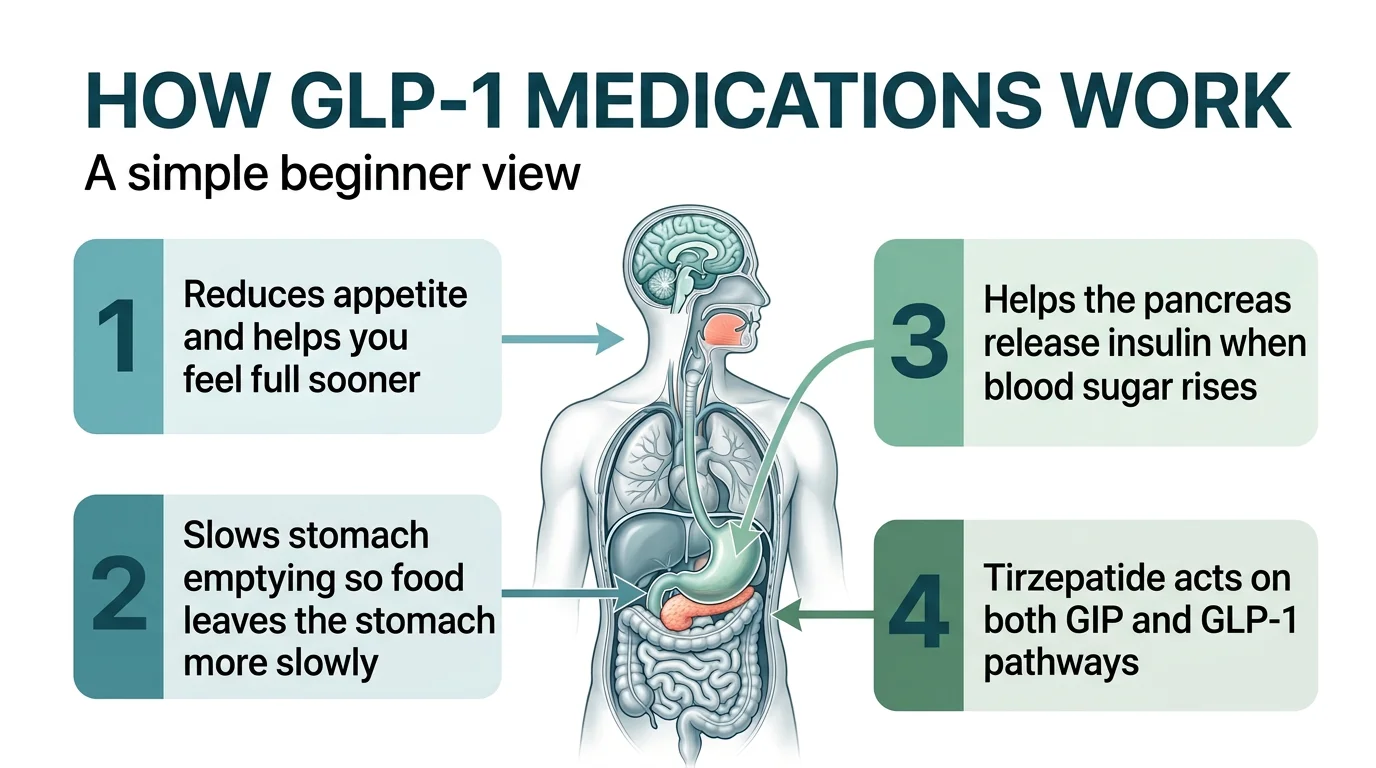
GLP-1 (glucagon-like peptide-1) is a hormone your body naturally produces after you eat. It tells your brain you’re full, slows down how fast food leaves your stomach, and helps regulate your blood sugar. GLP-1 medications mimic this hormone — but at levels high enough to meaningfully reduce appetite and change how your body handles food.
There are three things happening when you take a GLP-1:
Appetite Drops
The medication signals your brain’s satiety center more strongly. Food stops dominating your thoughts within the first week or two.
Feel Full Longer
Gastric emptying slows down, so meals satisfy you for hours instead of wearing off quickly.
Blood Sugar Stabilizes
Better insulin response means fewer energy crashes and cravings. This is why GLP-1s were originally developed for Type 2 diabetes.
The result: you eat less without fighting yourself. Clinical trials bear this out.
Semaglutide vs. Tirzepatide: Which One?
Semaglutide
(Ozempic for diabetes, Wegovy for weight loss, Rybelsus as oral tablet)
- Targets GLP-1 receptors
- Weekly injection (or daily oral tablet)
- STEP trial data: patients lost an average of ~15% of body weight over 68 weeks with lifestyle changes (Wegovy prescribing information, FDA)
Tirzepatide
(Mounjaro for diabetes, Zepbound for weight loss)
- Targets BOTH GLP-1 and GIP receptors (dual-action)
- Weekly injection
- SURMOUNT trial data: patients lost an average of ~20.9% of body weight at the 15 mg dose over 72 weeks (Zepbound prescribing information, FDA)
How to choose: Don’t choose based on TikTok. Choose based on what’s available to you, what your provider recommends, and what your budget supports. Both produce significant weight loss. Tirzepatide has shown slightly higher averages in trials, but semaglutide has a longer track record and more widely available supply. Your prescribing clinician will recommend the best option based on your health profile.
For a deeper comparison, see our full semaglutide vs. tirzepatide guide.
Compounded vs. Brand-Name GLP-1: What Utah Patients Need to Know
This is the section most sites skip or sugarcoat. We’re going to give it to you straight, because your safety matters more than a sale.
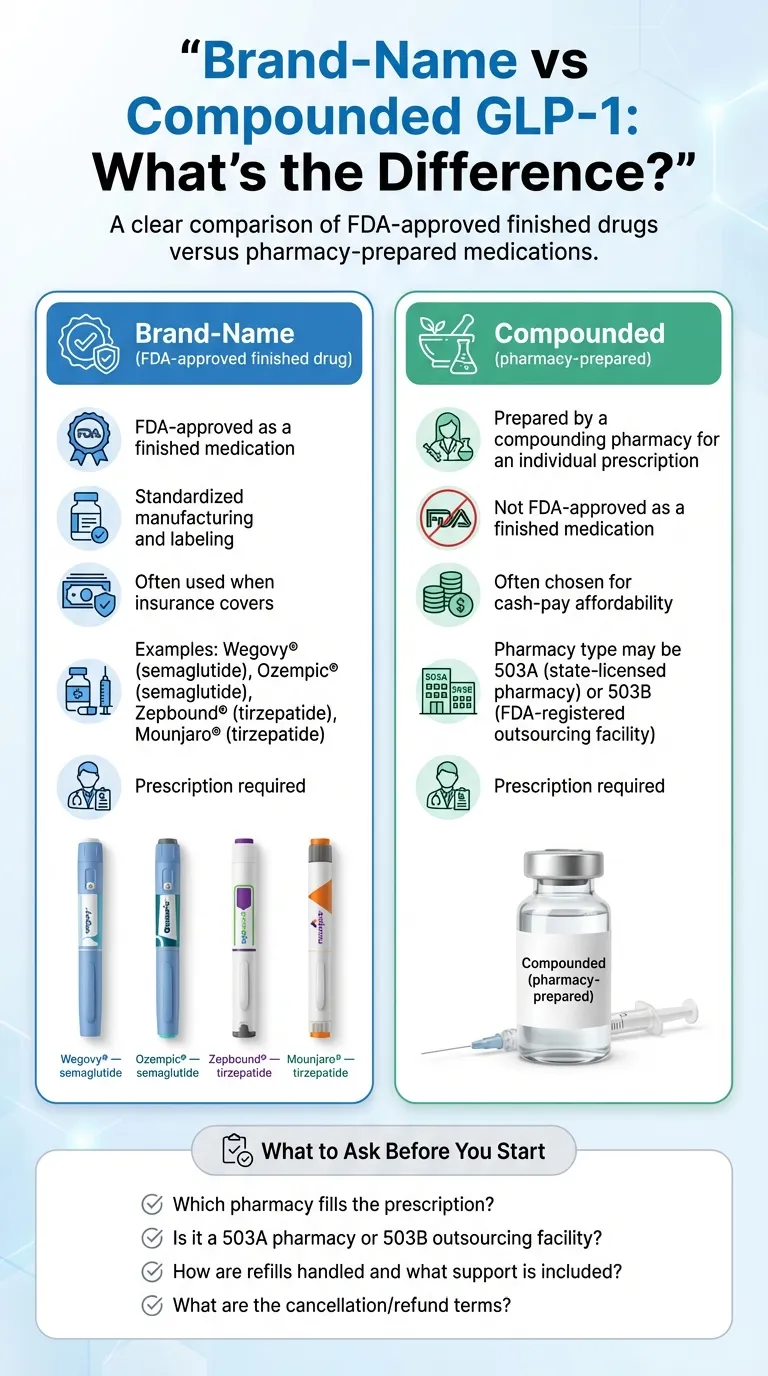
What “Compounded” Means
Compounded semaglutide or tirzepatide is a pharmacy-prepared formulation that is not FDA-approved. The difference from brand-name medications is in how it’s manufactured, regulated, and reviewed by the FDA.
Brand-Name (FDA-approved)
- • Made by Novo Nordisk or Eli Lilly in strictly controlled manufacturing facilities
- • Undergoes rigorous FDA review for safety, efficacy, and quality
- • Costs $900–$1,500+/month without insurance
Compounded
- • Prepared by licensed U.S. compounding pharmacies — 503A (state-licensed) or 503B (FDA-registered outsourcing facilities)
- • Pharmacy-prepared formulations that are not FDA-approved
- • Costs $150–$400/month. NOT FDA-approved as finished products
What the FDA Says Right Now
We need to be transparent here, because this landscape has changed significantly:
- In February 2025, the FDA declared the semaglutide shortage resolved, which technically means compounding pharmacies can no longer produce “essentially a copy” of commercially available FDA-approved drugs
- Several telehealth companies have continued offering compounded GLP-1s by creating “personalized” formulations — modified doses or added ingredients that make them legally distinct
- The FDA has expressed concern about fraudulent compounded GLP-1 products, dosing errors, and misleading marketing (FDA: Concerns About Unapproved GLP-1 Drugs)
- Litigation is ongoing between drug manufacturers and compounding companies
What This Means for You as a Utah Patient
- Verify the pharmacy. Ask your provider which compounding pharmacy fills your prescription. It should be a U.S.-licensed 503A or 503B facility. You can verify through FDA BeSafeRx and the NABP Safe Site Search.
- Understand the tradeoff. Compounded medications are available at a fraction of the brand-name price. But they are not FDA-approved and haven’t been reviewed by the FDA for safety, effectiveness, or quality. For most patients working with a licensed provider, the risk is manageable — but it’s not zero.
- If cost is not a barrier, brand-name FDA-approved medications are the gold standard. Your insurer, if they cover GLP-1, will fill brand-name.
Bottom line: We understand why most cash-pay patients choose compounded — because $179/month vs. $1,300/month is the difference between treatment and no treatment for a lot of people. The key is working with a legitimate provider who uses licensed U.S. pharmacies and a rigorous medical screening process.
For a deeper dive, see our full guide: Is Compounded Semaglutide Safe?
GLP-1 Side Effects: What to Expect (and Why Most People Push Through)
Here’s the part nobody loves talking about but everyone wants to know.
The Most Common Side Effects
In clinical trials for semaglutide (Wegovy), the most frequently reported side effects were:
~44%
Nausea
~30%
Diarrhea
~24%
Vomiting
~24%
Constipation
~20%
Abdominal pain
Source: Wegovy prescribing information, FDA. These rates come from clinical trials that included dose escalation. In practice, most clinicians today start low and titrate gradually to improve tolerability.
Most patients report that nausea — the most common complaint — is worst in the first 2–4 weeks and fades as your body adjusts. It’s usually mild enough to manage with simple changes.
Practical Side Effect Management Plan
For nausea: Eat smaller, more frequent meals. Choose bland, protein-forward foods during the first few weeks. Ginger tea or ginger chews can help. Avoid lying down right after eating.
For constipation: Increase water intake (aim for 64+ oz daily), add fiber gradually, and consider a gentle stool softener if needed.
For fatigue: This usually means you’re not eating enough protein. GLP-1 reduces appetite, but you still need adequate nutrition. Aim for 60–100g protein daily to preserve muscle mass and energy.
For injection site reactions: Rotate injection sites between your abdomen, thigh, and upper arm. A small bruise or mild redness is normal and fades quickly.
The mindset shift that helps:
Think of the first 2–4 weeks as an adjustment period, not a preview of your entire experience. Nearly every patient who pushes through reports that the side effects become background noise — and the results become impossible to ignore.
The Rare but Serious Stuff
GLP-1 medications carry a boxed warning about thyroid C-cell tumors observed in animal studies. The human relevance hasn’t been determined, but GLP-1s are contraindicated if you have a personal or family history of medullary thyroid cancer or Multiple Endocrine Neoplasia syndrome type 2 (MEN2). Other rare risks include pancreatitis and gallbladder issues. Your prescribing provider will screen for these contraindications before approving treatment.
Why Most People Stay on Treatment
Because the side effects are temporary and the results aren’t. The average person on semaglutide loses 15% of their body weight. On tirzepatide, about 21% at the highest dose. For a 220-pound person, that’s 33 to 46 pounds. And it’s not just the scale — patients report better sleep, more energy, improved mood, lower blood pressure, and reduced joint pain.
For more detail, see our full guide: Pros and Cons of GLP-1 Medications
Do You Qualify for GLP-1 in Utah?
Most people who are searching for GLP-1 options qualify. Here’s the general picture.
Typical Eligibility Criteria
- BMI of 30 or higher (clinically defined as obesity), OR
- BMI of 27 or higher with at least one weight-related condition (high blood pressure, Type 2 diabetes, high cholesterol, obstructive sleep apnea)
Note: In 2024, the FDA updated labels for semaglutide and tirzepatide to remove specific BMI thresholds, now approving them for “adults with obesity or overweight.” Your provider makes the final determination based on your full health picture.
Who Should NOT Use GLP-1 Medications
- Personal or family history of medullary thyroid cancer
- Multiple Endocrine Neoplasia syndrome type 2 (MEN2)
- History of pancreatitis
- Currently pregnant or nursing
- Known hypersensitivity to semaglutide or tirzepatide
What You’ll Need for the Evaluation
- Basic health history (conditions, current medications)
- Weight and height (for BMI calculation)
- Weight loss goals
- Some providers order lab work if your health history indicates it’s needed. MEDVi includes free lab work through partner labs when required.
Not sure if you qualify? Most telehealth providers offer free eligibility screening. You can check your eligibility through MEDVi’s online evaluation in about 5 minutes — there’s no cost or commitment to find out.
For a full eligibility breakdown, see our GLP-1 eligibility guide.
No cost to check. MEDVi ships to all Utah addresses.
How to Start GLP-1 Treatment in Utah (Step by Step)
You’ve done the research. Here’s the action plan.
Path A: Telehealth (Fastest, Most Affordable for Cash-Pay)
Timeline: Start to first injection in about 3–7 days
- Choose your provider. Based on our comparison, MEDVi offers the best combination of price, support, and simplicity for most cash-pay Utah residents.
- Complete the online evaluation. Answer questions about your health history, medications, and weight loss goals. Takes about 5 minutes.
- Provider review. A licensed clinician reviews your submission — typically within 24 hours.
- Medication ships. If approved, your prescription ships directly to your Utah address. Most patients receive their medication within 3–5 business days.
- Start treatment. Your first injection is a low dose (usually 0.25mg semaglutide). Weekly subcutaneous injection — most people say it’s much easier than expected.
- Ongoing support. Message your care team anytime. Dose increases happen gradually over weeks/months.
Path B: Insurance + Local Provider
Timeline: 1–4 weeks depending on prior authorization
- Call your insurer to confirm GLP-1 coverage and requirements
- Schedule an appointment with your PCP or an obesity medicine specialist
- Your provider documents eligibility and submits prior authorization
- If approved, fill your prescription at a Utah pharmacy
- Check manufacturer savings cards for copay assistance
- Regular follow-ups with your provider
Path C: Utah Medicaid
Timeline: 2–6 weeks for PA processing
- Confirm you’re enrolled in Utah Medicaid
- Schedule with a Medicaid-accepting provider
- Provider completes the Utah Medicaid GLP-1 Prior Authorization form (documents BMI, diet/exercise program, comorbidities)
- If approved, fill at a Medicaid-participating pharmacy — minimal or no cost
- Follow up as required by your treatment plan
Path D: Local Utah Clinic (Cash-Pay)
Timeline: 1–2 weeks depending on appointment availability
- Research clinics in your area (see our city-by-city section above)
- Schedule a consultation (many offer free initial consults)
- Get evaluated for eligibility
- Begin treatment — most clinics offer weekly injections you can do at home or in-office
- Monthly follow-up appointments at the clinic
5 minutes online. Medication at your Utah door in 3–7 days.
GLP-1 Use in Utah: What the Data Shows
Utah is unique when it comes to GLP-1 adoption — and the data tells an interesting story that might actually make you feel better about where you are in this decision.
According to insurance claims data analyzed by PurpleLab and reported by Axios Salt Lake City:
2.3%
of Utah adults obtained at least one GLP-1 prescription last year
299,000+
doses dispensed in Utah (6.1% increase from 2023)
9%
of Utah GLP-1 prescriptions went to Medicaid patients
~25.5%
Utah’s obesity rate (lower than ~42% national average)
The cultural context matters here. Utah has a unique relationship with health and appearance. After a flush of celebrity endorsements, GLP-1 medications were initially perceived in the state as a cosmetic luxury — in the same category as plastic surgery. But that framing is fading. With FDA approvals for cardiovascular risk reduction and obstructive sleep apnea, expanding insurance coverage, and strong clinical trial data showing 15–21% body weight loss, GLP-1s are increasingly recognized as what they are: medical treatment for a chronic metabolic condition.
If you feel any hesitation — whether it’s about cost, stigma, or uncertainty — know that you’re not alone. Over a quarter million GLP-1 doses were dispensed in your state last year. Your coworkers are on this medication. Your neighbors are. The difference between them and you right now is that they already started.
Utah’s obesity rate (~25.5%) is lower than the national average (~42%), but that doesn’t mean weight-related health issues aren’t real here. And with Utah being the youngest state in the nation, the population that stands to benefit most from early intervention is larger than almost anywhere else. Starting GLP-1 treatment in your 30s or 40s can change the trajectory of decades of health outcomes.
How to Avoid GLP-1 Scams in Utah
With demand this high, bad actors have entered the market. The FDA has specifically warned about fraudulent compounded GLP-1 products and companies marketing unapproved copycat medications (FDA). Protecting yourself is straightforward if you know what to look for.
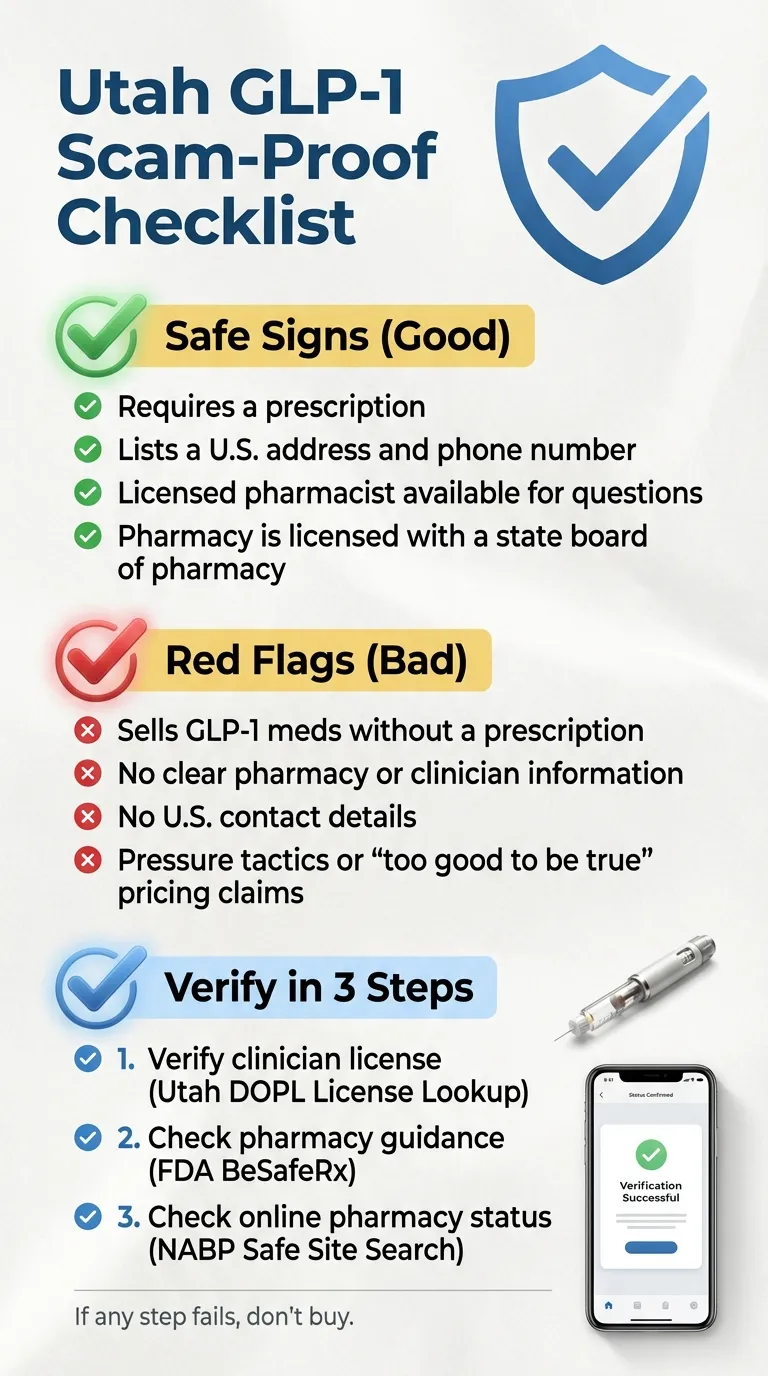
Red Flags
- No prescription required. GLP-1s are prescription medications, period.
- Prices that seem impossibly low. If it’s $50/month, something is wrong.
- No U.S. pharmacy or provider information.
- No phone number or customer service contact.
Verify in 3 Steps
- Check the clinician’s license using Utah DOPL License Lookup
- Verify the pharmacy through FDA BeSafeRx and NABP Safe Site Search
- Look for real reviews on independent platforms like Trustpilot (not just testimonials on the provider’s own website)
How Fast Will I Lose Weight — and What Happens If I Stop?
The Timeline
Weeks 1–2
Most people notice reduced appetite and fewer cravings. You might not lose much weight yet — you’re on a starter dose.
Weeks 3–8
As your dose titrates up, weight loss typically accelerates. Many patients report losing 4–8 pounds in the first month at therapeutic doses.
Months 2–6
This is where the momentum builds. Consistent weekly injections + healthy eating habits = steady weight loss. The average is about 1–2 pounds per week.
Months 6–12+
Clinical trial averages: 15% body weight loss with semaglutide, about 21% with tirzepatide at the highest dose. For most people, that’s transformative — not just physically, but in energy, confidence, mobility, and health markers.
What Happens If You Stop
We’ll be honest: studies show that some weight regain is common after discontinuing GLP-1 medications. One study published in Diabetes, Obesity and Metabolism found that participants regained roughly two-thirds of the weight they’d lost within one year of stopping semaglutide. That’s not a failure of the medication — it’s the nature of obesity as a chronic condition.
But here’s the more important context: That same research showed participants who stopped treatment were still lighter at the one-year mark than when they started. And patients who maintained lifestyle changes had significantly less regain than those who returned to old habits.
This is not a reason to avoid starting. It’s a reason to think of GLP-1 as part of a longer-term plan:
- Many patients transition to a maintenance dose (lower, less expensive) rather than stopping completely
- The healthy habits you build while on the medication — smaller portions, reduced cravings, more activity — give you a foundation that lasts
- Discuss a transition plan with your provider before deciding to stop. “Tapering” rather than abruptly stopping may help minimize regain
- Some patients use GLP-1 to reach their goal weight and then maintain with lifestyle changes alone
- New research is exploring how long-term low-dose GLP-1 treatment compares to cycling on and off
The most important thing: the version of you 40 pounds lighter, sleeping better, moving easier, and off blood pressure medication is worth the investment. GLP-1 gets you there. What you build along the way helps you stay.
Join thousands of Utah patients. No contract, no clinic visit.
How We Evaluated GLP-1 Providers for This Guide
Transparency matters. Here’s exactly how we did this.
What we compared: 12+ providers serving Utah residents — telehealth platforms, local clinics, and health system programs.
What we reviewed:
- • Monthly pricing (sourced from each provider’s website as of the dates noted)
- • What’s included in the price (medication, consultations, shipping, support)
- • Utah availability and telehealth service areas
- • Patient reviews on independent platforms (Trustpilot, Yelp)
- • Medical screening process and prescribing model
- • Cancellation and refund policies
What we label:
- • Verified = we confirmed the data directly from the provider’s published pricing page (with date)
- • Provider-stated = the information comes from provider marketing or third-party sources and has not been independently confirmed
What we did NOT do:
- • Accept payment from any provider for ranking placement
- • Test every provider personally (where we haven’t tested directly, we note “provider-stated”)
- • Guarantee that pricing won’t change — always check the provider’s website for current rates
Our affiliate relationship: We do have affiliate relationships with some providers mentioned in this guide, including MEDVi. When you use our links and enroll, we may earn a commission at no extra cost to you. This never influences our recommendations. We include providers we don’t have affiliate relationships with (local Utah clinics, Intermountain Health, the insurance path, the Medicaid path) because our job is to give you the full picture, not push one option. See our full ranking methodology.
How we stay current: We re-verify pricing and availability monthly. The “Last Verified” date at the top of this page reflects our most recent check. If you spot a mismatch between our data and a provider’s current pricing, let us know and we’ll update within 48 hours.
Sources cited throughout this guide:
- • FDA prescribing information for Wegovy and Zepbound
- • FDA guidance on compounded GLP-1 medications
- • FDA BeSafeRx pharmacy verification
- • Axios Salt Lake City — Utah GLP-1 prescription data
- • KFF — Medicaid coverage research
- • GoodRx — commercial insurance coverage data
- • CMS — BALANCE Model documentation
- • Utah Medicaid pharmacy prior authorization forms
- • Utah DOPL license verification
- • Trustpilot — independent patient reviews
- • Provider websites — pricing and program details
Your 5-Step Action Plan (Start This Week)
You’ve read enough. Here’s what to do now:
Pick your path.
Insurance, cash-pay telehealth, Medicaid, or local clinic — based on your situation. If you’re unsure, start with the decision guide above.
If going cash-pay:
Check your eligibility with MEDVi — it’s free, takes 5 minutes, and there’s no commitment. If you qualify, medication can arrive at your Utah address within days.
If going insurance:
Call your insurer today. Ask: "Does my plan cover Wegovy or Zepbound for chronic weight management, and what’s the prior authorization process?"
Verify your provider.
Whether it’s telehealth or a local clinic, confirm the clinician is licensed to practice in Utah and the pharmacy is legitimate. Takes 2 minutes with the links above.
Start, and give it time.
The first few weeks might include some nausea as you adjust. That’s normal and temporary. The people who succeed are the ones who push through the adjustment period. In 3–6 months, you’ll understand why hundreds of thousands of people call GLP-1 the thing they wish they’d started sooner.
Ready to Start Your GLP-1 Journey in Utah?
MEDVi ships to every address in Utah. No clinic visit needed, no contract, no hidden fees. $179 for your first month includes everything — the doctor review, medication, and shipping. Most patients have medication in hand within 3–7 days.
Affiliate link. We may earn a commission at no extra cost to you. This never affects our recommendations. Full disclosure.
Frequently Asked Questions About GLP-1 in Utah
Medical Disclaimer: This guide is for informational purposes only and does not constitute medical advice, diagnosis, or treatment. Always consult a qualified healthcare provider before starting any medication or weight loss program. Individual results vary. GLP-1 medications are prescription medications and require medical evaluation. Compounded medications are not FDA-approved as finished products. See the FDA’s guidance on compounded GLP-1s for important safety information.
• This guide is independently published by WeightLossProviderGuide.com. We are an affiliate site — not a medical provider, insurer, or pharmacy. Some links are affiliate links and we may earn a commission at no cost to you. This never influences our rankings or recommendations. See our full advertising disclosure and how we rank providers.