Eden vs WeightWatchers Clinic: True Cost of Each (2026)
Published by Weight Loss Provider Guide
Last verified: August 29, 2026 · Next price review: September 1, 2026
Weight Loss Provider Guide is an independent comparison resource for GLP-1 telehealth providers.
We may earn a commission if you use some links on this page, including eligible Eden, Ro, and Embody links. It never changes what we recommend, and it never changes what you pay. We earn nothing from WeightWatchers.
Eden vs WeightWatchers Clinic comes down to one thing almost nobody tells you: Eden's low-cost price includes your medicine. WeightWatchers' price does not.
Eden runs about $198 a month, all in, for compounded semaglutide. WeightWatchers Med+ runs $74 a month for the program only on its 12-month plan — the medicine is a separate bill on top of that.
So they look like they're $124 apart. They're not even the same purchase.
Here's the fast answer:
- Commercial insurance might cover a GLP-1? → WeightWatchers. Eden does not bill insurance.
- Eligible for the Medicare GLP-1 Bridge? → WeightWatchers may help. Eligible Part D members can get certain weight-loss GLP-1s for a $50 copay through December 31, 2027.
- Paying cash and want brand-name Wegovy? → WeightWatchers. About $3,827 for year one with its 12-month medication commitment, versus $21,468 through Eden at Eden's published Wegovy price.
- Paying cash and want the lowest price of these two? → Eden. About $2,316 for year one for compounded semaglutide.
- Might quit in three months? → Eden if you are comparing the lowest advertised rates. WeightWatchers does have a no-commitment membership, but it rises to $149 a month plus medicine after the $49 first month.
One thing to know before you pick Eden: it got an FDA warning letter on June 8, 2026 about how it described its products online. We read the letter. We'll show you exactly what it says and what it doesn't.
And there's a number buried in WeightWatchers' own fine print that flips the whole answer for cash-pay shoppers. Most people never find it. We did the math on it below.
The first thing to understand: these two sell different things
Answer capsule: Eden is a cash-pay telehealth company whose low-cost GLP-1 plans combine compounded medication with a required membership. WeightWatchers Clinic is a membership that provides a prescriber, insurance help, and the WeightWatchers behavior program, with GLP-1 medication billed separately. Eden's advertised $99 is a medicine price before membership. WeightWatchers' advertised $74 is a service price before medicine.
Think of it like a gym versus a personal trainer who also hands you a protein shake.
Eden hands you the shake. The price on the tag is what you drink — after you add the required membership.
WeightWatchers gives you the trainer, the class schedule, the meal plan, and someone who works on insurance paperwork. The shake is sold separately, and its price depends on the drug, the offer, and your coverage.
Both are real businesses. Both connect patients with licensed clinicians. Neither one guarantees you a prescription — a clinician has to decide the treatment is right for you first.
But when you put "$198" next to "$74" and pick the cheaper one, you have not compared anything. That's the mistake that costs people the most money on this decision, and it's the reason almost every other comparison page you'll read has the wrong answer.
| Question | Eden | WeightWatchers Clinic (Med+) |
|---|---|---|
| What the headline price buys | Low-cost path: medicine plus required membership | Membership only |
| Is the GLP-1 included? | Yes on Eden's compounded plans | No — billed separately |
| GLP-1 medicine type | Compounded semaglutide or tirzepatide on the low-cost plans; brand-name products also listed at much higher cash prices | FDA-approved brand-name GLP-1s |
| Takes insurance for the medicine? | No insurance billing | Yes, plus coverage and prior-authorization help |
| Minimum commitment | Month to month | None at the $149 monthly rate; 3, 6, or 12 months for lower rates |
| Auto-renews into another full term? | No long-term contract | Yes on the commitment plans unless canceled before renewal |
| Food, habit, and community program | Lighter provider-stated coaching and community | Full WeightWatchers program, workshops, tracking, coaches, and community |
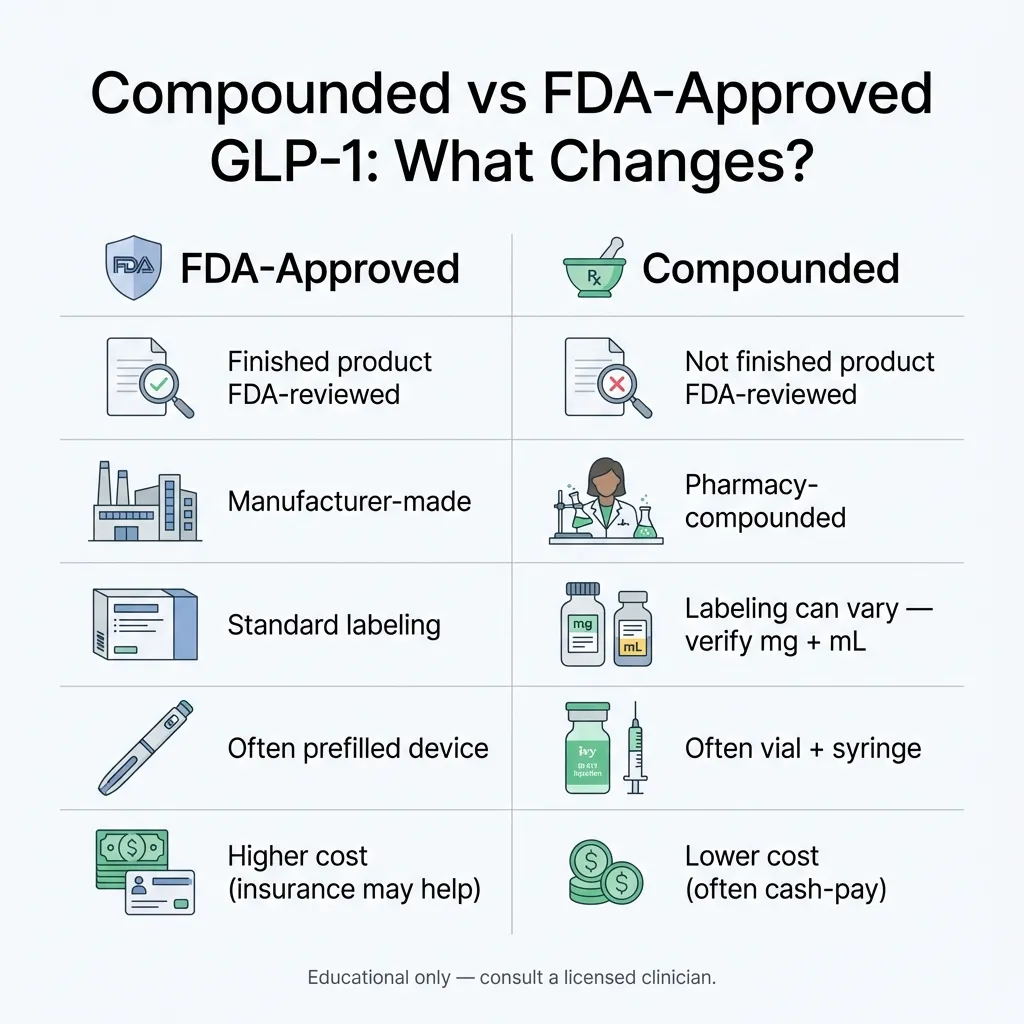
One term you'll see all over this page: compounded. It means a pharmacy prepares the medicine instead of dispensing a finished, FDA-approved product from the manufacturer. Compounded drugs are not FDA-approved. The FDA does not review them for safety, effectiveness, or quality before they're sold. Compounding can be lawful when federal and state conditions are met, but it is not FDA approval. Federal law also limits when pharmacies may compound copies of commercially available drugs. That is a real difference, and it matters more than price for some people.
Still choosing the lane? Use the FDA section below to decide whether compounded or FDA-approved medicine fits you before you choose a company.
How much do Eden and WeightWatchers Clinic really cost?
Answer capsule: Eden's advertised $99 compounded semaglutide price excludes a required membership of $39 the first month and $99 per month after, bringing the true cost to $138 in month one and $198 ongoing, or $2,316 for twelve months. WeightWatchers Med+ costs $25 the first month and then $74 per month on the 12-month plan, totaling $839 for twelve months, with GLP-1 medication billed separately on top. Its no-commitment route is $49 for month one and $149 a month after.
Let's put the real numbers on the table.
Eden: the $99 that isn't $99
Eden advertises compounded semaglutide at $99 a month and compounded tirzepatide at $199 a month. Underneath that sits a required Eden membership — $39 for the first month, then $99 every month after. You need an active membership to get medication through the program.
So the actual bill:
| Eden plan | Month one | Every month after | 6 months | 12 months |
|---|---|---|---|---|
| Compounded semaglutide | $138 | $198 | $1,128 | $2,316 |
| Compounded tirzepatide | $238 | $298 | $1,728 | $3,516 |
Two things worth knowing here.
The good part: Eden says that price does not move when your dose goes up. Some programs charge more at higher doses. Eden says its advertised compounded price stays the same when you titrate — that's the word for stepping up your dose over time. That's a real advantage and we'll give them full credit for it.
The part that surprises people: month two costs $60 more than month one, because the $39 introductory membership renews at $99. Eden discloses this. It's just easy to miss when the headline says $99.
Membership does not guarantee a prescription. Eden's current terms say that if its clinician completes the initial intake evaluation, decides treatment is not appropriate, and issues no prescription, Eden refunds the $39 initial membership fee in full.
WeightWatchers Med+: the $25 that isn't your whole bill
WeightWatchers advertises Med+ at $25 for the first month on its 6- and 12-month plans. That's the first month only — not two months, not ongoing.
Its live membership page also lists a flexible route most comparison pages miss:
| WeightWatchers plan | First month | Ongoing membership rate | What you commit to | Known first-term total |
|---|---|---|---|---|
| 12-month | $25 | $74/mo | 12 months | $839 |
| 6-month | $25 | $84/mo | 6 months | $445 |
| 3-month | $49 | $99/mo after the introductory month | 3 months | Confirm at checkout |
| Month to month | $49 | $149/mo | No long-term term | $1,688 if kept for 12 months |
The medicine is separate on every one of those plans. WeightWatchers says it plainly: “Cost of GLP-1 medications not included.”
Then you add the medicine. That's the whole ballgame, and it's the part every other comparison page skips.
🔑 The finding that changes the answer for cash payers
Here's the number in the fine print.
WeightWatchers is a NovoCare Recognized Care Provider. NovoCare is Novo Nordisk's direct-to-patient pharmacy route. Eligible Med+ members can pre-pay for 3, 6, or 12 months of Wegovy and get a lower monthly medication price than the standard month-to-month self-pay price.
NovoCare's standard self-pay price for a Wegovy pen is $349 a month at the standard doses from 0.25 mg to 2.4 mg. WeightWatchers' 12-month medication commitment cuts that to $249 a month, with the full $2,988 paid up front.
Now watch what happens when you run the year:
| How you buy brand-name Wegovy | Membership | Medicine for 12 months | Year-one total |
|---|---|---|---|
| WeightWatchers Med+ with 12-month Wegovy commitment | $839 | $2,988 ($249/mo) | $3,827 |
| Straight from NovoCare at standard self-pay price | $0 | $4,188 ($349/mo) | $4,188 |
| NovoCare for an eligible new patient using two $199 starter fills | $0 | $3,888 | $3,888 |
| Eden's published brand-name Wegovy route | $1,128 | $20,340 ($1,695/mo) | $21,468 |
Read that first row again.
Going through WeightWatchers costs $361 less than buying the exact same standard-dose Wegovy pen from NovoCare at its regular $349 price. For an eligible new NovoCare patient who gets the first two starter fills at $199, WeightWatchers is only $61 cheaper for year one.
The $74 a month isn't just a fee in that exact cash-pay setup. The Wegovy discount can more than cover it.
The catch, stated plainly: the $249 Wegovy rate requires pre-paying twelve months of medicine up front. That's $2,988 in one hit. The 12-month Med+ membership also signs you up for a full year and auto-renews into another full term unless you cancel. If you don't have almost $3,000 sitting there, this route is closed to you no matter how good the math looks.
There is one more catch: WeightWatchers says medication-commitment refunds are limited to medicine that has not shipped, and any refund can be recalculated at the higher standard monthly price. Read that refund line before you pre-pay.
The other side of that coin: Eden and brand-name drugs
Eden now publishes its brand-name prices on its own treatment page. They are not estimates anymore.
| Eden brand-name option | Published medicine price | First-year membership | First-year total |
|---|---|---|---|
| Wegovy | $1,695/mo | $1,128 | $21,468 |
| Zepbound | $1,399/mo | $1,128 | $17,916 |
| Ozempic | $1,399/mo | $1,128 | $17,916 |
| Mounjaro | $1,399/mo | $1,128 | $17,916 |
Eden's published Wegovy price is nearly five times NovoCare's $349 standard self-pay price. Brand prices vary by drug, dose, and manufacturer route, so compare the exact product.
If you're looking at brand-name medicine, price it at the manufacturer route, at WeightWatchers, and at Eden before you pay anyone. The gap is too big to guess at.
Why published “Eden vs WeightWatchers” prices never match
If you've opened five tabs and gotten five different numbers, you're not losing your mind. Here are the five mistakes almost every page makes:
- Treating Eden's $99 as the full monthly bill — it isn't; add the membership.
- Treating WeightWatchers' $74 as if it includes medicine — it doesn't.
- Comparing Eden's compounded semaglutide price against a brand-name tirzepatide price without saying so.
- Quoting a limited-time promotion as if it's the regular price.
- Ignoring WeightWatchers' $149 month-to-month membership and acting as if every member must choose 6 or 12 months.
We've listed our sources and dates at the bottom so you can check every number yourself.
➡️ Your first move
You now know what each one actually costs. That's the hard part.
If you're paying cash and open to compounded medicine:
👉 See Eden's current all-in price and check eligibility →(https://www.eden.health/treatment/glp-1-treatments)
If you want FDA-approved medicine or think insurance might help:
👉 Check WeightWatchers Med+ eligibility and coverage →
Checking eligibility does not guarantee a prescription. Before you pay anyone, confirm the medicine, the full total, the renewal date, and the cancellation deadline on the same screen.
What does Eden's 2026 FDA warning letter mean?
Answer capsule: The FDA sent Eden Health International Inc. a warning letter on June 8, 2026, reference number MARCS-CMS 728279, citing two problems with how Eden's website described its compounded products. The letter concerns false or misleading marketing and labeling language. It does not announce a recall, product-contamination finding, patient-harm finding, fine, or criminal charge. As of August 29, 2026, we could not locate an FDA close-out letter for Eden in the agency's public warning-letter records.
We read the letter at FDA.gov. Here's what's in it, in plain English.
What the FDA actually said
FDA reviewed Eden's website in March 2026 and found two things it called false or misleading:
1. The label problem. The vials pictured on Eden's site had “Eden” printed on them. FDA said that name on the pictured label suggested Eden compounded the drug — and Eden did not.
2. The “FDA-licensed” problem. Eden's site said its products came from “FDA-licensed 503(a) outsourcing facilities.” FDA replied that this is not a status the law creates. A pharmacy may operate under section 503A, and an outsourcing facility may register under section 503B, but FDA does not “approve” or “license” either the facility or its compounded products through that process.
Both were misbranding findings under sections 502(a) and 502(bb) of the federal drug law.
What the letter does not say
This part matters just as much, and we're not going to let anyone read this section and walk away scared of the wrong thing.
- It is not a recall. No product was pulled by this letter.
- It is not a fine or a criminal charge.
- It is not a finding that anyone was harmed.
- It does not say Eden's medicine was contaminated, fake, or wrongly dosed.
A warning letter puts a company on notice about violations and gives it a chance to respond. FDA told Eden to respond within 15 business days and warned that unresolved violations could lead to further action. We searched FDA's warning-letter records and could not find a public close-out letter for Eden as of August 29, 2026. That does not prove Eden has or has not fixed everything. It means we did not find a public FDA close-out.
Eden was not alone
Eden's letter was part of a larger June 2026 batch of warning letters FDA sent to telehealth companies over false or misleading claims about compounded GLP-1 products. FDA had already announced 30 similar warning letters in March 2026.
This was an industry-wide advertising crackdown, not a recall aimed at one Eden batch. That does not erase Eden's letter. It puts it in the right frame.
Why WeightWatchers doesn't have this problem
Because WeightWatchers left this lane.
WeightWatchers started offering compounded semaglutide in October 2024. In May 2025, after FDA's shortage-related enforcement window closed for outsourcing-facility copies of semaglutide, WeightWatchers stopped its compounded program and moved affected members toward FDA-approved options.
On its Q2 2025 earnings call, WeightWatchers' CEO criticized competitors that kept offering compounded GLP-1s under what she called a “personalization exemption.”
That's one of the two companies you're choosing between, on the record, describing the other one's lane. You don't have to agree with her. But you should know that's the fault line you're standing on.
Here's the honest way to use this information:
- FDA-approved medicine is non-negotiable for you? Then this comparison is already over. Go with WeightWatchers.
- Open to compounded, but this letter bothers you? Reasonable. Get a second cash-pay quote and compare the pharmacy, terms, and current regulatory record.
- Read it, understand it, and still accept the compounded lane? Then compare the actual all-in price and contract, not the headline.
The sources below link to Eden's full FDA warning letter so you can read the agency's exact wording yourself.
➡️ If the letter gave you pause
You came here for Eden's price, not Eden's regulatory file. That's fair, and there's a middle path.
Embody advertises compounded GLP-1 injections from $79 a month and GLP-1/GIP injections from $129 a month, with medication, shipping, and 24/7 support included. It says there is no separate membership fee. Its actual price depends on the medication and the 4-, 12-, 24-, or 52-week plan you select.
👉 Compare Embody's current plan and term →(https://joinem.co/)
This is a second cash-pay quote, not a regulatory clean bill of health. Embody's compounded medicines are also not FDA-approved. Compare the exact drug, pharmacy, total price, term, and cancellation rules before switching.
Which is better if I have commercial insurance?
Answer capsule: WeightWatchers Clinic is the better option for most readers trying to use commercial insurance, because its care team helps with coverage and prior authorization. Eden does not bill insurance, so its $99 and $199 medicine prices are cash prices, not copays. On cost alone, WeightWatchers beats Eden's $2,316 first-year compounded semaglutide total when the reader's average out-of-pocket medication cost is under $123.08 per month on the 12-month Med+ plan.
This is the shortest section on the page because the answer is short.
Eden does not bill insurance. Not “sometimes.” Not “depends on your plan.” It's a cash-pay program. Eden says an HSA or FSA card may work for most visits and prescriptions, but that is a health spending account, not insurance coverage.
WeightWatchers works on insurance coverage for the prescription. Its team helps check benefits, submit the prior authorization — the paperwork your insurer may require before it agrees to pay for an expensive drug — and manage follow-up paperwork and refills. The Med+ membership itself is still a separate charge.
The break-even number
Here's the math that decides it for you.
WeightWatchers' first-year cost on the 12-month plan = $839 membership + (12 × your average monthly drug cost)
Set that against Eden's totals and you get a clean threshold:
| If your average monthly out-of-pocket drug cost is… | Then compared with Eden… |
|---|---|
| Under $123.08 | WeightWatchers beats Eden's $2,316 compounded semaglutide year |
| Under $223.08 | WeightWatchers beats Eden's $3,516 compounded tirzepatide year |
| Over those numbers | Run both full-year totals before deciding |
A $50 monthly drug cost puts WeightWatchers at $1,439 for the year. A $100 monthly drug cost puts it at $2,039. Both beat Eden on price — and the WeightWatchers GLP-1 route is for an FDA-approved product, not a compounded one.
That comparison is about your budget, not about the medicines. A lower total does not mean compounded semaglutide and brand-name Wegovy are interchangeable. They are not, and a clinician decides what's appropriate for you.
The honest limit on insurance help
Prior authorization is not a promise. It's an attempt.
WeightWatchers' own 2024 data said roughly 45% of clinic members who were eligible and prescribed a GLP-1 were still denied by their insurer after three prior-authorization requests. That number is old and the coverage market has changed, but it is the clearest public number WeightWatchers has put on the failure rate. It tells you the help is real and also that it can fail a lot.
Before buying a long membership, check whether your plan excludes weight-loss drugs, whether your deductible applies, and what your pharmacy expects you to pay.
See our guide to GLP-1 providers that help with insurance.
Does WeightWatchers Clinic work with Medicare in 2026?
Answer capsule: Yes, WeightWatchers says Med+ supports eligible Medicare Part D members seeking GLP-1 access through the Medicare GLP-1 Bridge. The federal program gives eligible members certain weight-loss GLP-1s for a $50 copay from July 1, 2026 through December 31, 2027. Medicare Part D enrollment, clinical eligibility, and a prescription for an eligible weight-management GLP-1 are required.
That answer changed in July 2026. WeightWatchers now supports the federal Bridge route for eligible Medicare Part D members.
WeightWatchers announced that Med+ helps eligible members with the Bridge paperwork, prior authorizations, prescribing when appropriate, and ongoing care. CMS says the Bridge is for eligible Part D beneficiaries using an eligible GLP-1 to reduce excess body weight or maintain weight reduction.
The first-year math, using WeightWatchers' 12-month membership rate, is:
- Med+ membership: $839
- Bridge medication copay: $600 for 12 months
- Total: $1,439 for year one
That is not a guarantee. Not every Medicare member qualifies. The Bridge runs outside normal Part D coverage, and CMS uses a central processor for prior authorization, claims, and pharmacy payment. Check the federal eligibility rules instead of assuming Part D enrollment alone is enough.
Medicare Part D and think you may qualify? Start with the federal Bridge rules, then ask WeightWatchers what its membership adds before paying.
➡️ Find out before you commit
👉 Check whether WeightWatchers can work with your plan →
Insurance probably won't help you? Then you're in a cash-pay decision, and the section below on commitment is the one that matters most.
Which one is easier to quit?
Answer capsule: Eden is easier to leave because it bills month to month. But stopping the membership and stopping the next prescription order are not the same action: Eden says to contact support at least 48 hours before renewal while an order is still pending, and an active order cannot be canceled. WeightWatchers gives you a real no-commitment option at $49 for month one and $149 a month after. Its lowest $74 rate requires a 12-month term, and a member who stops using that plan after one month still has $814 of membership payments left.
This is where the two are furthest apart, and it's the objection most people don't think about until it's too late.
What you still owe if you choose WeightWatchers' 12-month plan and stop using it
| You stop after… | Eden compounded semaglutide, canceled on time | WeightWatchers Med+ 12-month plan |
|---|---|---|
| Month 1 | $138 paid; no term balance | $814 still scheduled |
| Month 2 | $336 paid; no term balance | $740 still scheduled |
| Month 3 | $534 paid; no term balance | $666 still scheduled |
| Month 6 | $1,128 paid; no term balance | $444 still scheduled |
| Month 12 | $2,316 paid; no term balance | $0 — then it auto-renews unless canceled |
That's not a knock on WeightWatchers. It's how discounted term plans work — you trade flexibility for a lower rate. But you should know you're making that trade, because the checkout screen makes it easy to focus on the $25 start and the $74 monthly rate.
And read that last row one more time. The 12-month plan auto-renews into another 12-month term. It does not automatically turn month to month after year one. That is in the offer terms.
If you want WeightWatchers without the lock-in, it has a month-to-month option. The current price is $49 for the first month and $149 a month after, with medication still separate.
Eden's version of the same problem
Eden isn't friction-free either. Two things to know:
The 48-hour membership rule. Eden's terms say your membership cancellation must be confirmed at least 48 hours before the next renewal date to avoid the next membership charge. The membership stays active through the last day of the paid billing period.
The pharmacy gap. Canceling the treatment plan in the portal does not cancel an active order already sent to the pharmacy. If an order is still pending, Eden says to contact support. If you're leaving, cancel the membership, check the order status, contact support about any pending order, and save both confirmations.
Neither company hides every term. But “cancel anytime” and “stop every future charge immediately” are two different promises. Read the exact plan you selected, not the headline.
➡️ The one honest trade-off you should hear
Let's say you want FDA-approved medicine — Wegovy, Zepbound, Foundayo, or another brand route — but you're not certain enough to sign a twelve-month membership.
WeightWatchers itself can solve that with its $149 month-to-month membership, but the program fee is high and the medicine remains separate.
Ro gives you another clean comparison. It starts at $39 for the first month. After that, its membership is $149 month to month, or lower with a prepaid 3-, 6-, or 12-month plan. Medication is separate. Ro offers cash-pay manufacturer pricing for FDA-approved options and can also check insurance for select drugs and handle prior-authorization paperwork.
That's the right comparison when you want brand-name medicine but refuse to pretend you're sure about twelve months.
👉 Check your GLP-1 coverage free with Ro →(https://ro.co/weight-loss/)
What do you actually get for the money?
Answer capsule: WeightWatchers Med+ includes the Points program, nutrition and activity tracking, workshops, community, a care team, insurance help, and the GLP-1 Success Program. It also includes certain non-GLP-1 medications through its mail-order partner when prescribed. Eden includes clinician review, a treatment plan, 24/7 care-team messaging, shipping, coaching, and access to its community, but it does not offer the full WeightWatchers food-and-behavior system.
WeightWatchers gives you more structure. That's not in dispute.
Included in the membership:
- The Points program and more than 60 years of food-program history
- Macro, weight, food, and activity tracking in the app
- Live workshops, virtual and in person where available
- A care team with a clinician, insurance coordination, dietitian access, and coaching support
- The GLP-1 Success Program, built for people using these drugs — with nutrition, side-effect, protein, strength, and muscle-preservation support
- A member community
- Certain non-GLP-1 medications included at no added drug cost through the mail-order route when prescribed, including metformin and naltrexone/bupropion options
Eden gives you less structure, on purpose.
Included in the compounded semaglutide total:
- Clinician review of your intake
- A personalized treatment and dosing plan if prescribed
- Unlimited 24/7 messaging with the care team
- Free expedited shipping
- Provider-stated coaching and community access
- A state-licensed network pharmacy selected for fulfillment
No Points system. No full WeightWatchers workshop calendar. No comparable dietitian-led behavior program.
Whether that's a downgrade depends entirely on you. If you've already got your eating sorted and you just want the medicine and clinical follow-up handled, Eden's model is cleaner and you're not buying a program you'll never open. If the food part is the part you've never been able to crack — and for a lot of people it is — WeightWatchers is selling you the thing you're actually missing.
Does either one publish real results?
Both now publish outcome numbers. Neither company's marketing page is an independent head-to-head trial of Eden versus WeightWatchers.
Eden reports:
- 98% reported weight loss during treatment, based on self-reported data from 4,633 members in Eden weight-loss programs.
- 29 pounds of average weight loss in the first six months, based on self-reported data from only 111 Eden members using GLP-1 injections with diet and exercise.
Those numbers are provider-stated, self-reported, and not proof that Eden caused the result. The 29-pound figure comes from a much smaller sample than the 98% figure.
WeightWatchers reports:
- Med+ members prescribed a GLP-1 lost 21% of body weight on average at 12 months and 20.5% at 24 months.
- Members who logged into the GLP-1 Success Program at least four days a week lost 22.20% at 52 weeks, while members who never logged in lost 17.20%.
WeightWatchers advertises that second finding as members losing 29% more weight. The claim is mathematically real. Here's what it means:
| What the ad says | What the footnote says |
|---|---|
| Members lose 29% more weight | Frequent app users (n=376) lost 22.20%. Members who never logged in (n=2,949) lost 17.20% over 52 weeks. |
| Sounds like 29 percentage points | It is a 5-percentage-point absolute gap. The 29% is the relative difference between 22.2 and 17.2. |
| Sounds like a randomized clinical trial | It is not. WeightWatchers says the analysis was internal, self-reported, not randomized, and not independently verified. |
We want to be fair here: WeightWatchers disclosed those limits itself. They didn't hide them. We just put the footnote next to the headline, which is what somebody should have done a while ago.
And the useful point survives the footnote: in WeightWatchers' own data, heavier engagement was associated with more weight loss. The data do not prove that logging into the program caused the difference.
What real customers say
We use dated, attributable reviews to look for billing and customer-service patterns. Reviews cannot tell you whether a medicine is safe or whether it will work for you.
From Eden's Trustpilot page:
“Melanie went above and beyond…”
That August 2026 review says a support rep resolved a double-payment issue — which tells you two useful things at once: the reviewer reported a billing problem, and someone resolved it.
“Great communication.”
A second August 2026 review is only two words. Useful as a signal, not useful as proof.
From WeightWatchers' own website — testimonials selected and published by the company, not an independently sampled review pool:
“I feel like I've gotten my life back.”
“There's constant honesty and constant support.”
Where the complaints cluster:
- Eden: refill delays, communication, billing, refunds, and cancellation problems appear in current review summaries and complaints. Eden's Trustpilot page showed a 4.5 score across 4,594 reviews when checked on August 29, 2026. Its BBB profile showed an F rating, no accreditation, 111 complaints, and 86 complaints listed as unanswered.
- WeightWatchers: term commitments, billing, cancellation, and people misunderstanding that medicine costs extra. Its BBB profile showed a C- rating, no accreditation, 1,825 complaints in the prior three years, 21 unresolved complaints, and one unanswered complaint when checked.
Those platforms measure different things and collect feedback differently. The gap between a strong Trustpilot score and a weak BBB grade is exactly why you should not reduce a company to one badge.
Neither grade tells you anything about medication quality. Read reviews for billing, fulfillment, and support patterns — not medical evidence.
Individual results vary. These quotes are not evidence that any medication is safe or effective for you.
Which one fits your exact situation?
Answer capsule: Eden fits cash-paying readers who accept compounded medication and want month-to-month flexibility. WeightWatchers Clinic fits readers who need FDA-approved medication, want help using commercial insurance, may qualify for the Medicare GLP-1 Bridge, or want structured food and behavior support. Readers who want FDA-approved medication without a long commitment can use WeightWatchers' higher-priced monthly plan or compare another month-to-month brand-name provider.
Find yourself below.
“I'm paying cash and I want the lowest number.” → Eden
You get compounded semaglutide for $138 in month one and $198 after, all in, with the same advertised price at every dose and no long-term contract. Read the FDA section first, then decide.
“FDA-approved medicine or nothing.” → WeightWatchers Clinic
Eden's cheap plans are compounded. If that's a hard no for you, this comparison is settled. WeightWatchers' GLP-1 lane uses FDA-approved brand-name products.
“My commercial insurance might cover it.” → WeightWatchers Clinic
Eden does not bill your plan. If your average monthly out-of-pocket drug cost lands under $123.08 on the 12-month Med+ plan, WeightWatchers also beats Eden's compounded semaglutide year on raw cost.
“I'm paying cash but I want brand-name Wegovy.” → WeightWatchers Clinic
About $3,827 for year one through the 12-month Med+ and medication commitments, versus $21,468 through Eden, versus $4,188 at NovoCare's standard price or $3,888 for an eligible new NovoCare patient using the two starter fills. This is the least-known answer on this page and the one that can save the most money.
“The food part is what I've never been able to figure out.” → WeightWatchers Clinic
You're buying the program, not just the prescription. That's what it's for.
“I might stop after a couple of months.” → Eden — or WeightWatchers month to month
For compounded medicine, Eden is the simpler all-in exit. If you want WeightWatchers, choose the $149 monthly membership instead of signing a 12-month plan you already suspect you'll want out of. That's how you avoid the $814 remaining balance.
“I want brand-name medicine but no annual contract.” → WeightWatchers monthly or Ro
WeightWatchers now has a $49 first month and $149 ongoing month-to-month membership. Ro also has a $149 monthly membership after its $39 first month. With either one, the medicine is separate. Compare the total, not just the program fee.
“I'm on Medicare Part D.” → WeightWatchers may fit
Eligible Part D members can get certain weight-loss GLP-1s through the Medicare GLP-1 Bridge for a $50 copay through December 31, 2027. WeightWatchers says Med+ supports that route. Check the federal eligibility rules before paying for the membership.
“I'm on Medicaid or Kaiser.” → Check the plan before choosing either
Eden remains cash pay. WeightWatchers can help with coverage work, but it cannot create a benefit your plan excludes or force a closed system to use its prescriber. Verify the exact drug and route first.
“I still don't know if I want compounded or brand-name.” → Don't pick a company yet
Pick the lane first. Re-read the FDA section above, then come back. Choosing a provider before you've chosen a medicine type is how people end up on the wrong plan.
➡️ Still on the fence?
👉 Take the free 60-second matching quiz → and get a personalized next step based on your medicine preference, insurance situation, and commitment comfort.
Who should skip both of these?
Answer capsule: Neither Eden nor WeightWatchers Clinic fits readers who want a prescription without a clinical evaluation, need guaranteed insurance approval, require a specific medication regardless of clinical judgment, or cannot cover the full program-plus-medication cost. Eden also fails readers who require FDA-approved medicine or insurance billing. WeightWatchers' discounted terms fail readers who need immediate freedom to stop paying.
We'd rather lose you here than have you sign up for the wrong thing.
Skip Eden if: you only want FDA-approved medicine, you need to bill insurance, the FDA warning letter is a dealbreaker for you, or the required $99 membership pushes the total past your budget.
Skip WeightWatchers' commitment plans if: you need to be able to cancel and stop future membership payments immediately, you'll never use the program, your coverage excludes the medicine and you cannot pay cash on top of the fee, or you're already sure this is a short trial. Its month-to-month plan may still fit, but it costs more.
Skip both if: you're expecting a prescription without a clinician's evaluation, you want a guarantee your insurer or Medicare will approve, or you need a specific drug regardless of what a clinician thinks is appropriate. Neither company — and no legitimate company — works that way.
What to check before you pay either one
Answer capsule: Before paying either provider, verify seven things on the checkout screen: the medication name and whether it is compounded or FDA-approved, the medication price, any required membership fee, how often each charge renews, the minimum commitment, the cancellation deadline and method, and the dispensing pharmacy. A headline price is not a final cost until every required charge appears on one screen.
Here's the seven-field test, with what we found on August 29, 2026 already filled in so you know what to expect:
| What to check | Eden | WeightWatchers Med+ |
|---|---|---|
| 1. Medicine and status | Low-cost plans: compounded semaglutide or tirzepatide — not FDA-approved. Brand-name products also listed. | FDA-approved brands, including current Wegovy, Zepbound, Saxenda, and other listed routes when appropriate. |
| 2. Medicine price | Compounded: $99 or $199/mo before membership. Wegovy: $1,695/mo. Zepbound/Ozempic/Mounjaro: $1,399/mo. | Separate. Depends on drug, dose, insurance, and offer. 12-month Wegovy pen commitment: $249/mo, $2,988 up front. |
| 3. Required membership | $39 first month, then $99/mo | $25 first month on 6- or 12-month plans; then $84 or $74. Month to month: $49 first month, then $149. |
| 4. How often it renews | Monthly | Monthly billing inside the selected membership term; medication commitments may be prepaid |
| 5. Minimum commitment | None | None on the $149 monthly route; 3, 6, or 12 months for lower rates |
| 6. Cancellation deadline | Confirm membership cancellation at least 48 hours before renewal. Treatment-plan cancellation does not cancel an active pharmacy order; contact support if the order is pending. | Monthly route can be stopped before its next renewal; commitment plans generally continue through the selected term and can auto-renew |
| 7. Dispensing pharmacy | Network pharmacy assigned at fulfillment | Insurance route varies; current prepaid Wegovy route names CenterWell Pharmacy |
The WeightWatchers pill contradiction you must confirm yourself
WeightWatchers' current Wegovy pill page advertises:
- $149 self-pay access for the 1.5 mg and 4 mg doses through August 31, 2026
- Commitment pricing for 9 mg and 25 mg pills
But a FAQ on the same page says: “At this time, only access to the 1.5mg dose is available through Weight Watchers Med+.”
We could not resolve that from the outside. If you're choosing the pill, confirm the dose that is actually available to you before you pre-pay for medicine or lock in a membership.
The $149 promotion for the 4 mg pill is scheduled to end August 31, 2026. The page says the 4 mg price becomes $199 after that date. If you're reading this later, recheck every pill price.
The two formulas worth saving
WeightWatchers 12-month total:
$839 membership + 12 × your average monthly medication cost
WeightWatchers 12-month balance after you stop using it:
$74 × the number of unpaid months left in the term
Those two lines answer more than the $25 ad ever will.
How we compared Eden and WeightWatchers Clinic
Answer capsule: This comparison uses current provider pricing pages and membership terms for commercial facts, FDA and CMS records for regulatory and Medicare claims, manufacturer pages for cash drug prices, and direct arithmetic for totals. Company outcome reports are labeled provider-stated. Review platforms are used only for service and billing patterns, never to establish medication safety or effectiveness.
✅ What we actually verified
On August 29, 2026, we:
- Read Eden's FDA warning letter in full at FDA.gov — MARCS-CMS 728279, dated June 8, 2026
- Searched FDA's public warning-letter records for an Eden close-out letter and did not locate one
- Read Eden's current treatment page, membership price, brand-name prices, cancellation language, and self-reported results
- Read WeightWatchers' current Med+ membership pricing, including its month-to-month, 3-, 6-, and 12-month options
- Read WeightWatchers' current Wegovy offer terms, medication-prepayment rules, auto-renewal language, and pill FAQ
- Checked NovoCare's standard Wegovy pen price and its eligible-new-patient starter offer
- Checked WeightWatchers' Medicare GLP-1 Bridge announcement against CMS rules
- Read WeightWatchers' own footnotes on the 21%, 20.5%, and 29.1% outcome claims
- Calculated every 6-month, 12-month, break-even, prepayment, and remaining-balance figure ourselves
- Captured Trustpilot and BBB snapshots for service-pattern context
Provider-stated vs. independently verifiable
| Claim or data point | What it is | How to use it |
|---|---|---|
| Eden's $99/$199 medicine prices and $39/$99 membership | Current provider terms | Use for checkout math; recheck monthly |
| WeightWatchers' membership rates and term language | Current provider terms | Use for commitment math; recheck before paying |
| $249 Wegovy with $2,988 paid up front | Current WeightWatchers medication offer | Use only if the exact offer and dose are available to you |
| NovoCare $349 standard price and two $199 starter fills | Manufacturer terms | Eligibility and end dates apply |
| Eden's 98% and 29-pound results | Provider-stated, self-reported | Not an independent trial or guarantee |
| WeightWatchers' 21%, 20.5%, and 29.1% claims | Company-reported analyses; some self-reported and observational | Not an Eden-vs-WW randomized trial |
| FDA warning letter and lack of a located public close-out | Federal public record search | Regulatory fact, not a medicine-quality test |
| Trustpilot and BBB numbers | Platform snapshots | Useful for service patterns, not clinical evidence |
⚠️ What we could not verify firsthand
We're telling you this because a page that claims to have checked everything is lying to you.
- We did not complete a paid signup with either company.
- We did not see the final state-specific prescription options a clinician would offer any one reader.
- We did not test whether NovoCare's eligible-new-patient starter offer can stack with any WeightWatchers medication commitment; our table treats them as separate routes.
- We could not resolve WeightWatchers' pill-dose contradiction from its public page.
- We did not inspect the exact pharmacy label or package a reader would receive after fulfillment.
- Taxes, lab costs, pharmacy substitutions, and state availability can change the amount shown at checkout.
What we earn
We have an affiliate relationship with Eden, Ro, and Embody and may earn a commission from eligible tracked links. We earn nothing from WeightWatchers. That is why this page states where WeightWatchers is the better answer even though it pays us zero.
Eden vs WeightWatchers Clinic: FAQ
Is Eden cheaper than WeightWatchers Clinic?
For compounded medicine paid in cash, Eden is usually cheaper: $2,316 for the first year of compounded semaglutide versus WeightWatchers' membership plus medication. But if your average monthly out-of-pocket drug cost is under $123.08 on the 12-month Med+ plan, or if you want brand-name Wegovy through the current prepay offer, WeightWatchers can be cheaper.
Does Eden's $99 price include the membership?
No. Eden charges $99 for compounded semaglutide plus a required membership of $39 the first month and $99 every month after. Your real bill is $138, then $198.
Does WeightWatchers' $25 price include medication?
No. That's the first month of the Med+ membership on a 6- or 12-month plan. GLP-1 medicine is billed separately. Certain non-GLP-1 medicines may be included when prescribed through the mail-order route.
Is Eden's semaglutide FDA-approved?
No. Eden's $99 medicine is compounded semaglutide, which is not an FDA-approved finished drug and is not reviewed by FDA for safety, effectiveness, or quality before marketing. It is not an FDA-approved generic Wegovy or Ozempic.
Does WeightWatchers Clinic take insurance?
WeightWatchers helps use insurance for eligible prescriptions and works on coverage and prior authorization. The Med+ membership itself is a separate fee. Approval is never guaranteed.
Does Eden take insurance?
No. Eden is a cash-pay route and does not bill insurance. Eden says HSA and FSA cards can be used for most visits and prescriptions, but your plan administrator makes the final eligibility decision.
Can I cancel Eden anytime?
It is month to month. To stop the next prescription order, Eden says to contact support at least 48 hours before renewal while the order is still pending. An active order cannot be canceled, and canceling the membership does not stop it. Cancel early and save both confirmations.
Can I cancel WeightWatchers Clinic after one month?
On the month-to-month plan, yes, before the next renewal. On a 12-month commitment plan, stopping after month one generally leaves $814 in scheduled membership payments for the rest of the term.
Is WeightWatchers Clinic the same as Sequence?
Yes. WeightWatchers acquired Sequence in 2023 and folded it into WeightWatchers Clinic. Older comparisons written as “Eden vs Sequence” are about the earlier name for the same clinical program.
Which is better for Wegovy?
WeightWatchers, clearly, on current published cash prices. The 12-month Med+ plus Wegovy commitment totals about $3,827 for year one. Eden's published Wegovy route totals about $21,468 after the required membership. Eden's $99 plan is compounded semaglutide, not Wegovy.
Which is better for tirzepatide?
It depends on the lane. Eden's compounded tirzepatide totals $298 a month after month one. WeightWatchers can prescribe FDA-approved Zepbound when clinically appropriate, with the medicine billed separately.
Does WeightWatchers work with Medicare?
It can for eligible Medicare Part D members. WeightWatchers says Med+ supports the Medicare GLP-1 Bridge, which gives eligible members certain weight-loss GLP-1s for a $50 copay through December 31, 2027. Federal eligibility rules apply.
Which one approves you faster?
We won't call a winner without timing it ourselves. Speed depends on your state, the medicine, whether insurance is involved, the clinician review, and the pharmacy.
Can I use an HSA or FSA?
Eden says its visits and prescriptions are HSA/FSA eligible in most cases. WeightWatchers says it does not accept HSA/FSA cards directly at checkout: pay with a credit or debit card, then submit the receipt for reimbursement. Medication and the Med+ membership may require a letter of medical necessity. Your plan administrator makes the final call.
Was Eden's medication recalled?
No recall was announced in the June 2026 warning letter. The letter addressed false or misleading website and labeling claims. It did not announce a fine, criminal charge, contamination finding, or finding of patient harm.
What if neither one is right for me?
Take the matching quiz below. If you want brand-name medicine without a twelve-month commitment, compare WeightWatchers' monthly route with another monthly provider such as Ro.
The bottom line
Answer capsule: WeightWatchers Clinic is the better choice for readers with commercial insurance, eligible Medicare Part D readers using the GLP-1 Bridge, readers who require FDA-approved medication, readers who want brand-name Wegovy at the lowest published year-one price in this comparison, and readers who want structured food and behavior support. Eden is the better choice for cash-paying readers who accept compounded medication and want a lower all-in price with month-to-month flexibility.
Choose Eden if: you're paying cash, you understand and accept that the cheap plans are compounded, and you want to be able to walk away next month. $138 to start, $198 ongoing for compounded semaglutide, same advertised price at every dose.
Choose WeightWatchers Clinic if: insurance might help, you may qualify for the Medicare Bridge, you want FDA-approved medicine, or you want the food and habit program. The lowest membership rate is $839 for the year plus medicine. A no-commitment plan exists, but it rises to $149 a month plus medicine.
Choose neither yet if: you haven't decided between compounded and brand-name, you cannot cover the full program-plus-drug cost, or you expect a guaranteed prescription or guaranteed coverage.
Look — you've been thinking about this for a while. Probably longer than you'd admit. The research phase is over. Both are real companies. Both require clinical review. The decision is now about your lane, your full cost, and how long you are willing to be locked in.
The only wrong move now is opening a sixth tab without checking the total.
👉 Check Eden eligibility — cash pay, month to month →(https://www.eden.health/treatment/glp-1-treatments)
👉 Check WeightWatchers Med+ eligibility and coverage →
Still not sure which GLP-1 program is right for you? Take our free 60-second matching quiz.
👉 Get my personalized GLP-1 action plan →(/find-my-path)
Weight Loss Provider Guide is an independent comparison resource for GLP-1 telehealth providers. This page is for information only and is not medical advice. Compounded medications are not FDA-approved and are not reviewed by FDA for safety, effectiveness, or quality before marketing. Only a licensed clinician can decide whether any treatment is appropriate for you. Prices, eligibility rules, terms, and offers change often — verify them on the checkout screen before paying. Last verified August 29, 2026.
Sources
Primary regulatory and government sources
- FDA warning letter to Eden, MARCS-CMS 728279, June 8, 2026
- FDA: What telehealth companies should know when promoting compounded drugs
- FDA announcement of 30 March 2026 compounded GLP-1 warning letters
- FDA concerns with unapproved GLP-1 drugs used for weight loss
- FDA policies for compounders as the national GLP-1 supply stabilized
- CMS Medicare GLP-1 Bridge
- CMS Medicare GLP-1 Bridge information for providers
Provider and manufacturer terms
- Eden GLP-1 treatment and pricing page
- Eden terms of service
- Eden weight-loss page and self-reported results
- WeightWatchers Med+ membership cost
- WeightWatchers medication options and what the membership includes
- WeightWatchers Wegovy pill and commitment-pricing page
- WeightWatchers HSA/FSA guidance
- WeightWatchers Medicare GLP-1 Bridge announcement
- WeightWatchers GLP-1 Results Report announcement
- WeightWatchers October 2024 compounded launch and prior-authorization denial data
- WeightWatchers Q2 2025 transition away from compounded semaglutide
- NovoCare Pharmacy pricing
- Ro weight-loss pricing
- Embody pricing and program page